|
Showing posts with label faith. Show all posts

January 09, 2016

Faith over rationalism: The Indian elite are making the same mistake as their Pakistani counterparts (Shoaib Daniyal)

scroll.in

saffron strokes
Faith over rationalism: The Indian elite are making the same mistake as their Pakistani counterparts

Starting from politics in the 1980s, faith has now even entered India’s premier colleges.

Shoaib Daniyal · 9 Jan 2016

In 1947, India’s ruling elite set out a development blueprint for the nation that was surprisingly rational for the country’s income levels. Ravaged by two centuries of colonialism, while India was one of the poorest countries in the world in 1947, its Prime Minister Jawaharlal Nehru spoke of technology and progress. Nehru even coined the term “scientific temper”, which would be a goal of the Indian state in this new age. The prime minister was an agnostic writing to Gandhi in 1933 that he had “drifted away” from faith and his personal rationalism it seems, set the bar for independent India. The Indian state’s new “temples” would be dams, institutes of technology and science. The messiness of religion, both as ideology and communal identify was sought to be hidden away.

Even in the Nehruvian age, though, while the narrative in Delhi was all about science and rationality, the states were already jostling to use faith as driver. For example, starting from just after Nehru’s death, state governments started to pass laws which restricted the freedom of Hindus to adopt other faiths, injecting a theocratic agenda into matters of administration. By the 1980s, the old Nehruvian agenda had been weakened enough for this theocratic agenda to start to target the Centre.

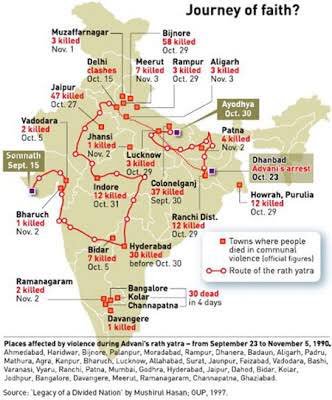
The Bharatiya Janata Party started its massive agitation for a temple at the site of the Babri Masjid. Overturning Nehruvianism, the BJP explicitly grounded its politics in faith. The religious faith of lakhs of Indians would overturn any legal process, claimed senior party leader Lal Krishna Advani. By 2014, the Hindutva movement had delivered its greatest success: under Narendra Modi, the BJP had been able to garner a Lok Sabha majority. This also meant a new low for the Nehruvian agenda of rationalism and scientific temper.

Modi set the bar

Prime Minister Narendra Modi himself set the ball rolling with amazing claims that cosmetic surgery and genetic sciences existed in ancient India. A minister from Goa wanted to “cure” people of homosexuality and in Rajasthan, rape accused “godman” Asaram Bapu is featured as a saint in a Class III textbook endorsed by the state government. While religion in politics has, to some extent, always been there, the new dynamics post May 2014 are even pushing it into higher academia which has, till now, been insulated from this sort of irrationality.

The new BJP government kicked things off with history, appointing Yellapragada Sudershan Rao the chairman of the Indian Council of Historical Research. Not only was Rao unknown as a historian but he also thought that the caste system was a good thing and considered the epics, the Ramayana and the Mahabharata, to be literally true. Given that the ICHR was a funding body for historians, it was quite clear the direction in which academia was now turning. In October, 2015, Delhi University organised a seminar where flying chariots and televisions sets from the Mahabharat were discussed in all seriousness.

Ramdev in JNU

A fortnight ago, Baba Ramdev, the television yoga guru who now also runs a pharmaceutical company, was asked to be the keynote speaker at the valedictory ceremony of the 22nd International Vedanta Congress at Jawaharlal Nehru University. Now Ramdev might be a good televangelist, but to lecture to scholars on theology is a bit much. After all, he holds views which suggest that yoga is a cure for AIDS and thinks that homosexuality is a reflection of “criminality and sick mentality”. While Ramdev’s invitation to JNU was cancelled as outraged students protested, this tweet did ensure that most right-thinking people won’t be inviting him back as a scholar of theology any time soon.


The recently concluded Indian Science Congress, which Nobel Prize winner Venkatraman Ramakrishnan called a “circus”, didn’t fail to disappoint, discussing topics such as the health benefits of blowing a shankh (conch) and “Lord Shiva as a greatest environmentalist in the world”. As a full circle, back to where it all started in the 1980s, news broke on Tuesday that Delhi University will allow a far-right organisation to hold a seminar on the Ram Mandir at Ayodhya on the campus. On its website, the organisation argues that since “For a great majority of Indians, Lord Shri Rama is central not only to their spiritual life but also their physical being”, a temple at Ayodhya needs to be built.

Retreat of rationalism

This retreat of rationalisation from the academic space is an especially dangerous development. While letting in people with less than academic views into campuses is often spun as an issue of free speech, that is a false, if common, argument used by the religious right across the world. Creationists in the United States have argued that not letting Intelligent Design be taught in schools is a violation of free speech, a specious argument that has been struck down by US courts. Freedom of expression is a right to be allowed to say or think what one wants; it is not a right to be allowed into a particular campus or textbook.

In many ways, of course, views such as these have existed in India for a long time, but have only now been given this sort of elite exposure. This, though, is hugely troubling development because by giving these kooky ideas an official stamp of legitimacy, it will encourage their rapid spread. To get an idea of the harm that legitimising such ideas can do, one only needs to peek across India’s western border where Islamist dictator Zia-ul-Haq kicked off proceedings by organising conferences on “scientific miracles” in the 1970s. The apogee of this sort of complete devaluation of rationalism is that Sultan Bashiruddin Mahmood, a top Pakistani nuclear engineer, has published papers proposing that djinns be tapped to generate energy.

This might seem hilarious – and it is – but India needs to use this as a dark example. Already, we have the somewhat odd sight of the chief of the Indian Space Research Organisation publicly going to a temple to have space mission being blessed by a deity. It does not bode well that our elite classes today present faith and not rationality as a virtue to be emulated.

April 30, 2015

Maulana Ziya Us Salam of The Hindu says Noor Zaheer's book 'Denied by Allah' is Heresy

[Ziya Us Salam is not the Pakistani footballer of the same name but is the literature cum filmi entertainment commentry man for The Hindu. He takes on the author Noor Zaheer for relying on the translations of the Quran by Syed Yusuf Ali and M Marmaduke Pickthall. What on earth is wrong with these translations should she have been reading the translation by Maulana Maududi ?. Since when has Mr Salaam this entertainment page man become an expert on the Quranic scriptures ? Who is he doing this gate keeping for ? Where is the hypersensitivity coming from? Is he also part of some 'Islam in Danger' Dharam Sankat May Hai hurt sentiment operation - See what the guy has to say of Noor Zaheer's book - editor, CW]

The Hindu, April 24, 2015

Write Angle

Heresy based on hearsay

Ziya Us Salam

In the season of Islam bashing, Noor Zaheer comes up with “Denied by Allah” denying the reader the complete picture

Noor Zaheer is a compulsive fiction writer. Her reputation, limited as it is, has been built around the success of “My God is a Woman”. She should have stuck to fiction. Here, she steps into the domain of society, religion, clerics and scriptures and ends up tying herself in knots.

Cannot accuse her of hypocrisy though. Right from the name of the book, “Denied by Allah”, which forced a Muslim cleric invited for the book release ceremony in New Delhi last week to refrain from lending a helping hand, to the contents, Noor goes around with the intention to provoke. She succeeds. In the author’s note itself, Noor says, “This book is not an attempt to reinterpret the Quran, find inner, deeper meanings, or to prove that the original text gives equal rights to the woman. This is an attempt to show the contradictions within Quran, the way they have been highlighted and interpreted to give an edge to patriarchy, the manner in which tribal customs have been made out to be the actual Islam and the woman has been relegated to the position of being a non-entity.” She subsequently proves herself to be a wonderful bundle of contradictions, a virtual non-entity as far as matters of faith and society go. The verses she quotes later in the book come back to disprove her avowed intention!

Truth to tell, Noor is consistent in her follies. She hides behind no fig leaf – oh, that word stemming from faith! In the author’s note she writes, “The Quran relegated women to a secondary position, right from where it describes the formation of the universe and the creation of Adam and Eve. It accuses Eve as the cause of the original sin and the reason for Adam being thrown out of paradise…” A simple reading of Surah Baqarah at the beginning of the Quran would have enlightened her. Agreed it is the longest chapter of the Quran but even a cursory reading would have ensured that she won’t mix up her Bible and the Quran. But who is to suggest that to the author who has never read/understood the scripture in the original and concedes, “I have relied in (her expression) the translations of the Quran by Syed Yusuf Ali and M Marmaduke Pickthall.” Sorry, but isn’t it a little like trying to understand Rabindranath Tagore through the pen of Gulzar?

Her declared cause for this book has been the alleged maltreatment of Muslim women at the hands of insensitive husbands, often unlettered, temperamental and drunkards. Yet she goes on to launch a diatribe not against such men, or indeed the moulvis who facilitate the ignoble actions of such men, but against the scriptures. The anomalies do not end there. Almost throughout the book, she quotes verses from the Quran which project women in a very positive light yet insists that the scripture is unfair to them. For instance, writing about triple talaq, she quotes from three different verses of the Quran, all correct in letter and spirit. She reproduces the opening verses of Surah Talaq wherein men are allowed to divorce women at fixed intervals and instructed to keep them during the duration from one pronouncement to another, thus giving reconciliation a chance. It tells, in other words, that talaq has to be pronounced at the passing of a menstrual cycle, an inability or unwillingness to do so for the second or third time nullifies the earlier pronouncement.

Amazingly, after such clear promulgation, it strikes Noor not that it is the society, not the book to blame. In doing so, she harms the cause of women. Talking of halala, like a commercial Hindi film director, she shows women as helpless beings, weak and vulnerable with no powers of thinking or reasoning. Indeed, in her case studies they hardly come across as human beings. For halala cases, Noor heaps all the blame on scriptures whereby, according to her, the woman has to marry another man to marry her husband again after divorce. According to her, the scriptures punish her for the fault of the man who might have divorced her in a fit of rage. On the contrary, they strengthen her making sure she takes no hasty decision to go back to him. Noor answers no obvious questions. Why would a woman want to rejoin an abusive husband? For kids, for social or economic society? Well, the man gets two chances to reform. If he commits the deed for the third time, does he really deserve her consideration? Isn’t he responsible for the maintenance for a fixed period, even giving money in case a baby has to be suckled.

For halala, a woman has to agree to marry another man, she is no dumb doll. Without her consent, the marriage does not take place. She has to fix her mehr, loosely termed as dower. Pray, why would a woman fix her mehr, find another man, give her consent to marital tie-up only to ask him to break it after the nuptial night? There is no provision of temporary marriage in Islam. But so obsessed is Noor with halala that she even imagines one in Belgium, quoting Sultan Shaheen! Now when was Shaheen an authority on jurisprudence?

Of course, the scene at the ground-level could be quite removed where uneducated or poor women may not know their rights, maulanas may not have read the tafsir of the holy book, and men may be both ignorant and ill tempered. But does that explain the assault on the book closest to a believer’s heart?

Noor could have done better had she read Surah Noor in the Quran. Talking of modesty, verse 30 advises men to keep their gaze lower. Only the following verse advises women accordingly. Right through, men and women are addressed together; an act of sin or piety is the same for both genders. Quite removed from the UAE case she quotes where three men were not charged with promiscuity/rape for outraging the modesty of a woman. Again the problem lay with the patriarchal set-up, not the laws; the Quran instructs lashing in such cases. She finds women relegated to an inferior position in the Quran yet the quoted verses prove otherwise. Does it strike her that in Islam no woman is expected to change her name following marriage and she can even walk out of it without giving any reason whatsoever? The prophet’s wives retained their maiden names. And a woman enjoys three times the rights of the man over her children.

These nuances would not have struck her mind. In the season of Islam bashing, she adds to the din. Full of contradictions and anomalies, low on facts, “Denied by Allah” is a book that denies readers the right to complete picture.

July 29, 2014

Faith versus history | Salil Tripathi

Livemint, July 16 2014.

Faith versus history

Y.S. Rao’s appointment is troubling not because he is not a Marxist but because he believes history is shaped by both faith and reason

Salil Tripathi


In The Life of Reason, the philosopher George Santayana wrote: “Those who cannot remember the past are condemned to repeat it.” And India is about to do just that by reviving the battle over its history books. The battle of the 1990s has resurfaced, with the appointment of Yellapragada Sudershan Rao to head the Indian Council for Historical Research (ICHR).

It is not easy to find Rao’s academic work on search engines that showcase global academic research—his name appears in one list of “Indic savants” in the field of computational sciences of antiquity. He has also written more than two dozen posts on a blog since 2007, which, it turns out, the cartel of historians who control academic citations through peer-reviewed journals haven’t caught up with yet.

Aggrieved over a “Marxist” interpretation of Indian history and livid with the so-called Macaulayite legacy, conservative ideologues in India have long asserted that Indians have been denied access to their own glorious past, and Rao’s work is part of that project. They argue that in the history that is taught in Indian schools and colleges, the horrors committed by Muslim invaders are understated and their positive influences exaggerated; the sins of secular politicians blurred out and the contribution of some—in particular the Nehru-Gandhi family—over-emphasized, and Indians are forced to look at their past through foreign eyes which leads to an inferiority complex.

To be sure, high school textbooks of many topics, including history, are woefully inadequate. Examples of textbooks from the last decade in Gujarat and Maharashtra have both shown remarkable howlers which would be hilarious if they weren’t real. When otherwise articulate Indians argue about points of Indian history, revealing the vacuity of their thoughts and ignorance of content, blame such history texts.

Indeed, Indian history texts can be improved. Neither Hitler nor Mao (or Lenin) was a hero, and Mohandas Gandhi was truly a remarkable leader, even though he had human frailties and he wasn’t a saint. But it is a Hanuman-like leap of logic to stress that to undo those wrongs a fresh set of mistakes must be made. And Rao’s appointment could lead to just that. If his appointment is troubling, it is not because he is not a Marxist, nor because he wants to highlight intellectual achievements of ancient, pre-colonized India, but because he appears to believe that history is shaped by both faith and reason.

Faith matters, of course; but faith is part of a culture, it should not dictate history. Faith is about unquestioned belief; history is about facts and reality. Faith may lead one to believe that Lord Rama was an ideal male; history may legitimately lead one to question if he existed at all—or if he was the product of imagination of a gifted writer. (Reason may also prompt some to question if he was indeed the ideal male). Ramayana is a great work of literature; it has historical significance—but is it history?

This is not to suggest that a literary hero cannot be inspirational. But historifying myths is a problem. If myths and history are not kept apart, the result can be a warped worldview, because the myths we believe in tend to be heroic, glorifying “us” and belittling “them”, and that leads to a perverse form of nationalism whose consequences—history shows us—are usually disastrous.

The rationale of rewriting history books is to glorify the past, and its logical extension is the kind of vandalization that we saw in 1992, when the Babri Masjid was torn down in Ayodhya. Rao’s appointment is part of a grander plan aimed at reimagining the past and making myths acceptable, to advance the Hindu nationalist agenda. It also means disregarding the inconvenient parts, which interfere with the master narrative. Isolated though they might seem, there is a pattern in the withdrawal of some textbooks during 1998-2004 when the National Democratic Alliance was last in power, the quixotic battle over the “Aryan Invasion Theory”, the campaign to remove an essay of the late poet A.K. Ramanujan which shows alternative renditions of the Ramayana, the banning books about Gandhi and Jinnah in Gujarat, the dream to reoccupy sites of hundreds of places where temples once stood, the attacks on D.N. Jha (because he exploded myths about the sacred cow) and calling Romila Thapar a foreign agent, the sustained denigration of some independence-era leaders for their alleged appeasement towards Pakistan, and the idolising of alternate heroes—Vallabhbhai Patel, Vivekananda, and Subhash Chandra Bose.

And so we have a government now spending taxpayers’ money to build a very tall statue for Patel, a politician who opposed the Rashtriya Swayamsevak Sangh; exalting the philosopher Vivekananda, who spoke out against idol worship; and valorizing Bose, a nationalist who used Hindustani—that amalgam of Hindi and Urdu—and not Hindi, and in Roman script, to be inclusive in communicating with the Indian National Army troops. But being Indian, this government naturally suffers from irony deficiency. Salil Tripathi is a writer based in London.

Read more at: http://www.livemint.com/Opinion/RD4bqdtgK8reRlLh1sspVO/Faith-versus-history.html?

December 07, 2013

India: The lingering Ayodhya dispute is a conflict between history and faith | Garga Chatterjee

The Friday Times, Issue: 06 Dec 2013

Faithless debates
by Garga Chatterjee

The lingering Ayodhya dispute is a conflict between history and faith

Some debates do not die. They remain unresolved, as they are not debates unto themselves but venting spouts for other concerns and tendencies. The strengthening and weakening of the concerns affect the vigour with which the debate is carried out. The Ayodhya ‘debate’ is one such. With ‘national’ parties in the Indian Union baying for a communalized election with a ‘development’ veneer, the apparently sleeping debate might just be rekindled.

The Babri Masjid was built in Ayodhya, in present day Uttar Pradesh in India on 1527. Some have come to claim that Babur, the Central Asian invader and the first Turkic/Mongol emperor of North-Western part of the Subcontinent had this mosque built by demolishing a pre-existing temple, one that stood on the birth-site of Lord Ram (Ram Janmabhoomi). On 6th December 1992, a large group of communal Hindu activists, egged on by leaders of India’s second largest political formation of the time, demolished this structure. Between 1949 and 1992, various attempts had been made, by action and inaction sponsored by the state, to change the nature of access to the site from the conditions existing before 1949. On 30th September 2010, a three-judge bench of the Allahabad High Court passed the now famous judgment – the disputed area is to be parsed between the 3 litigants. The Muslim litigant group will receive one third of the land but not the area under the central dome of the erstwhile Babri structure. The two Hindu groups were to get the remaining two-thirds, including the area under the central dome. None of the sides were happy with the judgment and have filed appeals. The case in still on.

The nature of the Ram Janmabhoomi–Babri Masjid debate shows how much certain parts of Indic society are now prisoners of a historical mode of thinking. This is evident not only in the kind of arguments and evidences that the court case dealt with but also the talking points that populated the media. People spoke about the past with clinical precision, of scientific evidence, without a shred of doubt that divine location of the Avatar’s birthplace would not transcend the evidence based historical research method. It would rather be the opposite – the evidence-based method would legitimize the ancient, indeed the timeless. There has been a steady change in the way crucial sectors of India conceptualize the past. And it is an ongoing process. A clandestine transformation of the nature of consciousness about the past has important implications about our imaginations of the future. It involves, in this case, the possibility that the very soul of our peoples – a plural soul – will undergo degeneration.

There are at least six other sites that are believed by numerous Hindus to be the birth site of Ram

Communities living in close proximity, trigger anxieties of self-demarcation like the “Islamic” in India against the “Hindu” backdrop. They also figure out ways of mutual tolerance. Such tolerance is often not one of brotherly love but these nonetheless co-exist without being at each other throats untiringly. A crucial enabler is time – time that heals, muddles, blurs and creates memories. This is the stuff of past consciousness that permeates the present in all its imaginative creativity – creating cross-faith interactions and encounters that put scripture peddlers of “pure” religion to shame. Unchangeable scriptural Words in India change, take myriad forms, meanings and still remain as ancient, as believable, as certain, eternal and final.

The disputed piece of land in Ayodhya, has two major contenders, ostensibly representing Hindu and Muslim interests and sentiments (though there are minor contenders too like the Buddhists and Jains). However, there are other, uncomfortable contenders of a different sort, too. There are at least six other sites with structures, in and around Ayodhya, unencumbered by mosques on top of them, which are believed by numerous Hindus to be the birthsite of Ram. Hence, the claim that the real Ram Janmabhoomi is exactly where the Babri Masjid stood necessarily involves dismissing the claims of these other contenders to Ram Janmabhoomi-hood and to inherent sacredness. This faithless claim of exclusivity runs antithetical to the vital force of hitherto dominant Indic style – where the quality of being sacred has a very distributed geography. All these are the birth-sites of Lord Ram. In Thailand, exists the old imperial capital city of Ayudhya or Ayuthhaya. It is as potently the city of Ram as any other. No order of precedence here. Indeed, it is a matter of faith, not chronology. The presence of so many sites of Ram hence points to a largely non-exclusive belief.

The Ayodhya legal case centres on the question what was “really” there

It is with this background in mind that one has to view the large currency this exclusive claim has gained with time. The pantheon of values that is the legacy of the European Enlightenment has long dominated the minds of certain sections of our society. Scientific rationality is the holiest of these values. This domination inevitably has victims. One such victim is the communitarian consciousness of the past, which is passed on and amended from generation to generation. Recollections of the past, fables and grand-mother’s tales, jati-puranas, gathas and legands, carry within them the imprint of long time-range mechanisms of survival, of healing from trauma, of long-held aspirations and fears, of close encounters. This is being replaced by an immutable archival view of the past. We have come to know this as history – objective, sharp and if one may add, unethical, pitiless and enslaving. It is frozen, out there – it simply needs to be unearthed, excavated, deciphered, dusted off and archived. Irrespective of whether it is a story of progress or not, it closes the possibilities of the past, nonetheless. The needs of present people cannot open it up as they wish, but only as History allows.

The raucous debates that were heard before and after the judgment and the echo-box streams that take their cue from them, have a few predictable characteristics. They seek to either protect God(s), or the constitution of the republic. The cynical use of the avatar of Lord Vishnu by the Hindutva brigade is matched well by “secular” brigades, whose parodying of the idea of locational divinity belies their ultimately belittling attitude towards the faith of small people – the unscientific, under-educated, in the penumbra of the Baconian world of the “seculars”. This utter disconnect is evident when Marxians of various hues bring in the “sociological” Ram to counter the “Ironman” Ram of the Hindutva Sangh Parivar. The charlatan usage of Ram’s powerful symbolism by the seculars who could care less of Ram’s divinity appears to the faithful like a village nautanki – a sordidly affected and unrehearsed one at that. The characters forgot change their dress and make up from the last scene but have only changed dialogues. Not many are impressed.

Such is the grip of historicity and scientific rationality among certain sections so that matters of faith, the ballast of certitude in uncertain times – are now being cynically evaluated. The Ayodhya legal case centres on the question what was “really” there – the real of course being pillars, columns, dirt, dust, radio-carbon dating and excavations. From the “real” will flow the “objective” truth establishing the “authentic” claim. This insistence on authentic exclusivity has affected religion also. History, the new God with all its heartlessness stands, scalpel in hand, in front of faith. In this battle that of thrust open faith, it is stabbed often by the scalpel. Not that faith is weak in front of History – just that its rules of engagement are different. But the new God has the support of the contemporary nation state behind it. The decentering of the mind this produces in man has no insurance. One is left alone to fend for its consequences – of unmet uncertainties and poisoned, sacred groves. Man has fantastic creative potentialities to tide over alienation. My fear is that such potential is not endless.

The present debate can be seen as another step in a long process of desacralization where scientific rationality as an ideology has cast its long shadow on religion. The ideology has been transforming it, attempting to cure it of all its promise and mystery. To survive this modernist siege, the religions themselves lay transformed – more masculine, cynical and frenzied; less faith, less creativity. The politico-religious bloc that often claims to speak for Hindus in general, has all the markers of this thrust.

This bloc does not only consist of those who are officially with the BJP or its comradely associates. It also includes parts of the migrating, ‘aspirational’, middle class. Significant sections of this group, without access to the intimate rootedness of local faith and continuities of ancestral rituals, are spirited cheerleaders of that dream of 19th century vintage – a homogenized Hinduism. They form a section of that peculiar species that now exists in certain Indian metros – people who are not Telugu Reddys or Bengali Mahishyas – they are simply Indians and nothing else but Indians. Rootless liberals make up the rest of such “Indians”. And such “Indians” have the means to exert influence beyond their numbers. This is evident in how Narendra Modi has been built up in recent months as well as the massive counter of Modi that has been built up. Connecting Modi and the anti-Modi is the thread of non-rootedness and an indignant aspiration to set agendas for the many. Thankfully, the subcontinent still has multiple poles, multiple centres, multiple loyalties and multiple contradictions.

Pan-Indic formulations of Hinduism are a grave challenge to the Indic faith systems. It is a mortal danger to the religious osmosis that has enriched our softly bounded identities. With its plural possibilities, the million Gods and Goddesses, protect the billion small people. These people refuse to stand united, to dump powerful local deities like Dharma Thakur and Ola Bibi, to let their own divine forces die a slow, impoverished death. For some this refusal is the rub, for some it is the only possibility.

Possibility of what, one may ask? In an atmosphere where the historical mindset reduces the past to a partly illuminated, linear archive of objective detail, the possibilities inherent in plural imaginations of the future are also severely impoverished. A linear, closed past restricts possibilities of the future. By refusing to buy History as the only way of looking at the past, by countering the homogenizing tendencies that History unleashes, by refusing to be sapped out of the uniqueness of its encounters, communities amongst themselves hold out the possibility of keeping the past open, alive, responsive. In the Indic context, people often conceive their aspired future ideal as an image of the past, (for example, Ramrajya or when 2 annas could get a maund of rice ).This also holds within itself the promise that the myriad open and plural pasts that populate the mindscapes of India are producing open and plural futures, right now. In a world of increasing dominance through homogenization, unfettered by historicity, imaginations of impossible futures can take wings right here. The Ayodhya debate and its lingering non-resolution shows how unimaginative we have become. It shows how fast we are losing the creativity to deal with antagonisms, how we can no longer dare let our God(s) seek their identity among the rustic and the fantastic.
- See more at: http://www.thefridaytimes.com/tft/faithless-debates/

December 02, 2013

Bravo comrade Karat for demanding a federal law against superstition, black magic

The Hindu
Mumbai, December 2, 2013

Karat demands Central Act against superstition, black magic

Staff Reporter

CPI(M) general-secretary addressed rally marking 100 days since Dr. Dabholkar’s murder

Communist Party of India (Marxist) general-secretary Prakash Karat on Monday demanded a Central Act to prohibit superstition and black-magic.

He was speaking at the rally organised here to mark the 100th day since the murder of rationalist Narendra Dabholkar.

“We feel that there is a need of a national-level Act like the one in Maharashtra. The issue should be raised in Parliament,” he said, referring to the atrocities and frauds committed by various individuals under the name of god and religion.

The protest march organised prior to the rally was led by the family members of Dr. Dabholkar and attended, among others, by Professor N.D. Patil, senior leader of The Peasants and Workers Party of India (PWPI), and veteran social activist Medha Patkar.

Mr. Karat also slammed the investigating agencies for shoddy investigation in the Dabholkar murder case. Referring to the recent affidavit filed by the Pune police in the Bombay High Court, which claimed no participation of communal forces in the murder, he asked: “When investigating agencies are clueless about the real culprits, how can they readily give a clean chit to them?” He called for a Special Investigation Team to investigate the case.

Dr. Dabholkar was shot dead by unknown assailants on August 20, 2013 in Pune, while on a morning walk. “We want the State government to pass the Anti-black-magic Act in the coming winter session. The police have no clue, even after 100 days, about [Dr. Dabholkar’s] murderers. We want the State government to speed up the investigation in this case,” said Avinash Patil, Executive President of the Maharashtra Andhashraddha Nirmulan Samiti (MANS), which was founded by Dr. Dabholkar.

Following the murder of Dr. Dabholkar, the State government cleared the ordinance of the Anti-black-magic Act.

Meanwhile, Parliamentary Affairs Minister Harshvardhan Patil on Monday announced that the Bill would be presented in the Maharashtra Assembly on December 8, during the winter session at Nagpur.

Dr. Dabholkar’s family has stressed that their priority was to pursue the clearance of the Bill in the Assembly’s winter session.

Dr. Dabholkar’s son Hamid on Monday told The Hindu that the family was not exploring any demand for a probe by a Special Investigation Team or the CBI at present.

September 11, 2013

India: Tax payers' money used by Govt of Uttarakhand state to pay for big advertisement in media which seeks divine blessings for rebuilding state infrastructure


Full page advertisement in India's newspapers by Uttrakhand Govt. seeking devine blessings for rebuilding the flood ravaged state.

The ad. announces the resumption of prayers at Kedarnath temple.

Uttarakhand chief minister Vijay Bahuguna, was also scheduled to attend the prayers along with some of his ministerial colleagues, could not take off from Dehradun due to inclement weather.

September 04, 2013

India: Business of Faith - Arrest of Asaram Bapu by Ram Puniyani

Business of Faith

Ram Puniyani

Our society has seen severe turmoil’s in the name of religion during last three decades in particular. While on one side we see that issues related to religion’s identity are trying to occupy the center stage, we also are witnessing the emergence of thousands of self proclaimed ‘Godmen’, supposed to be having divine powers. They do also claim and sometimes the state, society does informally accord them some sort of a special status. This came to the light once again in the case of Asaram bapu, against whom the allegation of rape of a minor girl was lodged. In this case the arrest of the accused was warranted immediately, but the police force took its sweet time and with great difficulty and drama; could arrest the Bapu. Bapu did try to evade the arrest on various grounds, so many programs are lined up, am unwell, my relative has died, but finally some pressures did work and Baba was arrested from his Indore Ashram (31st August 2013).

Asaram bapu is amongst the leading Godmen, as far as the wealth, number of Ashrams and the number of followers is concerned. While he has many influential people amongst his followers, there is no dearth of political people blatantly supporting the likes of him or delaying their arrest under the pressure of ‘electoral calculations’. This is not the first time that criminal cases have been talked about against him, many a cases of land grab came to surface, but law of the land seems to be sleeping on that. The death of two boys in his Ahmadabad Ashram, and two in Chindwara Ashram got suppressed through the mechanisms which are a back up of these God men.

To be fair to Asaram Bapu, he is not alone in the game. There are hordes of Godmen who have acquired infinite wealth. Many of them have been linked to cases of murders in their Ashrams (Shankaracharay Jayendra Sarswati, Late Bhagwan Staya Sai), the listing of those involved in sex scandals of various types is a long one and the lead in this area goes to Nityanand Mahraj, who claimed that he is reincarnation of Lord Krishna. The life style of these Saints is the one of luxury and affluence, proving that while preaching renunciation etc.; one gets the best of what the World has to offer in the arena of material wealth.

Using the word ‘Saint’ for these breed of Babas is also a bit problematic. We do recall the medieval saints of the genre of Kabir, Tukaram, Namdeo, Paltu, Raidas, who came from low caste, were working for their living, and rubbing shoulders with the poor and deprived. They criticized the evil practices in the society, questioning the social inequality in particular. They expressed the anguish of the deprived sections of society, the way Chokhmela, a saint from Maharashtra, talked of injustice in this world where ‘one that grows the grains is hungry, one that weaves the clothes does not have clothes and one who builds the houses has to sleep under the open sky’. These saints were away from the power centers and many of them had to face atrocities from those in power. Nizamuddin Auliya, a Sufi saint, refused to entertain the king to his hospice. Kabir talked against caste system, against the divisions in the name of religion and the social power structure. They had followers mainly amongst the poor and deprived.

The current genre of the Saints, have big following amongst affluent, receive huge donations from those who are drenched in wealth and the powers that be are on their side. These saints have built up their empires of wealth, affluence and power over a period of time. It is interesting that in India there has been a long tradition of people associated with religion. The dominant category is that of the clergy, like the Shankaracharya tradition. There are Mutts, there are ashrams and there are centers where theology and philosophy of religion is discussed at length. Incidentally the current series of Godmen have not much to do with the theology or philosophical debates around religion. In contrast the medieval saints were rooted in the society and talked of social issues, struggle against social evils, like Kabir comparing Chakki (grinding mill) with the idol of lord or reprimanding Mullah for loud bang (Azan).

Such social issues are not the concern of present Godmen. There is a vast variety of them and it is not easy to generalize them and their methods. Still some major features of the present ones can be outlined. Their rooting in philosophy or social issues is skin deep. They have picked up some formulae which are elaborated with song and music or they deliver discourses which probably soothe the tense nerves of the section of society, a section facing social dilemmas and anxieties. Some of these Godmen are outright frauds like Nirmal Baba, advising the solution to the problems e.g. through change of color of Chatni (Sauce), which is eaten with the popular Indian snack, Samosa. Meditation and yoga is a major method apart from discourses. Some of them like Morari Bapu have the luxury of preaching Bhagwat (Sacred Narration) while taking devotees on the Sea cruise around the world.

So the prefix saint has a totally different meaning with these two divergent set of people, the genre of Kabi-Nazamuddin Auliya on one side and Asaram Bapu-Nirmal Baba on the other. There is a fundamental difference in their grouping. In his famous sentence, Karl Marx says "Religion is the sigh of the oppressed creature, the heart of a heartless world, and the soul of soulless conditions. It is the opium of the people". And this sentence seems to answer this difficult question in categorizing the complex variety of saints. On one hand we have Clergy (the official –unofficial upholders of the rituals and institution of religion), in the form of Pundit, Maulana, Granthi, and Padri. On other hand is the vast array of medieval saints, coming from different religions, Bhakti saints, Sufi saints who while talking in idiom of religion, were not associated with the power structure or performance of rituals. And then we have this vast array of present saints, proliferating dime a dozen from the most well known like Asaram Bapu, Baba Ramdev and Sri Sri Ravishankar to the small time operators in different cities.

The clergy was definitely part of the power structure, accompaniment of the feudal lord and the Kings. In Maharashtra the phrase ‘Shetji-Bhatji’ (Landlord-Brahmin) sums it up very well. There is Raja-Rajguru, while the ‘Nawab and Shahi Imam’ is another association and the most structured one in this category comes in the form of ‘King and Pope’. They stood for status quo in a society, where the poor peasants were being exploited to their bones. They acted a sort of opiate for the masses to keep them tied to their hard labor. One can say that in contrast the medieval saints were the sigh of oppressed in this heartless exploitative World.

Coming to the Asaram Bapu-Nirmal baba series they are again like the opiate for the masses. Unquestioning the system, blind to injustices, quiet on social evils in the name of religion and at the same time cultivate strong bonds with social powers and have political patronage. While BJP currently may be coming forward in a bit more forthright manner to defend the Babas in the name of Hindu religion, even the others political tendencies also do not have enough courage to criticize the babas. These babas do fulfill the need of the opium to calm the tense nerves, and assume the larger than life image for themselves under the garb of religion. They become ‘more equal’ in the eyes of powers that be so it becomes difficult to get them arrested for criminal charges in the routine course and they can defy the law to some extent or the great extent. So unless the charge is very blatant, like as in case of Asaram, most of them get support from the political class and their blind supporters. One recalls Atal Bihari Vajpayee and Asaram Bapu sitting on a Dhrana in Delhi to oppose the arrest of Shankracharya Jayendra Sarswati in Shankar Raman murder case. One also recalls the soft peddling of murder of children in Asaram Bapus ashrams or other times when influential politician speak out of turn to protect these Babas.

The irony is that the rise of these babas is in parallel with the rise of politics in the name of religion. Many a times there is a subtle and overt association between these babas with the religious nationalist discourse, which they defend and propagate. Many of them also talk about the values of Manusmriti, the hierarchy of caste and gender in a more sophisticated ways. At social levels the current babas are for status quo of social relationships, like talking about caste harmony (Sri Sri Ravishanker) in contrast to Ambedkar’s ‘caste annihilation’.

One knows that a section of population treats them like God; a section does need them to allay their mental pressures. One also knows that they have emerged due to the rising insecurities in the society due to the economic and political factors. They all operate under the garb of religion and faith so it becomes difficult to question their methods. Such a garb of faith lifts them above the ordinary and gives them some immunity from the laws of the land. The need for respecting people’s faith and knowing its limits without denigrating reason and law of the land was never felt more desperately!


India: Reason must triumph over blind faith (Praful Bidwai)

THE assassination of anti-superstition activist Narendra Dabholkar in Pune is a black mark on Indian society. Forces of intolerance, superstition, irrationality and reaction killed him not because he threatened their faith or freedom, but because he was against exploiting people through black magic, sorcery, and sleights-of-hand while invoking supernatural powers.
http://www.sacw.net/article5457.html

September 02, 2013

India: The Advantages of Being Asaram Bapu

From: India Ink / NY Times, August 30, 2013
The Advantages of Being Asaram Bapu
By SNIGDHA POONAM
Strdel/Agence France-Presse — Getty Images
Spiritual leader Asaram Bapu during a ceremony in Jodhpur, Rajasthan on Aug. 11.

Asumal Sirumalani, a popular Indian spiritual leader who is known to his followers as Asaram Bapu, has fought a long battle against sex.

At his crowded satsangs (spiritual assemblies), which are telecast live on India’s proliferating religious channels, Mr. Asaram, who goes by one name, takes great pains to condemn sexual desire in men and women. Among his most persistent campaigns against the growing sexualization of Indian society has been one for the abolition of Valentine’s Day, which the guru sees as just the excuse all these young people need to have sex.  “Chhora Chhori ko phool de, bole main tumse pyaaar karta hoom; chhori chhore ko phool de, bole main tumse pyaar karti hoon. Satyanaash ho jaata hai. Pyaar ke bahane gandi gandi harkatein kar ke khali ho jaate hain.” (“Boy offers flower to girl, says he loves her; girl offers flower to boy, says she loves him. It leads to destruction. They engage in dirty acts in the name of love, wasting themselves in the process.”)

This year, he proposed to all state governments that they declare Feb. 14 “Matri Pitri Pujan Diwas” (“Parents’ Worship Day”). He even got Chhattisgarh, ruled by the Hindu nationalist Bharatiya Janata Party, or B.J.P., to impose it as such; circulars were sent to schools all over the state, its chief minister, Raman Singh, piously announced at the guru’s Raipur ashram in January.

Earlier, at another of his satsangs with a social message, he advised married couples to abstain from sex during auspicious days in the Hindu calendar like Holi and Diwali. “Husband-wife behavior” on these days led to lifelong diseases, even mentally and physically crippled children, the preacher said. “Tabahi, tabahi, tabahi” (“destruction, destruction, destruction”), he warned his horrified audience. A recurring feature of Mr. Asaram’s spiritual assemblies are yogic tips for maintaining celibacy, which include stuffing one’s ears with wet cotton and rolling the eyes back into the head.

Given his puritanical background, it’s not surprising the guru’s name was splashed across local newspapers after a 15-year-old girl filed a police complaint on Aug. 20 in Delhi against 72-year-old Mr. Asaram, accusing him of sexually abusing her five days earlier at a farmhouse in Jodhpur, where he was staying at the time. The girl, who studied at a school run by his foundation in Madhya Pradesh, had been brought to Jodhpur by her parents, devotees of the godman, to be rescued from evil spirits.

Mr. Asaram was booked under Sections 376 (rape), 509 (word, gesture or act intended to insult the modesty of a woman) and 354 (assault or criminal force to woman with intent to outrage her modesty) of the Indian Penal Code and Protection of Children from Sexual Offenses Act.

In fact, Mr. Asaram has not exactly been immune to such controversy in the past; the Gujarat police are investigating the mysterious murder and mutilation of two young boys in his ashram in April 2008. The sage said sadly, however, it was that the “dirtiness” of this latest accusation that stung him.

You’d think an accusation of sexual assault would be career-ending for your hard-working professional saint, but Sant Shri Asaramji Bapu has nothing to fear. At a time when people want the harshest punishment for the five slum dwellers, four of them reportedly Muslim, accused of raping a young working woman in Mumbai, the charges of sexual abuse against the guru have led to an outpouring of sympathy and support. While it’s neither the first time a religious leader is suspected of sexual exploitation, nor the only occasion when concessions are made for him or her, the difference in the political and public response to the two parallel cases reveals uncomfortable truths about our system.


Sanjeev Gupta/European Pressphoto Agency
Asaram Bapu, center, being escorted by police officers at the Raja Bhoj airport in Bhopal, Madhya Pradesh, on Thursday.

The country’s Hindu-nationalist establishment – peaceable organizations like the Vishwa Hindu Parishad, the Bajrang Dal, the Hindu Kranti Dal, the Hindu Jagriti Manch, and the Hindu Dharma Raksha Samiti – has put its firm weight behind its soldier, terming the incident a motivated attack against India’s saints and religious leaders. Press conferences have been called across central and north India — Delhi, Rajasthan, Haryana, Punjab, Bihar, Uttar Pradesh — to put forth explanations. It is the work of Christian missionaries, someone suggested; it’s a foreign conspiracy to finish Hindu culture, said another.

Leaders of the B.J.P. see this as a political conspiracy, hatched by the rival Congress. Raman Singh, an old follower of Mr. Asaram, said the guru had long been on the radar of “a particular party.” Tweeted another B.J.P. politician, the saffron-clad Uma Bharati: “Saint Asaram Bapu is innocent. He is being punished for opposing Sonia and Rahul Gandhi. False cases have been lodged against him in Congress (ruled) States. Saints are with Bapu.”

Then there’s Subramanian Swamy, a recent entrant to the B.J.P. best remembered for calling for Muslims to be disenfranchised: “Need to probe why there is a spate of allegations against Asaram Bapu. Is it because he asked TDK [a reference to Sonia Gandhi] to flee from the country?” Mr. Asaram does indeed share these luminaries’ concerns about Western influence, beyond just Valentine’s Day, and had indeed once appealed to Mrs. Gandhi, the Congress Party president, to leave India.

His spokeswoman, Neelam Dubey, has, meanwhile, speculated about the role of foreign corporations (“videshi takatein”) associated with coffee shops or soda brands, since “Pujya Bapuji” often spoke of the harmful effects of these Western imports. In one of his spiritual addresses, all of which are available on his Web site, the godman solemnly warned that dancing to “rock and pop” music at nightclubs, especially while sipping cold drinks, could lead to permanent pain and weakness below the knees.

People sometimes malign even the gods, Mr. Asaram has himself said of the girl’s charges. Not that his followers care. In a series of rallies in various cities and towns, his devotees have expressed their pain at his persecution, some threatening nationwide revolt if the charges were not withdrawn. “He is god to us and we will shed our blood for him,” said a young woman in Punjab on A2Z channel.

Aware of their unwavering devotion, the guru has moved from Jodhpur to Ahmedabad to Indore and now Surat on a spiritual tour even after receiving the summons for police interrogation. During a rare television interview to the ABP channel at his live satsang in Indore, he asked the reporter to turn the camera toward the cross-legged multitude before him, who let out wails of outrage for the camera.

It is an old trick for him. In January, after he was criticized for first saying that the young woman gang raped in a moving bus in Delhi could have saved herself by acting helpless and addressing the men as “Bhaiyya” (brother), and then suggesting that stricter rape laws could be misused by “bazaaru auratein” (“loose women”), he amassed a large gathering of his female followers for an address titled “Does Asaram Bapu Really Hate Women of India” and asked them, on live TV, if they thought he was against them. “No!” came the resounding response, unsurprisingly. “Every time there is an accusation against me, the number of my followers goes up,” he said in an interview to a local newspaper in Indore this week.

The most zealous of his followers are, however, neither in his satsangs nor the street demonstrations, but online. And as Internet champions of Hinduism are known to be, they are very angry. “Why only saints like Bapuji n baba ramdev is targeted? the answer is clear… because they inspire people … these anti-social elements know that defaming these prominent personalities will give a serious dent to Hindu religion” responds one of them to a news telecast on Satsang TV. “This is Conspiracy by Christian Missionaries and Her SISTER IN RULING PARTY OF INDIA to Defame INDIA HINDU GODMAN” writes another in a comment on the Web site FirstPost.

Mr. Asaram could turn out to be innocent, and this whole controversy may well be a conspiracy of the Congress or of Coca-Cola, but one thing is clear: rape is not yet a real issue in India.

Snigdha Poonam is Arts Editor at The Caravan. She is on Twitter at@snigdhapoonam

India's Dept of Personnel Peddles Biased Religious Text for Training of Administrators

http://tinyurl.com/mozxetd

August 30, 2013

India: Editorial comment on Maharashtra govt's ordinance against superstition and black magic

The Hindu, August 28, 2013

Editorial: Faithful to a cause

Public outrage over the brutal slaying of renowned rationalist Narendra Dabholkar finally forced the Maharashtra government’s hand in clearing an ordinance against superstition and black magic. Based on a bill that Dabholkar championed for almost 20 years, it could be the first such legislation in India. The ordinance is a path-breaking one in a country which lionises godmen and is steeped in obscurantism. It seeks to curtail superstitious practices which are “misused to exploit people” or cause them “financial or physical harm.” Dabholkar did not target religion and concerned himself only with the misuse of faith to victimise innocents. The law he drafted — which faced years of opposition from political and religious groups — follows this impulse. The ordinance, which will have to be ratified by the State Assembly, seeks to ban a range of superstitious practices including “black magic,” displaying so-called miracles to earn money, or insisting that mantras, not medicines, will cure critical injuries like snakebites. Also, assaulting and humiliating people under the guise of exorcising ghosts, and the sexual exploitation of women after claiming supernatural powers will also be banned. Complaints are to be probed by trained policemen and can even be lodged by third parties not involved in an exploitative ritual.

While inculcating a scientific temper is one of the Constitution’s Fundamental Duties vide. Article 51 A (h), seeking to regulate personal faith and beliefs is always tricky. The Bill underwent as many as 29 drafts and was introduced several times without success. Many saw it as an impediment to the freedom of religion and feared it would even ban poojas where the priest was paid for his services. Or painful, self-inflicted religious practices. Pontiffs felt vulnerable to complaints by motivated individuals. There were concerns that religious pilgrimages would be monitored, even stopped. But Dabholkar had argued these fears were unfounded. The ordinance targets forced and exploitative practices, not those that are voluntary or that do not take a physical or financial toll on people. Chanting mantras on a personal level to ward off evil spirits will not constitute an offence. But forcing an expensive, exorcism ritual could attract a complaint.

Weeding out motivated complaints and distinguishing a forced ritual from a voluntary one will be a serious challenge. Yet, ensuring that a law which opposes a society’s entrenched beliefs is actually enforced is perhaps the greater challenge. The law will gain greater meaning when there is a parallel process of social reform and education against superstition, the very tradition that Dabholkar himself epitomised.

August 29, 2013

Who Killed Dabholkar? by Ram Puniyani

The brutal killing of Dr. Narendra Dabholkar (20th August 2013) is a big jolt to the social movement against blind faith and superstitions. During last few decades the tendency for promotion of rational thought parallel to social change came up as Popular Science movement. In Maharashtra it took shape in the form of a movement, Andh Shraddha Nirmoolan Samiti (Committee for Eradication of Blind faith), where it became a powerful campaign for popular awareness, under the leadership of Dr. Narendra Dabholkar. There were those who were uncomfortable due to Dr. Dabholkar’s work against blind faith and superstitions and so he started getting threats to his life. Before his death he got several threats, one of which said, they will give him the same fate as that of Gandhi. After his killing Sanatan Prabhat, a Hindutva ideology paper, which constantly spew poison against him, commented that ‘one gets what one deserves’.

The practitioners and supporters of blind faith surely know that their art is a hoax, were sure that their blind magic can’t kill the pioneer of a rationalist movement, so they did hire assassins to kill Dabholkar. He was recipient of regular abuses from the Hindutva organization, Hindu Janjagruti Samiti, on their web posted claims that they have exposed anti Hindu conspiracy. In their publications they put across abuses for him in gay abandon, one of which read, ‘Dabholkar’s group” should permanently make their faces black for their misdeeds against Hindu religion.”

As such Dabholakar was not against religion or faith. He strongly condemned the practices of blind faith and superstitions, promoted and practiced by Babas and their ilk, who proactively practiced and propagated retrograde practices. Some of these practices like and Karni, Bhanamati are the ones’ in which magical rites are performed in the name of supernatural power. Some other practices are like offering of ash, talisman, charms etc. for the purpose of exorcism and to drive out evil spirits or ghosts. These Godmen and their types claim to be in possession of supernatural powers and advertise this claim. Many a times they claim to be reincarnation of a particular Saint or God, and this way they cheat the gullible and God-fearing simple folks. They do perform so called black magic and spread fear in society. The act which Dabholkar was campaigning for, which the Government adopted after his assassination, makes such practices as an offence under this act. Just a reminder that when this act was first brought up for discussion BJP-Shiv Sean combine strongly opposed the same. He was critical of these irrational practices, and for this he was labeled to be anti Hindu.

Apart from these upholders of politics in the name of Hindu religion other conservatives were also against the activities carried out by his organization. Faith is a complicated phenomenon, true it is needed by a section of society. Faith in supernatural power, faith in institution built around the names of prophets and individuals operating in the name of some religion or God have to some extent provided an emotional support to many in this cruel World with gross deprivations and inequalities. Recognizing this weakness of humans many a religio-entrepreneurs have systematically converted the faith into blind faith, a series of rituals, acts, which are deliberately used to exploit the gullible.

The battle between these two tendencies is old enough. Reason on one side and faith on the other. Reason believes in questioning the existing beliefs and to keep going beyond the prevalent knowledge. Faith, particularly the one constructed around the ‘institutions of religion’ begins with unquestioning subservience to the prevalent norms, beliefs and rituals. Many individuals who go in to establish their enterprises around these rituals, claim to be having divine powers. Incidentally, most of the founders of religions, the prophets, had questioning mind and they questioned the existing norms, values and practices. It is precisely for this that many of them were tormented and punished by the powers that ruled. The clergy, which built institutions around the names of these prophets or supernatural powers, developed rituals in the names of these prophets. The clergy and their practices were most static. Such tendency promotes status quo not only of knowledge but also of social situations and relations. Clergy promoted the social status quo and so demanded unquestioning loyalty to their interpretation of religion and social norms as dictated by them.

There are many incidents in the history, where those who came up with rational thought were not only killed but sometimes harassed to no end. We know the fate of Charvak in India, who questioned the supernatural authorities of Vedas, he was condemned, and his writings were burnt. In Europe, Copernicus and Galileo’s plight at the hand of clergy is another chapter, while the scientists like Bruno, Servatus who argued that diseases are due to Worldly reasons and not due to the wrath of God, were burnt alive by the machinations of clergy. The idea here was very simple, if people start understanding that the diseases are due to bacteria or other etiological factors, the earlier practices of pleasing God through the clergy for healing will come to a halt and clergy’s social power will decline.

In India as the secularization process, the land reforms plus reduction of the hold of clergy remained incomplete, the power of clergy in social field continued. Indian Constitution talks of promotion of scientific temper and people like Nehru kept promoting the inculcation of this scientific temper. Meanwhile the political tendencies operating in the name of religion, kept opposing scientific, rational thinking and kept uncritically glorifying the ancient past, ancient practices cultivated by the clergy to exploit the gullible society, society in the grip of uncertainty and deprivation.

India did witness the rational movements to promote the scientific temper, but its impact in the society remained marginal. With the rise of communal politics from the decade of 1980, the blind faith took a massive leap with hoards of Babas and acharyas, setting up their religious enterprises, enterprises which probably turned out to be most profitable by any standard. One hopes that the business schools are able to calculate the returns on the investments in such enterprises some day. In addition many such Babas extracted the additional bonus of physical pleasures of another kind, the way currently Asaram Bapu is being accused of and so many of them have had their fill. In a crass manner many of the small and high level players also incorporated magical tricks like producing ash and gold from nowhere as their trademark of divine powers. It is these tricks which were being exposed by Dabholkar’s groups.

The practitioners of blind faith and these hoards of five-seven star babas, get their legitimacy and appreciation from leaders of different hues. While those coming from RSS stable are firmly with them at all the levels, even politicians from other tendencies also personally support and follow these tricksters, Babas, Godmen and their whole tribe. The communalists stand to support them ideologically the way Sanatan Sanstha, while abusing Dabholkar also talked of his work being ‘anti Hindu’! A similar trickster, Benny Hynn did public performances for faith healing, and there is no dearth of the ‘Baba Bangali’ series indulging in such trade.

It took Dabholkar’s sacrifice for Mahrashtra Government to pass and bill against blind faith for which Daholkar was struggling from decades. He had collected data that it is women who are the biggest victims of those practicing black magic. He had been talking of taking on the highly rewarding trade of gems and their magic powers, in due course. Alas, that was not to be! Will other state Governments follow suit and try to bring a control on the flourishing trade of blind faith, black magic and its ilk? Will the progressive social movement take up the cause of the major victims of these abominable practices and take the society forward to the path of rational thought, rational culture and rational politics, away from the trappings of the faith based blindness. While our ‘scientific establishment’ has made giant strides the scientific thinking still lags behind as science is being practiced mostly as an instrument and not as a way of life. That’s how in many of science and technology institutions, on Dussera day, computers are worshipped with flowers and by putting vermillion on the forehead of the monitors! Can sacrifice of Dabholar wake up our policy makers to such a serious lacuna in our teaching and practice of science? We seem to have liked the benefits of technology and have been undermining the scientific way of thought and practice, more so after the politics-nationalism has started wearing the cloak of religion.

October 23, 2012

Faith versus Sanitation


Faith versus Sanitation
Jairam Ramesh’s remarks on Temple, Toilets

Ram Puniyani

The Union Rural development Minister’s remark that “toilets are more important than temples” (October 2012) was met with diverse responses. Ramesh was speaking at a launch of campaign to sensitize people about the ill effects of open defecation, a practice very common in rural areas and city slums, where sanitation facilities are poor or non-existent. Ramesh said that open defecation was the main reason for the hygiene related problems and that there are more temples than toilets in the country.

The BJP and friends immediately pounced on the minister saying that he is insulting their faith.  While BJP’s associates VHP and Bajrang dal took to strong condemnation of Ramesh, demanded an apology from him and launched protests. One case has also been registered against the minister for insulting the faith. Congress spokesman, in order to play safe said that Congress respects all religions. The only support the minister could get was from the NGO Sulabh International, the NGO which has initiated a chain of public toilets in places where they are most needed.  

What a shame that the basic point Ramesh is making is undermined by most and is being taken as an insult to Hindu religion. Surely he is talking of the holy places which have been the center of attention for spending money for their construction and upkeep while the core social issue is being undermined.  Temple here is a metaphor for the holy places, where people go for worship and associate it with their identity. Being in India the dominant number of temples is very obvious. The UN data shows the gross inadequacy of our sanitation facilities. While our sanitation system suffers from gross neglect, during last few decades many grander temples have come up along with the other small ones also. Even the affluent NRIs have also donated heavily for these temples. One should also notice here that even when Pundit Nehru, when he underlined the importance of dams, industries and modern education, he also used the word temple, saying that these are the temples of Modern India.

One should register that when the holy Hindu practices are done in the state functions, breaking of coconut, lighting the lamp, the BJP and company and many others take it as a routine. Now but when the word temple is generalized to draw the attention of deeper social issue, their protest and hysterical reaction, their defense of ‘faith’ is deafening! One concedes that as such also during last few decades many a Muslims making living in the gulf countries have been remitting money home for Mosques. During the relief work of Gujarat carnage victims, when the Modi Government stopped the rehabilitation work for the victims, the Muslims’ conservative organizations continued the relief work. In the colonies which they got constructed for the violence victims, the Mosques are big and grand while the houses are small.  

The core issue is related to social concerns of poor versus the identity based concerns in general. In independent India, thanks to the uncompromising values of Nehru, he could ward off the pressures of conservative sections to get Somnath temple repaired from state coffers. He also advised the President of India not to inaugurate the Somnath temple. His focus was on the basic issues of bread-butter, shelter, employment. Even at that time the previous avatar of BJP, Jan Sangh was talking of identity based issues related to protection of Mother Cow. This dichotomy, as to which type of issue is more important has been an age old one. Lord Gautama Buddha while opposing the caste system, focused that the central concerns are related to life in this world, ‘the other’ world around which identity is constructed, Brahma etc. are not his concern. Dr. Ambedkar pointed out that Buddha’s teachings were the major revolution in India, whereby the low caste could come out from the grip of Brahminical exploitation and identity issues. This revolution of Lord Buddha was met with the counter revolution led by Shankaracharya, as per whom this world is Mythya (illusion) and one should focus on the real truth in the form of Brahma.

In medieval times the saints of bhakti tradition in particular, like Kabir Tukaram, Dadu, Paltu, Pipa all drew our attention to the plight of people of the world, while clergy called for importance of rituals, holy places and the wrath of God, if people don’t follow their dictates about the identity related concerns. Sufis and Liberation theologians also talked about people’s issues and showed the path of love. Kabir at one point compares the grinding stone (chakki) and the idol of God. For him the grinding stone is more important than the idol of the Lord as grinding stone helps people to grind the grains and satisfy their hunger. During most of the social transformations when average people, poor come up to rebel, their issues are related to bread, while those opposed to social change harp on the identity related temples and mosque. During freedom movement, while National movement was talking about the values of Liberty, Equality and Fraternity so that people’s problems can be solved the communal organizations, standing for status quo, Muslim League and Hindu Mahasabha-RSS were taking the cover of their respective religions and keeping aloof from freedom movement for preserving their privileges under the garb of their religion.

Post Independence we see that the ideologies of status quo, have been taking up defense of Holy cow, and later India politics got transformed with the identity related issue of Babri Mosque, opposition to Shah Bano getting maintenance. Later other such issues have been waiting in the wings to oppose the social issues; the ones’ like Amarnath yatra, Ram Setu and a list of temples, which need to be built. The politics around temple, identity, issues related to ‘other world’ are stalking the world. Most fundamentalist politics is revolving around Temple (Mosque and Church), while the hunger pangs, basic necessities and violation of human rights of weaker section are being bypassed. On the side of temple are the practitioners of politics in the name of religion. On the side of Toilet, provisions for social living are the ones’ who are denied this basic survival thing in daily life or those who give primacy to these. There is bit of mix up also. Pure agenda may be difficult to come by so there are different degrees of emphasis. While the most radical one’s like Bhagat Singh, Ambedkar and their followers will talk of this world and rights, the middle of the road parties will give less emphasis to identity, temple, while the electoral wings of fundamentalist will give primacy to temple and lip service to grinding stone or toilets. In a way the temple-toilet debate is reminiscent of Kabir’s grinding mill versus stone-idol debate. Who dare to stand for toilet and who stands for temple, mosque church will tell us their social commitment. Commitment to social change versus aggressive desires to maintain status quo is the issue! 

March 26, 2012

Dont let fundamentalists drive university syllabi !

by Harsh Kapoor | sacw.net - 26 March 2012


This set of political buttons [see images below] were made by me in collaboration with Mukul Mangalik on the occasion of the First A K Ramanujan lecture and seminar that was held at the Ramjas college in Delhi University on 21 March 2012.

http://www.sacw.net/article2605.html

June 20, 2011

It pays to be a peddler of faith in India

Mail Today, 19 June 2011

Editorial

Rich in body and spirit


THE revelation that the late Sathya Sai Baba’s personal chamber stocked nearly 100 kg of gold, 307 kg of silver and ` 11.56 crore in cash raises a couple of pertinent questions.

While it is laudable that the Central Sathya Sai Trust has been transparent about the recovery it must be asked what such assets were doing in the Baba’s personal chamber in the first place.

Given that it is donations which greatly help godmen build their empires, surely there must be a proper mechanism to streamline and store collections, especially since they, being the property of a charitable trust, enjoy tax exemptions? Are we to infer from this that the Sathya Sai Baba enjoyed the autonomy to divert such money as and how he wished? The other important issue is of the contradiction between what our godmen seek to convey with their saffron robes and otherworldly paraphernalia and what they seem to follow in their personal lives.

We thought spiritual people inhabited an exalted realm, being free of the allurement of material possessions. But the wealth that has been unearthed from the Baba’s chamber — incidentally called a ‘ mandir’— reminds us of the ill- gotten stuff that is recovered from the homes of tax evaders and corrupt babus.

The irony here should not be lost on those who repose deep faith in godmen, which in the case of Sathya Sai Baba includes luminaries from different walks of life.

The other day, Baba Ramdev, who had launched a campaign against black money, gave details about the trusts he runs, making no mention of the many companies that are a part of his business empire.

There is no getting away from the conclusion that most of this country’s godmen take their trusting followers for a royal ride which, even the devil would acknowledge, is the most heinous of crimes.

o o o

It pays to be a peddler of faith in India

12 crore in cash

22 crore worth of gold

1.64 crore in silver faith in India

This is what was found after Sri Sathya Sai Baba’s personal chamber was opened. He is not the only spiritual guru to have owned millions in cash & kind. A look at India’s other godmen who walked on the path of spirituality & became rich enough to rival a king

BABA RAMDEV

BORN: RAM KRISHNA YADAV

ASSETS: Patanjali Yogpeeth & Divya Yogi Mandir trusts, which run, among other things, Patanjali Ayurved College, Patanjali Chikitsalaya, Yog Gram, Goshala, Patanjali Food And Herbal Park, etc.

THE RISE and rise of Baba Ramdev makes the perfect plot for any Bollywood flick.

Born in a poor farmer’s family in Haryana, he used his knowledge of yoga asanas to build an enviable ` 1,100 crore empire.

Until 15 years ago, a struggling Ramdev was often seen on the streets of Haridwar, peddling his bicycle as he went to temples and people’s homes to teach them yajnas to make ends meet.

He was born to Gulabo Devi and Ram Nivas Yadav at village Ali Saiyad Pur in Mahendragarh district. He attended the local school in Shahjadpur till Class VII. Thereafter, he joined a gurukul in Khanpur village, where he studied Sanskrit and yoga. Eventually, he renounced worldly life, entered sanyas and assumed the name Baba Ramdev. Later, he moved to Haridwar and spent years studying ancient Indian scriptures at Kangari gurukul . In the mid 90s, Ramdev, along with Acharya Karamveer, established the Divya Yog Mandir Trust in Haridwar and gained worldwide acclaim through his morning yoga classes on a TV channel.

His empire today consists of over three dozen companies.

Raju Gusain in Dehradun

--


MATA AMRITANANDAMAYI

KERALA’S ‘ hugging Amma’, Mata Amritanandamayi, may the richest godwoman in country.

Even by modest estimates, the Amritanandamayi Trust, which presides over, is said to have assets worth over ` 1,000 crore.

Amritanandamayi, who belonged to a backward Hindu community, embraced spirituality in her teens. Today, her ashram at her native Vallikavu, a small island off Kollam, is a posh five- storey building.

devotees.

across charged topnotch Under Amrita trust colleges, institutions courses communications.

are located Coimbatore, Prakash This Sai opened.

guru & who & Her trust’s fortunes come mostly from its numerous educational institutions — students are charged fees at market rates — besides a hospital, a TV channel and contributions from her millions of Indian and foreign devotees.

Amrita Schools are located across Kerala; students are charged the same fee as topnotch private schools.

Under the brand name of Amrita Viswa Vidyapeetham, the trust also runs engineering colleges, business schools, and institutions offering post graduate courses in biotechnology and communications. These colleges are spread over five campuses located in Kollam, Kochi, Coimbatore, Mysore and Bangalore.

Prakash in Thiruvananthapuram

BORN: SUDHAMANI IDAMANNEL

ASSETS: Amrita Viswa Vidyapeetham colleges, Amrita Institute of Medical Science ( Kochi), Amrita Schools, a TV channel

---


SRI SRI RAVI SHANKAR

SRI SRI RAVI SHANKAR SRI SRI Ravi Shankar loves projecting himself as a messiah peace.

With an estimated 300 million followers in 151 countries, the Art of Living founder — who prefers to don white robes instead of saffron — indeed has qualms boasting that he has touched more lives that any other godman worth his salt.

Ravi Shankar was unheard of the early 1980s. Within three decades, however, he built an empire that is said to be worth several thousand crores today.

Born in Papanasam, Tamil Nadu, in 1956, to Vishalakshi and R. S. Venkat Ratnam, Ravi Shankar started studying the Vedas when he was just six years old, his aides say. By the time he reached 17, he had completed studies in Vedic literature and science. Subsequently, he undertook a tour, meeting other spiritual leaders and in 1982, he established the Art of Living Foundation in Bangalore.

Soon, his ashram became a tourist centre, attracting millions of followers from across the globe.

But his ashram, on the Bangalore- Dindigul national highway, has come under its fair share of controversies.

Last July, NRI Paul P. accused Ravi Shankar’s trust of grabbing his land. Paul P. alleged that the trust had grabbed 15 acres of land for which he held the General Power of Attorney ( GPA).

But Ravi Shankar’s trust contended that it had purchased the land directly from the farmer and it was not aware of the GPA. That, however, has done little to dent Ravi Shankar’s following.

Aravind Gowda in Bangalore

BORN: RAVI SHANKAR RATNAM

ASSETS: Art of Living Centre ( Bangalore), Sri Sri Shankar Vidya Mandir Trust, PU College ( Bangalore), Sri Sri Centre for Media Studies ( Bangalore), Sri Sri University, Art of Living Health & Educational Trust ( US), etc.

--


RAM RAHIM

THE Sirsa- based Dera Sacha Sauda was established by Shah Mastana Ji from Baluchistan in 1948, as a centre for spiritual learning. Today, the sect — which is headed by the controversial godman Ram Rahim Singh — owns large tracts of agriculture land, market complexes, swanky cars and boasts of several ashrams across India.

According to the Dera website, it has got more than 250 branches worldwide with its headquarters based near Sirsa, Haryana.

The sect claims to be a non- profit, charitable society, independent of any political or commercial affiliations.

The Dera also runs three specialty hospitals and an international eye bank.

However, it has received maximum publicity — or notoriety — through Ram Rahim.

The Dera chief is accused of murder, rape and sexual harassment and is currently out on bail. He is being investigated by the CBI and trial is on before a special CBI court at Ambala.

Mail Today Bureau in New Delhi

BORN: GURMEET RAM RAHIM SINGH INSAAN

ASSETS: Over 700 acres of agriculture land in Sirsa, a 175- bed hospital in Ganganagar, Rajasthan, gas stations, market complexes and over 250 ashrams across the globe

--


SANT SRI ASARAM BAPU

AMONG all the living godmen in India, Asaram Bapu is one of the most controversial.

Besides several allegations of land- grabbing, there have also been whispers of “ sinister activities” at his ashrams, following the mysterious deaths of a few of his followers on the premises.

Asaram and his ashrams have been served several notices by the state governments, including that of Gujarat, for alleged land- grabbing. Even his main ashram at Motera, Ahmedabad, is said to be built on land acquired illegally.

In 2009, the Narendra Modi government admitted in the assembly that Asaram had encroached upon 67,000 square metres of land near Motera.

But most allegations have never been proved.

The trust headed by the controversial godman owns more than 350 ashrams in the country and abroad, besides 17,000 Bal Sanskar Kendras.

The first — and largest — ashram was set up in Motera along the banks of River Sabarmati in 1971.

Besides, the trust also has ashrams in New Jersey and other parts of the US, former media in charge of Asaram Ashram Uday Sanghani says.

The trust also generates its income through the production of puja materials, incense sticks, CDs, etc.

D. P. Bhattacharya in Ahmedabad

BORN: ASUMAL SIRUMALANI

ASSETS: Over 350 ashrams, with its headquarters in Ahmedabad; over 17,000 Bal Sanskar Kendras

--


LONG GONE BUT LEGACY LIVES ON

OSHO

BORN Chandra Mohan Jain on December 11, 1931, in Kuchwada, Madhya Pradesh, he spanned a multi- million empire and gathered followers from all corners of the world.

His outspoken criticism of socialism, Mahatma Gandhi, institutionalised religion, as well as his open attitude towards sexuality made Osho aka Bhagwan Shree Rajneesh one of the most controversial gurus in the country, until his death in 1990.

In 1981, he relocated to the US, where he established Rajneeshpuram in Oregon. Four years later, he was deported back to India. His Pune ashram, the Osho International Meditation Resort, today attracts over two lakh people from all over the world each year.

MAHARISHI MAHESH YOGI

THE GURU, who was born in Jabalpur as Mahesh Prasad Varma, achieved fame in the 1970s and became famous as the spiritual adviser to The Beatles and other celebrities.

He founded the Transcendental Meditation- Sidhi programme, which claimed to offer practitioners the ability to levitate and to “ create” world peace. When he died on February 5, 2008, his businesses were estimated to be valued at $ 2 billion to $ 5 billion. The real estate was valued at another $ 5 billion.