Resources for all concerned with culture of authoritarianism in society, banalisation of communalism, (also chauvinism, parochialism and identity politics) rise of the far right in India (and with occasional information on other countries of South Asia and beyond)
Who benefits from communal violence? BJP occupies the high moral ground, pushing the narrative of good governance and development, while VHP and Bajrang Dal are free to propagate religious polarisation. PinterestLinkedinGmailFacebook Messenger
Bharat Bhushan
Flames rise from shops and other structures set ablaze by miscreants during fresh violence in Haryana. Credit: PTI PhotoFlames rise from shops and other structures set ablaze by miscreants during fresh violence in Haryana. Credit: PTI Photo
The Bharatiya Janata Party (BJP) used to claim that there are no communal riots when it is in power. With the communal rioting in Manipur and Haryana, both run by the BJP, that claim lies exposed. The Manipur violence initiated between ‘ethnic’ communities has fast acquired the colour of a Hindu-Christian confrontation. The Muslims of Nuh in the Mewat region of Haryana where the violence started do not have a sterling reputation — with the violent criminals among them having graduated from cattle thievery to cybercrime. They claim to have been provoked by two videos released by cow-vigilante and Bajrang Dal activists. The videos called upon Hindus to join a religious procession on Monday in Nuh and visit temples in Mewat in large numbers. The videos, according to the police, infuriated the Muslim community, and they gathered in large numbers on July 31 to disrupt the procession. Only a detailed enquiry will show who lit the communal fuse, but who does a surcharged communal atmosphere help? The question is as relevant in Manipur as it is in Haryana. The conflict in Manipur has made BJP Chief Minister N Biren Singh virtually unassailable despite the utter failure of law and order in the state. He has consolidated the Meitei Hindus behind him. Prime Minister Narendra Modi cannot find it in himself to caution Singh to follow ‘Raj Dharma’, as he himself was advised by former Prime Minister Atal Bihari Vajpayee in 2002. In Haryana, the BJP is faced with declining popularity. After the 2019 state legislative election, it had to rely on Dushyant Chautala’s Jannayak Janta Party to form a government. Then with the farmers’ agitation in 2020-21 the Jat farmers turned their back on the BJP. The Jats form 27 per cent of the population and dominate 40 of the 90 assembly constituencies. Their disproportionate influence in Haryana politics is evident from the fact that in 33 out of 57 years of its existence, Haryana has been ruled by Jat chief ministers. The non-Jat chief ministers who have together ruled the state for 22 years, have had short tenures. Khattar will be only the second non-Jat Chief Minister other than Bhajan Lal to complete a 10-year tenure next year.
Elections to the Haryana legislature are due in October 2024. The state sends 10 MPs to the Lok Sabha. The BJP had won all 10 seats in the 2019 general election. It is unlikely to repeat the feat in April-May 2024, without the consolidation of Hindu votes. To achieve that, the hostile Jat farmer will have to be mobilised through their Hindu identity rather than through their caste and economic status. Communal polarisation will do that. That is why the communal violence in Nuh has significance beyond Mewat. It has already spread to the adjoining areas of Gurugram, Faridabad, and Palwal. Nor is it likely to be limited to the boundaries of Haryana. Already, sister Hindutva organisations of the BJP — the Vishwa Hindu Parishad (VHP) and the Bajrang Dal — have organised protests on August 2 in Delhi stopping traffic on the Faridabad-Delhi highway and protesting in RK Puram-I, Nirman Vihar, and Ghonda in Delhi. There were VHP protests in adjoining Noida in Uttar Pradesh as well. Could it be that the BJP has governance as its priority and the communal incidents are the handiwork of autonomous Hindutva militants? Modi recently advised party MPs to let the government’s work for the poor take precedence in the 2024 general election over the Ram temple at Ayodhya and the abrogation of Article 370 in Jammu and Kashmir. This seems to suggest that the governance train is on a different track than the communal one. Far from there being an airgap between the BJP and the Hindutva militants, they are in fact two strands of the same DNA — one prepares the ground for the other’s climb to power. Polarisation on made up communal issues such as wearing the hijab, refusal to sing or shout ‘Vande Mataram’, ‘love jihad’, reclaiming mosques as Hindu temples, etc. help to heat up the atmospherics before the BJP enters an electoral battle. The pattern is clear. When in power the BJP occupies the high moral ground, pushing the narrative of good governance and development and the militias of VHP and Bajrang Dal are left free to propagate religious polarisation on the ground. This collaboration was evident earlier also in the Ram temple agitation, the destruction of the Babri masjid, the Gujarat riots, and now in incidents of Ram navami violence in March, and now in Nuh. Ethnic militias like Arambai Tenggol and Meitiei Leepun play a somewhat similar role in Manipur. In Haryana, the VHP and the Bajrang Dal are being resuscitated because the BJP needs every Lok Sabha seat it won in the state in 2024, and Khattar is also unsure of winning a third term for the BJP. Already he has promised to use the Recovery of Damages to Property During Disturbance to Public Order Act against the ‘rioters’. There are no prizes for guessing who might face the State’s wrath. It is likely that communal tension justified as ‘Hindu anger’ against the Nuh violence will spread to Delhi (where the BJP won all seven Lok Sabha seats in 2019). It will not be a surprise if in the coming months communal poison is injected into other north Indian states where Hindutva forces need to strengthen the BJP’s electoral position. The election-going states are under the greatest threat of communal polarisation. The BJP had won 24 out of 25 Lok Sabha seats in Rajasthan, 28 out of 29 in Madhya Pradesh and nine out of 11 in Chhattisgarh. These states will have assembly elections in December. The BJP would like to build the momentum for the 2024 general election by winning all of them. It will need more than the rhetoric of good governance to do that. These states might also see new life being breathed into the VHP and the Bajrang Dal. (Bharat Bhushan is a Delhi-based journalist.)
In
May 2021, a Hindutva mahapanchayat was held in Mewat’s Indri village.
It witnessed several anti-Muslim hate speeches made by Hindutva leaders
who had assembled in support of the accused in the case of the mob
lynching of gym trainer Asif Khan.
Among
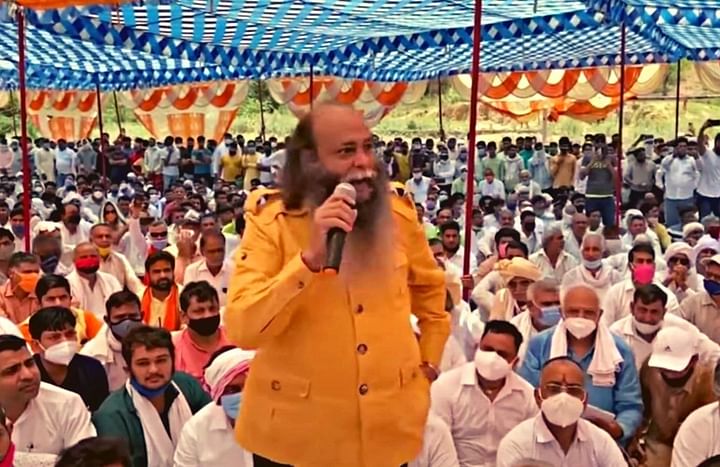
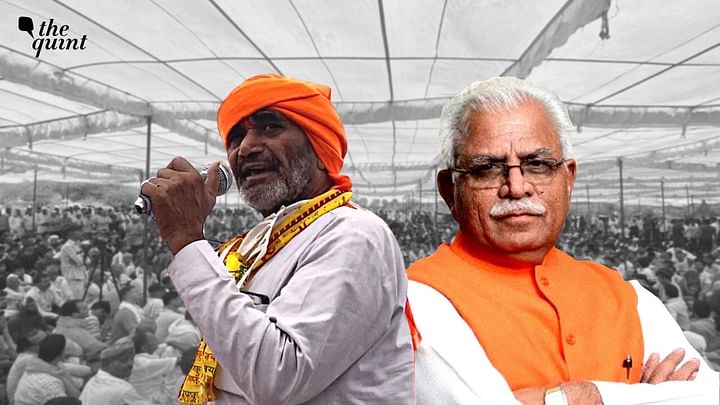
the speakers was BJP leader and Karni Sena chief Surajpal Amu.
Referring to Muslims, Amu provoked the attendees at the mahapanchayat,
“They make pornographic pictures of our sisters and daughters, and we
shouldn’t even murder them?”
BJP leader Surajpal Amu addressing the Hindutva Mahapanchayat in Mewat's Indri village in May 2021.
(Photo: Screenshot/YouTube)
A year later, in May 2022, there was yet another Hindutva Mahapanchayat
in Haryana. Once again, it was held in Mewat - in the village of
Sangel. The cause this time was different. It was being held in
retaliation against the Haryana Police filing an FIR regarding videos of
anti-Muslim violence which had gone viral. The mahapanchayat was held
to threaten the police and the administration to revoke the FIR, even
though the FIR itself was against unidentified persons. There were hate
speeches and calls for violence aplenty here as well.
Acharya
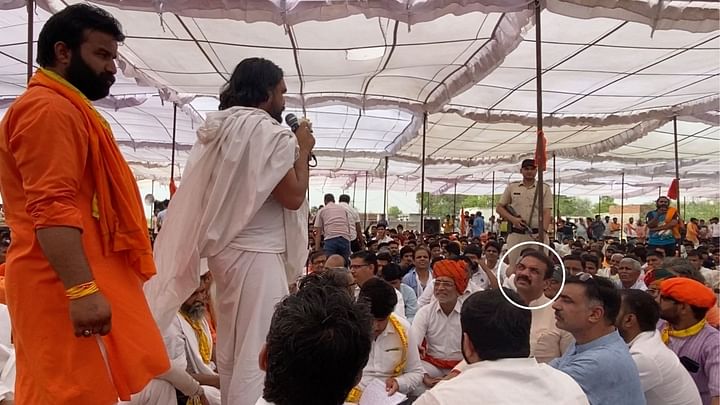
Yogendra Arya of the Gau Raksha Dal, Haryana addressing the
Mahapanchayat in Mewat on 8 May 2022, with BJP MLA Sanjay Singh
(circled) in attendance.
(Photo: The Quint)
And
these mahapanchayats, attended by hundreds and thousands of vigilantes
and members of Haryana’s Hindutva outfits aren’t the only events which
are acting as communal flashpoints in Mewat.
In recent months, there has been ample evidence to show that Mewat is witnessing a significant amount of vigilante violence,
at the hands of self-professed ‘gau rakshaks’ or cow vigilantes. More
on that in a bit. The region has also been a particular target area for
online anti-Muslim narratives peddled by Hindutva groups and their foot
soldiers.
But why do Hindutva outfits have this disproportionate focus on Mewat? The answer lies in its demography.
The
Mewat region is loosely defined as stretching from Alwar and Bharatpur
in Rajasthan to parts of Haryana and certain parts of western Uttar
Pradesh. It is a region broader than the district in Haryana that it
lent its name to, till 2016.
Yet, the demographics of the district
formerly known as Mewat (renamed Nuh six years ago), do serve to
explain the Hindutva focus on it.
According to the 2011 Census, around 79.2% of Nuh’s total population of 10.89 lakh people are Muslims.
(Photo: The Quint)
The
district of Nuh (known as Mewat till 2016) has a majority Muslim
population. According to the 2011 Census, around 79.2% of Nuh’s total
population of 10.89 lakh people are Muslims, while Hindus comprise 20.4%
of the population.
In April 2018, NITI Aayog identified the district of Nuh as India’s most backward district.
Alishan
Jafri, an independent journalist who focuses on tracking hate crimes
and vigilante violence, remarks, “Such a large district, with more than
75% of the population being Muslim, is a thorn in the eyes of Hindutva
groups and organisations. In the last one year, Mewat has been an object
of special focus and attention for Hindutva groups. If you see the two
mahapanchayats organised in 2021 (the one in Indri village in May and
then the one in Pataudi in July), people specifically spoke about
teaching the Muslims of Mewat a lesson.”
Jafri
continued, “Because, according to the narrative and rhetoric of the
Hindutva groups there, Hindus are being oppressed in Mewat, and Hindus
elsewhere in Haryana need to unite and teach Mewat a lesson.”
From Your Phones to the Floor of the House, Branding Mewat as ‘Mini Pakistan’
In
September 2021, BJP MLA and Leader of Opposition in the Rajasthan
Assembly, Madan Dilawar stated on the floor of the House that the Mewat
region had turned into "mini Pakistan".
Dilawar’s remark might
have prompted an uproar in the Rajasthan Assembly, but his comments are
par for the course among the Hindutva discourse in the region.
And
it’s not just BJP leaders or members of local Hindutva outfits who
routinely use the phrase “mini Pakistan” while referring to Mewat.
During the filming of the documentary ‘The Making of Lynchistan: Inside
India’s Deadly Gau Raksha Network’ in 2018, even police officials in the
region whom The Quint had interacted with had expressed a similar sentiment.
A
couple of cops in Alwar had told us, “The Mewat region is full of Meo
Muslims. Consider them to be a small country of their own. The business
of the Meos is to steal, slaughter cows, etc.”
The
policemen added, “Only Muslims do this. Not just any Muslims, it is Meo
Muslims who do this. When Aurangzeb and Babur were here, they forcibly
converted Hindus to Islam. They eat off India, and cheer for Pakistan.
These Meo Muslims are such people.”
The
“mini Pakistan” discourse is not a very recent phenomenon, but one that
has been built up over the years by Hindutva groups on the ground, BJP
leaders like Madan Dilawar and even certain media outlets.
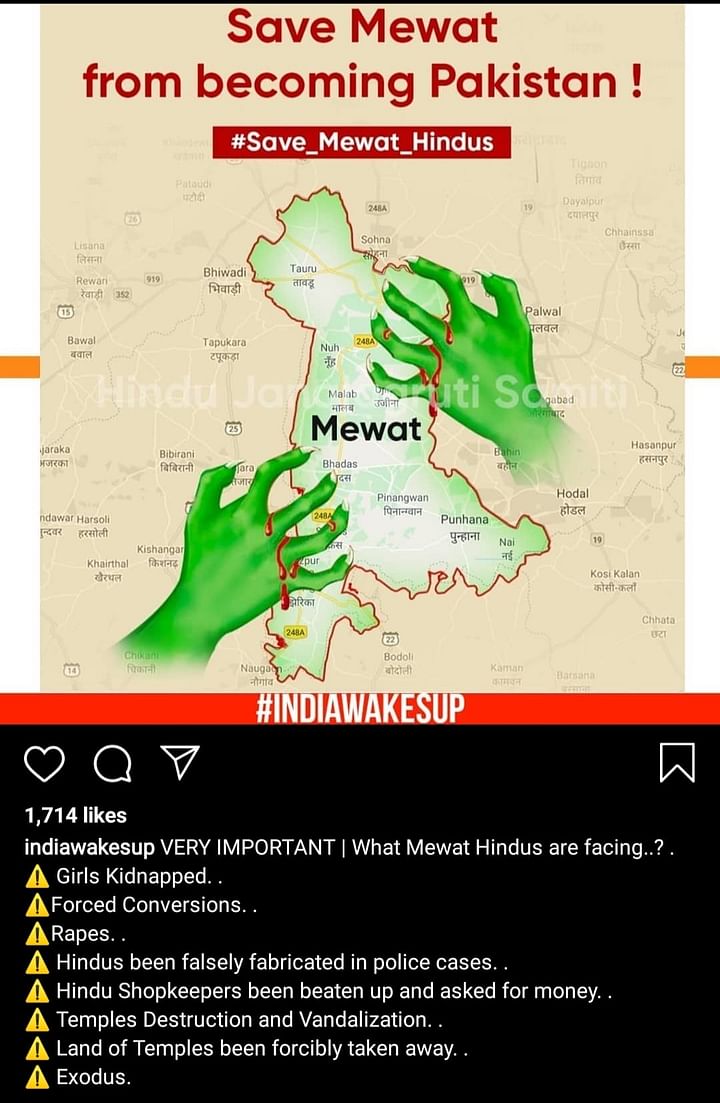
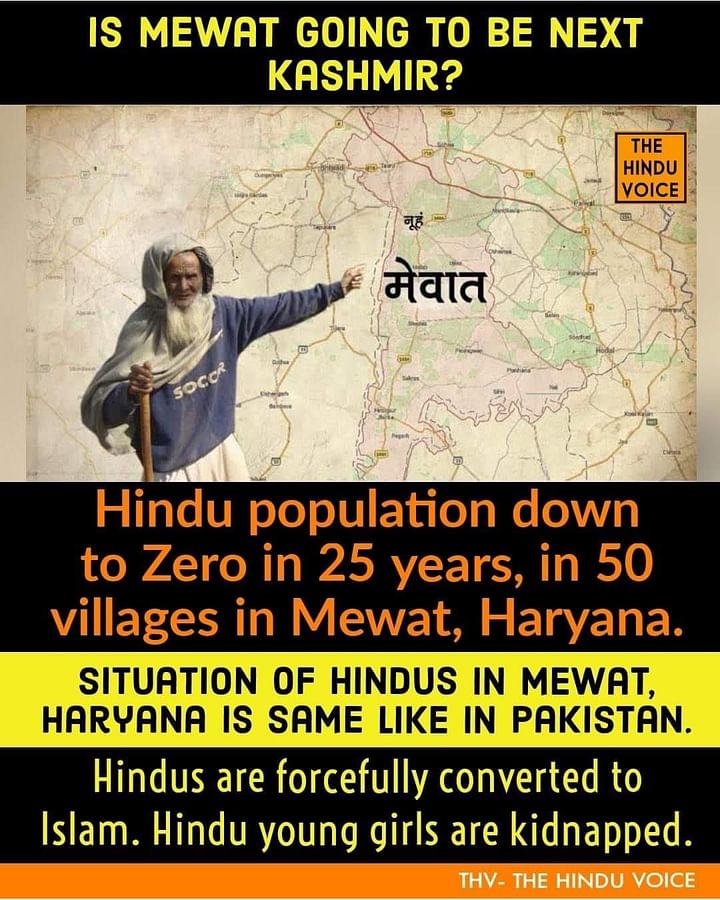
Social media posts and forwards such as the ones shown below have helped in making this narrative reach the masses.
A social media post exhorting people to "save Mewat from becoming Pakistan" and to "#Save_Mewat_Hindus."
(Photo: Angel Photographey/Facebook)
A communally provocative social media post asking if Mewat is going to become the "next Kashmir."
(Photo: Ungli Master/Facebook)
ADVERTISEMENT
The Rise of the Vigilantes, and the Role of the Administration
It
is in this backdrop that one must view the recent videos of vigilante
violence against Muslims which had gone viral. In the videos, proudly
uploaded and shared on social media by the vigilantes themselves, they
can be seen harassing and assaulting Muslim men from the region.
Independent
journalist Alishan Jafri had helped flag these videos online and tagged
the Haryana Police demanding they take action. Jafri says, “There has
been an escalation (in recent months). At least four videos (of
anti-Muslim violence by vigilantes in the region) went viral recently.”
Following
the videos going viral and outrage on social media against the seeming
inaction of the concerned authorities, the Haryana Police eventually
registered an FIR in the matter, against 3-4 unidentified persons. The
police are yet to announce any arrests in the case.
However,
some of the victims of the violence in the viral videos have instead
been promptly arrested by the police for alleged cow smuggling.
Despite
the FIR on the viral videos not naming or identifying any of the
vigilantes as the accused, the Hindutva vigilante outfits held a massive
mahapanchayat in Mewat’s Sangel village on 8 May, aggressively
demanding the revocation of the FIR.
Hindutva leader Kulbhushan Bhardwaj addressing the Mahapanchayat in Mewat on 8 May.
(Photo: The Quint)
The
event was organised by the Vishwa Hindu Parishad, the Bajrang Dal and
the Gau Raksha Dal Haryana. The two Hindutva mahapanchayats that had
been held in Indri and Pataudi in 2021 involving these same outfits had
seen a torrent of hate speech and calls for violence against Muslims.
Additionally, the promotional messaging for the event on 8 May had
distinct and provocative communal overtones, such as being a show of
strength to "those with jihadi mentality", and this too had been brought
to the notice of the district administration.
Yet, despite all of this, the district administration decided to grant them permission to go ahead with the event.
ADVERTISEMENT
Further
hate speeches were made at the Mahapanchayat, including calls for
anti-Muslim violence. There were also public threats made to attack
Congress MLA Mamman Khan and to burn down his house for speaking up
against vigilantes taking the law into their hands.
The communal tensions in Mewat were allowed yet another flashpoint.
Prior
to the event, the Deputy Commissioner of Nuh, Ajay Kumar had told The
Quint, “The organisers have been contacted and called, and it was
clearly communicated to them that the event should, under no conditions,
be like that (communally charged). And that even the speeches should
not be in hyperbole, in the sense of breaking the law."
The event
was both extremely communally polarising, and the speeches calling for
violence and threatening assault did definitely break the law.
No action is known to have been taken against the speakers or organisers of the Mahapanchayat for the same.
The
past few years themselves have shown that if allowed to escalate
relatively unchecked in this manner, hate speech, mob violence and
lawless vigilantism in a politically sensitive region like Mewat can
have disastrous consequences.
Between
2017 and 2018 for example, in Alwar alone, Rakbar Khan, a resident of
Nuh, was lynched in July 2018, Ummar Khan shot dead allegedly by cow
vigilantes in November 2017 and Pehlu Khan lynched in full public view
in April 2017.
Pehlu Khan’s son Irshad and his family.
(Photo: The Quint)
At
mahapanchayats like the ones in Indri in May 2021 and Sangel in May
2022, hundreds and thousands of members of Hindutva vigilante groups are
incited and spurred on towards conducting similar acts.
Mewat’s
Muslim-majority tag, “mini Pakistan” as the Hindutva leaders call it,
gives the vigilantes operating in an around the region that additional
sense of being exalted in their circles. Jafri says that the work of
such vigilantes provides for a very brave spectacle for the larger
Hindutva audience. He explains, "Going into a Muslim-majority area,
everybody there is a Muslim, and then they are assaulting people with
the kind of impunity these guys enjoy. It makes you a hero if you are
going into Mewat and beating Muslims there.”
He
adds, “So, it’s not surprising that people are not just being attacked,
but their videos are being recorded and uploaded online. It’s a message
to Muslims that you’re not even safe in your ghettos, in a place like
Mewat, where you’re the majority, where thousands and lakhs of Muslims
live. It sends a chilling message to Muslims.”
(At The Quint, we are answerable only to our audience. Play an active role in shaping our journalism by becoming a member. Because the truth is worth it.)
Christophe Jaffrelot writes: Will political change, as signalled by the Karnataka election results, translate into change at the grass roots — or has the Sangh Parivar taken over society?
Written by Christophe Jaffrelot
Updated: August 2, 2023 15:20 IST
Vigilantism is inherent in the mission that the RSS assigned to itself from its inception. (PTI Photo) During the Karnataka election campaign, the Congress committed itself to banning organisations such as the Bajrang Dal if they indulged in illegal activities. This promise is very important given the growing role of Hindu vigilantes, who are often part of the Sangh Parivar. Vigilantism is inherent in the mission that the RSS assigned to itself from its inception. K B Hedgewar’s aim was, indeed, to defend the Hindus by endowing them with physical strength in order to resist other groups seen as posing a threat to them, starting with the Muslims. But the RSS only very rarely resorted to the use of force itself, preferring to rely on persuasion and outsourcing coercion through violence to some of its affiliates, including the Bajrang Dal.
The Bajrang Dal was created in 1984 as the Vishva Hindu Parishad’s youth wing in the context of the Ram Janmabhoomi movement. As early as the 1990s, it set up training camps at which its activists were put through gruelling physical exercises. Although guns made their first appearance in the Bajrang Dal in the 1980's [. . . ]
The
communal clashes are believed to have been triggered by three videos
released on social media – two by Monu Manesar and another by Bittu
Bajrangi
Mohit
Yadav, 28, better known as Monu Manesar, could not be arrested for over
five months despite being named (along with 21 others) in the abduction
and killing of two cattle traders, Junaid and his cousin Nasir, whose
charred bodies were found in a burnt car in Rajasthan’s Bhiwani on
February 16.
Cleaning operations underway after communal violence hit Nuh district in Haryana, on Tuesday. (Parveen Kumar/ HT photo)
The
communal clashes are believed to have been triggered by three videos
released on social media – two by Monu Manesar and another by Bittu
Bajrangi, also a cow vigilante – between Sunday and Monday. In one of
the videos, Monu Manesar can be heard announcing that he will reach Nuh
to participate in the procession on Monday (July 31) and urging people
to visit temples in Mewat region in large numbers.
The
procession, while ostensibly religious, was also meant to be a show of
strength. Bittu Bajrangi in his video is also heard making derogatory
remarks. A few videos challenging Monu Manesar and threatening him to
face consequences if he reached Nuh also emerged on social media from
accounts having Muslim profiles.
Haryana
police officers say they suspect that the videos infuriated several
Muslim residents in the Nuh and Mewat region and prompted them to gather
in large numbers in Nuh town and resort to violence during which they
pelted stones, vandalised and torched private as well as police
vehicles, and allegedly surrounded a local temple where several Hindus,
police personnel and media professionals took shelter to save their
lives.
The
officers said that the clashes were ignited by rumours that Monu
Manesar had arrived and joined the procession. However, he did not turn
up for the event on the advice of the VHP, which feared that his
presence would create tension.
According to the officers, the
violence began 10 minutes after the procession of 3,000 to 4,000 people
started to walk from Edward Chowk in Nuh town around 2pm.
The Hindu processionists initially fled, but then regrouped and retaliated.
While the videos emerged at least a day before the scheduled procession, which had all requisite permissions from the police,
the local administration made no attempts to remove them or ensure that
they did not trigger violence, said residents of Nuh; they added that
no efforts were made to take Monu Manesar into custody.
Senior
officers from the Haryana police said Manesar has been at large since
Rajasthan police booked him in the abduction and murder case of the two
Muslim cattle traders and another case was registered against him at
Pataudi, Haryana in connection with rioting and other serious charges.
They said they did not know when and where Monu Manesar shot the videos
and from where they were uploaded.
“Several raids have been
conducted at his house in Manesar village and other possible hideouts by
Rajasthan and Haryana police in the past to arrest Monu Manesar.
However, he was never found at these places. He has remained underground
since February, when his name surfaced in the two murders. Our teams
are still making efforts to nab him,” said a senior Haryana officer, who
asked not to be named.
Bharatpur
superintendent of police Mridul Kachhawa said, “Monu Manesar is under
investigation, though we can’t say whether he is guilty or innocent. We
have arrested three accused and are trying to arrest more culprits who
absconded (in the February lynching case). The role of Monu Manesar will
be clear after arresting other accused, their interrogation and
investigation.”
Son of Om Prakash, a private school bus driver,
Monu Manesar was born in Nuh village in 1995 and was married at the age
of 19. He is the father of an eight-year-old boy. He is said to be a
polytechnic diploma holder and joined the Bajrang Dal during his second
year of college. He has risen to prominence over the course of the past
five years as a leading figure in the cow protection task force
implemented by the Haryana government in Gurugram. A locally influential
person, Monu Manesar’s photos with political leaders, police officials
and bureaucrats have surfaced in the past.
His
YouTube page called “Monu Manesar Bajrang Dal” had over 200,000
subscribers and nearly 330 videos till it was taken down. Most featured
high-speed chases; some boast of a gunfight; some showed him and his men
standing victoriously next to a group of men they have apprehended,
like game they have hunted. The first uploaded video was dated January
18, 2017. In October 2022, Monu Manesar received a silver play button
from YouTube for crossing 100,000 subscribers on his channel, which now
seems to have been taken down from the platform.
Monu Manesar’s
name made headlines in 2019, when he was shot at while chasing cattle
smugglers. He has been absconding since his name emerged in the
abduction and killing of Junaid and Nasir in Bhiwani, Rajasthan. He has
denied any involvement in the Bhiwani killings. At least two “Hindu
Mahapanchayats” happened in Haryana in his support and demanded that his
name be dropped from the FIR on the two murders.
After
close to 100 days, the Bharatpur police named Monu Manesar in the
Bhiwani murders. On February 22, the police named nine accused Rinku
Saini, Anil and Srikant Pandit from Nuh, Kalu Jaat from Kaithal, Kishore
from Karnal, Monu and Gogi from Bhiwani, Vikas and Sashikant Sharma
from Jind. A reward of ₹10,000 each was announced by the police.
A
forensic report confirmed that the charred bodies and blood stains
found in the SUV recovered from a cow shelter in Jind were of Junaid and
Nasir.
VHP, Bajrang Dal announce nationwide protests against Haryana violence — ‘won’t be tolerated’
At least five people have
been killed in violence that first broke out during a religious
procession in Nuh Monday, and spilled over to nearby regions including
Gurugram.
Assam: Bajrang Dal camp organisers booked for imparting arms training
Bajrang Dal
said 350 youths were trained in handling guns, performing martial arts,
besides learning lessons on arts, politics and spirituality at the camp
organised in Mornoi village in the district.
Dr Sahu and several other prayer participants
allegedly taken to police station, detained and threatened with jail for
‘disturbing peace’
Policemen outside the home where the prayer service was disrupted
Sourced by the Telegraph
Animesh Bisoee
|
Jamshedpur
|
Published 02.05.23, 06:16 AM
About
100 alleged Bajrang Dal members barged into a private home and attacked
a group of Christians participating in a prayer service on Sunday
afternoon in the Chhattisgarh village of Amleshwar, part of chief
minister Bhupesh Baghel’s Assembly constituency of Patan.
When the
police were called, they stood and watched as the intruders assaulted
some of the Christians, Dr Vinay Sahu, the dentist at whose home the
service was being held, told TheTelegraph.
Advertisement
Dr Sahu and several other
prayer participants were allegedly taken to the police station, detained
and threatened with jail for “disturbing peace”. No case has been filed
against the attackers, Chhattisgarh Christian Forum president Arun
Pannalal said.
Pannalal said that about 50 Christians were praying
at Dr Sahu’s home in Amleshwar, located in Durg district and about 16km
from state capital Raipur.
“All of a sudden, a mob of unarmed
Bajrang Dal members started shouting and forced the members to open the
door of the house. They abused the members and accused them of carrying
out conversions. They threatened to assault them. Some of the Christians
informed the local police,” Pannalal said.
“The police came but,
instead of acting against the intruding Bajrang Dal members, began
threatening the dentist. They took several Christian members to the
local police station. They asked why they had conducted a prayer service
at a private home and threatened to send them to jail for ‘disturbing
the peace’.”
He added: “They detained nearly 20 people
(Christians) in the police station. It was only after we reached the
police station and exerted pressure that they released them in the
evening.”
Dr
Sahu said that he and nine other Christians had been taken into
preventive arrest before being released at 8pm on a personal
recognisance (PR) bond, which is a written undertaking to appear in
court whenever required.
Dr Sahu said the Bajrang Dal —
youth wing of the Vishwa Hindu Parishad — had carried out a similar
attack on a prayer service at his home in 2021.
“We have been conducting prayer services at our house since 2019. A
similar protest was held at our house by the Bajrang Dal in 2021, and
that time too we were threatened with violence if we did not stop the
prayers,” Dr Sahu said.
“But it’s our house and we haven’t ever forced anyone to attend the
service. All those attending the prayer service on Sunday were
Christians. Nor do we use mikes and cause noise pollution. We fail to
understand the reason for the protest and such attacks.”
Dr Sahu said that “about five” of the Christians had suffered bruises and were treated at local clinics.
“We were surprised that the Bajrang Dal members attacked our members
right in front of the police, who remained mute spectators,” he said.
“More than 100 Bajrang Dal supporters were in the police station when we were taken there.”
Durg superintendent of police Abhishek Pallava told this newspaper
that “it was a small incident and has been resolved” before hanging up.
Pannalal said he was thinking of petitioning the high court for a
directive to the police to act against the Bajrang Dal attackers.
At the event,
attended by 400 people, including members of Bajrang Dal, Vishwa Hindu
Parishad and cow vigilante groups, attendees reiterated their demand for
a CBI probe into the case and warned the Rajasthan government against
initiating legal action against gau rakshaks.
India: In the northern state of Haryana all male private militias of the Far-right with thousands of unemployed lumpen youth police the streets in the name of cow protection. With full blessings of the ruling BJP Govt and the know of the police. https://www.tribuneindia.com/news/haryana/20k-cow-vigilantes-affiliated-to-three-outfits-active-across-state-480860
G N Devy
writes: Bajrang Dal's disruption of the performance of a play in
Shivamogga cuts short the journey of a story — transcending a span of a
millennium, a distance of several continents
Written by G. N. Devy
| New Delhi |
Updated: July 8, 2022 2:48:56 pm
GN
Devy writes: The drama unfolding before the people of India has an
indulgent state and the RSS, VHP and Bajrang Dal as its eager actors.
(Express Photo)
The world is,
indeed, a small place. Otherwise why would the recently devastated
Ukrainian Poltava create a familiar echo in Karnataka’s Shivamogga?
There is apparently no connection between Poltava city along the Vorskla
river and Shivamogga along the Tunga and Bhadra. Why would a 12th
century story of insanity and love from a distant island come to visit
Karnataka of the 21st century, transcending a span of a millennium and a
distance of several continents?
The story involves three daughters and their doting, old father. It
was reported first by the 12th century historian Geoffrey of Monmouth.
It was then reproduced by Raphael Holinshed during the 16th century. A
century later, William Shakespeare employed it as the plot for his
tragedy, King Lear. Shakespeare’s Lear has never ceased to inspire many writers in all continents since then.
One of them was a 19th century genius from Poltava in central Ukraine.
Born in 1859, Solomon Naumovich belonged to the minority of the
Ashkenazim. When he started writing during his teens, he took the
pen-name Sholem Aleichem. The Shakespeare story of Lear and his three
daughters appealed to him as he himself had an engagement with three
languages — Russian, Hebrew and Yiddish. Of these three, he gave up on
the first two and passionately kept up with Yiddish. Though, deeply
influenced by Germanic languages, Yiddish had kept alive its links with
Hebrew and Arabic.
Solomon’s pen-name, Sholem Aleichem, reminiscent of the Arabic
“salaam alequm”, takes one more easily back to the ancient Hebrew
“sholem”, closely linked in its linguistic genesis with what Sanskrit
inherited as “shanti”, both having roots in the ancient Indo-Iranian.
Sholem Aleichem’s rendering of the story had the king turned into an
amusing milk-man called Tevey. Given that he was witnessing the rise of a
bitter anti-Semitic social ethos in Eastern Europe, his fiction got
suffused with the pain and anxiety predicting the coming Holocaust. Like
many other Jews of his days, he chose to migrate to the US when the
First World War began. It was his fiction that inspired Joseph Stein for
producing his musical Fiddler on the Roof, also made into a film by the same title.
The songs of Stein’s superlative musical thrilled the rest of the
world and the depiction of religious discrimination made him a hero in
the fight against anti-Semitism. It would have been a surprise had not
Stein’s movie attracted Jayantha Kaikini, one of the finest lyricists of
India in our time. Kaikini, son of a major Kannada fiction writer
Gourish Kaikini, grew up in a progressive atmosphere and after a spell
in Bombay’s industrial ethos, took to writing. He has produced
outstanding fiction, poetry and plays, has won many literary awards and
is held today as a leading Indian writer and lyricist in Kannada.
Jayantha Kaikini’s “Jathegiruvanu Chandira (The Moon Will Be With Us)”
is not a recent play. It was published as part of a collection of his
plays a decade and a half ago. It has been performed in Bangalore and
elsewhere and has received laurels for its control of language and
dramatic intensity. It was performed in Shivamogga earlier this year by
theatre group Rangabelaku led by Kotrappa S Hiremagadi. When a
performance was staged on Sunday, July 3, it was disrupted by Bajrang Dal members.Their
argument was that the place where it was being performed was a
Veershaiva Hall and to perform a play with a Muslim character in it
would be sacrilege. Little do they know that the Ukrainian author who
created the modern story of the kind milkman and his three daughters,
Sholem Aleichem, had a name which literally means “Peace be on you’,
which in its Sanskrit form is “shanti, shanti, shanti”, the ultimate
benediction for every Upanishad.
One wonders if the Bajrang Dal members know that the founding text of the Veershaiva sect, the Shri Siddhanta Shikhamani,
states, “Bhaavo Yasy sthiro nityam manovaakkyaayakarmabhi… shaanto
daantstapashishilah satyavaak samadarshan.” It means, “Do hold the ‘Shiv
bhava’ — the mentality inspired by the divine — as the primary duty; do
learn the ‘shant’ (peace), generosity, study, truthful speech, for they
are manifestation of the divine.” The truth is the vandals who
disrupted the performance do not care for the teachings of the
Veershaiva path of life, nor do they know the long trajectory of the
story that Kaikini’s play brought to the Shivamogga performance.
Vandalism and cultural suppression are tragically short of memory. They
may act in the name of tradition, but they have barely any knowledge of
what it is that they are defending. The finest theatre academy in the
country created by Subanna is located at Heggodu in Shimoga district.
Another first-rate playwright and director, Prasanna, is a resident in
the same district. The people in the district have seen some of the
greatest theatre productions over the last half century. It is difficult
to imagine that theatre would be brought under attack there.
In today’s India, the Hindutva forces have little time to understand
what Hindu philosophies and metaphysics have advocated. Sholem, being an
Ashkenazim, understood how the hatred for Jews in Europe during the
late 19th century was affecting the creative sources of Russia, Germany
and France. The Dreyfus imprisonment and trial is still not forgotten.
Defenders of human dignity such as Sarah Bernhardt, Anatole France,
Georges Clemenceau and Emile Zola, are still not pushed into amnesia.
The hatred for Jews in Russia, France and in Hitler’s Germany is
remembered as a shameful episode in history.
In recent years, several important writers in Karnataka such as UR
Ananthamurthy, Girish Karnad, Devanoor Mahadeva and Rahmat Tarikere have
spoken against the rising atmosphere of hatred. Some like MM Kalburgi
and Gauri Lankesh
had to face bullets. Initially it was an apprehension, a view of a
horizon turning dark with clouds. Then followed physical assaults from
close quarters. During the last few months, the state has actively
ignited and encouraged an anti-minorities sentiment.
Now, the hatred project is on auto-pilot. It no longer requires state
patronage or concealment of its intentions through subterfuge. The
drama unfolding before the people of India has an indulgent state and
the RSS, VHP and BD as its eager actors. The theatre of hatred has made
spectacular progress. It has declared that even an imaginary character
in a play can pollute the purity of a religious place. The world has
always been a small place; in India, it is becoming much smaller than
the space that our rapidly disappearing Constitution had imagined for
it.
At an event in Gujarat organized by AHP for distribution of 5000 Trishuls, Praveen Togadiya's aide Manoj Kumar says,
"Tell Katuw@s (Muslims Men), Salma (Muslim Women) is waiting for her Bajrangis (Hindus). Muslim men are not enough for her, She wants to give birth to Luv-Kush".
(This article has been reposted fromThe Quint’s archivesto mark the anniversary of the murders of Graham Staines and his sons. It was first published on 22 January 2016.)
In
1965, there was no internet. A young Australian named Graham Staines
though had a close friendship with Santanu Satpathy all the way in
Baripada in Odisha. They had been pen pals since childhood and Graham
came to Baripada to visit his friend. He never left.
For
nearly 35 years, Graham Staines lived and worked with some of the
poorest Adivasi communities in Odisha. On 22 January 1999, he was burnt
alive along with his sons Philip and Timothy by right-wing activists,
including Dara Singh who was a member of the Bajrang Dal. They were
sleeping in their car, an old Willy’s four-wheel drive.
The burnt vehicle in which Graham Staines and his sons were killed on 22 January 1999. (Photo: Reuters)
Graham
was 58 years old at the time, Philip was 10 and Timothy was nine years
old. Graham was a Christian missionary and had spent his time in India
working with leprosy patients in Baripada. He learnt Odia and was fluent
in the local dialect, Santhali. Graham Staines was also a preacher.
The
men who killed him did so because they thought he was converting
Adivasis to Christianity. The charge, if that’s what it is, was denied
by Graham’s widow, Gladys, repeatedly.
Gladys Staines, Graham’s wife. (Photo: Reuters)
The
mob that committed the gruesome murders was led by Dara Singh, a member
of the Bajrang Dal. Dara Singh was convicted of the crime and sentenced
to death. His sentence was later commuted to life imprisonment.
Hindu activist and ringleader Dara Singh is seated in a police van in Bhubaneswar. (Photo: Reuters)
For the people who knew Graham, his death was more than a tragedy. It was a deep personal loss. Here’s what an India Today report in January 1999 had to say.
“But
not even the harshest words could measure up to the indignation felt in
Baripada, the headquarters of Orissa’s predominantly tribal district of
Mayurbhanj, which Staines had made his home. “It’s as if we all have
had a personal bereavement,” said District Collector R Balakrishnan. For
the past 35 years, dressed in casuals, sporting his trademark hat and
wheeling his rickety bicycle, Saibo – as he was popularly called – was a
fixture in Baripada where he did “God’s work”, tending and nursing
leprosy patients in a specially-run home on the town’s outskirts.”
Gladys Staines and her daughter Esther at the funeral of her husband and sons in Odisha. (Photo: Reuters)
Gladys
Staines continued to stay in Odisha with her daughter Esther. In 2005,
she was awarded the Padma Shri by the President of India for her work
with people suffering from leprosy.




 GN
Devy writes: The drama unfolding before the people of India has an
indulgent state and the RSS, VHP and Bajrang Dal as its eager actors.
(Express Photo)