|
Showing posts with label Terrorism. Show all posts

January 06, 2024

Culture and Violence in the British Far Right | Kyle Burke

 https://www.tandfonline.com/doi/abs/10.1080/09546553.2023.2204032?journalCode=ftpv20

December 14, 2023

India: Whether killing of Hindu religious leaders constitutes a ‘terrorist act’ is debatable, says Madras High Court

The Hindu

Whether killing of Hindu religious leaders constitutes a ‘terrorist act’ is debatable, says Madras High Court

Justices S.S. Sundar and Sunder Mohan say Section 15 of UAPA covers only acts that threaten or likely to threaten the unity, integrity, security, economic security or sovereignty of the country

December 14, 2023 02:23 pm | Updated 04:26 pm IST - CHENNAI

Representational image. File

The Madras High Court has raised a doubt as to whether a conspiracy hatched to kill leaders belonging to the Rashtriya Swayamsevak Sangh (RSS) or Bharatiya Janata Party (BJP) or even the killing of Hindu religious leaders as such can be termed as a ‘terrorist act

[ . . . ]

https://www.thehindu.com/news/national/tamil-nadu/whether-killing-of-hindu-religious-leaders-constitutes-a-terrorist-act-is-debatable-says-madras-high-court/article67637267.ece

August 02, 2023

India: Well Known Cow Vigilantes connected to Bajrang Dal, VHP, RSS at the center of Communal Violence in Haryana

 The Hindustan Times

Haryana violence: Vigilante Monu Manesar at the centre of row

Aug 02, 2023 04:56 AM IST

The communal clashes are believed to have been triggered by three videos released on social media – two by Monu Manesar and another by Bittu Bajrangi

Mohit Yadav, 28, better known as Monu Manesar, could not be arrested for over five months despite being named (along with 21 others) in the abduction and killing of two cattle traders, Junaid and his cousin Nasir, whose charred bodies were found in a burnt car in Rajasthan’s Bhiwani on February 16.

Cleaning operations underway after communal violence hit Nuh district in Haryana, on Tuesday. (Parveen Kumar/ HT photo)

Also Read| Attack on yatra ‘pre-planned’, ‘conspiracy’: Khattar

Manesar, who heads the cow vigilante wing of Bajrang Dal in Haryana, is now at the centre of Monday’s communal violence during a procession led by right-wing outfits Bajrang Dal and Vishwa Hindu Parishad (VHP) in Haryana’s Nuh that later spread to Sohna and Gurugram, claimed at least five lives, and left over 50 injured.

The communal clashes are believed to have been triggered by three videos released on social media – two by Monu Manesar and another by Bittu Bajrangi, also a cow vigilante – between Sunday and Monday. In one of the videos, Monu Manesar can be heard announcing that he will reach Nuh to participate in the procession on Monday (July 31) and urging people to visit temples in Mewat region in large numbers.

The procession, while ostensibly religious, was also meant to be a show of strength. Bittu Bajrangi in his video is also heard making derogatory remarks. A few videos challenging Monu Manesar and threatening him to face consequences if he reached Nuh also emerged on social media from accounts having Muslim profiles.

Also Read| Nuh to Gurugram: The spread of violence

Haryana police officers say they suspect that the videos infuriated several Muslim residents in the Nuh and Mewat region and prompted them to gather in large numbers in Nuh town and resort to violence during which they pelted stones, vandalised and torched private as well as police vehicles, and allegedly surrounded a local temple where several Hindus, police personnel and media professionals took shelter to save their lives.

The officers said that the clashes were ignited by rumours that Monu Manesar had arrived and joined the procession. However, he did not turn up for the event on the advice of the VHP, which feared that his presence would create tension.

According to the officers, the violence began 10 minutes after the procession of 3,000 to 4,000 people started to walk from Edward Chowk in Nuh town around 2pm.

Also Read| 40 cases registered in Nuh, over 100 detained

The Hindu processionists initially fled, but then regrouped and retaliated.

While the videos emerged at least a day before the scheduled procession, which had all requisite permissions from the police, the local administration made no attempts to remove them or ensure that they did not trigger violence, said residents of Nuh; they added that no efforts were made to take Monu Manesar into custody.

Senior officers from the Haryana police said Manesar has been at large since Rajasthan police booked him in the abduction and murder case of the two Muslim cattle traders and another case was registered against him at Pataudi, Haryana in connection with rioting and other serious charges. They said they did not know when and where Monu Manesar shot the videos and from where they were uploaded.

“Several raids have been conducted at his house in Manesar village and other possible hideouts by Rajasthan and Haryana police in the past to arrest Monu Manesar. However, he was never found at these places. He has remained underground since February, when his name surfaced in the two murders. Our teams are still making efforts to nab him,” said a senior Haryana officer, who asked not to be named.

Bharatpur superintendent of police Mridul Kachhawa said, “Monu Manesar is under investigation, though we can’t say whether he is guilty or innocent. We have arrested three accused and are trying to arrest more culprits who absconded (in the February lynching case). The role of Monu Manesar will be clear after arresting other accused, their interrogation and investigation.”

Son of Om Prakash, a private school bus driver, Monu Manesar was born in Nuh village in 1995 and was married at the age of 19. He is the father of an eight-year-old boy. He is said to be a polytechnic diploma holder and joined the Bajrang Dal during his second year of college. He has risen to prominence over the course of the past five years as a leading figure in the cow protection task force implemented by the Haryana government in Gurugram. A locally influential person, Monu Manesar’s photos with political leaders, police officials and bureaucrats have surfaced in the past.

His YouTube page called “Monu Manesar Bajrang Dal” had over 200,000 subscribers and nearly 330 videos till it was taken down. Most featured high-speed chases; some boast of a gunfight; some showed him and his men standing victoriously next to a group of men they have apprehended, like game they have hunted. The first uploaded video was dated January 18, 2017. In October 2022, Monu Manesar received a silver play button from YouTube for crossing 100,000 subscribers on his channel, which now seems to have been taken down from the platform.

Monu Manesar’s name made headlines in 2019, when he was shot at while chasing cattle smugglers. He has been absconding since his name emerged in the abduction and killing of Junaid and Nasir in Bhiwani, Rajasthan. He has denied any involvement in the Bhiwani killings. At least two “Hindu Mahapanchayats” happened in Haryana in his support and demanded that his name be dropped from the FIR on the two murders.

After close to 100 days, the Bharatpur police named Monu Manesar in the Bhiwani murders. On February 22, the police named nine accused Rinku Saini, Anil and Srikant Pandit from Nuh, Kalu Jaat from Kaithal, Kishore from Karnal, Monu and Gogi from Bhiwani, Vikas and Sashikant Sharma from Jind. A reward of ₹10,000 each was announced by the police.

A forensic report confirmed that the charred bodies and blood stains found in the SUV recovered from a cow shelter in Jind were of Junaid and Nasir.

March 20, 2023

India: Intelligence agencies had raised a red flag -- were the authorities sleeping at the wheel over the preacher Amritpal Singh?

 Hindustan Times

Amritpal Singh was raising own army, ‘human bomb squads': 10 points
ByAniruddha Dhar
, New Delhi
Mar 20, 2023 06:31 AM IST
Security agencies had raised a red flag after intelligence inputs suggested that Amritpal Singh was using drug de-addiction centres and a gurdwara for stockpiling weapons and preparing youths to carry out suicide attacks.

https://www.hindustantimes.com/india-news/amritpal-singh-was-raising-own-army-human-bomb-squad-10-points-101679271407267.html

July 18, 2022

India: ISIS video of Srinagar attack portends ill | Bharat Bhushan

Deccan Herald


ISIS video of Srinagar attack portends ill

Bharat Bhushan

The Islamic State has announced its presence in Jammu and Kashmir (J&K) by releasing an alleged live video recording of the shooting of a police officer on Tuesday July 12 in the heart of Srinagar. The incident left one police officer dead and two injured. The video was released by Amaq news agency, an online news outlet linked to the IS. It has been described by the New York Times as the “first point of publication for claims of responsibility” for terrorist attacks.

The video shot with a body camera worn by the attacker shows him shooting at a police officer, changing the magazine of his pistol mid-way through the shooting, attacking a stationary police vehicle and showering bullets on a policeman standing under a Chinar tree vainly trying to shield himself with his arms covering his face.

Up to now, angry youngsters used to wave the IS flag to rile the Indian security forces. Now it would seem that the IS had made inroads into Kashmir and is willing to declare its presence. This has serious security ramifications. It has the potential to  shorten the ongoing Amarnath Yatra as well as the postponement of the proposed legislative elections in the Union Territory.

There is no central authority which grants membership of the IS to any terrorist outfit. Any militant group can in principle join it online. It is quite another thing, however, for the IS to claim a group and its activities as its own. The terrorist attack in Srinagar’s Lal Bazaar has also been claimed by The Resistance Force (TRF) associated with Lashkar-e-Taiba but the self-styled Islamic State (Hind Province) have threatened it for doing so.

It would be unwise to dismiss the July 12 incident as a minor attack using a pistol. If the IS has indeed made inroads in the Valley, then not only could such attacks go up but there could be bigger and qualitatively different attacks in the future. Jammu may be particularly vulnerable. Experience elsewhere in the world shows that the capacity of IS to wreak havoc cannot be underestimated.

If the terrorist activities of the IS increase in J&K, the carefully managed narrative of Delhi that everything is “normal” in the Union Territory stands in danger of falling apart. The anti-India narrative in J&K has been contained up to now by cracking down on the media. While the pro-establishment journalists in J&K today are afraid of moving out of their homes, the independent or critical journalists are not allowed to operate freely. This way the Indian public is denied knowledge of the ground situation in Kashmir.

The government may now also find it difficult to hold elections to the UT legislative assembly any time soon. Neither the pro-India mainstream politicians nor the pro-BJP politicians created by the establishment would be able to move about freely. Not  many amongst them would be willing to contest legislative assembly elections putting their lives at risk. It could become next to impossible for the administration to provide security for all politicians in Kashmir including District Development Council members, sarpanches and panches, already holed up in secure hotels away from their constituencies.  

Meanwhile, the security forces may continue shooting  militants few days after every terrorist strike, claiming to have killed the ‘mastermind’ of the attack. Nonetheless, the narrative that the administration has the situation in Kashmir fully under control and terrorism has been eliminated is likely to become less and less credulous.

That is not all. The targeting of minorities in the rest of India by Hindutva activists, often with the connivance of the official machinery, may facilitate the entry of IS outside Kashmir as well. When political doors are shut on a minority community, its grievances not addressed by the state and the civil society is prevented from assuaging its sense of injustice, the ground is fertile for extremism.

Another major consequence of an increasing presence of  IS in terrorist activities would be that the Indian establishment would have no one to negotiate with. Unlike a  political or sovereign entity, the IS cannot be engaged in a dialogue. India would no longer be able to blame Pakistan for every violent incident in J&K (or even elsewhere) as it can be no one’s case that Pakistan controls the activities of the IS. Such claims, even if made by the Indian government, would not hold much water with the international community.

Even changing the Lieutenant Governor of J&K to a Muslim face will not help. The immediate issue is not whether a Manoj Sinha can be replaced with, say for example, a Mukhtar Abbas Naqvi or another minority leader acceptable to Delhi. It is the suffocation that the Kashmiri society feels after the cataclysmic events of August 2019 – the subjective perception of the people that they have been wronged -- which needs to be addressed.


June 30, 2022

religion keeps killing - Islamists kill over 'hurt sentiment' in Udaipur - three editorials

The Times of India

FROM TOI PRINT EDITION

Act of terrorism: Horrific Udaipur incident must lead to thorough investigation to see if there’s a bigger pattern

June 29, 2022,

Following the gruesome murder of Kanhaiya Lal in Udaipur – which was plainly an act of terrorism – the course of investigation suggests that governments think this was not an isolated local incident. GoI yesterday directed the National Investigation Agency to take over the probe, with the search for international links being a key dimension. Rajasthan CM Ashok Gehlot echoed the view. He said the murder was meant to spread terror and the information available indicated the two perpetrators have contacts overseas.

It bears mention that the two terrorists, Mohmmad Riyaz Akhtari and Gaus Mohammad, who have freely admitted to murdering Lal, apparently belong to groups that believe that the “punishment” for “blasphemy” must be death. Indeed, the most chilling aspect of what Riyaz and Gaus did was the videography, reminiscent of ISIS-style brutality. Clearly, what happened in Udaipur requires a multi-level and multi-agency response.

A thorough investigation by NIA into Lal’s murder, with the state government cooperating, and quick, definitive results are the best first responses to the act of terrorism. Interminable delays do great harm to the cause of fighting terror, especially when social situations are volatile. The other crucial job for investigators is to figure out whether Riyaz and Gaus are part of a deadly pattern that will emerge over time. If that’s the case, it’s imperative that agencies are proactive in their response.

There’s also the question of the quality of local policing. The victim, Lal, had communicated a threat to his life in a formal complaint. For sure, the state has suspended an assistant sub inspector in Udaipur for negligence. But this horrifying incident shows the cost of states’ reluctance to implement even most basic police reforms. In state after state, and in incident after incident, local police forces have been found wanting even when clear indications of threats have been available. And finally, all political parties must keep an eye on groups and individuals who can say or do things that aggravate an already volatile situation.


 o o

 The Tribune

Murder in Udaipur

Religious, political leadership must work for peace


The gruesome killing of an Udaipur man, Kanhaiya Lal Teli, by Islamist extremists for allegedly supporting blasphemy against their faith deserves the most unequivocal, strongest possible condemnation. Teli, a tailor by profession, was brutally killed in his shop by two men posing as customers on Tuesday evening. He was murdered less than three weeks after he had been arrested over the allegation that he had supported and propagated former BJP spokesperson Nupur Sharma’s comments on Islam and the Prophet. The killers — who also issued death threats to Prime Minister Narendra Modi and Nupur — have been arrested and the Central Government has handed over the probe into the case to the National Investigation Agency.

The murder and its aftermath, with curfew being imposed in Udaipur after protests and arson, must be met with a responsible, restrained response from the political and religious leadership. Since the controversy over Nupur’s comments began a month ago, several states have witnessed protests and violence, resulting in a number of fatalities and damage to public and private property. It is incumbent on religious leaders to emphatically denounce violence in the name of religion and God; and, for the sake of peace and harmony, political leaders must desist from making provocative, divisive statements and prodding their followers towards violence. The investigation into Teli’s murder must be completed at the earliest and the killers — as also those who hatched the conspiracy and indoctrinated the two — must be brought to book.

India is an amazingly diverse country with different beliefs, customs and practices, which people cherish; however, it’s time the people realised a fundamental, universal truth: human beings have rights, feelings and ideas do not. Modern, tolerant democracies are founded on the principle that even the most loathsome ideas can be expressed as long as they are focused on ideologies or belief systems rather than individuals. The sanctity of human life is paramount; sentiments can never be accorded more importance than it. This is a priceless lesson, and the earlier the people of India learn it, the better it would be for the peace and progress of its citizens.

o o

The Indian Express

The two men who killed Kanhaiya Lal must face the full force of the law, they must not get the power to spread their poison

While the crime has played out in public view, the grisly videos don't tell all, important questions remain

By: Editorial | 

Updated: June 30, 2022
 
Even as there is no room for the politics of one-upmanship, there is hard political work to be done by all parties and players.

The killing of Kanhaiya Lal in Udaipur, captured and flaunted by his killers on video, is a gruesome crime. It has deservedly drawn the strongest condemnation across political and ideological lines in the country. The starkness of the horror permits no ambiguity in the aftermath — the perpetrators of murder as ghastly spectacle must be brought to justice quickly and firmly. In the days ahead, political parties and governments also need to step up to the challenge to keep the calm. Chief Minister Ashok Gehlot has called for Prime Minister Modi to address the nation and appeal for peace. It is essential that this does not become a bid by the Gehlot government to abdicate its own responsibility, or to pass the buck. It is its primary task to ensure that a firm message is sent out that any attempt to stoke or inflame communal anxieties and tensions will not be brooked in the state, in Udaipur or elsewhere.

Even as there is no room for the politics of one-upmanship, there is hard political work to be done by all parties and players. While the crime has played out in public view, the grisly videos don’t tell all, important questions remain. The National Investigation Agency, tasked with investigating terror-related crimes, has been called in, and a thorough probe will be needed to arrive at the answers.

Meanwhile, it will be the work of politics to ensure that important distinctions are not blurred and crucial perspective is not lost in a climate in which prime-time TV seems to increasingly take its cue from the fringe and hardliners, and too many of those with a social media account unresistingly give in to the temptation of delivering instant justice on complex issues by playing judge, jury and executioner. The industry of hurt sentiments is quite capable of manufacturing hate and violence, too. It is necessary, in this moment, to remember and to remind that one of Indian democracy’s biggest success stories has been that it is home to a Muslim minority which has not been drawn into the Islamic radicalisation story that has been unfolding in troubling ways elsewhere in the world.

As the law follows its course, therefore, politics has to step up to ensure responsibility and restraint after the crime in Udaipur. The two men who walked into the tailor’s shop and killed Kanhaiya Lal in cold blood must face the consequences — they must not be given the power to spread their poison.

November 06, 2021

In Gurugram in India - Devotees of Religion & Hindutva Goons in Action threaten violence | video report from The Wire (Nov 2021)

 “Goli maro saalon ko, Hindu ke gadaaron ko (Shoot the traitors of Hinduism)” slogan was raised in Sector 12 of Gurugram on Nov 5, in an event organised in the name of Govardhan Puja. with BJP leader Kapil Mishra in attendance


October 12, 2021

The Kashmiri Pandit leader says when a Hindu is killed in Kashmir, all Kashmiri Muslims must condemn it, just as all Hindus must condemn lynching of Muslims anywhere in India

newsclick.in 

Some Government Policies Broke Pandit-Muslim Relations in Kashmir—Sanjay Tickoo

The Kashmiri Pandit leader says when a Hindu is killed in Kashmir, all Kashmiri Muslims must condemn it, just as all Hindus must condemn lynching of Muslims anywhere in India.
jk

File Photo.

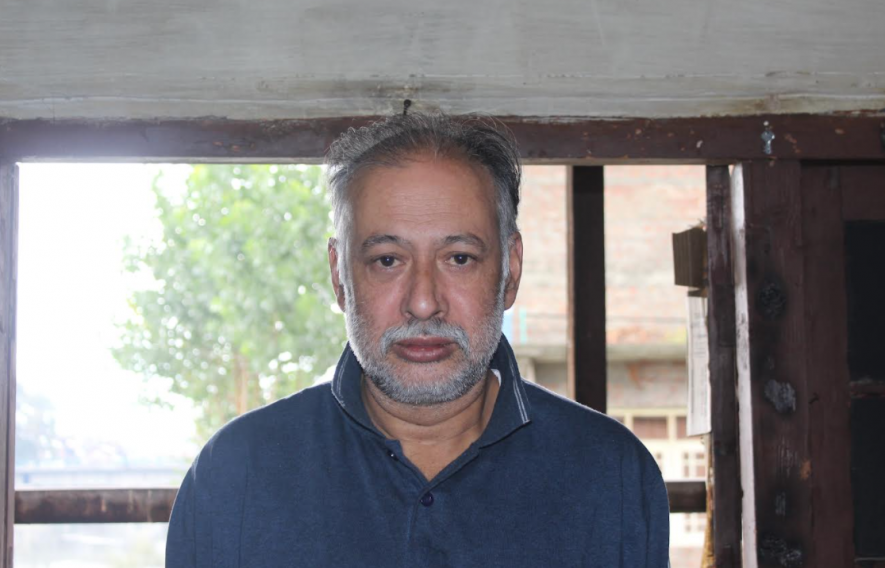
Sanjay Tickoo is the president of the Kashmiri Pandit Sangharsh Samiti, which he established in 1995 to fight, non-violently, for the rights of his community members residing in the Kashmir Valley. When the exodus of Kashmiri Pandits began in 1990 because of the rise of militancy in the Valley, Tickoo, then around 23 years old, chose to stay behind.
Tickoo

Tickoo is widely respected among Kashmiris, Hindus and Muslims alike, for his formidable ability to conduct conversations with those he ideologically opposes. He is fearless in his criticism of the government for some of its flawed policies and the targeted killings undertaken by state and non-state actors in Kashmir. In this interview with Ajaz Ashraf, Tickoo analyses the impact last week’s killing of religious minorities in Kashmir has had on religious minorities residing there.

Do you agree with those who say the situation for Kashmiri Pandits is worse than in 1990, the year they began to exit Kashmir because of the rise of militancy?

I was around 23 years old then, old enough to remember what happened in that year and thereafter. Yes, the situation today is worse in comparison to the 1990s. I say this because of the manner in which the members of minority communities were killed last week. As in 1990, so in 2021, the majority community is on the backfoot.

Backfoot?

What I mean is that when a Kashmiri Pandit is killed, the majority community consoles his or her family. They have to console and instil confidence in the [Valley’s] minority population. The last massacre of Kashmiri Pandits took place at Nandimarg village, in Pulwama district, in 2003. Twenty-four non-migrant Kashmiri Pandits (a term used to describe those who did not join the exodus) were killed. Last week, for the first time after 18 years, Kashmiri Pandits were shot dead, beginning with ML Bindroo [a reputed pharmacist].

Why do you say the current round of targeting of Kashmiri Pandits is worse than even 1990?

I say it because my dear friends in the majority community have remained silent.

What would you have wanted them to do?

I live in the Valley. Kashmiri Muslims are my immediate neighbours. Sure, many among them condemned the killings of last week. But they need to do a bit more—for instance, come out on the streets. That would have made the minorities feel safe and secure. After all, we had stood by Kashmiri Muslims in 1990 and thereafter.

In what way did Kashmir Pandits stand by the majority community?

By choosing to stay behind in the Valley, by not joining the exodus, the 808 Hindu families stood by the majority community. Our decision to stay behind was our way of supporting the majority community. If we, too, had left the Valley, there would have been no Kashmiri Pandit left to kill. In fact, if they want Kashmir to become the paradise on Earth once again, they have to come out against the killing of all civilians, religious minorities and Muslims alike, by both state and non-state actors.

Have you opted for police protection?

For the first time in my 52 years, the police came to my residence on the night of 5-6 October and said that since I was still on the radar of terrorists, I must come under their protection. My family is still at our residence. There is no security for them.

Do you think we will see another round of exodus of Kashmiri Pandits?

If there is another round of killing, not only Kashmiri Pandits, but all minorities, I fear, will leave the Valley. That is why I requested today [10 October] in my social media post that all masjid committees should use the public address system to assure minorities of their support and protection.

In case there is another round of killings, would a person like you also move out?

Yes, even I will.

How many Kashmiri Pandits are there in the Valley?

There are, as I told you, 808 Hindus families. These include, apart from Kashmiri Pandits, social groups like Rajputs. In addition, there are another 5,000 individuals who came because of the jobs given to them in and after 2010, during the prime ministership of Manmohan Singh.

Some have already left the Valley for Jammu.

They have shifted temporarily.

Some say more Muslims than minorities have been killed. As a minority outside Jammu and Kashmir, I can understand the psyche of non-Muslims there. Yet, I would want you to describe the fear that religious minorities reel under in the Valley.

Out of 28 civilians who have been killed this year, 21 were Muslim. However, the onus lies on the majority community to come to the protection of religious minorities, to make them feel safe. It is natural for minorities to feel vulnerable in the circumstance prevailing in Kashmir.

This is true for India as well. Whenever a Muslim is lynched in India, all Hindus should condemn it. Whenever a Hindu is killed in the Valley, all Kashmiri Muslims should condemn it. We need to react as humans. I am opposed to the targeted killings of the innocent by both state and non-state actors. This approach of mine is reflected in the statements of my organisation, issued at every incident of targeted killing, regardless of the religious identity of victims.

Did you know ML Bindroo, the pharmacist who was shot dead?

Yes.

Is it correct that he was a Rashtriya Swayamsevak Sangh (RSS), the reason cited for his assassination?

Even in 1990-91, whenever a Kashmiri Pandit was killed, he was labelled either an Army informant or Jan Sanghi. [Members of the Bharatiya Jana Sangh, the earlier incarnate of the Bharatiya Janata Party, were known as Jan Sanghis.] This has become a convenient reason to cite for justifying the killing of Kashmiri Pandits. In fact, even when non-state actors kill a Kashmiri Muslim, he is promptly declared to be an informant of the government and its security agencies.

The statement of Bindroo’s daughter was celebrated in national newspapers as an example of courage.

I do not endorse her statement. Every Kashmiri Muslim does not pelt stones.

Has the situation in Kashmir worsened or improved after Article 370 was read down on 5 August 2019?

It is not a matter of just Kashmir but the entire Jammu and Kashmir, which from being a State has become a Union Territory. It has created a political vacuum. The government must come up with a plan to fill this vacuum.

But has the situation improved or worsened?

It has neither improved nor worsened.

Did your life change after Art 370 was read down?

There was a feeling of sadness in the air. It touched all. We were put in what you can call an open prison [a reference to the lockdown preceding and following after 5 August], and all communications links were snapped. I am living on Ground Zero, along with 808 Hindu, 17,000 Sikh and 602 Christian families. There are 75,000 minorities living in the Valley. As minorities, we have always been labelled as Indian.

So?

My question to Indians outside Jammu and Kashmir is: Why was I and others, Indians all, put into an open prison?

Why have Kashmiri Pandits been targeted all of a sudden?

There always existed this belief, even before 1990, that whatever Delhi does in the Valley, it is at the behest of Kashmiri Pandits. What we have faced in October is an offshoot of this belief.

What about the theory that the sudden targeting of Kashmiri Pandits is a reaction to the government establishing a portal where they can lodge complaints if their properties were either sold in distress or encroached or illegally occupied? It is said this portal generated tremendous anxiety among Kashmiri Muslims.

Yes, it is true. There was a demand from my community that their properties had been encroached over the years, and that despite their complaints to local authorities, they were, under pressure, not providing relief to them.

But the way the Union Territory government tried to implement the policy, it did break the relationship between Kashmiri Pandits and Kashmiri Muslims.

Can you explain how?

It can’t be said that all Kashmiri Pandits who sold their properties did so in distress. Such properties under the Jammu and Kashmir Migrant Immovable Property (Preservation, Protection and Distress Sales) Act, 1997 can be restituted to the seller/owner. However, distress sales were just 10% to 15% of all properties Kashmiri Pandits sold.

Where did the Union Territory government go wrong?

You see, even I can file a complaint on that portal by citing a fictitious khasra number. The onus lies on the government to check whether my application is genuine.

Were they taking action without checking the genuineness of the application?

Yes. In fact, we too expressed our concerns to the authorities on this issue. It is only now that they have stopped doing so.

With regard to the killing of teachers, some say it was a reaction to the pressure brought on by the state on school teachers to hoist the national flag on 15 August and ensure the participation of children. Those teachers, in turn, pressured parents to send their children for the hoisting of the national flag.

Yes, that is correct. But all school teachers are not from minority communities. Most of them, in fact, belong to the majority community. You perhaps know that Burhan Wani’s father [Burhan was known as the poster boy of militants and was killed in 2016] too hoisted the flag at the school where he teaches. A photo and video of that moment went viral. If the crime of teachers who were killed was that they had hoisted the flag, then Burhan Wani’s father should have also been killed.

In other words, you are saying why target teachers belonging to minority communities.

Yes.

Do you think the method of pressuring teachers to send children to participate in the unfurling of the national flag was flawed?

Yes, definitely, 100%.

How deep and real is the fear of demographic change in the Valley?

When the government of India announced in 2009 that it would bring back Kashmiri Pandits to the Valley, Hurriyat leaders feared that it was a ruse to settle Hindus from elsewhere in India here. They opposed the transit camps where Kashmiri Pandits who had got jobs under a scheme in 2010 were to be put up. The Hurriyat wanted them to live among the civilian population.

In 2013, I met some Hurriyat leaders. I told them that you all keep saying Kashmiri Pandits should return and that the idea of Kashmiriyat [or the tradition of religious syncretism] cannot be complete without them. In case they do indeed want to return to the Valley, where would they stay? Both you and I know most of them have sold their properties. Can you all get those who purchased their properties to vacate them? Can you give compensation to those Muslims who had purchased their properties? They kept mum. I told them they should devise a plan to rehabilitate the Kashmiri Pandits, who are a minuscule minority in the Valley. They said they had never given attention to this aspect. I pointed this out to civil society groups as well.

But people are very suspicious of the domicile certificate.

Why would anyone from India want to come and settle in a conflict zone?

Why did you go on a fast unto death last year?

I went on a fast because the Union Territory government had not implemented a scheme to provide jobs to the unemployed among the Kashmiri Pandits. We had submitted a contingency plan to the government that if it did not want Kashmiri Pandits to leave the Valley, jobs must be provided to them. Because of the surveys I have done, I know the economic position of each and every one of the 808 Hindu families.

After 5 August 2019 and the Covid-19 crisis, Jammu and Kashmir’s economy has stagnated. Many Kashmiri Pandits families called me for help. In one household in south Kashmir, where I had gone to survey their condition, I heard the sound of sobbing in a room next to where I was sitting. I asked them the reason why the person was sobbing. They said they had not had a meal for two days. I was so pained by their plight that I decided there and then to fast unto death. [Tickoo broke the fast on the tenth day, after assurances from the government that the KPSS’s demands would be met.]

But the Union government conveys the impression that it is doing a lot for Kashmiri Pandits.

They might be doing it for Kashmiri Pandits outside Kashmir, but certainly not for those living here. The government’s focus is all wrong.

Do you think the importance of the Kashmir card in national politics, particularly in the Hindi heartland, complicates the situation in J&K?

Whether it was the Congress and the Janata Party earlier, or the BJP now, they have all deployed [the] Kashmir [card] for their politics. Certainly, after the BJP came to power in 2014, it has played the card quite often. In both 2014 and 2019, the BJP turned Kashmir into an emotional issue to gather votes. But I think over the last three-four months, if you go through the statement made by Prime Minister Narendra Modi and RSS chief Mohan Bhagwat, you will find their rhetoric has changed. For instance, Bhagwat said in a recent seminar that there cannot be a Hindu rashtra without Muslims. But…

That is like the Hurriyat saying that Kashmiriyat cannot be complete without Kashmiri Hindus—and yet no one, as you seem to suggest, works for it.

(Laughs heartily) You get my point, then.

You are credited to have surveyed Hindu temples and caves considered holy. What were your findings?

Our survey shows that there are 1,842 temples, holy caves and springs.

Do people worship at these temples?

Not in all. As of today, about 154 temples, caves and holy springs are functional.

Are all the temples intact?

No. After the Babri Masjid was demolished on 6 December 1992, the majority community retaliated. A lot of these places were desecrated and burnt from inside. Again, after a security operation at our Charar-e-Sharif shrine in 1995, when it was heavily damaged, temples became the most visible target for the majority community, which, obviously, did not want to take on the soldiers with guns.

That said, I must point out that 40 out of the 154 temples have been restored and made functional with the assistance of Kashmiri Muslims and masjid committees.

Some aspects of Kashmiriyat still exist?

Oh yes, we have the same DNA. We belonged to the rishi cult. That became the Sufi cult. I am not bothered about what happened five centuries ago, not even about 1947. I am bothered about what happened in 1990 and after that. I blame the leaders of both communities for the brutality we have witnessed.

Do you and other Kashmiri Pandits feel discriminated against in your everyday living?

No, no, not by the people, but, yes, we do feel the administration discriminates against us.

(Ajaz Ashraf is an independent journalist. The views are personal.)

December 03, 2020

Vivek | Reason - a documentary film by Ananad Patwardhan (in Hindi)


<iframe width="560" height="315" src="https://www.youtube.com/embed/g5VsGdPHsz0" frameborder="0" allow="accelerometer; autoplay; clipboard-write; encrypted-media; gyroscope; picture-in-picture" allowfullscreen></iframe>

May 12, 2019

‘The girl in the sky blue dress? She is dead’

The Indian Express, May 12, 2019

‘The girl in the sky blue dress? She is dead’

On Sept 29, 2008, Farheen stepped out to buy tikkis. Minutes later, a blast went off at Malegaon’s Bhikku Chowk, killing seven people, among them the 10-year-old. The story of the girl who loved taking strolls with her father, wearing bangles and dupattas and who “flew away like a bird”


Written by Smita Nair

malegaon blast 2008, malegaon blast 2008 victims, malegaon blast 2008 victim parents, pragya thakur, sadhvi pragya thakur, malegaon blast pragya thakur, pragya thakur elections, pragya thakur polls, indian express news
Farheen’s photo that stays tucked in her father’s pocket.
FARHEEN is a 2×2 inch studio portrait. Tucked away inside a booklet in her father’s shirt pocket, she only comes out on days when investigators or journalists knock on his door. There is more of her, in a metal trunk. Mostly otherwise, she is a memory.
Advertising
On the afternoon of September 29, 2008, Farheen was the happiest.. After weeks of trying, she had finally learnt to string together four words and make a sentence — her first in English. After three incorrect attempts at spelling ‘hi’ as ‘high’, she had proceeded to write a full sentence in her notebook. Neat, bold words, separated by irregular gaps, she wrote: “Have… a… good… day”. She didn’t live to see the day end. At 9.33 pm, she was dead.
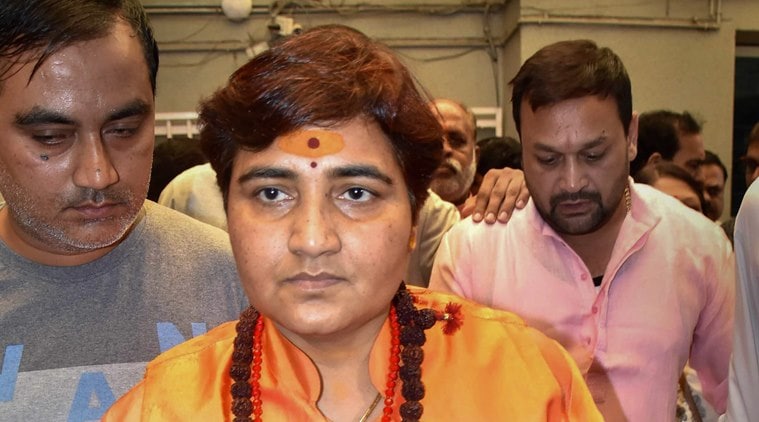
Her 10-year-old body had taken the maximum impact of military grade RDX, ammonium and nitrate radicals packed into a golden LML Freedom motorbike parked right at the curve of Malegaon’s Bhikku Chowk. The bike and the conspiracy were later traced to Varachha, Surat, and to Pragyasingh Chandrapalsingh Thakur. Thakur is now Sadhvi Pragya, the saffron of her robes dominating the BJP’s Lok Sabha poll campaign in Bhopal, with the party pitting her against the Congress’s Digvijaya Singh.
Over a decade after the blasts, Farheen’s father Shaikh Liyaqat Mohiudeen, 60, clings on to memories of his little daughter, the youngest of his five children. Mohiudeen, a truck driver, says he always returned home from work to an excited Farheen. Once home, the two always had their ritual. “She would be thrilled to see me return… hear my stories from the road, and then take me out to the chowk to eat tikkis,” he recalls. Evenings were reserved for walking through Malegaon, sitting at the chowk’s tea stall, or picking bangles from the shops that Farheen thought made Malegaon shimmer at night.
Advertising
malegaon blast 2008, malegaon blast 2008 victims, malegaon blast 2008 victim parents, pragya thakur, sadhvi pragya thakur, malegaon blast pragya thakur, pragya thakur elections, pragya thakur polls, indian express newsMohiudeen and Farida say they can still hear the sound of the blast that killed her. (Express photo: Mubasshir Mushtaq)
Farheen’s mother Farida, 48, says she has often caught Mohiudeen pulling out Farheen’s photograph — taken in school after she won a scholarship — from his pocket and talking to her. At least he had found a way to deal with his grief, she says. She still hasn’t. “Ma hoon uski. Kitna pyaar karte the… aapko kaise samjhayen? Khelti chalti bachchi thi humaari…aur woh ekdum chidiya ki tarah gurr se ud gayi (I am her mother, how do I tell you how much we loved her? She was a playful child and suddenly, she flew away like a bird).”
On October 7, 2008, at the peak of the ATS investigation, when a team had called on Thakur’s address in Surat, it was a photograph of the dead Farheen and the final post-mortem report that sat on the desk of Hemant Karkare, who led the probe.
Officers who assisted the late ATS chief recall an upset Karkare — himself a father to two girls — having returned from the blast site, moved and shaken by the photograph. The forensic report detailed the nature of her splinter injuries, with nothing except her face intact.
“In every probe briefing, he started with specific case studies of victims. Farheen was always remembered. He spoke of how we can never face Pakistan in peace negotiations if such barbaric attacks are done on Muslims inside our own borders,” says a Maharashtra Police officer from the 2008 investigation team.
Around 9.30 pm on September 29, 2008, the Shaikhs had been getting ready to break their Ramzan fast — and the only item missing was Farheen’s favourite, the tikkis made by the corner store chacha. It was the penultimate night before Eid-ul-Fitr. She decided to run the errand.
That night was Shabe-Qadr — a period that is said to mark Prophet Mohammed receiving the first verses of the Quran – and mosques in Malegaon were reciting the Tarawih prayer. That meant that the crowd of worshippers from the three corners of Bhikku Chowk — the Qasab Bada Masjid in the north, the Noorani Masjid in the south, and Nayapura Ahle-Hadith Masjid in the east — were still inside when the IED exploded.
The planters had evidently not factored in the extended prayer schedule or the dates in the Ramzan calendar. They had timed the bomb for it to set off around 9.30 pm when, they thought, Bhikku Chowk and its tea stalls would be the most crowded.

Seven persons were killed and 101 injured. Locals confirm the casualties would have escalated had the blast taken place anytime later, after the crowd from Noorani Masjid, Malegaon’s biggest, had spilled out.
Transcripts of alleged phone conversations between Thakur and ‘planter’ Ramji Kalsangra — produced in court in October 2018 — seem to indicate she had expected the casualty figure to be higher: “You had calculated many would die when you went there!” she chides Kalsangra, according to the transcripts.
That night, back at the Shaikh home, the tikkis never came. The first to hit the Shaikhs was a huge squall of dust. Their roof, a mere 50 metres from the blast site, couldn’t take the impact. The silence that followed the blast was even louder. Then the noises started. It had been 15 minutes since the explosion and Farheen hadn’t returned. Mohiudeen recalls he didn’t have the courage to look for her: “Ek ajeeb si ghabrahat chalu ho gayi… (A strange fear began stirring inside me).”
He hoped Farheen was hiding around the tea stall and assured his wife she must be safe. Next, they heard police firing and the wails following a stampede. Farida had to wait till late night, before someone told her a girl’s body lay covered at Faran Hospital. She says she still recalls the first time she heard the words: “Asmani rang ka kapda pehni hui? Woh bachchi toh nikal chuki hai (The girl in the sky blue dress? She is dead)”.
“Till date, the sound of the explosion booms in my ears. I can hear it when I want,” she says.
That night, just before she had rushed out, Farheen had draped a new purchase — her first dupatta, gifted by her father — and stopped to admire herself in the mirror. Farheen’s elder sister Farzana recalls how Farheen would always yank the dupatta off her mother and sisters and run with the breeze across the streets.
The whole evening, Farheen had bragged how her “gulabi rang ka dupatta” would make her look the most radiant on the night of Eid, recalls Farzana. Farheen was buried on October 1, the day of Eid-ul-Fitr.
At the hospital, Farida was not allowed to see anything beyond Farheen’s face. “They told me I would not be able to see anything else… I returned home,” she says.
At Faran Hospital in Malegaon, Dr Saeed Farani, who deposed before the NIA court on December 6, 2018, doesn’t recall Farheen. “I would have if she had been brought alive… Our focus that night was to attend to those who had hope.”
In the 2006 blasts in Malegaon, his 25-bed hospital had seen 173 patients; in 2008, 100 patients. Around 56 of the injured had serious splinter injuries.
“The bodies of 2006 and 2008 had similar injuries — huge, irregular metal pieces entering the body. Those were high-velocity wounds, like gun shots, but all over the body… the kind that tear the person, puncture the organs and basically leave nothing…”
Mohiudeen, who brought Farheen’s body home, recalls how it had then seemed like a cruel joke that she had to be brought back dead from hospital. “Farheen wanted to be a doctor,” he says. “She always said I wouldn’t need to drive my truck once she became a doctor. When she was not helping her mother or tending to goats, Farheen was always studying. Of my five children, she was the brightest.”
Farida talks about Farheen’s love for the stethoscope, how the “ziddi” girl would follow the neighbourhood “doctorni” around and write “prescriptions”. “We always thought she would achieve something, become famous. Jitni badi nahin thi utni badi baaten kar leti thi (She was small, but had big dreams),” she says.
The family says Farheen’s death brought Mohiudeen illnesses that never left him — a bypass in 2014 and a recurring tuberculosis have left his body broken. Yet, he goes to Bada Qabristan every Friday to recite fatihah (prayer) at the grave of his daughter, after offering namaz at Hamidiya Masjid inside the Bada Qabristan.
“We still have faith in the Indian judiciary… it’s our only hope,” he says. Then, without naming Thakur, he adds, “She will not win. I am 100 per cent sure. She cursed Karkare. Sitting in Malegaon, 500 km from her, I have cursed her. So have families of the other victims. I am a truck driver whose daughter she robbed. The curse of an oppressed is always stronger than that of a saint. In any religion.”
  Every year, the family distributes biryani to the poor on September 29, and Mohiudeen spends several evenings buying tikkis to the many Farheens who play outside his doorstep. Bhikku Chowk is now called ‘Hemant Karkare Chowk’ and the clock at the shop outside which Farheen died is stuck at 9.33.


India's Terror Accused Mimics Pakistani Counterpart - Hafiz Saeed took the political party route, not to be left behind Pragya Thakur is trying with help of BJP

Hafiz Saeed, the mastermind of 2008 Bombay terror attacks, set up a political party that contested national elections; Using that model, BJP has officially fielded terror accused Pragya Thakur to fight parliamentary elections

May 11, 2019

India: BJP’s move to field Pragya Thakur in Bhopal underlines an ominous political paradigm shift - normalisation of violence

The Indian Express

BJP’s move to field Pragya Thakur in Bhopal underlines an ominous political paradigm shift

How do we explain the shift in democratic politics when those arrested on charges of terrorism and out on bail are now beginning to contest elections? What sort of a moral force are they able to wield?

Sadhvi Pragya, Malegaon Blast, Malegaon Blast 2008, Sadhvi Pragya Malegaon blast, Malegao blast probe, sadhvi pragya elections, Lok Sabha elections 2019, Decision 2019, election news
Thakur’s campaign has claimed that her fight is against the “conspiracy to insult Hindu religion,” against those who “give a bad name to the entire country,” who “insult(ed) a woman, a sadhvi, and a patriot,” who put her in jail “illegally and tortured (her) physically, mentally and in every way”. (Source: PTI/File)
Democracy, while a robust political form, is one whose actual mechanisms might not necessarily be about principle-driven behaviour or perfection of governance. High levels of corruption, political violence, the entry of criminals into Parliament, are examples pertinent to many democracies today. In India, mafia leaders and those accused of gruesome crimes have chosen to contest elections with the aim of converting their catalogue of criminality into something more respectable.
Despite such muddied waters, elections in India had until now remained essentially separated from at least some varieties of public violence and those accused of it. Terrorism and terror-related offences are examples of violence that were still considered to weaken, not aid, access to power. Designating certain forms of violence as terrorism, bombings on civilians included, is done not simply on the basis of the idea that they are attacks on the government or law enforcement, but also on the basis of a belief that the state and its institutions cannot provide implicit or explicit cooperation to such violence undertaken by sub-national groups against non-combatant targets. If so, how do we explain the shift in democratic politics when those arrested on charges of terrorism and out on bail are now beginning to contest elections? What sort of a moral force are they able to wield?
One striking example in the 2019 general election is the candidature of Pragya Singh Thakur. According to the FIR prepared by Hemant Karkare in the 2008 Malegaon case, she took part in the Bhopal meeting of Abhinav Bharat where Himani Savarkar (the daughter of Gopal Godse) became president of the organisation and in the course of which the accused “conspired together to take revenge against Muslims in Malegaon by exploding a bomb at a thickly populated area. Accused (Lt. Colonel) Purohit took the responsibility of providing explosives. Accused Pragya Singh Thakur took the responsibility of providing men for the explosion. In this meeting all the participants agreed and consented to commit the explosion at Malegaon.” On June 11, 2008, Thakur allegedly introduced Ramchandra Kalasangra and Sandip Dange to Amritananda Dev Tirtha, another accused, as two reliable persons who would plant the bomb in Malegaon. In early July, she allegedly asked Tirtha to direct Purohit “to give explosives” to Kalsangra and Dange in Pune.
After the blast, another member of Abhinav Bharat, Major Ramesh Upadhyay, a former defence services officer, was arrested. He admitted that he had taken part in three meetings with Thakur and other accomplices on the Bhonsala Military School, Nashik premises to plan the Malegaon blast. Ajay Misar, the public prosecutor, declared: “Upadhyay, who was posted in the artillery department while working with the Indian military, is suspected to have guided the arrested accused on how to assemble a bomb and procure RDX.” Today, Upadhyay is the Hindu Mahasabha candidate from Ballia and another accused mentioned in Karkare’s FIR, Sudhakar Chaturvedi, is contesting as an independent in Mirzapur.

Thakur, on bail for medical reasons, is currently under trial for several terrorism-related charges under the Unlawful Activities (Prevention) Act. Her entry in electoral politics under the aegis of the BJP underlines striking shifts in India’s democracy. First, it points to the widening of the already rich assortment of candidates who are accused of criminal offences. What this means is not that even the murkiest forms of criminality simply have become more acceptable, but that its expansion occurs more or less in tandem with the eroding legitimacy of public office, severance of trust reposed in elected representatives, and the elevation of ethnic and religious persecution.
Second, it is also a comment on the Hindu nationalists. The use and normalisation of various forms of violence —
riots, demolition of the Babri Masjid, vigilantism etc — has cemented not just their electoral and ideological position, but also turned the brutal hostility against minorities into a routine affair. However, the extent to which the Hindu nationalist old guard would have gone to support those accused of terrorism is less straightforward. Even as its own campaign is designed around “national security”, the current BJP leadership’s encouragement to Thakur, her comment on cursing ATS chief Hemant Karkare to death, all convey less about their ideas of democracy than about the way in which they have contributed to the decline of basic social etiquette and political norms of a diverse society.
Third, one of their tactics in the pursuit of such politics is to claim victimhood. Thakur’s campaign has claimed that her fight is against the “conspiracy to insult Hindu religion,” against those who “give a bad name to the entire country,” who “insult(ed) a woman, a sadhvi, and a patriot,” who put her in jail “illegally and tortured (her) physically, mentally and in every way”. While the Human Rights Commission that probed into her allegations of torture in August 2014 had to close the case because it could not find any evidence, the discourse of victimisation reflects an attempt at legitimising majoritarian backlash and suggests a perversion of the language of the law and liberalism. It is perverse not simply in the sense that fact checking might be compromised or in the sense of embarrassing those in whose name they seem to be fighting. But most importantly, it is perverse in the sense that convenience and malleability of victimhood have regularly begun to shape political and ideological agendas.
Finally, the electoral arithmetic that has informed Thakur’s entry in politics accompanies deep institutional malaise. A decade since the bombings, people know little about the perpetrators. What does the state make of the “evidences”, the “FIRs”, and the lists of “prime accused”? The NIA, judiciary, police, and government represent aspects of state power: How do they justify the power they wield in the absence of any commitment to security and justice for its citizens?
The implications seem to be that the more deadly the crimes people are associated with, higher are their chances for a career in politics; the more the business of elections relies on crime, the more is the depreciation of any meaningful claims of being a democracy; the more the electorate assimilates this as banal and logical, the more they deprive themselves of the means of justice.
This article first appeared in the print edition on May 11, 2019, under the title ‘The Sadhvi portent’. Jaffrelot is senior research fellow at CERI-Sciences Po/CNRS, Paris, and professor at King’s India Institute, London. Maheshwari is assistant professor of political science at Ashoka University

May 09, 2019

India: Malegaon’s wanted, linked to Pragya, held bomb training camps


Malegaon’s wanted, linked to Pragya, held bomb training camps: Gauri Lankesh probe SIT to court

In the 2008 Malegaon blasts case, Pragya Singh Thakur, the BJP’s Bhopal Lok Sabha candidate, is an accused along with 13 others, including two missing Abhinav Bharat members, Ramji Kalsangra and Sandeep Dange, who have been declared “proclaimed offenders”.

Amit Shah, Shivraj Singh Chouhan and Pragya Singh Thakur at a roadshow in Bhopal on Wednesday. PTI
Four missing members of Hindutva outfit Abhinav Bharat, all wanted for blasts in the Samjhauta Express, Mecca Masjid, Ajmer Dargah and Malegaon between 2006 and 2008, trained several suspects linked to the Sanatan Sanstha in making bombs at secret training camps across the country between 2011-2016, the investigation by the Karnataka Police into the murder of journalist Gauri Lankesh has revealed. This disclosure is part of documents submitted by the SIT to a Bengaluru court.
In the 2008 Malegaon blasts case, Pragya Singh Thakur, the BJP’s Bhopal Lok Sabha candidate, is an accused along with 13 others, including two missing Abhinav Bharat members, Ramji Kalsangra and Sandeep Dange, who have been declared “proclaimed offenders”.
According to documents submitted in court by the Karnataka SIT probing the Lankesh case, three men linked to Sanatan Sanstha, and arrested in the Lankesh murder case, and four witnesses, who attended the training camps, described the presence of a “Babaji” and four “Gurujis” at the camps where training was given in making bombs.
The “Babaji” was identified after his arrest in November 2018 — 11 years after he went into hiding — in Gujarat as Suresh Nair, an Abhinav Bharat member accused in the 2007 Ajmer dargah blast case.
Nair’s arrest has also revealed that the three other bomb experts at Sanstha-linked camps were Dange, Kalsangara and Ashwini Chauhan — all “proclaimed offenders” in the Samjhauta Express case and four other blast cases, said sources.
A fifth trainer who attended the camps has been identified by those arrested in the Lankesh case as Prathap Hazra, who is linked to the Hindutva outfit Bhavani Sena of West Bengal.
Links between missing suspects from bombings tied to Abhinav Bharat between 2006 and 2008, which killed 117 people, and the members of a group associated with the Lankesh murder have unravelled in recent months in the course of the SIT probe.
Based on descriptions provided by those arrested in the Lankesh case and witnesses who saw the “bomb experts”, sketches of the “guest trainers” were prepared by the SIT and their possible locations were identified through technical analysis.
And on the information provided by the SIT, Nair, who police believe was “Babaji” in the training camps was arrested by the Gujarat ATS in Bharuch in November 2018. When Nair was shown portraits of the other trainers at camps, he identified them as Dange, Kalsangara and Amit Hakla alias Ashwini Chauhan, said sources.
Dange, a former RSS worker who is considered a bomb expert and has an Interpol red corner notice against him, is on the most wanted list of the NIA with Kalsangara and Hakla. Dange and Kalsangara carry a Rs 10 lakh reward on their heads while Hakla carries a Rs 5 lakh reward on his head.
Following Nair’s arrest, NIA sources said Dange and Kalsangara were still hiding in India and that efforts were on to arrest them.
The descriptions for “Babaji” were provided in the course of the Lankesh case probe by three arrested men Shrikant Pangarkar, 40, a former Shiv Senacouncillor from Maharashtra, Sharad Kalaskar, 26, who is also the alleged shooter in the 2013 Narendra Dabholkar murder case, and Vasudev Suryavanshi, 29, a mechanic who allegedly stole motorcycles for a series of Sanatan linked murders of rationalists and free thinkers between 2015 and 2017.
The SIT has found that 19 training camps were organised by the Sanatan Sanstha linked group in the usage of firearms, improvised explosive devices and subterfuge tactics across India between 2011 and 2017 with the five IED experts attending five of the camps in Maharashtra, Gujarat and Karnataka as “guest trainers”.
According to statements provided by suspects and witnesses in the Lankesh case, some trainers like “Babaji” moved around in the garb of monks. Each trainer, sources said, had his own area of expertise ranging from petrol bombs to sophisticated pipe bombs with electrical circuits – on the lines of mobile phone triggered IEDs used in some of the blasts that occurred between 2006-08.
Giving descriptions of four trainers who he saw at IED camps held at Ahmedabad and Mangalore, an accused in the Lankesh case described them as “Babaji Sir”, “Circuit Expert Sir”, “Bengali” and “Lambu Sir”.’ Another suspect describes two trainers at another camp in Jalna as “Babaji” and “Guruji”.
According to the case documents the camps provided training to dozens of people recruited by a covert unit of the Sanatan Sanstha linked to the murders of the rationalist Dabholkar, leftist thinker Govind Pansare, Kannada scholar M M Kalburgi and Gauri Lankesh.
The suspects in the Lankesh and other murder cases who attended the IED training camps are Amit Degwekar, Kalaskar, Pangarkar, Suryavanshi, Ganesh Miskin, Amit Baddi and Bharat Kurne. Four men who were part of the group – currently considered witnesses in the Lankesh case – also attended some of the camps.
As many as five “training camps” – Jalna in 2011, Jalna in January 2015, Mangalore in August 2015, Ahmedabad in November 2015 and Nasik in January 2016 – were held by suspects from Abhinav Bharat, the SIT investigation has revealed.