|
Showing posts with label Pragya Singh Thakur. Show all posts

May 26, 2019

India: Disciples of Savarkar, LK Advani, Nathu Ram Godse, Pragya Singh Thakur ... the list is long


May 12, 2019

India's Terror Accused Mimics Pakistani Counterpart - Hafiz Saeed took the political party route, not to be left behind Pragya Thakur is trying with help of BJP

Hafiz Saeed, the mastermind of 2008 Bombay terror attacks, set up a political party that contested national elections; Using that model, BJP has officially fielded terror accused Pragya Thakur to fight parliamentary elections

May 11, 2019

India: BJP’s move to field Pragya Thakur in Bhopal underlines an ominous political paradigm shift - normalisation of violence

The Indian Express

BJP’s move to field Pragya Thakur in Bhopal underlines an ominous political paradigm shift

How do we explain the shift in democratic politics when those arrested on charges of terrorism and out on bail are now beginning to contest elections? What sort of a moral force are they able to wield?

Sadhvi Pragya, Malegaon Blast, Malegaon Blast 2008, Sadhvi Pragya Malegaon blast, Malegao blast probe, sadhvi pragya elections, Lok Sabha elections 2019, Decision 2019, election news
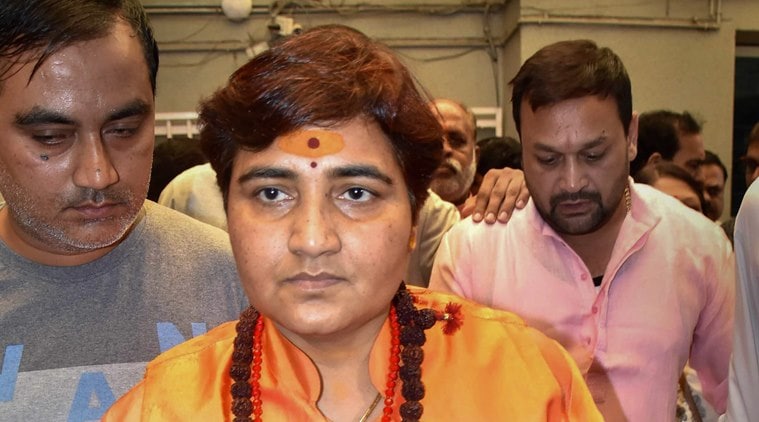
Thakur’s campaign has claimed that her fight is against the “conspiracy to insult Hindu religion,” against those who “give a bad name to the entire country,” who “insult(ed) a woman, a sadhvi, and a patriot,” who put her in jail “illegally and tortured (her) physically, mentally and in every way”. (Source: PTI/File)
Democracy, while a robust political form, is one whose actual mechanisms might not necessarily be about principle-driven behaviour or perfection of governance. High levels of corruption, political violence, the entry of criminals into Parliament, are examples pertinent to many democracies today. In India, mafia leaders and those accused of gruesome crimes have chosen to contest elections with the aim of converting their catalogue of criminality into something more respectable.
Despite such muddied waters, elections in India had until now remained essentially separated from at least some varieties of public violence and those accused of it. Terrorism and terror-related offences are examples of violence that were still considered to weaken, not aid, access to power. Designating certain forms of violence as terrorism, bombings on civilians included, is done not simply on the basis of the idea that they are attacks on the government or law enforcement, but also on the basis of a belief that the state and its institutions cannot provide implicit or explicit cooperation to such violence undertaken by sub-national groups against non-combatant targets. If so, how do we explain the shift in democratic politics when those arrested on charges of terrorism and out on bail are now beginning to contest elections? What sort of a moral force are they able to wield?
One striking example in the 2019 general election is the candidature of Pragya Singh Thakur. According to the FIR prepared by Hemant Karkare in the 2008 Malegaon case, she took part in the Bhopal meeting of Abhinav Bharat where Himani Savarkar (the daughter of Gopal Godse) became president of the organisation and in the course of which the accused “conspired together to take revenge against Muslims in Malegaon by exploding a bomb at a thickly populated area. Accused (Lt. Colonel) Purohit took the responsibility of providing explosives. Accused Pragya Singh Thakur took the responsibility of providing men for the explosion. In this meeting all the participants agreed and consented to commit the explosion at Malegaon.” On June 11, 2008, Thakur allegedly introduced Ramchandra Kalasangra and Sandip Dange to Amritananda Dev Tirtha, another accused, as two reliable persons who would plant the bomb in Malegaon. In early July, she allegedly asked Tirtha to direct Purohit “to give explosives” to Kalsangra and Dange in Pune.
After the blast, another member of Abhinav Bharat, Major Ramesh Upadhyay, a former defence services officer, was arrested. He admitted that he had taken part in three meetings with Thakur and other accomplices on the Bhonsala Military School, Nashik premises to plan the Malegaon blast. Ajay Misar, the public prosecutor, declared: “Upadhyay, who was posted in the artillery department while working with the Indian military, is suspected to have guided the arrested accused on how to assemble a bomb and procure RDX.” Today, Upadhyay is the Hindu Mahasabha candidate from Ballia and another accused mentioned in Karkare’s FIR, Sudhakar Chaturvedi, is contesting as an independent in Mirzapur.

Thakur, on bail for medical reasons, is currently under trial for several terrorism-related charges under the Unlawful Activities (Prevention) Act. Her entry in electoral politics under the aegis of the BJP underlines striking shifts in India’s democracy. First, it points to the widening of the already rich assortment of candidates who are accused of criminal offences. What this means is not that even the murkiest forms of criminality simply have become more acceptable, but that its expansion occurs more or less in tandem with the eroding legitimacy of public office, severance of trust reposed in elected representatives, and the elevation of ethnic and religious persecution.
Second, it is also a comment on the Hindu nationalists. The use and normalisation of various forms of violence —
riots, demolition of the Babri Masjid, vigilantism etc — has cemented not just their electoral and ideological position, but also turned the brutal hostility against minorities into a routine affair. However, the extent to which the Hindu nationalist old guard would have gone to support those accused of terrorism is less straightforward. Even as its own campaign is designed around “national security”, the current BJP leadership’s encouragement to Thakur, her comment on cursing ATS chief Hemant Karkare to death, all convey less about their ideas of democracy than about the way in which they have contributed to the decline of basic social etiquette and political norms of a diverse society.
Third, one of their tactics in the pursuit of such politics is to claim victimhood. Thakur’s campaign has claimed that her fight is against the “conspiracy to insult Hindu religion,” against those who “give a bad name to the entire country,” who “insult(ed) a woman, a sadhvi, and a patriot,” who put her in jail “illegally and tortured (her) physically, mentally and in every way”. While the Human Rights Commission that probed into her allegations of torture in August 2014 had to close the case because it could not find any evidence, the discourse of victimisation reflects an attempt at legitimising majoritarian backlash and suggests a perversion of the language of the law and liberalism. It is perverse not simply in the sense that fact checking might be compromised or in the sense of embarrassing those in whose name they seem to be fighting. But most importantly, it is perverse in the sense that convenience and malleability of victimhood have regularly begun to shape political and ideological agendas.
Finally, the electoral arithmetic that has informed Thakur’s entry in politics accompanies deep institutional malaise. A decade since the bombings, people know little about the perpetrators. What does the state make of the “evidences”, the “FIRs”, and the lists of “prime accused”? The NIA, judiciary, police, and government represent aspects of state power: How do they justify the power they wield in the absence of any commitment to security and justice for its citizens?
The implications seem to be that the more deadly the crimes people are associated with, higher are their chances for a career in politics; the more the business of elections relies on crime, the more is the depreciation of any meaningful claims of being a democracy; the more the electorate assimilates this as banal and logical, the more they deprive themselves of the means of justice.
This article first appeared in the print edition on May 11, 2019, under the title ‘The Sadhvi portent’. Jaffrelot is senior research fellow at CERI-Sciences Po/CNRS, Paris, and professor at King’s India Institute, London. Maheshwari is assistant professor of political science at Ashoka University

May 09, 2019

India: Malegaon’s wanted, linked to Pragya, held bomb training camps


Malegaon’s wanted, linked to Pragya, held bomb training camps: Gauri Lankesh probe SIT to court

In the 2008 Malegaon blasts case, Pragya Singh Thakur, the BJP’s Bhopal Lok Sabha candidate, is an accused along with 13 others, including two missing Abhinav Bharat members, Ramji Kalsangra and Sandeep Dange, who have been declared “proclaimed offenders”.

Amit Shah, Shivraj Singh Chouhan and Pragya Singh Thakur at a roadshow in Bhopal on Wednesday. PTI
Four missing members of Hindutva outfit Abhinav Bharat, all wanted for blasts in the Samjhauta Express, Mecca Masjid, Ajmer Dargah and Malegaon between 2006 and 2008, trained several suspects linked to the Sanatan Sanstha in making bombs at secret training camps across the country between 2011-2016, the investigation by the Karnataka Police into the murder of journalist Gauri Lankesh has revealed. This disclosure is part of documents submitted by the SIT to a Bengaluru court.
In the 2008 Malegaon blasts case, Pragya Singh Thakur, the BJP’s Bhopal Lok Sabha candidate, is an accused along with 13 others, including two missing Abhinav Bharat members, Ramji Kalsangra and Sandeep Dange, who have been declared “proclaimed offenders”.
According to documents submitted in court by the Karnataka SIT probing the Lankesh case, three men linked to Sanatan Sanstha, and arrested in the Lankesh murder case, and four witnesses, who attended the training camps, described the presence of a “Babaji” and four “Gurujis” at the camps where training was given in making bombs.
The “Babaji” was identified after his arrest in November 2018 — 11 years after he went into hiding — in Gujarat as Suresh Nair, an Abhinav Bharat member accused in the 2007 Ajmer dargah blast case.
Nair’s arrest has also revealed that the three other bomb experts at Sanstha-linked camps were Dange, Kalsangara and Ashwini Chauhan — all “proclaimed offenders” in the Samjhauta Express case and four other blast cases, said sources.
A fifth trainer who attended the camps has been identified by those arrested in the Lankesh case as Prathap Hazra, who is linked to the Hindutva outfit Bhavani Sena of West Bengal.
Links between missing suspects from bombings tied to Abhinav Bharat between 2006 and 2008, which killed 117 people, and the members of a group associated with the Lankesh murder have unravelled in recent months in the course of the SIT probe.
Based on descriptions provided by those arrested in the Lankesh case and witnesses who saw the “bomb experts”, sketches of the “guest trainers” were prepared by the SIT and their possible locations were identified through technical analysis.
And on the information provided by the SIT, Nair, who police believe was “Babaji” in the training camps was arrested by the Gujarat ATS in Bharuch in November 2018. When Nair was shown portraits of the other trainers at camps, he identified them as Dange, Kalsangara and Amit Hakla alias Ashwini Chauhan, said sources.
Dange, a former RSS worker who is considered a bomb expert and has an Interpol red corner notice against him, is on the most wanted list of the NIA with Kalsangara and Hakla. Dange and Kalsangara carry a Rs 10 lakh reward on their heads while Hakla carries a Rs 5 lakh reward on his head.
Following Nair’s arrest, NIA sources said Dange and Kalsangara were still hiding in India and that efforts were on to arrest them.
The descriptions for “Babaji” were provided in the course of the Lankesh case probe by three arrested men Shrikant Pangarkar, 40, a former Shiv Senacouncillor from Maharashtra, Sharad Kalaskar, 26, who is also the alleged shooter in the 2013 Narendra Dabholkar murder case, and Vasudev Suryavanshi, 29, a mechanic who allegedly stole motorcycles for a series of Sanatan linked murders of rationalists and free thinkers between 2015 and 2017.
The SIT has found that 19 training camps were organised by the Sanatan Sanstha linked group in the usage of firearms, improvised explosive devices and subterfuge tactics across India between 2011 and 2017 with the five IED experts attending five of the camps in Maharashtra, Gujarat and Karnataka as “guest trainers”.
According to statements provided by suspects and witnesses in the Lankesh case, some trainers like “Babaji” moved around in the garb of monks. Each trainer, sources said, had his own area of expertise ranging from petrol bombs to sophisticated pipe bombs with electrical circuits – on the lines of mobile phone triggered IEDs used in some of the blasts that occurred between 2006-08.
Giving descriptions of four trainers who he saw at IED camps held at Ahmedabad and Mangalore, an accused in the Lankesh case described them as “Babaji Sir”, “Circuit Expert Sir”, “Bengali” and “Lambu Sir”.’ Another suspect describes two trainers at another camp in Jalna as “Babaji” and “Guruji”.
According to the case documents the camps provided training to dozens of people recruited by a covert unit of the Sanatan Sanstha linked to the murders of the rationalist Dabholkar, leftist thinker Govind Pansare, Kannada scholar M M Kalburgi and Gauri Lankesh.
The suspects in the Lankesh and other murder cases who attended the IED training camps are Amit Degwekar, Kalaskar, Pangarkar, Suryavanshi, Ganesh Miskin, Amit Baddi and Bharat Kurne. Four men who were part of the group – currently considered witnesses in the Lankesh case – also attended some of the camps.
As many as five “training camps” – Jalna in 2011, Jalna in January 2015, Mangalore in August 2015, Ahmedabad in November 2015 and Nasik in January 2016 – were held by suspects from Abhinav Bharat, the SIT investigation has revealed.

May 05, 2019

Hindi Article on Pragya Thakur as BJP Lok Sabha Candidate


प्रज्ञा ठाकुर चुनाव में: भविष्य का संकेत -राम पुनियानी सन 2019 के आम चुनाव में शासक दल भाजपा द्वारा निहायत संकीर्ण और सांप्रदायिक मुद्दे उछाले जा रहे हैं. नागरिकता विधेयक, कब्रिस्तान, वंदेमातरम्, छद्म राष्ट्रवाद आदि जैसे भड़काऊ मुद्दों का इस्तेमाल करने के अलावा, भाजपा ने भोपाल संसदीय क्षेत्र से प्रज्ञा ठाकुर को अपना उम्मीदवार बनाया है. प्रज्ञा कई आतंकी मामलों में मुख्य आरोपी हैं, जिनमें मालेगांव, अजमेर, मक्का मस्जिद और समझौता एक्सप्रेस प्रकरण शामिल हैं. इन सभी घटनाओं में कई लोग मारे गए थे और सैंकड़ों घायल हुए थे. भाजपा में शामिल होने और भोपाल से पार्टी उम्मीदवार घोषित होने के बाद, प्रज्ञा ने कई ऐसी बातें कहीं हैं जो चिंतित करने वालीं तो हैं हीं, वरन उनसे प्रज्ञा और भाजपा की मानसिकता का पता भी चलता है. यहाँ, उनके विरुद्ध जो आरोप हैं, उनका विवरण देना उचित होगा. सन 2008 में मालेगांव में हुए बम धमाके, जिसमें छह लोग मारे गए थे, की जांच के दौरान, महाराष्ट्र पुलि स के आतंकवाद-निरोधक दस्ते के तत्कालीन प्रमुख हेमंत करकरे को एक महत्वपूर्ण सुराग मिला. बम धमाके में जिस मोटरसाइकिल का इस्तेमाल किया गया था, उसके चेसिस नंबर के आधार पर पता चला कि वह प्रज्ञा ठाकुर के नाम पर पंजीकृत थी. इसके बाद, आगे जांच हुई, जिसके आधार पर लेफ्टिनेंट कर्नल पुरोहित, मेजर उपाध्याय, स्वामी दयानंद पाण्डेय और स्वामी असीमानंद आदि को गिरफ्तार किया गया. अत्यंत सूक्ष्मता से की गयी जांच और लेपटॉपों में उपलब्ध सामग्री और आरोपियों की आपसी बातचीत के अध्ययन से यह पता चला कि मालेगांव धमाके एक बड़े षड़यंत्र का हिस्सा थे, जिसमें शामिल लोगों का आरएसएस से किसी न किसी तरह का जुड़ाव था. इनमें से सबसे महत्वपूर्ण सबूत था स्वामी असीमानंद का इकबालिया बयान. एक न्यायिक मजिस्ट्रेट के समक्ष दिए गए अपने बयान, जो विधिक दृष्टि से पूर्णतः स्वीकार्य था, में असीमानंद ने पूरे षड़यंत्र का खुलासा किया. सन 2014 में, भाजपा के नेतृत्व में, एनडीए की सरकार के केंद्र में सत्ता में आने के बाद, राष्ट्रीय जांच एजेंसी (एनआईए) का इन मामलों में रुख बदल गया. इसका सबसे बड़ा सबूत था सम्बंधित सरकारी वकील रोहिणी सालियन का बयान, जिसमें उन्होंने स्पष्ट कहा कि उन्हें इन मामलों को हलके ढंग से लेने के लिया कहा गया है. उन्होंने ऐसा करने से इंकार कर दिया, जिसके बाद ये मामले उनसे वापस ले लिए गए. प्रज्ञा के मामले में एनआईए ने 2016 में अदालत में आरोपपत्र पेश किया, जिसमें उन्हें क्लीनचिट देते हुए कहा गया कि उन्हें स्तन कैंसर है और वे बिना सहारे के चल भी नहीं पातीं हैं. अदालत ने एनआईए के निष्कर्ष को स्वीकार नहीं किया और प्रज्ञा के खिलाफ आरोप तय कर दिए. उन्हें केवल और केवल बीमारी के आधार पर जमानत दी गयी. अदालत ने कभी यह नहीं कहा कि वे निर्दोष हैं. अतः, तथ्यात्मक स्थिति यह है कि वे आतंकवाद के प्रकरण में आरोपी हैं और बीमारी के आधार पर जमानत पर हैं. भोपाल से उन्हें भाजपा का उम्मीदवार घोषित किये जाने के बाद उन्होंने कहा कि हेमंत करकरे की मौत उनके श्राप के कारण हुई थी. करकरे की मौत, 27/11 2008 को मुंबई पर पाकिस्तान द्वारा प्रायोजित आतंकी हमले में हुई थी. करकरे एक साहसी पुलिस अधिकारी थे और सड़क पर आतंकियों से मुकाबला करते हुए उनकी गोलियों से मारे गए थे. प्रज्ञा का बयान एक ऐसे शहीद का घोर अपमान है जो अपने कर्त्तव्य के पालन में देश की रक्षा करते हुए मारा गया. बाद में प्रज्ञा ने यह कहते हुए अपना बयान वापस ले लिया कि इससे देश के दुश्मनों को लाभ होगा! कुछ लोगों ने बिलकुल सही कहा है कि अगर प्रज्ञा के श्राप में इतनी ही शक्ति है तो उन्होंने पाकिस्तान में बैठे आतंकियों के आकाओं को श्राप क्यों नहीं दिया. प्रज्ञा का यह भी कहना है कि उन्हें करकरे ने यातनाएं दी थीं और इसलिए उन्होंने करकरे को श्राप दिया. यह सफ़ेद झूठ है. राष्ट्रीय मानवाधिकार आयोग ने यातना सम्बन्धी उनकी शिकायत की जांच की थी और उसे झूठ पाया था. करकरे को किसी को यातना देने की ज़रुरत नहीं थी क्योंकि उन्होंने मज़बूत साक्ष्य इकठ्ठा कर लिए थे. करकरे के बारे में प्रज्ञा की अपमानजनक और बेहूदा टिप्पणी के बाद, अनेक पूर्व पुलिस अधिकारी, जो अपनी कर्तव्यनिष्ठा और ईमानदारी के लिए जाने जाते थे, करकरे के सम्मान की रक्षा के लिए आगे आये. इनमें जूलियो रिबेरो, प्रकाश सिंह और मीरन बोरवंकर शामिल हैं. अख़बारों में प्रकाशित अपने लेखों और टेलीविज़न साक्षात्कारों में उन्होंने जोर देकर कहा कि करकरे एक ईमानदार और साहसी अधिकारी थे, जो अपने काम पूरी तरह से पेशेवराना तरीके से करते थे. उनके जीवनकाल में भी कई हिंदुत्व नेताओं ने उन्हें देशद्रोही बताया था. नरेन्द्र मोदी ने प्रज्ञा को उम्मीदवार बनाने के अपनी पार्टी के निर्णय को सही ठहराते हुए फ़रमाया कि प्रज्ञा पर आतंकी हमले में शामिल होने का आरोप लगाना, पांच हज़ार साल पुरानी हिन्दू सभ्यता का अपमान है! प्रज्ञा हमारी सभ्यता के मूल्यों की प्रतिनिधि कब से बन गईं? भारत की सभ्यता समावेशी है और इस धरती की सभी परम्पराओं को आत्मसात करने वाली है. हमारी सभ्यता के प्रतिनिधि गौतम बुद्ध, भगवान महावीर, कबीर, गुरुनानक, निजामुद्दीन औलिया और गाँधी जैसे व्यक्तित्व हैं, जो प्रेम, शांति और सहिष्णुता की बात करते थे न कि प्रज्ञा जैसे लोग. प्रज्ञा का स्तन कैंसर भी एक रहस्य है. मुंबई के जेजे अस्पताल के डीन की अध्यक्षता में गठित एक मेडिकल बोर्ड ने यह पाया था कि वे किसी प्रकार के कैंसर से ग्रस्त नहीं थीं. उनके अनुसार, वे गौमूत्र और पंचगव्य (गाय के दूध, मूत्र, गोबर, दही और घी का मिश्रण) से अपने रोग से मुक्त हुईं हैं. इस तरह के बेसिरपैर के दावे, उस विचारधारा के अनुरूप ही हैं जिसकी वे अनुयायी हैं और जो सांप्रदायिक राष्ट्रवाद के अपने एजेंडे के तहत अंधश्रद्धा को बढ़ावा देती है. उनकी बीमारी तो रहस्य है ही, उसका इलाज भी उतना ही रहस्यपूर्ण है. प्रज्ञा ने यह दावा भी किया है कि वे बाबरी मस्जिद को ढहाने वाली टीम में शामिल थीं. चुनाव आयोग ने इस पर उन्हें एक नोटिस भी जारी किया है. यह बहुत अच्छी बात है कि वे अपना गुनाह क़ुबूल कर रही हैं. वे मालेगांव बम धमाका मामले में तो आरोपी हैं हीं, अब उन्होंने यह भी स्वीकार कर लिया है कि वे बाबरी विध्वंस में भी शामिल थीं. इस तरह के व्यक्ति को अपना उम्मीदवार बना कर भाजपा क्या साबित करना चाहती है? लगता है, अब उसने अपना हिन्दुत्ववादी एजेंडा पूरी तरह लागू करने का निर्णय ले लिया है. वाजपेयी जैसे नेताओं के काल में, भाजपा अपने इरादे छुपा कर रखती थी. अब वह अपना असली रंग दिखा रही है. यह साफ़ है कि वह विघटनकारी, हिंसक और संकीर्ण सांप्रदायिक विचारधारा में यकीन करती है. यह विचारधारा हमारे संविधान के मूल्यों के खिलाफ है तो हुआ करे. (अंग्रेजी से हिन्दी रूपांतरण अमरीश हरदेनिया) (

May 02, 2019

India: Pragya Thakur as BJP candidate - Portents for future - link to Ram Puniyani's article in The Citizen


https://www.thecitizen.in/index.php/en/NewsDetail/index/4/16839/Pragya-Thakur-for-Parliament-Her-Past-and-Portents-for-the-Future

April 29, 2019

India Ajmer priest has questions for BJP on the choice of Pragya Thakur

In Ajmer, nationalism ‘judge’ BJP faces questions on Pragya

"How can Narendra Modi, who rails at terrorism, field a terror accused in the Lok Sabha elections?" asks priest
Published 29.04.19

https://www.telegraphindia.com/india/in-ajmer-nationalism-judge-bjp-faces-questions-on-pragya/cid/1689632?ref=top-stories_home-template

April 28, 2019

Yogi Adityanath to Pragya Thakur . . . Savarkarite Hindutva getting normalised in BJP, India's ruling party

The Times of India

With Pragya Thakur in the fray, Hindutva no longer needs to wear a mask

April 28, 2019, 12:29 am IST in Bloody Mary | India | TOI
 
There’s an intriguing absence of outrage about the fact that an individual accused in a terror case is now the BJP’s Bhopal candidate. Pragya Thakur (‘Sadhvi’ to her followers) remains charged under UAPA, India’s main anti-terror law under which terrorism suspects are held. The announcement of her candidature was a media sensation — TV anchors rushed to record gushing interviews, channels are covering her campaign extensively. There’s little shock, no letter campaigns, almost no public protest by civil society groups. Either the middle class is by now numbed to extreme rightwing voices in politics, or silently endorses the advent of the Hindu Rashtra. The latter is more likely.
For the BJP to choose Thakur without waiting until she was cleared of terror charges signals a triumph of religious ideology over law and constitutional values. When PM Modi himself declared in Wardha that “never in history will you find Hindus involved in such (terror-related) activities”, he seemed confident that Pragya Thakur would only enhance BJP’s brand equity, not reduce it. Beyond a small protest in Mumbai over Thakur’s offensive comments on Maharashtra ATS chief Hemant Karkare, and a public condemnation from the IPS Association, there have been no protests over her. In fact, in times when the mainstream media regularly parades extremist religious voices, a right-wing terror accused as candidate can probably even be expected to create a frisson of excitement about a bold ‘New India’ rather than any anxiety about loss of democratic constitutional values.
A powerful sense of ‘Hindu victimhood’ and ‘Hindu grievance’, partly genuine, partly manufactured by media and politicians, lies behind the apparent public consent to figures like Thakur. Social media and WhatsApp are bombarding users with videos, fake news, memes and slogans about an imminent Islamic invasion of India. Any terror attack anywhere in the world, such as the recent Sri Lanka bombings, sends Hindu victimhood spiking upward with politicians and media quickly seizing the opportunity to widen religious differences and polarise the public. Hindu victimhood and sense of siege are not only encouraged by top leaders but also fanned by online and offline mobs.
On the ground, various militant senas, which seem to enjoy immunity from the law even in Congress-ruled states, fan ghettoisation of communities through violence, such as the Muzaffarnagar riots of 2013. Those who accuse the Congress of “minority appeasement” are practising their own appeasement of Hindutva radicals.
But then, this is the era of Hindutva unbound. In the 1990s, K N Govindacharya, hardline ideologue of the Sangh was banished from his post for referring to then PM Vajpayee as a “mukhota” or a mask for ideology. Today’s Modi-led BJP has no need for masks. Ideological core agendas are government priorities. Where Vajpayee was constrained to once remind an audience that he was a swayamsevak, Modi’s a proud former RSS pracharak and party president Amit Shah wears “vichardhaara” on his sleeve.
That this unapologetic Hindutva-ness has wide support is seen in the electoral wins the BJP has regularly notched up under the Modi-Shah leadership. Bollywood celebrities are readily endorsing the flamboyant mix of politics and religion, a new political order in which “infiltrators” are publicly attacked, accused cow vigilantes are garlanded and “anti-nationals” openly identified.
In today’s BJP, an anti-corruption activist like Kirit Somaiya can be denied a ticket but a Sakshi Maharaj cannot be touched. Pragya Thakur’s open pride in the demolition of the Babri Masjid or absurd views on cow urine being able to cure cancer are barely challenged by political opponents who are themselves keen not to lose the Hindutva vote.
A recent CSDS opinion poll shows that 2014 onwards the support for Narendra Modi has grown dramatically in the 18-25 age group, up from 33% in 2018 to 40% in 2019. There’s barely any large-scale urban outrage over mob lynchings as there has been against corruption or crimes against women.
The Hindutva arc from Vajpayee to L K Advani to Narendra Modi to Yogi Adityanath to Pragya Thakur has dissolved the so-called divide between “soft” and “hard” Hindutva, carrying along with it, ever-increasing sentiments of Hindu victimhood. Additionally, as globalisation expands, the middle class’s nostalgic yearning for ancient cultural roots is channelling itself into support for intensely politicised state religiosity.
Today there’s nothing like too much kesar in the “nationalist” menu. The rise of terror suspect Pragya Thakur as BJP candidate shows that Hindutva doesn’t need to wear a mukhota anymore. The masks are off, signalling that this is India’s unabashed Hindutva moment.
DISCLAIMER : Views expressed above are the author's own.
Chowkidar Sachidanand Kabir
By nominating the Sadhavi, the BJP has exposed and unmasked all who are pretending to be saints! Sonia Ghandy and Rahul Ghandy are both out on bail on...
Varinder Dhawan
sagarika, member of tukde tukde gang. for some Hindus and Hindutva words are hot potato. Rich Indian history and Hindu religion has been distorted and...
Balakrishnan Hariharan
At last, Sabatana Dharma is asserting itself. Thank Heavens. The sheer hypocrisy of the likes of this NEHRUVIAN Secular writer against the candidature...

April 25, 2019

India: On BJP & PM Narendra Modi's Vigorous Defence of Pragya Singh Thakur as a Lok Sabha candidate in 2019 - Editorial in The Telegraph

The Telegraph

A stretch to imagine Pragya Singh Thakur as part of civilized life, let alone a civilization

Sadhvis and yogis now form a phalanx in a no-holds-barred political battle, defying ethics, decorum, reason, truth and the law
By The Editorial Board

Published 22.04.19, 9:06 AM


Pragya Singh Thakur arrives at the Madhya Pradesh BJP headquarters in Bhopal on Wednesday, April 17. That the BJP inducted her just before announcing her candidacy indicates its wish to employ a full-on Hindutva strategy with its unmistakable undertone of threat and violence


The concept of holiness has changed somewhat in India. Sadhvis and yogis now form an aggressive phalanx in a no-holds-barred political battle, defying ethics and decorum, reason, truth and the law. From the inspiring call for one more ‘dhakka’ to bring down the Babri Masjid in 1992 through marking out the ‘haramzades’ from the ‘Ramzades’ in a meeting to being nominated as a candidate while facing trial for a terrorist attack, the sadhvis match their saffron-clad male peers in growing earthly power. Pragya Singh Thakur’s candidacy in Bhopal in the Lok Sabha elections suggests that the Bharatiya Janata Party is thumbing its nose at the need to clean politics of criminality. Ms Thakur, out on bail, is expected to face trial under the Unlawful Activities (Prevention) Act for planning and helping to execute the 2008 Malegaon blast. She was acquitted for this charge under the Maharashtra terror law; the National Investigation Agency has been rather sparse with evidence in this and other similar cases, the Samjhauta Express blast case being an example. It seems that Hindu terror is a nasty story told by ‘anti-nationals’, including members of the Opposition. Perhaps Ms Thakur and her vicious remarks — she apologized for the latest one probably because the BJP did not back her — are less important than what she is meant to represent. That the BJP inducted her into the party just before announcing her candidacy indicates its wish to employ a full-on Hindutva strategy with its unmistakable undertone of threat and violence.

Even more telling is the prime minister’s defence of the party’s newest recruit. Narendra Modi has chosen Ms Thakur for, according to him, the Opposition will have to pay dearly for having accused the Hindu civilization of terror. This is a frightening inversion. Accusing an individual is not accusing a civilization; besides, Ms Thakur’s case is being processed under the law. Is the law Opposition? By flaunting her as a Lok Sabha candidate, the prime minister and his party are indirectly proclaiming her innocence — still unproven in court — and suggestively glorifying her for what she allegedly has not done. What else qualifies her as a BJP candidate? But even for the BJP, it is a bit of a stretch to imagine Ms Thakur as part of any civilized life, let alone a whole civilization.

April 17, 2019

India: The dismantling of cases against suspected Hindu militants ( 2015 report in The Caravan)

 Blinkered Justice
The dismantling of cases against suspected Hindu militants
01 August 2015
https://caravanmagazine.in/perspectives/blinkered-justice-aseemanand-hindu-terrorhttps://caravanmagazine.in/perspectives/blinkered-justice-aseemanand-hindu-terror

India: Pragya Thakur will contest 2019 elections on a BJP ticket from Bhopal, she is an accused in the 2008 Malegaon terrorism case and other Hindutva extremism

 The case against Sadhvi Pragya
BJP’s Bhopal candidate is facing trial under terror charges for the Malegaon 2008 attack in which 6 people were killed. She has also figured in investigations into several other cases of alleged Hindutva extremism.
Sadhvi Pragya Thakur, Digvijaya Singh, Digvijay Singh, Bhopal, Bhopal news, lok sabha elections, Sadhvi Pragya Malegaon Blast, Malegaon Blast, sunil joshi murder, ajmer dargah Blast, Bhopal Lok Sabha seat, Digvijaya-Sadhvi Pragya, indian express news
The Bhopal Lok Sabha seat, which has over 18 lakh voters, including 4.5 lakh Muslim voters, will go to the polls on May 12.
https://indianexpress.com/article/explained/sadhvi-pragya-thakur-digvijaya-singh-bjp-bhopal-lok-sabha-elections-malegaon-case-ajmer-dargah-blast-5681180/

 o o o

SEE ALSO

An excerpt on how Thakur, Sunil Joshi and Aseemanand planned the samjhauta blast: