Resources for all concerned with culture of authoritarianism in society, banalisation of communalism, (also chauvinism, parochialism and identity politics) rise of the far right in India (and with occasional information on other countries of South Asia and beyond)
|
Showing posts with label Swami Asimananda. Show all posts
Showing posts with label Swami Asimananda. Show all posts
Samjhauta Express blast case: With ‘anguish’, NIA judge says ‘dastardly act’ unpunished for want of proof
The court has also rapped the investigating agencies in general for
what it called a "malaise" to "coin various terms like Muslim terrorism,
Hindu fundamentalism etc or brand an act of criminal(s) as act(s) of
particular religion, caste or community".
Written by Sofi Ahsan | Chandigarh | Updated: March 29, 2019
Coming down heavily on the NIA, the Panchkula special court judge,
who last week acquitted all four accused in the Samjhauta Express blasts
case, said he was doing it “with deep pain and anguish” because a
“dastardly act of violence” was going unpunished.
In a 160-page order which was released Thursday — the verdict was
delivered on March 20 — special NIA court judge Jagdeep Singh said the
“best evidence” was “withheld” by the prosecution and was not brought on
record. He said some of the cited independent witnesses were never
examined or sought to be declared hostile for cross-examination when
they chose not to support the prosecution case. Naba
Kumar Sarkar alias Swami Aseemanand, Kamal Chauhan, Rajinder Chaudhary
and Lokesh Sharma were acquitted by the court on March 20. Sixty-eight
people including 43 Pakistan citizens, 10 Indian citizens and 15
unidentified people were killed in the blasts which took place on the
Attari-bound Samjhauta Express on February 18-19 night in 2007. Two
explosions took place in two unreserved coaches between Diwana and
Panipat in Haryana. Two bombs that did not go off were recovered later.
Three accused, Amit Chouhan (Ramesh Venkat Malhakar), Ramchandra
Kalsangra and Sandeep Dange, have been declared proclaimed offenders.
Another accused, Sunil Joshi — the NIA called him the mastermind — was
killed in December 2007 in Dewas, Madhya Pradesh.
Advertising
In his order, the judge said: “There are gaping holes in the
prosecution evidence and an act of terrorism has remained unsolved.
Terrorism has no religion because no religion in the world preaches
violence. A Court of Law is not supposed to proceed on popular or
predominant public perception or the political discourse of the day and
ultimately it has to appreciate the evidence on record and arrive at
final conclusion on the basis of relevant statutory provisions and
settled law applicable thereto.”
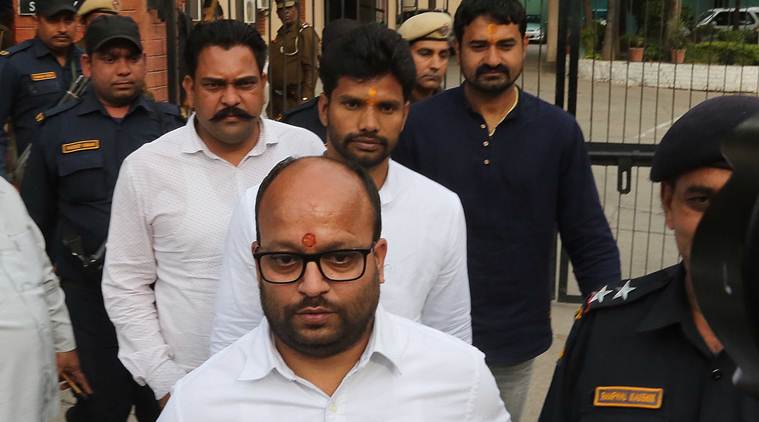
Samjhauta Expres blast case verdict: Lokesh Sharma, Rajender Chaudhary
and Kamal Chauhan at Panchkula court. (Express Photo: Jaipal Singh)
“In the present case, there is no evidence regarding any agreement to
commit the crime amongst the accused persons. There is no evidence
regarding any meeting of minds between the accused to commit the crime.
No concrete oral, documentary or scientific evidence has been brought on
record to connect the accused, facing the trial, with the crime in
question. There is not an iota of evidence to make out any motive on the
part of the accused to indulge in the crime,” he said.
Observing that a large number of witnesses turned hostile in the
case, the judge underlined the need for a sound and workable witness
protection scheme in the country. Of 299 witnesses in the case, 224
deposed before the court. Of these, 51 were said to have turned hostile,
changing statements recorded earlier.
Also read | I feel humiliated, says UP tailor who lost his parents
On the alleged statement of witness Dr Ram Pratap Singh — the NIA’s
sole witness to the “bomb ka badla bomb theory” at a meeting in Bhopal
in 2008 where Aseemanand allegedly said “Hindus should also retaliate in
the same way to the jihadis who are attacking Hindu religious places” —
the order noted “even though Dr Ram Pratap Singh did not toe the line
of prosecution, but neither any leave of the court was taken nor was he
cross-examined by learned Special PPs for the NIA in order to contradict
and confront him with his statement”. The court said the witness was “a
got up witness of the prosecution” and even failed to identify the
accused.
The NIA Investigating Officer had told court that there were CCTV
cameras at the Old Delhi Railway Station in 2007. The judge said “this
much admission on the part of investigating officers further lays bare
chinks in the prosecution version, because the best evidence in the
shape of CCTV footages has been withheld by the prosecution/NIA. Had
CCTV footage of Old Delhi Railway Station been collected by the
investigating agency and put to rigorous examination, then some vital
leads might have been obtained by it in order to bring the real culprits
to justice, but no such evidence has been brought on record”.
On the NIA claim that the suitcase covers of the two unexploded bombs
recovered from the blast site were made by an Indore-based tailor, the
judge said it is “crystal clear” that the suitcase covers, which were
recovered from the place of occurrence, were found to have been stitched
by the same tailor but “for reasons best known to the investigating
agency”, the evidence has not been corroborated by conducting a test
identification of the accused.
“…investigating agency, very strangely, has not even bothered to get
conducted Test Identification Parade (TIP) of suspects/accused so as to
arrive at concrete finding that any of the accused persons facing trial
had in fact got the suitcase covers stitched at the said shop and
procured for using the same in the occurrence and thus investigating
agency has lost a very valuable piece of evidence by not conducting
investigation properly in this regard,” the judge said.
The order noted that the NIA had claimed that call detail records of
various mobile phones revealed that Sunil Joshi, the alleged mastermind,
was at the Kothari market in Indore in February 2007 and call detail
records of the telephones used by Pragya Thakur, Sunil Joshi, Sandeep
Dange and Aseemanand showed inter-connectivity and links of
suspects/co-accused during the months of February/March, 2007.
“However, again prosecution/NIA has not brought an iota of evidence
on record to establish any such facts/assertions. Neither any call
detail records (CDRs) of any mobile phone nor any other evidence
pertaining to ownership and possession of any mobile phone by the
accused/suspects has been brought on record,” the judge said.
Stating that there is no evidence on record to prove the accused had
carried out recce of Delhi Railway Station and they had stayed at the
dormitories there as was claimed by the NIA in the charge sheet, the NIA
Court has said there is no evidence on record to even prove that the
accused had travelled from Indore to Nizamuddin Railway Station. One
official witness had claimed the record pertaining to dormitories was
available and was not disposed of.
“This court has not got an opportunity to look into a vital piece of
evidence because the entries in the handwriting of passengers might have
been got compared with the handwritings/signatures of suspects, thereby
further providing a vital clue about the involvement of real culprits,”
the court has said, adding it has been claimed that four accused after
planting the bombs escaped to Jaipur and then Indore but “again no
evidence in this regard has been brought on record to make out any such
escape journey of these accused … in the absence of any credible and
admissible evidence, this court cannot put stamp of approval to the
version put forth by the prosecution in the shape of mere allegations”.
It also has said that a “malaise” has set in the investigating
agencies which coin terms like “Muslim terrorism” or “Hindu
fundamentalism” and brand an act of the criminal as an act of the
particular religion, caste or community.
“A criminal element, belonging to a particular religion, community or
caste, cannot be projected as representative of such particular
religion, community or caste and branding the entire community, caste or
religion in the name of such criminal element(s) would be totally
unjustified and it would be in the best interests of human kind to nip
such tenancies in the bud lest we should be heading towards intense
civil war or caught in a whirlpool of fratricide,” Additional Sessions
Judge Jagdeep Singh has said in the verdict.
The court further said it is high time that the world is made a place
of peaceful existence, adding, “lest the sentiments of mutual hatred or
false notions of supremacy over one other would engulf the planet”.
However, it added everything is not lost while recording its
appreciation for one Assistant Sub Inspector Kashmir Singh, who is said
to have been busy in rescuing the passengers at the time of incident and
died during the rescue operation.
“… Services of ASI Kashmir Singh (since decreased) have been
exemplary, who himself took up the courage to save maximum lives trapped
in the burning coaches of Samjhauta Express train and it further
reflects that police personnel and armed forces personnel do not
hesitate even in making the supreme sacrifices in the line of their
duties and such personnel like ASI Kashmir Singh are the real heroes who
deserve the highest accolades and the highest awards/rewards for their
selfless services towards mankind and it is selfless services of such
personnel, which keep all hopes of Utopian society afloat,” the judgment
read.
The court also added, “Indian civilization, which is one of the oldest
one, had survived several onslaughts throughout centuries, which
testifies vibrancy of its rich heritage and culture and therefore we
need to remind ourselves and the world at large the old Indian phrase
expressed in ‘Vasudhaiva Kutumbakam’, which aptly conveys that ‘the
world is one family.”
Seeing the pattern of justice delivery system of India currently it seems getting justice, punishing the guilty is not easy. The judgments come as an outcome of the evidence produced by the executive, police in front of the magistrates. The attitude of the ruling dispensation matters a lot in matters of the crimes related to the ideology being propounded and defended by the ruling party. Sometimes the assertion and strength of the ideologies, which are dominant but not in power also influence the delivery of justice. Times and over again this cruel fact has been staring at our face. In Mumbai violence of 1992-93 nearly one thousand persons was done to death, not too many convictions took place related to the heinous crimes committed during this carnage. In the aftermath of this carnage the bomb blasts took place, orchestrated by the underworld in collaboration with ISI of Pakistan. In these blasts nearly two hundred people died. In these cases some have been hanged to death for the crime, many have got life imprisonment and many others got other punishments. This is what should happen in a democracy. The most glaring case has been the contrast between Rubina Memon who is in prison for life for being the formal owner of the car which was used In Mumbai blasts, while Sadhvi Pragya Singh Thakur, whose motor cycle was used for Malegaon blast got the bail.
All this comes to one’s mind yet again when the NIA Court has acquitted Swami Aseemanand in case of Samjhauta Express blast in which 68 people (43 of them from Pakistan) died. Incidentally Swami was granted bail in the Mecca Masjid blast case earlier and the factors influencing justice delivery became obvious as the main file, a key document containing the disclosure by Aseemanand, went missing from the Court’s custody.
Swami Aseemanand, the associate of RSS, who was working in Dangs with Vanvasi Kalyan Ashram, was key figure in organizing the Shabri Kumbh in Dangs. He also emerged as the key figure in many a blast cases, Malegaon, Mecca Masjid, Ajmer Dargah and Samjhata Express. All these took place in 2006-2008. The whole series came to a stop when Maharashtra ATS Chief Hemant Karkare, while investigating these cases came across the fact that the motor cycle used in Malegaon Blast cases belonged to Sadhvi Pragya Thakur, and ex ABVP worker. The trail of investigation led to the role of many a followers of Hindutva ideology, influenced by or close to RSS related organizations. When these facts started coming out Karakare was criticized and attacked by the Hindu nationalists. Shiv Sena mouth Piece Saamna wrote that we spit on the face of Karkare. While the then Chief Minister of Gujarat Mr. Narendra Modi called him Deshdrohi (Anti national). Though Karkare was investigating with full professional integrity, such criticisms from political circles did shake him and he shared his anxiety with his senior and upright police officer Julio Rebiero. Later as NIA started maligning Karkare, Reibero stood by him andgave him the strongest testimony of professional integrity.
The involvement of elements like Pragya Thakur, Assemanand and company was a big revelation and some from then UPA Government used the word ‘Hindu terrorism’ or ‘saffron terrorism’ for these cases. This was a faulty word anyway. It came up on the lines of the prevalent term Islamic terrorism which has been in vogue since quite some time. Hemant Karkare was killed in 26/11 2008 terror attack in Mumbai. Many of those calling him anti-National now declared him as martyr! Later Rajasthan ATS further carried the investigation and many from RSS related stable were found to be accomplices in the acts of terror. Subhash Gatade’s book Godse’s Children chronicles it well.
The investigation changed the track with the coming of NDA II in power in center in 2014. Rohini Salian the public prosecutor from Mumbai, who was dealing with these cases was told to go soft on these cases. Now a decade later Hemant Karkare’s investigation has been totally bypassed. Counter allegations against Karkare are floating around. At the same time doubts about the legal system and its role in punishing the guilty is coming to surface yet again.
In case of Swami Aseemanand, after his arrest he had given a confession in front of a magistrate. This confession was not in police custody; this was after two days of judicial custody. In his confession, which is legally valid, he gave the details of his central role and planning the blasts which took place during 2007-2008. He also indicated that even top level RSS leadership was also in the know of the goings on. In a long interviews spanning over two years, given to Caravan Magazine journalist Leena Raghunath (Believer, Caravan) he stated the things similar to what he told the magistrate. Later he withdrew the statement given in front of magistrate saying that the confession was given under pressure.
After this bail it is clear yet again that the justice system is so much dependent on the executive, the way police presents the case to the Magistrate examining the case. In the aftermath of this bail, Vikash Naraan Rai, who was Chief of SIT, investigating into Samjhauta blast, questions the handling of case by NIA. He asks "It is for the NIA to answer that why the witnesses resiled (back-traced) in this case. As they have turned hostile in the court even after giving statements under 164 of CrPC, the investigating agency should press perjury charges on them. The general perception is that NIA had gone soft in this case. One can further comment once the complete judgment comes,"
With this bail the question comes up who is responsible for the death of those 68 people, as usual it seems nobody did the blast leading to Samjhauta express tragedy! What we are witnessing is a sustained effort to undermine the process of justice in pursuit of sectarian nationalism.
भारतीय
न्याय प्रणाली इन दिनों जिस ढंग से काम कर रही है, उससे न्याय पाना और दोषियों को
सजा दिलवाना बहुत कठिन हो गया है. न्यायिक निर्णय, कार्यपालिका (पुलिस व अभियोजन)
द्वारा न्यायाधीशों के समक्ष प्रस्तुत सबूतों पर आधारित होते हैं. ऐसे में,
सत्ताधारी दल की विचारधारा और उसकी सोच की आपराधिक मुकदमों में बहुत महत्वपूर्ण
भूमिका होती है. कई मौकों पर, वर्चस्वशाली विचारधारा - भले ही उसके पैरोकार सत्ता
में न हों - भी अदालती फैसलों को प्रभावित करती है. यह दुर्भाग्यपूर्ण परन्तु सच
है. सन 1992-93 में मुंबई में भड़की सांप्रदायिक हिंसा में 1,000 से अधिक लोग मारे
गए थे. परन्तु इस खूनखराबे के दौरान घटित गंभीर अपराधों के बहुत कम दोषियों को सजा
मिल सकी. इस हिंसा के बाद, पाकिस्तान की आईएसआई के सहयोग से, मुंबई के अंडरवर्ल्ड
ने मुंबई में अनेक बम विस्फोट किए, जिनमें करीब 200 व्यक्ति मारे गए. बम विस्फोटों
से सम्बंधित प्रकरणों में कई लोगों को फांसी की सजा सुनायी गयी, अनेक को आजीवन
कारावास से दण्डित किया गया और बड़ी संख्या में अन्यों को अलग-अलग अवधि की सजाएं दी
गईं. इसमें कुछ भी गलत नहीं है और प्रजातंत्र में यही होना भी चाहिए. परन्तु क्या
हम रुबीना मेमन और साध्वी प्रज्ञा सिंह ठाकुर के साथ हुए अलग-अलग व्यवहार को
नज़रअंदाज़ कर सकते हैं? रुबीना मेमन, उस कार की मालिक थीं, जिसका इस्तेमाल मुंबई बम
धमाकों में किया गया और प्रज्ञा, उस मोटरसाइकिल की, जिसका प्रयोग मालेगांव धमाकों
में हुआ. परन्तु रुबीना को आजीवन कारावास मिला और प्रज्ञा को बरी कर दिया गया !
यह सन्दर्भ
इसलिए क्योंकि हाल में, एक एनआईए अदालत ने समझौता एक्सप्रेस बम धमाके, जिसमें 68
लोग मारे गए थे (इनमें से 43 पाकिस्तानी नागरिक थे), से सम्बंधित मामले में स्वामी
असीमानंद को बरी कर दिया है. इसके पहले, असीमानंद को मक्का मस्जिद बम धमाका प्रकरण
में भी ज़मानत मिल गई थी. इस मामले में न्यायिक प्रक्रिया को किस तरह प्रभावित किया
गया यह इससे साफ़ है कि अदालत से प्रकरण की वह मुख्य फाइल ही गायब हो गयी, जिसमें
असीमानंद द्वारा किये गए खुलासे दर्ज थे.
स्वामी
असीमानंद पक्के संघी हैं और गुजरात के डांग जिले में, वनवासी कल्याण आश्रम के लिए
काम करते थे. उन्होंने डांग में शबरी कुम्भ के आयोजन में महत्वपूर्ण भूमिका निभायी
थी. उनका नाम कई बम धमाकों के सन्दर्भ में सामने आया था, जिनमें मालेगांव, मक्का
मस्जिद, अजमेर दरगाह और समझौता एक्सप्रेस धमाके शामिल थे. ये सभी, सन 2006 से 2008
के बीच हुए थे. इन धमाकों का सिलसिला तब रुका जब महाराष्ट्र पुलिस के आतंकवाद
निरोधक दस्ते के तत्कालीन प्रमुख हेमंत करकरे के अथक प्रयासों से यह उजागर हुआ कि
मालेगांव धमाके में प्रयुक्त मोटरसाइकिल, पूर्व एबीवीपी कार्यकर्ता साध्वी प्रज्ञा
सिंह ठाकुर की थी. सघन जांच से यह भी सामने आया कि इन धमाकों के तार, हिंदुत्व की
विचारधारा से प्रेरित कई लोगों से जुड़े थे और ये सभी लोग या तो आरएसएस या उससे सम्बद्ध
संस्थाओं से सीधे जुड़े थे या उनसे प्रभावित थे. शिवसेना के मुखपत्र सामना ने करकरे के मुंह पर थूकने की बात कही और गुजरात
के तत्कालीन मुख्यमंत्री नरेन्द्र मोदी ने उन्हें देशद्रोही बताया. यद्यपि, करकरे
अपना काम पूरी ईमानदारी से और पेशेवराना ढंग से कर रहे थे परन्तु राजनीतिज्ञों
द्वारा उन पर हमले ने उन्हें हिला दिया. उन्होंने अपनी व्यथा, अपने वरिष्ठ अफसर
जुलिओ रिबेरो से साँझा की. बाद में, जब एनआईए ने करकरे पर कीचड़ उछालना शुरू किया,
तब रिबेरो ने उनका पूरा साथ दिया और खुलकर कहा कि करकरे सत्यनिष्ठा से अपने
कर्तव्य का पालन कर रहे हैं.
प्रज्ञा
ठाकुर, असीमानंद और उनके साथियों का आतंकी हमलों में हाथ होने के खुलासे ने देश
में सनसनी पैदा कर दी और तत्कालीन यूपीए सरकार के कई मंत्रियों ने इन मामलों को
“हिन्दू आतंकवाद” या “भगवा आतंकवाद” का नमूना बताया. यह एक दम गलत था और इसकी
तुलना केवल इस्लामिक आतंकवाद शब्द के कुछ समय से प्रचलित प्रयोग से की जा सकती है.
हेमंत करकरे मुंबई पर 26/11 2008 को हुए आतंकी हमले में मारे गए और जो लोग उन्हें
कल तक देशद्रोही बता रहे थे, वे ही उन्हें शहीद का दर्जा देने लगे. बाद में,
राजस्थान पुलिस के आतंकवाद-निरोधक दस्ते ने इस जांच को आगे बढ़ाया और यह सामने आया
कि कई आतंकी हमलों में संघ परिवार से जुड़े लोगों का हाथ था. इस सबका संपूर्ण विवरण
सुभाष गाताडे की पुस्तक गोडसेस चिल्ड्रेन में उपलब्ध है.
सन 2014
में, एनडीए के शासन में आते ही, जांच की दिशा बदल गयी. मुंबई की रोहिणी सालियान,
जो इन मामलों में लोक अभियोजक थीं, से कहा गया कि वे आरोपियों को सजा दिलवाने के
लिए ज्यादा प्रयास न करें और नरमी बरतें. हेमंत करकरे के सनसनीखेज खुलासे के एक
दशक बाद, उनकी जांच और उसके नतीजों को ठन्डे बस्ते में डाल दिया गया है और उलटे,
उन पर तरह-तरह के आरोप लगाये जा रहे हैं. इसके साथ ही, न्यायिक प्रक्रिया और
दोषियों को सजा दिलवाने की उसकी क्षमता भी संदेह के घेरे में आ गयी है.
असीमानंद
ने अपनी गिरफ़्तारी के बाद, मजिस्ट्रेट के समक्ष इकबालिया बयान दिया था. तब वे
पुलिस की हिरासत में नहीं थे और दो दिन से, न्यायिक हिरासत में जेल में थे. अपने
इकबालिया बयान, जो क़ानूनी दृष्टि से वैध है, में उन्होंने इन धमाकों की योजना
बनाने और उन्हें अंजाम देने में अपनी केंद्रीय भूमिका का विस्तार से वर्णन किया
था. उन्होंने इस आशय के संकेत भी दिए थे कि इस घटनाक्रम की जानकारी आरएसएस के
शीर्ष नेतृत्व को भी थी. लगभग दो साल की अवधि में, केरेवेन पत्रिका की लीना रघुनाथ को दिए अपने लम्बे
साक्षात्कार में भी उन्होंने लगभग वही बातें कहीं थीं, जो उन्होंने मजिस्ट्रेट को
बताईं थीं. बाद में, उन्होंने यह कहते हुए अपना इकबालिया बयान वापस ले लिया कि उन
पर दबाव डालकर उनसे यह बयान दिलवाया गया था.
असीमानंद के
बरी होने से यह साफ़ है कि न्याय प्रणाली किस हद तक कार्यपालिका पर निर्भर है. काफी
कुछ इस बात पर निर्भर करता है कि पुलिस, सम्बंधित मजिस्ट्रेट के सामने कोई प्रकरण
किस तरह प्रस्तुत करती हैं. विकास नारायण राय, जो कि समझौता एक्सप्रेस प्रकरण की
जांच करने वाले विशेष जांच दल (एसआईटी) के मुखिया थे, ने एनआईए की भूमिका पर
प्रश्नचिन्ह लगाये हैं. “एनआईए को बताना चाहिए कि गवाह अपनी कही बातों से पीछे
कैसे और क्यों हट गए. दंड प्रक्रिया संहिता की धारा 164 के तहत अपना बयान दर्ज
करवाने के बाद गवाह अदालत में पलटे हैं. जांच एजेंसी को उनके विरुद्ध झूठी गवाही
देने के आरोप में मुक़दमा चलाना चाहिए. सामान्य धारणा यह है कि एनआईए ने इस मामले
में नरमी बरती है. पूरा निर्णय पढ़ने के बाद ही मैं इस विषय में कुछ और कह सकूंगा.”
इस निर्णय
से यह प्रश्न भी खड़ा हो गया है कि आखिर 68 लोगों की मौत के लिए कौन ज़िम्मेदार है.
क्या समझौता एक्सप्रेस में अपने आप धमाका हो गया था? दरअसल, सांप्रदायिक
राष्ट्रवाद के एजेंडे के तहत, न्याय प्रक्रिया को योजनाबद्ध ढंग से कमज़ोर किया जा
रहा है. (अंग्रेजी
से हिन्दी रूपांतरण अमरीश हरदेनिया)
Here's Why Investigators Saw Clear Hindutva Link to Samjhauta Bombing
Former SIT head Vikash Narain Rai's investigations led to the first breakthrough in the 2007 train blast case. In an interview to The Wire, he explained how the dots were connected.
Who will answer for death of my five children? Ali and his wife Rubsana (54) lost five of their children in the 2007 Samjhauta Express blast. The couple survived with their youngest daughter, Aksa Shehzadi, who is now 12. Now, they have another daughter Khajija (7). “Who will answer for the death of my five children? Who killed them? The verdict has taken the life out of me. I was never asked by anyone to testify in court,” Rana Shaukat Ali (61) told The Indian Express over phone from his home in Pakistan’s Faisalabad.
Ali and his wife Rubsana (54) lost five of their children in the 2007 Samjhauta Express blast. The couple survived with their youngest daughter, Aksa Shehzadi, who is now 12. Now, they have another daughter Khajija (7).
Before delivering the verdict acquitting the four accused in the case, the special NIA court Wednesday dismissed an application seeking permission for deposition of Pakistani witnesses. The application was filed by Pakistan resident Rahila Wakil, who claimed that no proper summons were sent to 13 Pakistani witnesses. “Hindu or Muslim, they were children after all. Who killed them? You tell me,” said Rubsana. The couple said they had visited India thrice after the blast, and not once were they intimated by Indian or Pakistani authorities that they could testify in court. “If I could have given my statement, maybe the trial could have taken a different turn,” Ali said. In 2007, the couple and their six children visited Delhi’s Laxmi Nagar for a relative’s wedding. “I still remember my children dancing. My eldest daughter Aisha Tabassum (16) was to take her Class X exams. I remember brushing her hair,” Rubsana said. Ali remembers that ill-fated journey. His sons Rana Mohammad Bilal (12) and Rana Mohammad Amir (11) were tucked under blankets, and Aisha was chatting with her sister Asma Shehzadi (8). When the blast took place, Ali jumped out of the train in the chaos. His wife followed with their youngest daughter. “There was smoke all over. My children burnt to death,” Ali said.
I remember I was among the first to reach the scene after the blast
in May 2007. The police picked up and took into custody nearly one
hundred young Muslims. In many cases, the families were not even aware
till much later where the youth were being kept and questioned. It was
as though the investigators were hoping that questioning so many would
yield them some leads. There were allegations of torture, of people
being coerced to give confessions. Subsequently, they were booked, not
for the Mecca Masjid blast case but in several other random cases of
conspiracy or watching videotapes of Gujarat with the alleged intention
of creating trouble.Then came Aseemanand's confession in a very
dramatic turn of events. Tales of how he had met Abdul Kaleem inside
jail did the rounds. Kaleem had been allegedly picked up for a crime he
did not commit. Aseemanand is said to have had a change of heart and
confessed. That too was later retracted. The idea of 'Hindu terrorism'
surfaced at that point. In the course of a botched-up investigation,
witnesses turned hostile and now 11 years later, all the accused have
been acquitted due to lack of evidence. Not only do the people not
have any closure about who bombed the Masjid, they will lose faith in
the entire justice system because of a possibly shoddy investigation and
inability to collect material evidence. It calls to question the way
the investigation was conducted and the trial proceeded. To say now that
there is nothing called 'Hindu terror' is to send out a message that
terrorists in India come from only one community. This is a massive
setback for the premier terrorism investigation agency in the country,
the NIA. It puts a question mark on the quality and integrity of the
agency. https://theprint.in/talk-point/talkpoint-mecca-masjid-blast-is-there-a-pattern-to-hindu-terror-acquittals-or-has-justice-prevailed/50084/
Mecca Masjid blast: NIA prosecutor N Harinath has ABVP link
On Monday,
an NIA court in Nampally acquitted five accused, including Swami
Aseemanand, in the case. The NIA declined comment on the empanelment of
Harinath — associated with only the Mecca Masjid bombing case — as a
prosecutor.
Written by Rahul Tripathi | New Delhi | Updated: April 18, 2018 7:21:30 am
Mecca
Masjid blast: NIA prosecutor N Harinath has ABVP link The Mecca Masjid:
the site of the blast (Express photo by Raaj Dayal)
NIA
special public prosecutor N Harinath, engaged for the 2007 Mecca Masjid
blast case, was associated with the Akhil Bharatiya Vidyarthi Parishad
(ABVP) as a student in Hyderabad and said Tuesday that he has continued to help the RSS-affiliated student body organise events.
On Monday, an NIA court in Nampally acquitted five accused, including Swami Aseemanand, in the case.
Harinath,
who took over as the NIA prosecutor when the Mecca Masjid blast trial
started in 2015, told The Indian Express: “When I was pursuing my second
year in law I joined ABVP but have never been associated with the BJP. I
have since been donating and helping them (ABVP) organise events.”
Read | Mystery red shirt found with unexploded IED at site never reached NIA
The NIA declined comment on the empanelment of Harinath — associated with only the Mecca Masjid bombing case — as a prosecutor.
Harinath
also said he did not face any pressure from anyone to dilute the case.
“From day one, we were working to secure the conviction in the case.
When I joined in 2015, the trial was about to start and I was engaged by
NIA after scrutiny of my application. I have provided them with the
list of cases I have dealt in the past. I have been practising in
criminal court since 1994 and have been a special public prosecutor for
the Enforcement Directorate since 2011.”
Read | Five including Aseemanand acquitted, judge who delivered verdict resigns
According
to Harinath, the NIA court while acquitting the accused observed that
the confession of Aseemanand recorded before a magistrate in Delhi was
not fair. “The entire prosecution case was based on the confession of
Aseemanand, which was recorded before a magistrate in Delhi. In his
deposition to court, the magistrate said Aseemanand was in police (CBI)
custody when he was brought before him and after recording his statement
he was taken into the police custody. The court concluded that it is
not a fair confession.”
Under section 164 CrPC, the confession cannot be recorded before a police officer.
Aseemanand acquitted in Mecca Masjid blast case Aseemanand, one of the five acquitted Monday. (File Photo)
“The
court observed that the case pertained to Hyderabad and the CBI could
have got Aseemanand’s statement recorded before the magistrate here when
he was in jail. The magistrate who recorded Aseemanand’s statement was a
prosecution witness in the case,” he said.
Read | Among acquitted in Mecca Masjid blast: RSS leader convicted in Ajmer blast last year
Another
reason they failed to secure the conviction, Harinath said, was
witnesses turning hostile. “Had these witnesses supported the
prosecution case, we would have secured a conviction,” he said.
All accused in Hyderabad Mecca Masjid blast case, including Aseemanand, acquitted by special NIA court
A special NIA court on Monday acquitted all the accused in the Mecca Masjid bomb blast case. The bombing took place during Friday prayers in the mosque in Hyderabad on May 18, 2007, claiming nine lives and leaving 58 injured. Five others were killed in police firing in the violence that followed immediately after the blast.
india Updated: Apr 16, 2018 12:45 IST
Mecca blast case: Aseemanand’s ‘disclosure’ missing from court
TNN | Mar 14, 2018, 05:35 IST
HYDERABAD: A key document in the 2007 Mecca Masjid blast case containing a disclosure by Hindu right-wing member Swami Aseemanand, which could seal the fate of the trial, has gone mysteriously missing from a lower court’s custody.
The revelation came after chief investigating officer and CBI SP T Rajah Balaji on Tuesday began recording his evidence. Balaji filed the first chargesheet before the case was transferred to the NIA.
On May 18, 2007, a bomb blast inside the Mecca Masjid during Friday prayers killed nine people and injured 58 others. Later, more people were killed when the police opened fire on protesters. As part of the trial, more than 160 witnesses were examined by the court that includes victim, RSS pracharaks and several others.
Aseemanand was granted bail in April 2017 on the condition that he can’t leave Hyderabad and Secunderabad.
On Tuesday, K Ravinder Reddy, the fourth Additional Metropolitan Sessions Judge cum special court for NIA cases, came down heavily on court officials after several documents pertaining to the case couldn’t be traced. The proceedings of the case had to be stalled by more than one and half hours before officials could trace some of the documents that were exhibited before the court.
Balaji was taken by surprise after a key two-page document relating to the reported disclosure made by Naba Kumar Sarkar aka Swamy Aseemanand before CBI, explaining the alleged conspiracy, was not traceable. The document, marked as “Memo of Disclosure” No 88 in NIA chargesheet, reportedly contains names of senior RSS leaders.
The missing document is believed to be of much importance and can seal the fate of Aseemanand in the case, investigators said.
During investigation, the CBI officer examined 68 witnesses in the case, out of which 54 have turned hostile, including DRDO scientist Vadlamani Venkat Rao, who is the prosecution witness No 151 in the case.
On Wednesday, a special court of the National Investigation Agency acquitted
Swami Aseemanand and six others in the 2007 Ajmer shrine blast case,
giving them the “benefit of doubt”. In 2011, the former activist of the
Rashtriya Swayamsevak Sangh had confessed to planning and helping
execute bomb blasts targeted at minorities “to avenge attacks on Hindu
temples”. Aseemanand still stands accused in two other blast cases. But
this acquittal dilutes the case against saffron terror.
Aseemanand
was alleged to be part of a terror network that carried out a series of
bomb blasts in the last decade, including Ajmer 2007, Mecca Masjid
2007, Samjhauta Express 2007, Malegaon 2006 and 2008. Many of those
accused in these cases were part of a shadowy extremist Hindutva outfit
called Abhinav Bharat, or they had ties with the RSS.
But over
the last decade, the big names associated with this terror network been
struck off the list of the accused in most cases. Sadhvi Pragya Thakur,
once a member of the Akhil Bharti Vidyarthi Parishad, was recently
cleared of charges that she was involved in the murder of Sunil Joshi, a
former RSS pracharak who was killed in 2007. However, the Mumbai High
Court has reserved her bail order in the 2008 Malegaon blasts case.
Indresh Kumar, now a national executive member of the RSS and convenor
of its Muslim Rashtriya Manch, was named in the Ajmer blasts case but
never even called for questioning. The case
against Colonel Purohit, the army man who became part of Abhinav Bharat
and an accused in Malegaon 2008, also seems to be collapsing.
A
constant theme over the last few years, has been the accusation that the
guilty got away because of institutional complicity. Most damning were
the charges against the National Investigation Agency, which took over a
raft of saffron terror cases in 2011. These charges came out into the
open after Rohini Salian, special public prosecutor in the Malegaon 2008
case, alleged that after the National Democratic Alliance government
came to power in 2014, she had been told by the investigating agency to
“go soft” on cases of saffron terror. They were echoed to a certain
extent by Ashwini Sharma, public prosecutor in the Ajmer blast case, who
felt the agency had not done enough to build a case against Aseemanand,
and who now feels mystified that the swami should be acquitted in spite
of his confession. As witness after witness turned hostile and charges
under the Maharashtra Control of Organised Crime Act were dropped,
suspicions mounted that the dilution of these cases was politically
motivated. The accused, it has been pointed out, often belonged to
organisations that are close to the ruling Bharatiya Janata Party.
With
the collapsing of these cases, a larger battle will be lost. In 2008,
they spawned the term Hindutva terror. It marked a radical shift away
from the way terror is understood, that it is not restricted to
followers of any one religion or extremism. The term stuck, in spite of
institutional resistance and public denial. But now, with the charges
against the accused rapidly melting away, Hindutva terror will be
restored to myth once more.
Terror accused Aseemanand acquitted by NIA court in Ajmer blasts case
A
special NIA court has acquitted terror accused Swami Aseemanand in the
Ajmer blast case. The court, however, found three men guilty.
Last year, Aseemanand was granted bail in Samjhauta Express blasts case, where he’s the prime accused.
This came after the National Investigation Agency (NIA), which is
controlled by the central government, decided not to oppose the
conditional bail granted to Aseemanand, chargesheeted in the 2007
Samjhauta blasts case.
This was stated by Minister of State for Home Haribhai Parathibhai
Chaudhary in Lok Sabha while replying to a written question by Asaduddin
Owaisi of All India Majlis-E-Ittehadul Muslimeen (AIMIM) last month.
The Narendra Modi government had also declined to grant permission to
challenge a bail order granted to two other Hindutva terror accused in
the Mecca Masjid blasts case, Devender Gupta and Lokesh Sharma, on the
“grounds of parity” since bail had been granted to Bharat Mohal Lal and
Tejaram Parmar which had not been challenged by the prosecution.
Saffron terror Not just Rohini Salian: Public prosecutor in Ajmer blast case is also unhappy with NIA
Ashwini Sharma says the federal agency could have done a great deal more to build the case against Swami Aseemanand and seven others charged with setting off bombs that killed three people in 2007.
Supriya Sharma
Around 11 am on July 10, surrounded by a dozen policemen, eight men shuffled into room number 302 of Jaipur's district and session court. The oldest among them, a short, frail man in pale saffron robes, Swami Aseemanand, slumped into a chair. Two younger men in check shirts, Harshad and Mehul, stepped into the dock. The others, middle-aged men, bunched up behind them. Common to the motley group were the tilaks on their foreheads – in the case of Mehul, it was an elaborate U-shaped tilak, while the Swami carried a barely perceptible dot.
The eight have been charged with planning and executing a terror attack on the Ajmer Sharif Dargah on October 11, 2007. Two bombs were planted outside the shrine. While one bomb failed to go off, the other exploded at 6.14 pm, killing three men and injuring 15 others. According to the investigators, this was one of six attacks carried out between 2006 and 2008 by Hindutva activists, many of whom were workers of the Rashtriya Swayamsevak Sangh, the ideological parent of the ruling Bharatiya Janata Party.
The case was first investigated by the anti-terrorism squad of Rajasthan Police and later transferred to the federal National Investigation Agency in April 2011.
The trial began in June 2014, a month after the BJP formed the government at the centre.
So far, 93 witnesses have been summoned by the prosecution to give evidence in court. Most of them are people whose statements were recorded by policemen in the course of the investigation. Such statements are not counted as evidence. In some cases, however, the statements were recorded by a magistrate under Section 164 of the Indian Penal Code, which means they can be used as evidence in the case. If the witness retracts the statement in court, which amounts to "turning hostile", the court must decide on the basis of the circumstances whether to treat it as evidence.
Nineteen key witnesses in the Ajmer blast trial have either denied making the statements attributed to them or have said they were made under duress. At least six of them have retracted statements recorded by a magistrate.
In the last held hearing on July 10, of the five witnesses who deposed, only two, who were government employees, stuck to their statements, while the others did not. They were declared hostile by the public prosecutor.
One of them was a scrawny man named Lal Krishna Joshi, a resident of Jhalawar, who the police claimed had known several of the accused while he was a student in Indore. In the court, however, Joshi denied speaking with the police. He said he knew Sadhvi Pragya Thakur, an associate of the accused, but not the accused directly. Yet, minutes after he stepped down from the witness box, he smiled in their direction and exchanged a silent greeting.
As the hearing wound up in the afternoon, the public prosecutor Ashwini Sharma walked out with a sense of resignation. "The defence lawyers are bringing the prosecution witnesses to the court," he said. "I get to see them directly in the witness box."
Witnesses being influenced
Since several witnesses were acquaintances of the accused, they were liable to be influenced by the defence lawyers, said Sharma, a short man in his forties. But it was the task of the investigating agency to ensure that did not happen, he added. At the very least, it could gather evidence to show the witnesses were being influenced by the defence.
For instance, during their cross examination, Sharma had asked the witnesses for their mobile numbers. "The NIA could have procured their call records which would show that they were in touch with the lawyers of the accused," he said.
He passed on the name of the hotel where he heard a group of witnesses had been lodged by the defence. In their cross-examination, the witnesses had claimed to have spent the night in Jaipur at the railway station. "If the NIA got a copy of the hotel register, it would show that the witnesses were lying," he said.
He even suggested that the NIA obtain copies of the CCTV footage of the court building to "show the witnesses were meeting the defence lawyers and discussing the case with them".
But his suggestions were ignored.
The investigating officer of the case, Vishal Garg, declined to respond to Scroll's queries. He said he was not authorised to speak with the press. Senior officers designated as the agency's spokespersons were unavailable for comment.
The defence lawyers refused to respond to the allegation that they were influencing the witnesses. JP Sharma, who is assisting JS Rana, the counsel for Aseemanand, said that they had decided not speak to journalists because they had been previously let down by "TRPs-seeking media".
Last month, a senior NIA official, speaking unofficially, maintained that the agency's job was limited to investigating the case and gathering evidence. What transpires in the court is outside its purview.
Sharma dismissed the argument. He represents the Central Bureau of Investigation in several cases and its officers put more effort in safeguarding witnesses, he claimed.
The government lawyer denied facing pressure from the NIA to go soft on the case in the way Rohini Salian, his counterpart in the Malegaon case, another alleged Hindutva terror conspiracy, claimed to have, in an interview with the Indian Express. But he expressed disappointment with the lack of interest shown by the NIA during the trial. "The IO [Investigating Officer] hasn't even come once for the hearing," he said. "When I called and told him that the witnesses are turning hostile, he said 'Panditji, what to do, I have many other cases.'"
Further proof of the NIA dropping the ball in the Ajmer case could lie in its failure to appeal against the bail order of one of the accused. In 2011, the Rajasthan High Court gave bail to Chandrashekhar Leve, an RSS worker charged with hiding mobile phones used to activate the SIM cards used in the terror attack. At that time, since the case was still with the Rajasthan anti-terrorism squad, the state government filed a Special Leave Petition in the Supreme Court appealing against the order. Subsequently, the case was transferred to the NIA. The Rajasthan government asked the court to allow it to withdraw the petition since it was no longer conducting the investigation. On January 17, 2014, the Supreme Court dismissed the petition. The NIA could have stepped in. But it did not.
This isn't surprising. As the Economic Times reported, the NIA has decided not to challenge the Punjab and Haryana High Court's August 2014 order granting bail to Swami Aseemanand in the Samjhauta Express case, in which 68 people were killed. The agency has also not filed an appeal against the bail given in April last year to three accused in the Mecca Masjid case.
Little direct evidence
What makes the NIA's neglect of the cases damaging, Sharma said, was the challenge posed by terror conspiracies, which are often marked by "little direct evidence". Securing witness testimonies is crucial, he said.
Combing through more than 1,000 pages submitted by the investigators in the Jaipur court, this certainly appears to be the case with the Ajmer blast trial.
According to the chargesheets filed by the Rajasthan anti-terrorism squad, and subsequently by the NIA, a group of Hindutva activists plotted terror attacks on Muslim pilgrimage sites to avenge terror attacks on Hindu temples. The locations they aimed to target were the Jama Masjid in Delhi, Dargah Sharif in Ajmer, Mecca Masjid in Hyderabad, Malegaon in Maharashtra and the Samjhauta Express which runs between Delhi and Lahore.
The chargesheet says the leader of the group was Naba Kumar Sarkar, better known as Swami Aseemanand. Then in his mid-fifties, the long-time RSS worker was a key figure in its affiliate, the Vanvasi Kalyan Ashram, which aimed to spread the Sangh's ideology among adivasis. He lived in the Sabari Ashram in Gujarat's Dang district, where several of the meetings of the group were allegedly held.
The other key figure in the group was Sunil Joshi, the former district head of the RSS in Indore, Madhya Pradesh. He collaborated with other RSS workers to arrange funds and explosives, and divided tasks among them.
Two RSS workers in Madhya Pradesh, Sandeep Dange and Ramji Kalsangra, were tasked with procuring explosives. Both are absconding.
Devendra Gupta, the RSS head of Jamtara district of Jharkhand, who had earlier worked with Joshi in Indore, was asked to arrange for SIM cards and mobile phones, which would be used as timer devices. For this, Gupta allegedly forged identity documents.
Lokesh Sharma, a property dealer and RSS worker in Indore, pitched in with getting mobile phones and ferrying explosives.
Chandrashekhar Leve, an RSS communication head in Shajapur district, played a role in hiding the mobiles.
Bharat Rateshwar, a merchant in Gujarat, gave financial support and provided shelter to the others.
A group of men drawn from Gujarat and Madhya Pradesh were assigned the task of planting the bombs. Some of them like Mehul and Bhavesh had been earlier implicated in the Best Bakery riot cases.
According to the chargesheet, the same group also planted three bombs in Mecca Masjid in Hyderabad on May 18, 2007. Two failed to go off, while one that exploded left 11 dead.
The bombs in Hyderabad and Ajmer were similar in material and in the way they were made. All four bombs used mobile phones as timer devices. The devices formed the first lead in the case.
SIM cards
The SIM card in the phone that exploded in Ajmer was traced to a mobile shop in Dumka, Jharkhand. Records showed it had been sold to Babulal Yadav, a resident of Mihijam village. Investigators found no man by that name in the village. The identify proof furnished with the customer application form was a voter identity card issued in Jamtara district next door to Dumka. The picture on the card was found to tally with one in the Hindi edition of Outlook ‒ it was that of the magazine's health columnist, Taraknath Pramanik.
The SIM card from the unexploded bomb also led investigators to Babulal Yadav, except in this case, the records showed he was a resident of Asansol in Burdwan district in West Bengal. The picture on the driving licence furnished as proof, however, remained the same.
Eventually, investigators found that Pramanik's picture has been used to obtain 11 SIM cards between May and November in 2006. These included the SIM cards used in the Mecca Masjid attack.
At that time, Devendra Gupta was the head of the RSS in Jamtara. The police claims he was instrumental in forging the cards and licences.
As proof, they say they found two driving licences on him at the time of his arrest. Both were made on the basis of forged school transfer certificates. In court, a school official has corroborated that the transfer certificates belonged to another student. But the transport agents have denied helping Gupta, turning hostile in court.
There is no material evidence in the form of computer records to show Gupta forged the same driving licences by pasting Pramanik's picture and adding Babulal's name to them.
As for the voter identity card, the police claim that Gupta forged the card of Sugandhi Pandey, the mother of an RSS worker, fell flat when mother and son turned hostile in court, denying that Gupta took the card from them.
Mobile phones
According to investigators, the mobile phone used in the Ajmer blast was bought from a shop in Faridabad by Lokesh Sharma. The RSS worker identified the shop himself, according to the police. Further, a salesman at the shop, Ishant Chawla, identified Lokesh inside the Hyderabad jail. In court, however, Chawla has turned hostile.
The SIM cards used in the blasts in Ajmer and Hyderabad were activated in mobile phones with specific IMEI numbers. One of them was found with Chandrashekhar Leve, the RSS communications head in Shajapur in Madhya Pradesh, while two were recovered from his acquaintance Vishnu Patidar.
The police claims Sandeep Dange, who assembled the bombs, sent the phones to Leve. As proof, it has submitted transcripts of purported intercepted phone conversations where Leve tells Patidar that in the event of questioning by the police, he must say the phones were bought from Pankaj Patidar, a dead villager. It isn't clear if the police have a recording of the conversation. (Intercepted conversations are admissible as evidence in Indian courts provided they meet certain requirements under the Evidence Act).
In court, Patidar swung between denying the conversation and saying he did not remember it. But Sharma said call records showed he had spoken with Leve, which would prove he had lied to the court.
But the link between Leve and Patidar might not be enough. The prosecution would also have to establish that Leve obtained the phones from Dange. "The burden of proof will lie with the accused," said Sharma.
Dange is still absconding. To prove that he was working in tandem with Sunil Joshi, the prosecution is relying on witness statements. Since witnesses are turning hostile, this part of the case could turn weak.
Explosives
The prosecution faces even greater difficulties to prove how explosive material was obtained and assembled into bombs.
The police claims that Lokesh not only accepted his crime at the time of the arrest, he even identified the spot in Indore where the explosives were collected and assembled into bombs. But the police has no independent witnesses apart from its own personnel for Lokesh's spot identification.
According to the police, the detonators were sourced by Devendra Gupta. To establish this, the prosecution relied on the statement of Rohit Kumar Jha, who lived with Gupta. But Jha has turned hostile in court.
Another witness was Randhir Singh, a politician with the Jharkhand Vikas Morcha party and an acquaintance of Gupta. In his statement to the police, he said he saw Gupta and Joshi fire from a pistol in a village. But Singh went back on the statement in court. An NDTV report pointed out that Singh recently joined the Bharatiya Janata Party and was made a minister in its government in Jharkhand.
Planting the bombs
According to the chargesheet, Sunil Joshi travelled with two young men, Mehul and Sunny, in a car from Indore to Godhra on October 9, 2007. They packed explosives at the house of Mukesh Vasani. The next day, Mukesh, Mehul and Sunny joined Suresh Nair and Bhavesh Patel who were waiting at the bus stop. All five men travelled by bus to Vadodara and further to Udaipur. From there, they travelled by jeep to Ajmer. On the evening of October 11, Sunny left one bag at the Dargah, Mehul left another.
This account is based primarily on the statements of the accused and their acquaintances, some of whom, including the owner of the car, have appeared in court and turned hostile. The prosecution is relying on the government employees who were witness to the spot identification done by Harshad, Mukesh and Bhavesh.
There is no documentary evidence for the travel except the call records of one of the accused that the public prosecutor is still analysing.
The Swami
The police claim to have arrested Aseemanand from Haridwar. According to the chargesheet, fearing arrest, he left Gujarat and moved to Haridwar where he adopted the name Omkarananda. One of the witnesses, who the police claims helped him get a ration card under the assumed name, has turned hostile in court.
To establish its case against Aseemanand, the prosecution would have to rely largely on the two confessional statements that he made in the presence of a magistrate under Section 164. He subsequently retracted the statements but the prosecution believes the court might overlook the retraction if the magistrates who recorded the statement testify in court.
Much of the case hinges on whether the court gives precedence to the retractions of the accused and the witnesses, or to the testimonies of the magistrates who recorded the statements.
Two video recordings of the questioning of Aseemananda and Bharat Rateshwar have also been admitted as evidence.
Asked what more could the investigators have done to strengthen the case, Sharma said they could have kept more reliable witnesses for seizures, recoveries and spot identification. One of the witnesses for the recoveries of mobile phones from Chandrashekhar Leve is his brother.
Most of all, Sharma said the NIA should have pushed for the Ajmer and the Mecca Masjid blast cases to be tried at a single location. "Both are part of the same conspiracy," he said. "Both have the same accused, the same witnesses, the same evidence."
In fact, some of the documents for the Ajmer case are lying in Hyderabad. "I have asked the NIA people to get the certified copies at least," said Sharma. "Bas bahut ho gaya. I have done enough. I have many other cases and limited time. I might as well leave this one."
Press Information Bureau
Government of India
Ministry of Home Affairs
11-August-2015 13:39 IST
Bail to Samjhauta Express blast accused
The Punjab and Haryana High Court passed an order granting conditional bail
to Naba Kumar Sarkar @ Swami Aseemanand on 28.08.2014 in the Samjhauta
Express Blast Case. However, the certified copy of the said order was
issued by the court only on 01.05.2015. The NIA examined the feasibility of
filing a SLP and decided that there were no grounds to challenge the Order
in the Supreme Court. However, Naba Kumar Sarkar @ Swami Aseemanand
continues to remain in jail since he did not comply with the conditions of
bail specified in order dated 28.08.2014.
Besides, the Government did not find it fit to challenge the order dated
21.03.2014, whereby bail was granted to the two accused in Mecca Masjid
Blast case of May 2007 viz Devender Gupta and Lokesh Sharma, on grounds of
parity since the order dated 03.06.2012 and 27.06.2013 whereby bail was
granted to Bharat Mohan Lal @ Bharat Bhai and Tejaram Parmar had not been
challenged by the prosecution. However, both the accused continue to be in
jail as they are also accused in other cases wherein they have been denied
bail.
This was stated by the Minister of State for Home Affairs, Shri Haribhai
Parathibhai Chaudhary in a written reply to a question by Shri Asaduddin
Owaisi in the Lok Sabha today.
Samjhauta blast accused Swami Aseemanand granted bail by High Court
Express News Service | Chandigarh | August 28, 2014
Summary
Aseemanand was arrested by NIA on December 26, 2012 in connection with the Samjhauta Express blast case.
Swami Aseemanand, one of the accused in the Samjhauta Express blast case, was on Thursday granted bail by the Punjab and Haryana High Court. A division bench comprising Justice SS Saron and Justice Liza Gill passed the orders on the application moved by the accused saint.
Aseemanand was arrested by NIA on December 26, 2012 in a case which was registered on July 26, 2007, following a blast in the Samjhauta Express near Panipat.
Swami Aseemanand and three co-accused for their alleged involvement in the Samjhauta Express train blast in 2007 were charged with murder and sedition.
The charges were framed under Section 120-B (conspiracy), 302 (murder), 307 (attempt to murder), 124-A (sedition), 438 (punishment for mischief with intent to destroy a decked vessel with explosive substance) and 440 (mischief committed after preparation made for causing death), of the IPC.
Sections under which charges were framed include Section 151 (destruction of certain railway properties), 153 (endangering safety of persons traveling by railway by willful act) of the Railways Act, Section 3 (punishment for causing explosion likely to endanger life or property) and 4 (punishment for attempt to cause explosion or keeping explosive with intent to endanger life or property) of the Explosive Substances Act.
Aseemananda, the main accused in the acts of terrorism of bombing the Samjhauta Express (February 2007), Hyderabad Mecca Masjid (May 2007), Ajmer Dargah (October 2007) and two attacks in Malegaon (September 2006 and September 2008)—which together took the lives of 119 people— in an interview to Caravan magazine, has made startling revelations saying that the top leadership of the RSS had sanctioned his participation in these acts of terror. Aseemananda has also revealed how affiliated organizations of the Sangh Parivar have been involved in planning and orchestrating violence on Christians’ in the Dangs district of Gujarat and elsewhere in the country. These revelations coming in the wake of organized acts of lumpen violence by organizations like the Sri Ram Sena,Indian Mujahideen, Shiv Sena, MNS, VHP, Bajrang Dal, Hindu Rashtra Sena and other religious extremist organizations point to an extremely disturbing trend of using violence & terror to achieve communal objectives. If such violent tendencies and organizations are not checked, they will come to pose a serious threat tothe unity in diversity of the country and indeed to the social fabric of the country.
According to the interview carried in Caravan magazine, Aseemananda has said that senior leaders of the RSS Indresh Kumar and Mohan Bhagwat (current head of the RSS) came to meet Aseemamanda in Dangs, Gujarat in July 2005 to discuss his plans to bomb Muslim public places, and said the following to him: “Swamiji, if you do this we will be at ease with it. Nothing wrong will happen then. Criminalisation nahin hoga (It will not be criminalised). If you do it, then people won’t say that we did a crime for the sake of committing a crime. It will be connected to the ideology. This is very important for Hindus. Please do this. You have our blessings.”
In the interview, Aseemananda has also said that Modi came and met him when Keshubhai Patel was CM of Gujarat, and had ordered the arrests of some of Aseemananda’s men (at the instance of LK Advani) for their involvement in communal riots. According to Aseemananda, Modi told him ““I know what Keshubhai is doing to you. Swamiji there is no comparison to what you are doing. You are doing the real work.Now it has been decided that I will be the CM. Let me come and then I will do your work. Rest easy”. While talking about the communal riots of February/March 2002, Aseemananda has said that the attacks on Muslims in Panchmahal district was organized directly by him, and that he received lots of financial and personal support from Modi for his actions in the Dangs, after Modi became CM again in October 2002.
Aseemananda’s revelations are extremely disturbing, since they point towards a systematic collusion between terrorist elements, the top leadership of the Sangh, and the CM of a state. Yet, the BJP and RSS have chosen to dismiss these serious questions by saying that the entire interview is concocted and a ‘pack of lies’. This is in spite of the fact that Caravan magazine has made audio recordings of the entire interview with Aseemananda public, and the audio recordings clearly show that Aseemananda has indeed said everything of his own volition, with complete freedom. The evidence thus lays bare the hypocrisy of the RSS and the BJP, which constantly talk about the safety and integrity of the nation, and at the same time support anti‐national, divisive activities of the most violent and dangerous kind.
We must remember that India is a diverse country consisting of people of many religions, castes, communities and such diversity is an asset which needs to be celebrated in the country. It is therefore important for all people in the country to be wary of and indeed shun such organizations which have become abreeding ground for spreading hatred and propagating the use of violence against those that they disagree with or whom they consider to be different. Such organizations, ironically, call themselves nationalist but actually pose a serious threat to the unity and integrity of our nation itself.
The top leadership of the BJP, including Mr. Modi himself owe their origins to the RSS and acknowledge that they draw their inspiration and much of their cadre from the RSS and its affiliated organizations within the Sanghparivar. In these circumstances, the following questions need to be asked of the BJP and its leadership.
1.Do they not regard such violent and indeed terrorist activities allegedly engaged in by members of the RSS, to be anti‐national or not?
2.Do they not regard the organized attempts by such organizations to spew venom and spread hatred against members of other communities to be anti‐national, and a threat to the integrity of the nation?
3. Will the BJP and its leaders not ask its members to shun such violent and divisive organizations and their activities?
4.What action does the leadership and the state governments of the BJP propose to take against the violent and divisive activities of its sister organizations?
The explosive material revealed in the article based on interviews given by Aseemanand to The Caravan magazine raise very serious questions which require further investigation. Aseemanand has revealed his links with the top leadership of the RSS while planning the series of terrorist bomb blasts on civilian targets.
Aseemanand is implicated in three terrorist attacks in which 82 persons were killed and is under investigation in other terrorist cases too. As is known he was working in the tribal areas of Gujarat with the RSS organization the Vanvasi Kalyan Ashram. It was here in Gujarat that according to the interview, after an RSS meeting in Surat in July 2005, Mohan Bhagwat the current RSS Chief along with Indresh Kumar went to a temple in the Dangs where Aseemanand was living and discussed the plan to bomb several Muslim targets around India.
Although the interview has been denied by a legal representative of Aseemanand, the publication has stated that the interview has been taped and all tapes are available.
In such a situation and in view of the grave implications the reported actions of certain RSS leaders have on national security and integrity, it is essential for the NIA, which is presently in-charge of the investigations, to immediately and urgently investigate the revelations made in the interview and take appropriate action in the matter.
Swami Aseemanand emerged as the alleged kingpin in the series of blasts, starting from Malegaon, Makkah Masjid, Hyderabad, Ajmer Dargaah and Samjhauta express blasts, which rocked the nation from 2006 onwards. Just to recall, the initial investigations into series of blasts allegedly done by Hindutva groups, were led by Hemant Karkare, who was later killed in 26/11 2008 Mumbai terror attack. Later Rajasthan ATS took over and the long trail of investigation led to the unearthing the network of the Hindutva activists inspired by the ideology of Hindutva and working for different groups close to or associated with RSS. Many of them are currently in jails. Recently Swami and three others have been formally charged (Jan 25, 2014) in Samjhauta Express blast, Swami being accused number one.
After his arrest he confessed to his crimes in front of a metropolitan Magistrate The confession was voluntary was recorded under Section 164 of the Criminal Procedure Code before Metropolitan Magistrate Deepak Dabas at Tis Hazari courts on December 18. Swami had refused legal assistance and the statement was recorded after 48 hours of judicial custody, to ensure that no sort of pressure or intimidation is working on the mind of the confessor. In this statement he confessed that he and other Hindu activists were involved in bombings at Muslim religious places because they wanted to answer every Islamist terror act with “a bomb for bomb’’ policy. This was a 42 page confession and was widely reported in the media.
A bit later he retracted the statement saying that this was given under coercion. It came as a lot of surprise as one knows that the statements given in front of police authorities can be under pressure or coercion but in front of a judge it is another matter. His 48 hours judicial custody was a time enough to consider all aspects of the issues involved. It seems more of a turning around, an afterthought to protect his associates and the parent organization. It reminds one, of the statement of Nathuram Godse in the trial of Gandhi murder that he had no links with RSS. Later his brother Gopal Godse in an interview said that the denial of their links with RSS was deliberate to protect their colleagues in that organization (http://www.frontline.in/books/the-bjp-and-nathuram-godse/article4328688.ece ). Swami after accepting the legal assistance; retracted the statement.
There seems to be a repeat performance from his side. Once his interviews were published in Caravan, a lot of turmoil was created. Immediately Swami went on to retract his content of the interviews he gave to the reporter. The reporter and the editor of Magazine have stood to their version and have also released the parts of the audio tapes to authenticate the interview’s contents. This Caravan story not only reconfirmed most of what Swami had confessed in the Court but added other dimensions also. The said article is very explosive as it takes the terror link right to the top of the RSS organization head. Caravan report points out “..[A]seemanand’s description of the plot in which he was involved became increasingly detailed. In our third and fourth interviews, he told me that his terrorist acts were sanctioned by the highest levels of the RSS—all the way up to Mohan Bhagwat, the current RSS chief, who was the organization’s general secretary at the time. Aseemanand told me that Bhagwat said of the violence, “It’s very important that it be done. But you should not link it to the Sangh…
Aseemanand told me about a meeting that allegedly took place, in July 2005. ..In a tent pitched by a river several kilometers away from the temple, Bhagwat and Kumar met with Aseemanand and his accomplice Sunil Joshi. Joshi informed Bhagwat of a plan to bomb several Muslim targets around India. According to Aseemanand, both RSS leaders approved, and Bhagwat told him, “You can work on this with Sunil. We will not be involved, but if you are doing this, you can consider us to be with you.”
(The Believer: Swami Aseemanand’s radical service to the Sangh, by LEENA GITA REGHUNATH | 1 February 2014, Caravan Magazine, http://www.caravanmagazine.in/reportage/believer)
In this report the writer, Leena Gita Reghunath tells us that she met Swami for four times over a period of last two years and talked to him at length. This detailed account elaborates about the activities of Swami Aseemanand, who was part of Vanvasi Kalyan Ashram, which is a RSS associate organization. Aseemanand is a trained RSS swayamsevak who undertook the work in the Adivasi areas, was the main person to organize Shabri Kumbh in Dangs. He makes his agenda clear in a very explicit way. His goal was to bring Adivasis into Hindu fold through a process of Ghar Vapasi. He was not interested about their real issues as such. The issues of Adivasis, those related to their welfare, their rights did not matter at all. I too recall that as a member of concerned citizens group, while visiting Swami’s Ashram, one could see the malnourished-semi clothed Adivasi children shouting Jai Shir Ram to our team which was studying the phenomenon of planned Shabri Kumbh. Some parts of the story carried by Caravan, related to his work in Adivasi areas and his being core organizer of Shabri Kumbh has earlier been reported through section of media and the inquiry reports which went in to investigate the attacks on Christians in the area of Dangs. Many of these facts are spilling out from the horse’s mouth now.
The other highlight of the Caravan story is the pride with which Swami tells that all this is a part of his political agenda. He is also proud that he is in the same jail cell in which Nathuram Godse was lodged before his hanging. During the course of his interview he also tells that he hosted planning sessions, selected targets, provided funds for the construction of IEDs, and sheltered and otherwise aided those who planted the bombs. This was part of his confession to the Metropolitan magistrate as well.
As per Aseemanand “Bhagwat said of the violence… If you do it, then people won’t say that we did a crime for the sake of committing a crime. It will be connected to the ideology. This is very important for Hindus. Please do this. You have our blessings.”
Now the whole thing will lapse in the quagmire of the authenticity of the interview, the forensic test of the tapes and what not. If Swami could retract the statement given to the Magistrate, disowning the interview is no big game. This aspect of alleged RSS related activities need to be thoroughly and professionally investigated irrespective of the stature of those directly or indirectly involved in the acts of terror.