Resources for all concerned with culture of authoritarianism in society, banalisation of communalism, (also chauvinism, parochialism and identity politics) rise of the far right in India (and with occasional information on other countries of South Asia and beyond)
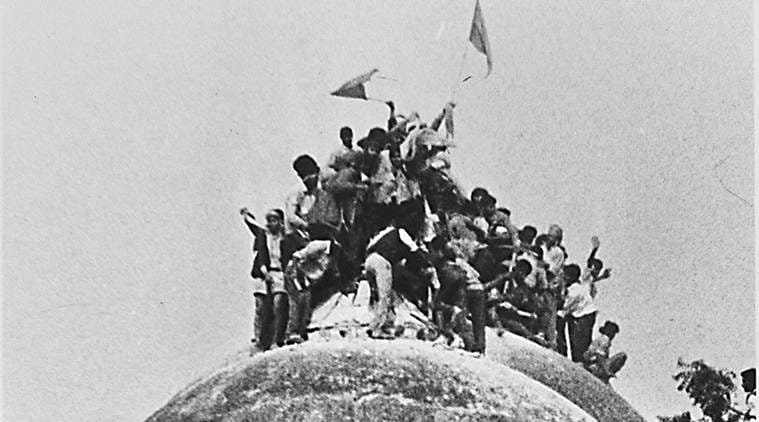
[Babri Masjid demolition] Allahabad High Court dismisses appeal against acquittal of LK Advani, others
The
plea challenged the 2020 judgment by the Special CBI court which held
that there was nothing on record to establish the existence of a
conspiracy to demolish the Babri Masjid.
From Babri to Gyanvapi, how India’s courts have helped escalate Hindutva claims on mosques
Rather than dismissing them under the Places of Worship Act, 1991,
courts often allow petitions against mosques to fester, thus helping
Hindutva politics.
Tandav controversy: ‘Filing FIRs has become fashionable’
Activists and experts feel
that India’s freedom of expression is shrinking day by day, and it’s
time we stop blowing up trivial issues by marginalising the real issues
The other Ayodhya trial: Case against LK Advani, Murli Manohar Joshi, Umar Bharti is crawling
As SC begins daily hearings in Ram Janmabhoomi dispute amidst national spotlight, the criminal trial in the Babri Masjid demolition, against L K Advani, Murli Manohar Joshi and Uma Bharti among others, is crawling. The Indian Express spends a day at the Lucknow trial where an overburdened judge is racing against time, as well as decaying evidence, and ailing, lost or dead witnesses
NEW DELHI — Seventeen years after she was gang raped during the Gujarat riots in 2002, Bilkis Bano thanked the Supreme Court for ordering the state government to pay her compensation worth Rs. 50 lakh — the highest compensation given to a rape survivor in India.
Addressing a press conference in New Delhi on Wednesday, Bilkis said, “The Supreme Court has acknowledged the pain that I have endured for 17 years. That is important to me.”
“This was a long fight but I have never lost faith in the Constitution and the justice system,” she said. [ . . . ]
Paradoxical though this may sound, but the Supreme Court verdict
turning down the plea to send the 1994 Ismail Faruqui case to a larger
Constitutional Bench, may eventually eliminate extraneous matters which
have complicated what is quintessentially a civil dispute and force
future hearings to the core issue. This is the same case where the apex
court made the sweeping assertion that "a mosque is not an essential
part of the practice of the religion of Islam".
From a fundamental
question of ownership or title of the disputed structure (or the land),
all sorts of faith related questions have been added to complicate an
already byzantine legal maze. The return to the title suit now pending
for almost seven decades, which will be heard from October 29 by a newly
constituted bench, marks new hope for arriving at a judgement aimed at
settling the original dispute.
The first majority judgement,
pronounced by three of the five judge bench, concluded that in Islam a
place of worship is not central or of vital import as namaz "can be
offered anywhere, even in open", without as much as either detailed
examination of Islamic scriptures or the query being central to the
case. The dissenting verdict of Justice S Abdul Nazeer now provides
several reasons why the issue of essentiality and centrality of a mosque
in Islam must be heard by a larger bench. If the Supreme Court, too,
follows the path which the Allahabad High Court chose when it pronounced
the populist judgement on September 30, 2010, faith of people will be
severely eroded in the judiciary. [ . . . ] https://www.thequint.com/voices/opinion/ayodhya-verdict-shows-how-faith-suits-majority
Sunil Singh, once Adityanath’s right-hand man and now in police custody, claimed that the charge of hate speech is true.
On 27 January 2007, despite injunctions from the district magistrate, the current chief minister of Uttar Pradesh, Adityanath, delivered an incendiary speech
urging revenge for the death of a young Hindu boy who had got caught in
a clash between two groups in Gorakhpur during Muharram. In February
this year, the Allahabad high court accepted
the state government’s refusal to sanction the prosecution of its chief
minister. On 20 August, based on a plea challenging that decision, the
Supreme Court asked
the Uttar Pradesh government to explain why Adityanath should not be
prosecuted for the alleged hate speech. Days before the case comes up
for hearing before the apex court, Sunil Singh, once Adityanath’s
right-hand man and now in police custody, has claimed that the charge of
hate speech is true.
“The meeting that evening happened in a charged atmosphere,” Singh
recounted to me in a telephone conversation while being taken to court
from the Lucknow Central Jail on 10 September. The gathering, which took
place near the statue of Maharana Pratap at the entrance of the
Gorakhpur railway station, was organised in the memory of the Hindu boy
who had died, he told me. “I addressed the crowd just before Adityanath
gave his speech. It is the video recording of that speech that has been
submitted to the court. I was very much present on the spot.”
According to Singh, the violence began while Adityanath was still
addressing the crowd. “A hotel just in front of the venue of meeting was
looted and vandalised even before Adityanath could finish his speech,”
he said. “The hotel was owned by a local Muslim. I am myself an accused
in that case. From there, the rioting spread to other parts of
Gorakhpur.”
Two people were killed and property worth crores of rupees was burnt
in the riot that followed. On 28 January, the next day, Adityanath and
over a dozen other leaders of the Hindu Yuva Vahini—a Hindu youth
militia Adityanath founded in 2002—were arrested
while they were marching towards Gorakhpur’s troubled areas. “I was
also arrested along with Adityanath,” Singh said. “While Adityanath
remained in the custody for 11 days, I was released after 66 days.”
At the time, Singh was one of Adityanath’s most trusted lieutenants,
serving as the Hindu Yuva Vahini’s state president. Singh held the post
until early 2017, when he was expelled
for fielding electoral candidates from the Hindu outfit even as
Adityanath explicitly denied that members of the organisation would be
contesting elections.
After Adityanath became chief minister in March 2017, Singh remained
in the shadows for some time. However, according to various
district-level leaders and workers of the Hindu Yuva Vahini, Singh
continued to stay in contact with them and the cadre. After all, he had
been responsible for bringing most of them into the organisation.
Since late 2017, the cadres told me, they started looking to Singh
for leadership. In order to appease the Rashtriya Swayamsevak Sangh—the
BJP’s parent body—Adityanath had begun sidelining his own organisation
and dissolved many district level units that refused to fall in line.
The RSS’s pressure was a test of loyalty for Adityanath. As chief
minister, he had to prove that the political ambitions of his Hindu
outfit would not clash with those of the BJP. Though Adityanath has
always contested on a BJP ticket, the Hindu YuvaVahini has existed
outside the Sangh Parivar, a collection of Hindu nationalist
organisations headed by the RSS. [ . . . ]
Wink not blasphemous, says Supreme Court, clears actor
TNN | Sep 1, 2018, 12.58 AM IST
NEW DELHI: The Supreme Court quashed the FIR against actor Priya Prakash Varrier on Friday for her wink in the song “Manikya Malaraya Poovi” from the Malayalam film “Oru Adaar Love”, and said a wink could never be “blasphemous” for Islam or any religion.
Giving Varrier immunity from future persecution, a bench of CJI Dipak Misra and Justices A M Khanwilkar and D Y Chandrachud said no FIR or complaint “should be entertained against the actor and the film’s director and producer because of the picturisation of the song”.
The FIR was lodged in Hyderabad on the complaint of one Muqeeth Khan on February 14. He had alleged that the “wink” in the song, a version of a traditional Muslim song from Malabar region of Kerala in circulation since 1978, offended the religious sentiments of his community.
No intent in song to insult or disturb public order'
Section 295A of the IPC, which was invoked against the actor and others, provides for up to three years’ imprisonment for “anyone who with deliberate and malicious intention of outraging the religious feelings of any class of citizens of India, by words, either spoken or written, or by signs or by visible representations or otherwise, insults or attempts to insult the religion or the religious beliefs of that class”.
After hearing Varrier’s counsel Haris Beeran and Telangana counsel S Uday Sagar, the bench said the complaint appeared to have been lodged by Khan to gain unwarranted mileage from the FIR. “We do not find Section 295A will be attracted in the present case.
We are inclined to think so for picturisation of the said song solely because of the ‘wink’ will not be tantamount to an insult or attempt to insult the religion or the religious beliefs of a class of citizens,” it said.
“The said song has been on YouTube since February 2018. We do not perceive any calculated tendency to insult or to disturb public order,” it added.
Quoting its rulings involving the film “Padmaavat” and cricketer MS Dhoni, the bench said the apex court had consistently laid emphasis on aggravated form of insult to religion when it was perpetrated with deliberate and malicious intent to outrage religious feelings. “What is urged before us is that picturisation, which involves the actress with a wink, is blasphemous. Barring that, there is no other allegation. Such an allegation, even if it is true, will not come within the ambit and sweep of Section 295A IPC,” the bench said.
Many of those
charged in the Babri Masjid demolition case are lawmakers. That’s what
makes the case a litmus test for rule of law in the country
Written by Seema Chishti
|
Updated: June 30, 2018 1:19:45 pm
In May last year, a special CBI court charged the 12 accused in the
Babri Masjid demolition case of criminal conspiracy under Section 120B
of the Indian Penal Code.
In July, the Supreme Court will resume hearings to the title suit of
the land in Ayodhya. But it is another litigation, related to the
demolition of the Babri Masjid in 1992, which holds great significance
for India as a constitutional republic. The verdict in this case could
send out the powerful message that the law applies equally to everyone.
Or indicate that it is soft on those in power.
In May last year, a special CBI court charged the 12 accused in the
Babri Masjid demolition case of criminal conspiracy under Section 120B
of the Indian Penal Code, to be read with sections 153, 153A, 295, 295A
and 505. These charges include conspiracy, spreading animosity between
specific groups and provocation with intent to cause riots, among other
things. The special court is hearing the matter in Lucknow.
Significantly, those accused of exhorting people to bring the mosque
down — or at least being apparently happy about its demolition and the
subsequent events — are now making laws. This is what makes the Babri
Masjid demolition case more important than ever.
On June 25, Uttar Pradesh Chief Minister Yogi Adityanath took special
care to attend functions involving the contested land at Ayodhya. He
said there was “no doubt” that the Ram temple will be built. Ram Vilas
Vedanti — a member of the Ramjanambhoomi Nyas also present at the
function — referred to the Babri Masjid demolition and said “just like
everything happened then without court orders. before the 2019
elections, the construction of the temple would start in Ayodhya. I
assure you”. Uma Bharti, Union minister charge-sheeted in the case said,
a day later, she expects “a bold step” would be taken towards building
the temple because Narendra Modi is at the helm at the Centre and Adityanath is leading the UP government.
Two other important accused in the case, LK Advani and Murli Manohar
Joshi (both former Union ministers and BJP presidents) have been pushed
into retirement — for entirely secular reasons — but they remain symbols
of the country’s most powerful party in 30 years. Kalyan Singh, a
governor now, was the chief minister on whose watch the masjid was torn
down between noon and 5.30 pm on December 6, 1992.
With an important set of accused in the case either powerful in the
government or close to government circles, the resolution of the Babri
Masjid demolition case will be a test for legal processes in the
country. In 1992, as communal riots broke out on a scale not witnessed
since the Partition, India’s claims about being inclusive and modern
seemed boastful. Riots and unrest continued — even if spasmodically at
some places — till the Mumbai riots of 1993. It was a moment of
reckoning for India’s post-Partition generations. This is what makes the
1992 moment important.
When the BJP led the ruling coalition from 1998 to 2004, the Ayodhya
issue — along with Article 370 and the Uniform Civil Code — was put on
the back-burner. The party had to give in to the exigencies of coalition
politics. The broad idea was that these demands stood outside the pale
of the law.
A leadership that emerged during the Emergency became the
establishment in 1970s. The Mandal issue threw up the country’s leaders
in the Nineties. The leadership that grew out of the disruption centred
around the Babri Masjid disruption now holds office at the Centre — and
enjoys an absolute majority.
Uma Bharti, Kalyan Singh, LK Advani, MM Joshi, all charged with
having led or participated in the assault on the Babri Masjid, are
members of the ruling party. Adityanath’s politics drew from the Ayodhya
divide of 1992. In their book, Everyday Communalism, researchers Sudha
Pai and Sajjan Kumar note that there were 28 FIRs against Adityanath and
his Hindu Yuva Vahini in the wake of the Gorakhpur riots. How these and
other cases were quashed with him as the chief minister is another
story.
There are many principled arguments about the damage that is
inflicted on democracy when the fringe becomes the law. But the matter
is also germane to a basic question centred around the rule of law — how
it deals with the politically powerful.
The World Bank’s Ease of Doing Business Rating speaks of the primacy
of the “regulatory environment” and lays stress on fidelity while
“enforcing contracts”. But how can the country be seen to be upholding
regulatory norms if the bare basics of the rule of law aren’t asserted
loudly and clearly?
So, even if those charged with the destruction of the Babri Masjid
have the popular mandate, the law must act against them if they are
found guilty in a criminal case. How India acts in 2018 with respect to
what happened in 1992 is an important test for its democracy.
Relatives of the convicts in 2002 Naroda Patiya massacre
case in tears outside the court after the pronouncement of sentence in
Ahmedabad, in 2012.(AP File Photo)
A few
weeks before a Supreme Court-led investigation led to the conviction of
Bharatiya Janata Party (BJP) legislator and minister Mayaben Kodnani in
2012, I was in Naroda Patiya, speaking with eyewitnesses who had stood
firm for 10 long years. They had been threatened and intimidated for
naming the minister.
They gave graphic descriptions of that day in
February 2002, when their nondescript neighbourhood in Ahmedabad
resembled a gigantic bonfire. Mobs had gathered at Noorani Masjid,
located on the main road, and then roamed its labyrinthine bylanes,
shouting ‘Jai Shri Ram’ slogans and brandishing swords and trishuls
(tridents).
Among the 97 Muslims that the fire devoured were
Shakeela Bano’s mother, two brothers, a sister-in-law and a young niece
and nephew. Bano remembered the children being flung into the blaze. She
and many others told the special court about Kodnani’s alleged role; of
how she allegedly came to the area and exhorted the crowd to kill
Muslims. They claimed she oversaw the distribution of swords and
trishuls and assured the crowd that there would be no police enquiries
against them.
The Gujarat riots file
◼ A coach of a train, carrying Hindu pilgrims, burns in Gujarat’s Godhra. (REUTERS FILE)
February 27, 2002:
A fire guts a coach of a train carrying Hindu pilgrims, returning from
Ayodhya, at the Godhra train station in Gujarat; 59 are killed in the
blaze.Feb 28–Mar 2:
Hindu mobs rampage through Muslim neighbourhoods as communal riots
break out in several cities across Gujarat. In three days, 790 Muslims
and 254 Hindus are killedFeb 28:
Hours after Godhra train burning, a thousands-strong mob reaches Naroda
Patiya – a predominantly Muslim neighbourhood in Ahmedabad. The mobs,
instigated allegedly by BJP and Bajrang Dal activists, kill 97 people
2002: Gujarat police start investigations, and Maya Kodnani — a state legislator at the time —is not among suspects named in the FIR2003:
Kodnani’s name first appears in survivor accounts shared with the
Nanavati-Shah commission set up to inquire into the Godhra train burning
and subsequent riots. Witnesses also name Bajrang Dal leader Babu
Bajrangi
2008: Kodnani is named in an investigation that is taken over by a special investigation team on the direction of the SC.August 2012:
Kodnani, Bajrangi and 29 others are convicted by special court for the
Naroda Patiya killings. Kodnani is given a 28-year prison term and
Bajrangi ordered to spend rest of his life in prisonApril 2013:
The Gujarat government led by Narendra Modi clears the way for
prosecutors to seek the death penalty for Kodnani and others in a higher
court, but reverses its stand in SeptemberJuly 2014: Gujarat high court grants Kodnani bail after accepting her plea that she is unwellAugust 2012-2018:
Appeals against Kodnani and Bajrangi’s conviction and sentence are
filed at the high court. Between 2014 and 2016, seven judges recuse
themselves from the hearingApril 2018:
High court acquits Kodnani, giving her the benefit of doubt, after
noting inconsistencies in testimonies. HC also reduces Bajrangi’s
sentence to 21 years
The
police didn’t name her as an accused but the apex-court driven Special
Investigation Team said it found evidence of her involvement – including
call logs of her being in touch with the other Patiya accused.
The
victims’ families led wretched lives for 10 years until judge Jyotsana
Yagnik delivered her judgment in 2012, convicting Kodnani and sentencing
her to 28 years in jail. Detailing the minister’s alleged role, the
judgment called her the “kingpin of riots”.
Kodnani has now been exonerated
by the Gujarat high court. Survivors such as Bano remain at the mercy
of their neighbours, who have continued to threaten them for naming
their Hindu neighbours. Patiya’s residents had, in the worst form of
betrayal, turned on their own.
“Communal riots are like cancer on
constitutional secularism and the incident in Naroda Patiya was a black
chapter in the history of the Indian Constitution,” special judge
Yagnik had observed. Her words had gone a long way in assuaging the
wounds of Patiya’s survivors but today, the high court overturned the
conviction, saying the witnesses were unreliable and that none of them
had named Kodnani when the case was first registered.
India has a
spectacular record of not delivering basic justice when it comes to
brazen riots, carried out in broad daylight, be it Delhi or Ahmedabad.
Who killed 3,000 people in Delhi and 1,000 in Gujarat? Can it be that
the guilty are only petty foot soldiers? Did political exhorters have
nothing to do with 1984 or 2002?
The Supreme Court of India on March 14 resumed hearing
the Ram Janmabhoomi-Babri Masjid (RJBM) appeal. The Court dismissed all
the Interlocutory Applications filed by parties to the 13 appeals as
well as by third parties. The bench further directed the registry not to
accept any applications from third parties. Senior Counsel Rajiv Dhawan
then resumed his arguments, the main crux of which was based on the
doctrine of essential practices.
The doctrine of essential practices as developed by the Supreme Court
is designed to enforce secularism in the Indian context. This doctrine
lays down that State legislation can regulate all religious practices,
other than the ones essential for the performance of religious worship.
The bench had asked the Senior Counsel if the decision in Ismail Faruqui v Union of India should be referred to a five judge Constitution Bench for reconsideration. The Ismail Faruqui
case was one of the first cases to be decided on a matter related to
the RJBM issue. In this case it was held that the State could acquire
the disputed property until the matter was finally adjudicated. [ . . . ]
Mecca blast case: Aseemanand’s ‘disclosure’ missing from court
TNN | Mar 14, 2018, 05:35 IST
HYDERABAD: A key document in the 2007 Mecca Masjid blast case containing a disclosure by Hindu right-wing member Swami Aseemanand, which could seal the fate of the trial, has gone mysteriously missing from a lower court’s custody.
The revelation came after chief investigating officer and CBI SP T Rajah Balaji on Tuesday began recording his evidence. Balaji filed the first chargesheet before the case was transferred to the NIA.
On May 18, 2007, a bomb blast inside the Mecca Masjid during Friday prayers killed nine people and injured 58 others. Later, more people were killed when the police opened fire on protesters. As part of the trial, more than 160 witnesses were examined by the court that includes victim, RSS pracharaks and several others.
Aseemanand was granted bail in April 2017 on the condition that he can’t leave Hyderabad and Secunderabad.
On Tuesday, K Ravinder Reddy, the fourth Additional Metropolitan Sessions Judge cum special court for NIA cases, came down heavily on court officials after several documents pertaining to the case couldn’t be traced. The proceedings of the case had to be stalled by more than one and half hours before officials could trace some of the documents that were exhibited before the court.
Balaji was taken by surprise after a key two-page document relating to the reported disclosure made by Naba Kumar Sarkar aka Swamy Aseemanand before CBI, explaining the alleged conspiracy, was not traceable. The document, marked as “Memo of Disclosure” No 88 in NIA chargesheet, reportedly contains names of senior RSS leaders.
The missing document is believed to be of much importance and can seal the fate of Aseemanand in the case, investigators said.
During investigation, the CBI officer examined 68 witnesses in the case, out of which 54 have turned hostile, including DRDO scientist Vadlamani Venkat Rao, who is the prosecution witness No 151 in the case.
The Supreme Court’s resolve to treat the
Babri Masjid–Ramjanmabhoomi dispute as a pure land dispute is welcome,
as it clears a great deal of clutter on the path to a legal solution.
Attempts at mediation have failed and “sentiments” have been bruited
about for far too long, making the dispute seem well-nigh intractable. A
democracy has to be based on rule of law; going down the path of
sentiments can only be a recipe for anarchy, disorder, riots and mayhem.
As a corollary, extraneous parties who are in the fight for all sorts
of political or theological reasons need to be kept out – whether they
are Hindu bodies, Muslim bodies, right wingers, left wingers, spiritual
gurus or anybody else.
The politics of the dispute has smouldered for long and there will be
no end in sight as long as there are electoral benefits to corner. But
legality which has as its premise only the indubitable evidence on
record rather than suppositions and sentiments is a different ball game –
it is the only possible route to a lasting and peaceful resolution
given that even long drawn out attempts at mediation have failed.
It is important for India’s democratic institutions to reassert that
the rule of law will take precedence. Investors have little confidence
in a state kneeling before or whipping up vigilantism and a judiciary
that struggles to resolve civil disputes. Casting aside narrow
sentimentalism and politicking and governing dispassionately can be the
best advertisement for “New India”. If judges can blank out the noise
around them and focus solely on the documents presented to them, there
could be a closure to the title dispute. The political class and civil
society must respect the verdict and lend a helping hand to restore
communal harmony.
This piece appeared as an editorial opinion in the print edition of The Times of India.
On December 6, 1992 a frenzied mob of kar sevaks pulled down the Babri Masjid in the presence of Lal Krishna Advani and other top Sangh Parivar leaders. The aftermath saw the mob and the leaders become the subject matter of two FIRs . In this article, V. Venkatesan, Associate Editor, Frontline, and Vidya Subrahmaniam, Senior Fellow, The Hindu Centre for Politics and Public Policy, trace how the criminal cases arising out of the FIRs were delayed and deflected and connect the dots to show a pattern behind the 25-year long, and continuing, wait for justice. The delay had prompted the Supreme Court in April 2017 to pass an extraordinary order to expedite the trial and deliver the judgment "within a period of two years".
[ . . . ] http://www.thehinducentre.com/the-arena/current-issues/article9988868.ece
Babri Masjid case: Case coming up before SC on eve of 25th anniversary of demolition, what lies ahead?
By The Invisible Lawyers Team December 4, 2017
December 6th, 1992, marked one of the darkest days of
Indian history which witnessed the impact of the polarisation that had
taken place within our society. On this day, prominent leaders of the
BJP including L.K. Advani flagrantly flouted the orders of the Allahabad
High Court and the Supreme Court, and brought down the Babri Masjid in a
planned and organised manner. A Lucknow Bench of Allahabad High Court
in 1989, had ordered a status quo over the disputed land. However,
despite these orders a band of karsevaks surrounded the mosque and
demolished it, thereby destroying the peace that was much required in
the communally sensitive area of Faizabad and Ayodhya. It led to
communal outrage, which further resulted in violence between the
communities.
The land occupied by the Babri Masjid has been a subject for
litigation since 1885, when Mahant Raghubar Das, the chief priest of the
Ram Janmsthan filed a civil suit when the Faizabad Deputy Commissioner
refused to let him build a temple on the land adjoining the mosque.
However, despite the constant battle for power between the two
communities, from 1951 to 1986, Faizabad and Ayodhya remained
comparatively at peace and tension free. During this time, no legal
activity was undertaken by either of the communities and the decisions
pronounced by District and High Courts, i.e. the maintenance of status quo, prevailed. The Hindu and the Muslim communities co-existed, without any disruption. However, this changed after December 1992.
Following the demolition of the Babri Masjid, L.K.Advani and Murli
Manohar Joshi, both senior leaders from the BJP, made communally
inflammatory speeches which ultimately led to the demolition of the
mosque and violence all over the country. Criminal conspiracy charges
were brought against the leaders of the BJP but in May, 2010, the
Allahabad High Court dismissed the petition for a direction to proceed
with the conspiracy charge against L.K.Advani and others.
In September, 2010, the Allahabad High Court awarded two-thirds of
the Ayodhya site to Hindu parties, and one-third to the Waqf Board. (see
details of the litigation below) However, in May, 2011, the Allahabad
High Court verdict was stayed by the Supreme Court, directing status quo
to be maintained. The oldest litigant in this case passed away in
December, 2014.
In March, 2017, a Supreme Court bench comprising of Justices P.C.
Ghose and Rohinton Nariman posted for detailed hearing a CBI appeal
against the dropping of charges for criminal conspiracy against
L.K.Advani and Murli Manohar Joshi. While these proceedings are still
pending, the Supreme Court is due to hear the Appeal against the
judgment of the Allahabad HC on 5th Decemeber, just one day before the 25th anniversary of the demolition
The Supreme Court has a mammoth task ahead, to decide one of the
longest running disputes, which has historically been a volatile issue
dividing the two communities.
Fuzail Ahmad Ayyubi, Advocate-on-Record representing
respondent Haji Mehboob, provides a timeline for the Babri Masjid
dispute as it played out:
The mosque was constructed in 1528, by the nobleman Mir Baqi, at the
request of Babar, the first Moghul Emperor, hence the name Babri Masjid.
The following inscription can be found in Persian on the gate of the Mosque: “By the command of Emperor Babar, whose justice is an edifice
reaching up to the very height of the heaven; the good-hearted Mir Baqi
built this alighting-place of angles Buvad Khair Baqi (may this
goodness last forever) the year of building made clear likewise, when I
said Buwad khair Baqi (935 A.H) (i.e. 1528)”
Though Ayodhya has been held to be the birth place of Hindu God Ram, based on the Ramayana written by Valmiki, there was no mention of any temple being destructed for the construction of mosque, not until 19th
century, when British Historians, based on popular local myths, started
stating the story of the demolition of a temple known to be the birth
place of the lord Ram by Mughal emperors and the subsequent construction
of a mosque. Neither do the historical texts during the reign of Babar
reflect any incident of such destruction. Thus since the mosque was
built in 1528 till early nineteenth century, undisputedly, there existed
a mosque used by Muslims for worshipping.
Legal History
The legal history of Babri Masjid begins from the construction of a “chabutra” or
Platform (17ft x 21ft area situated on the outer enclosure of disputed
mosque) on 23.11.1857, inside the boundary wall of the Babri Masjid,
which was known as the Janamsthan or the Birth place of Lord Shri Ram. Thereafter, in 1857, the Nawab of Avadh declared different timings for the observance of namaz by Muslims in the mosque and worship on the chabutra, by the Hindus.
The first legal dispute arose in 1885, when Mahant Raghubar
Das, the Chief Priest of Ramjanmsthan, filed a civil suit in the court
of Sub-Judge, Faizabad on 15.01.1885 seeking permission to build a
temple on the said chabutra. Pt. Hari Kishan Singh, the Sub
Judge, rejected the plea on the ground of threat to public law and order
situation. In his consideration if a temple were allowed to be
constructed on the chabutra, being so close to Masjid, then it would ‘lay the foundation of death and murder.’
The Mahant then appealed to the District Court of Faizabad.
Colonel J.E.A Chamber, after an inspection of disputed land, dismissed
the appeal and held that a temple could not be built without inflaming
communal passions. Subsequently, a railing was built to separate the chabutra from the Masjid imposing a physical boundary between both communities. In his Judgment, he observed: “I found that the Masjid built by Emperor Babar, stands on the
border of the town of Ayodhya. It is most unfortunate that a mosque
should have been built on the land specially held sacred by the Hindus.
But, as that occurred 356 years ago, it is too late now to remedy the
grievance. All that can be done is to maintain the parties in status
quo.”
Raghubar Das, on 25.05.1886 filed his suit again which was dismissed
by the Judicial Commissioner of Oudh, who in his judgment, observed that
the plaintiff’s earlier suits have been dismissed, on the ground that
the plaintiff had no evidence to support his claim that the place
belonged to Hindus, but, while dismissing the suit he observed that: “This spot is situated within the precinct of the grounds,
surrounding the mosque erected some 350 years ago, owing to the bigotry
and tyranny of the Emperor, who purposely chose this holy spot which
according to Hindu legend was the site of the temple. The Hindus seemed
to have very limited right of access to certain spots, within the
precincts adjoining the mosque and they have, from a series of years,
been persistently trying to increase those rights and to erect buildings
on two spots, namely Sita-Ki-Rasoi and Ramchandra –Ki- Janmabhumi.”
Afterwards, in March 1934, communal riots arose when allegedly a cow
was slaughtered by Muslims in the adjoining region of Ayodhya. The
Hindus tried to ravage the mosque and damaged it, but it was repaired by
the funds collected through the fine imposed on Hindu rioters.
In 1936, in response to an enquiry, the Commissioner of Waqf Boards
expressed, that mosque was built in 1528, by Babar, the emperor and a Sunni Muslim.
Another litigation concerning this mosque came up in 1945, involving, Shia and Sunni. Both sects claimed the mosque. The local Civil Judge, S.A Ahsan, declared in his pronouncement on 23.03.1946, that although mosque was built by Babar who was a Sunni, yet there is evidence that it was used by both the sects.
Post partition, in December 1949, the controversy rose again and the
legal battle started. Some Hindus allegedly kept the statues of Rama, Sita and Laxman during the night of 22-23 December 1949 inside the mosque, thereby attracting Hindu believers to gather for sacred viewing, Darshan, of the deity.
This incidence led to communal confrontation. Pt. Jawahar Lal Nehru,
ordered Govind Ballabh Pant, the then CM of U.P to remove the statues.
However, K.K Nayar, the DM, refused to remove the idols because he
asserted that removing the idols will flare up the communal riots.
The court decided to maintain the status quo till the
finalisation of decision of ownership. The gates of disputed place were
locked. The Additional Magistrate of Faizabad and Ayodhya, Markendey
Singh, appointed the Chairman of Municipal Board of
Faizabad-Cum-Ayodhya, Priya Dutt Ram, as receiver, to arrange for case
of property on dispute.
Later on, Gopal Singh Vishared, a Sanatan Hindu and an
inhabitant of the Ayodhya city, filed a suit on 16.01.1950 in the Civil
Court urging entitlement of worship, and unobstructed visit to idols and
sought a perpetual injunction, restraining the defendants from removing
the idols. The Civil Judge, V.N Chadha on 19.02.1950 granted a
temporary injunction which was later on confirmed in his judgment on
03.03.1951, where the Judge recorded it as an undisputed fact that on
the date of the suit, the idols of Lord Ram and others, did exist on the
site and that worship was being performed by Hindus, including the
plaintiff though under some restrictions put by the executive
authorities.
On behalf of UP Govt., Dy. Commissioner, Faizabad, J.N Ugra filed a written statement on 24.04.1950, stating that, “The
property in suit is known as Babri Masjid and it has been for long time
in use, as a mosque for the purpose of worship of the Muslims. It has
not been in use as a temple of Shri Ram Chandraji.” The next para of the statement pronounced by Deputy Commissioner added that, “On the night of 22 December 1949, the idols of Shri Ram Chandra Ji were surreptitiously and wrongly put inside.” In the paragraph 16 it added that, “That
as a result of the said wrongful act, a situation imperiling public
peace and tranquility was created and public authorities had to
intervene in order to prevent the breach of peace and tranquility.”
Along with the suit number 2 of 1950, filed by Gopal Singh Vishared,
three more suits were filed by other parties, regarding receivership and
waqfs of site.
In 1959, Nirmohi Akhara also filed a suit for ownership of the disputed land. All those suits continued to be justified.
On April 26, 1955, Allahabad High Court, confirmed the status quo order, issued by the Civil Judge V.N Chadha in 1950.
The Sunni Waqf Board filed their suit No. 12 on 18.12.1961 in the
court of Civil Judge Faizabad seeking help from court in declaring a
portion of Area as a public mosque, commonly known as “Babri Masjid” and
area beyond referred mosque, was a graveyard of Muslim public.
From 1951 to 1986, Faizabad and Ayodhya remained comparatively at
peace and tension free. During this time, no legal activity was
undertaken by either of the communities. During the aforesaid time of 36
years, the decisions pronounced by District and High Courts, i.e. the
maintenance of status quo, prevailed. The Hindus continued the Akhand Kirtan in front of mosque to ‘liberate’ the ‘Shri Ramjanmabhumi’ since 23.12.1949, without any disruption.
On 25.01.1986, an advocate Umesh Chandra Pandey, submitted a new
application within the case no. 2/1950 filed by Gopal Singh Vishared
demanding the locks to be opened and the Hindus to be allowed to worship
the idols. It was a matter of astonishment that all claimants or
defenders of case no. 2/1950, had died and case also, was barred
according to law. So, no new claimant could be entered without
permission of the court. But it had happened and without permission of
the court, the application of Umesh Chandra Pandey, was accepted under
the old case and the judiciary refused this demand on 28 January. 1989.
An appeal was then filed against the referred order, before District
Judge, K.M Pandey on 31.01.1986. Within a day of this appeal, 1.02.1986
was fixed for the final hearing. The District Judge ordered on the same
day directing the state of Uttar Pradesh, the District Magistrate and
Superintendent of Police, Faizabad to open the locks, finding them to be
“an unnecessary irritant to the applicant and other members of
Community”, and not to impose any restriction or cause hurdle in the darshans of applicant and other members of the Hindu community.
Gates of Babri Masjid were unlocked in the presence of police
security after the pronouncement of this judgment. On 3rd February 1986,
Mohammad Hashim filed a case in High Court, seeking stay on the
aforesaid order of District Judge Faizabad. The court gave an order on
the same day to the maintenance of status quo “as existing
today” till the further order. The Sunni Waqf Board also put a petition
on 12 May 1986, against the order of the District Judge, to open locks.
The Lucknow Bench of Allahabad High Court clubbed together all cases
pending over Mandir-Masjid dispute on 14.08.1989, and issued an interim
direction to maintain status quo regarding the disputed property.
The leaders of VHP promised the Home Minister, Buta Singh, that they
will act upon the aforesaid directions of Lucknow Bench of Allahabad
High Court, given on 14.08.1989, to the effect that, “Parties to the
suit shall not change the nature of property in question and ensure
that the peace and communal harmony are maintained.”
The foundation stone of Mandir was laid on 9.11.1989, quite near the Babri Masjid and Kar Seva began, which was stopped the next day by the order of District Magistrate. The VHP claimed that Shilanyas was
laid on the undisputed land. But it was done at plot no. 586, claimed
by Sunni Waqf Board as having been used for long as a Muslim burial
ground.
Therefore, all legal suits related with Ayodhya were allotted by
Supreme Court to Lucknow Bench of Allahbad High Court in 1989, which
ordered a status quo over the disputed land. But, despite this legal
situation, Babri Masjid was demolished on December 6, 1992.
After this, the then Prime Minister, Narsimha Rao, by the permission
of the Parliament, vide Ayodhya Ordinance 1993 which eventually became
the Acquisition of Certain Areas of Ayodhya Act, took whole of 67 acres
in its possession on 07.01.1993, on the same day, the President of India
vide the Parliament Act 143 (1) allotted the whole case to Supreme
Court but Supreme Court again sent the case to Allahabad High Court. As
according to the Indian Constitution, Supreme Court cannot put aside the
decision pronounced by High Court, while providing its own decision
with referred legal action on 24 October 1994, the Supreme Court
restricted any construction of any kind on 67 acres of land. Moreover,
it announced to maintain status quo till the further orders.
The case remained pending further for 6 years and in 2002 Aslam
Bhoora, proceeded to the court. The court held on to its previous
decision of 24.10.1994 and on 13.03.2002 ordered to maintain status quo.
In March 2003, Lucknow Bench of Allahabad High Court ordered
Archaeological Survey of India to dig land around the Babri Masjid site
however the resulting report was not of help.
Besides the above mentioned civil suits, several other disputes
relating to speeches and the incident of 06.12.1992 are under process in
various commissions and judicial agencies.
Lucknow Bench of Allahabad High Court, on 30.09.2010, delivered a
decision and declared that disputed land will be divided in three parts
with the portion below the central dome where the idols are kept going
to the Hindus; Nirmohi Akhara would be allotted land including Ram chabutra and Sita ki Rasoi and
one the third land would be allotted to Suni Waqf Board and if minor
adjustments are required, the land acquired by central government could
be allotted. After this, the judgment was criticized by different
scholars, historians, political commentators and lawyers because it was
based on ‘faith’ and not on ‘facts’.
After this, against this judgment, many parties which appealed in
Supreme Court, included the Suni Waqf Board, Nirmohi Akhara, All India
Hindu Maha Sabha and Bhagwan Shri Ram Virajman. On May 2011, Supreme
Court stayed the verdict on Ayodhya of Allahabad High Court. Justice
R.M. Lodha declared the High Court verdict to be “strange”. He observed,
“The decree of partition was not sought by the parties. How can a
decree for partition be passed when none of parties had prayed for it?”
The Bench said that the status quo at the disputed site would
remain as directed by the 1994 constituted Bench and order passed on
March 13-14, 2002. The Bench while directing the status quo to continue, made it clear that the existing puja in the make-shift Ram Lala temple at the disputed site, would go on as usual.
The matter is to be heard by the Hon’ble Supreme Court of India in December 2017.
On Friday (December 1st) Citizens for Justice and
Peace has filed an intervention application in this case. They have
requested in their petition that having regard to the fact the that it
is not just a matter that concerns the Plaintiffs and the Defendants
alone, but relations between almost every citizen in India who seek
justice and peace, the matter should be referred to a Constitution bench
of seven judges.
Excerpts from the petition are given below: “52. It is further stated by the Applicants that, though the
exact series of events that had occurred while the present dispute was
being heard by the High Court might not occur again, it cannot be denied
that the said dispute is not just a dispute between the Plaintiffs and
the Defendants. The Plaintiffs and the Defendants represent a larger
demographic of entire communities for whom the said dispute has become
contentious and sensitive. It cannot be denied that, with the unrest in
the atmosphere as is present today, there is still an evident
possibility that adjudication upon the present dispute is likely to
cause unrest and disturbances of violence in the country. There is also a
possibility that there still exist elements who are likely to exploit
the controversy of the present dispute for their own advantage at the
cost of lives of innocent. Thus, it makes it even more significant, that
this Hon’ble Court may take into consideration that, the issue in the
present appeals is not just a dispute over property between the
Plaintiffs and the Defendants but has several other issues which will
have far reaching effects on the secular fabric of the country.
The Applicants submit that unfortunately secularism is being
manipulated by all groups political or otherwise. Muslims claim special
privileges in the name of secularism, Hindus demand a reversion to a
time that exists only in the political imagination. This issues before
the High Court involved a civil suit and, in our humble view, could not
have decided the larger issues of constitutionality. In view of the fact
that neither party was able to establish their case, no one should have
succeeded, even partially. It appears that finding no way to balance
these two, the High Court decision attempts a secular solution that
unfortunately does not put the festering wounds caused by this conflict
to rest.
It is therefore most respectfully prayed that this Hon’ble
Court upholds the high ideals of secularism and the rule of law. Today
it is a battle of unequals within the courts as a divisive and
cataclysmic movement and event is given legitimacy by the powers that
be, and all of India, young and voiceless millions want to see the end
to this deliberately perpetrated conflict. The only situation lies today
In each of us Indians rising above narrow confines of class, caste,
community and gender and dedicate the spot that has come to signify
conflict to a constructive non religious purpose.
For over three decades, this peace loving people of India,
practicing co existence and negotiation between different faiths and
languages, who have been held hostage to this dispute, have been,
unfortunately, not heard. Their vast voice has simply not been heard.
This small group of representatives Indians represents that vast, silent
voice, that wishes above all peace harmony and collective advancement
of all Indians.
That the applicants also submit that by virtue of the nature of
the dispute this Hon'ble Court may also consider the necessity to
constitute a larger bench of at least 7 judges as certain Constitutional
questions are bound to arise and there may be a need to re-consider the
judgement of this Hon’ble Court in Ismail Faruqui v. Union of India
(1994) 6 SCC 360.”
Read the full text of the petition here.
Read the statement by CJP:
Citizens for Justice and Peace, a human rights and legal
resources platform dedicated to fighting communalism and discrimination,
and for the rights of one and all, is now intervening in the Ram Janm
Bhoomi – Babri Masjid case along with a galaxy of prominent Indians from
various walks of life, from across the length and breadth of the
country. CJP’s plea is that the Supreme Court exercise its jurisdiction,
not treat this matter like a narrow property dispute and instead
recognise the ramifications of letting religion dictate the fate of a
piece of land.
CJP implores the court to take cognisance of the meaning of the word
Ayodhya, a compound word formed by adding together ‘a’ meaning ‘without’
and ‘yudh’ meaning ‘war’. Ayodhya, a space that should exist for all,
without conflict, has come to symbolise a vicious and bigoted conflict
between communities.
This voice of peace-loving and concientitious citizens, held hostage
to the conflict, has appealed to the Supreme Court not to treat the
dispute as just a property dispute between the litigants but one that
has a bearing on the fundamentals that this country stands on, its
Constitution.
Interveners include close to three dozen Indians from across the
country and from various walks of life, from Shyam Benegal, Aparna Sen,
Om Thanvi, RB Sreekumar, Anand Patwardhan (Ram Ke Naam), Ganesh Devy,
Medha Patkar, Aruna Roy, Anil Dharker, Ganesh Devy, Teesta Setalvad, Joy
Sengupta, Cyrus Guzder, Ram Rahman, Sohail Hashmi, MK Raina, to Dr. BT
Lalitha Naik and John Dayal. Others include: Suman Mukhopadhyay, Kiran
Nagarkar, Kumar Ketkar, Kalpana Kannabiran, KL Ashok, KP Sripala, AK
Subbaiah, Suresh Bhatt Bakrabail, Prof G Haragopal, N. Babaiah, Tanaz
Dara Mody, Muniza Khan, Tanveer Jafri and Dolphy D'souza.
“The outcome of this dispute, perpetrated and violent, has the potential
to affect the very foundations on which Indian democracy stands,” says
Teesta Setalvad, Co-founder and Secretary, CJP. “It is time for the
wounds caused by this conflict to heal and for peace-loving citizens of
all communities, young and old to speak up for an inclusive and forward
looking solution. This matter concerns the very soul of India,” she
adds.
CJP filed its intervention application to the civil suit on Dec 1 and
is likely to present its stand when hearing begins on Dec 5 at the
Supreme Court. Meanwhile, it has uploaded an online petition on its
website, seeking ordinary Indians sign up in support of Peace in
Ayodhya.
Disclaimer:"The views in the article are of the author and do not represent the views of the Invisible Lawyer"
Gujarat HC Allows Zakia Jafri to Appeal for New Probe in Modi’s Role in 2002 Riots
Zakia’s petition
sought that Narendra Modi and 61 others be named as accused for being
part of a conspiracy that facilitated the Gujarat riots.
New Delhi: In
what appears to be a silver lining in an otherwise adverse judgment for
Zakia Jafri, the wife of Congress politician Ehsan Jafri who was killed
by a mob in the Gulberg Society massacre in Ahmedabad during the 2002
anti-Muslim riots, the Gujarat high court on Thursday
allowed her to move the courts to request a fresh investigation into
the alleged criminal role of the then chief minister Narendra Modi and
61 others.
Zakia had moved the high court in 2014 against
the closure report filed by the Supreme Court-appointed special
investigative team (SIT). Zakia had also alleged in her petition that
the 2002 riots were part of a larger conspiracy involving Modi and
others.
The closure report – submitted by the SIT in 2012 at
a trial court hearing Zakia’s pleas – had stated that the SIT could not
find any “prosecutable” evidence against the accused persons, as a
result of which it could not press any charges against Modi and others.
Protesting
this, Zakia had appealed to the metropolitan magistrate’s court
demanding a fresh probe, but her appeal was dismissed in 2013. The
magistrate, B.G. Ganatra, had ruled that since the SIT was monitored by
the Supreme Court, he did not have the power to order a fresh
investigation.
This had forced Zakia to file her petition at the high court, which started final hearings in the case in 2015. On Thursday, the high court upheld the validity of the closure report and dismissed Jafri’s allegation.
However,
the high court allowed Zakia to demand a fresh investigation in the
case – as sought by her in the petition – and overturned the trial
court’s observations, which had ruled out another probe as it thought
the SIT was monitored by the Supreme Court.
“The
trial court has self-limited itself in saying that further
investigation, in this case, can’t be ordered. This order of [the] lower
court deserves interference. So, the petitioner can raise the issue
before the concerned court that is the same magisterial court, the
division bench of the high court or the Supreme Court,” Justice Sonia
Gokani told the Indian Express.
Effectively,
the high court judgment has created an opening for Zakia to seek
redressal at a lower court instead of the Supreme Court, which would
have been her last stop for appeal.
Speaking to The Wire,
activist Teesta Setalvad of Citizens for Justice and Peace, which is
also co-petitioner in the case, said, “The high court has partly allowed
the criminal revision application filed by Zakia Jafri challenging
magistrate B.G. Ganatra’s order of December 26, 2013, which had refused
further investigation. Justice Sonia Gokhani also made it clear that the
lower court was wrong in holding that the magistrate had no power under
law to order further investigation.”
Ehsan
Jafri was one of the 69 people killed in the massacre, which lasted for
more than six hours. It was alleged by Zakia that despite repeated
calls to the police by the former parliamentarian, the security forces
did not turn up to control the rioting. People were dragged out, hacked
and burnt to death in one of the worst massacres that followed.
Ever
since the SIT had filed its closure report exonerating Modi and other
important Hindutva leaders of the charge of inciting mobs against
Muslims, many critics have pointed out glaring loopholes in the report
and have compared it with the 2010 SIT report to the Supreme Court,
which had very incriminating words to say about the role of Modi. In
this context, the contrasting conclusions drawn by the SIT in both its
reports have attracted severe criticism from lawyers, civil society
activists and opposition parties. While the BJP has interpreted the SIT
closure report as a “clean chit” to Modi, others have pointed fingers at
the SIT for having sharply deviated from its earlier position as
reflected in its 2010 report.
After a wait of 14 long years, in 2016, a special court convicted 24
of the 66 accused in the Gulberg society case, but 36 people were let
off, including two of the main accused – BJP corporator Bipin Patel and
K.G. Erda, who was then a deputy superintendent of police in the area.
The SIT’s allegedly lackadaisical investigation was seen as the primary
reason for the poor rate of conviction in the case by many.
In a 2016 interview with The Wire, Manoj Mitta, senior journalist and author of the book The Fiction of Fact Finding: Modi and Godhra, too, had some damning things to say about the SIT.
“…the
closure report filed by the SIT on Zakia’s complaint is riddled with
internal contradictions which undermine the credibility of its so-called
clean chit to Modi. Take the one related to Gulberg society. On the one
hand, the SIT patted Modi for holding a series of meetings with
officers from the police and home departments to track the violence as
it unfolded on February 28, 2002, the day after the Godhra incident.
But, on the other hand, the SIT allowed Modi to get away with the claim
that he had been unaware of the Gulberg society violence, the first
post-Godhra massacre, until about five hours after it had been carried
out. Though its investigation is supposed to have been monitored by the
Supreme Court, the SIT exonerated Modi without any pretence of
questioning him on the ignorance feigned by him in a bid to save face.”
“The
clean chit that came in 2012 bore no trace, for instance, of the
criticism made by (R.K.) Raghavan (SIT chief) two years earlier before
the Supreme Court of Modi’s disparaging statement against Muslims in the
wake of the Godhra incident. Modi’s statement accusing some elements in
Godhra and the neighbourhood as possessing a criminal tendency was
sweeping and offensive, coming as it did from a chief minister, that too
at a critical time when Hindu-Muslim tempers were running high. Without
any explanation, such damning observations were excised from the SIT’s
final report, paving the way for Modi’s ascendance on the national
stage.”
It
is in this context that Zakia’s petition was being keenly-watched by
both the supporters and critics of Modi. With the high court ruling
against Zakia’s petition against the closure report but also allowing
her to file an appeal for a fresh probe, the legal battle is still far
from over.