|
Showing posts with label Ayodhya. Show all posts

January 22, 2024

When Was Ram Mandir Project Not Political? | Jyoti Punwani

 rediff.com

 When Was Ram Mandir Project Not Political?

In saying this, the Opposition is either being naive or hypocritical, argues Jyoti Punwani.
 

IMAGE: A worker decorates the entrance gate on the eve of the pran pratishtha ceremony in Ayodhya, January 21, 2024. Photograph: Shrikant Singh/ANI Photo

Does one have to be a Mumbaikar to associate the new Ram temple in Ayodhya with blood on the streets?

Wasn't the demolition of the Babri Masjid the foundation of this grand temple? What followed that demolition?


A generation may have grown up after December 6, 1992, which has no memory of the communal violence that broke out in Mumbai hours after the Babri Masjid fell. But even if one counts only those directly affected by the violence which claimed 900 lives, there would be at least 10,000 Mumbaikars for whom Ayodhya will forever be associated with bloodshed and ruin.


The RSS and Opindia have been visiting the families of those (the number varies from 16 to 28) who died in the police firing in 1990, when BJP/RSS supporters had gathered in Ayodhya to damage the Babri Masjid, in defiance of prohibitory orders.


What of the families of those who were killed by fellow Indians for no other reason than religious hatred? Not just in Mumbai, the December 6 demolition sparked riots in Surat, Ahmedabad, Kanpur, Delhi, Bhopal, and Ayodhya itself where 17 persons were killed on that very day.
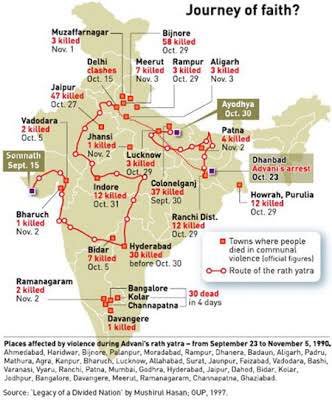
What of those killed earlier, in the wake of L K Advani's rath yatra in 1990? Aimed at whipping up Hindu sentiments in favour of building the Ram temple at the very spot where stood the Babri Masjid, the yatra left a trail of blood through Uttar Pradesh, as well as in cities such as Indore, Hyderabad.
These lives wouldn't matter to the RSS, but surely they should to the Opposition? Why has no party bothered to visit these families and find out how the violent Ram Mandir campaign changed their lives?
***
Indeed, the Opposition's stand on the Ayodhya consecration is puzzling. Their only objection seems to be that the BJP has hijacked a religious event for political benefit.
In saying this, the Opposition is either being naive or hypocritical. When was the Ram Mandir project not political? L K Advani decided to go on his rath yatra with a political aim: to counter the political upheaval caused by reservations for OBCs introduced by then prime minister V P Singh, in accordance with the Mandal Commission recommendations.
The character of the campaign was political. L K Advani linked Ram to nationalism; a Ram drohi was automatically a desh drohi.


The country was declared categorically and exclusively for Hindus: 'Yeh desh Hinduon ka/na kisi ke baap ka.' Musalmans were called gaddars (traitors) and given just two places to go to: Kabristan ya Pakistan. Not one of the slogans that emerged from the Babri Masjid Ram Janmabhoomi movement that spanned six years, was religious.


It was during this movement that the greeting 'Jai Siya Ram' became the war cry 'Jai Sri Ram'. In January 1993, during the second phase of the Mumbai post-demolition riots, Muslims were lynched to chants of 'Jai Sri Ram'.


The initial phase of the Ayodhya campaign took the BJP from two seats in 1984 to 86 seats in the 1989 Lok Sabha. Since then, the BJP has blatantly milked the Ayodhya Ram Mandir for electoral purposes. A more critical press than what exists today invariably wrote edits on this cynical use of religious feelings.
Given this background, how can we expect the consecration of this temple to be religious, and not political?


IMAGE: Sadhus and devotees near the Hanuman Garhi Mandir on the eve of the pran pratishtha ceremony in Ayodhya, January 21, 2024. Photograph: Rahul Singh/ANI Photo
***


The Opposition could well have given another reason for not attending the consecration. The new temple has been built after demolishing another's place of worship, at the cost of thousands of innocent lives. How can such a structure be a place of worship?


By making no reference to the violence at the heart of the Ayodhya project, the Opposition has shown that Muslims, killed for no reason other than their faith during this long campaign, barely feature in their consciousness. It seems the constituents of INDIA simply take Muslim votes for granted.


IMAGE: Vishwa Hindu Parishad workers in Prayagraj carrying pots containing water of the Ganga move towards Ayodhya ahead of the pran prathistha ceremony. Photograph: ANI Photo


***


Muslims certainly are nowhere in the grand national celebration that the government, with the full throated support of a fawning media, is conducting on January 22. Or maybe they are.
This State-backed national event is also being projected as a kind of triumph, the 'beginning of India's cultural revival and national pride', to quote Defence Minister Rajnath Singh.


If a nation's pride depends on building a temple after destroying a mosque, implicit in that pride is the humiliation of those who held the mosque in reverence. Also implicit is the exclusion of other faiths from the nation's pride.


With the Government of India backing this event, India can now boast of joining the company of theocratic nations. For those who prided themselves for being citizens of a secular country, where all communities are equally valued, at least officially, January 22, 2024 can only be a day of mortification.
Feature Presentation: Aslam Hunani/Rediff.com

Why is India’s Ram temple in Ayodhya controversial? | Areesha Lodhi

 Why is India’s Ram temple in Ayodhya controversial?
Governing party BJP’s Prime Minister Modi will be consecrating Ram Mandir on Monday, more than three years after laying its first stone.

By Areesha Lodhi
Published On 22 Jan 202422 Jan 2024
India’s stock market is shut for the day. Central government offices are only open for half the day. Neighbourhood watch parties have been organised across the country.[ . . . ]

https://www.aljazeera.com/news/2024/1/22/why-is-indias-ram-temple-in-ayodhya-controversial

Temple fever | Sevanti Ninan

 Temple fever

According to the Dainik Bhaskar, Rajiv Gandhi began his election campaign from Ayodhya, but when the elections took place it was the Bharatiya Janata Party which took its seat tally from 2 to 85

Sevanti Ninan Published 22.01.24

 https://www.telegraphindia.com/opinion/temple-fever-the-medias-blitzkrieg-on-the-ram-mandir-inauguration/cid/1995344

Those who control the State apparatus have compromised Secular India's ideals and State neutrality towards religion | S N Sahu

 newsclick

Contrasting Consecrations at Somnath and Ayodhya Rama Temple

S N Sahu |
 
Those who control the State apparatus have compromised Secular India's ideals and State neutrality towards religion.

Ram Mandir

The restoration of the Somnath temple initiated by Sardar Vallavavai Patel by mobilising money from the public and its consecration in 1951 offers vital lessons regarding the consecration of the Rama temple in Ayodhya.

Patel heeded Mahatma Gandhi’s pleadings that government funds should not be used for a shrine representing any one faith. It was Gandhi’s conviction that the Indian State should always maintain neutrality towards religion, a sentiment he expressed in the context of the restoration of the Somnath temple while addressing a prayer meeting in Delhi on 28 November 1947. 

He said the government formed after independence represented all Indians pursuing diverse faiths because, in his own words, “It is a secular government, that is, it is not a theocratic government. It does not belong to any particular religion.”

Nehru Disapproved of President’s Participation in Somnath Event 

Then President of India, Rajendra Prasad, was invited to participate in the consecration ceremony of the Somnath temple and inaugurate it on 11 May 1951. He sought the views of Prime Minister Jawaharlal Nehru, who, on multiple occasions, requested him not to do so since, as the head of the Republic, he represented the secular State of India. Therefore, his participation in consecrating the Somnath temple would go against the secular nature of governance. 

Nehru Felt Somnath Event was Political

Nineteen days before the consecration of the Somnath temple, Nehru wrote to Prasad (on 22 April 1951) expressing his worry about the Somnath affair. He stated, “As I feared, it is assuming a certain political importance.” Proceeding further, he added that at the international level, references were being made to it and remarked, “In criticism of our policy in regard to it, we are asked how a secular government such as ours can associate itself with such a ceremony which is, in addition, revivalist in character.” 

Nehru also informed Prasad that in response to several questions in Parliament on the issue, he had stated that the government had nothing to do with it and those connected with it were acting in their personal capacity. 

Nehru’s remarks from 73 years ago resonate in the context of the consecration of Ayodhya’s Rama Temple. It has been built on the spot where the Babri mosque once stood and was demolished. The Supreme Court, while allowing the construction of the temple, held that the demolition constituted “an egregious violation of [the] rule of law”. Prime Minister Narendra Modi and several other constitutional functionaries are participating in the inauguration, which also makes it a political event.

Nehru Declined Somnath Event Invitation  

When on 22 April 1951, Digvijay Singh, the Rajpramukh or head of the government of Saurashtra, invited Nehru to participate in the consecration ceremony, he wrote on 24 April thanking him, and stating with sadness, “I am troubled by this revivalism and by the fact that our President and some ministers and you as Rajpramukh are associated with it.” 

“I think,” Nehru wrote, “That this is not in line with the nature of our State, and it will have bad consequences both nationally and internationally.” “As individuals, of course, it is open to anyone to do what he chooses in such matters... But many of us happen to be more than private individuals, and we cannot dissociate ourselves from our public capacities.”

Pride Over Rama Temple Invite 

How the Prime Minister and his party are taking obvious pride in being invited to inaugurate the Rama temple in Ayodhya amidst a spectacle of priestly rituals sharply contrasts the ideals of a secular State and Nehru’s vision. 

In a letter written on 28 April 1951 to RR Diwakar [former Information and Broadcasting minister in the Nehru Cabinet and later the Governor of Bihar], Nehru described the Somnath consecration event as a “pompous ceremony” and asserted that “...any kind of governmental association is going to injure us abroad and even in India”. He revealed that he had received many complaints and letters inquiring “...if this is how a secular State behaves”.  

Nehru wrote with anguish that the Rajpramukh of Sourashtra directly wrote to Indian embassies abroad to send soil from those countries and water from some important rivers to reconstruct the Somnath temple. He stated that such requests greatly embarrassed the country, and foreign missions and leaders of many countries were wondering why a place of worship being restored in India would use foreign soil and water.  

Other Leaders Disapproved of President’s Decision 

It has been a persistently popular notion in India that only Nehru disapproved of President Rajendra Prasad’s decision to participate in the Somnath consecration ceremony. A peep into the records of that period and numerous other writings of Nehru reveals that several distinguished leaders and public figures expressed solidarity with him and made persuasive appeals to Prasad not to associate himself with the Somnath shrine ceremony. For instance, S Radhakrishnan, acclaimed for his deep understanding of Indian and Western philosophy, wrote that the association of high functionaries of the State with the consecration of Somnath temple was “liable to misunderstanding”. Even C Rajagopalachari joined hands with Nehru to dissuade President Prasad not to participate in the Somnath programme. Mridula Sarabhai, sister of the renowned space scientist Vikram Sarabhai and a freedom fighter, also supported Nehru’s stand on the Somnath issue. Nehru advised Sarabhai to meet Prasad and share her critical stand. 

Contrasting Publicity for Somnath and Rama Temples

The unabashed media publicity given to the Rama temple event in Ayodhya by the corporate-controlled TV channels and many print outlets is at the cost of the fundamental issues of the people. It reminds of Nehru’s statements on 28 April 1951 regarding his instructions to the media on their coverage of the Somnath temple consecration. He wrote, “I feel that in the circumstances, our radio broadcast should rather tone down the description of what happens at Somnath and not make it appear in any way that it is a governmental function.”

However, we now witness the Modi regime giving no-holds-barred publicity to the Rama temple consecration event. 

Stress on Secular Non-communal Ideals 

In a letter to chief ministers on 2 May 1951, nine days before the Somnath ceremony, Nehru wrote that several people were attracted to it, and some of his colleagues preferred to participate in the event in their personal capacities. While doing so, Nehru wrote, there was bound to be “a certain measure of public support to this venture” and cautioned that nothing should be done to come “in the way of our State being secular”. 

He flagged the point that secularism formed the very basis of the Indian Constitution and governments and urged chief ministers to “refrain from associating themselves with anything which tends to affect the secular character of our State”. “There are, unfortunately”, Nehru said, “many communal tendencies at work in India today, and we have to be on our guard against them.” He also said, “It is important that governments should keep the secular and non-communal ideal always before them.”

Tragically, secular and non-communal ideals are being relentlessly devalued by the powers that be. They have pushed the country into a whirlpool of politics anchored in rituals and divisive religious narratives, contrary to the Constitution and its vision of India that celebrates the coexistence of all faiths.

Tuning into the vision of Gandhi and Nehru to salvage the secular State is a vital lesson which Indians today ignore at their peril even as they witness the ritually driven consecration ceremony at Ayodhya with the active involvement of the Prime Minister.  

The author served as an Officer on Special Duty to the President of India, KR Narayanan. The views are personal.

January 20, 2024

India: Avay Shukla on the upcoming event on 22 January 2024 and Shankaracharyas and Cameracharyas

 View from [Greater] Kailash

19 January 2024

OF SHANKARACHARYAS AND CAMERACHARYAS


  This last week has established that plumbing the depths of the ridiculous and the bizarre is not only our national pastime, it is also now the leitmotif of our society and ruling regime. The other day I decided I needed a "kurta", not one of those fancy and expensive Myntra creations, but something more befitting a pensioner who has not received his last four DA instalments because his state govt. has decided to buy cowdung and cow urine with the money instead in order to win elections. So off I went to the local market; there were kurtas aplenty but only in one colour- yellow. The shopkeepers told me that they were "jajman" kurtas, in honour of the Ram Mandir consecration next week! Which explains why we should not be too hard on the Chief Justice of India for turning up in a saffron kurta at a temple recently- he really had no choice of colour. The fact that this was preceded by the Supreme Court delivering a couple of disappointing judgments in favour of the government was, of course, merely a coincidence.

  Staying with the curious goings-on in Ayodhya, it appears that we now have a fifth Shankaracharya, located in Delhi- no wonder the original four are feeling threatened. The affairs of the Hindu faith shall no longer be conducted on the Collegium pattern  but on the Master of the Roster model: there are no "Kaun Banega Crorepati" prizes for guessing who this gentleman is. But one has to admit he fully deserves his pre-eminent position for his sheer gall and inventiveness, and the ability to smoothly sail over contradictions: the inauguration of the new Parliament building last year, which was patently a political occasion, was effortlessly converted into a religious event, while the consecration of the Ram Mandir, which should be a purely religious ceremony, has been converted into a mega political event! Politics and religion have been seamlessly blended into one supreme individual, very soon the Shankaracharyas too shall be dispatched to the Marg Darshak Mandal which does appear to be getting a bit top heavy. Actually, the four genuine Shankaracharyas should never have entertained hopes of presiding over the Mandir consecration, for an "ubermensch" like our venerated PM, who has never let a single train be inaugurated by the Railway Minister or an Expressway by the Transport Minister, was certainly not going to allow this spiritual thunder to be stolen from him by a couple of sulking saints.

   Or by a battered Constitution, for that matter, now on a ventilator under the Bharat Ayushman scheme. Article 370 may have been deleted in full public glare, but Article 27 (which prohibits the state from using the taxpayers' money for the promotion and maintenance of any religion) has been given the quietus, well, quietly. The icing on the "prasad" is the government's order declaring a half day holiday for all central govt. and PSU employees on the 22nd of January. By my calculations this shall cost the exchequer Rs. 250 crores. Expect these folks to go chanting Jai Shri Ram all the way to the local "theka" on the 22nd, and to the polling booth subsequently. I have no doubt that this holiday will now become an annual feature.

   And suddenly Ayodhya has become the El Dorado for our own remora-like corporates who have a remarkable resemblance to this species of fish that hang about the jaws of sharks for the crumbs: land prices have tripled, plans have been launched to build hotels, condominiums, malls, airports, old age homes, homestays to cater to the 40 lakh visitors expected every month. One airline, which has a reputation for locking up its passengers in its planes and airbridges for hours on end and serving them a-la-carte meals on airport tarmacs, converted its Ayodhya flights into morality plays, dressing up its crew in Ramayan costumes: the pilot became Ram, Sita and Laxman received the boarding passengers at the gate. There was no sign of Hanumanji-he was probably on another mission to set on fire that other impudent island which had the temerity to mock God's chosen One. The Disneyfication of Ayodhya is almost complete. Wait for Akshay Kumar a.k.a Akhand Kumar to make his next movie on it, just as soon as he finishes his prolonged genuflections to the powers that see, or for Amitav Bachchan's next quiz show Kaun Banega Shankarcharya ? 

   All those who laboured for years to make the Ram temple happen will, of course, not be there: this is in the best traditions of the bird after which our country may well be named now- in cuckooland, after all, the real work is done by someone but the credit claimed by someone else. And so the likes of Advani and Murli Manohar Joshi will not grace the occasion, the poor labourers who have given their blood and sweat for its construction will be kept miles away, the worshippers of the temple will be outside while the usurpers will be inside. But for me the unkindest cut is the non-invitation to that flag bearer of nari shakti, if not nari bhakti, from my state- Kangana Ranaut. Ayodhya could have done with her oomph, and her temporary absence from Himachal would also have had the beneficial effect of slowing down the melting of the glaciers there. Methinks the BJP has missed a trick here- it could have used her scholarship in history to get her to revise the date of Independence once again, to 22nd January 2024. What about the earlier announced date of 2014?, you may well ask; well that would now become the year of the Quit Thinking movement. But I can understand the Supreme Leader's quandary- even with all the AI tools at Mr. Amit Malviya's disposal he would have had a tough time keeping the cameras focused on the fifth Shankaracharya once the Rampaging Ranaut entered the frame. Algorithms have their limitations too, you know. A.I may be artificial, but its not stupid.

January 19, 2024

India’s Ayodhya Temple Is a Huge Monument to Hindu Supremacy

time.com

 India’s Ayodhya Temple Is a Huge Monument to Hindu Supremacy

Ideas
Audrey Truschke is a professor of South Asian history at Rutgers University.

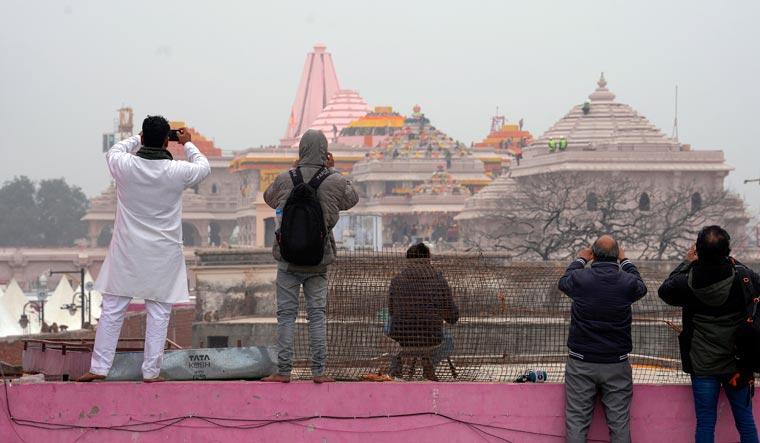
On Jan. 22, Indian Prime Minister Narendra Modi will inaugurate a three-story monument made of marble, sandstone, and teak that features 44 gates and 392 intricately-carved pillars. But the structure, built on a vast 70-acre plot, may be the least remarkable part of the new Ayodhya temple. Its controversial inauguration atop the ruins of a 16th-century mosque marks the culmination of a three-decade promise made by Modi, his ruling Bharatiya Janata Party, and other Hindu nationalist groups—and serves as the biggest political testament yet to Hindu supremacy over Indian Muslims.

Ayodhya is a town in northern India that, for centuries, was home to the Babri Masjid. The mosque was built in 1527 by a general associated with the Mughal Emperor Babur and was a rare surviving example of the architecture of the early Mughal Empire, which ruled parts of India from the 16th to 19th centuries. Muslims, India’s largest religious minority, worshipped in the mosque for more than 300 years without issue.

Watch more from TIME

In the 1850s, when India was largely under British colonial rule, the first signs of trouble arose as the Babri Masjid emerged as a key site of Hindu nationalist attempts to rectify perceived historical wrongs by Muslims, an idea inherited from British colonialists. Hindus claimed that Lord Ram, a major god and mythological hero, had been born at the very spot on which the mosque stood. Competing claims of Ram’s birthplace were once attached to many sites in Ayodhya, but the Babri Masjid drew particular fervor because it was a mosque. Some imagined further historical wrongs associated with the Babri Masjid, including claiming that the mosque was built after Babur’s general destroyed a Hindu temple at that location.
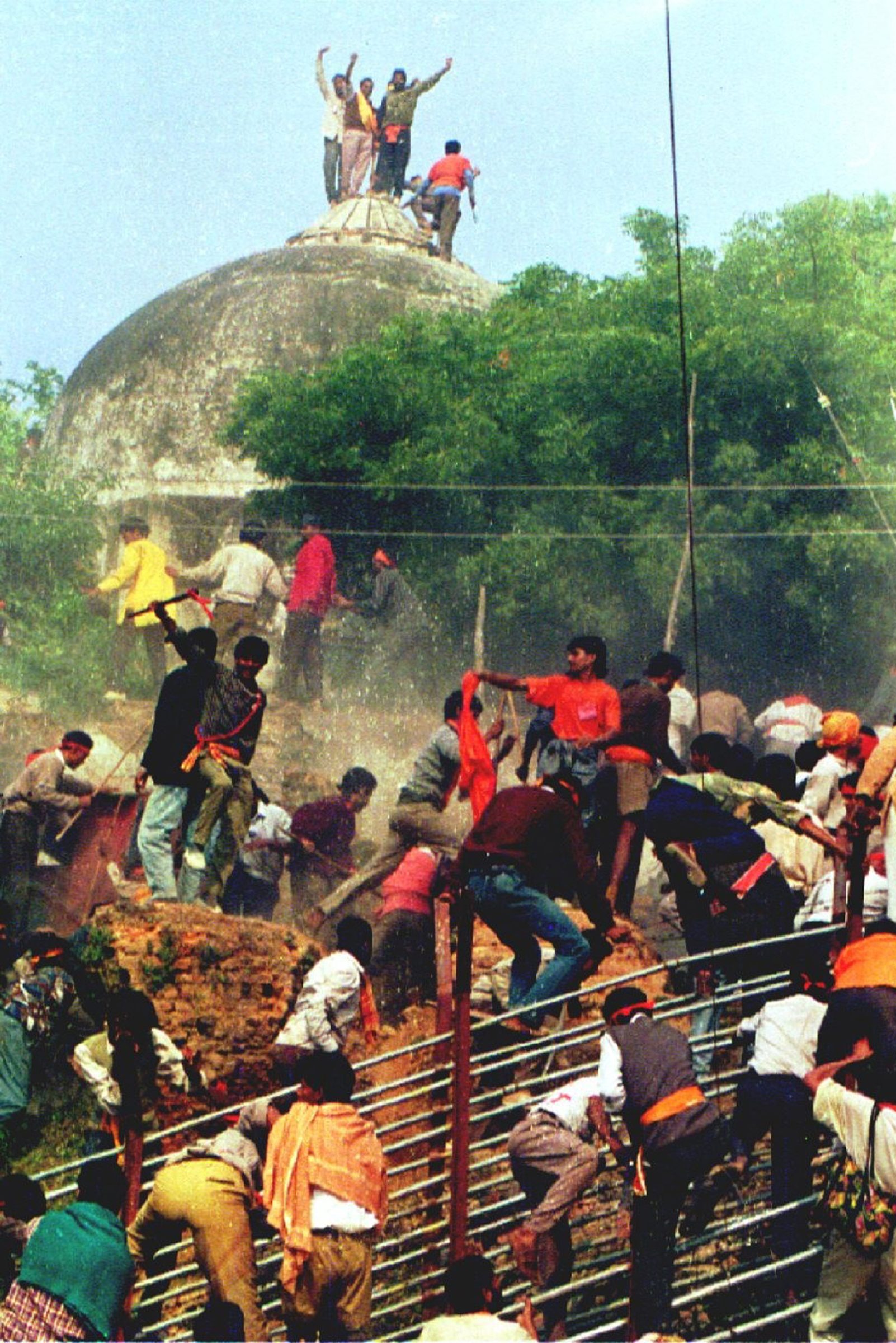
Hindu militants storm the Babri Masjid in December 1992, climbing atop the building's dome as they demolish it to clear the site for a Hindu temple.
Hindu militants storm the Babri Masjid in December 1992, climbing atop the building's dome as they demolish it to clear the site for a Hindu temple.Sunil Malhotra—Reuters
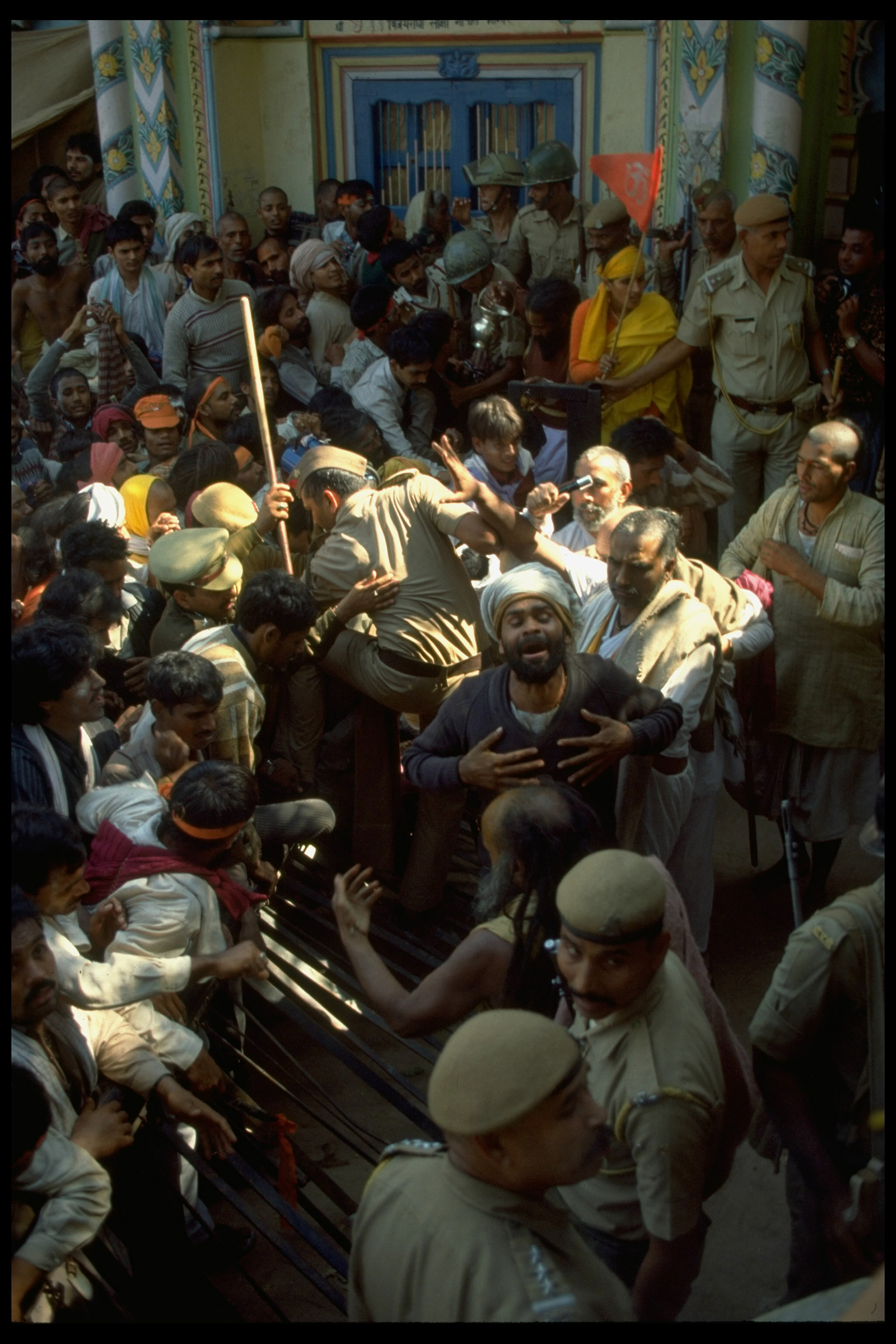
Riot police battling incited Hindus bent on razing the Babri Masjid and erecting a Hindu temple to Ram, October 1990.
Riot police battling incited Hindus bent on razing the Babri Masjid and erecting a Hindu temple to Ram, October 1990.Robert Nickelsberg—Getty Images

None of these claims stand up to historical scrutiny. But in the 1980s, Hindu nationalist groups began tapping into these claims to argue that the mosque needed to be destroyed to clear the way for a new Hindu temple, declaring Mandir wahi banayenge (“The temple will be built right there!”). After years of agitation, their efforts resulted in an explosion of Islamophobic violence on Dec. 6, 1992, when a Hindu mob numbering at least 75,000 descended on Ayodhya and dismantled the Babri Masjid, brick-by-brick. The mob’s anti-Muslim iconoclasm extended to people, and many Muslims in Ayodhya fled the city that day, fearing for their lives. In the days that followed, communal riots that rocked various Indian cities claimed about 2,000 lives, most of them Muslim. A subsequent report commissioned by the Indian government found dozens of people—many of whom are now BJP political leaders—responsible for orchestrating and encouraging the attacks.

The BJP benefited from stirring up Hindu nationalism around the Babri Masjid, and in 2014 swept into power, displacing the more pluralistic Indian Congress Party. The BJP then began to remake democratic India into a Hindu supremacist state. Following a second BJP national victory in 2019, India’s Supreme Court—whose autonomy has been undercut by the Modi government—issued its final judgment that decided the fate of the Babri Masjid site. The court called the mosque’s destruction “an egregious violation of the rule of law,” but nonetheless ruled that a Hindu temple could be built on the mosque’s rubble. Modi laid the foundation stone at a groundbreaking ceremony in August 2020, and will finish what the BJP and other Hindu supremacists began more than 30 years ago by consecrating the Ayodhya temple surrounded by his Hindu nationalist peers.
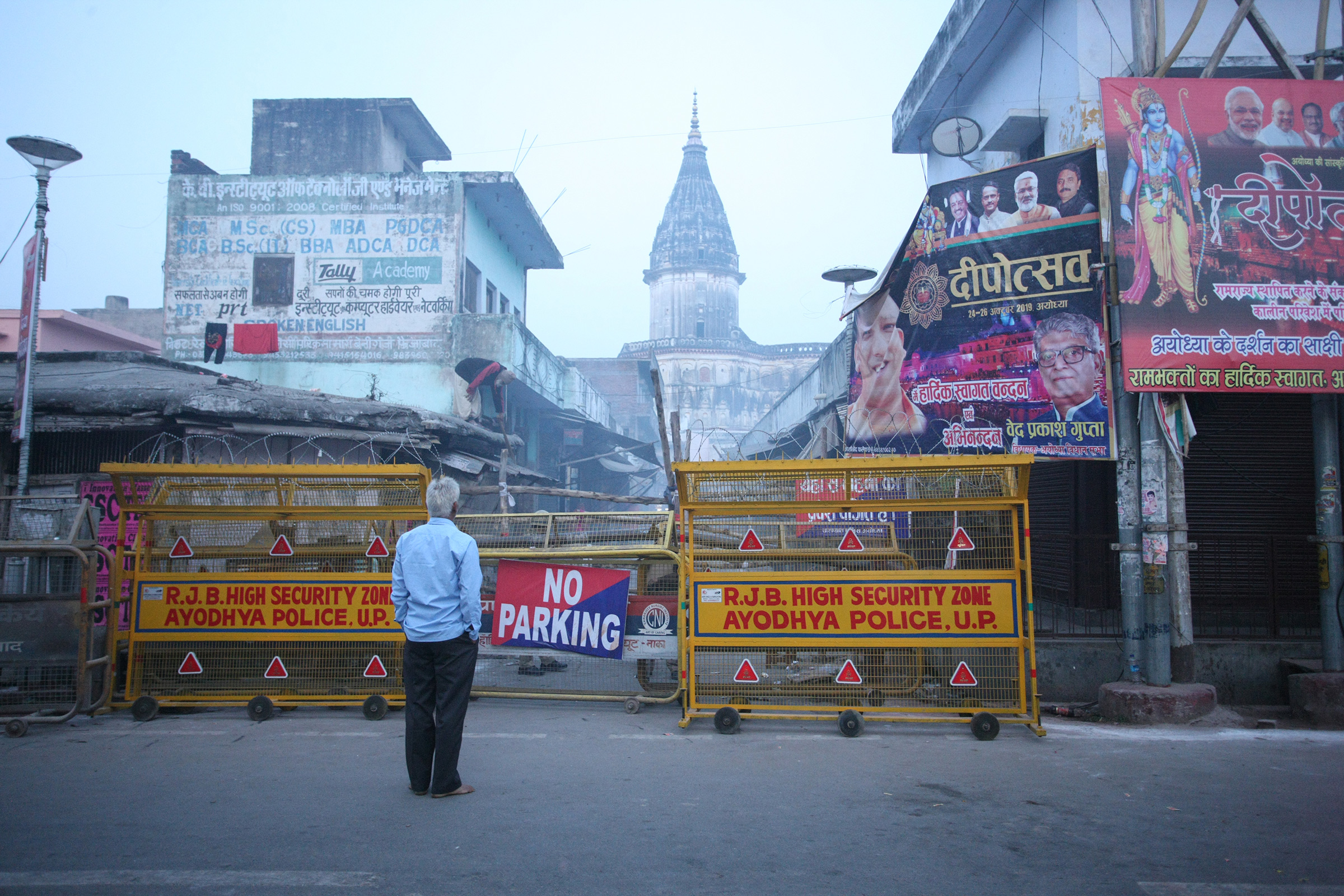
A local man looks on through barricade on street near Hanmuna Gadhi temple in Ayodhya on Nov. 9, 2019, ahead of a Supreme Court verdict on the future of a disputed religious site in the holy city.
A local man looks on through barricade on street near Hanmuna Gadhi temple in Ayodhya on Nov. 9, 2019, ahead of a Supreme Court verdict on the future of the Ram Temple. Ritesh Shukla—NurPhoto/Getty Images

Still, the event will be marked by conspicuous absences. Leaders of the opposition Congress party will skip the festivities, in protest over what they rightly see as a consecration that is more a political ploy than a religious ceremony. Even some Hindu leaders agree, arguing that the Ayodhya temple cannot be consecrated since it remains incomplete, and therefore violates Hindu scriptures. They also object to the participation of divisive political figures like Modi.

Yet the Indian Prime Minister is pressing ahead with inaugurating an incomplete temple—even at the price of alienating Hindu religious leaders—because of India’s May 2024 general election in which the BJP hopes to secure another national victory. If history is any guide, this tactic of harnessing majoritarian sentiment for political gain may well succeed.

The Ayodhya temple’s inauguration portends dark times ahead not just for India’s Muslims but also many Hindus who remain committed to pluralism and tolerance. Hindu supremacists have long sought to reduce the broad-based Hindu religious tradition to their hateful political ideology. The Ayodhya temple is a sizeable step toward that goal.

Muslims are second-class citizens in Modi’s India, regularly subjected to human rights violations. Freedom House now classifies India—once heralded as the world’s largest democracy—only “partly free” on account of the “rise in persecution affecting the Muslim population.” And there are signs that the Ayodhya temple may only mark a new era of the Hindu supremacist war on mosques. There are numerous cases in Indian courts seeking to demolish more of them in favor of building Hindu temples in Varanasi, Mathura, and other cities. Such demolitions may unleash more violence on India’s beleaguered Muslim minority, and further cement the feeling that the country is for Hindus, and Hindus alone.


January 18, 2024

Video: Excerpt from the documentatry film Ram Kay Naam by Anand Patwardhan


A clip from a film we made 33 years ago. Sadly relevant ! Includes an interview with Mahant Ramsevakdas Shastri who with a few others broke the lock of the Babri Mosque on a December night in 1949 and inserted Ram idols there. He and his friends were arrested and later got bail. But the idols were not removed. Finally when Babri was demolished on 6 December 1992, the idols disappeared as mysteriously as they had appeared. Now new idols have been placed and Modi will open Lord Ram's eyes on 22nd February. But who will open the eyes of the people of this country to see how they are being made a fool of by Modi and Co.

January 11, 2024

Ram temple shows Hindutva demands complete surrender – even of our memories | Amrita Dutta

The betrayal of the Babri Masjid demolition is being written out of history in the triumphant run-up to the inauguration of the temple in Ayodhya.


 https://scroll.in/article/1061871/ram-temple-shows-hindutva-demands-complete-surrender-even-of-our-memories

January 08, 2024

India: How a Journalist Was Sexually Assaulted the Day Babri Masjid Fell | Aviral Virk (Report in The Quint from Sept 2020)

 How a Journalist Was Sexually Assaulted the Day Babri Masjid Fell

Ruchira Gupta recalls how kar sevaks mistook her to be a Muslim, throttled and sexually abused her in Ayodhya.
Aviral Virk
News Videos

Updated: 29 Sep 2020

https://www.thequint.com/amp/story/videos/news-videos/babri-demolition-day-vhp-bajrang-dal-kar-sevaks-assaulted-journalist-ruchira-gupta

January 07, 2024

India: Idol Chatter - Neerja Chowdhury presents RSS myth on Ayodhya as history | Dhirendra K Jha

The Caravan

Idol Chatter
Neerja Chowdhury presents RSS myth on Ayodhya as history

by Dhirendra K Jha

28 October 2023

Neerja Chowdhury's How Prime Ministers Decide perpetuates the RSS myth that Nanaji Deshmukh was involved in placing a Ram idol at the Babri Masjid on the night of 22 December 1949. SONDEEP SHANKAR / GETTY IMAGES

It is well known that the Ram Janmabhoomi movement, aimed at constructing a temple at the site of Ayodhya’s Babri Masjid, was the most pivotal Hindu majoritarian campaign for capturing the centre stage of Indian politics. It is an equally established fact that the Sangh Parivar launched this campaign only in 1984, when the issue was made the central plank of the Vishva Hindu Parishad and the Bharatiya Janata Party. The critical turning point of this dispute—the placing of a Ram idol inside the mosque on the night of 22 December 1949—was the handiwork of another section of Hindu communalists, belonging to the Hindu Mahasabha. In fact, it was this act, seen as the first attempt to convert the Babri Masjid into a Hindu religious site, that led to the decades-long legal battle that culminated in the Supreme Court, on 9 November 2019, mandating the construction of a temple at the site of the mosque.

Given the significance of the issue, the Rashtriya Swayamsevak Sangh seems to have long desired the stamp of antiquity on its association with the dispute. Until the assassination of Mohandas Gandhi, on 30 January 1948, the RSS and the Hindu Mahasabha had acted almost like sister organisations, with overlapping membership being widespread. But, after the assassination, in order to de-hyphenate itself from the assassin, Nathuram Godse, the RSS quickly disassociated from the Hindu Mahasabha, even though they remained in the same ideological space. The Sangh’s move emanated from Godse’s claim, during his trial, that he had left the RSS and joined the Hindu Mahasabha long before he killed Gandhi. To give credence to Godse’s lie and cover its tracks, the RSS fabricated history to push the false notion that it had existed in total separation from the Hindu Mahasabha since the 1930s.

This line of argument became a hurdle for the Sangh when it sought to associate itself with the Hindu Mahasabha’s 1949 bid to convert the Babri Masjid into a Ram temple. Even after launching its own campaign, in 1984, the RSS did not seek any such association, for a very practical reason: to avoid being implicated in the crime of breaking into the mosque. However, years later, when a legal victory began to appear imminent, some members of the Sangh, in their typically nuanced way, quietly circulated stories that Nanaji Deshmukh, the RSS pracharak—full-time worker—in charge of eastern Uttar Pradesh in 1949, had played an important role in placing the idol.

[  . . .  ]

 https://caravanmagazine.in/history/neerja-chowdhury-rss-myth-ayodhya

Twitter Video clip: Dhirendra Jha speaking of the Ram Temple being built in Ayodhya

 “ये मंदिर जो बन रहा है वो नाइंसाफ़ी का एक प्रतीक है। झूठ, फ़रेब, साज़िश ये सब हिंदुत्व की राजनीति का एक हिस्सा रहा है चाहे वो बाबरी मस्जिद की बात हो या गांधी के हत्यारे से अपने आप को अलग दिखाने की कोशिश” मस्जिद को मंदिर में कैसे बदला गया, बता रहे हैं लेखक धीरेंद्र के झा -

https://twitter.com/khanumarfa/status/1743568599921672664

January 04, 2024

India: Firm stance: Editorial on CPM’s Sitararam Yechury declining invitation to attend the Ram Mandir inauguration | The Telegraph

 https://www.telegraphindia.com/opinion/firm-stance-editorial-on-cpms-sitararam-yechury-declining-invitation-to-attend-the-ram-mandir-inauguration/cid/1990041

Firm stance: Editorial on CPM’s Sitararam Yechury declining invitation to attend the Ram Mandir inauguration
CPM, however, has made no bones ab­out its reservations. Commenting on Sitaram Ye­chury’s decision to decline the invitation, the po­litburo, refreshingly, did not seek refuge in ambiguity
 

The Editorial Board Published 29.12.23, 07:28 AM

In the grey world of politics, invitations can transcend the realm of courtesy. This is because attending or skipping an event is often loaded with political and ideological significan­ce. The responses of some members of the Op­position who have been recipients of the invitation to the forthcoming inauguration of the Ram temple point to the political factors at play. Mamata Banerjee and Sonia Gandhi, the leaders of the Trinamul Congress and the Congress, respectively, have not made it clear whether they are likely to grace the occasion. It is possible that they are anxious about the Bharatiya Janata Party utilising their presence at the inauguration for political gain in an election year. The Communist Party of India (Marxist), however, has made no bones ab­out its reservations. Commenting on Sitaram Ye­chury’s decision to decline the invitation, the po­litburo, refreshingly, did not seek refuge in ambiguity. On the contrary, it made it clear that it stood against the exploitation of religion as a political instrument and accused the BJP and the Rashtriya Swayamsevak Sangh of attempting to transform a religious ceremony into an ostensibly State event. The CPI(M) has a point. The presence of the prime minister, the face of the government, along with other political dignitaries is likely to blur the lines that are meant to separate a religi­ous function from a State ceremony. The constitu­tional and legal spirit buttresses the politburo’s charge. In the constitutional template of governance, the State, as underlined by the Constitution and reiterated by the nation’s highest court, cannot have an expressly religious character. Jawaharlal Nehru, a staunch votary of the prin­ci­ple of secularism, had opposed gubernatorial at­tempts to involve the public exchequer and em­bassies in festivities related to the Somnath tem­ple.
What is singular about the new republic is that this principle emphasising the insularity of the State from the Church has little political purchase. The BJP has reaped electoral dividends by politicising the Ram mandir: its inauguration is being curated by the party with the general elections in mind. The perverse triumph of religiosity in politics has meant that most political parties in India are interested in flirting with benign or rabid forms of majoritarianism. The Congress’s espousal of soft Hindutva in the recent elections in Madhya Pradesh is a case in point. It is heartening to note that the Left, an electoral lightweight at the moment, refuses to swim with the tide. Politics should ideally be a matter of principle.


January 01, 2024

India: Land Lords - Windfall gains made in the name of the Ram temple | The Caravan - Jan 2024 issue

 The windfall gains made in the name of the Ram temple; The Hindu Mahasabha’s mendacious attempt to recreate Ayodhya at Madhya Pradesh’s Kamal Maula mosque

https://caravanmagazine.in/religion/windfall-gains-made-name-ram-temple

December 31, 2023

India: With the Ayodhya Ceremony, has the inclusive India of his dreams been lost asks Harsh Mander


Harsh Mander: With the Ayodhya ceremony, has the inclusive India of my dreams been lost forever?

The idea of a humane country of equal citizenship has taken a bad knock.


December 29, 2023

India: Mixing Religion with Politics | Aditya Mukherjee

Deccan Herald

Mixing Religion with Politics

The BJP government has decided to remind us that genuine patriotism stems from taking pride in the construction of the Ram temple, which serves as an affirmation of our religious faith.

Aditya Mukherjee
Last Updated 28 December 2023 

January 2024 will be a defining moment for the BJP under the prime ministership of Narendra Modi: the inauguration of the new Ram Temple in Ayodhya

The BJP government has decided to remind us that genuine patriotism stems from taking pride in the construction of the Ram temple, which serves as an affirmation of our religious faith. Moreover, Lord Ram, as we all know, was an inspiring cultural symbol of India. It is believed that an estimated cost of around Rs 1,800 crore has been incurred in building this temple.
Even the Congress might avoid criticising Modi’s initiative to construct the Ram temple in Ayodhya due to political expediency. The reason is that the party cannot afford to alienate Hindu voters ahead of the upcoming general elections. While Rahul Gandhi claims to be a Janeudhari Hindu and a devotee of Lord Shiva, Kamal Nath attempted to project himself as a more devout follower of Hinduism than Shivraj Singh Chouhan during the recently concluded assembly elections in Madhya Pradesh. Ayodhya has remained a political hot potato for close to four decades ever since Rajiv Gandhi, as prime minister, ordered the unlocking of the small shrine to Ram at the disputed site. Since then, the issue has perpetually smoldered. Thus, this anticipated contest of religious assertions has underscored that the temple issue remains a persistent factor in the ever-fluctuating political landscape of our country. The construction of religious structures can serve as a distraction from addressing other important socio-economic problems.

[ . . . ]

https://www.deccanherald.com/opinion/mixing-religion-with-politics-2828476

India: Is Modi Bigger Than Ram? Why Politics in Name of Ram Temple?


Is Modi Bigger Than Ram? Why Politics in Name of Ram Temple?

Newsclick Team |
In this episode of Bol Ke Lab Azad Hain Tere, Abhisar Sharma discusses how the Bharatiya Janata Party is planning to use the inauguration of Ram Mandir on January 22, 2024, to project its politics, and how it will use this day to glorify the Prime Minister’s image.


https://www.newsclick.in/modi-bigger-ram-why-politics-name-ram-temple

Video: Is it a religious event or a political stunt? । Ayodhya Temple - Ram Mandir Inaugration - a discussion on Satya Hindu


https://www.youtube.com/live/zNPAXvpuvAs?si=Kw2WFBJk_Bc48nvJ