|
Showing posts with label state. Show all posts

January 22, 2024

Those who control the State apparatus have compromised Secular India's ideals and State neutrality towards religion | S N Sahu

 newsclick

Contrasting Consecrations at Somnath and Ayodhya Rama Temple
S N Sahu |
 
Those who control the State apparatus have compromised Secular India's ideals and State neutrality towards religion.

Ram Mandir

The restoration of the Somnath temple initiated by Sardar Vallavavai Patel by mobilising money from the public and its consecration in 1951 offers vital lessons regarding the consecration of the Rama temple in Ayodhya.

Patel heeded Mahatma Gandhi’s pleadings that government funds should not be used for a shrine representing any one faith. It was Gandhi’s conviction that the Indian State should always maintain neutrality towards religion, a sentiment he expressed in the context of the restoration of the Somnath temple while addressing a prayer meeting in Delhi on 28 November 1947. 

He said the government formed after independence represented all Indians pursuing diverse faiths because, in his own words, “It is a secular government, that is, it is not a theocratic government. It does not belong to any particular religion.”

Nehru Disapproved of President’s Participation in Somnath Event 

Then President of India, Rajendra Prasad, was invited to participate in the consecration ceremony of the Somnath temple and inaugurate it on 11 May 1951. He sought the views of Prime Minister Jawaharlal Nehru, who, on multiple occasions, requested him not to do so since, as the head of the Republic, he represented the secular State of India. Therefore, his participation in consecrating the Somnath temple would go against the secular nature of governance. 

Nehru Felt Somnath Event was Political

Nineteen days before the consecration of the Somnath temple, Nehru wrote to Prasad (on 22 April 1951) expressing his worry about the Somnath affair. He stated, “As I feared, it is assuming a certain political importance.” Proceeding further, he added that at the international level, references were being made to it and remarked, “In criticism of our policy in regard to it, we are asked how a secular government such as ours can associate itself with such a ceremony which is, in addition, revivalist in character.” 

Nehru also informed Prasad that in response to several questions in Parliament on the issue, he had stated that the government had nothing to do with it and those connected with it were acting in their personal capacity. 

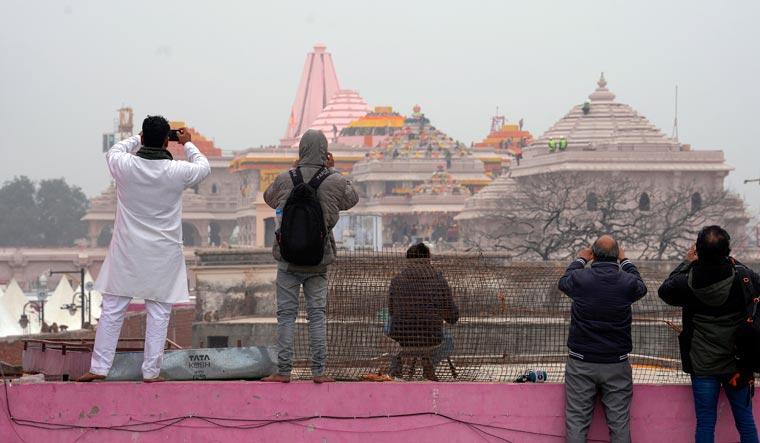
Nehru’s remarks from 73 years ago resonate in the context of the consecration of Ayodhya’s Rama Temple. It has been built on the spot where the Babri mosque once stood and was demolished. The Supreme Court, while allowing the construction of the temple, held that the demolition constituted “an egregious violation of [the] rule of law”. Prime Minister Narendra Modi and several other constitutional functionaries are participating in the inauguration, which also makes it a political event.

Nehru Declined Somnath Event Invitation  

When on 22 April 1951, Digvijay Singh, the Rajpramukh or head of the government of Saurashtra, invited Nehru to participate in the consecration ceremony, he wrote on 24 April thanking him, and stating with sadness, “I am troubled by this revivalism and by the fact that our President and some ministers and you as Rajpramukh are associated with it.” 

“I think,” Nehru wrote, “That this is not in line with the nature of our State, and it will have bad consequences both nationally and internationally.” “As individuals, of course, it is open to anyone to do what he chooses in such matters... But many of us happen to be more than private individuals, and we cannot dissociate ourselves from our public capacities.”

Pride Over Rama Temple Invite 

How the Prime Minister and his party are taking obvious pride in being invited to inaugurate the Rama temple in Ayodhya amidst a spectacle of priestly rituals sharply contrasts the ideals of a secular State and Nehru’s vision. 

In a letter written on 28 April 1951 to RR Diwakar [former Information and Broadcasting minister in the Nehru Cabinet and later the Governor of Bihar], Nehru described the Somnath consecration event as a “pompous ceremony” and asserted that “...any kind of governmental association is going to injure us abroad and even in India”. He revealed that he had received many complaints and letters inquiring “...if this is how a secular State behaves”.  

Nehru wrote with anguish that the Rajpramukh of Sourashtra directly wrote to Indian embassies abroad to send soil from those countries and water from some important rivers to reconstruct the Somnath temple. He stated that such requests greatly embarrassed the country, and foreign missions and leaders of many countries were wondering why a place of worship being restored in India would use foreign soil and water.  

Other Leaders Disapproved of President’s Decision 

It has been a persistently popular notion in India that only Nehru disapproved of President Rajendra Prasad’s decision to participate in the Somnath consecration ceremony. A peep into the records of that period and numerous other writings of Nehru reveals that several distinguished leaders and public figures expressed solidarity with him and made persuasive appeals to Prasad not to associate himself with the Somnath shrine ceremony. For instance, S Radhakrishnan, acclaimed for his deep understanding of Indian and Western philosophy, wrote that the association of high functionaries of the State with the consecration of Somnath temple was “liable to misunderstanding”. Even C Rajagopalachari joined hands with Nehru to dissuade President Prasad not to participate in the Somnath programme. Mridula Sarabhai, sister of the renowned space scientist Vikram Sarabhai and a freedom fighter, also supported Nehru’s stand on the Somnath issue. Nehru advised Sarabhai to meet Prasad and share her critical stand. 

Contrasting Publicity for Somnath and Rama Temples

The unabashed media publicity given to the Rama temple event in Ayodhya by the corporate-controlled TV channels and many print outlets is at the cost of the fundamental issues of the people. It reminds of Nehru’s statements on 28 April 1951 regarding his instructions to the media on their coverage of the Somnath temple consecration. He wrote, “I feel that in the circumstances, our radio broadcast should rather tone down the description of what happens at Somnath and not make it appear in any way that it is a governmental function.”

However, we now witness the Modi regime giving no-holds-barred publicity to the Rama temple consecration event. 

Stress on Secular Non-communal Ideals 

In a letter to chief ministers on 2 May 1951, nine days before the Somnath ceremony, Nehru wrote that several people were attracted to it, and some of his colleagues preferred to participate in the event in their personal capacities. While doing so, Nehru wrote, there was bound to be “a certain measure of public support to this venture” and cautioned that nothing should be done to come “in the way of our State being secular”. 

He flagged the point that secularism formed the very basis of the Indian Constitution and governments and urged chief ministers to “refrain from associating themselves with anything which tends to affect the secular character of our State”. “There are, unfortunately”, Nehru said, “many communal tendencies at work in India today, and we have to be on our guard against them.” He also said, “It is important that governments should keep the secular and non-communal ideal always before them.”

Tragically, secular and non-communal ideals are being relentlessly devalued by the powers that be. They have pushed the country into a whirlpool of politics anchored in rituals and divisive religious narratives, contrary to the Constitution and its vision of India that celebrates the coexistence of all faiths.

Tuning into the vision of Gandhi and Nehru to salvage the secular State is a vital lesson which Indians today ignore at their peril even as they witness the ritually driven consecration ceremony at Ayodhya with the active involvement of the Prime Minister.  

The author served as an Officer on Special Duty to the President of India, KR Narayanan. The views are personal.

January 08, 2024

Saffron Flag as The Unifying Flag: Chief Justice of India Reaffirms Commitment to Hindutva | Shamsul Islam


Saffron Flag as The Unifying Flag: Chief Justice of India Reaffirms Commitment to Hindutva


https://cdn.countercurrents.org/wp-content/uploads/2024/01/DY-Chandrachud.jpg
Chief Justice of India Justice DY Chandrachud with family at Dwarkadhish temple, in Devbhoomi Dwarka district, Saturday, Jan. 6, 2024. (PTI Photo)

D Y Chandrachud when took charge as Chief Justice of Indian Supreme Court (SC) in November 2022 (to relinquish office in November 2024) many of the pseudo-liberals who claimed to defend the democratic-secular polity of India manifested great happiness. They thought that the time of SC being an appendage of the RSS-BJP government headed by PM Modi was over as Justice Chandrachud was a liberal judge committed to democratic-secular polity of India. They over-looked the fact that he was believed to have been the Justice who authored the notorious Ayodhya judgment given on November 9, 2019. It was not a judgment based on legal and constitutional proprieties but a political decision full of trickeries to placate the majoritarian agenda catered aggressively by Modi and RSS.

If one needed another proof of his love for Hindutva we must take note of his love for saffron flag as flag of justice. Justice Chandrachud after performing pooja at Hindu temples of Dwarikadhish and Somnath with his family in Gujarat on January 6 (2024) had no qualms in stating “I was inspired this morning by the dhwaja [flag] at Dwarikadhish ji, very similar to the dhwaja, which I saw at Jagannath Puri. But look at this universality of the tradition in our nation, which binds all of us together. This dhwaja has a special meaning for us. And that meaning which the dhwaja gives us is – there is some unifying force above all of us, as lawyers, as judges, as citizens. And that unifying force is our humanity, which is governed by the rule of law and by the Constitution of India,”

[‘After temple visits, CJI D Y Chandrachud flags ‘dhwaja of justice’ to district court lawyers’ The Indian Express, January 7, 2024. https://indianexpress.com/article/cities/ahmedabad/after-temple-visits-cji-flags-dhwaja-of-justice-to-district-court-lawyers-9098282/]

It is to be noted that all the above referred temples fly saffron/yellow flags and CJI Chandrachud implied that Tricolour; the Indian National Flag was not the “unifying force” but the flags flying at the temples. The above statement of CJI was, in fact, rephrasing of the statement of the most prominent ideologue of RSS, M S Golwalkar who while addressing a Gurupurnima gathering in Nagpur on July 14, 1946, stated: “It was the saffron flag which in totality represented Bhartiya [Indian] culture. It was the embodiment of God. We firmly believe that in the end the whole nation will bow before this saffron flag.” [Golwalkar, M.S., Shri Guruji Samagar Darshan (collected works of Golwalkar in Hindi), Bhartiya Vichar Sadhna, Nagpur, nd., volume 1, p. 98.]

The same Golwalkar while denouncing the choice of Tricolour as National Flag in an essay entitled ‘Drifting and Drifting’ in the book Bunch of Thoughts (collection of writings of Golwalkar, a RSS publication and Gita for RSS cadres) wrote: “Our leaders have set up a new flag for our country. Why did they do so? It is just a case of drifting and imitating….Ours is an ancient and great nation with a glorious past. Then, had we no flag of our own? Had we no national emblem at all these thousands of years? Undoubtedly we had. Then why this utter void, this utter vacuum in our minds?” [Golwalkar, M.S., Bunch of Thoughts, Sahitya Sindhu, Bangalore, 1996, pp. 237-238.]

This hatred for the Tricolour led RSS to declare the Tricolour as ‘evil’ on the eve of Independence. The RSS English mouthpiece ORGANIZER demeaning the choice of the National Flag (14 August 1947) wrote: “The people who have come to power by the kick of fate may give in our hands the Tricolour but it never be respected and owned by Hindus. The word three is in itself an evil, and a flag having three colours will certainly produce a very bad psychological effect and is injurious to a country.”

RSS borrowed this hatred for the Tricolour from V D Savarkar who declared that “The Charkha-Flag [then Tricolour used to have charkha or spinning wheel in the middle which was later replaced by Ashok Chakra] in particular may very well represent a Khadi-Bhandar, but the Charkha can never symbolise and represent the spirit of the proud and ancient nation like the Hindus.” [Bhide, A. S. (ed.), Vinayak Damodar Savarkar’s Whirlwind Propaganda: Extracts from the President’s Diary of his Propagandist Tours Interviews from December 1937 to October 1941, na, Bombay, 1940, pp. 469– 473]

It is horrendous that CJI of Indian Supreme Court who is duty-bound to safeguard the democratic-secular polity of India with Tricolour as a unique symbol of it is renegading on his OATH which he took while assuming the office as the  50th CJI on November 9, 2022!

Shamsul Islam is a retired professor of Delhi University

Link for some of S. Islam’s writings in English, Hindi, Urdu, Marathi, Malayalam, Kannada, Bengali, Punjabi, Gujarati and video interviews/debates:

http://du-in.academia.edu/ShamsulIslam

Facebook: https://facebook.com/shamsul.islam.332

Twitter: @shamsforjustice

http://shamsforpeace.blogspot.com/

Email: notoinjustice@gmail.com

January 04, 2024

India: Firm stance: Editorial on CPM’s Sitararam Yechury declining invitation to attend the Ram Mandir inauguration | The Telegraph

 https://www.telegraphindia.com/opinion/firm-stance-editorial-on-cpms-sitararam-yechury-declining-invitation-to-attend-the-ram-mandir-inauguration/cid/1990041

Firm stance: Editorial on CPM’s Sitararam Yechury declining invitation to attend the Ram Mandir inauguration
CPM, however, has made no bones ab­out its reservations. Commenting on Sitaram Ye­chury’s decision to decline the invitation, the po­litburo, refreshingly, did not seek refuge in ambiguity
 

The Editorial Board Published 29.12.23, 07:28 AM

In the grey world of politics, invitations can transcend the realm of courtesy. This is because attending or skipping an event is often loaded with political and ideological significan­ce. The responses of some members of the Op­position who have been recipients of the invitation to the forthcoming inauguration of the Ram temple point to the political factors at play. Mamata Banerjee and Sonia Gandhi, the leaders of the Trinamul Congress and the Congress, respectively, have not made it clear whether they are likely to grace the occasion. It is possible that they are anxious about the Bharatiya Janata Party utilising their presence at the inauguration for political gain in an election year. The Communist Party of India (Marxist), however, has made no bones ab­out its reservations. Commenting on Sitaram Ye­chury’s decision to decline the invitation, the po­litburo, refreshingly, did not seek refuge in ambiguity. On the contrary, it made it clear that it stood against the exploitation of religion as a political instrument and accused the BJP and the Rashtriya Swayamsevak Sangh of attempting to transform a religious ceremony into an ostensibly State event. The CPI(M) has a point. The presence of the prime minister, the face of the government, along with other political dignitaries is likely to blur the lines that are meant to separate a religi­ous function from a State ceremony. The constitu­tional and legal spirit buttresses the politburo’s charge. In the constitutional template of governance, the State, as underlined by the Constitution and reiterated by the nation’s highest court, cannot have an expressly religious character. Jawaharlal Nehru, a staunch votary of the prin­ci­ple of secularism, had opposed gubernatorial at­tempts to involve the public exchequer and em­bassies in festivities related to the Somnath tem­ple.
What is singular about the new republic is that this principle emphasising the insularity of the State from the Church has little political purchase. The BJP has reaped electoral dividends by politicising the Ram mandir: its inauguration is being curated by the party with the general elections in mind. The perverse triumph of religiosity in politics has meant that most political parties in India are interested in flirting with benign or rabid forms of majoritarianism. The Congress’s espousal of soft Hindutva in the recent elections in Madhya Pradesh is a case in point. It is heartening to note that the Left, an electoral lightweight at the moment, refuses to swim with the tide. Politics should ideally be a matter of principle.


July 13, 2023

Gangajal at police stations, facility camps, closure of meat, liquor shops: States vie to roll out red carpet for Kanwariyas piligrimage with Public money | Report in Indian Express

Indian Express
Gangajal at police stations, facility camps, closure of meat, liquor shops: States vie to roll out red carpet for Kanwariyas


Uttarakhand CM Pushkar Singh Dhami washed the feet of Kanwar pilgrims in Haridwar, saying that he was ‘serving Kanwariyas as a mark of respect to them’
By: Express News Service
New Delhi | July 10, 2023 12:46 IST

Haridwar: Uttarakhand Chief Minister Pushkar Singh Dhami at the Kanwar Mela, in Haridwar, Saturday, July 8, 2023. (PTI Photo)


On July 8, Uttarakhand Chief Minister Pushkar Singh Dhami washed the feet of Kanwar Yatris in Haridwar. Saying that he was “serving Kanwariyas as a mark of respect to them”, Dhami pointed out that all adequate arrangements have been made for the Yatra this year, including health camps, toilets, parking, tin sheds, among others. This year’s Kanwar Yatra beginning July 5 would continue till July 15.
Last year saw similar scenes in Uttarakhand, with the BJP government even making budgetary allocations for the Kanwar pilgrimage for the first time. Dhami had washed the feet of Kanwariyas then too.
The Kanwar Yatra is an annual event which sees lakhs of devotees undertaking pilgrimage to places like Haridwar, Gaumukh, Gangotri in Uttarakhand, Sultanganj in Bihar, and Prayagraj, Ayodhya and Varanasi in Uttar Pradesh. The Yatris return by carrying Ganga water in kanwars to seek the blessings of Mahadev. The Yatra sees the governments in various states taking several measures to facilitate the pilgrims.

July 26, 2022

On the “saffronisation” of India’s foreign policy establishment | P. Raman (in The Wire)

 The Wire

There have been urgent whispers about the “saffronisation” of India’s foreign policy establishment ever since Narendra Modi became prime minister in 2014, writes P. Raman. 

In 2017, the Ministry of External Affairs released an official publication on the Bharatiya Janata Party ideologue, Deendayal Upadhyaya, titled Integral Humanism. As if this were not odd enough – the ministry has never involved itself with domestic politics – its contents were also unusual:  it equated ‘Indian thought’ with ‘Hindu thought’ and spoke of how “Hindu society has begun the work of organising itself”.


Though evidence of the transformation of India’s outward projection from Nehruvian internationalism to Hindutva  is all around us [ . . . ]

https://thewire.in/government/ambassadors-of-hindutva-how-saffron-has-seeped-into-our-diplomatic-space

July 25, 2022

India: State & Religion meet more and more - In UP's Baghpat and in Meetut, top state officers flower petal on Kanwariyas

 In UP's Baghpat, DM and SP shower flower petal on kanwariyas

https://twitter.com/Benarasiyaa/status/1551226359891894272

#UttarPradesh | #Baghpat में खुली जीप में सवार होकर डीएम-एसपी ने शिवभक्तों पर बरसाए फूल

In UP's Meerut, SSP Rohit Singh Sajwan and DM Deepak Meena onboard a helicopter shower flower petals on Kanwariyas

https://twitter.com/Benarasiyaa/status/1551524017932099586

  Uttar Pradesh | Meerut SSP Rohit Singh and DM Deepak Meena showered flower petals on kanwariyas, through helicopter

https://twitter.com/ANINewsUP/status/1551518430561308672 

March 31, 2022

India: Desecularising the State - Text of Edit, Peoples Democracy, March 27, 2022 (Bhagavad Gita would be taught in schools in Gujarat)

Peoples Democracy, March 27, 2022

Editorial

Desecularising the State

THE announcement by the Gujarat education minister that the Bhagavad Gita would be taught in schools as part of the syllabus for class 6 to class 12 students from the academic year 2022-23, is a flagrant breach of the secular principle of the State. 

It is a fundamental principle of all secular States that State-run schools do not impart religious instruction of any sort.  The United States, France, Japan and a host of other countries follow this principle. Private schools are free to offer religious instruction of any kind but not State schools. 

The Bhagavad Gita is a religious text.  It seeks to expound a way of life and conduct based on Hindu religious traditions and philosophy. It cannot be depicted as a book of morals and ethics divorced from its religious context, as the BJP-RSS are claiming.  There are some from within the Hindu fold who are critical of some aspects of the Gita such as the exposition of karma on its pronouncement that the chaturvarna system of caste is  divinely ordained.

But the real issue is not whether the Gita is obscurantist and purveys some regressive ideas.  The question to focus on is how government schools can have religious instruction of a particular kind?

The Constitution of India, in the Fundamental Rights chapter states in Article 28 (1) that: “No religion instruction shall be provided in any educational institution wholly maintained out of State funds”. It further states that in educational institutions (which are not State-run) but are recognized by the State or receiving aid out of State funds, if there is any religious instruction, no student attending such institutions can be made to take part in any such religious instruction or religious worship unless the guardian of that student, if a minor, has given consent.

The Gujarat decision on the Bhagavad Gita, therefore, goes against the basic premise set out in the Constitution - no religious instruction in State-funded and run schools.

The Gujarat example will now be emulated by other BJP-ruled states.  The Karnataka minister for school education has stated that the state government will consider introducing Bhagavad Gita in schools after discussions with educationists.  He said that, “Bhagavad Gita is not only for Hindus, it is for all.” It is the same Karnataka government which has outlawed the use of hijab by Muslim students in educational institutions.

The Union Minister, Prahlad Joshi, promptly stated that “Bhagavad Gita teaches us morality and ethics….Every state government can think about it.”

The efforts to introduce Hindu religious texts and scriptures in government schools is part of the overall project of the RSS-BJP to desecularise the Indian State. The Gujarat education minister cited the New Education Policy recommendation to include “Indian culture and knowledge systems” to justify the introduction of the Gita in the school syllabus.  In all other spheres of the State, the introduction of Hindu religious symbolism in State functions and provision of State funds for expanding and renovating Hindu places of worship have become a common feature. The Prime Minister’s inauguration of the Kashi Vishwanath corridor is a prime example.

The State patronising the religion of the majority and privileging it in State institutions and systems is going to spell the end of any semblance of secularism left. The obverse side of this are the various laws passed by BJP state governments against `love jihad’, conversions and the drastic ban on slaughter of cattle which target the minorities.  The Central law, the Citizenship Amendment Act, introduced a religious criteria to citizenship. 

In Gujarat, the introduction of the Bhagavad Gita  in schools has been welcomed by the main opposition party, the Congress. Its spokesperson said: “We welcome the decision to introduce Bhagavad Gita  in the syllabus, but the state government also needs to learn from the Gita first”.  Not to be left behind, the AAP spokesperson said, “We welcome the decision of the Government of Gujarat. This will benefit the students”.

This response of the opposition parties in Gujarat indicates the new reality – Hindutva is steadily acquiring a hegemonic status.  The Left and democratic forces and all those who wish to see India remain a secular State will have to factor in this reality while working out a strategy to fight for an alternative vision to Hindutva.

(March 23, 2022)

December 17, 2021

India: Open spectacle at Kashi mixing of State authority with Hindu faith ......

Suhas Palshikar writes: The master-narrative unfolding through events like the inauguration of the Kashi-Vishwanath corridor popularises a new social contract for a Hindu state

Written by Suhas Palshikar |
Updated: December 17, 2021

 https://indianexpress.com/article/opinion/columns/kashi-vishwanath-corridor-inauguration-hindu-state-7676653/

October 13, 2021

India: Haryana lifts decades-old ban on govt employees joining RSS; how many other states have had the ban? (Indian Express, October 13, 2021)

 The Indian Express

Explained: Haryana lifts decades-old ban on govt employees joining RSS; how many other states have had the ban?

The Haryana government’s move has triggered a sharp reaction from the Congress, which asked if the ML Khattar government was running a “BJP-RSS school”.

Written by Varinder Bhatia , Edited by Explained Desk | Chandigarh |
Updated: October 13, 2021 8:28:12 am
Government employees were first barred on November 30, 1966 when Indira Gandhi was the prime minister. (File)

The Haryana government has scrapped a 54-year-old rule that restricted state government employees from joining or being associated with the Rashtriya Swayamsevak Sangh (RSS) and the Jamaat-e-Islami. The government employees were first barred under Service (Conduct) Rules from joining these organisations on November 30, 1966 when Indira Gandhi was the prime minister, with the government believing they were not merely cultural or social organisations. The ban was briefly lifted in 1975 but reimposed in 1980.

 [ . . . ]
https://indianexpress.com/article/explained/haryana-lifts-ban-on-govt-employees-joining-rss-7568181/

September 24, 2021

Karnataka Law gives carte blanche to encroach on public land by building an illegal religious structure on it - says Editorial, Deccan Herald, Sep 22, 2021

Editorial, Deccan Herald (Sep 22 2021) Law to save illegal structures is wrong Govt buckled under pressure, has set bad precedent The Karnataka government has adopted a ‘secular’ policy towards all illegal religious structures in the state – whether they be temples, mosques, churches or gurudwaras, among others -- by granting them protection from demolition even if they are built on public land, including roads, junctions and parks. The stated objective of the Karnataka Religious Structures (Protection) Bill, which was passed by the Assembly, is to “protect communal harmony and not to hurt the religious sentiments of the public.” However, the real objective is to negate an order of the Supreme Court which had directed demolition of all unauthorised religious structures across the country. Karnataka had identified 6,300 such constructions. Though the demolition drive has been slow-paced over the years, Chief Secretary P Ravi Kumar had recently sent a reminder to deputy commissioners to hasten the process, following a nudge from the High Court. While structures belonging to different communities were being razed across the state, the demolition of a temple in Nanjangud led to a controversy, with BJP MP Pratap Simha communalising the issue. This also gave the opposition a stick to beat the BJP government with, considering that the demolitions occurred under the watch of the party that claims to be the custodian of Hindus. While Simha threatened to launch a ‘save temple’ agitation, some office-bearers of the Hindu Mahasabha declared that when even Mahatma Gandhi was assassinated for “being anti-Hindu”, it would not be difficult to mete out the same treatment to Chief Minister Basavaraj Bommai. The decision of the government gives rise to suspicion that it buckled under pressure and threats from such fringe elements. The Bill is self-defeating in many ways. For one, it could come in the way of infrastructure projects like roads, as clearing illegal religious structures will now be impossible. Besides, it also ties the government’s hands with regard to encroachment of forest lands, lakes or civic amenity sites in the name of religion. The question also arises if the Bill will really save those religious structures that are currently lined up for demolition as one contradictory clause in the Bill states that no protection shall be granted to a structure if any case relating to its removal is pending in any court of law. In the instant case, the matter of demolition of most structures are pending before court. While the Bill states that no protection will be granted to illegal structures in the future, the message it sends out is the opposite. The Bill sets a bad precedent and virtually gives a carte blanche to those who have encroached upon public land by building a religious structure. See original source: https://www.deccanherald.com/opinion/second-edit/law-to-save-illegal-structures-is-wrong-1033239.html

May 27, 2021

India State and Religion: Why Jawaharlal Nehru disapproved Rajendra Prasad’s presence at Somnath temple inauguration

 ‘Hindu revivalism?’: Why Jawaharlal Nehru disapproved Rajendra Prasad’s presence at Somnath temple inauguration

While the President disregarded the advice of the prime minister and went ahead with the inauguration ceremony, he was sure to emphasise on the Gandhian ideal of inter-faith harmony in his speech at Somnath

Written by Adrija Roychowdhury

https://indianexpress.com/article/research/hindu-revivalism-why-jawaharlal-nehru-disapproved-rajendra-prasads-presence-at-somnath-temple-inauguration-6539918/

April 17, 2021

India: RSS workers as Special Police Officers for Kumbh crowd management . . . [a good so it was officillly done] Hindu Rashtra ia already here | See report in India Express April 15, 2021

In Kumbh crowd management, a first: RSS workers as Special Police Officers

Kumbh Mela Deputy SP Birendra Prasad Dabral said RSS volunteers helped out during Kumbh in the past as well but this is the first time they have been issued identity cards of SPOs. “They are doing well in traffic and crowd management,” said Dabral.

Written by Lalmani Verma | Haridwar |
Updated: April 15, 2021 12:24:14 pm
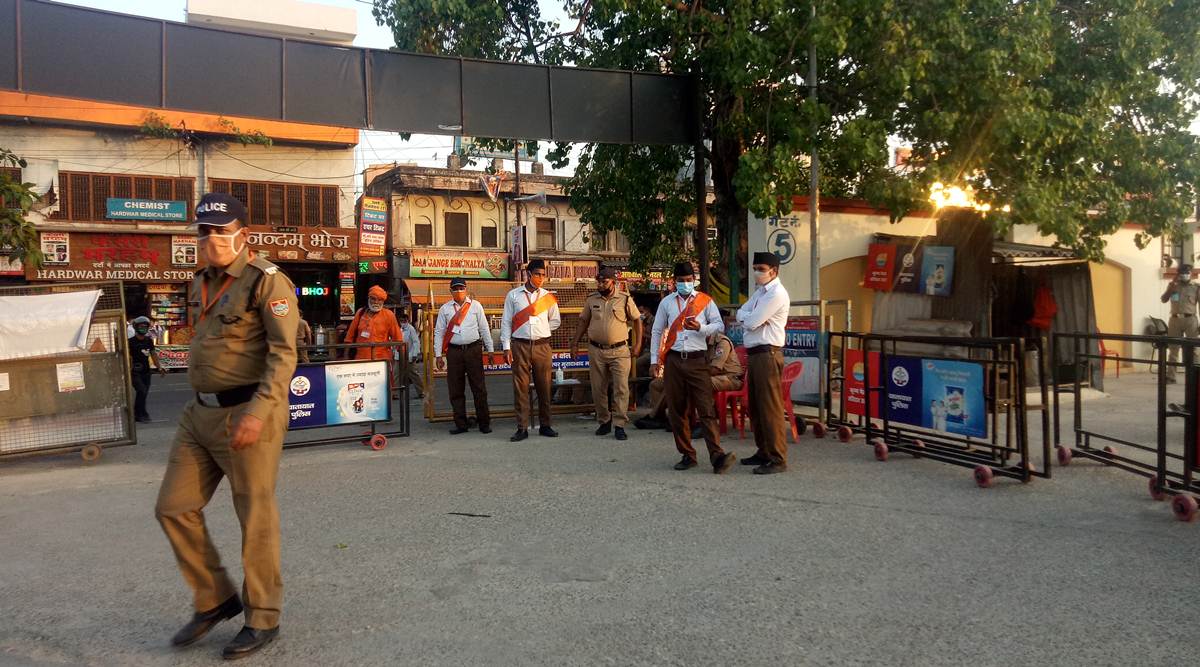
RSS workers working as SPO at Haridwar railway station. (Express Photo)

As devotees returned to railway and bus stations after the second shahi snan Monday evening, a young RSS worker in his traditional shakha uniform stood at Post Office Crossing in Haridwar, helping out with directions – as well as gently nudging them to wear the mask properly. These are Covid times and you should be careful with the mask, he reminded a batch of youngsters, as he gave directions to the station.

Ashish Chaudhary and another RSS worker, Tarun Sharma, both in early 20s, have been working in a 12-hour shift – 8 pm to 8 am – since April 7, assisting personnel of central forces and local police in crowd and traffic management at their assigned location.

Chaudhary and Sharma are among the 1,553 RSS volunteers who have been appointed as Special Police Officers (SPOs) by Uttarakhand Police for this year’s Kumbh festival – the first time ever. While 1,053 RSS volunteers are working in the field, the rest are back-up strength.

[ . . . ]

 https://indianexpress.com/article/india/in-kumbh-crowd-management-a-first-rss-workers-as-special-police-officers-7274131/

October 20, 2020

India: On How 736 Sangh Parivar NGOs qualified for government funds, subsidised rations during the COVID-19 lockdown | Sagar - 11 July 2020, The Caravan

The Caravan - 11 July 2020

736 Sangh Parivar NGOs qualified for government funds, subsidised rations during the COVID-19 lockdown

by Sagar 

As of 13 May, at least 736 NGOs affiliated to the Rashtriya Swayamsevak Sangh featured among a list of organisations enlisted by the central government for relief interventions during the ongoing lockdown to control the novel coronavirus pandemic. All these entities come under the umbrella of the Rashtriya Sewa Bharati, which is a registered trust, and works in the fields of education, health and “self-reliance,” according to its website. The RSB’s NGOs are among the 94,662 NGOs which are working as “COVID warriors” with district administrations across the country since the first week of April, and are being monitored by a group of bureaucrats, constituted by the home secretary. Owing to this enlistment, the RSB’s NGOs became entitled to funds from the State Disaster Relief Fund, or SDRF—set up under the Disaster Management Act, 2005 for states to use during a crisis—and for buying subsidised foodgrains from the Food Corporation of India, a central government body.

In an ongoing series, The Caravan tracked the RSS’s relief interventions since the beginning of the lockdown. As demonstrated in the first report, the Sangh, a three-time banned organisation, employs disaster-relief interventions, such as the ongoing pandemic, to gain influence and acceptability for its foundational aspiration—the formation of the Hindu Rashtra. Consequently, the RSB’s organisations’ use of government funds and resources to carry out relief work is significant because the RSS has never publicly acknowledged financial support from any government for its disaster-relief work.

As of 2014, the RSB’s roster included 57,000 social and economic projects which were being executed by at least 928 NGOs registered under its domain. All these organisations are listed on the RSB’s website. The central government’s list of enlisted NGOs is collated on a portal called NGO-Darpan, run by the Niti Aayog, the central government’s planning body. The RSB’s website claims that all its organisations are voluntary and independent, and it is only ideologically attached to the RSS. However, the RSB’s own five-yearly report, last published in 2014, has a section by Bhaiyyaji Joshi, the RSS’s sarkaryawaah, or second in command. Joshi wrote that these sewa bharati units “are independent but being supported and inspired by RSS.” He further noted, “The workers of these organisations are connected with the local RSS pattern … None of the service programmes work with RSS banners though these works are directed by swayamsevaks.” Senior members of the RSB’s organisational hierarchy have held similarly high positions in the Sangh, too.

According to Sankar Das, a bauddhik pramukh—intellectual head—of Assam, the Sangh has “46 national platforms,” which include the RSS’s labour wing, the Bharatiya Mazdoor Sangh and the student wing, the Akhil Bharatiya Vidhyarthi Parishad, among others. It should be noted that there seems to be no consensus among scholars as to the exact number of organisations which come under the ambit of the Sangh. Since the Sangh is neither a registered organisation nor does it pay taxes, this has helped it avoid scrutiny of its finances and those of its affiliates, collectively referred to as the Sangh Parivar. Instead, the mythos of the Sangh is based on its voluntary nature—the RSS’s own literature and outreach has meticulously created and projected an image of an organisation that is “self-reliant” and does not take money from external sources. An oft-repeated refrain is that the RSS raises its money from voluntary members, called swayamsevaks, in the form of a donation known as “gurudakshina”—a gift given to honour a guru.

I spoke to around two dozen RSS members, including those associated with the RSB, from 11 states. Speaking about the Sangh’s funding, one of the RSB’s members gave me a response that the rest of them echoed: “Khud se kartey hain ya kabhi kabhi samaj ke logon se madad mil jati haiWe do it ourselves or sometimes we get help from people in the society. There was no mention of any funding from the government.

In addition, the RSB’s website offers its NGOs to private corporations as “avenues” to spend their CSR funds. In fact, a week into the second phase of the lockdown, the Niti Aayog had “urged” private companies to consider the NGOs registered on the NGO-Darpan portal for their CSR spending. Under the existing law, a private corporation has to spend two percent of its profit on social projects, either through its own non-profit foundation or independently registered non-profit organisations. Earlier, on 23 March, the ministry of corporate affairs had allowed spending on COVID-related activities to be counted as CSR. Consequently, all of the NGOs on the Niti Aayog portal, including the RSB’s, qualified for these CSR funds.

According to a notification by the ministry of home affairs, the decision to engage NGOs and support them with government resources and money was formulated four days after the lockdown began on 25 March. The lockdown, enforced without any assurances on food, wage and shelter security, forced thousands of migrant workers living in the cities to return to their homes on foot, and severely impacted the most vulnerable segments of Indian society. By 28 March, at least 12 lakh migrants were grounded at various state borders after the ministry of home affairs ordered the director generals of police of all states to stop all movement of migrants. On 29 March, to deal with the situation, the government formed 11 “empowered groups” headed by bureaucrats attached to the central government to prepare a “well planned and coordinated emergency response” system against the outbreak. One of the empowered groups, EG 6, was headed by Amitabh Kant, the chief executive officer of Niti Aayog. The mandate of the group was “coordinating with the private sector, NGOs and international organisations for response related activities.”

The EG 6’s first meeting, on 5 April, was chaired by Kant, and the subsequent press release said, “CEO NITI Aayog has written to over 92000 NGOs/ CSOs registered on the Darpan portal of NITI Aayog, appealing them to assist the government.” The assistance sought was wide-ranging and included delivery of essential services to vulnerable populations, awareness drives, and community kitchens, among others. The notice also said that Kant had written to “all Chief Secretaries urging them to instruct the local administration at the district level to utilise the physical and human resources made available by NGOs and CSOs.”

Five days later, the prime minister Narendra Modi chaired a review meeting of all the empowered groups, which was also attended by the national security advisor, Ajit Doval, and the principal secretary, PK Mishra. According to the update on Modi’s website, Mishra had suggested that “coordination with NGOs at district level be done to avoid overlaps and ensure efficacious utilization of resources.”

A day after Modi’s review, on 11 April, the Food Corporation of India, which comes under the ministry of consumer affairs, food and public distribution, released a circular on supplying foodgrains to NGOs. The notice stated that “in view of the extraordinary situation … it has been decided that as an one time measure, charitable/non-governmental organizations running relief camps/providing food to needy people may be provided foodgrain … without the need for registration/empanelment with FCI or the need to participate in e-auction.”

Two weeks later, on 25 April, a group of ministers, the highest executive body set up by Modi to monitor the administration’s response system, also held its review meeting. This GoM was formed on 3 February, and was headed by Harsh Vardhan, the union minister for health and family welfare. According to a press release, Kant told the GoM, “These NGOs are supported by the States by allotting funds from SDRF funds and by FCI who is providing the foodgrains at subsidized cost.”

The very next day, Akhilesh Yadav, the president of the Samajwadi Party and a former chief minister of Uttar Pradesh, accused the RSS of receiving food from the government but distributing it as its own relief material. “BJP governments are doing politics instead of working honestly. There is no difference between community kitchen and the storage of RSS in the state. The RSS is claiming the food items received from voluntary organisations and government institutions as its own and then distributing them in the Modi bag to some BJP families.” Yadav is one of the few senior politicians who have publicly criticised the RSS’s relief work during the lockdown. When I posed this allegation to Ramashish Singh, an RSS pracharak—full-time member—based out of Varanasi, he evaded it. He is also a member of the Prajna Pravah, a Sangh affiliate that describes its mission as “incorporating the theme of nationalism in spiritual terms.” Instead, Ramashish told me, “What credibility or legitimacy does Akhilesh Yadav have?”

However, a senior central tax official, who chose to remain anonymous, told me that even though the RSB organisations can recruit volunteers of their choice, including swayamsevaks, to execute their COVID-related programmes and their regular social projects, one cannot rule out the possibility that the government funds given to sewa bharati units were used by the RSS. The RSB’s own annual report of 2014 categorically states that the sewa bharti’s projects are designed and supervised by local RSS administrators, and executed by swayamsevaks, among other members. 

On 4 May, Kant chaired another meeting of EG 6, which included details of the entire plan implemented by the group. A press release about the meeting said, “The EG 6 is monitoring and coordinating with NGO and CSO networks in all State / Union Territories and with 700 District Magistrates in the country on a real time basis to fight the spread of COVID-19. The mobilisation of these 92000 NGOs has resulted in commendable outcomes.” It had details of foodgrains and their prices, for NGOs to procure and distribute. According to the statement, the EG 6 had requested all the chief secretaries “to appoint State-level Nodal Officers to coordinate with all NGOs and resolve their issues apart from leveraging their resources and networks.”

Currently, there is no way to quantify the actual transaction of money between the SDRFs and the government-enlisted NGOs since the disbursals of SDRFs during the lockdown are not in the public domain. The data on the amount of subsidised food sold to these NGOs during the pandemic is also not public.

When I spoke to the national general secretary of the RSB, Shrawan Kumar, and asked him about the funds coming from the government, he denied taking any money from the administration. He said, “I do not know about SDRF.” Kumar said that “all our state units function independently. It’s possible that the state unit knows about it and they are doing it on their own, since all our units work independently.” He agreed that “yes, we got the FCI circular and we told all our state units to use this scheme.” In addition, Kumar said that while he himself had not enlisted the RSB’s NGOs with the government but “RSB is an umbrella organisation. Each state works at its own level. They keep doing things independently; maybe one of them did this.”

While Kumar denied any knowledge of SDRF, D Vijayan, the president of the Kerala unit of the RSB, told me that they had availed of both, the FCI’s subsidised foodgrains and the SDRF. He said “we are waiting for the [SDRF] funds” and had submitted the necessary documentation for the funds to be released to them.

Kumar also insisted that “we are a registered trust and follow all the legal requirements.” Since it is registered, as per the law, RSB units can raise funds from people and private corporations. Its website states: “In order to promote its CSR activities, the company needs to identify social entrepreneurs, self-help groups or an individual from an impact and influence area and support them by impact investment. Rashtriya Sewa Bharti is an impactful avenue for channelizing the corporate CSR resources.”

It should be noted here that in its 95-year history, the RSS has never registered itself. In September 2018, during an  address at the Vigyan Bhawan in the national capital, the RSS chief, or sarsanghchalak, Mohan Bhagwat, gave a rather convoluted reason for why the Sangh is not registered or does not pay taxes. “When the Sangh started, the government was not of independent Bharat. It was 1925. It started and went on like that,” he said. “After Independence also it went on like that. In all the laws after Independence, there was no such law that every organisation has to get itself registered. And by law, the Sangh has a status—Body of Individuals. As per this status, by law, we don’t have to pay tax.”

Irrespective of the lack of a money trail, it would not be amiss to say that the RSB and the RSS are conjoined at more than an ideological level. Rishipal Dadwal, the current vice-president of the RSB, is also a rashtriya sangathan mantri, or national organisational secretary, of the RSS. In February 2019, when the former Samajwadi Party leader Amar Singh donated a part of his family property to the RSB, Dadwal was present during the registration of the property in Lucknow. Until 2018, Parag Abhyankar, the present sampark adhikari, or communication liaison of the Rashtriya Sewa Bharati, had been a prant pracharak –a full-time member who handles state-wide activities—for the RSS’s Malwa prant. The RSS’s state boundaries are different from the union map. An RSS publication titled, Rashtriya Swayamsewak Sangh: Ek Parichay, says that as per the Sangh’s administrative divisions, India has 41 states and seven union territories. 

Kumar told me that his organisation implements social-welfare projects because it is in the “interest of the nation” and part of “Indian culture.” All the two dozen office-bearers of the RSS and the RSB that I spoke to used a similar vocabulary when questioned about the Sangh’s role during disasters. All of them invoked the concept of “sewa”—service—as an essential pillar of the “nation” and “nation-building.” Their notion of “nation” was unerringly conflated with being “Hindu.” Most of them studiously avoided any reference to fundraising for the RSB’s nine-hundred plus NGOs, insisting that “people from the society” chipped in with whatever money and resources they could.

The Caravan compared the database of NGOs enlisted by the government, which is available in the Niti Aayog-run portal, NGO-Darpan, with the list of organisations registered under the Rashtriya Sewa Bharti. The RSB’s website has the details of at least 928 NGOs. Duplication or repeating entries were eliminated by cross-matching emails and mobile numbers from the NGO-Darpan database. A total of 736 RSB’s organisations, spread across 25 states, were found on the Darpan database. Uttar Pradesh, Gujarat, Karnataka and Kerala accounted for the maximum number of RSB’s NGOs enlisted with the government.

This is the second report of a series on the Rashtriya Swayamsewak Sangh’s relief interventions during the COVID-19 lockdown. You can read the first and third report, here and here, respectively.

 Sagar is a staff writer at The Caravan.