Contrasting Consecrations at Somnath and Ayodhya Rama Temple
The restoration of the Somnath temple initiated by Sardar Vallavavai Patel by mobilising money from the public and its consecration in 1951 offers vital lessons regarding the consecration of the Rama temple in Ayodhya.
Patel heeded Mahatma Gandhi’s pleadings that government funds should not be used for a shrine representing any one faith. It was Gandhi’s conviction that the Indian State should always maintain neutrality towards religion, a sentiment he expressed in the context of the restoration of the Somnath temple while addressing a prayer meeting in Delhi on 28 November 1947.
He said the government formed after independence represented all Indians pursuing diverse faiths because, in his own words, “It is a secular government, that is, it is not a theocratic government. It does not belong to any particular religion.”
Nehru Disapproved of President’s Participation in Somnath Event
Then President of India, Rajendra Prasad, was invited to participate in the consecration ceremony of the Somnath temple and inaugurate it on 11 May 1951. He sought the views of Prime Minister Jawaharlal Nehru, who, on multiple occasions, requested him not to do so since, as the head of the Republic, he represented the secular State of India. Therefore, his participation in consecrating the Somnath temple would go against the secular nature of governance.
Nehru Felt Somnath Event was Political
Nineteen days before the consecration of the Somnath temple, Nehru wrote to Prasad (on 22 April 1951) expressing his worry about the Somnath affair. He stated, “As I feared, it is assuming a certain political importance.” Proceeding further, he added that at the international level, references were being made to it and remarked, “In criticism of our policy in regard to it, we are asked how a secular government such as ours can associate itself with such a ceremony which is, in addition, revivalist in character.”
Nehru also informed Prasad that in response to several questions in Parliament on the issue, he had stated that the government had nothing to do with it and those connected with it were acting in their personal capacity.
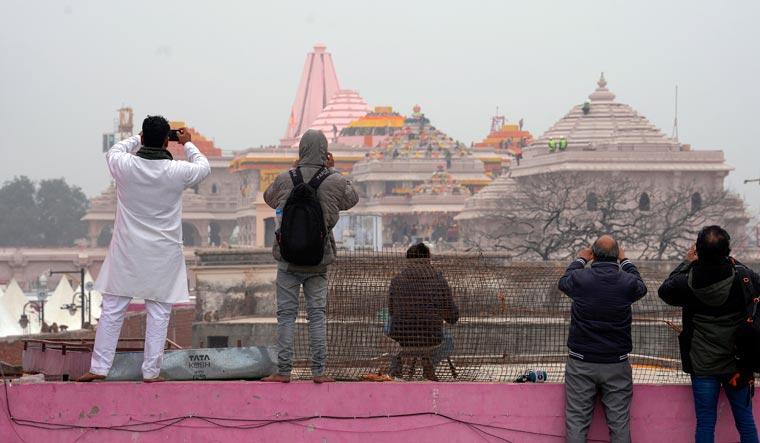
Nehru’s remarks from 73 years ago resonate in the context of the consecration of Ayodhya’s Rama Temple. It has been built on the spot where the Babri mosque once stood and was demolished. The Supreme Court, while allowing the construction of the temple, held that the demolition constituted “an egregious violation of [the] rule of law”. Prime Minister Narendra Modi and several other constitutional functionaries are participating in the inauguration, which also makes it a political event.
Nehru Declined Somnath Event Invitation
When on 22 April 1951, Digvijay Singh, the Rajpramukh or head of the government of Saurashtra, invited Nehru to participate in the consecration ceremony, he wrote on 24 April thanking him, and stating with sadness, “I am troubled by this revivalism and by the fact that our President and some ministers and you as Rajpramukh are associated with it.”
“I think,” Nehru wrote, “That this is not in line with the nature of our State, and it will have bad consequences both nationally and internationally.” “As individuals, of course, it is open to anyone to do what he chooses in such matters... But many of us happen to be more than private individuals, and we cannot dissociate ourselves from our public capacities.”
Pride Over Rama Temple Invite
How the Prime Minister and his party are taking obvious pride in being invited to inaugurate the Rama temple in Ayodhya amidst a spectacle of priestly rituals sharply contrasts the ideals of a secular State and Nehru’s vision.
In a letter written on 28 April 1951 to RR Diwakar [former Information and Broadcasting minister in the Nehru Cabinet and later the Governor of Bihar], Nehru described the Somnath consecration event as a “pompous ceremony” and asserted that “...any kind of governmental association is going to injure us abroad and even in India”. He revealed that he had received many complaints and letters inquiring “...if this is how a secular State behaves”.
Nehru wrote with anguish that the Rajpramukh of Sourashtra directly wrote to Indian embassies abroad to send soil from those countries and water from some important rivers to reconstruct the Somnath temple. He stated that such requests greatly embarrassed the country, and foreign missions and leaders of many countries were wondering why a place of worship being restored in India would use foreign soil and water.
Other Leaders Disapproved of President’s Decision
It has been a persistently popular notion in India that only Nehru disapproved of President Rajendra Prasad’s decision to participate in the Somnath consecration ceremony. A peep into the records of that period and numerous other writings of Nehru reveals that several distinguished leaders and public figures expressed solidarity with him and made persuasive appeals to Prasad not to associate himself with the Somnath shrine ceremony. For instance, S Radhakrishnan, acclaimed for his deep understanding of Indian and Western philosophy, wrote that the association of high functionaries of the State with the consecration of Somnath temple was “liable to misunderstanding”. Even C Rajagopalachari joined hands with Nehru to dissuade President Prasad not to participate in the Somnath programme. Mridula Sarabhai, sister of the renowned space scientist Vikram Sarabhai and a freedom fighter, also supported Nehru’s stand on the Somnath issue. Nehru advised Sarabhai to meet Prasad and share her critical stand.
Contrasting Publicity for Somnath and Rama Temples
The unabashed media publicity given to the Rama temple event in Ayodhya by the corporate-controlled TV channels and many print outlets is at the cost of the fundamental issues of the people. It reminds of Nehru’s statements on 28 April 1951 regarding his instructions to the media on their coverage of the Somnath temple consecration. He wrote, “I feel that in the circumstances, our radio broadcast should rather tone down the description of what happens at Somnath and not make it appear in any way that it is a governmental function.”
However, we now witness the Modi regime giving no-holds-barred publicity to the Rama temple consecration event.
Stress on Secular Non-communal Ideals
In a letter to chief ministers on 2 May 1951, nine days before the Somnath ceremony, Nehru wrote that several people were attracted to it, and some of his colleagues preferred to participate in the event in their personal capacities. While doing so, Nehru wrote, there was bound to be “a certain measure of public support to this venture” and cautioned that nothing should be done to come “in the way of our State being secular”.
He flagged the point that secularism formed the very basis of the Indian Constitution and governments and urged chief ministers to “refrain from associating themselves with anything which tends to affect the secular character of our State”. “There are, unfortunately”, Nehru said, “many communal tendencies at work in India today, and we have to be on our guard against them.” He also said, “It is important that governments should keep the secular and non-communal ideal always before them.”
Tragically, secular and non-communal ideals are being relentlessly devalued by the powers that be. They have pushed the country into a whirlpool of politics anchored in rituals and divisive religious narratives, contrary to the Constitution and its vision of India that celebrates the coexistence of all faiths.
Tuning into the vision of Gandhi and Nehru to salvage the secular State is a vital lesson which Indians today ignore at their peril even as they witness the ritually driven consecration ceremony at Ayodhya with the active involvement of the Prime Minister.
The author served as an Officer on Special Duty to the President of India, KR Narayanan. The views are personal.