|
Showing posts with label Varanasi. Show all posts

September 21, 2022

India: What will happen at Gyanvapi ? ... Hindutva tactics on Mosque to Temple & response Varanasi District Court order transforms Gyanvapi mosque into a disputed site

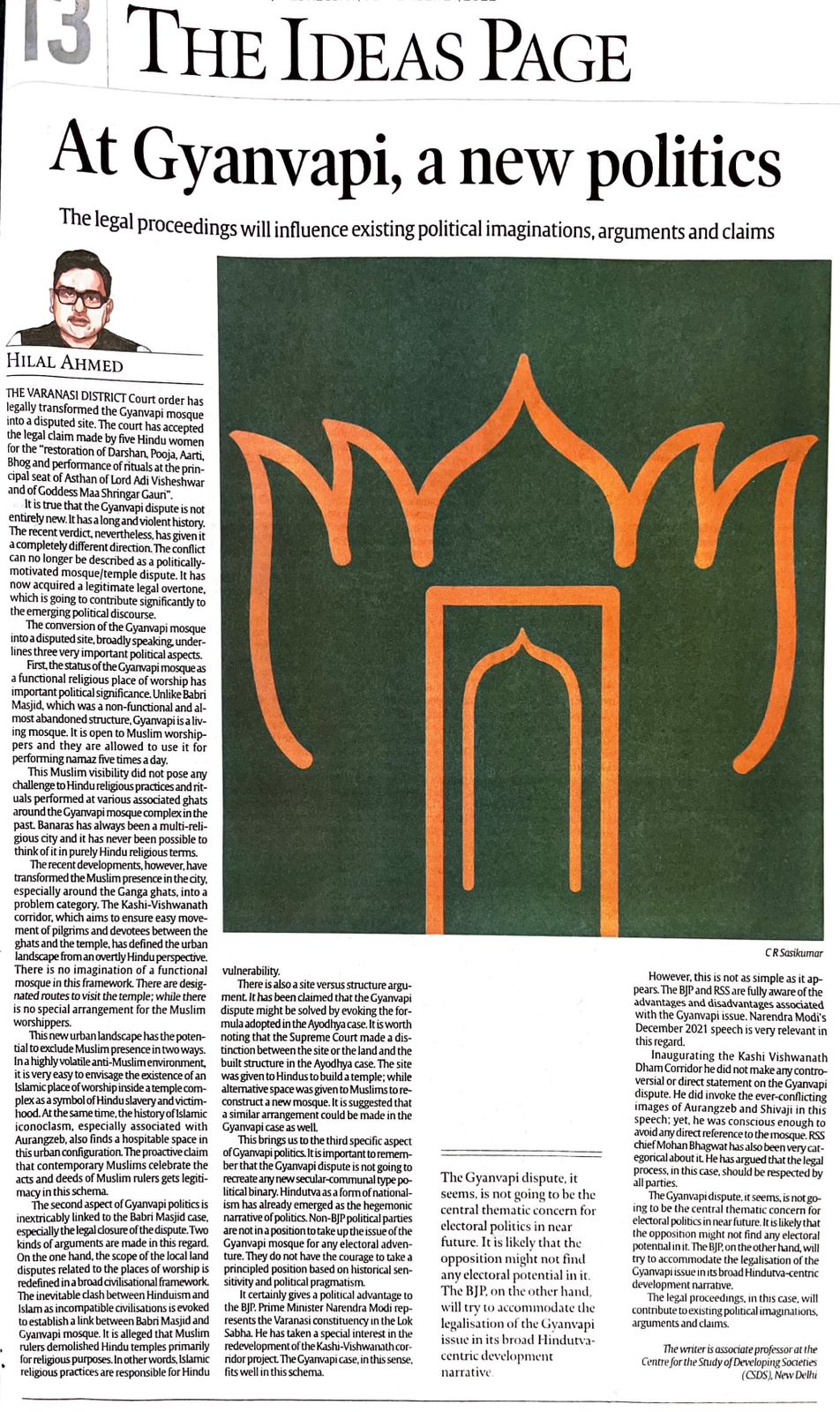
At Gyanvapi, the law feeds into BJP’s political imagination

Hilal Ahmed writes: It is important to remember that the Gyanvapi dispute is not going to recreate any new secular-communal type political binary. It will be accommodated as a part of the ruling party's ongoing narrative.

Written by Hilal Ahmed
Updated: September 21, 2022

The Varanasi District Court order has legally transformed the Gyanvapi mosque into a disputed site. The court has accepted the legal claim made by five Hindu women for the “restoration of Darshan, Pooja, Aarti, Bhog and performance of rituals at the principal seat of Asthan of Lord Adi Visheshwar and of Goddess Maa Shringar Gauri”.

It is true that the Gyanvapi dispute is not entirely new. It has a long and violent history. The recent verdict, nevertheless, has given it a completely different direction. The conflict can no longer be described as a politically-motivated mosque/temple dispute. It has now acquired a legitimate legal overtone, which is going to contribute significantly to the emerging political discourse.

The conversion of the Gyanvapi mosque into a disputed site, broadly speaking, underlines three very important political aspects.

First, the status of the Gyanvapi mosque as a functional religious place of worship has important political significance. Unlike Babri Masjid, which was a non-functional and almost abandoned structure, Gyanvapi is a living mosque. It is open to Muslim worshippers and they are allowed to use it for performing namaz five times a day.

This Muslim visibility did not pose any challenge to Hindu religious practices and rituals performed at various associated ghats around the Gyanvapi mosque complex in the past. Banaras has always been a multi-religious city and it has never been possible to think of it in purely Hindu religious terms.

The recent developments, however, have transformed the Muslim presence in the city, especially around the Ganga ghats, into a problem category. The Kashi-Vishwanath corridor, which aims to ensure easy movement of pilgrims and devotees between the ghats and the temple, has defined the urban landscape from an overtly Hindu perspective. There is no imagination of a functional mosque in this framework. There are designated routes to visit the temple; while there is no special arrangement for the Muslim worshippers.

This new urban landscape has the potential to exclude Muslim presence in two ways. In a highly volatile anti-Muslim environment, it is very easy to envisage the existence of an Islamic place of worship inside a temple complex as a symbol of Hindu slavery and victimhood. At the same time, the history of Islamic iconoclasm, especially associated with Aurangzeb, also finds a hospitable space in this urban configuration. The proactive claim that contemporary Muslims celebrate the acts and deeds of Muslim rulers gets legitimacy in this schema.

The second aspect of Gyanvapi politics is inextricably linked to the Babri Masjid case, especially the legal closure of the dispute. Two kinds of arguments are made in this regard. On the one hand, the scope of the local land disputes related to the places of worship is redefined in a broad civilisational framework. The inevitable clash between Hinduism and Islam as incompatible civilisations is evoked to establish a link between Babri Masjid and Gyanvapi mosque. It is alleged that Muslim rulers demolished Hindu temples primarily for religious purposes. In other words, Islamic religious practices are responsible for Hindu vulnerability.

There is also a site versus structure argument. It has been claimed that the Gyanvapi dispute might be solved by evoking the formula adopted in the Ayodhya case. It is worth noting that the Supreme Court made a distinction between the site or the land and the built structure in the Ayodhya case. The site was given to Hindus to build a temple; while alternative space was given to Muslims to reconstruct a new mosque. It is suggested that a similar arrangement could be made in the Gyanvapi case as well.

This brings us to the third specific aspect of Gyanvapi politics. It is important to remember that the Gyanvapi dispute is not going to recreate any new secular-communal type political binary. Hindutva as a form of nationalism has already emerged as the hegemonic narrative of politics. Non-BJP political parties are not in a position to take up the issue of the Gyanvapi mosque for any electoral adventure. They do not have the courage to take a principled position based on historical sensitivity and political pragmatism.

It certainly gives a political advantage to the BJP. Prime Minister Narendra Modi represents the Varanasi constituency in the Lok Sabha. He has taken a special interest in the redevelopment of the Kashi-Vishwanath corridor project. The Gyanvapi case, in this sense, fits well in this schema.

However, this is not as simple as it appears. The BJP and RSS are fully aware of the advantages and disadvantages associated with the Gyanvapi issue. Narendra Modi’s December 2021 speech is very relevant in this regard.

Inaugurating the Kashi Vishwanath Dham Corridor he did not make any controversial or direct statement on the Gyanvapi dispute. He did invoke the ever-conflicting images of Aurangzeb and Shivaji in this speech; yet, he was conscious enough to avoid any direct reference to the mosque. RSS chief Mohan Bhagwat has also been very categorical about it. He has argued that the legal process, in this case, should be respected by all parties.

The Gyanvapi dispute, it seems, is not going to be the central thematic concern for electoral politics in near future. It is likely that the opposition might not find any electoral potential in it. The BJP, on the other hand, will try to accommodate the legalisation of the Gyanvapi issue in its broad Hindutva-centric development narrative.

The legal proceedings, in this case, will contribute to existing political imaginations, arguments and claims.

Advertisement

The writer is associate professor at the Centre for the Study of Developing Societies (CSDS), New Delhi


source URL: https://indianexpress.com/article/opinion/columns/hilal-ahmed-gyanvapi-law-feeds-into-bjps-political-imagination-8162270/
 

May 21, 2022

India: Why Hindu petitioners in Gyanvapi Mosque case have split -- acrimony between the Hindutva organisations behind the case ?


Farzi’ organisation: Why Hindu petitioners in Gyanvapi case have split

The four Varanasi petitioners have now parted ways with the lone Delhi petitioner.

May 20, 2022

India: CPI(M) press Statement on the Gyanvapi Mosque Issue

 May 19, 2022
 
Press Statement
 
The Polit Bureau of the Communist Party of India (Marxist) has issued the
following statement:
 
On Gyanvapi Mosque issue
 
The Communist Party of India (Marxist) expresses serious concern over the
fact that the District Court, Varanasi took an ill-considered decision to
allow videography under its supervision within the premises of the Gyanvapi
Mosque that has resulted in a situation which can be utilised by communal
forces.
 
The Supreme Court has now intervened in the matter and the CPI(M) demands
that the utmost caution be exercised and that no violation, in letter and
spirit, of the Places of Worship (Special Provisions) Act, 1991 takes
place. The Act came into existence precisely to ensure that such
controversies over religious places are avoided and that efforts to change
their existing character not be permitted.
 
 
[For CPI(M) Central Committee Office]

May 18, 2022

Press Statement Gyanvapi Masjid Case. India gets played. Again | Socialist Party

Press Statement

Gyanvapi Masjid Case. India gets played. Again.

With a steady drumbeat of bad news for the lives of ordinary citizens - inflation at a multi-year highrupee at an all-time lownegative job creation and when all forward indicators as seen by industry leaders point to recessionary clouds on the horizon, what’s a serially-incompetent government to do ? Dust out their time-tested-citizen-distraction playbook. The Gyanvapi-Masjid case is all of this - as a weapon of mass distraction. This zeitgeist of our times is best captured by a recent opinion piece. 

The idea is to keep the pot on a perpetual boil, simmering at the top, whirling feverishly beneath. A restless society forever living precariously on the precipice arouses distrst, uneasiness, fear and discomfort, That is a toxic panoply for manufacturing rage, which can then be effortlessly mobilized at short notice. BJP is creating an eco-system of  real-time instant delivery of hate-mongers. That is how we are suddenly experiencing a nuclear cloudburst of daily anti-Muslim rhetoric promoting their defenestration all over the country. 

In the second quarter of 2021, just as the horrors of the Covid spike were in full swing, five women decided to petition the court to open up - what they considered as a then-currently somewhat inaccessible ‘Goddess Shringar Gauri' place of worship - situated - they believed -  adjacent to a mosque in Varanasi. One of the five - a Delhi woman aided by her husband-founder of a 2018 era Yet-Another-Vishwa-Vedic-Sanathan-Sangh drove the petition - along with 4 other Varanasi women - among the latter a wife of a VHP Varanasi officer bearer; others seem to be stand-ins and foot-soldiers - proxies really for the Hindutva complex. Either way, the court accepted the plea (more on the court’s jurisdiction later) - and ordered a survey using video of the relevant area. The case came into the limelight this May because the Mosque management filed a counter-plea against the commissioner in-charge - asking for his removal - alleging that he was exceeding his mandate and had insisted on filming areas not authorised by the court. The court on hearing the plea doubled down on its original order, not only retaining the commissioner but also provided him two additional legal assistants to complete his work. The two-page order (OneTwo) asks for submission of timebound results. Over the weekend, accordingly work proceeded.

Opponents to this legal drama are furious and have been insisting that this in-Limine (at the outset) violates 'The Place of Worship (Special Provisions) Act', a 3-page 1991 law that lays a framework for exactly such scenarios. The law calls for a standstill in all and any such cases. It compels cease-and-desist - from any party - that attempts to convert a religious-house to a different denomination - retroactive to the known religious status of such places - as of and on August 15th, 1947. Here:

3. Bar of conversion of places of Worship

No person shall convert any place of worship of any religious denomination or any section thereof  into a place of worship of different section of the same religious denomination or of a different religious denomination or any section thereof.

4, Declaration as to the religious character of certain places of worship and bar of jurisdiction of courts, etc.

 (1) It is hereby declared that the religious character of a place of worship existing on the 15th day of August, 1947 shall continue to be the same as it existed on that day.

More pertinently, the act itself bars - effective as of Sept 1991 going into the future - the involvement of courts in such matters. Note the last line in the extract below : 

‘(2) If, on the commencement of this Act. any suit, appeal or other proceeding with respect to the conversion of the religious character of any place of worship, existing on the 15th day of August, 1947, is pending before any court, tribunal of other authority, the same shall abate, and no suit, appeal or other proceeding with respect to any such matter shall lie on or after such commencement in any court, tribunal or other authority.

 It is therefore troubling that the court took this case up - when expressly barred from exerting jurisprudence on it - and is indicative of the extent of ongoing judicial capture. Socialist Party (India) strongly objects to the politicization of this matter, and the use of illegal lawfare - expressly to keep the communal pot simmering. This is a waste of public legal resources at a time when critical attention is needed towards solving pressing issues such as mass hunger. We urge the government and/or the Supreme Court to follow the written law of the land and halt/dismiss motions of the original petitioners. 

Socialist Party (India)

Drafted by: Venkatesh Narayanan, email.venkatesh.narayanan@gmail.com

Spokespersons: Bobby Ramakant, bobbyramakant@yahoo.com, Manoj Sarang, 9446835833, 8921519296

May 17, 2022

India: The Supreme Court must rule on Gyanvapi on basis of 1991 law and put an end to any more litigation of this nature

 The Times of India

Act on the act: SC must rule on Gyanvapi on basis of 1991 law and put an end to any more litigation of this nature

May 17, 2022 

The Supreme Court’s interim order on Gyanvapi mosque – removing restrictions on Muslims offering namaz but protecting the spot where a shivling was said to have been found – seems intended to make neither side too unhappy. But the fundamental question for SC, which the Varanasi lower court sidestepped, is whether the Places of Worship Act, 1991, should be upheld. And the answer must be an unequivocal ‘yes’. Anything else will burst a dam that is already being battered – following the Varanasi court ruling there are now demands on surveying and examining the religious character of Mathura’s Shahi Idgah Masjid and a fast-growing list of monuments including Taj Mahal, Qutub Minar, and Jamia Masjid at Srirangapatna in Karnataka. Nothing about this will end well.

The 1991 Act prohibits conversion of religious places and maintains their “religious character” as it existed on August 15, 1947. The law had solely exempted the Ram Janmabhoomi-Babri Masjid title dispute, which was of pre-1947 vintage. All other suits filed after Independence are supposed to abate and no court should entertain them. Even while granting the disputed Ayodhya land to Hindu petitioners, SC was all praise for the Places of Worship Act. It had said the law “addresses itself to the State as much as to every citizen” and that its norms “bind those who govern the affairs of the nation at every level”.

The law’s cut-off date of August 15, 1947 isn’t incidental. Before this period India wasn’t a nation-state in modern terms but a geographical area that saw many invasions and many centres of power and therefore many conflicts, until it became a colony of a ruthless imperialist power. The history isn’t pretty. But a modern nation-state, especially a diverse democracy that now aspires to be a major global economic power, shouldn’t expend its energy on relitigating history. The country already confronts a number of communal flashpoints. Adding a mosque-was-temple dimension to it can have dangerous consequences.

That’s why SC must draw a line while giving its Gyanvapi ruling. Any concession, however small, will be an invitation for other demands, and at some point, disputes are likely to move from courts to streets, and we know what that can mean. SC must also in no uncertain terms tell lower courts that they must follow the 1991 Act rigorously while hearing any further petitions and that no judicial transgression on this will be tolerated. That’s the only way to end what should never have begun.

India: By Allowing Gyanvapi Mosque Survey, SC Has Turned a Blind Eye Towards Injustice | Apoorvanand

Multiple attempts hv been made in d past 2 make d Gyanvapi Mosque a disputed site.This time,d judiciary is letting it happen

 https://t.co/ppqh6lijAO

India: findings of the filming at Gyanvapi mosque being leaked to the media even before the report was submitted to court

 "I Was Betrayed..." Says Officer Who Led Filming In Gyanvapi Mosque

Ajay Mishra, a lawyer, was removed after lawyers representing the Hindu petitioners and the mosque respondents had a heated argument in court today over the findings of the filming being leaked to the media even before the report was submitted to court.

All IndiaR eported by , Edited by Updated: May 17, 2022

https://www.ndtv.com/india-news/have-done-no-wrong-says-officer-who-led-filming-in-gyanvapi-mosque-2984122#pfrom=home-ndtv_bigstory

May 16, 2022

India: Supreme Court must step in Gyanvapi case and uphold Places of Worship Act | Nandita Rao

 The Indian Express

In Gyanvapi mosque, an unfolding illegality

Supreme Court must step in Gyanvapi case and uphold Places of Worship Act, its own assurances in Ayodhya verdict

Written by Nandita Rao |
Updated: May 16, 2022 9:01:25 pm
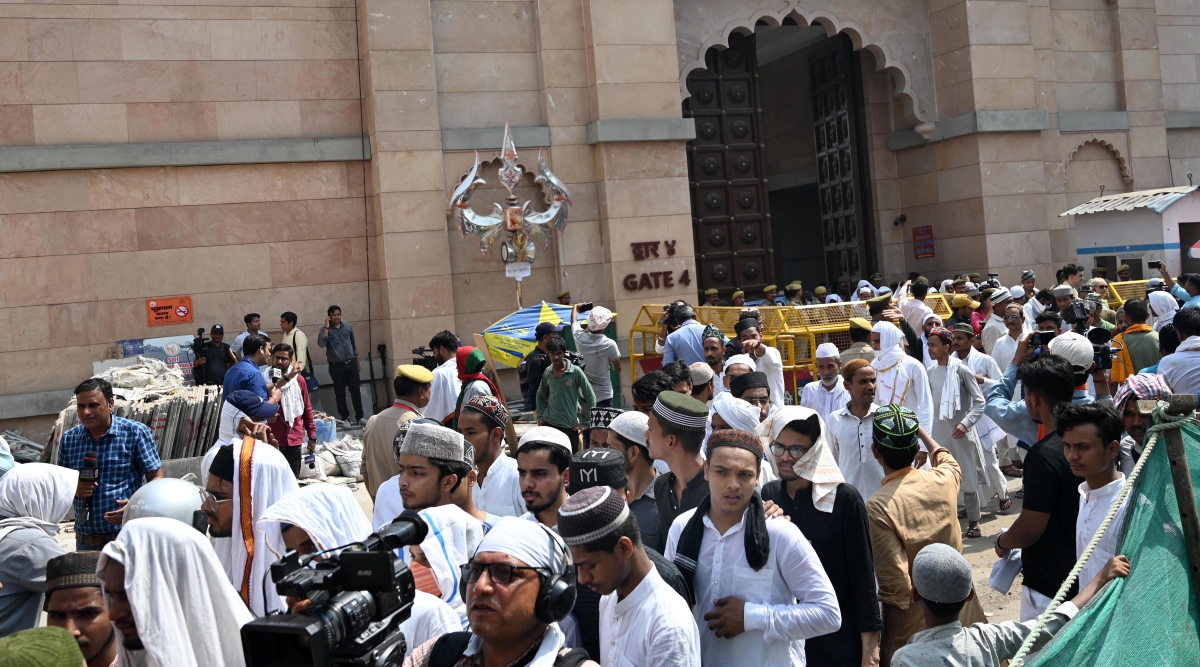
Devotees leave after offering Friday prayers at Gyanvapi Masjid in Varanasi. (PTI)

As the average Indian reels under fears of Covid and battles the bitter inflation, many noticed with worry and consternation that a court in Varanasi at the instance of a group of women petitioners (seeking permission to pray in the premises of the Gyanvapi Mosque) directed a survey to be conducted of the mosque, by a lawyer commissioner, one Ajay Kumar Mishra. The said directions to conduct the survey were challenged by the Anjuman Intezamia Masjid Committee, which manages the Gyanvapi mosque before the Allahabad High Court. Unfortunately, the Court upheld the order leading to the filing of a Special Leave Petition.

On Friday, mentioning this matter, the Senior Advocate appearing for the Anjuman Committee requested the Supreme Court that it stay the survey. However, the apex court declined and instead listed the matter for the coming Tuesday. In surprising haste, the Varanasi court, on May 16 has gone ahead on the basis of submissions made by the Court Commissioner that a Shiva Linga was found in a portion of the mosque, to seal that portion. One would have expected — as is normally the case in civil suits — that the trial court stays its hand and does not precipitate the matter further while the Supreme Court is seized of it. The haste of the trial court was accompanied by statements made by the judge concerning his own safety, which in itself raises concerns around judicial independence.

The Places of Worship (Special Provisions) Act 1991 declares under Section 4 that the religious character of a place of worship existing on the 15th day of August 1947, shall continue to be the same as it existed on that day. It further provides that any suit or proceeding filed with respect to the conversion of the religious character of any place of worship existing on August 15, 1947, is not maintainable and if pending, would abate. The only exception created to this rule is the Ram Janmabhoomi-Babri Masjid dispute.

On December 6, 1992, anti-social elements defied the rule of law and brought down an Archaeological Survey of India-recognised monument, popularly known as the Babri Masjid. The demolition of the Babri Masjid was held to be an act of criminal conspiracy by the Supreme Court in State through CBI vs. Kalyan Singh and Others [2017 (7) SCC 444]. The demolition was followed by communal riots that spread across the country leading to the death of many innocent citizens on account of the communally-charged atmosphere. Unfortunately, despite extensive video coverage of this criminal act, the trial court failed to convict the ring leaders on the ground of lack of evidence.

Best of Express Premium

UPSC CSE Key – May 16, 2022: What you need to read todayPremium
Modi in Lumbini: Buddhism provides India a cultural inroad in Nepal – it ...Premium
The angry young brigade of Sharad ‘Mr Congeniality’ PawarPremium
Explained: How heatwave is again sweeping across IndiaPremium

The civil dispute over the ownership of the property between the Sunni Waqf Board, the Nirmohi Akhara and the faction on behalf of Ram Lalla was put to rest by the Supreme Court in M. Siddiq vs. Mahant Suresh Das and others [(2020) 1 SCC 1]. The proceedings of the Court were watched by citizens in the hope that the constitutional morality would prevail over any emotive and sentimental considerations. However, the Constitutional Bench exercised Article 142 jurisdiction and chose to decide this dispute in a manner that appeared to appease the majoritarian sentiment: Despite not finding any archaeological evidence that the structure below the mosque was a Hindu temple, the Court decided to give the disputed land to the Hindu petitioners describing them generically as Hindus. The description and discussion of the parties in this dispute as Hindus vs. Muslims discounted the reality that 70 per cent of Indians had no voice, whether through referendum or otherwise, to offer an opinion on the dispute.

The Supreme Court defended its judgment calling it a “peace judgment”; that this long-festering dispute once put to an end in favour of the majority would buy long-term peace. This hope was also discernible from their observation that all other instances of a dispute over the historic character of the monument would be strictly governed by the Places of Worship (Special Provisions) Act, 1991 and would not be entertained.

The optimism demonstrated by the Supreme Court in this was not shared by most jurists. The judgment was widely critiqued as an act of appeasement to the majoritarian sentiment which, though not subscribed to necessarily by most Hindus, was the sentiment of a certain ideological group. The judgment was also found to be contrary to settled principles of civil law and constitutional morality. The sceptics feared that emboldened by this appeasement, the Hindu right-wing would further its divisive agenda, despite thin evidence to justify its rhetoric. The slogan “Ayodhya toh jhaanki hai, Kashi Mathura baaki hai” began to do the rounds.

Wiser in hindsight, one hopes that the Supreme Court will put a firm end to the Gyanvapi Mosque suit filed in Varanasi and quash this completely illegal survey by Court Commissioners. The Places of Worship (Special Provisions) Act, 1991 firmly prohibits any such suit or survey and it is time that the Supreme Court enforces peace by the rule of law and not by appeasement of a particular ideological group or sentiment that may currently be in the majority.

The writer is a Delhi-based lawyer

May 13, 2022

India: Why this Varanasi Court Verdict on Gyanvapi Mosque when the Places of Worship Act (1991) says preserve status quo at religious places . . .

India Today TV panel discussion  discuss status quo at religious places & Places of Worship Act

https://twitter.com/IndiaToday/status/1524818843985911808

o o

‘Don’t Want To Lose Another Masjid’: Owaisi on Gyanvapi Mosque Verdict

Owaisi's remarks came after a Varanasi court said that the survey inside the Gyanvapi mosque will continue.

Published: 

Plea to worship Hindu idols, survey row — the latest Kashi Vishwanath-Gyanvapi legal tussle

Shikha Salaria

What is Places of Worship Act? The law used by SC to censure Babri Masjid demolition

Ayodhya disputed site was exempted from Places of Worship Act passed during Narasimha Rao govt in September 1991, a year before Babri Masjid demolition.

9 November, 2019

April 12, 2021

Video: Is Modi's Kashi Corridor laying the ground for another Babri? | The Caravan Magazine


Since 2018, to make way for the Modi's Kashi Vishwanath corridor project, the Uttar Pradesh government has cleared 45,000 square feet of land surrounding the temple. Visible now, in clear relief, is the Gyanvapi mosque. Many in Varanasi see this as deliberate—a golden opportunity for Hindu groups to stoke communal tensions in the area, to their political benefit. Video by Rough Cut Productions. Read Sushil Kumar's report on the Kashi Vishwanath corridor here: https://caravanmagazine.in/religion/h...