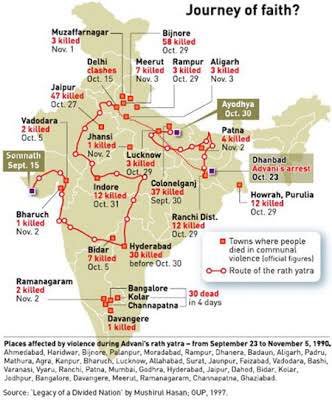
Sainik
Schools, run under the Defence Ministry’s guidance, send cadets to
India’s armed forces. The new initiative however relies on ideologically
slanted organisations to train future cadets


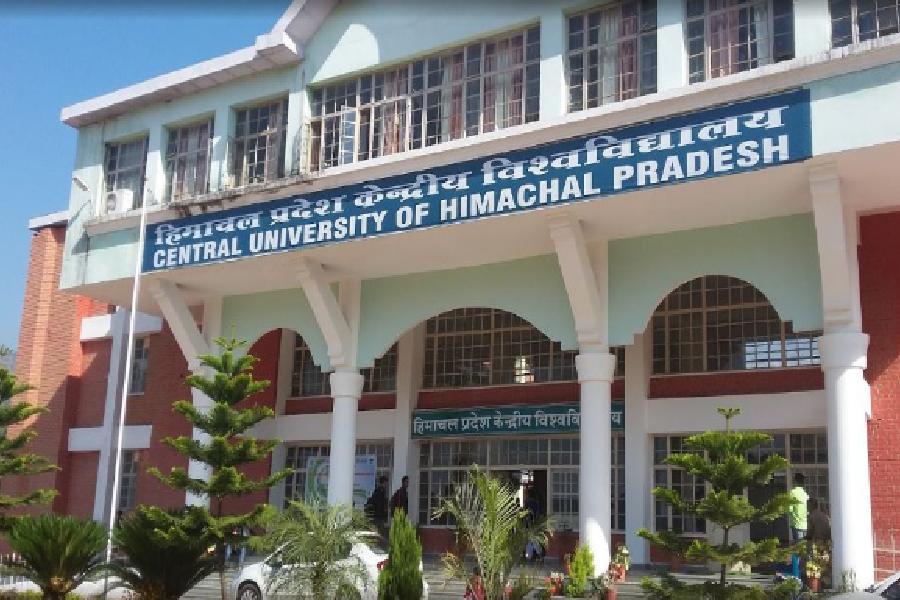
Central University of Himachal Pradesh www.cuhimachal.ac.in
The Central University of Himachal Pradesh has decided to appoint an RSS pracharak as “professor of practice” under a national scheme that relaxes the requirements of academic degrees and publications for these posts.
Atul Kothari, national secretary of the Shiksha Sanskriti Utthan Nyas, will be professor of practice in Hindu studies. The Nyas is a self-appointed adviser to the government on curriculum reforms and has suggested the teaching of “Vedic mathematics” at schools, among other recommendations.
[ . . . ]
https://www.newsclick.in/education-hindu-rashtra-ugc-ncerts-right-wing-drive
Education for Hindu Rashtra: UGC-NCERT’s on Rightwing Drive
Ram Puniyani
As the ruling party BJP is close to completing two terms in office, its impact on most of the institutions is more than obvious. While ED-IT-CBI have played their role in cornering the opposition parties, Election Commission at times has played a partisan role, the UGC and NCERT are not far behind in changing the educational pattern to suit the political ideology of the ruling Government.
At one level the New Education Policy is out to change the whole pattern and structure of our educational system. On a regular basis new instructions are being sent to induct the Hindu nationalist sentiments and ethos for the students. One recalls that when this Government was trying to intimidate and undermine the student movements and protests, these activities were labeled as anti National and the then MHRD Minister Smriti Irani came up with the idea of installing a tall pole in each University to hoist the national flag. The idea was also floated to put a military tank in JNU in particular, where the vocal students were articulating on various issues which went against the grain of thinking of the ruling Government.
Recently a few more circulars have been issued. One is that students should be made to participate in the year long celebrations of the birth Centenary year of Dattaji Didolkar. Didlkar was RSS Pracharak, who set up the Akhil Bhartiya Vidyarthi Parishad (ABVP). This cult building exercise for a Hindu Nationalist is particularly meant for colleges in Maharashtra. Is UGC right in promoting the celebration of figures from Hindu Nationalist stable? The figures who should be promoted are surely those who stood for Indian Nationalism or fought against British colonial rule. Mr. Didolkar, being a part of RSS, was never part of neither freedom struggle nor he stood for the values enshrined in Indian Constitution.
The other circular is asking for setting up of ‘Selfi points’ with the backdrop of Prime minister, Modi. Such a step is being taken surely with the 2024 elections in mind. This is an idea, which has no place in a democratic country. It is a deliberate propaganda for a leader belonging to one party and its supreme leader. It violates the ethos of democracy for sure! Such blatant violation of democratic and constitutional values; is a gross abuse of power by the ruling party.
Topping it all has come the instruction that for students between 7to 12 standard Ramayan and Mahabharat should be taught as a part of history, (Times of India, 22nd November). As per the expert Panel of NCERT, this will bring self esteem, patriotism and pride in the Nation! These two great epics of India are definitely a part of our mythology. They do represent the social norms of the times when they were written. One can learn a lot about those times from these epics.
Ramayan amongst these is extremely popular not only in India but also in different countries of Asia like Sri Lanka, Thailand, Bali, Sumatra etc. Interestingly it has many versions. Originally written by Valmiki, later it was made more popular by Goswami Tulsidas, who rendered it in popular Avadhi. It became part of popular culture from 16th Century onwards in Northern parts India. Interestingly there are many versions of Lord Ram Story. The version being promoted by Hindu nationalists is one among many. The book by Richa Paulman, “Many Ramayans’ (OUP) deals with the diverse version of Lord Ram Story. On similar lines A.K.Ramnujan wrote an essay, ‘300 Ramayans: Five Examples and Three Thoughts on translation’. This remarkable essay was part of Delhi University curriculum till the ABVP protested and this was removed from the syllabus.
The Hindu nationalists want a particular version of Lord Ram’s story to be projected. Ramanujan in his essay tells us the diverse telling of the story, Jain version, Buddha version, Women’s version (by Rangnayakmma of Andhra). Adivasi Ramayan has yet again a different story line. Ambedkar wrote ‘Riddles of Hinduism’ and drew our attention to Ram killing Shambuk as he was performing penance, and as Shudra’s were not permitted such a thing he was done to death by the Lord Himself. Ram also kiiled Bali from behind, Bali is a king revered by backward castes, who chant:’Eida Pida Javo: Baliche Rajya Yevo’ (Let our pains go: Let Bali’s return as a King). Ambedkar is very critical of Ram banishing Sita to forest on the suspicion of fidelity. Periyar is also critical of Lord Ram for imposing the North Indian Aryanism on the Dravidas. The real history is mired in some vague understanding while the great epic gives us a valuable insight into that time.
Similarly Mahabharat, composed by Maharishi Ved Vyas is the longest poem ever composed, gives us a valuable glimpse of those times. They are important sources of historical knowledge. To put them in the syllabus as history is a different idea altogether. It is linked more to the Hindu nationalist agenda than unraveling the truth of history.
In addition, among many other moves by the panel; is to instruct the name India with Bharat on the ground that India denotes slavery, as the word was given by the British. They deliberately want to suppress the fact the variations of word India are prevalent from the times much before the British came here. As early as BCE 303, Megasthanese had called it Indica. The derivatives from river Sindhu have been in vogue from early times. ‘Bharat that is India’ is the perfect formulation outlined in our Constitution. But in tune with Hindu Nationalist Agenda they are not comfortable with the word India. Lastly they want to re-periodize Indian history. The early period of Indian history, which the British called as Hindu period, they want to call it ‘Classic Period’. The idea is to present the values of that period as the baseline for our society. And these values, outlined in Manusmriti were the precise one’s which made Ambedkar rebel against and to burn this book.
UGC-NCERT are totally being guided by the Hindu Nationalist agenda, totally in contrast to the values of Indian Constitution.
In rural India, private schools run by the Ekal Foundation provide access to education – but force children to imbibe divisive teachings that preach Hindu superiority.
Shammi Shukla teaches Hindu hymns to students, sitting beside photos of Hindu deities in Mishrikh, Uttar Pradesh, India.
Credit: Tarushi AswaniOn a scorching afternoon in Mishrikh, a remote village in northern India’s Uttar Pradesh state, children are gearing up to go to Ekal Vidyalaya. Most children who attend these schools wear tattered clothes and hand-me-down slippers, and carry half-broken and half-chewed pencils.
The school is part of the Ekal Vidyalaya Foundation (EVF), which claims that it aims to ensure children in rural India get access to education. These one-teacher schools are free and offer vocational classes alongside literacy to children aged five to 14 from any caste or religion.
However, the curriculum is firmly rooted in Hindu nationalism.
As children trail behind each other, they can be seen entering a local Hindu temple in their village, where they obediently sit on the floor, which exhales the heat of the sun. Facing a table with photos of Hindu deities neatly placed with the support of incense sticks, children focus all their attention toward the deities.
Shammi Shukla, the teacher at this makeshift school strictly goes by the book. She makes sure that all children, irrespective of their religion, are made to chant Hindu prayers and mantras. “We need to learn who the Adharmis (unrighteous) are and only Hinduism can teach us that,” Shukla said.
“Those who are not Hindus, are Adharmis.”
Ekal and Education
This alternate school where Shukla teaches is called Ekal Vidyalaya, meaning a school that belong to the EVF, a U.S.-based organization that sets up private, single-teacher schools in rural India. This concept was conceived in 1986 in India’s Jharkhand; in 1989, Shyam Gupta, a senior member of the Rashtriya Swayamsevak Sangh (RSS), a Hindu paramilitary organization, stepped in to take over the campaign for Ekal Foundation.
The Ekal Vidyalaya Foundation of USA was established in 2002. This branch is the primary campaigner for the donations that are received to run schools in India.
Another radical Hindu organization responsible for attacks on Muslims and Christians – the Vishwa Hindu Parishad (VHP) – has boasted of its involvement with the EVF. The VHP’s website states that the launch of the EVF of USA was among “some of the major contributions made by VHP of America.”
Classes at Ekal include a mix of children from all spheres of village life: Hindu upper castes, lower castes, tribals, and Muslims. As of March 2023, Uttar Pradesh housed 17,188 Ekal schools, where more than 519,301 students were enrolled. Students from the ages of five to 14 attend these schools, which provide free non-formal and vocational education.
Shukla, the teacher at the local Ekal school in Mishrikh, feels that Ekals are significantly different from mainstream schools due to their syllabus, which binds together nationalism and Hinduism.
During its investigation, The Diplomat met with Mahender Yadav, the supervisor of Ekal schools in Sitapur district. Yadav, a staunch Hindu, is not shy about proclaiming the Hindu nationalist agenda.
“Muslims and Christians need to be shown their rightful place in society, they can either accept Hindu supremacy or convert to Hinduism. Ekal prepares children to identify enemies of Hinduism at an early stage,” he told The Diplomat.
Under Yadav, 430 Ekal schools and institutions are able to further their agenda of radicalizing students.
Yadav also shared with The Diplomat a textbook that the teachers follow. Upon even a cursory glance, the reader can glean that the book has doctored stories about how Muslims forcefully convert Hindus to Islam – a narrative that has been pushed since years by radical Hindu organizations in India.
During the lessons that The Diplomat attended at a dozen Ekal schools across Uttar Pradesh, children were being made to correlate the Hindu goddesses to the idea of India as motherland. Teachers at Ekal schools are clear: for them there is no separation between Hinduism and nationalism.
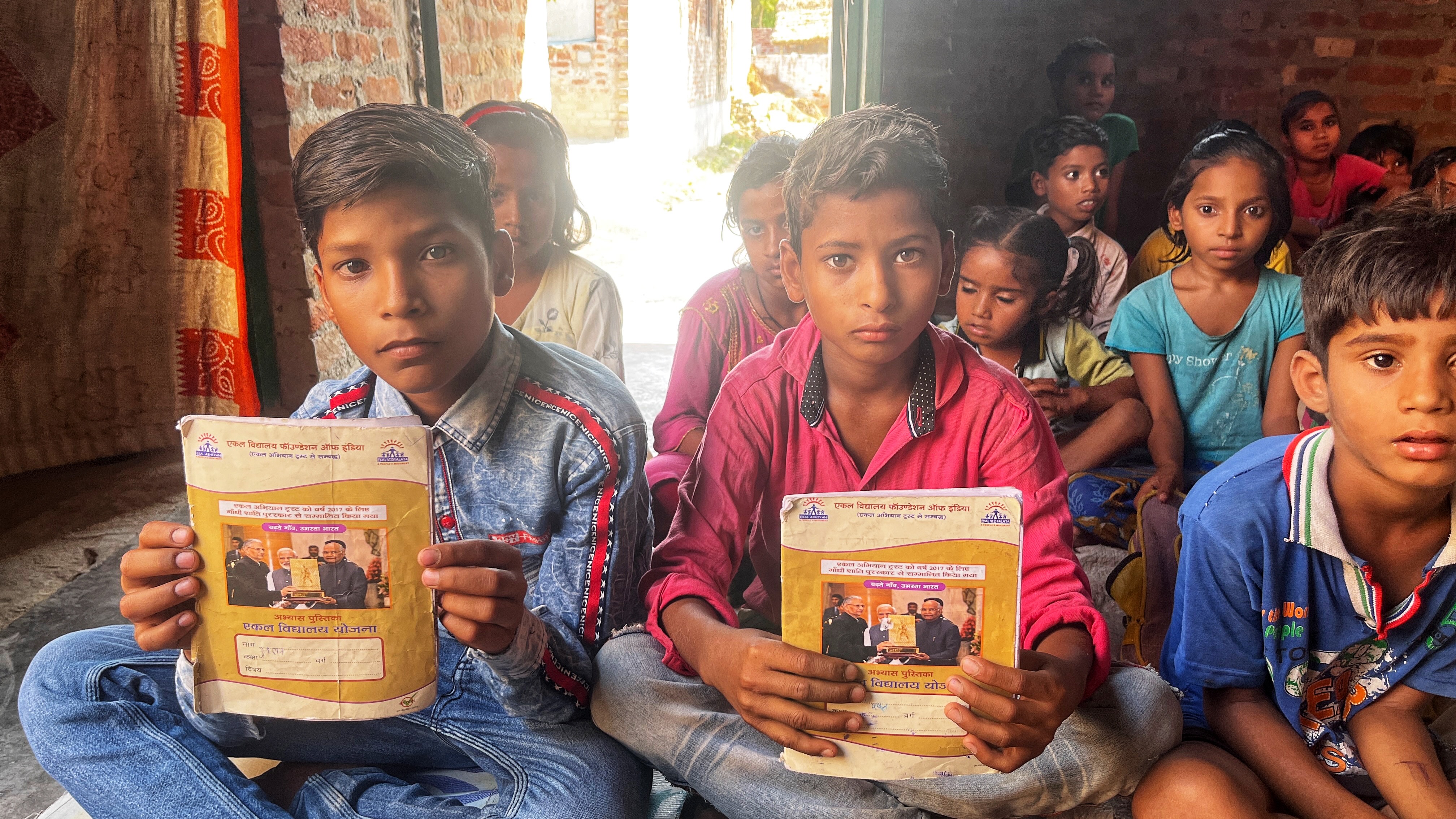
Hindu students display the textbooks that they received from the Ekal Vidyalaya Foundation in Sitapur, Uttar Pradesh. Photo by Tarushi Aswani
Harnessing Hate
At the same Ekal school, Nikhil Shukla, a 15-year-old student, is an energetic young man who chooses to wear the color saffron, purely because the color is considered holy in Hinduism. Shukla, inspired by his teacher’s understanding of Hinduism, has recently joined the Bajrang Dal, a Hindu nationalist militant organization.
“Hindu religion is being attacked across India, we need to fight to save it,” Shukla proclaimed.
Despite being just 15, Ekal has motivated Shukla to join a Hindu militant organization responsible for vandalism at churches and mosques, the murders of several Muslims, and furthering a demand to economically boycott Muslims so as to kill their mode of livelihoods across India.
Owing to the anti-minority harassment, for the the last four years, the United States Commission on International Religious Freedom has recommended that India be designated a “Country of Particular Concern,”a category of governments performing poorly on religious freedom criteria.
The Diplomat also spoke to two
senior officials in the Uttar Pradesh Department of Basic Education
regarding the functioning of the Ekal schools. Both officials denied
having any information about these schools and their operations. The
officials also confirmed that these schools are not affiliated with
their department.
Instead, these schools are funded by individual donations and through foundations, including one that was registered with authorities in the United Kingdom until 2020, one in Canada, and one in the United States. According to 990 tax documents, over the last decade, the Ekal Foundation of USA sent over $60 million to its sister organization Ekal Abhiyan in India to run Ekal schools.
In 2009, a report issued by India’s Ministry of Human Resource Development found that the “training to the teachers of Ekal schools was mainly to spread communal disharmony in the communities and also to inculcate a fundamentalist political ideology… creating enmity amongst communities on the basis of religion.”
Yet, these U.S.-funded schools are allowed to exist in India and those with limited resources are being lured to send their children to these schools.
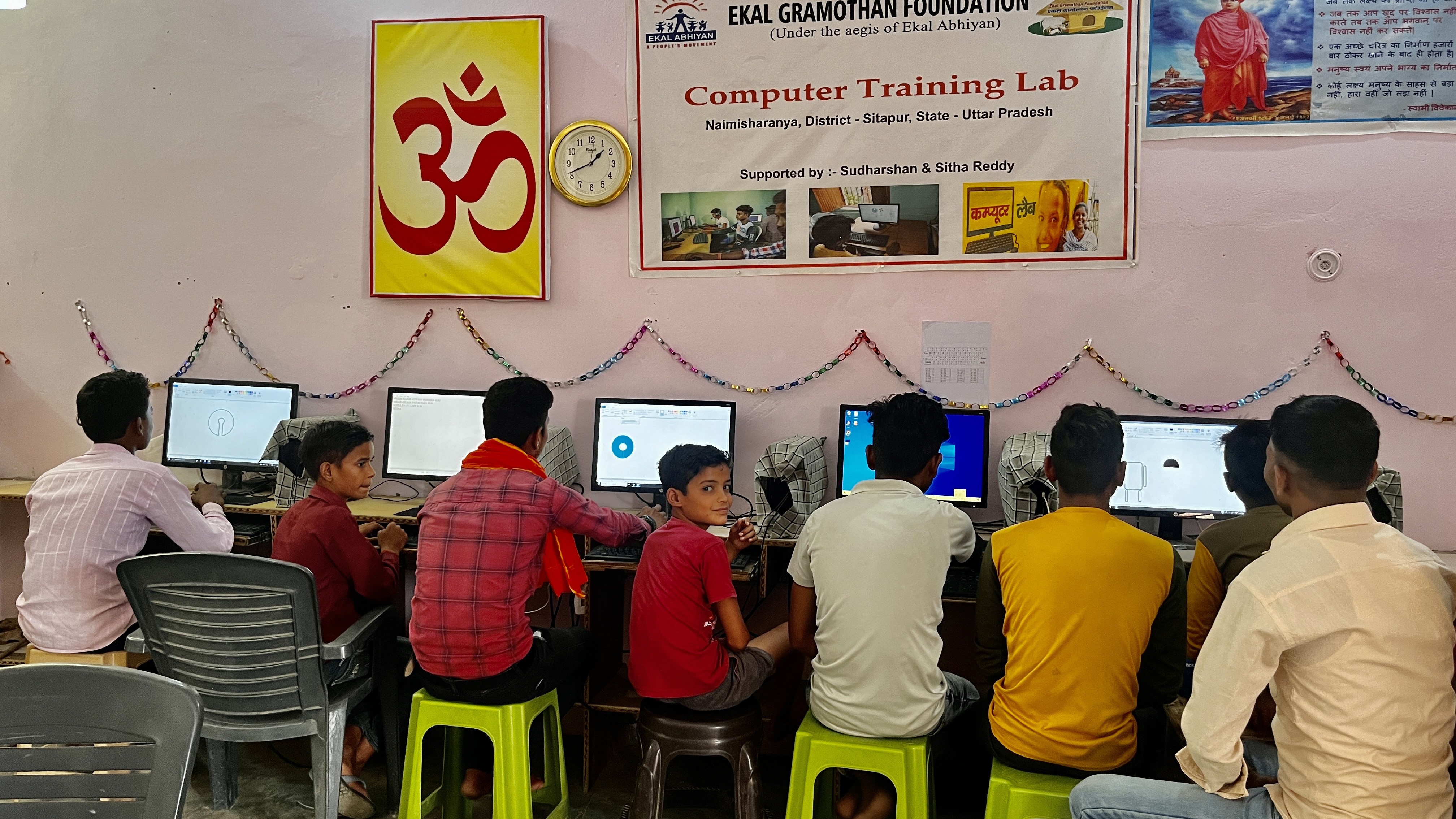
Students learn using computers at an EVF center in Naimisharanya, Uttar Pradesh. Photo by Tarushi Aswani
Poverty and Propaganda
At another school, in Sitapur district’s Naimisharanya village, 30 students await their teacher, Lakshmi Kumari.
As students learned math inside a brick room, Lakhan Pal waited for his daughter, who is a student at this school. Pal, a daily wage laborer at a construction site, said, “I earn $5 a day on good days, so free schools like Ekal are a good option for my daughter, I don’t have to spend on her education then.”
Meethi and Pinky Kumari, two 4-year-olds, also attend the Ekal. While they barely understand anything beyond their ABCs and 123s, their mother Pooja, a recently widowed, unemployed woman sends them there because she is unable to send them to a public or private school.
Pooja, a Hindu, who chooses to stay indoors since the death of her husband, has no agency to earn money for her daughters and herself. Since her in-laws and parents have mandated her to not venture into the village, Ekal Vidyalaya is the only place where her daughters can learn.
“I don’t earn and the family is not willing to invest in the education of two girls. Government schools are subsidized, but I don’t have any way even to afford basics such as uniforms, books, and transportation,” Pooja lamented.
The Ekal school is not only free, but provides amenities many of the rural residents can only dream of – such as access to a computer lab, a luxury in a village that is barely electrified. That serves as a potent attraction, drawing students into receiving the Hindu nationalist teachings on offer.
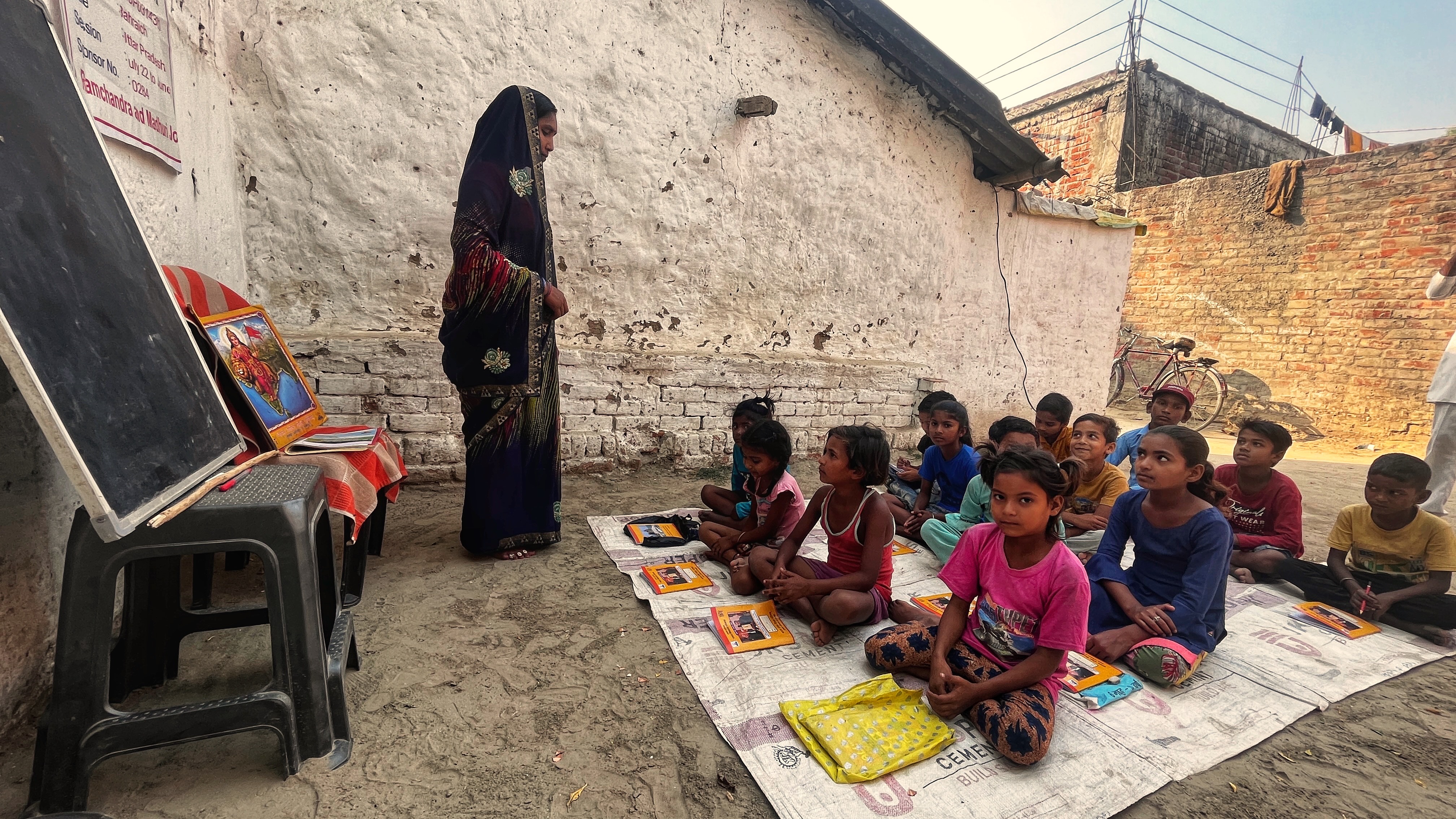
Nidhi Maurya stands in front of Muslim students at an Ekal Vidyalaya in Bahraich, Uttar Pradesh. Photo by Tarushi Aswani.
Sitting 100 kilometers away from Naimisharanya is a Muslim-dominated district, Bahraich. In another Ekal school, Nidhi Maurya in Bahraich’s Gulra village has accomplished a task that has fetched her admiration from her superiors: during her eight-month tenure, Maurya has made Muslim children into Hindu-prayer-reciting students.
Maurya beamed at the sight of the Muslim girls sitting near her feet. “These Muslim girls know three Hindu prayers – the Gayatri Mantra, the Saraswati Vandana and Pratah Kaal prayer – by heart,” she boasted.
On being asked why the Muslim girls were being sent to Hindu schools where the goal of the syllabus is to glorify Hinduism and demean others, a Muslim girl named Muskan told The Diplomat, “This school is free, our parents send us here to learn whatever little we can.”
The Muslim students at Maurya’s school are essentially being made to give up Islam in order to gain a free education.
Filling the gaps in access to education, Ekal is a unique model. While providing decentralized, non-formal education, it mandates that its students to follow and believe in Hindutva, a radicalized form of Hinduism, by making it a part of the compulsory curriculum. Students across Ekal schools are being made to believe that being Hindu equates to being more “Indian” than following another religion.
While the schools may be free for individual families, they do come at a steep cost for society: deepening communal divisions and further marginalizing hundreds of millions of non-Hindu Indians.
Vidya Bharati schools across the country use false claims, cultural indoctrination and consistent anti-Muslim rhetoric to instil Hindutva ideology in young minds.
New Delhi: It was time. Everything was ready for the biggest function in the school – a grand stage, a hall decorated with magnificent lighting, jam packed audience seats, and high-profile chief guests: Union minister D.V. Sadananda Gowda, Puducherry governor Kiran Bedi and several ministers from Karnataka.
[ . . .]

The Indian Express, May 9, 2023
Muslims in higher education: A sobering tale
Data points to falling Muslim enrolment. This level of absolute decline has not happened in the recent past for any group
Written by Christophe Jaffrelot , Kalaiyarasan A
The Sachar Committee Report (SCR) submitted in 2006 showed that the condition of Muslims in education was comparable to, or even worse than, the country’s most backward communities.
The recently released All India Survey on Higher Education 2020–21 shows some contrasting trends. On the one hand, enrollment of Dalits, Adivasis and OBCs in higher education has increased by 4.2 per cent, 11.9 per cent and 4 per cent respectively compared to 2019-20. The upper castes, whose share in enrollment had been declining with the implementation of Mandal II since the late 2000s but who have come back with the highest growth rate of 13.6 per cent. On the other hand, the enrollment of Muslim students dropped by 8 per cent from 2019-20 – that is, by 1,79,147 students. This level of absolute decline has never happened in the recent past for any group.
UP accounts for 36 per cent of that total decline followed by Jammu and Kashmir, which accounts for 26 per cent, then Maharashtra (8.5 per cent), Tamil Nadu (8.1 per cent), Gujarat (6.1 per cent), Bihar (5.7 per cent) and Karnataka (3.7 per cent). Except in Tamil Nadu, Muslims alone witnessed an absolute decline in their enrollment. While the states that have a larger share of the Muslim population account for the higher share of decline, small states too show similar trends. For instance, between 2019-20 — 2020-21, Delhi lost about 20 per cent of its Muslim students while J&K lost about 36 per cent.
If OBCs constitute about 36 per cent of total enrollment in higher education, Dalits 14.2 per cent and Adivasis 5.8 per cent, Muslims stand at the bottom at 4.6 per cent when they represent about 15 per cent of society.
The Sachar Committee Report (SCR) submitted in 2006 showed that the condition of Muslims in education was comparable to, or even worse than, the country’s most backward communities. Their marginalisation, since then, has deepened. Initially, Muslims were slightly above Dalits. But Dalits overtook Muslims in education in 2017-18 and in 2020-21, it was the turn of the Adivasis.
If we strictly follow the age cohort 18-23, the PLFS data confirms this trend. Muslims do even worse than Dalits and Adivasis. According to this source, only about 19 per cent are currently attending higher education institutions, as against 21 per cent among Adivasis, 26 per cent among Dalits, 34 per cent Hindu OBCs and 45 per cent Hindu upper castes. Among major states, in 2020-21 in no state did Muslims do better than Dalits except in Tamil Nadu, Telangana and Delhi. Advasis do better than Muslims in many states such as Rajasthan, Assam, Gujarat, Maharashtra and Jharkhand.
Being the most populated state, UP pulls down the national average. Muslims, who account for about 20 per cent of the state’s population, have just 4.5 per cent of total enrollment. UP alone witnessed the dropout of 58,365 Muslim students from 2019-20 — a decline of 16 per cent. If UP illustrates the story of the deepening deprivation of Muslims, Kerala offers a story of upward mobility. Kerala has not only seen positive growth in enrolment, it also tops in the percentage of Muslim youth (43 per cent) who are currently attending higher education. The century-old positive discrimination in favour of Muslims has helped the community to build educational capital in the state.
Muslims in Kerala enjoy 10 per cent reservation in government jobs and 12 per cent in educational institutions. After Ezhavas (14 per cent), Muslims form the largest population who also claim a large share of quota in the state’s OBC list.
While the sources of marginalisation began much before, what is new is the acceleration of such marginalisation in recent times. How can this be explained? A few factors might have played a key role in the context of rising Hindu majoritarianism.
First, the future is bleak as job opportunities have been shrinking for Muslims even more than for others — they face the highest unemployment rate among socio-religious groups. The percentage of regular/salaried workers who did not report work during the reference week for Muslims rose from 1.6 per cent in 2018-19 to 13.2 per cent in 2019-20. This data is partly a reflection of some discrimination in the job market – an old trend that has been documented by surveys: You send the same CV with Brahmin names, Dalit names and Muslim names, and the percentage of those invited to an interview is the lowest in the case of the latter.
Second, in such a bleak context, one may not have enough money for studying and may, on the contrary, need to work to make a living. Hence, the high dropout rate among Muslim youth who continue with the kind of manual work and low-paying self-employment the community is known for, such as weaving and car repair.
Third, increased violence against Muslims has restricted their spatial mobility and has forced them to withdraw into their shells, a development evident from the ongoing process of ghettoisation in almost all Indian cities.
In this context, the only reasonable policy for the government, as the Sachar Committee Report and (even more) the Mishra Report recommended, would be to initiate positive discrimination in favour of Muslims — something some southern states have done successfully. On the contrary, the state support for Muslims has come down. Karnataka which had been providing Muslims a sub-quota — 4 per cent within the OBC quota — was scrapped recently by the BJP government. The Ministry of Minority Affairs has stopped the Maulana Azad Fellowship — dedicated to pursuing higher education — for minority students from 2022-23.
Where else have we seen a constant policy of discrimination vis-à-vis a vulnerable minority targeting their access to higher education? Only in countries where the intention was to manufacture second-class citizens. And there it worked, but never resulted in harmonious development.
Jaffrelot is senior research fellow at CERI-Sciences Po/CNRS, Paris, professor of Indian Politics and Sociology at King’s India Institute, London. Kalaiyarasan is assistant professor, Madras Institute of Development Studies, Chennai
© The Indian Express (P) Ltd
https://rampuniyani.com/scrapping-maulana-azad-fellowship-blow-to-educational-handicaps-of-muslims/
by Ram Puniyani
Sachar Committee which was appointed by UPA I in 2005 released its report in 2006. It observed that the condition of Muslim community in all areas of social and political life has been sliding down. Faced with the insecurity due to violence against them, its representation in social-political life has been going down for a free fall. UPA in all its wisdom decided to work on this nagging social political issue. One of the steps taken by it was institution of Maualana Azad National Fellowship. This was meant for higher education and research for the minority students. It had provisions for scholars from all religious minorities, Muslims, Christians, Sikhs, Jains and Buddhist. Still as the number of Muslim minority is much higher from among the 1000 fellowships lately 733 were awarded to Muslims.
Among Muslims the status of education worsened after Independence due to the intimidating atmosphere, poverty and lack of any affirmative action. As the level of education went up the number of Muslim students enrolled fell down steeply. Above 17 years of age educational attainment of Muslim students is abysmally low. As per Ministry of education data the national average for Matriculation is 17% for Muslims while the national average is 22%. The literacy rate stands at 57.3% as against the national average of 73.4%. The overall illiteracy among Muslims is higher than among other religious minorities. Similarly their enrollment in higher echelons of education and research is much lower. This is where MANF came in as a small boost for higher education among Muslims. As against 14.2% of their population only 5.5% Muslims reach higher education. As per 2011 census data Graduates among Hindus were 5.98 and amongst Muslims was 2.76%.
On similar lines Pre Matric scholarship for Muslims has been restricted only to 9th and 10th standard students only. The pre-matric scholarship was launched in 2008 and was definitely of great help to Muslim students in secondary education. Even at that time with Modi as Chief Minister of Gujarat argued in Supreme Court that Center cannot force Gujarat to implement it as it is based on Religion! The central contribution for the scheme was returned by the Gujarat state. In tune with this the Central Government has now restricted the scope of Pre Matric scholarship only to 9th and 10th standard students as per a notification in November 2022.
The MANF has been stopped from this December as per proclamation by the minority’s affairs minter Ms Smriti Irani on 8th December 2022. There have been protests against this high handed policy of the Government and many Congress and other MPs have also raised the issue in Parliament. The argument of Ms Irani is that this scheme overlaps with other similar schemes for which Muslims students are entitled, the ones for OBCs. She forgets that one cannot get two scholarships at the same time.
As per research scholar Abdulla Khan (Muslim Mirror) “The enrollment of Muslims in higher education, as per All India Survey on Higher Education Reports (AISHE) (conducted by MHRD, GOI) revealed that the representation in higher education has also been lowest from other communities such as SCs, STs and OBCs…”
It is very clear that the present Government is out to undo whatever little affirmative action directed ‘Equal Opportunity’ exists. At political level we have witnessed the communal forces targeting the Muslim minorities in different ways. We have recently witnessed the angle of love Jihad being highlighted in cases like Shraddha-Aftab. This is being projected in communal angle while the core reason is anti women violence in our patriarchal society. We have witnesses many such cases of violence against women by Hindu men being underplayed with a political agenda.
Undoubtedly education is the key to social progress for any community. The Saeed Mirza classic ‘Salim Langade pe Mat ro’ brought this forward in a very perceptive way. The recent survey conducted by Mumbai based human rights group, Bebak Collective’ points out that Muslim youth are suffering due to social conditions prevailing currently,
Unfortunately in India the dominance of divisive politics has affected the lives of Muslim minorities in diverse ways. Even when not in power they put immense pressure on semi secular parties not to undertake any affirmative action in favor of Muslim and Christian minorities in particular. With new education policy and ruthless privatization of education, the poor and marginalized will be the big victims.
The ruling party has a majority in the parliament and the opposition to such decisions of the Government is not going to change its pro-elite and anti-Minority stance. The powerful electoral machinery of the divisive party is going to come in the way of a coalition at center which can undertake the issues of marginalized sections in a sensitive way. Still a way has to be thought of as to how in prevalent adverse circumstances how to pull out the intimidated community from being left behind in the march to progress for a healthy society with concern for all sections of society, irrespective of their religion, caste and language.
The present Government has a different agenda. Those who have been behind ‘Youth for Equality’ type movements cannot understand the values of affirmative action or ‘Equal opportunity’ in an unequal society. The minority community will recall with pain the attack on Jamia and AMU students. On parallel grounds when the same Ms Irani was MHRD minster we painfully witnessed the plight of Dalits in the form of suicide of Rohith Vemula.
So where do we go from here? Can Muslim community philanthropes, those controlling Waqf and other community resources come forward to fill the massive gap left by the withdrawal of MANF or restricting pre-matric scholarship only to 9th and 10 standard students. It’s a tall order but it has to be done if the demand for reversal of these orders by the Government are not yielded to by the ruling Government, which at present is out to implant its anti Minority agenda with full force. The students in the middle of their higher education and those aspiring for such education need to be helped in all the ways possible.
Caste threads are spawning deadly conflicts in Tamil Nadu schools
Children are wearing the threads to school to assert their caste identity.
The result is a spiral of violence that recently led to a student's death
Johanna Deeksha
25 May 2022
https://scroll.in/article/
*O*n a windy Tuesday afternoon in May 2022, loud howls erupted from a house
in Adaichani, a village in southern Tamil Nadu’s Tirunelveli district. The
sound led villagers to the home of Sundar Rajan, a 40-something man who was
in a fit of rage: in one hand, he held his 16-year-old son’s collar, and in
another, he had a small shovel. The son cried and begged to be let go. The
women in the neighbouring houses hurriedly called the police stationed in
their village to calm the angry father down.
The neighbours explained to me that the father was furious because he had
found out that his son had gone to the village temple festival, despite
being directed to stay at home. Things were not normal outside. “Being out
during this time is not safe for us, that is why the father was angry,” a
neighbour explained. “We have to be on guard at all times.”
The villagers belong to the Scheduled Caste community of Arunthathiyars.
Eleven days earlier, a Class 11 student from the village, who belonged to
the community, had been in a fight with a Class 12 student from another
village, who was from the Thevar caste, an Other Backward Classes
community. The Class 12 student, Selva Surya, had later died, allegedly
from injuries that he suffered in the fight.
The incident had occurred at the Pallakkal Podhukodi Government Higher
Secondary school, a kilometre away from the village. The region was already
tense, and this incident had made it even more so. The police had, in fact,
been stationed at the village to prevent any clashes that could break out
between the two communities.
“Now that they have lost a son, they will be determined to take one of
ours,” said Karpagam, a resident of Adaichani, who goes by one name. “So we
are asking high school students in the village to stay home and not step
out.”
Karpagam’s son missed his Class 11 exam that morning. He had been sent away
to a relative’s house for his safety. He, too, was a student of the school
where the incident had occurred. Karpagam and her husband have decided not
to let their son return to the same school the next academic year. Instead,
they plan to send him to another school, somewhere far away, where he will
be safe.
* “It’s okay if his studies are affected, his life is more important,” she
said.*
Some other parents in the village also shared these fears and said they
were considering moving their children to different schools.
The fight between the two students had erupted over a caste thread. These
caste threads, or bands, are worn around the wrist by people in some
districts of Tamil Nadu, and are particularly common in southern districts
like Tirunelveli, Thoothukudi and Tenkasi. Some caste communities in these
districts have their own flags, and caste threads reflect the colours of
these flags.
“It was the upper castes who used to wear these bands,” said AK Manikumar,
a retired professor of history, who has studied and written on caste riots
and caste politics in the state. “It wasn’t a practice among the OBC and
Scheduled Castes. But slowly, the OBC castes also began to emulate the
upper castes by wearing these threads.” In this region, he said, it was the
Thevar community that first began to display them – over the last two
decades, other communities also began to develop their own symbols.
“It was gradual,” said Marimuthu Bharathan, a Dalit rights activist in the
region. First, caste associations designed their own flags, which would be
displayed on streets to mark the entry into areas where that caste was
predominant. “Then, young people began to wear vests in the colour of these
flags,” Bharathan said, adding that the vests sometimes had caste names
printed on them. “They would wear the vest under their uniform, so it would
be easy to identify who was who. Then they came up with *bottus*” –
decorative dots on the forehead – “and caste threads in the same colours,”
he said.
These caste markers “are a way to hold on to the identity and to the past,”
said Karthick Ram Manoharan, a scholar from the University of Wolverhampton
and author of a book on Periyar. “It isn’t even about superiority, it is
just a way to show they are ‘different’ from other castes.”
Bharathan said that he had noticed young people, especially students,
wearing these threads from the late 2000s onwards. But members of Scheduled
Castes started to sport the threads only in the last ten years, he added.
“Subaltern assertion is vital in a political democracy,” said Vignesh KR, a
doctoral scholar from King’s College London who researches Tamil Nadu
politics, caste and democracy. He observed that the success of the
Dravidian and anti-caste movement have in different ways helped ensure
access to education for Scheduled Caste students, which resulted in a
newfound confidence, and a desire to assert caste identity.
*“The fact that Scheduled Caste students are also wearing the thread is
unsettling the OBC students, who feel that the caste thread is exclusive to
them,” he said.*
Some accounts suggest this tension was the root of the Adaichani incident.
Salim Amir, the father of a student in the school who was friends with the
Scheduled Caste student, said his son had told him that Surya had been
harassing the Scheduled Caste student for some time over his caste thread.
He had allegedly demanded that the Scheduled Caste student remove his
thread because he belonged to a lower caste. (The names of the Class 11
student, other students accused in the incident, and their families, are
being withheld because the Juvenile Justice Act prohibits the disclosure of
any identifying information of juveniles accused in crimes.)
Francis L, the deputy superintendent of police of Tirunelveli, told
*Scroll.in *that teachers from the school had previously called Surya’s
parents, “complaining that he was causing communal issues”. But he had not
heard anything specific about Surya targeting the Scheduled Caste student.
On the day of the incident, Amir said, Surya had allegedly picked a fight
with the Scheduled Caste student during their lunch interval, and his son
and another Muslim student tried to defend him. “They were friends since
class six,” he said, of his son and the Scheduled Caste student.
According to Amir, Surya’s friends also joined in the fight. In the course
of the fight, Amir said, the Scheduled Caste student allegedly threw a
stone at Surya, which hit his head. Amir’s son returned home that evening
with a wound on his head, and told his parents that “he could not stand by
while his friend was being beaten up”.
Meanwhile, Surya was taken to a hospital, where “the doctors stitched up
the wound instead of doing a scan,” Surya’s mother said. The family found
out the next day that he had internal bleeding. Five days later, he passed
away. His family alleged that delayed medical attention and
irresponsibility on the part of the school resulted in Surya’s death.
Police arrested the Scheduled Caste student and the two Muslim students on
murder charges. School authorities declined to comment for this story.
Surya’s family has a different version of the events that preceded the
incident. They told *Scroll.in* that Surya had only asked the accused
student to remove his thread because the school had prohibited it. The
police are still investigating the incident.
Currently, the Scheduled Caste student and two Muslim students are in a
juvenile home.
*“One life has been lost and another three hang in the balance,” said
Vargis Rani, a social worker who works with the Arunthatiyar community.*
After the student’s death, police seized caste threads from shops and
warned students against wearing them. Since exams were on, they threatened
to disallow students from attending them if they arrived wearing the
threads. “They just cut it with a scissor before we enter,” a school
student said.
*N*early a century has passed since EV Ramasamy, better known as Periyar,
founded Tamil Nadu’s self-respect movement in 1925, aimed at dismantling
the caste system. At that time, Brahmins occupied most positions of power
in the state, then known as the Madras Presidency.
According to the 1916 “non-Brahmin manifesto” of the South Indian People’s
Association, in one provincial civil service exam, “15 out of the 16
successful candidates were Brahmins” although “not less than 40 out of 41
and a half million, who form the population of this presidency, are
non-Brahmins”.
In 1927, Madras Presidency became the first province in India to implement
reservations in government jobs. That legacy endures till this day: Tamil
Nadu reserves 69% of seats in government educational institutions and
government jobs for disadvantaged communities, higher than any other state.
It ranks among the top in the country in terms of development indices, for
which many credit its reservation policy.
Periyar, the philosopher and social activist, subsequently went on to lead
the Justice Party, the parent of Tamil Nadu’s two major political parties,
the Dravida Munnetra Kazhagam and the All India Anna Dravida Munnetra
Kazhagam. Governance in Tamil Nadu has historically been guided by his work
and thinking, and leaders have strived to provide equitable access for
communities that were ranked among the lowest in the caste system.
But even in this relatively progressive environment, caste tensions surface
frequently. While formal political power may have moved away from Brahmins,
it has come to be concentrated in Other Backward Classes, a diverse
category marked by wide disparities. In recent years, social and economic
change has further created a churn, helping Dalit communities progress, but
making groups in the lower end of the spectrum of OBCs grow resentful.
The result is that caste tensions are now seeping into schools, with even
children developing a strong sense of caste identity. The manner in which
these tensions develop and spill over into violence is revealing of how
deep-rooted the problem of caste is in the country, and of just how
challenging it is to try and tackle it.
The prominent castes in southern Tamil Nadu are the Nadars, a Backward
Class community, and the Thevars, also a Backward Class community, which is
divided into three subcategories – Agamudaiyar, Kallars and Maravars. (Of
these three, the Kallars and Maravars are significantly disadvantaged
groups – both were previously classified as “criminal” and were
subsequently denotified.) The three main Scheduled Caste communities in
this region are Paraiyars, Arunthathiyars and Pallars.
According to responses to Right to Information Act applications filed by
Evidence, an NGO based in Madurai, 300 murders were registered in the state
between January 2016 and December 2020, under the provisions of the
Scheduled Castes and Scheduled Tribes (Prevention of Atrocities) Amendment
Act, 2015. In one particularly violent period, in September 2021, four
beheadings were reported
<https://timesofindia.
in
a span of ten days in southern Tamil Nadu – most of the incidents involved
members of the Thevar community and Scheduled Castes.
This violence is also mirrored in a rise in tensions between schoolchildren.
* “What students see in their homes and neighbourhoods, they replicate in
their school as well,” said Rani, the social worker. “Where else will
children learn these things?”*
Bharathan, who noticed that many school children had begun wearing caste
threads, petitioned the National Human Rights Commission in 2015, seeking
its intervention in the matter. That same year, the Commission issued a
notice to the Tamil Nadu government, directing it to look into the issue of
caste threads and other caste markers among school students in Tirunelveli.
Four years later, a 2018 trainee batch of IAS officers appealed to the
Tamil Nadu government, seeking its intervention in the matter of caste
threads. The subject had come up for discussion during a training session,
following which the batch decided to make the representation. In 2019, the
Tamil Nadu government issued a circular banning the wearing of the threads,
and directing authorities to identify and crack down on schools where they
were being worn.
The BJP leader H Raja called the move “anti-Hindu” and condemned the
circular. The next day, the then education minister K Sengottaiyan, of the
AIADMK government, which was an ally of the Bharatiya Janata Party at the
Centre, did a U-turn and claimed that it had been issued without his
permission. A day later, he backtracked. *The Hindu* reported him as
saying: “Necessary action will be taken if complaints are received in this
regard.”
Bharathan explained that the interventions have had little impact.
“Students continued to wear the caste thread,” he said. “In some instances,
teachers who are casteist allowed it to continue, in others, the
administration simply failed to implement the rule.”
Those teachers who are trying to enforce the rule struggle to discipline
students who are determined to display caste markers.
At around 1.30 pm on a Thursday, high school students of a government
school in the village of Nadakallur in Tirunelveli strolled out of their
classrooms after an exam. Outside at the gates, on the busy highway on
which the school was located, middle school students waited to be let in
for their exam. As I stood at the gate, speaking to a physical education
teacher, he pointed out a student who had one palm wrapped around the wrist
of his other hand. “See, he knows we’re watching so he’s trying to hide the
caste thread,” the teacher said. That student slipped away but the teacher
managed to stop another student and make him wipe out the *bottu* on his
head.
“It’s not easy,” the teacher confessed. “When I ask them to remove it,
they do it immediately but the minute I turn away, they put it back on.”
Many teachers said that social media had had a role to play in reigniting
children’s feelings of caste pride, often referred to as “*jaati veri*”, in
Tamil, which literally translates to “caste mania”. Caste pages and
caste-related videos on YouTube were contributing to this mania, teachers
told me.
The problem can be dealt with if school administrations take effective
steps, noted R Shankar, the principal of the Nettoor Government School in
Tenkasi. “But the teachers and principals are scared,” he said. “They are
scared of the students and their parents, so they do not take strict steps.
That is why these practices continue to take place.”
Shankar said that he himself took about six months to ensure students were
not wearing caste threads to class. If students threatened to call their
parents, he asked them to go ahead. “I would ask the parents, do you want
your ward to sit on a chair like me?” he said. “If they said yes, then I
would tell them to let me do my job and not interfere.” Currently, he said,
no students wore these threads to his school – but he added that sometimes,
he observed some wearing them outside the school.
More than 80 km away from Nadakallur, in the village of Palavoor

https://www.southasiamonitor.
Imposing Sectarian Agenda on Educational Syllabus
Ram Puniyani
In the name of rationalization of curriculum many a topics have been removed from the CBSE syllabus (April 2022). From the tenth standard syllabus; the topics excluded are democracy and diversity, rise of Afro-Asiatic Islamic states, history of Mughal Courts, non alignment movement, impact of globalization on agriculture, popular struggle movements, poems of Faiz in the section of Communalism and challenges to democracy.
Criticizing this; Rahul Gandhi labeled CBSE as Central Board for Suppressing Education, and called RSS, the force behind these policies as Rashtriya Shiksha Shredder. Also All India Democratic Students Organization has launched a signature campaign against it. As such when the BJP comes to power, one of its major goals is to modify change the education policy and curriculum to tune it to its version of sectarian nationalism. Its focus is on faith based knowledge away from scientific temper and rational approach to social, historical issues.
One recalls when BJP led NDA came to power in 1998; Dr. M.M. Joshi was the MHRD minster. He changed the history books to introduce communal angle to historical events. Accompanying this was the introduction of Paurohitya (Priest craft) and Karmakand (Rituals). In contrast to scientific astronomy, astrology started being taught. There was an interesting paradox. In astrology Saturn was the trouble makers, while in astronomy Saturn was taught as a planet of Sun. In opposition to biological understanding that sex of child is determined by X or Y chromosome coming from father, the Putrakameshti Yagna (ritual to get male child) was being taught as the method for getting the much sought after son.
The pattern continues. RSS has already formed Shiksha Sanskriti Uthan Nayas, an RSS affiliate, to campaign with influence the MHRD ministry. It has been pressurizing NCERT for removal of English, Urdu and Arabic words, the thoughts of Rabindranath Tagore; extracts from painter M F Husain’s autobiography; references to the Mughal emperors as benevolent, to the BJP as a “Hindu” party, an apology tendered by former Prime Minister Manmohan Singh over the 1984 riots; and a sentence that “nearly 2,000 Muslims were killed in Gujarat in 2002”. (25th July 2017) As such these recent recommendations to NCERT are continuation of the same agenda which is working for its goal of Hindu Rashtra.
It had also been putting pressure to undertake Bharatiyakaran of education. Under its pressure many publishers have also buckled. The major example is that of Penguin, pulping the book ‘The Hindus’ by Wendy Doniger. This was an academic work which looked at various aspects of Hindus, particularly the plight of women and dalits. One RSS leader Dinanath Batra has been very active in this area and has produced number of books for school children. In Gujarat 42000 schools introduced his books after their translation to Gujarati.
The pattern of the curriculum presented in these books spells things like Kutub Minar was a Hindu Monument, called Vishnu Stambh, built by Samudra Gupta. These books totally bypass the syncretic traditions and present the Kingdoms through the eyes of king’s religion. The focus is to present the view that foreign Muslim rulers were doing atrocities on the native Hindus. It is through this lens that Kings of Mughal dynasty are presented. Now in the new scheme of things the Mughal Courts and their pattern will be totally eliminated. Even the during much maligned Mughal period the Mughal Kings had Hindu associates (Akbar+Mansingh, Aurangzeb+Raja Jaising) to give just a small sample.
In these books Muhammad Gazni and Ghori are the key villains. Gazni had many Hindu generals (Tilak, Sondhi,Harzan, Rai and Hind) in his army. Shivaji and Rana Pratap presented as the main heroes. Incidentally Shivaji’s confidential secretary was Maulana Haiser Ali and Rana Pratap had Hakim Khan Sur as one of his generals.
The disturbing changes brought by BJP are an attempt to construct a history to suit its narrative of Hindu nationalism. Gandhi (Hind Swaraj) and Nehru (Discovery of India) gave the history of India, which was inclusive and reflected the emerging National movement and underlying concept of Indian Nationalism. The changes brought in by BJP in education were called as Saffronization by its critics. Initially BJP and company responded to this criticism by ignoring the phrase. Later they aggressively said that the syllabus needs to be saffronised. Even present Vice President Venkaiah Naidu asserted that syllabus needs to be saffronized.
The current changes which are seeing are in tune with their political requirements of RSS Combine. Mughal Court was an example of Hindu Muslim unity, so it can’t have a place in BJP scheme of things. Faiz Ahmad Faiz, who was a democrat and secular and was also nominated for Nobel Prize for Literature, is an icon for literature for progressive democratic values. Having a poet with Pakistani identity will surely be big no for the present ruling dispensation.
Currently one of the aims of the Government is to undermine the first Prime Minster of India, the architect of Modern India, one who stood tall for his commitment to democratic and secular values, Jawaharlal Nehru. His major contribution on global scene was to evolve and work for Non Alignment Movement. This movement gave a new direction to global alignments. It also helped India to develop taking advantage of collaboration of different camps in the World despite the Cold war. So the chapter on Cold War era and non alignments has been kept out of the syllabus.
Present ruling party and its ideology want to push the country in authoritarian sectarian state, where democracy has no role, so that chapter on pluralism and diversity is out. India’s pluralism and diversity have a major role to play in the culture and strength of India. India’s freedom movement and Indian Constitution respect our diversity. But uniformity in language, religious traditions and other cultural aspects is what is being aimed at.
Overall the changes proposed, to be implemented are in tune with the concept of nationalism, and the culture which sectarian nationalists want to impose on the country. These need to be opposed and ensure that our syllabi are in tune with rationalism, scientific temper of pluralism of India.
‘Ram temple’ springs up inside University of Hyderabad, student organisations protest efforts to ‘saffronise’ campus
Peoples Democracy, March 27, 2022
Editorial
Desecularising the State
THE announcement by the Gujarat education minister that the Bhagavad Gita would be taught in schools as part of the syllabus for class 6 to class 12 students from the academic year 2022-23, is a flagrant breach of the secular principle of the State.
It is a fundamental principle of all secular States that State-run schools do not impart religious instruction of any sort. The United States, France, Japan and a host of other countries follow this principle. Private schools are free to offer religious instruction of any kind but not State schools.
The Bhagavad Gita is a religious text. It seeks to expound a way of life and conduct based on Hindu religious traditions and philosophy. It cannot be depicted as a book of morals and ethics divorced from its religious context, as the BJP-RSS are claiming. There are some from within the Hindu fold who are critical of some aspects of the Gita such as the exposition of karma on its pronouncement that the chaturvarna system of caste is divinely ordained.
But the real issue is not whether the Gita is obscurantist and purveys some regressive ideas. The question to focus on is how government schools can have religious instruction of a particular kind?
The Constitution of India, in the Fundamental Rights chapter states in Article 28 (1) that: “No religion instruction shall be provided in any educational institution wholly maintained out of State funds”. It further states that in educational institutions (which are not State-run) but are recognized by the State or receiving aid out of State funds, if there is any religious instruction, no student attending such institutions can be made to take part in any such religious instruction or religious worship unless the guardian of that student, if a minor, has given consent.
The Gujarat decision on the Bhagavad Gita, therefore, goes against the basic premise set out in the Constitution - no religious instruction in State-funded and run schools.
The Gujarat example will now be emulated by other BJP-ruled states. The Karnataka minister for school education has stated that the state government will consider introducing Bhagavad Gita in schools after discussions with educationists. He said that, “Bhagavad Gita is not only for Hindus, it is for all.” It is the same Karnataka government which has outlawed the use of hijab by Muslim students in educational institutions.
The Union Minister, Prahlad Joshi, promptly stated that “Bhagavad Gita teaches us morality and ethics….Every state government can think about it.”
The efforts to introduce Hindu religious texts and scriptures in government schools is part of the overall project of the RSS-BJP to desecularise the Indian State. The Gujarat education minister cited the New Education Policy recommendation to include “Indian culture and knowledge systems” to justify the introduction of the Gita in the school syllabus. In all other spheres of the State, the introduction of Hindu religious symbolism in State functions and provision of State funds for expanding and renovating Hindu places of worship have become a common feature. The Prime Minister’s inauguration of the Kashi Vishwanath corridor is a prime example.
The State patronising the religion of the majority and privileging it in State institutions and systems is going to spell the end of any semblance of secularism left. The obverse side of this are the various laws passed by BJP state governments against `love jihad’, conversions and the drastic ban on slaughter of cattle which target the minorities. The Central law, the Citizenship Amendment Act, introduced a religious criteria to citizenship.
In Gujarat, the introduction of the Bhagavad Gita in schools has been welcomed by the main opposition party, the Congress. Its spokesperson said: “We welcome the decision to introduce Bhagavad Gita in the syllabus, but the state government also needs to learn from the Gita first”. Not to be left behind, the AAP spokesperson said, “We welcome the decision of the Government of Gujarat. This will benefit the students”.
This response of the opposition parties in Gujarat indicates the new reality – Hindutva is steadily acquiring a hegemonic status. The Left and democratic forces and all those who wish to see India remain a secular State will have to factor in this reality while working out a strategy to fight for an alternative vision to Hindutva.
(March 23, 2022)
Admiration for national heroes comes naturally to the citizenry. Problems are bound to arise when an elected government deems it necessary to impose a template of reverence. The ministry of education has asked students of central board schools as well as state authorities to prepare projects on the lives of the winners of Gallantry Awards under a month-long ‘Veer Gatha Project’. According to an official circular, the initiative aims to “disseminate the details of acts of bravery and the life stories” of armed forces personnel, thereby raising awareness among schoolchildren about the magnitude of the sacrifices made by those who guard the nation. The initiative has been lauded by several educationists who opine that interactive projects — the defence ministry will organize hour-long programmes for schoolchildren — can help students learn about topics of importance in a more comprehensive manner than can be achieved through rote-learning. Recognizing valour is important. But the methodology of doing so merits examination in the light of the fact that the Bharatiya Janata Party-led government has not only been guilty of encroaching upon educational curriculum but also rolled out several programmes with a pronounced ideological tilt in the garb of celebrating ‘Indian heritage’. Take, for instance, Yoga Day; it aims to instil a holistic approach to health but, curiously, coincides with the death anniversary of K.B. Hedgewar, the founder and first sarsanghchalak of the Rashtriya Swayamsevak Sangh. The celebration of Hindi Divas had also drawn attention after the Central Board of Secondary Education tweeted that Hindi is “our identity”.
The Veer Gatha Project must, therefore, not be allowed to go the way of other seemingly innocuous programmes that seek to surreptitiously indoctrinate young minds in a particular ideological — militaristic? — mooring. Such a proclivity not only infringes upon the autonomy of educational institutions — they, not the government, should have the right to frame curricula — but also presupposes that citizens need to be tutored on the mores of reverence. There is also the question of developing independent, critical thinking as opposed to instilling passive admiration. Would students be allowed to appreciate not only valour but also the conditions — political, historical and strategic — that compel India’s brave jawans to make the ultimate sacrifice?