|
|
|

|
|
|


https://www.newsclick.in/caste-census-would-be-real-tribute-ambedkar
Initiating Caste Census: Real Tribute to Ambedkar Today
Ram Puniyani
This year 2023, 14th April saw plethora of organizations celebrating Baba Saheb Ambedkars 132nd birth anniversary probably more than before. The occasion was marked by gaiety and celebratory spirit among the large sections of SC/ST/OBC sections for whom he is the messiah. His contributions are recognized more and more, not only nationally but even at global level with over 150 countries celebrating the occasion. Most groups who are committed to social justice and equality, opposed to birth based hierarchies and injustices celebrate the occasion with deep reverence and hope. One can say that this occasion is also assuming religious overtones as at places rituals are being given more importance than highlighting Babasaheb’s values. Surely there is a need to launch and sustain struggles to fulfill the dreams for which Babsaheb struggled all his life.
There are other groups and formations who are deeply opposed to the principles and values for which Ambedkar struggled all his life. As such ‘Hindu nationalists’, RSS and progeny, are totally opposed to Babasaheb’s core aim of ‘annihilation of caste’. They project ‘harmony among castes’ as their credo. Ambedkar stood for affirmative action for the deprived sections of society. Initially there were provisions for reservations for ten years only. Probably Ambedkar had a hope that ten years will be enough to root out the deep malice of Hindu society. He probably did not take into consideration the fact that the implementation of the policy lays in the hands of upper caste elite themselves, who in due course found ways to circumvent the proper implementation of reservation for SC/STs and so it had to be prolonged till the date, which is a requisite for march towards social justice.
The constitution, the drafting of which he presided over, did give the provision for SCs and STs, still leaving out Other Backward Classes. This is a large constituent of the society, about which not much attention was paid for long time. Last time the decadal census which took this into consideration was in 1931. It stood at 52% at that time which later became the basis of giving them 27% of reservations in 1990s. There were some provisions for affirmative action but its proper implementation took place with Mandal Commission implementation only.
The reservations have been an eyesore to certain sections of society and they did float groups like “Youth for Equality” types which stood for abolition of reservations. By word of mouth and other channels it was popularized that due to these reservations, ‘non deserving’ people find their way and the deserving one’s are left out. Social biases got constructed around dalit-OBCs and these social biases did get converted in to the suicides of the likes of Rohith Vemula or Darshan Solanki. These biases also formed the base of anti dalit violence in 1980s in Ahmadabad and anti OBC violence in Gujarat in 1985.
While BJP’s parent RSS, initiated social engineering and floated organizations like ‘Samajik Samrasta Manch’ (Social Harmony Forum) which was an attempt to co-opt these marginalized sections. Its efforts did pay it rich electoral dividends, which are reflected in the presence of large number of BJP MPs and MLAs from the constituencies reserved for these sections. The large force of RSS pracharaks and Swayamsevaks has relentlessly worked in these areas through social engineering, process of sanskritzation, and charity work among these communities.
At ideological level ‘Hindu right wing’ has made tall efforts to attribute ills of caste system to ‘invading’ Muslim kings and trying to project that all castes were equal before Muslim kings came, type of formulations. It is no surprise that BJP and its associates also make the show of celebrating Ambedkar anniversary. At the same time they undermine the need for demands like caste census which can pave the way for modification of policies, through which the marginalized sections can benefit in the real sense.
It is this background that Rahul Gandhi’s speech in Kolar becomes significant. Mr. Gandhi asked for population census and stated that the results of affirmative action are not as visible as in the case of top bureaucrats like Secretaries in Union Government, hardly 7% belong to these sections. While putting forward this demand he also asked for the Caste census findings conducted under UPA in 2011 be made public. He correctly states that, “The data will provide evidence if Other Backward Classes (OBC), Dalits, and Adivasis don't have enough representation in the country's politics proportionate to their population”
In contrast BJP is trying to dodge the issue. A party which could undertake the massive and painful exercise of NRC in Assam; is rejecting caste census! It told the Supreme Court (2021) that such a census would be "administratively difficult and cumbersome" and that it was a "conscious policy decision" to exclude such information from the census purview.”
The real intent of BJP regarding social justice becomes clear at the times of crucial decisions. Its decision to oppose caste census is one such. During last nine years the, introduction of reservations for ‘Economically Weaker Sections’ of society has already diluted the prevailing provisions and upper caste with income of 8 lakhs will also be eligible for reservations. Economic backwardness has never been in consideration for reservation, as the very concept of reservation was related to caste backwardness, caste as a handicap for one’s place in the society.
Coming back to celebrating Ambedkar
Anniversary, it is clear that for parties like BJP Ambedkar’s principles don’t
matter. As a matter of fact Hindu nationalist politics came up precisely to oppose
the rising assertion of SC/SC/OBC. The foundational ideological pronouncements
of this politics glorified the holy tomes and traditions boosting the caste and
gender hierarchy. Today what we need is a genuine assessment of the population
of different marginalized sections and to modify our policies so that the
uneven growth of the society is brought on path of equality. Also the deaths of
likes of Rohith Vemula and Darshan Solanki should awaken us to the need to
combat the biases constructed against the SC/ST/OBC and strive for a future
where ‘annihilation of caste’ is the central credo of our society.
Mis-understanding Mohan Bhagwat | Alishan Jafri and Apoorvanand
Scores of organisations like Ram Sene and Hindu Yuva Vahini have little consideration for the occasional preaching of sanity by the RSS chief.

Illustration: Pariplab Chakraborty
Every time Mohan Bhagwat speaks in public, a group or another complains that he has targeted them and then at least one prominent media house is blamed for misquoting him.



Often, this aggrieved group is the Muslim minority. But oddly it’s the Brahmins this time.
In the past one month, at least two criminal complaints were filed against Bhagwat, the chief of the Rashtriya Swayamsevak Sangh, or the Sarsanghchalak as he is affectionately called in the Sangh Parivar’s lingo. What might be astonishing for many observers is the fact that both these complaints were filed by pro-Hindutva activists who somehow feel that Bhagwat’s comments are prima facie anti-Hindu and anti-Brahmin.
This is disconcerting for observers because most Hindutva critics view the Sangh Parivar and its support base as a monolith wherein every follower obeys and never questions the decision of the top leadership, which is perhaps partly correct in the context of elections and the BJP’s political masterstrokes. In that context, what Prime Minister Narendra Modi, the Bharatiya Janata Party and the RSS have achieved in the past decade is a seemingly absolute political consolidation of a Hindu electorate that has been carved out from various caste groups and a brazen political exclusion of minorities, particularly the Muslims.
This includes an active outreach to the communities within the Scheduled Castes, Scheduled Tribes and the Other Backward Classes.
Contrary to its claims of a ‘Hindu first’ politics, the BJP has rather mastered the art of strategic caste and ethnic politics across states. The BJP’s traditional support base, the Brahmins and other ‘upper’ castes, seemed to have made peace with these new realities but the question of caste-based reservation and the SC/ST (Prevention of Atrocities) Act continues to haunt them.
These various caste alliances and their underlying contradictions are carefully but hurriedly glossed over with the help of a virulent anti-Muslim rhetoric that cuts across society, a tight grip over public institutions, and a pliant mainstream media ready to stoop to daily lows in its ambushes on the opposition and Muslims. It informs critics that the BJP has achieved an invincible formula to maintain its hold over India.
However, if we keep aside this intimidating political arithmetic and focus on the recent attack and cultural backlash against Bhagwat and the RSS, it demonstrates the wider social contradictions in the vision of the RSS and other less popular Hindutva movements that are not ready to give up caste privilege in exchange of just Muslim-baiting.
It is advisable to view this apparent anger against Bhagwat in the context of these contradictions in the Hindutva universe that are not as ideologically homogeneous as it appears to be. Before we talk about these contradictions, let us examine why Bhagwat ended up triggering a prominent section of the Hindu right at least twice.
The first complaint against Bhagwat was filed for his allegedly “pro-LGBTQ” views and comments on the Hindu deity Krishna that he made during an interview. The interview had predominantly grabbed headlines for Bhagwat’s anti-Muslim diatribe in which he had asked Muslims to give up what he described as their belligerent supremacy and justified Hindu extremism as a natural response of a victimised society at war since the last 1,000 years.
He had also claimed that the Hindu civilisation has traditionally acknowledged the LGBTQ community. According to the complaint, Bhagwat’s interview with the two RSS mouthpieces, Panchanjanya and Organiser, endorsed and associated homosexuality with Hindu religious figures. Bhagwat has also been accused of making inflammatory remarks against Krishna.
The complaint alleged that Bhagwat’s depiction of Hans and Dimbaka as a gay couple or that they felt “attraction towards each other” is not factually correct. The complainants cited the Sri Harivansh Puran as having carried the actual version of this “historical incidence”. Further, Bhagwat was accused of calling Krishna a cheater. This was followed by a torrent of angry comments and messages by traditionalists. A section of rightwing activists demanded Bhagwat apologise and the two Sangh mouthpieces take down the alleged “anti-Hindu” comments.
With little oxygen from the media, the campaign ended abruptly.
However, two week later when Bhagwat was perhaps attempting to firefight Samajwadi Party leader Swami Prasad Maurya’s campaign against Ramcharitmanas, he criticised the caste system and said, “Caste was created by Pandits,” triggering widespread expressions of resentment amongst Brahmins.
As the cauldron of popular anger against Bhagwat turned red, the RSS tried to water it down with a carefully worded clarification circulated in the media. The corrigendum claimed that Bhagwat was not targeting Brahmins by mentioning the word ‘Pandit,’ rather he was referring to ‘some scholars’ since the word ‘pandit‘, in Marathi, means ‘scholar’, and that he has been misquoted.
Our north Indian Hindi speaking minds didn’t agree with this explanation but the more generous speakers of the language within the Hindutva fold seemed to meekly claim that perhaps Bhagwat was actually misquoted.
The word ‘pandit’ in the English language refers to ‘scholar’, the same meaning Bhagwat claimed it had in Marathi, the language in which he delivered his speech.
Bhagwat’s clarification, however, didn’t sit well with independent Hindutva ideologues.
Also read: ‘Pandits’: Amidst Controversy Over RSS Chief’s Remark, Hindu Godmen Defend Caste System
As of now, the most prominent Hindu religious figures: the Shankaracharya of Puri and Dwarka have publicly attacked Bhagwat.
When asked to react to Bhagwat’s comments by a devotee, Nischalananda Saraswati, the Puri Shankaracharya, appeared to defend the caste system and slammed Bhagwat. “The name of the first Brahmin is Brahma ji. You should study the scriptures. All the sciences and arts in the world are explained by Brahmins alone. Education, defence and other services should always be balanced. If we do not accept the Sanatan [literally eternal truths, used to refer to a version of Hinduism] system, then what system should be there?” he asked.
Responding to Bhagwat’s clarification, Shankaracharya Swami Avimukteshwaranand said, Bhagwat is saying that God did not create this (caste system), they have been made by Pandits. Then he says that ‘Pandit’ means ‘scholar’ and not ‘Brahmin’. If scholars have said something then why are you denying it?” the Shankaracharya asked.
The less charitable ones in the community of godmen, who are widely renowned for their anti-Muslim statements – like Paramhans and Narsinghanand – called Bhagwat anti-national and anti-Hindu.
This controversy is not limited to a war of words. Last week, an alleged BJP leader opened fire at a Vishwa Hindu Parishad leader in Moradabad of Uttar Pradesh, reportedly because of an argument over Bhagwat’s ‘Pandit’ remark.
The controversy has given insight into the simmering differences within the Hindutva universe over the question of caste as it has opened a small window into the Sangh Parivar’s own lack of debate on how to navigate the growing concerns of the ‘upper’ castes over a resurgent Ambedkarite discourse in which the caste system and associated Hindu beliefs receive unsparing criticism.
Bhagwat is not alone in antagonising this section of the Hindu right. We have seen how PM Modi often gets in the crosshairs with the traditionalists for some of his rare utterances bearing some semblance of secular civility.
However, secularism is no more the biggest worry of the traditionalist camp. A strong section of ‘upper’ caste right-wingers think that the BJP government is appeasing the so-called anti-Hindu, Ambedkarite and Bahujan groups. With the BJP being unable to strongly respond to emboldened Bahujan politicians like Rajendra Pal Gautam, Swami Prasad Maurya or Chandra Shekhar who have not shied away from their Ambedkarite views on the caste system and the religious texts that defend it, this anger of the Brahmin right-wing has come out in the open.
Bhagwat is thus in a tricky spot. He can’t retract his comments totally (he never does) and he can’t also claim that he meant what he said. An explicitly violent campaign against Ambedkarite leaders and parties may even end up consolidating all Dalit communities in favour of Ambedkarite politics. Not responding at all would create a need to look for more radical caste supremacist alternatives to the Sangh Parivar.
But even Bhagwat’s sympathisers would agree with his critics that his clarification is sketchy. If Bhagwat was not referring to Brahmins when he talked about the so-called ‘Pandits who have polluted Hindu texts with caste propaganda then Bhagwat should simply name all those scholars, who in his view, are guilty and should be held accountable of this humongous sin of creating disunity amongst Hindus by adding caste supremacy in their texts.
He should then, by a rational extension of his own clarification, also mention the particular texts that according to him have been polluted by this propaganda.
Since Bhagwat is widely recognised as one of the biggest well-wishers of Hindus, he’s almost duty bound to name those ‘Pandits.’ In case he doesn’t do that, then common Hindus who follow him might end up getting confused. This would cast undue aspersions on scriptures and the Pandits wrote since Bhagwat left his comments open to public interpretation.
Moreover, as some Bhagwat critics argue, this ‘open to interpretation’ clarification can solidify what the so-called ‘anti-Hindu’ influencers have to say about the question of caste. This is what happened when Swami Prasad Maurya endorsed and welcomed Bhagwat’s comments.
On a more serious note, let us try to understand what these apparent contradictions mean for the non-Indic religion people, especially Muslims and Christians.
First, one can see that the RSS no longer controls the violent Hindutva network.
In the last decade several big and small gangs and organisations have emerged all over India which are not affiliated to the RSS the way BJP, Akhil Bharatiya Vidyarthi Parishad, VHP and numerous other organisations are. But without the long and sustained work by the RSS and the establishment of the national ‘Hindu Rashtra’ under Narendra Modi, it would have been difficult, if not impossible for them to thrive.
Scores of organisations like Ram Sene and Hindu Yuva Vahini have little consideration for the occasional preaching of sanity by Bhagwat. They are not guided by the need to indulge in pseudo-intellection as Bhagwat and his colleagues love to do. Why, even the members of the RSS know that they are mere words. We suspect that Bhagwat also knows what he says is not for his base or the larger Hindutva network.
This is what the Muslim or Christian elites need to understand when they approach RSS to secure peace for themselves. It is foolish to expect the so-called ‘fringe Hindutva’ groups to cease what they are doing because the RSS asks them to.
It is also true that the influence of the ‘Shankaracharyas’ on the thinking of Hindus is highly overrated. We have not seen Hindus paying attention to what they say.
The capacity of Bhagwat to effect a rethinking among the followers of the ideology of Hindutva is limited. As said earlier, he also does not intend it. Otherwise, he wouldn’t be changing his ground on the question of Muslims being equal Indians or the issue of caste.
If we assume that Brahmins didn’t create this system, even then the moot question is whether the system should go or not? What are the efforts that the RSS is taking towards annihilation of caste? It recruits members from SC and ST communities in the army of Hindutva but what does it do to achieve equality within the Hindu society?
Even when we read about Dalits trying to gain entry to temples, we don’t read of RSS playing any role there. Neither have we ever come across any news of the RSS undertaking any campaign to end violence against SCs in daily Hindu life. Its ‘upper’ caste base knows that the RSS would do nothing to take away the privilege it has enjoyed for eternity. Hierarchies would remain as they have been, the only ground where these historically segregated caste groups are allowed to meet is the battle ground against Muslims and Christians.
The present day RSS leadership also knows well that it cannot control Narendra Modi.
Its decision to come out in support of Gautam Adani is a demonstration of the fact that it is compelled to make available all its resources to Narendra Modi.
As Dhirendra K. Jha has shown, with his extensive and deep understanding of the way the Hindutva network operates, the RSS is now subservient to the wishes of Narendra Modi. It cannot rebel against him also because of what his rule has secured for the RSS and its leadership. An RSS worker explained it very simply, “When in the history of the RSS would pracharaks and its leaders have imagined that they would get the comfort that is now available to them? Which Sarsanghchalak would have thought that he would be treated as the national thinker and his speeches would be telecast live from all channels? Can they leave this comfort? The only way for them to maintain it is by keeping Narendra Modi and the likes in power.”
The political economy of the violent Hindutva network needs to be understood. It is related to local control: social, political and economic. Violence creates influencers and leaders. It is the first step of their career path. And a necessary component of their politics. It is impossible to do away with it.
Those who think that once they achieve power they’ll desist from indulging in it need to explain the dog-whistling of Narendra Modi and Amit Shah against Muslims and Christians. What is the meaning of the warning of Amit Shah to the Kannadigas against Kerala? What is the explanation of the call of the Karnataka BJP chief to eliminate the followers of Tipu Sultan?
What does the RSS have to say about these violent exhortations?
Leaving these aside, how is a listener to make sense of Bhagwat’s talk of a “thousand-year warfare which has forced Hindus to become violent?” We can see that Bhagwat is trying to prove that he can be the leader of the wider Hindu society while at the same time assuring the violent lot that he continues to be their patron.
Thus any strategy to combat the ever-expanding network of Hindutva will need a rethink in the light of the above.
Caste threads are spawning deadly conflicts in Tamil Nadu schools
Children are wearing the threads to school to assert their caste identity.
The result is a spiral of violence that recently led to a student's death
Johanna Deeksha
25 May 2022
https://scroll.in/article/
*O*n a windy Tuesday afternoon in May 2022, loud howls erupted from a house
in Adaichani, a village in southern Tamil Nadu’s Tirunelveli district. The
sound led villagers to the home of Sundar Rajan, a 40-something man who was
in a fit of rage: in one hand, he held his 16-year-old son’s collar, and in
another, he had a small shovel. The son cried and begged to be let go. The
women in the neighbouring houses hurriedly called the police stationed in
their village to calm the angry father down.
The neighbours explained to me that the father was furious because he had
found out that his son had gone to the village temple festival, despite
being directed to stay at home. Things were not normal outside. “Being out
during this time is not safe for us, that is why the father was angry,” a
neighbour explained. “We have to be on guard at all times.”
The villagers belong to the Scheduled Caste community of Arunthathiyars.
Eleven days earlier, a Class 11 student from the village, who belonged to
the community, had been in a fight with a Class 12 student from another
village, who was from the Thevar caste, an Other Backward Classes
community. The Class 12 student, Selva Surya, had later died, allegedly
from injuries that he suffered in the fight.
The incident had occurred at the Pallakkal Podhukodi Government Higher
Secondary school, a kilometre away from the village. The region was already
tense, and this incident had made it even more so. The police had, in fact,
been stationed at the village to prevent any clashes that could break out
between the two communities.
“Now that they have lost a son, they will be determined to take one of
ours,” said Karpagam, a resident of Adaichani, who goes by one name. “So we
are asking high school students in the village to stay home and not step
out.”
Karpagam’s son missed his Class 11 exam that morning. He had been sent away
to a relative’s house for his safety. He, too, was a student of the school
where the incident had occurred. Karpagam and her husband have decided not
to let their son return to the same school the next academic year. Instead,
they plan to send him to another school, somewhere far away, where he will
be safe.
* “It’s okay if his studies are affected, his life is more important,” she
said.*
Some other parents in the village also shared these fears and said they
were considering moving their children to different schools.
The fight between the two students had erupted over a caste thread. These
caste threads, or bands, are worn around the wrist by people in some
districts of Tamil Nadu, and are particularly common in southern districts
like Tirunelveli, Thoothukudi and Tenkasi. Some caste communities in these
districts have their own flags, and caste threads reflect the colours of
these flags.
“It was the upper castes who used to wear these bands,” said AK Manikumar,
a retired professor of history, who has studied and written on caste riots
and caste politics in the state. “It wasn’t a practice among the OBC and
Scheduled Castes. But slowly, the OBC castes also began to emulate the
upper castes by wearing these threads.” In this region, he said, it was the
Thevar community that first began to display them – over the last two
decades, other communities also began to develop their own symbols.
“It was gradual,” said Marimuthu Bharathan, a Dalit rights activist in the
region. First, caste associations designed their own flags, which would be
displayed on streets to mark the entry into areas where that caste was
predominant. “Then, young people began to wear vests in the colour of these
flags,” Bharathan said, adding that the vests sometimes had caste names
printed on them. “They would wear the vest under their uniform, so it would
be easy to identify who was who. Then they came up with *bottus*” –
decorative dots on the forehead – “and caste threads in the same colours,”
he said.
These caste markers “are a way to hold on to the identity and to the past,”
said Karthick Ram Manoharan, a scholar from the University of Wolverhampton
and author of a book on Periyar. “It isn’t even about superiority, it is
just a way to show they are ‘different’ from other castes.”
Bharathan said that he had noticed young people, especially students,
wearing these threads from the late 2000s onwards. But members of Scheduled
Castes started to sport the threads only in the last ten years, he added.
“Subaltern assertion is vital in a political democracy,” said Vignesh KR, a
doctoral scholar from King’s College London who researches Tamil Nadu
politics, caste and democracy. He observed that the success of the
Dravidian and anti-caste movement have in different ways helped ensure
access to education for Scheduled Caste students, which resulted in a
newfound confidence, and a desire to assert caste identity.
*“The fact that Scheduled Caste students are also wearing the thread is
unsettling the OBC students, who feel that the caste thread is exclusive to
them,” he said.*
Some accounts suggest this tension was the root of the Adaichani incident.
Salim Amir, the father of a student in the school who was friends with the
Scheduled Caste student, said his son had told him that Surya had been
harassing the Scheduled Caste student for some time over his caste thread.
He had allegedly demanded that the Scheduled Caste student remove his
thread because he belonged to a lower caste. (The names of the Class 11
student, other students accused in the incident, and their families, are
being withheld because the Juvenile Justice Act prohibits the disclosure of
any identifying information of juveniles accused in crimes.)
Francis L, the deputy superintendent of police of Tirunelveli, told
*Scroll.in *that teachers from the school had previously called Surya’s
parents, “complaining that he was causing communal issues”. But he had not
heard anything specific about Surya targeting the Scheduled Caste student.
On the day of the incident, Amir said, Surya had allegedly picked a fight
with the Scheduled Caste student during their lunch interval, and his son
and another Muslim student tried to defend him. “They were friends since
class six,” he said, of his son and the Scheduled Caste student.
According to Amir, Surya’s friends also joined in the fight. In the course
of the fight, Amir said, the Scheduled Caste student allegedly threw a
stone at Surya, which hit his head. Amir’s son returned home that evening
with a wound on his head, and told his parents that “he could not stand by
while his friend was being beaten up”.
Meanwhile, Surya was taken to a hospital, where “the doctors stitched up
the wound instead of doing a scan,” Surya’s mother said. The family found
out the next day that he had internal bleeding. Five days later, he passed
away. His family alleged that delayed medical attention and
irresponsibility on the part of the school resulted in Surya’s death.
Police arrested the Scheduled Caste student and the two Muslim students on
murder charges. School authorities declined to comment for this story.
Surya’s family has a different version of the events that preceded the
incident. They told *Scroll.in* that Surya had only asked the accused
student to remove his thread because the school had prohibited it. The
police are still investigating the incident.
Currently, the Scheduled Caste student and two Muslim students are in a
juvenile home.
*“One life has been lost and another three hang in the balance,” said
Vargis Rani, a social worker who works with the Arunthatiyar community.*
After the student’s death, police seized caste threads from shops and
warned students against wearing them. Since exams were on, they threatened
to disallow students from attending them if they arrived wearing the
threads. “They just cut it with a scissor before we enter,” a school
student said.
*N*early a century has passed since EV Ramasamy, better known as Periyar,
founded Tamil Nadu’s self-respect movement in 1925, aimed at dismantling
the caste system. At that time, Brahmins occupied most positions of power
in the state, then known as the Madras Presidency.
According to the 1916 “non-Brahmin manifesto” of the South Indian People’s
Association, in one provincial civil service exam, “15 out of the 16
successful candidates were Brahmins” although “not less than 40 out of 41
and a half million, who form the population of this presidency, are
non-Brahmins”.
In 1927, Madras Presidency became the first province in India to implement
reservations in government jobs. That legacy endures till this day: Tamil
Nadu reserves 69% of seats in government educational institutions and
government jobs for disadvantaged communities, higher than any other state.
It ranks among the top in the country in terms of development indices, for
which many credit its reservation policy.
Periyar, the philosopher and social activist, subsequently went on to lead
the Justice Party, the parent of Tamil Nadu’s two major political parties,
the Dravida Munnetra Kazhagam and the All India Anna Dravida Munnetra
Kazhagam. Governance in Tamil Nadu has historically been guided by his work
and thinking, and leaders have strived to provide equitable access for
communities that were ranked among the lowest in the caste system.
But even in this relatively progressive environment, caste tensions surface
frequently. While formal political power may have moved away from Brahmins,
it has come to be concentrated in Other Backward Classes, a diverse
category marked by wide disparities. In recent years, social and economic
change has further created a churn, helping Dalit communities progress, but
making groups in the lower end of the spectrum of OBCs grow resentful.
The result is that caste tensions are now seeping into schools, with even
children developing a strong sense of caste identity. The manner in which
these tensions develop and spill over into violence is revealing of how
deep-rooted the problem of caste is in the country, and of just how
challenging it is to try and tackle it.
The prominent castes in southern Tamil Nadu are the Nadars, a Backward
Class community, and the Thevars, also a Backward Class community, which is
divided into three subcategories – Agamudaiyar, Kallars and Maravars. (Of
these three, the Kallars and Maravars are significantly disadvantaged
groups – both were previously classified as “criminal” and were
subsequently denotified.) The three main Scheduled Caste communities in
this region are Paraiyars, Arunthathiyars and Pallars.
According to responses to Right to Information Act applications filed by
Evidence, an NGO based in Madurai, 300 murders were registered in the state
between January 2016 and December 2020, under the provisions of the
Scheduled Castes and Scheduled Tribes (Prevention of Atrocities) Amendment
Act, 2015. In one particularly violent period, in September 2021, four
beheadings were reported
<https://timesofindia.
in
a span of ten days in southern Tamil Nadu – most of the incidents involved
members of the Thevar community and Scheduled Castes.
This violence is also mirrored in a rise in tensions between schoolchildren.
* “What students see in their homes and neighbourhoods, they replicate in
their school as well,” said Rani, the social worker. “Where else will
children learn these things?”*
Bharathan, who noticed that many school children had begun wearing caste
threads, petitioned the National Human Rights Commission in 2015, seeking
its intervention in the matter. That same year, the Commission issued a
notice to the Tamil Nadu government, directing it to look into the issue of
caste threads and other caste markers among school students in Tirunelveli.
Four years later, a 2018 trainee batch of IAS officers appealed to the
Tamil Nadu government, seeking its intervention in the matter of caste
threads. The subject had come up for discussion during a training session,
following which the batch decided to make the representation. In 2019, the
Tamil Nadu government issued a circular banning the wearing of the threads,
and directing authorities to identify and crack down on schools where they
were being worn.
The BJP leader H Raja called the move “anti-Hindu” and condemned the
circular. The next day, the then education minister K Sengottaiyan, of the
AIADMK government, which was an ally of the Bharatiya Janata Party at the
Centre, did a U-turn and claimed that it had been issued without his
permission. A day later, he backtracked. *The Hindu* reported him as
saying: “Necessary action will be taken if complaints are received in this
regard.”
Bharathan explained that the interventions have had little impact.
“Students continued to wear the caste thread,” he said. “In some instances,
teachers who are casteist allowed it to continue, in others, the
administration simply failed to implement the rule.”
Those teachers who are trying to enforce the rule struggle to discipline
students who are determined to display caste markers.
At around 1.30 pm on a Thursday, high school students of a government
school in the village of Nadakallur in Tirunelveli strolled out of their
classrooms after an exam. Outside at the gates, on the busy highway on
which the school was located, middle school students waited to be let in
for their exam. As I stood at the gate, speaking to a physical education
teacher, he pointed out a student who had one palm wrapped around the wrist
of his other hand. “See, he knows we’re watching so he’s trying to hide the
caste thread,” the teacher said. That student slipped away but the teacher
managed to stop another student and make him wipe out the *bottu* on his
head.
“It’s not easy,” the teacher confessed. “When I ask them to remove it,
they do it immediately but the minute I turn away, they put it back on.”
Many teachers said that social media had had a role to play in reigniting
children’s feelings of caste pride, often referred to as “*jaati veri*”, in
Tamil, which literally translates to “caste mania”. Caste pages and
caste-related videos on YouTube were contributing to this mania, teachers
told me.
The problem can be dealt with if school administrations take effective
steps, noted R Shankar, the principal of the Nettoor Government School in
Tenkasi. “But the teachers and principals are scared,” he said. “They are
scared of the students and their parents, so they do not take strict steps.
That is why these practices continue to take place.”
Shankar said that he himself took about six months to ensure students were
not wearing caste threads to class. If students threatened to call their
parents, he asked them to go ahead. “I would ask the parents, do you want
your ward to sit on a chair like me?” he said. “If they said yes, then I
would tell them to let me do my job and not interfere.” Currently, he said,
no students wore these threads to his school – but he added that sometimes,
he observed some wearing them outside the school.
More than 80 km away from Nadakallur, in the village of Palavoor
Apartheid is usually associated with South Africa. Embedded racism was the beating heart of this ogre. But racial discrimination is prevalent in other nations too. Similarly, South Africa is not the only country that can make an ignominious claim on apartheid: several countries stand implicated in this crime. Shamefully, New India can no longer say it is innocent either. The only difference lies in the cause of the virus that continues to devour India’s body-politic — religion and casteism, as opposed to race, remain central to institutionalized differentiation here. Thus, Karnataka — the Bharatiya Janata Party rules the roost in this state — has now strictly implemented a ban on Muslim vendors selling wares on the premises of popular temples. Astoundingly, this patent form of discrimination has legal teeth in a nation that is constitutionally secular: the Congress, apparently a flag-bearer of communal harmony, had, the BJP alleges, brought in a law to this effect. Neighbouring, ‘progressive’ Kerala — the state with the highest literacy rate in India — has bared its fangs too. A noted danseuse has been denied permission to perform in a temple because she is a Muslim by birth and an atheist by choice.
The brazen communal rhetoric may have coincided with the political ascendancy of the BJP but it cannot be denied that India’s social fabric was — and is — pockmarked with cleavages pertaining to identity and gender. This is not to suggest that prejudice and bigotry have gone unchallenged. M.K. Gandhi gave his life for the secular project; B.R. Ambedkar remains a leading light of the struggle for equality. The capitulation has, however, come from the post-Independence political class which, in spite of the legacy of such luminaries, has done little to address these structural deficiencies. Caste and faith remain formidable political weapons in this ‘modern’ polity. The culture of segregation that periodically rears its ugly head, be it in the ‘emancipated’ South or the orthodox North, thus represents a continuum that is both enduring and potent.
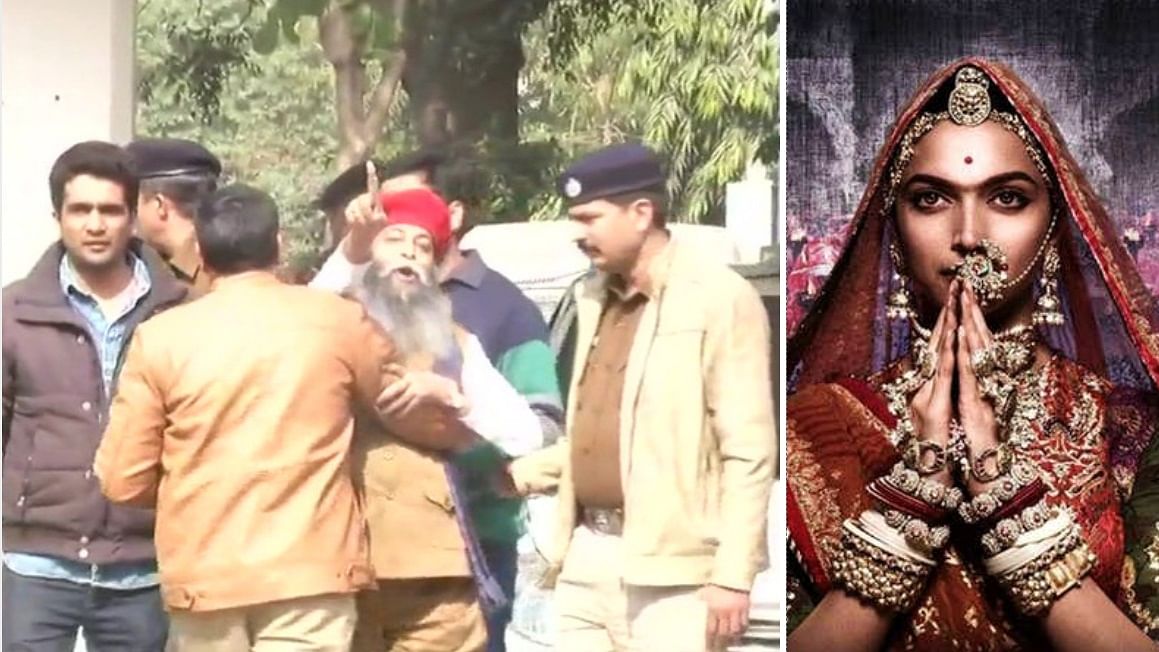
Suraj Pal Amu, who had announced a bounty on Deepika Padukone’s head for Padmaavat’s release, is back in the news.
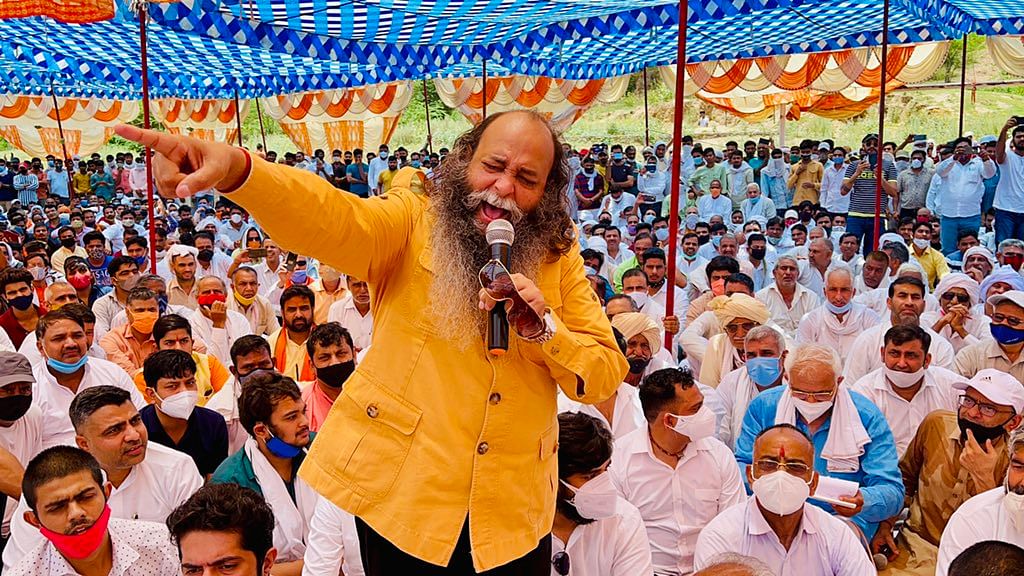
“Our boys are not guilty. They (Muslims) distort the pictures of our sisters and daughters. Should we not even murder them?”Shri Ram Karni Sena Chief Kunwar Suraj Pal Amu
These words of Shri Rajput Karni Sena Chief Kunwar Suraj Pal Amu in a video that has gone viral on social media have stoked controversy. Amu, who had previously come to the limelight for announcing a reward for beheading actor Deepika Padukone over the controversy surrounding the film ‘Padmaavat’ is back in the news – this time for openly resorting to hate speech against Muslims.
In the latest video, Amu can be heard making a speech before a large assembly of people in Haryana, asserting his endorsement of the lynching of a local Muslim man that took place a few weeks ago.
Asif Khan, who hailed from Mewat’s Khalilpur Kheda village, was lynched allegedly by a mob of Gujjar men on the night of 16 May when he was returning home after buying medicines.
Asif’s cousin Rashid, who was present at the spot at time of the lynching said, “Unhone bola ‘Mulleh, tum logo mein se ek ko bhi nahi chhodenge’ aur ye bhi bola ‘tum sab se hum Jai Shri Ram bulvayenge’ (They said they will not leave any of us alive and also said they will make us chant Jai Shri Ram).”
They pulled Asif out of the car, thrashed him and killed him, Rashid said.
The three prime suspects in the murder case – Rohit, Pradip and Amit – have now been arrested, as per a tweet by the Nuh Police on 6 June.
Amu, who had addressed a large assembly at a Mahapanchayat held in Indri district of Haryana, could be seen validating the violence by the perpetrators of the Asif Khan murder case.
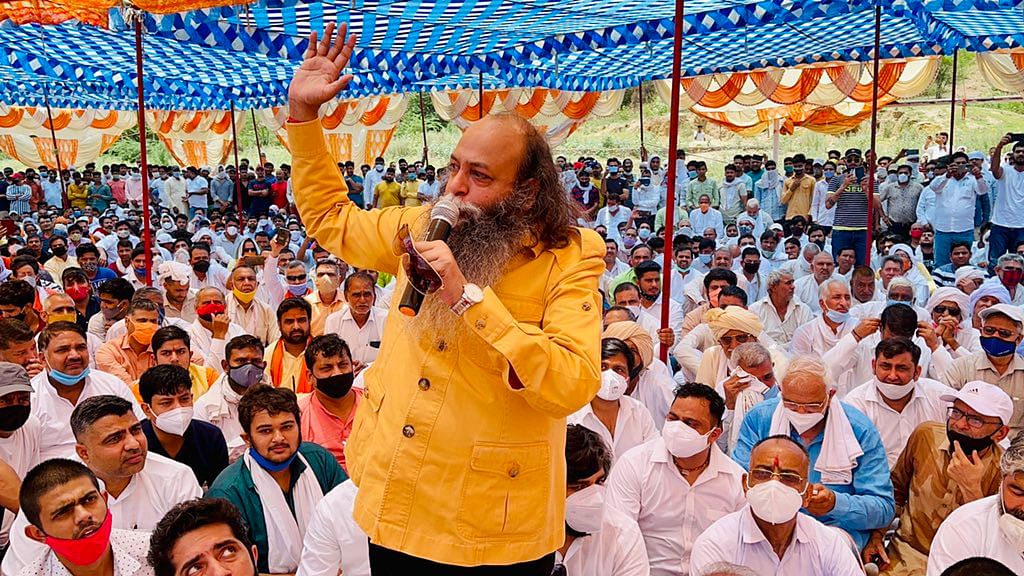
Karni Sena Chief Amu addressing a mahapanchayat at Haryana's Indri.
(Photo: Twitter/ Kunwar Suraj Pal Amu)
"We will pound them. Whoever has the courage can try to stop us," he added.
Before beginning his speech, Amu can be seen asking “true and good Hindus” to raise their hands. After a show of hands from the crowd, he then enquires “if there was any child of Pakistan there, he should also raise his hand”. He further says, “Muslims are no one’s brothers. They’re all butchers.”
Amu, who posted the video on his Facebook page on 31 May, captioned it: “Thousands came for the Hindu Mahapanchayat at Indri (Nuh) today. One who submits to a crime is a greater criminal than the one who commits it. If anyone insults our Hindu religion, will you keep silent? Only true Indians comment.”
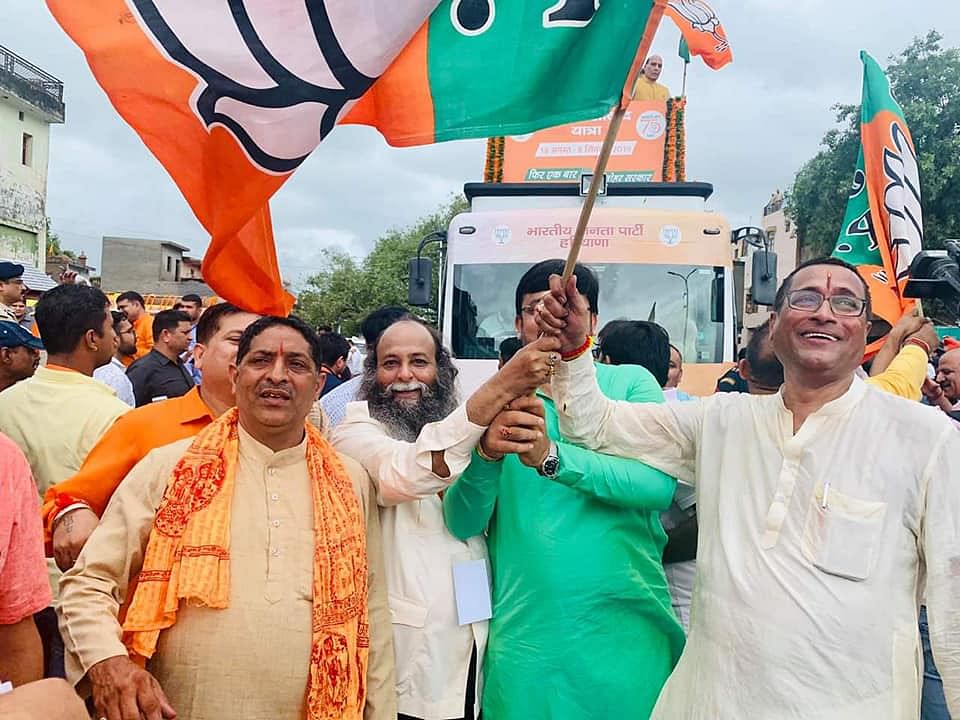
Karni Sena Chief Suraj Pal Amu and Haryana BJP.
(Photo: Facebook/ Kunwar Suraj Pal Amu)
Born in an affluent Arya Samaj family in 1968 in Haryana's Sohna, Amu became an active member of the Rashtriya Swayamsevak Sangh (RSS) at the age of 10.
A law graduate, he was a member of the RSS’s student wing – ABVP – and served as its member from 1985 to 1988.
Amu has held several posts in the BJP over the years.
He has served as the State Secretary, State Vice-President, and National Executive Member of the Bharatiya Janata Yuva Morcha (BJYM), the youth wing of the party.
Significantly, he was made the spokesperson of Haryana BJP in 2013.
From 2014-2019, Amu served as the Chief Media Coordinator for BJP Haryana.
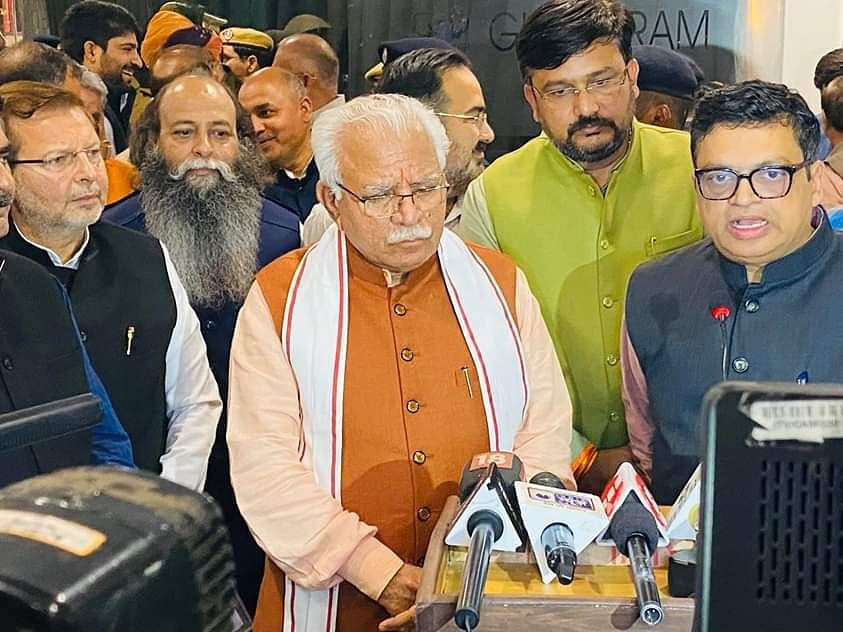
Karni Sena Chief Suraj Pal Amu and Haryana CM Manohar Lal Khattar.
(Photo: Facebook/ Kunwar Suraj Pal Amu)
In 2019, he became the President of Shri Rajput Karni Sena, a Rajasthan-based interest group formed to protect and promote the concerns of the Rajput community. The interest group has been accused of incitement of a number of violent incidents in the past few years.
Most prominently, the Haryana BJP leader was arrested under IPC Section 506 (criminal intimidation) over his threats to the makers of the movie ‘Padmaavat’ in 2017.
In January 2018, after being granted bail in the case, Amu resigned from the primary membership of the party. On 8 October, almost eight months after this, Haryana BJP Chief Subhash Barala had reportedly refused to accept his resignation.
"For around 29-30 years I have held different posts in the party and its student wing. The last eight months were very tough for me to stay away from the party. However, I kept working with different social organisations. It is like a homecoming for me," Amu had said.
In November 2017, Amu had announced a Rs 10-crore reward for anyone who would behead actor Deepika Padukone and filmmaker Sanjay Leela Bhansali for making ‘Padmaavat’.
Amu had also lauded a Meerut man’s statement to award a Rs 5-crore reward for beheading Deepika Padukone and Sanjay Leela Bhansali. He said that the bounty would be doubled to Rs 10 crore.
His speech against the film had allegedly encouraged his followers to take up arms against Padmaavat’s makers. The Haryana BJP leader had then said that the families of those who committed to the deed would be taken care of, as he asked Prime Minister Narendra Modi to strike down the film.
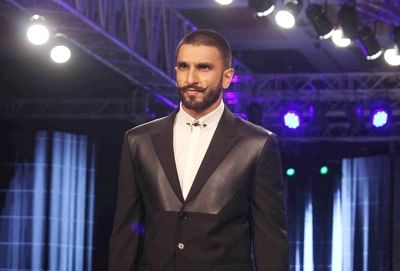
Alleging that the movie was disrespectful to the Rajput community, Amu also threatened to ‘break the legs’ of actor Ranveer Singh, who plays the role of Alauddin Khilji in the film.
Haryana’s BJP chief Subhash Barala had issued a show-cause notice to Amu for his incendiary comments.
Superintendent of Police Narendra Bijarniya, alluding to the viral video, told NDTV: "We have taken cognisance of this viral video and we will take action. None of the Mahapanchayats held in the district had prior permission of the administration."
The large assembly was held at a time when there is a widespread lockdown in the country in the aftermath of the devastating second wave of the COVID-19 pandemic.
(With inputs from NDTV.)
o o
The 2013 riots claimed over 60 lives, displaced nearly 50,000 people and shattered the Jat-Muslim unity, altering the political dynamics of western UP.
PUBLISHED ON FEB 07, 2018
oo
A harvest of horror and shame [2014]
https://www.thehindu.com/opinion/lead/a-harvest-of-horror-and-shame/article6342806.ece
o o