|
Showing posts with label Honour Killings. Show all posts

March 11, 2021

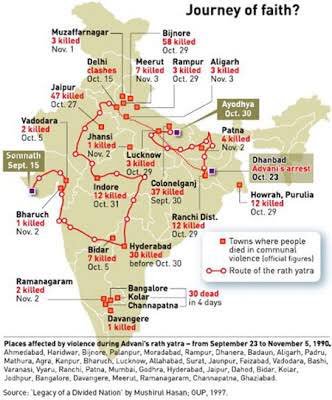
India: 2021 Caste Mahapanchayats or Khap Panchayats that are been talking farmers unity in Muzafarnar / Shamli etc have habitually talked social control over women or promoted caste or communal violence as in 2013

Muzaffarnagar riots: Case closed against BJP MLA accused of circulating inflammatory video
The closure report was filed by SIT and the complainant, a cop, was killed in a mob attack in 2018  

https://sabrangindia.in/article/muzaffarnagar-riots-case-closed-against-bjp-mla-accused-circulating-inflammatory-video

o o 

The 2013 riots claimed over 60 lives, displaced nearly 50,000 people and shattered the Jat-Muslim unity, altering the political dynamics of western UP.

Former union minister Sanjeev Balyan met chief minister Yogi Adityanath, seeking withdrawal of 402 cases registered largely against Hindus during the Muzaffarnagar riots of 2013.
By Manish Chandra Pandey | Hindustan Times, Lucknow, Lucknow

PUBLISHED ON FEB 07, 2018

https://www.hindustantimes.com/lucknow/ex-union-minister-meets-yogi-seeks-withdrawal-of-402-muzaffarnagar-riots-cases/story-IoCMbCfMNES94jMSmBUXLP.html

oo

 A harvest of horror and shame [2014]

https://www.thehindu.com/opinion/lead/a-harvest-of-horror-and-shame/article6342806.ece

o o 

A khap panchayat in Uttar Pradesh's Muzaffarnagar district has has barred women from wearing jeans, t-shirts, skirts, and men from wearing shorts, saying they are part of western culture and hence forbidden.
 
Uttar Pradesh khap panchayat bans half pants, jeans, skirts Read more at: https://www.deccanherald.com/national/uttar-pradesh-khap-panchayat-bans-half-pants-jeans-skirts-960372.html

Read more at: https://www.deccanherald.com/national/uttar-pradesh-khap-panchayat-bans-half-pants-jeans-skirts-960372.html
Uttar Pradesh khap panchayat bans half pants, jeans, skirts

Read more at: https://www.deccanherald.com/national/uttar-pradesh-khap-panchayat-bans-half-pants-jeans-skirts-960372.html

April 20, 2016

A state of mind, not a brick wall - More inter-faith and inter-caste marriages ( Comment by Gauri Lankesh)

Bangalore Mirror

A state of mind, not a brick wall

By Gauri Lankesh

More inter-faith and inter-caste marriages are needed if we as a society need to feel as one


The Hindu bride Ashitha looked radiant in a pink lehenga. The Muslim groom Shakeel Ahmed looked handsome in a blue suit. Among the guests attending their wedding were people from both the communities. Nearly half of the women guests sported bindis while a sprinkling of Muslim women wore burkhas. Male guests were seen either greeting one another with a 'namaskara' or giving the triple hugs. It was one happy gathering of people who had managed to overcome notions of caste and community.

As the evening wound down, Ashitha's father Dr Narendra Babu was beaming like a man who had just won a big battle. His wife Umadevi looked relieved that no untoward incident had happened. Mukhtar Ahmed, father of Shakeel, was in such a magnanimous mood that he asked his new daughter-in-law if she would like to exchange garlands with his son as per Hindu marriage customs. Ashitha and Shakeel thanked all the people who had supported their inter-religious wedding.

Ashitha, a Vokkaliga resident of Mandya, succeeded in marrying the man of her choice. She was able to do so since she had a supportive family which stood strong against the wrath of a handful of Hindu fundamental elements. Monica, who was also a Vokkaliga and a resident of Mandya, was not as lucky. Exactly fifteen days prior to Ashitha's wedding, Monica was allegedly killed by her own father. What was Monica's crime? She dared to fall in love with a Dalit youth and had eloped with him.

The tragedy is that while outfits such as the BJP, Vishwa Hindu Parishat, Bajrang Dal and Swabhimani Vokkaligara Vedike, which vociferously protested Ashitha marrying Shakeel, did not even utter a word of remorse about Monica's demise. Doesn't their silence about Monica's murder imply that they think that killing a Vokkaliga girl because she fell in love with a youth from another caste is acceptable but her marrying someone of her choice is objectionable?

Mandya is no stranger to 'honour killings'. In early 2000's, a Dalit youth fell in love with a Vokkaliga girl. When she came to know that a Dalit had had the temerity to lay his eyes on her, she felt so humiliated that she committed suicide. This was enough for Vokkaligas to take out a massive rally throughout the district. That prompted Dalits to take out a counter rally. In the last fifteen years, quite a few girls have been killed by their own family members in the district. In one instance, a young couple, belonging to different castes, tied their hands together with a piece of cloth and died by jumping into a well.

Things were not so bad in the previous decades. The Raita Sangha was very strong in Mandya district in the 80's. Realising that many farmers were being pushed into a spiral of debt due to massive wedding expenses, the Raita Sangha actively promoted 'sarala maduve' (simple wedding) along with inter-caste marriages. Though the concept of simple wedding was propagated by poet Kuvempu, it was the farmers' movement which made it popular. Besides the farmers' movement, socialists and Lohiaites like the late Prof Ramdas had formed 'Manava Mantapa' and conducted 'sarala maduves' of couples who hailed from different castes but wished to marry one another. Today, Ramdas's daughter Sneha is continuing the activities of 'Manava Mantapa' in neighboring Mysuru. Similarly, Ramdas's associates are coming to the aid of inter-caste and inter-faith couples who face strident opposition from their families.

Though the peace in the coastal districts of the state is wracked intermittently by both Hindu and Muslim communal elements, the very same areas have seen relatively more number of inter-faith marriages. Progressive people such as Hayavadana Upadhyaya have formed 'Jaati Muktha Sambandha Vedike' and conducted several inter-faith marriages. "With our support a couple of years ago, a Brahmin boy wed a Muslim girl. Today are they are a happy couple with a one-year-old child. The marriages we conduct do not attract the attention of fascist forces since we keep it away from the media,'' points out Upadhyaya.

Caste is undoubtedly a disgusting social stratification system which needs to be destroyed if we as a society need to feel as one. But despite the efforts of several reformists and social movements, caste continues to have strong roots in our society. How can we try to change this?

As Babasaheb Ambedkar wrote in his essay 'Annihilation of Caste', one of the solutions is encouraging inter-caste and inter-faith marriages. "I am convinced that the real remedy is intermarriage. Fusion of blood can alone create the feeling of being kith and kin, and unless this feeling of kinship, of being kindred, becomes paramount, the separatist feeling - the feeling of being aliens - created by caste will not vanish,'' opined Ambedkar.

"Caste is not a physical object like a wall of bricks or a line of barbed wire which prevents the Hindus from commingling and which has, therefore to be pulled down. Caste is a notion; it is a state of mind,'' Ambedkar said in the same essay.

Ashitha, Shakeel and their families overcame the notion of caste and community to form a kinship as humans. They deserve our applause.

December 03, 2013

Bleeding heart third worldism in the name of poor and hungry is nice coming from right and left. BKU had no role in Muzaffarnagar killings and Swadeshi Jagarn Munch has no links with the Hindutwa right wing

[Lovely to see the famous Indian progressive NGO types rub shoulders with the most retrograde sections of the India's right wing, all for a good cause they will tell you. Bloody shameless hypocrites these third worldists from India as from elsewhere. The impresario call for a 'Bahu Beti Bachao' Mahapanchayat from BKU (which also represents the largest contingent of India's Kulaks in Via Campesina - the celebrated international peasants alliance much adored by the lefties] was the most open coordinated effort to fan the flames that led to the communal killings and mass migration scale in Muzaffarnagar district. Is BKU running the camps to provide food for the poor displaced in the camps. Its not their job they will tell you. And India's Largest right wing trade union BMS, was it out in the streets supporting the Right to food bill in India when the huge coordinated attack by the right took place to scuttle the bill in Parliament . . .. Nice and clean this coalition. Bravo for the international statement below against the imperialist devil. The less said the better of your hollow and shady alliance for real food security. --HK]

o o o

India: Defending the Poor and Hungry is Non-Negotiable!

2 December 2013

On the occasion of the Ninth Ministerial Meeting of the World Trade Organisation (WTO) in Bali, Indonesia, several farmers’ organisations, trade unions, mass organisations and peoples’ campaigns resolved to support the Indian Government’s position to not trade away national food security.

The group welcomes the decision of the Indian Cabinet on 28th November to reject any peace clause that does not guarantee a permanent solution. The peace clause has been widely opposed by the Chairs of the Parliamentary Standing Committee on Commerce and Agriculture, several political parties including the Bharatiya Janata Party and the Left parties, and mass organisations.

However, the group cautioned the Indian negotiating team headed by Commerce Minister Mr. Anand Sharma, not to bow to any pressure to weaken India’s position on defending and upholding national food security as a sovereign right. The group declared that the safeguarding and promotion of the country’s food security, rural employment and livelihoods are non-negotiable, and that food security cannot be ensured without supporting agricultural production by small and marginal farmers

The group reminds the WTO members that no country needs to be on the defensive about protecting the right to food and fighting hunger in their countries. And that aggressively upholding the rights of its citizens is not tantamount to collapsing the ministerial talks. On the contrary, such pressure tactics must be exposed as a conspiracy to keep people hungry and poor.

It was decided that the group would closely monitor the negotiations during the ministerial meeting to ensure that the interests of the poor and hungry are not compromised in any way.

Action Aid India

Bhartiya Kisan Union

Bharatiya Krishak Samaj

Bharatiya Majdoor Sangh

Focus on the Global South India

Great Mission Group Consultancy

Public Services International

Right to Food Campaign

Shram Seva Nyas

South Indian Coordination Committee of Farmers’ Movements

Swadeshi Jagran Manch

Third World Network India

September 21, 2013

India: The journal Manushi stands up in defence of 'Khap Panchayats' which issue dictats seeking public honour killings amogst other things - Statement from Manushi

Manushi Intervention in the Supreme Court Stalls Unconstitutional Law Demanded by NGOs to Ban Khaps

In recent years, media has systematically led a hate campaign against Khap Panchayats projecting them as an unwanted hangover of India’s “barbaric” medieval past. Even those who had never heard or knew the meaning of the word Khap, nor ever seen or met a person belonging to any Khap joined the chorus asking the government to ban Khaps. This hate campaign was ably fuelled by NGOs, most of who are generously funded by international donor agencies to “reform” Indian society and polity. One of them “Shakti Vahini”, filed a petition in the Supreme Court seeking a draconian law to ban age old traditional Panchayats, especially Khaps on the plea that they are the cause for “honor killings”, even though Shakti Vahini’s own data submitted to the Court does not support this charge.

Even though the entire purpose of this petition was to get the Central Government to pass a law to ban the very existence of Khaps and other community based Panchayats on the absurd charge that they are all “extra judicial" bodies, Khaps were kept out of the picture as a deliberate strategy. In a well-orchestrated move, Shakti Vahini did not make any of the Khap Panchayats a party in this case. Instead, it made Union of India, Ministry of Home Affairs, Ministry of Women and Child, States of Haryana, Punjab, UP, Jharkhand, Bihar, Himachal Pradesh and Madhya Pradesh parties to the case.

In response to this petition, the Vacation Bench of Justice R M Lodha and Justice A K Patnaik issued a notice on 21/06/2010 to all the sarkari respondents. But since Khaps were not included as a party, they were neither issued a notice nor informed about the case against them.

For two and a half years the case against Khap Panchayats was argued in absentia. Most of the state governments who were made respondents in this case, opposed the proposed new law to virtually ban traditional Panchayats but Shakti Vahini with the full encouragement and support of Central government represented by the Additional Solicitor General, Ms Indira Jaisingh kept pushing the Supreme Court Bench hearing the case to give a stringent order for the enactment of a draconian and unconstitutional law. This has been drafted for the Law Commission of India by a group of feminist activists patronized by the current UPA Government. Under the pretence of combating honour killings this law seeks to deprive rural communities of their fundamental rights guaranteed under the Constitution.

A study done by Shakti Vahini to bolster its case against Khap Panchayats is so full of nonsense that nowhere else in the world would it pass muster even as an undergraduate term paper, leave alone product of a serious research funded and supported by no less than the National Women’s Commission.

However, on 04/01/2013 as the case was near conclusion, the Supreme Court Bench of Justice Aftab Alam and Justice Ranjana Desai indicated that they cannot pass any order in the absence of the affected parties. Since Khap Panchayats were not listed as parties in the case, the Supreme Court could not invite them officially. However, the Apex Court let it be known that they are willing to hear anybody who has anything to say on the subject.

This was reported in all newspapers. Ravikant of Shakti Vahini took personal responsibility to inform two of the largest Khaps – Meham Chaubisi and Sarva Khap Panchayat of Rohtak and Jind. So a couple of days later, these Khaps received a note on Shakti Vahini’s letter head informing them that the Court was willing to hear their views on the subject.

At this point, several Khap leaders approached Manushi to press us to present their case in the Supreme Court because they feared with systematic negative stereotyping of Khaps, they would not get a fair hearing on their own merit. I decided to argue in person because some of the eminent women lawyers we approached were unwilling to be associated with Khap Panchayats. The very same lawyers, who do not hesitate to take up the case of known murderers and crooks, were reluctant to get branded as retrogressive by representing Khaps. Some of the male lawyers we approached felt that with Additional Solicitor General Indira Jaisingh arguing against the Khaps they would not get a sympathetic hearing. Therefore, I decided to appear in person especially since I had done a good deal of research on Khaps and honour killings.

On January 14, 2013, advocate Ashok Agarwal--an old friend of Manushi- appeared in the Supreme Court on our behalf and sought the permission of the Court to include Manushi and some Khaps as parties in the case and allow us to file written submissions. He also sought permission to file a petition on behalf of Dalal Khap.

On 02/04/2013, the case came up for hearing. While Indira Jaisingh on behalf of Union of India and Shakti Vahini lawyers argued for the Court to pass its orders, Ashok Agarwal and I argued that since the case had been thus far heard in absentia, we needed proper hearings before the court pass any orders. Indira Jaisingh repeatedly pleaded for at least some interim orders but we stood our ground that without hearing the affected parties any order passed by the court would violate due process and therefore be invalid. Thus, we managed to successfully stall any adverse orders against Khap Panchayats, including the draconian law proposed to be enacted against them.

In this we are also helped by the fact that Justice Aftab Alam was to retire in a few days. Therefore, he had no time to conclude the case if fresh hearings were to be started following our intervention.

Had the Supreme Court passed a hostile order against Khap Panchayats, it would have made headline news on front pages of all news papers and would have resulted in endless discussions on TV channels. But none of the newspapers or TV channels mentioned a word about stalling of court orders due to Manushi intervention.

For the text of our submissions Read :http://www.manushi.in/articles.php?articleId=1680&ptype=campaigns

--

Madhu Purnima Kishwar
Founder MANUSHI
Professor, Centre for the Study of Developing Societies
Tel: 011 23978851, 08826377770
Website:www.manushi.in

September 18, 2013

India: The chilling familiarity of Muzaffarnagar [and a deathly silence on a draft bill to fix accountability for communal violence] Farah Naqvi

The Hindu, September 18, 2013

The chilling familiarity of Muzaffarnagar

by Farah Naqvi

Riot follows riot with sickening regularity but there is only a deathly silence on a draft bill to fix accountability for communal violence and guarantee justice and compensation to victims

In communal politics, facts matter less than fiction. The spin and narrative are what make “riots” unique — violence sought to be justified, even warranted, then forgotten. “Riots” are always about the blame-game that follows; the action-reaction theory; the rationalisation for what is indefensible — the taking of human life, the rendering homeless of innocents, and the inevitable polarisation benefiting political parties. With social media, mobile apps, and image morphing software a flick of a button away, the ammunition of spin is handy. But though technology is new, the narrative is frighteningly familiar. Women as commodities (of a piece with land and cattle), and women’s bodies as repositories of patriarchal honour are once again at the epicentre of this narrative.
On the ground

This belt of western Uttar Pradesh is the home turf of the “dis-honor” killings, where the sex ratio is among India’s lowest (Muzaffarnagar has a child sex ratio of 863 in the 2011 census); where the narrative of “women’s honour” can be stirred so easily into the communal cauldron. Even the recent national outrage over increasing violence against women has been appropriated and deployed. One headline in a prominent internet news site screamed “Stalker’s death triggered Muzaffarnagar conflagration,” implicitly justifying the murder of someone the reporter decided to call a “stalker,” though there was no evidence or charge of stalking (a serious crime after the Criminal Law (Amendment) Act, 2013) in the incident of August 27. The story opened with, Two brothers kill a man stalking their sister [….] The actions by “the brothers” were in this and many other variations normalised, even tacitly valorised. For that is what “real men” do when family honour is on the line. It is precisely the mindset that applauds the death penalty for rape, knowing it will solve nothing systemic. But who cares, for it satisfies the blood lust.

The mahapanchayat on September 7, in violation of prohibitory orders, is variously reported as Beti Bachao Bahu Bachao mahapanchayat or Beti Bahu Izzat Bachao mahapanchayat. “Izzat (honour”) and “Bachao (protect”) are scary words in the macho lexicon of western U.P. Here, women’s sexuality is a tool to be deployed only in service to community and patriarchy. Sexual autonomy is a threat to the entire edifice, and opposing intercommunity relationships (signalling choice and sexual autonomy) has long been a favourite pastime for the khaps that rule the roost. Many such intercommunity relationships, ending in murder, have been inter-caste. Now with inter-religious romance labelled “love jihad” under the Vishwa Hindu Parishad scanner, we need to be worried and watchful, as this game of izzat plays itself out. The “love jihad” construct of the Hindu right in one stroke raises the spectre of the “violent, enemy other, seducing by force” (Muslim jihadist) and condemns personal choice (i.e. “love”). And when protection and control over “our” women’s bodies are placed at the centre of any blood feud, one must fear the ground that communalists of all hues are preparing in the fertile soil of western U.P.

Gujarat and U.P.

The comparisons between the “narratives” of Gujarat and Muzaffarnagar are telling. In Muzaffarnagar, an alleged attack by the “other community” on the izzat of two brothers (by harassing their sister) turns out to be fake (NDTV, September 14). But it still leads to a mahapanchayat called to protect “the honour of women.” This then spurs the violence (with inflammatory speeches, incendiary video, death and displacement, police inaction, omnibus FIRs, and truckloads of scared people fleeing their homes).

We saw a similar narrative structure in Gujarat 2002, and it was written about in two reports by women’s rights activists — Survivors Speak and Threatened Existence. In addition to the train burning at Godhra, there was a false news report on February 28 in Sandesh (a leading Gujarati daily), saying that Hindu women were dragged from a railway compartment by a fanatic mob. A fake follow-up on March 1, said some women’s bodies were found with breasts cut off. A retraction, published much later by Sandesh, lay buried in a corner of the paper, while the fake news spread like wildfire, and became the justificatory rallying cry for what followed (Survivors Speak, pp 10-11). All of this — from Gujarat to Muzaffarnagar — is of a piece with the existing stock repertoire of the Hindu right — stories and myths about Muslim marauders, raping and defiling Hindu women, and by conflation, attacking the “izzat” of Mother India herself, provide eternal justification for “honorable” retaliation by Hindu men and the Hindu nation (Threatened Existence, p.39).

Protecting rights

Thus far, Muzaffarnagar has taken lives, devastated livelihoods and displaced at last count over 55,000 people. Thus far, women’s bodies are at the centre of the narrative, not the centre of the violence that has been reported. But, at the time of writing, unconfirmed stories are coming in, and fact-finding teams are still digging up “the truth.” So let us not be lulled. It is alarming when the Home Minister says that only 410 communal incidents occurred in the country last year, but this year, already 451 incidents have taken place. What world do we live in where 410 incidents big and small are an “only”? An acceptable number? And yet, amid the pro forma condemnations, calls for peace and the Prime Minister’s announcement of Rs.2 lakh for the next of kin of those killed, there is a deathly silence on the one piece of legislation promised in the United Progressive Alliance’s manifesto — the Communal Violence Bill. A draft Bill, crafted from the experience of victims and survivors of many communal carnages, sits on the back-burner, while we watch one communal incident after another. We hear pleas from survivors. We rail helplessly at loopholes in our statutory frameworks that allow state inaction and dereliction at the cost of lives; that make displaced and violated citizens plead and grovel for justice and compensation from state authorities. So much would have been citizens’ rights by law if such a bill were in place today.

Or, is the intent to simply allow things to go on as they are? One incident to the next, with no learning, with no dent in impunity; no movement towards an architecture of rights for innocents routinely hurt by this violence, and by the threats that women face? Can we afford to persist with this state of denial — imagining that communal violence is a thing of the past; that an aspirational India has moved beyond identity fault-lines? Let us remind ourselves of fearful people running from their homes and confront the reality that they may languish in camps of one kind or another in perpetuity, like scores of victims of communal carnages before them, with no justiciable framework of rights, no justice.

While there is silence on a law to challenge impunity, new slogans of communalism are being crafted everyday, embellishing the core of the “honour” narrative. The latest from Muzaffarnagar according to one news report (HT, Lucknow, September 13), throws cow slaughter and, perhaps predictably, Modi into the fray — “desh, bahu aur gai ko bachana hai toh Narendra Modi ko lana hai.”

(Farah Naqvi, a writer and activist, is a member of the National Advisory Council. The views expressed are personal. E-mail: farah.naqvi64@yahoo.com)

June 04, 2011

Ramdev with support from honour killings thugs of Haryana

The Times of India

Haryana khaps to join Ramdev fast

Sukhbir Siwach, TNN | Jun 4, 2011, 02.50am IST


CHANDIGARH: Haryana's infamous khap leaders has decided to pitch for Baba Ramdev in Delhi on Saturday with a large number of supporters.

Khap leader Om Parkash Dhankhar, who is coordinating with other khap leaders of Haryana to mobilize support for the yoga gura, on Friday claimed that more than 50,000 people from the state would participate in the indefinite hunger strike called by Baba Ramdev to press for his demand to bring back black money stashed in tax havens abroad.

As many as 170 khaps and 28 Jat outfits from Haryana have decided to support the agitation, said Dhankhar, president of the Dhankhar khap. Seven vehicles from Beri village and four cars from Dhakla village of Jhajjar district have gone to Delhi. Besides trains and government buses, people have arranged cars and private buses to reach Delhi, said a source. Some khap leaders have even agreed to sit on indefinite hunger strike.

While facing flak for running kangaroo courts, which even lead to death sentences for runaway couples in Haryana, the khap leaders said it's the right time to hit out at corruption.

Pradeep Mathur, a follower of Baba Ramdev, claimed that khap panchayats are working in the right direction. ``In the movement against corruption, we want support from every corner,'' he added.

Secretary of Meham Chaubisi Sarv Khap Panchayat, Ramphal Rathi said their panchayat has sent a resolution in support of the movement against corruption. Leader of Hooda khap Shri Krishan Hooda and Jai Singh Ahelawat of Ahlawat khap also expressed their support for Ramdev.

July 28, 2009

Central Govt should stop all funding of religious pilgrimages; Follow welcome order by Andhra high court

Excerpts from a recent op-ed by the veteran journalist BG Verghese Deccan Herald, 28 July 2009

" one must welcome a judgment of the Andhra high court staying a state government order providing financial assistance to Christians desirous of going on pilgrimage to Bethlehem, Jerusalem and Nazareth. The proposal was a clear case of communal vote banking and an abuse of public funds on a par with the increasing subsidies being given to Haj pilgrims and those undertaking the yatra to Kailas-Mansarovar.

It is time the UPA government put an end to such flagrant competitive communalism that goes against the Constitution and the commitment to secularism. Provide facilities within reason, yes. Subsidies - essentially the buying of community votes – no.

Finally, the country needs to come down heavily on such unacceptable traditions as neck-deep burial of children to cure their disabilities during total solar eclipses, as happened in Gulbarga last week, and a series of ‘honour killings’ for marriage within the same gotra in Haryana. Leaving social reform to time alone is a poor answer. "