https://indianexpress.com/article/india/assault-kanwariyas-haridwar-rss-bjp-mistaken-muslim-8841622/
July 16, 2023
December 08, 2021
India: Kejriwal's AAP govt in Delhi Continues Normalising Hindutva
[ . . . ]
AAP’s Hindutva politics
The Aam Aadmi Party (AAP) supremo can defend himself by reading us the list of the 12 pilgrim sites that his government has identified for the followers of different faiths. But one cannot miss the significance of his move and his centre staging of Ayodhya. Ayodhya does have a place in the sacred geography of Hindus. It is called Ayodhyaji by the devotes. But it was not in the original list of the Delhi government, which had Puri, Rameswaram, Shirdi, Mathura, Haridwar, Kartarpur, the Golden Temple and Vaishno Devi. Ayodhya was added to it when Kejriwal and his colleagues returned from Uttar Pradesh after launching their campaign for the assembly elections due in that state in 2022.
As part of the campaign, they took out a Tiranaga yatra, to pay homage to the Ram Lalla virajman at Ayodhya. It was very clear from the move that AAP wanted to marry nationalism with the ideology of Hindutva which worked through the metaphor of the Ram temple – which is actually a victory memorial of an imagined war in which Muslims were trounced. Kejriwal put it upfront when he said that his darshan of Ram Lalla prompted him to add Ayodhya to the list. So, it is not Ayodhya in the traditional imagination but the Ayodhya which had displaced Faizabad that he wants his Hindu elderly to visit.
[ . . . ]
https://thewire.in/politics/ayodhya-aap-arvind-kejriwal-hindutva-normalise
May 12, 2021
July 23, 2017
Into the world of the Kanwariyas Reportage by Snigdha Poonam (Hindustan Times)
Shiva’s band of men: Into the world of the Kanwariyas
Who is a Kanwariya and what does he want from life? HT travels with a group of pilgrims, who are getting younger, wilder and more male every year, to understand why they take the journey
long reads Updated: Jul 22, 2017 22:45 ISTHindustan Times
The whole exercise is planned around the holy water. One is only a true Kanwariya if his Ganga jal remains in motion over the two-day Kanwar route between Hardwar and his home, where he will offer the water to the nearest Shivalinga. It’s up to him to decide how he wants to cover the 200-odd kilometers without spilling a single drop: walking, running, crawling, or participating in a relay race involving a moving vehicle. Hordes of pilgrims have covered the route carrying the Kanwar – a wooden pole with an urn of Ganga jal tied to each end – since the 19th century. Little about the pilgrimage remains the same, however. What used to be a monsoon ritual undertaken in pockets of the Gangetic plains is today India’s biggest annual pilgrimage. Only a few thousand made the journey until the 1980s; around 20 million carried the Kanwar between Hardwar and Delhi in 2016.
“Bhole Has Called Me”
No change in the world of Kanwar Yatra is as visible as the composition of the Kanwariyas, who get younger, more male, and more out of control with every year. Until only a decade ago, the Kanwariya season meant a procession of saffron-clad men and women wobbling along the roads between Hardwar and Delhi. Now, it’s 200 kilometers of free-ranging masculinity: thousands of young men taking over every inch of public space to do what they think is their right – walking, running, driving, dancing, dressing, undressing, bathing, sleeping, getting high, and making all kinds of trouble.
“Why spend the saving on Kanwar?” I ask him. “What to do – Bhole (lord Shiva) keeps calling me,” he says, sliding to the edge of the deck to prepare for the plunge.
That Special Feeling
Apparently, only a man can understand what a Kanwar yatra means to another man. Married for four years, Naresh has never brought his wife along on a Kanwar trip. “It’s not for the ladies. I have visited Hardwar with my wife otherwise but not like this. Some ladies from our village do the yatra but they prefer to walk back and forth, like the older people.” No matter what his wife thinks of his annual adventure, Naresh will keep returning to Hardwar with his gang. ““I like so many things about the journey.” It’s the only time in a year when, irrespective of his caste or class, the world treats Naresh like he thinks it should: families offer him meals, shopkeepers reserve a discount, complete strangers press his feet, and a policeperson accompanies his team from when their truck enters Delhi to when it recedes from the capital.
It’s the most conflict-prone leg of the Kanwariya’s journey: this is when Naresh and his friends come face to face with an urban middle class they only provide their services to otherwise. As Kanwariyas, though, their only loyalty is to each other and to “Bholenath” so the rest of the world can go to hell. The roads can remain jammed, the schools shut, and loudspeaker limits extended.
He isn’t sure what he will do next. “I will sit for Haryana police exam maybe,” he says, panting. He has just covered about 25 km running with the Ganga jal. I wonder if the labour is for lord Shiva, but he doesn’t even see himself as religious. “Not really. My family does agarbatti-dhoop before the gods every Sunday. Sometimes I also stand around, that’s all.” I ask him why he is here at all. “To have a good time with friends. To have fun,” he says, sharing on Facebook a selfie he has just taken with me.
He would have got a real tattoo of Shiva on his arm for the trip if not for the fact that “some people have been rejected in the physical exam for Haryana police because of that.” He’s making do with a psychedelic tattoo sleeve. It’s his first Kanwar yatra and he tells me it’s been plenty fun so far. I ask him what he likes the most about it. He says it’s the dancing on the roof of the truck between the sprints. What about the part with the hockey sticks? “Oh that’s just to clear the traffic. If people are blocking the truck then you have to move them aside.” What if they are hurt in the process, I ask him as he swings a stick over his head. “No, no, we are not there to hurt anyone,” replies Omi Saini, who is now back on the deck after two rounds of running. “We are peaceful people.”
May 19, 2017
The growing business of religion in India (Pranav Gupta & Sanjay Kumar)
The growing business of religion in India
Studies conducted by Lokniti at the Delhi-based Centre for Study of Developing Societies (CSDS) help us answer such questions. The studies show that nearly one in two Indians plan to undertake religious tourism in the next two years and a bigger number reported doing so in the past two years.
A study conducted by Lokniti on Religious attitudes, behaviour and practices in 2015 shows that a significant section of the population in all major religious groups in India reported having undertaken religious tourism over the past two years. Religious tourism is defined as going for a pilgrimage and it may or may not involve an overnight stay. There was significant inter-religious variation in prevalence of religious tourism though, with the figure being around three-fourth for Sikhs and one-third for Muslims and Christians.
Does class play a role in people undertaking religious tourism? Among Hindus, class does not seem to have any influence on religious tourism, but among Muslims, lower classes seem to have a slightly higher probability of undertaking pilgrimages. The results are based on Lokniti’s multi-dimensional economic class index which takes into account income, asset ownership, place of residence and occupation.
The popular perception that older people are more likely to go for pilgrimages seems to be slightly misplaced. Among Hindus, we find no age-based pattern as respondents from all age-groups were equally likely to have undertaken a pilgrimage. Among Muslims, those aged 56 years or above were relatively much more likely to have undertaken a pilgrimage. While there is no gender-based difference among Hindu pilgrims, Muslim men are more likely to undertake pilgrimages than women.
Given the rise in religiosity in the country, going for pilgrimages may increase in times to come. The same study also shows that more than 25% Indians reported having become more religious over the past 4-5 years. The trend is valid across religions and in keeping with other attitudinal surveys. Between 2007 and 2015, the share of respondents in India who perceived religion to be very important increased by 11 percentage points to 80%, according to the Pew Global Attitude surveys.
Religious places are ranked high in preferred tourist destinations for Indians, according to the State of Nation Study conducted by Lokniti in 2008, which found that 39% of the respondents reported pilgrimages/holy sites as their most preferred location for a vacation.
These findings, however, are slightly different from a National Sample Survey Office (NSSO) report on domestic tourism for 2008-09. The report found that social purposes accounted for almost three-fourth of all overnight trips, while pilgrimages and religious trips accounted for only around one in 10 such trips in the year preceding the survey. Although the NSSO released a similar report in 2014-15, it can’t be compared with the Lokniti findings as NSSO figures are based on response for the last 30 days, against Lokniti’s period of past two years.
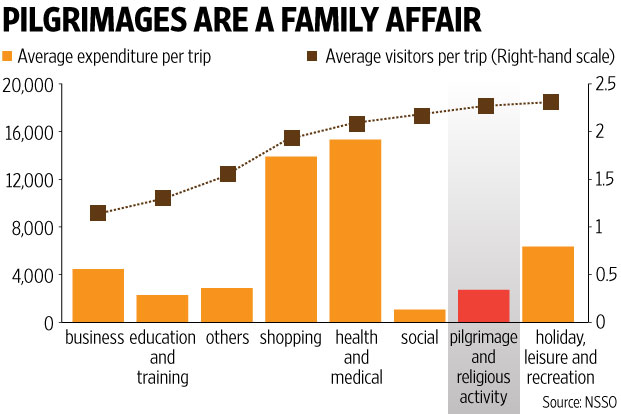
Nonetheless, the NSSO report does show that average expenditure on religious trips has more than doubled during this period, and it is ranked second in terms of average number of persons per household who go on such trips.
The broad trends seem to suggest that religious tourism should be accorded priority in India’s tourism policy.
This story is based on survey data shared exclusively with Mint. Pranav Gupta is a researcher with Lokniti CSDS and Sanjay Kumar is professor and currently director of CSDS
August 24, 2015
Kanwariyas: Are the BJP and RSS Attempting to Saffron-ise Dalits? (Sumegha Gulati)
Kanwariyas: Are the BJP and RSS Attempting to Saffron-ise Dalits?
Sumegha Gulati
Naya Gaon Akbarpur Kaidri is a small, nondescript village in Kanth tehsil, 27 kilometres from Moradabad. The Kanwariya season – which ends today – has seen an interesting surge in the village this year, with more than 36 men participating in the Kanwar yatra as opposed to just 15 last year.
The sudden interest in the Yatra has surprised many, with villagers tracing its roots back to a ‘riot’ that erupted in the village last year. Naya Gaon reportedly comprises 25% dalits, mainly chamaars (cleaners) and 75% Muslims, mainly bunkars (weavers) and lohaars (ironsmiths). No upper-castes live in the village.
A disagreement over the placement of a loudspeaker in the village of Naya Gaon led to clashes between the dalits and local police. (Photo: The Quint)
Early last year, the two communities had a disagreement over the placement of a loudspeaker at a local Ravi Dass temple where the dalits prayed.
Anees, a villager, told The Quint that members of the Muslim community complained about the matter to the Tehsildar’s office. The authorities intervened and the loudspeaker was taken off. However, that led to clashes between the dalits and the local police, with a curfew being clamped down on the village, dalits being lathi-charged and several incidents of stone pelting, during which, the District Magistrate was injured in the eye.
Bano and her husband Mohammad Shafiq, who live opposite the temple, said most ‘rioters’ had come from outside the village and many sported orange headbands.
Peace was eventually brokered by the Kanth MP, BJP’s Sarvesh Kumar Singh and Peace Party MLA Anis-ur-Rehman.
Since then, villagers claimed, there has been a marked shift in the Dalit politics – with members of the community gravitating towards the BJP. The Ravi Dass temple, which is still known by the same name in local police records, has been renamed as “Shiv Mandir” by locals and a shivalaya has been installed inside. However, the priest at the temple remains a dalit.
Dalit politics in the area has seen a marked shift with members of the community gravitating towards the BJP. (Photo: The Quint)
Before elections, Sarvesh Singh promised Dalits that if he won, he would get the loudspeaker permanently installed. He did eventually win and got the thing fixed here, but local administration found it to be flouting of rules. So, they got the loudspeaker removed. What we cannot understand is – why have so many dalit men started undertaking this yatra? They make noise all night and police is stationed here to control their rowdiness. Also, why have dalits suddenly changed the name of their temple?
— Anees, Village Resident
Vijay Singh (47), a labourer and representative of the Dalit community, said that they had arrived in the village 62 years ago after floods ravaged the area where they lived. The temple is more than 40 years old and was always a Shiva temple, he claimed. When asked why the temple was listed as Ravi Dass temple in police and administrative records, pat came the reply: “It’s a conspiracy of the Samajwadi Party government.”
Kanwariyas seen on the side of a highway. (Photo: The Quint)
Singh explained that the loudspeakers were always a permanent feature at the temple.
Some were getting old so we got new ones before Shivratri. We thought that our boys are going for the kanwar yatra and the womenfolk would sing bhajans so let’s have new loudspeakers. These people (Muslims) filed an application against us in the Tehlisdaar’s office and the authorities removed it. They entered the temple with their shoes. We protested but were beaten up and charges were filed against 22 of us in the police station.
— Vijay Singh, Dalit Representative
Moradabad’s then-DM, Chandrakant who was injured in the incident and is now posted as the DM in Aligarh along with the then-Senior Superintendent of Police, Dharamvir Yadav, now posted in Bareilly, declined to comment on the matter, stating it “pertained to another district now”.
A senior police officer at the Kanth police station, however, said on condition of anonymity:
Loudspeaker lagane pe vivaad tha. Avaid mana gaya. Dalits ne jhagda kar diya. But it happens everywhere. Azaans blaze from loudspeakers at mosques day and night across UP. Nobody opposes them.
— Senior Police Official
A 19-year old BA student who went for the yatra this time said,
We took two vehicles and went. The Hindutva feeling is rising among people. But I don’t think I went for the Hindu cause. I just wanted to enjoy with my friends.
— Navneet Kumar, Student
Singh quickly interrupted.
Of course this is about Hindu Ekta. The SP government just favours Muslims. BSP fields Muslim candidates each time who do not work for us at all. We want BJP in the state. Sangh members, VHP volunteers keep coming to the village. We are in regular touch with them and they are concerned for our needs.
— Vijay Singh, Dalit Representative
Pavan Jain, RSS Moradabad Prachar Pramukh, confirmed that “upliftment of dalit brothers” was high on the organisation’s agenda.
We call them ‘Sewa Vasti’ – those who need our sewa. We try to provide them education, medical and other facilities.
— Pavan Jain, RSS Prachar Pramukh, Moradabad
BJP, VHP and RSS are mobilising huge financial resources to vulnerable areas of dalits. (Photo: The Quint)
The move is increasingly being viewed by many political experts as an attempt by the saffron brigade to “Hindu-ise” the dalit community for political gains.
Writer and social activist Kancha Ilaiah explained how BJP, VHP and RSS are mobilizing huge financial resources to vulnerable areas of dalits.
If they are converting a Ravi Dass temple into Shiv Mandir with a Dalit priest, then it is serious. If there had been any upper castes in the village, dalits would be treated as untouchables or abused daily, and their main opposition then would have been the upper castes and not Muslims. I don’t think one can generalise. But in this village, BJP and RSS have carefully used the binary existence of Dalits and Muslims to their advantage. RSS has tried to organise dalits into a homogenous group vis-à-vis muslims.
— Kancha Ilaiah, Social Activist
August 12, 2015
India: Every year Kanwaria mayhem spills on the road [news reports]
Kanwarias trigger traffic congestions in NCR, commuters complain
HT Correspondent, Hindustan Times | Updated: Aug 12, 2015
http://www.hindustantimes.com/india-news/kanwarias-cause-heavy-traffic-in-ncr-commuters-complain/article1-1379175.aspx
इलाहाबाद-फैजाबद हाई वे पर कांवड़ियों का उत्पात, डीजे की अनुमति नहीं मिले पर सैंकड़ों गाड़ियों में तोड़ फोड़
http://m.hindi.news18.com/news/uttar-pradesh/demands-not-fulfill-kanwar-broke-down-vwhicles-533669.html
August 15, 2014
Kashmir controversy over Kousar Nag yatra - Shujaat Bukhari responds to Rahul Pandita
http://www.risingkashmir.com/denigrating-kashmiri-muslims/
August 11, 2014
India - Kashmir: On Politics over Konsar Nag Pilgrimage | Rahul Pandita
My neighbour, the environmentalist
Rahul Pandita
What does the Kashmiri separatist machinery achieve by preventing 40 persons from undertaking an ancient pilgrimage?
If you ever happen to drive towards Srinagar airport in Kashmir Valley, and if you have a little time to spare, take a little detour towards your left. Go to the posh Hyderpora colony off the airport road, and ask any passer-by for directions to the house of the pro-Pakistan separatist leader, Syed Ali Geelani.
Chances are that he will meet you. He is an extremely polite person — he never raises his voice and the expression on his face hardly changes. If he likes you, he will, after instructing his staff to get you tea, hold your hand and ask you to be the ambassador of Kashmir in “Hindustan.” As you leave, he will gift you a few books on Islam and tell you that it is not a religion but a “way of life” of which politics is an essential part.
You will love him.
Mr. Geelani often visits Delhi, mostly to seek medical treatment from some of India’s best doctors, including a Kashmiri Pandit. When he speaks to journalists, he refers to exiled Kashmiri Pandits as “brothers.” Without batting an eyelid, he says Kashmir is incomplete without them.
But besides his false avowal, Mr. Geelani, in practice, is opposed to the idea of sharing Kashmir with non-Muslims, especially the Pandits. A few days ago, owing to his strong opposition, the State government withdrew permission to a small group of Pandits to undertake the historical Konsar Nag yatra in south Kashmir. The group comprising 40 people, including women, had to halt its journey midway after Mr. Geelani’s supporters resorted to stone pelting and blocked the road leading to the pilgrim site. The pilgrims took shelter in a temple and were then forced to return to Srinagar.
A journalist friend in Kashmir calls Mr. Geelani’s strategy to thwart Hindu pilgrimages such as Konsar Nag as a “multistage rocket.” The first stage involves terming such yatras as a “threat to [the] environment.” Then, very systematically, they are termed as “conspiracies to change Kashmir’s demography.” Then, as it happened in the case of Konsar Nag, Mr. Geelani fires his last salvo by denying the Valley’s Hindu past. “The Hindus had no stake over Konsar Nag,” he claimed.
The historical past
In Nilmat Puran, the 6th century text on Kashmir, Konsar Nag is referred to as Kramasara (Kram: footstep, Sar: lake), and has been worshipped as Vishnupad (Vishnu’s footstep). According to the renowned Kashmir scholar, Shashi Shekhar Toshkhani, the Puran refers to it as a “sacred place” where “even evil-minded people are freed from their sins.” In Kathasaritsagara, a well-known 11th century collection of stories in Sanskrit by Kashmiri Brahmin scholar, Somadeva, Konsar Nag is referred to as the spot where Lord Vishnu put one of his three steps as Vaaman avatar. In a paper written by another Kashmir scholar, Ramesh Tamiri, Konsar Nag is identified as the site of the Naubandhana tirtha where, according to Kashmiri religious tradition, Goddess Parvati converted herself into a nauka (boat) to save the human seed from the deluge of destruction. The waterfall at Aharbal, whose traditional source is placed in the lake, has been described by Abul Fazl in the 16th century Ain-e-Akbari as the spot from where “Hindu devotees throw themselves down... and with utmost fortitude sacrifice their lives in the belief that it is a means of securing their spiritual welfare.” From time immemorial, Kashmiri Pandits used to visit the lake in small groups, till this chain was broken in 1989 due to militancy.
But what Mr. Geelani and his supporters are trying to achieve in Kashmir should not come as a surprise to anyone. In the last few years, Kashmir’s Hindu and Buddhist past have been subjected to large-scale effacement at the hands of radical elements in the Valley. Even Sufi dargahs have not been spared. One would think that Mr. Geelani is really concerned about environmental degradation in Kashmir. But how is it possible that a small group of 40 pilgrims could cause more pollution than tourists and local residents who are free to visit the lake, or than large groups of school children who are taken there for excursion?
The fact is that Mr. Geelani uses “environment” as a metonym for “you are not welcome here.”
Reality check on environment
In the last two-and-a-half decades of insurgency, environmental laws have been rampantly violated in Kashmir, often with the connivance of the State administration. Unauthorised construction and illegal encroachments have pushed lakes such as the Dal, the Anchar, the Nigeen, and the Wular to the brink of extinction. Hyderpora, from where Mr. Geelani issues his diktats, is in Badgam district where at least 200 unauthorised brick kilns operate in brazen violation of over 12 environmental and other laws of the land. These kilns have wreaked havoc with the land and local water bodies, causing major ruin of agriculture. A friend who owns an orchard in Badgam says it is no longer possible to grow anything there. “Some fruit trees still survive, but the fruit has been rendered tasteless,” he says.
As The Hindu has reported in the past, over a dozen cement plants of big business houses are operating close to the Dachigam National Park, which is home to, among other animal species, the endangered Kashmir stag, Hangul. Some of these plants are owned by a prominent business family from north Kashmir’s Sopore — Geelani’s home town.
An investigative report in a local daily, Kashmir Monitor, on August 4 pointed out the “unabated timber smuggling” in several parts of south Kashmir. The report says “felling of green Deodar and Pine trees goes on unabated in Compartment no. 66-67 of Gudhar forest range of Kachwar area of Kulgam and picturesque Kalihar of Daksum, (Compartment no. 27-28) as well.” Konsar Nag, ironically, falls in Kulgam district. While the district’s deputy commissioner was quick to withdraw permission to the yatra, one wonders what steps he has taken so far to check reckless tree felling that has led to man-animal conflicts in south Kashmir. Last year alone, 150 people were attacked by wild animals, out of which 16 lost their lives.
To add to the controversy, a few local journalists wrongly reported that 4,000 Pandits wanted to undertake the yatra, whereas only 40 of them had applied for permission. As expected, Chief Minister Omar Abdullah has not uttered a word on why Kashmiri Pandits were not allowed to undertake the yatra. Both the Bharatiya Janata Party and the Jammu and Kashmir’s People’s Democratic Party, who are cosying up to each other in the wake of the coming Assembly elections, have also kept mum. The conditioned stimulus of India’s intellectuals and other flag bearers of secularism and religious freedom has prevented them as well from raising this issue.
It is 25 years since Kashmiri Pandits were forced into exile. In what the political theoretician Hannah Arendt called “the infinitely complex red-tape existence of stateless persons,” their last hope is to keep intact their connection with their Gods and their ancient rituals and tradition. By denying them their right to pray at Konsar Nag, the Indian state is only pushing them further into ontological despair.
rahul.p@thehindu.co.in
August 01, 2014
India: Kashmir: Kounsarnag yatra - using pilgrimages to extend influence of Hindutva ideology
Editorial: Playing politics with pilgrimages
Kounsarnag yatra may be yet another chapter in furthering designs of extending influence of Hindutva ideology
The conflicting versions and lack of information about the conduct of the Kounsarnag yatra has added to the politicization of this otherwise unknown pilgrimage, with all key players hesitating to spell out clearly their role in it. While many in Kashmir Valley have opposed the yatra, it is still unclear who is organizing the event. A right wing Kashmiri Pandit group that talks of taking a group of people to perform religious rituals there, however, has distanced itself from organizing the yatra. While the Kulgam administration dismisses the fears, maintaining that only a group of 20-25 people are embarking on the journey, the Reasi administration has maintained that the pilgrimage comprised 1000 pilgrims. Whatever be the reality, the 6 day pilgrimage is already underway and has caused much anxiety in Valley with statements pouring in and protests also being staged. Adding to the chorus is the vehement opposition of Mustafa Kamal, senior leader and additional general secretary of the ruling National Conference. The historical importance of the yatra is not quite clear and even though some ancient references have been given by those supporting the pilgrimage to the religious importance of the spring, there has been no tradition of this pilgrimage being undertaken in recent decades. In view of lack of evidence of tradition of this pilgrimage, it has generated concerns of ecological impact as well as aroused suspicions of a deliberate policy to increase the footprints of Hindutva through increase in the number of Hindu pilgrimages, their duration and number of pilgrims in Kashmir region. While it may be argued that all kinds of developmental activities with adverse ecological impact have not generated so much of opposition in the Valley or created the kind of apprehensions that this obsessive tendency with pilgrimages is assuming, the fact remains that though ecology remains a vital area of concern that deserves attention of both the government and the civil society, these activities are not politicised in the way the pilgrimages are becoming off late.
The apprehensions aroused in Kashmir need to be analysed in the backdrop of the recent years of over-politicisation of several traditional pilgrimages and introduction of new ones and its offshoot of visible influence of Hindutva, howsoever seasonal that has turned out to be. RSS with its Hindutva agenda made inroads into Ladakh in the 90s with Advani’s Sindhu darshan yatra which is once again being re-invented. The 15 day annual pilgrimage of Amarnath has been massively enlarged in terms of duration and size beyond the capacity of the place. It has already become an obsession with not just the saffron parties but also jittery governments as over-politicisation of the yatra has made the affairs of the pilgrimage a sentimental issue across the country, and consequently a matter of vote bank politics, as part of what seems to be a deliberate strategy. The low key affair of the Buddha Amarnath yatra in Poonch is also following a similar pattern and many other pilgrimages in Muslim majority areas are being excessively hyped up. Such a background and the confusion over the otherwise unheard of Kaunsarnag pilgrimage is naturally causing apprehensions in the minds of the Kashmiris, who already feel intimidated with RSS idea of resolving Jammu and Kashmir political dispute by changing the demography of the state. The issue cannot be ignored because it may have the dangerous potential of vitiating the atmosphere and enhancing communal polarization which must be avoided at all costs in this complex state. While one expects little from the Centre, which is maintaining cryptic silence over instances of communal conflagrations of all sorts across the country, the situation in Jammu and Kashmir requires state government to step in and clear the mist and come out with a clear answer about the genesis of this fresh yatra and the official involvement in a pilgrimage that has already snowballed into a major controversy and has the potential of creating regional and communal tensions. It must respond to the serious questions of both the ecological impact of these pilgrimages and the political insecurity these arouse.
October 07, 2013
“Political Hinduism” & Material Culture in North India - Pika Ghosh's Review of In the Name of Krishna
“Political Hinduism” & Material Culture in North India
A review of In the Name of Krishna: The Cultural Landscape of a North Indian Pilgrimage Town, by Sugata Ray.
This study examines the consolidation of a ‘political Hinduism’ in British colonial India through the study of the material culture of the pilgrimage town of Brindaban (Vrindavan) in north India. These range from architecture, cartography, and pictorial practices, to the colonial-era genres of photography and prints, and more transient materials such as clothes and temple rituals that undermine the stability of art historical methods such as iconography. Ray assembles this array of visual forms to argue for the production of a local culture that engaged in multiple dialogues. In the particular stylistic choices made during the eighteenth and nineteenth centuries, he locates strategies and statements in relation to emergent colonial discourses about modernity, and narratives constructing Muslim Otherness, as well as the sixteenth-century Mughal style adopted for the creation of the site of Krishna’s play and multiple competing Vaishnava communities (sampradayas).
The choice, for an art historian at the beginning of the twenty-first century, to study Brindaban in the colonial era, is a bold and provocative one. It follows on the heels of archaeological evidence being marshaled to attest to the existence of temples beneath mosques and mausolea. Ray hones in on multiple scholarly interstices, beyond the esoteric sacred texts that reified a religion we would hardly recognize on the ground, and also the art historical estranging of a pre-Islamic past of temples and icons from the glories of the Mughal and British empires, shunning both ‘late’ temples as corrupt and ritual practices and bodily presences as contaminating much prized, pristine architectural images. But pure products go crazy, here as elsewhere. That is to say, excavating the localizing practices of this neglected phase of Brindaban’s past is itself a political act that compels us to contemplate our uneasy disciplinary boundaries with their attendant problematic categorizations that have been complicit in the consolidation of the very ideologies we seek to undermine. Marshaling an exciting assemblage of ideas and material cultural artifacts, he also challenges prior assumptions of timelessness with their troubling Orientalizing overtones, alerting us, instead, to the inherently provisional, mutable, and incremental nature of survival, resistance, and innovation.
Part 1 “The Body Politic in a North Indian Pilgrimage Town: Pre-colonial Vrindavan,” Section 1 “The Two Bodies of Krishna” presents an argument for a visible political dimension to acts of veneration, already initiated in the late sixteenth century, through allusions to contemporary courtly Mughal forms. This section locates Brindaban materially and stylistically between Fatehpur Sikri and Agra. It situates patronage patterns between Akbar and Man Singh, between Gaudiya ritual injunctions and Pushtimargi sartorial choices. Section 2, “Imagining Loss: The Govind Dev Temple (1590),” embeds the peculiar, perhaps even unprecedented form of the Govind Dev Temple in the scholarly literature of the past decade about temple desecration. Ray argues for newly ambitious Jat interventions to the physical fabric of the temple rather than imperial Mughal or fanatical Muslim ones. Section 3, “Towards an 18th-century Vaishnava architecture,” delineates consonant architectural affinities, pointing toward cementing Gaudiya and Mughal political allegiances rather than severance as posited in nineteenth-century accounts.
Part 2 “The Tactics of the Everyday: Making Space in 19th century Vrindavan,” section 4 “Claiming the Nagara: The Krishna Chandrama Temple (1810),” examines the stylistic choices made for the form of this temple as political. Ray identifies a distinctly modern statement about political identity in the particular composite form – the tower (shikhara) of pre-Islamicate temples atop the flat-roofed temple typology that had emerged in emulation of Mughal architectural and political practices of darshan enshrining a divine ruler (a shared, mutually beneficient gaze), now rendered with European-style pillars. The environment within which such choices were contemplated, and the implications of this maneuver are situated in Section 5, “Of Renegade Kings and Cows in the Early 19th century,” within the context of Maratha anti-colonial agitation. Section 6, “The Islamicate in Brindavan: The Shahji Temple (1868),” turns to alternate models such as the Lucknow imambaras for the mid-nineteenth-century Shahji Temple, but without entirely rejecting the growing legacy of European contact. Section 7, “Of Roads and Maps: (Re)making ‘State Space,’” reads pilgrimage maps and road construction as processes of engagement, as tactics or strategies whereby the local elite intervened in state projects to reclaim space. Sections 8, “The Spatial Techniques of 19th-century Vaishnavism,” and Section 9, “Cow Protection in the Era of Colonial Nationalism,” reiterate through an assemblage of materials and an examination of legal proceedings, right to religious procession, and cow protection, that contestations ranged across competing interests and they resist any singular or easy explanation. They span multiple groups, often overlapping categories – among Vaishnavas, between elite and non-elite, residents and non-resident patrons, and British legislation and army. These accounts resolutely refute any narrative about a monolithic Hinduism in opposition to a Muslim minority.
It is through the accretion of such microhistories that simultaneously converse across a vast terrain, and diachronically map the changing lives of sites through a rich array of materials and queries, that the field of South Asian art history matures and speaks back to the discipline as a whole.
Pika Ghosh
Department of Art
University of North Carolina at Chapel Hill
pghosh@email.unc.edu
Primary Sources
Govind Dev Temple (1590), Vrindavan
Govind Dev Temple (18th century), Jaipur
Nagina Masjid, Agra Fort (1630s), Agra
The Krishna Chandrama Temple (1810), Vrindavan
The Shahji Temple (1868), Vrindavan
Dissertation Information
University of Minnesota. 2012. 359 pp. Primary Advisor: Frederick Asher.
Image: Pilgrimage site in Vrindavan, photograph by Sugata Ray.
September 22, 2013
India: Vishwa Hindu Parishad set to launch another yatra in Uttar Pradesh
ALLAHABAD, September 22, 2013
Vishwa Hindu Parishad set to launch another yatra
Omar Rashid
Undeterred by the clampdown on its 84 Kosi Yatras, the Vishwa Hindu Parishad is set to kick off another yatra, Panch-Kosi Parikrama, from Monday, even as the government issued prohibitory orders in Ayodhya.
Section 144 has been enforced in the temple town, but Faizabad District Magistrate Vipin Kumar Dwivedi said devotees would not be restricted from carrying out ritual activities. However, the administration has banned weapons, demonstrations and restricted the use of loudspeakers.
The Parikrama was to have started on Sunday. However, VHP spokesperson Sharad Sharma told The Hindu that there was no change in the schedule, and the programme kicked off on Sunday, with seers from south India doing a ‘yagna’ at Karsevakpuram, the workshop where stone carvings for the grand temple are kept. He, however, admitted that the Parikrama was to promote the demand for a Ram Mandir at the disputed site. The yatra will kick off on Monday and go on till October 13.
As they did during the 84 Kosi Yatra, prominent seers lashed out at the VHP, saying Panch-Kosi Parikrama did not have religious sanction. Acharya Satyendra Das, mahant of the Ram Janmabhoomi, said the Parikrama was traditionally held during Karthik and the yatra was an example of the VHP “trying hard to have its way.”
July 31, 2013
India: Kawadia pilgrims take over the roads
Traffic on Delhi-Haridwar highway diverted to other routes
PTI | Jul 31, 2013, 01.35 PM IST
MUZAFFARNAGAR: Traffic on the Delhi-Haridwar national highway has been diverted to alternative routes by the district authorities to ensure smooth movement of 'Kawad' pilgrims during their yatra.
Heavy traffic from Delhi to Muzaffarnagar, Roorkee, Haridwar and Rishikesh has been diverted to alternative routes, SSP Manzil Saini said.
The steps have been taken to prevent any untoward incident in the district as 'Kawad' pilgrims, who gather at Haridwar every year to take a dip in the Ganga, use the highway to carry water from the river to offer it to Lord Shiva during the 'Kawad Yatra'.
The Delhi-Haridwar national highway has been closed for traffic from July 30 to August 5.
All schools in the district have also been closed till August 5 due to the yatra.
Meanwhile, lawyers here have also announced that they will not work in courts due to closure of different routes in the district.
June 28, 2013
India: The secular state already neck deep in promoting umpteen pilgrimages, and now a demand for a whole separate ministry to manage pilgrimages
Dehradun, June 28, 2013
Religious leader demands separate pilgrimage ministry
PTI
A file picture of Chief of Govardhan Math Puri Shankaracharya Swami Adhokchajanand Teerth.
PTI A file picture of Chief of Govardhan Math Puri Shankaracharya Swami Adhokchajanand Teerth.
With Kedarnath shrine in Garhwal Himalayas suffering extensive damage in the recent calamity in Uttarakhand, a leading seer on Friday asked the Centre to constitute a separate pilgrimage ministry to frame a code of conduct for people visiting shrines in high altitudes.
“A separate ministry to govern the affairs of pilgrimage centres in the Himalayas is the need of the hour,” Chief of Govardhan Math Puri Shankaracharya Swami Adhokchajanand Teerth told reporters in Haridwar.
Swami Adhokchajanand also asked the government to declare Himalayas as an ecologically conserved zone.
“We demand that the Centre should act on the proposal of declaring the Himalayas as an ecologically sensitive zone and frame a code of conduct for people visiting the Himalayan shrines of Kedarnath, Badrinath, Gangotri, Yamunotri, Vaishnodevi, Mansarovar and Amarnath,” Swami Adhokchajanand said.
He said the Centre should also constitute a high-level advisory panel comprising distinguished religious leaders and dharmacharyas to offer guidelines to the proposed pilgrimage ministry.
A policy must be framed for conservation of the ecology of the Himalayas which is also of great strategic importance to India, he said.
The Himalayan shrine of Kedarnath was one of the worst hit areas in the recent calamity that occurred in Uttarakhand.
September 25, 2012
Sangh Parviar continues to rake up Amarnath yatra for political ends
Amarnath ropeway plan puts J&K on a powder keg
Firdous Syed | Agency: DNA | Wednesday, August 29, 2012
Memories of the 2008 Amarnath land row are still fresh in the minds of the people. No sane person in his right frame of mind will like to see a repeat of 2008. The then governor, General SK Sinha, having a poisonous mindset, had triggered the Amarnath land row. He was keen to construct a ropeway right up to the holy shrine situated at an altitude of more than 13,000 ft. This ill-conceived plan stirred such a mass hysteria that in no time, the entire population was on the streets with a do-or-die determination. The public perception that the permanent infrastructure being created will enable yatra round the year, which could probably facilitate a change of demography of the valley, caused deep unrest. Disturbances in the valley followed by a counter uprising in the Jammu caused such a turmoil that for a while it appeared as if partition of J&K with immense loss of human life was unavoidable. Eventually good senses prevailed and the plans to create permanent infrastructure were shelved, thus allowing the inflamed passions to settle down.
During the last decade, the yatra has undergone a phenomenal increase; from 1.1 lakh pilgrims visiting the shrine in 2002, the number has crossed 6.21 lakh in 2012. This growth of the yatra has certainly given rise to many ecological concerns. However, irrespective of the real ecological concerns, people in the valley are by and large not perturbed by the ever-growing number of pilgrims. But that seems to be changing for the worst. The Amarnath yatra, which actually signifies the syncretic nature of the Kashmiri society, has now been rendered controversial. Divisive politics is being played around a purely religious practice, which otherwise signifies inter-faith harmony. The Sangh Parivar has succeeded in creating hysteria; it has become nearly impossible to analyse the problem of mismanagement in right perspective. The impression being created that absence of infrastructure is the reason for the increased deaths is hogwash.
Judicial activism may also prove counterproductive. The Supreme Court, without waiting for the special committee’s report, has asked the ‘government to finish construction of roads and widening of passage to the Amarnath shrine before snowfall”. Out of the total 93 deaths this year, only three or four were due to accidents on the tracks. All other deaths occurred due to complications because of the high altitude. The Shri Amarnath Shrine Board (SASB) had registered 4.5 lakh yatris for this year’s pilgrimage but 6.21 lakh undertook the yatra — clearly “1.7 lakh yatris undertook the pilgrimage without registration”. Instead of widening of tracks, it needs to be ascertained why unregistered pilgrims were allowed to undertake the journey without any medical clearance.
The over-eagerness of the pilgrims — owing to the fear of fast melting of the Lingam — to undertake the pilgrimage in the first few weeks effectively deflates the bogey of short duration of the yatra, another reason being cited for the increased deaths. The statistics for the last three years reveal that 75% to 85% “of the pilgrims completed the yatra during the first 30 days”. This year, while 31,000 yatris undertook the journey in the first two days, “on the last day, 1,400 pilgrims performed darshan of the holy ice Lingam”. Where is the need for the yatra period to be extended? And after the melting of the Lingam, what is the significance of undertaking the journey?
Whenever and wherever religion is deployed as a political tool, it is inevitably bound to cause social unrest. The Sangh Parviar, smelling blood, has started creating a ruckus and said that “without wasting time the government should pay all attention in bettering facilities, including construction of road or ropeway to cave shrine”. The Union home minister, by assuring the MPs in the Rajya Sabha that he will look into the issue of the ropeway, has made the people in the valley believe that SK Sinha’s plan has been finally revived. The state is once again placed atop a powder keg.
Certainly creation of permanent infrastructure for a pilgrimage that in actuality is a yatra to be undertaken during a particular timeframe has no justification whatsoever — “as per the Hindu traditions/mythology, the pilgrimage is limited to Shravan month only”. Former Sadar-e-Riyasat and MP Dr Karan Singh recently stated that the yatra duration used to be 10 days ‘in 1949 when he started performing pooja in the holy shrine for the first time” and only “5,000 yatris had visited that year”. In case the yatra is not politicised, Kashmiri Muslims will continue to welcome it; without their active participation, successful conduct of the yatra till now would have been simply impossible. Let the yatra remain a matter of faith and not politics.
● firdoussyed@yahoo.com
May 09, 2012
Pilgrims’ progress - Indian Express, Editorial on court ruling against Haj Subsidy
Pilgrims’ progress
May 10 2012
The Supreme Court is right to ask for an end to the Haj subsidy, unloved by all
The Haj is both a pilgrimage and an annual congress of Islam. Rooted in scripture, its rituals have been enacted for 14 centuries, as believers assemble in a specified place in a specified season. And yet, this journey, meant to forge the faithful together, has been used instrumentally by nations with Muslim populations, sponsored by governments, and politicised through subsidies and services. India’s Haj subsidy is the government’s airfare concession for pilgrims who go through the official Haj technocracy.
It has been opposed across the board — by those who believe the state should not insert itself into religious activities apart from providing logistical support, by those who consider this pandering to Muslims, and — most significantly — by Muslim clerics and MPs who oppose it on religious, political and practical grounds. The government has itself been contemplating a set of Haj Committee reforms, including a scheme where better-off pilgrims subsidise the others. In August 2010, the ministry of minority affairs had also argued that the subsidy be ended, on the grounds that it violated Islamic stricture. Now, the Supreme Court has directed the Centre to reduce and eliminate the Haj subsidy over 10 years. It observed that though the subsidy was not a constitutional breach, given that the Indian state funds other religious events, it was a misguided policy. The Quran states that the pilgrimage is an obligation only on those who are financially and physically able. Many Muslim groups have claimed that the Haj subsidy also allows the taunt of “Muslim appeasement” to flourish, while providing no real benefit. Others have argued that all it does is give Air India a ticket monopoly, that the subsidy amounted to a discount on an overpriced good, and that removing it would bring down the exorbitant prices for travel.
Instead of this misdirected and patronising subsidy, the government would do better to channel its resources towards genuine welfare schemes for Muslims and address the disproportionate disadvantages they face.
April 14, 2012
Madhya Pradesh State Subsidy for pilgrimages
Hindutva agenda behind subsidy to visit religious places: Ajay
PTI | 12:04 PM,Apr 06,2012
Bhopal, Apr 6 (PTI) Leader of Opposition in Madhya Pradesh Assembly, Ajay Singh here today said that it appears that there is an "Hindutva agenda" behind the decision of the BJP government to give subsidy to people in the state to visit certain religious places in foreign countries. "It appears that there must be an Hindutva agenda behind giving subsidy to people visiting some religious places belonging to a particular community," Ajay told PTI. "If at all the state government wanted to subsidise such religious visits then it should do it for all the communities of the society," he said. He also said that it would have been better if instead of giving subsidy for such visits, the government could have spent the money on the renovation of dilapidated temples and other religious places of the state. The state government has yesterday expanded the subsidy scheme for pilgrimage to places of religious importance situated in Sri Lanka (Sita Mata Temple and Cambodia (Angkor Wat Temple), official sources said. Such provisions are already in place for pilgrimage to Kailash Mansarovar (China-Tibet), Hinglaj Mata Mandir and Nankana Saheb (both in Pakistan). The State Government will now provide 50 per cent subsidy on expenses (maximum Rs 30,000) to the state's citizens for the journey to pilgrim centres in Sri Lanka and Cambodia.
July 29, 2009
Report on Andhra court order "that the state cannot fund any pilgrimages"
State can’t fund pilgrimages: High Court
TNN 23 July 2009, 04:38am IST
HYDERABAD: Just two months before the Haj season is to begin, a verdict of the AP High Court on Wednesday, which held that the state cannot fund
any pilgrimages, sent the YSR government into a tizzy.
Responding to two PILs challenging the government’s order allocating Rs 2 crore for Christians to undertake a pilgrimage to holy sites including Jerusalem, the division bench comprising Chief Justice Anil Ramesh Dave and Justice Ramesh Ranganathan set aside the GO No 29 issued on July 21, 2008. While petitioners Satish Agarwal and G Raghava Reddy wanted the GO to be quashed on the grounds that it was unconstitutional, the second PIL wanted similar facilities to be extended to Hindus going on a pilgrimage to Mansarovar, etc.
The bench, however, made it clear that though the petitioners questioned only the state sponsorship of pilgrimage to Jerusalem, their order was not limited to it. “Our order covers every religion. We will not allow the tax-payers money to be spent on such activities,” the Bench ruled.
Legal sources told TOI that this order would jeopardise AP’s Haj plans. In fact, after the Bench gave its verdict, additional advocate general A Satya Prasad had submitted to the court that Haj falls within the purview of the Haj Committee Act 2002, which is a central Act. “Hence, the court cannot pass an order without hearing the Centre on the issue,” he said. However, the Bench said it would consider this matter during further hearings.
For this year’s Haj, the state has been allotted a quota of 6,222 pilgrims with another 150 on the waiting list. Some lawyers were of the view that the HC order would not affect the Haj. “The subsidy given for the pilgrimage to Mecca is a central subject and therefore it cannot be affected,” said Shafeeq Rahman Mahajir, a lawyer specialising on minority issues. The Centre spends about Rs 400 crore every year on pilgrims going on Haj from India.
But, state government legal sources said the HC order had wider ramifications. “While the state does not directly fund the Haj as such, it shortlists the pilgrims every year, and looks after all their arrangements including their boarding and lodging at the Haj House in Hyderabad. The state spends up to Rs 50 lakh every year in providing these facilities. Now, as per the HC order, we will not be able to do it,” said sources.
Realising the gravity of the issue, the government sought a written copy of the order by Wednesday evening itself so that it can mull further action, including going in for an immediate appeal in the Supreme Court. “However, the court informed us that the order will be ready only by tomorrow evening or the day after,” Satya Prasad said.
July 28, 2009
Central Govt should stop all funding of religious pilgrimages; Follow welcome order by Andhra high court
" one must welcome a judgment of the Andhra high court staying a state government order providing financial assistance to Christians desirous of going on pilgrimage to Bethlehem, Jerusalem and Nazareth. The proposal was a clear case of communal vote banking and an abuse of public funds on a par with the increasing subsidies being given to Haj pilgrims and those undertaking the yatra to Kailas-Mansarovar.
It is time the UPA government put an end to such flagrant competitive communalism that goes against the Constitution and the commitment to secularism. Provide facilities within reason, yes. Subsidies - essentially the buying of community votes – no.
Finally, the country needs to come down heavily on such unacceptable traditions as neck-deep burial of children to cure their disabilities during total solar eclipses, as happened in Gulbarga last week, and a series of ‘honour killings’ for marriage within the same gotra in Haryana. Leaving social reform to time alone is a poor answer. "
June 18, 2009
More state subsidy for pilgrimages or none at all? No debate in India
Populism takes pilgrimage path
by Venkatesha Babu, Priyanka P. Narain and C.R. Sukumar
Bangalore/Mumbai/Hyderabad: Competitive populism is entering the realm of religion, a trend that critics say is a potentially dangerous political game being played with an eye on electoral gains.
Click here to watch video
http://tinyurl.com/lohbhg
State governments in a country that swears by secularism are starting to offer subsidized pilgrimages to citizens, who at election time in the past have been wooed by politicians with promises ranging from offers of rice at Rs2 per kg to free colour television sets.
Religious bandwagon
Karnataka’s Bharatiya Janata Party (BJP) government is the latest to join the religious bandwagon, proposing to subsidize the travel and stay of pilgrims who visit the temples of Udupi, Dharmasthala and Saudatti in the southern Indian state.
In neighbouring Andhra Pradesh, the Congress party-led government is subsidizing the cost of travel for Christians visiting Jerusalem, the holy land.
Karnataka minister for housing S.N. Krishnaiah Setty, who also heads a department that oversees Hindu temples and endowments under government control, said last week that the administration intends to set apart Rs10 crore to subsidize pilgrimages for Hindus.
He didn’t say how the money would be spent or the beneficiaries identified. “Modalities are being worked out and will be announced shortly,” Setty said.
To be sure, the concept of subsidized pilgrimages is not new. The Union government spent an estimated Rs700 crore last year on the Haj subsidy for Muslims to perform the pilgrimage to Mecca.
The Centre also underwrites a part of the cost of the annual pilgrimage to Kailash Mansarovar in Tibet that Hindus believe is the abode of the Hindu god Shiva.
President Pratibha Patil, in her inaugural speech to the new Parliament outlining the policies of the Congress party-led coalition, said the government would strive to strengthen and “reform the management of Haj operations”.
At the heart of the debate is what it means to be a secular state—should the government be involved in all religions equally or in none at all in a country where Hindus comprise about 80% of the population, Muslims around 13% and Christians 3%?
A matter of faith: A file photo of Haj pilgrims. State governments are offering subsidies for religious pilgrimages, sparking a debate on whether the state should be be involved in all religions equally or in none at all. Amit Dave / Reuters
Rama Jois, former chief justice of the Karnataka high court and author of a special report on government presence in temples and temple trusts, says the idea of a secular government subsidizing religious travel is a dangerous one.
“Ideally, the governments should not be opening this door at all,” Jois said. “Although it is not unconstitutional for a secular state to subsidize religious travel for citizens, it must be done equally for all. But then the question is about what is equal.”
Dangerous game