https://youtu.be/IxxPF9YZVAk?si=EaVi3SIOAMdPLTCn
|

Showing posts with label Hinduism. Show all posts
Showing posts with label Hinduism. Show all posts
May 08, 2024
January 13, 2023
India: Disneyfication of Piligrimage centres in the Himalayas for commercial gain has destroyed them | Anonymous
via: Dilip Simeon's Blog
With Joshimath sinking, the worst prophecies I have made in the past about our disastrous policies for the ‘development’ of the Himalayas are sadly coming true. Joshimath is just the beginning. While I have much to say about how as a government as well as a civil society we continue to treat the destruction of Himalayan ecology with total disregard, the case of Joshimath, Kedarnath, and Badrinath and other sacred destinations has a different dimension.
This is related to the growth of the most vulgar form of Hindutva, devoid of any connection with those Hindu spiritual traditions which have made these locations sacred. We have little understanding now of how and why these locations, sometimes chosen with great geographical precision as to the axis they formed, were designated as ‘sacred’. What was common to all of them was their remoteness, the difficulty of access and their intimate relationship with their natural surroundings – river, rock, direction of the sun, flora and fauna.
The temples were built to highlight these relationships. Journeying to them – the Yatra , the circumambulation – had to be arduous – a kind of Tapasya and it was the Yatra itself which led to self realization not the entry into a temple. In Kedarnath for example, it is the rock face which is worshipped as the icon.
Hindutva has destroyed this sacredness. We have Disneyfied these destinations. Built hotels, shops, parking lots, houses and made it possible to reach them by Helicopter or built the most destructive four lane expressways. We have forgotten that just fifty years ago a night stay in Kedarnath was forbidden by tradition and a pilgrim after reaching there from the last post from where the final climb began had to return before nightfall. Only the priest was allowed to stay in the complex – no one else. A few Sants lived in the caves around and that was all. All this was a part of the mystique, and critical to its sacredness. All gone.
This is Hindutva as a flourishing industry, a perverse kind of commerce in pop religiosity, cheap calendar art iconography, mythology as Bollywood fantasy, raucous bhajans based on filmy tunes, filthy dhabas selling greasy ‘Prasad’ and travelers in hordes who treat this as a form of guilt free spiritual saturnalia.
In fact it is by adding to all this the layer of muscular, patriarchist, cultural nationalism that the new Hindutva identity is being constructed. It is an identity built on violence against nature and against humanity. There is nothing sacred about our Geography anymore. This is not Hinduism.
The sinking of Joshimath had to happen. Worse may follow.
Anonymous


June 13, 2022
India: Bulldozer is a sign that Hindutva is Flat! - normalisation of Hindutva ideology as Hinduism | Brahma Prakash
source URL: https://indianculturalforum.in/2022/05/23/bulldozer-is-a-sign-that-hindutva-is-flat/
The Figure of Bulldozer
Like my ideologue, John Berger, I keep looking for a figurative image to understand the art and ideology of the times. For a while now, I have been searching for a complex definition of Hindutva: Its possible grey areas; its coated meanings; its teeth hidden in the tongue and belly like a bulldozer itself. I was looking for a figurative image that captures its dynamitic power; its unbridled emotions; its automobility. I was looking for a body and machine that captures its muscle and movement: Its muscular politics.
I was trying to understand the electric power of Hindutva that makes the words viral and put the body in trance. Perhaps an installation work of Hindutva that instils the fear of aligning aesthetics and anaesthesia together. I was looking for an artefact. An object that has cultic and exhibitory values but can equally cut the body like the swords of the Ramanavami procession. I was looking for an image that brings artillery and artefact together. Music and terror together. Slogan and silence together. Fun and violence together. I was looking for a toy of Hindutva that steals the love and instils the violence in children’s minds like the toy gun culture of the US Empire. I was looking for the object that rolls all these things together, in one bundle like a bulldozer itself.
The figurative image for the Hindutva that I have found is that of a bulldozer. Moving and bulldozing. It was open out there, in body and spirit, in politics and procession, in sign and sensation, in mobs and automobility, in manhood and machine-hood. It is a device that becomes biopolitical as well as geopolitical in its domination. It moves to demolish; it moves to displace; it moves to dominate. It moves to decimate. It moves to dismiss any prospect of dialogue. It moves to move the earth where one stands. It moves to create a new site for the settlers at the expense of the livelihood of the others.
In India, bulldozer does not remain a machine. It has become an artefact now. It has entered into the popular psyche. There is a massive demand for bulldozers. People are offering it as a part of wedding and birthday gifts. There is a massive demand for bulldozer toys. A report says that bulldozer pichkari sold like a cake in the city of Banaras during the Holi. There are popular songs and music tracks dedicated to the device. The media is full of the news and views on it. Leaders are trying to name themselves after it—bulldozer baba, bulldozer mama, bulldozer bhai and so on. Bulldozer is the new bull of Indian politics. In a medicine shop in Bihar, a young man was asking for a bulldozer (a condom). I checked it. In fact, there is a JCB condom. Its promotion says, “it restores the confidence and relieves you of the inferiority complex”. Clearly, the bulldozer is a sign of the insecurities of Hindutva masculinity.
Flatness of Hindutva
I soon realised that Hindutva doesn’t hold complexity. It simply cannot hold. It is not interested in complex seeing. Perhaps we do not need a complex definition for Hindutva. Bulldozer is a sign that Hindutva is flat. It wants to excavate everything. The soil that nurtures the soul, the food that nourishes the body, and the home that gives us a sense of belonging. It wants to dig out everything. It plans to smoothen out the history. It wants to cut down the raising hands. It wants to roll down the raising heads. It wants to make everything flat and transparent going with the agenda of neoliberal politics. For Hindutva, everything is an exhibition — from faith to religion to nationalism, everything. How we will know unless you don’t show. It is a remarkable show of politics on a spectacular level. It is a neoliberal formation of Hinduism in a destructive form. Some say that bulldozer brings development.
Of course, there is a difference between Hinduism and Hindutva. But not in the way the liberals want to show us. That is Hinduism is good, Hindutva is bad. The differences lie in the ways they disclose themselves. Hinduism maintains pretensions, Hindutva is flat. One is ceremonial, the other is a show. When it comes to caste hierarchy, let’s be brute, if Hinduism is cunning, Hindutva is crude. What Hinduism does with its “accommodating ideology”, Hindutva does it by othering! What lower castes were to Hinduism, Muslims are to the Hindutva. One maintains its ideology through hegemony, the other wants to maintain it by brute force symbolised by the bulldozer. Hate remains the common factor and thus the hierarchy.
One cannot hide by saying that Hindutva is dangerous for Hinduism. In fact, Hindutva has given a new lease of life to Hinduism which was facing a crisis from its lower castes. Check the geography. Hinduism has expanded its territory. The expansion becomes only possible through the ideology of Hindutva. Hindutva of today is the Hinduism of tomorrow. What we are facing is the normalisation of Hindutva ideology as Hinduism. Hindutva is a general manifestation of Hinduism in a neoliberal regime. We can say that Hindutva is not an aberration. It is the religion in its true sanatani sense.
One cannot hide by saying that Hindutva is inspired by western ideology; it has its Indian root too. Did we forget its history: how dissenters were punished, how women were burnt, and how Buddhism was crushed in its own land? What we are witnessing is new but not so much. Do we believe that the hatred that we are seeing today is the making of 7-10 years? It has been accumulating for years. It is outpouring now. It has found its opportune time and moment.
Bulldozer is a sign that Hindutva is flat! Made of iron, its heart is flattened, its eyes are flattening. It sees nothing. It hears nothing. It wants to make everything flat. It believes in uniformity of all. The most insidious thing Hindutva does with life and culture is it makes everything flat. It sees things in black and white. You are a Hindu or a Muslim. You are nationals or anti-nationals. You are with us or against us. Its art, rhetoric, epics and sculptures typically follow and fall in this line. It makes everything flat. Have you seen the Bollywood movie, Kashmir Files? In the movies, the politics fall flat and so do the differences without addressing the gaps. See the sheer flatness of the Statue of Unity, the world’s tallest monument standing in front of Narmada; it is a spectacle. It asks for the gaze but does not unveil. It does not gape. It remains straight. To represent this art of Hindutva, nothing is better than a bulldozer. A flat, brute, massive, spectacular machine. It neither hides anything, nor does it reveal. Flatness becomes its clarion call. The art of bulldozer has a flatness of aesthetics. It reminds us of the futurism—the art of the fascists.
If Hinduism is represented by the figure of a Brahmin with a ponytail, Hindutva reminds me of the figure of Brahmarakshas. In many folk narratives, the figure is shown as a huge but mean figure. It is a scary figure with horns and tentacles on its head with a ponytail. He keeps hanging upside down on a tree. Like a bulldozer, the figure has swishing tails, carnivorous teeth and sharp nails. Despite their differences, Brahmins, Brahmarakshas and bulldozers keep looking for their sacrifices. Sometimes they capture the mind. Sometimes they rip apart the body. And sometimes they rip apart the land.
Bulldozer too has a history!
The deployment of bulldozers against minorities might be new in India but it has a long genocidal history. Before the bulldozer machines came into the world, the term “bulldozer” was deployed to intimidate Black people in parts of the United States. Bulldozing was used to describe intimidation “by violent and unlawful means.” The lawlessness of the bulldozer is not new, nor is the violence inscribed in the term. In the United States in the 1870s, the term “bulldoze” was used for administrating a large and efficient dose of any sort of medicine or punishment.
Ahead of the US presidential election of 1876, Black American voters were at the receiving end of a severe beating and lashing for participating in their rights in the form of a “bulldoze — a dose fit for a bull”. They would be thrashed, whipped and often lynched. “Many were bulldozed into silence,” writes Andy Hollandbeck in the Racist Origins of Bulldozer. He also writes that bulldozing got a clear meaning “to coerce or restrain by use of force.” The invention of the massive machine made the term more concrete. Bulldozer brought the figurative image of its powerful meaning. It has been using brute force to push…
The arrival of the Bulldozer in India is not a coincidence, it symbolises the ideology of the time. Bulldozer does not move that much but it marks the genocidal connection beyond geographical boundaries. It was there against the Blacks in the United States. It is there in China against the minorities. It is used in Palestine by the Israeli authorities. It has been at the centre of indigenous and ethnic displacement across the world.
In this regard, Pranay Samajula writes, “The fact that bulldozers have cropped up in both India and Israel as a chilling symbol of state repression itself is common to both cases: in both India and Israel, the far-right regimes that govern the two countries share a common vision of an ethnic-majoritarian apartheid state, and are willing to go to extreme lengths to realise that vision.”
Much before the demolition and displacement were taken out in Delhi and Madhya Pradesh, Israeli authorities deployed it against Palestinians in massive ways. The machine came with a legacy and meaning, with chilling memories. What is this connection between unknown territories? We are not sure if Indian authorities have learnt from its White or Jewish supremacist but their genocidal connection is clear. Their bulldozing connection is clear, its brutality of power and the flatness of aesthetics is clear.
Disclaimer: The views expressed in
this article are the writer's own, and do not necessarily represent the
views of the Indian Writers' Forum.
April 21, 2022
India: new Hinduism is about widespread acceptance of vile prejudice, alignment of state with majoritarian power, contempt for rights | Pratap Bhanu Mehta
The Indian Express
With eyes wide open, we’re hurtling into an abyss
Pratap Bhanu Mehta writes: The new Hinduism is about widespread acceptance of vile prejudice, alignment of state with majoritarian power, contempt for rights, glorification of violence
Written by Pratap Bhanu Mehta | Updated: April 21, 2022
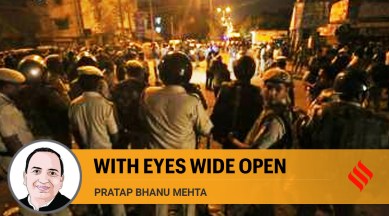 Police
at the spot where communal violence took place between two communities
at Jahangirpuri in New Delhi. (Express Photo by Praveen Khanna)
Police
at the spot where communal violence took place between two communities
at Jahangirpuri in New Delhi. (Express Photo by Praveen Khanna)
Anyone who has ever genuinely immersed themselves in Ramcharitmanas will recognise the singular poignancy of one moment in the Sundarkand where Hanuman meets Sita. Until that point the story is hurtling towards disaster. Sita has been abducted. Ram is distraught and unsure of himself. But the moment Hanuman meets Sita is the point at which the epic turns; the confidence that order will be restored reappears. Hanuman drops Ram’s ring from the tree. Sita experiences contradictory emotions: Joy at recognition of the ring; fear about what its presence might mean. (In Tulsidas’s rendition: Harsha vishaad hridya akulani). Sita is thinking many things. Suddenly Hanuman’s words of reassurance break out as he identifies himself. In all musical renditions, whether by Channulal Mishra or the underrated version by Mukesh, the gentle line “madhur vachana bole Hanumana (Hanuman spoke, his words like honey)”, always stops you in your tracks. Its power is not just the simple poetry but the magical calm it produces, an almost irresistible effect that, for a moment at least, bathes you in gentle reassurance and bliss. That moment is itself the deliverance from all worry, and from evil.
It is a measure of our perversion as a society that Ram and Hanuman are now tropes to prepare the ideological groundwork for pogroms. The communal frenzy that has accompanied Ram Navami and Hanuman Jayanti, spread across several cities, should leave us in no doubt about the direction in which India is headed. On the surface, the narrative circulating in society is simple “Hindus were taking out processions celebrating festivals. We were asserting our right. We got pelted by stones or worse. The minorities are responsible for this. It shows Hindus are not safe nor do they have space in their own country”. And then the ominous “We need to get rid of them.” This narrative is designed to feed the most contrived sense of Hindu victimhood. This is an old playbook.
What should give us nightmares is this. The simple fact is that this narrative is very widespread. All the arguments that we used about majoritarian communalism in India no longer hold. Its logic is no longer merely instrumental (as if that is not bad enough), that will pass with election cycles. It is no longer episodic where we can take reassurance that it will somehow pass of its own accord. It is not local in nature, but has taken on a national character. The orgies of hate and prejudice are not aberrations. They are now the norm. They are the norm because the highest levels of political authority, including the prime minister, by silences or dog whistles, condone it. They are the norm because elites openly spout it, without shame. They are the norm because being communal in some ways has become almost a necessary condition of political advancement and is fast becoming the default common sense of civil society.
But what is more ominous is this. Think of what might happen to a society whose dominant religious sensibility literally inverts everything of value. Religion has often been misused and put to grossly perverse and violent uses. But can you think of another occasion in the history of modern Hinduism where everything sacred has become ominous, forms of worship have become fearsome, singing and text weapons, acts of public piety menacing, a sense of community murderous, and any talk of decency or civilisation constraining? That is the fearsome image the organised mobs that masquerade as religious processions now evoke. Let us be very clear. This new form of Hinduism you are seeing unfolding is not an expression of genuine pride and piety. It is meant to be a raw assertion of power and violence to intimidate minorities. It is meant to literally extract reaction (even one photograph will do), that can be used as a pretext to construe all minorities as a threat. The number of seemingly well- meaning people for whom stone-throwing on threatening processions can become a vindication of the deepest prejudices against minorities is truly alarming. It is the one factoid they are looking for to sustain their insidious lie that Hinduism will not be safe unless minorities are shown their place if not erased. This was the mission and the aggressive processions accomplished that. It sustains the insidious lie that the murderous perversion of modern Hinduism, now sustained by state power, is entirely reactive; a belated self-assertion against a minority that dominates us, rather than what it is: Increasingly a drive to violence and cruelty.
Writing on communalism has become a futile act. Who is it addressed to? Certainly not the state whose ideological practices and power fuel the crisis in the first place. Not civil society, because there is not much of civil society left. Not religious groups. To the votaries of new Hinduism, the only discourse of communalism that matters is one they can use in a discourse of revenge. To Muslims, what reassurance can we now give that asymmetry of numbers, state power and ideological zeal will not be used in a project of their cultural erasure? Those who claim to be secular are bulldozed by the lie that secularism is minority appeasement. To those who want to speak the language of human dignity beyond the vortex of communal identification? Is anybody left in that camp? To the Opposition parties who have no courage of conviction or a grammar of politics that can combat majoritarianism?
There is a comforting fallacy out there that somehow a pragmatic, instrumental logic will at some point assert itself over the politics of Hindutva: Inflation and unemployment will show up the cracks. But this communalism is not always rooted in material conditions. The fact that hordes of young men are seeking vindication and self-esteem through a public display of collective narcissism and violence suggests that communalism is now so deep that even social discontent has to express itself in the language of communalism.
Almost all the preconditions for widespread pogrom-type violence are now in place in India. You almost dread the thought that India has reached a point where the question is not “if” but “when.” What else would you call the widespread acceptance of vile prejudice, the dismantling of any semblance of conscience, the alignment of the state with majoritarian power, the complete effacement of the individual by imposed communal identification, the self-justification of the majority that has cloaked itself as the victim, the total contempt for rights, the glorification of violence, the search for the slightest pretext for revenge, and the radical othering of minorities?
Even Hanuman Jayanti is not the deliverance from evil but us hurtling into it, with eyes wide open.
January 13, 2022
Video: Professor Sabyasachi Bhattacharya on how to understand the Chicago Address of Swami Vivekanand to World Parliament of Religions in 1893
Sabyasachi bhattacharya on Chicago centenary lecture https://www.youtube.com/watch?
January 12, 2022
India: Swami Vivekananda's vision of Hinduism is endangered by Hindutva | S N Sahu
https://www.nationalheraldindia.com/opinion/swami-vivekanandas-vision-of-hinduism-is-endangered-by-hindutva
The National Herald, 12 Jan 2022
Swami Vivekananda's vision of Hinduism is endangered by Hindutva
by S N Sahu
At a time when Swami Vivekananda is being appropriated by forces representing right wing bodies it is pertinent to revisit Swami Vivekananda's worldview which is often twisted to polarise society
It was Prime Minister Rajiv Gandhi who took the decision to celebrate Swami Vivekananda's birth anniversary on January 12 as national youth day. It is on this day one recalls the yearning of Prime Minister Atal Bihari Vajpayee who after gruesome riots in Gujarat in 2002 asserted in the Lok Sabha that he preferred the Hinduism of Ramakrishan Paramahansa, Swami Vivekananda, Mahatma Gandhi and Sri Aurobindo and not Hindutva which was invoked to kill innocent people in that State.
So when Swami Vivekananda is being appropriated by the forces representing Hindutva and other right wing bodies for aggressively demonising the Muslims and other minorities and violently targeting them, it is pertinent to revisit the worldview of Swami Vivekananda which is often distorted and twisted to polarise society and serve the political goals based on majoritarianism.
Generations of Indians including the stalwarts of our freedom struggle be it Mahatma Gandhi, Jawharlal Nehru or Netaji Subhash Bose were deeply influenced and inspired by Swami Vivekananda who brilliantly expounded the foundational pillars of Hinduism and spirituality before the western people and cast a spell on them. Representing Hinduism as a monk in the World Parliament of Religions held in Chicago in 1893 he articulated its core values of tolerance and universal acceptance and affirmed that all religions as true. He was equally critical of it and his interrogation of Hinduism by pointing out its shortcomings were evident even before he delivered his famous Chicago address.
In a letter written on August 20, 1893 from the USA to his Tamil disciple Alasinga, he stressed on Lord Buddha’s practical gospel of equality and social raising up and indicted Hinduism by saying “No religion on earth preaches the dignity of humanity in such a lofty strain as Hinduism, and no religion on earth treads upon the necks of the poor and the low in such a fashion as Hinduism.”
So while projecting Swami Vivekananda as their icon, the Hindutva forces are conveniently oblivious of his critical outlook on Hinduism which is imperative to understand and evaluate the role of religion in society and life and the necessity of evaluating it by applying reason and rationality.
It is deeply painful to note that Hindutva leaders have often justified the violent attack on places of worship of people professing different faiths. It is extremely tragic that the Hindutva leaders are now calling for arms, genocide of Muslims and and one of them even mentioned his sinister desire to assassinate Prime Minister Manmohan Singh.
It is worthwhile to recall the poignant words of Swami Vivekananda who in his famous Chicago speech delivered on 9/11, 1893 had said, “Sectarianism, bigotry and its horrible descendant, fanaticism, have long possessed this earth. They have filled the earth with violence, drenched it often with human blood, destroyed civilization and sent whole nations to despair. Had it not been for these horrible demons, human society would be far more advanced than it is now. But their time is come; and I fervently hope that the bell that tolled this morning in honor of this convention may be the death-knell of all fanaticism, of all persecutions with the sword or with the pen, and of all uncharitable feelings between persons wending their way to the same goal.”
The “horrible demons” representing “sectarianism, bigotry and its horrible descendent fanaticism” are now poisoning the body polity of India in the twenty first century and causing all round havoc. The demolition of Babri Mosque by such forces on December 6 1992 subverted rule law, jurisprudence, Constitution and civilisational values. The acquittal of all those charged with the demolition has emboldened them to fuel bigotry and fanaticism.
The Hindutva leaders and their followers who flattened the Babri Mosque on 6th December 1992 mocked at the ideals of acceptance and tolerance which Swami Vivekananda so gloriously articulated in his Chicago speech in 1893 and for which the Americans professing Christianity acclaimed him.
Even as the Supreme Court in its judgement of November 10, 2019 unequivocally observed “The destruction of the mosque and the obliteration of the Islamic structure was an egregious violation of the rule of law” it allowed construction of Ram Temple where once the Mosque stood. In fact a nuanced understanding of Swami Vivekananda’s vision embodied in his writings reveals that such judicial sanction for construction of temple where the mosque was demolished by Hindutva forces constitutes a negation of his vision.
On Swami Vivekananda’s return to India after his historic trip to the World Parliament of Religions he was accorded rousing welcome and he responded by delivering series of speeches compiled in the volume “Lectures from Colombo to Almora”.
In one of those speeches delivered in Madras, now Chennai, he famously said, “It is here in India that Hindus have built and are still building churches for Christians and mosques for Mohammedans.”
He did so to underline the values of universal tolerance and acceptance. In fact, in the same speech Swamiji underlined that Hindus would continue to build mosques for Muslims and Churches for Christians even if they faced scorn and contempt from some people belonging to those communities.
He further added, “...the world is waiting for this grand idea of universal toleration. It will be a great acquisition to civilisation. Nay, no civilisation can long exist unless this idea enters into it. No civilisation can grow unless fanaticism, bloodshed and brutality stop. No civilisation can begin to lift up its head until we look charitably upon one another; and the first step towards that much-needed charity is to look charitably and kindly upon the religious conviction of others. Nay more, to understand that not only should we be charitable, but also positively helpful to each other, however different our religious ideas and convictions may be. And that is exactly what we do in India as I have just related to you. It is here in India that Hindus have built and are still building churches for Christians and mosques for Mohammedans. That is the thing to do”.
Now in several parts of BJP ruled States right wing forces representing Hindutva are attacking Churches, and Christians. The processions organised in some areas inhabited by minorities to collect funds for the construction of Ram temple witnessed violence against Muslims and destruction of their houses. Such willful target of Muslims in the name of construction of Ram temple constitutes a manifestation of “sectarianism, bigotry and its horrible descendant, fanaticism” in twenty-first century India.
In the process the Hinduism of Swami Vivekananda, which Vajpayee preferred over Hindutva has become a casualty. Can the Constitutional vision of India prevail and detoxify the communal ecosystem created by the Hindutva forces? It is hoped that it is in the realm of possibility. Let us recall illuminating words of Swami Vivekananda who flagged the integrated vision of India by combining both Hindusim and Islam and celebrating religious pluralism which remain at the core of our Constitution and secularism. He said, ““Practical Advaitism … is yet to be developed among the Hindus universally… Therefore we are firmly persuaded that without the help of practical Islam, theories of Vedantism, however fine and wonderful they may be, are entirely valueless to the vast mass of mankind…For our own motherland a junction of the two great systems, Hinduism and Islam – Vedanta brain and Islam body – is the only hope… I see in my mind’s eye the future perfect India rising out of this chaos and strife, glorious and invincible, with Vedanta brain and Islam body.”
It is such a vision of India which is in danger and we need to salvage it by invoking Swami Vivekananda and the constitutionally enshrined Idea of India.
October 21, 2021
Hinduism / Hindutva .... Will people spot the difference in Future! Yati Narainghanand Saraswati the righwing Hindutva Fanatic appointed head of Dashnami Juna Akhara - largest organized body of men, in Hinduism
via facebook
LONG POST ALERT
Yati Narainghanand Saraswati, the most dangerous figure in the ecosystem of Hindu Terrorism, the ex-Chemical Engineer turned ‘Sadhu’ who runs the hate factory at Dasna, and issues regular and explicit calls for the genocide of Indian Muslims, and for showing Christians ‘their place’, has just been appointed the ‘mahamandaleshwar’, or supremo, of the Dashnami Juna Akhara, a militant monastic order of Hindu men that sees itself as an armed force.
The Juna Akhara is the largest organized body of men, in Hinduism. Many amongst these men bear arms, and are dedicated to a life committed to the cultivation of violence as a ritual requirement within the logic of the contemporary institutional-ritual structure of the Hindu faith.
The Juna Akhada is immensely wealthy in terms of liquid and immobile assets, particularly land and property. Much of its wealth is neither accounted for, nor accountable. It is very influential in local and state level politics, particularly in Uttar Pradesh, Uttarakhand, Bihar, Madhya Pradesh, Chattisgarh and Jharkhand.
The ascension of a terrorist like Narsinghanand to a position of unchallenged power within one of the most influential and powerful bodies within institutionalised Hinduism is deeply dangerous. He can’t have come this far without the tacit endorsement of the Prime Minister and Home Minister of the country and of the Chief Minister of the state of Uttar Pradesh. This cannot, and must not be underestimated. It’s like an out and open Neo-Nazi being made the global head of the Jesuit order. People, not just in India, but everywhere in the world should take this very, very seriously.
Narsinghanand is a violent and hateful man. He is abusive and loud. He is also cold, conniving and calculating, and a rank misogynist. He has tremendous presence and reach on social media in Hindi speaking North India. He knows how to whip young men into states of rage and frenzy. He seduces them into romanticising ‘suicide missions’. He rationalizes violence against the poorest and the most vulnerable, even against children. He makes no secret of his hatred for people who are not Hindu. He also has a band of fanatical young male followers who, collectively, and individually, are all serial catastrophes waiting to unfold. He is connected to all the hate-mongering, random acts of violence, lynchings and thuggery and anti-Muslim, anti-Rohingya hatred, in the name of religion, ‘cow-protection’ and ‘anti-love-jihad militancy’, that have taken place of late in the Western Uttar Pradesh-Haryana-NCR-Uttarakhand belt. Narsinghanand’s men are directly implicated in the violence of the Delhi pogrom of February 2020, in the attacks on JNU and Jamia, and in aggressive campaigns of harrassment and intimidation of Muslim street vendors in the Delhi-NCR region.
He has enjoyed immense impunity, with the protection and patronage of the chief minister of Uttar Pradesh. He is clearly poised to take a huge step forward with his new appointment. This clearly also has something to do with the forthcoming elections in Uttar Pradesh, but it’s real significance is even beyond the fate of an election.
I have been writing consistently about the danger that Narsinghanand represents, as have a few other people, Alishan Jafri, for instance. I find it deeply disturbing that despite our clear indication of the nature and intensity of the threat that Narsinghanand and his cohort represents, he continues to be seen by the completely deluded liberal commentariat of this country as the ‘loony fringe’. As if he were just some inconsequential, annoying but sinister clown. He is anything but inconsequential. And if he was once on the fringe, welll, then that fringe now squats dead centre on the mainstream. You don’t get to be in a more prominent place within Hinduism than at the summit of an entity like the Juna Akhara. It gilds naked terrorist ambitions with the patina of respectability and hallowed tradition.
The saddest aspect of this development is that it confirms what I had begun to suspect for a while, especially in the wake of the Akhadas complicity in the disaster of Covid 19 infections because of the deliberate holding of an untimely Kumbh Mela - and that is the hollowing out of the ethnic core of institutionalised Hinduism. But that is totally confirmed for me with a man like Narsinghanand enthroned. In the wake of the rapid ascent of Narsinghanand on the Holy Hindu Hierarchy, institutional Hinduism can no longer make the case for having l, or retaining, a spiritual or ethical core. It has turned into a thing of decadence and moral pollution. It is wedded to money, violent masculine sexuality, political power, weapons and sadism.
I had hoped that there might be individual renunciants, monks, men and women of religion within the Hindu faith who would not have sold themselves to the devil, and who would have a realistic idea of the distilled evil that has now made their faith a ‘home base’. I thought, perhaps naively, as a non-Hindu, that maybe the Ramakrishna Order, or some Hindu mystic or philosopher cleaving to an Upanishadic ideal might stand up and refuse to entertain a man like Narsinghanand being given the highest honours within the Hindu world. That hope has not yet been realised. As of now, the institutional vortex of the Hindu world is comatose, at least form an ethical perspective.
There are dark days ahead for those of us who happen to be non-Hindu citizens of this increasingly dystopic republic. But the darkest days are those that believing Hindus will face. A terrorist demands their veneration. And he doesn’t make ‘requests’. He commands. I know his voice. The choice, to offer that veneration, or not, is one which every Hindu believer will have to make now. We’ve done what we could to warn you of the place that you have allowed yourself to be dragged into. Your religious guides, gurus, leaders and authorities did absolutely nothing to resist the ascent of this man and to loosen the stranglehold that he and other men like him have on the majoritarian imagination of social and political life in North India.They garlanded and feted him. And you did not hold them accountable. They failed you, you failed yourselves.
Try getting out of this now, with your sanity intact, by yourselves. This is not our fight. We have other things to do, like figuiring out how best to defend ourselves when Yati Baba’s boys come calling.
Best of luck.
हरिद्वार: यति नरसिंहानंद गिरि बने जूना अखाड़े के महामंडलेश्वर, जूना पीठाधीश्वर ने कराया अभिषेक
Read more: https://www.amarujala.com/uttarakhand/haridwar/yati-narsinghanand-giri-becomes-mahamandaleshwar-of-juna-akhara
Read more: https://www.amarujala.com/uttarakhand/haridwar/yati-narsinghanand-giri-becomes-mahamandaleshwar-of-juna-akhara
September 17, 2021
Anand Patwardhan: If Hindutva is Hinduism then the Ku Klux Klan is Christianity (speech @ Dismantling Global Hindutva conference Sept 10-12, 2021)
A rally of Hindutva supporters and India and of white supremacists in the US. | Narinder Nanu/AFP, Stephanie Keith/Reuters
Before I begin let me read a reply I sent to one of the many who cautioned me in the last few weeks.
“Dear friend
All the hate mail I received went directly into my trash. Your letter represents a genuine concern, so I’m replying.
I was also once a student in America and understand that diaspora Indians face racism and discrimination and need to feel a sense of pride about their land of origin. This is natural. The question is, can we choose what to feel proud about and what to feel ashamed about so we become agents of positive change?
I feel proud about Mahatma Gandhi and the inclusivity he practiced in the name of Hinduism, not through ritual, but by deed. He was perhaps the first (in quotations) “upper caste” Hindu to insist on manually scavenging night-soil and not depend on the lowest ranked to do the jobs that were considered unclean and impure.
Towards the end of Gandhi’s life he strongly advocated inter-caste marriage so future generations would be free of caste. And he died a martyr to the cause of bridging the Hindu-Muslim divide so meticulously nurtured by British colonialists.I feel proud about Dr Ambedkar, born a Dalit and subjected to discrimination, who broke the taboo against education, earned doctorates abroad and returned to India to lead the struggle for an egalitarian world. He headed the drafting of India’s Constitution and became our first Law Minister. Later, with thousands of followers, he converted to Buddhism, a religion that did not believe in caste.
I feel proud about Abdul Ghaffar Khan also known as Badshah Khan, or Fakhr-e-Afghan, or Frontier Gandhi, whose legendary non-violent fighters named the Khudai Khidmatgars, faced British massacres with the greatest bravery of the entire Independence struggle. Badshah Khan never compromised his ideals and spent half of his adult life in prison, first in British India and then in Pakistan.
I feel ashamed about the upper caste conspiracy against Gandhi that began after 1932 when an agreement between Gandhi and Ambedkar granted reservations for scheduled castes and tribes. In this period temples and village-wells were thrown open to Dalits, temporarily raising hopes of a Renaissance. Angered by this, a gang of upper caste men started a series of assassination attempts on Gandhi, the first being a bomb attack in Poona in 1934.
After six failed attempts, the seventh succeeded in 1948. VD Savarkar was named as “the mastermind” by an approver, but was acquitted for lack of supporting evidence. Only after Savarkar died in 1966 did the evidence surface in the Kapoor Commision Report.Today there is much to feel proud and ashamed about in India. Just as in the USA one can feel proud about the “Black Lives Matter” movement and all those who fight for disarmament and peace, and against climate change. But one can only feel ashamed that the USA for its short-term interests created religious jihad. Today after spending trillions of dollars and extinguishing thousands of lives it has surrendered to its own creation.
There is more to say but I would urge that you attend the conference with an open mind. You will hear things that may surprise you in a positive way or hear things that may upset you, but use each to do more research. More research, in all directions, can never hurt.
Let us feel proud not of the 1% that have lived for centuries by enslaving and exploiting others but of the 99% who despite being denied opportunities, are in the process of finding their voice.”
Advertisement
Illogical, ahistorical claims
The title of my talk today is: Hindutva is as Hindu as the Ku Klux Klan is Christian.
The term Hindutva was invented in the 20th century and popularised by Savarkar in his book of the same name. Published in 1923, the book was originally titled Hinduism but its title was covered over by a paper sticker with the word Hindutva.
The book makes ahistorical, illogical and contradictory claims and must have been confusing even to Savarkar’s followers, as 80 years later, right up to 2003 when the Bharatiya Janata Party began to glorify Savarkar, only seven editions were published. Savarkar claimed the deepest antiquity for Hinduism, treated the Ramayana as actual history, while admitting that the term Hindu originated from Greeks, Persians and Arabs. Indeed the term Hindu cannot be found in scriptures like the Vedas, Upanishads, Bhagvad Gita or any of the Smritis and Puranas.
How then to differentiate Hinduism from Hindutva? In 2018, we completed a film Reason/Vivek, which apart from documenting atrocities against Muslims and Dalits, examines the murders of rationalists like Narendra Dabholkar, Govind Pansare, MM Kalburgi and journalist Gauri Lankesh, all of whom were born Hindu. The murder trials have not concluded but several Hindutva militants are under arrest.
Advertisement
I quote from a scene showing militant, sword-brandishing men and women from the twin groups Sanatan Sanstha and Hindu Janjagruti Samiti, a few of whom are now in custody, marching through the streets of Mumbai.
The commentary says:
“Hinduism is a dynamic composite of cultural practices, both indigenous and those, borrowed from passing streams.
Sanatan, Aryan, Vedic, Hindutva on the other hand, is a Brahminical project of supremacy.
Knowledge, controlled by a caste elite, recruits the powerless in an endless war against imaginary demons.”
These sentences are very compressed as our film was already four hours long, but it may be worth teasing them out here.
The first point is that Hinduism is less a religion etched in stone or written by the hand of god than a composite of cultures that evolved over time as indigenous populations came into contact with an endless stream of visitors, some who came temporarily and others who stayed permanently. So intricately did our syncretism evolve that only a colonial power or a ruling elite interested in divide and rule would try and separate the streams.
The second sentence looks at the phenomenon of divide and rule, otherwise known as the caste system. Sanatan (literally meaning “eternal”), Aryan, Vedic, Hindutva are all claims to antiquity. Brahmins (the priest caste) are at the top of the caste hierarchy and it is certainly no accident that people like Savarkar who headed the Hindu Mahasabha, or KB Hedgewar and MS Golwalkar who headed the Rashtriya Swayamsevak Sangh, were Brahmins. It’s also a historical fact that the Hindu Mahasabha, RSS and the Muslim League all collaborated and formed governments with the British in 1942 even as the Indian freedom struggle reached its peak.
Which brings us to the last sentence. Brahmins historically controlled knowledge to keep themselves and their upper-caste allies in power while ensuring that the working majority did the dirty work. To an extent the Independence struggle and ideals of secular democracy loosened their grip on power so what we see is an attempt to reassert caste superiority by the subterfuge of creating a common enemy.
Advertisement
Hindutva ranked their enemies in order – Muslims, Christians and Communists. It applauded Hitler’s “national” pride and invoked the Nazi model of dealing with minorities. Like Hitler, Hindutva believed in race superiority and dreamt of world dominance. Yesterday it collaborated with the British. Today it flaunts the tricolor it had openly denigrated, pretends to uphold a Constitution it wanted replaced with the Laws of Manu, a misogynist, Brahminical text, and is busy selling every available public asset to the nearest foreign or Indian crony.
Without stating it in words, their murder of Gandhi in 1948 added a new enemy to the list – Hindus who stood against the project of Hindutva.
Inspirational teachers
I compared Hindutva to the Ku Klux Klan though Klansmen are buffoons compared to the sophistication of a Brahminism developed over centuries. Fortunately, Brahminism was never the only stream and resistance to it is centuries old as Charavak, Buddha, Basava, Kabir, Guru Nanak, Ravidas, Meera, Tukaram, Bulle Shah, Jotirao and Savitri Phule, Bhagat Singh, Badshah Khan, Gandhi and Ambedkar and so many of our inspirational teachers have shown.
Luckily casteism is not genetic so not every birth Brahmin is doomed by it but not every non-Brahmin is immune. There is a war between exclusive and inclusive ideas and what we need is a rainbow alliance that includes not just the dispossessed but also that section of the privileged that no longer chooses to side with privilege.
Advertisement
If armed, our revolution would be easily crushed by any modern state. Our revolution must then be a revolution of ideas and culture, and our weapons: Knowledge, Reason and Compassion.
Anand Patwardhan is a filmmaker. This speech was delivered at the Dismantling Global Hindutva conference being held from September 10-September 12.
November 16, 2018
India: The Hindu vs Hindutva battle is meaningless in shaping our politics
Spare me the good Hindu: The Hindu vs Hindutva battle is meaningless in shaping our politics
Hartosh Singh Bal
06 July 2018
Unless we claim that true Hinduism is folk religion, to be found not in, but away, from the great traditions of Hinduism, we are left to conclude that it is those who are most Hindu who are the most avid supporters of Hindutva. PTI
During a speech at the India Today Conclave in March this year, Sonia Gandhi said, “The BJP has managed to—I don’t say brainwash because that is a rude word, but it has managed to convince people, to persuade people that the Congress party is a Muslim party.” The speech was an attempt to defend the Congress’s need to project Rahul Gandhi’s new-found love for temples.
Two months earlier, an India Today story, in a cover package titled, “Hindu vs Hindutva,” noted, “While the appropriation of Hindu identity by the ‘Hindutva’ politics of the Sangh Parivar has … helped propel the NDA government to power … recent months have seen an unprecedented attempt by ‘liberal’ political forces to reclaim the lost ground. From Rahul Gandhi’s temple tour on the Gujarat campaign trail to Rajinikanth’s manifesto of ‘spiritual politics’ and Siddaramaiah’s war of words with Yogi Adityanath or the latest posters depicting the PM as Ravana in Amethi—the battle of ‘Hindu versus Hindutva’ has been joined.” Other commentators have carried forward the argument—in a March story in The Print, its chairman and editor-in-chief, Shekhar Gupta, claimed that the BJP’s hold over the country “cannot change until those with claims to secularism and minority votes reset their politics.” He further wrote, “They have zero hope if they can’t bring a critical mass of the majority back.”
This argument is wrong on many levels, and it ends up concealing its real implications.
To begin with, the argument commits the sin of endorsing the very disease it claims to fight. It relegates over 220 million people—including Muslims, Christians and Sikhs, who would on their own constitute the fifth-most populous country on earth—to the role of mere onlookers in a tussle between Hindus over Hindutva. Such a formulation of the present-day politics implicitly concedes the core argument of Hindutva—that those who are not part of the Hindu majority are lesser citizens—and foregoes the equality granted under the Constitution. It implies that they live here only through the forbearance of the Hindus, not because they have the same rights as any Hindu in India.
Though it begins with a claim that seems reasonable—the need to persuade Hindus they are well represented irrespective of whether the BJP or the Congress is in power—the argument ends in absurdity. Why should any such argument stop at Hindus—should not all Indians should feel that they are well represented irrespective of whether the BJP or the Congress is in power? But we already know this is not the case. Muslims, and most Indian minorities in general, are not represented at all when the BJP is in power. The logical inference in this seems to be that the cure for the BJP’s marginalisation of the Muslims is to make the Congress more Hindu—apparently the only way to make Hindus feel secure is to ensure that neither the Congress nor the BJP is seen as representing Muslims. [ . . . ]
https://caravanmagazine.in/politics/hindu-vs-hindutva-battle-meaningless-in-shaping-our-politics
Hartosh Singh Bal
06 July 2018
Unless we claim that true Hinduism is folk religion, to be found not in, but away, from the great traditions of Hinduism, we are left to conclude that it is those who are most Hindu who are the most avid supporters of Hindutva. PTI
During a speech at the India Today Conclave in March this year, Sonia Gandhi said, “The BJP has managed to—I don’t say brainwash because that is a rude word, but it has managed to convince people, to persuade people that the Congress party is a Muslim party.” The speech was an attempt to defend the Congress’s need to project Rahul Gandhi’s new-found love for temples.
Two months earlier, an India Today story, in a cover package titled, “Hindu vs Hindutva,” noted, “While the appropriation of Hindu identity by the ‘Hindutva’ politics of the Sangh Parivar has … helped propel the NDA government to power … recent months have seen an unprecedented attempt by ‘liberal’ political forces to reclaim the lost ground. From Rahul Gandhi’s temple tour on the Gujarat campaign trail to Rajinikanth’s manifesto of ‘spiritual politics’ and Siddaramaiah’s war of words with Yogi Adityanath or the latest posters depicting the PM as Ravana in Amethi—the battle of ‘Hindu versus Hindutva’ has been joined.” Other commentators have carried forward the argument—in a March story in The Print, its chairman and editor-in-chief, Shekhar Gupta, claimed that the BJP’s hold over the country “cannot change until those with claims to secularism and minority votes reset their politics.” He further wrote, “They have zero hope if they can’t bring a critical mass of the majority back.”
This argument is wrong on many levels, and it ends up concealing its real implications.
To begin with, the argument commits the sin of endorsing the very disease it claims to fight. It relegates over 220 million people—including Muslims, Christians and Sikhs, who would on their own constitute the fifth-most populous country on earth—to the role of mere onlookers in a tussle between Hindus over Hindutva. Such a formulation of the present-day politics implicitly concedes the core argument of Hindutva—that those who are not part of the Hindu majority are lesser citizens—and foregoes the equality granted under the Constitution. It implies that they live here only through the forbearance of the Hindus, not because they have the same rights as any Hindu in India.
Though it begins with a claim that seems reasonable—the need to persuade Hindus they are well represented irrespective of whether the BJP or the Congress is in power—the argument ends in absurdity. Why should any such argument stop at Hindus—should not all Indians should feel that they are well represented irrespective of whether the BJP or the Congress is in power? But we already know this is not the case. Muslims, and most Indian minorities in general, are not represented at all when the BJP is in power. The logical inference in this seems to be that the cure for the BJP’s marginalisation of the Muslims is to make the Congress more Hindu—apparently the only way to make Hindus feel secure is to ensure that neither the Congress nor the BJP is seen as representing Muslims. [ . . . ]
https://caravanmagazine.in/politics/hindu-vs-hindutva-battle-meaningless-in-shaping-our-politics
August 27, 2018
India: The Erased 'Muslim' Texts of the Nath Sampradāy
The Wire
Two recently rediscovered teachings illustrate that prior to the 20th century, the Nath community spoke to a Muslim audience and opted to acquire power through religious inclusivity.
The Erased 'Muslim' Texts of the Nath Sampradāy
Rare illustrations from 1715CE Nath manuscript located at the Wellcome Collection, London (ccby4).
by C. Marrewa Karwoski
23/Mar/2018
These last few weeks have been arduous for Uttar Pradesh’s chief minister Adityanath. Crisscrossing India, this mahant of the Gorakhnath temple in Gorakhpur has been using his spiritual standing to garner votes for BJP candidates from Tripura to Karnataka. While it is by no means unusual for Nath yogis to involve themselves in political matters, the manner in which Adityanath is using right-wing Hindu rhetoric to woo voters defies the more traditional tenets of his faith.
Two recently rediscovered and never before printed Nath teachings, the Avali Silūk and the Kāfir Bodh, illustrate in detail that although Adityanath polarises communities in order to gain political influence, prior to the 20th century, members of the Nath sampradāy opted to acquire power through religious inclusivity. [ . . . ] .
FULL TEXT HERE: https://thewire.in/religion/the-erased-muslim-texts-of-the-nath-sampraday/
Two recently rediscovered teachings illustrate that prior to the 20th century, the Nath community spoke to a Muslim audience and opted to acquire power through religious inclusivity.
The Erased 'Muslim' Texts of the Nath Sampradāy
Rare illustrations from 1715CE Nath manuscript located at the Wellcome Collection, London (ccby4).
by C. Marrewa Karwoski
23/Mar/2018
These last few weeks have been arduous for Uttar Pradesh’s chief minister Adityanath. Crisscrossing India, this mahant of the Gorakhnath temple in Gorakhpur has been using his spiritual standing to garner votes for BJP candidates from Tripura to Karnataka. While it is by no means unusual for Nath yogis to involve themselves in political matters, the manner in which Adityanath is using right-wing Hindu rhetoric to woo voters defies the more traditional tenets of his faith.
Two recently rediscovered and never before printed Nath teachings, the Avali Silūk and the Kāfir Bodh, illustrate in detail that although Adityanath polarises communities in order to gain political influence, prior to the 20th century, members of the Nath sampradāy opted to acquire power through religious inclusivity. [ . . . ] .
FULL TEXT HERE: https://thewire.in/religion/the-erased-muslim-texts-of-the-nath-sampraday/
May 20, 2018
India: Swami Shashi - The political Hinduism of Shashi Tharoor
Swami Shashi: The political Hinduism of Shashi Tharoor

AT THE OUTSET of Why I Am a Hindu, the politician and writer Shashi Tharoor—a member of the Nair castes, and so a Shudra—writes that the book is in large part a response to the “intolerant and often violent forms of Hindutva that began to impose themselves on the public consciousness of Indians in the 1980s.” I am also a Shudra, part of what are now officially called the Other Backward Classes, and I wrote my book Why I Am Not a Hindu in response to the rise of Hindutva as well.
My book was published in 1996, in the aftermath of the demolition of the Babri Masjid and the struggle over the Mandal reservations. It was widely opposed by Brahminical forces, including Hindutva groups, and earned me many threats. No mainstream publisher agreed to carry it, and the book was finally published by Samya, a Kolkata-based imprint of the publishers Bhatkal and Sen. Kolkata was a safe place for such a book in those days, with West Bengal ruled by the Left Front. Bhatkal and Sen also had an imprint in Mumbai, but if the book had been published there, with Maharashtra ruled by an alliance of the Bharatiya Janata Party and the Shiv Sena, it would have faced the book-burning squads notorious in the state at the time. Why I Am Not a Hindu was not widely promoted, but as word of it spread the book became a bestseller.
Why I Am a Hindu is on its way to becoming a bestseller too, but under very different circumstances. It has been put out by a prestigious publisher that which has not been shy with publicity. Tharoor’s argument is that Hindutva goes against what he sees as “the spirit of Hinduism,” but no Hindutva forces have raised any protest against the book, even as they are ascendant across much of the country.
Tharoor’s book is the very opposite of mine, and not just in its title. I said I am not a Hindu because of the inequality by birth of different communities within Hinduism, as enshrined in the caste system that pervades Hindu scripture, morality, ritual, social organisation—really the entire Hindu worldview. The very theory of caste goes against the fundamental principle that all humans are created equal. I also criticised Hinduism’s negation of the values and labour that go into productive work, which it stigmatises and reserves for oppressed castes, and the resulting maltreatment of productive communities, including Shudras and Dalits (my book referred to both under the collective term “Dalitbahujans”). Tharoor, by contrast, talks of restoring Hinduism “to its truest essence, which in many ways is that of an almost ideal faith for the twenty-first-century world.” He celebrates it as “a religion that is personal and individualistic, privileges the individual and does not subordinate one to a collectivity; a religion that grants and respects complete freedom to the believer to find his or her own answers to the true meaning of life; a religion that offers a wide range of choice in religious practice, even in regard to the nature and form of the formless God; a religion that places great emphasis on one’s mind, and values one’s capacity for reflection, intellectual enquiry, and self-study; a religion that distances itself from dogma and holy writ, that is minimally prescriptive and yet offers an abundance of options, spiritual and philosophical texts and social and cultural practices to choose from.”
Tharoor does not seem to have read my book, despite choosing a title that echoes mine. He does not engage with my arguments anywhere. He also ignores some far more important thinkers on Hinduism. Among Shudra writers alone, the tradition of critiquing the religion goes back at least to Jotirao Phule, the Maharashtrian social reformer whose 1873 book Gulamgiri, or “Slavery,” was a stinging critique of Hinduism and the caste system. In 1941, Dharma Theertha published The History of Hindu Imperialism, another serious assessment of Hinduism, and came to conclude that it oppresses all Shudras. Although Dharma Theertha was a Nair like Tharoor, he refused to describe himself as a Hindu.
How does Tharoor come to a different view of Hinduism than any Shudra writer of great prominence before him? Simply put, it is by not applying any critical or analytical thinking. His main strategy of persuasion is not argument, but repetition with rhetorical flourishes of a two-in-one premise and conclusion, stated already in the very first paragraph of the book where he describes Hinduism as “that most plural, inclusive, eclectic and expansive of faiths.”
The book’s first section, largely autobiographical and titled “My Hinduism,” is strangely silent on aspects of Tharoor’s own background, including his caste. It is also very selective in its citation of holy texts, while whitewashing Hindu history and sidestepping many of Hinduism’s sharpest critics. The second section, “Political Hinduism,” blames only Hindutva groups for mixing Hinduism with politics, pretending that Tharoor’s own Congress party has never had anything to do with that kind of politicisation. The third section, “Taking Back Hinduism,” disguises a proposed return to Tharoor’s “essence” of Hinduism as a step forward rather than back.
Tharoor admits that he does not write as a scholar of Hinduism, but it is obvious that he does not even write as a sincere autobiographer. That leaves him writing as a politician—a politician who wants to keep one foot each in two camps, the Congress and the Bharatiya Janata Party.
“WHY AM I A HINDU?” Tharoor asks. Because, he answers, “I was born one.” This raises the question: with what status was he born into Hinduism?
Tharoor’s account of how he came to his Hinduism includes autobiographical anecdotes—his father’s poojas, his mother’s stories—but excludes, except in a few very brief instances, any mention of his Nair roots. He never acknowledges that Nairs, originally from Kerala, are considered Shudras within the Hindu caste order. This lays the ground for Tharoor to completely omit the history of the Nairs, and of their struggle against the casteist discrimination long imposed upon them.
Traditionally, the basic work of Nairs, as of many Shudra castes, was agriculture, but the caste system that allotted them this work also denied them land rights. Over the centuries, Nairs moved away from their typically Shudra occupation, and under the influence of Brahminism entered into a unique relationship with the dominant Nambudiri Brahmins. Well into the nineteenth century, Nair women lived in sambhandham with the Nambudiri Brahmins’ younger sons. This was a form of sexual slavery, with the women denied marital rights and the men freed from obligation towards any children of the union, and it had full spiritual and religious sanction under the caste order.
Like other oppressed castes, under Brahminical hegemony Nairs were also denied the right to education. That restriction was loosened with the arrival of British power, but with that control over education in Kerala fell largely into the hands of Syrian Christians. In 1914, the Nair leader Mannatthu Padmanabha Pillai established the Nair Service Society, with a view to gaining educational autonomy. The organisation runs a number of institutions of learning to this day, and has been crucial to making Nairs the most educated Shudra community in India.
Pillai was a reformer of the Nairs, but not a reformer of society as a whole. In response to Nairs’ historical oppression and humiliation, the Nair Service Society chose not to reject Brahminical social organisation but to further Brahminise the Nair community. The organisation asserted that it was a Hindu group, and aggressively propagated the religion. Tragically, the Nair Service Society never helped in the upliftment of other oppressed castes. Instead, Nairs have participated in those castes’ continued persecution, and have played only a marginal role in anti-caste movements. Tharoor is a carrier of this legacy.
“I am the product of a nationalist generation that was consciously raised to be oblivious of caste,” Tharoor writes, recounting that his father dropped “Nair” from his name, “moved to London and brought his children up in Westernised Bombay.” He congratulates himself for how even after he entered the “caste-ridden world of Indian politics … I did not deliberately seek to find out the caste of anyone I met or worked with; I hired a cook without asking his caste (the same with my remaining domestic staff) and have entertained all manner of people in my home without the thought of caste affinity even crossing my mind.” He recalls his “own discovery of caste.” While he was at school, an older boy cornered him near the toilet to ask “what caste are you?” Tharoor replied, “I—I don’t know.” The other boy continued, “You mean you’re not a Brahmin or something?” Tharoor writes, “I could not even avow I was a something.”
Tharoor acknowledges that he holds a privileged position: in today’s India, only great wealth and social advantage, combined to permit a private English-language schooling, can allow anyone the pretence of being innocent of caste. In Tharoor’s case, it exposes his social ignorance, while his roundabout treatment of caste suggests an unease. If he had been a Brahmin, it is likely Tharoor would have owned up to it matter-of-factly. By disregarding his Nair heritage and his caste’s struggle against subordination in the Hindu order, he obscures how he came to be in his privileged position. As a result, he makes it seems as if caste can be shrugged off, where for the vast majority of Indians the attempt to break free of it has been, and is, a bloody struggle. To write in this way about the religion that created the caste system is unethical.
“It is difficult to pretend that Hinduism can be exempted from the problems of casteism,” Tharoor states at the start of a passage examining caste in general, yet taken as a whole that is exactly what the passage does. He writes that “many modern Hindus have grown up rejecting the discriminatory aspects of the caste system, while still observing caste preferences when it comes to arranging the marriages of their children.” Tharoor sees no contradiction between the two parts of the sentence. He says that “the rigidities of the caste system as we understand it today were introduced by the British in their desire to understand, categorise, and classify the people they were ruling, in order to control them all the better” yet also that historically “social mobility was relatively rare in Hinduism.” According to Tharoor, “the Upanishadic insistence on the unity of being, a divinity available to everyone … implies the equality of all souls and argues against caste discrimination,” but that “there is little doubt that many Hindus believed that the caste system had religious sanction.” He cites the Rig Veda’s theory of the creation of human life, where Brahmins are created from the mouth of Purusha, Kshatriyas from the arms, Vaishyas from the thighs and Shudras from the feet—the source of the caste hierarchy, with those falling outside these four varnas, Dalits and Adivasis, given the lowest standing of all. Yet, even as he profusely references this highly revered Hindu text by Brahmins, Tharoor maintains that “Hindu society may have maintained a distasteful practice”—that is, the caste system—“but no one can credibly argue that it is intrinsic to the religion.”
In fact, many have credibly argued that. The most prominent of them is perhaps BR Ambedkar, whose fundamental thesis, in works such as Riddles in Hinduism and The Annihilation of Caste, is that caste and Hinduism are one and the same, and if one dies the other cannot survive. Tharoor mentions Ambedkar just a handful of times in the almost 300 pages of his book, each time only in passing. Much of the analysis Ambedkar used to arrive at his conclusions relied on close readings of Hinduism’s holy texts, yet Tharoor does not address or challenge Ambedkar’s analysis even while extensively citing the Upanishads, Puranas and Vedas to defend his proposition that Hinduism is an “almost ideal” faith. The fact is that these texts never gave any rights to Shudras, let alone Dalits—who together form the majority of India’s population.
One of the most difficult texts for Tharoor to deal with is the Manusmriti, which promotes undisguised casteism. His approach is to try and play it down. “The Smritis are purely man-made and mutable,” he writes, and “no Hindu seriously argues that they must be observed to the letter today. (Indeed, it is debatable whether they were strictly followed even in the times in which they were propounded.)” If all Hindus are so dismissive of the Smritis and they were never really followed, and if the Vedas, Puranas and Upanishads all uphold the equality of man as Tharoor claims, then how do we explain the fact that the caste system has existed for millennia, and continues to exist today?
The Manusmriti also sanctions discrimination against women, as other Hindu texts do as well, and Tharoor deals with this uncomfortable fact in a similar way. He cites a stray line from the Rig Veda to try and prove otherwise—“The wife and the husband, being equal halves of one substance, are equal in every respect”—and points out that “Manu declared ‘where women are honoured, there the gods rejoice, but where they are not honoured, there all rituals are useless.’” If he had any knowledge of feminist discourse, he would have known that the problem lies exactly in Manu’s regressive concept of female honour. Tharoor goes on, “The strong position held by the polyandrous, property-owning Nair women in Kerala’s matrilineal society, the honoured position of Rajput women, who killed themselves en masse after their husbands fell on the battlefield, and the reverence accorded to women mystics like Mirabai and social reformers like Savitribai Phule, show Hinduism as accepting of women as figures of authority and respect. The fact that the Manusmriti says something does not preclude the possibility that throughout the ages, it was honoured in the breach.”
Tharoor’s use of Savitribai Phule in this way is a disservice to her. She dedicated her life to fighting the gender discrimination of Hindu society, and also its caste discrimination. But her views on caste, and those of her husband Jotirao Phule, find no place in the book. Just as he does with Ambedkar and other serious critics of Hinduism, Tharoor finds a way around them. He also apparently knows little of the intellectual legacy of Dravidian thought in south India, with its insistence on the equality of all human beings and the dignity of labour and labouring communities. The struggles of the Dravidian anti-caste icon Periyar Ramasamy do not figure in Tharoor’s story of his formative years. He does, later, at least touch upon Ayyankali and Narayana Guru, Malayali reformers who fought against the discrimination of the oppressed castes.
The figure Tharoor returns to most in defining and defending his Hinduism is Vivekananda, whom he reveres as “the magnetic-eyed saint with the majestic mien and marvellous oratorical skills, who did more than anyone else to place Hinduism on the world map in the late nineteenth century.” In one instance, he describes Vivekananda’s appearance at the Parliament of the World’s Religions in the United States in 1893, where “he articulated the liberal humanism that lies at the heart of his (and my) creed: ‘I am proud to belong to a religion which has taught the world both tolerance and universal acceptance. We believe not only in universal toleration, but we accept all religions as true.’”
These were false claims of tolerance. Vivekananda did occasionally speak against caste discrimination, but for him to then also speak with conviction of Hinduism’s “tolerance and universal acceptance” he had to be just as blind to caste’s role in the Hindu order as Tharoor is. Even Vivekananda’s praise of Hinduism could not win him equality in caste society with the Brahmins who dominated the religion. Born a Kayastha in Bengal, and treated as a Shudra by Bengali Brahmins, Vivekananda never had the right to become a temple priest as a Brahmin could, just as Shudras are barred from this occupation today.
Tharoor describes how “nationalism—not just in the sense of overthrowing the foreign ruler, but in the sense of national reawakening—became a prominent theme in Vivekananda’s thought. He believed that a country’s future depended on its people, and his teachings focused on what today we might call human development.” Vivekananda proposed some reforms, but fundamentally the “national reawakening” he called for was a Hindu reawakening. It is no coincidence that today Vivekananda is embraced wholeheartedly by the same Hindu nationalists that Tharoor says he is writing against. Tharoor himself tells us, while listing historical figures he sees as key reformers and revivalists of Hinduism, that “many Hindus, notably Swami Vivekananda himself,” see Guru Nanak, the founder of Sikhism, “as a Hindu reformer.” He forgets to add that this is not a popular view among Sikhs, but it is among Hindu nationalists, who see all of India’s religious minorities as straying Hindus.
In addition to Vivekananda, Tharoor lists Ramanuja, Adi Shankara, Sarvepalli Radhakrishnan and MK Gandhi as major figures of inspiration in a chapter titled “Great Souls of Hinduism.” With the exception of Gandhi, all of these men were Brahmins, and their efforts for caste reform never went beyond such things as allowing Shudras to enter temples and relaxing the ban on Brahmins crossing the seas. Unsurprisingly, these reforms only expanded Brahmin privilege, and brought Shudras further under their power. Gandhi was a Bania, and unlike Tharoor he was never shy about his caste. (The first sentence of the first chapter of his autobiography is, “The Gandhis belong to the Bania caste and seem to have been originally grocers.”) He spoke against untouchability, but never against the caste system as a whole.
Tharoor writes, “my admiration for and pride in Hinduism outweighs my critical concerns, and I make no apology for this.” There is no questioning of Brahminical hegemony anywhere in the book, though at one point Tharoor notes, “Some Hindus reject the term ‘Hindu’ altogether as a description of their faith, preferring to speak of ‘Brahminism’, though this is used by some Dalits and others as a term of abuse against the Brahmins who have dominated the faith.” Just like that, he dismisses the whole tradition of thought that stems from the Phules and Ambedkar as nothing but slander.
THAROOR WRITES that his Hinduism “sits comfortably with the Nehruvian notion of Indianness.” And he insists, “I am a Hindu, and I am a nationalist, but I am not a Hindu nationalist. My nationalism is unquestioningly, all-embracingly, Indian. The Sangh does not speak for Hindus like me.” Tharoor uses this comparison throughout the book. On one side is the Hindutva of the Rashtriya Swayamsevak Sangh and its offspring, the BJP, and on the other is Nehruvian secularism. Even as Tharoor sets these up as opposing positions, what he actually does is find common ground between them.
Jawaharlal Nehru was ambivalent about his own Brahmin background, and pushed to enshrine secularism in the country’s constitution and institutions of government. For Tharoor, this implicitly stands in for the Congress’s position on Hinduism, and shields the party from any association with Hindu nationalism. “In India this claim to authenticity and rootedness has taken on a majoritarian Hindu colouring under the BJP,” he writes. But the full story is not so black and white, and the Congress’s history with Hindu nationalism and Hinduism—that is to say, Brahminism—is much more complex.
Nehru’s secularism could not change the structure of Hinduism or Indian society. Brahmins and Banias of his time, in the context of socialist revolutions sweeping across the world, saw that positioning themselves in favour of secularism was necessary to keep power in their hands. Brahminical forces continued to control even Nehru’s own Congress. Ambedkar pointed this out to Dalits and repeatedly clashed over the issue with the Congress and Gandhi, but Tharoor completely ignores this part of Gandhi’s and the Congress’s politics. Some of the more privileged Shudras did comparatively better—for instance, Vallabhbhai Patel rose high in the Congress, and became the deputy prime minister—and saw economic improvement in the long stretch of Congress government after Independence, but this upset many Brahmins and Banias. Shudras were slow to understand that the problem was in the continuation of the Hindu philosophical positioning of their status.
Patel, despite his high position, was not equal to the task of constructing a philosophical bridge between Shudras and the structures of power in the way that Gandhi did for the Banias. He was largely a muscle man, who mobilised Shudra force in the service of the Congress. It should be remembered that in 1949, after the ban on the RSS following Gandhi’s assassination had been lifted, the Congress passed a resolution allowing RSS members to join the party. This happened while Nehru was abroad, and had the backing of Patel and his supporters, but was reversed after Nehru returned. Today, Shudras do not see Patel as an icon, but the RSS does, despite his association with the Congress.
Patel is not the only historical Congress leader who sympathised with Hindu nationalist views. Bal Gangadhar Tilak advocated for the protection of cows, and for the conversion of Indian Muslims to Hinduism. Madan Mohan Malviya also made cow protection a political issue, and was a member of the nationalist Hindu Mahasabha, alongside Lala Lajpat Rai and others.
After Nehru died, the Congress’s secularism was compromised under Indira Gandhi, and then under Rajiv Gandhi, who did little to interrupt the rise of the RSS. Rajiv’s government allowed Hindutva groups to lay the foundation stone of a temple at the site of the Babri Masjid in 1989, in the run-up to an election. PV Narasimha Rao’s government watched as the mosque was demolished in 1992. Now, Rahul Gandhi is calling himself a Brahmin and visiting temples to try and gain voters. Tharoor is making a similar gamble, and it will only further weaken the Congress’ secular stance.
Even if we overlook Tharoor’s uncomfortable silences on Congress history, his embrace of Nehruvian secularism side by side with his Hinduism is not convincing. The major sources of Tharoor’s Hinduism—the Vedas, Upanishads, Puranas and Smritis, the views of Adi Shankara, Ramanuja, Vivekananda and even Gandhi—are also major sources for Hindutva. And the overlaps do not end there.
In the second section of the book, Tharoor introduces Hindutva by summarising the views of some of its leading lights—VD Savarkar, MS Golwalkar and Deendayal Upadhyaya. When discussing Upadhyaya, Tharoor describes his concept of “integral humanism,” and shows how it is a subterfuge. He writes, “While demanding of Muslims and other minorities this subordination to, and total identification with, a Hindu Rashtra, Upadhyaya—while his reasons differed in both premise and approach—arrived at the same place as Savarkar and Golwalkar.” Later, Tharoor says that while “there is much that is troubling” in Hindutva, “not everything in the philosophy that I have sought to summarise is objectionable—and there is much to admire, for instance, in Upadhyaya’s humanistic thinking.”
While discussing Golwalkar, Tharoor criticises Hindutva historiography. He writes that, according to Golwalkar, “India was a pristine Hindu country in ancient times, a place of unparalleled glory destroyed in successive assaults by foreign invaders.” But when Tharoor describes his understanding of Hindu history earlier in the book—having already blamed British colonialism for the evils of caste, just as many RSS theoreticians do—he agrees with the worst of Golwalkar’s view. Tharoor writes:
As we have seen, Islam was initially a threat, and the attacks of Muslim invaders on temples and Hindu treasures, as well as the rape and abduction of Hindu women, in a number of episodes in the five centuries from 1000 CE onwards, led to a defensive closing of the ranks and the adoption of protective practices that entrenched restriction and prohibitions previously unknown in Hindu society. The protection of life, religion and chastity introduced rigidities into the Hindu practice: restrictions on entry into temples (to safeguard their treasures from prying eyes), child marriages (to win protection for girls before they were old enough to be abducted by lustful invaders) and even the practice of sati (the burning of a widow on her husband’s funeral pyre) were all measures of self-defence during this turbulent period of Indian history, that developed into pernicious social practices wrongly seen as intrinsic to Hinduism rather than as reactions to assaults upon it.Tharoor’s challenge to Hindutva involves no suggestion of any fundamental reform of Hinduism, and so is not a challenge to Hindutva at all. The RSS and BJP have shown themselves to be truly afraid only of Ambedkar’s path of change, which leads away from Hinduism, and not of the Congress’s take on the religion.
We should ask why a Congress politician like Tharoor would write a book like this. His vision of Hinduism avoids posing any challenge to his electoral base, and caters to groups such as Nairs that are moving closer to the BJP. Nairs are some of the better-off Shudra castes, along with Reddys, Kammas, Marathas, Patels, Jats and so on. The BJP and RSS are successfully wooing these groups by aggressively insisting that they belong in Hinduism. This trick can only work by pretending the caste system does not exist, just as Tharoor does. His book is a tool for the Congress as it pursues a similar strategy.
The tragedy of these numerically vast and economically strong groups is that under this approach they are still denied control of theology, philosophy, learning and social relations, which remain under Brahmin hegemony. No Shudra is admitted into Hindu priesthood, or into the Sanskritic schools that teach religious discourse. Their status is still subordinate. But Tharoor’s caste-blind scholarship does the most damage to the worse-off, largely non-agrarian Shudra castes classed as OBCs, and Dalits. Their condition can only improve from challenging Hinduism’s core values of inequality. The movement for reservations only gained ground because of their challenge from below, and their assertion of autonomy from Hinduism. Shudras like Tharoor, instead of using their position to empower the disadvantaged, are only further empowering the dominant castes that already hold spiritual, political and economic power.
THAROOR’S POVERTY OF PHILOSOPHY and theology comes out very well in Why I am a Hindu. All dreams of a national revival (politicians today prefer the term “national development”) through politics that does not challenge Hinduism’s central place in Indian society are empty. What Tharoor proposes as a return to “true” Hinduism does not help the nation, but harms it.
Hinduism is constructed around a notion of the divine and virtuous as being completely separate from the material processes and resources needed for human advancement. In all the texts that Tharoor refers to, the gods do not engage in or respect human labour or production processes. The texts deal mainly with war and Brahmin morality, which negate the idea of the sanctity and equality of all human beings.
The Hindu religion centres itself on sanyasi values, and promotes activities that guarantee moksha rather than material wellbeing. Hindu economics involves, apart from bare sustenance, building temples, mobilising devotees, purifying so-called sacred rivers, and so on. Sanyasis—including many Hindutva rulers, such as Adityanath in Uttar Pradesh—do not understand and have no real agenda for family development, child education and productive employment in such things as agriculture and industry. The Hindu ideal of life involves vegetarianism and yoga, but never the labour of tilling the land, raising cattle or manufacturing goods and commodities.
Indian capitalism exists today because of Shudra, Dalit and Adivasi labour. Brahmins and Banias contribute hardly any physical work to it—mostly they are at the consuming end. Tharoor has no understanding of the lives of Shudras, Dalits and Adivasis, or of the relationship between production and morality. This is why he fails to see the serious contradiction between Hindu economics on one side and Shudra, Dalit and Adivasi economies on the other.
Shudras possess a productive philosophy—so far never worked into a theology—that is the opposite of the Hindu philosophy, and that operates among them every day. This philosophy evolved in Shudra societies in the process of doing productive work. History as Shudras remember it is full of the production and distribution of life-sustaining goods and commodities, and not of war and violence. This history and philosophy has allowed Shudras to sustain their lives and economy, and to continue to produce the things they do against all odds.
Brahmins have codified their philosophy and written it into books, but Shudras have not yet fully done this with theirs. The caste system traditionally reserved book-writing for Brahmins, and denied literacy to oppressed castes. Still today, there is an inferiority complex among the oppressed castes and a belief that they cannot write philosophical texts. Shudras of Tharoor’s kind have studied India only through Brahminical books, which have nothing to do with land and labour, but never through the culture and experience of the Shudra masses. His argument flows from the lives of Brahminic sanyasis and saints, but not from the real lives of productive Indians.
This is especially clear when Tharoor comes to the issue of gau raksha, or cow protection. He writes that the current government’s clampdown on the cattle economy “is not just about beef or the welfare of the cow, but about freedom. … Like many Hindus, I have never considered it my business what others eat.” That is good, but when Tharoor turns to the Brahminical structure of the cattle economy, he betrays his narrow-mindedness. He writes, “Upper caste hindus may worship the cow, but cows, alas, are not immortal, and when they die (ideally of natural causes), their carcasses need to be disposed of.” To think that it is ideal for a cow to die naturally is a sanyasi position. Those who depend economically on cattle accept that they have to sell aged and unproductive animals for slaughter to earn the money to buy and raise young animals. Tharoor recognises that the task of dealing with dead cows “has traditionally been left to Dalits, who for centuries and more have skinned the animal to sell its hide to tanners and leather-makers, disposed of its meat to Muslim butchers in the few states where it is legal, and buried or cremated the rest.” He says this “is a distasteful task to many caste Hindus, who are happy to let willing Dalits do it.” It is not surprising that caste Hindus are happy to let Dalits do what Hinduism considers impure work, but Tharoor must know that Dalits are still doing it not because they are “willing,” but because Brahminical society leaves them no alternative. Tharoor’s criticism of gau raksha offers the oppressed castes nothing more than a return to the old status quo.
Shudra philosophy is very clear that pure vegetarianism is unnatural, and that the people involved in the cattle economy have dignity, as do all productive workers. Brahminism, whether it is of the BJP or the Congress kind, is not going to make India great, but a productive philosophy can push the country to develop. The RSS and BJP’s ideology of gau raksha, and the entirety of sanyasi economics, can only be defeated through the philosophy of the country’s productive workers—not through standing by Brahminism like Tharoor does, feeling proud that he was born a Hindu from the feet of the Brahmin god. He has surrendered to Brahminism for the sake of political power. This surrender may keep him in the Congress now, but could also take him into the BJP camp as things unfold. His Hinduism suits him personally and politically, but it has no promise for the future of India.
Kancha Ilaiah Shepherd is a social scientist, academic and writer. He is the author of books such as Why I Am Not A Hindu and Post-Hindu India.
February 05, 2018
India: ‘Hindu’, ‘Hinduism’ & ‘Hindutva’ in court rulings
How Supreme Court viewed words ‘Hindu’, ‘Hinduism’ & ‘Hindutva’ in rulings
Dhananjay Mahapatra | TNN | Feb 5, 2018https://timesofindia.indiatimes.com/india/how-supreme-court-viewed-words-hindu-hinduism-hindutva-in-rulings/articleshow/62782807.cms
April 27, 2017
India:Hartosh Singh Bal Interviews D.N. Jha regarding his book 'Rethinking Hindu Identity' (2009)
Open Magazine, 20 June 2009
Bible on Hinduism (Hartosh Singh Bal)
Hinduism as we know it was a British creation. DN Jha reveals a few home truths
Rethinking Hindu Identity | DN Jha | Equinox | 100 pages | £14.99
[. . .]
When you say Hinduism is the youngest of religions, do you mean this literally?
A There may be a few sects younger than Hinduism, but it is certainly one of the youngest religions. The word Hindu in the sense of a religion does not exist in Sanskrit texts prior to the 19th century. Given this fact, how do we accept the view that Hinduism is an eternal religion? It cannot be treated as eternal or sanatana—the Sanskrit term for eternal. There is no basis for this in history. Interestingly, even the expression Sanatan Dharma was first used in the Buddhist texts Suttanipata and Dhammapada. The former defines it as truth being an undying word and the latter as love alone being an antidote to hatred and enmities. Subsequently, the Brahminical texts used it in different senses and in various texts and contexts.
Hinduism itself is a colonial construct: when the British commenced the Census, they faced the problem of classifying amorphous groups of castes and communities, and people of different religious denominations. The Census authorities used the term Hindu to bring all non-Muslims under one category. But the line between Hindus and others was so unclear that the term ‘Hindu Mohammedans’ was used in some Census records as late as 1911.
The 19th century social reformers also accepted this term, which is why it became so popular. The first Indian to do so was Rammohan Roy. In the early 20th century, the University of Calcutta started two departments of history: one for the study of ancient Indian history and the other for promoting the study of Islamic history. Though, in practice, the former glorified the ‘Hindu’ period of Indian history and the latter denigrated Muslim rule. RC Majumdar and Jadunath Sarkar—no doubt great historians of modern times—were the products of the academic milieu in which celebration of Hindu kings and condemnation of Muslim rulers went hand in hand. This milieu has unfortunately continued in most Indian universities.
[. . .]
http://www.openthemagazine.com/article/books/a-bible-on-hinduism
April 10, 2017
India: Hinduism risks being taken over by Hindutva need to worry warns Apoorvanand
HINDUS
need to worry. Not about Muslims being beaten up or killed on the
pretext of cow smuggling or slaughter, or Christians being attacked on
the pretext of conversion. Hindus need to stir out of slumber because
Hinduism is in peril. It is not threatened by Muslims. For the last 150
years, Hindus have been led to believe that they would be drowned by the
rapidly increasing numbers of Muslims. Not by Christians too, for they
have not been able to convert all other Indians to a religion of foreign
origin. Instead, there is a clear threat now of Hinduism being taken
over by an organisation called the Rashtriya Swayamsevak Sangh.
Hinduism, a religion that is a way of life, as its adherents like it to
be known, is now in the hands of organisations and people who want to
transform it into an ideology of dominance over populations, which are
seen, feared and abhorred as ‘others’. Hindus better be warned. [. . .]
Full text here: http://www.sacw.net/article13211.html
Full text here: http://www.sacw.net/article13211.html
Subscribe to:
Posts (Atom)