|
Showing posts with label Dalits. Show all posts

August 04, 2023

India: New Research Reveals How Public Services Are Restricted, Denied To Muslims, Dalits In Ghettoised Localities


Segregated & Unequal: New Research Reveals How Public Services Are Restricted, Denied To Muslims, Dalits In Ghettoised Localities
KAVITHA IYER 04 Aug 2023 9 min read  

Based on evidence from 1.5 million highly localised neighbourhoods of 700 people each in urban and rural India, a paper finds Indian Muslims to be systematically disadvantaged, less likely to have public schools, clinics, sewerage, water supply and closed drains than in non-Muslim areas, a misallocation of government services that is comparable to the current situation of blacks in the United States. 

https://article-14.com/post/segregated-unequal-new-research-reveals-how-public-services-are-restricted-denied-to-muslims-dalits-in-ghettoised-localities--64cc7264b3852

November 09, 2022

India: Hindutva’s Dalit card - Op-Ed in The Telegraph by Harish S. Wankhede (Nov 8, 2022)

 Hindutva’s Dalit card

Large sections of Dalits are still attached to Hindu religious traditions and overwhelmingly participate in various local rituals 
 
The Dalits emerged as a radical political class in the 1990s, imagining the ‘bahujan’ as the new upholder of power on account of the Bahujan Samaj Party’s assertive interventions.
File Photo.

Harish S. Wankhede   |   Published 08.11.22
 

March 18, 2021

India: How BJP uses gods and icons of marginalised communities in Bengal | Badri Narayan

How BJP uses gods and icons of marginalised communities in Bengal and elsewhere to draft them into Hindutva politics

It has turned the heterogeneity of Hindu culture into its strength

Written by Badri Narayan
Updated: March 18, 2021 8:58:29 am

Prime Minister Narendra Modi is expected to visit the Matua temple at Orkandi later this month when he travels to Dhaka. He had also started his 2019 election campaign in West Bengal by seeking the blessing of Boro Maa, the head of Matua sect. The Matua is one of the largest Dalit communities of West Bengal, which migrated from East Bengal after Partition. Similarly, the party invokes Lord Birsa Munda (Bhagwan Birsa) in the Adivasi belt these days. In Bengal, we see the BJP constantly extending its political influence by assimilating left-out and marginal communities in various ways. These actions point to the BJP’s attempts to expand its footprint by including new gods and goddesses in its pantheon. [ . . . ]

https://indianexpress.com/article/opinion/columns/narendra-modi-bjp-hindutva-politics-7233187/


Written by Badri Narayan |


September 15, 2018

India: Term 'Dalit' Can't Be Used, but 'Brahmin' and 6,000 Other Caste Names are allowed. Why ?

The Wire

So the Term 'Dalit' Can't Be Used But 'Brahmin' and 6,000 Other Caste Names Can

To ban the term that has now come to be identified with the political awareness of an oppressed community is in itself caste oppression.
Ever since the Ministry of Information and Broadcasting asked the media to refrain from using the term ‘Dalit’, many people have taken to the internet to search for the etymology of the word. What is really needed, however, is an understanding of history and society.
Pankaj Meshram, a Maharashtra-based social activist, felt the term was not constitutionally valid. He went to the Bombay high court demanding a ban on the word since it was ‘derogatory and in no sense defines [the community’s] journey for dignity.’  Following this, the court asked the Central government to issue an advisory to the media through the Press Council of India. Neither the court nor the government attempted to examine whether ‘Dalit’ was indeed a term that was ‘derogatory in nature’.
Earlier, in 2007, the SC/ST commission asked state governments not to use the term Dalit in government documents. However, it is one thing for the state to press for uniform or ‘official’ nomenclature in official documents and another for the Central government to act so quickly to banish the term Dalit from public discourse. This keenness to ‘uphold the honour of Dalits’ is not only unprecedented, it is also phoney.
The fact is that no one – petitioner, court or government – has the right to force an identity on oppressed communities. The community will find its identity on its own. It is in keeping with this that the term Dalit was introduced 200 years ago, and used by Phule and Ambedkar among others – and has now become a major political symbol.
A name that empowers when others humiliate
The direct meaning of Dalit may be ‘broken’ or ‘shattered’, but its use is being opposed only because it has now become a term of empowerment for the oppressed community that uses it.
When drafting the Constitution of India, Ambedkar included the Dalits – considered untouchable by the caste Hindus – in a separate list to give them separate representation. He used the term ‘Scheduled’. This term was politically familiar because the British had already used the terms Depressed Classes and Scheduled Castes to denote the Untouchables and thus the terms ‘Scheduled Castes’ and ‘Scheduled Tribes’ got place in the constitution.
When the oppressed who were harassed by their caste names in the villages stepped into educational institutions because of reservation, they escaped from direct caste insults. But the term ‘SC’ soon became a caste slur for caste Hindus. Even today, the term is used to humiliate Dalit students. Though SC as a term is not derogatory, it has turned offensive in practical usage. Since the term figures in the constitution as an administrative term, there is a logic to using it in government records for administrative purposes. But to force the media to use the term SC clearly springs from malicious intent – to perpetuate the oppression of an already oppressed community.
Caste Hindus have humiliated Dalits with individual caste names such as Pallars, Paraiyars, Sakkiliars and some common names such as Dasa, Rakshasa, Asura, Avarna, Panchama, Chandalas, Untouchables and Harijans. In the British period, they were classified as Depressed Classes and Scheduled Castes. It was around this time that the oppressed communities for the first time called themselves ‘Dalits’ – a casteless term. It does not carry any shame, contrary to claims made by the government, the high court or some movements and individuals. In fact, it is a word that stands against all the degrading names given to the oppressed community by caste Hindus.
Boys carry a flag while riding a bicycle across a deserted road after Dalits called for Maharashtra bandh to protest the Bhima Koregaon violence, in Mumbai on Wednesday. Credit: PTI/Shashank Parade
Boys carry a flag while riding a bicycle across a deserted road after Dalits called for Maharashtra bandh to protest the Bhima Koregaon violence, in Mumbai Credit: PTI/Shashank Parade/Files
What Ambedkar told Gandhi
When Gandhi gave the name Harijan to Untouchables, Ambedkar opposed it vehemently and rejected the term.  ”… The Untouchables say that they preferred to be called Untouchables. They argue that it is better that the wrong should be called by its known name. It is better for the patient to know what he is suffering from. It is better for the wrongdoer that the wrong is there, still to be redressed. Any concealment will give a false sense of both as to existing facts. The new name in so far as it is a concealment is a fraud upon the untouchables and a false absolution to the Hindus,” he explained.
For Ambedkar, even though bitter, the word that reflects reality is always better. The term ‘Dalit’, which indicated the natural social status of those oppressed by caste, gained huge attention after the Ambedkar centenary in 1991. Organisations like the Dalit Panthers were already making a mark. Movements, literature and socio-political struggles carrying the prefix emerged during this period. Dalit became a term of liberation for writers, protestors and politicians. The term politically connected all 1300 oppressed communities across the country and attracted attention in international human rights forums.
To ban the term that has now come to be identified with the political awareness of an oppressed community is in itself caste oppression.  In fact, several terms and actions that consistently humiliate the oppressed communities have been alive for over 2000 years. How else to understand a move that does nothing about these terms and actions, yet positions the identity of Dalits against themselves?
The term ‘Brahmin’ is insulting to Dalits
Let us be open and direct. Will the courts and the government ban the term ‘Brahmin’ even if a number of petitions are filed? Aren’t they supreme in society only because they believe they were born from the head of Brahma according to Varnashrama’s steep hierarchy? In this hierarchy, the shudras (backward classes) are kept below and the panchamars (oppressed classes) are kept out of it.  If a person calls herself/himself a Brahmin, it is akin to calling others low persons.
The first term that humiliates Dalits is ‘Brahmin’. The Oxford Dictionary defines a Brahmin as a socially or culturally superior person. Does it not follow that others in society are inferior? The dictionary has no such meaning for whites or white people. Among the many meanings, ‘white’ also has this meaning: ‘Belonging to or denoting a human group having light-coloured skin’. Even when ‘whites’ ruled the world, even when they had enslaved the blacks and other native communities, the dictionary did not call them superior. The term ‘negro’ is defined as ‘a member of a dark-skinned group of peoples originally native to Africa south of the Sahara’. It also carries the warning of being offensive. Several terms used by whites to humiliate blacks do not exist now. They are considered offensive, even illegal. The laws – and maturity of the people – have changed discrimination in all aspects.
The fact that Brahmin is not defined simply as “one among Indian castes” but as a culturally or socially superior person, reflects the backwardness and lack of maturity of caste Hindus who see Brahmins as superior and thus are unable to see how the continued use of the term actually shames the majority of people in the country, the non-brahmins. Since the term oppresses others by putting one group of people on a higher pedestal, ‘Brahmin’ should have been banned in India a long time ago.
Yet even today the Brahmins continue to flaunt their caste surnames. It is important to note that even the media uses the term liberally. Apart from news reports, columns and TV shows, there are matrimony and rental ads with Brahmin only tags. There are even ‘Brahmin only’ property advertisements which newspapers print quite openly.
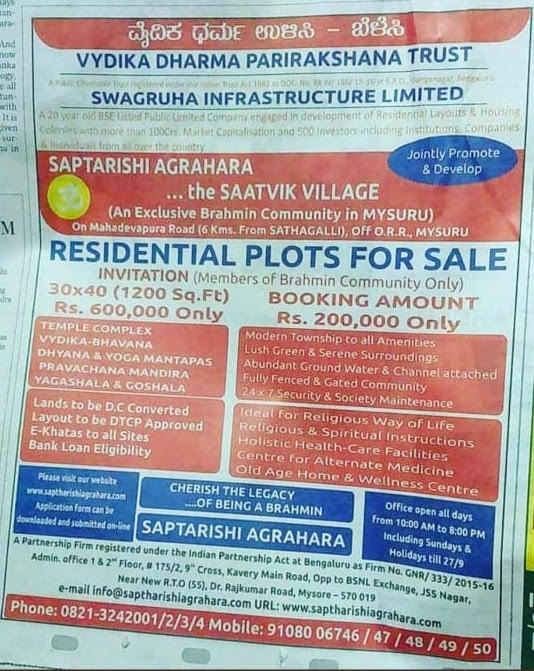
A recent advertisement for Brahmin-only housing.
If we follow the nomenclature used in the constitution, and the logic of the Bombay high court and Ministry of Information and Broadcasting, then the term ‘Brahmin’ should not be used by the media; instead, the only permissible term would be ‘General category’ or ‘Non-Scheduled Castes’ or ‘Other Castes’. Yet Brahmins identify themselves as Brahmins everywhere, including in interviews, press conferences, debates, workplaces, public forums and even in foreign countries.
More recently, a petition demanding a ‘Brahmins Atrocity Prevention Act’ was uploaded on Change.org and sent to the Supreme Court and Prime Minister’s office. Do they even know what an atrocity means?  The Andhra Pradesh government has created a ‘Brahmin Welfare Corporation’ and has allotted Rs. 200 crore for it.  Is it not illegal for the government to use the term Brahmin? Does anybody have the courage to ban this as unconstitutional?
Names as oral caste certificates
Even in an age as advanced as this, the caste Hindus continue to carry caste names as surnames. Mishra, Pandey, Bharadwaj, Deshmukh, Deshpande, Kulkarni, Desai, Patil, Jothi, Kaul, Trivedi, Chaturvedi, Agnihotri, Mukherjee, Chatterjee, Acharya, Goswami, Desai, Bhat, Rao, Hegde, Sharma, Shastri, Tiwari, Shukla, Namboothiri, Iyer, Iyengar and what not.
Brahmins use their caste names as surnames with much pride. Indians across the country may differ from one another when it comes to language, culture and food habits. But if there is one aspect that connects someone living in Kashmir with somebody in Kanyakumari, it is their caste.  In Kashmir, he is a Bhat, in Punjab Sharma, in Gujarat Trivedi, in Maharashtra Gokhale, in Bengal Mukherjee, in Odisha Mishra, in Assam Goswami, in Karnataka Acharya, in Andhra Shastri, in Kerala Namboothiri, In Tamil Nadu, Iyer. Whatever their cultural differences, caste brings together the Brahmins from various states.
It is perhaps for this reason that the habit of using caste as a surname was created. The surname could be an oral caste certificate. The name alone would suffice to open all doors. They could have a cakewalk to the top. This is how Brahmins across the country occupy dominant positions in virtually all fields.
The use of caste names is the rule for all 6000 castes in India. One could be identified as Brahmin, Kshatriya, Vaishya, Sudhra or Panchama by name and accordingly, demarcation lines are drawn. Caste Hindus carry their caste surnames with pride while the oppressed communities do it with shame. This has not attracted any attention even in this modern age. No one seems perturbed by the fact that they carry surnames that perpetuate the dominant-slave system. It is surprising that even progressives, rationalists, women rights activists and rights defenders who speak against caste discrimination seem not to be conscious about their surnames, which denote their castes.
Indian progressives believe caste operates outside, only among common people. But to every Indian, either progressive or conservative, caste operates deep within the human mind. Ambedkar says it operates in the unconscious mind. It is so much a part of their being that they do not realise they carry caste markers in their names. How can caste be annihilated when someone who fights against it also carries their caste identity in their name?
Whatever their cultural differences, caste brings together the Brahmins from various states. It is perhaps for this reason that the habit of using caste as a surname was created. The surname could be an oral caste certificate. The name alone would suffice to open all doors.
The problem of Indian progressives – the educated generations – is precisely this. They do not apply the same rule to themselves that they would apply to others when it comes to caste. So caste is protected as belief, as tradition and ritual in every household. Had Indian liberals followed a minimum level of honesty on the question of caste, they would have made a lot of difference.
The irony is that even women who vehemently oppose Hindutva do not feel guilty about carrying caste surnames. The fact is that the caste Hindu system considers women lower creatures. Even if they carry caste surnames such as Seshadhri, Mishra, Sen, Patkar, Rai, Karat, Iyer or Iyengar, women are lowly creatures according to caste Hindu beliefs. The Manusmriti says those who have sinned in their previous births are born as women. Both Periyar and Ambedkar have written extensively on the status of women in Hinduism. Any self-respecting woman, after reading them, would refuse to carry caste surnames.
“Religion says a woman is not fit for freedom at any level. A woman as a child should be supervised by her parents, and in her youth by her husband. She should be supervised by her children at her old age and cannot be left independently says Manusmriti. The religious text says that since women have been created as prostitutes at their birth by the Gods, they should be carefully guarded.”
This is part of Periyar’s speech published in Kudi Arasu dated February 5, 1933.
How Tamil Nadu dropped its caste names
It was Periyar’s clarity on caste that led to abolition of the practice of having caste surnames in Tamil Nadu. In keeping with the ethics that those working for the annihilation of caste should first be shorn of caste themselves, the first Tamil Provincial Self Respect Conference at Chengalpet in 1929 (conducted by the Self Respect movement) passed a resolution abolishing caste surnames. One can only imagine how aggressive the Brahmin hegemony would have been then. Yet Periyar, along with many others, got rid of their castes. He took the oath ‘I, E. Ve. Ramasamy Nayakkar from now onwards would be called E. Ve. Ramasamy’. Periyar took part in many meetings of caste organisations but everywhere he exhorted the crowd to abolish their caste surnames.
Periyar. Credit: Twitter
Today, we do not have individuals carrying caste surnames in Tamil Nadu. The state achieved this without a government order or an act. The consciousness of society evolved to a point where it became an act of incivility – something that invited ridicule – to carry caste surnames. Most Brahmins also did away with their caste surnames. Anyone using caste names to gain political mileage here has never been able to win. Cultural changes can only be brought about by the change of hearts and awareness among the public; never by laws. How sad it is that only in Tamil Nadu has there been this cultural change, and nowhere else,
To carry caste surnames is the most humiliating thing that Dalits are forced to encounter in open every day. People might ask how it is demeaning to someone else if they carry their castes in their names. When a Brahmin is introduced as an Iyer or Trivedi in a public place, is it not inherently humiliating to the Dalit present there? If you are a Brahmin, what am I – this is a question that remains unanswered yet stays there. When a person from a dominant caste gives her name with the caste surname to a Dalit, she reminds the Dalit of her own caste – causing hurt without knife or blood.
There are so many debates around caste, so much literature is being written on the subject, and so many protests around caste issues. Ambedkar, the father of the Indian constitution, has written over 10,000 pages on caste. If all this cannot influence an educated mind, what does it mean? Because it helps them, because it gives them power and domination, educated caste Hindus do not want to do away with caste. They carry castes as their culture even if they settle abroad. The principle of equality followed in many countries does not touch them in any way. They will be rattled and protest if there is an ethnic attack or taunt against a person of Indian origin. But whatever they do to Dalits is ‘culture’.
Caste as crime
Caste Hindus who refuse to do away with their caste names are angry about community certificates asked for in schools. They complain that it is only because of community certificates that the caste system exists, yet they carry community certificates in their own names. We could make a list of hundreds of public personalities across the country including politicians, scientists, writers, actors, activists, environmentalists, communists, rights activists and journalists who carry caste surnames. They do not deem it fit to correct themselves before they set out to correct the society. This is the reason why Indian democracy failed.
In  Ambedkar’s time, only untouchability was made a crime. However hard he fought, he could not make caste a crime. If India had people with a pure conscience, this task would have been accomplished in the 70 years of independence. If caste were to be made a crime in the constitution, caste Hindus would not be able to flaunt it as culture and deceive the international community. The ignominious practice of carrying caste surnames as family names would have come to an end.
But instead, caste rituals are revived and given a new lease of life in this generation too. It is easy to ask a person for his caste. Matrimonial advertisements openly name the dominant castes. Is this not an insult to Dalits? The newspapers that run these ads do not carry advertisements for Dalit sub-sects like Pallars, Paraiyars or Arundhathiyars. Is this not discrimination? Is this not untouchability? An actor advertising a household product says that he has come to the house of  Mrs. Iyer. Couldn’t the advertisers get another name for the woman? These kinds of advertisements humiliate the Dalits who watch television every day. This subtle domination is dangerous. It spreads across discreetly, like cancer. But who will ask to ban this?
If the courts and the government are really concerned about the dignity of the Dalits, let them declare all the 6000 caste names including ‘Brahmin’ as illegal, unconstitutional. Until the caste Hindus become cultured and civilised and get rid of caste surnames at all levels – if not their own then at least that of their children and of future generations – the term Dalit will stay, to remind them of the inequality and injustice prevailing in society.
Jeya Rani is a journalist based in Chennai.
Translated from the Tamil original by Kavitha Muralidharan

August 24, 2018

India: On ground, BJP works to woo Dalits, OBCs

The Indian Express

Social engineering: On ground, BJP works to woo Dalits, OBCs by handing key posts

The developments in the Hindi heartland states over the past few months is being seen as a concerted attempt to chip away at caste combinations that are held as key voter base of opposition Congress, Samajwadi Party and the Bahujan Samaj Party.
Written by Lalmani Verma | New Delhi | Updated: August 24, 2018 7:03:05 am
Social engineering: On ground, BJP works to woo Dalits, OBCs by handing key posts
X
Among three new Governors appointed this week, Satyadev Narayan Arya (Haryana Governor) and Baby Rani Maurya (Uttarakhand) are from the Dalit community. (Picture for representational purpose)
 
In what is seen as an attempt to counter the Opposition’s allegations that the BJP-led NDA government is against reservation, the saffron party is giving representation to leaders from Scheduled Caste (SC), Scheduled Tribes (ST) and Other Backward Classes (OBC) communities in recent selection for appointment of Governors as well as Rajya Sabha and Legislative Council election candidates.
The developments in the Hindi heartland states over the past few months is being seen as a concerted attempt to chip away at caste combinations that are held as key voter base of opposition Congress, Samajwadi Party and the Bahujan Samaj Party.
Among three new Governors appointed this week, Satyadev Narayan Arya (Haryana Governor) and Baby Rani Maurya (Uttarakhand) are from the Dalit community. The third, Satya Pal Malik, is a Jat from western UP, a community that had overwhelmingly backed the BJP in 2014 Lok Sabha polls but now a section is seen as gravitating towards the RLD.
Both Haryana and Uttarakhand has significant population of Dalits. A former mayor of Dalit-dominated Agra, Baby Rani Maurya is a Jatav who had held positions in BJP’s national SC morcha in the past and is at present a member of the BJP national council. BJP insiders said she had been active especially among women from Dalit and backward caste background through Seva Bharti programmes.
Last month, Ram Shakal, a leader from Mirzapur in UP was nominated to Rajya Sabha. A former RSS man, Ram Shakal has been a three-time MP from Robertsganj Lok Sabha constituency in Sonbhadra district of eastern UP, which has a large Dalit population.
In Rajya Sabha elections held in March in UP, Bihar, Rajasthan, Madhya Pradesh and Jharkhand, the BJP had given tickets to four candidates from OBC communities, two from ST and one SC. In the Legislative Council elections of UP and Bihar in April, it had named two SCs and one OBC, and left one seat in UP for ally Apna Dal’s president Ashish Singh Patel, who comes from an OBC background.
In Rajya Sabha polls, four BJP candidates from OBC communities were Madan Lal Saini from Rajasthan, Kailash Soni (MP), Sakal Deep Rajbhar and Harnath Singh Yadav (both from UP).
According to BJP leaders in MP, apart from the caste factor, another reason for selection of Kailash Soni was that he is the national president of Loktantra Senani Sangh. “There is a large number of veterans in MP who had been booked under MISA when Emergency was imposed in the country. They had been in Jan Sangh and other parties,” a BJP leader said.
In UP, Harnath Yadav comes from Mainpuri, a Samajwadi Party bastion. The move is seen as an attempt to dent the SP’s Yadav vote-bank.
Likewise, the election of Sakal Deep Rajbhar, an OBC from eastern UP, where backward caste Rajbhars form a significant chunk of the electorate, is seen as a bid to counter Om Prakash Rajbhar, a UP minister and the chief of ally SBSP, who has often shown a rebellious attitude.
For Rajya Sabha, the BJP gave tickets to two leaders from ST background: former Lok Sabha MP Kirodilal Meena in Rajasthan and Samir Oraon in Jharkhand. The Oraon caste is the second largest ST population in Jharkhand and has influence in nearly a dozen Assembly segments and Lok Sabha constituencies of Ranchi and Lohardaga.
The BJP also sent Kanta Kardam to Rajya Sabha from western UP. She is a Jatav, a community considered a strong vote base of the BSP.
Kardam had lost the mayor election from Meerut last year when the seat was reserved for SCs.
Her selection is being seen as a move by the BJP to woo Dalits amid some caste tension in the region following clashes between Dalits and Thakurs in Saharanpur last year, apart from some other areas.
Of the Legislative Council candidates, Ashok Kataria comes from the OBC Gurjar community, which has influence in western UP. The party had named Vidya Sagar Sonkar, from SC community, who is presently BJP’s UP general secretary.
In Bihar, it had given ticket to Sanjay Paswan, a Dalit leader who was a Union minister in the Atal Bihar Vajpayee government.

India: Which party for dalits Today?

Which party cares for Dalits Today?
Ram Puniyani
Recently anti-dalit atrocity laws were first diluted inserting the clause of anticipatory bail. Following this there were serious protests all over. In these protests, the anti dalit nature of present ruling dispensation, BJP led NDA was highlighted. Under the pressure of the protests, the government had to bring in a bill to restore its previous provisions. The Lok Sabha on Monday (August 6, 2018) unanimously passed a Bill to reverse the effects of a Supreme Court order concerning certain safeguards against arrests under the SC/ST law. The amended ‘Scheduled Castes and Scheduled Tribes (Prevention of Atrocities) Amendment Bill, 2018’, now rules out any provision for anticipatory bail for a person accused of atrocities against people from SC or ST communities, as it stood before the revision. Ram Vilas Paswan, part of NDA, thanked the Prime Minster and also criticized the Congress on the occasion. To show that Congress is anti Dalit he raked up the elections in which Congress had contested against Ambedkar. Ram Vilas Paswan’s own allegiance to Ambedkar ideology is strongly under cloud, as he is allying and empowering BJP, the party with agenda of Hindu Rashtra, something which was an anathema for Ambedkar as he stood for social justice, secularism and democracy.

As Paswan was well described as Mausam Vaigyanik, (Scientist predicting weather) who in order to remain in power always twists and turns and makes the ideological compromises. His own ideology is that of hunger for power and his words in a way should not matter much except on electoral chess board. His projection of the electoral battle between Ambedkar and Congress is a very selective presentation of the relationship between Congress and Ambedkar. While he points this out he forgets that Ambedkar was not a member of Congress party any time. Also that it is the same Congress party in whose government he was made the Cabinet minister. He needs to be reminded that not only was he minister in the first Cabinet of India, he was also made the Chairman of Drafting Committee of Indian Constitution, in which Babsaheb played a pivotal role. To cap this it was he who was requested to draft the Hindu Code Bill, a major step to reform the family laws towards gender just society.

While the likes of Paswan, hankering after power do mouth the name of Ambedkar, they deliberately forget that the major opponents of Constitution drafted by him, the major opposition to Hindu Code bill came from the stable of RSS, the parent organization of the party, in whose alliance he is enjoying the perks of power. One can say that his ally BJP’s agenda of Hindu Rashtra is polar opposite to the dream of Babasaheb, the dream of Liberty, Equality and Fraternity, the dream of secular democratic India. RSS never hesitated in criticizing the Indian constitution, calling it Western; BJP never severed its umbilical cord to the Hindu nationalist RSS. Lately from within BJP itself from top down, Hindu nationalism is being propagated and practiced.

On the eve of 2014 general election Narendra Modi, the Prime Ministerial candidate himself pronounced that he was born in a Hindu family; he is a nationalist, so he is a Hindu nationalist. Another minister in the Center, Anant Kumar Hegde stated that BJP is there to change the Indian constitution and that secular identity should not be used by the people. To cap it all the UP Chief Minster Adityanath Yogi stated that Secularism is the biggest lie of Independent India. BJP itself is very consciously walking the rope, balancing the phrases and actions as for as dalits are concerned. On one hand power-lust of some dalit leaders like Paswan, Udit Raj and Ramdas Athwaley are used to give a pro dalit veneer to BJP’s actions, on the other hand likes of Hegde and Yogi are forthright about their political agenda. It is also true that for the sake of electoral equations even BJP has to pay obeisance to Ambedkar, despite having and agenda totally opposed to his political ideology.

At ground level the impact of BJP-NDA, of which likes of Paswan are members, has affected dalits in a very serious way. While through social engineering they are also trying to woo a section of dalits through manufactured icons likeSuhel Dev and Shabri Mata among others, they have unleashed policies which affect the dalits in a very adverse way. The merciless beating of dalits in Una, which Paswan dismissed as a minor event, the emotive issue of Holy cow has affected the livelihood of dalits in a big way. We also remember that it is during this period that institutional murder of Rohith Vemula and the anti dalit attack at Bhima Koregaon tormented the dalit community no end. Even Modi Government on its own did dilute the Anti Dalit atrocity act, only once they saw a serious opposition to their move that they were forced to retreat for electoral calculations.

While BJP pays tribute to Ambedkar on one side, at the same time it presents Lord Ram as the central icon of its politics. What Ambedkar has said about Lord Ram in his various writings like ‘Riddles of Hinduism’ is well known to us. For BJP, what is important is to garland Babasaheb; it is of no consequence to them to take the issues of social justice in any serious way. The attempt to selectively present the electoral battle of Congress and Ambedkar is a deliberate ploy to undermine the efforts which national movement and Mahatma Gandhi-Congress did to fight against untouchablity in particular. We have miles to go as far as Babasaheb’s dream is concerned, but one thing which Ambedkar pointed out was that Hindu Raj will be a big tragedy for dalits of the country. It is too much to expect that likes of Paswan will realize their folly of allying with BJP-RSS whose very agenda is inherently anti-dalit, as they are blinded by lust for power!

June 08, 2018

India: Who Are Sambhaji Bhide & Milind Ekbote? Did Have Role in Bhima Koregaon Violence ?

The Quint

Bhima Koregaon Violence: Who Are Sambhaji Bhide & Milind Ekbote?

As the ripples of the Bhima Koregaon clashes spread throughout Mumbai, everyone is asking the same question — how did the violence begin? On Monday, an FIR was filed against two men — Milind Ekbote from Samast Hindu Aghadi and Sambhaji Bhide of Shiv Pratishthan Hindustan for sparking stone-pelting and the subsequent violence.
But who are the men at the center of the violence against Dalits in Maharashtra and the ensuing chaos in the state? Here's a quick look.

Sambhaji Bhide and His PM Modi Connection

Known as 'Bhide Guruji' by his followers, 85-year-old Sambhaji Bhide is no stranger to controversy. In 2008, he led the protests against Ashutosh Gowariker's historical romance film Jodhaa Akbar, and was booked for ransacking theaters and halting screenings of the movie. A year later, he sparked unrest in Sangli in Maharashtra over the depiction of an "artist's impression of assassination of Adil Shah's army commander Afzal Khan by Shivaji Maharaj", reports Mumbai Mirror.
When Prime Minister Modi visited Sangli, also Bhide's hometown, in 2014, he praised Bhide and is reported to have said, “I did not come to Sangli on my own, but I was given orders by Bhide Guruji to visit his city, and here I am.” Here’s a video of PM Modi speaking about Sambhaji Bhide. (Note: The Quint is unable to independently verify the authenticity of the attached video.)
A physicist by training, Bhide completed his MSc in nuclear physics and was a professor of physics at Pune's Fergusson College. Later, he joined the Rashtriya Swayamsevak Sangh (RSS) as a pracharak and founded an organisation called "Shiv Pratishthan Hindustan." Shiv Pratishthan Hindustan focuses on spreading the teachings and information on the life of Shivaji Maharaj and his son Sambhaji Maharaj. Despite his age, Bhide has a significant following among the young in areas like Sangli, Kolhapur and Satara and has an impressive social media following on Facebook.
A screenshot of Sambhaji Bhide’s page on Facebook.
(Photo: Facebook/Sambhajirao Bhide Guruji)

Milind Ekbote

56-year-old Milind Ekbote has been in an out of power in Pune, as a BJP and Shiv Sena corporator. His first stint was in 1997, when he was a BJP corporator in the city. In 2002, he was denied a ticket, and lost the election on an independent ticket. But with his organisation, 'Hindu Ekta Manch' in 2007, he came into prominence by leading protests against Valentine's Day. He has 12 cases of rioting, trespassing and other charges against him, out of which he has been convicted in five, reports Mumbai Mirror.
Responding to the Bhima Koregaon violence, Ekbote has issued a statement where he says he is “saddened by the inconvenience caused to Dalits due to rioting after their visit to Bhima Koregaon”, and has condemned “the act of rioting,” reports The Indian Express. Commenting on Dr BR Ambedkar, he added that he considers them as “icons.”

April 29, 2018

India: Bajrang Dal activist forcibly converted a Dalit man back to Hindusim in Uttar Pradesh's Shamli


SCREENSHOT FROM FACEBOOK VIDEO
In another horrific story of caste and communal violence, Bajrang Dal activist forcibly converted a Dalit man back to Hindusim in Uttar Pradesh's Shamli on Tuesday after he had converted to Islam on Monday.
https://www.huffingtonpost.in/2018/04/26/shamli-bajrang-dal-activist-force-ghar-wapsi-on-dalit-man-who-had-converted-to-islam_a_23420600/

April 28, 2018

India: Drop the term Dalit, stick to SC/ST, RSS tells its workers

Hindustan Times

Drop the term Dalit, stick to SC/ST, RSS tells its workers

Last week, the ministry of social justice and empowerment pointed out that the term Dalit “does not find mention in the Constitution of India or any statute”.

india Updated: Apr 24, 2018 23:48 IST
Smriti Kak Ramachandran
Volunteers of Rashtriya Swayamsevak Sangh in Mumbai.
Volunteers of Rashtriya Swayamsevak Sangh in Mumbai. (REUTERS File)
The Rashtriya Swayamsevak Sangh (RSS) wants its volunteers to avoid using the word Dalit, which it considers a colonial appendage with derogatory connotations, senior functionaries from the group said.
A senior RSS official, speaking on condition of anonymity, said the RSS brass now wants its volunteers and those associated with its many affiliates to opt for the “constitutionally approved terms Scheduled Castes (SC) and Scheduled Tribes (ST)” instead.
Alok Kumar, the international working president of RSS offshoot Vishva Hindu Parishad (VHP), said the Sangh feels the terms SC and ST are more appropriate as it has constitutional sanction.
“SC/ST is a term that has no castigation and is not derogatory,” he said.
Last week, the ministry of social justice and empowerment wrote to all states and government departments, in the wake of a Madhya Pradesh high court verdict, to refrain from using the nomenclature ‘Dalit’ for members of the SC/ST communities.
The ministry pointed out that the term Dalit “does not find mention in the Constitution of India or any statute”.
According to D Shyam Babu, a Dalit academic at the Centre for Policy Research, the word Dalit in Marathi means broken or downtrodden, and its usage was popularised by Dr BR Ambedkar.
The RSS and its affiliate, the Bharatiya Janata Party (BJP), are making attempts to mend caste fault lines that they perceive as a threat to the party’s cohesive Hindu vote bank by weaning away the Scheduled Castes, tribes and other backward classes from other political parties. In the wake of cases of atrocities against Dalits in Gujarat, Rajasthan and Uttar Pradesh and the Bhima Koregaon violence in Maharashtra earlier this year, the RSS has already sounded an alarm on the potential electoral costs that caste fractures could inflict on the BJP as its heads into the 2019 elections.
As per Census 2011, the percentage of Scheduled Castes in the country is 16.6% and Scheduled Tribes is 8.6%.
Through its renewed Samajik Samrasta (social harmony) campaigns — having meals and spending a night at the homes of members of the SC/ST communities and pushing for anointment of priests from the communities — which have been emulated by the BJP, the Sangh is trying to prevent the cracks from widening. A few Sangh fucntionaries said a change in nomenclature would help erase the “still prevalent biases”.
But former Rajya Sabha MP Bhalchandra Mungekar of the Congress party, who is also a Dalit, described the move as “politically motivated”, saying the term Dalit denotes the stigma of untouchability, which is now outlawed.
“The term Dalit has been used to denote all socially, economically and educationally exploited and politically backward communities. It is inclusive. This sudden need to drop the term, which is now used internationally, is nothing but an attempt to divide the Dalit movement,” he said.
RSS thinker Rakesh Sinha, however, said the term SC/ST is the “most legitimate term that does not show any radical posturing to a particular community, unlike the term Dalit”.
“With the change of relationship between state power and social forces, a new connotation takes birth and gets a legitimate space. Earlier the marginalised people in Hindu caste system were called untouchables, colonial state addressed it in a more secular manner by calling them depressed classes. Then Mahatma Gandhi changed the narrative with the sociology-spiritual term Harijan that is still used in many parts of rural India. The connotation SC,unlike Dalit, has been approved by the Constituent Assembly headed by none other than Babasahab Ambedkar,” he said.
“The official nomenclature has always been SC/ST, but there have been various terms used, for instance first it was depressed classes then SC/ST, in between there was Harijan. But the word Dalit has been picked by the communities themselves. It is how they identify themselves and take pride in; how can Dalits be stopped from using this word, which they have picked,” said D Shyam Babu.

April 12, 2018

India: Dilution of the provisions of the Scheduled Castes and Scheduled Tribes (Prevention of Atrocities) Act and Dalits’ anger may spell the end of Modi magic

The Asian Age

Dalits’ anger may spell the end of Modi magic
Bharat Bhushan

Published : Apr 12, 2018, 5:47 am IST

The Supreme Court ruling comes in the wake of the increasing atrocities against the dalits under BJP rule.

Prime Minister Narendra Modi has asked all BJP MPs to spend two nights each in a dalit village. (Photo: PTI)

The Narendra Modi government virtually allowed the dilution of the provisions of the Scheduled Castes and Scheduled Tribes (Prevention of Atrocities) Act. Hoping that the courts will rule on issues which the political executive is shy of addressing directly can be a recipe for disaster.

In the face of the rising dalit anger, however, the government has gone into damage control mode. The BJP and the Rashtriya Swayamsevak Sangh (RSS) have sent teams to various states to contain the political damage. Prime Minister Modi has asked all BJP MPs to spend two nights each in a dalit village. And there will be a mega-event on Dr B.R. Ambedkar’s birth anniversary on April 14, with high rhetoric flowing from the Prime Minister himself.

However, the BJP is unlikely to remain unsinged by the dalit anger. The dalits’ perception seems to be that their fortunes are sliding as the legal and constitutional provisions safeguarding their interests are being systematically dismantled.

The Supreme Court ruling comes in the wake of the increasing atrocities against the dalits under BJP rule. A dalit youngster can be beaten or even killed for daring to ride a horse to his own wedding or for sporting a moustache. The only time upper caste goons forget about untouchability is when they rape dalit women. From Una, Shaharanpur and Bhima-Koregaon to Gwalior more recently, there has been an unprecedented display of arrogance towards dalits by politically emboldened upper caste Hindus. That is why the BJP’s protestations about protecting dalit interests lack any credibility.

Given the party’s largely upper caste support base, it has in fact been in favour of diluting the provisions of the SC/ST Act. This was one of the critical demands of the Maratha agitation after the rape of a girl from their community in Kopardi village in Maharashtra in 2016. Maharashtra chief minister Devendra Fadnavis had assured the agitators that he would recommend reviewing the provisions of this law to the Centre. Fearful of losing the Maratha vote, the BJP was keen to have a less stringent law.

Some in the Opposition have even suggested that the Central government was complicit in these developments. They point to the government not directing either of its two top law officers — the attorney-general or the solicitor-general — to defend the existing provisions of the law. The government was instead represented by the additional solicitor-general. He admitted that the government had received certain complaints about misuse of the provisions and argued that anticipatory bail should be granted in cases registered under the SC/ST Act.

Not only did the government not mount a vigorous legal defence in the Supreme Court, it also did not move a review petition immediately after the ruling. A senior dalit leader and a minister in the government, Thawar Chand Gahlot, who had immediately alerted the government to the impending trouble, was ignored. Only when the BJP’s allies and ministers Ramdas Athawale and Ram Vilas Paswan began speaking out against the court ruling that the government decided to act. The ruling came on March 20 and the review petition was filed two weeks later, on April 2, with the attorney-general himself appearing in court, on the very day dalits across the country had called a Bharat Bandh against the order.

By this time, however, the ground had shifted. Even the dalit leaders of the BJP had started rethinking their future. Five dalit MPs from the party — Ms Savitribai Phule from Bharaich, Mr Chotelal Kanwar from Robertsganj, Mr Ashok Kumar Dohrey from Etawah, Dr Yashwant Singh from Nageen and Mr Udit Raj from North-West Delhi constituencies — raised the red flag about the party’s attitude towards dalits. While Mr Udit Raj vented his anger on the social media, the rest wrote angry letters to the Prime Minister. They alleged discrimination in the party against dalits, threats to removing reservations for SCs and STs and police brutality against those who had protested against the Supreme Court’s order on April 2.

It is not surprising that four of the five protesting dalit MPs were from Uttar Pradesh, which has 21 per cent dalit population. They reflected the palpable fear in the party that the dalit vote which it had mobilised successfully in 2014 was likely to slip away. Not only could the dalit vote shift, it could also catalyse an alliance with the Other Backward Castes (OBCs) and Muslims for the 2019 general election.

The OBCs also think that they are being targeted. The common perception of Yadavs in Bihar is that their leader, Mr Lalu Prasad Yadav, has been singled out for punishment while all upper caste leaders accused in the fodder scam were discharged; and that he continues to be denied bail while Salman Khan was given bail within 48 hours of conviction. These perceptions may not have a legal basis, but they have strong political implications. There is also a strong suspicion that the BJP-RSS combine is keen to do away with OBC and dalit reservations — RSS chief Mohan Bhagwat has repeatedly called for a review of the policy. His statements have emboldened the upper castes to mount anti-reservation protests.

As for Muslims, who form 15 per cent of the total population, the Hindutva forces in the past four years have attempted to reduce them to second-class citizens by setting up a series of hoops they must jump through to prove their nationalism. Hate crimes against them have gone up and they have been targets of lynching in the name of cow protection. From 2012 till now, it is estimated that 97 per cent of all cow-terrorism deaths have taken place since the BJP assumed power in 2014 — that is 76 people killed, most of them Muslims. And they have been killed mostly in North India.

The ground is fertile for forging political unity among dalits, OBCs and Muslims. In North India, that could make things very tough for the BJP in 2019. Such an alliance is already taking shape in Uttar Pradesh and could soon spread to other Hindi belt states. It’s in this alliance of disgruntled communities which have borne the brunt of Mr Modi’s misgovernance that he may eventually get his comeuppance.

The writer is a senior journalist based in New Delhi.

February 15, 2018

India: Full Text of statement Condemning Violence Unleashed by the Police and the RSS Outfits Against Dalits in Vadayampady, Kerala

We the undersigned express our grave concern over the brutal violence unleashed by the State Police and the RSS outfits against the Dalits in Vadayampady in Kerala. Dalits in Vadayampady are protesting over a year now against the ‘Caste Wall’ built by the upper caste blocking Dalits from entering into the common space/playground used by the public for decades. The peaceful protest by Dalits against the wall of exclusion is met with brutal attacks by the police force of the state commanded by CPI-M led left government, as well as by the upper caste in the locality led by the RSS. It is indeed shocking that the police manhandled and arrested those who went to Vadayampady in solidarity, and also to participate in Dalit Self Respect Convention, including well-known activists and writers such as K.K. Kochu, K M Salim Kumar, C S Murali, Mrudula Devi Saidharan, Dr. Dhanya Madhav, Dr. P G Hari, KK Baburaj, and Gomathi Augustine of Pembillai Orumai.

Ironically, the police acted as spectators when the RSS attacked the Dalit protesters. The violence in Vadayampady is one among the several recent instances of the police brutality and connivance in the RSS led onslaught against Dalit protestors and media reporters in the state. It is alarming that even the state police forces commanded by a left government is colluding with the right wing religious extremists to protect the interest of the upper caste, their illegal claims and acts of social segregation. This and the subsequent inaction by the law enforcing agencies had enabled a vacuum in law and order leading to physical and verbal assault against poet Kureepuzha Sreekumar by the RSS outfits on his way back to his home after declaring his solidarity with the Dalit protesters. We strongly condemn the attack on Kureepuzha Sreekumar.

We are also concerned about the cold response of the government and the left parties who attempt to side-line the police violence as a ‘minor issue’. CPI-M and other left parties in the government are supposed to be part of the progressive forces of the country. But it is felt that the Dalit-Adivasi agitators are often portrayed by even the dominant left as Maoists/anarchists/terrorists in their attempt to strategically delegitimise the Dalit-Adivasi Struggles. We are afraid that this would result in the weakening of fight against various social injustices  while increasing the attack on the marginalised groups in the country. The current Dalit struggle in Vadayampady which has been ongoing for more than a year has roots in how Dalits, Adivasis and other marginalized groups in Kerala have been discriminated against accessing public places, and deprived of land and resources by both left and right wing governments.  We feel strongly than ever now that the situation of state forces colluding with right wing religious forces unleashing violence against Dalit protesters in Kerala is equally alarming that of the cases of from elsewhere from the country and needs to be resisted. We call forth all the progressive forces in the country and beyond to contempt and challenge the increasing violence against the Dalits and urge those agencies whose mandate to uphold the values and rights promised in the constitution to take steps to bring the culprits before the law in a befitting manner.

Signatories:

1. Ruth Manorama, National Convenor, National Federation of Dalit Women, Delhi
2. Anand Teltumbde, Writer, political analyst and civil rights activist with CPDR, Maharashtra
3. Gajendran Ayyathurai, Postdoctoral Fellow and Study Advisor, Centre for Modern Asian Studies, University of Gottingen, Germany
4. Sharika Thiranagama, Assistant Professor, Department of Anthropology, Stanford University, United States
5. Virginius Xaxa, Professor of Eminence, Tezpur University, Assam
6. M. Kunhaman, Professor, TISS, Mumbai
7. Rupa Viswanath, Professor, Centre for Modern Asian Studies, University of Gottingen, Germany
8. A.K. Ramakrishnan, Professor, School of International Studies, JNU, Delhi
9. K. Satyanarayana, Professor, EFLU, Hyderabad
10. Sanal Mohan, Associate Professor, School of Social Sciences and Hon. Director, IUCSSRE MG University, Kerala
11. Asha Kowtal, General Secretary, Dalit Mahila Adhikar Manch
12. M. Amruth, Historian and Sociologist, KFRI, Thrissur, Kerala
13. T.M. Yesudasan, Retired Professor and Writer, Kerala
14. K.S. Madhavan, Writer, Associate Professor, Department of History, University of Calicut
15. Cynthia Stephen, Writer and Researcher
16. Sylvia Karpagam,  Public health doctor and researcher.
17. Ravichandran Bhathran, Founder of Dalit Camera
18. Karthik Navayan Batulla, Writer, Human Rights Activist
19. Irfan Engineer, Director of CSSS, Mumbai
20. Sruthi Herbert, SOAS, University of London, United Kingdom
21. M.B. Manoj, Assistant Professor, Department of Malayalam,  University of Calicut
22. Vikramaditya Thakur, Assistant Professor, University of Delaware, United States
23. Rekha Raj, Programme Manager-Women Rights, Amnesty International, Bengaluru
24. Rajesh Komath, Assistant Professor, School of Social Science, MG University, Kottayam
25. Parthasarathi Muthukaruppan, Assistant Professor, EFLU, Hyderabad
26. Sumeet Mhaskar, Associate Professor and Associate Dean of Student Affairs, O.P. Jindal Global University , Delhi.
27. Abhilash Thadathil, Assistant Professor, Centre for Development Studies, Thiruvananthapuram
28. Mythri Prasad-Aleyamma, Associate Fellow, Institute of Human Development, New Delhi
29. Anish Vanaik, Assistant Professor, O.P. Jindal Global University, Delhi
30. Varsha Ayyar, Assistant Professor, Centre for Labour Studies, TISS, Mumbai
31. T.V. Sajeev, Scientist, KFRI, Thrissur
32. Brahmaputhran, Daya Hospital, Thrissur
33. Prashanth Bansode, Associate Professor, Gokhale Institute of Politics and Economics, Pune
34. Satheesh Kumar, Assistant Professor, History, University College, Thiruvananthapuram
35. M.V. Bijulal, School of International Relations and Politics, MG University, Kottayam
36. N. Gopakumaran Nair, HoD, History, University College, Thiruvananthapuram
37. K.M. Sheeba, Associate Professor, Department of History, Sree Sankaracharya University, Kalady, Kerala
38. Dickens Leonard M,  Guest faculty, Univ. of Hyderabad.
39. Mythri P.U., School of Distance Education, University of Calicut
40. Manju E.P. PhD Research Scholar, Univ. of Hyderabad
41. Sanjay Kumar Paswan, Independent research consultant for social sector agencies, Patna
42. R. Manohar, Regional Coordinator, Human Rights Defenders Alert India
43. Dr K. Babu Rao, Human Rights Forum, Hyderabad
44. Sukla Sen, Peace Activist, Mumbai
45. Subhash Gatade, New Socialist Initiative
46. Siddharth, Independent Researcher, Bengaluru
47. Jayaseelan Raj, Assistant Professor, Centre for Development Studies, Thiruvananthapuram, Kerala
48. Maya K.S, Writer, PhD Research Scholar, Christ College, University of Calicut, Kerala
49. Prameela, Assistant Professor, Sanskrit Sahitya, Sree Sankaracharya University, Kerala
50. Jentle Varghese, Guest Lecturer, Government College, Kottayam, Kerala
51. Chandran Komath, Assistant Professor, Government College, Kottayam, Kerala

January 24, 2018

India: Involvement of radical Hindutva elements in Bhima Koregaon violence - Pune Mayor | Sabrang India report

“Involvement of radical Hindutva elements in Bhima Koregaon violence: Pune Mayor”

Written by Sabrangindia Staff | Published on: January 23, 2018
Evidence has been mounting regarding the involvement of Sambhaji Bhideand Milind Ekbote in Bhima Koregaon violence. In a ground breaking fact finding report, Mayor of Pune Siddharth Shende has alleged, “There is sufficient evidence against them [Bhide and Ekbote] available in the public domain in terms of audio-visual proof.. The duo has played a major role in instigating the Hindutva-minded vandals to target Dalits and their vehicles and they must be arrested at the earliest. They had a major role in injecting communalism in the minds of the innocent villagers to achieve the objectives of extreme Hindutva,”

Bhima Koregaon Violence
Image Courtesy: www.justicenews.co.in

The ten member fact finding and co-ordination team was appointed by Pune rural police to find out the main cause of the violence that ensued at Bhima Koregaon on January 1. The committee filed its report on January 20.

Meanwhile, the Special Inspector General of Police (SIG), Vishwas nangra Patil however alleged that the report was entirely wrong and misleading. He said, ““The government will issue a clarification in this regard soon,” he said.

Deputy Mayor of Pune, Siddharth Shende who led the team claimed that the Bhima Koregaon riots were pre planned and unlike the portrayal by some sections of media, were not the outcome of a fight between Dalits and Marathas.

Placing the onus where it lies, Mr. Shende said, “A minuscule section of radical Hindutva elements had conspired and targeted the Dalits. The local police also failed miserably in maintaining law and order situation on ground. There was a significant amount of pre-event information available with the police but the local police did not take necessary action in advance, which could have averted the riots”

He also added that all the facts that the team received were of “irrefutable evidential value” and that these will help the police in arresting the real culprits involved in the conspiracy. “The Dalits had written their own narrative of history and valour, which was not supported by a section of people vested interests, who then instigated violence against the Dalits” he added.

Hence, he explained that the main demand made by the committee was to immediately constitute a special investigation team (SIT) to carry out an independent and fair probe into the violence, booking the culprits under the stringent sections of NSA Act. He also said that now the Dalits had to face boycott in these villages.

The fact finding team comprised of 10 members who visited the villages around Bhima Koregaon. Vadhu Budruk, Shikrapur and Sanswadi and other nearby places.

The team comprised of members from the Dalit community, including professor Rahul Makhare, MN Kamble, Vikas Salve, Datta Pol, Shyam Gaikwad, Ramakant Khande, Rajendra Gaikwad, Kiran Shinde and others.

The Akhil Bharatiya Brahman Mahsabha, the staunch Hindutva group demanded the arrest of Siddharth Dhende alleging that they were trying to disturb law and order instead of working toward bringing peace in the society.
 

January 13, 2018

भीमा कोरेगांव: ऐतिहासिक नायकों की तलाश में दलित


-राम पुनियानी
महाराष्ट्र के कोरेगांव में एक जनवरी 2018 को उन दलित सिपाहियों, जो सन् 1818 में पेशवा के खिलाफ युद्ध में अंग्रेजों की ओर से लड़ते हुए मारे गए थे, को श्रद्धांजलि देने के लिए इकट्ठा हुए दलितों के खिलाफ अभूतपूर्व हिंसा हुई।  सन् 1927 में अंबेडकर ने कोरेगांव जाकर इन शहीदों को अपनी श्रद्धांजलि दी थी। दलितों द्वारा हर साल भीमा कोरेगांव में इकट्ठा होकर मृत सैनिकों को श्रद्धांजलि देना, दलित पहचान को बुलंद करने के प्रतीक के रूप में देखा जाने लगा है। इस साल यह समारोह बड़े पैमाने पर आयोजित किया गया क्योंकि इस युद्ध के 200 साल पूरे हो रहे थे। विवाद एक दलित - गोविंद गायकवाड़ - जिसके बारे में यह कहा जाता है कि उसने संभाजी का अंतिम संस्कार किया था - की समाधि को अपवित्र किए जाने से शुरू हुआ। भगवा झंडाधारियों ने उन दलितों पर पत्थर फेंके जो भीमा कोरेगांव मे इकट्ठा हुए थे। शिवाजी प्रतिष्ठान और समस्त हिन्दू अगादी नामक हिन्दुत्व संगठन इस हिंसा के अगुआ थे।
पुणे के शनिवारवाड़ा, जो पेशवाओं के राज का केन्द्र था, में एक सभा को संबोधित करते हुए दलित नेता जिग्नेश मेवानी ने ‘आधुनिक पेशवाई‘ के खिलाफ संघर्ष शुरू करने का आव्हान किया। ‘आधुनिक पेशवाई‘ से उनका आशय भाजपा-आरएसएस की राजनीति से था। जिस सभा में उन्होंने भाषण दिया, वहां दलितों के साथ-साथ अन्य समुदायों के नेता भी उपस्थित थे। इस घटना पर विभिन्न प्रतिक्रियाएं हुईं। कुछ लोग इसे मराठा विरूद्ध दलित संघर्ष बता रहे हैं तो कुछ का कहना है कि यह दलितों पर हिन्दुत्ववादी ताकतों का हमला है। एक ट्वीट में राहुल गांधी ने इस घटना के लिए भाजपा की फासीवादी व दलित-विरोधी मानसिकता को दोषी ठहराया।
भीमा कोरेगांव युद्ध का इतिहास, समाज में व्याप्त कई मिथकों को तोड़ता है । इस युद्ध में एक ओर थे अंग्रेज, जो अपने साम्राज्य का विस्तार करना चाहते थे, तो दूसरी ओर थे पेशवा, जो अपने राज को बचाना चाहते थे। अंग्रेजों ने अपनी सेना में बड़ी संख्या में दलितों को भर्ती किया था। इनमें महाराष्ट्र के महार, तमिलनाडू के पार्या और बंगाल के नामशूद्र शामिल थे। अंग्रेजों ने उन्हें अपनी सेना में इसलिए शामिल किया था क्योंकि वे अपने नियोक्ताओं के प्रति वफादार रहते थे और आसानी से उपलब्ध थे। पेशवा की सेना में अरब के भाड़े के सैनिक शामिल थे। इससे यह साफ है कि मध्यकालीन इतिहास को हिन्दू बनाम मुस्लिम संघर्ष के रूप में प्रस्तुत किया जाना कितना गलत है। जहां इब्राहिम खान गर्दी, शिवाजी की सेना में शामिल थे वहीं बाजीराव पेशवा की सेना में अरब सैनिक थे। दुर्भाग्यवश, आज हम अतीत को साम्प्रदायिकता के चश्मे से देख रहे हैं और इस बात को स्वीकार करने के लिए तैयार नहीं हैं कि युद्धों का उद्देश्य केवल और केवल संपत्ति और सत्ता हासिल करना था।
बाद में अंग्रेजों ने दलितों और महारों को अपनी सेना में भर्ती करना बंद कर दिया क्योंकि उन्होंने पाया कि ऊँची जातियों के सिपाही अपने दलित अफसरों को सेल्युट करने और उनसे आदेश लेने के लिए तैयार नहीं थे। अंबेडकर का प्रयास यह था कि दलितों की ब्रिटिश सेना में भर्ती जारी रहे और इसी सिलसिले में उन्होंने यह सुझाव दिया कि सेना में अलग से महार रेजिमेंट बनाई जानी चाहिए। महार सिपाहियों के पक्ष में अंबेडकर इसलिए खड़े हुए क्योंकि वे चाहते थे कि समाज के विभिन्न क्षेत्रों में दलितों की मौजूदगी हो।
क्या भीमा कोरेगांव युद्ध दलितों द्वारा पेशवाई को समाप्त करने का प्रयास था? यह सही है कि पेशवाओं का शासन घोर ब्राम्हणवादी था। शूद्रों को अपने गले में एक मटकी लटकाकर चलना पड़ता था और उनकी कमर में एक झाड़ू बंधी रहती थी ताकि वे जिस रास्ते पर चलें, उसे साफ करते जाएं। यह जातिगत भेदभाव और अत्याचार का चरम था। क्या अंग्रेज, बाजीराव के खिलाफ इसलिए लड़ रहे थे क्योंकि वे पेशवाओं के ब्राम्हणवाद का अंत करना चाहते थे? कतई नहीं। वे तो केवल अपने साम्राज्य की सीमाओं का विस्तार करने के इच्छुक थे ताकि उनका व्यापार और फले-फूले और उन्हें भारत को लूटने के और अवसर उपलब्ध हो सकें। इसी तरह, महार सिपाही, पेशवा के खिलाफ इसलिए लड़े क्योंकि वे अपने नियोक्ता अर्थात अंग्रेजों के प्रति वफादार थे। यह सही है कि इसके कुछ समय बाद देश में समाज सुधार की प्रक्रिया शुरू हुई और उसका कारण थी आधुनिक शिक्षा। अंग्रेजों ने देश में आधुनिक शिक्षा व्यवस्था इसलिए लागू की ताकि प्रशासन के निचले पायदानों पर काम करने के लिए लोग उन्हें उपलब्ध हो सकें। समाज सुधार इस प्रक्रिया का अनायास प्रतिफल था। अंग्रेज़ भारत की सामाजिक व्यवस्था में परिवर्तन लाने के लिए अपनी नीतियां नहीं बनाते थे। वैसे भी, उस दौर में जातिगत शोषण के प्रति उस तरह की सामाजिक जागृति नहीं थी जैसी कि बाद में जोतिबा फुले के प्रयासों से आई।
यह कहना कि पेशवा राष्ट्रवादी थे और दलित, ब्रिटिश सेना में भर्ती होकर साम्राज्यवादी शक्तियों का समर्थन कर रहे थे, बेबुनियाद है। राष्ट्रवाद की अवधारणा ही औपनिवेशिक शासनकाल में उभरी। ब्रिटिश शासन के कारण देश में जो सामाजिक-आर्थिक परिवर्तन आए, उनके चलते दो तरह के राष्ट्रवाद उभरे। पहला था भारतीय राष्ट्रवाद, जो उद्योगपतियों, व्यापारियों, शिक्षित व्यक्तियों,  श्रमिकों और पददलित तबके के नए उभरते वर्गों की महत्वाकांक्षाओं की अभिव्यक्ति था। दूसरे प्रकार का राष्ट्रवाद धर्म पर आधारित था - हिन्दू राष्ट्रवाद और मुस्लिम राष्ट्रवाद। इसके प्रणेता थे जमींदार और राजा-नवाब, जो समाज में प्रजातांत्रिक मूल्यों के प्रति बढ़ते आकर्षण से भयातुर थे और धर्म के नाम पर अपना वर्चस्व बनाए रखना चाहते थे।
पिछले कुछ वर्षों में देश में दलितों के बीच असंतोष बढ़ा है। इसको पीछे कई कारण हैं। रोहित वेम्युला की संस्थागत हत्या और ऊना में दलितों की निर्मम पिटाई इसके लिए कम जिम्मेदार नहीं हैं। वर्तमान सरकार की नीतियां, दलितों को समाज के हाशिए पर धकेल रहीं हैं - फिर चाहे वह आर्थिक क्षेत्र हो या शिक्षा का क्षेत्र। कोरेगांव में भारी संख्या में दलितों का इकट्ठा होना इस बात का प्रतीक है कि वर्तमान स्थितियों से वे गहरे तक असंतुष्ट हैं। नए उभरे दलित संगठन समाज के अन्य दमित वर्गों के साथ गठजोड़ कर रहे हैं। भीमा कोरेगांव में हुई घटनाओं के बाद धार्मिक अल्पसंख्यकों, श्रमिकों और कई अन्य सामाजिक संगठनों ने दलितों के साथ अपनी एकजुटता प्रदर्शित की। दलित, अतीत के नायकों से प्रेरणा ग्रहण करने का प्रयास कर रहे हैं। हालिया घटनाक्रम से यह साफ है कि वे भारतीय प्रजातंत्र में अपना यथोचित स्थान पाने के लिए दृढ़ संकल्पित हैं। उन पर हिन्दू दक्षिणपंथी समूहों का आक्रमण, दलितों की महत्वाकांक्षाओं को दबाने और कुचलने का प्रयास है।  (अंग्रेजी से हिन्दी रूपांतरण अमरीश हरदेनिया)