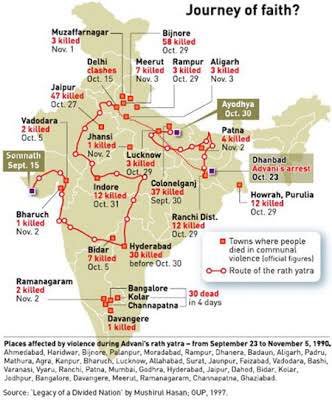
https://www.wearesavera.org/wp-content/uploads/2024/04/Cut-from-the-Same-Cloth_Savera-Report-2.pdf
|

Showing posts with label VHP. Show all posts
Showing posts with label VHP. Show all posts
February 03, 2024
August 04, 2023
India: Who benefits from communal violence? asks Bharat Bhushan
Who benefits from communal violence?
BJP occupies the high moral ground, pushing the narrative of good governance and development, while VHP and Bajrang Dal are free to propagate religious polarisation.
PinterestLinkedinGmailFacebook Messenger
Bharat Bhushan
Flames rise from shops and other structures set ablaze by miscreants during fresh violence in Haryana. Credit: PTI PhotoFlames rise from shops and other structures set ablaze by miscreants during fresh violence in Haryana. Credit: PTI Photo
The Bharatiya Janata Party (BJP) used to claim that there are no communal riots when it is in power. With the communal rioting in Manipur and Haryana, both run by the BJP, that claim lies exposed.
The Manipur violence initiated between ‘ethnic’ communities has fast acquired the colour of a Hindu-Christian confrontation. The Muslims of Nuh in the Mewat region of Haryana where the violence started do not have a sterling reputation — with the violent criminals among them having graduated from cattle thievery to cybercrime. They claim to have been provoked by two videos released by cow-vigilante and Bajrang Dal activists. The videos called upon Hindus to join a religious procession on Monday in Nuh and visit temples in Mewat in large numbers. The videos, according to the police, infuriated the Muslim community, and they gathered in large numbers on July 31 to disrupt the procession.
Only a detailed enquiry will show who lit the communal fuse, but who does a surcharged communal atmosphere help? The question is as relevant in Manipur as it is in Haryana.
The conflict in Manipur has made BJP Chief Minister N Biren Singh virtually unassailable despite the utter failure of law and order in the state. He has consolidated the Meitei Hindus behind him. Prime Minister Narendra Modi cannot find it in himself to caution Singh to follow ‘Raj Dharma’, as he himself was advised by former Prime Minister Atal Bihari Vajpayee in 2002.
In Haryana, the BJP is faced with declining popularity. After the 2019 state legislative election, it had to rely on Dushyant Chautala’s Jannayak Janta Party to form a government. Then with the farmers’ agitation in 2020-21 the Jat farmers turned their back on the BJP. The Jats form 27 per cent of the population and dominate 40 of the 90 assembly constituencies. Their disproportionate influence in Haryana politics is evident from the fact that in 33 out of 57 years of its existence, Haryana has been ruled by Jat chief ministers. The non-Jat chief ministers who have together ruled the state for 22 years, have had short tenures. Khattar will be only the second non-Jat Chief Minister other than Bhajan Lal to complete a 10-year tenure next year.
Elections to the Haryana legislature are due in October 2024. The state sends 10 MPs to the Lok Sabha. The BJP had won all 10 seats in the 2019 general election. It is unlikely to repeat the feat in April-May 2024, without the consolidation of Hindu votes. To achieve that, the hostile Jat farmer will have to be mobilised through their Hindu identity rather than through their caste and economic status. Communal polarisation will do that.
That is why the communal violence in Nuh has significance beyond Mewat. It has already spread to the adjoining areas of Gurugram, Faridabad, and Palwal. Nor is it likely to be limited to the boundaries of Haryana. Already, sister Hindutva organisations of the BJP — the Vishwa Hindu Parishad (VHP) and the Bajrang Dal — have organised protests on August 2 in Delhi stopping traffic on the Faridabad-Delhi highway and protesting in RK Puram-I, Nirman Vihar, and Ghonda in Delhi. There were VHP protests in adjoining Noida in Uttar Pradesh as well.
Could it be that the BJP has governance as its priority and the communal incidents are the handiwork of autonomous Hindutva militants? Modi recently advised party MPs to let the government’s work for the poor take precedence in the 2024 general election over the Ram temple at Ayodhya and the abrogation of Article 370 in Jammu and Kashmir. This seems to suggest that the governance train is on a different track than the communal one.
Far from there being an airgap between the BJP and the Hindutva militants, they are in fact two strands of the same DNA — one prepares the ground for the other’s climb to power. Polarisation on made up communal issues such as wearing the hijab, refusal to sing or shout ‘Vande Mataram’, ‘love jihad’, reclaiming mosques as Hindu temples, etc. help to heat up the atmospherics before the BJP enters an electoral battle.
The pattern is clear. When in power the BJP occupies the high moral ground, pushing the narrative of good governance and development and the militias of VHP and Bajrang Dal are left free to propagate religious polarisation on the ground. This collaboration was evident earlier also in the Ram temple agitation, the destruction of the Babri masjid, the Gujarat riots, and now in incidents of Ram navami violence in March, and now in Nuh. Ethnic militias like Arambai Tenggol and Meitiei Leepun play a somewhat similar role in Manipur.
In Haryana, the VHP and the Bajrang Dal are being resuscitated because the BJP needs every Lok Sabha seat it won in the state in 2024, and Khattar is also unsure of winning a third term for the BJP. Already he has promised to use the Recovery of Damages to Property During Disturbance to Public Order Act against the ‘rioters’. There are no prizes for guessing who might face the State’s wrath. It is likely that communal tension justified as ‘Hindu anger’ against the Nuh violence will spread to Delhi (where the BJP won all seven Lok Sabha seats in 2019). It will not be a surprise if in the coming months communal poison is injected into other north Indian states where Hindutva forces need to strengthen the BJP’s electoral position.
The election-going states are under the greatest threat of communal polarisation. The BJP had won 24 out of 25 Lok Sabha seats in Rajasthan, 28 out of 29 in Madhya Pradesh and nine out of 11 in Chhattisgarh. These states will have assembly elections in December. The BJP would like to build the momentum for the 2024 general election by winning all of them. It will need more than the rhetoric of good governance to do that. These states might also see new life being breathed into the VHP and the Bajrang Dal.
(Bharat Bhushan is a Delhi-based journalist.)


August 03, 2023
India: Violence in Nuh, Haryana -- once religious event of Jalabhishek Yatra now all about show of power
The Tribune
Nuh clashes: Once 'religious', Jalabhishek yatra turns into power show
Updated At: Aug 03, 2023 10:13 AM (IST)
Nuh clashes: Once 'religious', Jalabhishek yatra turns into power show
Charred remains of vehicles set on fire by miscreants. PTI file
Tribune News Service
Gurugram, August 2
The attack on the Brajmandal Jalabhishek Yatra in Nuh, which left six dead and around 60 injured, has caught national attention, with people wanting to know the relevance and origin of this ‘pilgrimage’.
The yatra was introduced three years ago by the Vishwa Hindu Parishad (VHP) to “revive holy Hindu sites and Hindu religious tourism” in Meo Muslim-dominated Nuh. Inhabited by 80 per cent Muslims, the district is home to three Mahabharata-period Shiva temples. The Aravallis are popularised as grazing grounds of Lord Krishna’s cows. The temples have long existed undisturbed — even conserved — but aiming to save them from “potential threat of being encroached by mosques”, like it happened with Kashi Vishwanath or Krishan Janambhoomi, the VHP started the yatra, insisting that pilgrims would keep the temples relevant.
What started with just members of the VHP from Nuh, Gurugram, Faridabad and Palwal soon started getting more and more participants from across Haryana to reclaim the power of “Hindutva” in Mewat. All right-wing outfits from the state are now part of the yatra, which enters Mewat from Sohna. The yatra begins from Nalhar Mahadev Temple at Nuh, proceeds to Jhirakeshwar Mahadev and Radha Krishna Temple at Shrangar village in Punhana block of the district, before culminating at Shringeshwar Mahadev Temple.
However, the yatra, which was started as pilgrimage, has been converted into a “power show”, where not just the VHP or Bajrang Dal, but even cow vigilantes brandish arms. Over the last two years, the yatra has been preceded by online war of challenges between participants and local men. There is always tension surrounding the yatra, which escalated this year.
“What is wrong in this? Our temples are there and Hindu community also lives there. We can take out processions. Think of Mewat seven years ago, when people were wary of entering villages. As Hindus, we are reclaiming our fundamental right to travel and pray everywhere,” said a senior VHP leader.
MLA Aftab Ahmed, talking to The Tribune, stated that both communities had for long coexisted peacefully in Mewat and temples had been given due regard, but rowdyism and instigation by rival groups was increasing.
India: Video of Hate speech by VHP leader Surendra Jain in Nuh a few hours before communal violence in Haryana
<blockquote
class="twitter-tweet"><p lang="en" dir="ltr">EXCLUSIVE: Few
hours before violence erupted in Haryana, Surendra Jain, General
Secretary of Vishwa Hindu Parishad was present at Nuh's Nalhar
Mahadev Mandir (destination of procession) where he delivered hate
speech against Muslims in Mewat.<br><br>We have obtained
video of his speech <a
href="https://t.co/ymY3nfKZ9h">pic.twitter.com/ymY3nfKZ9h</a></p>—
HindutvaWatch (@HindutvaWatchIn) <a
href="https://twitter.com/HindutvaWatchIn/status/1686619915678048256?ref_src=twsrc%5Etfw">August
2, 2023</a></blockquote>
August 02, 2023
India: Well Known Cow Vigilantes connected to Bajrang Dal, VHP, RSS at the center of Communal Violence in Haryana
Haryana violence: Vigilante Monu Manesar at the centre of row
Aug 02, 2023 04:56 AM IST
The communal clashes are believed to have been triggered by three videos released on social media – two by Monu Manesar and another by Bittu Bajrangi
Mohit Yadav, 28, better known as Monu Manesar, could not be arrested for over five months despite being named (along with 21 others) in the abduction and killing of two cattle traders, Junaid and his cousin Nasir, whose charred bodies were found in a burnt car in Rajasthan’s Bhiwani on February 16.

Also Read| Attack on yatra ‘pre-planned’, ‘conspiracy’: Khattar
Manesar, who heads the cow vigilante wing of Bajrang Dal in Haryana, is now at the centre of Monday’s communal violence during a procession led by right-wing outfits Bajrang Dal and Vishwa Hindu Parishad (VHP) in Haryana’s Nuh that later spread to Sohna and Gurugram, claimed at least five lives, and left over 50 injured.
The communal clashes are believed to have been triggered by three videos released on social media – two by Monu Manesar and another by Bittu Bajrangi, also a cow vigilante – between Sunday and Monday. In one of the videos, Monu Manesar can be heard announcing that he will reach Nuh to participate in the procession on Monday (July 31) and urging people to visit temples in Mewat region in large numbers.
The procession, while ostensibly religious, was also meant to be a show of strength. Bittu Bajrangi in his video is also heard making derogatory remarks. A few videos challenging Monu Manesar and threatening him to face consequences if he reached Nuh also emerged on social media from accounts having Muslim profiles.
Also Read| Nuh to Gurugram: The spread of violence
Haryana police officers say they suspect that the videos infuriated several Muslim residents in the Nuh and Mewat region and prompted them to gather in large numbers in Nuh town and resort to violence during which they pelted stones, vandalised and torched private as well as police vehicles, and allegedly surrounded a local temple where several Hindus, police personnel and media professionals took shelter to save their lives.
The officers said that the clashes were ignited by rumours that Monu Manesar had arrived and joined the procession. However, he did not turn up for the event on the advice of the VHP, which feared that his presence would create tension.
According to the officers, the violence began 10 minutes after the procession of 3,000 to 4,000 people started to walk from Edward Chowk in Nuh town around 2pm.
Also Read| 40 cases registered in Nuh, over 100 detained
The Hindu processionists initially fled, but then regrouped and retaliated.
While the videos emerged at least a day before the scheduled procession, which had all requisite permissions from the police, the local administration made no attempts to remove them or ensure that they did not trigger violence, said residents of Nuh; they added that no efforts were made to take Monu Manesar into custody.
Senior officers from the Haryana police said Manesar has been at large since Rajasthan police booked him in the abduction and murder case of the two Muslim cattle traders and another case was registered against him at Pataudi, Haryana in connection with rioting and other serious charges. They said they did not know when and where Monu Manesar shot the videos and from where they were uploaded.
“Several raids have been conducted at his house in Manesar village and other possible hideouts by Rajasthan and Haryana police in the past to arrest Monu Manesar. However, he was never found at these places. He has remained underground since February, when his name surfaced in the two murders. Our teams are still making efforts to nab him,” said a senior Haryana officer, who asked not to be named.
Bharatpur superintendent of police Mridul Kachhawa said, “Monu Manesar is under investigation, though we can’t say whether he is guilty or innocent. We have arrested three accused and are trying to arrest more culprits who absconded (in the February lynching case). The role of Monu Manesar will be clear after arresting other accused, their interrogation and investigation.”
Son of Om Prakash, a private school bus driver, Monu Manesar was born in Nuh village in 1995 and was married at the age of 19. He is the father of an eight-year-old boy. He is said to be a polytechnic diploma holder and joined the Bajrang Dal during his second year of college. He has risen to prominence over the course of the past five years as a leading figure in the cow protection task force implemented by the Haryana government in Gurugram. A locally influential person, Monu Manesar’s photos with political leaders, police officials and bureaucrats have surfaced in the past.
His YouTube page called “Monu Manesar Bajrang Dal” had over 200,000 subscribers and nearly 330 videos till it was taken down. Most featured high-speed chases; some boast of a gunfight; some showed him and his men standing victoriously next to a group of men they have apprehended, like game they have hunted. The first uploaded video was dated January 18, 2017. In October 2022, Monu Manesar received a silver play button from YouTube for crossing 100,000 subscribers on his channel, which now seems to have been taken down from the platform.
Monu Manesar’s name made headlines in 2019, when he was shot at while chasing cattle smugglers. He has been absconding since his name emerged in the abduction and killing of Junaid and Nasir in Bhiwani, Rajasthan. He has denied any involvement in the Bhiwani killings. At least two “Hindu Mahapanchayats” happened in Haryana in his support and demanded that his name be dropped from the FIR on the two murders.
After close to 100 days, the Bharatpur police named Monu Manesar in the Bhiwani murders. On February 22, the police named nine accused Rinku Saini, Anil and Srikant Pandit from Nuh, Kalu Jaat from Kaithal, Kishore from Karnal, Monu and Gogi from Bhiwani, Vikas and Sashikant Sharma from Jind. A reward of ₹10,000 each was announced by the police.
A forensic report confirmed that the charred bodies and blood stains found in the SUV recovered from a cow shelter in Jind were of Junaid and Nasir.
August 01, 2023
India: Goons of VHP, Bajrang Dal announce nationwide protests against Haryana violence - Aug 1, 2023
VHP, Bajrang Dal announce nationwide protests against Haryana violence — ‘won’t be tolerated’
At least five people have been killed in violence that first broke out during a religious procession in Nuh Monday, and spilled over to nearby regions including Gurugram.
June 11, 2023
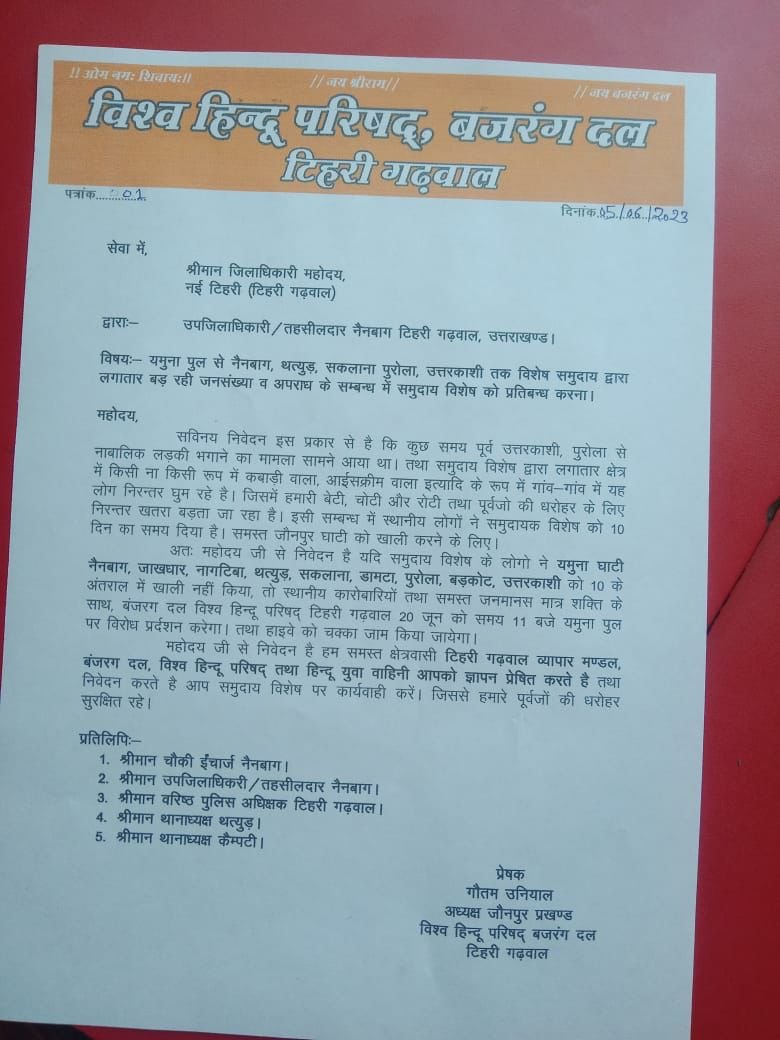
May 02, 2023
India: Bajrang Dal men attack Christian religion prayer at home Chhattisgarh - cops detain prayer participants
Chhattisgarh: Attack on Christian service at home
Dr Sahu and several other prayer participants
allegedly taken to police station, detained and threatened with jail for
‘disturbing peace’
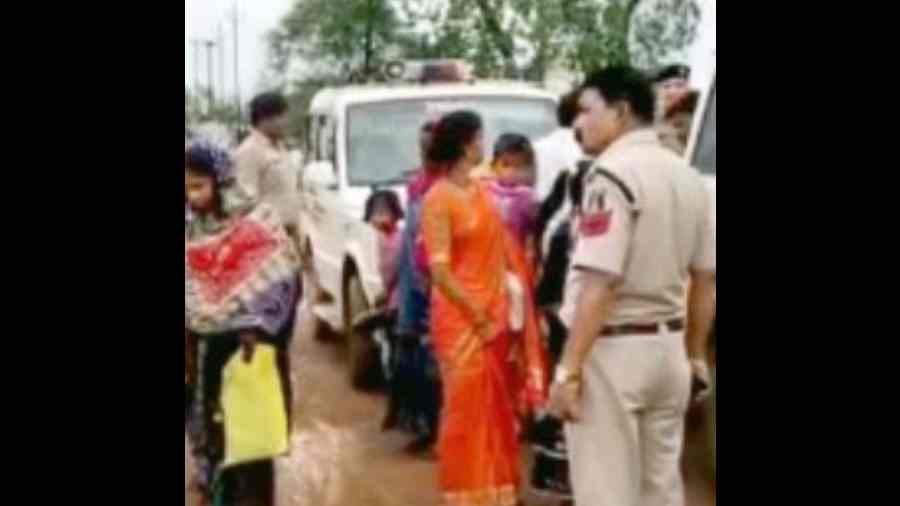
Policemen outside the home where the prayer service was disrupted
Sourced by the Telegraph
|
Jamshedpur
|
Published 02.05.23, 06:16 AM
About 100 alleged Bajrang Dal members barged into a private home and attacked a group of Christians participating in a prayer service on Sunday afternoon in the Chhattisgarh village of Amleshwar, part of chief minister Bhupesh Baghel’s Assembly constituency of Patan.
When the police were called, they stood and watched as the intruders assaulted some of the Christians, Dr Vinay Sahu, the dentist at whose home the service was being held, told TheTelegraph.
Advertisement
Dr Sahu and several other prayer participants were allegedly taken to the police station, detained and threatened with jail for “disturbing peace”. No case has been filed against the attackers, Chhattisgarh Christian Forum president Arun Pannalal said.
Pannalal said that about 50 Christians were praying at Dr Sahu’s home in Amleshwar, located in Durg district and about 16km from state capital Raipur.
“All of a sudden, a mob of unarmed Bajrang Dal members started shouting and forced the members to open the door of the house. They abused the members and accused them of carrying out conversions. They threatened to assault them. Some of the Christians informed the local police,” Pannalal said.
“The police came but, instead of acting against the intruding Bajrang Dal members, began threatening the dentist. They took several Christian members to the local police station. They asked why they had conducted a prayer service at a private home and threatened to send them to jail for ‘disturbing the peace’.”
He added: “They detained nearly 20 people (Christians) in the police station. It was only after we reached the police station and exerted pressure that they released them in the evening.”
ADVERTISEMENT
Dr Sahu said that he and nine other Christians had been taken into preventive arrest before being released at 8pm on a personal recognisance (PR) bond, which is a written undertaking to appear in court whenever required.
Dr Sahu said the Bajrang Dal — youth wing of the Vishwa Hindu Parishad — had carried out a similar attack on a prayer service at his home in 2021.
“We have been conducting prayer services at our house since 2019. A similar protest was held at our house by the Bajrang Dal in 2021, and that time too we were threatened with violence if we did not stop the prayers,” Dr Sahu said.
“But it’s our house and we haven’t ever forced anyone to attend the service. All those attending the prayer service on Sunday were Christians. Nor do we use mikes and cause noise pollution. We fail to understand the reason for the protest and such attacks.”
Dr Sahu said that “about five” of the Christians had suffered bruises and were treated at local clinics.
“We were surprised that the Bajrang Dal members attacked our members right in front of the police, who remained mute spectators,” he said.
“More than 100 Bajrang Dal supporters were in the police station when we were taken there.”
Durg superintendent of police Abhishek Pallava told this newspaper that “it was a small incident and has been resolved” before hanging up.
Pannalal said he was thinking of petitioning the high court for a directive to the police to act against the Bajrang Dal attackers.
February 23, 2023
India: Haryana's cattle protection militia's including VHP and Bajrang Dal want UP style bulldozer model
At Haryana panchayat, clamour for ‘UP model’
At the event, attended by 400 people, including members of Bajrang Dal, Vishwa Hindu Parishad and cow vigilante groups, attendees reiterated their demand for a CBI probe into the case and warned the Rajasthan government against initiating legal action against gau rakshaks.
Written by Pavneet Singh Chadha
New Delhi | Updated: February 23, 2023
https://indianexpress.com/article/cities/delhi/at-haryana-panchayat-clamour-for-up-model-8461417/
February 20, 2023
India: Haryana's private cow protection militias with thousands of unemployed youth police the streets - A mass 'employment scheme' of sorts
India: In the northern state of Haryana all male private militias of the Far-right with thousands of unemployed lumpen youth police the streets in the name of cow protection. With full blessings of the ruling BJP Govt and the know of the police. https://www.tribuneindia.com/news/haryana/20k-cow-vigilantes-affiliated-to-three-outfits-active-across-state-480860
May 05, 2022
India - Gujarat: right-wing groups make trouble over hurt sentiments - Protests at MSU, Vadodara over ‘objectionable’ artwork at fine arts faculty exhibition
Vadodara: Protests at MSU over ‘objectionable’ artwork at fine arts faculty exhibition
Dean denies that the artwork was part of the exhibition, says they were planted.
Written by Aditi Raja | Vadodara |Updated: May 5, 2022
January 13, 2022
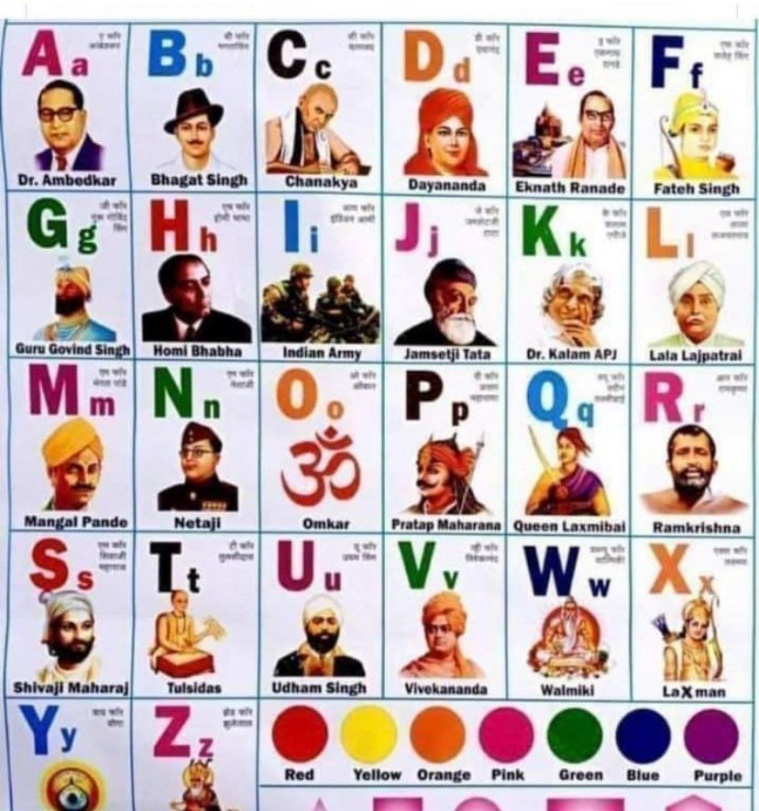
English Alphabets Chart by Vishwa Hindu Parishad (VHP)
January 28, 2021
India: Inside a VHP bike rally for temple funds: Businessman, insurance execs, children ... in Mayur Vihar in New Delhi
Inside a VHP bike rally for temple funds: Businessman, insurance execs, children
Most bikes flaunted saffron flags, three men shared many two-wheelers, and barely anyone wore a helmet. Some women accompanied them on scooters, while e-rickshaws in the back had the elderly, children and more women. Written by Abhinav Rajput | New Delhi | Updated: January 28, 2021
“Hum Hindu jagaane aaye hain, Hum Hindu jaga kar jaayenge”; “Chamak rahi talwarein sab ki, chamak raha trishul hai, Hindu ko kamzor na samjho, ye dushman ki bhool hai”; and “Hindustan me rehna ho to Vande Matarm kehna sikho, aur aukat me rehna sikho”.
These were among songs that blared on a loudspeaker installed on a lorry on Tuesday as hundreds of motorbikes lined up behind it as part of a rally to raise awareness about the Ram Mandir fund collection drive. It had been organised by the Mayur Vihar unit of the Vishva Hindu Parishad and the Bajrang Dal.
[ . . .]
September 28, 2019
India: VHP to install 7-foot statue in Delhi to "celebrate" abrogation of article Article 370 in Kashmir ....
The Times of India
VHP to install 7-foot ..
Read more at:
http://timesofindia.indiatimes.com/articleshow/71350064.cms
VHP to install 7-foot ..
Read more at:
http://timesofindia.indiatimes.com/articleshow/71350064.cms
June 08, 2019
India - Gujarat: Photo of Billboard 'Wecome to Hindu Rashtra' [with Hindu Rashtra at Work - a report by Anupama Katakam in Frontline (june 21, 2019)]
| The board in Gujarati says: Welcome to Halwad City of Hindu Rashtra - Vishwa Hindu Parishad, Bajrang Dal : photo: Alp Sankya Adhikar Manch [in Frontline - June 21, 2019] |
May 31, 2019
India Did these people speak at the World Hindu Congrees, of Nov 2014 held in New Delhi ?
Did these people speak at the World Hindu Congrees, of Nov 2014 held in New Delhi ?
Gautam Sen (LSE), Vandana Shiva, noted environmentalist, former ISRO Chairman G Madhavan Nair and CBSE chairman Vineet Joshi, Chairman, Board of Governors, IIT Delhi Vijay Bhatkar, Kapil Kapoor, V-C MG International Hindi University, a news report in The Pioneer* mentions these names
https://www.dailypioneer.com/2014/india/rss-bjp-leaders-to-address-world-hindu-congress.html
Gautam Sen (LSE), Vandana Shiva, noted environmentalist, former ISRO Chairman G Madhavan Nair and CBSE chairman Vineet Joshi, Chairman, Board of Governors, IIT Delhi Vijay Bhatkar, Kapil Kapoor, V-C MG International Hindi University, a news report in The Pioneer* mentions these names
* RSS, BJP leaders to address World Hindu Congress
Monday, 17 November 2014 | Deepak K Upreti | New Delhi
May 10, 2019
India: RSS Indoctrination of adivasi young boys and adults in Jhabua, Madhya Pradesh - Report by Neha Dixit on newslaundry.com
Reproduced from: https://www.newslaundry.com | May 9, 2019
Meet the boys, young adults and old men of RSS preparing for 2019 elections in Jhabua
Battling Christianity and Islam is a top priority.
In January 2018, Mohan Bhagwat, chief of the Rashtriya Swayamsevak Sangh, said all are “children of Adivasis”. Addressing a rally in Raipur, Bhagwat said: “When we say Adivasi, then that is our core identity. We are their children. Even though we see different pictures, our forefathers were the same … from 40,000 years ago."
According to the 2011 census, 21 per cent of the total population of Madhya Pradesh is Scheduled Tribe, known as Adivasi. The Malwa-Nimar region comprising the districts of Jhabua, Dhar, Badwani, Khargone, Khandwa, Dewas, and Ratlam has 22 out of the 47 seats reserved for STs in Madhya Pradesh. The area, of extreme political consequence, has been part of the RSS's pet project to draw the tribals into a pan-Hindu world through RSS-affiliated outfits like the Sewa Bharti, Vanvasi Kalyan Ashram and Vidya Bharti, among others.
Despite that, since the first Lok Sabha elections in 1952 up till 2015—a span of 17 elections—the RSS's political body, the Bharatiya Janata Party, has only won this seat once, in 2014.
The Ratlam-Jhabua parliamentary seat is set for polls in the last phase of the 2019 Lok Sabha Elections on May 19. Newslaundry meets members of different age groups and outfits of the RSS to find out about their work, areas of focus, and preparations for the upcoming elections.
The RSS: old men and 'ghar wapsi'
“As of now, religious conversions of tribals by Christians is at an all-time high in Jhabua. Thirty-five per cent of the district is now Christian," says Ashok Verma, sitting in the verandah of his house in Antervelia village. Verma is in charge of the RSS unit of Antervelia in Meghnagar town in Jhabua district. A small-built man in his mid-50s, he runs a tent house and a local grocery shop, even as he’s otherwise employed in “spreading Hindutva”.
Verma attended a “Hindu Sangam” in 2008 in Jhabua and joined the RSS soon after. The Hindu Sangam is a platform to bring members, supporters of the RSS and its affiliate organisations—over 40 of them—together to exchange thoughts on building a Hindu nation. The RSS has been holding these Sangams, a congregation of Hindus in the tribal-dominated areas of Jhabua, for over three decades.

Ashok Verma, who is in charge of the RSS unit in Antervelia.
Verma's anti-conversion Hindutva rhetoric against Christians in Jhabua dates back to the 1990s. It first started when Sister Rani, a nun at a local church, was killed in the neighbouring district of Indore in 1995. When Uma Bharti, the hardline BJP leader who came into prominence for her role in the Babri Masjid demolition in 1992, was appointed as the Madhya Pradesh chief minister from 2003 to 2004, slogans like “Pehle Kasai, Phir Isai (First the Muslims, then Christians)” became commonplace in this tribal belt. These are the two communities that are perceived enemies in the Hindutva project of RSS. In 2005, there was a spate of attacks on churches in Jhabua when a minor girl was raped inside a Christian missionary school. Since then, almost every year, anti-Christian violence picks up during the month of December. As a result, NDTV reports, in 2017, in parts of Madhya Pradesh, Christians chose to “forego Sunday prayers, carol singing and displaying crosses and rosaries through the year, fearing they will be accused of converting locals and persecuted”. In January 2018, two boys performing a "Christmas dance" in a primary school in Meghnagar were stopped by RSS members.
According to Verma, there are 400 “illegal” churches in Jhabua built to convert tribals to Christianity and to occupy government land. He estimates that at least 7,000 people have converted to Christianity in the last three years in the district. This year, on February 3, a statue of the Virgin Mary was set on fire in Ishgar village in Jhabua. He says: “They lure them with biscuits, cakes, money, non-vegetarian food. First, they get them to start lighting incense sticks in front of a picture of Jesus Christ on a weekly basis, and then get them to baptize. Are we going to be mute spectators?"
He says his local RSS unit has managed to do “ghar wapsi” of over 100 families over the past year in Jhabua.
“Ghar wapsi” is a series of “reconversion” activities initiated by the Vishva Hindu Parishad and the RSS to “facilitate” the conversion of non-Hindus to Hinduism. In December 2014, VHP leader Pravin Togadia had said the world was once inhabited only by Hindus, and that the VHP would ensure the Hindu population in India increased from its current 82 per cent to 100 per cent.
The reconversion process involves a hawan, a Hindu ritual of burning offerings to “purge” the converts, and a pledge to follow the tenets of Hinduism.
Verma believes there is a larger conspiracy behind the religious conversions done by the local churches. "The Indian Constitution guarantees reservation to STs in the government sector. By converting tribals to Christianity, they want to take over positions of power in the Indian administration and rule the Hindus."
His son Rohendra Verma, 24, nods at his father's statement. Currently unemployed, Rohendra believes that only “kattar” or “staunch” Hindus can save India. When asked if he knows of any cases of tribals converting to Christianity, he replies, "I have heard of them but don't know any in my own circles. They are taking away our jobs. We either save Hindus now or get rid of Muslims and Christians later. There are only two choices." He is yet to officially join the RSS.
The 2011 census data negates the paranoia peddled by the RSS. According to these figures, 0.3 per cent of Madhya Pradesh's population of 77 million were registered as Christians and around 90 per cent were Hindus. The same census figures state that the Christian population in Jhabua is 3.75 per cent, 10 times less than the RSS’s figures. In fact, instead of an increase, the overall population of Christians in India has been on a decline in the past five decades: 2.60 per cent in 1971, 2.44 per cent in 1981, 2.34 per cent in 1991, 2.30 per cent in 2001 and 2.30 per cent in 2011.
Verma says the census data is “flawed”.
Apart from “saving” the tribal population from Christians, Verma also actively works towards propagating the Hindu religion among them. This includes distributing statues of Hanuman to all households, teaching them how to celebrate Raksha Bandhan, and how to conduct Hindu weddings. He says, “They didn't even know how to take seven rounds around the fire. We had to teach them."
In her book In The Belly Of The River, sociologist Amita Baviskar had written: “Adivasi religious life is built around animism and ancestor worship and evolved quite distinctly from the Hindu tradition. Their myths and rituals are located in their closeness to and reverence for nature.” Verma’s task is to appropriate these practices as Hinduism. “The kind of round stone the Bhil community worships as Bada Dev is actually like Shiv. Similarly, the foliage and the trees are part of the 'Mata Ka Van (Forest of the Goddess)’. We tell them their practices are all Hindu. They just don't know that.”
Another task is to repudiate local tribal practices and replace them with “upper-caste” Hindu rituals. The RSS started a drive here to stop the sacrifice of kadaknath—a rare breed of fowl available only in this belt—among tribals on Diwali and replaced it with the ritual worship of Ganapati and Goddess Lakshmi. Similarly, the tribal communities participate in a pre-Holi celebration called Bhagoria: a “festival of love” called pranayapurva where young women choose their life partners by applying gulal on the faces of the young men. Verma says this behaviour is a “blot on the character” of Indian women. “We have worked to stop this perversion.”
In this area, the RSS has a comprehensive network that follows a five-tiered structure of villages, mandals, khands, sankuls and jilas (divisions, segments, complexes and districts) parallel to the two-tiered government model. When asked what is the larger goal of Hindutva, Verma says, "I didn't think about it ever. I just want to see a society purged of Christianity. I hope Modiji will help us in his second term."
In the upcoming 2019 elections in the state, the BJP has fielded their local MLA Guman Singh Damor. Verma says, “We worked very hard to get Damor elected from the Jhabua Assembly seat. For the upcoming elections, our booth agents have been shortlisted. The booth tolis with 20 RSS members each are ready. Our slogan will be 'Hindu Jago, Kristi bhago (Hindus wake up, Christians go away)'."
The young men: battling Muslims and ‘deviant’ Hindu girls
Meanwhile, the Bajrang Dal is also hard at work to save Hinduism in the area.
"We try very hard to work for Hindu unity. Our special focus is on ‘love jihad’ cases," says Devraj Singh Rathore, a 21-year-old member of the outfit. Tall, lean and well-built, he wears a freshly-applied red tilak on his forehead. Rathore is an undergraduate student of commerce at a local college. His area of concern, "love jihad", is a Hindu Right-wing theory that Muslim men “lure” Hindu women to marry them and convert them to Islam. Many police investigations have conceded in court that there is no evidence to prove the existence of this practice.
The Bajrang Dal is the youth wing of the VHP, formed in 1984 in Ayodhya, Uttar Pradesh, when the VHP was organising a “Ram-Janki rath yatra” in the town. Ayodhya is believed to be the birthplace of Lord Ram and the tense communal atmosphere at the time led the government to refuse the VHP permission to carry out the procession, citing security reasons. As a result, senior leaders of the VHP had called upon the Hindu youth to protect the procession—and Hinduism—from its enemies, resulting in the formation of the Bajrang Dal.
The group organises akhadas, training camps to teach martial arts, wrestling and Hindutva ideology. Like a lot of young men, Rathore was interested in bodybuilding and wrestling, and hence started attending the local akhada in the area three years ago. “I was initially just having fun. I really got interested in Bajrang Dal activities when Deepak Makwana, the RSS pracharak from Thandla tehsil, addressed us. He said that we should think of how Muslims are united all over the world. Then why not Hindus? That really struck a chord with me."

Devraj Singh Rathore and Gaurav Vikram, both members of the Bajrang Dal.
Rathore’s friend, 22-year-old Gaurav Vikram, sits next to him. He’s also a member of the Bajrang Dal. “There are one crore Bangladeshi Muslims and 11 lakh Rohingya Muslims in India,” Vikram says. “They run terrorist training camps inside madrassas. There’s an organisation by the name of Jaish even in Jhabua. This needs to stop or they will take over.”However, he is unable to explain how an organisation called “Jaish” is necessarily a terrorist outfit. He says, "I will find out and tell you."
Vikram has been running a mobile shop for the last three years. He was unable to enroll for higher education because of financial constraints at home. “They are taking over jobs, our country and our women. For the last three years, I have actively done the Hindu religion's promotion to fight the Islamic threat," he says.
On May 19, Rathore and Vikram will vote for the first time in a Lok Sabha election. Rathore says, “We want a government at the Centre that listens to us. The BJP government in Madhya Pradesh under Shivraj Singh was here for 15 years. Even their administration rarely listened to us when we protested against Muslims taking out Muharram processions and against 'love jihad' cases. Now, with the Congress government in power, there is even less scope.”
Both young men firmly believe that they “show the direction to those who get lost or deviate from the Hindu way of life”. They regularly conduct vigils in Meghnagar town, especially on Fridays and during Ramzan because that is the time “Muslim shop owners in town get together to plan anti-Hindu activities”, according to them. This has often led to many reported skirmishes between the two communities.
Rathore says, "Two years back, we had a major breakthrough. We managed to separate at least five Hindu women from their Muslim husbands in town. It was a big achievement for us. But now, our Hindu girls are deviating from our traditions at a lightning fast speed."
To prevent “love jihad”, the local Bajrang Dal unit actively collaborates with the Akhil Bharatiya Vidyarthi Parishad, the student wing of the RSS, to keep tabs on every single girl in college to track whom they’re interacting with. “If we see them talking to boys, especially Muslim boys, we inform their families,” Vikram says. The girls are then stopped from coming to college regularly and only come to sit for the exams. That is one way of saving girls from ‘love jihad’ kind of situations.”
However, this tactic hasn’t been as effective as they’d hoped over the last year. When Rathore spotted the daughter of a well-known Hindu family in Meghnagar roaming around with her Muslim boyfriend, her family was informed. However, they paid no heed. When nothing worked, they tried to “explain” to the young woman that she should end the relationship immediately. Rathore says: “She was my college senior. She said, 'there is nothing illegal in having a Muslim boyfriend'. She even threatened us with a police complaint. Imagine! We want the central government to change this law in the upcoming Lok Sabha elections."
The boys: protecting the Hindu way of life
A few kilometres inside Khacchartodi village of Meghnagar in Jhabua, in the backdrop of hillocks, stands a building under construction in a huge compound. The plaque on the building identifies it as the “Vanvasi Sashaktikaran Kendra/Forest Dwellers' Empowerment Centre” run by the Padma Keshav Trust.

The Sewa Bharti building.
The centre currently serves as a hostel for 26 boys in the age group of 5-17 monitored by Sewa Bharti, the welfare organisation of the RSS. "We have children from many tribal communities including Damoh, Bhil, Bhilala, and Katara. It takes up to three years to make a Bhil-speaking child learn Hindi. How will they learn Indian values and build a Hindu Rashtra if they don't learn Hindi?" asks Kailash Ameliya, the hostel’s coordinator. He is lean and wears a pigtail on his head—a tradition observed by upper caste Brahmins—and a pointy moustache. Ameliya has been associated with the organisation for the last 15 years. Most of the boys are students of Class 2 to Class 11 in several local government-run (shasakiya) schools, Ameliya says. They are selected on the basis of a test that involves IQ, general knowledge and course-related questions. "Most of their parents are migrant labourers in Gujarat, Maharashtra and Rajasthan, so we get them here. The children of single parents are given priority."
Once they complete their school education, the students are made to stay at the hostel for four more years to, as Ameliya says, integrate them into the “mainstream” way of life and “serve Bharat Mata”.
At the hostel, the students wake up at 5 am. The shakha, an RSS assembly ritual, commences at 6 am. Mango Singh Katariya, the manager of this Sewa Bharti branch, says, “We teach them how to play Indian games like kabaddi and kho-kho. We have also come up with a game called Tank War to instill feelings of nationalism in the young boys so that they can protect Bharat Mata.” Tank War is a game where each group tries to make a chain and encircle the other group to capture it. The groups are often named “India” and “Pakistan”.

Mango Singh Katariya, the manager of this Sewa Bharti branch, and Verma.
As we talk, Satyanarayan Chakradhari, a member of Vidya Bharti, the educational wing of the RSS, steps in. He announces that he was just passing by. On his arrival, both Ameliya and Katariya stop answering further questions from this reporter. Instead, Chakradhari intervenes in the conversation. “Our aim is to protect Indian culture and values, and we can only do that by catching the children young,” he says. According to him, there are 16 Christian schools in Jhabua which convert tribal children to Christianity. Chakradhari echoes what Ashok Verma had said earlier: “5,000 people were converted to Christianity last year.”
He laments, “Can’t you see the Christian influence? Children want to celebrate birthdays by cutting cake instead of going to temples. They want to study in an English medium school. And the girls! The Western clothes, such forthrightness instead of being docile. We believe in teaching them Indian values and culture from childhood itself so that they don’t lose their way when they grow up.”
When I ask to take a photograph, Chakradhari refuses. “We don’t engage with the media. You can take pictures of the boys.”

The boys who stay in this hostel.
The 26 boys are lined up in a huge hall in the backdrop of a large Bharat Mata poster. They’re all dressed in half-sleeved shirts and pants. I’m not allowed to speak to them. They greet me in chaste Hindi and begin with a war song followed by a hymn in praise of Bharat Mata. In the upcoming elections, this Sewa Bharti branch plans to carry out a mass drive among the hostel children to “write pamphlets on Bharat Mata and the Hindu way of life” for distribution among the local population. "So that they vote for the sons of Bharat Mata and not the Kristis," adds Chakradhari.
Disclaimer : Newslaundry.com is determined to include views and opinions from all sides of the spectrum. This doesn't mean we agree with everything we publish. But we do support their right to the freedom of speech. In case of columnists and non-Newslaundry staff articles, the information, ideas or opinions in the articles are of the author and do not reflect the views of Newslaundry.com. Newslaundry.com does not assume any responsibility or liability for the same.
April 25, 2019
Book excerpt from Dhirendra Jha's book 'Ascetic Games: Sadhus, Akharas and the making of the Hindu vote'
scroll.in, 25 April 2019
How the VHP transformed Ayodhya from a town of bohemian sadhus into a hotbed of violence
VHP members marking the 25th anniversary of the Babri Masjid demolition in Ayodhya | HT Photo
Dhirendra K Jha
The relationship between a guru and a chela, which is at the heart of Ramanandi akharas, is underlaid with turbulence. Outsiders might not see this or skim over it – because of the veil of religion – but anybody with even a surface view of the akharas cannot remain blind to it. It even finds a mention in Ayodhya’s folklore:
Charan dabaa ke sant bane hain,
gardan dabaa mahant;
Paramparaa sab bhool gaye hain,
bhool gayen hain granth;
De do inko bhi kuchh gyaan,
dharaa par ek baar tum phir aao, Hey Ram.
(He became a sadhu by massaging feet,
And a mahant by choking a throat;
They have forgotten the traditions
and the scriptures;
Enlighten them
Come down to earth one more time, O Ram.)
Most sadhus of Ayodhya I spoke to agree that this violent streak was exacerbated around the mid-1980s, soon after the VHP pushed the Ram Janmabhoomi issue to the fore. The VHP, for almost two decades after its inception in 1964, had been unable to use the sadhus in creating a favourable electoral condition for the BJP. This failure led the RSS to relaunch the VHP in the early 1980s with the prime motive of spearheading a new political strategy.
The Ram Janmabhoomi issue had been almost forgotten after the few months of commotion that it generated following the surreptitious idol-planting of 1949.
Until that night, Ramchabutara – an elevated platform of 17x21x6 feet, located about 100 paces from the Babri masjid inside its outer courtyard – was treated as the birthplace of Lord Ram. All attempts by naga vairagis to build a temple over Ramchabutara had failed because the British government had imposed a restraint on any construction work in the Babri masjid campus. India’s independence was perceived by some of the Hindu Mahasabha’s prominent leaders and the nagas in Ayodhya as a removal of that restraint. In the atmosphere of bitterness created by the communal clashes that took place in the wake of Partition, a group of Ramanandi nagas and Hindu Mahasabha leaders succeeded in capturing the whole of Babri masjid. But once the idol was planted, the turmoil gave way to legal battles and the issue remained politically dormant for over three decades, until the RSS saw an opportunity in it.
In early 1984, the VHP organised its first Dharma Sansad in Delhi, which unanimously adopted a resolution demanding the “liberation” of the birthplace of Lord Ram. In July that year, the Shri Ram Janmabhoomi MuktiYajna Samiti (Committee to Liberate Ram’s Birthplace) was founded. On 1 October, the VHP established its militant wing, Bajrang Dal, under the leadership of Vinay Katiyar, who had been an RSS pracharak since 1980. As theVHP’s main strike force,the Bajrang Dal was tasked with “liberating” the “Ram temple”, as Babri masjid has been called ever since the idol of Lord Ram was planted in it in 1949. A procession was set off from Sitamarhi in Bihar for this purpose, and it reached Ayodhya on 6 October. The focal point of the procession was a lorry bearing large statues of Ram and Sita beneath a banner with the slogan “Bharat Mata Ki Jai”.
Peter van der Veer describes how the response to the procession in Ayodhya was marked by extreme indifference: “As far as I could see only some five to seven thousand people had come to listen to the speeches.This seemed a disappointing number...The Hindu press was not taken aback by this number, however, and inflated it to fifty thousand and in some papers even to a hundred thousand, numbers which were taken over by the national press.”
After halting in Ayodhya for a day, the procession started for Lucknow to present a petition to the chief minister of Uttar Pradesh. The Ramanandi nagas’ largely unenthusiastic response in Ayodhya frustrated the VHP and the participating sadhus; van der Veer records it thus: “Some of Ayodhya’s sadhus had accompanied the procession to Lucknow and told, after their return, that it had had a far greater success in Lucknow and in the places on the way than in Ayodhya itself.”
It was an unnerving time for theVHP. The lack of support from the ascetic community of Ayodhya, the epicentre of the Ram Janmabhoomi movement, threatened to disrupt its new agenda.
The VHP had devoted many months and all the resources under its command to raise the pitch of the campaign in order to mobilise Hindus in general, and Ayodhya’s ascetic community, in particular – a critical component for the success of its plans. The VHP’s campaign in Ayodhya was conducted by a handful of Ramanandi vairagis who had little support from the rest of the community, and, in the end, not much was accomplished.
In the months that followed, progress continued to elude the VHP. In the last week of November 1984, for example, Ayodhya witnessed three Ramayan Melas, gatherings at which the Ramayana would be recited. Two of them were organised by the government and the third by the VHP’s pointman in Ayodhya, Ramchandradas Paramhansa, the shri mahant, or chief abbot, of the Digambar akhara, the smallest of the three main Ramanandi akharas of the Vaishnava sect. “While the two Melas organized by the Congress (I) governments [both at the Center and state] were reasonably well attended, Ramchandradas’s Mela was an abject failure,” writes Peter van der Veer.
Partly because of this inability of the VHP to expand its network among the naga vairagis of Ayodhya, it set up a Ram Janmabhoomi Trust and conferred its chairmanship on Jagat Guru Ramanandacharya Shivaramacharya, head of the Ramanandis of Varanasi, the holy town located close to Ayodhya. It was a shrewd move, because Shivaramacharya, said to command immense respect throughout Vaishnava circles, would help swing the majority of Ramanandis to the VHP, particularly in Ayodhya. Having set up the trust, with which BJP leader Vijaya Raje Scindia and a number of corporate representatives, like GP Birla, GH Singhania, KN Modi and RN Goenka, were associated, the VHP called on the government to transfer the property rights of the disputed site in Ayodhya to the trust so that the “biggest temple in the world” could be built there.
Soon, however, it became clear that even Shivaramacharya could not ensure the kind of foothold the VHP required in Ayodhya.
The movement met with greater enthusiasm in other parts of Uttar Pradesh and, in fact, got a fillip following the order in early 1986 by a district and sessions judge in Faizabad – the district that houses Ayodhya – that the Uttar Pradesh government should unlock the gates of the Babri masjid-Ram Janmabhoomi temple to enable devotees to offer darshan and puja in the disputed structure. But the movement was still not particularly successful at the local level in Ayodhya, and this seemed to get on the VHP’s nerves.
Advertisement
The Ram Janmabhoomi movement gave the temples of Ayodhya a keener edge and the local mahants an exalted position. Getting these temples and their mahants on board was a political necessity for the RSS and the VHP if they wanted to present themselves as leader of the Ram Janmabhoomi “liberation” movement. The VHP knew that it could not authentically act as a representative voice for Indian sadhus or for the “cause”, if the mahants of Ayodhya did not fall in line.
The VHP desperately needed pliable mahants in Ayodhya’s temples. For ambitious ascetics, this provided a new opportunity as well as readily available help to accrue material prospects or grab lucrative mahantships in Ayodhya. And in this little-studied internal history lies the unravelling of the sadhus. The VHP’s role in creating a killing field in Ayodhya has remained hidden.
“The VHP has trained the sadhus of Ayodhya to achieve anything through crime,” says Raghunandan Das, the mahant of Satsang Ashram temple at Swargadwar in Ayodhya. He was part of the VHP’s procession in 1984 and headed the procession in Darbhanga district of Bihar. Three decades later he admits: “In the name of temple movement, the VHP singlehandedly destroyed the tranquillity of Ayodhya. Violence, money, power and political influence were used openly by it to get favourable mahants installed in the temples here. Goons in the garb of sadhus became powerful. Old and vulnerable mahants became victims. The dignity that the sadhus of Ayodhya have lost, because of the VHP’s direct or indirect interference in deciding successions in temples here, can never be reclaimed.”
As Ayodhya moved from the 1980s to 1990s, punctuated by the massive shock it received on 6 December 1992, when Babri masjid was eventually demolished, the power and prestige attached to a mahant in Ayodhya shot up. This was partly because the VHP and its sister organisations, after having overseen the demolition of the mosque, hastened the installation of pliable mahants in the temples of Ayodhya, and partly because the scramble for mahantship created a suitable ground for the entry of hardened criminals from the nearby areas of Uttar Pradesh and Bihar looking for safe havens. Together, they vitiated the atmosphere in Ayodhya even further.
Advertisement
Over time, the situation deteriorated so much that today only a mahant with a band of armed goons of his own can feel safe. And even that cannot guarantee safety.
“It would be stupid to pretend that politics has no role in it,” fugitive mahant Ram Asare Das told me. “During the last three decades, such incidents have increased exponentially. Earlier, elder mahants used to be respected, but ever since the Ram temple movement was revived, the mahants of Ayodhya have lived in constant fear. The mahantship has now become a business here. Not just my temple, the VHP has been instrumental in getting its own men installed as mahants in several other temples of Ayodhya.”
That, however, was not the only way the Ram Janmabhoomi movement hit Ayodhya. Between 1950 and 1984, except for legal battles, there had been no on-the-ground action, no movement to demand the Hindu occupation of Babri masjid. Pilgrims to Ayodhya were mostly lay devotees from rural or semi-urban regions, without any political agenda. The means of these devotees were limited, so were their reasons for visiting Ayodhya. With the revival of the Ram Janmabhoomi movement, the town began to witness a spurt in the influx of religious tourists. This spiked further during the 1990s and thereafter. Many temples were converted into dharamshalas and the prices of real-estate possessions of these religious institutions shot up.
“There was also a change in the nature of religious tourists,” said Raghuvar Sharan, an Ayodhya-based journalist. “Earlier, Ayodhya used to attract traditional devotees who had longstanding relationships with their gurus and their temples, and who had been visiting the town at regular intervals. But once the temple movement started heating up politically, a new variety of tourists began visiting the town in large numbers. This new variety of visitors had no traditional association with Ayodhya or its old temples, nor were they simpletons like their predecessors. They brought money as well as aggression. The sadhus of Ayodhya could not remain unaffected.”
It must indeed have been a turning point for Ayodhya. Many residents I interviewed said that these new tourists were less religious and more communal. They eulogised warrior Ram and his ferocious devotees, providing a psychological boost for those who had money and power. Spirituality started dying fast, so did the tranquillity of Ayodhya and its sadhus.
Advertisement
The bohemian sadhus of the town were converted into, or replaced by, those desirous of owning properties and wielding their power.
Excerpted with permission from Ascetic Games: Sadhus, Akharas and the making of the Hindu vote, Dhirendra K Jha, Context.
How the VHP transformed Ayodhya from a town of bohemian sadhus into a hotbed of violence
VHP members marking the 25th anniversary of the Babri Masjid demolition in Ayodhya | HT Photo
Dhirendra K Jha
The relationship between a guru and a chela, which is at the heart of Ramanandi akharas, is underlaid with turbulence. Outsiders might not see this or skim over it – because of the veil of religion – but anybody with even a surface view of the akharas cannot remain blind to it. It even finds a mention in Ayodhya’s folklore:
Charan dabaa ke sant bane hain,
gardan dabaa mahant;
Paramparaa sab bhool gaye hain,
bhool gayen hain granth;
De do inko bhi kuchh gyaan,
dharaa par ek baar tum phir aao, Hey Ram.
(He became a sadhu by massaging feet,
And a mahant by choking a throat;
They have forgotten the traditions
and the scriptures;
Enlighten them
Come down to earth one more time, O Ram.)
Most sadhus of Ayodhya I spoke to agree that this violent streak was exacerbated around the mid-1980s, soon after the VHP pushed the Ram Janmabhoomi issue to the fore. The VHP, for almost two decades after its inception in 1964, had been unable to use the sadhus in creating a favourable electoral condition for the BJP. This failure led the RSS to relaunch the VHP in the early 1980s with the prime motive of spearheading a new political strategy.
The Ram Janmabhoomi issue had been almost forgotten after the few months of commotion that it generated following the surreptitious idol-planting of 1949.
Until that night, Ramchabutara – an elevated platform of 17x21x6 feet, located about 100 paces from the Babri masjid inside its outer courtyard – was treated as the birthplace of Lord Ram. All attempts by naga vairagis to build a temple over Ramchabutara had failed because the British government had imposed a restraint on any construction work in the Babri masjid campus. India’s independence was perceived by some of the Hindu Mahasabha’s prominent leaders and the nagas in Ayodhya as a removal of that restraint. In the atmosphere of bitterness created by the communal clashes that took place in the wake of Partition, a group of Ramanandi nagas and Hindu Mahasabha leaders succeeded in capturing the whole of Babri masjid. But once the idol was planted, the turmoil gave way to legal battles and the issue remained politically dormant for over three decades, until the RSS saw an opportunity in it.
In early 1984, the VHP organised its first Dharma Sansad in Delhi, which unanimously adopted a resolution demanding the “liberation” of the birthplace of Lord Ram. In July that year, the Shri Ram Janmabhoomi MuktiYajna Samiti (Committee to Liberate Ram’s Birthplace) was founded. On 1 October, the VHP established its militant wing, Bajrang Dal, under the leadership of Vinay Katiyar, who had been an RSS pracharak since 1980. As theVHP’s main strike force,the Bajrang Dal was tasked with “liberating” the “Ram temple”, as Babri masjid has been called ever since the idol of Lord Ram was planted in it in 1949. A procession was set off from Sitamarhi in Bihar for this purpose, and it reached Ayodhya on 6 October. The focal point of the procession was a lorry bearing large statues of Ram and Sita beneath a banner with the slogan “Bharat Mata Ki Jai”.
Peter van der Veer describes how the response to the procession in Ayodhya was marked by extreme indifference: “As far as I could see only some five to seven thousand people had come to listen to the speeches.This seemed a disappointing number...The Hindu press was not taken aback by this number, however, and inflated it to fifty thousand and in some papers even to a hundred thousand, numbers which were taken over by the national press.”
After halting in Ayodhya for a day, the procession started for Lucknow to present a petition to the chief minister of Uttar Pradesh. The Ramanandi nagas’ largely unenthusiastic response in Ayodhya frustrated the VHP and the participating sadhus; van der Veer records it thus: “Some of Ayodhya’s sadhus had accompanied the procession to Lucknow and told, after their return, that it had had a far greater success in Lucknow and in the places on the way than in Ayodhya itself.”
It was an unnerving time for theVHP. The lack of support from the ascetic community of Ayodhya, the epicentre of the Ram Janmabhoomi movement, threatened to disrupt its new agenda.
The VHP had devoted many months and all the resources under its command to raise the pitch of the campaign in order to mobilise Hindus in general, and Ayodhya’s ascetic community, in particular – a critical component for the success of its plans. The VHP’s campaign in Ayodhya was conducted by a handful of Ramanandi vairagis who had little support from the rest of the community, and, in the end, not much was accomplished.
In the months that followed, progress continued to elude the VHP. In the last week of November 1984, for example, Ayodhya witnessed three Ramayan Melas, gatherings at which the Ramayana would be recited. Two of them were organised by the government and the third by the VHP’s pointman in Ayodhya, Ramchandradas Paramhansa, the shri mahant, or chief abbot, of the Digambar akhara, the smallest of the three main Ramanandi akharas of the Vaishnava sect. “While the two Melas organized by the Congress (I) governments [both at the Center and state] were reasonably well attended, Ramchandradas’s Mela was an abject failure,” writes Peter van der Veer.
Partly because of this inability of the VHP to expand its network among the naga vairagis of Ayodhya, it set up a Ram Janmabhoomi Trust and conferred its chairmanship on Jagat Guru Ramanandacharya Shivaramacharya, head of the Ramanandis of Varanasi, the holy town located close to Ayodhya. It was a shrewd move, because Shivaramacharya, said to command immense respect throughout Vaishnava circles, would help swing the majority of Ramanandis to the VHP, particularly in Ayodhya. Having set up the trust, with which BJP leader Vijaya Raje Scindia and a number of corporate representatives, like GP Birla, GH Singhania, KN Modi and RN Goenka, were associated, the VHP called on the government to transfer the property rights of the disputed site in Ayodhya to the trust so that the “biggest temple in the world” could be built there.
Soon, however, it became clear that even Shivaramacharya could not ensure the kind of foothold the VHP required in Ayodhya.
The movement met with greater enthusiasm in other parts of Uttar Pradesh and, in fact, got a fillip following the order in early 1986 by a district and sessions judge in Faizabad – the district that houses Ayodhya – that the Uttar Pradesh government should unlock the gates of the Babri masjid-Ram Janmabhoomi temple to enable devotees to offer darshan and puja in the disputed structure. But the movement was still not particularly successful at the local level in Ayodhya, and this seemed to get on the VHP’s nerves.
Advertisement
The Ram Janmabhoomi movement gave the temples of Ayodhya a keener edge and the local mahants an exalted position. Getting these temples and their mahants on board was a political necessity for the RSS and the VHP if they wanted to present themselves as leader of the Ram Janmabhoomi “liberation” movement. The VHP knew that it could not authentically act as a representative voice for Indian sadhus or for the “cause”, if the mahants of Ayodhya did not fall in line.
The VHP desperately needed pliable mahants in Ayodhya’s temples. For ambitious ascetics, this provided a new opportunity as well as readily available help to accrue material prospects or grab lucrative mahantships in Ayodhya. And in this little-studied internal history lies the unravelling of the sadhus. The VHP’s role in creating a killing field in Ayodhya has remained hidden.
“The VHP has trained the sadhus of Ayodhya to achieve anything through crime,” says Raghunandan Das, the mahant of Satsang Ashram temple at Swargadwar in Ayodhya. He was part of the VHP’s procession in 1984 and headed the procession in Darbhanga district of Bihar. Three decades later he admits: “In the name of temple movement, the VHP singlehandedly destroyed the tranquillity of Ayodhya. Violence, money, power and political influence were used openly by it to get favourable mahants installed in the temples here. Goons in the garb of sadhus became powerful. Old and vulnerable mahants became victims. The dignity that the sadhus of Ayodhya have lost, because of the VHP’s direct or indirect interference in deciding successions in temples here, can never be reclaimed.”
As Ayodhya moved from the 1980s to 1990s, punctuated by the massive shock it received on 6 December 1992, when Babri masjid was eventually demolished, the power and prestige attached to a mahant in Ayodhya shot up. This was partly because the VHP and its sister organisations, after having overseen the demolition of the mosque, hastened the installation of pliable mahants in the temples of Ayodhya, and partly because the scramble for mahantship created a suitable ground for the entry of hardened criminals from the nearby areas of Uttar Pradesh and Bihar looking for safe havens. Together, they vitiated the atmosphere in Ayodhya even further.
Advertisement
Over time, the situation deteriorated so much that today only a mahant with a band of armed goons of his own can feel safe. And even that cannot guarantee safety.
“It would be stupid to pretend that politics has no role in it,” fugitive mahant Ram Asare Das told me. “During the last three decades, such incidents have increased exponentially. Earlier, elder mahants used to be respected, but ever since the Ram temple movement was revived, the mahants of Ayodhya have lived in constant fear. The mahantship has now become a business here. Not just my temple, the VHP has been instrumental in getting its own men installed as mahants in several other temples of Ayodhya.”
That, however, was not the only way the Ram Janmabhoomi movement hit Ayodhya. Between 1950 and 1984, except for legal battles, there had been no on-the-ground action, no movement to demand the Hindu occupation of Babri masjid. Pilgrims to Ayodhya were mostly lay devotees from rural or semi-urban regions, without any political agenda. The means of these devotees were limited, so were their reasons for visiting Ayodhya. With the revival of the Ram Janmabhoomi movement, the town began to witness a spurt in the influx of religious tourists. This spiked further during the 1990s and thereafter. Many temples were converted into dharamshalas and the prices of real-estate possessions of these religious institutions shot up.
“There was also a change in the nature of religious tourists,” said Raghuvar Sharan, an Ayodhya-based journalist. “Earlier, Ayodhya used to attract traditional devotees who had longstanding relationships with their gurus and their temples, and who had been visiting the town at regular intervals. But once the temple movement started heating up politically, a new variety of tourists began visiting the town in large numbers. This new variety of visitors had no traditional association with Ayodhya or its old temples, nor were they simpletons like their predecessors. They brought money as well as aggression. The sadhus of Ayodhya could not remain unaffected.”
It must indeed have been a turning point for Ayodhya. Many residents I interviewed said that these new tourists were less religious and more communal. They eulogised warrior Ram and his ferocious devotees, providing a psychological boost for those who had money and power. Spirituality started dying fast, so did the tranquillity of Ayodhya and its sadhus.
Advertisement
The bohemian sadhus of the town were converted into, or replaced by, those desirous of owning properties and wielding their power.
Excerpted with permission from Ascetic Games: Sadhus, Akharas and the making of the Hindu vote, Dhirendra K Jha, Context.
Subscribe to:
Posts (Atom)