|
Showing posts with label rajasthan. Show all posts

February 19, 2023

India: How Villagers Probed Junaid & Nasir's Death? | The Quint


Car Owner, Sarpanch, Glass Shards — How Villagers Probed Junaid & Nasir's Death

Junaid and Nasir were allegedly abducted in Rajasthan's Bharatpur by Bajrang Dal members.

by Fatima Khan

June 30, 2022

religion keeps killing - Islamists kill over 'hurt sentiment' in Udaipur - three editorials

The Times of India

FROM TOI PRINT EDITION

Act of terrorism: Horrific Udaipur incident must lead to thorough investigation to see if there’s a bigger pattern

June 29, 2022,

Following the gruesome murder of Kanhaiya Lal in Udaipur – which was plainly an act of terrorism – the course of investigation suggests that governments think this was not an isolated local incident. GoI yesterday directed the National Investigation Agency to take over the probe, with the search for international links being a key dimension. Rajasthan CM Ashok Gehlot echoed the view. He said the murder was meant to spread terror and the information available indicated the two perpetrators have contacts overseas.

It bears mention that the two terrorists, Mohmmad Riyaz Akhtari and Gaus Mohammad, who have freely admitted to murdering Lal, apparently belong to groups that believe that the “punishment” for “blasphemy” must be death. Indeed, the most chilling aspect of what Riyaz and Gaus did was the videography, reminiscent of ISIS-style brutality. Clearly, what happened in Udaipur requires a multi-level and multi-agency response.

A thorough investigation by NIA into Lal’s murder, with the state government cooperating, and quick, definitive results are the best first responses to the act of terrorism. Interminable delays do great harm to the cause of fighting terror, especially when social situations are volatile. The other crucial job for investigators is to figure out whether Riyaz and Gaus are part of a deadly pattern that will emerge over time. If that’s the case, it’s imperative that agencies are proactive in their response.

There’s also the question of the quality of local policing. The victim, Lal, had communicated a threat to his life in a formal complaint. For sure, the state has suspended an assistant sub inspector in Udaipur for negligence. But this horrifying incident shows the cost of states’ reluctance to implement even most basic police reforms. In state after state, and in incident after incident, local police forces have been found wanting even when clear indications of threats have been available. And finally, all political parties must keep an eye on groups and individuals who can say or do things that aggravate an already volatile situation.


 o o

 The Tribune

Murder in Udaipur

Religious, political leadership must work for peace


The gruesome killing of an Udaipur man, Kanhaiya Lal Teli, by Islamist extremists for allegedly supporting blasphemy against their faith deserves the most unequivocal, strongest possible condemnation. Teli, a tailor by profession, was brutally killed in his shop by two men posing as customers on Tuesday evening. He was murdered less than three weeks after he had been arrested over the allegation that he had supported and propagated former BJP spokesperson Nupur Sharma’s comments on Islam and the Prophet. The killers — who also issued death threats to Prime Minister Narendra Modi and Nupur — have been arrested and the Central Government has handed over the probe into the case to the National Investigation Agency.

The murder and its aftermath, with curfew being imposed in Udaipur after protests and arson, must be met with a responsible, restrained response from the political and religious leadership. Since the controversy over Nupur’s comments began a month ago, several states have witnessed protests and violence, resulting in a number of fatalities and damage to public and private property. It is incumbent on religious leaders to emphatically denounce violence in the name of religion and God; and, for the sake of peace and harmony, political leaders must desist from making provocative, divisive statements and prodding their followers towards violence. The investigation into Teli’s murder must be completed at the earliest and the killers — as also those who hatched the conspiracy and indoctrinated the two — must be brought to book.

India is an amazingly diverse country with different beliefs, customs and practices, which people cherish; however, it’s time the people realised a fundamental, universal truth: human beings have rights, feelings and ideas do not. Modern, tolerant democracies are founded on the principle that even the most loathsome ideas can be expressed as long as they are focused on ideologies or belief systems rather than individuals. The sanctity of human life is paramount; sentiments can never be accorded more importance than it. This is a priceless lesson, and the earlier the people of India learn it, the better it would be for the peace and progress of its citizens.

o o

The Indian Express

The two men who killed Kanhaiya Lal must face the full force of the law, they must not get the power to spread their poison

While the crime has played out in public view, the grisly videos don't tell all, important questions remain

By: Editorial | 

Updated: June 30, 2022
 
Even as there is no room for the politics of one-upmanship, there is hard political work to be done by all parties and players.

The killing of Kanhaiya Lal in Udaipur, captured and flaunted by his killers on video, is a gruesome crime. It has deservedly drawn the strongest condemnation across political and ideological lines in the country. The starkness of the horror permits no ambiguity in the aftermath — the perpetrators of murder as ghastly spectacle must be brought to justice quickly and firmly. In the days ahead, political parties and governments also need to step up to the challenge to keep the calm. Chief Minister Ashok Gehlot has called for Prime Minister Modi to address the nation and appeal for peace. It is essential that this does not become a bid by the Gehlot government to abdicate its own responsibility, or to pass the buck. It is its primary task to ensure that a firm message is sent out that any attempt to stoke or inflame communal anxieties and tensions will not be brooked in the state, in Udaipur or elsewhere.

Even as there is no room for the politics of one-upmanship, there is hard political work to be done by all parties and players. While the crime has played out in public view, the grisly videos don’t tell all, important questions remain. The National Investigation Agency, tasked with investigating terror-related crimes, has been called in, and a thorough probe will be needed to arrive at the answers.

Meanwhile, it will be the work of politics to ensure that important distinctions are not blurred and crucial perspective is not lost in a climate in which prime-time TV seems to increasingly take its cue from the fringe and hardliners, and too many of those with a social media account unresistingly give in to the temptation of delivering instant justice on complex issues by playing judge, jury and executioner. The industry of hurt sentiments is quite capable of manufacturing hate and violence, too. It is necessary, in this moment, to remember and to remind that one of Indian democracy’s biggest success stories has been that it is home to a Muslim minority which has not been drawn into the Islamic radicalisation story that has been unfolding in troubling ways elsewhere in the world.

As the law follows its course, therefore, politics has to step up to ensure responsibility and restraint after the crime in Udaipur. The two men who walked into the tailor’s shop and killed Kanhaiya Lal in cold blood must face the consequences — they must not be given the power to spread their poison.

July 29, 2021

India: Faceoff at Jaipur fort over tribal deities, saffron flag - dispute between the tribal Meena community and Hindu outfits

 Faceoff at Jaipur fort over tribal deities, saffron flag

Leaders of the Meena community have accused local Hindu outfits of allegedly trying to tamper with tribal culture and appropriate tribal symbols at Amagarh fort.

Written by Deep Mukherjee | Jaipur |
Updated: July 29, 2021 7:46:31 am
 

An 18th-century fort in Jaipur is now at the centre of a dispute between the tribal Meena community and Hindu outfits with tensions escalating over the last two months and police bracing for a possible confrontation triggered by calls for hoisting a saffron flag at the site this week.

Leaders of the Meena community have accused local Hindu outfits of allegedly trying to tamper with tribal culture and appropriate tribal symbols at Amagarh fort. The Hindu outfits, meanwhile, have hit out at the Meenas for allegedly taking down a saffron flag from the fort last week and issued calls on social media for followers to reach the fort on August 1 to hoist another flag.

 [ . . . ]
 

June 09, 2021

India: Reactionary caste mahapanchayats provide a platform to Karni Sena and its campaign justifying hate crimes [also to a section of the farmers agitation, but that doesnt make it progressive]

 The Quint

Rajasthan to Haryana, Karni Sena Chief’s ‘Hate Campaign’ Continues

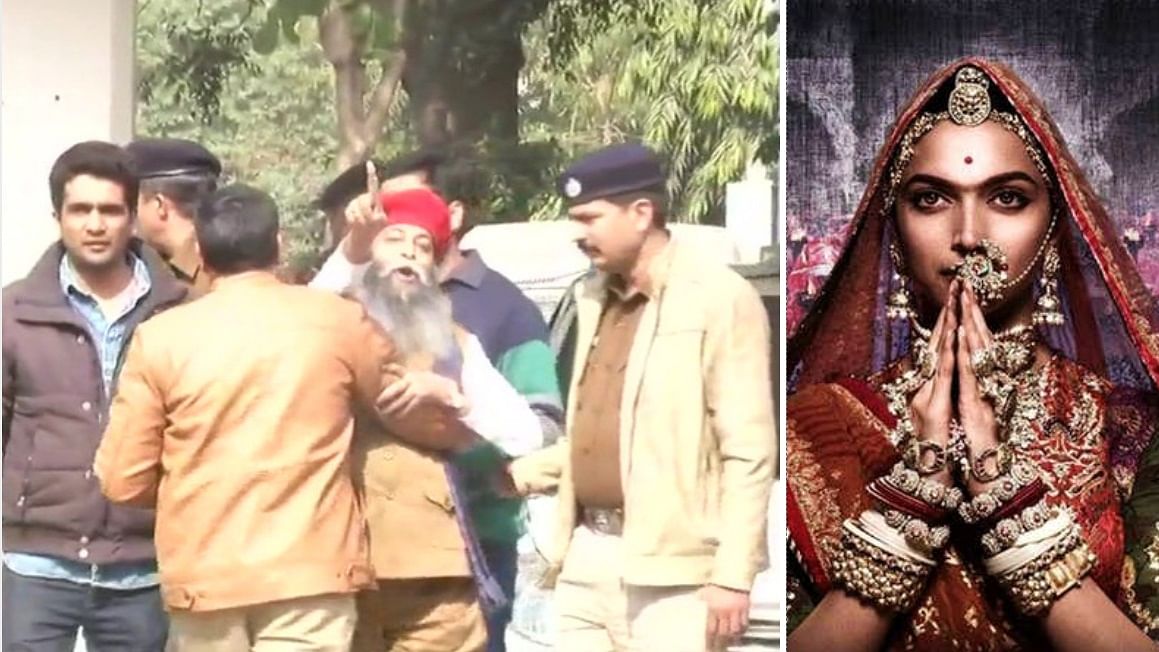
Suraj Pal Amu, who had announced a bounty on Deepika Padukone’s head for Padmaavat’s release, is back in the news. 

Published: 
Karni Sena Chief Amu addressing a mahapanchayat at Haryana’s Indri.

“Our boys are not guilty. They (Muslims) distort the pictures of our sisters and daughters. Should we not even murder them?”
Shri Ram Karni Sena Chief Kunwar Suraj Pal Amu

These words of Shri Rajput Karni Sena Chief Kunwar Suraj Pal Amu in a video that has gone viral on social media have stoked controversy. Amu, who had previously come to the limelight for announcing a reward for beheading actor Deepika Padukone over the controversy surrounding the film ‘Padmaavat’ is back in the news – this time for openly resorting to hate speech against Muslims.

In the latest video, Amu can be heard making a speech before a large assembly of people in Haryana, asserting his endorsement of the lynching of a local Muslim man that took place a few weeks ago.

Asif Khan, who hailed from Mewat’s Khalilpur Kheda village, was lynched allegedly by a mob of Gujjar men on the night of 16 May when he was returning home after buying medicines.

Asif’s cousin Rashid, who was present at the spot at time of the lynching said, “Unhone bola ‘Mulleh, tum logo mein se ek ko bhi nahi chhodenge’ aur ye bhi bola ‘tum sab se hum Jai Shri Ram bulvayenge’ (They said they will not leave any of us alive and also said they will make us chant Jai Shri Ram).”

They pulled Asif out of the car, thrashed him and killed him, Rashid said.

The three prime suspects in the murder case – Rohit, Pradip and Amit – have now been arrested, as per a tweet by the Nuh Police on 6 June.

What Did Amu Say?

Amu, who had addressed a large assembly at a Mahapanchayat held in Indri district of Haryana, could be seen validating the violence by the perpetrators of the Asif Khan murder case.

<div class="paragraphs"><p>Karni Sena Chief Amu addressing a mahapanchayat at Haryana's Indri.</p></div>

Karni Sena Chief Amu addressing a mahapanchayat at Haryana's Indri.

(Photo: Twitter/ Kunwar Suraj Pal Amu)

"We will pound them. Whoever has the courage can try to stop us," he added.

Before beginning his speech, Amu can be seen asking “true and good Hindus” to raise their hands. After a show of hands from the crowd, he then enquires “if there was any child of Pakistan there, he should also raise his hand”. He further says, “Muslims are no one’s brothers. They’re all butchers.”

Amu, who posted the video on his Facebook page on 31 May, captioned it: “Thousands came for the Hindu Mahapanchayat at Indri (Nuh) today. One who submits to a crime is a greater criminal than the one who commits it. If anyone insults our Hindu religion, will you keep silent? Only true Indians comment.”

ADVERTISEMENT

The Haryana BJP Connection

<div class="paragraphs"><p>Karni Sena Chief Suraj Pal Amu and Haryana BJP.</p></div>

Karni Sena Chief Suraj Pal Amu and Haryana BJP.

(Photo: Facebook/ Kunwar Suraj Pal Amu)

Born in an affluent Arya Samaj family in 1968 in Haryana's Sohna, Amu became an active member of the Rashtriya Swayamsevak Sangh (RSS) at the age of 10.

A law graduate, he was a member of the RSS’s student wing – ABVP – and served as its member from 1985 to 1988.

Amu has held several posts in the BJP over the years.

He has served as the State Secretary, State Vice-President, and National Executive Member of the Bharatiya Janata Yuva Morcha (BJYM), the youth wing of the party.

Significantly, he was made the spokesperson of Haryana BJP in 2013.

From 2014-2019, Amu served as the Chief Media Coordinator for BJP Haryana.
ADVERTISEMENT
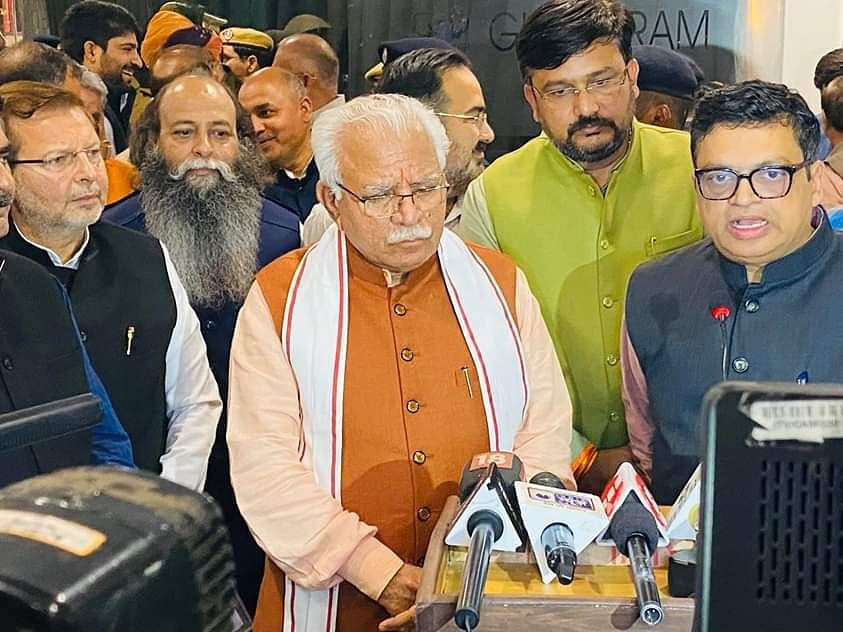
<div class="paragraphs"><p>Karni Sena Chief Suraj Pal Amu and Haryana CM Manohar Lal Khattar.</p></div>

Karni Sena Chief Suraj Pal Amu and Haryana CM Manohar Lal Khattar.

(Photo: Facebook/ Kunwar Suraj Pal Amu)

In 2019, he became the President of Shri Rajput Karni Sena, a Rajasthan-based interest group formed to protect and promote the concerns of the Rajput community. The interest group has been accused of incitement of a number of violent incidents in the past few years.

Most prominently, the Haryana BJP leader was arrested under IPC Section 506 (criminal intimidation) over his threats to the makers of the movie ‘Padmaavat’ in 2017.

In January 2018, after being granted bail in the case, Amu resigned from the primary membership of the party. On 8 October, almost eight months after this, Haryana BJP Chief Subhash Barala had reportedly refused to accept his resignation.

"For around 29-30 years I have held different posts in the party and its student wing. The last eight months were very tough for me to stay away from the party. However, I kept working with different social organisations. It is like a homecoming for me," Amu had said.

ADVERTISEMENT

The ‘Padmaavat’ Controversy

In November 2017, Amu had announced a Rs 10-crore reward for anyone who would behead actor Deepika Padukone and filmmaker Sanjay Leela Bhansali for making ‘Padmaavat’.

Amu had also lauded a Meerut man’s statement to award a Rs 5-crore reward for beheading Deepika Padukone and Sanjay Leela Bhansali. He said that the bounty would be doubled to Rs 10 crore.

His speech against the film had allegedly encouraged his followers to take up arms against Padmaavat’s makers. The Haryana BJP leader had then said that the families of those who committed to the deed would be taken care of, as he asked Prime Minister Narendra Modi to strike down the film.

Alleging that the movie was disrespectful to the Rajput community, Amu also threatened to ‘break the legs’ of actor Ranveer Singh, who plays the role of Alauddin Khilji in the film.

Haryana’s BJP chief Subhash Barala had issued a show-cause notice to Amu for his incendiary comments.

ADVERTISEMENT

Superintendent of Police Narendra Bijarniya, alluding to the viral video, told NDTV: "We have taken cognisance of this viral video and we will take action. None of the Mahapanchayats held in the district had prior permission of the administration."

The large assembly was held at a time when there is a widespread lockdown in the country in the aftermath of the devastating second wave of the COVID-19 pandemic.

(With inputs from NDTV.)

May 12, 2019

India: Hindu Vigilantes Drive Rajasthan’s Cow Trade Into Decline

Hindu Vigilantes Push Rajasthan’s Cow Trade Into Decline

Written by Srinand Jha | Published on: May 10, 2019

New Delhi: The cow trade at a leading cattle fair in Rajasthan, India's second-largest cattle-trading state, fell 95% over six years to 2017, an indication of the decline in cow rearing--once a popular livelihood choice--during the tenure of the Bharatiya Janata Party (BJP).


https://www.sabrangindia.in/article/hindu-vigilantes-push-rajasthans-cow-trade-decline


March 25, 2019

India - Rajasthan: No justice yet for Pehlu Khan who was beaten to death by a lynch mob | Tavleen Singh


No justice yet for Pehlu Khan
by Tavleen Singh | March 24, 2019

Last week I went to Behror. Pehlu Khan was beaten to death here two years ago. I wanted to see what had happened to the men who lynched him.

[ . . . ]

What is truly troubling is that there is a Congress government in Rajasthan now and it has done nothing to help Pehlu Khan’s family get justice. They were promised a compensation of Rs 5 lakh that everyone seems to have forgotten about.

[ . . .]

https://indianexpress.com/article/opinion/columns/pehlu-khan-mob-lynching-narendra-modi-up-cow-vigilantism-lok-sabha-election-5639873/

December 25, 2018

India: Congress, Now In Charge Of Rajasthan, Fails Naseeruddin | Brinda Karat

ndtv.com, December 23, 2018

by Brinda Karat

Naseeruddin Shah, one of India's finest actors, had in a most moving interview to Karwan-e-Mohabbat, referencing his inter-faith marriage, family and concerns for his children, expressed his anguish at a situation, like in Bulandshahr, where the "death of a cow has more significance than that of a police officer."

He said he spoke as a worried Indian. Well, he is not the only worried Indian. We are and should all be worried that things have come to such a pass that no one can express an opinion against the toxic politics of hate promoted by those in power without running the risk of being attacked and humiliated by them. The organizers of an event in Ajmer which was to be inaugurated by Shah on Friday decided to cancel it after members of the BJP Yuva Morcha and other groups tore down posters, vandalized the stage and reportedly threatened further violence.

These highly condemnable actions show the levels of impunity enjoyed by thugs and hooligans owing allegiance to the ideology of the Sangh Parivar. Under the Vasundhara government, as in other BJP-ruled states, those spouting hate speech and committing hate crimes have had a free run with not a single case registered for even the most communally provocative speeches. After the lynching of Pehlu Khan and later Rakbar Khan by the same breed of people who killed a police officer in Bulandshahr, Vasundhara Raje had in an interview during the election campaign sanitized the brutal and communal lynchings by referring to them as a law and order issue like any other. Concealing the specifically communal nature of a crime in a sense "normalizes" the kind of hate crimes that have become a hallmark of the rule of the current BJP governments.

The communal politics around the cow are a central theme along with the Ram temple in the agenda being pushed by the Hindutva forces. This includes the highly perverted argument that any violence committed in the name of cow protection is acceptable. The main accused in the Bulandshahr violence, a leading member of the Bajrang Dal, Yogesh Raj is still not arrested, while an FIR filed by him saw innocent Muslims locked up for cow slaughter. There are reports by journalists that Muslim houses are being raided and there is an environment of fear being created in the name of identifying cow slaughterers. The Special Investigation Team or SIT formed by the Yogi government has been unable to answer any questions as to who was responsible for the display of cattle carcasses which were conveniently discovered by members of the Sangh Parivar groups and how the only eye witness to the so-called slaughter of the cows was the very same man, Yogesh Raj, who reportedly led the mob violence that saw the policeman, Subodh Kumar Singh, being killed. It is quite likely that the entire incident was manufactured by a political conspiracy of the right wing groups to coincide with the large gathering of minority communities in the Ijetama in the region.

Chief Minister Yogi Adityanath has said that his main priority is to identify those "directly or indirectly linked to cow slaughter"; by inference, who killed the police officer is low or no priority. Such statements give license and a cloak of political patronage to Sangh Parivar cohorts across the country to act in similar ways.

And those who even raise a question mark on this kind of toxic politics are targeted.

Naseeruddin Shah became an easy target.

But Vasundhara Raje is no longer the Chief Minister and Rajasthan is now governed by the Congress. The newly-elected Gehlot government had and still has an opportunity to show how it is different by taking suo moto notice and arresting those responsible. There is ample evidence of the identity of the men who attacked the venue. Shamefully, the attacks took place in full view of the police who stood by watching. Perhaps this is what they had been ordered to do in the past, to protect the saffron brigade when they indulged in violence. But surely the Gehlot government should have taken firm steps to send a strong message that this type of communal politics, violence and intimidation will not be tolerated.

While the official handle of the Congress party at the centre tweeted support for Shah, there has been no follow up in the state where the incident occurred and where they are running the government. Even 24 hours after the shameful incident, there has not been a single word of condemnation by any Congress minister or leader in Rajasthan. No case has been filed, there has not been a single arrest. No policeman is being questioned for their lack of action in what appears to be a clear case of connivance. It is a disappointing start.

Brinda Karat is a Politburo member of the CPI(M) and a former Member of the Rajya Sabha.


November 06, 2018

India: BJP Minister in Rajasthan Booked for Seeking Votes in the Name of Religion

BJP Minister in Rajasthan Booked for Seeking Votes in the Name of Religion

"In Rajasthan, all Hindus should vote for the BJP, whether any work is done or not. If Muslims can vote en masse for the Congress, all Hindus should do so for the BJP," said Dhan Singh Rawat, the BJP legislator from Banswara district.

Shruti Jain

30/Oct/2018

Jaipur: Dhan Singh Rawat, the BJP legislator from Rajasthan’s Banswara district and the minister of state for panchayati raj, has been booked for invoking religious polarisation before the forthcoming assembly elections in the state. [ . . . ]

https://thewire.in/politics/bjp-minister-dhan-singh-rawat-rajasthan-polls-speech-communalism

October 08, 2018

India: Pre-Election Campaign of Communal Rhetoric In Rajasthan

Ahead Of Elections, Campaign Of Communal Rhetoric In Rajasthan's Alwar

Alwar has repeatedly been in the national headlines in the past two years for lynchings in the name of the cow. Pehlu Khan was murdered in 2017 and more recently, Rakbar Khan died in custody; both men were accused of cattle smuggling.

Written by | Updated: September 26, 2018

https://www.ndtv.com/india-news/ahead-of-elections-campaign-of-communal-rhetoric-in-rajasthans-alwar-1922215

September 29, 2018

India - Flagrant impunity of for the violent mob: Pehlu Khan lynching case - Witnesses ‘fired at’ while going to depose

Pehlu Khan lynching case: Witnesses, including sons, ‘fired at’ while going to depose

The witnesses who were on their way to Behror to depose Pehlu Khan's lynching, claimed they were overtaken by an SUV on NH-8 and then later fired upon.
Written by Hamza Khan | Jaipur | Updated: September 29, 2018

https://indianexpress.com/article/india/pehlu-khan-lynching-case-witnesses-including-sons-fired-at-while-going-to-depose-5379110/

July 31, 2018

India: Alwar lynching shows the government has put the burden of ending mob killings on victims themselves


https://scroll.in/article/888454/alwar-lynching-shows-the-government-has-put-the-burden-of-ending-mob-killings-on-victims-themselves

Alwar lynching shows the government has put the burden of ending mob killings on victims themselves

Relatives and neighbours of Rakhbar Khan, who was allegedly lynched to death on suspicion of cow-smuggling in Alwar's Lalawandi area on July 20, 2018. | Sanjeev Verma/HT Photo

Harsh Mander

I held Rakbar Khan’s father Suleiman’s hand in mine for a long time. His face was creased with grief, his eyes often welled up. Khan’s widow lay close by, stretched out on a string cot, her face fully covered with her red dupatta, unmindful of the claustrophobic heat, surrounded by women of her village who whispered around her in solicitous tones. “She has become crazed with her agony,” one of them said. “She just gets up and laughs.” Earlier, when she spoke publicly, she had lamented that she was left alone to raise her seven children, the smallest a boy who had only just spoken his first words. The children, most of them with light hazel eyes, gazed at us and the large crowd of village men who had gathered outside their home with puzzlement and nervous unease, unable to comprehend why their father had been killed, and why so many of us had collected there.

Some things are by now clear about the circumstances in which 28-year-old Rakbar Khan, an impoverished, nearly unlettered dairy farmer, was lynched in Rajasthan’s Alwar district on the night of July 21, a few kilometres from his village Kolgaon in Haryana’s Nuh district. Other facts are still disputed or deliberately obscured. The facts beyond dispute are that as Rakbar Khan was returning home on foot under cover of darkness with his friend Aslam Khan and two dairy cows he had bought from Rajasthan, he was attacked by a group of men claiming to be gau rakshaks or cow protectors. Aslam Khan managed to escape but Rakbar Khan was not so fortunate.

As a teenager, Rakbar Khan had laboured on sand and stone-mining sites in the surrounding Aravali Hills. After the mining was shut down a decade ago, he fell back on the only other vocation his family knew, dairy farming, supplemented with intermittent farm labour. Two milch cows were tethered outside the family’s small home. His father had aged, and Rakbar Khan alone could barely bring in Rs 5,000 a month for his parents and children. He decided that his only chance to improve his family’s lot was to buy a couple more milk-yielding dairy cows – the local metaphor is biyahi or married cows, impregnated cows fecund with milk. His father-in-law had loaned him Rs 50,000 to buy two cows. These, Rakbar Khan had hoped, would change their lives. They did, but not in ways he had hoped. What transpired instead was the worst nightmare of every Muslim dairy farmer in Nuh today.

The Karwan e Mohabbat team visits Rakbar Khan's family in Kolgaon village in Haryana's Nuh village. (Credit: @karwanemohabbat / Twitter)

Each of them knows that buying cows and transporting them have become ultra-high-risk enterprises on the watch of the current political regimes in the country and in Haryana and Rajasthan. Since Pehlu Khanwas lynched last summer for buying and ferrying biyahi cows and their calves in a pick-up truck, farmers are terrified of the risk of being spotted anywhere with cows, and now even buffaloes. The law bans the slaughter of cows, not their transport for dairying.. But who will explain this to a lynch mob? Or for that matter to a state home minister, and even police officials, who continue to defame both Pehlu Khan and Rakbar Khan as cow smugglers, thereby directly rationalising their mob killings? Cow vigilante groups, openly supported by the political establishment and the police, rule the streets. It has become routine for those who transport dairy animals to face violence and extortion at their hands. Aggravating matters, the Haryana Police have established an official Cow Protection Force of men and women in uniform, with the official mandate of saving cows. There are now special cow protection police chowkis that are dreaded by farmers for their coercion and extortion.

Rakbar Khan weighed all of these risks before opting to embrace the hazards of buying a cow. The two cows would have doubled his monthly income from Rs 5,000 and allowed his children to drink more milk and to go to school, his parents to eat better. Too poor to hire a vehicle, he decided to walk the dairy cows home. And he decided to avoid the highways and walk instead through fields in the dark. Nuh is a Muslim-majority district, and we find that most incidents of lynching of Muslim farmers from here occur not within Nuh but in districts like Alwar in neighbouring Rajasthan, where Muslims are in a minority. Rakbar Khan and Aslam Khan were just a few kilometres from the borders of their district when some farmers alerted cow vigilante groups, who chased down the two men. A terrified Rakbar Khan left his two cows and endeavoured desperately to escape, but the men caught up with him. Aslam Khan barely managed to escape. He reached his home at dawn, his clothes smudged with wet mud. He had crawled face down through the fields, petrified through his nightmarish journey that the vigilantes would spot him.

We could not meet Aslam Khan in Kolgaon when our Karwan e Mohabbat team visited Rakbar Khan’s family. We were told that since his escape, he felt dragged down with the shame of abandoning his friend and had left the village for a while.

In Rakbar Khan's village Kolgaon, residents rejected claims that the dairy farmer had not died of injuries sustained during the mob assault. (Credit: Ashish Soni)

Who killed Rakbar Khan?

What remains bitterly contested about the events of that night is how severely the attackers, who reportedly bragged that they were backed by Rajasthan Bharatiya Janata Party MLA Gyan Dev Ahuja, beat up Rakbar Khan. The men claimed they only slapped Rakbar Khan and beat him “a little” to “show off” to the crowd and teach him a lesson.. They produced a number of witnesses who told television reporters that Rakbar Khan was able to sit up after the beating. It was at the police station, where he was taken before he was brought to a hospital, that they claim he was beaten to death. Rajasthan Home Minister Gulab Singh Kataria too said that this seemed to him to be a case not of cow lynching but of custodial killing. He seemed more willing to sacrifice the uniformed men under his charge than his party supporters who were given to lynching Muslim men.

However, during the Karwan team’s visit to Rakbar Khan’s village, the residents insisted it was the mob that had thrashed him nearly to death, not the police. It was only to save themselves that they had shifted the blame to the police, the villagers said. They hoped that with this, they would be spared the charge of murder, and even in the unlikely chance that they were convicted, they would spend just a few years in jail and emerge heroes. The policemen would, again at worst, face administrative action, and ultimately be acquitted when public memory faded.

It was the post-mortem report that confirmed the villagers’ version, that the mob attack had left Rakbar Khan critically injured.. It stated that he had suffered 13 injuries – including a fractured wrist, another fracture in the left femur, bruises, abrasions and a laceration – in the attack, and concluded that he had died of “shock as a result of ante-mortem [before death] injuries sustained over body”. It also said the injuries on his body were 12 hours old, calculated from the time of autopsy. Since the post-mortem was conducted at 12.44 pm on July 22, the time of the assault that killed Rakbar Khan was around midnight the night before, when he was still at the mercy of the mob.

Not just an ‘error in judgement’

Even though Rakbar Khan probably died mainly because of the mob assault, the police were far from blameless. If there was any life left in him when they got to him, he could possibly have been saved had they immediately taken him to hospital, which was just 4 km away. Instead, as is now well-known, they took nearly four hours during which they (or members of the mob) washed him and changed his clothes (a wanton and criminal act of destruction of evidence), delivered his cows to a cow sanctuary, stopped by for cups of tea and only then delivered him to the hospital, where he was declared dead on arrival.

Senior Rajasthan Police officials described the actions of their men in Alwar as only an “error in judgement”. What they failed to acknowledge was that this failure may have cost an innocent man his life, and therefore was criminal. They also did not admit that the policemen felt emboldened to act in this way because of the unambiguous messages they receive from their seniors, both in uniform and the political establishment. A minister in the Rajasthan government, Jaswant Yadav, rationalised the lynching as he alleged that Muslims smuggle cows. And Union minister Arjun Ram Meghwal said the rising graph of lynchings reflected the growing popularity of Prime Minister Narendra Modi. In the Pehlu Khan lynching incident too, the Rajasthan home minister and senior police officials had described the victims as cow smugglers, and the police had registered criminal cases against his son and nephew, even as the men named by Pehlu Khan in his dying declaration were either deemed by the police to be innocent or are out on bail.

In this way, the messages junior rungs of the police receive from their superiors, in uniform or from the elected executive, in Rajasthan as in most parts of the country today, are clear – that attacks on Muslims by mobs or men in uniform in the name of protecting the cow (or the “honour” of Hindu women) are understandable acts by provoked Hindus who love their religion, the cow and their country (in deplorable contrast to Indian Muslims). These police personnel anyway belong to the same society that is today widely surcharged with communal hatred against Muslims and caste hatred against Dalits. There is little in their training and leadership to encourage them to interrogate and, even less, abandon their communal and casteist instincts. If they are then extensively fuelled by open hate speech and encouragement of hate violence by those who control their careers, how can we blame just junior policepersons for the casual disregard they display for the law and for protecting the lives of Muslim and Dalit victims of targeted hate violence?

Rakbar Khan had bought two milch cows to give his impoverished family a better life. (Credit: @karwanemohabbat / Twitter)

An unsaid message

I end by examining the frank rationalisation of lynching by representatives of the Rashtriya Swayamsevak Sangh and the BJP that I have encountered in every television debate I have participated in (and watched) in recent weeks. This is that lynching is the outcome of understandable and righteous Hindu anger because Muslims refuse to respect Hindu sentiments and continue to illegally slaughter cows. To take just one recent public articulation of justification for lynching, let us listen more carefully to the words of Rajasthan minister Jayant Yadav. He appealed to Muslims to stop the business of cow smuggling and to understand and respect the sentiments of Hindus. “Smugglers stuff 50-50 cows into a truck to smuggle them and sprinkle acid on them,” he told Aaj Tak. “I request Muslims to not take to cow smuggling as this hurts the sentiments of the Hindus.” Lynching occurs, he added, because this “boils the blood of Hindus”.

There are, of course, innumerable problems with this kind of reasoning that is widely peddled to validate mob violence. Even if it were true that Muslims generally smuggle cows and Hindus as a whole object to cow slaughter, it does not justify in any way the raising of a single hand against a Muslim (or any other person) who is transporting cows. His guilt or lack of it must be resolved only by the process established by law.

But even apart from this, the alleged Hindu-Muslim divide on the question of cow slaughter is a disingenuous, false and communally mischievous construction. Since incidents of lynching of dairy farmers in Nuh have grown in recent years, I have come to know closely the communities to which Pehlu Khan and Rakbar Khan belong. They love cows no less than any Hindu farmer. Both Pehlu Khan and Rakbar Khan were lynched when they were transporting dairy cows that they had bought for milk, not slaughter. Both had borrowed and spent Rs 25,000 to Rs 30,000 on each cow. The maximum a person can earn from selling a cow for slaughter is Rs 5,000 to Rs 8,000. It is, therefore, indisputable that they were legitimate and lawful dairy farmers, not illicit smugglers of cows for slaughter. Despite this, senior ministers, elected representatives of the BJP and the police persist in slandering them as cow smugglers. On the other hand, many Hindus also eat cow meat. The BJP needs to clarify if they regard Dalits to be Hindus, and if they do, how can they generalise that all Hindus oppose cow slaughter? What about Hindus who live in Assam and Kerala? And then, of course, the ordinary farmer, both Hindu and Muslim, who may deeply love the cow, but who does not have the wherewithal to feed and rear the cow when her milk dries and she ages?

Adityanath, the saffron-clad chief minister of India’s most populous state, Uttar Pradesh, declared that human beings must be protected, but so also must cows. “It is the responsibility of every individual, every community, every religion to respect each other’s sentiments,” he said, days after Rakbar Khan’s lynching. What he implied but did not say explicitly was that Muslims must respect the alleged sentiments of Hindus, but Hindus owe Muslims no such obligation.

In other words, the BJP unambiguously places the burden of ending lynching violence on the principal victims of this violence, the country’s Muslims. Muslims in India, after all, are themselves responsible for their own lynching.

July 22, 2018

India: PUCL Statement against the lynching of Akbar Khan in Alwar in the early hours of 21st July 2018

PEOPLE'S UNION FOR CIVIL LIBERTIES
RAJASTHAN
Jaipur,
21st July, 2018
Press Note

NOT COW SUMGGLING BUT EXTORTION WHICH LED TO THE LYNCHING OF           AKBAR KHAN 
At 1 am in the night of 20th and 21st July

After having studied collectively with others activists, the lynchings in Mewat area of Rajasthan, it has become clear to the PUCL that Akbar Khan who had bought two cows from village Ladpur, Ramgarh tehsil, Alwar district and was taking back the cows in the night to his own village Kol near Firozpur Jhirka, Mewat, Haryana. Where he was killed in Jungle Lalawandi, Ramgarh. It is well known that extortionists under the garb of gaurakshaks are roaming the streets looking for a prey. If those carrying cows are able to pay the sum demanded, then they are allowed to go or else fired at and killed. This time too this has been the case, as reported by activists from the ground level.

The murder of Akbar is the complete failure of your Government in protecting Muslims in particular Dairy farmers from the killer Gaurakshaks, who are basically extortionists.  

You may recall that in the past 4 lynchings have happened since 2015, with three in 2017. Please recall the following murders: 
·           30 may 2015, Abdul Gaffar Querishi, Birloka, Didwana tehsil, Nagaur district
·           1st April, 2017 Pehlu Khan, Behror thana, Alwar district
·           16th June, 2017 Zafar Khan, Pratapgarh town, Pratapgarh district
·           10th sept, 2017 Bhagtaram Meena, neem ka thaana sikar district.
Along with police encounters in the city of Alwar of Mev Muslims, in the name of the picking up cows.
Although in this case the police brought the deceased to Alwar and lodged an FIR 0321/18 U/S 143, 341, 323, 302, 34 IPC at the Ramgarh police station.
 We would like to ask the Government of Rajasthan, who tweeted immediately this morning, condemning this incident, whether she had any plans to call a halt to this bloody madness as now the Gau rakshaks have tasted blood and have the support of the police and administration
All pehlu khan killers were thrown out of the purview of investigation and cases of cow smuggling are still being faced by Pehlu khan’s companions, Azmat and RAfiq. Todate Zafar khans killers are roaming free and the eye witnesses in the Umar case were thrown into jail. In Bhagtaram’s case nothing happened, till the High Court intervened earlier this month in July.. There seems to be complete impunity to the killers, with the Home minister Gulab singh Kataria going on record that Gau Rakshaks to good work, after Pehlu khan was killed.
We would also like to know whether the GOR has any plans to implement the Supreme court guide lines. The SC clearly made the centre and State responsible for lynchings, and said mobocracy will not be allowed. As part of the guidelines it has all state to make nodal officers, immediate arrests and chargesheets and fast track courts and maximum punishment.
It these are not going to stop now, these murders are going to be on the increase? It will be a major violation by your Government of Article 21, the right to life of the Muslims

we demand :

·         the immediate transfer of investigation to an independent agency, like an SIT or under the IG.
·         Arrest the killers of Akbar Khan.
·         Immediately and restore the cows to the family of Akbar Khan.
·         Compensation including cash of 25 lakhs and land to the family. And a government job to his kin.
·         Aslam be given protection.
·         No false case of cow smuggling be filed against Akbar and Aslam...
·         The Ramgarh SHO be dismissed from duty. As the onus is on the State to protect the people from lynching.  
·         The Home minister give a plan for the protection of dairy farmers particularly the Meos in Mewat region.

We also demand from the CM that this be the last lynching in Rajasthan. The impunity and protection to these killers be withdrawn now.

Kavita Srivastava, (President)

Anant Bhatnagar ( General Secretary)

 FIR attached


Address for Correspondence: 76, Shanti Niketan Colony, Kisan Marg, Jaipur -302015
Phone No: 0141/ 2708917, 09351562965, 9887158183; E-mail -  pucl.rajasthan[at]gmail.com


April 10, 2018

India: A hatred filled Ram Navmi - reports from Bihar, Rajasthan and Bengal - selected reports

January 30, 2018

India: Alwar’s Long History of Hindutva | Kannan Srinivasan

The Wire, 29 January 2018

Alwar’s Long History of Hindutva Casts a Shadow Even Today

 Alwar City Fort. Credit: Wikimedia Commons
Alwar City Fort. Credit: Wikimedia Commons
The murders of Pehlu Khan and Umar Mohammed by gau rakshaks last year and repeated recent anti-Muslim propaganda will certainly have mobilised local forces of the Hindu Right in Alwar. That may come into play in the by-election to the Lok Sabha held on Monday, January 29.
At this point, it is worth recalling some history.
During Partition, the princely states of Alwar and Bharatpur were the sites of a pogrom directed against the Muslim Meo community. The Meos are a distinctive Rajput Muslim community with a number of Hindu or Rajput practices. They also had a history of being assertive, and bearing arms.
Both Jai Singh of Alwar – who ruled from 1903 to 1933 – and Kishan Singh of Bharatpur (1899-1929) provided official patronage to the Arya Samaj and its Shuddhi movement of conversion to Hinduism. The Hindu Mahasabha and the Rashtriya Swayamsevak Sangh (RSS) grew in importance with the patronage of their durbars. The Mahasabha’s V. D. Savarkar set in motion a policy of courting Hindu princes. Both states officially changed the official script from Nastaliq to Nagari, and banned the teaching of Urdu and Persian in state schools. The Shahi Jama Masjid in Alwar was one of several important buildings that were converted by order of the government. Discriminatory taxation led to a tax revolt by the Muslim Meo population, in the course of which the state army opened fire on a crowd with machine guns at Govindgarh on January 7-8, 1933, and killed more than 30 people.
The British government of India saw in this the evidence of sufficient misrule to remove Jai Singh from Alwar and take over the administration later that same year. Bharatpur had already been taken over following Maharaja Kishen Singh’s misgovernance in 1929. Despite the removal of these pro-Hindutva rulers, the Hindu Mahasabha gained in strength in both darbars even during the period of British administration right through the thirties and forties.
Eventually, Tej Singh, Jai Singh’s successor chosen by the Indian government, took over administrative control of Alwar in 1943, and Brijendra Singh took over Bharatpur in 1944. Both took measures to make their administrations more sympathetic to the Hindu Mahasabha, and anti-Muslim. Brijendra Singh shared most coercive powers with his brother, Girraj Saran Singh, military secretary, who was reputed to be something of a gangster. “The brother of the Bharatpur Ruler is a Minister and is definitely involved in dacoities and looting,” Prime Minister Jawaharlal Nehru wrote to Vallabhbhai Patel in 1947.
Despite Tej Singh’s increasingly anti-Muslim administration, the promise of greater autonomy than might be offered by the Congress led him, like Hanwant Singh of Jodhpur and others, to flirt with the idea of joining Pakistan. But his Hindutva-ising of his administration was to culminate in the appointment of Narayan Bhaskar Khare of the Hindu Mahasabha as prime minister of Alwar on April 18, 1947, as well as adviser to the state of Bharatpur.
 V. D. Savarkar. Credit: Wikimedia Commons
V. D. Savarkar. Credit: Wikimedia Commons
Khare had earlier been the Congress prime minister of the Central Provinces and Berar from 1937 to 1939. Savarkar, head of the Hindu Mahasabha, and his colleague B.S. Moonje had been inspired by Khare’s provision of arms licences to campaign for the same for Hindu organisations and schools. It is not certain when Khare secretly turned to the Hindu Mahasabha, but it is clear that he had an anti-Muslim agenda long before formally joining the party. Khare soon persuaded Tej Singh to abandon the idea of Pakistan. In July 1947, Alwar hosted a Hindu Mahasabha conference for the princely states. Soon, a small arms factory was set up in Alwar by Khare and another one in Bharatpur.
Now, Khare’s greatest asset when he came to Alwar was that despite his former estrangement from the Congress party, he had mended his relations with Patel, member for home in the viceroy’s executive council and the interim government who would soon become home minister and minister for states in the new government of independent India. In correspondence, such as his letter of June 17, 1947, Patel, otherwise quite formal, addressed Khare as “Dear Friend.”
Khare persuaded Patel that a Muslim Meo revolt was brewing and that the Meo areas of Alwar and Bharatpur would attempt to join Pakistan. He claimed that K.M. Ashraf, a communist sympathiser in Congress, was the ring leader of the revolt and working with the Muslim League, as mentioned by Khare in his book My Political Memoirs. In fact, as the distinguished subaltern studies historian Shail Mayaram shows, the Left programme was for Mewat self governing autonomy within independent India. Nevertheless, Patel was persuaded. Patel’s officials in the states ministry, such as the secretary V.P. Menon, also accepted Alwar state’s official account.
Vallabhai Patel. Credit: Wikimedia Commons
What explains Patel’s sympathies? They were of a piece with those of a certain group of Congressmen. The Congress party itself represented a coalition of personalities of various beliefs, from communists such as Ashraf to progressive liberals such as Nehru to creatures of the Hindu Right such as Patel, Rajendra Prasad who was to become president, or Purshottam Das Tandon who was elected to be president of the Congress party as Patel’s candidate, despite’s Nehru’s efforts. We have misread the past when we have thought Nehru as all-powerful. Rajeshwar Dayal, then home secretary, united provinces, recorded his experience of his prime minister, Govind Ballabh Pant in 1947:
“the Deputy Inspector-General of Police of the Western Range, .. BBL Jaitley, arrived at my house in great secrecy. .. .. (he) brought … incontrovertible evidence of a.. conspiracy to create a communal holocaust throughout the western districts of the province. .. ….  Timely raids conducted on the premises of the RSS (Rashtriya Swayam Sevak Sangh) had brought the massive conspiracy to light. … Both Jaitley and I pressed for the immediate arrest of the prime accused, Shri Golwalkar, who was still in the area. Pantji … instead of agreeing to the immediate arrest of the ring leader….. asked for the matter to be placed for consideration by the Cabinet at its next meeting. ….. What ultimately emerged was that a letter should be issued to Golwalkar pointing out the contents and nature of the evidence which had been gathered. ..”
“By this means, “Golwalkar ..(was) tipped off and he was nowhere to be found…” (A Life of our Times, Orient Longman).
On June 18, 1947, there was a large-scale flight of Meos from Bharatpur to Alwar, and within Alwar to other tehsils. Mayaram has quoted a captain in the Alwar state army on the safaya as the killings were euphemistically termed, and shuddhi, conversions:
“I was ADC to HH Tej Singh. We were with the RSS. It had been ordered to clear the state of Muslims. I was sent on special duty to Tijara. ……. I went ahead and posted the force on a hill ..” In the valley below were 10,000 Meos. “We killed every man, all of them.”
Thereafter, in village after village, the army, accompanied by a shuddh squad, compelled Meos, if they wished to live, to eat a piece of pork and convert from Islam. The last battle was at Naugaonwa, “a large Meo stronghold. We butchered them.” As the Meos fled, they were killed at every place: “It took us more than two months, July, August, to clear the whole bloody area.”
A Bharatpur Jat interviewed by Mayaram says:
“Meonis were made shuddh … Any man who did not have a woman took her and kept her…any woman was taken, even while she was walking or cutting grass she was lifted, carried over the shoulder. She would not say anything for fear.”
Khare rejoiced, as mentioned in his book: “As a result, today there is not a single Muslim in the whole of the Alwar State… In this way, the Meo problem in the State which was troubling the State for several centuries has been solved at least for the time being.”
Years later, he was to exult in his achievement when interviewed for the oral histories of the Nehru Memorial Museum and Library:
“But Moonje was damn pleased with what I did to the Muslims of Alwar…. He called me to Nasik and embraced me….More than anything else, what I did in Alwar and the way I broke the back of Muslims there pleased Dr Moonje immensely. I was in Delhi as a member of the Constituent Assembly in 1947. Moonje was also in Delhi in December. So he gave me a good party, a huge party, an At Home. When I went there, Moonje caught hold of me and embraced me saying, Doctor, All of us are very pleased with what you have done in Alwar, whatever we have done to each other let us forget…”
Curiously, after the killings of Meo Muslims and after most survivors had been driven out of Alwar and Bharatpur, Patel wrote to Khare:
“a lakh of Meos who had left Alwar and Bharatpur… wish to return to the States under such conditions as you might lay down. They are now in a penitent mood.. if continued in this present position (as refugees in Gurgaon) they might get more desperate instead of being cowed down, as they are at present.”
This signified that the Meos were wrong, that Khare was justified in imposing any conditions and that it was a good thing that soon to be citizens of free India were cowed down.
Prime Minister Nehru wrote most carefully to Patel on November 4, 1947:
“As you know the Rulers of some States, for instance, Alwar, Bharatpur, … are misbehaving in their States. … I suggest that your States Ministry might point out to them that what they are doing is objectionable and harmful. Further that we might stop all export of arms and petrol to these States”.
But Patel brushed him off:
“The present atmosphere and condition in the country makes it necessary to handle the State questions with a degree of caution and tact.”
Mayaram has estimated that a large population fled, many to Pakistan at the time of Partition. Of those who stayed, 82,000 were killed and many converted forcibly (Khare’s own estimate of conversions was 40,000-45,000).
Ashraf was able to persuade Gandhi to take up the issue, and undertake a tour of Mewat. Such efforts enabled perhaps 100,000 Meos to return to Alwar and Bharatpur. Nevertheless, Ian Copland, examining census records, shows how the Muslim population which had been 26.2% of Alwar in 1941 and 19.2% of Bharatpur, dropped after the pogroms, conversions and flight, to 6% in both states. About two-thirds of their land was taken away.
As for Khare, he was suspected of involvement in Gandhi’s assassination, for some evidence suggested Alwar and Gwalior were both a part of the conspiracy. He was thereafter to become president of the Hindu Mahasabha.
Kannan Srinivasan is a journalist and writer based in New York.