Resources for all concerned with culture of authoritarianism in society, banalisation of communalism, (also chauvinism, parochialism and identity politics) rise of the far right in India (and with occasional information on other countries of South Asia and beyond)
Indian Muslims and Electoral Choices |
Ram Puniyani
As the 2024 General Elections are looming on the horizon some Muslim elite are appealing to Muslim community to give a relook at BJP They claim that Indian Muslims are not being discriminated against. Such intellectuals also argue that BJP is giving special attention to Pasmanda Muslims and the Sufi Muslims. They also argue that Muslims are beneficiaries of BJP’s schemes for social welfare: food; housing; gas; water among others and lastly that there has been no major communal violence since 2014 and that India has been most peaceful during the last fifty years.
Such appeals are based on half truths and ignore the core problem which shapes the lives of Muslims in India. True, some elite Muslims may not be facing the problems so severely but overall the central issue of insecurity, marginalization and ghettoization as a whole is not accounted for in such appeals. The point that there is no major violence against Muslims since 2014 is a blatant lie. The horrific Delhi violence in the aftermath of massive Shaheen Baugh movement, instigated by BJP worthies, (Goli Maro, and ‘we will get them removed from the place of Dharna’) led to the death of 51 people, 37 of those being Muslims.
Day in and day out bulldozers are on the streets to target the Muslim properties, on one or the other pretexts. In BJP ruled states there seems to be a competition as to who can inflict more damage to Muslim properties. AP Shah, a retired chief justice of the Delhi High Court, affirmed to the news portal Coda, “Mere alleged involvement in criminal activity cannot ever be grounds for demolition of property.” While the cow beef politics has led to stray animals causing accidents on roads and in attacks on the standing crops on one hand on the other it has led to initiation of a new phenomenon of lynching on Indian streets.
Starting from Mohammad Akhlaq there are many cases where Muslims (and also dalits) have been the target of the incited mobs.
The case of Monu Manesar who was part of the crime of Nasir and Junaid is most frightening. Harsh Mander who visited victims’ families wrote “I am profoundly chilled as I scan social media pages of Monu Manesar. He and members of his gang live stream as they openly brandish sophisticated firearms, sound sirens mimicking police jeeps, shoot at vehicles, and brutally thrash the men they catch.” The proper data of bovine related violence is not available as the state wants to hide it, but it has created a fear among large sections of Muslims. In Mewat in particular where Muslims deal with dairy business face a tough time. Just a couple of horrific incidents which give us chills in our spine are when Shambhulal Regar not only killed but videotaped brutal killing of Afrazul in Rajasthan.
We saw those accused of murdering Kalimuddin Ansari feted by Jayant Sinha, a Union Minister at the time. Such incidents have now become ‘new normal’.
We also saw the scare created around Love Jihad and then types of Jihad were tabulated, UPSC, Land Jihad among others. The amusing one was Corona Jihad, where the Tablighi Jamaat meeting was blamed for the spread of Corona, the Muslims hawkers were denied entry into societies.
Islamophobia is reaching new heights by the day.
This intimidatory atmosphere is leading the rise in the process of ghettoisation of Muslims in the cities. Muslims are being denied housing in the mixed localities in most places. This is accompanied by the decline in their educational and economic status. One example of this is the scrapping of Maulana Azad Fellowship, the major beneficiaries of which have been the Muslim students trying to pursue higher education. The economic climb-down of the community continues in recent years. Gallup data shows that, “For both groups, (Hindus and Muslims) perceptions that standards of living were worsening shot up between 2018 and 2019, as the Indian economy entered a deep slowdown. Among Muslim Indians, the percentage jumped to 45% in 2019, up from 25% the previous year. And among Hindu Indians, the percentage saying the same hit 37% in 2019, an increase of 19 percentage points from 2018.”
The threat of disenfranchising the Muslims through exercise of NRC, CAA is very much there. The Assam exercise showed that among the 19 Lakh people who did not have proper papers the majority were Hindus. For Hindus the safety clause of CAA is in place and for Muslims, detention centers are coming up.
The present show of sympathy for Pasmanda Muslims is a mere eye wash. We understand the majority of victims of violence inspired by majoritarian politics are Pasmanda Muslims. The Muslim Ashrafs do need to ensure better treatment of the Pasmandas, but the bigger threat for the community as a whole is the insecurity, which affects them both and makes a fertile ground for orthodox elements to flourish. Reform amongst Muslim community is a must, however the point is reforms remain in the backyard till the community feels the threat to their existence and to their citizenship.
The BJP Government in different states is now planning things which are further discriminatory against Muslims. With Ram Temple inaugurated the RSS-BJP’s majoritarian politics may become more assertive. Already Muslims have been losing representation in the political institutions. We remember that in this Hindu nationalist party not a single MP is a Muslim.
Even earlier governments could not alleviate the suffering of this community. The major obstacle in this direction has been the opposition from RSS-BJP. Sachar Committee has been an example of how any affirmative action for this deprived community is marred. In the aftermath of this report, the then Prime Minister Manmohan Singh stated that deprived and marginalized communities have the first right on national resources. That was propagated as if Singh is saying that Muslims have the first right on national resources. And then there was a brake in any initiative to alleviate the miseries of this community.
BJP’s claim that its free rations etc. are reaching all sections of society. Such schemes and the very concept of Labharthis is so much against the democratic ‘Rights based approach’. We do need to introspect about electoral choices in general for all the communities, and of course the luring of Muslim community is a hollow drum bereft of any substance.
Uttarakhand Chief Minister Pushkar Singh Dhami with the Adi
Kailash mountain behind him, Pithoragarh district on October 12.
|
Pushkar Singh Dhami @pushkardhami/Twitter
India’s most populous hill state Uttarakhand is in
unprecedented turmoil. It is the first state in India in which an
influential and popular campaign for ethnic cleansing has gathered
ominous momentum: a battle for the expulsion of all Muslims from the
state. This crusade is tacitly supported by the state government.
These
alarming fractures in the state have mostly escaped national attention
because not much blood has been spilt. But barely below the surface,
Uttarakhand smoulders with communal temperatures ratcheted to perilous
levels.
Advertisement
Uttarakhand
has not witnessed significant communal tensions between its religious
communities in the past. Its ruptures have much more pivoted on caste.
Uttarakhand probably has a higher proportion of Brahmins than any other
state, estimated at around 20% of the population. The sometimes violent
movement for the separation of Uttarakhand from Uttar Pradesh to create a
separate state in the 1990s was substantially sparked off by the
decision of the Mulayam Singh government to extend reservations in
government jobs to members of the other backward classes. Muslims widely
supported the demand for the separate hill state.
Muslims
constitute around 14% of the state’s population. The present canvassing
for the ejection of the state’s Muslim population rests on three
pillars. The first of these is the premise of the pristine sacredness
for Hindus of the hill state, polluted by the presence of Muslims. The
second is claims of the exclusive indigeneity of Hindus in this holy
land, threatened by the surge of Muslim outsiders who are rapidly and
dangerously altering the demography of the state. The third is the
alleged inherent perfidy of Muslims, evident in the battery of jihads
that they are unleashing on hapless Hindu residents of this sanctified
land – population jihad, love jihad, land jihad, mazaar jihad and, most
recently, vyapar jihad. Mazaar refers to mausoleums and vyapar to trade.
These arguments are propagated vigorously by an extensive
network of the Rashtriya Swayamsevak Sangh and its family of Hindutva
formations that have expanded to remote mountainous corners of the
state. There are 1,400 shakhas or branches of the Sangh in Uttarakhand
and plans are underway to double the number in the next two years. Sangh
workers explain that their work is cut out for them: they must warn the
Hindu people of the dangers that Muslim residents of the state pose to
the purity of the Dev Bhumi.
People at a Vishva Hindu
Parishad event, where Pushkar Singh Dhami was also present in Haridwar
on October 6. Credit: Pushkar Singh Dhami @pushkardhami/Twitter.
The
hatred against Muslims is fuelled and legitimised by Hindu religious
leaders in saffron, who do not desist even from calls for mass rape and
genocide. Their discourse is amplified exponentially by right-wing
publications, the social media and a widely communalised local press.
All of these get embedded into ruptured social and economic relations by
calls for boycott, expulsion, and occasional acts of violence against
Muslims.
Advertisement
But what has most decisively inflamed anti-Muslim sentiments in the hill state is its elected political leadership. Chief Minister Pushkar Singh Dhami
has for 33 years of his life of 45 years been a dedicated worker of the
Rashtriya Swayamsevak Sangh. He was a political lightweight when he was
suddenly installed as chief minister in 2021. His importance to the
Sangh became further apparent when he was re-elected as chief minister
even after he lost his assembly seat in the state elections in 2022.
He
was later elected from a seat vacated by a Bharatiya Janata Party
legislator. He regularly presses all the buttons that craft the toxic mythology of the Muslim in the state of Uttarakhand as outsider, jihadi and enemy.
Six months after he became chief minister, a notorious Dharm Sansad,
literally a religious parliament was organised in Hardwar, from
December 17 to 19 in 2021. Speakers urged people to keep “sharpened
swords” ready at home to kill “intruders”. Another held up the Myanmar
persecution of the Rohingya as a model for the state, and called for a
“safai abhiyan”, or cleansing drive, in which the police, army and
leaders would also take up arms against the enemy within.
Yet another speaker called for 100 soldiers to kill two million Muslims
to “reduce their population”. But the state police dealt with these
incendiary and patently criminal calls for genocide with kid gloves. The Quint
observes that prominent among those who made hate speeches in the
Dharma Sansad of 2021 were Prabodhanand and Darshan Bharti, who continue
to freely spout hate and instigate violence in Uttarakhand even today.
First, take the casting of Uttarakhand as the holy land of the Hindus.
The argument is that the Abrahamic religions have their holy lands –
Muslims have their Mecca and Christians their Vatican. It is claimed
that people of other religious faiths are not allowed into these two
holy sites. There is, in fact, no such restriction in the Vatican and
the Vatican is sacred for Catholics, not all Christians. The Hindutva
project, in many ways, is trying to mimic the Abrahamic faiths, such as
by propounding a central deity (Ram), a central text (the Gita), and now
a single and exclusionary holy land. All of these are at odds with the
extraordinary pluralism of the Hindu faith.
Advertisement
The
modelling of Uttarakhand as the holy land of Akhand Bharat (as Hindutva
publications declare) is of course highly contestable. Only one of the
Char Dham or four pilgrimage sites that devout Hindus believe they must
visit at least once in their lives, Badrinath, is in Uttarakhand. The
others are Dwarka in Gujarat, Rameswaram in Tamil Nadu and Puri in
Odisha. Each of these sites – and indeed most states in India – can
claim to be holy for Hindus.
Today it has become commonplace to
describe Uttarakhand as Dev Bhumi or the Land of the Gods, not just in
popular discourse and tourism hype but also in official documents. Even
in a matter as prosaic as accomplishments in vaccination – as pointed
out by Caravan – does the prime minister refer to Uttarakhand
as Dev Bhumi. He underlines its special sacredness by his frequent – and
extravagantly photographed – visits to Badrinath.
The Uttarakhand
government legislature passed a statute that doubled the maximum
punishment for “forcible” religious conversions from five to ten years.
Dhami declared that the state needed a more stringent anti-conversion law since Uttarakhand is “the country of the gods” and acts like religious conversion are “detrimental to us”.
The
elevation of Uttarakhand into the sacred land of Hindus is twinned with
a demand as a corollary for the barring of Muslims from living or
trading in the vicinity of religious sites. This has become a common
chorus across the family of Hindutva organisations and many BJP leaders.
But this appears more the thin edge of the wedge; the maximalist
objective of many is to expel Muslims from the entire “holy” state.
Narendra Modi at Parvati Kund in Uttarakhand on October 14. Credit: Narendra Modi @narendramodi/Twitter.
The
campaign to expel Muslims from Uttarakhand is in fact of much older
vintage. Madan Mohan Malviya, founder of the Hindu Mahasabha, had
constituted Ganga Sabha in the early 1900s. It campaigned to restrict
Muslim presence near Har ki Pauri in Haridwar. Ujjwal Pandit, an
office-bearer of the Ganga Sabha told reporters that even today, the
bye-laws of the Haridwar municipal council prohibit non-Hindus from
running any business or buying a house, and from the sale of alcohol,
cigarettes, and meat and eating meat within four kilometres north and
south of Har Ki Pauri, reported the Caravan.
Advertisement
The
discourse of religious leaders and members of the Rashtriya Swayamsevak
Sangh family of organisations is belligerent and raucous in their call
to expel Muslims. Hindu priest Anandswaroop
is pugnacious in his ranting. “If the entry of non-Hindus is not
banned, then Hindu priests will take to the streets,” he threatened.
“Members of the Muslim community are creating a ruckus here, spreading
non-vegetarianism, throwing meat and cow meat in the Ganga to defile it
[sic]. If we don’t take note, then it will become Kashmir. There should
be one state for Hindus at least.”
Ajendra Ajay, senior BJP
leader, alleged that instances of “love jihad” and other crimes have
increased in Uttarakhand because of an influx of people belonging to “a
certain religious community”. This community, he claims, “secretly”
constructs its places of worship which leads to communal tension, and
this he describes as “land jihad”.
“The
hill districts are getting empty and people are migrating… [while]
those belonging to a particular community are occupying every place
here,” he said. “This is also a big threat to national security…”
“There is an international conspiracy to make Dev Bhumi hell,”
echoed Prabodhanand, president of the Hindu Raksha Sena. He urged
Chief Minister Dhami to be “vigilant” because there is “a growing jihadi
population in Uttarakhand...They even attempted to desecrate our holy
pilgrimage sites” he alleged, and “to hold namaz there”. Darshan Bharti,
founder of the Devbhoomi Raksha Abhiyan, asked in the same tenor, “Do
you want Dev Bhumi to be the land of gods or the land of shrines and
mosques?”
In the Hindutva worldview the
new-found elevated sacredness to Hindus of Uttarakhand privileges Hindu
inhabitants in their claims of special belonging to the state. These
assertions are further invigorated by Hindutva claims that the Hindu
inhabitants of the state are its indigenous inhabitants, in contrast to
the alleged “foreignness” of Muslims. Muslims I spoke to in Uttarakhand
were at pains to maintain that Muslims have lived in the hills and
valleys of the state from as far back as the 13th century.
Advertisement
They
point also to Haldwani, the second-largest city in the state, that this
was primarily a Muslim town adjacent to the military cantonment. It is
only in recent decades that Hindus have built and populated the new city
of Haldwani. Muslims in the state mostly run small businesses like
fruit and vegetable stores, barber salons, and motor repair garages.
Many trace their residence in the state back at least two or three
generations. Some Muslims are doubtless recent migrants into the state,
but the Constitution defends the right of Indian citizens to travel to
and work in any part of the country.
Claims of indigeneity of
Hindus and foreignness of Muslims are buttressed by allegations of a
systematic dark Muslim conspiracy to skew the population ratios of the
state by a massive and organised influx of Muslim migrants. Even Dhami
never tires of decrying what he describes as disturbing demographic
changes of a steep and unnatural rise in the population of a “certain
community”.
He is not restrained by the fact that he does not
offer concrete data to support his claim of an exceptional rise in the
ratio of Muslims in Uttarakhand. The 2011 census recorded a ratio of
nearly 14% people of Muslim identity in the state. This was an increase
of only around 2% from the 2001 census, reflecting the natural increase in population and possibly some small numbers of migration from other states.
The Piran Kaliyar Sharif
dargah, which dates back to the 13th century, is located near Roorkee
in Haridwar district of Uttarakhand. Credit: कृष्ण कान्त शर्मा, CC
BY-SA 4.0, via Wikimedia Commons
Also, even if
there is indeed a rise in the population of Muslims in the state, why
should this be viewed as a matter of worry or a threat by the government
and other residents of the state? After all, Muslims are also equal
citizens of this diverse and pluralist country and have the right to
settle in any part of the country that they choose (except some remote
sensitive areas populated by particularly vulnerable communities).
Advertisement
Still, alarmist reports are rife in the right-wing media. OpIndia, for instance, claims that security agencies are anxious about a sudden surge in the Muslim population in several districts of Uttarakhand,
behind which they see a “specific conspiracy”. Although there has been
no census since 2011, the report claims that Muslim populations have
more than doubled since then.
Dainik Jagran goes even further, claiming that security agencies reveal that these illegal settlers
are attempting to build a premeditated corridor connecting Uttarakhand,
Bangladesh, Bihar, Nepal, Uttar Pradesh, Haryana, and Punjab, and
ultimately Pakistan.
These claims of conspiratorial changes in
demography in the state are further grist for anti-Muslim propaganda.
Gajraj Singh Bisht, former state general secretary of the BJP in
Uttarakhand, declares that “initially, these Muslims would come to hold
your feet. They will then beg you with folded hands. But, when their
count grows from one to ten, they will not even let you access their
streets” .
The claimed duplicity of
Muslims is not restricted to their alleged population jihad. Hate
propaganda against Muslims (encouraged and amplified from the top) is
also of love jihad. The construction of the Muslim male as a sexual
predator goes back to the Partition riots. But the hate mythology of
love jihad is of more recent origin, dating to the 2000s, fabricated in
right-wing publications, pamphlets and social media.
Advertisement
Hindutva
propagandists allege that love jihad is a conspiracy by Muslims fuelled
by petrodollars from the Gulf. In this imagination, Hindu women are
assumed to lack both agency and discernment, and Muslim men as being
shifty, devious and devoid of finer sentiments of love and care.
Good-looking Muslim men are trained to entrap young Hindu girls and
women into romantic and sexual relations and marriage. They coldly and
cynically lure these hapless and naïve Hindu girls into sex and marriage
with the sole intention of converting them to Islam and producing
through their bodies, large numbers of Muslim children.
In just a
few years, love jihad has become the staple of social media forwards
and is the main rationale offered for lynching and hate attacks in many
parts of the country after cow protection. It has become today the core
of the hate propaganda that feeds the calls for the expulsion of Muslims
from the state of Uttarakhand.
Uttar Pradesh Chief Minister Adityanath was the first among heads of governments who publicly declared war on love jihad,
instructing his police force to be vigilant to prevent and punish such
misdemeanours. He then passed what he described as a law against love
jihad, criminalising religious conversions by women for marriage. This
statute in effect, as observed by political scientist Ajay Gudavarthy,
regulates Hindu women and criminalises Muslim men. The chief minister
made an unsubtle threat of violence against Muslim men in relationship
with Hindu women, “I warn those who conceal their identity and play with
the honour of our sisters and daughters, if you don’t mend your ways,
your final journey will begin”.
Many BJP-ruled chief ministers
followed in the trail blazed by Adityanath. Prominent among them is
Dhami, who frequently thunders against love jihad, often in implied
support of civilian vigilante action against claimed crimes of love
jihad.
The Badrinath temple. Credit: Ketan0212, CC BY-SA 3.0, via Wikimedia Commons.
Hindutva hardliner Prabodhanand speaks of love jihad as an international plot
against the sacred Dev Bhumi. “Protecting sisters and wives in Dev
Bhumi has become harder... This is not a single girl’s story [sic]. Many
girls are being targeted in Uttarakhand,” he declared, according to The Quint.
At a press meeting on June 5, he alleged, “Love jihad incidents are on
the rise in Dehradun as well. Their goal is to make Dev Bhumi look like
Kashmir... To prevent this from happening, each of us must take action.
The Jihadis have crossed the border and are now targeting Hindu women.”
Advertisement
Reema
Chauhan, a Hindutva politician from Roorkee in Uttarakhand, said in a
widely circulated video, “I want to request the people of Uttarakhand to
wake up before something like this occurs to our daughters in
Uttarakhand... These jihadis disguise themselves as barbers, carpenters,
vegetable dealers, or scrappers and infiltrate Uttarakhand. They entice
our daughters and then either kill or abduct them”.
Amid the heat
and dust raised against love jihad, the political leadership, the
police officialdom and the entire Hindutva enterprise seem unperturbed
and unconstrained by the fact that few of the Muslim-Hindu alliances
actually proved to be of Muslim men forcing or tricking Hindu women into
the relationship. Most turn out to be consensual, or occasionally of
crimes of trafficking or rape that had nothing to do with any organised
communal conspiracy.
There is cynical doublespeak in the official
pronouncements around love jihad even in Uttar Pradesh. When questioned
in the Uttar Pradesh legislative assembly, the official reply
laconically contradicted the fiery public statements of the chief
minister.
An incident that briefly drew national attention was in the Uttarkashi town of Purola.
A host of right-wing organisations claimed that a local Muslim man was
caught trying to abduct a minor Hindu girl in a shocking incident of
“love jihad”. Posters came up around the town demanding the ejection of
all the Muslim residents of Purola. Shops and homes were ransacked and
41 Muslim families fled from the town.
But Newslaundry journalist Anmol Pritam spent a week in the town investigating and uncovered a very different story.
The minor girl of 14 was an orphan, raised by her uncle Rakesh (name
changed). Two men, one Hindu and one Muslim, Ubed Khan and Jitendra
Saini, tried to kidnap her presumably for trafficking, but the girl was
rescued on time. Rakesh said that he filed a complaint with the police,
who acted fairly and arrested both men.
But a local journalist
tried to persuade Rakesh to be silent about the Hindu kidnapper, and
complain instead that the girl was lured away by a Muslim man in a love
jihad conspiracy. He refused, but this did not constrain local Hindutva
organisations to leap in and manufacture this into a crime of love
jihad, resulting in violence and the exodus of Muslim families from the
state.
On May 29, hundreds joined a rally in the town in which
hundreds chanted “drive away the love jihadis. Drive away the Muslims.
Muslim rule won’t be tolerated.” They added, “Muslim mukt Uttarakhand
chahiye” – We want a Muslim-free Uttarakhand. On June 5, posters were
pasted outside their shops that warned “all love jihadis” to leave the
town, signed by the Dev Bhoomi Raksha Abhiyan.
The virus that continues to devour India’s
body-politic — religion and casteism — remain central to
institutionalized differentiation here
The Editorial Board
|
Published 31.03.22, 01:22 AM
Apartheid is usually
associated with South Africa. Embedded racism was the beating heart of
this ogre. But racial discrimination is prevalent in other nations too.
Similarly, South Africa is not the only country that can make an
ignominious claim on apartheid: several countries stand implicated in
this crime. Shamefully, New India can no longer say it is innocent
either. The only difference lies in the cause of the virus that
continues to devour India’s body-politic — religion and casteism, as
opposed to race, remain central to institutionalized differentiation
here. Thus, Karnataka — the Bharatiya Janata Party rules the roost in
this state — has now strictly implemented a ban on Muslim vendors
selling wares on the premises of popular temples. Astoundingly, this
patent form of discrimination has legal teeth in a nation that is
constitutionally secular: the Congress, apparently a flag-bearer of
communal harmony, had, the BJP alleges, brought in a law to this effect.
Neighbouring, ‘progressive’ Kerala — the state with the highest
literacy rate in India — has bared its fangs too. A noted danseuse has
been denied permission to perform in a temple because she is a Muslim by
birth and an atheist by choice.
The brazen communal rhetoric may have coincided with the political
ascendancy of the BJP but it cannot be denied that India’s social fabric
was — and is — pockmarked with cleavages pertaining to identity and
gender. This is not to suggest that prejudice and bigotry have gone
unchallenged. M.K. Gandhi gave his life for the secular project; B.R.
Ambedkar remains a leading light of the struggle for equality. The
capitulation has, however, come from the post-Independence political
class which, in spite of the legacy of such luminaries, has done little
to address these structural deficiencies. Caste and faith remain
formidable political weapons in this ‘modern’ polity. The culture of
segregation that periodically rears its ugly head, be it in the
‘emancipated’ South or the orthodox North, thus represents a continuum
that is both enduring and potent.
Madhya Pradesh’s BJP government is
tabling a bill to prosecute “love jihad”, a non-existent entity that
also weighs heavily on the minds of other BJP state governments. The
orchestrated thrust for such a law is surprising because central
agencies haven’t detected a single love jihad case in the country.
Hapless citizens must bear the cost of such unnecessary
over-legislation, even now a prime underlying factor for poor governance
in the country. Inclusive nationalism – or uniting the land and its
people under one law, with the state not discriminating against citizens
on grounds of region, religion, language, caste and sex – takes a
beating here. In this regard, MP’s state sponsored discrimination
directly challenges Article 15.
Far from BJP’s longstanding Uniform Civil Code promise, the love
jihad legislative trajectory leads to a differentiated civil code. Where
the Special Marriage Act invites Indians irrespective of religion to
enter into a marital relationship, the MP bill frowns upon allowing the
same right to interfaith couples. The interfaith couple, and a religious
priest if theirs is a personal law marriage, must inform the district
magistrate 30 days before the wedding. With offences being cognisable
and non-bailable, attracting a five year jail term even for
collaborators, the law will all but criminalise interfaith marriage.
A country aiming for a nation under one tax, one ration card, one
civil and criminal code contradicts itself by herding citizens into
religious ghettos, daring those who mingle with state sponsored
harassment. Consenting adults having to contend with the state as
gatekeeper and vetoholder in marriage, while being told in other
contexts to become job creators and empowered citizens, betrays yet
another contradiction. The new India is beginning to look like a really
archaic India. Such laws will pose hurdles for New Delhi’s foreign
policy as well. Unfavourable international attention stemming from
discriminatory legislation with potential to fuel social conflict has
grave reputational and soft power costs – recall CAA.
The Centre can, of course, reveal its hand when the bill comes to the
stage of governor giving assent or referring to the President. The
easiest course for Centre would be to reform the SMA’s convoluted
provisions that force harried couples to take the easier route of
religious marriages. Such a modernising move can end the love jihad
conversation over religious conversion and earn the gratitude of
lovestruck youngsters. And if all else fails there is the Supreme Court,
which must act as the conscience keeper of the Constitution.
Jaipur: Hotel Denies Accommodation to Unmarried Interfaith Couple
The hotel claimed that it was acting on orders of the local police.
The Wire Staff
08/Oct/2019
Jaipur: A Muslim man and a Hindu woman were not allowed to check into a hotel in Jaipur that they had booked online, after the hotel staff ‘identified’ their religion. The couple was told that the local police had specifically ordered the hotel to deny entry to ‘unmarried couples’ from different religions.
The man, a resident of Rajasthan, was in the capital city of Jaipur for work. He had booked a room for two on Goibibo, an online travel booking app. When he reached the OYO Silverkey 39701 hotel in the Tonk Phatak area on Saturday, he was asked to present his identity card.
“I had reached the hotel alone earlier. While checking-in, the receptionist asked me for the name of the other person who would be accompanying me. From the name, she quickly figured out that my friend is a Hindu,” the Muslim man told The Wire.
“He told me, ‘This is not going to happen. We can’t allow you a room here since you two hail from different religions,'” he said.
The man tried to convince the hotel that there is no such rule that bars two adults from staying together, either on the hotel website or the constitution of India. However, the hotel maintained that the local police had given strict orders to them to not permit interfaith couples.
Speaking to The Wire, OYO Silverkey 39701 hotel manager Govardhan admitted that the hotel had denied entry to the couple, “We politely explained the instructions from local police to not allow interfaith couples in the hotel to the customer. We even helped them book a room at another property. If the couple [interfaith] can present their marriage certificate to us, we have no issue with giving them a room.”
The manager also admitted that the hotel had denied entry to another interfaith couple two months ago. “This was not the first time that we stopped an interfaith couple from staying together in the hotel. Earlier, a Hindu woman had checked into the hotel and then her Muslim friend arrived. We had a lot of trouble handing the matter then,” he added.
Also read: Safe Houses for Interfaith Couples and Cities of Refuge
However, the police have denied the allegations made by the hotel. In a statement to the Indian Express, commissioner of police Anand Shrivastava said, “No such instructions, either written or verbal, have been issued. They are merely misusing the name of the department.”
Sunil Godara, sub-inspector at the Bajaj Nagar police station in Jaipur said that the hotels had made such guidelines by themselves. “There is only a general rule to not allow any suspects but we haven’t issued any order restricting interfaith couples in the hotels. If the hotels are doing so, it is their own mentality. Our seniors will take action against the hotel owners for misusing our name,” he told The Wire.
The couple said that it was for the first time in their decade-old relationship that they had been questioned on the grounds of their religions. “The whole system is flawed. I don’t understand how can the police issue orders governing what adults can do or not do? It’s so strange that the hotel has no issues with the unmarried couple from the same religion staying together,” the man said.
After the matter came to light, the man was compensated by the travel booking service. “They paid the entire amount back to me and even booked a room at a different property although that hotel was of inferior quality than what I had previously booked. One thing is clear, if they are compensating me that means they were wrong.”
Speaking to Express, OYO Hotels and Homes said, “We have initiated an inquiry into the manger’s actions which resulted in the inconvenience caused to the customer. We sincerely apologise for this unfortunate experience.”
“OYO hotels and homes is committed to bringing quality living experiences to our guests from around the world, irrespective of their race, religion, national origin, disability, sexual orientation, gender, marital status, age, etc. We do not tolerate any form of discrimination across all our properties and take immediate strict action, which can also lead to the termination of the contract with asset owners. Any such action that is tantamount to discrimination is a serious violation of the basic principles of OYO’s work policies,” the statement added.
PEOPLE’S ALLIANCE FOR DEMOCRACY AND SECULARISM
4 June 2019 [updated on 5 June 2019] An Adivasi Doctor Commits Suicide in India
(Public statement by People’s Alliance for Democracy and Secularism on the suicide of Dr Payal Tadvi in a Mumbai hospital)
Dr Payal Tadvi, an Adivasi Muslim from one of the most backward
tribes of India committed suicide on 22 May in her hostel room in a
Mumbai hospital. She was a post-graduate resident doctor in the
hospital. Many times before her suicide her mother and husband had given
written representations to the hospital authorities about the
harassment she had been facing from three of her seniors. According to
these complaints, her harassers were using casteist abuses and publicly
humiliating her. However, the hospital took no administrative actions.
After her death, the hospital’s anti-ragging committee has reportedly
found evidence of harassment, and according to some newspaper reports
the police have found evidence of derogatory casteist remarks. [ . . . ] FULL TEXT AT: http://www.sacw.net/article14117.html
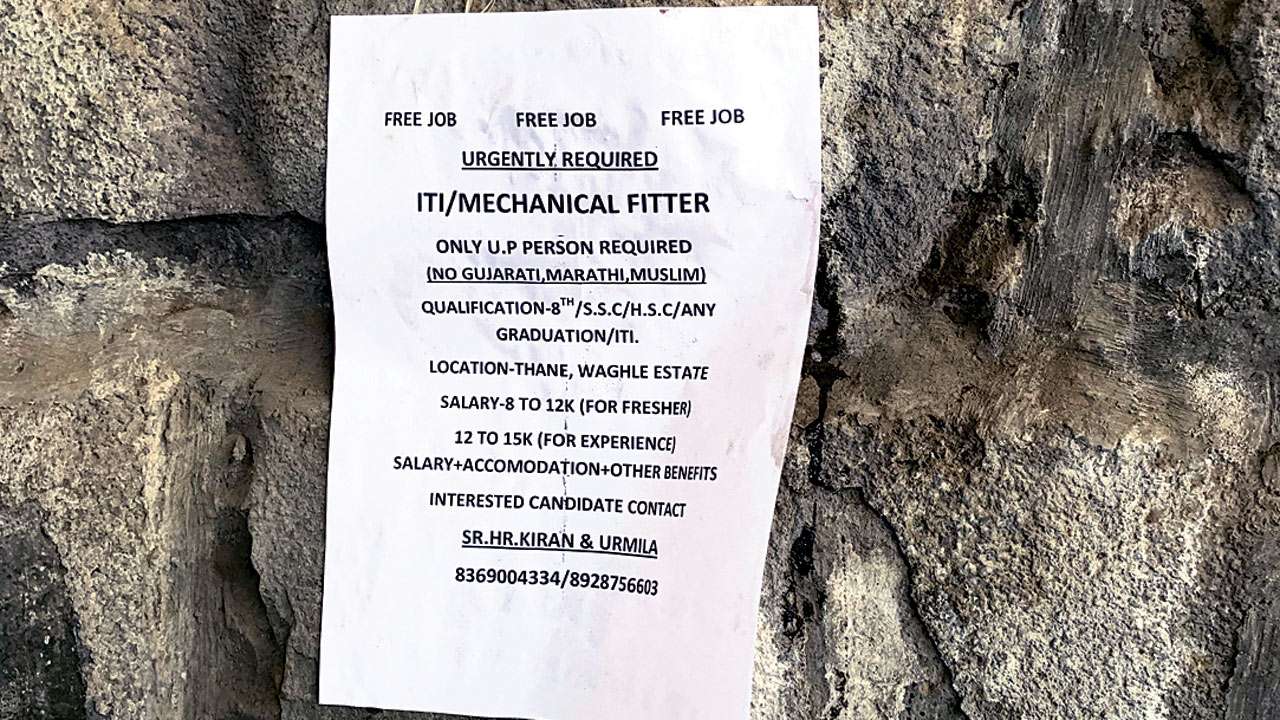
A recent job advertisement by a recruitment firm at different places in Mumbai read: Job, Job, Job but only for people from Uttar Pradesh, no Gujaratis, no Marathis, and no Muslims. One such advertisement was found at the Prabhadevi railway station.
On being contacted, a representative of the firm said that they were hiring on behalf of another company and affirmed they find nothing wrong in the said ad.
The details of the advertisement were, "Urgently required, ITI/Mechanical Fitter. Only UP persons required. No Gujarati, Marathi, Muslims). Qualification- 8th/SSC/HSC/Any Graduation/ITI. Location: Thane, Waghle Estate. Salary Rs 8-12,000 (for fresher) and Rs 12-15k (for experience). Salary+Accommodation+Other benefits. Interest Candidates contact."
The advertisement came with two contact numbers and was placed close to the taxi stand at the Prabhadevi station beneath the Rail Over Bridge (ROB).
On being contacted, an employee of the firm Urmila S said, "We are a recruitment firm and the advertisement is for another company. The company has specific requirements and hence, the specifications. The job would require one to travel a lot and people from UP do not mind travelling," she said. When asked if she or the company did not find the advertisement problematic, she said, "I will talk to my seniors and get back on the issue."
Jatin Desai, a senior journalist and human rights activist said that such advertisements are against the basic ethos of our constitution that clearly says no discrimination on the basis of religion, gender, or region should be made. He further said, "Such advertisements are weapons of a divide in an already polarised atmosphere. What if a political party sees it and uses it to target people. Such things shouldn't be encouraged."
On Tuesday, January 8, GoI shoved a Bill to amend India’s 1955 citizenship law through the Lok Sabha. It’s a small step downhill from the world’s largest democracy to a possible ‘Hindutva-Pakistan’. The tweak makes it simple for illegal Hindu, Christian, Sikh, Parsi, Jain and Buddhist immigrants from Bangladesh, Pakistan and Afghanistan to become citizens. The original law doesn’t allow citizenship for illegals. It says, immigrants must be here 11 years to become Indians. The change fast-forwards citizenship for non-Muslims to six years. Faith is a Fine Invention
All nation states are founded on some story. In our parts, four men — a Punjabi called Bhai Parmanand, two Bengali contemporaries called Rajnarayan Basu and Nabagopal Mitra, and a somewhat younger Maharashtrian called Vinayak Damodar Savarkar — churned up a prime concoction 100 years ago. They said religion was the most fundamental thing about people, who were the ‘atoms’ of a nation. Faith was the basis of national identity. Therefore, Hindus and Muslims couldn’t live together. Each faith had to have its own nation. QED.
By 1923, Savarkar was asking in his book, Hindutva, “Can we recognise these [converted] Mohammedans as Hindus?” And so on and so forth, till he concludes that the only people who qualify as Indians are those whose birth and faith originate here. That rules out Indian-born Muslims, Christians, Parsis and Jews because their beliefs were born someplace else.
What goes around, comes around. The year Hindutva was published, Muhammad ‘Allama’ Iqbal, a poetphilosopher-barrister, was knighted by the British India administration. In 1930, as Muslim League president, he said in Allahabad, “I would like to see the Punjab, North-West Frontier Province, Sind and Baluchistan amalgamated into a single State. Self-government within the British Empire, or without the British Empire, the formation of a consolidated North-West Indian Muslim State appears to me to be the final destiny of the Muslims….”
Iqbal imagined such a State, and perhaps a similar one in Bengal, would give Muslims political heft to resist Hindu bullying. He, who had written ‘Saare Jahan Se Achha, Hindostan Hamara’, couldn’t contemplate two nations after British India. That idea came from a young Cambridge University graduate, Rahmat Ali, who cleverly mashed up Punjab, Afghan, Kashmir, Sind and Balochistan, to coin the word ‘Pakistan’ three years after Iqbal’s speech.
By 1940, another Anglicised barrister, worried about the fate of Muslims in Hindu-dominated India, argued, “Hindus and Muslims belong to two different religious philosophies, social customs and literary traditions. They neither intermarry nor eat together, and indeed they belong to two different civilisations which are based mainly on conflicting ideas and conceptions…. It is a dream that Hindus and Muslims can ever evolve a common nationality.”
Like Savarkar and Co, Muhammad Ali Jinnah insisted a multi-faith nation was impossible — so, two faiths, two nations. Five years later, Bhimrao Ambedkar, surprisingly, concurred. The idea that Hindu and Muslim could cohabit was “an empty sermon, a mad project, to which no sane man would agree”. Rx: A Strong Constitution
India’s founding fathers, Jawaharlal Nehru, Vallabhbhai Patel, Rajendra Prasad, Acharya Kripalani, Abul Kalam Azad and — above all — Mohandas Gandhi, were determined to prove Ambedkar, Jinnah and Savarkar wrong. So, they wrote a secular Constitution, guaranteeing the right of people to practice any faith of their choice and equality before law. Administration can’t discriminate on faith. Exclusion bad, inclusion good.
January’s citizenship rules tries to bury that ideal, making religion a marker for Indian-ness, excluding Muslims immigrants from citizenship, resurrecting Savarkar and Jinnah. The excuse: our neighbours hound non-Muslims.
Really? After a brief lurch towards Islamism, in 2010, Bangladesh’s courts ensured that secularism, written in its 1972 constitution, must be enforced. Its Hindu population trebled from 3% in 1974 — after liberation from Pakistan — to 10% in 2011. After India and Nepal, Bangladesh hosts most Hindus globally.
Pakistan is not just an Islamic State, but a Sunni Muslim one. It persecutes Ahmadiyas, Shias and Sufis. Imambaras, Shia places of worship, are a favourite target of bombers during prayers. Will the Narendra Modi government allow these ‘Islamic’ minorities into India too? If the Bill is about sheltering people persecuted for being in the religious minority, will India let in the Rohingyas from Myanmar too? Fat chance.
The lurch towards a ‘Hindutva-Pakistan’ is possibly illegal. In 1973, a 13-judge bench of the Supreme Court produced India’s most significant ruling. The ‘Kesavananda Bharati’ judgment, it said that no government can fiddle with the ‘basic structure’ of the Constitution. However you define this core, equality before law and freedom of worship tops every list.
But this attempt to ignite bigotry will scar lives and property. Assam, Tripura, Meghalaya, Nagaland, Manipur and Mizoram, mostly with BJP or BJP-linked administrations, are boiling over with rage. Each is a cauldron of ethnic, religious and tribal loyalties, now incensed by the idea of encroaching ‘outsiders’. Regularising (non-Muslim) illegals is anathema here. The northeast states account for 24 Lok Sabha seats, which the BJP covets for polls later this year. It can kiss goodbye to that.
DISCLAIMER : Views expressed above are the author's own.
A contrived sense of difference perpetuates hatred, and hateful practices have trickled down into quasi-official policy
By The Editorial Board
Published 12.10.18
The
‘trickle-down effect’, it seems, seldom works for the good things. Yet
it operates most efficiently when the urge is to divide and hurt. A
primary school in Wazirabad village in Delhi has been separating its
Hindu and Muslim pupils into different sections. The school falls under
the aegis of the North Delhi Municipal Corporation, which has promised
to look into the matter after being informed of this by a group of
teachers. While the bright spot in the induced darkness is the fact that
the teachers complained, it is an indication of the successful spread
of fear that they wished to remain anonymous. The decision to segregate
pupils, reportedly, came from the teacher-in-charge, C.B. Singh
Sehrawat, who was installed in place of the previous principal in July.
According to this gentleman — he has now been suspended — the
reshuffling of sections was a management decision, routinely done to
preserve peace, discipline and a good learning environment. Apparently
children were ‘squabbling’, not exactly over religion but over food —
that is, some were ‘vegetarian’.
The implications of Mr
Sehrawat’s comments are clear. Dividing up religious communities on the
basis of food assumes that vegetarian food is ‘pure’ and eaters of flesh
‘impure’. Surveys have shown that the strident insistence of the party
in power at the Centre and its right-wing siblings that most of India is
vegetarian is just a vociferous lie. The championing of vegetarianism
is not only discriminatory from the point of view of faith, but is also
casteist and region-specific. But it forms the basis of the drive
against the trade in beef and leather, to the disadvantage of particular
communities and castes. To indoctrinate children in primary school,
even by indirect means such as classroom segregation, with this
contrived sense of difference is to perpetuate hatred through future
citizens. Such hate-based practices have ‘trickled down’ into
quasi-official policy, too, where discrimination is more aggressive.
Reportedly, applications for registration under the Special Marriage
Act, needed for interfaith unions, are being routinely refused in Uttar
Pradesh. One such couple had to get married in Calcutta because the
registrar in UP had simply not allowed them to apply. The couple are now
scared of their future as they return to work. Why are the founding
principles of the republic being allowed to be subverted so easily?
Six Years On, 'Social Boycott' of Minority Community in Zanskar Continues
The
small Muslim community in Zanskar alleges they’ve been facing a social
boycott from the majority Buddhist community since 2012, which has
crippled their livelihood.
Srinagar: About 450 kms from Srinagar, the Muslim
minority community of about 600 people in Zanskar division of
Kargil district, Leh region, has been facing a “social boycott” from the
majority Buddhist community, which makes up over 95% of the population
in the sub-division, for nearly six years. Local people from the
minority community alleged that the Zanskar Buddhist Association (ZBA)
has enforced this “social boycott” after four Buddhist families,
comprising of 22 members, converted to Islam in October 2012.
Manipur Christian group’s denial of burial rights to woman reflects growing intolerance in India
Ritah Haorei, who died in August, was not buried for over a month as a debate raged between religious and tribal groups.
Women march in Imphal demanding that Ritah Haorei be buried. | HT
Nandita Haksar
It may seem far removed from the reality we live in but the debate in the past month over the burial of a Catholic woman in a Baptist society in Manipur is just another reflection of growing religious intolerance in our country.
Ritah Haorei’s body lay in a Catholic church in Hundung village in Ukhrul district from August 7 to September 18 after neighbouring Leingangching village denied her husband Yangmi Haorei permission to bury her. Yangmi Haorei, a resident of Leingangching, had been excommunicated because of his faith. The village had in 1973 passed a resolution banning all religious denominations except Baptist Christians.
Both villages are predominantly inhabited by the Tangkhul Naga tribe. Many Naga villages in Manipur and in Nagaland have passed similar resolutions.
When Ritah Haorei was finally laid to rest in Leingangching, it was on “humanitarian grounds” and not as her constitutionally-guaranteed right to practise the religion of her choice.
Looking through the records of the case and the parties involved, it is ironic that the judge of a secular High Court quoted passages from the Bible, an insurgent group with the motto “Nagaland for Christ” gave orders based on the principles of secular laws and cited humanitarian law to deny people their human rights, while tribal bodies used customary laws to justify religious intolerance.
The parties to the dispute are: (a) the Leingangching village authority, (b) Yangmi Haorei and four other Catholic families, (c) the parish priest of the Catholic church, (d) the Catholic joint action committee, (e) the Baptist church, (f) the Tangkhul Naga Long, the tribe’s apex body, (g) the Government of the People’s Republic of Nagalim, a government-in-exile established by the National Socialist Council of Nagalim (Isak-Muivah), an insurgent group fighting for a sovereign Naga state, and (h) the Indian state, which includes the district administration, courts and state government.
The first question that must be addressed: can a village in India pass a resolution stating it will be “a Baptist village” and not allow people to practise other religions? Can the village authority throw out villagers, damage their property and not allow them to till their land if they convert to another religion?
Catholic versus Baptist
Though Leingangching passed its Baptists-only resolution in 1973, no one bothered about it for several decades, perhaps because there were no Catholics in the village.
But in 2009, the parish priest of the Sacred Heart church in Hundung wrote to the Leingangching headman and village authority informing them that five families had converted to Catholicism and they should not be disturbed. In his reply on November 24, 2009, the headman said no other religious denominations could be allowed within the village. He said the five families had broken the village law and must apologise, failing which they would have to find somewhere else to live and work.
In March 2010, the families were evicted, their properties destroyed and their “citizenship of this village” cancelled. They, in turn, filed a first information report against the villagers.
Their treatment angered the Catholic community, which sought the intervention of the National Socialist Council of Nagalim (Isak-Muivah).
In November 2010, the Government of the People’s Republic of Nagalim run by the insurgent group gave its order. It fined Yangmi Haorei a pig worth Rs 20,000 “for violation of their village avowed sectarian constitution/agreement” but held that he and the other families could not be prevented from converting to any religion. It also said all five families “being bonafide citizens of the village shall enjoy all rights as entitled to other fellow citizens of the village” and that they should not be harassed. It directed Yangmi Haorei to withdraw the FIR and the villagers to pay compensation to the five families.
The families withdrew the FIR and the Catholic community paid the Rs 20,000 fine. But the Leingangching village authority rejected the order.
The Catholic community marches with the coffin of Ritah Haorei in Manipur's Ukhrul district. Photo credit: via Facebook)
Fightback over funerals
On September 15, 2014, Joseph Lungshi’s wife Ningmila died. Lungshi was among the villagers who had converted to Catholicism. He was not allowed to bury his wife in the village.
On December 10, 2016, Ninghorla, also among the five families, died and was denied a burial. The Sacred Heart church in Hundung gave her a spot in its cemetery.
When Yangmi Haorei too was not allowed to bury his wife, the Catholic community decided to fight back. And so Ritah Haorei’s body lay in a glass coffin in the Sacred Heart church for over a month. Three days into the protest, the Catholics marched to Leingangching to bury her but failed to get past the Baptist villagers.
The procession was led by Paotam Zimik, a well loved leader of the Catholic community. He died on September 1 and I attended his funeral. Zimik was married to my husband’s sister. When the funeral procession made its way to Ukhrul, the two-hour journey took five hours because people wanted to pay their respects. Many said the stress of Ritah Haorei’s case had taken a toll on him.
The president of the Tangkhul Naga Long was conspicuous by his absence at the funeral. He had sent Zimik a notice for a Rs 5,000 fine for leading a protest march on August 16. Zimik had received permission from the deputy commissioner for the procession. The same day, the Catholic joint action committee had submitted a memorandum to Chief Minister N Biren Singh seeking his intervention in the case.
On August 28, Yangmi Haorei filed a writ petition in the Manipur High Court seeking security for his wife’s burial and resettlement of the five families in Leingangching. He cited a Gauhati High Court order in a case where Catholic families had been thrown out of Phokhungri village in Nagaland. In that case, the court had on May 26, 2014, quashed a village resolution that allowed only Baptists to live in Phokhungri.
In the Leingangching case, though, a day before the Manipur High Court was to give its order, Ritah Haorei was buried. The judge observed, “This court would like to express happiness at the admirable accommodating spirit shown by both sides in resolving a very contentious issue relating to the burial of late Smt Ritah Haorei. This court would like to put on record the genuine humanitarian gesture shown by the private respondents.”
Quoting from the Bible, the judge said: “… Surely there is at least one wise person in your fellowship who can settle a dispute between fellow Christians.”
That “wise person” was the National Socialist Council of Nagalim (Isak-Muivah), but it specifically stated that Ritah Haorei’s burial was on humanitarian grounds and not as a right. In its September 2 order, it also directed Yangmi Haorei to withdraw all cases.
Growing hatred, from Manipur to Goa
Many Baptists have expressed anger, distress over the incident. But these liberal voices remain isolated, ineffective. The fundamentalists have both the organisation and the arms.
I watched the events in Manipur unfold from the other end of the country, Goa, where a similar controversy is raging. Here, Catholics and Hindus in a village have objected to a Muslim graveyard. It is a controversy that, like the one in Ukhrul, began before the Bharatiya Janata Party came to power in 2014. The Muslim villagers’ plans for a new cemetery have faced resistance for several decades, forcing them to dig up old graves to bury their dead.
The opposition is now more vociferous, with religious extremists from the majority community fanning the flames of disharmony. Liberal voices can hardly be heard. Slowly, we are witnessing the hyper-normalisation of intolerance and as we watch, we are unable to imagine a political alternative.
Nandita Haksar is a human rights lawyer, teacher, activist and writer