|
Showing posts with label sexual assault. Show all posts

January 08, 2024

India: How a Journalist Was Sexually Assaulted the Day Babri Masjid Fell | Aviral Virk (Report in The Quint from Sept 2020)

 How a Journalist Was Sexually Assaulted the Day Babri Masjid Fell

Ruchira Gupta recalls how kar sevaks mistook her to be a Muslim, throttled and sexually abused her in Ayodhya.
Aviral Virk
News Videos

Updated: 29 Sep 2020

https://www.thequint.com/amp/story/videos/news-videos/babri-demolition-day-vhp-bajrang-dal-kar-sevaks-assaulted-journalist-ruchira-gupta

June 27, 2023

India: The Bilkis Banos of Manipur | Ajaz Ashraf (26 June 2023)

mid-day.com

The Bilkis Banos of Manipur

Updated on: 26 June,2023 08:16 AM IST  |  Mumbai
Ajaz Ashraf 

Chilling accounts of Kuki women sexually assaulted by Meitei mobs echo the experience of Gujarat’s lionhearted survivor of 2002

The Bilkis Banos of Manipur

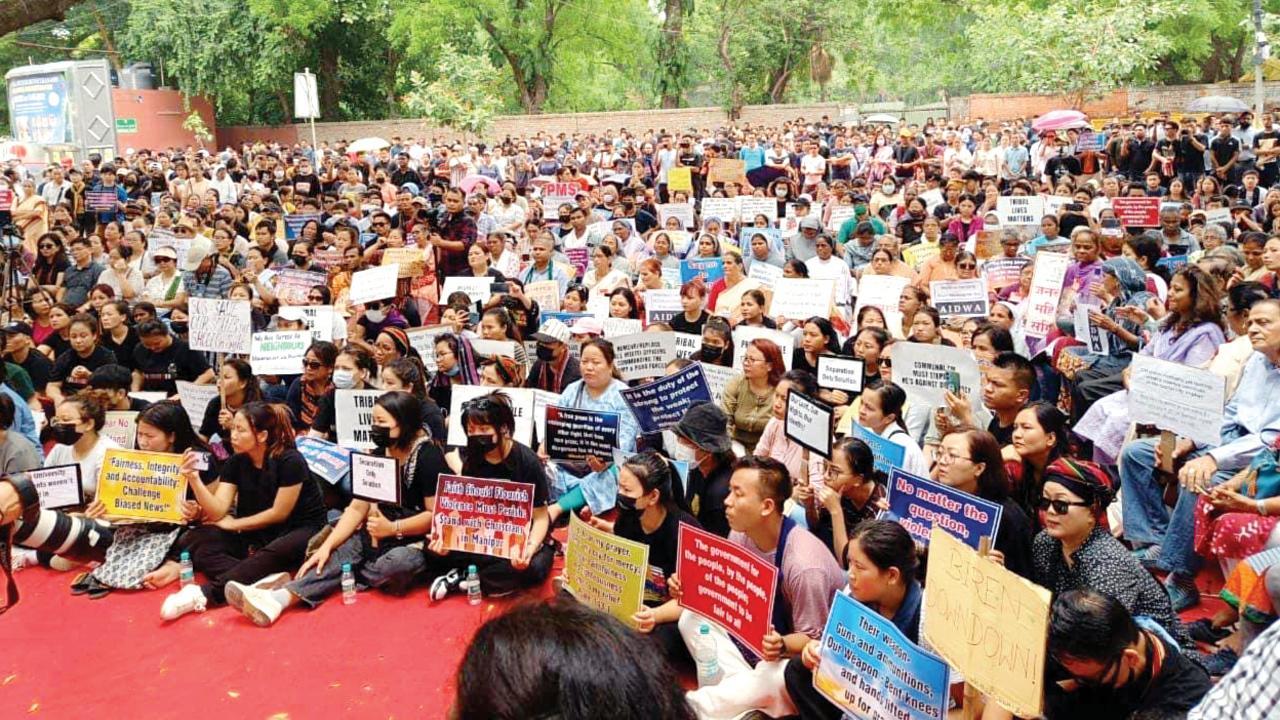
Kukis stage a protest over the ongoing violence in Manipur, at Jantar Mantar in New Delhi on June 24. Pic/Damlemsang


Ajaz AshrafOn July 15, 2004, a group of Manipuri women assembled in front of Imphal’s Kangla Fort, the Assam Rifles headquarters, took off their clothes and held aloft a banner that declared: “Indian Army Rape Us.” These Meitei women were protesting against the Assam Rifles soldiers accused of raping and killing 32-year-old Manorama Thangjam. Images of their protest became iconic representations of resistance against uniformed men violating women in conflict zones.

In sharp contrast to the 2004 protest at the Kangla Fort, Meitei women have not only been part of mobs hunting and killing Kukis, but they have also reportedly egged on men to rape Kuki women caught in the bloody maelstrom of Manipur’s ethnic-religious conflict.

Take Hahat, a resident of B Phainom village, Kangpokpi district, whose account to the Kuki Women’s Forum, a civil society group, makes for a chilling read. On May 4, the village repulsed the raid by a Meitei mob comprising men and women. The Meiteis regrouped and attacked again. With their defence crumbling, the residents, including Hahat, fled to the hills. Once at a safe distance, Hahat watched the horror unfold: her brother and his son were executed. Her niece and the village chief’s wife were disrobed, paraded around naked, and raped.

Hahat’s account echoes the experience of Bilkis Bano during the 2002 Gujarat riots. Then 21 years old and pregnant, Bilkis and her extended family fled Radhikpur village, in Dahod district, at the outbreak of violence across Gujarat. The fleeing villagers were waylaid by a group of men armed with swords and sickles. Bano, her mother and three other women were gangraped. Eight were killed, another six went missing. Bano survived, and went on to courageously wage her struggle for justice. 
It is a cruel twist of history that the land of Meira Paibis, or Women Torch Bearers, who led the iconic 2004 Kangla Fort protest, has spawned its own Bilkis Banos: vulnerable women raped, assaulted and left to die.

There seems to have been a demonic strategy to incite Meiteis to rape Kuki women and justify these barbaric actions as retaliatory in nature, a strategy laid bare by Hoineilhing Sitlhou, assistant professor at the University of Hyderabad, in a piece she wrote for NewsClick. Fake news about Kukis raping Meitei women was first spread via social media and word of mouth. The sexual assaults on Kukis were then projected as retribution. 

Here are some instances of fake news that Sitlhou cited in her piece. It was claimed that Kukis, in their stronghold of Churachandpur district, had raped Meitei women. Manipur’s Director General of Police denied it forthwith. It was bandied around that a Meitei nurse in Churachandpur had been raped; her father went to a local TV channel to deny it. Imphal’s Shija Hospital scotched rumours that the bodies of 37 Meitei rape victims were in its morgue. 

Yet just about every rape survivor or eyewitness to the violence against women told Sitlhou that the Meitei assailants spoke of the violation of their women even as they proceeded to sexually assault Kukis. The survivors also testified to the participation of Meitei women in the violence against their Kuki counterparts. 

For instance, employees at a car-wash company in Imphal hid two Kuki girls as a Meitei mob of men and women came searching for them. Under duress, an employee revealed their hideout. The two girls were gagged and dragged to another room, where they were mercilessly beaten and tortured. Their fathers, in their testament to the Kuki Women’s Forum, said, “Shockingly, women were among the perpetrators.” The two girls are dead, their bodies lying in a government hospital’s morgue. A doctor there told a family member of one of the two girls that “maybe” they were raped. 

Kim (name changed), 18, was abducted from Checkon, in Imphal, and ferreted away to a Meitei locality, where a group of men and, yes, women, battered her with rifle butts. Her hair was snipped off to break her resistance to the men’s sexual advances. The Meitei women did not intervene. Kim courageously, and miraculously, escaped from her captors. Her medical report confirmed she had been raped.

Bilkis Bano not only symbolises the vulnerability of women during spells of social chaos, but also the resolve of the weak to secure justice. The first step to justice requires an impartial investigation into the reports of rape discussed above. As Tracy Mate, of the Kuki Women’s Forum, says, “Justice is not served until the voices of rape victims are heard, their pain acknowledged, and their rights protected.” For the Forum’s Daisy Mate Munluo, though, justice has quite another meaning: “Associating with Meiteis only leads to our oppression. For me, justice means Kukis must have their separate administration. Families of survivors deserve separation from their tormentors.” 

Gujarat’s Bilkis Bano suffered during the rule of the Bharatiya Janata Party, which is the ruling party in Manipur, where its Bilkis Bano and the families of those who did not survive the ordeal of rape struggle to find closure to their suffering. It is for the readers to figure out whether the BJP factor, common to the social breakdown in Gujarat and Manipur, is merely a coincidence. 

The writer is a senior journalist


February 09, 2017

India: The Long struggle of Muzaffarnagar gang rape survivors (Aarefa Johari / scroll.in)

Three years after Muzaffarnagar riots, gang-rape survivors face death threats, trial delays

A new Amnesty report reveals how seven rape survivors who chose to report their sexual assaults were let down by the police, government and the courts.
In September 2013, communal riots in Uttar Pradesh’s Muzaffarnagar and Shamli districts killed 60 people and displaced thousands of Muslim families. While the riots were widely reported across the country, it took a while for the stories of sexual violence to emerge.
In the days after the riots, journalists and human rights activists working in relief camps came across scores of Muslim women who spoke of being raped or gang-raped by Hindu men during the clashes, but were unwilling to file police complaints because of the social stigma attached to sexual violence.
After a few days, seven women approached the police and reported being gang-raped by Jat men during the riots. They were promised swift justice and the Uttar Pradesh government set up a special investigative team to look into their cases.
More than three years later, swift justice seems like a pipe dream for these women. A new report by Amnesty India, the human rights organisation, reveals that ever since they approached the police, all seven women have faced threats, harassment and pressure to change their statements or withdraw their cases.
The report, titled Losing Faith: The Muzaffarnagar gang rape survivors’ struggle for justice, points out that the state government has failed to protect the women from threats and intimidation and has not even kept them informed about the status of their cases. [. . .]

FULL TEXT AT: https://scroll.in/article/828581/three-years-after-muzaffarnagar-riots-gang-rape-survivors-face-death-threats-trial-delays-embargo


February 08, 2015

India: Neha Dixit on Muzaffarnagar: rape cases

From Outlook Magazine, 16 February 2015

muzaffarnagar: rape cases
The Law Is Under Trial Here
The legal journey in the Muzaffarnagar rape cases is far from encouraging
Neha Dixit
“If the government does not do anything in the next few days, I will do what even Damini did not do. I will set myself and my sons on fire in the middle of Muzaffarnagar city,” says S on the phone, two days after two rape accused in her case were granted bail. When I had met her in July, S was about to start her ‘Stitching Training Centre’ along with her husband, determined to fight her case till justice was hers.
The Damini she refers to you may know as Nirbhaya, or more baldly as the “Delhi gangrape victim”. S was gang­raped by three men from her village in Lankh on September 8, 2013, in Shamli district (see Outlook story Shadow Lines, Aug 4, 2014), but her ordeal, as well as that of hundreds of women sexually abused and gangraped, was subsumed within a broad category that came to be called ‘the Muzaffarnagar riots’. It was a madness that—according to the ‘official’ record of the Uttar Pradesh government—led to 60 deaths, seven rapes and the displacement of 40,000 people. Never mind if we could actually be looking at some 200 deaths, 1,20,000 people displaced and hundreds of unreported mass rapes.
S’s trajectory has crossed the Nirbhaya case in several ways. The Criminal Amendment Act, 2013, drafted by the Verma Commission set up in the wake of the protests following the December 16, 2012, Delhi gangrape, came into force in February 2013. While the Act introduced multiple amendments in laws related to sexual violence, lawmakers for the first time also took cognisance of the systematic violence against women during communal riots in India. As a result, a crucial amendment—Section 376(2)(g)—­was included in the Indian Penal Code.


There were delays both in the filing of FIRs and medical checks. The Allahabad HC used these to grant the accused bail.


Among other things, the section states, “Whoever commits rape during communal or sectarian violence shall be punished with rigorous imprisonment for a term which shall not be less than ten years, but which may extend to imprisonment for life, which shall mean imprisonment for the remainder of that person’s natural life, and shall also be liable to fine.” The Muzaffarnagar riots broke out five months after this vital addition to the law. The violence erupted on September 7 and continued well into the next day. Seven women, all gang­raped on the morning of September 8, filed cases. These would be the first in Indian history to be tried under Section 376(2)(g). The legal trajectory of these cases needs to be examined in the light of its precedent-setting import.
FIRs: The first information report for five out of the seven petitioners was filed within three weeks of the gang­rapes. The sixth case was filed on October 9, 2013, while the seventh case, that of S, took the longest to register. S had sent her FIR on October 22, 2013, five weeks after the incident, to the Fugana police station in Muzaffarnagar through registered post in which she also named the three accused. The police neither filed the FIR nor ack­nowledged receipt of her complaint. It was only when her counsel, Vrinda Grover, who is representing the seven women in court, handed over a copy of her complaint to the lawyer representing the UP government that the FIR was filed on February 18, 2014.
Medical examination: The law mandates a medical examination within 24 hours of filing the complaint. All the seven women were gangraped on Sep­tember 8, 2013. Their medical examination, however, was conducted bet­ween September 29, 2013, and February 22, 2014. It is because of this gap between the dates of the incident and the tests that the medical reports remained inconclusive in ‘proving’ rape.
The Allahabad High Court made the delay in the filing of FIRs and medical examination to grant bail on October 15, 2014, to the gangrape accused in the case of Fm, one of the seven women. It did so on grounds that “there was an inordinate delay of 14 days in filing FIR and that her testimony could not be accepted as it was not corroborated by medical evidence in the marks of injury on her body”. The state authorities chose not to appeal against this order.
Compensation: The Supreme Court, on March 26, 2014, while responding to several writ petitions related to the Muzaffarnagar communal violence, including one by Vrinda Grover and Kamini Jaiswal on behalf of the seven women, directed the UP government to pay compensation to all the seven gangrape survivors within four weeks, before April 26, 2014. The seven women had filed applications for compensation on April 9, 2014.
This compensation amounted to five lakh rupees in addition to other benefits. While five of them received the compensation on May 8, 2014, the sixth got it on May 22, 2014, and the seventh only on October 25, 2014, more than a year after the incident when counsels Grover and Jaiswal filed a contempt of court petition in the Supreme Court on September 15, 2014.
The apex court had, in addition to this compensation, also asked the UP government to provide financial and other assistance to these women to help them rehabilitate themselves. The state government, however, provided the same blanket compensation for loss of moveable and immoveable property that it provided to all families who were victims of the communal violence.

K Her nightmare unfolded in Phugana, in Shamli district. (Photograph by Jitender Gupta)
Role of the state and police: In the same March 26, 2014, SC judgement, the court blamed the UP government for negligence. It said, “We prima facie hold the state government responsible for being negligent at the initial stage in not anticipating the communal violence and for taking necessary steps for its prevention.” The police had been unable to control the violence during the riots; it is only when the Centre sent paramilitary forces that the victims could be rescued.
The investigation into the cases also started a month late. Kalpana Saxena, a superintendent of police in Muzaffar­nagar district, said the police got delayed in investigating the riot-related sexual assault cases because the initial team of officers formed in September did not include any women. Mala Yadav, the investigating officer, was included in the Special Investigations Team as late as November 2013.
In this entire period and afterwards, the seven rape survivors filed several written complaints with the police, clearly mentioning the threats to them and their family members by the accused men and their kin. Living in extremely vulnerable conditions in relief camps in this time, they were provided police protection as late as nine months after they filed the FIR.


Votebank politics, says counsel Vrinda Grover, is behind delay in trials. The accused are from the dominant Jat community.


There were also specific and grave complaints against Mala Yadav. K, one of the rape survivors, had said, “When Mala Yadav, the investigating officer, came to record my statement, she asked people in the camp if they had seen my torn clothes on the day I reached the camp. She even told me that having a full-time guard sent by the Supreme Court is not enough and I should compromise.” Fm too corroborated the ins­ensitive investigation. When she came investigating her case, Fm said, “she asked the other people in the camp, ‘Did you see her crying? Did she tell you about the rape?’” Apparently, the men she had mentioned in her complaint knew each word of what she had told Yadav. “I am a woman who is revealing that I was raped publicly, unlike so many others. Why will I lie? During the period of investigation in the camp, even those who didn’t know I was raped also got to know because of the police’s lack of discretion.” In fact, Kf had also submitted an application to the National Human Rights Commission on May 29, 2014, detailing how Yadav’s investigation was biased and if her case could be transferred to an impartial investigating officer. No action was taken until four months later when counsels Grover and Jaiswal filed a contempt of court petition in the Supreme Court in September and an enquiry was finally initiated against Yadav on November 2, 2014. She was removed from these cases as late as November 23, 2014, more than a year after the gangrapes.
X, husband of T, another gangrape survivor, too had claimed that the police recorded videos of their statements and then showed it to the accused in the village. They also used subversive tactics on occasion to dissuade the women. In January 2014, X’s cousin was booked for rioting, robbery and even having links with the terror outfit Lashkar-e-Toiba! When this was reported in the media, the charges were dropped overnight.
Nor was any action taken against the police officials who failed to register an FIR despite S’s written complaint, which amounts to an offence under Section 166 A of the Indian Penal Code.
5. Chargesheets: Contrary to the law which mandates that a chargesheet be filed within 90 days of the filing of an FIR, the chargesheet in one case was filed on April 19, 2014, on May 24, 2014 in five cases, and in one case as late as December 2014.
Arrests: The apex court had on March 26, 2014, told the UP government to proceed swiftly with the investigations and arrest all the accused. Only three of the 29 accused named by the seven petitioners had been arrested in the six months after the report was filed. It was only after the counsels filed the contempt of court petition, six months after the SC judgement and a year after the first FIR was filed, that the state administration got into action and arrested the other accused, a year and three months after the rapes.
In this interim, the women, all from working class backgrounds—ironsmiths, agricultural labourers, carpenters et al—were regularly intimidated by the accused. The latter hail from the dominant landowning Jat community, far more influential in terms of money and influence over the state machinery.
7. Trial: Section 309 of the CrPC mandates that a trial in the case of rape should be completed within two months of the filing of the chargesheet. The trial hasn’t even begun in any of the seven cases yet, however the accu­sed have already started procuring bail. Three of the accused have already been granted bail, and on January 9, 2015, two out of the three accused in S’s case were granted bail as well. And the very next day, S’s niece, who had gone to the local pds shop to collect ration, was intimidated by the family of the accused.
Commenting on the situation, the women’s counsel, Vrinda Grover, says, “The delay in starting the trial of these cases is not by default but by design. The state government is ind­ulging in votebank politics by protecting the dominant community in the area to which the accused belong. The seven women are constantly threatened, and fear for their lives. Two constables are not enough to save their lives. The case must be transferred outside Muzaffarnagar to Delhi so that they can depose freely in a court of law.” The counsel’s demand for protection of the witnesses intensified after the witness in the rape case against godman Asaram Bapu was shot dead on January 11, 2015, in Muzaffarnagar itself.
Grover also says that the state government initially did not invoke Section 376(2) (g) which deals specifically with rape survivors during communal violence. “It is only after our insistence that the new law must be included in the proceedings of these seven cases that the police finally included it in the chargesheets in May,” says Grover.
S has not stepped out of her house ever since the gangrape accused in her case were granted bail. She has also temporarily shut down her stitching training centre, her only source of livelihood.  “What does it say when the accused roam scot free and the victims are forced to shut themselves up inside the house?” she asks. For an answer, there is only empty air.


November 03, 2014

India: Police question top RSS functionary in Karnataka re mysterious death of relative of woman who had filed sexual assault case

CID questions top RSS functionary over suicide case
See more at: http://indianexpress.com/article/india/india-others/cid-questions-top-rss-functionary-over-suicide-case/

July 26, 2014

India: Chilling accounts of muzaffarnagar rape survivors | Neha Dixit

Outlook Magazine, August 4, 2014

EXCLUSIVE muzaffarnagar rape survivors
Shadow Lines
Chilling accounts of rape survivors in the Jat-Muslim riot that changed the contours of the UP election
by Neha Dixit

“Why were we raped if a boy eve-teased a girl? Did the whole nation go about raping the women of the community of Nirbhaya’s rapists to avenge what was done to her?”

She is someone I’ll call S, not because she does not want the world to know her name, but because her identity has to be protected, for the consequences it might possibly have. S is one of the ‘Muzaffarnagar rape victims’, of the seven whose ordeal is the collective shame and guilt of our entire country.

Around the end of August 2013, word was that a Muslim boy in Kawal village had eve-teased a Jat girl, though the incident remains uncorroborated till date. Her brother and cousin, in an attempt to safeguard their sister’s ‘honour’, apparently killed him and were in turn allegedly lynched by an irate Muslim mob on the spot.

The men of both communities swore revenge. A congregation of Muslims did so after Friday prayers in Muzaffar­nagar town; thousands of Hindu farmers gathered in Nanglamandor village some 15 to 20 km away on September 7, 2013, to ensure the avowed objective of ‘beti bachao, bahu banao (save your daughters, make theirs (Muslims’) your daughters-in-law’. Several khap panchayats in the vicinity issued this call, with help from local BJP leaders, including MLA Suresh Rana, the recen­tly-elected Hukum Singh, besides Sangeet Som and Sadhvi Prachi. The panchayat also declared a war against ‘love jehad’, perceived by the Hindu right-wing as an organised attempt by Muslims to “make Hindu girls fall in love with Muslim boys and marry them”.

It didn’t take long for the patriarchal, sexist urge of the panchayat to put women and their ‘honour’ in the centre and transform it into communalist, political tinder. Rumour provided the fuel that would soon feed the raging communal fire.

The following morning, several villages woke up to the news that a Muslim mob had attacked groups of Jats returning from Kawal, killed them and dumped their bodies in Jauli canal, a Muslim-dominated area. Everyone heard it, in Lankh Bavdi, Lisad, Phugana, Kutba-Kutbi, Kirana, Budhana and Bahawdi. Thus began a vicious circle of violence and brutality. Mass rapes and sexual violence against women were freely used as instruments of asserting the power and authority of one community over the other. Officially, 72 people died, seven women were raped and a few hundreds injured. But visits to Ground Zero and conversations in relief camps suggest that many hundreds were killed, close to 100 women raped and over a lakh displaced from their homes forever.

Nineteen women were subjected to rape, sodomy and murder of their kin in the compound of the village headman of Lankh village in Shamli district, an incident Outlook reported on extensively in its December 29, 2013, cover story, Thread Bared. They weren’t the only ones, but ‘honour’ it was once again that came in the way of their speaking about it. Finally S and six other women dared to come forward and register cases against their rapists. Appearing on these pages are the stories of their courage—and theirs alone.

Six of them have received the Rs 5 lakh compensation from the Uttar Pradesh government and a security guard each on the directions of the Supreme Court. Yet, not a single chargesheet has been filed, nor any arrests made in the last seven months, when the first case was registered.

Deputy Superintendent of Police Shailendra Lal, praised by top politicians as well as the Supreme Court for “the good work of saving property and lives” during the September 2013 communal riots, was suspended on June 18. Lal in his writ petition to the apex court says he got distress calls from BJP leader Sanjeev Baliyan in April this year. An accused in the Muzaffarnagar riots and now the minister of state for agriculture in the Union cabinet, Baliyan pulled up Lal for stopping local BJP leaders from pressuring voters on polling day in Muzaffar­nagar. “Bahut time se teri harkatein dekhta aa raha hoon (I have been noticing what you have been doing for a long time now),” he apparently told Lal, “agar hamare khilaf aur kaam kiya to tujhe dekh loonga (if you continue to work against us, it won’t do you any good).”

For the seven who dared to rise above social stigma and opposition from within their families and community, new threats flow incessant from the accused, local leaders and police, asking them to withdraw their cases. Kf, one of these seven, alleges that the current pradhan of the village, Thaam Singh, reached out to her on behalf of Baliyan, to accept Rs 30 lakh and drop the case.

Special Investigation Officer Mala Yadav, who has been appointed for these cases, refuses comment on the slow pace of investigation.

What is refusing to be stifled, however, is the voice of courage these seven women have displayed, whose bitterness, rage and agony are tempered by the stronger determination to bring the perpetrators to book, and move on. Read these voices also as a challenge to the selective outrage of a nation that bleeds for a while when one Nirbhaya is raped but chooses not to say a word when countless other Nirbhayas are subjected to such ignominy in their daily lives.

A Settling Of Dues

Sb, 40, Fugana village, Muzaffarnagar district’s
Four accused Chargesheet yet to be filed

"They inserted a big stick into me, and I started bleeding. They revelled seeing that, then raped me.”

To a prejudiced mind, she might not seem a typical rape survivor. Her presence is dominating, her voice loud and hoarse. As she leads me to the courtyard of her house, away from the men, to talk to me in private, she slaps her seven-year-old son for following us. She’s also quick to send her teenage daughter away. “I haven’t told my children what happe­ned. I don’t want their minds to be conditi­oned by this,” she tells me as she gestures for me to sit on the jute cot.

“When you come out with this report, send me the link,” she tells me. I will see it on the internet on my phone.”

Her husband, M, a salesman in Rajasthan, came only 15 days after she was raped and escorted to the relief camp by paramilitary forces. He left a month later, after helping her file the case. She has been by herself since then, taking care of her four children and her old but supportive mother-in-law.

“I had worked in their fields as an agricultu­ral labourer for 15 days last harvest season. I kept pleading for months, but I never got paid. They said because I was fat, I didn’t do as much work as the others,” says Sb.

Since news of the violence had already reached the village on September 7, her mother-in-law had left with three of her grandchildren to a relative’s place in Loni the day before. “I had feared more for my teenaged grand-daughter,” says J, the grandmother, “but I never imagined they would do this to her mother.”

Four men, whom she remembers as Rahul, Mohit, Sudhir and Arvind entered her house and put a gun to her temple. “They said if I screamed, they would kill my two-year-old son sleeping on the cot,” Sb recalls in horror. “They inserted a big stick into me, and I started bleeding. They revelled in seeing that, and then proceeded to rape me.”

She came to with a cellphone call from her brother-in-law, Ashu. “He called asking for help after one of his hands was maimed in the violence outside. I collected myself, gra­bbed my son and ran to the village common ground where the PAC had arrived,” she says.

A day before my visit, Rambeer, father of two of the four alleged rapists, and on whose field Sb had worked, had come to threaten her. She had forgotten her aukaat (station in life), he said, and that it wouldn’t take him long to make her daughter disapp­ear. “It’s not new for them,” Sb tells me. “Jheemar and Chamar women on their fields are raped regularly before getting payment. I did not agree to it, so I was raped during the riots.”

Of Sons And Daughters

Kf, 48, Fugana village, Muzaffarnagar district
Four accused Chargesheet yet to be filed Compensation not received

"(Raped by the local grocery owner, the tailor), “I fainted by the time the third one started.”

“I married off one of my daughters in the relief camp itself before registering the case,” says Kf. “After all that happened, I wasn’t sure if I’d be able to protect her. Also, no one would have married her thereafter.”

Kf was gang-raped by Devender, the local grocery shop owner; Sunil, the tailor, Ram Kumar and Dharmendra. “I fainted by the time the third one started.”

When the forces came to pick them up later, the naara (drawstring) of her salwar had broken. Gesturing, Kf says she just clutched her salwar tight and sat meekly in the corner of the truck.

She withdrew her case after armed Jat men held a gun to her son’s temple in the middle of the town square, asking her to withdraw the case. “He is my only son. I cannot even have any more children, so I got scared.” But when she saw other rape survivors filing cases, she got back to fighting the case.

Recently, one of the Jat men came up to her husband and said, “Ab to apne ghar ki sarkar aa gayi”. It’s nothing new, she says. “Sloganeering like ‘Musalman ke do sthaan, Kabristan ya Pakistan’ had peaked a few months before the riots,” she says.

She has stopped sending her son to school now. “I feel scared.” She was offered Rs 30 lakh recently to drop the case. “I have been raped but have not stooped so low yet,” she declares.

The Perils Of A Glib Tongue

S, mid-30s, Lankh village, Shamli district
Three accused roam scot-free Chargesheet yet to be filed
Compensation received

"Before they could break open the door, I ran out into the cane fields. Only to realise I had left my son back.”

Short, plump and so full of life that you do not cease to get amazed. Mother of two boys, she says, “I am not like those Muslims who think that it is Allah’s wish to keep having kid after kid. These two are enough for me. I want them to go to a proper private school, not a madrassa. My mother says it is this glib tongue of mine which has brought this misfortune on me.”

She serves me chilled Maaza, bought a few minutes ago from the shop next door. “It is mango season,” she tells me. “I would have fed you Chausa had you come to Lankh.” She stares into the vacuum a brief second, then resumes, with a smile, “Anyhow, for now, let’s make do with this.” Chausa is a variety of mango grown in parts of western UP, and hailed as the king of mangoes.

She puts a stool in front of me, places the bottle of Maaza on it, drags the new pedestal fan from the front room and switches it on. “Last night was the first in 10 months that I slept under a fan; we had three at our tailoring shop back home,” she informs me. She and her husband V were both tailors before their shop, their belongings and life was set on fire. “Now, a journalist didi just like you has bought us a sewing machine. One day I hope to open a sewing school,” she says.

On that fateful morning, September 8, her elder son had been down with fever. V was with him in hospital when the violence broke out. “I heard my uncle and aunt in the neighbourhood calling out to me to run.” She couldn’t make sense of what was happening till their screeching reached her before the mob did. “Before they could break open the door, I ran out of the back door, straight into the sugarcane fields. I stopped only an hour later to realise I had left my younger son beh­ind,” S recounts. She was hiding behind the Bright Zone School on the Muz­affarnagar-Shamli highway when three men—Kuldeep, Sikander and Mahinder—caught hold of her, and raped her turn by turn. “I couldn’t get up till 4 or 5 in the evening when I heard a tempo. It was taking several people from my village to Loni. A woman gave me a hand and I got on to it,” she says.

V and her sons found her three days later, at the Loni relief camp. “I told him what had happened to me only the next day. He was supportive enough to tell me it was not my fault.” She looks out at her husband, standing at the far end of the compound they have bought with the money received as compensation. “Unlike other rape survivors from my village, I’ve decided to fight my case and will not withdraw it because I want other women to speak out as well,” she says determinedly.

Moving on is essential. S is doing her best. But every so often, it sits between them, the ‘taint’. “Now, if he disagrees with me even a little, I think it’s because of the rape. Earl­ier, when we’d fight, I’d give it back to him. Now I keep quiet. I’ve learnt to tame my tongue.”

The Walking Dead

Fm, 52, Fugana village, Muzaffarnagar district
Five accused Chargesheet yet to be filed

"Boys my son’s age did not flinch even for a moment before pulling my salwar down.”

She had taken her cattle out to graze that morning when five men dragged her into an empty house, and raped her. “Boys my son’s age did not flinch a moment before pulling my salwar down,” says Fm, shuddering. As if it was about keeping count. They even described my genitals to the boys in the house next door, who replied, ‘The one here is masaledar’.” Ajit Singh, Saini, Vedpal, Sachin and Yogesh then vandalised the house, and left. “I wondered why they didn’t kill me like the men they had murdered later. For women, I guess, it means the same thing.” She is among the Walking Dead.

Her husband had passed away a couple of years earlier, leaving behind two sons and three daughters. “When Mala Yadav, the SIT inspector, came to record my statement, she asked others in the camp, ‘Did anyone see her crying? Did she tell anyone of you about the rape?’ How will they know about it, I wanted to ask her,” she tells me.

The men mentioned in her complaint know each word of what she had told Yadav. “Unlike others, I am a woman who is revealing publicly that she was raped. Why will I lie? After the investigation, even those who didn’t know I was raped now know, thanks to the police’s indiscretion,” says Fm. Back in Fugana, accused brothers Ajit and Saini say they have not even seen this woman ever. “We want a CBI investigation,” they tell me. “These cases are politically motivated.”

Her sons, both teenagers, have become part of the jamaat that has been managing the relief camps. “One day they told me to cover my hair. I was shocked to see them behave so. But they too must have heard details about their mother’s rape to feel this way,” she says.

The Ghosts Of Yesterday

T, Early 20s, Fugana village, Muzaffarnagar district
Four accused Chargesheet yet to be filed

"They raped me as my little girls watched and cried. I begged them to leave me alive for their sake.”

There cannot be a crueller joke for a rape victim to fight a case when she is eight months pregnant for a gang rape that took place nine months earlier. “The investigating cop asked me, ‘kiska hai (whose is it)’, with a smirk. Fellow women also asked me, ’itni jaldi kya padi thi (what was the big hurry)?’ What do I say to that? As if the rape before or the pregnancy afterwards were in my hands,” says T, as she runs a comb through her hair. Dressed in an olive-green salwar-kurta, she is a mother of three girls and hopes her fourth will be a boy.

On the morning of September 8, she was cooking in the kitchen when Ranbir, Sanjeev, Pushpendra and Rupesh broke open the wooden door and attacked her. “They raped me as my little girls watched and cried. I begged them to do whatever they wanted with me but leave me alive for my girls,” she says matter-of-factly, emotion long elided out of her speech.

Her husband, X, had been out with fellow Muslims to meet Harpal Singh, the former pradhan of the village, to ask for help. “While he was assuring us that nothing would happen to us, his cousins and relatives were raping my wife,” he says.

Harpal too has been accused in cases of murder and rioting. “When he met me recently at the police station, he told me, ‘That day you were pleading before me, today you want to take me to court’,” says X. “He said this in front of the police officer, who also happens to be his nephew.” X claims that the police records videos of their statements and then shows it to the Jats in the village so that they can identify the complainants against them.

In January, X’s cousin was booked for rioting, robbery and having links with the Lashkar-e-Toiba. When reported in the media, the charges were removed overnight. “During interrogation, he was asked to convince me to withdraw the case,” says X, as a guard provided to the couple by the Supreme Court recently cleans his gun nearby. “I can go out only with them now,” says X. “Even now, if you step out, you will find some or the other Jat lurking in the vicinity to negotiate with riot victims who have filed cases of rioting.”

T says the only other rape case she had heard of until then apart from Nirbhaya’s was of a Brahmin girl in her village. “Sanjeev’s father and relatives had raped and killed a girl a number of years back in our village because she was found with one of the Jat boys in a sugarcane field. Her ghost can still be seen in that part of the village,” she says. “After the riots, the whole village will be full of ghosts. I don’t want to go back there, ever.”

A Matter Of Honour

F, mid-20s, Fugana village, Muzaffarnagar district
Four accused Chargesheet yet to be filed

"My lower abdomen hurts, still does, continuously. I would bleed often. Only my husband knew.”

When I reach F’s rented accommodation in Kandhla, she is busy washing off the dried henna from the soles of her two-month-old daughter’s feet. “This is to keep her body temperature normal in this killing heat,” she tells me.

She was three months pregnant with this child when she was raped by four men. She didn’t recognise the men who barged in with their faces covered and swo­rds and guns in their hands. She heard them call each other Nilu, Badlu and Amardeen. “Two held my hands and legs, while the others raped me,” she tells me. “They said if I told anyone, they’d kill me. I kept quiet because I didn’t want to faint or die.”

Her husband, who had been on the terrace when the men broke in, ran away with their five-year-old son, a student of Class I. Paramilitary forces rescued her later in the evening, when all Muslim families were ushered into relief camps.

F lived in the Jogia Khera relief camp for the next two-and-a-half months. “My lower abdomen hurt, still does, continuously. I would bleed often and when I met doctors at the relief camp, they’d tell me it was because I was pregnant. I had obviously not told them about what had happened to me. Only my husband knew and he asked me to keep quiet about it,” she says. She relied on desi medicines to ease the pain and eventually had to have a caesarian section for the baby.

W, her husband, was a salesman with bag manufacturing companies in Rajasthan. The twentysomething hasn’t returned to work in the last nine months, constantly guarding his wife and family. “He is too scared to leave us alone,” says F. “But how will we manage if he does not go back to earn. Please don’t tell him I told you this.”

W sits on a cot outside, dressed in a plain vest. “I know rapists have no religion,” he tells me, “but just 20 days back, when a woman was gang raped by 7-8 Muslims in Shahpur, the police took immediate action and arrested the people involved. The same police has done nothing in our case till date.”

Asking for directions to F and W’s house, a man identified him immediately: “Wahi jo bhaag gaya tha jab uski biwi ke saath galat kaam ho raha tha? Ajeeb aadmi hai (the same one who ran away while his wife was being raped? Strange man.”

Offering random and extra information to strangers is commonplace in the rural parts of north India. As is becoming the butt of misogynist jokes in the patriarchal set-up of western UP, the pressures of which justify W’s passive aggression. “Everyone knows my wife was raped and I couldn’t save her. My honour is lost. The least I can do now is fight it out in court and show them their place,” he says, teeth firmly clenched. “Friends and relatives of those who have been named in the FIR keep visiting this area to get us to compromise. The other day, they threatened to burn down our present house. I chased them out with bricks. Enough is enough, this time it will be an eye for an eye.”

Impotence Is Not An Empty Rage

K, 50, Fugana village, Muzaffarnagar district
Four accused Chargesheet yet to be filed

"When investigating officer Mala Yadav came to our camp, she asked if anyone had seen my torn clothes!”

“They laughed at me for filing a rape case. A Jat man walked up to me and said an infertile (woman) now wants to feel attractive,” says K. It’s true she filed the case because she does not have any children. She thought it would be easier for her to fight it out compared to the other rape survivors who have family honour to think about.

“Recently Naresh Tikait, president of the Bharat Kisan Union, said that what had happened to us was a trailer, and the film was still pending. What more does he want,” asks K in despair. “The police is pressuring us, the locals are threatening us and our own people are scared to talk to us for fear of the influential Jats.”

On September 8, her husband, who was on the terrace, jumped when he saw the armed mob metres away from the house. K was downstairs when four men caught hold of her and raped her for half an hour.

“When Mala Yadav came to record my statement, she asked people in the camp if anybody had seen my torn clothes. She even said that having a full-time guard sent by the Supreme Court would not be enough and that I should compromise,” she tells me, eyes red with unshed tears.

In Fugana, Mehak Singh, father of the accused Ramesh, says, “Has she looked at her face? Such an old hag. Why will my son rape her?”

Z, her husband, is the government-appointed paroikar in all of the seven cases. He ran a dairy in the village and had invested in the small businesses his nephews ran. “The pradhan that day confused us by telling us that we were safe and nothing would happen,” he says. “We didn’t even get a chance to come together to face them.” Says his wife, “I don’t know what is better, being infertile or being raped. With a rape, you can at least fight back. I am doing exactly that.”

By Neha Dixit in Muzaffarnagar and Shamli districts; Photographs by Jitender Gupta

December 31, 2013

India: The silence of Muzaffarnagar | Shiv Visvanathan

The Asian Age,Dec 31, 2013

The silence of Muzaffarnagar

Shiv Visvanathan

From Partition to Muzaffarnagar, the history of riots has been a celebration of rape. Muzaffarnagar sounds like it’s a part of the UP badlands, while pundits hair-split words like responsibility and secularism.

If you were to ask most citizens what the most exciting event of the year was, most would talk excitedly about the rule of the Aam Aadmi Party. If you were to detain them a bit further and ask what event disturbed them the most, they would stumble, think, mention gangrapes, corruption and then lapse into silence. A friend facilely replied Dhoom 3. Few today would talk of Muzaffarnagar — the well of silence surrounding it is not just the silence of Hindu majoritarianism gloating in anticipation of the rise of Narendra Modi. It is not merely the silencing of the media owned by corporate interests. Indifference is no one’s particular patent. Corporate dons, journalists, citizens, all claim a stake in it. The silence of Muzaffarnagar is the most disturbing event of the year.
Muzaffarnagar summons the memory of every riot since Partition. It echoes all of them and yet every riot is singular. Every riot as an act of violence adds to the grammar of evil. If Partition or the history of silence after Partition emphasised the enormity of rape, every riot after that added to the degradation of women. The degradation was at two levels; first in the nature of violence as rape and secondly in the nature of silence that followed it. The grammar of riots changed between 1984 and 2012. Grammar is important in decoding a riot. It creates an early warning system to the nature of evil in our society. The sad thing is that grammarians sound cold blooded next to the passion of the victim.
A few keywords stand out as tuning forks. The first is memory: both official and unofficial. Official memory, official histories of riot often create pre-emptive histories. They close camps long before the victims are rehabilitated. Worse, they deny further history, or even the legitimacy of pain.
Mr Modi refused to accept responsibility for the camps. Not to be outdone, Mulayam Singh Yadav claimed that those in the Muzaffarnagar camps were plants of the Bharatiya Janata Party and the Congress.
Mr Yadav’s idiocy was amply supplemented by the affable illiteracy of the secretary, Anil Gupta. Immaculately dressed, aptly bespectacled, the Indian Administrative Service officer explained that his surveys indicated that there were very few deaths in the camps. Like a United Nations health expert, he then expanded affably that “people do not die of cold, otherwise how can people live in Siberia”. This piece of Socratic wisdom has enshrined Mr Gupta in the annals of governance. Yet, it reveals something more fundamental — the transition that political scientist Chandrika Parmar mapped between silence and indifference.
Silence has many triggers. One can suffer from compassion fatigue where members of a community get tired of repeated reports of pain. There is an indifference that emerges from a distorted idea of justice, that the victim deserved it. Here riots and rape merge, in that the community is seen as a justified object of violence as revenge and the victim is seen as a seductress, a threat to the public good. Suddenly the logic of official policy and sociology erases the pain and voice of the victim. It is now a vagrant, a deviant, a piece of pathology. Indifference is more lethal than silence because it erases the life story of the victim. What was once geography of pain becomes an empty space devoid of history.
There is a third kind of silence which has many variants, each a particular dialect of power. There is the silence of the majority Jat Hindu which exterminates another in the guise of justice or honour killing. A small act of misunderstanding or a minor fracas gets amplified into what is literally a collective execution of men and a systematic rape of women. It is ruthless, systematic, implacable, repetitive and diabolical. One cannot understand how a society, especially a majoritarian group, can return to normalcy after that. It is weird that the Jats of Muzaffarnagar feel they have retained their honour. One wonders what honour means to a society in this context when its sense of decency, its integrity as a normative society lies in tatters.
To the silence of the majority, we add the silence of the media. Newspapers and magazines with the exception of Outlook which featured a freelancer’s outstanding report, were indifferent. It was as if beyond being an electoral issue Muzaffarnagar was not an “exciting” issue. NDTV with Srinivasan Jain tried to sustain memory. It was heroic but not quite successful. Party silence, media silence, majoritarian silence and the silence of human rights groups combined to create the greater silence of Muzaffarnagar, a grinding searing silence that makes Muslims wonder if India still remains a decent society.
There is a discrepancy to the very narratives of violence. One talks of murder yet these stories are coy about rape. From Partition to Muzaffarnagar, the history of riots has been a tacit celebration of rape. Muzaffarnagar sounds like it’s a part of the Uttar Pradesh badlands, while pundits hair-split words like responsibility and secularism. Electoral logic of the BJP, Samajwadi Party and the Congress can dispense with the ordinary Muslim. He is either electoral fodder as minoritarian vote or the fodder of violence to stoke communal fears.
India feels it has reached a positive turn of history. The AAP is in power in Delhi and the Modi juggernaut is moving relentlessly to crush the Congress. Both events seem to signal a middle class, majoritarian victory. In the tumult of that moment, they might ask, so what if a few Muslims died. That is the sadness of history. It is also the final obituary of any democracy.

The writer is a social science nomad

December 21, 2013

Muzaffarnagar coverstory by Outlook - 30 Dec 2013

Outlook Magazine, 30 December 2013

EXCLUSIVE | cover story: muzaffarnagar
Thread Bared
They had invested hope in the village pradhan. He had said he’d protect them. Instead, what happened at his house during the morning of the riots will make you shudder. Outlook meets Muslim women at the camps, the faceless Nirbhayas of Muzaffarnagar....
by Neha Dixit
http://www.outlookindia.com/article.aspx?288907

EXCLUSIVE | cover story: muzaffarnagar
The New Lord Of The Chaudharis
The polarisation is complete. Modi and BJP’s chances have never looked better.
by Narendra Bisht
http://www.outlookindia.com/article.aspx?288908

EXCLUSIVE | cover story: muzaffarnagar
Better Safe Than Sorry In Kamalpura
No attacks were reported but Dalit Hindus of riot-affected areas take no chances
http://www.outlookindia.com/article.aspx?288909

December 07, 2013

Why is rape in Goa different from rape in Muzaffarnagar? asks Saeed Naqvi

New Age, 8 December 0213

Why is rape in Goa different from rape in Muzaffarnagar?


In Tarun’s case, there is that uncertainty as to what really happened. Here is rape with as many witnesses as can fill a court of law. Efforts to administer justice in the case of an alleged rape in the lift of a five-star Goa hotel, contrasted sharply with gross inaction in Muzaffarnagar. The star-struck media was taking no interest, writes Saeed Naqvi


STATE election results have taken Tarun Tejpal off prime time shows and the front pages. This is something of a relief.

On November 7-8, past midnight, after extensive partying at what was billed to be a THINK fest at a five-star hotel in Goa, the feisty proprietor editor of Tehelka magazine followed one of his junior reporters, a friend of his daughter’s, and allegedly did things to her which under a revised law is tantamount to rape. Strangely, something similar happened the subsequent day too.

In such stories, a routine triangle emerges. There was, for instance, Tarun’s wife and family in a state of trauma. In the young lady’s case there is apparently a boyfriend in the bargain. The truth of any human story will always be conditioned by these extraneous factors.

No sooner had the story leaked than it was banner headlines, recycled mornings, afternoons, nights on prime time shows. That was not all. It remained the staple for TV discussions week after week, as if the world had come to a standstill, riveted on Tarun Tejpal.

By a coincidence, I had just returned from Muzaffarnagar, barely two hours drive from New Delhi, where Muslim victims from recent communal violence were preparing for a bitter winter in makeshift camps. Among the refugees were scores of women, raped in front of their parents and children and who are still waiting for the wheels of justice to move at all. In Tarun’s case, there is that uncertainty as to what really happened. Here is rape with as many witnesses as can fill a court of law.

Efforts to administer justice in the case of an alleged rape in the lift of a five-star Goa hotel, contrasted sharply with gross inaction in Muzaffarnagar. The star-struck media was taking no interest.

These victims of rape and ethnic cleansing were confronting yet another challenge. The regional party in power in Lucknow, the Samajwadi party, is keen that these victims must somehow disappear because their continued presence in camps reflects on the government’s inability to prevent the pogrom.

There was another dilemma. If the state intervened on behalf of the Muslims, the government will lose Hindu support. Should it end up doing nothing for the uprooted Muslims, the party faces the certainty of that vote bank drifting away.

So what should ‘Maulana’ Mulayam Singh Yadav do on the eve of key national elections? He has a brainwave. He will require the few thousand Muslims still in the camp to accept a lumpsum of Rs 5 lakh, equivalent of $8,000, by way of compensation for having been dislocated.

So far so good. But they will be entitled to this lumpsum only on one condition: they sign an affidavit that they will not ever return to their homes under any circumstance.

Why is the government of Mulayam Singh going to such extraordinary lengths to prevent this timid vote bank from returning to their villages? Because he cannot guarantee them their security.
Why such helplessness on the part of the nation’s most populous state? Because the conflict in the region is between Jats and Muslims and the police force is overwhelmingly Jat.

If that is the case why not transfer a Jat force to a non-Jat area and the other way around? Hush!! Don’t even whisper this. Jats will get angry.

To sweeten the deal for the victims, Mulayam has roped in Maulana Arshad Madani, national president of Jamiat-Ulama-i-Hind. Maulana says the ‘victims should take the money and build a home elsewhere.’ But why should they abandon the property they have left behind in the villages from where they have been driven out. ‘That property is theirs,’ says the Maulana. ‘No one can take it away from them.’ So, Mulayam Singh has placed the fate of the Muzaffarnagar riot victims in the care of the Deoband seminary.

With all of this swimming in my head upon my return from Muzaffarnagar, I had difficulty placing all the brouhaha about the Goa episode in proper perspective.

I messaged Tarun: A media so focused on rape, should be directed to Muzaffarnagar.

It turns out that Maulana Arshad Madani’s nephew, Maulana Mahmood Madani, was also at the Goa THINK fest dominating the nation’s news. The clergy, it turns out, has got it covered at all ends.

Saeed Naqvi is senior Indian journalist, television commentator, interviewer, and a Distinguished Fellow at Observer Research Foundation, New Delhi.

October 12, 2013

India should rehabilitate and support victims of sexual assault in Muzaffarnagar communal violence says Human Rights Watch

[Links to human rights watch statement on Muzaffarnagar communal violence; They also have a translation in heavily sankritised Hindi that many ordinary mortals hardly understand]

India: In Aftermath of Riots, Support Sexual Assault Victims
Victims Fear Reprisals; Authorities Need to Map Relief and Rehabilitation Plan
October 7, 2013 - Human rights Watch
http://www.hrw.org/news/2013/10/07/india-aftermath-riots-support-sexual-assault-victims

Statement also available in Hindi at:
http://www.hrw.org/node/119618

October 07, 2013

India: NY Times Blog report on cases of sexual violence against women during the rioting in Muzaffarnagar, UP

India Ink / September 30, 2013, 10:23
A Village in Muzaffarnagar Recounts Rapes and Murder
By PAMPOSH RAINA

A burned room inside a house in Lisarh village of Muzaffarnagar district, Uttar Pradesh.

KANDHLA and LISARH, Uttar Pradesh—More than three weeks after deadly sectarian violence broke out in the Muzaffarnagar district of the northern Indian state of Uttar Pradesh, cases of sexual violence against women during the rioting are beginning to surface. Only five such complaints have been taken up by the police so far.

“Three cases of rape and two cases of molestation from Fugana village are being investigated. We received information about these just two days ago,” said Kalpana Saxena, a superintendent of the police in Muzaffarnagar district, in a phone interview on Sunday.

FULL TEXT HERE

September 02, 2013

India: The Advantages of Being Asaram Bapu

From: India Ink / NY Times, August 30, 2013
The Advantages of Being Asaram Bapu
By SNIGDHA POONAM
Strdel/Agence France-Presse — Getty Images
Spiritual leader Asaram Bapu during a ceremony in Jodhpur, Rajasthan on Aug. 11.

Asumal Sirumalani, a popular Indian spiritual leader who is known to his followers as Asaram Bapu, has fought a long battle against sex.

At his crowded satsangs (spiritual assemblies), which are telecast live on India’s proliferating religious channels, Mr. Asaram, who goes by one name, takes great pains to condemn sexual desire in men and women. Among his most persistent campaigns against the growing sexualization of Indian society has been one for the abolition of Valentine’s Day, which the guru sees as just the excuse all these young people need to have sex.  “Chhora Chhori ko phool de, bole main tumse pyaaar karta hoom; chhori chhore ko phool de, bole main tumse pyaar karti hoon. Satyanaash ho jaata hai. Pyaar ke bahane gandi gandi harkatein kar ke khali ho jaate hain.” (“Boy offers flower to girl, says he loves her; girl offers flower to boy, says she loves him. It leads to destruction. They engage in dirty acts in the name of love, wasting themselves in the process.”)

This year, he proposed to all state governments that they declare Feb. 14 “Matri Pitri Pujan Diwas” (“Parents’ Worship Day”). He even got Chhattisgarh, ruled by the Hindu nationalist Bharatiya Janata Party, or B.J.P., to impose it as such; circulars were sent to schools all over the state, its chief minister, Raman Singh, piously announced at the guru’s Raipur ashram in January.

Earlier, at another of his satsangs with a social message, he advised married couples to abstain from sex during auspicious days in the Hindu calendar like Holi and Diwali. “Husband-wife behavior” on these days led to lifelong diseases, even mentally and physically crippled children, the preacher said. “Tabahi, tabahi, tabahi” (“destruction, destruction, destruction”), he warned his horrified audience. A recurring feature of Mr. Asaram’s spiritual assemblies are yogic tips for maintaining celibacy, which include stuffing one’s ears with wet cotton and rolling the eyes back into the head.

Given his puritanical background, it’s not surprising the guru’s name was splashed across local newspapers after a 15-year-old girl filed a police complaint on Aug. 20 in Delhi against 72-year-old Mr. Asaram, accusing him of sexually abusing her five days earlier at a farmhouse in Jodhpur, where he was staying at the time. The girl, who studied at a school run by his foundation in Madhya Pradesh, had been brought to Jodhpur by her parents, devotees of the godman, to be rescued from evil spirits.

Mr. Asaram was booked under Sections 376 (rape), 509 (word, gesture or act intended to insult the modesty of a woman) and 354 (assault or criminal force to woman with intent to outrage her modesty) of the Indian Penal Code and Protection of Children from Sexual Offenses Act.

In fact, Mr. Asaram has not exactly been immune to such controversy in the past; the Gujarat police are investigating the mysterious murder and mutilation of two young boys in his ashram in April 2008. The sage said sadly, however, it was that the “dirtiness” of this latest accusation that stung him.

You’d think an accusation of sexual assault would be career-ending for your hard-working professional saint, but Sant Shri Asaramji Bapu has nothing to fear. At a time when people want the harshest punishment for the five slum dwellers, four of them reportedly Muslim, accused of raping a young working woman in Mumbai, the charges of sexual abuse against the guru have led to an outpouring of sympathy and support. While it’s neither the first time a religious leader is suspected of sexual exploitation, nor the only occasion when concessions are made for him or her, the difference in the political and public response to the two parallel cases reveals uncomfortable truths about our system.


Sanjeev Gupta/European Pressphoto Agency
Asaram Bapu, center, being escorted by police officers at the Raja Bhoj airport in Bhopal, Madhya Pradesh, on Thursday.

The country’s Hindu-nationalist establishment – peaceable organizations like the Vishwa Hindu Parishad, the Bajrang Dal, the Hindu Kranti Dal, the Hindu Jagriti Manch, and the Hindu Dharma Raksha Samiti – has put its firm weight behind its soldier, terming the incident a motivated attack against India’s saints and religious leaders. Press conferences have been called across central and north India — Delhi, Rajasthan, Haryana, Punjab, Bihar, Uttar Pradesh — to put forth explanations. It is the work of Christian missionaries, someone suggested; it’s a foreign conspiracy to finish Hindu culture, said another.

Leaders of the B.J.P. see this as a political conspiracy, hatched by the rival Congress. Raman Singh, an old follower of Mr. Asaram, said the guru had long been on the radar of “a particular party.” Tweeted another B.J.P. politician, the saffron-clad Uma Bharati: “Saint Asaram Bapu is innocent. He is being punished for opposing Sonia and Rahul Gandhi. False cases have been lodged against him in Congress (ruled) States. Saints are with Bapu.”

Then there’s Subramanian Swamy, a recent entrant to the B.J.P. best remembered for calling for Muslims to be disenfranchised: “Need to probe why there is a spate of allegations against Asaram Bapu. Is it because he asked TDK [a reference to Sonia Gandhi] to flee from the country?” Mr. Asaram does indeed share these luminaries’ concerns about Western influence, beyond just Valentine’s Day, and had indeed once appealed to Mrs. Gandhi, the Congress Party president, to leave India.

His spokeswoman, Neelam Dubey, has, meanwhile, speculated about the role of foreign corporations (“videshi takatein”) associated with coffee shops or soda brands, since “Pujya Bapuji” often spoke of the harmful effects of these Western imports. In one of his spiritual addresses, all of which are available on his Web site, the godman solemnly warned that dancing to “rock and pop” music at nightclubs, especially while sipping cold drinks, could lead to permanent pain and weakness below the knees.

People sometimes malign even the gods, Mr. Asaram has himself said of the girl’s charges. Not that his followers care. In a series of rallies in various cities and towns, his devotees have expressed their pain at his persecution, some threatening nationwide revolt if the charges were not withdrawn. “He is god to us and we will shed our blood for him,” said a young woman in Punjab on A2Z channel.

Aware of their unwavering devotion, the guru has moved from Jodhpur to Ahmedabad to Indore and now Surat on a spiritual tour even after receiving the summons for police interrogation. During a rare television interview to the ABP channel at his live satsang in Indore, he asked the reporter to turn the camera toward the cross-legged multitude before him, who let out wails of outrage for the camera.

It is an old trick for him. In January, after he was criticized for first saying that the young woman gang raped in a moving bus in Delhi could have saved herself by acting helpless and addressing the men as “Bhaiyya” (brother), and then suggesting that stricter rape laws could be misused by “bazaaru auratein” (“loose women”), he amassed a large gathering of his female followers for an address titled “Does Asaram Bapu Really Hate Women of India” and asked them, on live TV, if they thought he was against them. “No!” came the resounding response, unsurprisingly. “Every time there is an accusation against me, the number of my followers goes up,” he said in an interview to a local newspaper in Indore this week.

The most zealous of his followers are, however, neither in his satsangs nor the street demonstrations, but online. And as Internet champions of Hinduism are known to be, they are very angry. “Why only saints like Bapuji n baba ramdev is targeted? the answer is clear… because they inspire people … these anti-social elements know that defaming these prominent personalities will give a serious dent to Hindu religion” responds one of them to a news telecast on Satsang TV. “This is Conspiracy by Christian Missionaries and Her SISTER IN RULING PARTY OF INDIA to Defame INDIA HINDU GODMAN” writes another in a comment on the Web site FirstPost.

Mr. Asaram could turn out to be innocent, and this whole controversy may well be a conspiracy of the Congress or of Coca-Cola, but one thing is clear: rape is not yet a real issue in India.

Snigdha Poonam is Arts Editor at The Caravan. She is on Twitter at@snigdhapoonam

August 21, 2013

India: Top godman Asaram Bapu booked on charges of sexual assault - Police worried at risk hurting the religious sentiments of a community

The Times of India

Sexual assault case registered against Asaram Bapu in Delhi
Raj Shekhar, TNN | Aug 21, 2013, 12.12 PM IST

A zero FIR under section 376 has been lodged at Kamla Market police station in central Delhi. (TOI Photo)
DELHI: Delhi Police on Wednesday booked self-styled godmanAsaramBabu on charges of raping a 16-year-old girl.

A zero FIR under section 376 has been lodged at Kamla Market police station in central Delhi. The case pertains to the rape of a girl at a hostel in Jodhpur and will be transferred there for further probe.

The case is being supervised by Joint CP Tejendra Luthra and inspector Pramod Joshi is investigating the matter. DCP Alok Kumar may question the godman, sources say.

The girl's father is a transporter in Shahjahanpur in UP. Jodhpur and Shahjahanpur police had earlier refused to lodge an FIR after which the victim came to Delhi and gave a complaint. A case was registered on Monday after a senior officer's approval.

The cops are approaching the case cautiously so as not to risk hurting the religious sentiments of a community.

February 11, 2013

'Non-consensual intercourse within marriage is not rape' says Jamaat-e-Islami Hind

From: The Hindu

Karnataka
BANGALORE, February 11, 2013

Jamaat: Non-consensual sex within marriage not rape

The Jamaat-e-Islami Hind, in a resolution passed on Sunday at its State conference, said non-consensual intercourse within marriage “is not rape” and “should be dealt with separately”.

While welcoming the Justice Verma Commission’s observations on sexual crimes committed by men in uniform in regions where the Armed Forces Special Powers Act is in force, the Jamat senior council said it did not agree with the recommendations of the commission on the issue of marital rape.

The convention also commended the State government for schemes such as Vajpayee Arogyasri and Sakala, but expressed concern over “unacceptable treatment meted out to Muslim youth under the garb of fighting terrorism”.

Calling for “fair treatment for these youth until the law reaches its logical conclusion”, the convention demanded that “police officers who frame innocents must be punished equally strongly as terrorist themselves should be”.

The convention, which was held at the Khuddus Saheb Eidga Maidan, was attended by a large number of delegates from across the State.

Leki Thungon: Rape, Race and Misogynist Nationalism(s)

From New Socialist Initiative Blog - February 11, 2013

Rape, Race and Misogynist Nationalism(s)
- Leki Thungon

One of the biggest problems with the prevalent notion of rape is how the social response to it coincides with the rigidity of its legal definition. A complaint of rape necessitates the legally cumbersome process of demonstration how and why the act would constitute the act of rape. While there is a difference between sexual harassment and rape, it is the different reactions they generate which is highly problematic and dangerous. One frequently comes across statements like ‘Oh, it was “only” harassment not rape’, this kind of understanding not only blankets the severe misogynist vocabulary found in our language itself but also stigmatizes rape as an ultimate end of a woman’s already marginalized identity; anything lesser than the insertion of the penis into the vagina is not rape, therefore not that bad..! In the same light, my constant fear of being a source of someone’s perverse racial reassurance which in this case is the superior “Indian”, national gene Northeast is believed to be devoid of and the awareness of my face and body becomes a secondary problem. This question challenges a framework which goes beyond the purview of criminality and pathology. It cuts across issues of nationalism, identity and patriarchy.

The question of racism and misogyny has been discussed at length in various levels, however, there is a general trend which is followed in both how it is conceived and received. Whenever there is a discussion on the racial discrimination faced by people from the Northeast the blissful idea of ignorance by “these” mainland Indians or the problem of their (Northeasterners) acceptance as Indians or both are frequently raised; thereby creating a political dilemma which sways between reductive identity politics or nationalism/ national appropriation. However, when the question of women is inserted it muddles up the two strongly separate ideologies and showcases the former following the same models of the latter in order to legitimize its foundation which is by appropriating the bodies and behavior of “their” women. In fact a geographical line can be connected between the Rajasthan government’s discussion on the length of a school girl’s skirt and the compulsion of donning a phanek on a woman in Manipur. To many people’s surprise and dismay, I would have to declare that the women in Northeast are not free from/of patriarchy as her counterpart in any part of North India. Rape is considered the ultimate dishonor of a woman and her community regardless of mainstream notion of an egalitarian society.

Living as the ultimate other in a place like Delhi, one can think of innumerable incidents of racist and misogynist episodes with anger, frustration and helplessness. There were times when you could think of an equally ridiculous retort, sometimes you would threaten or even use the new Act which promises to “protect” you but most of the time you are left with the now familiar feelings of disbelief and disgust. This racial othering of the already gendered body is a process of curious interplay of racism, misogyny, exoticism, curiosity and nationalism where there is a conspicuous invisibility of Northeast. This results in a constant insecurity, alienation and tremendous vulnerability. One can only imagine the effect of this on a woman of an already marginalized community. One of the most common and dangerous reaction is the demonizing of the other by both the parties.

Patriarchy marks different bodies differently. The constant fear of being an object of racial discrimination does not only generate a counter mistrust but also results in the exhausting need to reassert or more precisely prove oneself. This fear, further, is not represented through gender dynamics but rather as a part of the agendas of either reassertion of ethnicity (Meitei case) or reassurance of assimilation (the compulsion of salwar suit as uniforms for girls in Arunachal Pradesh). Which is why it is not surprising to hear figures of authority of the northeast using the same language of decency and dignity of women when they connect violence against women on the attires of women.

Against the popular notion of a more liberal society of the Northeast, to speak critically of the family structure or conventional gender relations is also considered as transgressions of the most immodest and indecent nature. If we refer to different anthropological accounts on Northeastern tribes (which cause more damage than good) there are many tribes which allow women to divorce and remarry, however within many of these tribes the punishment against women who commit adultery are equally severe. One reason for this disparity in the behavior toward women is economic where the question of land and labour especially in matrilineal societies where women are the source of both. The connection between land, labor and this disparity especially in matrilineal societies and also other societies where the inheritance of women are sought to be retained through marital alliances is not explored. Rather a superficial understanding of this is conjured as the reason for looking at women from this reason as “free” and more negatively “loose”. The question of punishment of adulteresses never really became an attractive subject of interrogation or even introspection. There has been a lopsided measure of coverage between adulterer and adulteress, in many tribes adultery by men is seen as a part of the erroneous idea of manhood. This stark distinction between the virtues of womanhood and the clout of manhood has informed the hunter-warrior brand of machismo which still sells across the country.

The protest against the Delhi gang rape case is also resonating in parts of Northeast, specifically Guwahati which had once before “come together” to protest against the molestation of a minor girl outside a pub last year. An interesting characteristic of these protests, which is not only limited to Guwahati, is how it not only demands for women’s safety but prescribes a definition of “real” masculinity. Patriarchy is presented in its most powerful and convincing form in these protests which is the power to patronize. The air seems to be pregnant with our- women- need –to- be- protected- from- the- bestiality- of- rapists syndrome. This patronizing voice reflects the incapacity to draw a continuum between incidents of rape and the gender violence. Therefore, rape as a crime should be met with immense severity but having a violent relationship with your girlfriend or sister is “normal”. There is a lack of conceptualizing these events as not aberrations but amplifications of a gendered society.

In the wake of Guwahati molestation case hoardings sprang up overnight in the streets of Guwahati proclaiming the men involved in the incident as having vitiated the honour of Assamese society and its values.

Episodes of war and violence like the Partition clearly show how women’s bodies become a field of conscious form of claiming power over the Other’s most crucial ‘property’. Emasculation of the male Other takes place through the bodies of the female which were not adequately “protected” by them. A woman’s body becomes the medium of communication between two male powers. Rape should be identified as an assertion of power on the body of a woman, it marks a social relation based on inequality. And one needs to extend this understanding to our everyday lives. The nature of many campaigns against rape and safety for women precisely showcase this notion of man -to –man dialogue, where the male rapist seems to claim “I rape your wife, daughter, mother, sister” and the decent male members of the society are quick to retort through big banner, “Real men Don’t rape” or “Raping is Ape-ing”.

The language employed in these protests for women is not very different from the one that Indian State funded ethnologies often use to describe the people of Northeast as “friendly”, “nature-lovely” etc. In their self-congratulatory attempt to speak for the women kind, to infantilize women as lovely creatures who have to be protected from the evil racist rapists kinds seems to be the only mode of dialogue between the two patriarchal systems.

One’s actions can never completely break from one’s identity, of what it symbolizes and what it limits. However, to be reduced to a pure case of race and exploitation is what one needs to relentlessly attempt to transcend. I refuse to be the hypersexual, exotic, complicit caricature neither do I accept the fatherly callings to partake in the process of being a clothed and tattooed piece of ornament.

Leki Thungon is an activist and a post-graduate student in the Department of sociology, Delhi School of Economics.

January 17, 2013

India's Rape Culture-Urban versus Rural

India’s Rape Culture: Urban versus Rural

Ram Puniyani

While the horrific rape of Damini, Nirbhaya (December16, 2012) has shaken the whole nation, and the country is gripped with the fear of this phenomenon, many an ideologues and political leaders are not only making their ideologies clear, some of them are regularly putting their foots in mouths also. Surely they do retract their statements soon enough. Kailash Vijayvargiya, a senior BJP minister in MP’s statement that women must not cross Laxman Rekha to prevent crimes against them, was disowned by the BJP Central leadership and he was thereby quick enough to apologize to the activists for his statement. But does it change his ideology or the ideologies of his fellow travellers? There are many more in the list from Abhijit Mukherjee, to Mamata Bannerji, Asaram Bapu and many more.

The statement of RSS supremo, Mohan Bhagwat, was on a different tract as he said that rape is a phenomenon which takes place in India not in Bharat. For India the substitute for him is urban areas and Bharat is rural India for him. As per him it is the “Western” lifestyle adopted by people in urban areas due to which there is an increase in the crime against women. “You go to villages and forests of the country and there will be no such incidents of gang rape or sex crimes”, he said on 4th January. Further he implied that while urban areas are influenced by Western culture, the rural areas are nurturing Indian ethos, glorious Indian traditions. As per him ancient Indian traditions gave great respect to women, and it is due to these values of Indian tradition, that villages are free from crimes against women.

The statistics from India fly in the face of Bhagawat. In a significant statistical observation and study of rape cases Mrinal Satish, faculty member of National Law University, Delhi, tells us another tale. He has used the court data and observes that 75% of rape cases take place in rural India. His observations are based on the cases reported in Criminal Law Journal from 1983 to 2009.

The cases of rape in villages, like that of Khairlanji and rape against Adivasi women may not be on the radar of the Hindutva boss, Bhagwat, but those engaged with the issues of dalits, Adivasis and gender issues cannot buy the simplified rural versus urban divide. One knows that patriarchy which looks at women as secondary beings, primarily as sister, mother or daughter, rather than a person in her own right. She is not a being with swayam (selfhood) of her own. As for as RSS ideology is concerned only men have swayam (selfhood). The full form of RSS, the male organization is Rashtriya Swayamsevak Sangh while its women’s organization is Rashtrasevika Samiti, do note that the word swayam is missing here, in the name of women’s organization.

The myth that women had a place of honour in ancient Indian period is a well constructed one. During the long span of ancient Indian period the status of women kept changing, but women being subordinate beings was the running theme. During the Aryan period of pastoral life the women were supposed to commit symbolic self immolation after the death of husband, later this got converted to actual burning of the widows. It is probably around this period that two great epics were written, Ramayan and Mahabharat.

In Ramayan Lord Ram banishes his pregnant wife Sita, because of the rumours about her character amongst the subjects of Ayodhya. In Mahabharat, the Panadavas use their common wife Draupadi as a ‘thing’ and use her as a bet in gamble. Not to be left behind their cousins try to disrobe her in the court in front of the King Dhritrashtra! So much for the glorious place of women in ancient India! Later period’s values are well reflected in Manusmiriti, where the women were explicitly denied education and serving the husband and household chores were regarded as equivalent of education for the women. Manusmriti gives the detailed code for women and it leaves no doubt about women being subordinate or the property of men. The Gupta period (3rd to 7thCentury), which is regarded as the Golden Period of Ancient India, the women were having limited access to education and barring few names which are dished out to prove the glorious condition of Hindu women, mostly the women were having limited access to education. Their participation in Yagnas was secondary to husband, the Yajman, who was the primary being who had solicited the priest for the Yagnas. Yajnman word interestingly has no female equivalent.

The ideologues of the Mohan Bhagwat parivar attribute all the prevalent ills to the coming in of Muslims. This is a very clever ploy to externalize the internal suppression of women, and also of dalits. It’s not too long ago in history that during British rule, the continuation of this religiously sanctioned Hindu norm, Sati, had to be fought against by social reformers. The ghastly sati system, occasionally surfacing even now, and supported subtly by conservatives has not been easy to eradicate as religion was cited as the argument for preserving it. In the wake of sati of Roopkanwar in 1986, BJP’s Vice President Vijaya Raje Scindia, not only defended the sati system but also took out a morcha to oppose passing of the bill against sati. BJP of is the political child of RSS.

The travails of Raja Ram Mohan Roy in struggling against Sati system are a legend. The child marriage was/ is another such evil. While British wanted to bring in the law in early twentieth century to abolish child marriage, the argument to oppose it came from the sources of Hindu religion. It was asserted that as per Hindu norms the girl must be married before her first menses, Garbhadhan. It was argued that our religion’s norm about early marriage cannot be violated. The introduction of widow remarriage, the struggle to abolish Devadasi system, each of these has a long and painful story to tell about the status of women in India, in Ancient India, not influenced by modernization.

The education is the key to the empowerment of women and an integral part of democratization process. It was a painful journey and the efforts of Savitri bai Phule in this direction are revolutionary in the true sense of the word. These efforts were downright opposed on various grounds, the main obstacle being the Hindu traditions.

As such what is being criticized by Bhagwat as modernization is basically the process of democratization of society. This gentleman is stuck in the feudal mode thinking and is upholding feudal of social relationships in the garb of Hindu glorious traditions. As per these traditions; caste and gender hierarchy rules the roost. The atrocities against women are not due to democratization, which this worthy is calling modernization or westernization. The core of modernization is caste and gender equality. The essence of modernization is abolition of hierarchy, based on birth-the hierarchy of caste and gender. The process of democratization is the march of society from formal values of equality to substantive equality, and this the march has to be the agenda of social movements. The roots of oppression of women lie in the patriarchal values, which is the carry forward of ancient and medieval values, related to feudal society, society with the rule of kings, where woman was regarded as the one whose arena is the domestic work. The condition of widows and the women who were burnt alive as sati reflects the glorious ancient tradition to which Mr. Bhagwat wants to push back the Indian society, undoing all what Indian society has been able to achieve through the struggle for Independence, which was not merely a struggle to throw away the British rule but also a struggle to do away with caste and gender hierarchy.

For Bhagwat, the ancient glory is a cover to hide the gender inequality. Modernization is seen in a superficial way by many. Here the ancient traditions are glorified without going to the core of the social relationships. One is not criticizing the past, but understanding it in the context of the social milieu, the system of production, the level of education etc. is what is needed. Blind glorification of the past or blind condemnation of the past, both take the conclusions off the mark. To look down upon modernization as a crass process is a deliberate one, to try to bring in social equations, the epitome of which in a way is Manusmriti.

Here even the facts of statistics are being put upside down to prove a political point which is retrograde but covered in the cloak of ancient glory. The borderline between India and Bharat is not an iron wall, it is a fluctuating zone, merging and separating in a very fluid way. The need of the hour is to look deeper into the issue of violence against women. While all needs to be done to create a safe atmosphere, women’s safety and space for their work and creativity, we need to give a look at the social movements to overcome the chains of patriarchy, which is at the root of violence against women.