|
Showing posts with label Narendra Modi. Show all posts

May 11, 2024

Modis’ Election Propaganda: Falsehoods and Sectarianism Galore | Ram Puniyani

Modis’ Election Propaganda: Falsehoods and Sectarianism Galore


Ram Puniyani


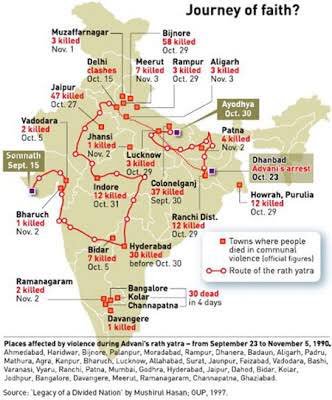
BJP has a strong electoral machine, well backed up by its parent organization, RSS. The core module of RSS-BJP is based on demonization of Muslims through distortions of the medieval period of history in particular and glorification of the past where caste and gender hierarchy prevailed. When it comes to elections, RSS progeny has resorted to various themes from time to time. The first major theme was destruction of Hindu temples by Muslim kings which was the hidden message of the Ram Temple campaign. In due course security (Pakistan as the enemy) was also brought in. Prior to the demolition of Babri, they used to talk of Indianization of Muslims among other anti Muslim themes.

In recent times, in 2014 it was Acche Din (Good Days) to take advantage of the anti Incumbency and the Jumlas (Mere phrases) like women’s security, 15 Lakhs per person, 2 Crore jobs every year along with the projection of Congress as a corrupt party. Thanks to the Anna movement promoted and supported by RSS wings, Congress is a corrupt party that was made to stick in people's minds for a long time. In 2019, National security, Pulwama-Balakot became the major propaganda for winning the elections. All through, anti-Muslim rhetoric formed the backdrop. Truth has been a major casualty in most of its propaganda.

This time euphoria around Ram Temple was anticipated to be the major fulcrum of its propaganda. Gyanwapi issue has also been racked up but with marginal effect. Its seems now there is sort of ‘fatigue’ around this issue and due to the dwindling social-economic conditions of the people, the grand Ram Temple-Gyanwapi may not give the results which they were expecting. That leaves it to fall back on its time tested divisive communal issue, the anti Muslim propaganda. This time around Mr. Modi has set the tone around anti Muslim dog whistles and linked it up with the Congress manifesto centered around Justice for weaker sections of society,( adivasis, dalits and religious minorities), women’s empowerment, and justice for youth (employment- internship) and students (Paper leaks).

So far justice for weaker sections of society has been the major point of opposition for RSS and its progeny. Its very foundation in 1925 was in the backdrop of dalits asserting their rights and women beginning to articulate their social presence. To dilute the caste based reservations they brought in reservations for economically backwards. In practice wherever possible they have been undermining affirmative action for dalit and OBC. Faced with the great appeal of Rahul Gandhi’s emphasis on reservation and affirmative action, BJP had to counter it without sounding that it is inherently opposed to reservations. In this direction the first step was falsehood from BJP patriarch Mohan Bhagwat that RSS has never been against reservations!

Modi in a clever and fake concoction has been saying that, “…they [Congress] wanted to grant reservation to one section of the society (i.e. Muslims, added) by cutting into the quotas meant for Dalits and backward classes, which is completely against the Constitution. The reservation rights that Dr Babasaheb gave to Dalits, backward classes, and tribals, the Congress and the INDI Alliance wanted to give them to specific minorities based on religion," 

Congress manifesto’s emphasis on caste census and giving the analogy of X Ray was picked up by Mr. Modi and linked with his anti Muslim narrative. Connecting the two, he peaked in the falsehood that Congress will do the X-Ray to find gold, money etc. and give it to those who have more children or who are infiltrators (Meaning Muslims as usual in their fake narrative). And to frighten the Hindus, Hindu women in particular, he stated “My mothers and sisters, they won't even leave your mangalsutras(Sacred necklace worn by married Hindu women)  . The Congress manifesto says that if they form a government, then a survey of property belonging to every person will be done. It will be checked how much gold our sisters own and how much money government employees have…They also said that gold owned by our sisters would be equally distributed. Does the government have the right to take your property? ' He cited Mangalsutra' as something which will be taken away and given to Muslims.

This is like killing many birds in one stone. One is, to criticize Congress Manifesto, two to target Muslims and three to frighten Hindu women. The limit of falsehood concocted by him is so obvious here. The arrogance that such falsehoods can be believed by a large number of people comes from the solid understanding that the committed volunteers of ‘RSS combine’ the IT cell and the corporate controlled TV channels and media will ensure that this falsehood will be taken seriously by large sections of people. The peak point of this exercise was to bring in poor buffalo, which had been left out so far in the ‘Cow as mother’ elaborations. ‘If you have two buffaloes one will be taken away by Congress!’ Post truth lies at its best!

How can Pakistan not be made part of the campaign by BJP-Modi? Modi brought in the P factor by stating that Pakistan wants a weak Government in India. One Fawad Chaudhary, an ex-minister of Pakistan, had stated that Rahul Gandhi has Socialism within him. Modi’s claim is that Pakistan is scared of Balakot type reaction so they want Rahul as PM. Modi must have forgotten that it was Congress-Indira Gandhi, which took the bold decision to help in liberation of BanglaDesh, and divide Pakistan into two countries, against the wishes of mighty Western powers!

To bring in Mughals, Modi used the tweet from Tejasvi Yadav, when he was having fish a day before Navratra (Hindu sacred period, when many Hindu do not consume non vegetarian food). Modi propagated that Tejeswai Yadav is consuming ‘non vegetarian’ food in Holy Navratra to insult the feelings of Hindus, the way Mughal kings used to humiliate Hindus by destroying Hindu temples. Connecting the opposition leader’s innocuous act with Mughals thereby reflecting on to present Muslims, showed that the BJP’s current ‘propaganda in chief’ can stretch any simple and harmless thing into a tool to demonize the Muslims and along with the political opposition to his power.

Remarkable is the prowess of Mr. Modi to concoct things to generate ‘Hate for Muslims’ and opposition parties for his electoral gains and social hegemony.   


April 03, 2024

December 29, 2023

India: Is Modi Bigger Than Ram? Why Politics in Name of Ram Temple?


Is Modi Bigger Than Ram? Why Politics in Name of Ram Temple?

Newsclick Team |
In this episode of Bol Ke Lab Azad Hain Tere, Abhisar Sharma discusses how the Bharatiya Janata Party is planning to use the inauguration of Ram Mandir on January 22, 2024, to project its politics, and how it will use this day to glorify the Prime Minister’s image.


https://www.newsclick.in/modi-bigger-ram-why-politics-name-ram-temple

March 01, 2020

India: RSS men packed in Modi's govts 1 & 2

The Print, 27 January, 2020

RSS in Modi govt in numbers — 3 of 4 ministers are rooted in the Sangh

Of 53 BJP ministers in Modi govt, 38 have a Sangh background. In Modi’s first term, 41 of 66 BJP ministers who had taken oath in 2014 were from RSS.
Neelam Pandey and Shanker Arnimesh 27 January, 2020 9:00 am IST


New Delhi: One out of five BJP MPs associated with the Rashtriya Swayamsevak Sangh (RSS) were appointed as ministers in the Narendra Modi cabinet 2019 but this ratio is 1:14 for party MPs who do not have a Sangh background.

Simply put, parliamentarians with an RSS background had three times better ministerial prospects than the others, a fact that aspiring ministers should bear in mind amid speculation about a possible revamp of Team Modi.

It should come as no surprise, though, as Prime Minister Narendra Modi is a former RSS pracharak himself. The No.2 in the government, Home Minister and former BJP president Amit Shah, was also associated with the Akhil Bharatiya Vidyarthi Parishad (ABVP), the RSS’ students wing. It also explains the influence of the Sangh ideology on government policies.

Of the 53 ministers from the BJP in the Modi government, 38 have a Sangh background — 71 per cent of the total. This figure stood at 62 per cent in Modi’s first term when 41 of the 66 BJP ministers who had taken oath in 2014 were from the RSS.

The prime minister has, however, assigned several key portfolios to ministers who don’t have an RSS background, including Finance Minister Nirmala Sitaraman, Minister of External Affairs S. Jaishankar, Housing and Urban Affairs Minister Hardeep Singh Puri and Power Minister R.K. Singh.

A senior BJP leader played down the connection.

“Having an affiliation with the RSS is not a criterion to become a minister,” the leader said. “The PM and senior leadership take a call on this. To say someone is being promoted merely because they have links with the RSS is not a fair comment.”

The view was echoed by an RSS functionary. “The RSS has no role in deciding tickets for the party or deciding the portfolio. At the same time, RSS only believes in two things — there are those who are already with us and those who are yet to come under the fold,” the functionary said.

“As far as BJP leaders are concerned, Sushma Swaraj had no RSS background but she held important positions and even Jaswant Singh didn’t. So these categorisations are not correct.”

The Sangh footprint

Despite such protestations, the Sangh’s footprint on the Modi government is evident.

Of the 303 BJP MPs in the Lok Sabha, 146 or 48 per cent have an affiliation to the RSS. In the Rajya Sabha, of its 82 MPs, the BJP has 34 with links to the Sangh.

Such links are increasingly visible in the decision-making of the government as well.

For instance, a separate Ministry of Animal Husbandry, Dairy and Fisheries was created in Modi 2.0, a suggestion that has chiefly emerged from the Vishva Hindu Parishad (VHP). Besides, the National Education Policy (NEP) also lists numerous suggestions in the draft policy from Sangh-affiliated organisations.

Prior to the Lok Sabha elections last year, after pressure mounted by the RSS and VHP, the BJP government had asked the Supreme Court to expedite the Ayodhya title dispute case.

“The government wants to promote those who have ideological integrity. Compared to the previous Atal Bihari Vajpayee government, which didn’t enjoy a full majority, the Modi dispensation has made it quite clear that it is a government that has no qualms in furthering the Sangh agenda,” said Nilanjan Mukhopadhyay, a writer and journalist based in Delhi.

“Right from the PM, home minister and defence minister, all have an RSS background. The fact that there are more ministers from RSS background is also because this is the government’s way to integrate the Sangh Parivar in a better way so that there are no divisions,” added Mukhopadhyay who has written the books The RSS — Icons of the Indian Right and Narendra Modi: The Man, The Times.

Suhas Palshikar, who taught political science at Savitribai Phule Pune University, said the situation at the time of the Vajpayee government was very different because it was a coalition.

“I believe if we compare this with the Vajpayee government the situation might be different probably because it was a coalition government. As far as Modi government is concerned, we see a very specific relationship with the RSS, and their agenda is taken up by the government,” said Palshikar.

“As far as ministers are concerned, one may see those with an RSS background occupying important portfolios too. It is this unique situation between an organisation and a party where it is difficult to say who is controlling whom, but their agendas are definitely complementary and so are their political projects.”

The most important panel in the Modi cabinet, the cabinet committee on security (CCS), is dominated by the Sangh but does have two non-RSS members — Finance Minister Nirmala Sitharaman and External Affairs Minister S. Jaishankar. The committee is chaired by Prime Minister Narendra Modi and also has Home Minister Amit Shah and Defence Minister Rajnath, all from the Sangh Parivar.

The cabinet committee on economic affairs (CCEA), the second most important ministerial panel, is also dominated by those with RSS backgrounds. The committee consists of Rajnath Singh, Shah, Nitin Gadkari, D.V. Sadanand Gowda, Narendra Singh Tomar, Ravi Shankar Prasad, Piyush Goyal and Dharmendra Pradhan all of whom have links to the RSS. The only exceptions are, once again, Sitharaman and Jaishankar.

Where the link is really evident is in the RSS’ core interests of education, culture and labour. All of these portfolios are handled by ministers with close ties to the organisation — Ramesh Pokhriyal, Prahlad Singh Patel and Santosh Gangwar respectively.

September 27, 2019

September 27, 2019 Protest Against Modi outside the UN Press Releases by Coalition Against Fascism in India (CAFI)

Coalition Against Fascism in India (CAFI)

MEDIA ADVISORY

NEW YORK CITY, NY — (9/26/19) Indian Americans To Protest As Narendra Modi Speaks at U.N.


Thousands of Indian Americans will hold a massive protest near the United Nations headquarters on September 27, 2019 when Indian Prime Minister Narendra Modi will be addressing the U.N. General Assembly.


WHAT: Rally to Protest UNGA Visit of Prime Minister Modi

WHEN: Friday, September 27, 9 a.m.

WHERE: Dag Hammarskjöld Plaza, 245 E 47th St, New York, NY 10017


The protests are called by the Coalition Against Fascism in India (CAFI), that includes Indian American organizations dedicated to defending human rights and democracy in India, and are endorsed by anti-fascist, anti-racist, secular, and environmentalist groups.


“Narendra Modi’s government has been orchestrating a pogrom of hate and violence against Muslims and Dalits in India,” CAFI said in a statement on September 26. “Recently, it has disenfranchised 7 million Kashmiris. It has also rendered nearly 2 million people stateless in Assam and is building detention centers to imprison them.”


CAFI added: “Mr. Modi’s anti-poor, anti-minority government has also been cracking down on all forms of dissent and all those who question its politics of hate. Its economic policies have resulted in escalating poverty and the highest unemployment rate in half a century. These events in India concerns all of us who live in the United States.”


CAFI said Mr. Modi’s politics was no different from President Trump’s: “When Trump spoke at Mr. Modi’s rally at Houston it made their overlap more evident than ever.”


CAFI demands that Mr. Modi restore Jammu and Kashmir's special status under Art. 370, end Kashmir’s military occupation, and respect Kashmiris’ right to decide their future; repeal the Public Safety Act and the Armed Forces Special Powers Act (AFSPA); terminate the National Register of Citizens; halt the lynchings of Dalits, Muslims and Adivasis; repeal the draconian laws misused against Adivasis, Dalits, minorities, environmentalists and the working classes; free political prisoners such as the physically challenged Prof. G.N. Saibaba and those in the Bhima Koregaon case; and withdraw false cases against anti-caste activists such as Anand Teltumbde.


The CAFI protest is co-sponsored by:

• Alliance for a Democratic and Secular South Asia

• Hindus for Human Rights

• India Civil Watch

• Indian American Muslim Council

• The Boston Coalition


Endorsed by: Black Lives Matter (Greater New Y0rk); Campus Anti-Fascist Network; Central New Jersey Democratic Socialists of America; Democracy, Equality and Secularism in South Asia (DESSA), Winnipeg; East India Defense Committee (EIDC), Vancouver; India Civil Watch (ICW-Canada); International Action Center; International League of Peoples’ Struggles; International South Asia Forum (INSAF), New York; Jewish Voice for Peace NYC; MICAH Institute; Party for Socialism and Liberation, Boston; Philadelphia Socialists; Philadelphia South Asian Collective Popular Resistance; Punjabi Literary and Cultural Association, Winnipeg; South Asia Research and Resource Centre (CERAS), Montreal; South Asian Network for Secularism and Democracy (SANSAD), Vancouver; South Asian Women's Community Centre (SAWCC), Montreal; and Women of Diverse Origins.


Protest Location:

CONTACT:

(917) 518-2441

outreach@iamc.com

cafiusa2019@gmail.com

Twitter @Hum_CAFI_hai

Facebook www.facebook.com/HumCafiHain

Coalition Against Fascism in India (CAFI) is a coalition of various organizations dedicated to defending human rights and democracy in India, and are endorsed by anti-fascist, anti-racist, secular, and environmentalist groups.


o o o


INDIAN AMERICAN COALITION ANNOUNCES U.N. PROTEST AGAINST MODI


PRESS RELEASE


Demands include end to Kashmir’s lockdown, repeal of draconian laws, halt to mob lynchings


Renowned U.S. historian Audrey Truschke to join protest


NEW YORK, September 26 — Thousands of Indian Americans will be massing outside the United Nations headquarters here on Friday, September 27, from 9 am onwards, to protest the arrival of Indian Prime Minister Narendra Modi to speak at the General Assembly.


The protest is being organized to draw global attention to Mr. Modi’s “anti-poor and anti-minority” government, the Coalition Against Fascism in India (CAFI), the lead organizer, said in a statement released here on Thursday, September 26.


“Narendra Modi’s government has been orchestrating a pogrom of hate and violence against Muslims and Dalits in India,” CAFI’s release said. “Recently, it has disenfranchised seven million Kashmiris. It has also rendered nearly two million people stateless in Assam and is building detention centers to imprison them.”


CAFI added: “Mr. Modi’s anti-poor, anti-minority government has also been cracking down on all forms of dissent and all those who question its politics of hate. Its economic policies have resulted in escalating poverty and the highest unemployment rate in half a century. These events in India concerns all of us who live in the United States.”


Audrey Truschke. History professor at Rutgers University, who will join the protest, said communities and individuals protesting “have experienced, often personally and painfully, the cataclysmic results of his hateful brand of extreme nationalism: Hindutva.


“Hindutva is a bigoted political ideology with many victims. India’s religious minorities, especially Muslims, have faced increasing disenfranchisement and violence during Modi’s tenure. The Modi government has ruthlessly attacked the media, academics, and others who dare to speak out. In some cases, Modi has successfully silenced people he deems problematic, most recently subjecting the entire population of India-controlled Kashmir to a communications blackout that has lasted nearly two months already.


“The Modi government has been clear in its message that criticizing, or even merely accurately describing, Hindutva comes with increasing risks, which makes the scale and diversity of the current protests all the more astonishing. I urge global leaders to listen, not only to Modi, but to those he has not yet managed to silence.”

Said Mohammad Jawad, National General Secretary of Indian American Muslim Council: “We are not anti-India or anti-Hindu. We are only demanding basic human rights that the Constitution of India guarantees for all citizens. The Modi government follows the RSS’s Hindutva ideology which is responsible for all atrocities and lynchings against the minorities. These need to stop and the perpetrators prosecuted.”


Added Sunita Viswanath, Co-Founder of Hindus for Human Rights: “We will keep raising our Hindu voice of protest against the fascist policies of the Modi government and their unabated human rights atrocities such as lynchings, rapes, murders, arrests of dissenters, Islamophobia, National Register of Citizens and the siege of Kashmir under siege. This government is destroying Indian democracy in the name of Hinduism. As Hindus, as Indians, and as people of conscience, we say ‘Not In Our Name’."


Kerala-based Dalit rights activist Ajaya Kumar who is visiting New York and will join the protest, said Mr. Modi’s government has dismantled the “very democratic institutions that we had laboriously built… He has dragged the country's politics back to the medieval age. The minorities, Dalits, Adivasis and every other identity that does not fit into Hindu Nationalism faces a serious threat, and dissenting voices are targeted.”


Hawk Newsome, Chairman, BLM Greater New York, said: “We stand united against governments that exploit the most vulnerable.” They, too, will join the protest.


New York-based Musician Sunny Jain, who will perform at the protests, said Mr. Modi’s Hindu nationalistic ideology was “simply divisive and inciting aggression towards minorities, namely Muslims. I condemn nationalism from Trump to Modi and urge all artists, South Asians and people to raise their voice against these hurtful ideologies.”


James Sues, Executive Director, Council on America-Islamic Relations (CAIR), New Jersey, said that the Modi government had “illegally stripped” the people of Kashmir of their autonomy, and called for a reinstatement of the Indian Constitution’s Article 370 that gave Kashmir a special status and that was last week scrapped by Mr. Modi. “We call on world leaders of conscience to reject the fascist agenda of Mr. Modi and the BJP and stand with the marginalized minorities of India,” Mr. Sues said.


The Thamizh Diaspora of America in coalition with CAFI will be protesting for:

- Justice For Thoothukudi and the 15 lives killed on 4/22/18 for protesting against a powerful copper smelter owned by Anil Agarwal of London who is a BJP donor.

- Shut down the copper Sterlite Permanently

- Ban NEET to prevent student suicides,

- Hands OFF Activists

- Stop Hydrocarbon Extraction in TN,

- Stop Environment destruction

- Stop Farmers’ Land grabbings

- Save Cauvery Delta, Stop the unfair New Educational policy, Stop mob lynchings and religious hatred, Stop military occupation in Kashmir, Stop violence against women and children, Stop all abuse of power and fascism in India


CAFI includes Indian American organizations dedicated to defending human rights and democracy in India. Many civil rights groups have endorsed the protests.


CAFI demands that Mr. Modi’s government restore Art. 370 that granted Jammu and Kashmir a special status, end Kashmir’s military occupation, and respect Kashmiris’ right to decide their future; repeal the Public Safety Act and the Armed Forces Special Powers Act (AFSPA); terminate the National Register of Citizens; halt the lynchings of Dalits, Muslims and Adivasis; repeal the draconian laws misused against Adivasis, Dalits, minorities, environmentalists and the working classes; free political prisoners such as the physically challenged Prof. G.N. Saibaba and those in the Bhima Koregaon case; and withdraw false cases against anti-caste activists such as Anand Teltumbde.


The CAFI protest is co-sponsored by Alliance for a Democratic and Secular South Asia, Hindus for Human Rights, India Civil Watch andIndian American Muslim Council.


Other organizations that have endorsed the protests are: Black Lives Matter (Greater New Y0rk); Campus Anti-Fascist Network; Central New Jersey Democratic Socialists of America; Democracy, Equality and Secularism in South Asia (DESSA), Winnipeg; East India Defense Committee (EIDC), Vancouver; India Civil Watch (ICW-Canada); International Action Center; International League of Peoples’ Struggles; International South Asia Forum (INSAF), New York; Jewish Voice for Peace NYC; MICAH Institute; Party for Socialism and Liberation, Boston; Philadelphia Socialists; Philadelphia South Asian Collective Popular Resistance; Punjabi Literary and Cultural Association, Winnipeg; South Asia Research and Resource Centre (CERAS), Montreal; South Asian Network for Secularism and Democracy (SANSAD), Vancouver; South Asian Women's Community Centre (SAWCC), Montreal; and Women of Diverse Origins.


CONTACT:

(917) 518-2441

outreach@iamc.com

cafiusa2019@gmail.com

Twitter @Hum_CAFI_hai

Facebook www.facebook.com/HumCafiHain

May 10, 2019

India: Modi’s Appeal In the Name of Voters’ Religion A Clear Violation of Representation of People Act

Modi’s Appeal In the Name of Voters’ Religion Makes Wardha Speech a Corrupt Practice

His charge that Rahul Gandhi chose Wayanad because Hindus are in a minority there and urging Hindu voters to punish the Congress for speaking of ‘Hindu terror’ violate the Representation of People Act.

April 25, 2019

India: What’s Under The Modi Masks | Parvis Ghassem-Fachandi

huffingtonpost.in

4/04/2019 3:58 PM IST

What’s Behind The Modi Masks That Are Everywhere This Election Season

PM Modi's supporters never seem to want to take their masks off while cameras are rolling, writes Parvis Ghassem-Fachandi in a new book

Hindustan Times via Getty Images
A supporter of Bhartiya Janata Party takes selfie with a face mask of Prime Minister Narendra Modi during BJP's political rally, at Asansol Polo ground, on April 23, 2019 in Kolkata, West Bengal. 
During fieldwork in 2011–14 and again in 2016, I began to see political supporters of Chief Minister Narendra Modi engaging in the curious practice of collective masquerade. In various public venues at the time, still visible today on countless photographs and in video recordings, large groups of people gather in which every single individual makes the same face. They all wear a Modi mask. The photos seem eerie for what they lack: individual facial expressions. The mask, one of which I purchased, is a rubber contraption that depicts the face of the Indian politician not as parody but in typifying detail. The practice started around 2007 when Modi had not yet entirely overcome major legal and political hurdles linking his administration to the Gujarat pogrom. It had, for Modi, a brilliant effect: the sea of masks made every photograph of a crowd gathering in his name a permanent visual advertisement for his face. Crowds of every kind are ubiquitous in India. In linking name and face via the crowd, Modi’s face became iconic beyond Gujarat. With his mass appeal and popularity steadily increasing, the Modi mask soon became an item en vogue.
Several types of masks circulated in various periods of electoral and public agitation leading up to the general election in 2014. Street workers, Modi supporters, and sometimes accidental bystanders, wore these masks during mass events. Some were made of stiff plastic, others of colored paper, but the most popular one was made of a soft, pliable rubber—the type one finds in Halloween stores in the US. It reminded me of the masks worn in the famous British comedy series Spitting Image. The soft rubber is produced by an India-based company and when worn causes heavy perspiration. It also smells strongly of the petrol chemicals with which synthetic rubbers are made. This most popular version of the Modi mask, covering only the front part of wearer’s face, depicts the politician’s facial features most accurately. During his national campaign in 2013–14, it far outnumbered the others. It faithfully depicts Modi’s distinctive features: smoothened white hair, high forehead, light skin tone, small ears, rimless eyeglasses, thick, full lips framed by a white mustache that blends seamlessly into the edges of his beard. The soft rubber material is of a kind that allows adjustment to any head size or shape while also minimising distortion of facial features. For an Indian today, it is impossible to doubt who this mask presents.
These masks acquired an unintended humorous quality at times by transferring the politician’s increasingly familiar features into strange social televisual contexts: dark-skinned tribal women as Modi-versions in interviews espoused economic development in their own unique tongues and voices; dusty rickshaw-drivers looked like Modi clones as they stuttered awed excitement about the prospects of a decent living wage into a reporter’s microphone; an athletic muscle-man in a T-shirt stretched his pecks into the TV camera, impersonating the somewhat plump and more humble politician while speculating about the future of health in the nation. And then there were countless children hidden behind a single overlarge adult face with white hair—all of them sweating profusely under the soft plastic in the incredible heat. In the mask their voices resounded hollowly through its orifices articulating their hopes for a better India, all hiding behind the rubber contraption.

The Modi mask is the plastic symbol of a new political formation that the BJP came to dominate. By presenting a single face and focusing all attention on only one man’s features, some degree of definite clarity in appearance was achieved which in the election attracted many voters.
The popularity of Modi masks can be contrasted with the popular disenchantment with the Congress system. There is no face in the Congress Party today that could do the work that Modi’s face does for the BJP. It’s former leader, the Italian-born Sonia Gandhi, represents a cosmopolitanism that is popularly disparaged as ‘Western’. Rahul Gandhi, its current leader, after winning his father Rajiv’s old seat in Amethi, UP, in 2009, did very badly in 2014 by bestowing on Congress one of its worst defeats. Congress has other problems relevant to representation and delegation: a very complicated mechanism of segmented representation; and the internal layering of dynastic rank, primogeniture, and traditional power as against the promise, however naive, of a singular strong authority. While Modi was able to oust his immediate predecessors, Rahul can ill afford to show disrespect to his mother. The Congress umbrella doesn’t open properly any longer. Such a decisive identification with a political leader like Modi is a phenomenon that has not taken place at a national scale in India at least since the days of Indira Gandhi. The Modi mask is the plastic symbol of a new political formation that the BJP came to dominate. By presenting a single face and focusing all attention on only one man’s features, some degree of definite clarity in appearance was achieved which in the election attracted many voters.
A crowd is usually understood to be a faceless phenomenon, but these political crowds found their face in Narendra Modi’s. This identification through masking becomes more intelligible when placed alongside the context of how people used them for the ubiquitous Indian ritual of tilaka: putting a mark of red vermillion on the center of their foreheads in order to honour the receiver. By putting a tilak on the rubber mask instead of one’s actual face, it suddenly became unclear, who was being honoured by this habitual act. Is it the anonymous individual wearing the mask or is it the important persona depicted by the mask’s surface features? The convergence of the anonymous member of the crowd with their designated leader was now complete: the politician as the representative face of the group and the group as the embodiment of the man.
A mask is an object that depicts and conceals at the same time. While the facial features depicted in and through the mask are shown, the face beneath it remains hidden. There is something strange happening when someone puts on a mask. Something breaks in the air. There enters a new presence, a supplementary address by a third, and this address becomes interrupted once it is taken off again. Masked supporters of Modi never seem to want to take off their masks while cameras are rolling or while photos are being shot. This, despite the fact that it was highly unlikely they would ever again be on live TV. I found the insistence on remaining concealed surprising, because I assumed that one way to emphasise the authenticity of one’s opinion is to add one’s individual features to it—i.e. to take off the mask. It reminded me of veiled Muslim women in Gujarat, who will often tie a niqab tightly when cameras are rolling for the duration of what they have to say, only to relax the practice a moment later, when they hail their rickshaw and drive home. The women want to become visible to an anonymous public only as pious and veiled and without their individual facial features. The Modi supporters similarly did not want to add something that might disturb the smooth surface of their leader’s rubber replica. Instead of becoming visible as who they were, they made themselves invisible as members of his crowd.
And yet, it is insufficient to understand this practice, the wearing of a mask of the leader by political supporters, as a unidirectional affair. The mirror works both ways. In India, politicians, too, wear the coverings of their potential voters. Election campaigns include elaborate tours through regions and the countryside, as well as cities in the Indian union during which candidates engage in spectacles of costuming that sometimes approximate a veritable carnival of sorts. Enveloped by playful accoutrements, such as coats and shawls, they pose bearing typifying swords, and especially colourful turbans or other headgear originating from various ethnic, regional, and caste communities. Sometimes the head coverings make them even look silly. Such productions are a remnant of a once much more elaborate ceremonial logic of honouring the stranger as a visiting guest.
For electoral candidates, sartorial styles, wearing garments and displaying other regalia, are symbolic strategies, especially while on the campaign trail.They offer token recognition to particular identities of which there are many in India. The practice of wrapping oneself in unfamiliar clothes is indexical of the inclusion and mutual consideration demanded in the world’s largest and by far the most diverse democracy. Nowhere can one find such a density of kitsch and superficial yet also endearing symbolism as when Indian politicians take on the garbs of their respective audiences, offering studied postures and making bland, complementary statements. Yet, the exchange always remains reciprocal: the attention the people give to the candidate (the guest) is reciprocated by the attention the candidate gives to the regional specificities and particularities of the hosts. Wearing the Modi mask marks a dramatic break with this customary reciprocity: under the mask, the people do not become present except in the leader’s image. 
Book Cover.
Parvis Ghassem-Fachandi is an Associate Professor of Anthropology at the Rutgers University.
Excerpted with permission from ‘Majoritarian State: How Hindu Nationalism Is Changing India’. Edited by Angana P Chatterji, Thomas Blom Hansen and Christophe Jaffrelot.
2019/537 Pages 537/Hardback: Rs 899

April 14, 2019

RSS's expanded influence across India - Fueling Modi’s Campaign

The Secret Society of Hindu Foot Soldiers Fueling Modi’s Campaign


  • RSS has expanded to have unprecedented influence across India
  • Millions of volunteers are urging voters to back ruling party
Join us on WhatsApp for special coverage of India’s election. Sign up here.
They’re known as the RSS -- a force of more than four million volunteers devoted to the re-election of India’s hardline Hindu prime minister.
But the power of the secretive, all-male Rashtriya Swayamsevak Sangh stretches way beyond dusty villages and sprawling urban centers. More members of the group, founded in 1925, are in the top ranks of government than ever before -- including India’s president and vice president, the head of the ruling party and even Prime Minister Narendra Modi, who joined its children’s unit when he was eight years old.
TOPSHOT-INDIA-POLITICS-RELIGION-RSS
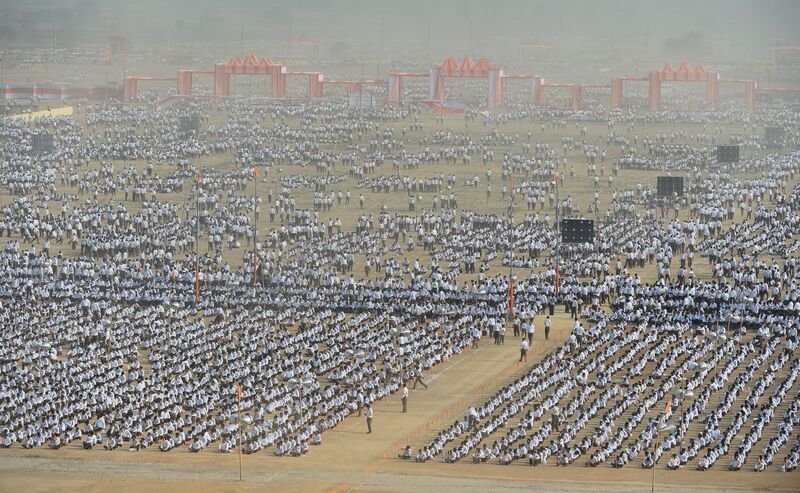
Volunteers of the Rashtriya Swayamsevak Sangh (RSS) gather for a large-scale congregation in Meerut on Feb. 25, 2018.
Photographer: Sajjad Hussain/AFP via Getty Images
With its affiliates, the RSS is recognized as one of the world’s largest non-government associations -- and it’s also the ideological mentor of Modi’s ruling right-wing Bharatiya Janata Party. For three days last month, key RSS functionaries from all over the country gathered for their annual conclave in Gwalior in the central Indian state of Madhya Pradesh to discuss their core tenet: the protection of Hindu traditions and beliefs.
It set the tone of the agenda for the next BJP government. Priorities include the construction of a Hindu temple at the disputed site of Ayodhya, a uniform civil code for all religions and the abolition of special status for Jammu and Kashmir, India’s only Muslim-majority state. All these were featured in the BJP’s election manifesto unveiled on Monday.
For Modi, the RSS also serves another function: It operates one of the country’s most effective get-out-the-vote operations. The group’s support, which hasn’t always been a guarantee for the BJP, could determine whether Modi stays on for another five-year term after votes are counted on May 23.
“Whatever we did in 2014 election, we will do this time also,” Alok Kumar, acting president of the Vishwa Hindu Parishad, an affiliate organization of RSS, said at the Gwalior conclave. “We will try for one hundred percent polling to strengthen the Hindu forces.’’
Other key RSS members, some of whom asked not to be identified, confirmed the group would support the BJP in force as voters head to the polls in the weeks ahead.
“We will go door-to-door for maximum voting,’’ Om Prakash Sisodia, a full-time official from the RSS in Madhya Pradesh, said over breakfast on the sidelines of the meeting.
RSS Workers Celebrate Vijayadashami Utsav In Pune
Members of the RSS during the Vijay Dashmi Utsav celebration in Nagpur, India, on Oct. 18, 2018.
Photographer: Sunny Shende/Hindustan Times via Getty Images
The RSS -- which is Hindi for National Volunteer Corps -- has only twice before put all its might behind the ruling party and mobilized cadres to campaign openly: in 1977 when the RSS was struggling for its survival, and in 2014 when it was blamed for propagating terrorism.
The group, banned three times in post-independent India, has been accused by opponents of fueling religious conflict that has claimed thousands of lives -- mostly Muslims. A closed society, it mostly communicates mostly verbally with its members, keeps no records of those it recruits and has few dealings with the media.
The organization now has unprecedented influence across India, according to Walter Andersen, a professor of South Asia studies at Johns Hopkins University in Washington, who has studied the right-wing group for over five decades and also co-authored two books on the RSS.
“On policy process, yes, it is much more active and outspoken than ever before and that is because the affiliates have grown rapidly and those affiliates have penetrated every aspect of Indian society,’’ Andersen said. Modi enjoys their support because they “have a measure of influence in a BJP government to achieve what they want.’’

Foot Soldiers

Like every BJP president before him, Amit Shah was among the 1,400 delegates who went to Gwalior. He sat humbly on a plastic seat with the rest of the attendees -- without the paramilitary commandos who accompany him everywhere -- and asked for their support to make Modi prime minister once again.
That approach has already paid off. RSS members have gone village-to-village, house-by-house to mobilize voters, highlighting Modi’s flagship welfare programs and calming the anger of citizens who still feel left behind in a country where a quarter of the population still live on less than $2 per day.
INDIA-RELIGION-POLITICS-HINDU
Volunteers of RSS offer prayers during the organization’s foundation day in Amritsar on Sept. 30, 2017.
Photographer: Narinder Nanu/AFP via Getty Images
“As a leader of a political party, it’s his duty to seek support from all,’’ Suresh ‘Bhaiyyaji’ Joshi, general secretary of the RSS, told reporters at the Gwalior conclave. “The role of the Sangh is to work for hundred percent voting in elections.’’
While the RSS officially says it’s apolitical, volunteers work in their “individual capacity” at polling booths to ensure maximum voter turnout for the ruling party. They coordinate with millions of members from its 40 affiliated organizations, including labor, student and education wings, as well as another 500 social groups that want Modi to win again.
No other political party in India has a similar organization behind it, said Nilanjan Mukhopadhyay, a political analyst who has written a biography on Modi and the RSS. “The RSS has the biggest political network in the country, but they don’t say it’s a political network,” he said.

Political Pressure

For nearly a century, the RSS has sought to place itself at the center of the country’s policy-making process. During Modi’s regime it has grown exponentially, with a 32 percent rise in daily gatherings across the country, according to figures provided by the organization.
The RSS has its own political priorities. The organization advocates for Hindu culture and believes India belongs only to Hindus. It has made the protection of cows -- considered sacred to Hindus -- a top priority.
When its chief Mohan Bhagwat said in April last year India must have ownership and control of the debt-ridden state-run carrier, Air India Ltd., the minister in charge committed publicly to retain the airline in Indian hands. It has since changed direction after a failed sale attempt.
One of its affiliated organizations successfully pushed the government to cut royalties on genetically modified cotton seeds, despite a concerted lobbying effort from multinational Monsanto Co. And the RSS and its associated organizations have pressured the government on issues ranging from the goods and services tax, labor and education to healthcare, forcing policy and rule changes.

Still, the RSS does not align with the BJP on every issue. The group has come into conflict with successive BJP-led governments that didn’t give more favorable treatment to domestic industry over foreign investment, and they’ve opposed some aspects of Modi’s proposed labor reforms.

Spreading Wings

RSS thrives under Modi, rises 32% in five years


Source: Rashtriya Swayamsevak Sangh Annual Report
* Figures are number of `shakhas' or daily gatherings of volunteers of Rashtriya Swayamsevak Sangh
RSS volunteers are like any other citizens who like the ideology of Modi and support him, said Vinay Sahasrabuddhe, vice president of BJP. “We are inspired by the same ideology.”

Patriotic Songs

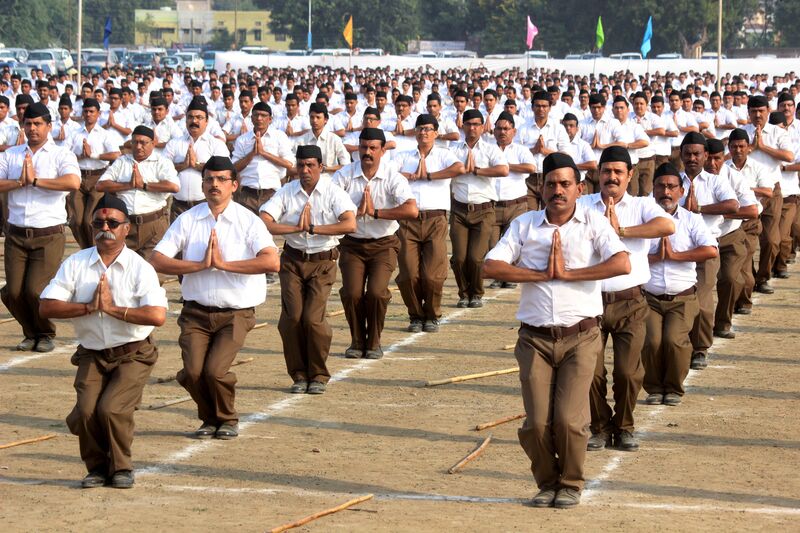
The RSS is famous for daily gatherings on sports fields and school grounds around the country. Volunteers including children as young as five exercise, march and sing patriotic songs while donning a distinctive uniform, which only in 2016 changed from khaki shorts to long brown trousers. During Modi’s time, the group said, its daily gatherings swelled to 59,266 from 44,982 in 2014.
“Modi is the most loved child of the RSS,’’ said Satish Misra, a political analyst at the Observer Research Foundation in New Delhi. “This time again RSS will back him to the hilt so that its ideological objectives are further progressed.’’
— With assistance by Archana Chaudhary

April 09, 2019

India: Shiv Sena founder Bal Thackeray Was Disenfranchised for Far Less Than Modi's Polarising Politics - the election commission is failing us

When Bal Thackeray Was Disenfranchised for Far Less Than Modi's Polarising Politics

In December 1987, while campaigning for Shiv Sena candidate Ramesh Prabhu, Thackeray had made several hate speeches for which he was later benched for six years by the judiciary and the EC.

Mumbai: With all else, including the air strikes against Pakistan, failing, Prime Minister Narendra Modi has decided to communalise the ongoing elections in the country.
On April 1, in Wardha, he slammed Congress president Rahul Gandhi for filing his nomination papers from Wayanad in Kerala, which he described as a Hindu minority constituency.
Elsewhere, he berated the Congress for describing a section of terrorists in India as ‘saffron terrorists’.
So far, the Election Commission’s response has been wanting. This is especially clear to see from how the Shiv Sena, an ally of the BJP in the present election, paid the price for less than this in the 1980s and 1990s when the EC barred Bal Thackeray and his candidate Dr Ramesh Prabhoo from contesting polls for six years. The two were also disenfranchised for the same amount of time.
Campaigning for Prabhoo, who had been his physician since the early 1970s, Thackeray had called Muslims names and appealed to Hindus to vote for a fellow Hindu at a by-election for the Maharashtra assembly in December 1987. 

[ . . . ] 

March 29, 2019

India: If Narendra Modi returns to power, whatever we have seen so far will look like a benign trial run

The Wire, 28 March 2019

The Next Five Years Could Change India Forever

If Narendra Modi returns to power, whatever we have seen so far will look like a benign trial run.
When Indira Gandhi suddenly announced elections in January 1977, indicating the end of the national Emergency that had been imposed in June 1975, the country was surprised. There had been no hint at all that the Emergency was going to be lifted and certainly nothing to suggest that normal democracy would resume.
Opposition leaders were freed from jail and restrictions on the media were lifted. The media rediscovered its spine, the leaders went into a huddle to plan how to fight the Congress and the young were galvanised. A new spirit of freedom was in the air.
The elections were crucial, if for nothing else than to show Mrs Gandhi that India would not accept any threats to its democracy and that all those who subverted fundamental rights would be discarded. Various parties came together under one banner and solemnly swore to put aside their differences and put up a joint front. Atal Bihari Vajpayee, whose Jan Sangh had merged with the Janata Party, said that it would not fall apart because the leaders had to keep the trust of the masses.
We know what happened eventually, but at that crucial moment, everyone understood the importance of those particular elections. A victory for the Congress would have legitimised the Emergency; that would have changed India in fundamental ways.
Also read: Maharashtra’s VBA, an Alliance of the Excluded, is Attempting a Social Transformation
The elections in 2019 too have the potential to change India as we know it forever. The last five years have seen unprecedented hatred, bigotry and assaults on not just individuals or communities, but on the whole super structure of what makes India what it is – a secular liberal democracy, with robust institutions that are supposed to uphold its democratic values. Those institutions have been under relentless attack and if they have held so far, it is because the foundations were strong. The next wave of attacks will be on the foundations and once that is achieved and the institutions subverted, a ‘new India’ will be created, one that will be completely different from what we have now.
It is sometimes difficult to recall what India was just half a decade ago. It was not a golden age, not at all, and there was no dearth of problems small and big, but it was not a time when a citizen could be hauled out of his home and killed for speaking, eating or simply being from the ‘wrong’ religion or caste. No one was an ‘anti-national’ – in effect, a traitor – for expressing a point of view that did not fit in with the ruling party’s views, no journalist was abused as a ‘presstitute’, and certainly no former prime minister was accused of plotting with the Pakistanis to defeat the current incumbent. The sorriest part was that such statements and allegations came from ministers, not from trolls, who should have known better. In fact, it was the complete surrender of any sensibility
A salesman watches Prime Minister Narendra Modi addressing to the nation, on TV screens inside a showroom in Mumbai, March 27, 2019. Credit: Reuters/Francis Mascarenhas
The Indian media was obsessive in its criticism of the UPA government, especially in the last two to three years of UPA-II. It looked like a sustained campaign to discredit the Manmohan Singh government and, correspondingly, prop up candidate Narendra Modi as a fresh alternative. Nothing wrong with criticising the government, but that spirit vanished the moment Modi took power. Now much of the mainstream media not just vocally and shrilly supports Modi, it does everything in its power to undermine the opposition. Those who maintain a pretence of neutral professionalism – balance, objectivity, fairness, both sides and all that – do it in a way that legitimises the worst kind of behaviour.
Every institution, from the various cultural, social, educational organisations directly under the government’s control or dependent on government funding, has been taken over, some by stealth, others quite blatantly, some with threats of holding back the money, others by infiltrating the governing bodies. In almost every case, the government’s appointees are mostly mediocre time servers or apparatchiks, with little or no intellectual ability or heft. That is hardly surprising – the Sanghi, Hindutva obsessed right-wing has grown up on a steady diet of conspiracy theories, bogus mythology instead of history and hatred for a wide assortment of enemies, real and imagined. Formal education – in history, science, economics or indeed the arts – has always been anathema.
This has engendered a single-minded obsession of ‘righting the wrongs of the past’. This past could be as recent as the immediate post-independence period, when the much reviled Jawaharlal Nehru created the secular and modern Indian nation state, to the mythical past, when Bharatvarsh was a Golden Land, untroubled by Muslim invaders, where everyone lived peacefully and in perfect harmony in accordance with their caste and social status.
Also read: BJP is Replicating the Shiv Sena Model in Assam. This Should Worry the AGP
Every effort to suborn an institution or lynch a beef-eating Muslim is one more step towards re-establishing that social equilibrium and bringing back Ram Rajya. Modern democracy is seen as a foreign import grafted on to a reluctant India; it is time to uproot it. When sundry BJP members say that the constitution will be changed, they mean it. Or when a leader, an MP no less, declares that this will be the last elections if Narendra Modi wins, he should be taken seriously. That is what they have been told all along and that is what could well happen.
It is not as if another party winning will change things around rapidly. The poison that has entered the Indian system will not vanish so soon, whatever the results the elections throw up. The other parties have not necessarily shown a robust commitment to protect institutions, nor do they inspire confidence in their total faith in democratic processes. The media is so far sold out that redemption is impossible – it will continue on its self-destructive path and can be disregarded in any serious discussion of Indian democracy unless it can show that it can uphold the professional principles of being a watch dog. And political parties, especially in the opposition but also in the government, are not suddenly going to change their ways of treating parliament with contempt.
But there is a qualitative difference. A repeat of the last five years will accelerate the destruction of Indian democracy and eventually, of India itself. Then whatever we have seen so far will look like a benign trial run; the real thing will be brutal and ruthless. That is what has to be halted at any cost. The Janata Party experiment was a disaster, but it acted as the brakes for any similar adventure for a long time.
The same situation has arisen now. As a people who want nothing more than peace, harmony, security and an economy that benefits everyone in a society that is inclusive, we have to think of not just the next five years but the next five decades and beyond. It is the duty of this generation to save the generations to come. A mistake now could prove costly for a long time.

India: Shadow of fascism | Prabhat Patnaik

Frontline, April 12, 2019

Shadow of fascism

Prime Minister Narendra Modi arrives at the BJP headquarters in New Delhi with party president Amit Shah for the central election committee meeting on March 19. Photo: Sushil Kumar Verma

The Modi years have witnessed an authoritarian imposition upon society by an increasingly centralised state, the setting up of one segment of society against another and the promotion of a cult of hatred, behind which the state acts directly in corporate interests.
In its attack on civil liberties, its restructuring of the state to effect an acute centralisation of power, and its pervasive purveyance of fear, the Narendra Modi years resemble Indira Gandhi’s Emergency. But the resemblance stops there. In fact, the two differ fundamentally in several ways.
First, there were no lynch mobs or street thugs terrorising people and giving them lessons in “nationalism” during the Emergency. It was only the state that repressed people then; now we have gangs of Hindutva hoodlums, who force critics of the government to apologise for their “misdemeanours”, with the additional threat of arrests still hanging over these intimidated critics. One cannot easily forget the sickening sight of a professor being to made to ask for forgiveness on bended knees for a Facebook post that was critical of the government.

A new nationalism

Second, unlike the Emergency, the current repression invokes an ideology, that of “nationalism”, interpreted as being synonymous with Hindutva but cashing in opportunistically on the prestige of India’s anti-colonial nationalism despite having nothing in common with it. As a result, while Indira Gandhi’s repression had the effect (no doubt unwanted by her) of making her critics appear honourable, the current repression deliberately portrays them as dishonourable, as “enemies of the people”. This vilification is further magnified when state agencies are used to accuse these opponents of “corruption” and “wrongdoings” of various kinds; the idea is to destroy their moral standing before the people.
The third difference is the government’s capturing of the media. During the Emergency, the print media was subject to pre-censorship; papers would appear with vast spaces inked out, because of which they actually gained people’s respect. Now the media, barring a few honourable exceptions which, too, may not remain so for long, are totally in the Hindutva camp, and the task of destroying the moral stature of the opponents is facilitated because of the media’s complicity in it.
The media’s changed role, in turn, is linked to the fourth difference between then and now: the Modi government is entirely in cahoots with corporate interests, while the Indira Gandhi regime maintained its difference with the corporates and even presented a “progressive” anti-corporate image. Indeed, no government in post-independence India has been as close to the corporates as the Modi government, a point exemplified by his travelling in Adani’s aircraft to New Delhi to be sworn in as Prime Minister. (It is worth recalling, by way of contrast, that Jawaharlal Nehru, the Hindutva bete noire, did not have enough funds to visit his wife, Kamala, when she was dying of tuberculosis in a Swiss sanatorium and had refused G.D. Birla’s offer of financial assistance; eventually Nehru himself managed to raise the money.)

Anti-minorities

The fifth difference is the Modi government’s thrust against minorities, especially the hapless Muslim minority. Indira Gandhi’s repression did not have any specific ethnic or communal or caste target. It was repression, pure and simple, directed at her opponents and those of her son Sanjay, who was notorious for his shenanigans. Correspondingly, it did not have any grandiose projects of rewriting history, of presenting a narrative vilifying a particular religious community, and of using state power to thrust this narrative down the throats of even schoolchildren, inculcating in them a sense of hatred towards fellow countrymen belonging to a different religion.
The sixth difference, associated necessarily with this project, is a promotion of unreason, a prioritisation of faith over rational discourse, a cultivation of disdain for evidence and even for the internal consistency of argumentation. This phenomenon has for long characterised the Rashtriya Swayamsewak Sangh, but it has now invaded official public discourse, with even the Indian Science Congress not in a position to free itself of this discourse.
The seventh difference is the destruction of institutions that the Modi government has initiated, and this is especially true of public universities and other publicly funded centres of learning. All these institutions are faced with a “heads I lose, tails you win” situation. If they cave in to the demands of the government to change their ambience and curricula, they become intellectually dead anyway since intellectual survival requires independent critical thinking. But if they persist with independent critical thinking, then they are starved of funds and charged with harbouring “anti-national” seditious elements, as has happened to Jawaharlal Nehru University. The fact that some of the finest institutions in the country, from JNU to the University of Hyderabad to the Film and Television Institute of India, Pune, to the Tata Institute of Social Sciences and the Tata Institute of Fundamental Research, have been struggling for breath is symptomatic of our times. Nothing like this has happened before; no government in the past has ever shown such disdain for thought.

Repression

These differences between the Emergency years and the Modi years can be summed up as follows. The Emergency was an authoritarian imposition by the state, that had got extremely centralised by then, upon society or upon the people at large; it was no doubt a fallout of the contradiction between the logic of capitalist development and a democratic polity, but it did not represent direct corporate rule. The Modi years have witnessed not just an authoritarian imposition upon society by the state, that has also got extremely centralised; they have witnessed in addition a setting up of one segment of society against another and the promotion of a cult of hatred, behind which the state acts directly in corporate interests. The difference in a word is between authoritarianism and fascism. The statistics of repression, such as the number of persons jailed, were worse during the Emergency. But the potential for repression being built up now is much greater, more far-reaching.
Every single one of the characteristics mentioned above as being specific to the Modi years is in fact a characteristic of fascism: the rampaging mobs, the “fusion of corporate and state power” (supposed to have been Benito Mussolini’s definition of fascism), the targeting of a hapless minority, the promotion of unreason, the destruction of universities, and so on. To say this does not mean that we shall have a re-enactment of the 1930s. We have fascist elements in power but not yet a fascist state, and today’s context being different from the 1930s, we are unlikely to even have one.
To be sure, as in the 1930s, the current tendency towards fascism, which is not just an Indian phenomenon but a global one, arises from the crisis afflicting capitalism. Such a crisis brings with it a threat to the hegemony of the corporate-financial oligarchy, which therefore looks for an additional prop to retain its hegemony, one that can shift the popular discourse away from the flaws of the system to the danger supposedly posed by the “other”, some hapless minority that can be made the focus of anger. Corporate capital in such situations picks up some “supremacist” fringe group (such groups spewing hatred against a minority exist in most modern societies) and pushes it centre stage through massive financial backing: what the renowned Polish economist Michal Kalecki had called a “partnership of big business with fascist upstarts” comes into being.
This is what has happened in India, too, with the promise of neoliberal capitalism waning because of the prolonged stagnation that the world economy has entered into after 2008; Modi has been instrumental in effecting this “partnership” between big business and the Hindutva crowd, whence his current political importance.
There is, however, a basic difference between the 1930s and now, which consists in the fact that the corporate-financial oligarchy in the capitalist countries then was nation-based and engaged in acute rivalry with similar oligarchies of other nations; the apotheosis of militarism which is necessarily associated with fascism inevitably led to war in that situation.
This had two implications: one was that military spending in preparation for war, financed mainly by government borrowing, got the fascist countries quickly out of the Great Depression and its associated mass unemployment (Japan was the first to recover, in 1931, followed by Germany, in 1933); there was even a brief interregnum, therefore, between the recovery from the Depression and the devastation unleashed by war when the fascist governments actually became quite popular for having overcome unemployment. The second implication was that fascism also burned itself in the process, through the war. The cost extracted for this extinction was, no doubt, terrible, but it did mean the extinction of fascism.
Today, by contrast, we do not find rival corporate-financial oligarchies engaged in intense rivalry. All of them are integrated into a structure of globalised capital, which does not want the world broken up into separate “economic territories” through war; it would rather have a world that remains open for capital, especially financial, flows. This does not rule out wars, but wars today are directed by leading powers against those states that are either not under the hegemony of globalised finance capital or are challenging it.
Likewise, since finance capital dislikes fiscal deficits, and since the writ of globalised finance capital must run against any nation state (otherwise it would quit that country’s shores, causing an acute financial crisis), increased government spending, even military spending, cannot be financed by a fiscal deficit. Nor can it be financed by taxes on capitalists, which finance capital would obviously oppose. But these are the only means of financing government expenditure that can lead to an increase in employment (for government spending financed by taxes on workers who consume most of their incomes anyway does not add to aggregate demand). Contemporary fascism, therefore, is incapable of making any difference to the state of unemployment under neoliberal capitalism. And being corporate-financed, it cannot challenge neoliberal capitalism either.
This means both that it cannot acquire political legitimacy by improving the material conditions of life of the working people, and at the same time, it is not going to extinguish itself through war as fascism in the earlier era had done. It cannot also do away altogether with the institution of parliamentary elections because of the precious legitimacy that such elections provide to the hegemony of globalised finance. (It is significant that the coups we are witnessing these days against progressive regimes in Latin America that have dared to break away from neoliberal policies are parliamentary coups, which are undertaken in the name of preserving democracy, unlike the Central Intelligence Agency-sponsored coups of an earlier era, such those that toppled Iran’s Mossadegh or Guatemala’s Arbenz or Chile’s Allende).
It is in this context that the following denouement becomes a distinct possibility. Notwithstanding unwarranted interference with the electoral process, notwithstanding the discourse shift away from issues of material life to jingoistic nationalism which occasional terrorist actions make possible (there is a dialectic here between terrorism and the fascist elements in state power, each, objectively, serving to strengthen the other), the Modi government could lose the forthcoming Lok Sabha election. But the government that follows, if it does not break away from the neoliberal paradigm to provide succour to the peasantry and other segments of the working people, will also lose its popular support after sometime, which will once again enable the fascist elements to come back to power in a subsequent election.

Fascification of society

We may thus have oscillations with regard to government formation, with the fascist elements never getting extinguished, but on the contrary enforcing a gradual fascification of the society and the polity through such oscillations. The way, for instance, that the Congress government that has succeeded the Bharatiya Janata Party in Madhya Pradesh is emulating the latter in cashing in on the appeal of Hindutva is a pointer to this phenomenon of a gradual fascification of society through oscillations with regard to government formation.
We could, in short, witness a fascification of society over time, under pressure from the fascist elements who continue to remain strong whether or not they are actually in power. This would be a case of fascification, without a fascist state actually being imposed on society in the classical fashion of the 1930s, a case of “permanent fascism” unless the conjuncture that gives rise to fascism is itself eliminated.
This conjuncture is one of neoliberalism in crisis. To counter fascification effectively in India, it is necessary to go beyond the current regime of neoliberal capitalism that has reached a dead end and has enveloped the world in a crisis, from which even Donald Trump sees no way out for the United States except by imposing trade protection (which amounts to a certain negation of neoliberalism). A step towards such a transcendence of the current neoliberal capitalism would be the formulation of a programme of action that brings about an immediate improvement in the material conditions of life of the working people.
To say all this is not to underestimate the importance of ensuring the defeat of the Hindutva forces in the coming election and the importance of unity among all the secular forces to achieve this. But while that is a first step, rolling back the fascification of our society and polity would require a lot more than that; it would require above all a programme that provides relief to the people from the depredations of neoliberal capitalism. Only if such relief is provided (and appropriate measures to sustain it are made to follow) can we succeed in overcoming the fascistic legacy of the Modi years.