|
Showing posts with label Ramdev. Show all posts

April 11, 2024

Baba Ramdev Snubbed by the Supreme Court of India | Ram Puniyani

(https://thewire.in/health/the-business-of-godmen-how-ramdev-was-protected-and-even-promoted-by-the-system) 


Supreme Court Snubs Baba Ramdev


Ram Puniyani


Last couple of decades; we have seen the rapid rise of many Godmen. They did have a social presence earlier also but lately their social influence and political clout was quite frightening. Many of them had a dark belly also, but by and large that has been overlooked and shadowed by the large divinity surrounding them. Shakaracharya Jayendra Sarswati was accused of murder of Ashram worker, Shankar Raman. In Satya Sai Baba’s Prashanti Nilayam also there was a murder case. Gurmeet Ram Rahim carried on with his activities, one journalist Chhatrapti Ramchandra was killed for bringing forward his black deeds. Finally with difficulty law caught up with him and currently he is in jail, rather most of the time on parole. Asaram bapu is another one who succeeded in escaping the clutches of law till a long time and finally he is behind the bars. Currently another one Bageshwar Dham baba is having a roaring success with devotees. These are the tip of the iceberg, and spread around the country many such people are mesmerizing the people in the trap of blind faith. The riches of most of these are enviable.

There are two others who are worth mentioning Sri Sri Ravishankar, who rampaged the Yamuna for his gala event. He was also associated with Anna Hazare’s RSS supported movement. He is in the news generally for subtly supporting Hindu nationalist politics. And then there is Baba Ramdev. He began his career as a Yoga Guru with great success and then made transition to business World with the brand of Patanjali. This firm, producing and marketing Ayurvedic products has brought Baba in the line of front ranking business tycoons, with huge assets. He and his close associate Acharya Balkishan have built up a massive empire, un-challenged till lately. All his ayurveda products were publicized with great fanfare and a large section of media went gaga for his achievements.

The academic qualifications of Acharya and Baba duo are not much known. Currently there are many Ayurvedic Medical Colleges, but it is doubtful if they have any degree from these. On the pretext that they are posing an indigenous challenge to the multinational corporations, many of their methods probably went unchallenged.

Matters came to head during Covid 19. On one hand the ruling government made hefty donations for the Pune based Bharat Biotech, Covaccine. On the other hand, within a month of the outbreak of Pandemic; Baba came up with the claim that they have developed a medicine for treatment and prevention of the disease, ‘Coronil’. The claim was that it has the approval of WHO. When challenged by the Ayush ministry, they corrected themselves to say that it has been developed on the guidelines of WHO. Ayush ministry distanced itself from the claims of Baba. The Combo pack of Coronil was introduced with great fanfare in presence of two Cabinet ministers, Dr. Harshvardhan and Nitin Gadkari. Dr. Harshvardhan himself is a trained medical doctor. There is currently a blind praise of ancient systems.

Baba claimed that the medicine has been tested on 100 patients of mild to moderate severity and the Corona test became negative in a few days. He had tied up with a few doctors for the testing of medicine. The protocol of introducing the medicines in modern medicine is preceded by biochemical analysis, animal testing and clinical double blind trial of adequate size samples. This was not followed.

Overawed with his commercial success, he not only accepted the praise from most of the Godi media, he took a step further to call Allopathic as a stupid science. Irked by this the Indian Medical Association (IMA) filed a case against him, which was heard recently. First he apologized to IMA for insulting the modern medicine. Just to recall when he sat on a hunger strike against corruption, he claimed that he has a ‘Yoga body’ and he can withstand the fast for a long time. Within a few days his condition worsened and was admitted to an allopathic hospital. Similarly a year ago Acharya Balkishan was seriously ill and had to be admitted to the ICU of an allopathic hospital.

After Court’ warning, his firm continued misleading advertisements. Court summoned him. He apologized profusely. Court refused to accept his apology and has asked him to mend his ways and come back again.

The details of the whole episode apart, how come such faith based knowledge and use of medications based on that have been rising for so long, what an arrogance to downgrade the modern system of Medicine? One concedes there is lots of empirical wisdom in some traditional medicines and even in Grandma’s medicines. The point however is that the modern system of medicine is based on evidence and peer review. The knowledge is ruthlessly subjected to review and criticism. And this is what leads to improvement leading to something close to what is useful.

The faith based knowledge, and thereby treatment systems are above criticism. Many Babas have their own system of treatment. The protocol of medical systems is evolved by adapting to better systems. The likes of Ramdev take the advantage of Holiness, to be above criticism and make many statements as they like. He had proclaimed that he has treatment for Cancer, Aids and what have you. He even claimed that Homosexuality is a disease and he can cure it!

So far he has the protection of ‘system’ and that gave him the arrogance to downgrade the allopath and make irrational claims about ‘his’ system. And why are such Babas having gala time with their faith based claims?

Last few decades have seen the rise of politics in the name of religion. This also harps on the ancient Indian knowledge systems. Taking these in a critical way is what science and rationalists will demand. This is what was demanded by the likes of Dr. Dabholkar, Govind Pansare, M M Kalburgi and Gauri Lankesh. They were done away for raising rational understanding. This is a period when rational thinking and methods are being undermined in the glare of ‘faith based knowledge’. Even in our educational curriculum in the name of ‘Indian Knowledge systems’ the faith based things will form part of curriculum.

Baba Ramdev is a symptom of the society gripped by faith-blind faith combo. The Supreme Court has done well to put a small stop to this ascending ‘Baba’ trend in the field of medicine.   

February 06, 2023

India: Ramdev the Businessman & Yoga Guru charged for hate speech in Rajasthan - NDTV via PTI

Police Case Against Ramdev For Hate Speech At Rajasthan Event

The FIR was registered at Chauhatan police station based on a complaint filed by a local resident, Pathai Khan, a police officer said.

India News Updated: February 05, 2023

 Barmer:

An FIR was registered on Sunday against Yoga guru Ramdev for allegedly promoting enmity and outraging religious feelings over his provocative remarks at a meeting of seers in Rajasthan's Barmer district, police said.

The FIR was registered at Chauhatan police station based on a complaint filed by a local resident, Pathai Khan, a police officer said.

According to Parhai Chauhatan police station SHO Bhutaram, the case was registered under IPC sections 153A (promoting enmity between different groups on grounds of religion, race, place of birth, residence), 295A (deliberate and malicious acts, intended to outrage religious feelings of any class by insulting its religion or religious beliefs) and 298 (uttering, words, etc., with deliberate intent to wound the religious feelings of any person).

At the meeting of seers on February 2, Ramdev accused Muslims of resorting to terror and abducting Hindu women while comparing Hinduism to Islam and Christianity.

He alleged that the two faiths were obsessed with conversion while Hinduism taught its followers to do good. 

1Comments(Except for the headline, this story has not been edited by NDTV staff and is published from a syndicated feed.)

source: https://www.ndtv.com/india-news/ramdev-charged-for-hate-speech-at-seers-meet-in-rajasthan-report-3755404#pfrom=home-ndtv_topstories

June 04, 2021

India: Ramdev's rage suits BJP politically - Ramdev’s business empire benefitted from his proximity to the BJP govt | Bharat Bhushan (Deccan Herald)

Deccan Herald, June 4, 2021

Ramdev's rage suits BJP politically - Ramdev’s business empire benefitted from his proximity to the BJP govt

by Bharat Bhushan
However, no BJP government either at the Centre or in the states will act against Ramdev. Ramdev knows that there is some public receptivity for his statements, arising from people’s frustration with the pandemic’s devastation. But he misdirects and ...

Read more at: https://www.deccanherald.com/opinion/in-perspective/ramdevs-rage-suits-bjp-politically-993521.html

Read more at: https://www.deccanherald.com/opinion/in-perspective/ramdevs-rage-suits-bjp-politically-993521.html

Ramdev's rage suits BJP politically Ramdev’s business empire benefitted from his proximity to the BJP government PinterestLinkedinGmail Bharat Bhushan Bharat Bhushan, Jun 03 2021, 23:37 istupdated: Jun 04 2021, 01:27 ist Yoga guru baba Ra...

Read more at: https://www.deccanherald.com/opinion/in-perspective/ramdevs-rage-suits-bjp-politically-993521.html

June 22, 2018

India: Will competing monks help the BJP regain lost ground? | Kanchan Srivastava in Asia Times

Asia Times

Will competing monks help the BJP regain lost ground?

Uttar Pradesh, India's largest state, is where yoga entrepreneur Baba Ramdev’s core base is growing and he could be a key player for the ruling party
June 22, 2018 5:25 PM (UTC+8)  
 
Uttar Pradesh Chief Minister Yogi Adityanath (L) and yoga Guru Baba Ramdev. Photos: AFP
 
The speedy approval came after consumer goods company Patanjali threatened to move its mega food park from Noida in the northern state of Uttar Pradesh, citing bureaucratic hurdles.
To retain the mega project worth US$1 billion, the State Cabinet, or council of ministers, resolved a long pending issue by allowing the transfer of allotted land between two subsidiaries of Patanjali – from Patanjali Ayurveda Private Limited to Patanjali Food & Herbal Park Private Limited.
“The Food Park will enjoy the same incentives as committed to [the]  Ayurveda Park earlier,” said Satish Mahana, the Minister of Industries in Uttar Pradesh.
However, highly placed government officials said only the cabinet could take such a decision. “Any decision taken at the bureaucratic level to allow subleasing of the land between sister companies could have led to allegations of favoritism owing to revenue loss.”
The food park, touted as the biggest in the country, will be spread across 455 acres and is supposed to generate 10,000 jobs and produce goods worth $4 billion annually.
The delay in clearances followed by Patanjali’s Managing Director Acharya Balkrishna tweeting about shifting the project out of the state was read by many as a rift between two saffron-robed monks, Ramdev and Uttar Pradesh Chief Minister Yogi Adityanath.
However, observers said it was just a “friendly fight” for public consumption.

Two saffron monks

Their friendliness is well known in political circles. Ramdev was the first guest to visit Yogi when he became Uttar Pradesh’s chief ministerin Lucknow in March last year. That visit lasted four hours.
One day later, Ramdev inaugurated the Yoga Festival in Lucknow where he showered praise on Yogi and said he wanted to develop the state “together” with him. He also urged the chief minister to include Yoga in the school curriculum, which was promptly agreed to by the Uttar Pradesh government.
Ramdev flew to Lucknow again in December to “congratulate” the chief minister on the BJP’s good performance in the civic polls. BJP leaders, however, claimed that Ramdev was a “thorough businessman” and had been close to every ruling party in order to expand his empire. So his meetings with Yogi should not be viewed as “personal rapport” with the chief minister, they said. The party admits that the celebrity Yoga guru is close to RSS and is on good terms with Prime Minister Narendra Modi.

Win-win situation

To repeat its success in general elections next year, the BJP needs to perform well in Uttar Pradesh – India’s most populous and politically significant state which carries the largest number of parliamentary seats. The party won 75 of the 80 seats there in 2014.
Along with Modi, the party relies heavily on Yogi – the Hindutva’s poster boy for electoral campaigns who propelled a massive mandate for the BJP in the State Assembly last year. However, Yogi’s popularity seems to be on shaky ground on his home turf. Under his leadership, the BJP has lost three parliamentary seats in recent by-elections, including Yogi’s parliamentary seat.
On the other hand, Ramdev’s core base is intact, if not growing, thanks to yoga and his fast-moving consumer goods business, primarily based on the Ayurved-swadeshi-cows theme, which is similar to the RSS ideology. The faithful, mostly the middle class, still swear by Ramdev. That unwavering faith in the leader is the envy of many political parties.
Ramdev’s ability to blend the spiritual with nationalism and political rhetoric could make a difference in the 2019 polls, observers say, just as it did in the 2014 general elections. Uttar Pradesh cannot afford to lose such a strong campaigner.
Uttar Pradesh, with a huge developmental backlog, needs Ramdev the businessman as well. Big investors have largely been elusive despite the all out efforts of Yogi. He has also not succeeded in tackling crime and corruption, adding up to the anxiety of BJP’s core voters.
Meanwhile, the growing youth population – the median age in the state is 20 – need jobs, which are not in abundance, leading to heavy migration to other states and Gulf countries.
Ramdev’s Patanjali promises to train and involve local farmers and youth in organic farming and dairy farming. The process could create goodwill for the BJP in rural areas and possibly change the face of Uttar Pradesh from a “grain producer state” and “cow belt” to a processed food-maker.
This project, with packaged food verticals, is a shot in the arm for Patanjali, which aims to capture a 25% share of the Indian consumer market in the next few years compared to its 14% share at present.
The company’s revenue over the last fiscal year remained stagnant and it blamed changes in the tax regime. However, its business has boomed since the BJP took power. Revenues at the consumer goods enterprise are soaring – from about $156 million in the financial year ending in March 2013 to about $1.6 billion in 2017.
The firm’s products are available in every corner of the country, including in the canteens of India’s security forces, Parliament and malls. Patanjali advertisements echo the RSS’ Hindu nationalist ideology by appealing to consumers’ patriotism and emphasizing the ancient Indian medicine system Ayurveda.
Ramdev’s official link with the BJP started in March 2013 when he met its then chief Rajnath Singh in Delhi. Singh offered to support Ramdev’s vision and asked him to campaign for the party.
The yoga guru campaigned extensively across India to help make Narendra Modi the prime minister. A fortnight before the elections, Ramdev invited Modi to Patanjali’s headquarters in Haridwar, in the neighboring state of Uttarakhand.
In return, BJP leaders endorsed Ramdev’s vision of India, a populism laced with assertions of ancient Indian glory and nationalism. Yoga is also being promoted globally and Modi has taken command. The collaboration is expected to continue at least until the 2019 elections.

April 28, 2018

India: Injunction on book on Baba Ramdev’s life lifted in landmark victory for free speech - Statement from Juggernaut Books

Injunction on book on Baba Ramdev’s life lifted in landmark victory for free speech

PRESS STATEMENT BY JUGGERNAUT BOOKS
On April 28, 2018 the court of JSCC­-ASCJ-­GJ, East District, Karkardooma Courts, Delhi, presided by Sh. Jay Thareja, DJS, lifted the ex-parte interim injunction on the publication and sale of Godman to Tycoon: The Untold Story of Baba Ramdev. The publisher Juggernaut Books and author Priyanka Pathak-Narain were represented by Rajashekhar Rao, Satyajit Sarna and Amit Agrawal.
On August 4, 2017 the court of the ACJ-CCJ-ARC (East), at the Karkardooma District Courts in Delhi had restrained Juggernaut Books from the publication and sale of Godman to Tycoon. We complied with that order immediately thereafter. That order was passed ex-parte, that is, without hearing either the publisher, Juggernaut Books, or the author of the book, Priyanka Pathak-Narain. 
The April 28 order overturning the injunction is a victory for free speech. The judge noted in his judgment that  the ‘usual course, in suits like the present suit, is to protect the right of freedom and speech guaranteed to an individual/journalist/author, as guaranteed under Article 19(1)(a) of the Constitution of India, unless the defense of truth, fair comment and fair reporting, pleaded by the individual/journalist/author, appears to be completely meritless.’
The book will be once again available for sale immediately on the Juggernaut app and in a few days on online and in physical retail stores.
The publisher of Juggernaut Books, Chiki Sarkar, and CEO, Simran Khara, said ‘At Juggernaut we will always fight for our books and authors and we are delighted by this judgment. We hope, too, that it will help other publishers and writers.’
The author Priyanka Pathak-Narain said, ‘It is a great relief that the injunction has been lifted. Temporary injunctions can kill books and it is heartening that the judiciary has stood up for freedom of speech and of the press.’

August 27, 2017

India: Excerpt from Harish Kare's comment 'Not all deras are dens of debauchery'

The Tribune - August 27, 2017

Not all deras are dens of debauchery

Harish Khare

Gurmeet Ram Rahim Singh has given a bad name to all the deras and all the gurus. That would be unfair to the entire breed.

Deras and ashrams have been integral to the Indian social scene. I prefer to think of the deras and ashrams as natural manifestations of a changing social order; these are to be seen as outlets attending to the needs in society, beyond what the conventional religion is able to provide or not provide. Every organised religion develops a clergy and a hierarchy that over decades becomes rigidly demanding, choking up individualism and insisting on a conformist orthodoxy. In good time, there is dissent, a rebellion and a new sect, a new dera, a new math.

In modern parlance, the deras and ashrams are expressions of civil society at work, filling in the void created by the State’s failure to provide social protection and comfort to various social segments. Like a Lions Club or a Rotary Club, Dera Sacha Sauda also claims to be engaged in doing socially useful work.

People at all times and in every age have felt the need for spiritual fellowship. A successful guru is able to manufacture a unique relationship with his followers; a mutually convenient myth is created that the follower is blessed by proximity with the guru; each devotee is encouraged to feel that he/she shares a very special bond of nobility with the “baba”.

********************

OUTSIDERS may scoff at the deras, but for the devotees there is a very definite comfort, involving rites of inclusion and exclusion. Each dera creates its own special solidarity, which most devotees find very empowering, helping them cope with the vicissitudes of life. Deras obviously create a different world of alternate values where the followers feel respected and wanted. They offer approval and acceptance to the devotee.

In real life, most people have a need to follow — a leader, a guru, a role model, anyone who they think can help them make sense of a bewildering cruel world. This weakness is not just limited to the poor; even the very wealthy and well-to-do sections in society tend to gravitate towards the babas and gurus. Look at, for example, Sri Sri Ravi Shankar Maharaj and his upper class followers who feel pricey because they are his followers.

Many do laugh at Gurmeet Ram Rahim Singh’s pretensions to be Messenger of God. But he certainly seems to have a remarkable organisational talent and a marketing touch that would be the envy of any public relations executive. Many find his sales pitch to be crude and uncouth, but there is nothing insincere about it. He does not hide behind the ochre robe; unlike that other Baba, Ramdev, he does not invoke our “nationalism” to sell his merchandise of biscuits, facewash, and toothpaste.

I think where all these babas and deras go wrong is in getting enticed by the corrupting politician’s allurements; or, in thinking that they can exploit the politician for their own use. No one — and, that means, no one — ever gets the better of the politician.

What I fail to understand is the dera’s choice of the politician. I would like to presume that these deras are run by some very intelligent and shrewd men. And, these prescient men should know that deras are the natural enemies in the Hindutva project. The ultimate goal of the Hindutva project is to impose a monolithic order on all strands of Hindu society, whereas the deras and the ashrams are islands of customised separateness.

No one should be surprised if last Friday’s violence is used to see to it that the Dera Sacha Sauda stands dismantled.

*****

SINCE its formation in 1966, this is first time that Haryana has had a BJP government. Till a few weeks ago, an advertisement campaign was serenading 1,000 days of “manohar raj” in Haryana. Pleasant and benign rule of Manohar Lal Khattar. The Chief Minister was even feted by the newly proclaimed “Chanakya” of Indian politics, Amit Shah of the BJP. And, now Haryana burns. So much for Chanakyan foresight.

Perhaps, the most disappointed lot would be those impresarios in Nagpur. Yet another RSS poster boy has turned out to be such a disappointment. The RSS assiduously instigates a view that anyone who gets baptised as a swayamsevak gets automatically endowed with qualities befitting a public office.

That may be the Nagpur mantra but the RSS experiment in Haryana has cost the state heavily. For the second time in sixteen months, the state has been subjected to massive convulsions and disorder, only because the Chief Minster has failed to graduate from a swayamsevak to an administrator. Anyone can be appointed a chief minister (a la Yogi Adityanath) and he can also be given any number of advisers and officers but when the push comes to a shove, it is the top man and his reflexes that overshadow the decision-making. Novices will be novices.

[. . .]

FULL TEXT AT: http://www.tribuneindia.com/news/sunday-special/columns/not-all-deras-are-dens-of-debauchery/457873.html

May 13, 2017

India: Arrest warrant against Yoga guru Baba Ramdev For Inciting People To Behead Those Who Refuse To Chant 'Bharat Mata Ki Jai'

Warrant Issued Against Baba Ramdev For Inciting People To Behead Those Who Refuse To Chant 'Bharat Mata Ki Jai'

http://www.huffingtonpost.in/2017/05/12/warrant-issued-against-baba-ramdev-for-inciting-people-to-behead_a_22083616/

June 03, 2016

Ramdev, that hindutva laced yoga guru has big business ambitions

livemint.com Jun 03 2016

Inside Baba Ramdev’s Patanjali empire
Baba Ramdev is parlaying his popularity as a yoga guru to build a consumer products empire that’s up against global giants like Unilever and Colgate

http://www.livemint.com/Companies/hLEBBx17cFY5rPjTjmIP9O/The-Patanjali-story.html

April 09, 2016

India: Spirituality in a bottle - Indian guru builds empire on ‘holy’ bodywash for the faithful

The Observer (UK)

Spirituality in a bottle: Indian guru builds empire on ‘holy’ bodywash for the faithful
Yoga teacher Baba Ramdev is now a key political figure as his retail empire takes £530m in past year
Narendra Modi and Baba Ramdev.
Narendra Modi and Baba Ramdev. The swami was recently asked to inaugurate the prime minister’s International Yoga Day. Photograph: Hindustan Times/Getty Images

Vidhi Doshi

Sunday 10 April 2016 00.04 BST

It is an advert that will be familiar to most Indians. Baba Ramdev, dressed in the saffron robes of a Hindu saint, sits upright, cross-legged, breathing rapidly to move his diaphragm with all the skill of a yoga master. In the background, a voice lists the benefits of the swami’s Hindu lifestyle. Then the scene changes to a boy bathing with bodywash from the swami’s Patanjali range of bathroom products, which includes shampoos, toothpaste and hair oil.

Ramdev’s endorsement means big bucks in contemporary India. His brand of bodywash is in stores nationwide and has quickly come to compete with long-established brands such as Dove and Nivea. The swami regularly appears on billboards and television shows to recommend his products to his millions of followers.

In the past few years Ramdev has become a national business icon, selling hundreds of products from biscuits to aloe vera juice, all claiming to be Indian-made and good for health.

He surged to popularity as a yoga teacher in the past decade, bringing the discipline to the masses on his 24-hour television channel, Aastha. His rise has been accompanied by a revival of Hindu nationalist sentiment in rapidly modernising India. In recent years Ramdev has shared the stage with the prime minister, Narendra Modi, urging supporters to vote for the Hindu nationalist BJP during the election campaign.

Modi, who has recognised the brand value of new-age gurus, has associated closely with a string of holy men, including Sri Sri Ravi Shankar, whose “Art of Living” event in Delhi last month drew millions of followers.

Baba Ramdev has been given the government’s highest level of security protection, and was recently invited by Modi to inaugurate his flagship International Yoga Day.

Baba Ramdev launches Patanjali instant noodles in Delhi last year. Photograph: Hindustan Times/Getty Images

Over the past year, Patanjali estimates it made a total revenue of £530m, more than double its takings the previous year. Ramdev is leading a new generation of business-savvy ascetics in India who are using their spiritual capital to take on the giants of the retail world. Patanjali’s products are cheap, Ramdev says, because the company sources its materials locally, and because the holy man’s legion of followers are an easy market to tap into.

At Big Bazaar in Mumbai, yoga teacher Shanoo Chimulkar has come to buy his favourite Patanjali biscuits and honey. “He’s really doing a good job,” he says, filling his trolley. “If you say ‘yoga’, people think ‘Ramdev’, and he’s using his popularity to teach people about healthy living.”

Chimulkar swears by Ramdev’s products because they are made from local ingredients. “When companies came from outside and started selling in India, that’s when new health problems like diabetes and cholesterol started appearing. People should stick to our traditional way of life.”

Other shoppers are more sceptical. One man approaches a display of Patanjali products to see what the fuss is about. “I find him absolutely repulsive,” he says. “But everybody’s talking about him so I’ve come to see for myself.”

Ramdev has been in the business of converting spirituality into material profit
Swami Agnivesh

A store manager says that the Patanjali range has caught the imagination, and a broad range of Indians are experimenting with Ramdev’s products: “All kinds of people are buying Patanjali, regardless of their social class. The products have an advantage because they are cheaper than other brands, but whether the quality is the same, I can’t tell you.” The company has come under scrutiny in parliament recently. Reports of worms and high levels of monosodium glutamate in Ramdev’s instant noodles sparked controversy last year after a food standards authority said the product never received its approval.

Another product called Putrajeevak Beej, which claims to improve women’s fertility, has come under fire for suggesting it could help couples who want sons rather than daughters. Ramdev’s claims that his products can reduce the risk of conditions such as diabetes and Aids have also prompted criticism.
Advertisement

Unsurprisingly, Ramdev’s commercial rise has also provoked criticism from other holy men. A rival ascetic, Swami Agnivesh, criticised Ramdev in an editorial published in the Indian Express last week. He wrote: “Ramdev has been in the business of converting spirituality into material profit … Religion became, in the process, the means for indulging in covetousness. The mega bucks he earned became his entry into politics.”

But the Ramdev name still carries power. Harish Bijoor, a brand strategist, says the name has “sent the shivers out in corporate boardrooms in India”. According to Bijoor, the brand is set to dwarf its competitors because of Ramdev’s smart marketing tactics. “He wears saffron,” Bijoor explains, a colour that is closely associated with the Hindu religion. “That’s a colour that is the flavour of the decade in India today.

April 05, 2016

Baba Ramdev, The Daesh Bhakt - Cartoon by Morparia


March 15, 2016

India: Yoga as a Prelude to Politicisation of the Military (Ali Ahmed)

The Economic and Political Weekly, Vol. 51, Issue No. 11, 12 Mar, 2016


Yoga as a Prelude to Politicisation of the Military

Ali Ahmed (aliahd66[at]gmail.com) blogs on national security issues at www.ali-writings.blogspot.in

Drawing on the news reporting of the army's association with Ramdev's organisation for yoga training, a discussion on the potential and possibility of politicisation of the military with Hindutva philosophy.

In January 2016, 250 army men of the Western Command attended the Yoga Teacher’s Training Course organised by Ramdev’s Patanjali Yogpeeth in Haridwar. They are the first lot of 1,000 yoga trainers who are then to return to barracks and conduct yoga for troops (Times of India 2016). That the media finds this association between the army and Ramdev’s outfit newsworthy suggests the link needs further query.

The aim ostensibly is to de-stress the army in cantonments in the Western Command’s peace stations, before they return for yet another tour of duty in some counter-insurgency area or high-altitude picket.

Superficially, this is for the good insofar as physical and mental fitness goes. The army has figured in the news earlier for the wrong reasons: soldier suicides, fratricide and affrays between officers and men. Among the enabling conditions for such avoidable incidents is stress. Yoga is meant to mitigate such stress.

Yoga caught on in the military long before the three chiefs, along with a brigade of Delhi-based troops, lined up behind the Prime Minister on the Rajpath for yoga in June 2015. It has been in practice for about a decade, with the army turning its attention to the psychological scars of countering insurgency, once the situation in Kashmir started stabilising in the middle of the last decade. The Art of Living had also made an advent at about the same time for similar reasons.

The Underside

The problem is not so much yoga as much as the army’s institutional association with Ramdev’s organisation. Ramdev is controversial, with his business deals having come in for investigative scrutiny. The premises in Haridwar where the army men spent a couple of weeks had hosted a convention for the Rashtriya Swayamsevak Sangh in 2014 (Trivedi 2014). Ramdev is a known cheerleader for Prime Minister Narendra Modi.

Such proximity is not without an underside. Yoga is enwrapped in a cultural context. Cultural transmission can be expected, such as of ritual, intonations and interpretation of Sanskritic texts. Since the programme requires residence on campus, dietary mores and ashram routine would also be conduits.

A right-wing associated organisation is not about to pass up an opportunity for influencing the army with its world view. Even if tacit, the exposure of 1,000 troops this training year, and perhaps more to follow in subsequent years, will enable the opening of a window for the penetration of the right-wing perspective into the army.

This raises the question as to why this apprehension escaped the army’s exercise of due diligence in going about its yoga training programme. I suggest that the impetus is from both directions. While it can be expected that right-wing organisations are interested in the military, counter-intuitively, it appears that the military is not averse to such attention.

With the growing grip of Hindutva forces across polity and in society, the army should be alert to the possibility that it cannot escape attention—such as that received by the education sector. This should have made it defensive, if not prickly, so as to reduce the politicisation and the corresponding effect on professionalism that the penetration of cultural nationalism entails. Its yoga programme does not suggest that it is mindful of the otherwise obvious dangers. Since these are easy to apprehend, a plausible inference is that the army is courting Hindutva. Since it takes two to tango, are there elements within the military opening the door wider?

An illustration is the appearance of articles on Vedic leadership in military publications, specifically in the journal Infantry and on the website of the army think tank, the Centre for Land Warfare Studies (CLAWS) (Agnihotri 2016). Another illustration is that of a book on leadership, brought out in the 1990s by the Army’s Training Command, which quotes the controversial godman Sathya Sai Baba on leadership philosophy (Nath 2001).

Is this politicisation underway? This is not politicisation in the usual sense of the term, a convergence of institutional and political interest of the military leading to its displacing of the government, as has happened in Pakistan. This is better described as the incidence of subjective civilian control in which the civilian ruling dispensation connects with the military by ensuring that the military shares its world view—in this case, that of Hindutva—such as is the case in communist states.

On the other hand, against this is objective civilian control in which the military is rendered politically inert by being left to its professional devices. The difference between the two is that, where objective civilian control is exercised, the military is not a political player. Where the military is under subjective civilian control, the military is kept out of politics because, in subscribing to the dominant perspective, it does not feel the need to intervene.

A ‘Reset’ of India

Such a move by Hindutva forces can be expected. Once they go about their “reset” of India in right earnest, they would prefer to keep the military to its professional moorings. Whereas the mechanism of objective civilian control is available to this end, the ambitious Hindutva agenda for India forces a preference for a tighter embrace of the military. This will ensure, first, that it can be kept out by decree and does not feel the need to intervene, and, second, that it can be made to weigh in on the side of Hindutva, in the case that Hindutva forces find the going tough in the long run.

In light of the Indian military’s apolitical record, it can be argued that such apprehensions of convergence of interest are outlandish. This is true insofar as the military’s interest, unlike that of its peer militaries in developing states, was never in a takeover of the state. This would continue to be so. The difference this time round is that the military will increasingly subscribe to the world view of the regime in power.

This is not troubling insofar as the paradigm is a conservative-realist one that militaries, universally, subscribe to. However, the makeover of India in the image of majoritarian nationalism is unlikely to remain a political and democratic exercise. Aware of this, Hindutva forces would like a placid military when they contrive to remain in power and their agenda goes beyond governance.

On this count, the army’s association with Ramdev is only superficially innocent, to do only with yoga. The army is not so politically innocent as to be unaware of the upfront social and political changes going on in India. Its choice of Ramdev suggests that it needs watching, as much as the moves of the Hindutva combine to influence it do.

References

Agnihotri, Devesh (2016): “Contemporary Indian Military Leadership with Roots in Vedic Period Literature,” Centre for Land Warfare Studies, 20 January, viewed on 1 March 2016, http://www.claws.in/1503/contemporary-indian-military-leadership-with-roots-in-vedic-period-literature-devesh-agnihotri.html

Nath, Rajindra (2001): “Leadership in Army: An Insight,” Tribune, 21 January, viewed on 1 March 2016, http://www.tribuneindiacom/2001/20010121/spectrum/books.htm#4

Times of India (2016): “Army Jawans Land Up at Ramdev’s Ashram,” 28 January, viewed on 1 March 2016, http://timesofindia.indiatimes.com/india/Army-jawans-land-up-at-Ramdevs-ashram/articleshow/50750352.cms

Trivedi, Anupam (2014): “‘Acche Din’ Begin for Ramdev: RSS to Hold Convention in Yoga Guru’s Haridwar Ashram,” Hindustan Times, 27 November, viewed on 1 March 2016, http://www.hindustantimes.com/india/acche-din-begin-for-ramdev-rss-to-hold-convention-in-yoga-guru-s-haridwar-ashram/story-mEQZd1lEXewQ1loeNB83YI.html

January 09, 2016

Faith over rationalism: The Indian elite are making the same mistake as their Pakistani counterparts (Shoaib Daniyal)

scroll.in

saffron strokes
Faith over rationalism: The Indian elite are making the same mistake as their Pakistani counterparts

Starting from politics in the 1980s, faith has now even entered India’s premier colleges.

Shoaib Daniyal · 9 Jan 2016

In 1947, India’s ruling elite set out a development blueprint for the nation that was surprisingly rational for the country’s income levels. Ravaged by two centuries of colonialism, while India was one of the poorest countries in the world in 1947, its Prime Minister Jawaharlal Nehru spoke of technology and progress. Nehru even coined the term “scientific temper”, which would be a goal of the Indian state in this new age. The prime minister was an agnostic writing to Gandhi in 1933 that he had “drifted away” from faith and his personal rationalism it seems, set the bar for independent India. The Indian state’s new “temples” would be dams, institutes of technology and science. The messiness of religion, both as ideology and communal identify was sought to be hidden away.

Even in the Nehruvian age, though, while the narrative in Delhi was all about science and rationality, the states were already jostling to use faith as driver. For example, starting from just after Nehru’s death, state governments started to pass laws which restricted the freedom of Hindus to adopt other faiths, injecting a theocratic agenda into matters of administration. By the 1980s, the old Nehruvian agenda had been weakened enough for this theocratic agenda to start to target the Centre.

The Bharatiya Janata Party started its massive agitation for a temple at the site of the Babri Masjid. Overturning Nehruvianism, the BJP explicitly grounded its politics in faith. The religious faith of lakhs of Indians would overturn any legal process, claimed senior party leader Lal Krishna Advani. By 2014, the Hindutva movement had delivered its greatest success: under Narendra Modi, the BJP had been able to garner a Lok Sabha majority. This also meant a new low for the Nehruvian agenda of rationalism and scientific temper.

Modi set the bar

Prime Minister Narendra Modi himself set the ball rolling with amazing claims that cosmetic surgery and genetic sciences existed in ancient India. A minister from Goa wanted to “cure” people of homosexuality and in Rajasthan, rape accused “godman” Asaram Bapu is featured as a saint in a Class III textbook endorsed by the state government. While religion in politics has, to some extent, always been there, the new dynamics post May 2014 are even pushing it into higher academia which has, till now, been insulated from this sort of irrationality.

The new BJP government kicked things off with history, appointing Yellapragada Sudershan Rao the chairman of the Indian Council of Historical Research. Not only was Rao unknown as a historian but he also thought that the caste system was a good thing and considered the epics, the Ramayana and the Mahabharata, to be literally true. Given that the ICHR was a funding body for historians, it was quite clear the direction in which academia was now turning. In October, 2015, Delhi University organised a seminar where flying chariots and televisions sets from the Mahabharat were discussed in all seriousness.

Ramdev in JNU

A fortnight ago, Baba Ramdev, the television yoga guru who now also runs a pharmaceutical company, was asked to be the keynote speaker at the valedictory ceremony of the 22nd International Vedanta Congress at Jawaharlal Nehru University. Now Ramdev might be a good televangelist, but to lecture to scholars on theology is a bit much. After all, he holds views which suggest that yoga is a cure for AIDS and thinks that homosexuality is a reflection of “criminality and sick mentality”. While Ramdev’s invitation to JNU was cancelled as outraged students protested, this tweet did ensure that most right-thinking people won’t be inviting him back as a scholar of theology any time soon.


The recently concluded Indian Science Congress, which Nobel Prize winner Venkatraman Ramakrishnan called a “circus”, didn’t fail to disappoint, discussing topics such as the health benefits of blowing a shankh (conch) and “Lord Shiva as a greatest environmentalist in the world”. As a full circle, back to where it all started in the 1980s, news broke on Tuesday that Delhi University will allow a far-right organisation to hold a seminar on the Ram Mandir at Ayodhya on the campus. On its website, the organisation argues that since “For a great majority of Indians, Lord Shri Rama is central not only to their spiritual life but also their physical being”, a temple at Ayodhya needs to be built.

Retreat of rationalism

This retreat of rationalisation from the academic space is an especially dangerous development. While letting in people with less than academic views into campuses is often spun as an issue of free speech, that is a false, if common, argument used by the religious right across the world. Creationists in the United States have argued that not letting Intelligent Design be taught in schools is a violation of free speech, a specious argument that has been struck down by US courts. Freedom of expression is a right to be allowed to say or think what one wants; it is not a right to be allowed into a particular campus or textbook.

In many ways, of course, views such as these have existed in India for a long time, but have only now been given this sort of elite exposure. This, though, is hugely troubling development because by giving these kooky ideas an official stamp of legitimacy, it will encourage their rapid spread. To get an idea of the harm that legitimising such ideas can do, one only needs to peek across India’s western border where Islamist dictator Zia-ul-Haq kicked off proceedings by organising conferences on “scientific miracles” in the 1970s. The apogee of this sort of complete devaluation of rationalism is that Sultan Bashiruddin Mahmood, a top Pakistani nuclear engineer, has published papers proposing that djinns be tapped to generate energy.

This might seem hilarious – and it is – but India needs to use this as a dark example. Already, we have the somewhat odd sight of the chief of the Indian Space Research Organisation publicly going to a temple to have space mission being blessed by a deity. It does not bode well that our elite classes today present faith and not rationality as a virtue to be emulated.

October 31, 2015

India: Here’s what Baba Ramdev’s Vedic school model has on offer (Mayank Jain)

scroll.in - 30 October 2015

Enlightenment in ten years: Here’s what Baba Ramdev’s Vedic school model has on offer

The guru's aims to set up 700 spiritual schools across the country. The one already running in Haridwar offers a sense of what to expect.
Photo Credit: acharyakulam.org
Early morning yoga lessons, spiritual instruction through the day, gender-segregated hostels and libraries, training in religious rites and rituals. These are just some of the attractions that a school near you might soon offer if Baba Ramdev comes through on his promise of establishing a Vaidik Educational Board to oversee educational institutions he hopes to set up around the country.

On Monday, the yoga guru claimed that the Union government would soon approve his long-standing demand for a “swadeshi” education board that could become an alternative to Central Board of Secondary Education. This would help him establish chain of spiritual schools around the country.

Claiming that the Prime Minister Narendra Modi is in agreement with the proposal, Ramdev told Indian Express that he aims to establish at least 700 gurukuls and acharyakulams around the country.

“The board will be set up on the lines of the CBSE and Sanskrit will be compulsory from nursery to class 12,” he said. “We will teach Vedas, Upanishads, Ramayana and Mahabharat and the entire Vedic education and Ayurveda. The coursework will be modern but will be indigenised.”

Long-standing demand

Ramdev's schools will follow the model established by Acharyakulam, a school he runs in Haridwar. It was inaugurated by Modi in April in 2013. The school currently has 425 students and claims it will produce “vaidic scholars” who can take up the leadership of “modern Bharata”.


Modi at the inauguration of the school in 2013.

A closer look at the functioning of Acharyakulam could give one a sense of what to expect in Ramdev's schools if the proposed Vaidic Education Board becomes a reality.

Ten times enlightenment

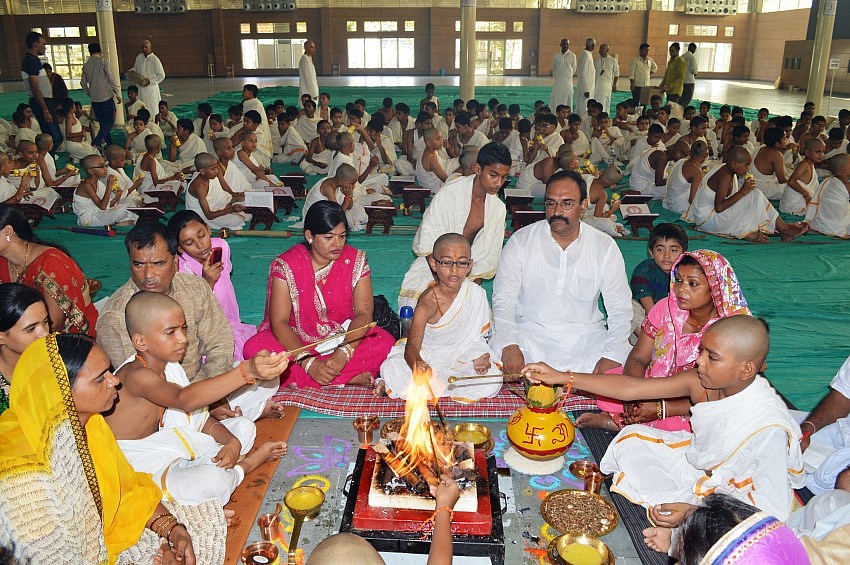
Acharyakulam has students from class 5 to 10 and imparts instruction on a wide variety of spiritual subjects, including the Vedas and the Upanishads. It also trains them how to conduct rites and rituals such as havans and yagnas. The students undergo a test before admission and the shortlisted candidates are given another test after spending a week in school.

Confirming that Ramdev’s plan is to establish one such school in every district, an official from school, who gave his name as Ajay Tripathi, said that Acharyakulam among the best schools in the country.

“The major difference between our school and other schools is that we lay equal focus on spiritual upbringing and teach students important values and scriptures,” he told Scroll on the phone. “We currently have 425 students who do yagnas, yoga regularly and attend their classes on subjects like Vedic literature, Vedic Mathematics etc.”

Baba Ramdev explained to the Economic Times last year that his schools will present an alternative view to the “conventional” discourse on subjects such as history by providing a perspective from the side of “justice”.

"Let me give you an example of a change we can effect in social science," he said. "Right now, what we are teaching our children are the leftovers of Western thought. In social science, we are taught man is a social animal. But what if we said man is the gift of God? He is the best creation of God. So, one school of thought views man as an animal and another sees him as a divine creation. We want to effect such a shift."


Students taking part in a ritual.

In its latest prospectus, Acharyakulam says that its teaching pattern is similar to the CBSE. Tripathi said that registration with the board is “in process”.

“We won’t need CBSE once this proposed board is established,” he said. “Our affiliation with CBSE though is still in process.”


Rakshabandhan celebrations at school

Acharyakulam's prospectus claims that children “generally” become enlightened by “one percent” every year. "But with the help of intellectual efforts we can develop this enlightenment physically, intellectually and spiritually by one to ten percent,” it says.

Strictly swadeshi and satvik

The prospectus notes that the school places a strong focus on keeping students away from “vices” such as non-vegetarian food. Only “sattvik” food is served to students.

Parents are not allowed to meet their wards except at a designated place in the school and that too only on alternate Sundays between 2 pm-6 pm. A 10-minute phone call is allowed to students every fortnight if they pay for it.

The rules also make it clear that students should not wear flashy clothing. “Dress sense should be based on Bharatiya Parampara, comfort, appropriateness & tastefulness of choice, rather than trends of fashion, desire for display or attracting unnecessary attention,” the rulebook states, adding that all items of general utility should be sourced from Indian manufacturers.


“We make a blend of eastern and western schools of thought,” the official said. “The students learn modernity through science,English and grammar but they also need to know about the glorious past and our ideals which are missing in Bharat’s leaders today.”

July 18, 2015

Truth vs Hype Exclusive: How Baba Ramdev, and a Proxy Hindutva Agenda, Have Entered IIT Delhi (Sreenivasan Jain)

ndtv.com

Truth vs Hype Exclusive: How Baba Ramdev, and a Proxy Hindutva Agenda, Have Entered IIT Delhi
All India | Sreenivasan Jain (with inputs from Manas Roshan) | Updated: July 18, 2015 22:21 IST

IIT JEE 2016 Preparation – 330 Hrs of Videos By Top IITians Free IITian mentor for Guidance

Truth vs Hype Exclusive: How Baba Ramdev, and a Proxy Hindutva Agenda, Have Entered IIT Delhi

Filr photo: Yoga Guru Baba Ramdev at IIT Delhi


The otherwise peaceful IIT Delhi campus has been in the news for the past several months over the exit of its Director, R K Shevgaonkar, over run-ins with the new government.

Now, there is a fresh twist to the allegations of political interference on its campus.

This has to do with the Unnat Bharat Yojana, a HRD Ministry scheme anchored by IIT Delhi which, according to its website claims to leverage the technical knowhow of institutions like IITs to help develop rural India.

But minutes of an initial meeting of Unnat Bharat held in January this year at IIT Delhi finds that the star guest was yoga guru Baba Ramdev.

Baba Ramdev, according to the minutes, was welcomed by Professor Shevgaonkar. Professor VK Vijay head of IIT Delhi's Centre for Rural Development and Technology claims Unnat Bharat was his brainchild, along with another IIT Professor Rajendra Prasad. He defended the choice of guest list.

He said the Baba Ramdev had come simply to understand what can be done to help rural India.

But given the nature of the gathering - the audience comprised, amongst others, of members of the RSS's tribal wing the Vanvasi Kalyan Ashram - the focus was less on exchange of innovative technology, and more on pet themes of Sangh Parivar, like the Indian cow.

In his comments, Ramdev said the IITs must study the genetic code of cows and bulls.

Startlingly, the minutes record that high ranking IIT officials present, like the Chairman of IIT's Board of Governors, Dr Vijay Bhatkar, also stuck to the same theme.

"Cow should be the instrument in finding all the solutions," said Dr Bhatkar at the meeting, adding that "cow based agriculture can bring revolution and its foundation could be Gaushala."

Though billed as an informal meeting, it was decided that the IIT Unnat Bharat group would partner professors with organisations which were either affiliated to the Sangh Parivar, or were quasi-religious: Professor P M V Subbarao with the RSS's Vanvasi Kalyan Ashram, Professor V K Vijay with Baba Ramdev's Patanjali Pith and Dr Vijay Bhatkar with the religious sect Gayatri Pariwar.

Further, several of the names of the collaborative agencies proposed for the IITs to work with followed the same bent: a Swami Sampoornanand, a Swami Muktanand, a Swami Rajdendra Das, and a Swami Vishudhanand. When asked what these individuals and organisations have to do with the area of rural development, or technology inputs, Professor Vijay said "these (organisations) are having their people connect, only we are looking there, if they are connected with the people and want to do something for rural technologies, assertive interventions, then only we will be considering."

The partnership has a monetary dimension. Each of the IITs are meant to fund Unnat Bharat with Rs. 20 lakh from their corpus. Will that money now flow to these Hindutva outfits and religious groups?

Professor Vijay claimed it would not but refused to explain details. Separately, the minutes record that Baba Ramdev offered a Rs. 200 crore donation to the scheme, which Professor Vijay claimed no knowledge of.

Officials in the HRD Ministry were unavailable for comment.

Sources close to Professor Shevgaonkar told NDTV that he was deeply uncomfortable after this conference, telling the organisers he does not understand what Unnat Bharat is.

He asked to be formally not to be part of the Unnat Bharat steering committee.

If the minutes of this early meeting are indicative, then Unnat Bharat seems far removed from the scientific engagement in the field for rural development that it purports to be, more as a proxy for backing, perhaps even funding of Hindutva organisations and agendas. There is the larger question of what it means to locate such an outfit in a premier science and research institution like IIT.

Professor Jagdeep Chokkhar, former IIT-ian and Founder, Association of Democratic Reforms said "it is absolutely strange that a particular type of individuals or organizations are associated or made the focus of a task assigned to an IIT of all places."

Story First Published: July 18, 2015 22:21 IST

July 01, 2015

The Indian Medical Association demands strict action against Ramdev


The Indian Medical Association demands strict action against Ramdev

Yoga guru Baba Ramdev

The Indian Medical Association has demanded strict and immediate action against yoga guru Baba Ramdev stating that his claims to cure heart diseases, diabetes and cancer were false.

“His claims are in violation of the Drugs and Magic Remedies (Objectionable Advertisement Act), 1954, which prohibits quackery. Baba Ramdev has a large fan following and though we appreciate his propagating yoga and its benefits, we will not allow anyone to make claims about helping cure cancer, diabetes and heart diseases,” said IMA joint secretary Dr. Anil Bansal.

“This is not the first time that we have complained against Baba Ramdev and his claims about offering cure. However, no action has been taken against him or his group so far. We now appeal to the Drug Controller of India and the Union Health Ministry to take action against Baba Ramdev,” added Dr. Bansal.

IMA has noted that Baba Ramdev’s action was in clear violation of the law.

“Baba Ramdev has advertised claiming to offer cure for several diseases including hypertension, arthritis and thyroid disorders. We are receiving a lot of complaints about the wrong treatment given by Baba Ramdev or his associates. A lot of people have suffered by taking his medicines. Diabetic patients have suffered a lot of complication by taking his treatment .Hypertension patients have suffered stroke because these patients had left their allopathic treatment and started taking Baba’s medicine in the hope of cure,” he added.

Chairman (Anti-Quackery Cell) Delhi Medical Association Dr. V.N. Sharma noted: “We have been asking the Government to take action but so far haven’t met with much success. The fact that the Western countries have refused to take ‘medicines’ made by the Baba Ramdev’s group should have been alarm bells enough for the Union Health Ministry to take action against what he is doing in his own country. Since Baba Ramdev has a large fan base, we need to urge the Government to take immediate action to ensure that more people don’t fall prey to his claims.”

Source : The Hindu

April 30, 2015

India: obscurantism peddler Ramdev in trouble for "son-guaranteeing'' medicine


Ramdev in trouble for "son-guaranteeing'' medicine
Anita Joshua

Uproar in the Rajya Sabha over a "son-guaranteeing'' medicine" being sold by the yoga guru's pharmacy

In the face of an uproar in the Rajya Sabha over a “son-guaranteeing'' medicine “being sold by yoga guru Baba Ramdev's pharmacy'', the Government on Friday agreed to look into the issue and see how the product was issued a license.

The matter was raised by Janata Dal (United) member K. C. Tyagi who wanted to know how a person selling such a product could be made brand ambassador of Haryana where the ‘Beti Bachao­Beti Padhao' scheme was launched.

Several members of the Opposition joined Mr. Tyagi in demanding an enquiry and action against the pharmacy. Jaya Bachchan (Samajwadi Party) said the medicine should be banned. Sitaram Yechury (Communist Party of India­ Marxist) said such a product not only promoted obscurantism but also went against scientific temper.

And, Ghulam Nabi Azad said the license of the product should be cancelled pending enquiry.

http://www.thehindu.com/news/national/action-sought-against-ramdev-for-songuaranteeing-medicine/article7157729.ece?utm_source=vuukle&utm_medium=referral#vuukle_div

April 13, 2015

BJP led Haryana govt to give cabinet minister status to the Yoga performer Baba Ramdev

Haryana govt to give cabinet minister status to Ramdev
PTI | Apr 13, 2015, 06.55 PM IST

Haryana government approves Rs 882 crore for 11,259 EWS flatsHaryana government to clear all staff related cases in 3 monthsLokayukta wants criminal cases in 10k cr tax scamHaryana orders FIR against firm for supplying fake mosquito repellentFour day Arogya fair kicks off in Chandigarh

CHANDIGARH: The Haryana government today decided to give "status equivalent to Cabinet Minister" to Ramdev, who has been appointed as the state's brand ambassador to promote yoga and ayurveda.

"Ramdev, Brand Ambassador for promotion of yoga and ayurveda in Haryana, will be given status equivalent to Cabinet Minister," Haryana's Health and Sports Minister, Anil Vij tweeted today.

Vij had earlier said a herbal forest would be developed in the state where plants of thousands of species of ayurvedic herbs would be grown under the supervision of Ramdev.
[. . .]
http://timesofindia.indiatimes.com/india/Haryana-govt-to-give-cabinet-minister-status-to-Ramdev/articleshow/46908764.cms

December 31, 2014

India: Khadi Bhandar to become Ramdev & Bros? - BJP supporter Baba Ramdev’s products may soon flood Khadi stores across India

The yoga guru’s institute has offered the Modi government help in reviving the recently-dissolved Khadi Commission.
Dhirendra K Jha
http://scroll.in/article/697973/BJP-supporter-Baba-Ramdev%E2%80%99s-products-may-soon-flood-Khadi-stores-across-India