Resources for all concerned with culture of authoritarianism in society, banalisation of communalism, (also chauvinism, parochialism and identity politics) rise of the far right in India (and with occasional information on other countries of South Asia and beyond)
First RSS ‘Army’ school from next April; Ist batch to have 160 students
School to follow Central Board of Secondary Education syllabus; prospectus ‘ready’.
By Kumar Anshuman|
Jul 29, 2019, 08.21 AM IST
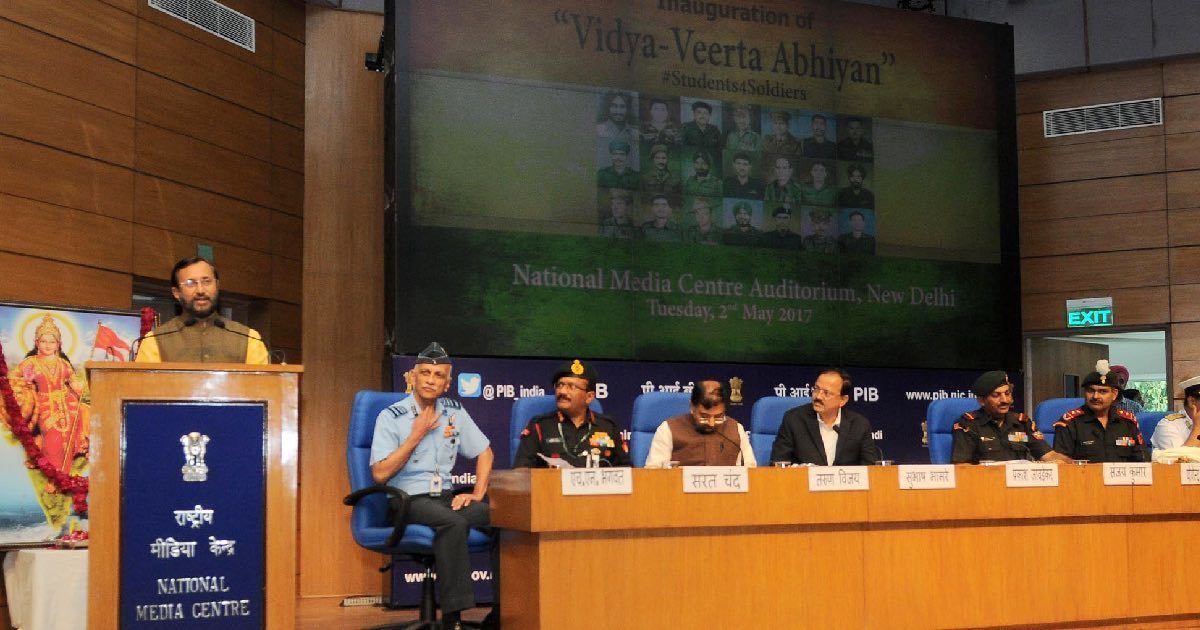
The RSS version of Bharat Mata made its way to a government event where senior military officers paid homage to it.
It would have been any other government function. The
launch of the Vidya Veerta Abhiyan by Human Resource Development
Minister Prakash Javadekar in the presence of Minister of State for
Defence Subhas Bhamre would not have made news in the normal course of
events.
Even the presence of Army Vice Chief Lt Gen Sarath
Chand along with Rear Admiral Krishen K Pandey and Air marshal HN
Bhagwat at a function to launch a programme to honour Indian soldiers
would not have caused any flutter.
The presence of Bharatiya
Janata Party politician and former Rashtriya Swayamsevak Sangh
pracharak Tarun Vijay at the function would also have been routine.
But there was a problem. Image credit: Manvender Vashist/ PTI
A different idea of India
The
Bharat Mata to which charan vandana – salutations at the feet – was
offered by the leaders of our armed forces at this function was no
ordinary Bharat Mata. For this Bharat Mata, resting on a lion and
holding a saffron flag against the backdrop of a map of India, is the
RSS version of Bharat Mata. The map she spreads over is also not the
usual, ordinary map of India. One can sense that this is the map of
Vrihhtattar Bharat, greater India which extends far beyond the
internationally recognised boundaries of what is known as India.
This
Bharat Mata is not a Hindu deity. Nor a religious figure. She is a
creation of the expansionist ideology of Hindutva which exhorts the
Hindus to realise the dream of Vrihhttar Bharat Varsh. The idea is to
keep the concept of Akhand Bharat, Undivided India, alive in the Hindu
minds, filling them with an inferiority complex and a sense of injustice
that they have to live with a truncated India. And, of course, Muslims
are held responsible for taking away Pakistan (and Bangladesh) from
Akhand Bharat. This image is also aimed to keep an anti-Pakistan rage
alive in India. Hindus have to prove their worth before this mother
figure by restoring her integrity. This remains an ever unfinished task.
This
image of Bharat Mata been discussed a lot in the last two years after
the call by the chief of the RSS, the parent body of the BJP, to teach
every Indian child to chant Bharat Mata Ki jai. [History Lesson: How ‘Bharat Mata’ became the code word for a theocratic Hindu state]
As we know from the century long debate on this issue,
this image of Bharat Mata is used to arouse hatred against Muslims and
is closely associated with the narrative of Anand Math of Bankim Chandra
Chattopadhyaya. Muslims are shown as villains in this novel, and their
ethnic cleansing is celebrated.
The Sanyasins in the novel seek
strength from goddess Durga by singing Vande Mataram in her praise. And
what do they seek strength for? To cleanse their mother land of the evil
presence of the Mlecchas, who are none other than Muslims. They also
welcome the British who would help them overpower Muslims.
From modesty to militarism
After the charan vandana, in the May 2 programme, Vande Mataram was sung in full, The Telegraph
reports, including the references to the goddess Durga. Only the first
two stanzas of Bankim Chandra Chattopadhyay’s poem have been adopted as
the country’s national song – these contain no references to any Hindu
god or goddess.
Questions definitely need to be raised about
ministers and government servants participating in a ceremony that
violates Constitutional propriety. There definitely is a reason why only
the first two stanzas of the song were declared the national song.
There was certainly no compulsion for the leaders of our armed forces to
be part of this highly questionable act of ideological symbolism. They
need to be reminded that in this highly divided country, it is still the
army that is sought and trusted by hapless minorities in the worst
times of violence against them. The partisan complicity of the police
forces has often made them seek the protection of the army. But if the
leaders and members of the armed forces start aligning with the ideology
of the RSS, who would the people turn to?
Parents,teachers and
teachers also need to think about the coupling of Vidya with Veerta –
education with bravery. In the Indian ethos, knowledge is supposed to
lead to modesty. Replacing Vinayam with Veerta is not an innocent act.
It is part of the militarist nationalist discourse that the ruling
party, with the support of its parent body, is busy promoting for the
last three years, in which a benign Bharat Mata has been transformed
into a militant goddess. Abanindranath Tagore/ ‘Banga Mata’ water colour that he later decided to title 'Bharat Mata'. 1905.Last
year, it was proposed by some retired militarymen that tanks should be
installed at the centre of so-called anti-national campuses like the
Jawaharlal Nehru University. Then came the infantile order of hoisting
giant sized national flags – all 46 centrally-funded universities were
asked to install flag masts 207 feet tall to hoist the tricolour at a
time when it was struggling to contain the largest nationwide student
protests in a quarter of a century. But clearly that was not enough.
The campuses are still, apparently, suffering from
nationalist-deficiency.
To cure them of this lack, Tarun Vijay,
who has a special sense of entitlement over Bharat, where he also allows
“black south Indians” to live, mooted an idea of having a “Wall of
Heroes” on university and college campuses which would display the
portraits of all the 21 Param Vir Chakra winners, recipients of India’s
highest gallantry award.
We learn that the vice chancellor of the
University of Delhi, the Director of the Indian Institute of Technology,
Delhi, the rector of the JNU and the vice chancellor of the Central
University of Kerala received portraits of these awardees from the
minister. It is now incumbent on them to erect this wall of patriotism
on their campuses. The minister has made it clear that the government
would not be funding this patriotic drive – he wants teachers and
students to contribute voluntarily towards this nationalist cause. Would
our vice chancellors now issue circulars announcing deduction a day’s
salary of their employees at the source itself – and levy patriotic
surcharges on the students’ fees?
That our brave and decorated
soldiers should be used to further and promote the narrow nationalist
politics of the ruling party should be a matter of shame – and concern.
More shameful and alarming is the consensual participation of the top
leadership of the armed forces in these rituals. The abject surrender of
the leaders of the institutions of higher education before this
militarism is even more worrisome. Apoorvanand is a professor of Hindi at the University of Delhi.
On Christmas day it happened. Retired veterans of the Indian
army—ex-army chief General NC Vij, former IAF vice chief Air Marshal
BhushanGokhale and Lt General Syed Ata Hasnain—shared the dais with
Rashtriya Swayamsevak Sangh (RSS) head Mohan Bhagwat and a host of seers
at the Dharma Sanskruti Mahakumbh. The event included the delivery of fiery speeches on Hindutva.
Hindutva, for those who may confuse it with the eclectic faith of
Hinduism, is the ideology that is straining to convert India into a
theocratic Indian state.
The issue of the communalization of the Indian army has always come into focus when an RSS-driven National Democratic Alliance (NDA) government has ruled the center.
In
an interesting, if unsavoury, development, the Times of India reported
on December 26 that it is Hindu religious heads who epitomize the
fountainhead of India’s nationhood, a claim that is tinged with Hindu
supremacy. "Do you know who is with the soldiers guarding the Siachen
glacier — the Naga Sadhus. Both soldiers and sadhus lead a strict life
in service of the nation and hence should get equal respect," said
Amravati-based Jitendra Maharaj, whose devotees include alleged conmen
Prashant Wasankar, Sameer Joshi and others now behind the bars for
running Ponzi schemes. The discourse pushed the envelope further.
Denigrating Mughal rule as ‘Muslim’ rule, the RSS chief, Mohan Bhagwat,
said that in the last 1000 years, "the people of this country did not
get a chance to rule, when that should have been the case in a
democracy." [. . .]
No institution, including Army, immune to Hindutva subversion:
Press Trust of India | New Delhi October 13, 2016
Alleging that BJP was exploiting surgical strikes by the Army for electoral gains in Uttar Pradesh, CPI(M) today said no institution in the country, including the armed forces, is "immune" to the Hindutva "subversion" under the NDA government.
Referring to Prime Minister Narendra Modi's speech at a Dussehra event in Lucknow, the Left party said the message was "clear" that BJP will fight the Uttar Pradesh Assembly polls by "mixing" religion with politics.
RSS chief Mohan Bhagwat's remark that "lawful" cow protectors should not be compared with those creating trouble was a "clear" signal that the right-wing outfits will continue their violence on the pretext of beef consumption and cow slaughter, it claimed.
"The warning bells are loud and clear. Under the BJP-RSS dispensation, no institution of the State, including the armed forces, are immune to the Hindutva subversion. This should be a matter of serious concern for every citizen.
"All those who wish to protect the secular, democratic character of the Republic should raise their voice to tell BJP and RSS to keep their hands off the armed forces," former CPI(M) general secretary Prakash Karat said.
He made the remarks in the editorial of forthcoming issue of party mouthpiece 'People's Democracy'.
The Prime Minister broke with the tradition and addressed a Dussehra event in the poll-bound state. The "obvious motive" behind it is making political gains in view of the Uttar Pradesh Assembly polls due next year, Karat said.
"Modi utilised the festival to lace his political message in a religious idiom. He started his speech with 'Jai Shri Ram' and talked of fighting terrorism using analogies from the Ramayana. The message was clear -- the electoral battle in Uttar Pradesh will be fought by mixing religion with politics and on a strident communal agenda," he said.
Reacting to Defence Minister Manohar Parrikar's remark that Indian troops were like Hanuman who did not quite know their prowess before the strikes, the Marxist leader said such "crass casteist and religious imagery to describe the Army's role is a dangerous stuff which will corrode secular basis of the armed forces".
(This story has not been edited by Business Standard staff and is auto-generated from a syndicated feed.)
USUALLY, Vijayadashami day has seen two addresses by the Hindutva forces – one by the RSS chief in Nagpur and the other by the Shiv Sena chief in Mumbai. This year there was a third pole – the speech by Prime Minister Narendra Modi at a Ramleela gathering in Lucknow. This is what has made the politics associated with Dussehra distinctive this year.
Both the RSS chief Mohan Bhagwat and the Shiv Sena president Uddhav Thackeray lauded Modi for the “surgical strikes” across the Line of Control. This was an acknowledgement of the elevated stature that Modi has acquired in the Hindutva camp.
The RSS chief spoke on expected lines. He defended the “gau rakshaks”, who are an RSS creation, as doing a good job of protecting the cow as ordained by the law. He warned the administration that they must keep this in mind. According to him, those who break the law are not “gau rakshaks”. Thus he dismissed the terror unleashed by the cow vigilantes against the Muslims and the dalits. Such a pronouncement from the RSS chief , after the series of lynch mob attacks in Uttar Pradesh, Jharkhand, Gujarat and other places, was a clear signal that the RSS outfits will continue their violence and intimidation against Muslims and dalits on the pretext of cow slaughter and eating beef.
As for Narendra Modi’s foray into Lucknow, the obvious motive is the forthcoming assembly elections in Uttar Pradesh. Modi utilised the religious festival to lace his political message in a religious idiom. He started his speech with “Jai Shri Ram” and talked of fighting terrorism using analogies from the Ramayana. The message was clear – the electoral battle in Uttar Pradesh would be fought by mixing religion with politics and on a strident communal agenda. The army’s “surgical strikes” have already become an election propaganda point for the BJP in Uttar Pradesh.
What is truly disturbing is the use of the army for the BJP’s narrow partisan ends. In Rajasthan, the chief minister Vasundhara Raje attended a religious ceremony, “Rashtra Raksha Yajna”, at the Shri Mateshwari Tanot Rai temple to “protect the troops from the enemy” organised by the Rajasthan Sanskrit Academy. The Yagna was performed by 21 “patriotic Brahmins” on October 6. According to the Sanskrit Academy chairperson, Jaya Dave, “Earlier too, when kshatriyas fought wars, Brahmins performed such ceremonies to protect them”. Earlier, the defence minister Manohar Parrikar had stated that “Indian troops were like Hanuman who did not quite know their prowess before the surgical strikes”. Thus, the government itself is projecting the armed forces in Hindutva terms and using crass casteist and religious imagery to describe their role. This is dangerous stuff which will corrode the integrity and the secular basis of the armed forces.
The warning bells are loud and clear. Under the BJP-RSS dispensation, no institution of the State, including the armed forces, are immune from the Hindutva subversion. This should be a matter of serious concern for every citizen of the country. All those who wish to protect the secular democratic character of the Republic should raise their voice to tell the BJP and RSS – “Hands off the armed forces”.
After the Kargil war in 1999, the brass had opposed attempts by the Sangh parivar to use the army for political purposes.
BJP election poster in Muzaffarnagar. Credit: Twitter
With Prime Minister Narendra Modi’s personal decision not to publicly
release video proof of the September 28 ‘surgical strikes’ across the
Line of Control (LoC), the Pakistan Army has been allowed to save face
and a route left open for de-escalating the on-going Indo-Pakistan
confrontation, with India having had the last word.
In contrast to the army’s measured tone towards Pakistan – with
Indian generals informing their Rawalpindi counterparts that “We don’t
have a plan to further conduct such strikes”– the Bharatiya Janata Party
(BJP) is assiduously milking the military’s success in on-going
electoral campaigns in Uttar Pradesh, Uttarakhand, Punjab, Goa and
Manipur.
The BJP’s election posters in UP have military imagery in the
background, with an armed soldier and a reference to the ‘surgical
strikes’. In the foreground stands Modi, clenched fist upraised,
threatening Pakistan. Neither the army chief, nor army headquarters has
yet objected.
The traditionally apolitical army had taken a more principled stand
after the victorious Kargil campaign in 1999, when politicians similarly
tried to piggyback on the military’s success. Then army chief, General
V.P. Malik, in his book, Kargil: From Surprise to Victory,
reveals he complained to former prime minister, Atal Bihari Vajpayee,
about National Democratic Alliance (NDA) election posters that featured
the three military chiefs. Vajpayee ensured it did not happen again.
Malik also describes “a large band of Vishwa Hindu Parishad (VHP)
representatives” descending upon army HQ on August 23, 1999, carrying
party and religious symbols and 20,000 rakhis for the troops in Kargil.
“They had brought along half-a-dozen photographers and insisted on
meeting the Army chief [me]. When they were refused permission, they
forced their way into the media cell offices and handed over the rakhis
to the staff, making sure that the TV cameras caught all the action.
From the next day onwards, entry into [army HQ] was further restricted”,
writes Malik.
In a paragraph that resonates today, Malik says: “The armed forces
were anguished because they were getting sucked into electoral politics
as a result of the blatant effort to politicise the war for immediate
electoral advantage. At one stage, in desperation, I had to send across a
strong message through the media: ‘Leave us alone; we are apolitical’.”
The current army chief has not trodden this principled path. For now,
the army is understandably happy that the BJP government’s
pro-activeness allowed it to turn the humiliation of losing 18 soldiers
in the Uri attack on September 18 into the cross-LoC success just
eleven days later.
It is unclear how long this confluence of interests will continue,
since the BJP is not content with the spotlight focused on the army. The
government wants the lion’s share of the credit for having shown
Pakistan its place.
This was evident a day after the ‘surgical strikes’, when defence
minister, Manohar Parrikar, electioneering in Uttarakhand, compared the
army with the mythological monkey-God, Hanuman, in needing to be
reminded of its powers. “I only made the army aware of the powers it
already possessed and it succeeded. On Modiji’s instructions, the army
did a brilliant job”, he said.
On Friday, Amit Shah demonstrated how the BJP is associating its
image with that of the army, while putting Modi front-and-centre in
claiming credit. He stated: “the achievement is the army’s, but the
determination and political intent is Prime Minister Modi’s.”
Shah is unapologetic about using the ‘surgical strikes’ as an
electoral issue, stating: “We will go to the people with this issue —
because every responsible party should motivate the army.”
The government and the BJP are also using the army to deflect any
criticism, whether political or strategic. Whenever asked to release
video evidence of the strikes, or to brief prominent political leaders,
BJP spokespersons have argued forcefully that “questioning our brave
soldiers” amounts to anti-nationalism; and, indeed, acting as a front
for Pakistan’s Inter-Services Intelligence (ISI).
With every major political party calculating that it would be
politically suicidal to question an army that is riding high on public
popularity, there is little penetrative interrogation of the NDA’s
handling of the issue. By arrangement with Business Standard
Drawing on the news reporting of the army's association with Ramdev's organisation for yoga training, a discussion on the potential and possibility of politicisation of the military with Hindutva philosophy.
In January 2016, 250 army men of the Western Command attended the Yoga Teacher’s Training Course organised by Ramdev’s Patanjali Yogpeeth in Haridwar. They are the first lot of 1,000 yoga trainers who are then to return to barracks and conduct yoga for troops (Times of India 2016). That the media finds this association between the army and Ramdev’s outfit newsworthy suggests the link needs further query.
The aim ostensibly is to de-stress the army in cantonments in the Western Command’s peace stations, before they return for yet another tour of duty in some counter-insurgency area or high-altitude picket.
Superficially, this is for the good insofar as physical and mental fitness goes. The army has figured in the news earlier for the wrong reasons: soldier suicides, fratricide and affrays between officers and men. Among the enabling conditions for such avoidable incidents is stress. Yoga is meant to mitigate such stress.
Yoga caught on in the military long before the three chiefs, along with a brigade of Delhi-based troops, lined up behind the Prime Minister on the Rajpath for yoga in June 2015. It has been in practice for about a decade, with the army turning its attention to the psychological scars of countering insurgency, once the situation in Kashmir started stabilising in the middle of the last decade. The Art of Living had also made an advent at about the same time for similar reasons.
The Underside
The problem is not so much yoga as much as the army’s institutional association with Ramdev’s organisation. Ramdev is controversial, with his business deals having come in for investigative scrutiny. The premises in Haridwar where the army men spent a couple of weeks had hosted a convention for the Rashtriya Swayamsevak Sangh in 2014 (Trivedi 2014). Ramdev is a known cheerleader for Prime Minister Narendra Modi.
Such proximity is not without an underside. Yoga is enwrapped in a cultural context. Cultural transmission can be expected, such as of ritual, intonations and interpretation of Sanskritic texts. Since the programme requires residence on campus, dietary mores and ashram routine would also be conduits.
A right-wing associated organisation is not about to pass up an opportunity for influencing the army with its world view. Even if tacit, the exposure of 1,000 troops this training year, and perhaps more to follow in subsequent years, will enable the opening of a window for the penetration of the right-wing perspective into the army.
This raises the question as to why this apprehension escaped the army’s exercise of due diligence in going about its yoga training programme. I suggest that the impetus is from both directions. While it can be expected that right-wing organisations are interested in the military, counter-intuitively, it appears that the military is not averse to such attention.
With the growing grip of Hindutva forces across polity and in society, the army should be alert to the possibility that it cannot escape attention—such as that received by the education sector. This should have made it defensive, if not prickly, so as to reduce the politicisation and the corresponding effect on professionalism that the penetration of cultural nationalism entails. Its yoga programme does not suggest that it is mindful of the otherwise obvious dangers. Since these are easy to apprehend, a plausible inference is that the army is courting Hindutva. Since it takes two to tango, are there elements within the military opening the door wider?
An illustration is the appearance of articles on Vedic leadership in military publications, specifically in the journal Infantry and on the website of the army think tank, the Centre for Land Warfare Studies (CLAWS) (Agnihotri 2016). Another illustration is that of a book on leadership, brought out in the 1990s by the Army’s Training Command, which quotes the controversial godman Sathya Sai Baba on leadership philosophy (Nath 2001).
Is this politicisation underway? This is not politicisation in the usual sense of the term, a convergence of institutional and political interest of the military leading to its displacing of the government, as has happened in Pakistan. This is better described as the incidence of subjective civilian control in which the civilian ruling dispensation connects with the military by ensuring that the military shares its world view—in this case, that of Hindutva—such as is the case in communist states.
On the other hand, against this is objective civilian control in which the military is rendered politically inert by being left to its professional devices. The difference between the two is that, where objective civilian control is exercised, the military is not a political player. Where the military is under subjective civilian control, the military is kept out of politics because, in subscribing to the dominant perspective, it does not feel the need to intervene.
A ‘Reset’ of India
Such a move by Hindutva forces can be expected. Once they go about their “reset” of India in right earnest, they would prefer to keep the military to its professional moorings. Whereas the mechanism of objective civilian control is available to this end, the ambitious Hindutva agenda for India forces a preference for a tighter embrace of the military. This will ensure, first, that it can be kept out by decree and does not feel the need to intervene, and, second, that it can be made to weigh in on the side of Hindutva, in the case that Hindutva forces find the going tough in the long run.
In light of the Indian military’s apolitical record, it can be argued that such apprehensions of convergence of interest are outlandish. This is true insofar as the military’s interest, unlike that of its peer militaries in developing states, was never in a takeover of the state. This would continue to be so. The difference this time round is that the military will increasingly subscribe to the world view of the regime in power.
This is not troubling insofar as the paradigm is a conservative-realist one that militaries, universally, subscribe to. However, the makeover of India in the image of majoritarian nationalism is unlikely to remain a political and democratic exercise. Aware of this, Hindutva forces would like a placid military when they contrive to remain in power and their agenda goes beyond governance.
On this count, the army’s association with Ramdev is only superficially innocent, to do only with yoga. The army is not so politically innocent as to be unaware of the upfront social and political changes going on in India. Its choice of Ramdev suggests that it needs watching, as much as the moves of the Hindutva combine to influence it do.
The
trend now has an eerie similarity to what happened in Pakistan, where
the army (and religion) play a potent and central role in politics.
Ex-servicemen
and students pay homage to soldiers of the Indian Army and victims of
the Parliament attack at a meeting organised by ABVP on the JNU campus
in New Delhi on Wednesday. Credit: PTI Photo by Vijay Verma
New Delhi: For the first time in India’s history,
armed forces personnel – so far only retired officers, of course – are
coming out to speak and hold demonstrations, and prescribe what is right
and what is wrong in a democracy, what ought to be done and what ought
not in universities, in public action and behaviour.
This coincides with a raging debate over nationalism and patriotism,
over religious and caste identities, with the Sangh parivar and BJP
seeking to redefine these terms and taking recourse to national symbols –
on nearly every issue that confronts them.
In what has now become an established – and disturbing – pattern,
the BJP and its kindred organisations routinely invoke the armed forces
to score political points against their opponents.
The Indian armed forces have remained resolutely apolitical and
secular and have been the strength of India and defenders of its
constitutional democracy, unlike what happened in Pakistan. The trend
has an eerie similarity to what happened in Pakistan, where the army
(and religion) play a potent and central role in politics.
The same tactic is now being resorted to in the Sangh parivar’s
attempt to clamp down on universities. On February 24, the BJP’s student
wing, the ABVP, invited former army officers to an event called “An
evening in memory of the martyrs” on the JNU campus. The army veterans
had strong words against the freedom of speech if it meant jeopardising
India’s sovereignty. At the meet, ex-servicemen contrasted the
sacrifices made by soldiers to protect India’s geographical integrity
with the calls for the dismemberment of the country allegedly made by
unidentified slogan shouters on campus on February 9.
The ex-servicemen’s anger was understandable but it also reflects the
gulf between their understanding of the role of a university and that
of the students.
If students in a university invite some people to try and understand
their point of view – and the invitees raise slogans – the students, who
have asserted their Indian-ness in that meeting, can be arrested for
the views supposedly (according to video clips) expressed by those
attending. While no Indian, including any of those in JNU charged with
sedition, supports India’s dismemberment, doctored videos portraying
them as backing anti-national forces have obtained traction among the
ultra-nationalists – and ex-servicemen seem to have followed
unthinkingly.
Major General GD Bakshi (retd), criticising US ambassador Richard Verma for saying that free speech was the essence of democracy,
said, “Today the American ambassador is trying to teach us about
democracy and nationalism. What is nationalism – it’s the people and the
territory. We are Indians and we are proud of it. You can’t remove
Kashmiri Pandits from their homes and take away our land.” He was
talking about the alleged slogans raised for Kashmir’s independence from
India at JNU.
Major General RK Malhotra (retd) denounced all anti-national acts and
wondered what he could tell the families, widows and orphans of
martyred soldiers when anti-India slogans were raised in universities.
Disclosing why he thought the pro-Afzal Guru event had been organised in
JNU, he said, “Why was February 9 chosen? Because Make in India was
happening and international participants were present in the country.
This is an orchestrated event. Such slogans are never made randomly.” He
also said that terrorism took birth in ideologies, not from guns.
“Freedom of expression is fine, but not at the cost of India’s
sovereignty.”
In its endeavour to set up nationalism as the touchstone for any
intellectual discourse in universities on concepts of nationalism,
self-determination, etc, the BJP government, as a beginning, has
already decreed that the national flag be hoisted in university campuses to instil a feeling of nationalism among the students. Now,
the idea suggested is to station a battle tank in JNU to instil
patriotism and a feeling of pride in the soldiers who have been
killed defending the nation. This suggestion comes in the wake of
several days of protests at the university by teachers and students
alike decrying the police action against some JNU scholars.
Earlier, ex-servicemen participated in a march from Raj Ghat to
Jantar Mantar in Delhi on Sunday, February 21 against what they termed
‘anti-national’ activities in Jawaharlal Nehru University. Several BJP
and RSS workers also participated in the march, which was held under the
banner of ‘Save the Nation’.
The ABVP is only following in the BJP’s footsteps. The BJP has been
talking about the armed forces, their valour and their sacrifices in
defending the country’s borders with disturbing regularity – nearly
every time in its statements and official briefings at BJP HQ. The most
recent was the one on February 23, 2016, while attacking those agitating
for freedom of expression.
These themes are also broadcast far and wide on social media and,
more significantly, on WhatsApp, thereby using the deep penetration of
the mobile phone network in the country to reach out to a large number
of citizens. Retired persons, housewives, salesmen, random persons on
the street, and ex-servicemen, all chime in to start prescribing what
should be taught in political science, history and sociology. These
ideas are circulated all over simply by recipients unthinkingly,
irresponsibly forwarding such messages to everyone possible. All out of a
sense of duty for the nation, especially since it does not take more
effort than touching a button.
Veterans of the Indian armed forces are often invited by news
channels for their views and expert opinions on issues relating to
security, defence and other matters concerning the services such as One
Rank One Pension (OROP). But to have former soldiers talk about academic
matters seems jarring and unwarranted, students and teachers say.
‘No “Jai Hind”, salute by saying “Ram, Ram” and “Jai Mata Di”.
Commandant Officer orders the Army Muslim priest.
Wife of the priest complains to Minority Commission. Alleges mental torture
By Saleem Siddiqui
New Delhi (SNB): ‘The task of army’s religious teacher is to enthuse the spirit of patriotism, zeal and unity in the jawans [lads] while the slogan of “Jai Hind” [Long live India] sends a message of religious hatred and extremism. If you do not rise above narrow-mindedness and do not salute by shouting “Ram, Ram” and “Jai Mata di” [slogans invoking Hindu deities], as per the rules of the battalion disciplinary action will be taken against you’. This notice has been issued by a high ranking army officer to Subedar Ishrat Ali who has been serving in the army for the last 22 years as a Maulvi [Muslim priest].Rajputana Rifles contingent
Subedar Ishrat Ali’s wife has filed a written complaint with National Minority Commission urging it to help her husband in getting rid of the discriminatory attitude of the officers.
In a letter sent to National Minority Commission, Shehnaz Bano, the wife of Subedar Ishrat Ali, transferred from Raj Rif Centre Delhi to Rajputana Rifles (3 Raj Rif bikaneer), has alleged that her husband is being continually subjected to mental torture. According to her Ishrat Ali’s Commandant Officer Chitra Sen says that as long as he is in his regiment he will have to follow its rules and will not be allowed to salute with the slogan of ‘Jai Hind’ but, instead, will have to salute his superiors by saying ‘Ram, Ram’ and ‘Jai Mata di’.
Shehnaz Bano quotes her husband as saying that during his 22 years’ service he had always saluted with the slogan ‘Jai Hind’ and as a Muslim it is impossible for him to utter ‘Ram, Ram’ or ‘Jai Mata di’. Because of this her husband has been served an official notice.
The notice issued on 31 August and signed by Major Lalit Shering reads, ‘Your commanding officer has ordered you not to utter ‘Jai Hind’ as long as you are in this battalion. The C.O. had directed you to salute by saying ‘Jai Hind’ when you are outside the battalion but while within the battalion, following its rules you will have to address your superiors by saying ‘Ram, Ram’ and “Jai Mata di.” In this connection a copy of a letter, No B/42120/AG/CW-1, dated 25 September 2012, received from the Military Headquarter that outlines the rules of saluting a superior, is being sent to you for your information.’
The notice further adds, ‘You are a religious teacher and your job is to enthuse patriotism, zeal and spirit of unity in the jawans [lads]. Your action [the utterance of Jai Hind] does not only send a message of religious hatred and extremism but also reflects upon your lack of knowledge; and that will not be tolerated. You are advised to rise above narrow-mindedness and work to enthuse in the jawans the spirit of patriotism, zeal and unity otherwise disciplinary action will have to be taken against you.’
According to Shehnaz Bano her husband under compulsion has to salute his superiors by saying ‘Ram, Ram’ and because of that not him alone but the whole family is suffering from mental tension.
She said that Col. Chitra Sen has also tarnished her husband’s ACR and asked him to sign it. When her husband asked to give him the reason of doing so, the Col. got it signed by other three officers (Adjutant, Subedar Major and Subedar Adjutant) as witnesses testifying that Subedar Ishrat Ali had refused to sign.
Shehnaz Bano says that on 25 August when her husband complained about it to the Commander of Infantry Brigade, on 17 August, Col. Chitra Sen issued him a notice saying that, ‘Since you have refused to sign therefore disciplinary action will be taken against you under section 27. You are asked to reply by 4 September.’
According to Shehnaz Bano her husband has replied by saying that he had not refused to sign but had requested to be explained the reason of it and had requested to be interviewed by the Brigadier Commander. Col. Chitra Sen has assured that ACR will be rectified.
Informing the National Minority Commission about an earlier discriminatory action against her husband, Shenaz Bano has also alleged that as per his seniority he was due to be sent to Sudan but a junior was assigned the job instead. ‘My husband wrote a letter of complaint to the Commander in Chief. After this complaint my husband was sent to Sudan with 8 Raj Rif but because of this complaint a grudge was held against him and transfer orders were sent to him while he was in Sudan.’
Shehnaz Bano says that her husband has left two more years in service because of that he had requested to be left posted in the Centre. I suffer from heart condition and am being treated at the Base Hospital and [as proofs] medical certificate have also been submitted. ‘In addition, two of our daughters are studying at Delhi University but Commandant Saheb disapproved all of the reasons and my husband was transferred to 3 Raj Rif, Bikaner, Rajasthan, where 187 MH Military Hospital does not have the facility of cardiology. Because of these reasons I cannot go to live with my husband there.’
She added, ‘After this we were ordered to vacate quarter No P13/8, Ichamati Line, Raj Rif Centre, Delhi that compelled us to seek the help of the Supreme Court where our petition against vacation orders and ignoring all of the documents submitted by us, will be heard on 12 September.’
Translated from Rashtriya Sahara, 10 September 2014, by Urdu Media Monitor.Com
Soldiers of the Party
A resurgent BJP reiterates its traditional appeal for the armyman.
Written by Christophe Jaffrelot
The Hindu nationalist movement’s appeal for security experts and armymen stems from the sense of vulnerability generated by Pakistan-backed Islamist terrorist attacks and Chinese expansionism. The Hindu nationalist movement’s appeal for security experts and armymen stems from the sense of vulnerability generated by Pakistan-backed Islamist terrorist attacks and Chinese expansionism.
Earlier this month, the former chief of the Indian army, General V. K. Singh, joined the BJP, less than two years after retiring. It was an unprecedented move. None of his predecessors had ever joined politics in such a manner. But this first occurred in a specific context and as the culminating point of a series of events.
Over the last few years, ex-servicemen have taken public stands more often than before — usually against the UPA government, overtly or covertly. The first controversy crystallised around the Armed Forces (Special Powers) Act (AFSPA), which had been denounced by human rights organisations as the root cause of abuses by the military in Jammu and Kashmir and the Northeast (especially Manipur), because of the impunity it granted to the army and paramilitary. The UPA government appointed the Jeevan Reddy committee in 2005, to review the working of the AFSPA. Prime Minister Manmohan Singh had then claimed that he would show zero tolerance for human rights abuses. But P. Chidambaram, as Union home minister, said the “army had taken a strong stand against any dilution” of the law. The AFSPA has not been repealed or amended, suggesting that the military has prevailed.
Last September came the The Indian Express’s revelations of an army probe report on the functioning of the Technical Services Division (TSD), a military intelligence unit set up in 2010 by the then army chief, V.K. Singh. It had allegedly attempted to topple the J&K government and spied on politicians and ministry of defence officials.
The same General Singh had been in the news for a tussle over his date of birth. He had even appealed to the Supreme Court to delay his mandatory retirement for one year, on the grounds that the date in the army records was wrong. He lost the case and retired in May 2012. But in January 2012, the manœuvres that two army units had carried out near Delhi had touched off unprecedented alarm in the MoD.
Last but not least, the letter that V.K. Singh had sent to the prime minister, denouncing government delays in the procurement process, made its way into the public domain. As a result of the alleged hindrances to the modernisation of the army, V.K. Singh declared in his letter, the Indian army was now “unfit for war”. He reiterated these criticisms in Courage and Conviction: An Autobiography, the book he published after retiring, along with charges of corruption against the UPA.
Through these controversies, the BJP has taken the army’s side. The party expressed strong reservations about any dilution of the AFSPA in J&K or Manipur. In September 2013, party president Rajnath Singh, speaking on the sidelines of a function in Bihar, said: “The Congress-led UPA government is troubling eminent personalities who want to join the BJP”. V.K. Singh had not joined the party then, but he had just shared the stage with Narendra Modi at an ex-serviceman rally in Rewari, while officially supporting another ex-serviceman, Anna Hazare. But Colonel Rajywardhan Singh Rathore, the shooter who had won a silver medal at the Athens Olympics, had already resigned from the army to join the BJP.
The Hindu nationalist movement has had a long association with the army. It goes back to V.D. Savarkar, author of Hindutva: Who is a Hindu? who supported initiatives such as the Nasik-based Bhonsala Military School of B.S. Moonje and requested Hindus to join the British army during World War II, to learn how to use modern weapons and “militarise Hindudom”. Among those who followed his advice was N.D. Apte, accused in the Mahatma Gandhi murder conspiracy along with Nathuram Godse.
Yet the Savarkarite tradition was subdued for decades, until the revelations of the FIR drafted by Hemant Karkare in the 2008 Malegaon case. This FIR resulted in the chargesheeting of an army man, Lieutenant Colonel Purohit and of an ex-army man, Ramesh Upadhyay, who had once headed the ex-servicemen cell of the BJP in Mumbai. The cell had first gained momentum in the 1990s, when the BJP was on the rise. The party attracted a large number of former senior officers, including two heroes of the 1971 war, Lieutenant General K.P. Candeth and Lieutenant General J.F.R. Jacob, as well as Major General B.C. Khanduri, who became an MP in 1991, a minister in the Atal Bihari Vajpayee government and chief minister of Uttarakhand in 2007. They were in the company of ex-armymen such as Jaswant Singh and Jagatveer Singh Drona, who became the RSS sanghchalak of Kanpur and an MP in 1990.
The BJP is rising to power once again and its ex-servicemen cell is gaining momentum, as is evident from its many activities, including “Kargil Diwas”. What is new is the Sangh Parivar receiving support from former officers who are associated with official institutions. The Centre for Land Warfare Studies (CLAWS), based in the Delhi cantonment is a case in point. In January, its director, Major General Dhruv C. Katoch, wrote an article entitled “Combating Left Wing Extremism” in the RSS weekly, The Organiser, criticising the UPA government’s approach to the Maoist threat. Another member of the CLAWS, Alok Bansal, published an article in The Organiser on “the perils of wahabisation” in J&K.
The Hindu nationalist movement’s appeal for security experts and army men stems from the sense of vulnerability generated by Pakistan-backed Islamist terrorist attacks and Chinese expansionism. But it has also to do with frustration over the neglect of the army by successive governments. Arms procurements have been delayed, submarine mishaps (including the one which led the navy chief to resign last month) have become more numerous and the recruitment crisis has not been addressed, as is evident from the growing deficit of officers. Military analyst Bharat Karnad, in an article entitled “Politicising an apolitical military” (September 24, 2013) felt: “The fact is, India could do with many more Khanduris and Bhagwats [a reference to the involvement of Admiral Vishnu Bhagwat in Bihar politics] at the Central level, and more ESM [ex-servicemen] at the state, town and village government levels, who, by dint of character and inflexible values, begin cleansing the system and righting the ship of state that is beginning to take a lot of water”.
But the proponents of change (“cleansing”, as an otherwise moderate Karnad puts it) among ex-servicemen do not turn to the BJP just because of their disillusionment with the UPA and the BJP’s commitment to security. There are ideological affinities, evident from the words of General V.K. Singh while joining the BJP. He described the party as the most “nationalist” one.
The ideological affinities between ex-servicemen and the BJP have been reinforced by the vanishing of minorities from the army ranks. Who among the jawans and the officers interacts professionally with Muslims — who represent a minuscule proportion of the officers? They are known mostly as the Other, in the garb of an enemy or a threat. In December 2003, a survey by the Centre for the Study of Developing Societies showed that 19 per cent of the soldiers interviewed believed that the army practised “religious discrimination”. Among the Muslim respondents, 24 per cent shared this feeling. For the Indian army to remain national, it has to be multicultural — and this problem may need to be addressed as urgently as those pertaining to arms procurement.
The writer is senior research fellow at CERI-Sciences Po/ CNRS, Paris, professor of Indian Politics and Sociology at King’s India Institute, London, Princeton Global Scholar and non-resident scholar at Carnegie Endowment for International Peace
Fascist conspiracy succeeding: Let’s prepare for a long haul
by
Faraz Ahmad
Former Army chief General V K Singh finally showed his true colours by joining the BJP on March 1 and pronounced the BJP as the only true nationalist party in the country. The BJP took time opening its cards and publicly owning up the general who from all appearances was contemplating a coup to dislodge an elected government and seize power. The UPA government has been so weak and supine that to date it has not had the guts to expose Singh’s designs. But it is worth recalling that all through the controversy over Singh’s bogus age issue, Leader of Opposition in the Rajya Sabha Arun Jaitley was stridently pleading the General’s case and was pressing the Government to concede the General another year in office to enable him to further tighten his grip upon the nation’s main Defence force and catapult into another General Ziaul Haq.
The sensational story of how two Army units evidently at General Singh’s command were being moved in a mysterious manner in the direction of Delhi on the eve of his approaching the Supreme Court, was broken nearly two years ago by the Indian Express though Defence minister A K Antony tried to play it down. General Singh flatly denied and imputed motives to the Indian Express for carrying a “malicious fiction” aimed at spoiling the good name of the Indian Army. But now the then Director General of Military Operations (DGMO) Lt Gen A K Choudhary has confirmed the alleged troop movement.
General Singh finally went out kicking and screaming in May 2013, despite the best efforts of the mild mannered Defence Minister A K Antony to handle him with utmost care and the Government’s demonstration of tremendous patience and perseverance. Finally it was left to the Supreme Court to deny him any relief. Soon as he hung his boots he jumped into politics taking active part in political agitations led by Anna Hazare. He was also present at the launch of Aam Aadmi Party (AAP) by Arvind Kejriwal, though he later went over to Anna, when Anna distanced himself from Kejriwal. But recently he appeared on the dais at BJP’s Prime Ministerial candidate Narendra Modi’s first rally in Haryana, the General home state.
The General had raised his banner of revolt against this Government at a time when the Opposition cries led by the BJP against the UPA government, ostensibly on corruption and mismanagement, had become most shrill and deafening. But BJP’s act of welcoming the seditious general with open arms merely exposes what brand of nationalism BJP believes in—my man could be a terrorist, could commit sedition but he is a nationalist, because he is with me.
The General was pushing the Government in a corner about the same time as Baba Ramdev had jumped into the fray beating his chest on black money stashed away in foreign banks, never mind how much of his ill gotten wealth is hidden in India and abroad. At a parallel level Subramaniam Swamy was knocking almost every day at the courts to damage the credibility of the Government on 2G spectrum eventually succeeding in causing a rift between the DMK and the UPA government, nee the Congress party.
Simultaneously Ram Jethmalani had launched his own tirade against the “corrupt” UPA government. What is the convergence point of all these gentlemen? Who provided the logistic for Anna’s Ramlila Maidan jamboree? Don’t go by my insinuation. Mohanrao Bhagwat the sarsanghchalak of the Rashtriya Swaywamsevak Sangh (RSS) said on record how the Sangh and its various subsidiaries ran the day night kitchens at Ramlila Grounds in Delhi which, apart from the day and night TV coverage was the main attraction for the people to turn up in droves at Ramlila Maidan, during that 11 day political tamasha.
Where did Anna finally go? With the Sangh. Where did General V K Singh go? With Anna and now formally in the BJP. Who gave all the land to Baba Ramdev in the pristine Himachal and Uttarkhand hills to Baba Ramdev? The successive BJP governments. So whose agenda is this sadhu serving by shouting hoarse black money, black money. Naturally RSS.
How did Subramaniam Swamy manage the rehabilitation back in the BJP? Swamy was disillusioned with the Congress party after 1999, because all his efforts to bring together Jayalalitha and Sonia Gandhi after the fall of Vajpayee’s 13-month government did not fructify in either his becoming a minister or in securing a reentry into 10 Janpath post the demise of Rajiv Gandhi. Rajiv Gandhi had no doubt flirted with the Tamil Brahmin Dravidian hater, because the two shared their disdain of V P Singh and were equally determined to put the Mandal genie back in the bottle. Post 2004 K N Govindacharya upset over a “foreigner” ruling the country, even though by proxy, started running a campaign through various fora, logistically supported by the Sangh and its various wings.
Govind is the one who organized a small public meeting at V P House within a few months of UPA government coming to power where the speakers included Subramaniam Swamy and George Fernandes. That was a creditable feat because in his book on Rajiv Gandhi assassination he had called George an LTTE agent. Soon enough the Vivekananda International Foundation (VIF) came into being with a fancy building at the capital’s most prime location Chanakyapuri with former Intelligence Bureau (IB) chief Ajit Doval (a confidant of L K Advani) heading it. This became a major venue for various calumny campaigns against the UPA government directed chiefly at Sonia and Manmohan Singh. That is also the place where Arvind Kejriwal made his debut as the so-called crusader against corruption by speaking at a seminar organized by Govind at the VIF. He was groomed by none other than Govindacharya.
The RSS/BJP, duly supported by a saffronised media has succeeded in convincing most people in the country that the UPA government is the most corrupt government India has seen since independence and it is at its lowest ebb today, with the people lapping up every word of a vicious semi literate campaigner like Narendra Modi, who has been telling half truths or blatant untruths in every speech he makes. But the people seem to hang on to every word he utters.
Going by Modi’s past, both as the three time chief minister of Gujarat and a one time organizational leader of the BJP and before that an arrogant Sangh pracharak, it is not difficult to predict that we are in for a very strident fascism in the country for sometime to come. It doesn’t surprise many when Modi/RSS/BJP strive to turn India into fascist a state. What surprises and agitates saner elements is the response from the people to Modi’s call, or for that matter Arvind Kejriwal’s dharna to unapologetically promote the racist, fascist agenda of his minister Somnath Bharti.
Sadly the Jats who have had cordial and fraternal relations with the Muslims for decades, have suddenly turned so communally volatile that they have driven out Muslims from their villages. And even more disheartening to learn that the RSS is succeeding in poisoning the minds of the Dalits and others against the Muslims, thus clearing the path for a clean sweep for Modi in Uttar Pradesh. And except for some well meaning secular activists like Teesta Setalvad, Shabnam Hashmi, Malika Sarabhai, Mukul Sinha there is no organized resistance to this strident progress of fascism in the country, what with the Brahmanical forces in the Congress having convinced that arrogant dim wit Rahul Gandhi that he would flower into a great leader by sitting in the Opposition and challenging Narendra Modi and the man has actually started believing in the likes of C P Joshi sent by the Ambanis on lien to the Congress party. What else could be his reason to rebuff Ram Vilas Paswan and Lalu Prasad and gift Bihar on a platter to Narendra Modi?
India has been very proud that it can never become a Pakistan. But then the line of difference seems to be blurring out slowly. I have always mentioned it to my BJP friends that as long as the father of Jihadi fascism in Pakistan General Mohammad Ziaul Haq lived, the BJP and the Indian Right never uttered a word against him. Why? Because deep down somewhere they silently approved of his actions and were keenly observing him to emulate him and that process is currently underway.
Ever since the creation of Pakistan the Punjabis have crushed other nationalities, the Sindhis, the Baluchis, the Pathans and the Mohajirs and earlier the Bengalis, under the boots of the Pakistani Army. But Zia came up with a better idea -Islam and cultivated Jihadi fascism which has since succeeded in terrorising and demolishing all secular, sub national movements of the linguistic and other minorities ruthlessly in the name of Islam.
Mandal put the fear of God in the Brahmins in India, apprehending the backward takeover of the country and justifiably for it created OBC leaders like Lalu Prasad, Mayawati and Kanshi Ram and Mulayam Singh Yadav who posed a threat to the Brahmin supremacy. This onslaught was briefly pushed back with the rise of communal passions over the Babri Masjid-Ram Janambhoomi dispute. But that did not last long for even the Hindutva brigade lost all interest after the demolition of the Masjid.
But then came Modi and he became an instant hero for crushing fiercely the Muslims in Gujarat. The poorer OBCs, Dalits and Tribals have virtually no say while the upper caste business community and its media is very pleased with Modi for his ability to squash the Muslims who may not raise their heads at least in the near future. When the media and the corporate sector talk of Gujarat as a role model, they want the rest of the country to be similarly governed with an iron fist of Narendra Modi.
Delhi elections have shown that the anti-Modi poorer and weaker sections, have been led astray by the likes of Arvind Kejriwal to believe that the UPA government was anti people and their leaders too corrupt to bring about any change. Fact of the matter is that the UPA led by Sonia Gandhi has done more for the poorer and deprived sections than any other government to date including the past coalition governments, be it NREGA, OBC reservation in higher learning institutes, Right to Information, Food and Education. True the schemes have not been fully implemented so far in the states, but for instance MNREGA has suddenly increased the daily wages of rural workers all over the country. That itself is a big step forward. Everyone has not benefited, much more needs to be done. But there are any number of commendable steps. But UPA government is corrupt and an Italian Sonia Gandhi needs to be thrown out. Mayawati has provide the best law and order and most effective and efficient government. But Mayawati is corrupt. Lalu Prasad has been the best Railway Minister the nation has seen since independence and that includes the great icon Lal Bahadur Shastri. But Lalu Yadav is corrupt. But Sonia is no less to blame not for all this but because of the love for her insolent and arrogant son and her unforgivable act of foisting a reluctant, incompetent and arrogant scion of the dynasty on the people of India.
On the other hand the same set of people who call the UPA leaders corrupt give a damn about all the scams of Modi and all his corrupt dealings with Mukesh Ambani, Tatas and Adanis. Why? because corruption is not really an issue with all those shouting about corruption. By the way I am not saying there is no corruption or these leaders have not indulged in corruption. All that I am saying is that those who are out to defeat Sonia, Lalu, Mayawati and the Left, which includes both Arvind Kejriwal and Anna Hazare, are not concerned in the least about corruption. Their reasons are entirely different and that is to set the clock back. Till a few days back I did not believe this country could ever have a Modi as the Prime Minister. But today I believe, after seeing what they did to Lalu in just one day, snatch the victory from him by spiriting away Ram Vilas Paswan and shoo away 13 of his 22 MLAs. If this is the mood and if the reports of Mukeshbhai having collected a seed fund of Rs 15000 crore to support Modi campaign is true, then there is nothing that can stop Modi and turning this country into another Pakistan.
Army recruitment done on caste, region, religion lines, SC told
Grouping of people from a particular region in an Army regiment is unconstitutional and amounts to discrimination on caste, region and religion basis, a petitioner challenging the recruitment policy told the Supreme Court.
In an affidavit filed in the apex court countering the assertion of the Army which had justified the policy for administrative convenience and operational requirements, the petitioner pleaded that such policy should be dismantled as it is also not followed by Indian Navy and Air Force.
Earlier, the Army told the Supreme Court that it does not recruit on the basis of caste, region and religion but justified grouping of people coming from a region in a regiment for administrative convenience and operational requirements.
Countering the stand taken by the Army, the petitioner, I.S. Yadav, a doctor from Rewari in Haryana, said, “The respondent (Army) has justified the recruitment in Indian Navy and Air Force which is not based on caste/region and religion basis because of the operational requirements of these forces. But in the same breath, it justifies the caste/region/religion-based recruitment giving the same excuse of operational and administrative requirements.
“At one instance they say that recruitment is open to all classes in Indian Army, but that the recruitment is open only to these classified groups and certainly not for every Indian.
It is incorrect that every section of Indian society is represented in these classified regiments,” he further said.
He alleged that a vast majority of the youths is being unjustly discriminated on caste-cum-region-cum-religion basis and their constitutional and fundamental rights are being violated at the intake point in the Army.
“The Indian Army should be composed of all those Indian citizens who are fit and ready to undertake the responsibility of military services,” he said, adding, “There were 22 army regiments which were based on caste, region and religion.
In an affidavit filed before the apex court, the Army had earlier refuted the allegation that unlike Air Force and Navy, there is “discriminatory classification” for recruitment on caste/religion/region basis to various regiments like Maratha Regiment, Rajasthan Rifles, Dogra Regiment and Jat Regiment.
“Subject to the ineligibility imposed by the statute itself, the Act recognises that all citizens are eligible for enrolment in regular army, and no discrimination has been made on the grounds of religion, race, caste, sex, descent, place of birth, residence or any of them,” the affidavit had said.
“The assessment of the petitioner with regard to single castes based regiments is incorrect since Dogra, Garwal Rifles and Madras Regiment are not defined by caste but by region.
These regiments are drawn from specified social and linguistic groups without reference to caste being the source of recruitment,” the affidavit had said.
The Army, however, admitted that certain regiments are composed and organised/grouped on reasonable classification lines but the overall process of recruitment is open to all classes.
“Certain regiments of the Army are organised on lines of classification because social, cultural and linguistic homogeneity has been observed to be a force multiplier as a battle winning factor,” the affidavit had said, adding, “The commonality of language and culture only further augments the smooth execution of operation”.
Gen V K Singh may join BJP on Sunday
Mohua Chatterjee, TNN Sep 14, 2013, 07.35AM IST
NEW DELHI: Retired Army chief General V K Singh is likely to begin his political career by joining BJP soon. He is scheduled to attend the BJP rally where Gujarat chief minister and the party's prime ministerial candidate Narendra Modi will be the star of the show at Rewari in Haryana on Sunday. There is a possibility that Singh will be inducted into the party at the rally.
Singh has been in touch with BJP leaders for a while now. He met party president Rajnath Singh, former party chief Nitin Gadkari and even Modi. http://articles.timesofindia.indiatimes.com/2013-09-14/india/42061432_1_bjp-rally-gen-v-k-singh-rajnath-singh
o o o
Jaipur: Ace shooter and former Olympic silver medallist Rajyavardhan Singh Rathore on Tuesday decided to take a shot at politics as he joined the Bharatiya Janata Party after taking voluntary retirement from the Indian Army.
Race and Recruitment in the Indian Army: 1880-1918
KAUSHIK ROY
Modern Asian Studies, Volume 47, Issue 04, July 2013, pp 1310 - 1347
doi:10.1017/S0026749X12000431 Published online by Cambridge University
Press 08th February 2013
Link to abstract: http://journals.cambridge.org/abstract_S0026749X12000431
Over the past decade there have been multiple news reports highlighting an intensified tension regarding what constitutes proper religious expression in the United States Armed Forces. However, there has been a scarce amount of thorough research examining the connection between these reports and, going further, proposing possible solutions. As a result, there has been a lack of information with which to stoke social and political will for change.
In this position paper, James Parco provides compelling evidence there has been a disturbing expansion and entrenchment of Christian fundamentalism in the U.S. military, a cultural force which remains at times both tacitly and overtly endorsed by senior military leaders. Parco supports his claim by presenting a number of case studies demonstrating a clear pattern of unconstitutional religiously sectarian behavior
Army rejects calls to raise new units based on caste or religion
Rajat Pandit, TNN Jan 30, 2013
NEW DELHI: The Army has once again strongly rejected calls for raising new "single-class" units like the Gujarat, Kalinga, Dalit, Ahir, Paswan or Tribal regiments as well as attempts to tinker with its "time-tested" regimental system.
"The policy since Independence is not to raise any new regiment on the basis of a particular class, creed, community, religion or region but to have a force in which all Indians have representation. This is the well-defined position of both the defence ministry and Army," said a senior official.
Added a top general, "Politics should not be played with the apolitical armed forces. The Army is an inclusive, secular force, open to all. It's for that reason the force had even opposed the religious headcount proposed by the Sachar Committee in 2005-06."
Having just finished with the Republic Day celebrations as well as the Army Day on January 15, which marks the day when Field Marshal K M Cariappa became the first Indian chief of the force in 1949, the 1.13-million-strong Army is equally steadfast about resisting any changes in its regimental system.
But it's the existence of this system, with a preponderance of "single-class" regiments like the Sikh, Gorkha, Dogra, Garhwal, Jat and the like, which propels politicians and others to demand a Dalit Regiment, like LJP chief Ram Vilas Paswan often does, or a Gujarat Regiment, as proposed by L K Advani when he was the deputy prime minister.
Single-class or "pure" regiments were raised during the Raj based on the classification of certain communities as "martial races". After 1947, India, however, decided to continue with these caste or community-based units because "regimental history, ethos and loyalty" was considered to be the main driving force in combat effectiveness and operational performance.
"Soldiers from the same clan fight better from the same foxhole. These tradition-bound regiments have proved themselves in combat in all conflicts since 1947. They should not be dismantled," said a major-general.
This "battalion esprit de corps" was quite evident during the 1999 Kargil conflict. Quizzed why they had made those daredevil assaults against fortified positions held by Pakistani intruders, the common refrain among jawans was that the "paltan's izzat" (the battalion's honour) was at stake, more than loftier notions about fighting for the flag and the country.
While officers can be commissioned into any unit, the infantry's 23 regiments — with over 350 battalions under them — are basically of three types. Single-class units constitute around 60% of the whole. Even among them, the further sub-divisions are based on community or caste. The Army's seven Gorkha Rifles, for instance, recruit separately from the Gurung, Rai, Limbu, Magar and other communities, both from India and Nepal.
The aim after Independence has been to raise "All India-All Class" regiments, like the Brigade of Guards, where jawans are recruited from all over the country irrespective of class and percentage. "The endeavour is to progressively move towards such regiments," said a Brigadier.
In between these two are the "mixed" and "fixed" class units like the Grenadiers or the Mahar Regiment. The 4 Grenadiers, for instance, has two companies of Jats, one company of Muslims and one company of Dogras. Similarly, Rajputana Rifles has an equal mix between Rajputs and Jats, while the Rajput Regiment mainly has Rajputs and Gujars with a sprinkling of Muslims and Bengalis.
"Jawans, with similar language and eating habits, have kinship, brotherhood...they form a cohesive fighting force. Even in mixed class regiments like Grenadiers, individual companies - the basic fighting units — are `pure'," said a Colonel.
The other "fighting arms" like the armoured corps and artillery also have several instances of "pure" units among them. Many artillery medium or field regiments, for instance, are "pure" ones recruiting only Gorkhas, Sikhs, Jats, Ahirs or Marathas into their respective folds. But "support" arms like ASC, EME, Ordnance, Signals and the like are resolutely "all-class" units.
by Sudhi Ranjan Sen, Edited by Abhinav Bhatt | Updated: November 02, 2012 22:52 IST
Is ex-chief of Army Staff inching towards politics and RSS?
New Delhi: Is the former Chief of Army Staff General V K Singh making his first forays into politics? Addressing a press conference in the Capital, the former Chief of the Army Staff endorsed the move of Bhartiya Kisan Mazdoor Sangh to "gherao" or surround the Parliament of India on December 4 over the pricing of sugar cane.
The Bhartiya Kisan Mazdoor Sangh is a breakaway faction of the RSS-backed Bhartita Kisan Sangh. Sharing the dias with General Singh was former journalist and RSS activist Ved Pratap Vaidik.
A week after Outlook’s exclusive interview with Lt Col Prasad Shrikant Purohit,
an accused in the Malegaon blast case of 2008, it’s still not clear
whether the story the first army officer to be charged with terrorism
has been telling rings true or not. Outlook reported on details of the
army’s Court of Inquiry (CoI), in which some officers vouched for
Purohit’s version of events. But the picture that emerges is still
confusing. Outlook takes a look at some of the many unanswered
questions:
Mystery man Purohit being taken to court. (Photograph by Apoorva Salkade)
Who was Lt Col Purohit reporting to when, in his own words, he infiltrated Abhinav Bharat?
Purohit claims he had the requisite permission from his immediate
superior Col S.S. Raikar (retd), who has corroborated Purohit’s claims
of providing inputs and allegedly cleared his association with Abhinav
Bharat.
So, was Purohit mandated to infiltrate right-wing groups?
That depends on which version you believe. Purohit, of course, says
he was following orders. Army sources, however, say board members of the
CoI have observed that Purohit appears to have operated independently
and without authorisation. Sources also confirm that, on paper, no such
operation was sanctioned whereby Purohit would have specifically had to
infiltrate Abhinav Bharat or similar right-wing groups.
Was Purohit then part of a covert army operation?
Sources investigating cases of right-wing Hindutva terror say that
Military Intelligence (MI) does not ordinarily have the mandate to
infiltrate civilian groups in non-conflict zones. If we believe
Purohit’s version, there should have been top-level clearance—which the
army denies. Lt Gen Ravi Sawhney (retd), former director-general of
military intelligence, says the army relaxes the rules in some cases—but
only after a lot of deliberation. “The enthusiasm displayed by this
gentleman,” he says, “doesn’t stand the test of scrutiny. If he’s
crossed the lakshmanrekha, he’ll have to face the consequences.”
How often did Purohit go beyond his MI mandate?
According to CoI board members, Purohit seems to have overstepped
his brief more than once. For instance, he had no authorisation to
attend religious meetings organised by Abhinav Bharat in Faridabad and
Calcutta in 2008 and in Bhopal in 2009. These were outside his area of
responsibility, especially because he had been posted out of Deolali on
October 2, 2007, and was doing an Arabic course with the Army Education
Corps. Therefore, as an officer-student, he wasn’t supposed to be
performing intelligence duties. Or was this, too, a ruse to conduct a
non-official op? Even so, despite many officers speaking up for him
before the CoI, army brass say his direct association with Abhinav
Bharat goes against him. Purohit’s admission is that he was a trustee of
the Abhinav Bharat Trust, and he says this is not the same as Abhinav
Bharat, the group allegedly involved in the Malegaon blast. But sources
in the army say that, according to rules, neither group is one with
which army personnel are allowed to associate as members or otherwise.
Did Purohit obtain permission from superiors, as he claims?
So far, Purohit hasn’t been able to produce documentation to support
his claim that he obtained his superiors’ permission to join the
Abhinav Bharat Trust. Neither did he obtain permission to organise an
Art of Living camp in Madhya Pradesh or to lecture ncc cadets in Pune on
Vijay Diwas. So it does appear he was in the habit of acting
independently. The CoI is viewing those actions as dereliction of duty.
Were these transgressions by Purohit red-flagged by his superiors in his service record?
Purohit’s orientation is evident from the quality and quantity of
intelligence inputs he provided during previous tenures: as intelligence
officer in the Deolali unit, he sent inputs on Bangladeshi immigrants,
on the banned simi and other such groups before focusing on right-wing
Hindutva groups such as Sanatan Sanstha and Abhinav Bharat. One of the
officers who testified at the CoI, Brig R. Borthakur (former head of
military intelligence, Southern Army Command, mentioned Purohit’s
eagerness to investigate the Malegaon bombings—completely outside the
army’s purview. During Purohit’s cross-examination at the CoI, Borthakur
said: “I visited you in January 2007 at Deolali, and you briefed me. I
appreciated your work and advised you to concentrate on your charter of
duties and not on other cases, which was not your primary task. I told
this to you after you showed interest in investigating the 2006 Malegaon
blasts.” The brigadier told the CoI he’d asked Purohit to let the
civilian investigating agencies do their job.
Wasn’t Purohit also feeding his superiors with information about saffron extremists?
While it has been corroborated that Purohit provided inputs, there
are those who question its quality. Days before his arrest, Purohit had
conveyed information about Sadhvi Pragya Thakur’s involvement in the
Malegaon blasts; but the National Investigation Agency says Purohit had
met her in early 2008. Says a Maharashtra anti-terrorism squad officer
formerly associated with the investigation, “If you compare his report
and the progress of our investigation, you’ll see that by the time he
sent the report, the Sadhvi’s name was already being talked about. Maybe
he wanted to safeguard himself by sending the report.” Col S.S. Raikar
(retd) had told the CoI he did receive inputs from Purohit after the
Abhinav Bharat meetings he attended. But now, doubts are being raised:
were the inputs provided selectively, only to ensure that Purohit had a
cover? According to anti-terrorism squad sleuths of Maharashtra, there’s
a stark difference in the details forwarded by Purohit to his superiors
and details gathered by the investigators—but such discerning scrutiny
is yet to take place in the special mcoca court trying the case.
Was Purohit used by the army and then dumped?
It has been asked why Purohit’s actions—especially his apparent
transgressions—were not questioned earlier. During the preliminary
inquiry by Col R.K. Srivastav—who handed Purohit to Maharashtra’s ats on
November 5, 2008—the names of several serving and retired personnel had
cropped up. However, none of this was ever substantiated. One theory
doing the rounds is that an operation to prop up right-wing groups to
counter Islamist terrorism was sanctioned “in principle”, but those who
saw the Abhinav Bharat operation going wrong, left Purohit to fend for
himself.
Says Maj Gen Sheru Thapliyal (retd), who has been in charge of
several key military operations: “The army works by a set mandate.
Random intelligence-gathering is not the job of an officer. There are
coordinated operations, but it never turns out like this. Purohit
appears to have flouted set rules of the army. No officer will allow
such a man like him to be an undercover operative.”




 New Delhi: For the first time in India’s history,
armed forces personnel – so far only retired officers, of course – are
coming out to speak and hold demonstrations, and prescribe what is right
and what is wrong in a democracy, what ought to be done and what ought
not in universities, in public action and behaviour.
New Delhi: For the first time in India’s history,
armed forces personnel – so far only retired officers, of course – are
coming out to speak and hold demonstrations, and prescribe what is right
and what is wrong in a democracy, what ought to be done and what ought
not in universities, in public action and behaviour.