Twitter hate: 86 percent of anti-Muslim content comes from US, UK, India
Users from the three countries generated 86 percent of malicious content between 2017-19; online hateful content led to physical attacks on Muslims and mosques.
|

Showing posts with label Bias. Show all posts
Showing posts with label Bias. Show all posts
December 13, 2023
Twitter hate: 86 percent of anti-Muslim content comes from US, UK, India | TRT World (2022)


December 12, 2023
India: Aditya Menon's take on Why did the Film 'Animal' Need to Have a 'Muslim Villain'
Animal: Why the Film Needed to Have a 'Muslim Villain'
Animal connects with right wing incels at a visceral level. It brings to life some of their pet fantasies.
Published:
There are many things that are superfluous in Sandeep Reddy Vanga's 'Animal' - the length, the women characters, Bobby Deol (an AI generated character with the prompt 'very evil, scary-looking man' would have sufficed).
Then there is the misogyny. Read more on that in this extensive review by Pratikshya Mishra of the Ranbir Kapoor-starrer film.
In this article, however, we'll look at two other aspects of the film:
First, an aspect that seems superfluous but is actually central to the film's worldview - the Muslim background of the antagonists.
Second, an aspect that seems central but is actually superfluous - the Sikh background of the protagonists. [. . .]
September 22, 2023
The blatant anti-Muslim bias displayed in the Indian parliament is a shame for the country | Tanya Arora
BJP
MP targets a Muslim MP, uses anti-Muslim slurs, calls him “Muslim
terrorist and militant” during the Special Session of the Lok Sabha,
comments expunged after uproar
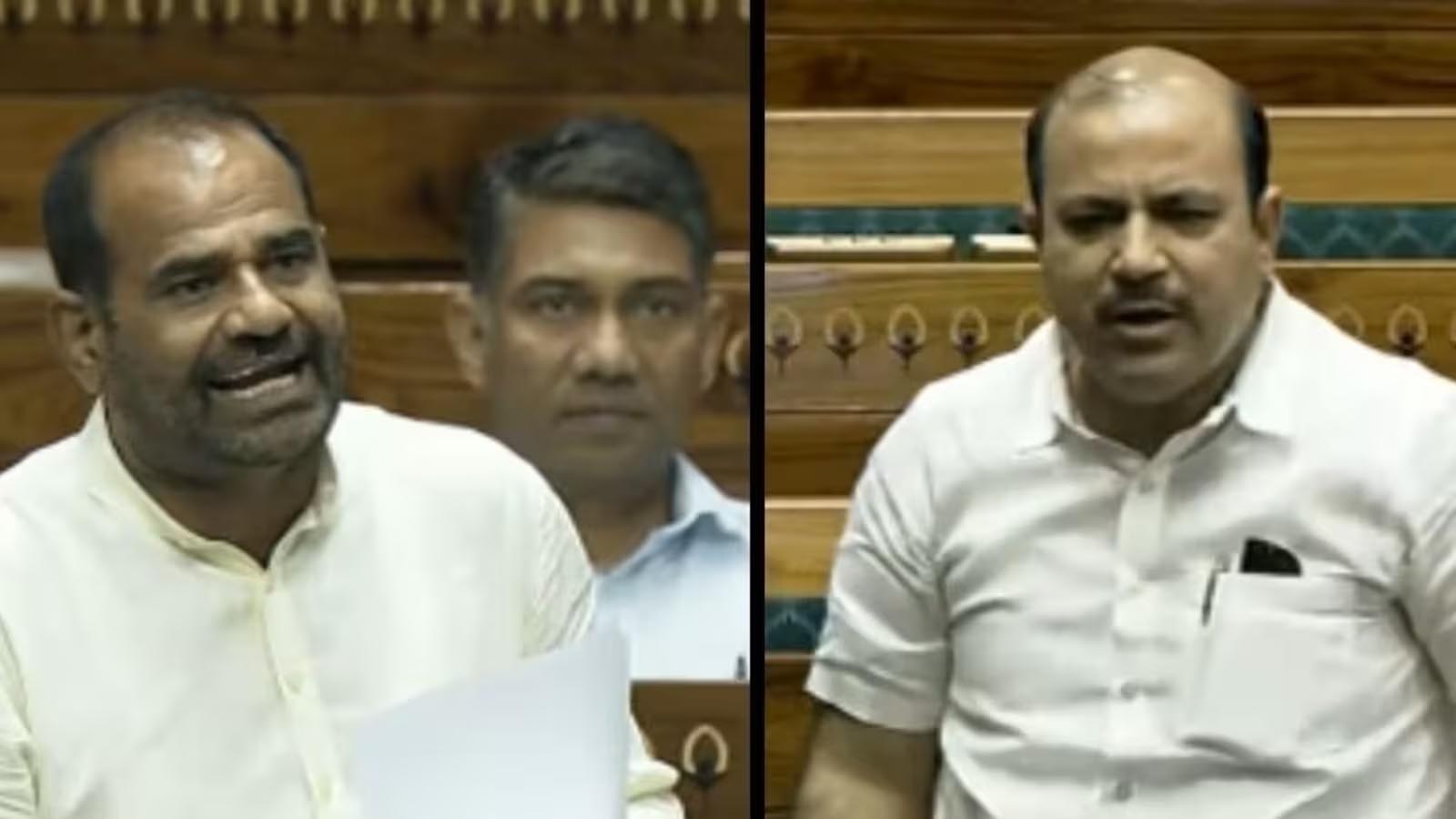
An elected member of the Lok Sabha openly uses anti-Muslim slurs against a Muslim member of Parliament during an ongoing session of the Parliament. He calls the Muslim MP a “B****a (pimp)”, “K***a (circumcised)”, “Mullah Atankwadi (Muslim terrorist)” and a “Mullah Ugrawadi (Muslim militant)” while giving a speech on record. The words uttered by the MP from the ruling party are televised. 75 years after attaining Independence, this is the state of our beloved India that is Bharat.
On September 21, BJP Lok Sabha MP Ramesh Bidhuri, from South Delhi, used filthy and violent anti-Muslim slurs against MP Danish Ali of the Bahujan Samaj Party during the special session of the Parliament. In the video that has now surfaced, Bidhuri can be heard giving a communally charged rant while talking about the recent Chandrayan 3 mission, referring to the Ali as a terrorist, urging the speaking to “throw the Mullah (anti-Muslim slur) out”. The video also shows another senior BJP member and former government minister, namely Harsh Vardhan, sitting behind Bidhuri and laughing at the anti-Muslim diatribe. The Lok Sabha speaker, Om Birla, can be heard asking the MPs to sit down.
[ . . . ]
Full text at: https://sabrangindia.in/the-blatant-anti-muslim-bias-displayed-in-the-indian-parliament-is-a-shame-for-the-country/
February 20, 2023

December 26, 2015
India: Frontline Cover Story Horror behind bars ........ Communal bias
Frontline, January 8, 2016
Minorities
Communal bias
By T. K. Rajalakshmi
Muslims, Dalits and Adivasis make up more than half of India's jail population. Undertrials belonging to the minority community are labelled as anti-nationals and persecuted. Photo:Rajendra Singh Hajeri
Inmates of the Tihar Jail, in Delhi, working in a leather-manufacturing unit, which manufactures shoes for a leading private school and other organisations. Photo:Rajeev Bhatt
Prison administrations flout every rule in the book, especially when the prisoners happen to be from the minority community. By T.K. RAJALAKSHMI
The 1994 Hollywood film Shawshank Redemption was critically acclaimed for its depiction of “jailhouse politics”. The film, based on Stephen King’s novella Rita Hayworth and Shawshank Redemption, is about how a banker, who is falsely implicated in a case of murder, plans his jailbreak meticulously even as he strives to improve conditions within the prison. The film also shows how the idea of prison reform gets stultified by corruption and the venality of the jail administration. Undertrials and convicts in India, especially those with lesser means, will find good reason to identify themselves with the film’s storyline.
Frontline spoke to a few undertrials and convicts, mainly from the minority community and who had been jailed for long durations, to find out what according to them was needed by way of jail reforms. Interestingly, some of them were aware of the Guantanamo Bay detention camp, the United States’ military prison, and its notoriety for torture, including waterboarding of prisoners.
‘It was plain kidnapping’
Mohammad Aamir Khan, accused of masterminding the bomb blasts that occurred in Delhi, Ghaziabad and Rohtak in 1996-97, has spent 10 years in the Tihar Jail (Delhi), three and a half years in the Dasna jail (Ghaziabad) and, lastly, six to eight months in the Rohtak jail (Haryana). He has been acquitted in two cases for want of evidence. His incarceration since the age of 18 has made him understand what is wrong with Indian prisons and why there is little scope for prison reform. “I have been asked about my conviction and how I plan to rehabilitate myself, but no one has asked me about life inside prison. When I think about it, there is a lot to say,” he said.
On February 20, 1998, plainclothesmen picked up Aamir, a resident of Kishanganj in Chandni Chowk in Delhi, at around 9:30 p.m. and took him away in a van. “It was plain kidnapping. I can’t call that an arrest as I was arrested much later. I was held by them for a week and I suffered real torture. I am undergoing psychiatric treatment as the memories of that horrible week keep haunting me,” he said.
In 2001, when Aamir lost his father, he was not given parole to attend the funeral as his was a “serious case”. Aamir wanted to pursue his studies from the jail and so enrolled in the Bachelor’s Preparatory Programme course offered by the Indira Gandhi National Open University. Subsequently, he enrolled in a graduation course in political science and sociology but had to discontinue as he became the target of a jailer who held a strong view on undertrials who had been charged with anti-national activities. “I would not like to name him. Being a prison official, the man was required to be impartial. He was our guardian. We were undertrials under the court’s jurisdiction, but that was no deterrence,” he said.
For the smallest of faults, undertrials were given harsh punishment. Once, Aamir was attacked by the inmates and was grievously injured. He had to be referred to a hospital outside the jail. The hospital labelled it as a medico-legal case, but no case was registered by the police.
Another undertrial, who has been acquitted, said on condition of anonymity that the jailers were the uncrowned kings of the jail, or “Betaaj Baadshahs”, as those who have been in jails refer to them.
The refrain of the undertrials Frontline spoke to was that there was an unholy nexus between jail administrations and local police stations. They wondered how in spite of multiple layers of security, deadly weapons were smuggled into prisons. One of them even said that many murders had taken place in the jails, but there was no way of cross-checking them. “How is it that surgical blades, smack, mobiles and knives reach the inmates?” one of them asked. Speaking about the Tihar Jail, the largest prison in Asia, some of them said the security there was relatively better as it was considered a “VIP” jail in view of the “high” profile of some of its prisoners. “The legal system is like a big cobweb. The big flies get out. The small get stuck. For instance, for corruption involving thousands of crores, the punishment is only a few years. The accused get bail on medical grounds and even have meetings in the rooms of the jail superintendent,” said one of them. On the other hand, a thief who may have stolen Rs.100 would first get beaten up by the public, then by the police and then by the inmates once he is inside the jail. “The big gangsters would tell him to wash their clothes; even the jail administration treats a petty thief with contempt. The bigger the crime, the more is the respect. The money a petty criminal may get when his family visits him would be taken away by the administration,” he said.
High-security prisoners, especially if they happened to be accused in bomb blast cases, receive a different kind of treatment. Aamir said: “Our patriotism is questioned. When I was a child, I saw a serial on Tipu Sultan on Doordarshan. He was depicted as a hero. Today, they say he was no good. Does history change just like that? Whenever there is a blast anywhere, they will shut down the library or the canteen and restrict access to those among us in the high-security ward.” Then, while being taken to court, these prisoners would be handcuffed. “They cannot do it without the court’s permission,” he said, but in district jails this was quite common.
Denial of facilities
According to the Jail Manual, which no prisoner gets to see, inmates are supposed to be provided with pen and paper. But Aamir, being a high-security ward prisoner, had to access it from the court. “When I asked for the Jail Manual, I was told to go the library. I did not find it there. One can find religious texts, a copy of the Criminal Procedure Code and the Indian Penal Code, but not the Jail Manual. Some jails do not even have a copy of the Constitution,” he said. It was very rare for prisoners to file complaints against the authorities for fear of reprisals.
“The jail authorities tell us not to discuss jail issues with the team of inspecting officials. There are hardly any medical facilities. Even the prescribed daily ration of 200-250 grams of dal [lentil] was not given. A large number of prisoners die in jails due to illness. In comparison, the ‘rich’ prisoners get better treatment. They can walk around, have visitors, eat fruits and enjoy other facilities. They even get chairs sometimes if they happen to be politicians,” he said, adding that the facilities in the Tihar Jail were slightly better than those in other jails.
In Ghaziabad, no lawyer was willing to argue Aamir’s case. Finally, he found one who stayed by him until the end. The legal services in Delhi were slightly better, and he got a good lawyer, he said. But not all the prisoners were lucky. The lawyers would insist on “something” (that is, a bribe). The best lawyers, he said, never came to the legal aid cell.
“I feel sorry for the jail inmates. Even when one stays with a dog, a cat or a goat, one gets attached to them. These are after all human beings. I read about the murder of Mohammad Qateel Siddiqui in the high-security prison ward in Pune in 2012. He was strangled by two inmates for his involvement in ‘anti-national’ activities. How could that happen? He was an undertrial. He was not even convicted,” he said. Anyone who came with the tag of a “terrorist” would be first beaten up by the rest of the inmates. Terrorists, rapists and thieves are all singled out for contempt by both the jail staff and the inmates.
Overcrowding in jails is perceived as a major problem and is one of the reasons why the scope for individual reform is limited. “People accused of rape, murder, murder for dowry, dacoity and petty thieving are all put in the same barrack. The thief will emerge from the jail as a dacoit. In one barrack, there are 200 to 300 people and only two latrines to serve all of them. When I was in Tihar, there were five jails inside the complex. Now they have 10. There are district jails, too, in Delhi. One of the biggest human rights violations is overcrowding,” he said.
Rehabilitation and reform
In bigger jails such as Tihar, the inmates are trained in skills ranging from carpentry to baking but are paid a pittance. It is felt that the remuneration should be high enough to sustain their families, who fend for themselves facing all kinds of social stigma. “As per the rule, only convicted people are supposed to work. But the jail staff make even undertrials work,” Aamir said. One undertrial said, on condition of anonymity, said that in one of the district jails, he was asked to give money to avoid being put on work. All prisoners agree that there should be some mechanism to protect their rights. As welfare officers were part of the jail staff, they were unable to do anything beyond the minimum prescribed.
“No one really cares about convicts losing their lives. How is it that they get hold of arms to attack each other? There has not been a single instance of action against officials,” Frontline was told. The religious gatherings and sermons in the jails did not help much. Jails were not meant for reform. An innocent person would often emerge from jail as a criminal. The undertrials said the people responsible for taking action were the perpetrators.
They said a lot needed to be done to make the jail staff accountable for the conditions in prisons. For one, the colour of the uniform of the jail staff should be different from that of the police as the inmates saw them as an extension of the police. In fact, the jail staff too saw themselves as an extension of the police. Complaints against the jail staff, they said, only resulted in internal transfers as a mechanism of redress. The undertrials said surprise inspections needed to be conducted. If the inmates complained to the judicial officer on inspection, they would be “dealt with” later by other inmates at the instigation of the jail staff. “Inmates live in fear of gang wars and the jail administration,” they said.
Acquittal and after
Syed Wasif Haider was incarcerated for eight years (from August 4, 2001 to August 12, 2009) for the murder of an Additional District Magistrate during riots in Kanpur. He was acquitted of all the charges by the Allahabad High Court on May 29, 2009. In fact, all the six persons accused in the case were acquitted. He was kept in three different jails in solitary confinement. “Discrimination starts as soon as a person enters jail. I wrote to the National Human Rights Commission. It sent a delegation but the members only met the Jail Superintendent. I was put in solitary confinement with no attached toilet. I was kept in a jail where men who were to be sent to the gallows the next day were kept. That was why the cell had no toilet, but I did not fall in that category. I was an undertrial,” he said. As most of the cases involving him were in Kanpur, he was shunted from one district to another. The travel between jails and from jail to the courts was a torturous experience as he was treated like a “terrorist”. No food was offered, and he was not allowed to buy food en route to jails or courts.
“The media project us differently. They show us as leading a luxurious life. The impression is that we must be guilty if we have been jailed,” he said. A first division science graduate in physics and mathematics from Kanpur University, Wasif was working in a multinational company when he was picked up in 2001. “The state has not compensated me for all that I and my family endured. Today, I find it difficult to get a job and provide for my family. People like us are implicated so that some others might get medals. Even after we are acquitted, the stigma does not go. There is no prosecution of those who tortured us or falsely implicated people like me,” he said.
Inmates have heard from the jail staff about the “earnings” made in district jails. The inmates have to bribe the officials to get some good food. Good food would be served whenever a district judge came to inspect the jail. “When I complained against the jail administration, I was accused of indiscipline. I raised the issue of violation of prisoners’ rights, and the issues of food and solitary confinement. Instead of recommending action, the courts asked the Jail Superintendent for a report. In the beginning, I was beaten up by the jail staff. For 20 days I was bedridden and was taken to the court in a stretcher. The court did not ask why I was lying on a stretcher. I had no access to the Jail Manual. It was with the permission of the court that I got a pen, a watch and books to read,” he told Frontline speaking from Kanpur.
Nothing happens in prison without the knowledge and consent of the Jail Superintendent. The treatment that an inmate receives has nothing to do with his criminal history. They are loved or hated depending on their ability to pay the jail staff, Frontline learnt. “Everyone, the hardened criminal and the topmost jail official, is a nationalist and a patriot, but people like us are labelled as anti-nationals,” said Wasif, Aamir and a few others from the minority community.
Sehba Farooqi, the Communist Party of India (Marxist) Secretariat member of the Delhi State unit who has been in touch with prisoners like Aamir and Wasif, told Frontline that nothing had been done to rehabilitate the young men who were arrested on false charges and acquitted by the courts. She was part of a delegation led by then CPI(M) general secretary Prakash Karat that met the President of India to give a representation regarding the persecution of youth belonging to the minority community and the rehabilitation and compensation of those acquitted.
The delegation submitted a list with the names of 22 persons, including Wasif and Aamir. “There are two issues.
One, the situation in jails is pathetic. The suicide of one of the accused in the Nirbhaya case is a pointer. Two, when the tag of terrorist gets attached to some people, it becomes difficult for them to start afresh despite being acquitted. The state never went into appeal. But the Central government and State governments concerned have not responded adequately to rehabilitate and help these young men. The best part is that all these men and their families still have implicit faith in the Indian judicial system. And to keep this faith alive, something needs to be done to help them,” Sehba Farooqi said.
According to a report on prisons, Muslims, Dalits and Adivasis make up more than half of India’s jail population. While the proportion of these three communities as a percentage of the overall population is only 39 per cent, they comprise around 53 per cent of the prisoner population. Jail reforms are one crucial component of the overall justice delivery system, and no society calling itself civilised can afford to ignore that.
Minorities
Communal bias
By T. K. Rajalakshmi
Muslims, Dalits and Adivasis make up more than half of India's jail population. Undertrials belonging to the minority community are labelled as anti-nationals and persecuted. Photo:Rajendra Singh Hajeri
Inmates of the Tihar Jail, in Delhi, working in a leather-manufacturing unit, which manufactures shoes for a leading private school and other organisations. Photo:Rajeev Bhatt
Prison administrations flout every rule in the book, especially when the prisoners happen to be from the minority community. By T.K. RAJALAKSHMI
The 1994 Hollywood film Shawshank Redemption was critically acclaimed for its depiction of “jailhouse politics”. The film, based on Stephen King’s novella Rita Hayworth and Shawshank Redemption, is about how a banker, who is falsely implicated in a case of murder, plans his jailbreak meticulously even as he strives to improve conditions within the prison. The film also shows how the idea of prison reform gets stultified by corruption and the venality of the jail administration. Undertrials and convicts in India, especially those with lesser means, will find good reason to identify themselves with the film’s storyline.
Frontline spoke to a few undertrials and convicts, mainly from the minority community and who had been jailed for long durations, to find out what according to them was needed by way of jail reforms. Interestingly, some of them were aware of the Guantanamo Bay detention camp, the United States’ military prison, and its notoriety for torture, including waterboarding of prisoners.
‘It was plain kidnapping’
Mohammad Aamir Khan, accused of masterminding the bomb blasts that occurred in Delhi, Ghaziabad and Rohtak in 1996-97, has spent 10 years in the Tihar Jail (Delhi), three and a half years in the Dasna jail (Ghaziabad) and, lastly, six to eight months in the Rohtak jail (Haryana). He has been acquitted in two cases for want of evidence. His incarceration since the age of 18 has made him understand what is wrong with Indian prisons and why there is little scope for prison reform. “I have been asked about my conviction and how I plan to rehabilitate myself, but no one has asked me about life inside prison. When I think about it, there is a lot to say,” he said.
On February 20, 1998, plainclothesmen picked up Aamir, a resident of Kishanganj in Chandni Chowk in Delhi, at around 9:30 p.m. and took him away in a van. “It was plain kidnapping. I can’t call that an arrest as I was arrested much later. I was held by them for a week and I suffered real torture. I am undergoing psychiatric treatment as the memories of that horrible week keep haunting me,” he said.
In 2001, when Aamir lost his father, he was not given parole to attend the funeral as his was a “serious case”. Aamir wanted to pursue his studies from the jail and so enrolled in the Bachelor’s Preparatory Programme course offered by the Indira Gandhi National Open University. Subsequently, he enrolled in a graduation course in political science and sociology but had to discontinue as he became the target of a jailer who held a strong view on undertrials who had been charged with anti-national activities. “I would not like to name him. Being a prison official, the man was required to be impartial. He was our guardian. We were undertrials under the court’s jurisdiction, but that was no deterrence,” he said.
For the smallest of faults, undertrials were given harsh punishment. Once, Aamir was attacked by the inmates and was grievously injured. He had to be referred to a hospital outside the jail. The hospital labelled it as a medico-legal case, but no case was registered by the police.
Another undertrial, who has been acquitted, said on condition of anonymity that the jailers were the uncrowned kings of the jail, or “Betaaj Baadshahs”, as those who have been in jails refer to them.
The refrain of the undertrials Frontline spoke to was that there was an unholy nexus between jail administrations and local police stations. They wondered how in spite of multiple layers of security, deadly weapons were smuggled into prisons. One of them even said that many murders had taken place in the jails, but there was no way of cross-checking them. “How is it that surgical blades, smack, mobiles and knives reach the inmates?” one of them asked. Speaking about the Tihar Jail, the largest prison in Asia, some of them said the security there was relatively better as it was considered a “VIP” jail in view of the “high” profile of some of its prisoners. “The legal system is like a big cobweb. The big flies get out. The small get stuck. For instance, for corruption involving thousands of crores, the punishment is only a few years. The accused get bail on medical grounds and even have meetings in the rooms of the jail superintendent,” said one of them. On the other hand, a thief who may have stolen Rs.100 would first get beaten up by the public, then by the police and then by the inmates once he is inside the jail. “The big gangsters would tell him to wash their clothes; even the jail administration treats a petty thief with contempt. The bigger the crime, the more is the respect. The money a petty criminal may get when his family visits him would be taken away by the administration,” he said.
High-security prisoners, especially if they happened to be accused in bomb blast cases, receive a different kind of treatment. Aamir said: “Our patriotism is questioned. When I was a child, I saw a serial on Tipu Sultan on Doordarshan. He was depicted as a hero. Today, they say he was no good. Does history change just like that? Whenever there is a blast anywhere, they will shut down the library or the canteen and restrict access to those among us in the high-security ward.” Then, while being taken to court, these prisoners would be handcuffed. “They cannot do it without the court’s permission,” he said, but in district jails this was quite common.
Denial of facilities
According to the Jail Manual, which no prisoner gets to see, inmates are supposed to be provided with pen and paper. But Aamir, being a high-security ward prisoner, had to access it from the court. “When I asked for the Jail Manual, I was told to go the library. I did not find it there. One can find religious texts, a copy of the Criminal Procedure Code and the Indian Penal Code, but not the Jail Manual. Some jails do not even have a copy of the Constitution,” he said. It was very rare for prisoners to file complaints against the authorities for fear of reprisals.
“The jail authorities tell us not to discuss jail issues with the team of inspecting officials. There are hardly any medical facilities. Even the prescribed daily ration of 200-250 grams of dal [lentil] was not given. A large number of prisoners die in jails due to illness. In comparison, the ‘rich’ prisoners get better treatment. They can walk around, have visitors, eat fruits and enjoy other facilities. They even get chairs sometimes if they happen to be politicians,” he said, adding that the facilities in the Tihar Jail were slightly better than those in other jails.
In Ghaziabad, no lawyer was willing to argue Aamir’s case. Finally, he found one who stayed by him until the end. The legal services in Delhi were slightly better, and he got a good lawyer, he said. But not all the prisoners were lucky. The lawyers would insist on “something” (that is, a bribe). The best lawyers, he said, never came to the legal aid cell.
“I feel sorry for the jail inmates. Even when one stays with a dog, a cat or a goat, one gets attached to them. These are after all human beings. I read about the murder of Mohammad Qateel Siddiqui in the high-security prison ward in Pune in 2012. He was strangled by two inmates for his involvement in ‘anti-national’ activities. How could that happen? He was an undertrial. He was not even convicted,” he said. Anyone who came with the tag of a “terrorist” would be first beaten up by the rest of the inmates. Terrorists, rapists and thieves are all singled out for contempt by both the jail staff and the inmates.
Overcrowding in jails is perceived as a major problem and is one of the reasons why the scope for individual reform is limited. “People accused of rape, murder, murder for dowry, dacoity and petty thieving are all put in the same barrack. The thief will emerge from the jail as a dacoit. In one barrack, there are 200 to 300 people and only two latrines to serve all of them. When I was in Tihar, there were five jails inside the complex. Now they have 10. There are district jails, too, in Delhi. One of the biggest human rights violations is overcrowding,” he said.
Rehabilitation and reform
In bigger jails such as Tihar, the inmates are trained in skills ranging from carpentry to baking but are paid a pittance. It is felt that the remuneration should be high enough to sustain their families, who fend for themselves facing all kinds of social stigma. “As per the rule, only convicted people are supposed to work. But the jail staff make even undertrials work,” Aamir said. One undertrial said, on condition of anonymity, said that in one of the district jails, he was asked to give money to avoid being put on work. All prisoners agree that there should be some mechanism to protect their rights. As welfare officers were part of the jail staff, they were unable to do anything beyond the minimum prescribed.
“No one really cares about convicts losing their lives. How is it that they get hold of arms to attack each other? There has not been a single instance of action against officials,” Frontline was told. The religious gatherings and sermons in the jails did not help much. Jails were not meant for reform. An innocent person would often emerge from jail as a criminal. The undertrials said the people responsible for taking action were the perpetrators.
They said a lot needed to be done to make the jail staff accountable for the conditions in prisons. For one, the colour of the uniform of the jail staff should be different from that of the police as the inmates saw them as an extension of the police. In fact, the jail staff too saw themselves as an extension of the police. Complaints against the jail staff, they said, only resulted in internal transfers as a mechanism of redress. The undertrials said surprise inspections needed to be conducted. If the inmates complained to the judicial officer on inspection, they would be “dealt with” later by other inmates at the instigation of the jail staff. “Inmates live in fear of gang wars and the jail administration,” they said.
Acquittal and after
Syed Wasif Haider was incarcerated for eight years (from August 4, 2001 to August 12, 2009) for the murder of an Additional District Magistrate during riots in Kanpur. He was acquitted of all the charges by the Allahabad High Court on May 29, 2009. In fact, all the six persons accused in the case were acquitted. He was kept in three different jails in solitary confinement. “Discrimination starts as soon as a person enters jail. I wrote to the National Human Rights Commission. It sent a delegation but the members only met the Jail Superintendent. I was put in solitary confinement with no attached toilet. I was kept in a jail where men who were to be sent to the gallows the next day were kept. That was why the cell had no toilet, but I did not fall in that category. I was an undertrial,” he said. As most of the cases involving him were in Kanpur, he was shunted from one district to another. The travel between jails and from jail to the courts was a torturous experience as he was treated like a “terrorist”. No food was offered, and he was not allowed to buy food en route to jails or courts.
“The media project us differently. They show us as leading a luxurious life. The impression is that we must be guilty if we have been jailed,” he said. A first division science graduate in physics and mathematics from Kanpur University, Wasif was working in a multinational company when he was picked up in 2001. “The state has not compensated me for all that I and my family endured. Today, I find it difficult to get a job and provide for my family. People like us are implicated so that some others might get medals. Even after we are acquitted, the stigma does not go. There is no prosecution of those who tortured us or falsely implicated people like me,” he said.
Inmates have heard from the jail staff about the “earnings” made in district jails. The inmates have to bribe the officials to get some good food. Good food would be served whenever a district judge came to inspect the jail. “When I complained against the jail administration, I was accused of indiscipline. I raised the issue of violation of prisoners’ rights, and the issues of food and solitary confinement. Instead of recommending action, the courts asked the Jail Superintendent for a report. In the beginning, I was beaten up by the jail staff. For 20 days I was bedridden and was taken to the court in a stretcher. The court did not ask why I was lying on a stretcher. I had no access to the Jail Manual. It was with the permission of the court that I got a pen, a watch and books to read,” he told Frontline speaking from Kanpur.
Nothing happens in prison without the knowledge and consent of the Jail Superintendent. The treatment that an inmate receives has nothing to do with his criminal history. They are loved or hated depending on their ability to pay the jail staff, Frontline learnt. “Everyone, the hardened criminal and the topmost jail official, is a nationalist and a patriot, but people like us are labelled as anti-nationals,” said Wasif, Aamir and a few others from the minority community.
Sehba Farooqi, the Communist Party of India (Marxist) Secretariat member of the Delhi State unit who has been in touch with prisoners like Aamir and Wasif, told Frontline that nothing had been done to rehabilitate the young men who were arrested on false charges and acquitted by the courts. She was part of a delegation led by then CPI(M) general secretary Prakash Karat that met the President of India to give a representation regarding the persecution of youth belonging to the minority community and the rehabilitation and compensation of those acquitted.
The delegation submitted a list with the names of 22 persons, including Wasif and Aamir. “There are two issues.
One, the situation in jails is pathetic. The suicide of one of the accused in the Nirbhaya case is a pointer. Two, when the tag of terrorist gets attached to some people, it becomes difficult for them to start afresh despite being acquitted. The state never went into appeal. But the Central government and State governments concerned have not responded adequately to rehabilitate and help these young men. The best part is that all these men and their families still have implicit faith in the Indian judicial system. And to keep this faith alive, something needs to be done to help them,” Sehba Farooqi said.
According to a report on prisons, Muslims, Dalits and Adivasis make up more than half of India’s jail population. While the proportion of these three communities as a percentage of the overall population is only 39 per cent, they comprise around 53 per cent of the prisoner population. Jail reforms are one crucial component of the overall justice delivery system, and no society calling itself civilised can afford to ignore that.
August 03, 2015
Nothing’s Secular in Modi’s India (Shanoor Seervai)
The Daily Beast - 08.03.2015
FOOD FIGHT
Nothing’s Secular in Modi’s India
by Shanoor Seervai
A regional ban on selling or consuming cows by forces close to Modi’s Hindu government has traditional Muslim butchers starving—and others worried about the country’s secular future.
MUMBAI — The stench of slowly rotting bovine entrails lingers in the air on a sultry June afternoon at the Deonar abattoir. A few men desultorily tend to a handful of water buffaloes in a muddy pen, but otherwise the grounds of the slaughterhouse—the largest in India—seem deserted.
A few steps away, six butchers seated on blood-splattered concrete idly chew paan—a mixture of betel nut and tobacco—and chat under the shade of a pale yellow building. Sheikh Qureshi has had almost no work for three months. After a new law banned the possession, sale, and consumption of beef in the western Indian state of Maharashtra, the 22-year-old butcher has been struggling to support his family.
“What are we to do?” he says. “All of us have become useless.”
Around 2,000 men at the slaughterhouse—butchers, skinners, caretakers—watched their jobs collapse overnight when the law came into force March 4.
Expanding a 1976 prohibition of the slaughter of cows, the ban makes killing bulls and bullocks illegal and punishable with a maximum of five years in prison and fines as much as 10,000 rupees (around $160). The amendment also forbids the possession of cow, bull, and bullock meat in Maharashtra, even if the animal was legally slaughtered outside the state.
Beef in India is typically the meat of less-revered male cattle and water buffalo because cow slaughter is banned or stringently restricted in almost all Indian states. Hindus, who make up some 80 percent of India’s 1.2 billion-strong population, believe the cow is sacred. But for Muslims, Christians, and many lower-caste Hindus, beef is a vital part of their diet.
Many say the new law is specifically targeted at Muslims, who control the butchers’ trade across India. The election manifesto of the Hindu right-wing Bharatiya Janata Party, which won federal elections by a landslide last year, promised to increase “protection and promotion of cow and its progeny.” (PDF)
Life in India looks increasingly bleak for those who do not toe the Hindu right’s line.
The Maharashtra ban, the first legislative measure to fulfill this pledge, forebodes a climate of increasing intolerance and censorship in a country that prides itself on being the world’s largest democracy.
From a push to rewrite school textbooks retelling history and science as a glorified Hindu past to the persecution of non-governmental organizations that receive foreign funds, life in India looks increasingly bleak for those who do not toe the Hindu right’s line.
Experts say this state-endorsed shift toward bigotry threatens centuries-old customs of religious minorities and marginalized social groups. “Cultural bias can’t become policy,” says Shiv Visvananthan, a sociologist and professor at the O.P. Jindal Global University in the northern state of Haryana.
Two weeks after Maharashtra imposed its beef ban, the state assembly of Haryana unanimously passed a bill with harsher punishments for the possession and sale of beef. “Banning books or banning meat—both are an attempt to author cultural codes,” explains Visvanathan, adding that Prime Minister Narendra Modi’s government is capitalizing on the “majoritarian impulse” of large swaths of the Hindu population to drive its cultural purification programs.
Last December, mobs of Hindu nationalists in northern India forced hundreds of Muslims to “reconvert” to Hinduism. These Muslims, the hard-line Hindu groups argue, have strayed from their path and are returning home to the Hindu fold.
“The PM promised ‘achhe din aaney wale hain’ [good days will come],” says Halin Qureshi, a leader of the Bombay Suburban Beef Dealers’ Welfare Association. “What ‘achhe din?’ He’s taken away our jobs and our food.” Qureshi—a surname common among Muslims in the beef trade—says he voted for the BJP for the first time last year after supporting the dynastic Congress Party for decades.
The government of Maharashtra, one of India’s richest and most populous states, denies that the law targets Muslims. It was brought into force “for the benefit of the farmers and to arrest the decline of the animal population,” says Mahesh Pathak, the Maharashtra secretary of animal husbandry.
According to Pathak, the long-term benefits of the beef ban include an increase in milk production and protein consumption in the state, and a decline in the use of chemical fertilizers. The butchers should adjust and “cut buff”—buffalo—“instead of beef,” he says, adding, “One choice of meat is not available, but buff will replace it.”
The Muslim butchers at Deonar, however, say they don’t like buffalo meat. “We are eaters of bull meat,” says Qureshi, the beef association leader. Preference aside, the number of animals slaughtered—and consequently the supply of beef—has dramatically declined, to 170 per day from 400 at its abattoir, according to its deputy general manager.
For many, this sudden shortage has led to near abstinence from meat altogether. Mutton, chicken, and fish are too expensive for the poor, for whom beef is a fundamental source of nutrients.
“None of us eat buffalo. Sometimes, we eat a quarter kilo of chicken. Sometimes, we eat bread. And sometimes, we go hungry,” says butcher Sheikh Nabi Lal, who is the sole breadwinner for his family of five.
While the butchers of Mumbai find it hard to make ends meet, India’s beef exports, predominantly buffalo meat, have soared in the past five years. The country now rivals Brazil (PDF) as the world’s largest exporter of beef, according to the United States Department of Agriculture.
“Look at the hypocrisy. There’s a huge vested interest [in the ban]—the buffalo industry,” says sociologist Visvanathan, adding, “The classification of animals is done by sleight of hand.” The impact of the ban becomes even more acute for many who are employed in industries related to beef, because they belong to the informal sector, says Visvanathan. “They’re invisible, so their livelihood gets eliminated,” he says.
Even Hindu farmers in rural Maharashtra—who most likely are vegetarians—are facing the brunt of the ban. They are unable to care for the aging cattle they intended to sell for slaughter, according to reports in The Times of India.
The ban hasn’t gone unchallenged. Petitions filed in the Bombay High Court asked the judiciary to stay certain provisions of the new law, arguing that they violate the constitutional rights of privacy and freedom of choice.
The court, the highest in Maharashtra, did not grant a stay. But in a feebly worded order, the judges recognized that an overnight ban did not grant enough time for people to get rid of the beef they once legally possessed.
The high court did, however, direct the government not to initiate prosecution against people in possession of beef for three months after the date of the April 29 order—or until the petitions are finally heard, whichever is later.
That’s of little consolation to the butchers, who used to earn around 600 rupees ($10) each day for 14 hours of work. “We don’t know how to do anything else,” says Mohammed Qureshi. “This [slaughterhouse] is like a jail for us.”
© 2014 The Daily Beast Company LLC
FOOD FIGHT
Nothing’s Secular in Modi’s India
by Shanoor Seervai
A regional ban on selling or consuming cows by forces close to Modi’s Hindu government has traditional Muslim butchers starving—and others worried about the country’s secular future.
MUMBAI — The stench of slowly rotting bovine entrails lingers in the air on a sultry June afternoon at the Deonar abattoir. A few men desultorily tend to a handful of water buffaloes in a muddy pen, but otherwise the grounds of the slaughterhouse—the largest in India—seem deserted.
A few steps away, six butchers seated on blood-splattered concrete idly chew paan—a mixture of betel nut and tobacco—and chat under the shade of a pale yellow building. Sheikh Qureshi has had almost no work for three months. After a new law banned the possession, sale, and consumption of beef in the western Indian state of Maharashtra, the 22-year-old butcher has been struggling to support his family.
“What are we to do?” he says. “All of us have become useless.”
Around 2,000 men at the slaughterhouse—butchers, skinners, caretakers—watched their jobs collapse overnight when the law came into force March 4.
Expanding a 1976 prohibition of the slaughter of cows, the ban makes killing bulls and bullocks illegal and punishable with a maximum of five years in prison and fines as much as 10,000 rupees (around $160). The amendment also forbids the possession of cow, bull, and bullock meat in Maharashtra, even if the animal was legally slaughtered outside the state.
Beef in India is typically the meat of less-revered male cattle and water buffalo because cow slaughter is banned or stringently restricted in almost all Indian states. Hindus, who make up some 80 percent of India’s 1.2 billion-strong population, believe the cow is sacred. But for Muslims, Christians, and many lower-caste Hindus, beef is a vital part of their diet.
Many say the new law is specifically targeted at Muslims, who control the butchers’ trade across India. The election manifesto of the Hindu right-wing Bharatiya Janata Party, which won federal elections by a landslide last year, promised to increase “protection and promotion of cow and its progeny.” (PDF)
Life in India looks increasingly bleak for those who do not toe the Hindu right’s line.
The Maharashtra ban, the first legislative measure to fulfill this pledge, forebodes a climate of increasing intolerance and censorship in a country that prides itself on being the world’s largest democracy.
From a push to rewrite school textbooks retelling history and science as a glorified Hindu past to the persecution of non-governmental organizations that receive foreign funds, life in India looks increasingly bleak for those who do not toe the Hindu right’s line.
Experts say this state-endorsed shift toward bigotry threatens centuries-old customs of religious minorities and marginalized social groups. “Cultural bias can’t become policy,” says Shiv Visvananthan, a sociologist and professor at the O.P. Jindal Global University in the northern state of Haryana.
Two weeks after Maharashtra imposed its beef ban, the state assembly of Haryana unanimously passed a bill with harsher punishments for the possession and sale of beef. “Banning books or banning meat—both are an attempt to author cultural codes,” explains Visvanathan, adding that Prime Minister Narendra Modi’s government is capitalizing on the “majoritarian impulse” of large swaths of the Hindu population to drive its cultural purification programs.
Last December, mobs of Hindu nationalists in northern India forced hundreds of Muslims to “reconvert” to Hinduism. These Muslims, the hard-line Hindu groups argue, have strayed from their path and are returning home to the Hindu fold.
“The PM promised ‘achhe din aaney wale hain’ [good days will come],” says Halin Qureshi, a leader of the Bombay Suburban Beef Dealers’ Welfare Association. “What ‘achhe din?’ He’s taken away our jobs and our food.” Qureshi—a surname common among Muslims in the beef trade—says he voted for the BJP for the first time last year after supporting the dynastic Congress Party for decades.
The government of Maharashtra, one of India’s richest and most populous states, denies that the law targets Muslims. It was brought into force “for the benefit of the farmers and to arrest the decline of the animal population,” says Mahesh Pathak, the Maharashtra secretary of animal husbandry.
According to Pathak, the long-term benefits of the beef ban include an increase in milk production and protein consumption in the state, and a decline in the use of chemical fertilizers. The butchers should adjust and “cut buff”—buffalo—“instead of beef,” he says, adding, “One choice of meat is not available, but buff will replace it.”
The Muslim butchers at Deonar, however, say they don’t like buffalo meat. “We are eaters of bull meat,” says Qureshi, the beef association leader. Preference aside, the number of animals slaughtered—and consequently the supply of beef—has dramatically declined, to 170 per day from 400 at its abattoir, according to its deputy general manager.
For many, this sudden shortage has led to near abstinence from meat altogether. Mutton, chicken, and fish are too expensive for the poor, for whom beef is a fundamental source of nutrients.
“None of us eat buffalo. Sometimes, we eat a quarter kilo of chicken. Sometimes, we eat bread. And sometimes, we go hungry,” says butcher Sheikh Nabi Lal, who is the sole breadwinner for his family of five.
While the butchers of Mumbai find it hard to make ends meet, India’s beef exports, predominantly buffalo meat, have soared in the past five years. The country now rivals Brazil (PDF) as the world’s largest exporter of beef, according to the United States Department of Agriculture.
“Look at the hypocrisy. There’s a huge vested interest [in the ban]—the buffalo industry,” says sociologist Visvanathan, adding, “The classification of animals is done by sleight of hand.” The impact of the ban becomes even more acute for many who are employed in industries related to beef, because they belong to the informal sector, says Visvanathan. “They’re invisible, so their livelihood gets eliminated,” he says.
Even Hindu farmers in rural Maharashtra—who most likely are vegetarians—are facing the brunt of the ban. They are unable to care for the aging cattle they intended to sell for slaughter, according to reports in The Times of India.
The ban hasn’t gone unchallenged. Petitions filed in the Bombay High Court asked the judiciary to stay certain provisions of the new law, arguing that they violate the constitutional rights of privacy and freedom of choice.
The court, the highest in Maharashtra, did not grant a stay. But in a feebly worded order, the judges recognized that an overnight ban did not grant enough time for people to get rid of the beef they once legally possessed.
The high court did, however, direct the government not to initiate prosecution against people in possession of beef for three months after the date of the April 29 order—or until the petitions are finally heard, whichever is later.
That’s of little consolation to the butchers, who used to earn around 600 rupees ($10) each day for 14 hours of work. “We don’t know how to do anything else,” says Mohammed Qureshi. “This [slaughterhouse] is like a jail for us.”
© 2014 The Daily Beast Company LLC
December 14, 2014
India: Muslims and police (A.G. Noorani, Frontline, 26 Dec 2014)
Commissions of inquiry have sometimes exposed shocking details of communal bias in the functioning of the institutions of law enforcement. Yet, little notice is taken of them. By A.G. NOORANI
http://www.frontline.in/the-nation/muslims-and-police/article6672575.ece
http://www.frontline.in/the-nation/muslims-and-police/article6672575.ece
August 25, 2014
India: Police attitudes towards Muslims will not change unless there is political recognition of the problem - Javed Anand
Acknowledge this
Police attitudes towards Muslims will not change unless there is political recognition of the problem.
BY: JAVED ANAND (Indian Express, 22 August 2014)
On July 17, The Indian Express scooped a report prepared jointly by the police chiefs of three states — Sanjeev Dayal (Maharashtra), Deoraj Nagar (UP), K. Ramanujam (Tamil Nadu) — and a senior IB officer. Muslims think we are communal, noted the report presented at the annual conference of DGPs in New Delhi in 2013.
Significantly, there was an honest admission that such perception is not without basis: “Poor representation of the minorities in the police forces has contributed to this distrust and suspicion. It has to be admitted that the conduct of some members of the police forces in various states during communal riots had only served to strengthen and heighten these suspicions and distrust in the minority communities,” the report said.
Warning of the serious implications of police bias “on the communal situation in this country and thus its internal security”, the DGPs recommended urgent remedial measures. While the UPA government did nothing, under the new Sangh Parivar-backed NDA dispensation, any talk of corrective action will surely be castigated as “Muslim appeasement”.
On July 31, Justices V.M. Kanade and P.D. Korde of the Bombay High Court sent out a new red alert, observing that most victims of custodial deaths in Maharashtra appeared to be Muslims and Dalits. The high-powered Sachar Committee appointed in 2005 by the prime minister to study the educational and socio-economic status of Indian Muslims had concluded that the community was grossly underrepresented in various state and social institutions, and was conspicuously overrepresented in only one institution: India’s jails.
Rampant religious bias in our context is not very different. It is as old as the widely acknowledged racial bias in the US resulting in overrepresentation of people of colour in America’s prisons. Following countrywide research, Vibhuti Narain Rai, a senior IPS officer, had published a study in the mid-1990s on the perception of the police among India’s minorities.
The study found that the country’s religious minorities, Muslims included, see the police as a partisan force. Rai had pointed out that the police, the armed limb of the state, was also its front face. If the minorities continued to experience the police as an alien force, they will inevitably end up feeling alienated from the Indian state as a whole, with serious internal security implications, he had warned. The ruling classes were as uninterested in what Rai said then as in the DGPs’ recent report.
One need only look around, whether in our immediate neighbourhood or beyond, to acknowledge that prejudice and bias against vulnerable minorities — religious, ethnic, racial, linguistic, casteist — is a global, not an India-specific, malady. Forget self-flagellation. What about some honest self-introspection?
“As a first step it is very necessary for the police leadership to admit that the problem exists and acknowledge that there is a need for correction within us,” said the DGPs’ report. And here lies the critical difference between a wilfully blind majoritarian polity and some of the world’s older democracies: the critical first step, the recognition that there exists a serious problem.
In April 1993, a black British youngster was stabbed to death in London by a gang of white supremacists. The acquittal of the accused for lack of sufficient evidence created a national outrage resulting in the appointment of a commission headed by Sir William Macpherson. The commission’s inquiry found the British police force guilty of “institutional racism” and recommended drastic corrective measures.
Published in February 1999, the Macpherson report has been called “one of the most important moments in the modern history of criminal justice in Britain”. The then home secretary, Jack Straw, presented it to the British parliament with the words: “The Macpherson report challenges all of us, not just the police service.” (We Indians have never felt similarly challenged.)
Among the many outcomes of the radical overhaul of the British policing system since then is a “Hate Crimes Manual”. The manual is obligatory reading for anyone entering the British police service and its message is clear and simple: “Anyone who is unable to behave in a non-discriminatory and unprejudiced manner must expect disciplinary action. There is no place in the police service for those who will not uphold and protect the human rights of others”.
In late January 2001, Benjamin Hermansen, a young African-Norwegian was knifed to death in Oslo by two neo-Nazis.
The very next day, a massive protest demonstration held in the national capital was led by none less than the country’s prime minister, Jens Stoltenberg. The message the country’s chief political executive sent out was loud and clear: “We will not tolerate hate crimes. This is not our way.”
A news report from Norway published at the time read: “In a tragic way, Benjamin has made Norwegian history. Tens of thousands of demonstrators marched through Oslo to protest racism and violence in the wake of what is seen as Norway’s first racial killing. Other cities followed up. Concerts with the most prominent Norwegian musicians were organised. Legal proposals have been made. The Norwegian public has made a clear statement: This murder will not be forgotten. And it will have clear consequences.”
Imagine a hate crimes manual for the Indian police force. Imagine the prime minister of India, Narendra Modi, leading a protest demonstration in Delhi, after a young Muslim, Mohsin Sadiq Shaikh, was killed in Pune in June to denounce hate crimes in unambiguous words: “This is not our way.”
The writer is co-editor, ‘Communalism Combat’ and general secretary, Muslims for Secular Democracy
source: http://indianexpress.com/article/opinion/columns/acknowledge-this/99/
Police attitudes towards Muslims will not change unless there is political recognition of the problem.
BY: JAVED ANAND (Indian Express, 22 August 2014)
On July 17, The Indian Express scooped a report prepared jointly by the police chiefs of three states — Sanjeev Dayal (Maharashtra), Deoraj Nagar (UP), K. Ramanujam (Tamil Nadu) — and a senior IB officer. Muslims think we are communal, noted the report presented at the annual conference of DGPs in New Delhi in 2013.
Significantly, there was an honest admission that such perception is not without basis: “Poor representation of the minorities in the police forces has contributed to this distrust and suspicion. It has to be admitted that the conduct of some members of the police forces in various states during communal riots had only served to strengthen and heighten these suspicions and distrust in the minority communities,” the report said.
Warning of the serious implications of police bias “on the communal situation in this country and thus its internal security”, the DGPs recommended urgent remedial measures. While the UPA government did nothing, under the new Sangh Parivar-backed NDA dispensation, any talk of corrective action will surely be castigated as “Muslim appeasement”.
On July 31, Justices V.M. Kanade and P.D. Korde of the Bombay High Court sent out a new red alert, observing that most victims of custodial deaths in Maharashtra appeared to be Muslims and Dalits. The high-powered Sachar Committee appointed in 2005 by the prime minister to study the educational and socio-economic status of Indian Muslims had concluded that the community was grossly underrepresented in various state and social institutions, and was conspicuously overrepresented in only one institution: India’s jails.
Rampant religious bias in our context is not very different. It is as old as the widely acknowledged racial bias in the US resulting in overrepresentation of people of colour in America’s prisons. Following countrywide research, Vibhuti Narain Rai, a senior IPS officer, had published a study in the mid-1990s on the perception of the police among India’s minorities.
The study found that the country’s religious minorities, Muslims included, see the police as a partisan force. Rai had pointed out that the police, the armed limb of the state, was also its front face. If the minorities continued to experience the police as an alien force, they will inevitably end up feeling alienated from the Indian state as a whole, with serious internal security implications, he had warned. The ruling classes were as uninterested in what Rai said then as in the DGPs’ recent report.
One need only look around, whether in our immediate neighbourhood or beyond, to acknowledge that prejudice and bias against vulnerable minorities — religious, ethnic, racial, linguistic, casteist — is a global, not an India-specific, malady. Forget self-flagellation. What about some honest self-introspection?
“As a first step it is very necessary for the police leadership to admit that the problem exists and acknowledge that there is a need for correction within us,” said the DGPs’ report. And here lies the critical difference between a wilfully blind majoritarian polity and some of the world’s older democracies: the critical first step, the recognition that there exists a serious problem.
In April 1993, a black British youngster was stabbed to death in London by a gang of white supremacists. The acquittal of the accused for lack of sufficient evidence created a national outrage resulting in the appointment of a commission headed by Sir William Macpherson. The commission’s inquiry found the British police force guilty of “institutional racism” and recommended drastic corrective measures.
Published in February 1999, the Macpherson report has been called “one of the most important moments in the modern history of criminal justice in Britain”. The then home secretary, Jack Straw, presented it to the British parliament with the words: “The Macpherson report challenges all of us, not just the police service.” (We Indians have never felt similarly challenged.)
Among the many outcomes of the radical overhaul of the British policing system since then is a “Hate Crimes Manual”. The manual is obligatory reading for anyone entering the British police service and its message is clear and simple: “Anyone who is unable to behave in a non-discriminatory and unprejudiced manner must expect disciplinary action. There is no place in the police service for those who will not uphold and protect the human rights of others”.
In late January 2001, Benjamin Hermansen, a young African-Norwegian was knifed to death in Oslo by two neo-Nazis.
The very next day, a massive protest demonstration held in the national capital was led by none less than the country’s prime minister, Jens Stoltenberg. The message the country’s chief political executive sent out was loud and clear: “We will not tolerate hate crimes. This is not our way.”
A news report from Norway published at the time read: “In a tragic way, Benjamin has made Norwegian history. Tens of thousands of demonstrators marched through Oslo to protest racism and violence in the wake of what is seen as Norway’s first racial killing. Other cities followed up. Concerts with the most prominent Norwegian musicians were organised. Legal proposals have been made. The Norwegian public has made a clear statement: This murder will not be forgotten. And it will have clear consequences.”
Imagine a hate crimes manual for the Indian police force. Imagine the prime minister of India, Narendra Modi, leading a protest demonstration in Delhi, after a young Muslim, Mohsin Sadiq Shaikh, was killed in Pune in June to denounce hate crimes in unambiguous words: “This is not our way.”
The writer is co-editor, ‘Communalism Combat’ and general secretary, Muslims for Secular Democracy
source: http://indianexpress.com/article/opinion/columns/acknowledge-this/99/
April 18, 2014
Whither Community Profiling | Subhash Gatade
Adam Goldman, a
journalist who with the help of his colleague Matt Apuzzo first broke the story
about New York Police Department's Muslim Spy Programme in a series of articles
he wrote for Associated Press must be a happy man these days.
News has come in that
NYPD (New York Police Department) has finally decided to disband its
DemographicUnit which was engaged in spying on Muslim neighborhoods,
infiltrating groups and eavesdropping on conversations across the northeastern
United States, In the years following the Sept. 11 attacks. It has finally
admitted that its secret Demographics Unit failed to yield a single terrorism
investigation or even a single lead. Senior police officers of the department
confirmed that the police gathered information on people even when there was no
evidence of wrongdoing, simply because of their ethnicity and native language.
It was quite a
coincidence that when the world at large was discussing how NYPD tried to
stigmatise a community and terrorise a people, reports about the 'informer-cop
nexus behind Islamic Fundamentalism in Tamil Nadu'.
(http://www.newindianexpress.com/states/tamil_nadu/Informer-Cop-Nexus-Behind-TN-Islamic-Fundamentalism/2014/04/11/article216)
were already making rounds. What is important to note here is that a (retd)
senior police officers confidential correspondence with higher officials formed
a key evidence in this unfolding drama.
Not very many people
would remember today that during Lal Krishna Advani's tour of Tamil Nadu in the
year 2011 police had discovered a plot to cause mayhem supposedly by Islamic
militants. It was told that pipe bombs were discovered on the route which
Advani's cavalcade was to follow. Police had even arrested two 'terrorists'
Syed Wahab and Ismath and presented them before the media.
A petition before the
Madras Highcourt which has sought a CBI probe into the various bomb planting
cases in Madurai alleging that the real accused were not arrested is revisiting
this particular high profile case as well. Madras Highcourt ( Madurai bench) is
expected to give its opinion on the 21 st April.The said letters written by
former Madurai SP V Balakrishnan to the DGP and Additional DGP in March and
August 2013 and were presented before the court in the second week of April.
According to
Balakrishnan police informers belonging to the Muslim community were themselves
indulging in subversive activities by abusing the faith the police had placed
on them and also due to their alleged nexus with some corrupt intelligence
sleuths.
"To buttress
this contention, Balakrishnan in a letter to the DGP dated March 29, 2013
pointed to a case registered by the Avaniyapuram police against Syed Wahab and
Ismath relating to a case of extortion. Of them, Ismath, who was an informer
for the City Intelligence unit, was involved in the Advani pipe bomb planting
case. Also, Vijaya Perumal, a head constable attached to the Madurai City
Intelligence Wing, had joined hands with Wahab and conducted kangaroo courts
settling controversial real estate dealings.
Balakrishnan had in another letter
written to the Additional DGP on August 23, 2013 strongly objected to the
transfer of an Inspector of the SIT who was probing cases related to bombs
planted by Islamic fundamentalists in the temple town. He feared that the
transfer of Inspector Madasamy would embolden fundamentalists to carry on with
their subversive activities."
Definitely this could
not be said to be the first investigation of its kind where the role of the
police and investigating agencies has come under a scanner. There are n number
of cases where law and order people have badly fumbled and have received enough
opprobrium from the judiciary. Not some time ago ' Jamia Teachers Solidarity
Association' had brought out a report 'Framed, Damned and Acquitted' which looks
at the operations of the Special Cell of the Delhi police, the stereotypical
manner in which they conducted investigations in cases arresting Muslims for
being part of terrorist outfits and how in most of these cases the accused were
acquitted by the courts.
The developments in
the Malegaon bomb blast case 2006 where a terror module of RSS workers was
finally chargesheeted, was also a pointer to the prejudices entertained by the
police and the role of informers in helping people nab innocents. One still remembers
the bomb explosions in Malegaon on the day of Shab-e-Barat (Sep 2006) and the
manner in which nine Muslim youth were apprehended and had to spend more than
five years behind jail because of biased investigation. Here also role of one
Abrar Ahmad had proved crucial - who worked for the police - who had provided
'evidence' against these nine youth. Later he had submitted an affidavit before
the court recounting the false evidence.
We have n number of
such examples where the actual perpetrators were never caught and innocents
were apprehended, tortured badly and asked to ‘confess’ a crime which they had
not committed.
Or refer to the
expose by Ashish Khaitan (www.gulail.com) which has unearthed
“.[i]nternal documents from more than
half a dozen anti-terror agencies that show that the State has been knowingly
prosecuting innocent Muslims for terror cases and keeping the evidence of their
innocence from the courts...”
In a press conference
held in Mumbai he had presented his investigation and had even screened a film
with candid interviews of accused Muslim men. He has even sent a letter
petition to the Bombay high court with nearly 400 pages of evidence in the form
of official investigation and interrogation reports of the accused men and
other documents which clearly indicate huge discrepancies. According to him his
research into the July 11, 2006, train blasts, the Malegaon 2006 blasts and the
Pune German Bakery blasts of February 2010 showed that the ATS has deliberately
created bogus evidence, extracted false confessions by the most inhuman
torture, planted explosives in the houses of the young men and implicated
innocent youth. In the name of internal security, the ATS and other agencies
were misleading the courts.According to a report which appeared in a section of
the media
..Khetan said he wasn’t out to prove
anyone’s guilt but expose the farcical criminal investigation which also
reflected deepset anti Muslim prejudice. What is serious is that one of these
men Himayat Baig has been given the death sentence for the Pune German Bakery
blasts when clearly police had found evidence of another man’s involvement. The
case of Qateel Sheikh who died in a high security Pune prison just before he
was to testify in a Delhi court is not longer a mystery going by what Khetan’s
documents show. The ATS arrested Himayat Baig from Udgir and claimed he had
carried out the German Bakery blast. However, a year later the Delhi police
arrested Qatil Siddiqui and Interrogation Reports obtained by Khetan show he is
linked to the Pune blast. These reports were not produced in the court which
finally gave Baig the death sentence. Police then tweaked reports to show
Sheikh’s involvement in another case.
Presenting all the facts, Khetan has
asked the high court to order an independent commission of inquiry into the
conduct of the investigating officers, action against officers guilty of
violations and relief for the victims of such operations.
(http://www.thehindu.com/news/national/other-states/from-stenography-to-journalismashish-khetan/article4739935.ece)
It has been more than
six years that Vanzara, ex DIG of Gujarat is languishing in jail for his
alleged role in the encounter killings which saw 15 deaths. All these killings
followed a very similar pattern. May it be the case of Ishrat Jahan, the
student from Bombay or Sameer Khan Pathan or for that matter Mr Soharabuddin,
all these encounters took place at night wherein none from the police force
received any injuries, despite the 'terrorists' being armed with 'latest automatic
weapons' (as was announced later) and the rationale provided for these killings
was that they had come to kill Mr Modi and his other colleagues from the
Hindutva brigade.
Last year his ten
page resignation letter had made headlines. Commenting on the unprecedented
situation wherein more than thirty officers working with him were now in jail -
which includes few officers of the IPS rank also - he maintained that between
2002 and 2007, he and other officers of his ilk
"simply acted and performed their
duties in compliance of the conscious policy of this government"
and yet his political
bosses betrayed him. The letter targetted Narendra Modi- Amit Shah - who
handled the home portfolio then- duo for their continuous neglect of these
police officers who were just implementing the policies formulated at higher
level and demanded that the policy formulators should also be questioned and
punished.
According to him
..the CBI investigation officers of all
the four encounter cases of Sohrabuddin (Sheikh), Tulasiram (Prajapati), Sadiq
Jamal and Ishrat Jahan have to arrest the policy formulators also as we, being
field officers, have simply implemented the conscious policy of this
government, which was inspiring, guiding and monitoring our actions from very
close quarters… I’m of the firm opinion that the place of this government,
instead of being in Gandhinangar, should either be at Taloja Central Prison in
Navi Mumbai or at Sabarmati Central Prison in Ahmedabad.”
(Excerpts of the letter sent)
As an aside it may be
mentioned here that when the Ishrat Jahan investigation was on, it was reported
that the CBI has evidence on tape where one of the accused police officers in
this particular case has claimed that Vanzara had told them that both Safed
Dadhi (White beard, alluding to Modi) and Kali Dadhi ( Black beard, alluding to
Shah) were in the know of things.
Coming back to NYPD's
decision to shut the unit, an activist notes the NYPD people just "[d]idn’t
wake up in the morning and decide to be nice to Muslims. " And he adds it
need be remembered that it took years of advocacy work, reports in the media
exposing the veil on the secretive program that was being conducted without any
public information, years of activism from members of the American Muslim
community and its allies. It included courageous plaintiffs who took great
risks to sue the New York Police Department in a lawsuit, Raza v. The City of
New York. and also included public pressure, rallies, joining coalitions with
the folks working on stop-and-frisk to show that the New York Police Department
has been conducting discriminatory police practices against many communities of
color, including political activists.
Perhaps a hint to everyone who is part of the democratic
movement elsewhere to persist and expose the machinations of the police and the
powers that be to stigmatise a whole community and consider everyone of
its members a suspect.
April 06, 2014
India: Media - News Medium and the Stereotypes | Anil Chamadia
Mainstream, Vol LII, No 15, April 5, 2014
by Anil Chamadia
The Hindu, a leading English daily newspaper, carried a report on December 20, 2013 about the suicide of Dr Khurshid Anwar, an Executive Director of an NGO. He had committed suicide on December 18. In the report its correspondent mentioned that Dr Anwar was buried on December 19. As per the reporter, “Dr Anwar was buried here on Thursday after the post-mortem.”(http://www.thehindu.com/news/cities..., NEW DELHI, December 20, 2013) However, this information was wrong and the newspaper accepted its fault and carried a clarification on December 21 that Dr Anwar was not buried but cremated at Nigambodh Ghat.
This news report raises a number of questions, which are related to the bent of mind and preconceived notions of scribes. These notions are embedded in their mind, which they carry since their childhood. The question is: what made the reporter to assume that a person with a Muslim name can only be buried? Actually this fixed notion is not only embedded in the scribes’ mind as information, which they assume to be the absolute truth. As they do not have clear perceptions so whatever information they gather, they do not crosscheck it and apply their biased mind and file a report.
It turns into a dangerous phenomenon when a reporter/correspondent falls prey to obscuran-tism and is biased enough to accept the religious ritual. When the reporter/correspondent accepts this as an irrefutable truth then they are free from being accountable arising out of the conse-quences of its dissemination. It’s not merely a matter of incorrect or correct information pertaining to the burial or cremation of any Muslim. In fact, it draws our attention towards the process of gathering and dissemination of information with a prejudicial mind. Scribes simply relate a Muslim name with Islam. This mentality of being “very obvious” does not differentiate an ordinary man and a reporter/ correspondent. A reporter has the responsibility to inform the people. In the social milieu, an individual is identified by his/her religion or caste first. In the Indian society, religion and caste have a strong bondage with the political, social and economic structure. The reality is that an individual is named by family members carrying the caste and religion which they belong to. Although the individual has the right to adopt or follow any particular religion or can quit his/her religion, which he/she was born into. Dr Khurshid Anwar’s name might show that he is a follower of Islam but it’s not necessary that he must be a believer of Islam and abide by the Islamic tenets. Ultimately, this question is related to a citizen’s right. So, a reporter/correspondent, who is sensitive and conscious enough, should be free from such preconceived notions or prejudices. Citizen’s individual freedom should be uppermost in his/her mind.
There have been many studies in the entire world on the scribes’ prejudicial mindset, working for media houses with reference to religious, sex, caste, language, region and economic biases. The reason behind the constant prejudices or biases in mediapersons about society and its people is solely due to not crosschecking the information which is carried in the name of legacy. An institution or scribe must break this inertia and carry forward to the next generations. This depends on the scribe’s objectives because if the media houses feel that carrying forward the prejudice is in his/her interest, he/she would maintain the status quo. But if the scribes desire to create consciousness in the society, then they would certainly break this prejudice. The reporter/correspondent did not even feel the necessity to know that after his death Dr Khurshid Anwar might or might not have an individual will/desire. Then it should be understood that the scribe is not very conscious about the rights of individuals. This act itself shows the level of consciousness of a reporter/correspondent. Not giving recognition to the individual’s rights means not under-standing the individual’s political rights. Dr Khurshid Anwar was leading an NGO, which spearheaded anti-communalism campaigns and programmes and ideologically he considered himself to be a Leftist.
The reporter/correspondent might claim that Dr Khurshid Anwar’s desire to be cremated and not to be buried according to the tenets of Islam is an exception, so the reporter/correspondent did not feel the need to confirm this information, but in fact this cannot be true for all. Just like Dr Anwar, there may be many other people who wished their last rites to be done differently. Actually this example is not just limited to the study of a Muslim, where the last rites were performed in a different way. Rather, it is an example to understand the deep-rooted prejudice in the scribes and media houses’ mindset. A good example can be cited here of Khushwant Singh, a renowned journalist and writer. He is turbaned and a Sikh but after his death, he has wished to be buried within the minimum space. His wish is to be buried in a vertical posture instead of horizontally and a tree should be planted at his burial ground. Popular theatre personality and activist Safdar Hashmi was also not buried after his death. He desired that his body should be cremated, so it was done like that. I have directly experienced about such a desire wherein an old man was put in a box and immersed in a river and that box was tied to a stone. He was a Hindu and this was his desire for his last rites.
So, if a reporter/correspondent is not up to date or connected with the changes taking place in the society, the scribe’s prejudices will remain intact. A reporter/correspondent should also be connected with his/her history because it will equip them with a vision of understanding the current phenomenon. Prejudices of the news media create obstacle in the development of society if they do not keep pace with the changes taking place around them.
by Anil Chamadia
The Hindu, a leading English daily newspaper, carried a report on December 20, 2013 about the suicide of Dr Khurshid Anwar, an Executive Director of an NGO. He had committed suicide on December 18. In the report its correspondent mentioned that Dr Anwar was buried on December 19. As per the reporter, “Dr Anwar was buried here on Thursday after the post-mortem.”(http://www.thehindu.com/news/cities..., NEW DELHI, December 20, 2013) However, this information was wrong and the newspaper accepted its fault and carried a clarification on December 21 that Dr Anwar was not buried but cremated at Nigambodh Ghat.
This news report raises a number of questions, which are related to the bent of mind and preconceived notions of scribes. These notions are embedded in their mind, which they carry since their childhood. The question is: what made the reporter to assume that a person with a Muslim name can only be buried? Actually this fixed notion is not only embedded in the scribes’ mind as information, which they assume to be the absolute truth. As they do not have clear perceptions so whatever information they gather, they do not crosscheck it and apply their biased mind and file a report.
It turns into a dangerous phenomenon when a reporter/correspondent falls prey to obscuran-tism and is biased enough to accept the religious ritual. When the reporter/correspondent accepts this as an irrefutable truth then they are free from being accountable arising out of the conse-quences of its dissemination. It’s not merely a matter of incorrect or correct information pertaining to the burial or cremation of any Muslim. In fact, it draws our attention towards the process of gathering and dissemination of information with a prejudicial mind. Scribes simply relate a Muslim name with Islam. This mentality of being “very obvious” does not differentiate an ordinary man and a reporter/ correspondent. A reporter has the responsibility to inform the people. In the social milieu, an individual is identified by his/her religion or caste first. In the Indian society, religion and caste have a strong bondage with the political, social and economic structure. The reality is that an individual is named by family members carrying the caste and religion which they belong to. Although the individual has the right to adopt or follow any particular religion or can quit his/her religion, which he/she was born into. Dr Khurshid Anwar’s name might show that he is a follower of Islam but it’s not necessary that he must be a believer of Islam and abide by the Islamic tenets. Ultimately, this question is related to a citizen’s right. So, a reporter/correspondent, who is sensitive and conscious enough, should be free from such preconceived notions or prejudices. Citizen’s individual freedom should be uppermost in his/her mind.
There have been many studies in the entire world on the scribes’ prejudicial mindset, working for media houses with reference to religious, sex, caste, language, region and economic biases. The reason behind the constant prejudices or biases in mediapersons about society and its people is solely due to not crosschecking the information which is carried in the name of legacy. An institution or scribe must break this inertia and carry forward to the next generations. This depends on the scribe’s objectives because if the media houses feel that carrying forward the prejudice is in his/her interest, he/she would maintain the status quo. But if the scribes desire to create consciousness in the society, then they would certainly break this prejudice. The reporter/correspondent did not even feel the necessity to know that after his death Dr Khurshid Anwar might or might not have an individual will/desire. Then it should be understood that the scribe is not very conscious about the rights of individuals. This act itself shows the level of consciousness of a reporter/correspondent. Not giving recognition to the individual’s rights means not under-standing the individual’s political rights. Dr Khurshid Anwar was leading an NGO, which spearheaded anti-communalism campaigns and programmes and ideologically he considered himself to be a Leftist.
The reporter/correspondent might claim that Dr Khurshid Anwar’s desire to be cremated and not to be buried according to the tenets of Islam is an exception, so the reporter/correspondent did not feel the need to confirm this information, but in fact this cannot be true for all. Just like Dr Anwar, there may be many other people who wished their last rites to be done differently. Actually this example is not just limited to the study of a Muslim, where the last rites were performed in a different way. Rather, it is an example to understand the deep-rooted prejudice in the scribes and media houses’ mindset. A good example can be cited here of Khushwant Singh, a renowned journalist and writer. He is turbaned and a Sikh but after his death, he has wished to be buried within the minimum space. His wish is to be buried in a vertical posture instead of horizontally and a tree should be planted at his burial ground. Popular theatre personality and activist Safdar Hashmi was also not buried after his death. He desired that his body should be cremated, so it was done like that. I have directly experienced about such a desire wherein an old man was put in a box and immersed in a river and that box was tied to a stone. He was a Hindu and this was his desire for his last rites.
So, if a reporter/correspondent is not up to date or connected with the changes taking place in the society, the scribe’s prejudices will remain intact. A reporter/correspondent should also be connected with his/her history because it will equip them with a vision of understanding the current phenomenon. Prejudices of the news media create obstacle in the development of society if they do not keep pace with the changes taking place around them.
February 26, 2014
India: A textbook case of howlers in Gujarat
The Hindu
AHMEDABAD/GANDHINAGAR, February 26, 2014
A textbook case of howlers in Gujarat
DARSHAN DESAI
Govt. won’t withdraw Social Science books abounding in mistakes
Mahatma Gandhi was assassinated on October 30, 1948. Japan mounted a nuclear attack on the United States during World War II. After Partition, a new country called ‘Islamic Islamabad’ came into being with its capital Khyber Ghat in the Hindukush mountains. All south Indians are “Madrasis.”
These are among factual mistakes and historical half-truths galore in the Social Science textbooks for classes 8, 7 and 6, let alone grammatical and spelling errors, produced by the Gujarat government.
Still the Gujarat State Board for School Textbooks will not withdraw thousands of copies being fed to as many as 50,000 English medium primary school children. It will at best release errata on the Internet.
GSBST Executive President Nitin Pethani told The Hindu: “There is no question of withdrawing the textbooks. There is no major issue but only mistakes of translation. A two-member committee of Gujarat Children’s University Vice-Chancellor Harshad Shah and Babasaheb Ambedkar Open University Vice-Chancellor Manoj Soni will study the books. Once the committee’s report comes, we will release the errata.”
‘Intellectual poverty’
“The books reflect the intellectual poverty of the authors,” asserts social and political scientist Achyut Yagnik. “This is not new with the present set of textbooks, the situation was similar with even the earlier versions,” he told The Hindu.
The class 7 book clubs the Rath Yatra of Puri among south Indian festivals. In the same breath, it has been included with Onam and Diwali in Kerala, Bharatanatyam of Tamil Nadu and Kuchipudi of Andhra Pradesh.
The book has even more interesting descriptions of life in eastern India. “People in east India wear clothes above ankle as there is more rainfall. Ladies wear sari in a peculiar manner.”
According to the textbook, most people in eastern India reside in “houses made of wood and bamboo.”
Samir Barua, former director of Indian Institute of Management, Ahmedabad, who was engaged by the Gujarat government in 2001 to review textbooks after he wrote articles pointing to glaring mistakes, says, “The authors of these books are not competent at all.”
Poor translation
The reason why these textbooks are full of errors is that the base material is in Gujarati and it is translated into English. Even a cursory reading shows that the translations are very bad, he says.
Mr. Barua may not be wrong. Here is a sample: “You might have heared, read and seen that the Earth is round. Whereas, you stay on the Earth, you cannot come to know the shape of Earth; because the Earth is too much vast. Why we do not feel that the Earth is round? Is the Earth really To whom it is like? Just imagine, round? The Moon-uncle is telling. ‘Come on to my surface and see from the edge. The travellers of the space had taken the photographs of the Earth from the space — see it”
This is from the class 6 textbook. One more instance: “The man found grains like wheat, jav etc. automatically in the various part of India’s soil. So the people of India [in that time] collected and preserved that grains for food. They met each other often and often and often, and so ‘Socialism’ increased. We are getting the residues of premature mankind since 20 lakhs years ago in India.”
Says Mr. Barua: “It is unfortunate that after one year of effort I put in, nothing of what I suggested was implemented. The entire exercise seemed to be to pacify me so that I don’t make more noise about the mistakes. I entrusted physics and chemistry books to subject experts, while I myself edited the entire maths textbook. I did it honorary for, I was appalled at the quality of the books.”
Analysing the situation, Mr. Yagnik said, “The Gujarat government never bothered to implement the National Curriculum Framework of 2005 and there is a clear-cut political bias in the textbooks.” He says the GCERT books have only a paragraph on 350 years of Mughal rule in India, while they wax eloquent on the Solanki and Vaghela dynasties in Gujarat.
The first semester textbook of class seven has a chapter on the medieval age but only one paragraph on Mughal rule. And that too speaks of how Mahmud of Ghazni plundered “India and Saurashtra.” His name has been spelt as Mohammad.
AHMEDABAD/GANDHINAGAR, February 26, 2014
A textbook case of howlers in Gujarat
DARSHAN DESAI
Govt. won’t withdraw Social Science books abounding in mistakes
Mahatma Gandhi was assassinated on October 30, 1948. Japan mounted a nuclear attack on the United States during World War II. After Partition, a new country called ‘Islamic Islamabad’ came into being with its capital Khyber Ghat in the Hindukush mountains. All south Indians are “Madrasis.”
These are among factual mistakes and historical half-truths galore in the Social Science textbooks for classes 8, 7 and 6, let alone grammatical and spelling errors, produced by the Gujarat government.
Still the Gujarat State Board for School Textbooks will not withdraw thousands of copies being fed to as many as 50,000 English medium primary school children. It will at best release errata on the Internet.
GSBST Executive President Nitin Pethani told The Hindu: “There is no question of withdrawing the textbooks. There is no major issue but only mistakes of translation. A two-member committee of Gujarat Children’s University Vice-Chancellor Harshad Shah and Babasaheb Ambedkar Open University Vice-Chancellor Manoj Soni will study the books. Once the committee’s report comes, we will release the errata.”
‘Intellectual poverty’
“The books reflect the intellectual poverty of the authors,” asserts social and political scientist Achyut Yagnik. “This is not new with the present set of textbooks, the situation was similar with even the earlier versions,” he told The Hindu.
The class 7 book clubs the Rath Yatra of Puri among south Indian festivals. In the same breath, it has been included with Onam and Diwali in Kerala, Bharatanatyam of Tamil Nadu and Kuchipudi of Andhra Pradesh.
The book has even more interesting descriptions of life in eastern India. “People in east India wear clothes above ankle as there is more rainfall. Ladies wear sari in a peculiar manner.”
According to the textbook, most people in eastern India reside in “houses made of wood and bamboo.”
Samir Barua, former director of Indian Institute of Management, Ahmedabad, who was engaged by the Gujarat government in 2001 to review textbooks after he wrote articles pointing to glaring mistakes, says, “The authors of these books are not competent at all.”
Poor translation
The reason why these textbooks are full of errors is that the base material is in Gujarati and it is translated into English. Even a cursory reading shows that the translations are very bad, he says.
Mr. Barua may not be wrong. Here is a sample: “You might have heared, read and seen that the Earth is round. Whereas, you stay on the Earth, you cannot come to know the shape of Earth; because the Earth is too much vast. Why we do not feel that the Earth is round? Is the Earth really To whom it is like? Just imagine, round? The Moon-uncle is telling. ‘Come on to my surface and see from the edge. The travellers of the space had taken the photographs of the Earth from the space — see it”
This is from the class 6 textbook. One more instance: “The man found grains like wheat, jav etc. automatically in the various part of India’s soil. So the people of India [in that time] collected and preserved that grains for food. They met each other often and often and often, and so ‘Socialism’ increased. We are getting the residues of premature mankind since 20 lakhs years ago in India.”
Says Mr. Barua: “It is unfortunate that after one year of effort I put in, nothing of what I suggested was implemented. The entire exercise seemed to be to pacify me so that I don’t make more noise about the mistakes. I entrusted physics and chemistry books to subject experts, while I myself edited the entire maths textbook. I did it honorary for, I was appalled at the quality of the books.”
Analysing the situation, Mr. Yagnik said, “The Gujarat government never bothered to implement the National Curriculum Framework of 2005 and there is a clear-cut political bias in the textbooks.” He says the GCERT books have only a paragraph on 350 years of Mughal rule in India, while they wax eloquent on the Solanki and Vaghela dynasties in Gujarat.
The first semester textbook of class seven has a chapter on the medieval age but only one paragraph on Mughal rule. And that too speaks of how Mahmud of Ghazni plundered “India and Saurashtra.” His name has been spelt as Mohammad.
Baised Textbooks of Gujarat Council of Education Research and Training (GCERT) - News reports
I.
http://mobiletoi.timesofindia.com/mobile.aspx?article=yes&pageid=1§id=edid=&edlabel=TOIA&mydateHid=08-02-2014&pubname=Times+of+India+-+Ahmedabad&edname=&articleid=Ar00102&publabel=TOI
Study hard girl, youll sweep the floor one day
Gujarat Board Textbooks Are Replete With Stereotypes
TEAM TOI
Ahmedabad: Hundreds of girls displayed karate chops to the beats of Lalkaar Chhe during the closing ceremony of Gujarat chief minister Narendra Modis pet project, Khelmahakumbh. But it seems that such empowering imagery is yet to punch biases in prescribed school literature.
For example,on the cover page of the class 8 Sanskrit textbook of the Gujarat board, the main illustration of a chapter called Khelmahotsav dealing with sports depicts a large number of children happily playing. In that visual, all are boys.
In fact, the state board textbooks prepared by the Gujarat Council of Education Research and Training (GCERT),which shape the worldview of class 8 adolescents,demonstrate a serious gender disconnect with reality.
So while the state celebrates Gujarat-origin icons like Sunita Williams who has stormed space, in the textbooks, girls are still stuck in a time warp sweeping floors, serving food to boys, and accompanying mothers to fetch water. Barring two images of a girl reading, the entire syllabus of class 8 adheres to medieval conventions; but boys are shown working on computers and using mobile phones.
Apart from gender stereotyping, instances of gender bias abound.The chapter on the Supreme Court in the social science textbook does not mention the first woman SC judge Justice M Fathima Beevi.
o o o
II.
http://timesofindia.indiatimes.com/india/Japan-nuked-US-in-World-War-II-says-Gujarats-Class-VIII-book/articleshow/30918166.cms
Japan nuked US in World War II, says Gujarat’s Class VIII book
TNN | Feb 24, 2014, 01.32AM IST
AHMEDABAD: The Father of the Nation, Mahatma Gandhi, was assassinated on October 30, 1948. And it was Japan that nuked US during World War II! These are just two of the 'nuggets of wisdom' out of an inexhaustible mine of factual errors in Social Science English medium textbook for Standard 8 published by the Gujarat Council of Educational Research and Training ( GCERT).
In this information age, when the answer to any question is just a mouse click away, such errors are unacceptable.
The textbook, which is being studied by more than 50,000 children in the English medium schools of Gujarat board, even suggests that leaders like Dadabhai Navroji, Surendranath Bannerjee and Gopal Krishna Gokhale were among leaders considered 'extremists' within the Congress during the Indian freedom movement. (They were, in fact, the moderate faces of the party.)
The textbook also teaches impressionable minds that after Partition in 1947, a new nation was born called, 'Islamic Islamabad', and that its capital was Khyber Ghat in the Hindukush mountains.
Two chapters of the textbook are dedicated to Gandhiji. In these sections, the authors and reviewers of the social science textbook ratify that the Mahatma set up his first Satyagraha Ashram at Kochrab in Ahmedabad in May 1925 (instead of 1915).
If children are expected to treat their textbooks as gospel truth, they would be committing blasphemy every time they leaf through the social science book prescribed for them. A cursory glance through the textbook of 124 pages reveals 59 shocking factual errors that have the potential of turning history on its head, apart from more than 100 spelling errors, including names of reformers and revolutionaries and their works.
Worst of all, the first chapter of this textbook on 'Socio-Religious Awakening' identifies just seven reformers in the country. Under the contributions of Raja Rammohan Roy, the book mentions that he fought against the 'evil practices of Sati' and 'dudhpiti' without explaining what these practices were.
Names like Ishwarchand Vidyasagar, Pandita Rambai, Veerasalingam Pantulu, Henry Derozio, Keshub Chandrasen and EV Ramaswamy Naicker (Periyaar) have been conveniently ignored.
"I have been told that there are many errors. We are trying to bring out an errors list and publish it on the internet. We cannot recall the books at this stage. But we give an assurance that we will correct the mistakes," said executive president, Gujarat state board of school textbooks, Nitin Pethani. Till then, one only hopes that the teachers or the students are smart enough to spot the errors and rectify them for themselves. Otherwise, one whole class would end up misguided and misled.
http://mobiletoi.timesofindia.com/mobile.aspx?article=yes&pageid=1§id=edid=&edlabel=TOIA&mydateHid=08-02-2014&pubname=Times+of+India+-+Ahmedabad&edname=&articleid=Ar00102&publabel=TOI
Study hard girl, youll sweep the floor one day
Gujarat Board Textbooks Are Replete With Stereotypes
TEAM TOI
Ahmedabad: Hundreds of girls displayed karate chops to the beats of Lalkaar Chhe during the closing ceremony of Gujarat chief minister Narendra Modis pet project, Khelmahakumbh. But it seems that such empowering imagery is yet to punch biases in prescribed school literature.
For example,on the cover page of the class 8 Sanskrit textbook of the Gujarat board, the main illustration of a chapter called Khelmahotsav dealing with sports depicts a large number of children happily playing. In that visual, all are boys.
In fact, the state board textbooks prepared by the Gujarat Council of Education Research and Training (GCERT),which shape the worldview of class 8 adolescents,demonstrate a serious gender disconnect with reality.
So while the state celebrates Gujarat-origin icons like Sunita Williams who has stormed space, in the textbooks, girls are still stuck in a time warp sweeping floors, serving food to boys, and accompanying mothers to fetch water. Barring two images of a girl reading, the entire syllabus of class 8 adheres to medieval conventions; but boys are shown working on computers and using mobile phones.
Apart from gender stereotyping, instances of gender bias abound.The chapter on the Supreme Court in the social science textbook does not mention the first woman SC judge Justice M Fathima Beevi.
o o o
II.
http://timesofindia.indiatimes.com/india/Japan-nuked-US-in-World-War-II-says-Gujarats-Class-VIII-book/articleshow/30918166.cms
Japan nuked US in World War II, says Gujarat’s Class VIII book
TNN | Feb 24, 2014, 01.32AM IST
AHMEDABAD: The Father of the Nation, Mahatma Gandhi, was assassinated on October 30, 1948. And it was Japan that nuked US during World War II! These are just two of the 'nuggets of wisdom' out of an inexhaustible mine of factual errors in Social Science English medium textbook for Standard 8 published by the Gujarat Council of Educational Research and Training ( GCERT).
In this information age, when the answer to any question is just a mouse click away, such errors are unacceptable.
The textbook, which is being studied by more than 50,000 children in the English medium schools of Gujarat board, even suggests that leaders like Dadabhai Navroji, Surendranath Bannerjee and Gopal Krishna Gokhale were among leaders considered 'extremists' within the Congress during the Indian freedom movement. (They were, in fact, the moderate faces of the party.)
The textbook also teaches impressionable minds that after Partition in 1947, a new nation was born called, 'Islamic Islamabad', and that its capital was Khyber Ghat in the Hindukush mountains.
Two chapters of the textbook are dedicated to Gandhiji. In these sections, the authors and reviewers of the social science textbook ratify that the Mahatma set up his first Satyagraha Ashram at Kochrab in Ahmedabad in May 1925 (instead of 1915).
If children are expected to treat their textbooks as gospel truth, they would be committing blasphemy every time they leaf through the social science book prescribed for them. A cursory glance through the textbook of 124 pages reveals 59 shocking factual errors that have the potential of turning history on its head, apart from more than 100 spelling errors, including names of reformers and revolutionaries and their works.
Worst of all, the first chapter of this textbook on 'Socio-Religious Awakening' identifies just seven reformers in the country. Under the contributions of Raja Rammohan Roy, the book mentions that he fought against the 'evil practices of Sati' and 'dudhpiti' without explaining what these practices were.
Names like Ishwarchand Vidyasagar, Pandita Rambai, Veerasalingam Pantulu, Henry Derozio, Keshub Chandrasen and EV Ramaswamy Naicker (Periyaar) have been conveniently ignored.
"I have been told that there are many errors. We are trying to bring out an errors list and publish it on the internet. We cannot recall the books at this stage. But we give an assurance that we will correct the mistakes," said executive president, Gujarat state board of school textbooks, Nitin Pethani. Till then, one only hopes that the teachers or the students are smart enough to spot the errors and rectify them for themselves. Otherwise, one whole class would end up misguided and misled.
September 17, 2013
India: Dept of of Personnel and Training (DoPT) removes training module with ‘religious bias’
The Hindu
NEW DELHI, September 15, 2013
DoPT removes training module with ‘religious bias’
Anita Joshua
Sitaram Yechury flagged ‘On Values in Administration’ document saying it ignored constitutional values
The Department of Personnel and Training (DoPT) has removed the training module “On Values in Administration” from the curriculum of State Administrative Training Institutes (ATIs) after the Communist Party of India (Marxist) raised objections about its religious bias.
CPI(M) Polit Bureau member Sitaram Yechury flagged the issue last month in a letter to the Union Minister of State for Personnel, Public Grievances and Pension V. Narayanasamy.
The Minister replied that the offending module had been removed. All other modules on the DoPT’s website are to be examined for objectionable content. Mr. Yechury had observed that the document — aimed at educating the government’s supervisory staff via distance-learning — made no effort to inculcate constitutional values such as equality, fundamental rights, and equity.
“Instead, the document talks about values derived from what the author calls ‘Indian Insights of Human Values,’ which then identifies such values virtually with Hindu religious texts and beliefs.” While the document’s provenance is unclear, it appears to have been prepared under the Bharatiya Janata Party-led National Democratic Alliance regime. It was one of 26 modules prepared as part of a development programme — jointly undertaken by the DoPT and the United Nations — in the endeavour to strengthen State ATIs.
According to the project document, the exercise was set to begin in December 2000 and wrapped up in two years.
NEW DELHI, September 15, 2013
DoPT removes training module with ‘religious bias’
Anita Joshua
Sitaram Yechury flagged ‘On Values in Administration’ document saying it ignored constitutional values
The Department of Personnel and Training (DoPT) has removed the training module “On Values in Administration” from the curriculum of State Administrative Training Institutes (ATIs) after the Communist Party of India (Marxist) raised objections about its religious bias.
CPI(M) Polit Bureau member Sitaram Yechury flagged the issue last month in a letter to the Union Minister of State for Personnel, Public Grievances and Pension V. Narayanasamy.
The Minister replied that the offending module had been removed. All other modules on the DoPT’s website are to be examined for objectionable content. Mr. Yechury had observed that the document — aimed at educating the government’s supervisory staff via distance-learning — made no effort to inculcate constitutional values such as equality, fundamental rights, and equity.
“Instead, the document talks about values derived from what the author calls ‘Indian Insights of Human Values,’ which then identifies such values virtually with Hindu religious texts and beliefs.” While the document’s provenance is unclear, it appears to have been prepared under the Bharatiya Janata Party-led National Democratic Alliance regime. It was one of 26 modules prepared as part of a development programme — jointly undertaken by the DoPT and the United Nations — in the endeavour to strengthen State ATIs.
According to the project document, the exercise was set to begin in December 2000 and wrapped up in two years.
September 07, 2013
India: Learning acquires saffron hue in RSS-run schools in Madhya Pradesh
From:
 Have
you heard this one? If 15 kar sevaks demolish the Babri Masjid in 300
days, how many kar sevaks will it take to demolish the Masjid in 15
days? There is no punchline, however, because this is no joke.
It is one of the questions to be introduced in a mathematics textbook
for primary school students in Madhya Pradesh-part of the RSS'S grand
design to etch its Hindutva ideology on impressionable minds in the
state.
Have
you heard this one? If 15 kar sevaks demolish the Babri Masjid in 300
days, how many kar sevaks will it take to demolish the Masjid in 15
days? There is no punchline, however, because this is no joke.
It is one of the questions to be introduced in a mathematics textbook
for primary school students in Madhya Pradesh-part of the RSS'S grand
design to etch its Hindutva ideology on impressionable minds in the
state.
Undoubtedly, the subversion of the educational system by the RSS has the state BJP Government's backing. To give education a saffron hue, entire textbooks from nursery to the postgraduate level are being rewritten with a Hindu emphasis.
More alarming is the Government's decision to give the Vidya Bharati, an RSS-run educational organisation, permission to set up a parallel education board conducting class five and eight exams. Till now, these exams were conducted by the Education Department.
As the efforts to subvert history acquire serious proportions, the Opposition is beginning to stir. Last fortnight the Congress(I), the CPI and the Janata Dal formed a common forum, the Sampradayik Sadbhavna Manch, to fight RSS infiltration into the state Government.
Says MPCC(I) chief Digvijay Singh:' 'The recent example of RSS infiltration was the Government decision to permit Vidya Bharati to conduct examinations."
His concern is legitimate. The decision has far-reaching ramifications. With around 1,600 Vidya Bharati schools catering to 1.95 lakh students in the state, the RSS-run institution now enjoys a carte blanche to steer students' minds in the 'right' direction.
The organisation's Hindutva leanings are proclaimed in its official brochure: "Our goal is to develop a national education system which can create a generation loyal to Hindutva and the nation." As Vinayak Shendey, an RSS worker in charge of the state Vidya Bharati, says: "A silent revolution is taking place in Madhya Pradesh."
Although the Government insists the rewritten history will only be correcting a "distorted" history, its new version is tailored to perpetuate the RSS ideology. While many text-books are still being tampered with, the state University Grants Commission has already introduced a new book, Bharat Ki Sanskritik Virasat (Cultural Heritage of India) in the foundation courses.
While commission Chairman Om Nagpal claims that the book lays emphasis on "projecting the past glory of India", it often borders on crude glorification of all things Indian. Consider these: "Indian culture is among the best in the world....
The Vedas, which epitomise the height of Indian culture, were written at a time when western countries were not even civilised"; "India is the original place of the Aryans. It is open to question that they migrated to other countries from India."
The
new book also reinterprets the freedom movement with a strong RSS bias.
For instance, it is often critical of Gandhi: "The Gandhi-Irwin Pact
will always be looked down at with suspicion and criticism in the
background of the hanging of Bhagat Singh and his colleagues."
In keeping with the party's rightist ideology, the communists who refused to participate in the Quit India movement have been described as "traitors".
The rewritten history subverts information by highlighting certain facts and omitting others. Some of the changes that have been agreed upon: a chapter on Karl Marx will be withdrawn from a class five textbook; history books will now project Maharana Pratap and Shivaji as heroes and Aurangzeb as a villain; other textbooks will include the biographies of RSS leaders such as Deendayal Upadhyay and Hedgewar; and courses on the freedom struggle will quote extensively from the writings of the original Hindutva hero, V.D. Savarkar.
The Education Department has already withdrawn the supplementary readers used from class three to eight. The idea, as Education Minister Vikram Verma explained, was to "lighten the load on the children". But the real reason behind scrapping the readers was that they included the biographies of certain national leaders who are anathema to the BJP.
Not surprisingly, the issue has forced its way into Parliament, forcing Human Resource Development Minister Arjun Singh to declare: "I would only plead with the Madhya Pradesh Government not to treat Gandhi, Mohammed, Buddha and Christ as a burden on children."
The state Government, of course, defends itself. According to the Education Department: "The books are being rewritten under the normal revision programme to update them." But ripping the veil off the Government's pious facade is the conversion of Vidya Bharati into a parallel examination board.
It is no coincidence then that the number of Vidya Bharati schools in the state has shot up from 1,2 00 to 1,600 since the BJP came to power. The Government has also relaxed the rules for appointment of Vidya Bharati teachers: they do not need to undergo training at a government institution.
There have been other examples of the BJP Government's largesse to Vidya Bharati. Although Vidya Bharati claims not to take any grant from the Government, in Bhopal its office is located in a government bungalow. Moreover, Vidya Bharati schools all over the state have been allotted about 200 plots, costing crores, free or for a nominal fee.
Vidya Bharati is now close to achieving its goal of acquiring at least one plot of land in each of the 317 tehsils in the state. The state Housing Board Chairman, Rajendra Dharkar, a BJP politician, has announced in no uncertain terms that Vidya Bharati schools will be given priority over others in allocation of land.
The grossly preferential treatment given to Vidya Bharati has raised many eyebrows. However, Chief Minister Sunderlal Patwa contends that Vidya Bharati has been working with unparalleled devotion without any government help so far.
Besides, the Education Department points out that about 90 per cent of the Vidya Bharati schools were recognised during the Congress(I) rule in the state. So: "Why should there be such a hue and cry if their noble activities have received a little encouragement in the last two years?"
However, it is the BJP-RSS'S insidious motives that are raising hackles. The opposition parties have denounced the decision to grant autonomy to Vidya Bharati as "a conspiracy by the RSS to infiltrate the educational field".
Digvijay Singh is furious: "The BJP Government wants to turn the schools into centres for the dissemination of RSS propaganda." His party has submitted a memorandum to the governor accusing the BJP Government of trying to pollute young minds with communal views.
There are other RSS-linked organisations that are also being promoted. The Government has given a grant of Rs.6 lakh to the Ujjain-based Itihas Sansodhak Mandal to rewrite history from a Hindu point of view.
Apart from this, it has begun the Chitrakoot Rural University in Satna district-with RSS leader Nanaji Deshmukh as chancellor-which will function "on the lines of ancient Nalanda and Takshila".
In the face of such evidence, few believe the state Government when it says it has no intention of subtly filtering its ideology into the state'ssocial and educational structure. Even fewer will do so when their children start spouting RSS shibboleths such as "the 21st century will be the century of the Hindus" in the same breath as their sweet little nursery rhymes.
Read more at: http://indiatoday.intoday.in/story/learning-acquires-saffron-hue-in-rss-run-schools-in-madhya-pradesh/1/307451.html
Injecting propaganda
Learning acquires saffron hue in RSS-run schools in Madhya Pradesh
Prayers at a Vidya Bharati school
Undoubtedly, the subversion of the educational system by the RSS has the state BJP Government's backing. To give education a saffron hue, entire textbooks from nursery to the postgraduate level are being rewritten with a Hindu emphasis.
More alarming is the Government's decision to give the Vidya Bharati, an RSS-run educational organisation, permission to set up a parallel education board conducting class five and eight exams. Till now, these exams were conducted by the Education Department.
As the efforts to subvert history acquire serious proportions, the Opposition is beginning to stir. Last fortnight the Congress(I), the CPI and the Janata Dal formed a common forum, the Sampradayik Sadbhavna Manch, to fight RSS infiltration into the state Government.
Says MPCC(I) chief Digvijay Singh:' 'The recent example of RSS infiltration was the Government decision to permit Vidya Bharati to conduct examinations."
His concern is legitimate. The decision has far-reaching ramifications. With around 1,600 Vidya Bharati schools catering to 1.95 lakh students in the state, the RSS-run institution now enjoys a carte blanche to steer students' minds in the 'right' direction.
The organisation's Hindutva leanings are proclaimed in its official brochure: "Our goal is to develop a national education system which can create a generation loyal to Hindutva and the nation." As Vinayak Shendey, an RSS worker in charge of the state Vidya Bharati, says: "A silent revolution is taking place in Madhya Pradesh."
Although the Government insists the rewritten history will only be correcting a "distorted" history, its new version is tailored to perpetuate the RSS ideology. While many text-books are still being tampered with, the state University Grants Commission has already introduced a new book, Bharat Ki Sanskritik Virasat (Cultural Heritage of India) in the foundation courses.
While commission Chairman Om Nagpal claims that the book lays emphasis on "projecting the past glory of India", it often borders on crude glorification of all things Indian. Consider these: "Indian culture is among the best in the world....
The Vedas, which epitomise the height of Indian culture, were written at a time when western countries were not even civilised"; "India is the original place of the Aryans. It is open to question that they migrated to other countries from India."
Fact Or Fiction?

|


In keeping with the party's rightist ideology, the communists who refused to participate in the Quit India movement have been described as "traitors".
The rewritten history subverts information by highlighting certain facts and omitting others. Some of the changes that have been agreed upon: a chapter on Karl Marx will be withdrawn from a class five textbook; history books will now project Maharana Pratap and Shivaji as heroes and Aurangzeb as a villain; other textbooks will include the biographies of RSS leaders such as Deendayal Upadhyay and Hedgewar; and courses on the freedom struggle will quote extensively from the writings of the original Hindutva hero, V.D. Savarkar.
The Education Department has already withdrawn the supplementary readers used from class three to eight. The idea, as Education Minister Vikram Verma explained, was to "lighten the load on the children". But the real reason behind scrapping the readers was that they included the biographies of certain national leaders who are anathema to the BJP.
Not surprisingly, the issue has forced its way into Parliament, forcing Human Resource Development Minister Arjun Singh to declare: "I would only plead with the Madhya Pradesh Government not to treat Gandhi, Mohammed, Buddha and Christ as a burden on children."
The state Government, of course, defends itself. According to the Education Department: "The books are being rewritten under the normal revision programme to update them." But ripping the veil off the Government's pious facade is the conversion of Vidya Bharati into a parallel examination board.
It is no coincidence then that the number of Vidya Bharati schools in the state has shot up from 1,2 00 to 1,600 since the BJP came to power. The Government has also relaxed the rules for appointment of Vidya Bharati teachers: they do not need to undergo training at a government institution.
There have been other examples of the BJP Government's largesse to Vidya Bharati. Although Vidya Bharati claims not to take any grant from the Government, in Bhopal its office is located in a government bungalow. Moreover, Vidya Bharati schools all over the state have been allotted about 200 plots, costing crores, free or for a nominal fee.
Vidya Bharati is now close to achieving its goal of acquiring at least one plot of land in each of the 317 tehsils in the state. The state Housing Board Chairman, Rajendra Dharkar, a BJP politician, has announced in no uncertain terms that Vidya Bharati schools will be given priority over others in allocation of land.
The grossly preferential treatment given to Vidya Bharati has raised many eyebrows. However, Chief Minister Sunderlal Patwa contends that Vidya Bharati has been working with unparalleled devotion without any government help so far.
Besides, the Education Department points out that about 90 per cent of the Vidya Bharati schools were recognised during the Congress(I) rule in the state. So: "Why should there be such a hue and cry if their noble activities have received a little encouragement in the last two years?"
However, it is the BJP-RSS'S insidious motives that are raising hackles. The opposition parties have denounced the decision to grant autonomy to Vidya Bharati as "a conspiracy by the RSS to infiltrate the educational field".
Digvijay Singh is furious: "The BJP Government wants to turn the schools into centres for the dissemination of RSS propaganda." His party has submitted a memorandum to the governor accusing the BJP Government of trying to pollute young minds with communal views.
There are other RSS-linked organisations that are also being promoted. The Government has given a grant of Rs.6 lakh to the Ujjain-based Itihas Sansodhak Mandal to rewrite history from a Hindu point of view.
Apart from this, it has begun the Chitrakoot Rural University in Satna district-with RSS leader Nanaji Deshmukh as chancellor-which will function "on the lines of ancient Nalanda and Takshila".
In the face of such evidence, few believe the state Government when it says it has no intention of subtly filtering its ideology into the state'ssocial and educational structure. Even fewer will do so when their children start spouting RSS shibboleths such as "the 21st century will be the century of the Hindus" in the same breath as their sweet little nursery rhymes.
Read more at: http://indiatoday.intoday.in/story/learning-acquires-saffron-hue-in-rss-run-schools-in-madhya-pradesh/1/307451.html
India: Academics, eminent citizens dismayed over biases in textbooks
From: The Hindu
NEW DELHI, September 7, 2013
Academics, eminent citizens dismayed over biases in textbooks
Aarti Dhar
“Such texts detract from our fraternal, secular, plural, inclusive and democratic ideals and tend to introduce biases in young and impressionable minds”
Academics and eminent citizens have expressed dismay over distortion of facts, interpretation and emphasis that has crept into certain history and social science textbooks in Karnataka and some other States containing elements of “saffronisation” and valourisation of specific regional heroes, ethnic identities and faith-based communities in a manner that do not do justice to or even denigrate others.
In a joint statement issued here, 24 academics and citizens said they were disturbed that despite renewed directions in this regard, school textbooks across the country were not always being produced in accordance with the guidelines laid down by the National Curriculum Framework (NCF) of 2005. They suggested the setting up of a committee to evaluate Social Sciences and Humanities textbooks.
This has happened in Maharashtra, Punjab and elsewhere (as cited by the CABE Committee of 2005 on non-governmental text books taught in private schools, chaired by Professor Zoya Hasan), and others.
“Such texts detract from our fraternal, secular, plural, inclusive and democratic ideals and tend to introduce biases in young and impressionable minds,” the statement said.
“In order to avoid such distortions and chaotic organisation of information, we would like to suggest the constitution of a National Commission to evaluate textbooks in the Social Sciences and Humanities, complementing the NCF. This body may have, say, three members for each important discipline and the right to vet textbooks and ask for the removal of those passages that do not come up to standard,” it said.
It could provide a useful institutional filter given the growing trend towards competitive, identity-based, vote-bank politics that derided and eroded the very idea of India, said the statement signed by Romila Thapar, historian; Zoya Hasan, professor at Jawaharlal Nehru University (JNU); Krishna Kumar, Delhi University; Somnath Chatterjee, former Speaker of the Lok Sabha; Gopalkrishna Gandhi, former Governor of West Bengal; Naresh Chandra, former Cabinet Secretary; N. Ram, former Editor-in-Chief of The Hindu; U.C. Anantha Murthy, Girish Karnad and Chandrashekhara Kambara, all Jnanpeeth awardees; B.K. Chandrashekar, former Minister for Education, Karnataka; Patricia Mukhim, Editor, Shillong Times; Mushirul Hasan, historian; Jayati Ghosh, JNU; Nivedita Menon, JNU; Ritu Menon, feminist publisher; Dileep Padgaonkar, Editorial Advisor, Times of India; Achin Vanaik, Delhi University; Indu Agnihotri, Director, CWDS; Rajeev Bhargava, Director, CSDS; Shadaksharappa Shettar, Basawaraj Kadgudi and O.L. Nagabhushana Swamy, leading Karnataka educationists, and B.G. Verghese, columnist.
Citing examples from a report of the Committee for Resisting Saffronisation of Textbooks (CRST), Karnataka, the statement says objectionable contents were found in the new VI standard Social Science Textbook prescribed in 2013 during the tenure of the previous government. The History Section of Social Science Semester 1 book appears to have been drafted ignoring appeals to resist saffronisation of textbooks. The social science textbook committee had strengthened stereotypes against Muslims and Christians and subdued the voices of women, Dalits and non-Vedic traditions, it said.
The first chapter, which introduces Christianity and Islam, is titled Bharatha matthu horaprapancha (India and the World Outside). The title itself alienates the two religions and those who follow them.
On the spread of Islam, it is written (P 5 of the Kannada text book), “...the Arabs also conquered the province of Sindh [in India] and spread Islamism in the land...The long rule of the Sultans led to the speedy spread of Islam in India.”
Whereas, in reality Islam spread earlier and more due to trade contacts and the rigidity of the caste system that had encouraged many to convert to Islam.
In the same chapter, the Crusades have been discussed in unnecessary detail.
Similarly, the IX Standard chapter on Protestants details immoral behaviour within the Catholic Church. On the other hand, in chapters titled Religious and Social Reform Movements (VI and IX Standards), Birth of Buddhism and Jainism (V and VIII Standards), there is just a casual, one-word mention about the caste system, untouchability, upper caste hegemony, blind beliefs and so on. For instance “...their reforms eradicated ignorance, evil practices...”
The chapter Bharatha matthu horaprapancha also introduces Genghis Khan and Timur and their cruelty, which strengthens negative stereotypes. The learner must think that the ‘World Outside’ (horaprapancha) is bad and cruel.
Later chapters entitled Rajputs, Rashtrakutas, Chalukyas of Kalyana, Hoysalas and the Cholas project mainstream history with little representation of subaltern voices or the history of the marginalised.
Social Science Semester II for Standard VI has a chapter on The Bhakti Cult which distorts facts. It states, “...many of them [for example, Baba Budan] were worshippers of Dattatreya...” This information is incorrect and biased. Sufism is here more projected as a Hindu tradition alone: for instance, “Sufis were influenced by Yoga, Vedanta... Budan-al-din wrote songs in praise of Lord Krishna... these practices were forbidden by orthodox Muslims...”
By presenting the Sufi cult in this manner, the textbook has not done justice to a great tradition.
The Civics Section of Class VI of Social Science book seems to have been used for instructing or cautioning minorities and Dalits and to strengthen right-wing ideologies. (PP.54-80).
Are questions like “What is the need for a Uniform Civil Code? (p.64)” appropriate topics for group discussion in this age group?” the report has sought to know.
The section on Fundamental Rights cautions minorities and inveighs against conversion: “... minority educational institutions are bound by the Government regulations.” Such examples clearly reveal a certain mind-set.
The section on “Unity in Diversity” in Civics section of Class VI Social Sciences Semester 11 does not mention any non-Vedic traditions and beliefs. It does not mention Christianity, Islam and other religions and their co-existence. It only makes mention of the Ramayana and Mahabharata. This reveals where the sympathies of the Textbook Society lie.
Similarly, in the new Class IX Science Textbook — prepared during the tenure of the erstwhile BJP government — there is a discussion of assisted reproductive systems or ‘Test tube babies in ancient India’ (Chikitsa, 1979). This names Drona of the Mahabharata the first test tube baby 7,500 years ago. P 209 reads: “...one day Baradwaja went to the Ganges for a bath and saw a beautiful apsara named Ghritachi. He was overcome with desire, causing him to ejaculate. Baradawaja captured the fluid in an earthen pot [drone], from which Drona was born and took his name.”
The text does not differentiate between myth and scientific truth, the CRST report says.
NEW DELHI, September 7, 2013
Academics, eminent citizens dismayed over biases in textbooks
Aarti Dhar
“Such texts detract from our fraternal, secular, plural, inclusive and democratic ideals and tend to introduce biases in young and impressionable minds”
Academics and eminent citizens have expressed dismay over distortion of facts, interpretation and emphasis that has crept into certain history and social science textbooks in Karnataka and some other States containing elements of “saffronisation” and valourisation of specific regional heroes, ethnic identities and faith-based communities in a manner that do not do justice to or even denigrate others.
In a joint statement issued here, 24 academics and citizens said they were disturbed that despite renewed directions in this regard, school textbooks across the country were not always being produced in accordance with the guidelines laid down by the National Curriculum Framework (NCF) of 2005. They suggested the setting up of a committee to evaluate Social Sciences and Humanities textbooks.
This has happened in Maharashtra, Punjab and elsewhere (as cited by the CABE Committee of 2005 on non-governmental text books taught in private schools, chaired by Professor Zoya Hasan), and others.
“Such texts detract from our fraternal, secular, plural, inclusive and democratic ideals and tend to introduce biases in young and impressionable minds,” the statement said.
“In order to avoid such distortions and chaotic organisation of information, we would like to suggest the constitution of a National Commission to evaluate textbooks in the Social Sciences and Humanities, complementing the NCF. This body may have, say, three members for each important discipline and the right to vet textbooks and ask for the removal of those passages that do not come up to standard,” it said.
It could provide a useful institutional filter given the growing trend towards competitive, identity-based, vote-bank politics that derided and eroded the very idea of India, said the statement signed by Romila Thapar, historian; Zoya Hasan, professor at Jawaharlal Nehru University (JNU); Krishna Kumar, Delhi University; Somnath Chatterjee, former Speaker of the Lok Sabha; Gopalkrishna Gandhi, former Governor of West Bengal; Naresh Chandra, former Cabinet Secretary; N. Ram, former Editor-in-Chief of The Hindu; U.C. Anantha Murthy, Girish Karnad and Chandrashekhara Kambara, all Jnanpeeth awardees; B.K. Chandrashekar, former Minister for Education, Karnataka; Patricia Mukhim, Editor, Shillong Times; Mushirul Hasan, historian; Jayati Ghosh, JNU; Nivedita Menon, JNU; Ritu Menon, feminist publisher; Dileep Padgaonkar, Editorial Advisor, Times of India; Achin Vanaik, Delhi University; Indu Agnihotri, Director, CWDS; Rajeev Bhargava, Director, CSDS; Shadaksharappa Shettar, Basawaraj Kadgudi and O.L. Nagabhushana Swamy, leading Karnataka educationists, and B.G. Verghese, columnist.
Citing examples from a report of the Committee for Resisting Saffronisation of Textbooks (CRST), Karnataka, the statement says objectionable contents were found in the new VI standard Social Science Textbook prescribed in 2013 during the tenure of the previous government. The History Section of Social Science Semester 1 book appears to have been drafted ignoring appeals to resist saffronisation of textbooks. The social science textbook committee had strengthened stereotypes against Muslims and Christians and subdued the voices of women, Dalits and non-Vedic traditions, it said.
The first chapter, which introduces Christianity and Islam, is titled Bharatha matthu horaprapancha (India and the World Outside). The title itself alienates the two religions and those who follow them.
On the spread of Islam, it is written (P 5 of the Kannada text book), “...the Arabs also conquered the province of Sindh [in India] and spread Islamism in the land...The long rule of the Sultans led to the speedy spread of Islam in India.”
Whereas, in reality Islam spread earlier and more due to trade contacts and the rigidity of the caste system that had encouraged many to convert to Islam.
In the same chapter, the Crusades have been discussed in unnecessary detail.
Similarly, the IX Standard chapter on Protestants details immoral behaviour within the Catholic Church. On the other hand, in chapters titled Religious and Social Reform Movements (VI and IX Standards), Birth of Buddhism and Jainism (V and VIII Standards), there is just a casual, one-word mention about the caste system, untouchability, upper caste hegemony, blind beliefs and so on. For instance “...their reforms eradicated ignorance, evil practices...”
The chapter Bharatha matthu horaprapancha also introduces Genghis Khan and Timur and their cruelty, which strengthens negative stereotypes. The learner must think that the ‘World Outside’ (horaprapancha) is bad and cruel.
Later chapters entitled Rajputs, Rashtrakutas, Chalukyas of Kalyana, Hoysalas and the Cholas project mainstream history with little representation of subaltern voices or the history of the marginalised.
Social Science Semester II for Standard VI has a chapter on The Bhakti Cult which distorts facts. It states, “...many of them [for example, Baba Budan] were worshippers of Dattatreya...” This information is incorrect and biased. Sufism is here more projected as a Hindu tradition alone: for instance, “Sufis were influenced by Yoga, Vedanta... Budan-al-din wrote songs in praise of Lord Krishna... these practices were forbidden by orthodox Muslims...”
By presenting the Sufi cult in this manner, the textbook has not done justice to a great tradition.
The Civics Section of Class VI of Social Science book seems to have been used for instructing or cautioning minorities and Dalits and to strengthen right-wing ideologies. (PP.54-80).
Are questions like “What is the need for a Uniform Civil Code? (p.64)” appropriate topics for group discussion in this age group?” the report has sought to know.
The section on Fundamental Rights cautions minorities and inveighs against conversion: “... minority educational institutions are bound by the Government regulations.” Such examples clearly reveal a certain mind-set.
The section on “Unity in Diversity” in Civics section of Class VI Social Sciences Semester 11 does not mention any non-Vedic traditions and beliefs. It does not mention Christianity, Islam and other religions and their co-existence. It only makes mention of the Ramayana and Mahabharata. This reveals where the sympathies of the Textbook Society lie.
Similarly, in the new Class IX Science Textbook — prepared during the tenure of the erstwhile BJP government — there is a discussion of assisted reproductive systems or ‘Test tube babies in ancient India’ (Chikitsa, 1979). This names Drona of the Mahabharata the first test tube baby 7,500 years ago. P 209 reads: “...one day Baradwaja went to the Ganges for a bath and saw a beautiful apsara named Ghritachi. He was overcome with desire, causing him to ejaculate. Baradawaja captured the fluid in an earthen pot [drone], from which Drona was born and took his name.”
The text does not differentiate between myth and scientific truth, the CRST report says.
September 02, 2013

India: Hindu religious texts and beliefs in the Distance Learning module for State Administrative Training Institutes (with support from UNDP)
From: The Hindu
NEW DELHI, September 2, 2013
CPI(M) urges govt. to withdraw training module
Anita Joshua
It promotes Hindu religious texts and beliefs, says Yechury
The Communist Party of India (Marxist) has questioned “religious bias in a training module for government officials” and asked the Department of Personnel and Training to immediately withdraw it.
CPI(M) Polit Bureau member Sitaram Yechury wrote to Minister of State for Personnel, Public Grievances and Pensions V. Narayanasamy on Friday, protesting against what the party termed promotion of Hindu religious texts and beliefs in the Distance Learning module ‘On Values in Administration’ prepared by the department with sponsorship from a United Nations Development Programme (UNDP)module.
“The module shows a shocking bias. There are disparaging remarks on Sikhism and Islam which in any case are not relevant to the subject matter — what constitutes values in administration. Neither is there any mention made of the Constitution of India, the various guarantees given under it to the Indian people and what it enjoins on the government personnel,’’ the letter said.
One unit in the module was dedicated to ‘Moral Law of Cause and Effect: The Doctrine of Karma.’ It dealt at length with ‘Nishkam Karma’ and ‘Guna Dynamics.’ At the end of the unit, a mind-stilling exercise was prescribed and packaged as self-introspection with stress on praying, as “prayer is a very powerful tool,” it said.
Further, according to Mr. Yechury, the text denigrated various political parties and identified itself with values intrinsic to erstwhile princely rulers of States. Citing Kerala, he said the text claimed that all advances in the State took place due to the enlightened rule of the former Maharaja of Travancore, and made disparaging remarks about Communists and their governments.
Communists are not alone at the receiving end.
In the same reference, the Congress is also shown in poor light despite a party-led government being in charge at the Centre.
“Fifty years of alternating governance by the Congress and Communists have contributed little to the industrial growth of Kerala, but the royal initiative to provide the best human investment — education to all — has ensured that the peripatetic Keralite would fine jobs anywhere in the world.”
The module is one of the 26 such being used by the department. It has been developed for State Administrative Training Institutes and is a part of a UNDP project on strengthening the institutes. When exactly this module was prepared is unclear and calls to the telephone numbers of the resource person mentioned on the Ministry’s website remained unanswered.
NEW DELHI, September 2, 2013
CPI(M) urges govt. to withdraw training module
Anita Joshua
It promotes Hindu religious texts and beliefs, says Yechury
The Communist Party of India (Marxist) has questioned “religious bias in a training module for government officials” and asked the Department of Personnel and Training to immediately withdraw it.
CPI(M) Polit Bureau member Sitaram Yechury wrote to Minister of State for Personnel, Public Grievances and Pensions V. Narayanasamy on Friday, protesting against what the party termed promotion of Hindu religious texts and beliefs in the Distance Learning module ‘On Values in Administration’ prepared by the department with sponsorship from a United Nations Development Programme (UNDP)module.
“The module shows a shocking bias. There are disparaging remarks on Sikhism and Islam which in any case are not relevant to the subject matter — what constitutes values in administration. Neither is there any mention made of the Constitution of India, the various guarantees given under it to the Indian people and what it enjoins on the government personnel,’’ the letter said.
One unit in the module was dedicated to ‘Moral Law of Cause and Effect: The Doctrine of Karma.’ It dealt at length with ‘Nishkam Karma’ and ‘Guna Dynamics.’ At the end of the unit, a mind-stilling exercise was prescribed and packaged as self-introspection with stress on praying, as “prayer is a very powerful tool,” it said.
Further, according to Mr. Yechury, the text denigrated various political parties and identified itself with values intrinsic to erstwhile princely rulers of States. Citing Kerala, he said the text claimed that all advances in the State took place due to the enlightened rule of the former Maharaja of Travancore, and made disparaging remarks about Communists and their governments.
Communists are not alone at the receiving end.
In the same reference, the Congress is also shown in poor light despite a party-led government being in charge at the Centre.
“Fifty years of alternating governance by the Congress and Communists have contributed little to the industrial growth of Kerala, but the royal initiative to provide the best human investment — education to all — has ensured that the peripatetic Keralite would fine jobs anywhere in the world.”
The module is one of the 26 such being used by the department. It has been developed for State Administrative Training Institutes and is a part of a UNDP project on strengthening the institutes. When exactly this module was prepared is unclear and calls to the telephone numbers of the resource person mentioned on the Ministry’s website remained unanswered.
May 24, 2013
Massive Police bias and misconduct unearthed by Ashish Khetan: Appeal to Citizens of Mumbai and India (A Matter of Conscience)
From: Teesta Setalvad
Date: Thu, May 23, 2013 at 4:56 PM
Subject: Appeal to Citizens of Mumbai and India (A Matter of Conscience)
May 23, 2013
Dear Friends.
Firstly I would urge all those who read this mail, to send a few words in response. It is unbearable to receive no replies at all...
For some time now, the unprofessional conduct of our investigating agencies in general but especially in cases related to investigations on "terror" have been surfacing, albeit in a sporadic manner. Intrepid journalist Ashish Khetan with his indomitable courage and commitment to precision and detail has unearthed an Investigation that raises serious questions about the unprofessional and rank biased conduct of the Maharashtra ATS. Senior officers with close patronage to politicians have been found guilty of the most unspeakable abuses. We do urge that you have a look. The scenario is quite worrisome and frightening. I enclose the articles below.
For those interested in exploring the issue further, do visit his web portal, GULAIL. And for those interested in reading his Letter Petition to the Bombay High Court, do write in...
Yesterday at the Mumbai event more than 25 media persons (print and television were present. Reports have appeared only in The Hindu, Mumbai Mirror and ADC. Inquilab, Rashtriya Sahara, Urdu Times prominent front page coverage. Though reporters from the TOI, Indian Express, DNA, Mid-Day, Hindustan Times were present -- no reports appeared. HT had however carried two stories abut the Delhi event last Saturday. (Some articles are attached)
A word for other friends from all walks of life, citizens of Mumbai, who till a decade back actively engaged in issues of conscience. Few were present at the meeting yesterday. What worries us is the sense of despair and alienation that must be felt by the sections who are at the receiving end of this treatment by sections of the establishment - be it Muslims today, Dalit activists tomorrow or adivasis all the time .... Have we lost our soul? Or do we see this as a problem that does not affect us ? If citizens of our city are treated this way by a police that feels it is unaccountable, this could spell danger and doom for civilized co-existence.
Quite apart from the rank un-professionalism and bias that this Expose by ASHISH KHETAN/GULAIL reveals, the sense of despair and alienation that such relentless treatment must ensure is also something that should concern us all. I do recall doing a similar expose of the 1993 Blast investigations when the Crime Branch office and the Mahim Police station were locales for the most unspeakable torture and treatment of family members of some accused and other alleged accused..Even women and children had not been spared.....
Twenty years down the line, little has changed; if at all things have gotten much much worse.
Yours, In Faith and Hope
Teesta
http://www.thehindu.com/news/national/other-states/from-stenography-to-journalismashish-khetan/article4739935.ece
THE HINDU
23MAY2013
From stenography to journalism — Ashish Khetan
Special Correspondent
Damning evidence against ATS operations
While the rest of the crime reporters were busy taking down what the police or Anti-Terrorism Squad (ATS) was putting out in Mumbai, journalist Ashish Khetan formerly with Tehelka, says he struck out on his own to go beyond the official versions of “terrorists”and terror cases. His year-long investigation into three major cases of bomb blasts has exposed horrific truths about the way in which the ATS, the Maharashtra police and police from other states have functioned with impunity and virtually condemned and tortured 21 young men because they were Muslims.
Khetan’s investigative journalism portal aptly named Gulail (or slingshot in English) has “ unearthed internal documents from more than half a dozen anti-terror agencies that show that the State has been knowingly prosecuting innocent Muslims for terror cases and keeping the evidence of their innocence from the courts.”
At a press conference on Wednesday to present his investigation and screen a film with candid interviews of accused Muslim men, Mr Khetan also said he had sent a letter petition to the Bombay high court with nearly 400 pages of evidence in the form of official investigation and interrogation reports of the accused men and other documents which clearly indicate huge discrepancies. The petition said that his research into the July 11, 2006, train blasts, the Malegaon 2006 blasts and the Pune German Bakery blasts of February 2010 show that the ATS has deliberately created bogus evidence, extracted false confessions by the most inhuman torture, planted explosives in the houses of the young men and implicated innocent youth. In the name of internal security, the ATS and other agencies were misleading the courts, Khetan said.
Senior police officials have been named by the young men in their interviews, where they speak of torture and abuse and pressure to turn approver for large sums of money. A senior police officer even expressed his helplessness and said it was important for them to find some accused since they were unable to crack the case. There are different versions of the same case notably Malegaon 2006 where the NIA has just filed a chargesheet. Seven of the nine men arrested earlier were released on bail in 2011.
Khetan said he wasn’t out to prove anyone’s guilt but expose the farcical criminal investigation which also reflected deepset anti Muslim prejudice. What is serious is that one of these men Himayat Baig has been given the death sentence for the Pune German Bakery blasts when clearly police had found evidence of another man’s involvement. The case of Qateel Sheikh who died in a high security Pune prison just before he was to testify in a Delhi court is not longer a mystery going by what Khetan’s documents show. The ATS arrested Himayat Baig from Udgir and claimed he had carried out the German Bakery blast. However, a year later the Delhi police arrested Qatil Siddiqui and Interrogation Reports obtained by Khetan show he is linked to the Pune blast. These reports were not produced in the court which finally gave Baig the death sentence. Police then tweaked reports to show Sheikh’s involvement in another case.
Presenting all the facts, Khetan has asked the high court to order an independent commission of inquiry into the conduct of the investigating officers, action against officers guilty of violations and relief for the victims of such operations.
http://www.afternoondc.in/epaper/EpaperPost.aspx?id=83257
Afternoon
23MAY2013
State ATS falsely implicated many Muslim youths in 7/11 train blast: Ashish Khetan
Thursday, May 23, 2013
By Zuber Ansari
Making serious allegations against Maharashtra Anti Terrorism Squad (ATS) and the National Investigation Agency (NIA), Ashish Khetan, a senior journalist working with various media houses has said that many Muslim youths have been falsely implicated by these agencies in several blast cases.
He also alleged that three IPS officers, including two former city police commissioners, A.N. Roy and K.P. Raghuvanshi, had tortured many youth and forced them into confessing to crimes by threatening their parents and family members.
Screening a video at the Indian Merchants Chamber (IMC) on Wednesday, in which he claimed that in at least three cases of terror, the July 11, 2006 Mumbai local train blasts, the 2006 Malegaon blasts and the Pune Best Bakery case of February 2010, the Maharashtra ATS had deliberately created bogus evidence, extracted false confessions by the most inhuman torture, planted explosives in the houses, to implicate innocent Muslim youth.
The video documentary reveals that torture, which included water-boarding, narcotic injections and illegal detention, was used as means of extracting false confessions and forcing innocents to turn approvers.
In the video, one Dr Tariq Ansari from Kurla, who was detained in the 7/11 blast case, is shown saying, “They picked me up from my Kurla residence and took me to Nagpada office of the ATS. There, A N Roy started beating me with his shoes and later offered me Rs.25 lakh to confess. Later, some ATS officers asked me to confess if I wanted to see my family members including my brothers alive.”
Another victim, who is an IT professional, is seen in the video saying, “We were taken to Bangalore Forensic Laboratory were one Mrs. Malini, who was the Director of the laboratory started torturing us physically and asked me to confess because she was under pressure from ATS, and if I did not do so then she would kill me with some medicine.”
It was the then ATS chief, Hemant Karkare, who changed the view towards Muslim youth and proved that Hindus could also be involved in blasts, after arresting many persons who belonged to Hindu outfits, added Khetan.
We have already forwarded letters to the National Human Rights Commission and Minority Commission to look into the matter and are soon going to file a petition in this regard. “My intention is not to pass a verdict of guilt against certain accused. But it is only to highlight the blatant discrepancies and contradictions in terror investigations,” claimed Khetan.
http://epaper.timesofindia.com/Default/Scripting/ArticleWin.asp?From=Archive&Source=Page&Skin=MIRRORNEW&BaseHref=MMIR/2013/05/23&PageLabel=12&EntityId=Ar01201&ViewMode=HTML
MM
23MAY2013
Agencies tinkered with evidence in terror cases, claims scribe
Mumbai Mirror Bureau @timesgroup.com TWEETS @_mumbaimirror
In a letter to the Chief Justice of India, investigative reporter Ashish Khetan has stated that different investigating agencies across India produced different versions of same terror cases and altered the evidence to suit their version.
At least in 3 cases prosecuted by ATS Maharashtra—July 11, 2006 Mumbai local train blasts, 2006 Malegaon blasts and Pune German Bakery case of February 2010—ATS deliberately created bogus evidence, extracted false confessions, planted explosives in the houses of the accused and implicated innocent youth, read the letter.
Khetan has uploaded the interaction he had with some of accused in the 7/11blastcaseonhiswebsite,www.gulail.com. Interestingly, these interviews were conducted in the court premises. Khetan said the ATS officials often tried to bribe the accused.
“The interview was conducted in the court premises with a spy camera. Accused Ehtasham Siddiqui, Majid Mohammed, Kamal Ansari and Naved Khan have alleged that they were lured by ATS officials to become approvers. They were offered Rs 25 lakh,” said Khetan.
In the interview, the accused claimedthatthecopsofferedthemjobs but they declined. Khetan was also informed that the then ATS chief K P Raghuvanshi asked the accused to help police convict others. “The accused signed the confession when they were threatened of dire consequences,” he said. On the website, he has also categorically pointed out various loopholes in the investigation.
Meanwhile, in the letter to the CJI, Khetan has stated that in the 7/11 case, a chargesheet was filed against 13 suspects belonging to Students Islamic Movement of India (SIMI). As many as 15 others were named as absconding on December 1, 2006. The accused included various professionals.
In2008,however,fresharrestswere made and Indian Mujahideen (IM) claimed responsibility for all attacks between 2005 and 2008. It led to the arrest of Sadiq Sheikh by Crime Branch, the letter stated. The confessions by Sheikhandothersclearlyshowthatthe people earlier prosecuted by the ATS had no connection with the local train bombings of 2006.
“These confessions contain a meticulously detailed description of more than eight terror strikes that Sheikh andhisaccompliceshadallegedlyplotted and executed since 2003. But curiously,Sheikhandhisaccompliceswere chargesheeted in only those blast cases in which the investigation was still not completed. Hyderabad blasts of 2007, Ahmedabad and Surat blasts of 2008 and Delhi blasts of 2008 were some of the cases in which the IM members were chargesheeted,” said the letter.
“Revelations regarding any blast before 2007 were ignored because those cases were claimed to have been solved. Sheikh and a few others were discharged in 2009, as ATS claimed they did not have enough evidence against them,” said Khetan.
http://navbharattimes.indiatimes.com/mumbai-crime/Makes-Maharashtra-police-39terror39--senior-journalist/articleshow/20214293.cms
Navbharattimes
'महाराष्ट्र पुलिस बनाती है आतंकी'
नवभारत टाइम्स | May 23, 2013, 05.30AM IST
रिपोर्टर॥ मुंबई।।
देश में हुए कई सीरियल बम ब्लास्ट की जांच करने वाली महाराष्ट्र एटीएस एक खास वर्ग के लोगों को निशाना बनाती है। इन लोगों की भूमिका किसी भी बम ब्लास्ट में प्रत्यक्ष या अप्रत्यक्ष रूप से नहीं है। दबाव की वजह से एटीएस देश भर से निर्दोष लोगों को पकड़कर कोर्ट में पेश कर देती है। इतना ही नहीं, बम बलास्ट में शामिल होने की बात कबूल करवाने के लिए एटीएस निर्दोष नौजवानों को जेल की सजा, पैसों और मुंबई में फ्लैट दिलाने का लालच भी देती है। पकडे़ गए आरोपियों की पत्नियों के साथ यौन उत्पीड़न की धमकी भी दी जाती है। यह खुलासा बुधवार को इंडियन मर्चेंट चेंबर में एक कॉन्फ्रेंस में वरिष्ठ पत्रकार आशीष खेतान ने किया।
गुनाह कबूल करवाने का दबाव
आशीष खेतान ने मीडिया के सामने पेश किए गए दर्जनों विडियो क्लिप में एटीएस द्वारा कि ए गए आतंकी हमलों की जांच का खुलासा किया है। उन्होंने जुलाई 2006 में हुए लोकल ट्रेन बम ब्लास्ट मामले में पकडे़ गए 13 आरोपियों में से 9 आरोपियों के स्ंिटग ऑपरेशन दिखाए, जिसमें आरोपियों ने उस समय के पूर्व कमिश्नर ए. एन. रॉय, एटीएस चीफ के. पी. रघुवंशी, पुलिस अधिकारी नवल बजाज और एटीएस जांच अधिकारी दिनेश कदम की भूमिका पर सवाल खडे़ किए। इन फुटेज में आरोपी युवक बताते हैं कि उन्हें एटीएस द्वारा हर दिन दो बार पुलिस स्टेशन में टॉर्चर किया जाता था। उनके गुप्तांगों में एक किस्म के तेल का इंजेक्शन लगाया जाता है।
कतिल मरा नहीं, मारा गया
13 फरवरी, 2010 को पुणे की जर्मन बेकरी ब्लास्ट में एटीएस द्वारा पक ड़े गए आरोपी कतिल सिद्दीकी और हिमायत बेग को खेतान ने निर्दोष बताया। खेतान के मुताबिक, हिमायत बेग को निर्दोष साबित करने वाला एकमात्र गवाह कतिल सिद्दीकी ही था। विशेष अदालत में गवाही की एक रात उसकी ऑर्थर रोड जेल की अति सुरक्षित मानी जाने वाली अंडा सेल में मौत हो गई। कतिल मरा नहीं, मारा गया, क्योंकि एटीएस पर हिमायत बेग को दोषी ठहराने का दबाव था।
एक गुनाह के दो आरोपी
2006 में हुए मालेगांव बम ब्लास्ट मामले में महाराष्ट्र एटीएस के चीफ के. पी. रघुवंशी ने कुछ मुसलमान युवकों को स्वयं अरेस्ट किया था। एटीएस ने इस मामले में मो. अली और आसिफ खान को अरेस्ट किया, जबकि एनआईए ने हिंदू संगठन
...
Date: Thu, May 23, 2013 at 4:56 PM
Subject: Appeal to Citizens of Mumbai and India (A Matter of Conscience)
May 23, 2013
Dear Friends.
Firstly I would urge all those who read this mail, to send a few words in response. It is unbearable to receive no replies at all...
For some time now, the unprofessional conduct of our investigating agencies in general but especially in cases related to investigations on "terror" have been surfacing, albeit in a sporadic manner. Intrepid journalist Ashish Khetan with his indomitable courage and commitment to precision and detail has unearthed an Investigation that raises serious questions about the unprofessional and rank biased conduct of the Maharashtra ATS. Senior officers with close patronage to politicians have been found guilty of the most unspeakable abuses. We do urge that you have a look. The scenario is quite worrisome and frightening. I enclose the articles below.
For those interested in exploring the issue further, do visit his web portal, GULAIL. And for those interested in reading his Letter Petition to the Bombay High Court, do write in...
Yesterday at the Mumbai event more than 25 media persons (print and television were present. Reports have appeared only in The Hindu, Mumbai Mirror and ADC. Inquilab, Rashtriya Sahara, Urdu Times prominent front page coverage. Though reporters from the TOI, Indian Express, DNA, Mid-Day, Hindustan Times were present -- no reports appeared. HT had however carried two stories abut the Delhi event last Saturday. (Some articles are attached)
A word for other friends from all walks of life, citizens of Mumbai, who till a decade back actively engaged in issues of conscience. Few were present at the meeting yesterday. What worries us is the sense of despair and alienation that must be felt by the sections who are at the receiving end of this treatment by sections of the establishment - be it Muslims today, Dalit activists tomorrow or adivasis all the time .... Have we lost our soul? Or do we see this as a problem that does not affect us ? If citizens of our city are treated this way by a police that feels it is unaccountable, this could spell danger and doom for civilized co-existence.
Quite apart from the rank un-professionalism and bias that this Expose by ASHISH KHETAN/GULAIL reveals, the sense of despair and alienation that such relentless treatment must ensure is also something that should concern us all. I do recall doing a similar expose of the 1993 Blast investigations when the Crime Branch office and the Mahim Police station were locales for the most unspeakable torture and treatment of family members of some accused and other alleged accused..Even women and children had not been spared.....
Twenty years down the line, little has changed; if at all things have gotten much much worse.
Yours, In Faith and Hope
Teesta
http://www.thehindu.com/news/national/other-states/from-stenography-to-journalismashish-khetan/article4739935.ece
THE HINDU
23MAY2013
From stenography to journalism — Ashish Khetan
Special Correspondent
Damning evidence against ATS operations
While the rest of the crime reporters were busy taking down what the police or Anti-Terrorism Squad (ATS) was putting out in Mumbai, journalist Ashish Khetan formerly with Tehelka, says he struck out on his own to go beyond the official versions of “terrorists”and terror cases. His year-long investigation into three major cases of bomb blasts has exposed horrific truths about the way in which the ATS, the Maharashtra police and police from other states have functioned with impunity and virtually condemned and tortured 21 young men because they were Muslims.
Khetan’s investigative journalism portal aptly named Gulail (or slingshot in English) has “ unearthed internal documents from more than half a dozen anti-terror agencies that show that the State has been knowingly prosecuting innocent Muslims for terror cases and keeping the evidence of their innocence from the courts.”
At a press conference on Wednesday to present his investigation and screen a film with candid interviews of accused Muslim men, Mr Khetan also said he had sent a letter petition to the Bombay high court with nearly 400 pages of evidence in the form of official investigation and interrogation reports of the accused men and other documents which clearly indicate huge discrepancies. The petition said that his research into the July 11, 2006, train blasts, the Malegaon 2006 blasts and the Pune German Bakery blasts of February 2010 show that the ATS has deliberately created bogus evidence, extracted false confessions by the most inhuman torture, planted explosives in the houses of the young men and implicated innocent youth. In the name of internal security, the ATS and other agencies were misleading the courts, Khetan said.
Senior police officials have been named by the young men in their interviews, where they speak of torture and abuse and pressure to turn approver for large sums of money. A senior police officer even expressed his helplessness and said it was important for them to find some accused since they were unable to crack the case. There are different versions of the same case notably Malegaon 2006 where the NIA has just filed a chargesheet. Seven of the nine men arrested earlier were released on bail in 2011.
Khetan said he wasn’t out to prove anyone’s guilt but expose the farcical criminal investigation which also reflected deepset anti Muslim prejudice. What is serious is that one of these men Himayat Baig has been given the death sentence for the Pune German Bakery blasts when clearly police had found evidence of another man’s involvement. The case of Qateel Sheikh who died in a high security Pune prison just before he was to testify in a Delhi court is not longer a mystery going by what Khetan’s documents show. The ATS arrested Himayat Baig from Udgir and claimed he had carried out the German Bakery blast. However, a year later the Delhi police arrested Qatil Siddiqui and Interrogation Reports obtained by Khetan show he is linked to the Pune blast. These reports were not produced in the court which finally gave Baig the death sentence. Police then tweaked reports to show Sheikh’s involvement in another case.
Presenting all the facts, Khetan has asked the high court to order an independent commission of inquiry into the conduct of the investigating officers, action against officers guilty of violations and relief for the victims of such operations.
http://www.afternoondc.in/epaper/EpaperPost.aspx?id=83257
Afternoon
23MAY2013
State ATS falsely implicated many Muslim youths in 7/11 train blast: Ashish Khetan
Thursday, May 23, 2013
By Zuber Ansari
Making serious allegations against Maharashtra Anti Terrorism Squad (ATS) and the National Investigation Agency (NIA), Ashish Khetan, a senior journalist working with various media houses has said that many Muslim youths have been falsely implicated by these agencies in several blast cases.
He also alleged that three IPS officers, including two former city police commissioners, A.N. Roy and K.P. Raghuvanshi, had tortured many youth and forced them into confessing to crimes by threatening their parents and family members.
Screening a video at the Indian Merchants Chamber (IMC) on Wednesday, in which he claimed that in at least three cases of terror, the July 11, 2006 Mumbai local train blasts, the 2006 Malegaon blasts and the Pune Best Bakery case of February 2010, the Maharashtra ATS had deliberately created bogus evidence, extracted false confessions by the most inhuman torture, planted explosives in the houses, to implicate innocent Muslim youth.
The video documentary reveals that torture, which included water-boarding, narcotic injections and illegal detention, was used as means of extracting false confessions and forcing innocents to turn approvers.
In the video, one Dr Tariq Ansari from Kurla, who was detained in the 7/11 blast case, is shown saying, “They picked me up from my Kurla residence and took me to Nagpada office of the ATS. There, A N Roy started beating me with his shoes and later offered me Rs.25 lakh to confess. Later, some ATS officers asked me to confess if I wanted to see my family members including my brothers alive.”
Another victim, who is an IT professional, is seen in the video saying, “We were taken to Bangalore Forensic Laboratory were one Mrs. Malini, who was the Director of the laboratory started torturing us physically and asked me to confess because she was under pressure from ATS, and if I did not do so then she would kill me with some medicine.”
It was the then ATS chief, Hemant Karkare, who changed the view towards Muslim youth and proved that Hindus could also be involved in blasts, after arresting many persons who belonged to Hindu outfits, added Khetan.
We have already forwarded letters to the National Human Rights Commission and Minority Commission to look into the matter and are soon going to file a petition in this regard. “My intention is not to pass a verdict of guilt against certain accused. But it is only to highlight the blatant discrepancies and contradictions in terror investigations,” claimed Khetan.
http://epaper.timesofindia.com/Default/Scripting/ArticleWin.asp?From=Archive&Source=Page&Skin=MIRRORNEW&BaseHref=MMIR/2013/05/23&PageLabel=12&EntityId=Ar01201&ViewMode=HTML
MM
23MAY2013
Agencies tinkered with evidence in terror cases, claims scribe
Mumbai Mirror Bureau @timesgroup.com TWEETS @_mumbaimirror
In a letter to the Chief Justice of India, investigative reporter Ashish Khetan has stated that different investigating agencies across India produced different versions of same terror cases and altered the evidence to suit their version.
At least in 3 cases prosecuted by ATS Maharashtra—July 11, 2006 Mumbai local train blasts, 2006 Malegaon blasts and Pune German Bakery case of February 2010—ATS deliberately created bogus evidence, extracted false confessions, planted explosives in the houses of the accused and implicated innocent youth, read the letter.
Khetan has uploaded the interaction he had with some of accused in the 7/11blastcaseonhiswebsite,www.gulail.com. Interestingly, these interviews were conducted in the court premises. Khetan said the ATS officials often tried to bribe the accused.
“The interview was conducted in the court premises with a spy camera. Accused Ehtasham Siddiqui, Majid Mohammed, Kamal Ansari and Naved Khan have alleged that they were lured by ATS officials to become approvers. They were offered Rs 25 lakh,” said Khetan.
In the interview, the accused claimedthatthecopsofferedthemjobs but they declined. Khetan was also informed that the then ATS chief K P Raghuvanshi asked the accused to help police convict others. “The accused signed the confession when they were threatened of dire consequences,” he said. On the website, he has also categorically pointed out various loopholes in the investigation.
Meanwhile, in the letter to the CJI, Khetan has stated that in the 7/11 case, a chargesheet was filed against 13 suspects belonging to Students Islamic Movement of India (SIMI). As many as 15 others were named as absconding on December 1, 2006. The accused included various professionals.
In2008,however,fresharrestswere made and Indian Mujahideen (IM) claimed responsibility for all attacks between 2005 and 2008. It led to the arrest of Sadiq Sheikh by Crime Branch, the letter stated. The confessions by Sheikhandothersclearlyshowthatthe people earlier prosecuted by the ATS had no connection with the local train bombings of 2006.
“These confessions contain a meticulously detailed description of more than eight terror strikes that Sheikh andhisaccompliceshadallegedlyplotted and executed since 2003. But curiously,Sheikhandhisaccompliceswere chargesheeted in only those blast cases in which the investigation was still not completed. Hyderabad blasts of 2007, Ahmedabad and Surat blasts of 2008 and Delhi blasts of 2008 were some of the cases in which the IM members were chargesheeted,” said the letter.
“Revelations regarding any blast before 2007 were ignored because those cases were claimed to have been solved. Sheikh and a few others were discharged in 2009, as ATS claimed they did not have enough evidence against them,” said Khetan.
http://navbharattimes.indiatimes.com/mumbai-crime/Makes-Maharashtra-police-39terror39--senior-journalist/articleshow/20214293.cms
Navbharattimes
'महाराष्ट्र पुलिस बनाती है आतंकी'
नवभारत टाइम्स | May 23, 2013, 05.30AM IST
रिपोर्टर॥ मुंबई।।
देश में हुए कई सीरियल बम ब्लास्ट की जांच करने वाली महाराष्ट्र एटीएस एक खास वर्ग के लोगों को निशाना बनाती है। इन लोगों की भूमिका किसी भी बम ब्लास्ट में प्रत्यक्ष या अप्रत्यक्ष रूप से नहीं है। दबाव की वजह से एटीएस देश भर से निर्दोष लोगों को पकड़कर कोर्ट में पेश कर देती है। इतना ही नहीं, बम बलास्ट में शामिल होने की बात कबूल करवाने के लिए एटीएस निर्दोष नौजवानों को जेल की सजा, पैसों और मुंबई में फ्लैट दिलाने का लालच भी देती है। पकडे़ गए आरोपियों की पत्नियों के साथ यौन उत्पीड़न की धमकी भी दी जाती है। यह खुलासा बुधवार को इंडियन मर्चेंट चेंबर में एक कॉन्फ्रेंस में वरिष्ठ पत्रकार आशीष खेतान ने किया।
गुनाह कबूल करवाने का दबाव
आशीष खेतान ने मीडिया के सामने पेश किए गए दर्जनों विडियो क्लिप में एटीएस द्वारा कि ए गए आतंकी हमलों की जांच का खुलासा किया है। उन्होंने जुलाई 2006 में हुए लोकल ट्रेन बम ब्लास्ट मामले में पकडे़ गए 13 आरोपियों में से 9 आरोपियों के स्ंिटग ऑपरेशन दिखाए, जिसमें आरोपियों ने उस समय के पूर्व कमिश्नर ए. एन. रॉय, एटीएस चीफ के. पी. रघुवंशी, पुलिस अधिकारी नवल बजाज और एटीएस जांच अधिकारी दिनेश कदम की भूमिका पर सवाल खडे़ किए। इन फुटेज में आरोपी युवक बताते हैं कि उन्हें एटीएस द्वारा हर दिन दो बार पुलिस स्टेशन में टॉर्चर किया जाता था। उनके गुप्तांगों में एक किस्म के तेल का इंजेक्शन लगाया जाता है।
कतिल मरा नहीं, मारा गया
13 फरवरी, 2010 को पुणे की जर्मन बेकरी ब्लास्ट में एटीएस द्वारा पक ड़े गए आरोपी कतिल सिद्दीकी और हिमायत बेग को खेतान ने निर्दोष बताया। खेतान के मुताबिक, हिमायत बेग को निर्दोष साबित करने वाला एकमात्र गवाह कतिल सिद्दीकी ही था। विशेष अदालत में गवाही की एक रात उसकी ऑर्थर रोड जेल की अति सुरक्षित मानी जाने वाली अंडा सेल में मौत हो गई। कतिल मरा नहीं, मारा गया, क्योंकि एटीएस पर हिमायत बेग को दोषी ठहराने का दबाव था।
एक गुनाह के दो आरोपी
2006 में हुए मालेगांव बम ब्लास्ट मामले में महाराष्ट्र एटीएस के चीफ के. पी. रघुवंशी ने कुछ मुसलमान युवकों को स्वयं अरेस्ट किया था। एटीएस ने इस मामले में मो. अली और आसिफ खान को अरेस्ट किया, जबकि एनआईए ने हिंदू संगठन
...
Subscribe to:
Posts (Atom)