http://gerbongartwork.com/row-over-artwork-at-american-centre/
Gerbong Artwork
Artwork Daily
Row over design during American Centre
An art exhibition, patrician “W.A.R (Women, Art, Resistance)”, that was on arrangement for dual weeks during a American Centre here, was on Saturday in risk of being taken down betimes following objections over depiction of Hindu Gods in a artwork.
It is accepted that member from a Union Ministry of External Affairs (MEA) contacted tip officials in a American mission, seeking that a muster be taken down. The exhibition, that went on arrangement on Dec 5, is to finish on Sunday.
Despite several attempts by The Hindu to hit officials, a MEA refused to comment. However, an central in a press bureau of a American Centre pronounced it was “not suitable for them to criticism on a issue”.
“The American Centre supposing space for a exhibit, only like we do for other exhibitions,” pronounced a official.
A design of one of a artworks on display, “HariHara” by Balbir Krishan, was circulated on Twitter on Friday. It sparked a discuss among visitors to a muster and Twitter users, with some labelling it as “insult to Hindu religion” and “denigrating Indian sensibilities”.
Responding to this, WAR muster curator Myna Mukherjee said: “The Twitter sequence unequivocally does expostulate home how distant a nation has come from a physical and plural roots, and how many belligerent fundamentalists and right-wingers have covered. Shameful and definitely sad,” she said.
“Needless to contend — a uncover will not be brought down one notation before a scheduled time.”
Talking to The Hindu about a specific artwork, she pronounced a square paid reverence to a comparison and gender fluidity that exists in Indian mythology. “It is formed on a story of Lord Ayyappa, one of a many renouned deities in South India, and a son of Hari [Vishnu in his Mohini avatar] and Hara [Shiva] called HariHara,” she added.
|

Showing posts with label exhibit. Show all posts
Showing posts with label exhibit. Show all posts
December 21, 2014
August 17, 2013
India: Mob of Hindutwa Right Wing Activists Vandalises Ahmedabad Pakistani artists’ paintings exhibit, Tears Down Paintings
http://www.indianexpress.com/news/mob-vandalises-ahmedabad-art-exhibition-tears-down-paintings/1156449/
Mob vandalises Ahmedabad art exhibition, tears down paintings
Express news service : Ahmedabad, Sat Aug 17 2013
A group of 20 persons vandalised an art exhibition at Amdavad ni Gufa in Ahmedabad on Friday afternoon. The group tore down more than two dozen paintings belonging to celebrated artists hailing from both India and Pakistan.
It is being alleged that a group of "right wing" activists was behind the act. However, no organisation has so far claimed responsibilities. The art gallery was designed by well-known painter M F Hussain and the city's noted architect B V Doshi.
The exhibition was organised by Mumbai-based International Creative Art Centre (ICAC). Gallery in-charge Vipul Prajapati said, "About 15 to 20 men, shouting slogans of 'Jai Shree Ram', entered the gallery and started damaging the paintings. I have no idea who these people were, but they targeted the whole gallery, damaging paintings, glass panes, as well as furniture."
The exhibition, inaugurated on Tuesday, was scheduled to conclude this weekend. While interacting with mediapersons, Ravindra Maradia, who is associated with ICAC, said the organisers recieved no warnings in this connection.
"I think that due to the recent incidents between India and Pakistan on the Line of Control, some people could have targeted the exhibition. The same exhibition was held in Mumbai a year ago, but there was no problem at all," he added.
No police complaint was lodged till late in the evening, while Gujarat University Police Inspector V M Selar said that organizers have not asked for any sort of protection.
Deputy Commissioner of Police, Zone-1, Virendra Singh Yadav, however, said that police are looking into the incident.
o o o
http://www.firstpost.com/india/ahmedabad-alleged-vhp-supporters-vandalise-pak-artists-paintings-in-art-gallery-1039523.html
Mob vandalises Ahmedabad art exhibition, tears down paintings
Express news service : Ahmedabad, Sat Aug 17 2013
A group of 20 persons vandalised an art exhibition at Amdavad ni Gufa in Ahmedabad on Friday afternoon. The group tore down more than two dozen paintings belonging to celebrated artists hailing from both India and Pakistan.
It is being alleged that a group of "right wing" activists was behind the act. However, no organisation has so far claimed responsibilities. The art gallery was designed by well-known painter M F Hussain and the city's noted architect B V Doshi.
The exhibition was organised by Mumbai-based International Creative Art Centre (ICAC). Gallery in-charge Vipul Prajapati said, "About 15 to 20 men, shouting slogans of 'Jai Shree Ram', entered the gallery and started damaging the paintings. I have no idea who these people were, but they targeted the whole gallery, damaging paintings, glass panes, as well as furniture."
The exhibition, inaugurated on Tuesday, was scheduled to conclude this weekend. While interacting with mediapersons, Ravindra Maradia, who is associated with ICAC, said the organisers recieved no warnings in this connection.
"I think that due to the recent incidents between India and Pakistan on the Line of Control, some people could have targeted the exhibition. The same exhibition was held in Mumbai a year ago, but there was no problem at all," he added.
No police complaint was lodged till late in the evening, while Gujarat University Police Inspector V M Selar said that organizers have not asked for any sort of protection.
Deputy Commissioner of Police, Zone-1, Virendra Singh Yadav, however, said that police are looking into the incident.
o o o
http://www.firstpost.com/india/ahmedabad-alleged-vhp-supporters-vandalise-pak-artists-paintings-in-art-gallery-1039523.html
Ahmedabad: Alleged VHP supporters vandalise Pak artists’ paintings in art gallery
Aug 16, 2013 Ahmedabad: An art gallery exhibiting works by Pakistani artists was vandalised today by alleged VHP activists, who tore all the paintings and ransacked furniture.
Around 20 people were involved in the vandalism at Amdavad-ni-Gufa, witnesses said.
“How can paintings of Pakistani artists be allowed to be on display here when that country is beheading and killing our soldiers, waging a proxy war,” VHP Gujarat unit general secretary Ranchhod Bharvad told PTI.
 Evading a question on whether VHP activists had ransacked the gallery and torn paintings, he said, “Our workers went there and registered a strong protest.”
Exhibition organiser Raveendra Maradia said, “Some people came and vandalised the exhibition. They even tore paintings by Indian artists. I don’t know if they were from VHP or Bajrang Dal, but I am sure that they were anti-social elements.”
Amdavad-ni-Gufa is an art gallery established jointly by the late M F Husain and noted architect B V
Doshi. Seventeen paintings were on display since August 13, including 11 by Pakistani artists.
“The purpose of this exhibition was to showcase the development in art and artists of both countries for more than 60 years,” Maradia said.
A complaint was registered at the Gujarat University police station, he said.
PTI
Around 20 people were involved in the vandalism at Amdavad-ni-Gufa, witnesses said.
“How can paintings of Pakistani artists be allowed to be on display here when that country is beheading and killing our soldiers, waging a proxy war,” VHP Gujarat unit general secretary Ranchhod Bharvad told PTI.

VHP supporters allegedly targetted an art exhibition in Ahmedabad. The image of an eralier VHP protest is used for representational purposes only. AFP.
Exhibition organiser Raveendra Maradia said, “Some people came and vandalised the exhibition. They even tore paintings by Indian artists. I don’t know if they were from VHP or Bajrang Dal, but I am sure that they were anti-social elements.”
Amdavad-ni-Gufa is an art gallery established jointly by the late M F Husain and noted architect B V
Doshi. Seventeen paintings were on display since August 13, including 11 by Pakistani artists.
“The purpose of this exhibition was to showcase the development in art and artists of both countries for more than 60 years,” Maradia said.
A complaint was registered at the Gujarat University police station, he said.
PTI


June 30, 2013
The Sahmat Collective, an Indian art exhibition touring the U.S. - A report by Lise McKean
The Hindu, June 29, 2013
A secular collage
by Lise McKean
The Sahmat Collective, an Indian art exhibition touring the U.S., is a striking representation of communal dynamics.
“That’s an auto-rickshaw,” a local woman said matter-of-factly to her companions pointing to the three-wheeler parked inside the Smart Museum of Art at the University of Chicago. Shiny red rather than dusty black and yellow, the authentic Bajaj auto-rickshaw came from nearby Wisconsin to help tell Sahmat’s story. The exhibition — The Sahmat Collective: Art and Activism in India Since 1989 — was in Chicago from February until early June and travels to museums at the University of North Carolina and then the University of California at Los Angeles.
The first image in the exhibition is ‘Safdar Hashmi’s Funeral Procession (1989)’, a large black and white print of a photograph taken by Ram Rahman. The photo shows Hashmi’s corpse covered with a hammer-and-sickle flag and surrounded by a packed procession of mourners. Thirty-four-year-old Hashmi was assassinated while leading a pro-labour street theatre performance in an industrial area outside Delhi. His family, friends, and fellow travellers formed Sahmat (Safdar Hashmi Memorial Trust) in the aftermath of this unprecedented onslaught on artist-activists.
The flag signals Hashmi’s party affiliation and Sahmat’s leftist politics. A Bangladeshi man viewing the exhibition told me that Sahmat is a front organisation for the CPI (M). However, Prabhat Patnaik’s essay in the impressive exhibition catalogue describes a more complex and nuanced relationship. The rapidity of Sahmat’s responses to the 1992 destruction of the Babri Masjid and the 2002 attacks on Muslims in Gujarat suggest that it is neither stymied nor stalled by party politics and bureaucracy.
Smart Museum curator Jessica Moss organised the exhibition with Delhi-based co-curator and Sahmat founding member Ram Rahman. Moss first heard about Sahmat several years ago when visiting Delhi with her husband Kavi Gupta, owner of contemporary art galleries in Chicago and Berlin. She was “struck by how the group could galvanise around issues and how little Sahmat was known outside of India.” And thus began her quest to bring Sahmat to the U.S.
Anthony Hirschel, the Smart Museum director, describes the museum’s impetus for organising the exhibit: “India now occupies such a large place in our understanding of the world, it seemed entirely the right time for the Smart Museum to devote a major exhibition to the work of some of its leading artists.” Both Hirschel and Moss also spoke about how Sahmat meshes with two key Smart interests — contemporary art from Asia and ways that artists engage with current social and political issues through their work. Moss added that the exhibition provides a context for more deeply understanding and appreciating works made by India’s “global art stars.”
Sahmat has a rich archive of diverse projects spanning over two decades of activism. Abundance and historical-cultural specificity pose challenges for creating an exhibition accessible to non-Indian audiences. But Moss and Rahman deftly responded by organising the exhibition into case studies. This approach highlights the innovative ways that the trust involves artists and designers to join forces with musicians, poets, dancers, and scholars. It also shows how Sahmat mobilises its resources to reach out to multiple publics and promote secular Indian nationalism and freedom of expression.
The case studies are grouped by theme in Smart’s galleries: Sahmat’s Beginnings; Janotsav (People’s Festival); Children’s Books; Artists Against Communalism; Ayodhya: Demolition of the Babri Masjid and After; Tributes to Gandhi; Gift for India; Art on the Move; Ways of Resisting; Reasserting Secularism; and Free Speech and Defending Husain. The final gallery billows with colourful Sahmat signs and screens a video compilation of excerpts from performances at the annual Safdar Hashmi Memorial and other Sahmat events.
Through the loosely chronological presentation, the artwork, artefacts, and accompanying text offer excellent primary sources on recent Indian history. Unfortunately, most audiences in art museums do not take the time to digest wall-text and captions. The difficulty of engaging with politically imbued art in the museum setting is multiplied when the work is displayed so far from its “native” context.
So despite several carefully worded definitions, the exhibition’s heavy use of the commonplace Indian term “communalism” confounded many non-Indian viewers. Communalism is not used in American political discourse. It doesn’t connote violence or struggle; much less inter-religious strife or religious nationalism. Fortunately, many pieces in the Sahmat show do not require background knowledge or expertise. Instead they rely on art’s power to convey ideas and evoke emotion and experience even when meaning isn’t readily discernible.
The exhibition offers no shortage of works that prompt return for repeated savouring. Gargi Raina and Gigi Scaria contributed two of the many striking works in the 2007 exhibition — Making History Our Own — which marked the 60th anniversary of India’s independence and the 150th anniversary of the 1857 Uprising. Raina’s austere yet visceral ‘The Scattering (Zafran)’ is a set of six prints on paper each arrayed with varying densities of delicate wisps of blood. Scaria’s ‘Details of a Personal History’, digital print of a black and white photograph, evokes the formal calm of a still life. It invites the viewer to visually ponder this workers’ way station — a store showroom under construction with clothes hanging on nails, a bamboo ladder diagonally bisecting half the room, and a patch of marble floor in the foreground gleaming through dust and debris.
M.F. Husain is revered by Sahmat and art lovers across the world as a giant of modern art. Sahmat has organised symposia, publications, and exhibitions to honour him and protest his persecution by Hindutva forces. Like other Sahmat projects with a shared theme, works in its 2009 exhibition celebrating Husain on his 94th birthday display a lively diversity. Pushpamala N. conveys incisive self-assertion in her tableau-like ‘Motherland with Om Flag and Trishul’ while Sudhir Patwardhan combines tenderness and wit in his drawing that gives Husain an extra pair of arms.
In addition to its filial devotion to M.F. Husain, Sahmat organised projects to revive the memory of Mahatma Gandhi.
This reminder of Hindutva’s viciousness is grimly echoed in Vivan Sundaram’s ‘Memorial: Burial 1, 2, and 6’ and ‘Memorial: Iron Pyre (1993)’. These post-Ayodhya works stopped Chicago-based photographer and geography professor David Solzman and me in our tracks. Dr. Solzman gravely pronounced, “This guy doesn’t take any prisoners. His work deals with savagery and god-awful waste.”
Keywords: Sahmat Collective, University of Chicago, Indian art exhibition, M.F. Husain, modern art
A secular collage
by Lise McKean
The Sahmat Collective, an Indian art exhibition touring the U.S., is a striking representation of communal dynamics.
“That’s an auto-rickshaw,” a local woman said matter-of-factly to her companions pointing to the three-wheeler parked inside the Smart Museum of Art at the University of Chicago. Shiny red rather than dusty black and yellow, the authentic Bajaj auto-rickshaw came from nearby Wisconsin to help tell Sahmat’s story. The exhibition — The Sahmat Collective: Art and Activism in India Since 1989 — was in Chicago from February until early June and travels to museums at the University of North Carolina and then the University of California at Los Angeles.
The first image in the exhibition is ‘Safdar Hashmi’s Funeral Procession (1989)’, a large black and white print of a photograph taken by Ram Rahman. The photo shows Hashmi’s corpse covered with a hammer-and-sickle flag and surrounded by a packed procession of mourners. Thirty-four-year-old Hashmi was assassinated while leading a pro-labour street theatre performance in an industrial area outside Delhi. His family, friends, and fellow travellers formed Sahmat (Safdar Hashmi Memorial Trust) in the aftermath of this unprecedented onslaught on artist-activists.
The flag signals Hashmi’s party affiliation and Sahmat’s leftist politics. A Bangladeshi man viewing the exhibition told me that Sahmat is a front organisation for the CPI (M). However, Prabhat Patnaik’s essay in the impressive exhibition catalogue describes a more complex and nuanced relationship. The rapidity of Sahmat’s responses to the 1992 destruction of the Babri Masjid and the 2002 attacks on Muslims in Gujarat suggest that it is neither stymied nor stalled by party politics and bureaucracy.
Smart Museum curator Jessica Moss organised the exhibition with Delhi-based co-curator and Sahmat founding member Ram Rahman. Moss first heard about Sahmat several years ago when visiting Delhi with her husband Kavi Gupta, owner of contemporary art galleries in Chicago and Berlin. She was “struck by how the group could galvanise around issues and how little Sahmat was known outside of India.” And thus began her quest to bring Sahmat to the U.S.
Anthony Hirschel, the Smart Museum director, describes the museum’s impetus for organising the exhibit: “India now occupies such a large place in our understanding of the world, it seemed entirely the right time for the Smart Museum to devote a major exhibition to the work of some of its leading artists.” Both Hirschel and Moss also spoke about how Sahmat meshes with two key Smart interests — contemporary art from Asia and ways that artists engage with current social and political issues through their work. Moss added that the exhibition provides a context for more deeply understanding and appreciating works made by India’s “global art stars.”
Sahmat has a rich archive of diverse projects spanning over two decades of activism. Abundance and historical-cultural specificity pose challenges for creating an exhibition accessible to non-Indian audiences. But Moss and Rahman deftly responded by organising the exhibition into case studies. This approach highlights the innovative ways that the trust involves artists and designers to join forces with musicians, poets, dancers, and scholars. It also shows how Sahmat mobilises its resources to reach out to multiple publics and promote secular Indian nationalism and freedom of expression.
The case studies are grouped by theme in Smart’s galleries: Sahmat’s Beginnings; Janotsav (People’s Festival); Children’s Books; Artists Against Communalism; Ayodhya: Demolition of the Babri Masjid and After; Tributes to Gandhi; Gift for India; Art on the Move; Ways of Resisting; Reasserting Secularism; and Free Speech and Defending Husain. The final gallery billows with colourful Sahmat signs and screens a video compilation of excerpts from performances at the annual Safdar Hashmi Memorial and other Sahmat events.
Through the loosely chronological presentation, the artwork, artefacts, and accompanying text offer excellent primary sources on recent Indian history. Unfortunately, most audiences in art museums do not take the time to digest wall-text and captions. The difficulty of engaging with politically imbued art in the museum setting is multiplied when the work is displayed so far from its “native” context.
So despite several carefully worded definitions, the exhibition’s heavy use of the commonplace Indian term “communalism” confounded many non-Indian viewers. Communalism is not used in American political discourse. It doesn’t connote violence or struggle; much less inter-religious strife or religious nationalism. Fortunately, many pieces in the Sahmat show do not require background knowledge or expertise. Instead they rely on art’s power to convey ideas and evoke emotion and experience even when meaning isn’t readily discernible.
The exhibition offers no shortage of works that prompt return for repeated savouring. Gargi Raina and Gigi Scaria contributed two of the many striking works in the 2007 exhibition — Making History Our Own — which marked the 60th anniversary of India’s independence and the 150th anniversary of the 1857 Uprising. Raina’s austere yet visceral ‘The Scattering (Zafran)’ is a set of six prints on paper each arrayed with varying densities of delicate wisps of blood. Scaria’s ‘Details of a Personal History’, digital print of a black and white photograph, evokes the formal calm of a still life. It invites the viewer to visually ponder this workers’ way station — a store showroom under construction with clothes hanging on nails, a bamboo ladder diagonally bisecting half the room, and a patch of marble floor in the foreground gleaming through dust and debris.
M.F. Husain is revered by Sahmat and art lovers across the world as a giant of modern art. Sahmat has organised symposia, publications, and exhibitions to honour him and protest his persecution by Hindutva forces. Like other Sahmat projects with a shared theme, works in its 2009 exhibition celebrating Husain on his 94th birthday display a lively diversity. Pushpamala N. conveys incisive self-assertion in her tableau-like ‘Motherland with Om Flag and Trishul’ while Sudhir Patwardhan combines tenderness and wit in his drawing that gives Husain an extra pair of arms.
In addition to its filial devotion to M.F. Husain, Sahmat organised projects to revive the memory of Mahatma Gandhi.
This reminder of Hindutva’s viciousness is grimly echoed in Vivan Sundaram’s ‘Memorial: Burial 1, 2, and 6’ and ‘Memorial: Iron Pyre (1993)’. These post-Ayodhya works stopped Chicago-based photographer and geography professor David Solzman and me in our tracks. Dr. Solzman gravely pronounced, “This guy doesn’t take any prisoners. His work deals with savagery and god-awful waste.”
Keywords: Sahmat Collective, University of Chicago, Indian art exhibition, M.F. Husain, modern art
November 04, 2012
A photo exhibition capturing the carnage of 1984
From: The Hindu
NEW DELHI, November 4, 2012
It still hurts
Shailaja Tripathi

Shame of '84: A street in Trilokpuri by Ram Rahman.
A photo exhibition capturing the carnage of 1984 serves as a reminder for some, a cathartic act for many, and also a means of raising awareness for all
Nineteen-year-old Anusha Roy, student at a vocational institute, would have probably never come to know about the carnage of 1984 if it were not for the scores of photographs put up at Gurudwara Bangla Sahib as part of “Forgotten Citizens 1984: Justice Campaign for 1984”. “I know about the Hindu-Muslim riots but not about these Sikh killings,” said Anusha moving around wearing a bewildered expression.
On the other hand, Bhupinder Singh is trying to identify his relatives amongst a group of 20 widows. “We had six houses in one row in Sagarpur and all male members were finished off. I can identify not all but some of my relatives in this picture. I feel pained and hurt and that’s why I am here.”
The 80 black-and-white frames, most of them not seen before, are a gruesome reminder of the Sikh massacre that shook the nation 28 years ago. “When judiciary, executive, legislature and even media failed us we had no other option but to go to the people,” says Jarnail Singh, journalist and author of “I Accuse...The anti-Sikh Violence of 1984”.
And what better way to reach out to the masses than laying bare the truth in front of them. Artist Arpana Caur was entrusted with the responsibility of gathering the photographs capturing the horrific incident. Caur collated images taken of those fateful three days by photographers like Ashok Vahie, Ram Rahman, Sondeep Shankar and others. “Some of the images particularly of Ashok Vahie were already with us as they were used in my book. I had bought some of these images,” says H.S. Phoolka, who along with journalist Manoj Mitta had written “When a Tree Shook Delhi”. Some lithographs by Sushant Guha and paintings by Vivan Sundaram and Arpan Caur were also part of the exhibition.
Senior advocate Phoolka is spearheading the movement which was kicked off in Jallianwala Bagh in October and travelled through various cities in Punjab. The photographs were also showcased at Delhi University, Ashok Vihar, Jail Road, Patel Nagar, Kalkaji and culminated at Jantar Mantar with a demonstration and a candlelight vigil. On November 9, a public hearing will be held at India International Centre to highlight the State’s failure to provide justice to victims of the riots.
“Ashok was there on the streets of Delhi all the three days shooting the violence taking place in front of his eyes so that’s how we have pictures of burnt vehicles at AIIMS crossing and other incidents of street violence,” said Phoolka. A whole section was devoted to such shots capturing Connaught Place shops on fire and charred vehicles.
“All the four brothers were burnt alive,” shares a middle aged viewer with his wife, pointing at the picture of Sahni Parts and Tiles shop in Paharganj.
Ram Rahman’s poignant frames were made in Trilokpuri right after the violence ended. Visiting the gali in Trilokpuri along with a relief team, he found just one male alive. There was one panel on Nanki Kaur, whose photograph holding her husband’s finger is one of the most telling of them all. The finger was chopped off by rioters, after he was killed, to remove his gold ring. “While we found the interview on BBC, I had her affidavit and it turned out that Ram (Rahman) had shot her so it all came together,” said Phoolka adding that it is because of the impact of these images that 35,000 signatories have signed the petition.
The petition is being sent to Prime Minister Manmohan Singh demanding that all cases closed by the police be reinvestigated and all culprits be punished. A strong law to deal with communal and sectarian violence is also being demanded through this campaign.
NEW DELHI, November 4, 2012
It still hurts
Shailaja Tripathi
Shame of '84: A street in Trilokpuri by Ram Rahman.
A photo exhibition capturing the carnage of 1984 serves as a reminder for some, a cathartic act for many, and also a means of raising awareness for all
Nineteen-year-old Anusha Roy, student at a vocational institute, would have probably never come to know about the carnage of 1984 if it were not for the scores of photographs put up at Gurudwara Bangla Sahib as part of “Forgotten Citizens 1984: Justice Campaign for 1984”. “I know about the Hindu-Muslim riots but not about these Sikh killings,” said Anusha moving around wearing a bewildered expression.
On the other hand, Bhupinder Singh is trying to identify his relatives amongst a group of 20 widows. “We had six houses in one row in Sagarpur and all male members were finished off. I can identify not all but some of my relatives in this picture. I feel pained and hurt and that’s why I am here.”
The 80 black-and-white frames, most of them not seen before, are a gruesome reminder of the Sikh massacre that shook the nation 28 years ago. “When judiciary, executive, legislature and even media failed us we had no other option but to go to the people,” says Jarnail Singh, journalist and author of “I Accuse...The anti-Sikh Violence of 1984”.
And what better way to reach out to the masses than laying bare the truth in front of them. Artist Arpana Caur was entrusted with the responsibility of gathering the photographs capturing the horrific incident. Caur collated images taken of those fateful three days by photographers like Ashok Vahie, Ram Rahman, Sondeep Shankar and others. “Some of the images particularly of Ashok Vahie were already with us as they were used in my book. I had bought some of these images,” says H.S. Phoolka, who along with journalist Manoj Mitta had written “When a Tree Shook Delhi”. Some lithographs by Sushant Guha and paintings by Vivan Sundaram and Arpan Caur were also part of the exhibition.
Senior advocate Phoolka is spearheading the movement which was kicked off in Jallianwala Bagh in October and travelled through various cities in Punjab. The photographs were also showcased at Delhi University, Ashok Vihar, Jail Road, Patel Nagar, Kalkaji and culminated at Jantar Mantar with a demonstration and a candlelight vigil. On November 9, a public hearing will be held at India International Centre to highlight the State’s failure to provide justice to victims of the riots.
“Ashok was there on the streets of Delhi all the three days shooting the violence taking place in front of his eyes so that’s how we have pictures of burnt vehicles at AIIMS crossing and other incidents of street violence,” said Phoolka. A whole section was devoted to such shots capturing Connaught Place shops on fire and charred vehicles.
“All the four brothers were burnt alive,” shares a middle aged viewer with his wife, pointing at the picture of Sahni Parts and Tiles shop in Paharganj.
Ram Rahman’s poignant frames were made in Trilokpuri right after the violence ended. Visiting the gali in Trilokpuri along with a relief team, he found just one male alive. There was one panel on Nanki Kaur, whose photograph holding her husband’s finger is one of the most telling of them all. The finger was chopped off by rioters, after he was killed, to remove his gold ring. “While we found the interview on BBC, I had her affidavit and it turned out that Ram (Rahman) had shot her so it all came together,” said Phoolka adding that it is because of the impact of these images that 35,000 signatories have signed the petition.
The petition is being sent to Prime Minister Manmohan Singh demanding that all cases closed by the police be reinvestigated and all culprits be punished. A strong law to deal with communal and sectarian violence is also being demanded through this campaign.
October 31, 2012
Travelling exhibit on anti-Sikh riots (Report in The Hindu)
The Hindu, NEW DELHI, October 30, 2012
A travelling tale of anti-Sikh riots
Jiby Kattakayam
A campaign to remind the government of its failure to punish the guilty
http://www.thehindu.com/news/cities/Delhi/a-travelling-tale-of-antisikh-riots/article4046489.ece
A travelling tale of anti-Sikh riots
Jiby Kattakayam
A campaign to remind the government of its failure to punish the guilty
http://www.thehindu.com/news/cities/Delhi/a-travelling-tale-of-antisikh-riots/article4046489.ece
October 27, 2012
Photo Exhibition on 1984 riots seeks justice for victims
From: Indian Express
Exhibition on ’84 riots seeks justice for victims


 To demand justice for the
victims of 1984 riots, senior advocate H S Phoolka was in Ludhiana on
Friday with his exhibition on the riots.
To demand justice for the
victims of 1984 riots, senior advocate H S Phoolka was in Ludhiana on
Friday with his exhibition on the riots.
Earlier, the exhibition, which included pictures clicked by photo journalists, had been held in Jallianwala Bagh, Sultanpur Lodhi and Jalandhar.
While one picture showed President’s escort being badly injured because he was a Sikh, another picture showed 26 widows of one family, half-burnt bodies and dogs eating human flesh.
Phoolka said, “From tomorrow onwards, this exhibition will be in Delhi till November 3. We will be giving a petition to Prime Minister Manmohan Singh on November 3 seeking justice for the riot victims. Though in Gujarat riots, punishment has been awarded to the culprits, it is not in the case of 1984 riots where killings were 10 times more than that in Gujarat. The exhibition was organised to make people realise that justice has not yet been done.”
The petition has been written by former Supreme Court Judge Justice Krishna Iyer in which he has demanded strict punishment for the culprits.
Exhibition on ’84 riots seeks justice for victims
Raakhi Jagga : Ludhiana, Sat Oct 27 2012, 02:46 hrs
Earlier, the exhibition, which included pictures clicked by photo journalists, had been held in Jallianwala Bagh, Sultanpur Lodhi and Jalandhar.
While one picture showed President’s escort being badly injured because he was a Sikh, another picture showed 26 widows of one family, half-burnt bodies and dogs eating human flesh.
Phoolka said, “From tomorrow onwards, this exhibition will be in Delhi till November 3. We will be giving a petition to Prime Minister Manmohan Singh on November 3 seeking justice for the riot victims. Though in Gujarat riots, punishment has been awarded to the culprits, it is not in the case of 1984 riots where killings were 10 times more than that in Gujarat. The exhibition was organised to make people realise that justice has not yet been done.”
The petition has been written by former Supreme Court Judge Justice Krishna Iyer in which he has demanded strict punishment for the culprits.
October 11, 2012
Media coverage on Memorial to a Genocide, CJP Jamia Millia Islamia October 9-13 2012
Memorial to a Genocide
CJP Jamia Millia Islamia October 9-13 2012
http://karalite.blogspot.in/
http://www.jamiajournal.com/
http://www.jamiajournal.com/
October 11, 2012Samreen Mushtaq
 Teesta Setalvad speaking at the discussion in the Mir Taqi Mir Bldg.; Wednesday, Oct. 10, 2012 (Photo: Iymon Majid)
 A Gujarat pogrom survivor speaking at the discussion in Mir Taqi Mir Bldg.; Wednesday, Oct. 10, 2012 (Photo: Iymon Majid)
 A Gujarat pogrom survivor speaking at the discussion in Mir Taqi Mir Bldg.; Wednesday, Oct. 10, 2012 (Photo: Iymon Majid)
o o o
 http://www.thehindu.com/
The Narendra Modi Government in Gujarat and its
administration negate the very basic principle of the Constitution
especially if one looks at their role in the Godhra genocide of 2002,
observed eminent historian Romila Thapar while speaking at the panel
discussion on “Memorial to a Genocide: Gulberg Gujarat 2002-2012” at
Jamia Millia Islamia here on Tuesday. She said
Gujarat cannot be called a secular State, even if one takes a rather
narrow definition of secularism. Raising several questions on the
efficiency of the State’s law and order machinery, Ms. Thapar asked: “If
Gujarat was so developed then what was the need for the killings?”
She underlined the fact that unlike in the 1984 Sikh riots in Delhi and the 2008 Kandhamal riots in Odisha where the violence was concentrated to particular areas, the killing of Muslims in Gujarat was widespread. Does that mean the violence was spontaneous or the law and order agencies of the State have been infiltrated by fundamentalist elements which didn’t bother to act during the killing of the minority community or “nationalism” in India has come to be defined as being Hindu, she asked?Putting the discourses of communal riot and the idea of majority and minority in Gujarat in a historical perspective Ms. Thapar talked about the ideological built up over centuries which led to the genocide. She said that the idea of Hindu trauma was result of the theory put forward by the colonial historians about Mahmood Gaznavi’s attack on the Somnath temple. This idea was later espoused by Gujarati intellectuals like K. M. Munshi and was later entrenched in the Gujarati middle class psyche due to its eager readings of his writings. But most importantly, it was this idea of the “Hindu trauma” which the BJP tried to revive by starting its Rath Yatra from Somnath, she added.
In the context of the healing of the survivors of the post-Godhra genocide, she said the repentance and apology for the killings along with punishment to its perpetrators can start the process of reconciliation in the present Gujarati society, but added that none seems to be coming from the present political dispensation in the State. She also argued that genocide is frightening especially when it is seen as a political solution. The minority community in the State has been pushed to the margins of ghettos because ghettos are not only “easy to control” but as targeted violence of 2002 showed, they are also “easy to destroy”, she added. While talking about the memorial built by the survivors of post-Godhra riot, academician and scholar Prof. Shiv Vishwanathan asked: “How do you remember when the society desperately wants to forget through ‘development?” He said the memorial, which include a photo retrospective, statistics, a missing persons’ wall, acknowledgments and survivors’ conversations, will remind people of the justice which is yet to be delivered to thousands of the survivors of the genocide.
Activist Teesta Setlwad said the memorial has been built to energise the society toward seeking justice and also to resist attempts to forget the 2002 genocide. While she spoke, she echoed a poster fixed on one of the walls quoting a survivor Sakina Bibi: “My child sleeps with me, waking up again and again screaming. The violence never goes away.”JMI Vice-Chancellor Najeeb Jung said the response 2002 genocide evokes can only be summed up in the insightful poetry of Sahir Ludhiyanavi -- “Jinhe naaz hai Hind per who kahan hain? (Where are those who are proud of India?)
http://timesofindia.
Jamia Millia Islamia and 'Citizens for Justice and Peace' are jointly organizing a series of programmes around "Memorial to a Genocide: Gulberg Gujarat 2002-2012" from October 9 to 13, 2012 on Jamia campus.
http://www.rina.in/news/a-
 New
Delhi 08-Oct (RINA): Jamia Millia Islamia and ‘Citizens for Justice
& Peace’ are jointly organizing a series of programmes
New
Delhi 08-Oct (RINA): Jamia Millia Islamia and ‘Citizens for Justice
& Peace’ are jointly organizing a series of programmes
o o o
http://www.millenniumpost.in/
Jamia Millia Islamia to discuss Gujarat ‘genocide’
9 October 2012, New Delhi, Agencies
Jamia
Millia Islamia and Citizens for Justice and Peace are jointly
organising a series of programmes-‘Memorial to a Genocide: Gulberg
Gujarat 2002-2012’, between 9-13 October, on the campus. The programmes
will include a photo retrospective, statistics, missing person’s wall,
acknowledgements and survivor’s conversations, among other things. The
programme will begin on 9 October, with the inauguration of the
‘Memorial as Resistance’ by Professor Romila Thapar. The inaugural event
will begin at 6 pm and will be held at M F Hussain Art Gallery, Jamia
Millia Islamia. It will be followed by a panel discussion. to be held at
the same venue where Prof Romila Thapar will be joined by Prof Shiv
Vishwanathan, Prof Purushottam Agarwal and Prof Francis Gonsalves. On
the same day, Music in Memorium will be held, in which there will be
performances by Vidya Shah Rao and Madan Gopal Singh. Najeeb Jung,
Vice-Chancellor, will inaugurate a seminar titled ‘In Pursuit of
Justice: Media and the Law’, which will be held on 12 October at 9.30 am
in the Edward Said Hall.
CJP Jamia Millia Islamia October 9-13 2012
http://karalite.blogspot.in/
http://www.jamiajournal.com/
http://www.jamiajournal.com/
Discussion on 2002 Gujarat Pogrom With Survivors and Teesta Setalvad
With
a view to let people have a first-hand account of the 2002 Gujarat
riots through a conversation with the survivors of Naroda Patiya and
Gulberg societies of Gujarat, the Jamia Teachers’ Solidarity Association
(JTSA) in collaboration with Citizens for Justice and Peace (CJP) today
organised a discussion titled “The Long Road to Justice” in the Mir
Taqi Mir Building. The discussion was chaired by well known journalist,
educationist and civil rights activist, Teesta Setalvad.
 Teesta Setalvad speaking at the discussion in the Mir Taqi Mir Bldg.; Wednesday, Oct. 10, 2012 (Photo: Iymon Majid)
The Naroda Patiya massacre at Naroda, Ahmedabad, during the 2002 Gujarat riots,
resulted in almost a hundred Muslims being killed by a mob of
approximately 5,000 people. The massacre at Naroda occurred during
the bandh called by Vishwa Hindu Parishad (VHP) a day after the Godhra
train burning. The Gulberg Society massacre, which took place on the
same day as Naroda massacre, saw a Hindu mob attacking the Gulberg
Society, a Muslim neighbourhood in Ahmedabad. At least 35 victims
including a former Congress Member of Parliament Ehsan Jafri, were burnt
alive, while 31 others went missing after the incident, later presumed
dead, bringing the total deaths to 69.
Teesta spoke about the unfolding of events leading to the massacre of 28th February 2002 in Narodiya Patiya and Gulberg, following the Godhra riots that occurred a day before.
 A Gujarat pogrom survivor speaking at the discussion in Mir Taqi Mir Bldg.; Wednesday, Oct. 10, 2012 (Photo: Iymon Majid)
“These were just the different aspects
of a mass criminal controversy. The way Gujarat burnt right from 28th
February to 18th May 2002, it was the only one of its kind. While
justice has been delivered in the Narodiya Patiya case, it is yet to
happen in case of the Gulberg society massacre in which Narendra Modi is
actually the prime accused, along with his top police officials and
other administrators.”
She shared her experience of the fight
for justice, the obstacles in the way and also about the recent Court
verdict of Naroda Patiya case that came on 29th August 2012
wherein 32 people were convicted, including the local MLA Maya Kodnani,
and also appreciated the way the narrative of gender violence returned
during the trial, calling it a “rare thing”. Castigating the media for
shying away from showing reality and being scared, Teesta added that the
media did not even dare to question the BJP leadership regarding the
conviction of Maya Kodnani, a BJP MLA, in the Naroda Patiya massacre.
She questioned media’s silence over delving deep into the sponsors of
NaMo Gujarat, Narendra Modi’s TV Channel that was recently launched and
silently taken off air after two days. “Media is terrified of this whole
ideology. BJP and RSS are fascists,” reiterated the civil rights
activist, while at the same time, appreciating Tehelka’s expose ‘Operation Kalank’ that served as important evidence in the case.
 A Gujarat pogrom survivor speaking at the discussion in Mir Taqi Mir Bldg.; Wednesday, Oct. 10, 2012 (Photo: Iymon Majid)
Teesta’s address was followed by
heart-wrenching stories of the massacre by some survivors, who have also
been eye-witnesses in the cases relating to the massacre. The
discussion saw some emotional moments and it was difficult to hold back
tears as the survivors went on narrating their tales of how they saw
their family members and loved ones being beheaded or burnt alive in
front of their eyes. “Hamaare saath khoon ki holi kheli gayi”,
voiced Dilawar, a survivor of the Naroda Patiya massacre. “What we lost
in 2002 is something that can never be ebbed off from our memory but
we’ll fight for justice”, added another eye-witness, Shakeela Bano.
While other survivors had similar tales of loss and devastation to
share, they all expressed their firm resolve to fight for justice and
never give up, despite the threats they received during the course of
the cases. This was followed by a question-answer session.
Talking to Jamia Journal, Manisha Sethi,
President JTSA, said “The motive of the program was to learn from the
personal stories of the remarkable courage of the survivors who have
stood firm in their quest of justice. JTSA salutes their struggle and of
all those activists who have stood with them at great personal cost”.
“If Gujarat was so developed, what was the need for the killings?”
Mohammad AliShe underlined the fact that unlike in the 1984 Sikh riots in Delhi and the 2008 Kandhamal riots in Odisha where the violence was concentrated to particular areas, the killing of Muslims in Gujarat was widespread. Does that mean the violence was spontaneous or the law and order agencies of the State have been infiltrated by fundamentalist elements which didn’t bother to act during the killing of the minority community or “nationalism” in India has come to be defined as being Hindu, she asked?Putting the discourses of communal riot and the idea of majority and minority in Gujarat in a historical perspective Ms. Thapar talked about the ideological built up over centuries which led to the genocide. She said that the idea of Hindu trauma was result of the theory put forward by the colonial historians about Mahmood Gaznavi’s attack on the Somnath temple. This idea was later espoused by Gujarati intellectuals like K. M. Munshi and was later entrenched in the Gujarati middle class psyche due to its eager readings of his writings. But most importantly, it was this idea of the “Hindu trauma” which the BJP tried to revive by starting its Rath Yatra from Somnath, she added.
In the context of the healing of the survivors of the post-Godhra genocide, she said the repentance and apology for the killings along with punishment to its perpetrators can start the process of reconciliation in the present Gujarati society, but added that none seems to be coming from the present political dispensation in the State. She also argued that genocide is frightening especially when it is seen as a political solution. The minority community in the State has been pushed to the margins of ghettos because ghettos are not only “easy to control” but as targeted violence of 2002 showed, they are also “easy to destroy”, she added. While talking about the memorial built by the survivors of post-Godhra riot, academician and scholar Prof. Shiv Vishwanathan asked: “How do you remember when the society desperately wants to forget through ‘development?” He said the memorial, which include a photo retrospective, statistics, a missing persons’ wall, acknowledgments and survivors’ conversations, will remind people of the justice which is yet to be delivered to thousands of the survivors of the genocide.
Activist Teesta Setlwad said the memorial has been built to energise the society toward seeking justice and also to resist attempts to forget the 2002 genocide. While she spoke, she echoed a poster fixed on one of the walls quoting a survivor Sakina Bibi: “My child sleeps with me, waking up again and again screaming. The violence never goes away.”JMI Vice-Chancellor Najeeb Jung said the response 2002 genocide evokes can only be summed up in the insightful poetry of Sahir Ludhiyanavi -- “Jinhe naaz hai Hind per who kahan hain? (Where are those who are proud of India?)
Jamia Millia Islamia and 'Citizens for Justice and Peace' are jointly organizing a series of programmes around "Memorial to a Genocide: Gulberg Gujarat 2002-2012" from October 9 to 13, 2012 on Jamia campus.
http://www.rina.in/news/a-
A series of programmes around the Gujarat Genocide on Jamia Campus
 New
Delhi 08-Oct (RINA): Jamia Millia Islamia and ‘Citizens for Justice
& Peace’ are jointly organizing a series of programmes
New
Delhi 08-Oct (RINA): Jamia Millia Islamia and ‘Citizens for Justice
& Peace’ are jointly organizing a series of programmes
around “Memorial to a Genocide: Gulberg Gujarat 2002-2012” from October 9-13, 2012 on Jamia
campus.
The programmes will include a Photo Retrospective, Statistics, Missing Person’s
Wall,Acknowledgements and Survivor’s Conversations among other things.
The programme will begin on the 9th of October with the Inauguration of the “Memorial as
Resistance’ by Professor Romila Thapar. The inaugural event will begin at 6 PM on the 9th and will be held at M.F. Hussain Art Gallery, Jamia Millia Islamia.
The inauguration will be followed by a panel discussion to be held at the same venue where Prof Romila Thapar will be joined by Prof Shiv Vishwanathan, Prof Purushottam Agarwal, Prof Francis Gonsalves.
On the same day, i.e. on the 9th, a “Music in Memorium’ will be held in which there will be musical
performances by Vidya Shah Rao and Madan Gopal Singh. This will be held from 7 PM onwards on
October 9, 2012 at Safdar Hashmi Ampitheatre, Jamia Millia Islamia
Mr. Najeeb Jung, Vice-Chancellor, Jamia Millia Islamia will inaugurate a Seminar Workshop titled “In Pursuit of Justice: Media and the Law” which will be held on October 12, 2012 at 9.30 AM in the
Edward Said Hall, Jamia Millia Islamia.
In the first Panel Discussion, which will be on, “Justice for Mass Crimes”, the panelists include MM
Tirmizi, Y.B. Shaikh, RB Sreekumar (former DGP Gujarat), Harsh Mander, Aruna Roy, Anuradha Chenoy.
Prof Prabhat Patnaik will chair the above session.
The second Panel Discussion will be on “Media and Mass Crimes”. The Discussants are – Prof
Dipankar Gupta, Ashish Khetan, Siddharth Vardarajan, Kamal Mitra Chenoy. Mr. Vinod Mehta, Editor-inChief, Outlook will Chair.
o o o
http://www.millenniumpost.in/
Jamia Millia Islamia to discuss Gujarat ‘genocide’
9 October 2012, New Delhi, Agencies
| FAVOURITE |
 EMAIL EMAIL |
 PRINT PRINT |
| o o o | ||||||
October 02, 2012
Gulberg - Gujarat 2002 - 2012 | (CJP events at Jamia 9-13 Oct. 2012)

Citizens for Justice and Peace & Jamia Millia Islamia
Memorial to a Genocide
Gulberg Gujarat 2002-2012
Photo Retrospective
Statistics
Missing Person’s Wall
Acknowledgements
Survivor’s Conversations
OCTOBER 9-13, 2012
M.F. Hussain Art Gallery, jamia millia islamia
TUESDAY OCTOBER 9, 2012
Inauguration 6 p.m.
Professor Romila Thapar, Professor Emeritus, JNU
Memorial as Resistance
Panelists: Romila Thapar, Shiv Vishwanathan, Purushottam Agarwal,
Mukul Mangalik Anusha Rizvi, Francis Gonsalves
Chair: Mr Najeeb Jung, Vice Chancellor, Jamia Millia Islamia
Venue: M.F. Hussain Art Gallery, Jamia Millia Islamia
Music in Memorium 7.15 p.m. onwards
Saib, Surdhani, Misha and Kshitij , Four Minstrels, Ramjas College, DU
Vidya Shah
Madan Gopal Singh
Venue: Safdar Hashmi Amphitheatre, Jamia Millia Islamia
:::::::::::
FRIDAY OCTOBER 12, 2012
Seminar Workshop 9.30 a.m. – 1 p.m.
In Pursuit of Justice: Media and the Law
Inauguration: Mr. Najeeb Jung, Vice Chancellor, Jamia Millia Islamia
10 am – 11.15 a.m.
Justice for Mass Crimes
Chair: Professor Prabhat Patnaik, Formerly, Professor Economics, JNU
Harsh Mander, MM Tirmizi, Y.B.Shaikh, RB Sreekumar former DGP Gujarat,
Anuradha Chenoy
11.30 am – 12.45 pm
Media and Mass Crimes
Chair: Vinod Mehta, Editorial Chairman Outlook
Dipankar Gupta, Ashish Khetan, Ram Rahman, Kamal Mitra Chenoy
Venue: Edward Said Hall, Jamia Millia Islamia
Citizens for Justice and Peace
Nirant, Juhu Tara Road, Mumbai 400049 Telephone: 022-26602288/26603927
Email: cjpindia@gmail.com, teestateesta@gmail.com, Website: www.cjponline.org
February 18, 2012
Public Events: Commemorating 10 Years of Resistance in Gujarat DASTAK (24-26 Feb) + National Convention in Delhi (4 March 2012)
http://www.anhadin.net/article152.html
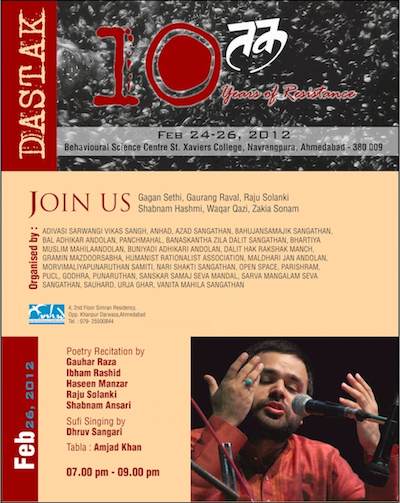
Dastak is a series of programmes commemorating Ten Years of Resistance against the forces of hatred.
Dastak is saluting the resilience of all those especially women who stood up for safeguarding the democracy, the rule of law, the secular. Dastak while remembering the horrific incidents of 2002 carnage, celebrates this resistance by ordinary Gujaratis.
Dastak pays tribute to the memory of those who were killed in the mindless violence perpetrated by hate mongers.
Dastak is an attempt to sensitise people especially the younger generation about the outcomes of communal hatred. Dastak wants people to internalize and understand how the politics of hatred has deep impact on the society as a whole. Hatred does not affect only the ‘other’ but gets reflected in the lives of those who harbor hate in their minds and hearts.
Dastak is an attempt to unite people and spread the message of communal harmony while establishing the fact that justice is a precondition of peace and communal harmony. Dastak is an attempt to invoke Gandhi and the Sufi traditions of Gujarat to spread love and win the heart of the people. Dastak is the beginning of a process which while fighting against injustices of 2002 will attempt to bring closer ordinary Gujaratis so that together they can resist the forces of hatred and celebrate democracy, equality and peace.
Dastak - is the commemoration of ten years of 2002 as well as it is a dastak (knock) on the doors of those in power to realize that all marginalized sections of Gujarat are coming together against the tyranny.
The Programme:
Feb 24,2012
Exhibition: ‘REFLECTIONS OF A JOURNEY’ will be inaugurated by Shweta Bhat at 11am.
Exhibition consists of ten installations. It is conceived & designed by Shabnam Hashmi.
Celebrating Resistance and Democracy: Saluting Women’s Resilience - is a convention from 12 noon to 6pm on the first day. Grassroots women activists will speak at the convention and they will be felicitated for their untiring struggle for peace and justice over the last decade. A documentary made by Arma Ansari on their struggles will be screened. A book is under production about their lives and struggles which will be released at the National programme in Delhi.
7-8 pm
A Candle Light Vigil will be organized In Memory of Victims of Communal Violence
Feb 25, 2012
The second day programme will begin at noon. From 12-4pm a convention Silent Majority Speaks will be organized. The convention will have non-conventional speakers whose voices are not heard otherwise.
From 6 - 9pm: Youth Performs for Communal Harmony
Young poets, singers, bands will perform for peace and communal harmony. The artists include: Ann Prabhakaran, Concern and Act Group, Falak Choksi, Farheen Raj, Minim band, Taha Mansoori
Feb 26, 2012
The third day will begin with poetry recitation by Gauhar Raza, Ibham Rashid, Haseen Manzar, Raju Solanki, Shabnam Ansari
Poetry session will be followed by Sufi Singing. Dhruv Sangari, a disciple of Ustad Nusrat Fateh Ali Khan will perform. He will be accompanied on Tabla by Amjad Khan.
All the programmes are open to public and will be organized in Behavioural Science Centre, St Xaviers College campus, Navrangpura.
The Exhibition will remain open from Feb 24-26, 2012 from 11am to 8pm
Venue:
Behavioural Science Center
St. Xavier’s College Campus, Navrangpura, Ahmedabad.
Programmes Organised by ADIVASI SARWANGI VIKAS SANGH, ANHAD, AZAD SANGATHAN, BAHUSAN SAMAJ SANGATHAN, BAL ADHIKAR ANDOLAN, PANCHMAHAL, BANASKANTHA ZILA DALIT SANGATHAN, BHARTIYA MUSLIM MAHILA ANDOLAN, BUNIYADI ADHIKARI ANDOLAN, CENTRE FOR SOCIAL JUSTICE (CSJ), DALIT HAK RAKSHAK MANCH, EKTA MAHILA SANAGATHAN, GRAMIN MAZDOOR SABAH, JANVIKAS, MALDHARI JAN ANDOLAN, NARI SHAKTI SANGATAHN, PRAGATI PRYAS KENDRA, PUCL-GODHRA, SAMNSKAR SAMAJ SEVA MANDAL, SARVA MANGALAM SEVA SANGATHAN, SAUHARD, URJA GHAR, VANITA MAHILA SANGATHAN
========================================
NATIONAL PROGRAMME
Bol ki Sach Zindaa Hai Ab Tak
Ten Years of Gujarat 2002
March 4, 2012
Constitution Club Lawns, Rafi Marg, New Delhi
10 am to 8 pm
Ten years Journey through the voices of victims, activists, academicians, artists
A Day Long Convention and a Cultural Tribute
Over 250 victims from Gujarat and senior activists will be participating in the convention. Approx 1000 delegates from across India are expected to participate in the convention.
BOOK RELEASE: “Lest we Forget History” written by GAGAN SETHI and PGJ NAMPOOTHIRI
Gagan Sethi and P.G.J. Nampoothiri’s book, written ten years after the carnage, pieces together the evidence to which they had been eye witnesses, they have reported the facts while keeping a tight lid on their personal angst. Individual instances have been recorded about the origin, the execution and the aftermath of Gujarat 2002. Gagan and Nampoothiri at the cost of sleepless nights and frenzied days have recorded this for future generations.
List of speakers:
BRINDA KARAT, FARAH NAQVI, GAGAN SETHI, GAUHAR RAZA, HANIF LAKDAWALA, HARSH MANDER, DR.HARSHVARDHAN HEGDE, JITENDRA AHWAR, KN PANIKKAR, MAHESH BHATT, PGJ NAMPOOTHIRI, RAM VILAS PASWAN, SANJIV BHATT, SHABNAM HASHMI, SHEBA GEORGE, SYEDA HAMID, UTTAM PARMAR, VRINDA GROVER, ZAKIA SOMAN
All the young artists have prepared new pieces for this programme. The artists include AVNI SETHI- a young kathak dancer and a designer, DHRUV SANGARI-sufi singer, IMAAD SHAH- actor, singer, theatre and cinema artist, MANU KOHLI-singer, MEHMOOD FARUQI AND DANISH HUSSAIN- story tellers, NAMRATA PAMNANI- a dancer , SABA AZAD- an actress, singer and dancer from Bollywood and theatre, SANJAY RAJOURA- a standup comedian, TARU DALMIA (DELHI SALTANAT)- a rock band.
You all are invited.
Contact: Waqar Qazi - 09898369090, Manisha Trivedi - 09904166635, Noorjahan Diwan - 09925470219, Gaurang Raval - 08401754999,
November 19, 2011
Closed gates; zipped lips. Quran exhibit shut down in Delhi
From: Outlook | Web | Nov 18, 2011
Essay
The Deadening Silence Of Good Intentions
Closed gates; zipped lips. What happens when an exhibition on the Quran opens in New Delhi.
by C.M. Naim
In September 2011, the Ahmadiyya Muslim Jamaat in India organized an exhibition on the Quran at the Constitution Club of India, New Delhi. It highlighted the teachings of the Quran under a wide range of headings: Justice; Suffering; Death; Science; Peace; Women’s Role and Rank, and so forth. It also put on display the translations of the sacred text in 53 languages—including Tamil, Telugu. Marathi, Russian, Korean and Vietnamese—that the Ahmadis have successfully produced over many decades. [1]
The exhibition was to last three days; it closed after one day and a half. There were raucous demonstrations outside the club by various local Muslim organizations, and the police ordered the exhibition closed. The authorities feared further, and more violent, protests. To their credit, however, the Delhi police did a good job of keeping the demonstrators from physically damaging the exhibits and the organizers. Credit is also due to the Congress MP, Mr Pratap Singh Bajwa, who represents Gurdaspur (Punjab), where Qadiyan is. He helped his constituents by making available the space for the exhibition—one hopes his party did not reprimand him. Also commendable is Mr Wajahat Habibullah, the Chairman of the National Minorities Commission, who visited the exhibition and also publicly spoke in support of it. In both cases, it was an act of personal courage besides being what was officially expected of them. [. . .].
FULL TEXT AT: http://www.outlookindia.com/article.aspx?279021
Essay
The Deadening Silence Of Good Intentions
Closed gates; zipped lips. What happens when an exhibition on the Quran opens in New Delhi.
by C.M. Naim
In September 2011, the Ahmadiyya Muslim Jamaat in India organized an exhibition on the Quran at the Constitution Club of India, New Delhi. It highlighted the teachings of the Quran under a wide range of headings: Justice; Suffering; Death; Science; Peace; Women’s Role and Rank, and so forth. It also put on display the translations of the sacred text in 53 languages—including Tamil, Telugu. Marathi, Russian, Korean and Vietnamese—that the Ahmadis have successfully produced over many decades. [1]
The exhibition was to last three days; it closed after one day and a half. There were raucous demonstrations outside the club by various local Muslim organizations, and the police ordered the exhibition closed. The authorities feared further, and more violent, protests. To their credit, however, the Delhi police did a good job of keeping the demonstrators from physically damaging the exhibits and the organizers. Credit is also due to the Congress MP, Mr Pratap Singh Bajwa, who represents Gurdaspur (Punjab), where Qadiyan is. He helped his constituents by making available the space for the exhibition—one hopes his party did not reprimand him. Also commendable is Mr Wajahat Habibullah, the Chairman of the National Minorities Commission, who visited the exhibition and also publicly spoke in support of it. In both cases, it was an act of personal courage besides being what was officially expected of them. [. . .].
FULL TEXT AT: http://www.outlookindia.com/article.aspx?279021
August 24, 2008
SAHMAT exhibition on MF Hussain attacked! : Join the protest
SAHMAT
8, Vithalbhai Patel House, Rafi Marg
New Delhi-110001
Telephone-23711276/ 23351424
e-mail-sahmat@vsnl.com
24.8..2008
SAHMAT exhibition attacked!
Protest meeting at 11 am on 25th August, at SAHMAT!
SAHMAT had organized an exhibition of reproductions of eminent artist M.F. Husain’s works on 22nd, 23rd and 24th August 2008, to coincide with the India Art Summit at Pragati Maidan, Delhi which had advised galleries not to show his work at their art fair. The exhibition, held in a shamiana outside the SAHMAT office, was vandalised by 8 to 10 miscreants on Sunday, 24th August, at 3.30 pm. The channel ETV, whose crew was present, has recorded the entire episode. The vandals ran away after destroying the framed photographs and prints, a television set, a DVD player and furniture. Artist Arpana Caur and Anil Chandra, SAHMAT member, were witnesses to the episode.
SAHMAT had informed the police in advance, on 20th August, about the exhibition to be held.
In protest against the vandalism and attack on SAHMAT, the exhibition is being extended, in ‘as-is’ condition, for a day – till 25th August. None of the material from the vandalised exhibition is being handed over to the police till the 25th. There will also be a meeting to protest this cowardly attack and against the attempt to impose a narrow, majoritarian view of our culture, at the venue of the exhibition, on Monday, 25th August, at 11 am
Parthiv Shah, M.K.Raina, Madangopal Singh, Anil Chandra,
Vivan Sundaram, Romi Khosla, Kalpana Sahni, Indu Chandrasekhar, Veer Munshi, Madhu Prasad, Inder Salim, K Bikram Singh, Geeta Kapur, Ram Rahman, Shankar Chandra, Rajen Prasad, Arpana Caur, Rajinder Arora, Rajni Arora, Vijay S Jodha, Sohail Hashmi and others
8, Vithalbhai Patel House, Rafi Marg
New Delhi-110001
Telephone-23711276/ 23351424
e-mail-sahmat@vsnl.com
24.8..2008
SAHMAT exhibition attacked!
Protest meeting at 11 am on 25th August, at SAHMAT!
SAHMAT had organized an exhibition of reproductions of eminent artist M.F. Husain’s works on 22nd, 23rd and 24th August 2008, to coincide with the India Art Summit at Pragati Maidan, Delhi which had advised galleries not to show his work at their art fair. The exhibition, held in a shamiana outside the SAHMAT office, was vandalised by 8 to 10 miscreants on Sunday, 24th August, at 3.30 pm. The channel ETV, whose crew was present, has recorded the entire episode. The vandals ran away after destroying the framed photographs and prints, a television set, a DVD player and furniture. Artist Arpana Caur and Anil Chandra, SAHMAT member, were witnesses to the episode.
SAHMAT had informed the police in advance, on 20th August, about the exhibition to be held.
In protest against the vandalism and attack on SAHMAT, the exhibition is being extended, in ‘as-is’ condition, for a day – till 25th August. None of the material from the vandalised exhibition is being handed over to the police till the 25th. There will also be a meeting to protest this cowardly attack and against the attempt to impose a narrow, majoritarian view of our culture, at the venue of the exhibition, on Monday, 25th August, at 11 am
Parthiv Shah, M.K.Raina, Madangopal Singh, Anil Chandra,
Vivan Sundaram, Romi Khosla, Kalpana Sahni, Indu Chandrasekhar, Veer Munshi, Madhu Prasad, Inder Salim, K Bikram Singh, Geeta Kapur, Ram Rahman, Shankar Chandra, Rajen Prasad, Arpana Caur, Rajinder Arora, Rajni Arora, Vijay S Jodha, Sohail Hashmi and others
May 17, 2007
In BJP ruled Madhya Pradesh: Hateful exhibit justified as freedom of expression
Indian Express
May 17, 2007
Here Bajrang Dal fights for right to expression
Milind Ghatwai
BHOPAL, MAY 16: Freedom of expression is relative —- it changes in absolute terms from Vadodara M S University’s Fine Arts Faculty to Bhopal’s Bharat Bhavan, both centres of cultural excellence.
Hindu activists in Bhopal today came out overwhelmingly in support of an exhibition of paintings at Bharat Bhavan titled ‘The Face of Terror’, featuring Muslims as terrorists. Such was the vehemence of their call for an artist’s right to express himself that a Muslim organisation’s protest was drowned in the din.
The exhibition by Kailash Tiwari, an artist who wears his saffron affiliation on his brush, opened last evening in the capital.
Ask him about the paintings, and Tiwari, the Madhya Pradesh convener of the right-wing Rashtriya Swabhiman Andolan, says: “Why does every dead or captured terrorist happen to be a Muslim?” In the past he has led a campaign against M F Husain for depicting Hindu gods and goddesses in the nude, and drawn a sketch of Parliament attack accused Afzal Guru in blood to protest against his clemency plea.
“What image comes to your mind when you think of terror,” repeats Tiwari, standing next to one of his 20 paintings, all featuring figures easily identifiable as Muslims. “Should I draw terrorists sporting a tilak or a dhoti?”
The district convener of the Bajrang Dal, Vishar Purohit, sees nothing wrong. “Why should anyone object to factual representation? The artist has every right to exercise his freedom of expression,” he reasons, while criticising in the same breath the paintings by M S University student Chandramohan, which landed him in jail. “Every Muslim is not a terrorist, but every terrorist is a Muslim,” Purohit and Tiwari add.
Incidentally, Bharat Bhavan did hold back six of Tiwari’s paintings, considering their content explosive. These covered issues like gangrape, cow slaughter and the Godhra train carnage. All paintings are on display on Tiwari’s website, www.kailashtiwari.com.
The painting on display titled ‘Sovereignty Shattered’ depicts the attack on Parliament while ‘Massacre’ shows killings of Hindus in Kashmir. In ‘A Tavesty’, the artist notes that the Tricolour cannot be hoisted in Kashmir except on official occasions. Al-Qaeda head Osama bin Laden also figures in some of the paintings.
Another painting, titled ‘The Tradition’, depicts Muslims flagellating themselves in mourning. “Such a barbaric ritual like drawing blood in public should be banned. Haven’t Hindu practices like sati and bali (sacrifice) been banned by the law?” he says.
Ausaf Shahmiri Khurram of the All India Festival Committee of Muslims was among the few voices objecting to the paintings today. “Were not those who killed Rajiv Gandhi or Indira Gandhi terrorists? What about Naxalites?” he says, demanding that the exhibition be wound up for conveying the impression that all Muslims are terrorists.
Asked about this demand, another Hindu activist, Devendra Rawat, was quick to defend Tiwari. “If you oppose the exhibition, you are supporting terrorism,” he said.
May 17, 2007
Here Bajrang Dal fights for right to expression
Milind Ghatwai
BHOPAL, MAY 16: Freedom of expression is relative —- it changes in absolute terms from Vadodara M S University’s Fine Arts Faculty to Bhopal’s Bharat Bhavan, both centres of cultural excellence.
Hindu activists in Bhopal today came out overwhelmingly in support of an exhibition of paintings at Bharat Bhavan titled ‘The Face of Terror’, featuring Muslims as terrorists. Such was the vehemence of their call for an artist’s right to express himself that a Muslim organisation’s protest was drowned in the din.
The exhibition by Kailash Tiwari, an artist who wears his saffron affiliation on his brush, opened last evening in the capital.
Ask him about the paintings, and Tiwari, the Madhya Pradesh convener of the right-wing Rashtriya Swabhiman Andolan, says: “Why does every dead or captured terrorist happen to be a Muslim?” In the past he has led a campaign against M F Husain for depicting Hindu gods and goddesses in the nude, and drawn a sketch of Parliament attack accused Afzal Guru in blood to protest against his clemency plea.
“What image comes to your mind when you think of terror,” repeats Tiwari, standing next to one of his 20 paintings, all featuring figures easily identifiable as Muslims. “Should I draw terrorists sporting a tilak or a dhoti?”
The district convener of the Bajrang Dal, Vishar Purohit, sees nothing wrong. “Why should anyone object to factual representation? The artist has every right to exercise his freedom of expression,” he reasons, while criticising in the same breath the paintings by M S University student Chandramohan, which landed him in jail. “Every Muslim is not a terrorist, but every terrorist is a Muslim,” Purohit and Tiwari add.
Incidentally, Bharat Bhavan did hold back six of Tiwari’s paintings, considering their content explosive. These covered issues like gangrape, cow slaughter and the Godhra train carnage. All paintings are on display on Tiwari’s website, www.kailashtiwari.com.
The painting on display titled ‘Sovereignty Shattered’ depicts the attack on Parliament while ‘Massacre’ shows killings of Hindus in Kashmir. In ‘A Tavesty’, the artist notes that the Tricolour cannot be hoisted in Kashmir except on official occasions. Al-Qaeda head Osama bin Laden also figures in some of the paintings.
Another painting, titled ‘The Tradition’, depicts Muslims flagellating themselves in mourning. “Such a barbaric ritual like drawing blood in public should be banned. Haven’t Hindu practices like sati and bali (sacrifice) been banned by the law?” he says.
Ausaf Shahmiri Khurram of the All India Festival Committee of Muslims was among the few voices objecting to the paintings today. “Were not those who killed Rajiv Gandhi or Indira Gandhi terrorists? What about Naxalites?” he says, demanding that the exhibition be wound up for conveying the impression that all Muslims are terrorists.
Asked about this demand, another Hindu activist, Devendra Rawat, was quick to defend Tiwari. “If you oppose the exhibition, you are supporting terrorism,” he said.
February 22, 2007
6 day event to remember Gujarat Carnage of 2002
Sach ki Yadein, Yadon ka Sach
PRESS INVITATION
Kindly find herewith, a backgrounder to a six-day (26th February to 3rd March 2007) event to commemorate the fifth anniversary of the Gujarat Carnage of 2002, entitled "Sach ki Yadein, Yadon ka Sach" being organized in Ahmedabad by several organizations.
The programmes will include seminars, a convention with survivors, film-shows, drama, street plays, painting exhibitions, etc. The whole focus of the programme is to serve as platform where all of us stand together for preserving the memory against forgetting.
To introduce the weeklong programmes and to provide their details, we are inviting you to a Press Conference :
On Friday, 23rd February 2007
At 1600 hrs.
At PRASHANT
Near Kamdhenu Hall, Drive-in Road
Ahmedabad 380 052
Tel: 27455913 / 66522333
We sincerely hope you / your Reporter and Photographer will attend this Press Conference.
We further request you to cover the events of the weeklong programmes that are being organized.
Thanking you in anticipation for the same,
For and on behalf of the Organizing Collective
Fr. Cedric Prakash
---------------------------------
Sach ki Yadein, Yadon ka Sach
(26 February - 3 March 2007)
Gujarat 2002 witnessed an estimated killing of 2000 people, rape of approximately 400 women, property damage worth Rs 3800 crores, around 1100 restaurants destroyed, 563 religious places (302 dargahs, 209 mosques, 30 madrassas, 18 temples and 3 churches) destroyed or damaged. About 2.5 lakh people were directly displaced.
Recent surveys reveal that 5,000-10,000 families are still living in around 80 relief camps, not recognized by the state govt. and without any basic civic amenities! Out of a total 4252 FIRs lodged (minuscule, compared to unofficial figures), 2208 cases were summarily closed and most of the accused were released within one year of the carnage. 214 people are still languishing in jails under POTA, all Muslims barring five!
The legacy continues! The politicians are still reaping benefits; academics are still trying to make sense of it for the long-term future of Indian democracy; media persons are still divided over it; activists are still trying to wrest for the victims whatever minuscule doles they can from an otherwise hostile state and the victims are still struggling to make two ends meet or to come to terms with the nightmare they had to undergo.
Meanwhile the memory of it all is being overwritten! It is being touted instead that all is well with the proverbial Gujarati world and the state continues to march on its way to glory. Those raising doubts are portrayed as conspiring to divide the five crore Gujaratis. The pathetic condition of the minorities does not raise any concern rather becomes a solid example to showcase the state as ruthless and hence very focused. And what is the state‚s track record on other fronts? Gujarat‚s status remains as number five in debt. According to NSSO May 2005, each of the 48 lakh farmers in the state is reeling under a debt of Rs. 15526. Officially, in the three years till 30 June 2006, 100 dalits have been murdered. Gujarat is also number five in the worst sex ratio record. At the same time, small-time thugs are not allowing Fanaa and Parzania to be screened inside Gujarat; are forcibly breaking inter-religious marriages apart and working for intense polarization among the tribals against the minorities.
The happenings of 2002 form the larger backdrop against which the events continue to unfold. How do we then pursue, an honest admission of truth and moral responsibility through a collective and public exercise as well as state‚s responsibility for the acts of its organs or agents and for its own failure to prevent or adequately respond to the commission of gross human rights violations, remains the challenge.
One continues to demand for the right to fair and adequate compensation; the right to restoration of the situation existing prior to the violation; the restoration of dignity and the right to a guarantee, by means of appropriate legislative and/or institutional intervention and reform, that the violation will not be repeated. A crucial aspect in all this is the symbolic reparation, especially in the backdrop of the gravest threat of 'erasure from memory and history', encompassing a process of remembering and commemorating the pain. It aims to restore the dignity of victims and serve as a continuing reminder. As we know, post-holocaust Germany is an example of that.
It is in this spirit that this six-day event is being organised. To serve as a platform where all of us stand together for preserving the 'memory' against 'forgetting'.
- - - - - - - - - - - - - - - - - - - - - - - - - - - -
PRASHANT - A Centre for Human Rights, Justice and Peace
Street Address : Hill Nagar, Near Kamdhenu Hall, Drive-in Road, Ahmedabad - 380052, Gujarat, India
Postal Address : P B 4050, Navrangpura PO, Ahmedabad - 380 009, Gujarat, India
Phone : 91 79 27455913, 66522333
Fax : 91 79 27489018
Email: sjprashant@gmail.com
www.humanrightsindia.in
PRESS INVITATION
Kindly find herewith, a backgrounder to a six-day (26th February to 3rd March 2007) event to commemorate the fifth anniversary of the Gujarat Carnage of 2002, entitled "Sach ki Yadein, Yadon ka Sach" being organized in Ahmedabad by several organizations.
The programmes will include seminars, a convention with survivors, film-shows, drama, street plays, painting exhibitions, etc. The whole focus of the programme is to serve as platform where all of us stand together for preserving the memory against forgetting.
To introduce the weeklong programmes and to provide their details, we are inviting you to a Press Conference :
On Friday, 23rd February 2007
At 1600 hrs.
At PRASHANT
Near Kamdhenu Hall, Drive-in Road
Ahmedabad 380 052
Tel: 27455913 / 66522333
We sincerely hope you / your Reporter and Photographer will attend this Press Conference.
We further request you to cover the events of the weeklong programmes that are being organized.
Thanking you in anticipation for the same,
For and on behalf of the Organizing Collective
Fr. Cedric Prakash
---------------------------------
Sach ki Yadein, Yadon ka Sach
(26 February - 3 March 2007)
Gujarat 2002 witnessed an estimated killing of 2000 people, rape of approximately 400 women, property damage worth Rs 3800 crores, around 1100 restaurants destroyed, 563 religious places (302 dargahs, 209 mosques, 30 madrassas, 18 temples and 3 churches) destroyed or damaged. About 2.5 lakh people were directly displaced.
Recent surveys reveal that 5,000-10,000 families are still living in around 80 relief camps, not recognized by the state govt. and without any basic civic amenities! Out of a total 4252 FIRs lodged (minuscule, compared to unofficial figures), 2208 cases were summarily closed and most of the accused were released within one year of the carnage. 214 people are still languishing in jails under POTA, all Muslims barring five!
The legacy continues! The politicians are still reaping benefits; academics are still trying to make sense of it for the long-term future of Indian democracy; media persons are still divided over it; activists are still trying to wrest for the victims whatever minuscule doles they can from an otherwise hostile state and the victims are still struggling to make two ends meet or to come to terms with the nightmare they had to undergo.
Meanwhile the memory of it all is being overwritten! It is being touted instead that all is well with the proverbial Gujarati world and the state continues to march on its way to glory. Those raising doubts are portrayed as conspiring to divide the five crore Gujaratis. The pathetic condition of the minorities does not raise any concern rather becomes a solid example to showcase the state as ruthless and hence very focused. And what is the state‚s track record on other fronts? Gujarat‚s status remains as number five in debt. According to NSSO May 2005, each of the 48 lakh farmers in the state is reeling under a debt of Rs. 15526. Officially, in the three years till 30 June 2006, 100 dalits have been murdered. Gujarat is also number five in the worst sex ratio record. At the same time, small-time thugs are not allowing Fanaa and Parzania to be screened inside Gujarat; are forcibly breaking inter-religious marriages apart and working for intense polarization among the tribals against the minorities.
The happenings of 2002 form the larger backdrop against which the events continue to unfold. How do we then pursue, an honest admission of truth and moral responsibility through a collective and public exercise as well as state‚s responsibility for the acts of its organs or agents and for its own failure to prevent or adequately respond to the commission of gross human rights violations, remains the challenge.
One continues to demand for the right to fair and adequate compensation; the right to restoration of the situation existing prior to the violation; the restoration of dignity and the right to a guarantee, by means of appropriate legislative and/or institutional intervention and reform, that the violation will not be repeated. A crucial aspect in all this is the symbolic reparation, especially in the backdrop of the gravest threat of 'erasure from memory and history', encompassing a process of remembering and commemorating the pain. It aims to restore the dignity of victims and serve as a continuing reminder. As we know, post-holocaust Germany is an example of that.
It is in this spirit that this six-day event is being organised. To serve as a platform where all of us stand together for preserving the 'memory' against 'forgetting'.
- - - - - - - - - - - - - - - - - - - - - - - - - - - -
PRASHANT - A Centre for Human Rights, Justice and Peace
Street Address : Hill Nagar, Near Kamdhenu Hall, Drive-in Road, Ahmedabad - 380052, Gujarat, India
Postal Address : P B 4050, Navrangpura PO, Ahmedabad - 380 009, Gujarat, India
Phone : 91 79 27455913, 66522333
Fax : 91 79 27489018
Email: sjprashant@gmail.com
www.humanrightsindia.in
6 day event to remember Gujarat Carnage of 2002
Sach ki Yadein, Yadon ka Sach
PRESS INVITATION
Kindly find herewith, a backgrounder to a six-day (26th February to 3rd March 2007) event to commemorate the fifth anniversary of the Gujarat Carnage of 2002, entitled "Sach ki Yadein, Yadon ka Sach" being organized in Ahmedabad by several organizations.
The programmes will include seminars, a convention with survivors, film-shows, drama, street plays, painting exhibitions, etc. The whole focus of the programme is to serve as platform where all of us stand together for preserving the memory against forgetting.
To introduce the weeklong programmes and to provide their details, we are inviting you to a Press Conference :
On Friday, 23rd February 2007
At 1600 hrs.
At PRASHANT
Near Kamdhenu Hall, Drive-in Road
Ahmedabad 380 052
Tel: 27455913 / 66522333
We sincerely hope you / your Reporter and Photographer will attend this Press Conference.
We further request you to cover the events of the weeklong programmes that are being organized.
Thanking you in anticipation for the same,
For and on behalf of the Organizing Collective
Fr. Cedric Prakash
---------------------------------
Sach ki Yadein, Yadon ka Sach
(26 February - 3 March 2007)
Gujarat 2002 witnessed an estimated killing of 2000 people, rape of approximately 400 women, property damage worth Rs 3800 crores, around 1100 restaurants destroyed, 563 religious places (302 dargahs, 209 mosques, 30 madrassas, 18 temples and 3 churches) destroyed or damaged. About 2.5 lakh people were directly displaced.
Recent surveys reveal that 5,000-10,000 families are still living in around 80 relief camps, not recognized by the state govt. and without any basic civic amenities! Out of a total 4252 FIRs lodged (minuscule, compared to unofficial figures), 2208 cases were summarily closed and most of the accused were released within one year of the carnage. 214 people are still languishing in jails under POTA, all Muslims barring five!
The legacy continues! The politicians are still reaping benefits; academics are still trying to make sense of it for the long-term future of Indian democracy; media persons are still divided over it; activists are still trying to wrest for the victims whatever minuscule doles they can from an otherwise hostile state and the victims are still struggling to make two ends meet or to come to terms with the nightmare they had to undergo.
Meanwhile the memory of it all is being overwritten! It is being touted instead that all is well with the proverbial Gujarati world and the state continues to march on its way to glory. Those raising doubts are portrayed as conspiring to divide the five crore Gujaratis. The pathetic condition of the minorities does not raise any concern rather becomes a solid example to showcase the state as ruthless and hence very focused. And what is the state‚s track record on other fronts? Gujarat‚s status remains as number five in debt. According to NSSO May 2005, each of the 48 lakh farmers in the state is reeling under a debt of Rs. 15526. Officially, in the three years till 30 June 2006, 100 dalits have been murdered. Gujarat is also number five in the worst sex ratio record. At the same time, small-time thugs are not allowing Fanaa and Parzania to be screened inside Gujarat; are forcibly breaking inter-religious marriages apart and working for intense polarization among the tribals against the minorities.
The happenings of 2002 form the larger backdrop against which the events continue to unfold. How do we then pursue, an honest admission of truth and moral responsibility through a collective and public exercise as well as state‚s responsibility for the acts of its organs or agents and for its own failure to prevent or adequately respond to the commission of gross human rights violations, remains the challenge.
One continues to demand for the right to fair and adequate compensation; the right to restoration of the situation existing prior to the violation; the restoration of dignity and the right to a guarantee, by means of appropriate legislative and/or institutional intervention and reform, that the violation will not be repeated. A crucial aspect in all this is the symbolic reparation, especially in the backdrop of the gravest threat of 'erasure from memory and history', encompassing a process of remembering and commemorating the pain. It aims to restore the dignity of victims and serve as a continuing reminder. As we know, post-holocaust Germany is an example of that.
It is in this spirit that this six-day event is being organised. To serve as a platform where all of us stand together for preserving the 'memory' against 'forgetting'.
- - - - - - - - - - - - - - - - - - - - - - - - - - - -
PRASHANT - A Centre for Human Rights, Justice and Peace
Street Address : Hill Nagar, Near Kamdhenu Hall, Drive-in Road, Ahmedabad - 380052, Gujarat, India
Postal Address : P B 4050, Navrangpura PO, Ahmedabad - 380 009, Gujarat, India
Phone : 91 79 27455913, 66522333
Fax : 91 79 27489018
Email: sjprashant@gmail.com
www.humanrightsindia.in
PRESS INVITATION
Kindly find herewith, a backgrounder to a six-day (26th February to 3rd March 2007) event to commemorate the fifth anniversary of the Gujarat Carnage of 2002, entitled "Sach ki Yadein, Yadon ka Sach" being organized in Ahmedabad by several organizations.
The programmes will include seminars, a convention with survivors, film-shows, drama, street plays, painting exhibitions, etc. The whole focus of the programme is to serve as platform where all of us stand together for preserving the memory against forgetting.
To introduce the weeklong programmes and to provide their details, we are inviting you to a Press Conference :
On Friday, 23rd February 2007
At 1600 hrs.
At PRASHANT
Near Kamdhenu Hall, Drive-in Road
Ahmedabad 380 052
Tel: 27455913 / 66522333
We sincerely hope you / your Reporter and Photographer will attend this Press Conference.
We further request you to cover the events of the weeklong programmes that are being organized.
Thanking you in anticipation for the same,
For and on behalf of the Organizing Collective
Fr. Cedric Prakash
---------------------------------
Sach ki Yadein, Yadon ka Sach
(26 February - 3 March 2007)
Gujarat 2002 witnessed an estimated killing of 2000 people, rape of approximately 400 women, property damage worth Rs 3800 crores, around 1100 restaurants destroyed, 563 religious places (302 dargahs, 209 mosques, 30 madrassas, 18 temples and 3 churches) destroyed or damaged. About 2.5 lakh people were directly displaced.
Recent surveys reveal that 5,000-10,000 families are still living in around 80 relief camps, not recognized by the state govt. and without any basic civic amenities! Out of a total 4252 FIRs lodged (minuscule, compared to unofficial figures), 2208 cases were summarily closed and most of the accused were released within one year of the carnage. 214 people are still languishing in jails under POTA, all Muslims barring five!
The legacy continues! The politicians are still reaping benefits; academics are still trying to make sense of it for the long-term future of Indian democracy; media persons are still divided over it; activists are still trying to wrest for the victims whatever minuscule doles they can from an otherwise hostile state and the victims are still struggling to make two ends meet or to come to terms with the nightmare they had to undergo.
Meanwhile the memory of it all is being overwritten! It is being touted instead that all is well with the proverbial Gujarati world and the state continues to march on its way to glory. Those raising doubts are portrayed as conspiring to divide the five crore Gujaratis. The pathetic condition of the minorities does not raise any concern rather becomes a solid example to showcase the state as ruthless and hence very focused. And what is the state‚s track record on other fronts? Gujarat‚s status remains as number five in debt. According to NSSO May 2005, each of the 48 lakh farmers in the state is reeling under a debt of Rs. 15526. Officially, in the three years till 30 June 2006, 100 dalits have been murdered. Gujarat is also number five in the worst sex ratio record. At the same time, small-time thugs are not allowing Fanaa and Parzania to be screened inside Gujarat; are forcibly breaking inter-religious marriages apart and working for intense polarization among the tribals against the minorities.
The happenings of 2002 form the larger backdrop against which the events continue to unfold. How do we then pursue, an honest admission of truth and moral responsibility through a collective and public exercise as well as state‚s responsibility for the acts of its organs or agents and for its own failure to prevent or adequately respond to the commission of gross human rights violations, remains the challenge.
One continues to demand for the right to fair and adequate compensation; the right to restoration of the situation existing prior to the violation; the restoration of dignity and the right to a guarantee, by means of appropriate legislative and/or institutional intervention and reform, that the violation will not be repeated. A crucial aspect in all this is the symbolic reparation, especially in the backdrop of the gravest threat of 'erasure from memory and history', encompassing a process of remembering and commemorating the pain. It aims to restore the dignity of victims and serve as a continuing reminder. As we know, post-holocaust Germany is an example of that.
It is in this spirit that this six-day event is being organised. To serve as a platform where all of us stand together for preserving the 'memory' against 'forgetting'.
- - - - - - - - - - - - - - - - - - - - - - - - - - - -
PRASHANT - A Centre for Human Rights, Justice and Peace
Street Address : Hill Nagar, Near Kamdhenu Hall, Drive-in Road, Ahmedabad - 380052, Gujarat, India
Postal Address : P B 4050, Navrangpura PO, Ahmedabad - 380 009, Gujarat, India
Phone : 91 79 27455913, 66522333
Fax : 91 79 27489018
Email: sjprashant@gmail.com
www.humanrightsindia.in
January 13, 2007
Remove Hussain's work, VHP tells gallery
(ibnlive.com
January 13, 2007)
Remove Hussain's work, VHP tells gallery
ibnlive.com
Posted Saturday , January 13, 2007 at 22:19
IN THE DOCK: VHP says Hussain’s work of art is “against Indian culture”.
New Delhi: If it’s not him, then it’s his paintings which are often attacked.
The organisers of an art exhibition in Jaipur have withdrawn renowned artist M F Hussain’s three paintings that were to be displayed in the exhibition, following threats from some Hindu organisations, including the Vishwa Hindu Parishad (VHP).
The Hindu organisations said the artist’s work of art is “against Indian culture”.
"I have decided to withdraw these paintings not because the threats I had received, but because I don't want to disturb the show and make it unpleasant for the guests," the organiser of the show Sangeeta Juneja was quoted by news agency PTI as saying.
"I had three paintings of M F Hussain which were actually drawings he had made in 1978 but they will not be the part of the show," added Juneja, who is organising 50th show of her art gallery.
She also said the callers had threatened her that they would set the gallery no fire if she didn’t pay heed to their call.
"It is a shame that there are people who do not understand art are carrying such threats forgetting the contributions made by Hussain in the field of art,” PTI quoted Juneja.
Meanwhile the spokesman of Vishwa Hindu Paridhad Awdesh Pareek said "since these paintings are against Indian culture, we had registered our protest and the organisers accepted to withdraw these from the exhibitions".
M F Hussain has been out of the country, on a self-imposed exile because of the various cases filed against him for hurting Hindu sentiments by certain provocative paintings.
January 13, 2007)
Remove Hussain's work, VHP tells gallery
ibnlive.com
Posted Saturday , January 13, 2007 at 22:19
IN THE DOCK: VHP says Hussain’s work of art is “against Indian culture”.
New Delhi: If it’s not him, then it’s his paintings which are often attacked.
The organisers of an art exhibition in Jaipur have withdrawn renowned artist M F Hussain’s three paintings that were to be displayed in the exhibition, following threats from some Hindu organisations, including the Vishwa Hindu Parishad (VHP).
The Hindu organisations said the artist’s work of art is “against Indian culture”.
"I have decided to withdraw these paintings not because the threats I had received, but because I don't want to disturb the show and make it unpleasant for the guests," the organiser of the show Sangeeta Juneja was quoted by news agency PTI as saying.
"I had three paintings of M F Hussain which were actually drawings he had made in 1978 but they will not be the part of the show," added Juneja, who is organising 50th show of her art gallery.
She also said the callers had threatened her that they would set the gallery no fire if she didn’t pay heed to their call.
"It is a shame that there are people who do not understand art are carrying such threats forgetting the contributions made by Hussain in the field of art,” PTI quoted Juneja.
Meanwhile the spokesman of Vishwa Hindu Paridhad Awdesh Pareek said "since these paintings are against Indian culture, we had registered our protest and the organisers accepted to withdraw these from the exhibitions".
M F Hussain has been out of the country, on a self-imposed exile because of the various cases filed against him for hurting Hindu sentiments by certain provocative paintings.
Subscribe to:
Posts (Atom)