Economic Times - Dec 6, 2013
Riot Survivors: Victims who retain the memory
by CP Bhambhri
An inter-religious violent conflict, commonly described as a communal riot, not only leads to killing of innocent men and women and destruction of property, it leads to flight of those targeted from their residence. They end up in so-called relief camps. It is not only that more than 45 Muslims were killed in the Muzaffarnagar and Shamli riots of September 8, 9, 10, 2013 in Uttar Pradesh, 70,000 residents of these riot affected areas are still living as "displaced" persons in "refugee camps" because they do not feel secure to return to their homes.
According to home minister Sushil Kumar Shinde, there have been 451 communal incidents this year already while the total count last year was 410. The "survivors" of communal riots are not only condemned to live with painful memories of the "dead" but also expected to struggle with their new status as displaced persons, something bound to "condition" their whole personality, attitude and ways of life.
Riot survivors are likely to develop negative attitudes towards society on the basis of their experiences. First, a section of "victim-survivors" are, on the basis of their own bitter experiences, likely to lose their confidence in the capacity of the Indian state to protect the life and property of religious minorities. The victims of riots spoke to PM Manmohan Singh and Sonia Gandhi, when they visited "refugee camps" on September 6 that "we pleaded for help but the police did not come. We had to flee ...."
Second, a section, at least, of aggrieved survivors can be persuaded to take the law into their own hands and act in a vengeful manner. These refugee camps can become a breeding ground for hostile sentiments among the victims. Third, a refuge camp may become a place for shared bitterness among the victims not only against the other religious community but also against the whole system of governance of a country. Rahul Gandhi was "admonished" by the Election Commission and leaders of many political parties when he stated at Muzzaffarnagar that Pakistan's ISI is in contact with angry Muslim victims of the riot. The fact is that the feelings of anger, hurt and humiliation among a section of survivors of communal riots can tempt some to fall prey to forces inimical to society.
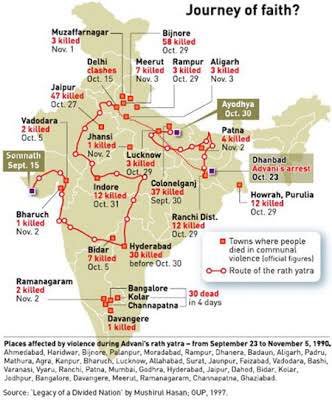
Those killed are no more. Their memory survives. But can it be denied that the Students Islamic Movement of India or the Indian Mujahideen or other violent and religiously motivated groups have emerged on the Indian scene after the 1990s? The Ram-Janmabhumi movement, which led to the destruction of the Babri Mosque at Ayodhya on December 6, 1992 and the large-scale communal riots which took place in the country clearly divided Indian society. Can these contexts be ignored? Fourth, frequent inter-religious riots have led to the ghettoisation of targeted Muslim minorities, who seek security of life by living together. Why are the Muslims of Muzzaffarnagar not volunteering, inspite of financial compensation, to go back to their home and villages? The refugee camps are considered safe because the victimised religious community has developed a feeling of togetherness with their co-religionists.
The worst impact of frequent communal violence is that the victims passively accept that they are fated to live along with the Hindu majority as "second-class citizens". The survivors of such tragedies transmit their experiences of deprivation and dispossession to coming generations and the best evidence is provided by the post-Partition "refugee population" which still remains tied to the bitter memories of the post-1947 communal holocaust. The past continues to haunt and every repetition of the same experiences, if faced by a new generation, strengthens the feeling of difference and separateness among religious communities.
The anti-Sikh riots of 1984 in Delhi are still part of the memory of this community and Muslims of Gujarat continue to live under the impact of post-Godhra riots of 2002. Narendra Modi is identified by the Muslims with the riots of 2002. Why is Modi making extra efforts to mobilise Muslims for his election meetings? Because he wants to erase the bitter memories of the Muslims of Gujarat.
The upshot of the above narrative is clear: frequent occurrences of collective violence in a multi-religious society solidify feelings of otherness and separateness. This is the reason the short-and-long-term consequences of these bitter memories should not be ignored by the political leadership.
|

Showing posts with label memory. Show all posts
Showing posts with label memory. Show all posts
December 18, 2013
June 10, 2013
India: Why a private memorial for victims 1984 anti sikh riots at a sikh religious temple , Why not a public memorial with tax payers money ?
[A memorial for victims anti sikh riots of 1984 is being built at a sikh religious temple in Delhi, Why not build a public memorial with tax payers money. After all these were Indian citizens who were killed. a state funded public memorial would be more appropriate. There should be similar memorials for Nellie, Gujarat and every where else that say religion on identity based violence. -HK]
Punjab Newsline
1984 Anti-Sikh riots: DSGMC determined to go-ahead with memorial construction
Sunday, June,09 2013 - 14:59
By Abhijit Prashar-
NEW DELHI/CHANDIGARH: Delhi Sikh Gurudwara Management Committee (DSGMC) has expressed its determination to go-ahead with the construction of an Anti-Sikh riots memorial inside Gurudwara Rakabganj Sahib complex despite an objection raised by New Delhi Municipal Corporation (NDMC).
The memorial’s foundation stone is slated to be laid on June 12. The ceremony will be attended by Punjab chief minister Parkash Singh Badal, deputy chief minister Sukhbir Singh Badal, who is also the president of Shiromani Akali Dal (SAD), BJP national president Rajnath Singh, leader of the Opposition in Lok Sabha and senior BJP leader Sushma Swaraj and CPM leader Brinda Karat, besides a host of SAD and Shiromani Gurudwara Parbandhak Committee (SGPC) leaders from Punjab.
The objection raised by NDMC has evoked a sharp reaction from SGPC chief Avtar Singh Makkar, who has alleged that no one but the Congress party was behind the notice. He termed it as ‘yet another move by the Congress to throttle the voice of the Sikhs.’
Meanwhile, Delhi chief minister Sheila Dikshit has said that DSGMC was well within its right to construct the proposed memorial inside Gurudwara Rakabganj Sahib complex as long as it did not violate building by-laws. Delhi government is learnt to have asked the NDMC to keep the Union home ministry informed of all developments relating to the issue.
Punjab Newsline
1984 Anti-Sikh riots: DSGMC determined to go-ahead with memorial construction
Sunday, June,09 2013 - 14:59
By Abhijit Prashar-
NEW DELHI/CHANDIGARH: Delhi Sikh Gurudwara Management Committee (DSGMC) has expressed its determination to go-ahead with the construction of an Anti-Sikh riots memorial inside Gurudwara Rakabganj Sahib complex despite an objection raised by New Delhi Municipal Corporation (NDMC).
The memorial’s foundation stone is slated to be laid on June 12. The ceremony will be attended by Punjab chief minister Parkash Singh Badal, deputy chief minister Sukhbir Singh Badal, who is also the president of Shiromani Akali Dal (SAD), BJP national president Rajnath Singh, leader of the Opposition in Lok Sabha and senior BJP leader Sushma Swaraj and CPM leader Brinda Karat, besides a host of SAD and Shiromani Gurudwara Parbandhak Committee (SGPC) leaders from Punjab.
The objection raised by NDMC has evoked a sharp reaction from SGPC chief Avtar Singh Makkar, who has alleged that no one but the Congress party was behind the notice. He termed it as ‘yet another move by the Congress to throttle the voice of the Sikhs.’
Meanwhile, Delhi chief minister Sheila Dikshit has said that DSGMC was well within its right to construct the proposed memorial inside Gurudwara Rakabganj Sahib complex as long as it did not violate building by-laws. Delhi government is learnt to have asked the NDMC to keep the Union home ministry informed of all developments relating to the issue.


March 03, 2013
11 years after riots — a cameo from Gulberg Society (Darshan Desai)
The Hindu, Ahmedabad, March 3, 2013
11 years after riots — a cameo from Gulberg Society
Darshan Desai
http://www.thehindu.com/news/national/other-states/11-years-after-riots-a-cameo-from-gulberg-society/article4471703.ece
11 years after riots — a cameo from Gulberg Society
Darshan Desai
http://www.thehindu.com/news/national/other-states/11-years-after-riots-a-cameo-from-gulberg-society/article4471703.ece
November 14, 2012
India must end the silence on 1984 Anti Sikh Riots
by Vikram Kapur
Many questions still remain unanswered about the 1984 anti-Sikh riots in Delhi. Unless we face them squarely to give the event a sense of an ending, its ghosts will continue to haunt us.
http://www.sacw.net/article3313.html
Many questions still remain unanswered about the 1984 anti-Sikh riots in Delhi. Unless we face them squarely to give the event a sense of an ending, its ghosts will continue to haunt us.
http://www.sacw.net/article3313.html
November 07, 2012
Text of Romila Thapar's intervention at an event marking 10 years of Gujarat Genocide (9 oct in Jamia Milia)
Would those who encouraged the victimisers to kill in Gujarat be willing to apologise or make a conciliatory gesture to the victims? That would be a confession of guilt and guilt is what Narendra Modi is constantly denying
FULL text at: http://www.sacw.net/article3287.html
FULL text at: http://www.sacw.net/article3287.html
February 28, 2012
Report and photos of a daylong memorial event at Gulberg society (27 Feb 2012)


From: Hiren Gandhi
On Behalf Of The Organizers, INSAF KI DAGAR PAR
INSAF KI DAGAR PAR
Sach Ki Yaaden- Yaadon Ka Sach
27 Feb 2012
On the day 2 of our 11 days memorial program, it was a daylong event at Gulberg society where along with Mr. Ehsan Jafri, 68 other people were burnt alive and killed on 28th Feb 2002. Almost 500 survivors of the carnage 2002 were present at Gulberg society. They were from different districts / villages of Gujarat still veiling and waiting for justice and peace. Ms. Teesta Setalwad and some other organizations are planning to start a museum of memories of carnage 2002. There were some 500 photographs of carnage victims of all over Gujarat which were put on the broken-blacken walls of burnt-deserted homes of Gulberg Society. There was a wish-tree of commitment where upon the victims hung their wishes (aarzoo). There was an ongoing AV footage about carnage and its aftermath. There were prayer service (Fateha / Namaaz), on the spot. Interviews of the survivors, religious leaders like Ahmedabad bishop Fr. Thomas Macwan, Film maker Rahul Dholakia, Activists like Harsh Mander, Ilaben Pathak, Dwaraikanath Rath, Prakash Shah, Hiren Gandhi, etc. Media people from different channels and newspapers were present. Prof. Juzar Bandukwala, Trupti Shah and environmental activist Rohit Prajapati came from Baroda. Advocate Mihir Desai from Mumbai was also there. The events went off for around four hours. At around 6 pm, there was a candle light homage and at the end of the day there was a musical concert by eminent artist Shubha Mudgal who sang songs of unity, harmony remorse and inspiration.
Overall the memorial was experience of sharing, struggle and positive energy of resistance and perseverance for justice. The memorial exhibition at Gulberg society will remain open till 2nd of March 2012, everyday from 11 am to 4 pm.
February 27, 2012
CNN-IBN special on ‘Ground Zero Gujarat’ by Rajdeep Sardesai
The CNN IBN special show on 10th anniversary of Gujarat riots was telecast on Feb 25 at 8pm
In February 2002, India witnessed one of the bloodiest and most painful episodes of communal violence unfold in Gujarat. Over 1,000 Hindus and Muslims were killed and hundreds went missing, even as the state looked on. Ten years on, have the wounds healed? Have the guilty been punished? Has Gujarat moved on?
On the 10th anniversary of Gujarat riots CNN-IBN presented ‘Ground Zero Gujarat’, a special show that took viewers back to the places and people affected by the 2002 riots. Editor-in-Chief Rajdeep Sardesai, who witnessed and reported the carnage from dangerously close quarters, returned to the state to find out if Gujarat truly has moved on.
CNN-IBN broadcast on 25th February, Saturday @ 8:00 PM with a repeat telecast on 26th February, Sunday @12:00 PM & 9:30 PM.
In February 2002, India witnessed one of the bloodiest and most painful episodes of communal violence unfold in Gujarat. Over 1,000 Hindus and Muslims were killed and hundreds went missing, even as the state looked on. Ten years on, have the wounds healed? Have the guilty been punished? Has Gujarat moved on?
On the 10th anniversary of Gujarat riots CNN-IBN presented ‘Ground Zero Gujarat’, a special show that took viewers back to the places and people affected by the 2002 riots. Editor-in-Chief Rajdeep Sardesai, who witnessed and reported the carnage from dangerously close quarters, returned to the state to find out if Gujarat truly has moved on.
CNN-IBN broadcast on 25th February, Saturday @ 8:00 PM with a repeat telecast on 26th February, Sunday @12:00 PM & 9:30 PM.
Activists mark 10th anniversary of Gujarat train burning and riots
From: Gulf News
Activists mark 10th anniversary of Gujarat train burning and riots
Urge people to mark February 28 as a day of national integration
By Pamela Raghunath, Correspondent
Published: 00:00 February 28, 2012
Image Credit: AP
A man walks past a poster during a ceremony on Monday in Ahmedabad, where hundreds of survivors of the 2002 riots gathered to mark the 10th anniversary of one of the country’s worst incidents of sectarian violence. AP
Mumbai: The tenth anniversary of the Godhra train burning and sectarian riots that followed was observed in the city with an appeal to people to mark February 28 as a day of national integration — as a grim reminder that something like this must not happen again.
Sanjiv Bhatt, Gujarat's former director general of police, who took on the powerful chief minister head-on, joined a public commemoration demanding justice for victims' families.
Others who joined him, including Tushar Gandhi, the great grandson of Mahatama Gandhi, and noted film-maker Mahesh Bhatt, appealed to all Indians to wear a black ribbon or a black scarf today "to protest against one of the most inhuman incidents in a state which has yet to see real justice", said Abraham Mathai of Harmony Foundation that is organising the commemoration.
At a press conference yesterday, he said 200 student volunteers will wear black T-shirts and distribute arm bands at railway stations today.
"This was one of the cruellest incidents, which unfortunately had the backing of the state. Ten years later, the main perpetrators of this inhuman crime roam free, with no remorse and repentance," Mathai said.
Traumatic incidents
Meanwhile, the commemoration event at Gulberg Society, one of Ahmedabad's localities that was worst affected by the sectarian violence, was held on Monday because of the countrywide trade union shutdown called for Tuesday.
Teesta Setalvad of Citizens for Justice and Peace, who has been fighting a relentless battle to get justice for the victims, said: "We decided to collectively commemorate the 300 traumatic bouts of violence over 19 districts [in Gujarat] in a Live Memorial at Gulberg Society."
This is because earlier attempts to pay respects at the burnt S-6 coach of the Sabarmati Express in Godhra were foiled by arrests.
Reconciliation and reparation appear a distant dream when collective memorials are thus forbidden, she said.
The digital installations and exhibits at Gulberg Housing Society, where 58 people were massacred in 2002, show the chronology of the rehabilitation and justice process. A photography show on the internally displaced people in various transit camps was also presented. Missing persons were remembered through a ritualistic ‘wailing wall'.
Justice Hosbet Suresh said in a statement: "The dead cannot be resurrected but the living should hope to have a dignified future while their struggle seems to be eternal for justice and survival. We are here to express our solidarity with them and in that to make the government accountable."
Activists mark 10th anniversary of Gujarat train burning and riots
Urge people to mark February 28 as a day of national integration
By Pamela Raghunath, Correspondent
Published: 00:00 February 28, 2012
Image Credit: AP
A man walks past a poster during a ceremony on Monday in Ahmedabad, where hundreds of survivors of the 2002 riots gathered to mark the 10th anniversary of one of the country’s worst incidents of sectarian violence. AP
Mumbai: The tenth anniversary of the Godhra train burning and sectarian riots that followed was observed in the city with an appeal to people to mark February 28 as a day of national integration — as a grim reminder that something like this must not happen again.
Sanjiv Bhatt, Gujarat's former director general of police, who took on the powerful chief minister head-on, joined a public commemoration demanding justice for victims' families.
Others who joined him, including Tushar Gandhi, the great grandson of Mahatama Gandhi, and noted film-maker Mahesh Bhatt, appealed to all Indians to wear a black ribbon or a black scarf today "to protest against one of the most inhuman incidents in a state which has yet to see real justice", said Abraham Mathai of Harmony Foundation that is organising the commemoration.
At a press conference yesterday, he said 200 student volunteers will wear black T-shirts and distribute arm bands at railway stations today.
"This was one of the cruellest incidents, which unfortunately had the backing of the state. Ten years later, the main perpetrators of this inhuman crime roam free, with no remorse and repentance," Mathai said.
Traumatic incidents
Meanwhile, the commemoration event at Gulberg Society, one of Ahmedabad's localities that was worst affected by the sectarian violence, was held on Monday because of the countrywide trade union shutdown called for Tuesday.
Teesta Setalvad of Citizens for Justice and Peace, who has been fighting a relentless battle to get justice for the victims, said: "We decided to collectively commemorate the 300 traumatic bouts of violence over 19 districts [in Gujarat] in a Live Memorial at Gulberg Society."
This is because earlier attempts to pay respects at the burnt S-6 coach of the Sabarmati Express in Godhra were foiled by arrests.
Reconciliation and reparation appear a distant dream when collective memorials are thus forbidden, she said.
The digital installations and exhibits at Gulberg Housing Society, where 58 people were massacred in 2002, show the chronology of the rehabilitation and justice process. A photography show on the internally displaced people in various transit camps was also presented. Missing persons were remembered through a ritualistic ‘wailing wall'.
Justice Hosbet Suresh said in a statement: "The dead cannot be resurrected but the living should hope to have a dignified future while their struggle seems to be eternal for justice and survival. We are here to express our solidarity with them and in that to make the government accountable."
India: Giving up on the battle for justice in Gujarat at our own peril
The Hindu, February 28, 2012
The battle against forgetting
by Farah Naqvi
If we accept Gujarat 2002 as something ‘in the past,' as some would like us to, we threaten the meaning of our present, and endanger our future.
Dateline: Shah-e-Alam Relief Camp, Ahmedabad, March 27, 2002:
Among the human debris scattered around the courtyard of the Shah-e-Alam relief camp in Ahmedabad, the largest with over 10,000 survivors, are Saira (age 12), Afsana (age 11), Naina (age 12), Anju (age 12), Rukhsat (age 9), Nilofer (age 10), Nilofer (age 9), Hena (age 11). They are all survivors from Naroda Patiya. And they have seen things no child should see. They know words no child should have to learn.
“Balatkar” (Rape) — they know this word. “Mein bataoon didi?” (Shall I tell you?), volunteers a nine year old. “Balatkar ka matlab jab aurat ko nanga karte hain aur phir use jala dete hain” (Rape is when a woman is stripped naked and then burnt). And then she looks fixedly at the floor. Only a child can tell it like it is. For this is what happened again and again in Naroda Patiya — women were stripped, raped and burnt.” (The Survivors Speak, fact-finding by a women's panel, April 16, 2002. P. 13)
Nothing was left of these mutilated women — no bodies, no evidence, no justice. Nothing but the scars on this little girl's mind. I still remember her face, and today 10 years later, I wonder where she is, how she is making her way through life, scarred by this macabre, twisted image of rape. I wonder where those men are, the ones who butchered so many childhoods and got away with it. I wonder, again and again, at the State, whose constitutional duty it was to protect, that colluded in the massacre of its own citizens.
Remains a wound
Ten years to the pogrom in Gujarat, I try to look back. But for me, like for thousands of survivors and activists, it is impossible. How does one look back at something that is so much a part of one's present? And so, Gujarat remains a wound that stays with me always, deep and continuous. I cried often in 2002. I still cry. And I guess that is all right. Because Gujarat should make us collectively weep. And make us truly ashamed of ourselves as a nation.
What happened 10 years ago is the kind of upheaval that refuses to be historicised. That cannot be consigned to the pages of any history book with a full stop at the end. In part because the violence of Gujarat continued for long after February-March 2002, and is continuing today in the frightened little lives lived by scores of destroyed Muslim families; in the lives of thousands of men, women and children still languishing in ‘resettlement colonies' relegated to the margins of Gujarat's seemingly flourishing towns and cities. In part, because many battles for justice are still being bravely waged in the courts, and the narrative is still unfolding. But in greatest part because the ‘meaning' of what Gujarat did to India remains contested.
People say — “move on, get a life, why do activists keep raking up this ‘unpleasant' past? It's been 10 years.” Why? Because if we settle for the past as some would like it scripted, we threaten the meaning of our present, and endanger our future. These contestations are not just about many battles in courtrooms that must be waged. The contestation is about the meaning of citizenship. It is about the relationship between citizen and State. It is about challenging State impunity. Gujarat is the battle for collective memory against forgetting because it is ultimately the battle for the idea of India.
In 1950, India made a constitutional promise to protect the rights of its minorities to live with dignity and with full rights of citizenship. Time and again, that sacred promise has been violated — in Delhi, Nellie, Meerut, Bhagalpur, Hashimpura, Kandhamal, Gujarat and most recently in Gopalgarh (Sept. 2011). In each case, innocents were murdered, maimed, sexually assaulted, burnt out of hearth and home, scattered to the winds, simply because of their minority identity, because of who they were. In each episode of targeted violence, the officers of the State acted in a biased manner, failing in their duty to protect, to prosecute, and to give justice. How long can this go on? How long will those in political power use the might of the State, the guns, and the police, and sirens against one group of citizens and get away with it? Institutional biases of the State machinery cannot be acceptable in any civilised democracy — that is the lesson of Gujarat.
The challenges
The massacre in Gujarat poses many challenges to us as a nation, exposing holes in our hearts, in our social fabric, as well as in our criminal justice system, laws and jurisprudence. Now we cannot legislate against communal prejudice and hatred in the hearts and minds of people. That is a battle that we as a society and a people must wage in a million different ways at a million different moments in our collective and individual lives. But we can and we must legislate to ensure justice to the weak.
Elusive justice
Unlike any other violent episode in India's recent history, Gujarat 2002 tested the strength and resilience of many of our democratic institutions to the fullest. The National Human Rights Commission, the honourable Supreme Court, and the National Commission for Minorities. Each came forward and acted. And yet somehow, that thing called justice still eludes the victims of Gujarat. These victims and survivors call upon us to restore equality in the working of the law for all citizens; to create a legal remedy for institutional bias by the State; to fill the lacunae in our laws and our jurisprudence that has failed time and again to ensure criminal culpability for those in command, those who are never caught with the knives in their hands, but who instruct others to lie, and kill and misuse the law for electoral gain. These are not very tall orders. For, if we get this right it will help realise, better than we have so far, the constitutional promise of justice and equality before law. And without justice, we cannot move on.
A survivor's courage
On January 18, 2008, Bilkis Bano, a Gujarat survivor who had the courage to speak of the unspeakable, withstanding over 20 days of gruelling cross-examination, found a little justice, when 12 accused who had gang-raped her, murdered and raped 14 members of her family, and smashed her three-year-old daughter to the ground during the horrifying days of 2002, were finally awarded life sentences by a Mumbai Session court.
On January 21, 2008, at a press conference in Delhi, Bilkis made this statement:
“For the last six years I have lived in fear, shuttling from one temporary home to the other, carrying my children with me, trying to protect them from the hatred that I know still exists in the hearts and minds of so many people. This judgment does not mean the end of hatred but it does mean that somewhere, somehow justice can prevail. This judgment is a victory for not only me but for all those innocent Muslims who were massacred and all those women whose bodies were violated only because, like me, they were Muslim. It is a victory because now, hereafter, no one can deny what happened to women in Gujarat in those terrible days and nights of 2002. Because now it will forever be imprinted on the historical record of Gujarat that sexual violence was used as a weapon against us. I pray that the people of Gujarat will some day be unable to live with the stigma of that violence and hatred, and will root it out from the very soil of a State that still remains my home.”
We give up on the battle for justice in Gujarat at our own peril. For in giving up on Gujarat, we give up on hope for a better India — an India that is by right home to each one of us.
(The author is a member of the National Advisory Council. Views expressed here are personal.)
The battle against forgetting
by Farah Naqvi
If we accept Gujarat 2002 as something ‘in the past,' as some would like us to, we threaten the meaning of our present, and endanger our future.
Dateline: Shah-e-Alam Relief Camp, Ahmedabad, March 27, 2002:
Among the human debris scattered around the courtyard of the Shah-e-Alam relief camp in Ahmedabad, the largest with over 10,000 survivors, are Saira (age 12), Afsana (age 11), Naina (age 12), Anju (age 12), Rukhsat (age 9), Nilofer (age 10), Nilofer (age 9), Hena (age 11). They are all survivors from Naroda Patiya. And they have seen things no child should see. They know words no child should have to learn.
“Balatkar” (Rape) — they know this word. “Mein bataoon didi?” (Shall I tell you?), volunteers a nine year old. “Balatkar ka matlab jab aurat ko nanga karte hain aur phir use jala dete hain” (Rape is when a woman is stripped naked and then burnt). And then she looks fixedly at the floor. Only a child can tell it like it is. For this is what happened again and again in Naroda Patiya — women were stripped, raped and burnt.” (The Survivors Speak, fact-finding by a women's panel, April 16, 2002. P. 13)
Nothing was left of these mutilated women — no bodies, no evidence, no justice. Nothing but the scars on this little girl's mind. I still remember her face, and today 10 years later, I wonder where she is, how she is making her way through life, scarred by this macabre, twisted image of rape. I wonder where those men are, the ones who butchered so many childhoods and got away with it. I wonder, again and again, at the State, whose constitutional duty it was to protect, that colluded in the massacre of its own citizens.
Remains a wound
Ten years to the pogrom in Gujarat, I try to look back. But for me, like for thousands of survivors and activists, it is impossible. How does one look back at something that is so much a part of one's present? And so, Gujarat remains a wound that stays with me always, deep and continuous. I cried often in 2002. I still cry. And I guess that is all right. Because Gujarat should make us collectively weep. And make us truly ashamed of ourselves as a nation.
What happened 10 years ago is the kind of upheaval that refuses to be historicised. That cannot be consigned to the pages of any history book with a full stop at the end. In part because the violence of Gujarat continued for long after February-March 2002, and is continuing today in the frightened little lives lived by scores of destroyed Muslim families; in the lives of thousands of men, women and children still languishing in ‘resettlement colonies' relegated to the margins of Gujarat's seemingly flourishing towns and cities. In part, because many battles for justice are still being bravely waged in the courts, and the narrative is still unfolding. But in greatest part because the ‘meaning' of what Gujarat did to India remains contested.
People say — “move on, get a life, why do activists keep raking up this ‘unpleasant' past? It's been 10 years.” Why? Because if we settle for the past as some would like it scripted, we threaten the meaning of our present, and endanger our future. These contestations are not just about many battles in courtrooms that must be waged. The contestation is about the meaning of citizenship. It is about the relationship between citizen and State. It is about challenging State impunity. Gujarat is the battle for collective memory against forgetting because it is ultimately the battle for the idea of India.
In 1950, India made a constitutional promise to protect the rights of its minorities to live with dignity and with full rights of citizenship. Time and again, that sacred promise has been violated — in Delhi, Nellie, Meerut, Bhagalpur, Hashimpura, Kandhamal, Gujarat and most recently in Gopalgarh (Sept. 2011). In each case, innocents were murdered, maimed, sexually assaulted, burnt out of hearth and home, scattered to the winds, simply because of their minority identity, because of who they were. In each episode of targeted violence, the officers of the State acted in a biased manner, failing in their duty to protect, to prosecute, and to give justice. How long can this go on? How long will those in political power use the might of the State, the guns, and the police, and sirens against one group of citizens and get away with it? Institutional biases of the State machinery cannot be acceptable in any civilised democracy — that is the lesson of Gujarat.
The challenges
The massacre in Gujarat poses many challenges to us as a nation, exposing holes in our hearts, in our social fabric, as well as in our criminal justice system, laws and jurisprudence. Now we cannot legislate against communal prejudice and hatred in the hearts and minds of people. That is a battle that we as a society and a people must wage in a million different ways at a million different moments in our collective and individual lives. But we can and we must legislate to ensure justice to the weak.
Elusive justice
Unlike any other violent episode in India's recent history, Gujarat 2002 tested the strength and resilience of many of our democratic institutions to the fullest. The National Human Rights Commission, the honourable Supreme Court, and the National Commission for Minorities. Each came forward and acted. And yet somehow, that thing called justice still eludes the victims of Gujarat. These victims and survivors call upon us to restore equality in the working of the law for all citizens; to create a legal remedy for institutional bias by the State; to fill the lacunae in our laws and our jurisprudence that has failed time and again to ensure criminal culpability for those in command, those who are never caught with the knives in their hands, but who instruct others to lie, and kill and misuse the law for electoral gain. These are not very tall orders. For, if we get this right it will help realise, better than we have so far, the constitutional promise of justice and equality before law. And without justice, we cannot move on.
A survivor's courage
On January 18, 2008, Bilkis Bano, a Gujarat survivor who had the courage to speak of the unspeakable, withstanding over 20 days of gruelling cross-examination, found a little justice, when 12 accused who had gang-raped her, murdered and raped 14 members of her family, and smashed her three-year-old daughter to the ground during the horrifying days of 2002, were finally awarded life sentences by a Mumbai Session court.
On January 21, 2008, at a press conference in Delhi, Bilkis made this statement:
“For the last six years I have lived in fear, shuttling from one temporary home to the other, carrying my children with me, trying to protect them from the hatred that I know still exists in the hearts and minds of so many people. This judgment does not mean the end of hatred but it does mean that somewhere, somehow justice can prevail. This judgment is a victory for not only me but for all those innocent Muslims who were massacred and all those women whose bodies were violated only because, like me, they were Muslim. It is a victory because now, hereafter, no one can deny what happened to women in Gujarat in those terrible days and nights of 2002. Because now it will forever be imprinted on the historical record of Gujarat that sexual violence was used as a weapon against us. I pray that the people of Gujarat will some day be unable to live with the stigma of that violence and hatred, and will root it out from the very soil of a State that still remains my home.”
We give up on the battle for justice in Gujarat at our own peril. For in giving up on Gujarat, we give up on hope for a better India — an India that is by right home to each one of us.
(The author is a member of the National Advisory Council. Views expressed here are personal.)
July 03, 2011
Some paths to forgiveness
The Hindu
July 2, 2011
Barefoot
HARSH MANDER
Enormous conspiracies of silence surround violence against women...
Photo: PTI Enormous conspiracies of silence surround violence against women...
Is there a way to build trust, confidence and eventually empathy between previously embroiled people?
In most cultures, through many phases in human history, warring and bitterly estranged peoples have from time to time wearied of battles and hate, of destruction and fear. They have instead buried their weapons and collectively sought or rediscovered ways of living together with peace, faith and goodwill. In the wake of the violence of Partition, and innumerable communal pogroms which followed, this is a path which Hindu and Muslim communities in India must still traverse.
I continue in this column from last fortnight, to search for ways in which these sporadically estranged religious communities in India can be bought together. A peace activist friend — who has devoted the best years of his life to attempts to strengthen Hindu-Muslim unity in India — in a moment of dark despair said to me, “I have given up hoping that Hindus and Muslims will love each other. Today for me it is enough that they do not kill one another.” I seek reconciliation well beyond this, one that positively builds trust, confidence and eventually empathy between previously embroiled people; a genuine meeting again of hearts and minds.
Half-truths of memory
In Ludhiana in Punjab, India, speaking to an audience on the need for reclaiming and defending a secular India, I recall being confronted by an elderly man in the audience who wept painfully, “My family was uprooted from Pakistan in 1947, and it lost many lives in the hands of the Muslims. What can I tell my children? How do you expect me to tell them to forgive and forget?” I replied that my own family belonged to Rawalpindi and suffered in similar ways. I added: “But why should Muslim men, women and children today deserve hatred and, even worse retribution, for crimes that other Muslim people may have committed decades ago? And more importantly, why is your memory so selective? If you must recall to your children the crimes suffered by Hindus and Sikhs during Partition, should you not recount to them also the fact that their Hindu and Sikh ancestors committed exactly the same unspeakable atrocities against Muslims on this side of the border?”
The falsehoods and half-truths of memory rob the ‘other' of not just equal citizenship, but even elementary humanity. The extraordinary support of many women of the majority Hindu community in Gujarat in 2002 for acts of mass sexual violence suggests the potency of the toxins of hate that seeped deep into the souls of even women of the majority religious community. They stopped seeing Muslim women in their own likeness, as women and as human. It drove them to regard Muslim women as deserving of the same violence which, had it been instead targeted towards themselves, would have humiliated and crushed them.
Ideas of reconciliation and forgiveness — as well as justice — are intrinsic in varied but related ways to virtually every major strand of diverse religious and secular convictions that have impinged through the centuries on the consciousness of Indian people. These include various tribal faiths, Buddhist, Jain, Vedic, Islamic, Christian, Parsi, Sikh, reformist Bhakti, Sufi, agnostic, atheistic and sceptical philosophical traditions.
In an inconsolable country grieving bitterly for a million lives extinguished by Partition, homes and homelands lost forever and a country dismembered by the divisive politics of hate, Gandhi's last battle before his assassination in January 1948 was for the rights of the Muslim people, and not even those who had chosen secular democratic India as their home, but those who had opted for the religious state of Pakistan. The conviction that drove him all his life was “There is no way to peace. Peace is the way”. He spoke of peace as “a heavy downpour of rain which drenches the soil to fullness, likewise only a profuse shower of love overcomes hatred”. His comments on forgiving and forgetting are illuminating: “To forgive is not to forget. The merit lies in loving in spite of the vivid knowledge that the one that must be loved is not a friend. There is no merit in loving an enemy when you forget him for a friend”.
I propose that paths to authentic forgiveness and reconciliation must traverse at least four milestones: acknowledgement; remorse; reparation; and justice. The first, acknowledgement, is a public acceptance — by direct perpetrators, by State authorities, but also by people and organisations who openly or tacitly ratify the violence or were silent or indifferent as it unfolded — that grave and unjust violence and discrimination actually took place, causing unconscionable suffering to those who were targeted by the violence. The second, remorse, is a public expression of collective sincere regret or contrition for the hate, violence, injustice and suffering that transpired.
Reparation entails adequate and timely assistance to enable victim survivors to rebuild shelters, livelihoods, common resources, habitats and cultural environments that are at levels at least comparable (and, I believe, better) than what they enjoyed prior to the conflict. There can be no compensation for loss of loved ones, homes and valued ways of life. But reparation should still address, with humility and sensitivity, these losses to the extent that is humanly possible, to assist the survivors to heal and hope again.
Not just the impersonal State but also perpetrators or people who share the identity of the wrong-doers, should be actively mobilised in a process of rebuilding. In the aftermath of the Gujarat 2002 massacre, we made a call to Hindu village folk in the region surrounding Godhra, the epicentre of the upheaval, to contribute their voluntary labour to rebuilding the destroyed homes of their Muslim neighbours. That Hindus volunteered their labour through shramdaan in 80 villages was intensely healing for the battered survivors.
Justice involves application and protection of the law, so that those who committed hate crimes are punished, and public officials charged with preventing and controlling communal violence, are held accountable. It also entails restoring peace: a sustainable environment of harmony and amity founded on legal and social justice, guarantees of non-repetition, freedom from fear and distrust between communities, and strengthening of social, economic and cultural bonds between them.
Specious arguement
Those who oppose post-violence human rights struggles often suggest that efforts for legal justice, undertaken long after visible violence has ceased on the streets, only revive enmities and cause further unrest and tensions rather than encourage peace. These threaten the fragile peace that is constructed with so much difficulty in post-conflict societies. This argument reminds me of beliefs that a family in which a woman accepts repeated violence in the hands of her spouse without complaint or resistance is a peaceful one, and a household in which she is encouraged or supported (or instigated?) to be emboldened enough to speak out is one in which the peace and sanctity of family life is being imperilled and destroyed.
Indeed the pleas for shrouding throbbing pasts in suffocating silence are particularly unjust for women survivors of communal violence. There are even in normal times, enormous conspiracies of silence that surround violence against women, whether in homes, work places or on the streets. In all communal squalls, the bodies of women are specially targeted. Women's bodies are refashioned as the property of the hated ‘other' and as symbols of their honour, therefore attacks on these aim to humiliate the men who ‘own' them and help break their spirit. Imposed consent for silence as forms of spurious reconciliation are likely to muffle the unhealed agony of women survivors most of all.
It is only when the crimes of the past are acknowledged, and atonement made with public expressions of genuine remorse, when the State, the perpetrator and survivor all join hands to rebuild broken lives, and when justice is done and seen to have been done, is it possible for those who suffer to forgive, to heal, to trust and possibly to even love again.
July 2, 2011
Barefoot
HARSH MANDER
Enormous conspiracies of silence surround violence against women...
Photo: PTI Enormous conspiracies of silence surround violence against women...
Is there a way to build trust, confidence and eventually empathy between previously embroiled people?
In most cultures, through many phases in human history, warring and bitterly estranged peoples have from time to time wearied of battles and hate, of destruction and fear. They have instead buried their weapons and collectively sought or rediscovered ways of living together with peace, faith and goodwill. In the wake of the violence of Partition, and innumerable communal pogroms which followed, this is a path which Hindu and Muslim communities in India must still traverse.
I continue in this column from last fortnight, to search for ways in which these sporadically estranged religious communities in India can be bought together. A peace activist friend — who has devoted the best years of his life to attempts to strengthen Hindu-Muslim unity in India — in a moment of dark despair said to me, “I have given up hoping that Hindus and Muslims will love each other. Today for me it is enough that they do not kill one another.” I seek reconciliation well beyond this, one that positively builds trust, confidence and eventually empathy between previously embroiled people; a genuine meeting again of hearts and minds.
Half-truths of memory
In Ludhiana in Punjab, India, speaking to an audience on the need for reclaiming and defending a secular India, I recall being confronted by an elderly man in the audience who wept painfully, “My family was uprooted from Pakistan in 1947, and it lost many lives in the hands of the Muslims. What can I tell my children? How do you expect me to tell them to forgive and forget?” I replied that my own family belonged to Rawalpindi and suffered in similar ways. I added: “But why should Muslim men, women and children today deserve hatred and, even worse retribution, for crimes that other Muslim people may have committed decades ago? And more importantly, why is your memory so selective? If you must recall to your children the crimes suffered by Hindus and Sikhs during Partition, should you not recount to them also the fact that their Hindu and Sikh ancestors committed exactly the same unspeakable atrocities against Muslims on this side of the border?”
The falsehoods and half-truths of memory rob the ‘other' of not just equal citizenship, but even elementary humanity. The extraordinary support of many women of the majority Hindu community in Gujarat in 2002 for acts of mass sexual violence suggests the potency of the toxins of hate that seeped deep into the souls of even women of the majority religious community. They stopped seeing Muslim women in their own likeness, as women and as human. It drove them to regard Muslim women as deserving of the same violence which, had it been instead targeted towards themselves, would have humiliated and crushed them.
Ideas of reconciliation and forgiveness — as well as justice — are intrinsic in varied but related ways to virtually every major strand of diverse religious and secular convictions that have impinged through the centuries on the consciousness of Indian people. These include various tribal faiths, Buddhist, Jain, Vedic, Islamic, Christian, Parsi, Sikh, reformist Bhakti, Sufi, agnostic, atheistic and sceptical philosophical traditions.
In an inconsolable country grieving bitterly for a million lives extinguished by Partition, homes and homelands lost forever and a country dismembered by the divisive politics of hate, Gandhi's last battle before his assassination in January 1948 was for the rights of the Muslim people, and not even those who had chosen secular democratic India as their home, but those who had opted for the religious state of Pakistan. The conviction that drove him all his life was “There is no way to peace. Peace is the way”. He spoke of peace as “a heavy downpour of rain which drenches the soil to fullness, likewise only a profuse shower of love overcomes hatred”. His comments on forgiving and forgetting are illuminating: “To forgive is not to forget. The merit lies in loving in spite of the vivid knowledge that the one that must be loved is not a friend. There is no merit in loving an enemy when you forget him for a friend”.
I propose that paths to authentic forgiveness and reconciliation must traverse at least four milestones: acknowledgement; remorse; reparation; and justice. The first, acknowledgement, is a public acceptance — by direct perpetrators, by State authorities, but also by people and organisations who openly or tacitly ratify the violence or were silent or indifferent as it unfolded — that grave and unjust violence and discrimination actually took place, causing unconscionable suffering to those who were targeted by the violence. The second, remorse, is a public expression of collective sincere regret or contrition for the hate, violence, injustice and suffering that transpired.
Reparation entails adequate and timely assistance to enable victim survivors to rebuild shelters, livelihoods, common resources, habitats and cultural environments that are at levels at least comparable (and, I believe, better) than what they enjoyed prior to the conflict. There can be no compensation for loss of loved ones, homes and valued ways of life. But reparation should still address, with humility and sensitivity, these losses to the extent that is humanly possible, to assist the survivors to heal and hope again.
Not just the impersonal State but also perpetrators or people who share the identity of the wrong-doers, should be actively mobilised in a process of rebuilding. In the aftermath of the Gujarat 2002 massacre, we made a call to Hindu village folk in the region surrounding Godhra, the epicentre of the upheaval, to contribute their voluntary labour to rebuilding the destroyed homes of their Muslim neighbours. That Hindus volunteered their labour through shramdaan in 80 villages was intensely healing for the battered survivors.
Justice involves application and protection of the law, so that those who committed hate crimes are punished, and public officials charged with preventing and controlling communal violence, are held accountable. It also entails restoring peace: a sustainable environment of harmony and amity founded on legal and social justice, guarantees of non-repetition, freedom from fear and distrust between communities, and strengthening of social, economic and cultural bonds between them.
Specious arguement
Those who oppose post-violence human rights struggles often suggest that efforts for legal justice, undertaken long after visible violence has ceased on the streets, only revive enmities and cause further unrest and tensions rather than encourage peace. These threaten the fragile peace that is constructed with so much difficulty in post-conflict societies. This argument reminds me of beliefs that a family in which a woman accepts repeated violence in the hands of her spouse without complaint or resistance is a peaceful one, and a household in which she is encouraged or supported (or instigated?) to be emboldened enough to speak out is one in which the peace and sanctity of family life is being imperilled and destroyed.
Indeed the pleas for shrouding throbbing pasts in suffocating silence are particularly unjust for women survivors of communal violence. There are even in normal times, enormous conspiracies of silence that surround violence against women, whether in homes, work places or on the streets. In all communal squalls, the bodies of women are specially targeted. Women's bodies are refashioned as the property of the hated ‘other' and as symbols of their honour, therefore attacks on these aim to humiliate the men who ‘own' them and help break their spirit. Imposed consent for silence as forms of spurious reconciliation are likely to muffle the unhealed agony of women survivors most of all.
It is only when the crimes of the past are acknowledged, and atonement made with public expressions of genuine remorse, when the State, the perpetrator and survivor all join hands to rebuild broken lives, and when justice is done and seen to have been done, is it possible for those who suffer to forgive, to heal, to trust and possibly to even love again.
August 28, 2008
Gujarat: celebration of victimhood isn’t helping - NGOs need to understand
Just let me be
by Ayesha Khan
Indian Express, August 29, 2008
Continual celebration of victimhood isn’t helping Gujarat. NGOs need to understand this
Perhaps it is the times we live in. Tragedies now engender anniversary celebrations. There’s a new social class of vocal, visible victims. And publicly parading pain is the new thing. So in Gujarat on August 26, a month after the Ahmedabad blasts, there were functions, official and NGO-sponsored. One of the latter variety was organised by the Citizens for Justice and Peace (CJP) in Quresh Hall, Ahmedabad. There, 2002 riot victims met 2008 terror victims.
What was the idea? Fostering secular bonding? Who can argue against that? But one can and must point out that life, and life in Gujarat, is not Amar, Akbar, Anthony. Manmohan Desai had the three brothers of different faiths united via an impossible conjunction of medicine and maa — siblings simultaneously donating blood to their mother, tubes running from their arms to their mother’s. Such ideas of the heroic potential of inter-faith bonding seemed quite apt when the organisers of the Quresh Hall meeting said that the attempt was to “bridge the gap” and “get them talking to each other in empathy, with sympathy”. “Our grief is same, our pain is same, our tragedies are similar, even if our faiths are different.”
Read the subtext. Riot victims of 2002 are Muslims who were victims of the state, the system and the majority Hindus. Victims of the Ahmedabad bombs in 2008 are Hindus, the perpetrators are Muslims. So, Muslims are victims, Hindus are victims, the bad guys may be different, but we all stand united — in fear, in tragedy. In Gujarat, it seems only fear and tragedy can secure the bonds.
Gujarat, let’s say it again, is becoming a strange place. The strange response to its brand of politics is now not only from society, but also from even civil society groups. Gujarat is perhaps the only Indian state to have the intriguing distinction of a memorial planned for riot victims — as CJP plans one in Ahmedabad’s Gulberg Society, the site of one of the most gruesome riots in 2002, where ex-MP Ehsan Jafri died. So we are to have a Gulberg Museum of Resistance. The sponsors didn’t ask anyone, didn’t ask me, for example, whether I want this. Whether as a Muslim or a Hindu, or Gujarai or Indian, whatever one’s identity is, such a memorial only brings deep discomfort.
This museum is not my culture, not my language. This is supposedly to be a museum that will be a reminder of human frailties and depravity. But will it soothe, will it heal? No, it will just help the wounds to fester. Gujarat has more than its fair share of slogans, hoardings, anniversaries and memorial functions. They are all over, in all shades and nuances. And they all bring discomfiture — they don’t help.
Bollywood secularism is not the answer to Gujarat’s political and social divides. This is missed even and especially by those who write reams on post-riot Gujarat. Six years later, there’s no escaping this narrative. I, like all of us, have layered identities. I am a journalist. I am Gujarati. I am a woman. I am a Muslim. But well-meaning groups wait for a month to pass after the Ahmedabad bombs day and start reminding me, lest I forget, that I am also to remember the riots, and the importance of being a victim. Why the presumption that this is what I want? Why the presumption that this is what anyone wants? If tragedies mean most in the personal dimension, then individuals should be allowed to deal with it.
So what victim-meets-victim programmes do is make me angry — because I am yet again labelled as the victim. I resent the reminder of victimhood being foisted on me. Apparently, in Gujarat, you can’t escape being a victim if you have once been identified as one. Victimhood takes different forms, searches for different contexts, waits for many anniversaries — but it’s always there. This is bizarre and made more so by the fact that there seems to be no recognition that all this coming together is not happening organically but because, in effect, different groups are being told they all have reasons to be afraid.
The state once wanted to decide for me in Gujarat where I stood in the scheme of things. Now, civil society groups also want to do that. That the motives might be different makes little difference. I don’t want the state or civil society groups to decide for me. I want the space and the time to decide for myself.
This is not an exceptionally demanding request. This is not a request that should surprise either politicians or civil society groups. This is not even a request that really needs to be made. Then why am I making it? And many in Gujarat feel this way.
We have to say this aloud because willy-nilly we have been playing a role decided for us. That role was something terrible when the state’s politics took that horrible turn. When civil society responded to that, and respond it had to, the role changed, the script changed, the people deciding the role changed, the motives were obviously infinitely better — but it was still a role I, and we, were expected to play.
I say this years after the riots, years during which I have felt constricted.
All that Gujarat wants is a space that the rest of India gives — to Indians irrespective of their faith and/or ideology. The state failed Gujarat on this. Will civil society groups let us down too?
Let me be. Just let me be.
ayesha.khan@expressindia.com
by Ayesha Khan
Indian Express, August 29, 2008
Continual celebration of victimhood isn’t helping Gujarat. NGOs need to understand this
Perhaps it is the times we live in. Tragedies now engender anniversary celebrations. There’s a new social class of vocal, visible victims. And publicly parading pain is the new thing. So in Gujarat on August 26, a month after the Ahmedabad blasts, there were functions, official and NGO-sponsored. One of the latter variety was organised by the Citizens for Justice and Peace (CJP) in Quresh Hall, Ahmedabad. There, 2002 riot victims met 2008 terror victims.
What was the idea? Fostering secular bonding? Who can argue against that? But one can and must point out that life, and life in Gujarat, is not Amar, Akbar, Anthony. Manmohan Desai had the three brothers of different faiths united via an impossible conjunction of medicine and maa — siblings simultaneously donating blood to their mother, tubes running from their arms to their mother’s. Such ideas of the heroic potential of inter-faith bonding seemed quite apt when the organisers of the Quresh Hall meeting said that the attempt was to “bridge the gap” and “get them talking to each other in empathy, with sympathy”. “Our grief is same, our pain is same, our tragedies are similar, even if our faiths are different.”
Read the subtext. Riot victims of 2002 are Muslims who were victims of the state, the system and the majority Hindus. Victims of the Ahmedabad bombs in 2008 are Hindus, the perpetrators are Muslims. So, Muslims are victims, Hindus are victims, the bad guys may be different, but we all stand united — in fear, in tragedy. In Gujarat, it seems only fear and tragedy can secure the bonds.
Gujarat, let’s say it again, is becoming a strange place. The strange response to its brand of politics is now not only from society, but also from even civil society groups. Gujarat is perhaps the only Indian state to have the intriguing distinction of a memorial planned for riot victims — as CJP plans one in Ahmedabad’s Gulberg Society, the site of one of the most gruesome riots in 2002, where ex-MP Ehsan Jafri died. So we are to have a Gulberg Museum of Resistance. The sponsors didn’t ask anyone, didn’t ask me, for example, whether I want this. Whether as a Muslim or a Hindu, or Gujarai or Indian, whatever one’s identity is, such a memorial only brings deep discomfort.
This museum is not my culture, not my language. This is supposedly to be a museum that will be a reminder of human frailties and depravity. But will it soothe, will it heal? No, it will just help the wounds to fester. Gujarat has more than its fair share of slogans, hoardings, anniversaries and memorial functions. They are all over, in all shades and nuances. And they all bring discomfiture — they don’t help.
Bollywood secularism is not the answer to Gujarat’s political and social divides. This is missed even and especially by those who write reams on post-riot Gujarat. Six years later, there’s no escaping this narrative. I, like all of us, have layered identities. I am a journalist. I am Gujarati. I am a woman. I am a Muslim. But well-meaning groups wait for a month to pass after the Ahmedabad bombs day and start reminding me, lest I forget, that I am also to remember the riots, and the importance of being a victim. Why the presumption that this is what I want? Why the presumption that this is what anyone wants? If tragedies mean most in the personal dimension, then individuals should be allowed to deal with it.
So what victim-meets-victim programmes do is make me angry — because I am yet again labelled as the victim. I resent the reminder of victimhood being foisted on me. Apparently, in Gujarat, you can’t escape being a victim if you have once been identified as one. Victimhood takes different forms, searches for different contexts, waits for many anniversaries — but it’s always there. This is bizarre and made more so by the fact that there seems to be no recognition that all this coming together is not happening organically but because, in effect, different groups are being told they all have reasons to be afraid.
The state once wanted to decide for me in Gujarat where I stood in the scheme of things. Now, civil society groups also want to do that. That the motives might be different makes little difference. I don’t want the state or civil society groups to decide for me. I want the space and the time to decide for myself.
This is not an exceptionally demanding request. This is not a request that should surprise either politicians or civil society groups. This is not even a request that really needs to be made. Then why am I making it? And many in Gujarat feel this way.
We have to say this aloud because willy-nilly we have been playing a role decided for us. That role was something terrible when the state’s politics took that horrible turn. When civil society responded to that, and respond it had to, the role changed, the script changed, the people deciding the role changed, the motives were obviously infinitely better — but it was still a role I, and we, were expected to play.
I say this years after the riots, years during which I have felt constricted.
All that Gujarat wants is a space that the rest of India gives — to Indians irrespective of their faith and/or ideology. The state failed Gujarat on this. Will civil society groups let us down too?
Let me be. Just let me be.
ayesha.khan@expressindia.com
February 22, 2007
6 day event to remember Gujarat Carnage of 2002
Sach ki Yadein, Yadon ka Sach
PRESS INVITATION
Kindly find herewith, a backgrounder to a six-day (26th February to 3rd March 2007) event to commemorate the fifth anniversary of the Gujarat Carnage of 2002, entitled "Sach ki Yadein, Yadon ka Sach" being organized in Ahmedabad by several organizations.
The programmes will include seminars, a convention with survivors, film-shows, drama, street plays, painting exhibitions, etc. The whole focus of the programme is to serve as platform where all of us stand together for preserving the memory against forgetting.
To introduce the weeklong programmes and to provide their details, we are inviting you to a Press Conference :
On Friday, 23rd February 2007
At 1600 hrs.
At PRASHANT
Near Kamdhenu Hall, Drive-in Road
Ahmedabad 380 052
Tel: 27455913 / 66522333
We sincerely hope you / your Reporter and Photographer will attend this Press Conference.
We further request you to cover the events of the weeklong programmes that are being organized.
Thanking you in anticipation for the same,
For and on behalf of the Organizing Collective
Fr. Cedric Prakash
---------------------------------
Sach ki Yadein, Yadon ka Sach
(26 February - 3 March 2007)
Gujarat 2002 witnessed an estimated killing of 2000 people, rape of approximately 400 women, property damage worth Rs 3800 crores, around 1100 restaurants destroyed, 563 religious places (302 dargahs, 209 mosques, 30 madrassas, 18 temples and 3 churches) destroyed or damaged. About 2.5 lakh people were directly displaced.
Recent surveys reveal that 5,000-10,000 families are still living in around 80 relief camps, not recognized by the state govt. and without any basic civic amenities! Out of a total 4252 FIRs lodged (minuscule, compared to unofficial figures), 2208 cases were summarily closed and most of the accused were released within one year of the carnage. 214 people are still languishing in jails under POTA, all Muslims barring five!
The legacy continues! The politicians are still reaping benefits; academics are still trying to make sense of it for the long-term future of Indian democracy; media persons are still divided over it; activists are still trying to wrest for the victims whatever minuscule doles they can from an otherwise hostile state and the victims are still struggling to make two ends meet or to come to terms with the nightmare they had to undergo.
Meanwhile the memory of it all is being overwritten! It is being touted instead that all is well with the proverbial Gujarati world and the state continues to march on its way to glory. Those raising doubts are portrayed as conspiring to divide the five crore Gujaratis. The pathetic condition of the minorities does not raise any concern rather becomes a solid example to showcase the state as ruthless and hence very focused. And what is the state‚s track record on other fronts? Gujarat‚s status remains as number five in debt. According to NSSO May 2005, each of the 48 lakh farmers in the state is reeling under a debt of Rs. 15526. Officially, in the three years till 30 June 2006, 100 dalits have been murdered. Gujarat is also number five in the worst sex ratio record. At the same time, small-time thugs are not allowing Fanaa and Parzania to be screened inside Gujarat; are forcibly breaking inter-religious marriages apart and working for intense polarization among the tribals against the minorities.
The happenings of 2002 form the larger backdrop against which the events continue to unfold. How do we then pursue, an honest admission of truth and moral responsibility through a collective and public exercise as well as state‚s responsibility for the acts of its organs or agents and for its own failure to prevent or adequately respond to the commission of gross human rights violations, remains the challenge.
One continues to demand for the right to fair and adequate compensation; the right to restoration of the situation existing prior to the violation; the restoration of dignity and the right to a guarantee, by means of appropriate legislative and/or institutional intervention and reform, that the violation will not be repeated. A crucial aspect in all this is the symbolic reparation, especially in the backdrop of the gravest threat of 'erasure from memory and history', encompassing a process of remembering and commemorating the pain. It aims to restore the dignity of victims and serve as a continuing reminder. As we know, post-holocaust Germany is an example of that.
It is in this spirit that this six-day event is being organised. To serve as a platform where all of us stand together for preserving the 'memory' against 'forgetting'.
- - - - - - - - - - - - - - - - - - - - - - - - - - - -
PRASHANT - A Centre for Human Rights, Justice and Peace
Street Address : Hill Nagar, Near Kamdhenu Hall, Drive-in Road, Ahmedabad - 380052, Gujarat, India
Postal Address : P B 4050, Navrangpura PO, Ahmedabad - 380 009, Gujarat, India
Phone : 91 79 27455913, 66522333
Fax : 91 79 27489018
Email: sjprashant@gmail.com
www.humanrightsindia.in
PRESS INVITATION
Kindly find herewith, a backgrounder to a six-day (26th February to 3rd March 2007) event to commemorate the fifth anniversary of the Gujarat Carnage of 2002, entitled "Sach ki Yadein, Yadon ka Sach" being organized in Ahmedabad by several organizations.
The programmes will include seminars, a convention with survivors, film-shows, drama, street plays, painting exhibitions, etc. The whole focus of the programme is to serve as platform where all of us stand together for preserving the memory against forgetting.
To introduce the weeklong programmes and to provide their details, we are inviting you to a Press Conference :
On Friday, 23rd February 2007
At 1600 hrs.
At PRASHANT
Near Kamdhenu Hall, Drive-in Road
Ahmedabad 380 052
Tel: 27455913 / 66522333
We sincerely hope you / your Reporter and Photographer will attend this Press Conference.
We further request you to cover the events of the weeklong programmes that are being organized.
Thanking you in anticipation for the same,
For and on behalf of the Organizing Collective
Fr. Cedric Prakash
---------------------------------
Sach ki Yadein, Yadon ka Sach
(26 February - 3 March 2007)
Gujarat 2002 witnessed an estimated killing of 2000 people, rape of approximately 400 women, property damage worth Rs 3800 crores, around 1100 restaurants destroyed, 563 religious places (302 dargahs, 209 mosques, 30 madrassas, 18 temples and 3 churches) destroyed or damaged. About 2.5 lakh people were directly displaced.
Recent surveys reveal that 5,000-10,000 families are still living in around 80 relief camps, not recognized by the state govt. and without any basic civic amenities! Out of a total 4252 FIRs lodged (minuscule, compared to unofficial figures), 2208 cases were summarily closed and most of the accused were released within one year of the carnage. 214 people are still languishing in jails under POTA, all Muslims barring five!
The legacy continues! The politicians are still reaping benefits; academics are still trying to make sense of it for the long-term future of Indian democracy; media persons are still divided over it; activists are still trying to wrest for the victims whatever minuscule doles they can from an otherwise hostile state and the victims are still struggling to make two ends meet or to come to terms with the nightmare they had to undergo.
Meanwhile the memory of it all is being overwritten! It is being touted instead that all is well with the proverbial Gujarati world and the state continues to march on its way to glory. Those raising doubts are portrayed as conspiring to divide the five crore Gujaratis. The pathetic condition of the minorities does not raise any concern rather becomes a solid example to showcase the state as ruthless and hence very focused. And what is the state‚s track record on other fronts? Gujarat‚s status remains as number five in debt. According to NSSO May 2005, each of the 48 lakh farmers in the state is reeling under a debt of Rs. 15526. Officially, in the three years till 30 June 2006, 100 dalits have been murdered. Gujarat is also number five in the worst sex ratio record. At the same time, small-time thugs are not allowing Fanaa and Parzania to be screened inside Gujarat; are forcibly breaking inter-religious marriages apart and working for intense polarization among the tribals against the minorities.
The happenings of 2002 form the larger backdrop against which the events continue to unfold. How do we then pursue, an honest admission of truth and moral responsibility through a collective and public exercise as well as state‚s responsibility for the acts of its organs or agents and for its own failure to prevent or adequately respond to the commission of gross human rights violations, remains the challenge.
One continues to demand for the right to fair and adequate compensation; the right to restoration of the situation existing prior to the violation; the restoration of dignity and the right to a guarantee, by means of appropriate legislative and/or institutional intervention and reform, that the violation will not be repeated. A crucial aspect in all this is the symbolic reparation, especially in the backdrop of the gravest threat of 'erasure from memory and history', encompassing a process of remembering and commemorating the pain. It aims to restore the dignity of victims and serve as a continuing reminder. As we know, post-holocaust Germany is an example of that.
It is in this spirit that this six-day event is being organised. To serve as a platform where all of us stand together for preserving the 'memory' against 'forgetting'.
- - - - - - - - - - - - - - - - - - - - - - - - - - - -
PRASHANT - A Centre for Human Rights, Justice and Peace
Street Address : Hill Nagar, Near Kamdhenu Hall, Drive-in Road, Ahmedabad - 380052, Gujarat, India
Postal Address : P B 4050, Navrangpura PO, Ahmedabad - 380 009, Gujarat, India
Phone : 91 79 27455913, 66522333
Fax : 91 79 27489018
Email: sjprashant@gmail.com
www.humanrightsindia.in
6 day event to remember Gujarat Carnage of 2002
Sach ki Yadein, Yadon ka Sach
PRESS INVITATION
Kindly find herewith, a backgrounder to a six-day (26th February to 3rd March 2007) event to commemorate the fifth anniversary of the Gujarat Carnage of 2002, entitled "Sach ki Yadein, Yadon ka Sach" being organized in Ahmedabad by several organizations.
The programmes will include seminars, a convention with survivors, film-shows, drama, street plays, painting exhibitions, etc. The whole focus of the programme is to serve as platform where all of us stand together for preserving the memory against forgetting.
To introduce the weeklong programmes and to provide their details, we are inviting you to a Press Conference :
On Friday, 23rd February 2007
At 1600 hrs.
At PRASHANT
Near Kamdhenu Hall, Drive-in Road
Ahmedabad 380 052
Tel: 27455913 / 66522333
We sincerely hope you / your Reporter and Photographer will attend this Press Conference.
We further request you to cover the events of the weeklong programmes that are being organized.
Thanking you in anticipation for the same,
For and on behalf of the Organizing Collective
Fr. Cedric Prakash
---------------------------------
Sach ki Yadein, Yadon ka Sach
(26 February - 3 March 2007)
Gujarat 2002 witnessed an estimated killing of 2000 people, rape of approximately 400 women, property damage worth Rs 3800 crores, around 1100 restaurants destroyed, 563 religious places (302 dargahs, 209 mosques, 30 madrassas, 18 temples and 3 churches) destroyed or damaged. About 2.5 lakh people were directly displaced.
Recent surveys reveal that 5,000-10,000 families are still living in around 80 relief camps, not recognized by the state govt. and without any basic civic amenities! Out of a total 4252 FIRs lodged (minuscule, compared to unofficial figures), 2208 cases were summarily closed and most of the accused were released within one year of the carnage. 214 people are still languishing in jails under POTA, all Muslims barring five!
The legacy continues! The politicians are still reaping benefits; academics are still trying to make sense of it for the long-term future of Indian democracy; media persons are still divided over it; activists are still trying to wrest for the victims whatever minuscule doles they can from an otherwise hostile state and the victims are still struggling to make two ends meet or to come to terms with the nightmare they had to undergo.
Meanwhile the memory of it all is being overwritten! It is being touted instead that all is well with the proverbial Gujarati world and the state continues to march on its way to glory. Those raising doubts are portrayed as conspiring to divide the five crore Gujaratis. The pathetic condition of the minorities does not raise any concern rather becomes a solid example to showcase the state as ruthless and hence very focused. And what is the state‚s track record on other fronts? Gujarat‚s status remains as number five in debt. According to NSSO May 2005, each of the 48 lakh farmers in the state is reeling under a debt of Rs. 15526. Officially, in the three years till 30 June 2006, 100 dalits have been murdered. Gujarat is also number five in the worst sex ratio record. At the same time, small-time thugs are not allowing Fanaa and Parzania to be screened inside Gujarat; are forcibly breaking inter-religious marriages apart and working for intense polarization among the tribals against the minorities.
The happenings of 2002 form the larger backdrop against which the events continue to unfold. How do we then pursue, an honest admission of truth and moral responsibility through a collective and public exercise as well as state‚s responsibility for the acts of its organs or agents and for its own failure to prevent or adequately respond to the commission of gross human rights violations, remains the challenge.
One continues to demand for the right to fair and adequate compensation; the right to restoration of the situation existing prior to the violation; the restoration of dignity and the right to a guarantee, by means of appropriate legislative and/or institutional intervention and reform, that the violation will not be repeated. A crucial aspect in all this is the symbolic reparation, especially in the backdrop of the gravest threat of 'erasure from memory and history', encompassing a process of remembering and commemorating the pain. It aims to restore the dignity of victims and serve as a continuing reminder. As we know, post-holocaust Germany is an example of that.
It is in this spirit that this six-day event is being organised. To serve as a platform where all of us stand together for preserving the 'memory' against 'forgetting'.
- - - - - - - - - - - - - - - - - - - - - - - - - - - -
PRASHANT - A Centre for Human Rights, Justice and Peace
Street Address : Hill Nagar, Near Kamdhenu Hall, Drive-in Road, Ahmedabad - 380052, Gujarat, India
Postal Address : P B 4050, Navrangpura PO, Ahmedabad - 380 009, Gujarat, India
Phone : 91 79 27455913, 66522333
Fax : 91 79 27489018
Email: sjprashant@gmail.com
www.humanrightsindia.in
PRESS INVITATION
Kindly find herewith, a backgrounder to a six-day (26th February to 3rd March 2007) event to commemorate the fifth anniversary of the Gujarat Carnage of 2002, entitled "Sach ki Yadein, Yadon ka Sach" being organized in Ahmedabad by several organizations.
The programmes will include seminars, a convention with survivors, film-shows, drama, street plays, painting exhibitions, etc. The whole focus of the programme is to serve as platform where all of us stand together for preserving the memory against forgetting.
To introduce the weeklong programmes and to provide their details, we are inviting you to a Press Conference :
On Friday, 23rd February 2007
At 1600 hrs.
At PRASHANT
Near Kamdhenu Hall, Drive-in Road
Ahmedabad 380 052
Tel: 27455913 / 66522333
We sincerely hope you / your Reporter and Photographer will attend this Press Conference.
We further request you to cover the events of the weeklong programmes that are being organized.
Thanking you in anticipation for the same,
For and on behalf of the Organizing Collective
Fr. Cedric Prakash
---------------------------------
Sach ki Yadein, Yadon ka Sach
(26 February - 3 March 2007)
Gujarat 2002 witnessed an estimated killing of 2000 people, rape of approximately 400 women, property damage worth Rs 3800 crores, around 1100 restaurants destroyed, 563 religious places (302 dargahs, 209 mosques, 30 madrassas, 18 temples and 3 churches) destroyed or damaged. About 2.5 lakh people were directly displaced.
Recent surveys reveal that 5,000-10,000 families are still living in around 80 relief camps, not recognized by the state govt. and without any basic civic amenities! Out of a total 4252 FIRs lodged (minuscule, compared to unofficial figures), 2208 cases were summarily closed and most of the accused were released within one year of the carnage. 214 people are still languishing in jails under POTA, all Muslims barring five!
The legacy continues! The politicians are still reaping benefits; academics are still trying to make sense of it for the long-term future of Indian democracy; media persons are still divided over it; activists are still trying to wrest for the victims whatever minuscule doles they can from an otherwise hostile state and the victims are still struggling to make two ends meet or to come to terms with the nightmare they had to undergo.
Meanwhile the memory of it all is being overwritten! It is being touted instead that all is well with the proverbial Gujarati world and the state continues to march on its way to glory. Those raising doubts are portrayed as conspiring to divide the five crore Gujaratis. The pathetic condition of the minorities does not raise any concern rather becomes a solid example to showcase the state as ruthless and hence very focused. And what is the state‚s track record on other fronts? Gujarat‚s status remains as number five in debt. According to NSSO May 2005, each of the 48 lakh farmers in the state is reeling under a debt of Rs. 15526. Officially, in the three years till 30 June 2006, 100 dalits have been murdered. Gujarat is also number five in the worst sex ratio record. At the same time, small-time thugs are not allowing Fanaa and Parzania to be screened inside Gujarat; are forcibly breaking inter-religious marriages apart and working for intense polarization among the tribals against the minorities.
The happenings of 2002 form the larger backdrop against which the events continue to unfold. How do we then pursue, an honest admission of truth and moral responsibility through a collective and public exercise as well as state‚s responsibility for the acts of its organs or agents and for its own failure to prevent or adequately respond to the commission of gross human rights violations, remains the challenge.
One continues to demand for the right to fair and adequate compensation; the right to restoration of the situation existing prior to the violation; the restoration of dignity and the right to a guarantee, by means of appropriate legislative and/or institutional intervention and reform, that the violation will not be repeated. A crucial aspect in all this is the symbolic reparation, especially in the backdrop of the gravest threat of 'erasure from memory and history', encompassing a process of remembering and commemorating the pain. It aims to restore the dignity of victims and serve as a continuing reminder. As we know, post-holocaust Germany is an example of that.
It is in this spirit that this six-day event is being organised. To serve as a platform where all of us stand together for preserving the 'memory' against 'forgetting'.
- - - - - - - - - - - - - - - - - - - - - - - - - - - -
PRASHANT - A Centre for Human Rights, Justice and Peace
Street Address : Hill Nagar, Near Kamdhenu Hall, Drive-in Road, Ahmedabad - 380052, Gujarat, India
Postal Address : P B 4050, Navrangpura PO, Ahmedabad - 380 009, Gujarat, India
Phone : 91 79 27455913, 66522333
Fax : 91 79 27489018
Email: sjprashant@gmail.com
www.humanrightsindia.in
Subscribe to:
Posts (Atom)