Resources for all concerned with culture of authoritarianism in society, banalisation of communalism, (also chauvinism, parochialism and identity politics) rise of the far right in India (and with occasional information on other countries of South Asia and beyond)
|
Showing posts with label secular response. Show all posts
Showing posts with label secular response. Show all posts
We, the people of India, condemn the alarming increase in Hate Crimes
against minorities, which have worryingly increased post the results of
the recently concluded general election!
Although the clear verdict by the Indian electorate was against
polarisation and the divisive campaign of hate, the ruling NDA refuses
to learn its lessons. BJP leaders have loudly blamed the minority
community for their defeat, such targeting of minority communities has
been openly indulged in by BJP leaders right from the PM to state
leadership and has fueled hate against the minority communities and
encouraged violent crimes targeting them. This is a worrying trend and
we strongly condemn it.
We appeal to the Leader of the Opposition to immediately raise this
issue in Parliament, and issue a public statement condemning the
increasing violent attacks and reassuring the minorities about their
safety and security.
The Constituents of the INDIA Bloc and its leaders must also
immediately speak out & mobilise their cadres and the citizens to
defend the minorities by raising the issue in Parliament, in State
Assemblies and on the streets of India. We must all unitedly defeat this
divisive conspiracy.
Even though the electorate resoundingly rejected the rabid hate
campaign indulged in by the Prime Minister himself, he continues to make
provocative and unsubstantiated allegations against the minorities thus
fuelling hate crimes. His party’s devious design is to polarise the
citizenry along religious lines. We stand united to defeat their
nefarious conspiracy to divide our nation irrevocably along communal and
caste lines.
We appeal to the Chief Justice of the Supreme Court of India to take
Suo Moto notice of the increasing spate of hate speeches resulting in
violent hate crimes against minority communities, and post haste pass
orders instructing the Central & State Governments, as well as the
police, to carry out their constitutional duties to protect the
Minorities, who are citizens of India and equally enjoy rights
guaranteed by our Constitution. The Supreme Court must expressly order
the police to act urgently and provide protection to minority
communities and prosecute hate mongers and those indulging in hate
crimes. The SC must remind the police that they serve the constitution
and not political bosses.
We also appeal to the Modi Government to stand by its constitutional
commitments and publicly issue a statement condemning hate crimes and to
immediately instruct all the State governments to implement measures to
protect the Minorities. The NDA Government must not forget that it
swore by the Constitution before taking office, thus it is it’s bounden
duty to provide protection to all citizens of India without prejudice or
partiality.
As citizens of India, we assure our sisters and brothers of the
Minorities that we stand with them in this hour of peril. The majority
of the people of our nation stand with the minorities and thus they need
not feel isolated or abandoned in anyway. We are honour bound to
protect them and to provide them with security and well-being. We will
always remain committed to the principles of fraternity, inclusiveness
and national unity as guaranteed by our Constitution. This we swear.
Released by
We the people of India
Dr GG Parikh, Medha Patkar, Tushar Gandhi, Farher Frezier, Dr Sunilam,
Teesta Setalvad, Shabnam Hashmi, Justice Kolse Patil retd, Irfan
Engineer, Dolphy D’Souza, Feroz Mithiborewala and Guddi
Leaflet by leaflet, a few aging activists fight India’s tide of bigotry
They have continued to hit
the pavement even as the price for dissent and free speech has become
high, trying to keep the flame alive for the nonsectarian ideal embedded
in India’s Constitution and in their own memories
Sameer YasirLucknow
Published 01.06.24, 04:35 PM
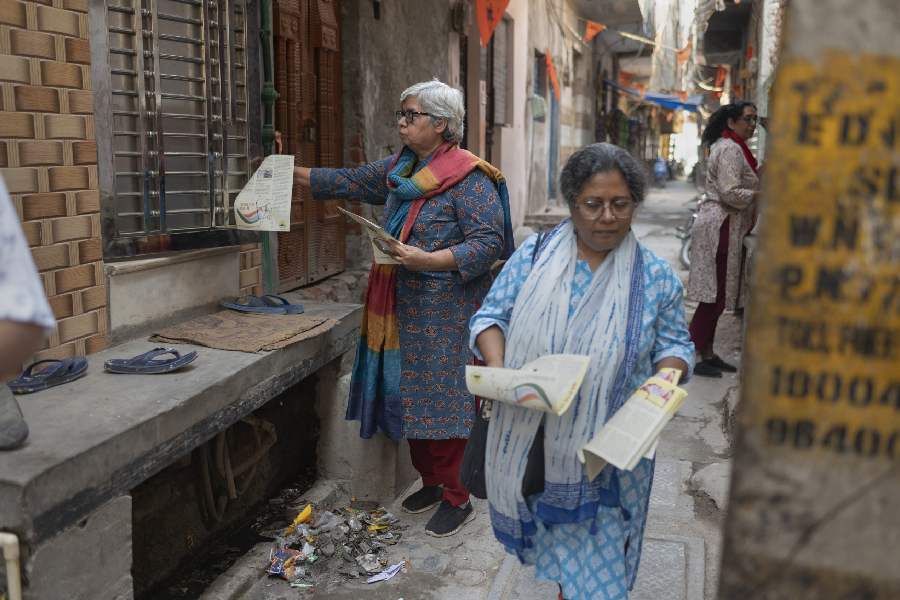
Shabnam Hashmi,
left, a 66-year-old activist, and another woman hand out pamphlets with a
message of peace and tolerance in New Delhi, May 9, 2024. Hashmi said
she had been threatened with prison for her activism over the decades,
but that it was “never so bad” as it is now.
Saumya Khandelwal/The New York Times
One recent morning, Roop Rekha Verma, an
80-year-old peace activist and former university leader, walked through a
north Indian neighborhood prone to sectarian strife and parked herself
near a tea shop.
From her sling bag, she pulled out a bundle
of pamphlets bearing messages of religious tolerance and mutual
coexistence and began handing them to passersby.
“Talk to each other. Don’t let anyone divide you,” one read in Hindi.
Spreading those simple words is an act of bravery in today’s India.
Verma and others like her are waging a lonely
battle against a tide of hatred and bigotry increasingly normalized by
India’s ruling Bharatiya Janata Party, or BJP.
As Prime Minister Narendra Modi and his
deputies have vilified the country’s minorities in a years long campaign
that has escalated during the current national election, the small band
of aging activists has built bridges and preached harmony between
religious groups.
They have continued to hit the pavement even
as the price for dissent and free speech has become high, trying to keep
the flame alive for the nonsectarian ideal embedded in India’s
Constitution and in their own memories.
More than three dozen human rights defenders,
poets, journalists and opposition politicians face charges, including
under anti-terrorism laws, for criticizing Modi’s divisive policies,
according to rights groups. (The government has said little about the
charges, other than repeating its line that the law takes its own
course.)
The crackdown has had a chilling effect on many Indians.
“That is where the role of these civil
society activists becomes more important,” said Meenakshi Ganguly, a
deputy director at Human Rights Watch. “Despite a crackdown, they are
refusing to cow down, leading them to hold placards, distributing
flyers, to revive a message that once was taken for granted.”
The use of posters and pamphlets to raise
public awareness is a time-tested practice among Indian activists.
Revolutionaries fighting for independence from British colonizers
employed them to drum up support and mobilize ordinary Indians. Today,
village leaders use them to spread awareness about health and other
government programs.
Such old-school outreach may seem quixotic in
the digital age. Every day, India’s social media spaces, reaching
hundreds of millions of people, are inundated with anti-Muslim vitriol
promoted by the BJP and its associated right-wing organizations.
During the national election that ends on
Saturday, Modi and his party have targeted Muslims directly, by name,
with brazen attacks both online and in campaign speeches. (The BJP
rejects accusations that it discriminates against Muslims, noting that
government welfare programs under its supervision assist all Indians
equally.)
Those who have worked in places torn apart by
sectarian violence say polarization can be combated only by going to
people on the streets and making them understand its dangers. Merely
showing up can help.
For Verma, the seeds of her activism were
planted during her childhood, when she listened to horror stories of the
sectarian violence that left hundreds of thousands dead during the
partition of the Indian subcontinent in 1947.
Later, as a university philosophy professor,
she fought caste discrimination and religious divides both inside and
outside the classroom. She opposed patriarchal attitudes even as slurs
were thrown at her. In the early 1980s, when she noticed that the names
of mothers were excluded from student admission forms, she pressed for
their inclusion and won.
But more than anything else, it was the
campaign to build a major Hindu temple in the town of Ayodhya in her
home state of Uttar Pradesh that gave Verma’s life a new meaning.
In 1992, a Hindu mob demolished a
centuries-old mosque there, claiming that the site had previously held a
Hindu temple. Deadly riots followed. This past January, three decades
later, the Ayodhya temple opened, inaugurated by Modi.
It was a significant victory for a Hindu
nationalist movement whose maligning and marginalizing of Muslims is
exactly what Verma has devoted herself to opposing.
The Hindu majority, she said, has a responsibility to protect minorities, “not become complicit in their demonization.”
While the government’s incitement of
religious enmity is new in India, the sectarian divisions themselves are
not. One activist, Vipin Kumar Tripathi, 76, a former physics professor
at the prestigious Indian Institute of Technology in New Delhi, said he
had started gathering students after classes and educating them about
the dangers of “religious radicalization” in the early 1990s.
Today, Tripathi travels to different parts of
India with a message of peace.Recently, he stood in a corner of a busy
train station in northeastern New Delhi. As office workers, students and
laborers ran toward platforms, he handed information sheets and
brochures to anyone who extended a hand.
His materials addressed some of the most
provocative issues in India: the troubles in Kashmir, where the Modi
government has rescinded the majority-Muslim region’s semiautonomy; the
politics over the Ayodhya temple; and ordinary citizens’ rights to
question their government.
“To respect God and to pretend to do that for votes are two different things,” read one of his handouts.
At the station, Anirudh Saxena, a tall man in
his early 30s with a pencil mustache, stopped and looked Tripathi
straight in the eyes.
“Sir, why are you doing this every week?” Saxena asked.
“Read this,” Tripathi told Saxena, handing
him a small 10-page booklet. “This explains why we should read books and
understand history instead of reading WhatsApp garbage and extracting
pleasure out of someone’s pain.”
Saxena smiled, nodded his head and put the booklet in his handbag before disappearing into the crowd.
If just 10 out of 1,000 people read his
materials, Tripathi said, his job is done. “When truth becomes the
casualty, you can only fight it on the streets,” he said.
Shabnam Hashmi, 66, another activist based in
New Delhi, said she had helped distribute about 4 million pamphlets in
the state of Gujarat after sectarian riots there in 2002. More than
1,000 people, most of them Muslims, died in the communal violence, which
happened under the watch of Modi, who was the state’s top leader at the
time.
During that period, she and her colleagues
were harassed by right-wing activists, who threw stones at her and filed
police complaints.
In 2016, months after Modi became prime
minister, the government prohibited foreign funding for her
organization. She has continued her street activism nonetheless.
“It is the most effective way of reaching the
people directly,” she said. “What it does is, it somehow gives people
courage to fight fear and keep resisting.”
“We might not be able to stop this craziness,” she added, “but that doesn’t mean we should stop fighting.”
Press Invite To The Editor, DOSTI (Democratic Outreach for Secular Transformation of India), a platform of Secular and democratic individuals, mass organisations and NGO’s has been formed in response to the ever-increasing majoritarian communal violence directed at Minorities, Dalits and women. Dosti is planning an intensive and broad-based campaign involving students, teachers, youth, academicians, workers, artists and other sections of our society to mobilise public opinion in defense of our inclusive traditions that form the foundation of our constitution. A press conference is being organised on 9th August 2023, the day Quit India Movement was launched. The press meet will begin at 5 pm at the Press Club, Raisina Road, Windsor Place, New Delhi-110001.The Press meet will be addressed by Advocate Prashant Bhushan, Former civil servant and activist Harsh Mander, Journalist Bhasha Singh, Advocate Sanjay Hegde, Social activist Ram Puniyani and chaired by Teacher activist Nandita Narain. Kindly depute a reporter and a cameraperson for the press meet.
Kannada author Devanoora Mahadeva fills the silence, takes RSS head on in his 68-page book
Even as his book exposes
the truth of the politics of hatred, Devanoora Mahadeva's critique of
the RSS is not a replay of the secular ideological polemics.
Hate Hatao tracks, documents, and takes action against acts of hate of all kinds, and now, anyone with a smartphone can get involved in the process of ensuring justice is delivered. Download the app now
India Unites Convention on Non Violence and Harmony
January 30, 2019 - Mahatma Gandhi's Martyrdom Day
Dear Friends,
India Unites for Non – Violence and Harmony is a non-political, citizen led campaign being organized from January 23- 30, 2019 to commemorate the 71st anniversary of Gandhiji’s martyrdom. Various civil society organizations, academics and activists are coming together on the anniversary of Gandhiji’s martyrdom to appeal to the nation to resist and confront the growing culture of violence facing the country.
Mahatma Gandhi was shot dead on January 30, 1948 at 17:17 hours as he headed towards a multi-faith prayer meeting. He was assassinated by fundamentalist forces opposed to his idea of Swaraj promoting nation-building on the principles of equality of all citizens, Hindu -Muslim unity and communal harmony. Gandhi's Swaraj focussed on the composite nature of Indian nationalism.
Under Gandhi's leadership, the freedom movement successfully mobilized and drew people into the struggle for independence against colonial rule: men and women, people from all faiths, regions, speaking different languages, having varied castes, traditions, customs, cultures, beliefs and inhabitants of both rural and urban areas. He dreamt of an India where people lived together and respected each other's differences; where interactions, protest and negotiations would be shaped by the principle of non-violence/ahimsa.
Today, 70 years after independence, we are witnessing a rise in hatred and prejudices based on religion, caste, gender, sexuality, region and class. Society is becoming increasingly intolerant and violent. Communal violence, caste based violence and hate crimes are on the upsurge. As citizens we can no longer be silent spectators to this growing ill will, hatred and violence. We must come together to protect the secular, pluralistic and democratic fibre of the country.
We are organising India Unites Convention on Non Violence and Harmony at Sophia Bhabha Auditorium on January 30, 2019 from 4pm -10pm in Mumbai to commemorate the 71st anniversary of Gandhiji's martrydom:
Speakers: Amol Palekar (actor, director & producer), Antara Dev Sen ( journalist, editor Little Magazine), Justice Chelameswar (retd Supreme Court Judge), Javed Akhtar (poet, lyricist & screenwriter), Kawalpreet Kaur (student leader), Admiral L Ramdas (former Chief of the Naval Staff), Meeran Chadha Borwankar ( former Inspector General (Prisons), Maharashtra), Nayantara Seghal (writer), Pradnya Daya Pawar (Marathi poet & fiction writer)
The speeches will be followed by a cultural programme on the theme. Performers include Dolly Thakore (theatre actress), Gauhar Raza (poet & scientist), Imaad Shah (actor & musician), Mannu Kohli (singer), Purva Naresh (playwright & dancer), Nazneen Shaikh (activist & singer), Lynn D'souza (vocalist) and Vasu Primlani ( stand-up comedian).
The program is organized by Anhad (New Delhi), CPD (Mumbai), CSSS (Mumbai), India Inclusive (New Delhi), PUCL Maharashtra, ICWM-Mumbai, Sadbhavna Sangh, YWCA of Bombay.
We are writing to invite you for the India Unites Convention on Non Violence and Harmony on 30 January, 2019. The address of the venue is Sophia College Ln, Breach Candy, Cumballa Hill, Mumbai, Maharashtra 400026.This is an open event. There is no registration fees. Entry is on a first come first served basis. Please share information about the event in all your networks and encourage as many people to participate.
A broad coalition of citizens and organisations came together today
under the banner of Sajha Kadam to discuss the menace of growing
communalism in Jharkhand and possible responses to it. The threat of
communalism, evident in recent lynching incidents, was seen in the
context of other threats to the right to life, including attempts to
dilute people’s rights to land, work and food. [. . .]
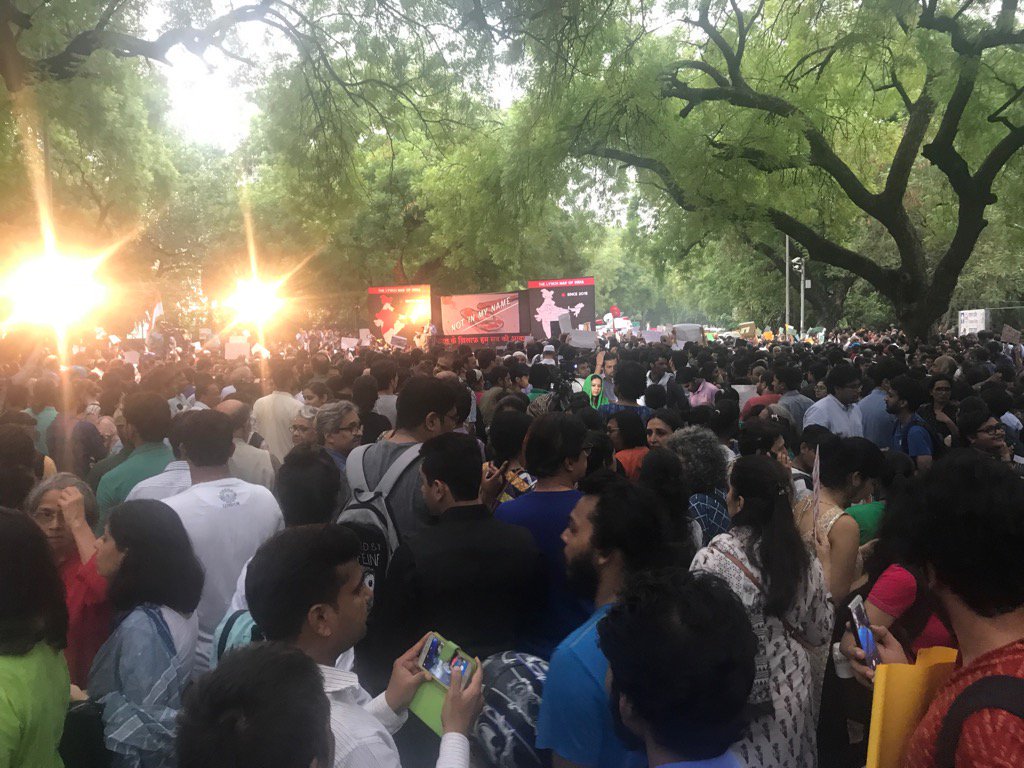
Black bands, protest placards and a message of unity at Pune’s ‘Not in my Name’ march
The march started from the statue of Babasaheb Ambedkar in front of the Collector office, and went on till the statue of Mahatma Gandhi near the Pune railway station.
By: Express News Service | Pune | Published:June 30, 2017
Over a thousand people participated in a silent march — ‘Not in my Name’ — in the city on Thursday evening, as part of a nationwide agitation against the spate of lynchings in the name of religion. The march started from the statue of Babasaheb Ambedkar in front of the Collector office, and went on till the statue of Mahatma Gandhi near the Pune railway station.
Among the prominent personalities who attended the protest were socialist leader Baba Adhav, Rajya Sabha MP Anu Aga, veteran filmstar Amol Palekar and Sandhya Gokhale. The representatives of AIMIM also participated in the march.
Representatives of many social organisations including Lokayat, Socialist Party (India), Rashtra Seva Dal and Swaraj Abhiyaan participated in the march. Former state minister Bhai Vaidya was also present.
The silent march started after sharing some information on the reason behind organising it. All the activists wore a black dress or tied a black ribbon on their arm to mark their protest. They carried placards condemning the incidents of attacks on minorities, and pledged to fight against those “spreading communal hatred”.
As the march progressed, the organisers — Lokayat and Socialist Party (India) — distributed pamphlets among local residents on the way. The march was meant to send a message that there is no space for religious hatred in the country, and to tell the minority communities that they were not alone, said the activists.
“There is an increasing number of attacks on members of the minority community, as the environment of hatred on religious grounds is spreading in the country. This is an indication of a serious situation…,” said Adhav, as he addressed the crowd.
He urged everyone to unite and “take on those who are trying to destroy the secular fabric of country”.
Girish Karnad protesting against lynchings in Bangalore - 28 June 2017
see embedded slide show from sacw photo archive with full set of photos by Mukul Dube taken at Jantar Mantar, New Delhi on 28 June 2017 citizens protest:
[ see link here https://tinyurl.com/yafg2f23]
About
speaker: Akash Joshi is Assistant Editor, Indian Express. He has worked
in The Quint earlier as Special Correspondent. Akash Joshi did his
graduation in Philosophy from St Stephens College, Delhi University,
Masters in Sociology at Delhi School of Economics and he studied
Politics in Paris School of International Affairs, France.
Venue: Anhad, B 5 Basement, Nizamuddin West, New Delhi-110013 Tel: 011-41670722
An Appeal to Voters of UP to Protect Democracy and Defeat the BJP
-->
Voters of Uttar Pradesh will be electing their
next state government in February 2017. UP is the largest state in the country.
The political choices of its citizens determine not only the shape of state
politics, but national politics as well. This time much more is at stake than
usual. The voters of UP will not only elect their state government but will
play a role in determining the fate of democracy in India. This puts a special
responsibility on them to cast their votes with extreme care and wisdom.
In the 2014 Lok Sabha elections the BJP got more
than 40% of votes and won 71 of the 80 UP seats. Many factors contributed to
this landslide – the political bankruptcy of the UPA government, the three-way
split of non BJP votes, a sustained targeting of religious minorities and
communal violence. The most vicious example of this was in Muzaffarnagar. In
addition, a section of the people were drawn toward the achhe din promised
by the BJP prime ministerial Narandra Modi.
The two and a half years of Mr Modi’s government
have shown that the promise of jobs, development and social peace was merely an
election jumla. His government has
failed in the first responsibility of any government to provide security to the
people. The violent communal elements of the RSS–led Sangh parivar took their
election victory as a signal to attack religious minorities and Dalit
communities. Mohammad Akhlaq of Badhana village, barely fifty km from Delhi,
was killed by so-called gau rakshaks of his own village. Dalits were
publicly humiliated in Una in Gujarat by violent hooligans parading as
protectors of Hindus. When Rohith Vemula of Hyderabad Central University
committed suicide in protest at harassment by university officials and the RSS
youth wing (ABVP), ministers in Mr Modi's government brazenly tried to prove
that he was not a Dalit. Now, when the BJP is faced with a tough going in UP,
it has again raked up the issue of Ram Mandir in its manifesto.While it is true that no government
in independent India has cared much for India’s oppressed communities, it is
also true that no government has been as shameless and open in attacking them
as the Modi government.
However, it would be a mistake to think that this
government is targeting only religious minorities and Dalits. Immediately after
coming to power it tried to change the land acquisition law passed by the
previous UPA government so that farmers could be dispossessed of their land
more easily, and their land given to rich capitalists and corporates. Payments
for the MNREGA, which had provided some economic security to the rural poor
during times of distress were reduced. The recent demonetisation of 500 and
1000 rupee notes took away the hard earned income of crores of farmers and
workers, and forced them to stand in queues for days to withdraw their own
money. This ‘surgical strike’ on the daily lives of ordinary citizens has
benefited only banks and companies dealing in digital payments. Scores of
citizens including housewives and retired service personnel have lost their
lives. Lakhs of informal sector workers have been thrown out of work. All
governments in India follow pro-rich policies. But the Modi government has
taken this to a new level. In its zeal to serve the rich it is dismantling the
little social security that was available to the poor.
What distinguishes Modi government from other
governments is its concerted effort to create an authoritarian environment and
weaken all institutions of democratic governance, from the judiciary and police
to the Reserve Bank. The right to elect leaders and parties of their choice is
crucial in a democracy. Democracy however is sustained by a number of other
norms and institutions. Indian democracy is facing its most serious crisis
since independence, because its elected leaders themselves are destroying its
foundations.
The Sangh Parivar to which Mr Modi belongs
follows a hate-filled communal ideology that advocates violence and aggression.
The RSS calls itself nationalist, but its idea of the Indian nation excludes
large numbers of Indians, and is determined by interests of a section of the
financial, land-owning and upper caste elite. When Indians were fighting for
freedom from the colonial rule, it was busy helping the British in their divide
and rule policy. This was the plan outlined by Savarkar, their ideological patron,
in his clemency appeals to British when he was jailed in the Andamans. India's
freedom movement was motivated by the idea of a nation incorporating all
Indians and their welfare. The Indian constitution has tried to give legal form
to these aspects of the freedom movement.
Freedom and equality of all citizens are the two
foundations of democracy. All people should be equally free to lead the life of
their choice, organise and express their opinion. The Modi government has
consistently attacked these freedoms. It has foisted false sedition cases
against university students for shouting slogans against official policies.
Hooligans associated with it have physically attacked JNU students in court
premises. When many noted writers and public figures protested against day
light murders of respected rationalist Dr N Dabholkar, trade unionist Govind
Panasare and author MM Kalburgi by fundamentalist forces, ministers of the Modi
government attacked their protests as anti-national. This government has
vitiated public discourse by abusing all its opponents as enemies of the
nation. Clearly, the Modi government wants to create an atmosphere of fear
to stop Indians from challenging what the RSS/BJP defines as India's national
interest.
The makers of the Indian constitution adopted a
parliamentary style of governance, in which the cabinet headed by a prime
minister is responsible to the parliament elected by the people. On many
occasions the Modi government has by-passed parliament, and is trying to rule
the country through ordinances. Even the president has expressed his
displeasure at this shameless disregard of parliamentary norms. Mr Modi rarely
attends parliament sessions. In parliament every member is equal, and a prime
minister has to deal with other members as equals. Perhaps Mr Modi is scared of
the parliament precisely because of this.
Barring the Emergency regime of 1975 - 1977, no
Indian government has tried to control the judiciary as brazenly as the current
government. It has delayed the appointment of judges recommended by the Supreme
Court collegium. Its investigating agencies are stalling criminal cases against
supporters of the regime, and victimizing their political opponents. No less a
person than the respected public prosecutor, Ms Rohini Salian has publicly
stated that she was asked to soften her case against Hindutva terrorists
accused of Malegaon blasts. Justice Jyotsana Yagnik, who pronounced important
judgments on the Gujarat killings of 2002 has received threatening telephone
calls. The governors of Uttarakhand and Arunachal Pradesh have been shamelessly
partisan in pushing the BJP’s interests.
If BJP wins the UP election the Sangh
supporters will continue with their attacks on the common people. Modi will
continue to target farmers' right to their land, and people's right to welfare.
Most important for all Indians, it will be encouraged to further subvert
Indian democracy. Political parties in UP are going to appeal to religious and
caste identities and the so- called national interest of voters. The RSS-led
Modi government is a threat to the Indian constitution. The people of UP
have the opportunity in this election to defend democratic rights of Indians,
which are more important than any sectional interest.
at Deputy Speaker Hall, Constitution Club, Rafi Marg, New Delhi-110001
Since
its earliest imagination, the idea of India has always been based on
plurality. What has been created through millennia of advent and
assimilation is a grand and many-hued heritage, shared by all who at
various points of time became part of it and contributed to it in their
own unique way.
Out
of these largely oral, intangible and timeless interactions and
traditions has emerged the rich and fluid Sufi-Bhakti culture of the
Indian Subcontinent. The shrine has always been a shared space, a third
space and a space for the meeting of hearts, minds and myriad
imaginations.
It
is this space of exchange and sharing which is now under attack from
various fascist, fanatic and politically polarizing forces. The main
purpose of these attacks is to prevent the perpetuation of this people
to people, faith to faith interaction and the wonderful culture of
dialogue, music, food and syncretic spiritual expression that it has
given rise to, instead imposing a monolithic and authoritarian culture
based of compliance, fear and falsehoods.
We
as artistes, intellectuals, spiritual practitioners and activists
condemn these nefarious attempts to communalize our social fabric and
wish to present our views on this subject, one of vital importance in
our troubled times.
&Divine Social Welfare Society cordially
invite you to
Convention
on
Harmony
and Freedom
Friday, May 13, 2016, 2:30 PM-6 PM
Speaker’s
Hall, Constitution Club, Rafi Marg, New Delhi
RSVP:
9717309263,
9999911213
M. AdeebV.K. TripathiPuneet
Manchanda
Themes
Sanctity and autonomy of
academic institutions
Constitutional
rights and responsibilities
People-centric
nationalism
It is time we
revive the vision of national movement that rejuvenated Indian masses to rise
together against colonialism, inequity and injustice. We
respect the fundamental constitutional rights of every citizen, irrespective of
his/ her caste, religion, gender or status, to live in the nation with full
freedom and dignity and bring them into the focus of debate on nationalism. Political
figures, academics and journalists, cutting across political lines, would
address the challenges faced by our secular democracy