|
Showing posts with label festivals. Show all posts

March 15, 2025

India: Weaponizing the Holi festival for communal polarisation | Irfan Engineer


Weaponizing the Holi festival for communal polarisation 

Irfan Engineer

According to advice of the Dy. Superintendent of Police in Sambhal – Anuj Kumar Chaudhary – that Muslims should stay indoors if they felt uncomfortable with Holi colours being sprinkled on them – as the festival comes only once a year, whereas Jumma namaz takes place 52 times in a year – it appears that the Muslims might have heeded his advice and remained indoors. There are no reported complaints from any Muslim that they were on streets – with or without any work – and got coloured. They changed the timing of their congregational Jumma namaz in the Holy month of Ramazan – to accommodate the Hindus observing their festival – and some might have decided to forgo their obligatory prayers. The Hindu nationalists in Sambhal (UP), and in other BJP ruled states had the streets entirely to themselves till they wanted. Chaupai, a Holi procession passed peacefully through 10 mosques in Sambhal, including the border wall of Shahi Jama Masjid (Pragynesh, 2025). The BJP MLA from Bihar – Haribhushan Thakur Bachol – made a similar appeal on the legislative assembly premises, asking Muslims to stay indoors on the day of Holi (Pandey, 2025). No one from the BJP or their alliance partners in Bihar, including JD(U) condemned the statement.

Hansraj Meena (25) in Dausa (Rajasthan) ventured out and despite his objection, colour was forcibly applied on him. He died after being assaulted by three persons who applied colour on him. Meena should have remained indoors but he ventured out to go to a library to prepare for his state civil service exams. He did not heed the advice of Dy.S.P. Chaudhary (Khan, 2025).

Provocative slogans were raised during Shimga festival on 13th March, 2025, when Madachi miravnuk, an old Konkani ritual, when tree trunks are carried to the Dhopeshwar temple in Rajapur (Ratnagiri district, Maharashtra) on the eve of Holi. Those carrying the tree trunk rammed into the mosque gate several times while raising provocative slogans (Express News Service, 2025). Muslims staying indoors did not protect this mosque.

UP police had to baton charge the traditional ‘laat sahab’ procession in Shahjahanpur district as those participating in the procession threw brickbats on the police, injuring three of them. Trouble started when those playing Holi threw footwears at the police (Rozana Sahafat, 2025). In Unnao (UP), drunk Holi revelers threw brickbats at the police in which three police officers were injured. To control them, police used their batons to disperse them. In the baton charge, many revelers were injured (Rozana Sahafat, 2025). In the traditional Phag procession in Gunj Muradabad village, on 14th March 2025, they were singing objectionable songs. At the conclusion of the procession, some drunk youth started teasing and playing mischief. When police resorted to mild baton charge, they started throwing brickbats at police. At least three police personnel were injured due to the brickbats thrown at them (Rozana Sahafat, 2025). Muslims remaining indoors did not save the police or the drunken brawls resorted by the revelers.

On 13th March 2025, on the eve of Holi festival, a man in Dombivili, a distant suburb of Mumbai, attacked a 17-year-old boy when a water balloon allegedly thrown by him landed on the man (Press Trust of India, 2025). This man in Dombivili did not heed the advice of the Dy.S.P. of Sambahal resulting in unnecessary conflict.

Does policing and maintaining law and order mean asking law abiding citizens from marginalized communities to remain indoors, while the potential law breakers from more powerful and dominant sections of the society have the freedom to indulge in revelry even in violation of law endangering peace? In the same vein, women are asked to remain indoors if they do not want to be sexually assaulted.

This approach also encourages those who believe in ‘might is right’ doctrine to be law unto themselves. The Dy.S.P. of Sambhal Anuj Kumar Chaudhary is seen in the viral video taking note of the fact that during the Holi festival people consume bhang (cannabis) and therefore mishaps of forcibly applying colours on Muslims might occur. However, he does not warn the consumers of cannabis. Will the police advice Indians who do not want to be killed in a potential road accident to remain indoors on the eve of new year celebrations as the likelihood of drunken driving increases?

Muslims are not the only victims during the Holi festival. Many Hindus do not like to be coloured. Women also are vary of Holi festival as they too are targeted by strangers against their wish on the pretext that everything is permissible during Holi. They say “bura na mano Holi hai”. The BJP and Hindu nationalists use the occasion to communally polarize people and assert dominance of Hindus. However, the moot question is, shouldn’t we take note of what damage such an approach will do to the Hindu religion and ethics? Not long ago, these festivals were celebrated peacefully with participation of people from all communities. This writer has also enjoyed playing Holi in his school days, and indeed taking part in all other festivals of all religious communities. The unprecedented and massive deployment of police force now necessary since a decade tells its own story. Holi is such a beautiful festival in which one reminds oneself to burn all negative feelings and instincts like acquisitive desires, selfishness, jealousy, fear, hatred into the Holi fire. Mughal emperors too played Holi with their durbaris for days together and called it Eid-e-Gulabi. Amir Khusro and many Muslim poets have composed beautiful verses on Holi.


June 05, 2019

India: In Jharkhand, Ram Navami Celebrations Now Sites For Violence | Kunal Purohit


In Jharkhand, Ram Navami Celebrations Now Sites For Violence

Written by Kunal Purohit | Published on: June 3, 2019
Gumla town, Jharkhand: Irshad Khan knew there would be trouble when he saw the procession. “They were up to no good,” he said of the Ram Navami revellers in Gumla town on April 5, 2017. The rally had halted outside the Jama Masjid, when it was not supposed to.

RamNavami_750
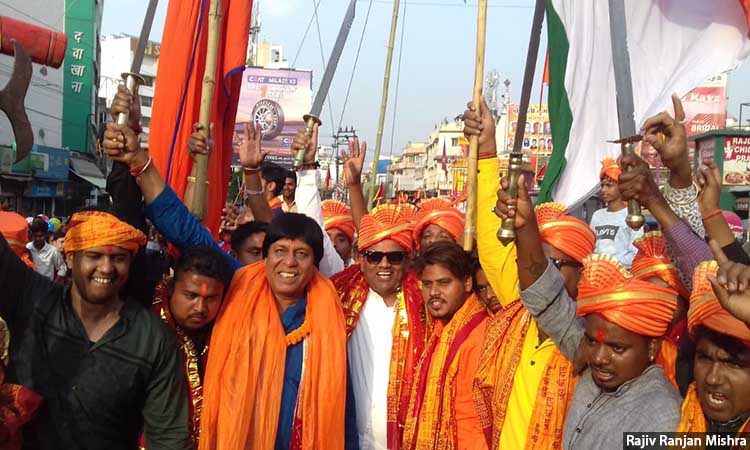
Rajiv Ranjan Mishra (centre, in blue) is a former chairperson of the Shri Mahavir Mandal and a key organiser of Ram Navami processions in Jharkhand state capital Ranchi for three decades. Mishra says up to 1 million people join the procession, often with weapons such as swords, sticks and rods. “After all, this procession is a shakti puja.So, men often get carried away, seeing all the weapons and the electric atmosphere.”

The halt made everyone anxious. Suddenly, the music changed and a new song came on. Khan does not remember the exact words. “But it was something to the effect of Mulle ki topi phenk do [let’s toss the Muslim man’s skullcap].” 

This was direct provocation for the Muslim community, said Khan, the Gumla head of Anjuman Islam, a socio-religious Muslim organisation. “Some of us tried to calm tempers in the Muslim community; others asked the procession members to stop the music.”

In those moments, Khan said, anything could have happened. Within minutes, however, the police intervened and defused the tension.

But Khan knew the situation was a ticking time bomb.

A few hours later, close to midnight, his fears came true, he told FactChecker on a recent April day. A call informed him that a group of Hindu men returning from the procession had lynched a Muslim boy, Mohamed Shalik, to death. The lynching had taken place in Soso village, 4 km from Gumla town, where the procession was held. The assailants had allegedly objected to Shalik’s relationship with a Hindu girl in the neighbourhood.

Calling Shalik a “jolha”, a pejorative term for Muslims, the mob had tied him to a pole and attacked him with sticks and rods, his father MD Minhaj told FactChecker. Shalik had died on the way to hospital, the first information report (FIR)–which is filed with the police by victims or eyewitnesses, and which FactChecker reviewed–said. 

Gumla_620
20-year-old Mohamed Shalik told his father, MD Minhaj (above), that he was going out to watch the Ram Navami procession that would travel across Gumla town. That night, when Shalik went to drop a Hindu girl to her village of Soso 4 km away, a mob of Hindu and tribal villagers lynched him to death. Many in the mob were returning from the Ram Navami procession in town.

Around the same time that evening, 280 km away in Koderma district’s Kolgarma village, Hindus participating in a similar Ram Navami procession had entered a Muslim neighbourhood, ransacked a mosque and assaulted local residents, including women.

Across Jharkhand, festivals are being weaponised in a bid to drive up religious hatred and polarise communities. Primary among them is Ram Navami, the occasion when the Hindu community celebrates the birth of Lord Ram.

Two of the seven hate crimes that this series investigated occurred on Ram Navami; the accused in both cases were procession participants. At the five other hate-crime spots, the festival played a key role in driving up communal frenzy, police officials and local observers said.

This is the first in a series of five stories investigating seven hate crimes across six districts of Jharkhand, recorded in Hate Crime Watch, a database of religious identity-based hate crimes across India from 2009 to 2019, maintained by FactChecker.

Jharkhand’s population is 68% Hindu and 14.53% Muslim, according to Census 2011 statistics. Since 2009, the state has reported 16 hate crimes motivated by religion and 12 deaths–the second highest after Uttar Pradesh (23 dead)–all of which have been reported after the Bharatiya Janata Party (BJP) won national and state elections in 2014 but before general elections in April and May 2019. The BJP won 11 of 14 parliamentary seats in Jharkhand this year.

Of the 16, FactChecker shortlisted nine instances listed in the database, trying to balance out different types of cases and geographical spread. Traveling across Jharkhand, covering more than 3,000 km in 13 days, we visited these nine spots, met the accused, the surviving victims and their families, and spoke to locals and police officials. The aim was to investigate and verify the listings in Hate Crime Watch, follow up on the developments that have taken place since, and document the long-term impact of the crimes on the social fabric of these regions. 

From our reporting, two cases did not turn out to be hate crimes, according to the definition and methodology employed for Hate Crime Watch.

For the purpose of Hate Crime Watch, FactChecker collates data on crimes motivated partly or wholly by prejudice against the religion of the victim(s). For an incident to qualify as religion-based hate crime under our criterion, the act must qualify as a criminal act under Indian law. It is not necessary that formal criminal proceedings should have started for the fulfillment of this criterion; only that the available evidence should suggest that the act qualifies as a criminal act on the face of it. The target of a hate crime can be a person, groups of persons or property. Hate Crime Watch does not document speech crimes.

The first of these was the alleged lynching of an elderly couple and their three daughters. While two daughters had sustained injuries, the couple and their elder daughter had died. Some of the media reporting of the incident had said the family were tribal Sarnas while the attackers were Hindus and Christians. Our investigation found that the victims were Hindus of the Kewat caste while some of the alleged attackers were also Hindus, some from the same caste and others from the Lohar caste. The reason behind the lynching, we found, was that the family had filed a complaint with the police against a 23-year-old Lohar youth for allegedly abducting their daughter. The youth, who had recently converted to Christianity though his family had remained Hindu, had died while trying to evade police custody. As a result, there was tension in the village, which had resulted in the lynching.

In the second case, it was reported that a 20-year-old Hindu girl from Ramgarh district had been raped and killed by her husband, his father and his uncle. The reason, the media reports had said, was that the girl had refused to convert to Islam.

We visited the families of the victim and the accused, spoke to senior police officials in the district as well as with defence and prosecution lawyers. We found that there was no evidence to show that the killing had been linked to the girl’s religion. The girl’s family also said that they did not fully understand why their daughter had been killed.

We are removing both these cases from our database, which leaves 14 cases from Jharkhand which led to nine deaths.

In each of the six districts FactChecker visited, Ram Navami celebrations had become synonymous with communal clashes and low-intensity tensions.

“The scale of Ram Navami celebrations in Jharkhand is unprecedented; it isn’t celebrated with as much fervour anywhere else in the country,” said ML Meena, additional director-general, Jharkhand Police. “Playing communally sensitive lyrics, provocative songs–there are some elements, not all, who try and do this. Some people take advantage of such major festivals and create trouble.”

Small scale, big style

The scale of Ram Navami celebrations in Jharkhand is massive. In state capital Ranchi alone, the procession that starts from different parts of the city and culminates at the Tapovan mandir in Doronda locality of the capital, comprises nearly 1 million people each year, IndiaSpend learned from long-term enthusiasts.

Typically, different akharas (in this context, Hindu socio-religious groups) start marching towards mandals (social groups) in different parts of the city, said Rajiv Ranjan Mishra, a former chairperson of key procession organiser Shri Mahavir Mandal, who has been at the helm of the celebrations for more than three decades. “When they start marching, people keep joining in and the procession keeps growing,” Mishra said.

Snaking through lanes and bylanes, the procession covers almost all the major parts of the city before reaching the mandir by late night. “The procession starts around 4 pm and then takes up to 8-9 hours to cover around 15 km,” Mishra said.

Most members of the procession wear saffron scarves–a colour associated with Hinduism–and are armed with weapons, such as swords, daggers, maces and rods. The procession involves showing off fighting skills using these weapons. “So, men either airfight or fight each other using these weapons on the streets,” said Mishra.

Often, the atmosphere, the weaponry and the fights create a sense of hyper-masculinity, Mishra said, adding, “After all, this procession is a shakti puja [worship of Shakti, the goddess of strength]. So, men often get carried away, seeing all the weapons and the electric atmosphere.”

Traditionally, these processions featured live bands. These have given way to pre-recorded music, played by DJs (disc jockeys) atop trucks fitted with amplifiers.

Police officials said the music often sparks off altercations, as in the 2017 Ram Navami processions in Gumla, where provocative songs were played right in front of a mosque.

Hindu rashtra, Masjid gali and har ghar bhagwa

A dive into the world of Ram Navami music, and conversations with participants and observers, showed that many songs played at processions involve themes such as Ram Mandir, berating erstwhile Mughal rulers, and making India a Hindu rashtra (nation). The sub-text to the lyrics almost always threatens Muslims with violence. Consider this popular song.


“Agar chhua mandir toh tujhe dikha denge,

Hum tujhko teri aukaad bataa denge..”

(If you touch the mandir, you won’t be spared,

We will show you your rightful place)

Another example is this song popular across many of Jharkhand’s Ram Navami processions which talks of a ‘Masjid galli’ (street).


One line goes:

Ram Seeta Lakhan sang hai Bajrang Bali

Chal tujhko ghuma laoon masjid galli

(With Ram, Seeta and Lakshman is Bajrang Bali

Let me take you for a ride to mosque lane)

“In that moment, with the slogans, the music and the weapons, the josh[fervour] is very high,” said Ramesh Singh (who did not wish to share his real name), 22, a Bajrang Dal member in Ranchi who has been going for these processions for years. “Some boys try and outshine the others by doing something.”

Singh’s ringtone is a wildly popular song often played at these processions, Har ghar bhagwa chayega (saffron will fly high in each house, saffron being a metaphor for Hinduism), which vows that gau-hatya (cow slaughter) will be stopped and insists that anyone who wants to continue to live in India must recite Vande Mataram (“Hail, Mother Goddess”, in popular usage taken to refer to Bharat Mata or Mother India). The song has gathered 230 million views on YouTube; its popularity has even elicited a second version.

That doing, Singh said, could include taking the lead in sloganeering in front of a mosque and provoking members of the Muslim community along the way.

Police precautions

Among police circles, Ram Navami celebrations have become a law and order issue. In some parts of Jharkhand, their link with hate crimes were direct and clear, as in the central Jharkhand district of Ramgarh.

One police official, not wishing to be named, narrated the sequence of altercations that the procession members would have with the police in the run-up to Ram Navami celebrations. “We would ask them to stick to the pre-decided route whereas they would insist on going to sensitive areas.”

Some of the main organisers of the Ram Navami celebrations in Ramgarh district have been Bajrang Dal members, including Chhotu Verma and Santosh Singh, a police official stationed in the district told FactChecker. Both of them led a mob in July 2017 that lynched and killed a trader, Alimuddin Ansari, for allegedly carrying beef.

“We had asked them [Bajrang Dal members] to submit a CD to us with all the songs they would play, because we had realised that the music is often provocative. They were angry but, finally, they had to submit the CD,” the police official added.

These precautions continue, current district superintendent of police Nidhi Dwivedi said: “We sit with both communities, map out a clear route and ask the organisers to submit a CD of the songs they are going to play.”

Despite these precautions, Ram Navami in Ramgarh district continues to be a thorny affair.

This year, there were clashes between two groups in the procession who hurled stones at each other, according to news reports. The violence left five people, including two police persons, injured.

Some instances are considered too local, or too sensitive, to be reported in the media, local reporters told IndiaSpend. “There have been times when there have been clashes between the two communities and the police defuse the situation. But, the authorities request the media to not report it so that it doesn’t lead to more tensions,” said Kasif Akhtar, a journalist based in Koderma district.

The Ram Navami procession in Koderma town passes through the Muslim localities peacefully, Akhtar said: “The Muslim community welcomes them with drinks and sweets when they pass by; the Hindu community does the same during Muharram processions.”

Yet, even in Koderma, fault lines exist.

‘Ram Navami an outlet for discord’

Kolgarma village in Koderma district, with a population of close to 1,700, has been on the edge since 2012, when construction of a mosque started on a piece of disputed land that both Hindu and Muslim communities claimed rights and ownership over.

In 2012, some Muslim villagers started voicing the need for a mosque in the village; the nearest one was at least 3 km away, said Mohamed Karim Rehmat Ansari, 35, the deputy village head.

But the construction ran into opposition, when the Hindu community objected. Hindu villagers said the Muslim community had deceived them. “We were told that a one-room madrassa [Islamic religious school] was being built. But then, once construction started, we realised it was not a small madrassa but a mosque that was being built, instead. That caused immense anger,” said Chhotu Yadav, 35, a daily-wage labourer.

The construction halted, but resumed after the Muslim community claimed they had obtained permission from the authorities. “We started construction again; in fact, the Hindu villagers were now on board, they even laid the foundation,” said Ansari.

But tensions were rising.

The mosque was inaugurated on March 25, 2017. On April 3, the Hindu community complained to the authorities.

A day later, on Ram Navami, the tensions spilled over. More than 200 members of the procession allegedly entered the Muslim neighbourhood during namaaz, assaulted people, and vandalised the mosque and some homes, according to the FIR filed at the Koderma police station. “The mob entered, shouting slogans like Jai Shri Ram [Hail Lord Ram], topi kholo[remove the skullcap], and Quran padhna band karo [Stop reading the Quran].”

24-year-old Imamul Haq was inside the mosque, praying, when he heard the slogans. “[But] I wasn’t afraid because the police were there,” he said. Within seconds, however, the attackers had broken in, and assaulted him with sticks, rods and swords, fracturing both his knee caps. “As soon as I received the first blow, I turned around to see a huge mob. They came from everywhere,” he said.

Kolgarma_620
24-year-old Imamul Haq stands outside the disputed mosque in Kolgarma village of Koderma district of northern Jharkhand, where he was assaulted on April 4, 2017, on the occasion of Ram Navami. A mob of more than 200 members from the Ram Navami procession entered the neighbourhood and attacked Haq as well as a few others who were praying in the mosque with sticks, rods and swords. Both his knees were fractured.

The injury was so severe that Haq, who was on a break from his job as a driver in Saudi Arabia, had to give up work. “For six months, I could barely walk,” he said. Even now, he cannot take up a job that involves using his legs.

Allegations and counter-allegations

Hindus blame Muslims for provoking Ram Navami processions.

“The procession was orderly. But when we were passing the Muslim neighbourhood, someone spat on us. Hence, some people got angry and reacted to it,” said Yadav of the clash following construction of a mosque in Kolgarma village.

Police officials registered a complaint from the Muslim community, against eight persons and 200 unnamed assailants.

Muslim villagers said after they lodged the complaint, the Hindu community boycotted them. “We were denied provisions at the shop; our fields went dry because we were not allowed to use sources of water on land owned by Hindus,” said Kayumuddin, 27, a local.

“We decided to not interact with them so that there is communal harmony and we don’t end up fighting. It was not a boycott,” said Dhaneshwar Sahu, 30, a Hindu trader from the village.

In 2018, the two communities clashed again in Kolgarma. Allegations and counter-allegations flew fast. Police officials at the Koderma police station said the incidents resulted from long-standing communal discord. “The dispute started with land–Hindu villagers had donated a piece of land and had agreed that a madrassa should be built. The Muslim community, instead, built a mosque,” Ram Narayan Thakur, the Koderma police station in-charge, said.

A police team from the Koderma police station were targeted while investigating the clashes, police officials told FactChecker.

The village now lives in an uneasy calm. Hindus told FactChecker that normalcy had returned, while Muslims said they felt fear.

Ansari, the deputy village head of Kolgarma, said the Muslim children in the local government school had stopped eating the government-distributed mid-day meals after a rumour spread that some Hindus were trying to poison their food. It has been two years since the clash in their village, but the children are still scared, he added.

This is the first of a five-part series.

Next: In Jharkhand, WhatsApp Is Both Polariser And Investigator

(Purohit is an independent journalist and an alumnus of the School of Oriental and African Studies (SOAS), University of London, writing on development, gender, right-wing politics and the intersections between them.)

Courtesy: http://factchecker.in/

April 05, 2018

India: Editorial in The Hindu on violence over Ram Navami processions

The Hindu, March 31, 2018

Editorial
Exposing fault lines: the violence over Ram Navami processions

There must be a thorough inquiry into the violence over Ram Navami processions

It has taken a voice of humanity to call out the manufactured nature of the political blame game around the communal clashes over Ram Navami processions in West Bengal and Bihar. In Asansol, the imam of a mosque who lost his teenage son to the clashes this week announced that should anyone carry out a retaliatory attack, he would leave town. At least four persons have died in the Raniganj-Asansol belt in West Bengal’s Paschim Bardhaman district after a procession turned violent. The area remains tense, Internet services are limited and prohibitory orders are in place. It is a shame that a sitting Union Minister, Babul Supriyo, who represents Asansol in the Lok Sabha, not just tried to defy the local administration, but also uttered inflammatory comments. Accounts about what ignited the clashes vary, and it would be best to await the findings of the official inquiry. But it is a reason for disquiet that ‘religious’ processions are becoming a pretext to force communal polarisation in many States. In Rajasthan’s Jodhpur district, a tableau was taken out on Ram Navami glorifying Shambhu Lal Raigar, currently in jail for hacking a man to death and videographing the violence along with an anti-Muslim rant. In Bhagalpur in Bihar this month, a religious procession organised by Sangh Parivar groups provoked communal clashes — there is an FIR against Arijit Shashwat, son of Union Minister Ashwini Choubey, for inciting violence. After Ram Navami, communal tension has spread to more areas of the State, including Aurangabad, Samastipur and Nawada.

In all such situations, the responsibility of isolating areas and causes of violence and tension is best assigned to the local administration, instead of State-level and national politicians weighing in. However, the violence suggests a pattern that is worrying. While the Raniganj-Asansol industrial belt is surprising territory for such clashes, the number of incidents of communal violence in West Bengal has increased sharply over the past three years. The violence in Bihar comes soon after the setback to the BJP-led National Democratic Alliance in the recent by-elections, with some party leaders giving the result a sectarian spin. Across swathes of north India, daily interactions between the majority and minority communities have been rendered fraught with the probability of violence. The majoritarian persuasion is carried out at the grassroots level, but the Sangh Parivar cannot plead plausible deniability. In this context, the increasingly assertive Ram Navami and other religious processions are drawing new fault lines. As the air gets politically charged in the lead-up to the 2019 general elections, the burden on the law and order machinery becomes that much more heavy — to pursue every incident of violence and incitement in order to limit its potential to be used for further polarisation.

India - West Bengal: Swapan Dasgupta on the explosion of political Hindutva, as personified by the Ram Navami celebrations

The Telegraph, April 05, 2018

Discernible shifts: The popularity of Ram Navami can be attributed to larger cultural changes
Swapan Dasgupta

Many observers, particularly those dependant on the media for their sources of information, may have been completely taken aback by the sectarian clashes in West Bengal that ensued in the wake of the Ram Navami celebrations on March 25. Although the scale of the violence and the loss of life were not staggering - judged by the permissive yardstick of riots in northern and western India - the mere fact that they took place in West Bengal has occasioned surprise for two reasons.

First, there is a stereotype of West Bengal as a region marked by inter-religious harmony. Political violence is endemic in the state but clashes involving different religious communities, though not entirely absent, are infrequent. Indeed, although Bengal was the scene of some of the worst communal rioting prior to Independence, including the massacres that followed the Muslim League's Direct Action Day in August 1946, the nature of political violence changed significantly in recent decades. One of the most significant achievements of the Left Front in its three decades of political dominance was to put a lid on old-style Hindu-Muslim violence. In her second term, Mamata Banerjee appears to have presided over a regression.

Secondly, while Ram Navami is an important festival in the Ganga belt, it has traditionally not been an important Hindu festival— except among some Hindi-speaking communities in urban clusters - in West Bengal. Indeed, it was only in 2017 that there were reports of Ram Navami being widely celebrated as a street festival. There were expectations that this year's celebrations would be on an even larger scale - an idea that was pooh-poohed by those who have taken it upon themselves to interpret Bengali culture to the outside world. Indeed, Ram Navami last month was quite widely celebrated in the mofussil and the smaller towns of West Bengal. Although the celebrations may have had a measure of religiosity, they also involved the mobilization and participation by political parties, notably the ruling Trinamul Congress and its foremost challenger, the Bharatiya Janata Party. Indeed, it would seem that in many cases, the political dimension - involving both parties - overrode the veneration for Lord Ram.

Whether it is politics or faith, the sudden explosion of Ram Navami celebrations in West Bengal over the past two years, including in district towns where there is no significant community of Hindi-speaking people from Bihar and Uttar Pradesh, has been seen as contrived. A retired bureaucrat with a deep interest in Bengal's indigenous traditions has, for example, found it interesting - although he probably meant curious - "to note how gods from the 'rest of India'- a typically regional parlance - are being imported and pressed into service in Bengal to heat up the sweltering month of Chaitra." To him, "under threat is the traditional Bengali worship of the benign Basanti Durga and the beautiful local Annapurna and even the powerful folk goddess, Shitala Ma, as their festivals are overshadowed by aggressive gods from the upper reaches of the Ganga."

While the bid to project the growing popularity of Ram Navami - and its attendant worship of weapons - as a facet of a conflict between 'little' and 'great' traditions of the Hindu inheritance is interesting, it assumes that the forms of worship and even the marketplace of deities are unchanging. Such a presumption seems historically questionable, considering that the Hindu faith is non-doctrinaire and prone to the vicissitudes of an unstated marketplace where devotees call the shots. In Bengal, the biggest shift has been witnessed in the celebration of Durga Puja in the past 150 years. What was once the preserve of rich zamindars and merchants in their private thakurdalan has evolved into the bustling community pujas, marked by corporate sponsorship and political patronage, of today. Likewise, many of the old minor deities such as Shitala have been edged out and even public festivals such as charak— which the British rulers found gruesome and abhorrent - are now a rarity.

Bengal is not the only state to have seen the eclipse of little traditions and the rise of 'manufactured' traditions. In Maharashtra, for example, Lokmanya Tilak sought to popularize the Ganesh festival as a form of Hindu solidarity and consolidation towards the beginning of the 20th century. His objectives were explicitly political. In the process, however, the worship of exclusively Maharashtrian deities such as Vitthal got overshadowed.

To attribute such contemporary shifts in West Bengal to political developments alone may fit a narrative that projects the state as a syncretic - and, by implication, accommodative - citadel resisting the tide of Hindu narrow-mindedness and exclusivist attitudes and has a political logic. It might even correspond to the subtext of Banerjee's plank that West Bengal must resist alien encroachments in its political and cultural life, encroachments that are being masterminded by Narendra Modi and Amit Shah. However, if there are greater influences from the north and west of India on Bengal, some of the responsibility must lie with Bollywood and the electronic media.

There is absolutely no doubt that everything, from fashion and food to worship, is experiencing a large measure of homogenization. Never mind the fact that Hindu traditions are largely localized, the past five decades have, for example, seen the emergence of Ganesh as a pan-Indian deity, especially among the upwardly mobile and the aspirational. Likewise, women's fashion has undergone big shifts, mostly influenced by Bollywood. The hold of Ram Navami on the popular imagination cannot be detached from the larger cultural changes that 21st-century India is experiencing. Insisting on regional authenticity in the face of market forces is touching but a shade too romantic.

At the same, there is a definite political dimension to the explosion of political Hindutva, as personified by the Ram Navami celebrations. Over the past three decades or so, there has been a steady - and relatively unacknowledged - growth in Bengali Hindu disquiet. Many factors have contributed to it -the perception of uninterrupted and organized illegal immigration from Bangladesh being a major one. The recent murmurings against the organized influx of Rohingyas from Myanmar, via Bangladesh, is significant in this context too. Overall, there has been a steady rise in what some academics call 'quiet communalism' that sees the state's minorities as being too brash, assertive and demanding.

Under the Left Front, political control was firmly vested in the CPI(M) local committees that exercised a combination of social control and petty tyranny. However, the charge that the Left had handed over political control to assertive minorities was rare. Under the Mamata Banerjee dispensation, control is not so regimented. There has been a fragmentation of power to fractious groupings within the Trinamul Congress - the rival syndicates - and, in places, to belligerent minorities. The riots in Kaliachak, Basirhat and other places over the past two years have shaken West Bengal and created an unstructured demand for local Hindu consolidation. This may explain why, despite the complete lack of any organizational structures, the BJP has occupied second place in most of the recent by-elections, edging the once mighty Communist Party of India (Marxist) into third place.

The BJP is still a long way from posing a direct challenge to Banerjee's stranglehold over political power in West Bengal. However, the fact that in both 2017 and 2018, the chief minister sought to counter the Ram Navami challenge by trying to establish her Hindu credentials is revealing. It suggests that even in the minds of those trying to forge a national, 'secular' alternative to Modi, there is an awareness that a distinctive Hindu vote bank is haphazardly emerging. It can of course be countered politically but the cultural challenge is more formidable.

April 04, 2018

India: Nilanjana Bhowmick on Noida's Thriving Militant Hinduism

The Wire - 4 April 2018

Noida's Thriving Militant Hinduism and The Resurrection of Hanuman

As Hindutva groups flex their muscles in Noida, the macho Hanuman 2.0 image has caught on like wildfire and given the youth a more aggressive version of a god they already revere.

Nilanjana Bhowmick

Last Sunday, I was stuck in traffic on my way to Noida’s Sector 18. Craning my neck, I saw a sea of saffron ahead of me – men in saffron kurtas and turbans, on motorbikes, carrying swords, tridents and knives. They chanted ‘Jai Shri Ram’, ‘Jai Hanuman’ and ‘Hindustan Humara Hain’.

My taxi driver, a young man named Mustafa, said it was a procession by the Bajrang Dal to celebrate Hanuman Jayanti.

“But Hanuman Jayanti was yesterday?” I asked. Today was Easter.

“It doesn’t matter. They can do what they want, whenever they want. Look at those police officers,” he said. “They are standing there laughing with them. They are providing them security, not us.”

I look out of the window and spy a lone police officer laughing and chatting with a Bajrang Dal activist, leaning against a coach.

As I tried to take a video, another car inched towards us. It had two men leaning out of its windows and one on the roof, brandishing a sword. As he saw me handling my phone, he swiped at the window of my taxi. I had never seen a sword from such close quarters. The sudden gleaming steel surprised me and my phone dropped from my hand. I was glad I had not rolled down the window. I also suddenly realised that these were some very aggressive-looking young men with weapons bared and save the lone policeman, not a police escort in sight.

Mustafa asked if we could turn the cab around and if I could please let him go. I agreed. We turned back.

The population of Noida, in western Uttar Pradesh, a satellite town of the Indian capital, is a mix of economic migrants of all classes and local farmers, who now play in millions and billions after selling off their farmland to the government or to private developers. The Rashtriya Swayamsevak Sangh (RSS) has been conducting its experimental indoctrination project here for years now.

After 2014, however, the saffronisation of Noida has been more in your face. They can be seen in the Hindu flags that flew high in balconies of various apartment complexes in Noida ahead of the Hindu New Year that falls on March 21, and which the RSS celebrated with great fanfare this year to unite Hindus. The group asked all Hindus to hoist flags with the “Om” symbol in their houses and to light diyas on the day. Traditionally, the Hindu new year falls on different days for different states and nationally is celebrated on Diwali, a festival with secular overtones.

Shakha members marching aggressively on the roads in their khaki gear with sticks in hands, shouting ‘Bharat Mata ki Jai’, is also a common sight in Noida over the weekends.

These visuals are a disturbing assertion of a resurrection of the RSS and the Bajrang Dal, and how in the last few years militant Hinduism has grown roots in India.

Today shakhas have mushroomed in some of the newer and upscale sectors in Noida, a satellite town of the Indian capital, that lies just 25 kms from New Delhi. A messaging group on Telegram that comprise nine sectors of this glitzy town has 1.1 k members and has been key in mobilising volunteers for the RSS’s recently held massive rally in Meerut in February.

“We are happy to announce that more than 400 swayamsevaks from sector 74 to 79 are on their way to attend the Meerut rally,” a message on the group says, adding that out of the three lakh who are expected to attend the rally, 40,000 were from Noida.

These groups are also used to organise various RSS gatherings all over Noida. In one of the messages, the admin boasts that there are shakhas in almost all sectors between 74 and 79 in Noida.

“If you oppose the shakha members, you are opposing the BJP. I was told this in my face,” a resident of Sector 79 tells me on the condition of anonymity.

The Hindutva groups are, however, not just targeting upscale apartment complexes in Noida. The proliferation of Hindu extremism can also be seen in an image that has been glaring at us from bikes and autorickshaws and the rear windows of cars: the transformed face of India’s beloved monkey-god Hanuman. In car bazaars in Noida, the Hanuman 2.0 stickers gleam in the sun.

Designed by a Mangalore-based artist in 2016, Hanuman 2.0 caught on almost immediately. The artist himself was taken aback when the sticker – which he considered only half-finished – first went viral on the streets of Bangalore.

The instant popularity of Hanuman 2.0, could probably lie in its mean energy. Hanuman 2.0 is not benign. The smile on his face has been replaced with strong frown lines. He radiates mean energy against a black and saffron background. His thunderous expression spells danger, and makes it clear he is no longer a server but a destroyer.

The Bajrang Dal was quick to coopt this image. It appeared on its flags in rallies, and on the cover for its new theme song – a catchy, modern tune, Hanuman is depicted as aggressive, indomitable, single-mindedly slaying his enemies.

And it has caught on like wildfire in Noida, where it adorns almost every second or third car. The reason for this popularity lies in this town’s demography. Sights of young people, joyriding on their bikes or in swanky SUVs, or dancing to DJ music in trucks in the middle of the road, is common in Noida. Locally known as Gujjar boys, they sit on the piles of money their parents have made from land acquisition. Their days are spent in body building in gymnasiums or akharas. The machismo of Lord Hanuman is a huge influencer in their lives. They are more aggressive, they want more power and influence, they want to flex their muscles and be counted. They have little to no education, the most expensive smartphones, designer clothes, swanky cars, and more money than they know what to do with.

The Bajrang Dal has resurrected the Hanuman to reach out to this youth brigade; to give them a Hindu icon to be proud of, a more aggressive version of the god they already revere. And in turn resurrect its own relevance that has been on the wane since after it burst onto India’s communal scape after the demolition of the Babri Masjid in 1992 despite its annual anti- Valentine’s Day or the recent alleged ‘Love Jihad’ campaigns.

Noida is the new India. And the enormous success of Hindutva groups in Noida is a warning that we will do well to pay heed to. And soon.

Nilanjana Bhowmick is a Delhi-based journalist. She tweets at @nilanjanab

India: Shameful display of Hindutva terror in festive processions | M Shamsur Rabb Khan

Asia Times, April 3, 2018

The bloody communal riots in the Indian states of West Bengal and Bihar during the Rama Navami processions are the outcomes of consistent efforts by right-wing groups led by Rashtriya Swayamsevak Sangh (RSS) to stamp the hegemony of Hindutva over tolerant Hinduism through a blatant display of muscle power, a threatening posture and prosecution of a mindset to create terror among Muslims.

More than 15 districts of the two states have been hit by Hindu-Muslim conflicts, in which at least six people have been killed and more than hundred injured. Looting, arson and killings have not only propagated extremist Hindutva terror but have tarnished the image of Rama.

During the Rama Navami processions to mark the birth of Lord Rama, the icon of Hindu faith, Hindutva brigades carried such weapons as swords, tridents, lances and pistols even though the West Bengal government banned arms during the processions.

The Mahila Morcha, the Women’s Wing of the Bharatiya Janata Party (BJP), also held processions as if they were going to war or were in search of an enemy who would confront them only to be defeated, not adhering to the sublime glory of Rama. Equipped with tridents, swords and lances and wearing headbands, the women marched to exhibit aggressive intentions.

In Bihar’s Samastipur district, Hindutva miscreants waved saffron flags at Madarsa Ziaul Islam mosque, burned part of the premises and desecrated the Koran. In Nawada, also in Bihar state, Muslim miscreants broke an idol of Hanuman. Truly, neither Rama nor the Prophet Muhammad would have approved of any of this.

The militant display of Hindutva power during the Rama Navami processions, the Ganesh Festival and the Shivaji Festival dates back to the call by Bal Gangadhar Tilak, an Indian nationalist of the early 20th century, for “consolidating Hindu consciousness and Hindu militancy.”

American religious-studies professor Ivan Strenski, in his paper “Legitimacy, Mythology and Irrational Violence in Hindu India,” argued that “the ethics of Gitarahasya took the form of militant Hinduism and political extremism and communal violence against Muslims increased rather than decrease with the rise of Tilak.”

Communal riots, with close collusion of the police and government, provide Hindutva forces an ample space to subjugate Muslims who suffered the fury of marauding crowd in countless riots in India.

In Bhagalpur district of Bihar, Arijit Shashwat, son of federal minister Ashwini Choubey, led a procession on March 17 without the government’s permission in which he ignited communal disturbance by his vituperative speech followed by objectionable slogans and songs. Interestingly, the father, in response to the First Information Report registered against his son, said it should be thrown in the trash. Shashwat was later arrested.

What is, in the first place, the significance of taking Rama Navami processions through Muslim areas? Why do Hindutva forces show so much rigidity in playing loud music and dancing before a mosque? What is the use of shouting anti-Muslim slogans during the processions?

The hysterical madness that some youths showed during the processions is not part of Hinduism. It echoes what V D Savarkar, the leader of the Hindu Mahasabha, said in 1938: “Hinduize politics and militarize Hinduism.” This slogan was used by Hindu Rashtra Sena members when they hacked a Muslim information-technology worker to death in Pune in June 2014.

The whole idea of Hindutva terror is based on anti-Muslim hatred, much as Nazi ideology was anti-Jewish. It has nothing to do with Hindu religion, and so far as Hinduism is concerned it is everywhere, in every sphere of Indian life, whether in politics or films or education in the forms of signs, symbols, deities, worships and inaugurations. Then why is there a need for militant Hindutva showbiz? It poses grave danger to India’s security, since Hindutva now thrives under the BJP government led by Prime Minister Narendra Modi.

M Shamsur Rabb Khan is assistant professor in the Department of English, King Khalid University, Abha, Saudi Arabia. He specializes in security issues, foreign relations and terrorism. He is writing a book on right-wing terror in India.

September 21, 2017

India: Has communal hatred seeped into the Bengali-speaking middle class psyche?

The Wire

Communal Contest Over Durga Puja and Muharram Processions is Recipe for Disaster in Bengal

By on

Kolkata: Durga puja is the most popular festival in West Bengal. Politicians of all hues usually suspend their mutual bickering and agitations mid-autumn and focus on public relations in and around puja pandals. Among the traditional rivals, nationalists of the Congress and the ruling Trinamool Congress (TMC) variety flex their political and financial muscles to put on ostentatious pujas in their paras (neighbourhoods). The old-styled competitive extortion of chanda (donation) has now largely been replaced by contests over corporate sponsorship in Bengal’s big towns. The Left leaders enjoy inhaling this especially aromatic opium of the masses, but prefer to hang up their boots for a while and man makeshift stalls selling Marxist literature close to the pandals.
This usual seasonal peaceful coexistence is likely to be shattered this time around as the modified BJP is all set to play bull in the china shop. The BJP opposed the decision by Bengal chief minister Mamata Banerjee to disallow Durga idol immersions from the late hours of Vijaya Dashami (Dussehra in other states) till the next day, Ekadashi, which coincides with Muharram.
Banerjee and her top police officers have justified the administrative order on grounds that the government wants to preempt any clash between the routes of immersion and Muharram processions, and avoid any law and order problems. The BJP and the rest of the Sangh parivar has been quick to call this another example of Banerjee’s “appeasement of Muslims” at the cost of Hindu rites, and are threatening to violate the order. The Calcutta high court on Thursday cancelled the West Bengal government’s decision to restrict the immersions.
Another point of simmering showdown is the Bengal government’s decision to ban the public display of weapons on Vijaya Dashami in the wake of the Sangh’s show of Hindu might by brandishing swords and daggers at the Ram Navami and Hanuman Jayanti rallies earlier this year. The saffron camp has planned to defy the order, citing the government’s permission to Muslims to carry traditional weapons in Muharram processions, and demanding the same right be given to the Hindu majority.
The tussle over idol immersion has reached the Calcutta high court but both sides seem adamant on fighting it out on the streets. The court’s observation citing the example of the Mumbai police allowing Hindu and Muslim religious processions on the same day has emboldened the saffron side, while the state government has dismissed this as a recipe for disaster considering the spate of riots in that city.
Durga puja immersion.
Durga puja immersion. Credit: Reuters
The rise of the fringe
Most Hindus in Bengal will vouch for the fact that hardly any baroari or community puja organisers go to immerse the idols on Dashami, except families who manage barir puja (household worshiping). For the dadas presiding over para pujas and common revelers, extra party time is more than welcome.
Unlike the Hindi heartland, shastro puja or worshiping of weapons and burning of Ravana’s effigy on Dashami are not part of Hindu rituals in Bengal. For traditional Hindu Bengalis, the day is marked more by sadness over a beloved daughter’s departure with her children after a joyous but short stay at her parents’ home, than by the celebration of Rama’s victory over Ravana.
Bengal’s post-immersion rituals of kolakuli (embracing of friends) and pranam (touching elders’ feet) in a spirit of family and community togetherness are widely different from the spectacular burning of the mythological demon king’s effigy in north India, where Ravana has moved on from being ‘the demon within’ to the epitome of a historical enemy of Hindus.
Although Durga puja is essentially a Hindu festival, Muslims in Bengal have by and large participated in it for generations, both for economic and social reasons. Despite being one of the original homes to Hindu nationalism and Muslim separatism of the bhadrolok and ashraf varieties, Bengal’s social milieu, nurtured by Bhakti-Sufi syncretism of the medieval period and the modern humanist and left-liberal ethos, has so far survived the ugliest communal riots and Partition horrors. Its postcolonial history of political violence has hardly had a religious hue. The battles of bullets and ballots for power were never fought in the name of Ram or Rahim. But this is not the case anymore.
The BJP’s fast emergence as the main opposition to the ruling TMC at the cost of the Left and Congress is changing the political rhetoric and social mobilisation. If the Left and the Congress had chosen to overlook the ominous signs of communalisation of popular minds since the demolition of the Babri mosque in 1992, they witnessed the making of further inroads by Hindutva forces following the post-Godhra pogrom in Gujarat a decade after. The spread of hatred was not limited to Hindi-speaking working people and business communities – its seepage into the Bengali-speaking middle class psyche became unmistakable.

Also read: If Only Durga Could Slay the Asura of Politicking


Today, after the arrival of Prime Minister Narendra Modi on Raisina Hill, the mutual brinkmanship of Left-Congress and TMC is further facilitating the occupation of the political as well as social centre-stage by the hitherto fringe forces. The former fort of the left-liberals appears to be crumbling before the charioteers of the Aswamedh Jaggya, with the BJP’s vote share increasing to 17% in 2014 and it winning three assembly seats in Bengal in 2016.
Despite a decrease in its vote share to 10% last year, its recent emergence as runner-up to the TMC in an assembly by-election in Kanthi Dakshin, close to Nandigram, has underlined the steep rise in its poll fortunes. The secretive Sangh’s presence in the state has increased manifold and this is now evident from its increasingly belligerent mobilisation.
Majoritarian consolidation
Amit Shah’s goal of bagging Bengal in 2019 would not have rattled anyone except the BJP’s rivals had his blue-print for the D-day not revealed the madness of the method. Riots have proved to be the most tested tool for communal polarisation for political ends even before India became independent. It is now increasingly apparent that the party wants a repeat of post-Muzaffarnagar Uttar Pradesh, if not Gujarat, in Bengal.
With panchayat polls round the corner, rousing Hindu sentiments over Durga puja will be convenient for Shah’s goal of majoritarian consolidation, as the issue has gained currency since last year. In this context, Banerjee’s latest decision has appeared to be a godsend for him as her administration prevented idol immersion for a day last year too. This led to legal wrangling as well as communal flare-ups in Hajinagar and Chandannagore in the Kolkata suburbs.
The flare-ups were not area-specific as subsequent months proved. Bengal is fast becoming a communal cauldron as religious strife engulfed several other areas since last year, from Kaliachak in North Bengal’s Maldah in January to Howrah’s Dhulagarh in December, as well as Baduria-Basirhat in North 24 Parganas this July. Nakasipara in Nadia is now convulsing under communal tension.
Amit Shah
BJP president Amit Shah with BJP MP Babul Supriyo in Delhi’s C.R. Park. Credit: Reuters
Recent riots have revealed the increasing influence of fundamentalist hawks among Muslims in Bengal who are inciting community youth to vent their pent up anger against the countrywide Hindutva rampage against the minority and to fight back on the streets to ‘save the honour of Islam’. Though saner voices among the community’s clerics in Bengal have warned against falling into the Hindutva trap, their failure to reach out to the youth, who are vulnerable to social media disinformation and provocations, has created room for rabble-rousers.
The role of the administration and police during successive riots has only reinforced the Sangh campaign and general Hindu perception of the TMC being partisan towards Muslims.
Banerjee’s balancing act
Muslims comprise more than 27% of Bengal’s population, though only three of the state’s 23 districts have Muslim majorities. The minority holds the key to at least 60 assembly seats, of which the TMC bagged 32 in 2016 while 18 went to the Congress and the rest to the Left Front.
This was crucial for Banerjee’s overwhelming majority in the house, in addition to her relentless poaching into Left and Congress legislative parties through a ruthless carrot and stick policy, even after garnering 211 seats out of 294 in the assembly.
Her vow to protect constitutional secularism and the syncretic tradition of Bengal notwithstanding, Banerjee’s realpolitik motives are clear from her choice of mostly orthodox males as minority representatives, both in her government and the party. They include a loudmouth fatwa-giving shahi Imam in Kolkata, now fallen from grace, or MPs who were either instrumental in fanning street violence in Kolkata while demanding the ouster of feminist writer Taslima Nasreen or in opposing Pulse Polio immunisation as an American conspiracy to depopulate Muslims during Left rule.
The TMC’s earlier public support to the right of Muslim males to instant triple talaq, and its silence over the Supreme Court’s recent ban on it, speaks volume about Banerjee’s social-political imperatives. Her refusal to rein in her minister and Jamat leader Siddiqullah Choudhury’s open defiance to the SC order has left no room for doubts.

Also read: Why Is the BJP Communalising West Bengal Instead of Offering It Good Governance?


Banerjee’s penchant for symbolism like public prayer in Muslim style and tokenism like allowance for mosque imams, has been aimed at wooing conservative male opinion without caring for substantial and long-term welfare, as many community insiders have felt. Almost none of her chosen people are from the emerging educated middle class within the community. Despite the visible regeneration of the middle class, which had depleted its rank following the migration of a large number of its members after Partition, it hardly enjoys political representation under the current dispensation.
During the Basirhat violence, Banerjee obliquely chided the zealots among Muslim religious and political leaders for overreacting to the ‘fakebook’ hate campaign against Islam that landed her in trouble at the height of the BJP’s campaign for president’s rule and triggered her spat with the governor on the breakdown of law and order. Earlier, she had cautioned two of her Howrah MLAs whose factional feuds had facilitated communal violence in Dhulagarh over the extension of the route for a procession in celebration of the prophet’s birthday last year.
But Banerjee kept mum against such hotheads at her annual party rally on July 21 and thereafter. Evidently, she does not want to chastise minority hawks, at least in public, fearing the loss of a crucial chunk of the community’s votes. Her public recitation of Sanskrit hymns, and celebration of Hanuman Jayanti and Ganesh Chaturthi by her colleagues this year are aimed at taking the wind out of Sangh’s sail. But it remains to be seen whether her balancing act will work at the hustings.
In the meantime, the land of Rabindranath Tagore and Nazrul Islam is heading for a further face-off between the politics of competitive communalism. This puja may be the beginning of the next round.
Biswajit Roy is a senior journalist.

August 06, 2015

Ram Puniyani: State must not organize religious festivals

After staging the Yoga on 21st June 2015 on Raj Path, Delhi, Modi Sarkar has planned to celebrate Rakhi, Raksha Bandhan at a grand scale in late August. This plan has full approval of its parent organization, the RSS. Now a Hindu religious festival will be given the status of a national festival so blatantly. It surely is indication of the type of deeper agenda of narrow nationalism this Government has in mind?

http://sacw.net/article11443.html

June 05, 2015

India: Imtiaz Ahmad on the transformation of Shab-e-Barat from a subdued occasion to one of pomp and show

The Times of India

‘Prosperity makes Shab-e-Barat occasion for pomp & assertion’
TNN | Jun 4, 2015, 03.40AM IST

Imtiaz Ahmad

Shab-e-Barat is a good example of the transformation of a Muslim festival under conditions of commercialization and search for identity in a plural society. Until a few decades ago, it was an innocuous religious festival associated with piety and obeisance to the dead. It was an occasion for prayers for the soul of the dead. Muslims usually spent the night in prayer and ritual offering to the dead, often in silence at home. No great pomp and show was associated with it. They would visit the graveyards where their ancestors lay buried and light candles on their graves. Some would prepare sweets and offer them to the dead and distribute in the community.

Over the past two or three decades, the character of the festival has changed from a subdued religious occasion to one where there is enormous display of pomp and show. There are fireworks and people, particularly young men, come out on the streets and indulge in revelry. Sweets are still distributed, but the focus is now on revelry and boisterous demonstration of solidarity of the Muslims. Since the festival coincides with the birthday of Prophet Muhammad, the festival becomes an occasion for sermons and gatherings of Muslim clerics. On most occasions, these gatherings and the accompanying celebrations go on all night.

This transformation of an otherwise innocuous sacred event into a boisterous and celebratory occasion has been prompted by several factors. One is prosperity. Muslims, particularly among the emerging socially mobile middle class, donate substantial amounts of money for holding large gatherings and for spending on the festivities. Another factor is the process of commercialization where the all-night gatherings also become a virtual marketplace for people to buy and sell goods. So strong is the pull of trade and commerce that the sanctity of the occasion is pushed to the background.

Most Muslim festivals, except for the Ramadan Eid, are relatively individual or family affairs. Shab-e-Barat has become an occasion for the display of community solidarity. Most Muslim youths use this occasion to show that it is a public celebration like Diwali or the birthdays of Hindu gods and goddesses like Ramnavmi or Janmashtami. Muslims use the festival to show that they too have public festivals and demonstrate a sense of community solidarity. While the community may feel that it is a Muslim festival, but the way it is now celebrated has been influenced greatly by the parallel growth of Hindu festivals and the pomp and show associated with them.

Usually, such transformation that Shab-e-Barat has undergone is natural for a society in which prosperity has become widespread and the prevailing democratic ethos allow all communities to celebrate their festivals with pomp and show. However, the state machinery is wary of such transformation of a Muslim festival. The state authorities often issue public statements advising Muslims to exercise restraint. The police are deployed in large numbers to ensure that Muslims do not go overboard and create potential for conflict. This presence of the state machinery creates more potential for violence and breakdown of social harmony.

Whether heavy deployment of police creates greater potential for conflict or breakdown of public peace is an open question. Muslims are as much interested in maintaining peace and harmony as other Indian citizens. Left to themselves, they may ensure peace, but the alarmist orientation of the law-enforcement agencies provokes potential for conflict and disturbance of public order. The state agencies may do well to reconsider this.

(The writer is a renowned political scientist)

January 24, 2015

India: Ahmedabad Urdu medium schools in a fix over Saraswati puja circular

The Hindu Jan 23, 2015

Ahmedabad Urdu medium schools in a fix over Saraswati puja circular

By Rahi Gaikwad

Many felt it is incompatible with their faith

A circular directing municipal schools to perform Saraswati puja for Vasant Panchami festival, which falls on Saturday, has left Urdu medium schools in Ahmedabad in a quandary.

LD Desai, officer of the school board, Ahmedabad Municipal Corporation, issued the circular on January 19, which states, “All municipal schools are hereby informed that the festival of ‘Mahusud Pancham’ or ‘Vasant Panchmi’ is celebrated in worship of goddess Saraswati – the goddess of knowledge and learning. Life is nothing without education. With a view to instil the importance of learning among students, schools should perform ‘Saraswati puja’ and ‘Saraswati Vandana’ (incantation) during the prayer session. Information on how ‘Vasant Panchami’ is celebrated in different States should also be given.”

A few of the 60 Urdu medium schools in the city, attended chiefly by Muslim children, and their parents have raised concerns about the diktat for being incongruous with their faith, while some others have taken it with a pinch of salt.

“No puja is conducted here. We follow our religion [Islam]. We can only inform the children that such a puja is performed on this day among the Hindus, but we cannot actually perform the ritual. If we do that there will be a backlash from the parents. We won’t be abiding by the circular and if we are questioned by the school management committee, we will explain our reasons. We know that goddess Saraswati is deity of knowledge and we can only inform the students about it,” the head teacher of an Urdu medium school in a Muslim-dominated locality of Ahmedabad told The Hindu.

The head teacher also said that this was the first time such a circular related to religion was issued to Urdu schools.

Principals of many schools were not ready to comment even on the condition of anonymity.

A principal of another Urdu school decided against informing the parents about the circular, preferring to let the day pass without occasion.

“Yes, the circular has been issued to all schools and requires to be followed, but it is not some kind of a decree,” he remarked.

“As Muslims, we do not offer puja and if there is one at school, we will see what’s to be done about it,” said GG Sheikh, grandfather of two girls studying in an Urdu school.

Not everyone seemed as perturbed. “There is no way that we will do the puja as our religion does not allow it. But if there is a regulation, it is not such a big issue. You can just remain present as a mark of respect,” said the mother of a class eight Urdu school student.

The AMC said such circulars were issued every year. “Our aim is very clear. We wanted to send a message about the importance of education,” AMC school board chairman Jagdish Bhavsar told The Hindu. Asked if it was mandatory to adhere to the circular, he said, “Schools should take steps based on the AMC circular.”

March 17, 2014

India: Holi - a shared colourful heritage of Hindus, Muslims

The Times of India

Holi - a shared colourful heritage of Hindus, Muslims
Mar 9, 2009, 01.02PM IST [ Firoz Bakht Ahmed ]

Holi - a shared colourful heritage of Hindus, Muslims
Though I never see people as Hindus and Muslims, yet I would like to share that Tilak Raj Rustagi, a Hindu friend and colleague of mine, has since 1983 been coming to my place on Holi to smear the red gulal on my forehead as a mark of the festival's inter-faith harmonious spirit.

Once a relative of mine, on seeing the colour smeared on my forehead, remarked, "It is irreligious to play Holi." I told him that such things only reiterate my faith in my religion, as friendly acts like putting gulal or lighting a candle on Diwali cannot take away my religion.

Since I have a Hindu neighbour, opposite my house, I lit two candles throughout the Diwali night in my balcony so that he is not hurt to see darkness at my end.

This milk of concord is very necessary since Hindus and Muslims have for centuries been living together in India.

Holi has a Muslim history as well. Revered Sufi saints like Hazrat Nizamuddin Aulia and Ameer Khusro in their chaste Persian and Hindvi poetry have adored the 'pink' festival generously.

Emperor Bahadurshah Zafar, whose Holi phags (songs) are even relished today and who allowed his Hindu ministers to tinge his forehead with gulal on the day of the festival each year, writes: "Kyon mo pe mari rang ki pichkari, Dekho kunwarji doon gi gari..." (Why am I with colour sprinkled - By me now you will be abused).

During the Shahjahani tenure of Delhi, Holi was known as Eid-e-Gulabi (pink Eid) or Aab-e-Pashi (shower of colourful flowers), and truly so owing to its carnival spirit and hysterical rejoicing for both the major Indian communities.

The umaras (nobles), the rajahs and the nawabs all exchanged rose-water bottles and sprinkled scented water on each other along with the frenzied beating of nagaras (big drums).

This enlightened spirit percolated in the Mughals right from the time of Akbar. Even Jahangir is shown holding Holi festivities in his autobiography "Tuzk-e-Jahangiri". Many artists especially Govardhan and Rasik have shown Jahangir playing Holi with Noorjahan, his wife. Mohammed Shah Rangila, in a remarkable painting, is shown running around the palace with his wife following him with a pichkari.

Such examples are umpteen for India's cultural heritage has been enriched by the harmonious amalgamation and assimilation of various faiths and ethnicities.

Mirza Sangi Baig in "Sair-ul-Manazil" narrates that the rollicking and frolicking Holi groups were alternately powdered and drenched till the floor had been covered with a swamp of crimson, yellow and orange colours with the faces being multi-coloured, a spectacle so very enthralling and exclusive that words fail the speaker or the writer to describe the thrill.

"Who says Holi is a Hindu festival?" asks Munshi Zakaullah in his book "Tarikh-e-Hindustani". Zakaullah writes that the carnival of Holi lasted for many days during which people, irrespective of their caste, creed or any other religious or social distinction, forgot their restraints and joined in the festivity.

The poorest of the poor used to throw colour on the emperor with a spirit so great. Children's Urdu monthly Khilona (March, 1960) mentions that during the days of Mughal emperor Bahadurshah Zafar special arrangements were made for Holi festivities.

In Jam-e-Jahanuma - an Urdu daily (March 10, 1844) - eminent writer Abdul Haq states that on such occasions of universal cosmic fabric, both Hindus and Muslims came out of their apprehensions and inhibitions to appear as unaffected and normal equals by sharing and mixing.

He described it as a spirited carnival of the Indian at a time of frenzied rejoicing, alacrity and licence of all kinds.

October 06, 2013

Photo of Man dressed as Lord Hanuman in Amritsar for Navratri festival


From Outlook, Oct 05, 2013
A man dressed up like Lord Hanuman waits to participate in a religious procession of Navratri festival in Amritsar.
- AP Photo/ Sanjeev Syal

September 09, 2013

October 29, 2012

India: Public religious festivals are a ready resource for reactionary politics. Can they be secularised?

- Editorial, Economic and Political Weekly, Vol - XLVII No. 44, November 03, 2012

Building New Solidarities
Public religious festivals are a ready resource for reactionary politics. Can they be secularised?

Religious festivals are no more merely about religion or spirituality. They are as much, if not much more, about politics, about national and other identities, and about the market. They are also, lest we forget, about celebrating and fraternising. Increasingly though, many festivals are coming under pressure from caste, gender and civic groups for their symbolisms and ideological content. As the country gets into the period of public festivals it may be a good time to take a step back and reflect on these events.

It was only in the late 19th century that religious festivals started coming out of the seclusion of the home and the religious gathering to become public spectacles, involving and inviting a larger public to participate. This tradition of public or, in that particular sense, communal (sarvajanik) religious festivals was a conscious effort by some nationalists to unite the community for the nation. The deliberate effort of Bal Gangadhar Tilak in starting the public Ganesh Pujas in Bombay or of the young Bengali nationalists in starting similar public Durga Pujas in Calcutta was to harness the potential of religious symbols and icons to unite large numbers of people in the new cities of colonial India by unshackling these ceremonies from their traditional family, caste and locality moorings. That this was a successful political intervention is attested to by the history of the 20th century where all mass religious denominations have changed their religious practices to make public religious celebration the centrepiece of their religious imagination and community identity. Thus Ganesh Chaturthi has become a cultural symbol of Maharashtra, like Onam has for Kerala or Durga Puja for Bengal.

Many of them are overflowing their regional and linguistic boundaries, carried over to new geographies on the backs of migrants and new technologies of communication. Such public religious festivals allow the recreation of migrants’ original communities in the new cities of residence. Other festivals like Diwali and Dussehra already have a pan-India presence and many others, like Holi, Raksha Bandhan and Karwa Chauth, are joining their ranks.

The public religious festival has not only served to build a certain form of national (or sub-national) identity, it has also been a convenient vehicle for creating communal divisions as well as, very often, reasserting caste and gender lines. Right from the moment when religious festivals were transformed into public celebrations, they have also sharpened religious divisions and often led to communal violence. In recent times, Onam’s myth of Mahabali, who was pushed into the netherworlds by Vishnu’s Vamanavatar, and Durga’s mythical killing of Mahishasur, have invited sharp dalit critiques of how this symbolism reasserts the subjugation of the lower castes and tribals by the upper castes. There is the much older, and similar, “debate” over the depiction of Ravana and his killing by the god Rama.

Today, the public religious festival has entrenched itself in the social fabric of the country. These religious festivals are occasions for celebrations, for sharing and exchanging gifts, visiting family and friends and participating in social gatherings which build local level fraternal bonds. To attack and critique such religious festivals is almost akin to assailing the celebrations and festivities of the people at large. Given how dominant these events have become, they have also been co-opted by political parties and organisations as well as by the market. It is a symbiotic relation where these festivals provide politicians and marketers with captive collectives of people with similar tastes, languages and perspectives; it also provides political and financial muscle to these festivals to expand and encroach more of the public space. The roads and parks are taken over, loudspeakers drown out any other talk, social pressure increases to conform to food and sartorial codes, while work and school schedules are increasingly dictated by these occasions. This has been the result of conscious and deliberate effort, almost all of it of right-wing and reactionary political forces.

Perhaps precisely because of this, it is necessary to develop a critique – both intellectual as well as political/practical – of the public religious festival. Some earlier attempts, like those of Tagore in Bengal, Gora in Andhra Pradesh and Periyar in Tamil Nadu, to critique them and move away to other, non-religious public festivities, have been unsuccessful, despite their initial promise. More recent attempts, those from the women’s movement or the anti-caste movement, or even from the peoples’ science movements, have been insufficient. Much of the left and radical politics has in fact surrendered to these and do not even make a formal attempt to provide critiques or alternatives.

In the social and cultural transformations of the last century and more, a process which has only intensified in recent decades, public religious festivals have become important mechanisms for building solidarities as well as creating divisions; of celebrating and sharing with friends and family as well as excluding those identified as “others”; of protest as well as conformity. Is it possible for radical and progressive forces to find forms of public festivities which can rival the public religious festival? Is it possible to build a popular culture which does not rely on religion and communal identities? We will not know the answer till the battle is truly joined.