|
Showing posts with label RSS. Show all posts

June 28, 2024

India: RSS & The Emergency | A G Noorani (From Frontline)


RSS & Emergency
A.G. NOORANI
 
Frontline, November 1977:
 
(Photo : RSS sarsanghchalak Balasaheb Deoras (left) with Jayaprakash Narayan at the latter’s residence.)
 
The RSS and its flock in the BJP have no locus standi to make noises about the Emergency. Its own leaders grovelled before the Congress dispensation to win reprieves from jail terms and have the ban lifted on their organisation.Every year on the anniversary of the Emergency, the Rashtriya Swayamsewak Sangh (RSS) and its foot soldiers, especially those in its political wing, the Bharatiya Janata Party (BJP), go to town denouncing sin. It boasts of the “sacrifices” made by it and its political front, the Jana Sangh, ancestor of the BJP, during the Emergency.Prime Minister Indira Gandhi’s imposition of the Emergency was no mere mistake; it was a sin, a constitutional crime committed for purely personal reasons, namely, to nullify the judgment of the Allahabad High Court on June 12, 1975, declaring her election to the Lok Sabha to be void. She put her political opponents behind bars; imposed press censorship; suspended the fundamental rights; extended the life of the Lok Sabha; rushed through Parliament the 42nd Constitutional amendment to undermine our democracy; attempted to give herself immunity from criminal proceedings; nullified the High Court judgment; and even made serious moves to discard the Constitution itself by convening a Constituent Assembly to establish a presidential system.But, in his correspondence with Indira Gandhi during the Emergency, the RSS boss, M.D. Deoras, never criticised those sordid moves or called for a return to the democratic order. Instead, on his advice and instructions, his men from the RSS gave unconditional undertakings to get out of prison.The government prepared a standard form, which RSS detenus happily signed. Some of them did not wait for the form. They gave unqualified undertakings in their own language, if only to get out. The Government’s printed draft read thus:“PRO-FORMA OF UNDERTAKINGI, Shri...................... Detenu Class I ................. prisoner agree on affidavit that in case of my release I shall not do anything which is detrimental to internal security and public peace. Similarly, I shall not do anything which would hamper the distribution of essential goods. So also I shall not participate in any illegal activities. I shall not indulge in any activities which is prejudicial to the present emergency.”D.R. Goyal records: “The Maharashtra government had demanded written undertaking for conditional release of the detenus. The RSS and Sangh detenus had independently decided to sign such undertakings. This caused a stir in the jail and socialist leaders like Bagaitkar, Babu Rao Samant and Dasrath Patil went to meet the Jana Sangh leader Mhalgi to dissuade his party people from signing this undertaking. Mr. Mhalgi pleaded that the decision to sign the undertaking was taken by the top leaders of the RSS and Jana Sangh not confined to jail ” ( Rashtriya Swayamsevak Sangh ; Radha Krishna Prakashan, 2000; page 141). The RSS did not oppose the Emergency. It collaborated with its perpetrators to save its own skin.Since the Bangladesh War, particularly, the RSS had developed a soft corner for Indira Gandhi and the Congress. It did not oppose her Congress in the 1984 election to the Lok Sabha. Its prime strategist Nanaji Deshmukh openly advocated support to Rajiv Gandhi.On December 22, 1971, the then RSS boss, M.S. Golwalkar, wrote a congratulatory letter to the Prime Minister reeking of fulsome praise. “The biggest measure of credit for this achievement goes to you”
 
( Organiser , June 16, 1973). Hers was a formal reply.The RSS men did not opt for prison. They were thrown into prison. The Emergency was declared on June 25, 1975. Deoras was arrested and put into prison on June 30. The RSS was banned, along with 23 other bodies, on July 4. The RSS initial response was to wait and watch. Two scholarly works describe that policy.s, training camps, parades and other activities were stopped. Soon some leading s, after consulting imprisoned Balasaheb Deoras, met at Bombay in late July to chart out the action plan for their banned organisation. They decided that the RSS would work closely with the LSS [Lok Sangharsh Samiti], thus breaking the RSS tradition of keeping the organisation aloof from political Samiti], thus breaking the RSS tradition of keeping the organisation aloof from political movements. The coordinating work of the RSS with the LSS would be carried out by the four zonal s. Yadavrao Joshi (South), Rajendra Singh (North), Moropant Pingale (West), and Bhaorao Deoras (East). In addition, while Rambahu Godbole was entrusted with the task of contacting the opposition party leaders, Eknath Ranade was to liaison with the government. Incidentally, Ranade was assigned the same job during the previous ban of 1948-49. This meeting also charted the following course of action for the banned organisation: (a) to keep up the morale of the s by arranging some form of congregations; (b) to establish an underground press; (c) prepare for a nationwide , establishing contact with significant non-political figures and with prominent representatives of the minority communities; and (d) solicit overseas Indian support for the RSS in the underground activities of the LSS. However, many critics believe that the RSS was keen on a compromise rather than fight Indira Gandhi” (Pralay Kanungo; Another account based on an interview with Deoras’ successor, Rajendra Singh, records in detail: “The initial reaction of the RSS leadership was to take a cautious wait-and-see approach. When the government began to arrest RSS workers on a large scale, the RSS committed itself to working closely with the LSS set up in support of Jayaprakash Narayan, thus breaking the RSS tradition of keeping the organisation aloof from political movements. This decision was taken at a meeting of leading pracharak s at Bombay in late July, after consultation with the incarcerated Balasaheb Deoras. Holding primary responsibility for coordinating RSS work with the LSS were four zonal pracharak s: Yadavrao Joshi (South), Rajendra Singh (North), Moropant Pingale (West), and Bhaorao Deoras (East). In addition, Rambahu Godbole, the Jana Sangh’s organising secretary for Bihar and West Bengal, was instructed to establish contact with opposition party leaders; Moropant Pingale to coordinate activities with the LSS and to organise a nationwide satyagraha ; Eknath Ranade, head of the Vivekananda Kendra, to handle discussions with the government.“The July meeting in Bombay established a set of goals for the underground RSS organisation: It would (1) maintain the morale of the swayamsewak s by providing them opportunities to meet together (eg., prayer meetings, sporting events, etc.); (2) establish an underground press and distribution system for it; (3) prepare for a nationwide satyagraha , establishing contact with significant non- political figures and with prominent representatives of the minority communities; and (4) solicit overseas Indian support for the RSS in the underground activities of the LSS. Regarding this last goal, the RSS made use of Indians for Democracy, an organisation established in the U.S. immediately after the Emergency. In November 1976 the Friends of India Society International was formed in England to mobilise overseas swayamsevak s for the same purpose” (Walter K. Andersen and Shridhar D. Damle; The Brotherhood in Saffron; Vistaar Publications, SAGE, 1987; page 212).Deoras’ letters to Indira GandhiThis is the context in which Deoras began shooting letters to Indira Gandhi, S.B. Chavan, Chief Minister of Maharashtra, and that “Sarkari Sant” Vinoba Bhave. These letters, along with letters by others, were placed on the table of the Maharashtra Assembly by Chavan.The very first para of Deoras’ first letter to Indira Gandhi, dated August 22, 1975, read: “I have heard the speech you delivered on August 15, 1975, from the Red Fort, Delhi on A.I.R. The speech was balanced and befitting to the occasion and has prompted me to write this letter to you.” Unctuous and false, as ever.“The aim of the RSS is to unify and organise Hindu society..... There are people who allege that R.S.S. is a communal organisation. This also is a baseless charge. Although at present the activities of the Sangh are confined to the Hindu society, the Sangh never preaches anything against any non-Hindu. It is absolutely wrong that the Sangh is anti-Muslim. We don’t even use an improper word regarding Islam, Mohammad, Kuran, Christianity, Christ or the Bible.” M.S. Golwalkar’s books We or the Nation Defined and Bunch of Thoughts expose the falsity of the denial.The concluding para of Deoras’ letter read: “I request you to please reconsider the case of the Sangh without any prejudice. In the light of the democratic right of freedom to organise, I beseech you to rescind the ban imposed upon the RSS.” And no more. Not a word about lifting the Emergency or releasing others from prisons.This letter, indeed, the entire correspondence, was conducted behind the back of the members of the LSS, with whom the RSS and its pointsman, Nanaji Deshmukh, professed (pretended?) to be associated. They were all stabbed in the back by the RSS’ cowardly betrayal. Indira Gandhi ignored him and his letters. Deoras’ first letter to S.B. Chavan, dated July 15, 1975, said: “The Sangh has done nothing against the government or society even remotely. There is no place for such things in the Sangh’s programme. The Sangh is engaged only in social and cultural activities.”Ripping the veneer of pretenceHowever, a telltale letter by an advocate, an RSS man, a lawyer who evidently acted on his supremo’s instructions, rips off the veneer of pretence. It is by V.N. Bhide, Detenu No.2181, Nasik Central Jail, dated July 12, 1976, and addressed to Chief Minister Chavan: “About seven months ago you expressed the view that detenus over 60 and those who are not in good health should be released. Accordingly, a list of such detenus was prepared. Also, after making due enquiries they were made to give an undertaking that they would not do anything against the Emergency. Of the 150 detenus of over 60 years of age, only 10 to 12 were released. On my suggestion a similar concession was made to some detenus under 60 years. As I said in my previous letter the fact that a beginning in releasing detenus on the basis of an undertaking has been made should satisfy both sides. As regards the wording of the undertaking, it will not be proper to use the expression ‘good behaviour’. I hope you will agree and delete this expression.“On July 6, 1975, Rule No.33 under the Defence of India Act was applied to the R.S.S. Following this the office-bearers of the Sangh have notified suspension of all activities of the Sangh. Therefore, there is no need to make non- participation in R.S.S. activities a condition for the release. This indeed is the purpose of this letter. I hope you will give due thought to this question.“Our stand should be clear from what I have written above. I have made this request without any ill-feeling against the government. The government should make the best use of the urge to work for the good of the society felt by many people. The country will benefit immensely from this.”September 1969: Prime Minister Indira Gandhi with Vinoba Bhave in Ranchi. Deoras pleaded with Vinoba Bhave to request Indira Gandhi to free jailed RSS men and lift the ban on the organisation.The RSS was very ready to give an undertaking. Only the words remained to be settled—shades of V.D. Savarkar’s many and abject undertakings to the colonial government.Deoras wrote to Vinoba Bhave (“at the feet of Respected Acharya Vinobaji”) on the eve of Vinoba’s meeting with the Prime Minister: “This is my prayer to you that you kindly try to remove the wrong notion of the Prime Minister about the Sangh, and as a result of which the RSS volunteers will be set free, the ban on the Sangh will be lifted and such a condition will prevail as to enable the volunteers of the Sangh to participate in the planned programme of action relating to country’s progress and prosperity under the leadership of the Prime Minister” (D.R. Goyal; Rashtriya Swayamsevak Sangh ; Radhakrishna Prakashan, New Delhi; 2000; page 279). Again, not a word about lifting the Emergency, releasing Jayaprakash Narayan and other prisoners.G.G. Parikh (right), vice chairman of the Yusuf Meherally Centre, with his wife and Haresh Shah, joint secretary of the centre. A file photograph.Baba Adhav exposed the RSS still further in Janata , a weekly founded by Jayaprakash Narayan in 1946 and now edited by his devoted socialist follower Dr. G.G. Parikh. At 94, he edits Janata and actively oversees the Yusuf Meherally Centre for tribal people in Tara, Panvel in Maharashtra. Baba Adhav’s disclosures appeared in Secular Democracy (August 1977, pages 40-41) and in Janata on September 16, 1979, on pages 3, 4, 15 and 16, from which the following excerpts are quoted. Adhav himself was in prison. So was Dr. G.G. Parikh, in the Yerawada Jail. He was witness to the RSS’ undertakings from prison.Baba Adhav wrote: “Written queries were circulated in the Yerawada Central Jail in Maharashtra three or four times, asking detenus if they would be prepared to sign an undertaking or a memorandum. I have seen with my own eyes majority of the RSS detenus signing their assent to do so. ... During the Emergency, Tarun Bharat , a Poona daily, brought out a ‘Sanjay Gandhi Special Number’.”Yet another witness was Brahm Dutt, a member of Charan Singh’s Bharatiya Lok Dal. He also was in prison during the Emergency and a witness to the RSS renegades’ behaviour. His book Five Headed Monster (Surge Publications, New Delhi, 1978) has a Chapter (IV) on “Dual Role of RSS”. He wrote: “On April 4, 1976 Panch Janya published the report of a speech made by Sanjay Gandhi at Lucknow in which he gave a call to the youth to free the downtrodden from the exploitation of the rich. On the same day, the Editor of the paper congratulated N.D. Tiwari, the Chief Minister of Uttar Pradesh, for the various steps taken by him. ...“An important document which included three letters, two of which were those of Sar Sanghchalak, Balasaheb Deoras, addressed to Indiraji from Yarvada Central Jail, Pune, was received in jails. In one of these letters Balasaheb had offered the co-operation of the RSS volunteers to the government and had sought the removal of the ban on the organisation and release of its members from the jails. It is significant that the highest authority in RSS was writing on behalf of this organisation only and had nothing to say about the other parties. Balasaheb had also written to Vinobaji to ask Indiraji to remove her misunderstanding about the RSS so that the RSS volunteers were released from the jails and they could participate in the developmental activities launched by Indiraji. Subsequently, it was revealed that he had also written to the Maharashtra Chief Minister, S.B. Chavan. Balasaheb had urged Mr. Chavan to use his good offices with Indiraji to get the ban on RSS lifted. This information was given and the copies of the letters were placed on the table of the Maharashtra Legislative Assembly on October 18, 1977. ... Bapu Rao Moghe confirmed the writing of these letters in Panch Janya , dated July 24, 1977. He had written that the RSS wanted a dialogue but the government had not replied to the letters of Balasaheb Deoras.”On July 8, 1976, leaders of the opposition parties met in New Delhi. Para 4 of the minutes read: “Choudhary Charan Singh raised the question of the RSS. He stated his firm belief that no RSS volunteers can join the new party and no member of the new party can join the RSS. It was a question of dual membership which could not be allowed and there should be no scope in the new party for surreptitious work.” It was a direct challenge. O.P. Tyagi spoke for the Jana Sangh: “Shri Tyagi said that the new party can lay down whatever conditions it sees fit. Currently the RSS was banned and it stood dissolved.” A year later, the RSS and the Jana Sangh leaders resiled from this “assurance” —and began claiming a heroic role during the Emergency.The RSS’ minions talk of fascism today. Read this from the Italian scholar Marzia Casolari’s book based on archival material: “On March 31, 1934, a meeting was arranged between Moonje, Hedgewar, and Laloo Gokhale. The subject was, again, how to militarily organise the Hindus along Italian and German lines: Laloo – ‘Well you are the President of the Hindu Sabha and you are preaching Sanghathan of Hindus. It is ever possible for Hindus to be organised?’“I said—You have asked me a question of which exactly I was thinking of late. I have thought out a scheme based on Hindu Dharm Shastra which provides for standardisation of Hinduism throughout India. ... But the point is that this ideal cannot be brought to effect unless we have our own swaraj with a Hindu as a dictator like Shivaji of old or Mussolini or Hitler of the present day in Italy and Germany. But this does not mean that we have to sit with folded hands until [ sic ] some such dictator arises in India. We should formulate a scientific scheme and carry on propaganda for it” (Marzia Casolari; In the Shade of the Swastika , 2011, page 78).It does not lie in the mouth of the RSS or its creature, the BJP, to cry “fascism” when Article 12 of the RSS Constitution itself makes the Sar Sanghchalak its dictator (“guide and philosopher”) with power to “nominate his successor”. Same chalaki (cleverness), this.

May 22, 2024

What is this talk of RSS-BJP separation ?


RSS-BJP separation is official now. It’s been a long time coming under Modi decade

If Modi wins a majority in 2024 election, then the RSS would find the going tougher for itself as the patriarch. But if he fails, then the RSS will have the last laugh.

21 May, 2024

[ . . .  ]

https://theprint.in/opinion/rss-bjp-separation-is-official-now-its-been-a-long-time-coming-under-modi-decade/2093920/


April 03, 2024

India: Centre hands over 62% of new Sainik Schools to Sangh Parivar, BJP politicians and allies.

Sainik Schools, run under the Defence Ministry’s guidance, send cadets to India’s armed forces. The new initiative however relies on ideologically slanted organisations to train future cadets


India: An RSS group issues CAA eligibility certificates to Pak. Hindus in Rajasthan

 In Rajasthan, an RSS group issues CAA eligibility certificates to Pak. Hindus 


https://www.thehindu.com/news/national/in-rajasthan-an-rss-group-issues-caa-eligibility-certificates-to-pak-hindus/article68016529.ece

March 31, 2024

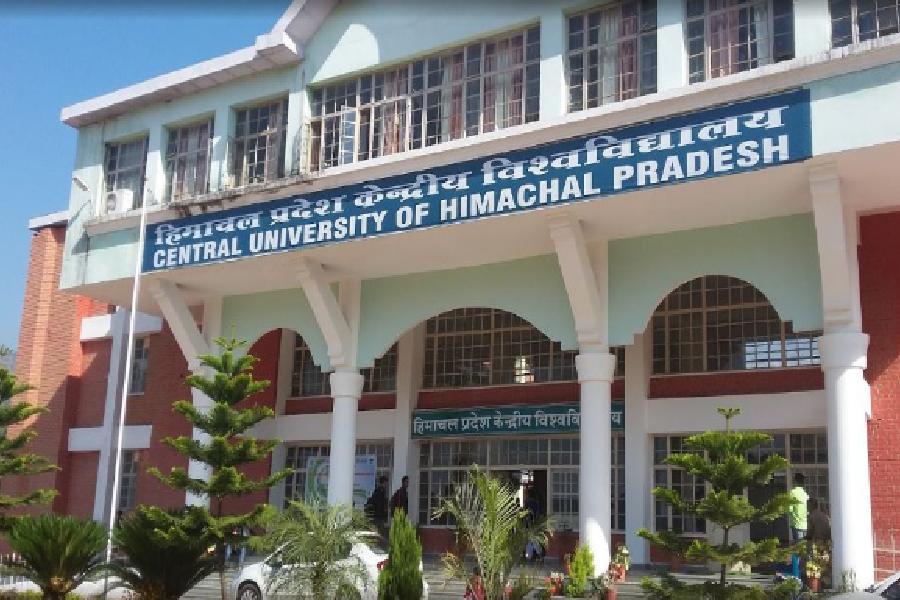
RSS man appointed as professor of practice by Central University in Himachal Pradesh to teach Hindu Studies


RSS pracharak as 'professor of practice' under national scheme

Shiksha Sanskriti Utthan Nyas is a self-appointed adviser to the government on curriculum reforms and has suggested the teaching of 'Vedic mathematics' at schools, among other recommendations

Basant Kumar Mohanty New Delhi Published 31.03.24, 05:49 AM
Central University of Himachal Pradesh

Central University of Himachal Pradesh www.cuhimachal.ac.in

The Central University of Himachal Pradesh has decided to appoint an RSS pracharak as “professor of practice” under a national scheme that relaxes the requirements of academic degrees and publications for these posts.

Atul Kothari, national secretary of the Shiksha Sanskriti Utthan Nyas, will be professor of practice in Hindu studies. The Nyas is a self-appointed adviser to the government on curriculum reforms and has suggested the teaching of “Vedic mathematics” at schools, among other recommendations.

[ . . . ]

 https://www.telegraphindia.com/india/central-university-of-himachal-pradesh-appoint-rss-pracharak-as-professor-of-practice-under-national-scheme/cid/2010139

March 15, 2024

January 24, 2024

January 18, 2024

India: On the differences between 'Ram Rajya' of Gandhi & that of BJP/RSS | Ram Puniyani [article in Hindi]


गांधी और बीजेपी-संघ के रामराज्य फर्क

 राम पुनियानी 

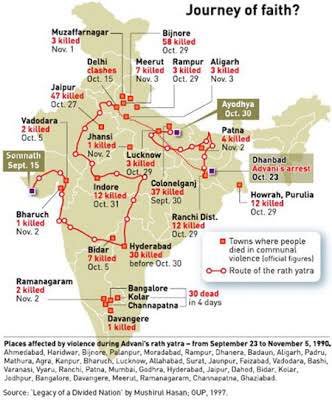
1980 के दशक में देश के इतिहास ने एक नया मोड़ लिया था. पहली बार, राममंदिर जैसा भावनात्मक मुद्दा आर्थिक और सामाजिक न्याय जैसे मूलभूत मुद्दों से ज्यादा अहम बन गया. बाबरी मस्जिद के ताले खोले जाने के बाद बीजेपी के लालकृष्ण आडवाणी ने रथयात्रा निकालने की योजना बनाई. तत्कालीन प्रधानमंत्री वीपी सिंह द्वारा मंडल आयोग की रिपोर्ट लागू किए जाने की घोषणा के बाद, इस यात्रा को और तेज किया गया. यह यात्रा स्वतंत्र भारत में सांप्रदायिक आधार पर समाज को ध्रुवीकृत करने वाली सबसे बड़ी परिघटना बन गई. रथयात्रा अपने पीछे खून की एक गहरी और मोटी लकीर छोड़ गई.

इसके बाद बाबरी मस्जिद का ध्वंस हुआ और बीजेपी की ताकत में जबरदस्त इजाफा हुआ. बीजेपी जो उस समय गांधीवादी समाजवाद का लबादा ओढ़े हुए थी, को चुनाव में जबरदस्त मुंह की खानी पड़ी थी. रथयात्रा उसके लिए जीवनदायिनी अमृत साबीत हुई. चुनावों में उसके प्रदर्शन में जबरदस्त सुधार हुआ और 1996 में उसने केंद्र में अल्पमत की सरकार बना ली. इसके बाद, 1998 में वह एनडीए के सबसे बड़े सदस्य दल के रूप में सत्ता में आई और 2014 में उसे स्वयं के बलबूते पर बहुमत हासिल हो गया.

चुनावों में सफलता पाने के इस फार्मूले को बार-बार इस्तेमाल करने में बीजेपी सिद्धहस्त हो गई है. चुनाव आते ही वह राममंदिर जैसे विघटनकारी और भावनात्मक मुद्दे उछालने लगती है. उसके साथ वंदे मातरम्, लव जिहाद, पवित्र गाय आदि जैसे पहचान से जुड़े मुद्दों का मिश्रण तैयार कर, वह सत्ता में आने का कोशिश करती है. चूंकि अगले साल देश में आम चुनाव होने हैं, इसलिए बीजेपी को एक बार फिर भगवान राम की याद सताने लगी है.

इस बार भगवान राम की सहायता से चुनाव में विजय प्राप्त करने के अभियान की शुरूआत, आरएसएस प्रमुख मोहन भागवत ने उडिपी में नवंबर 2017 में आयोजित विहिप की धर्मसंसद से की. विहिप ने भागवत के संकेत को समझा और मुस्लिम राष्ट्रीय मंच के संयुक्त तत्वाधान में उत्तर प्रदेश के अयोध्या से तमिलनाडु के रामेश्वरम तक रामराज्य रथयात्रा की शुरुआत की. महाराष्ट्र की जो संस्था इस यात्रा का समन्वय कर रही है, उसका नाम है श्री रामदास मिशन यूनिवर्सल सोसायटी. इस यात्रा के रथ का आकार, अयोध्या में प्रस्तावित राममंदिर की तर्ज पर है. यह साफ है कि इस यात्रा का मुख्य एजेंडा राजनैतिक है और उसके लक्ष्य वही हैं, जो हिंदू राष्ट्रवादियों के हैं. जिन मांगों को लेकर यह यात्रा निकाली जा रही है, उनमें रामराज्य की स्थापना, अयोध्या में भव्य राममंदिर का निर्माण, रामायण को स्कूली पाठ्यक्रमों में शामिल करना और रविवार के स्थान पर गुरूवार को साप्ताहिक अवकाश घोषित करना शामिल हैं.

मुस्लिम राष्ट्रीय मंच, आरएसएस के हाथों का खिलौना है, जिसका इस्तेमाल वह समय-समय पर यह दिखाने के लिए करता रहता है कि मुसलमान भी उसके साथ हैं. सच यह है कि अधिकांश मुसलमानों को अब यह अच्छी तरह से समझ में आ गया है कि देश में लव जिहाद, बीफ, तिरंगा आदि मुद्दों पर हिंसा भड़का कर मुसलमानों को दूसरे दर्जे का नागरिक बनाने का षड़यंत्र रचा जा रहा है. देश में 16 करोड़ मुसलमान हैं और उनमें से जफर सरेशवाला जैसे मुसलमान खोज निकालना मुश्किल नहीं है, जो सत्ता से लाभ पाने के लोभ में बीजेपी का बिगुल बजाने में तनिक भी संकोच न करें.

आईए, देखें कि यात्रा निकालने वालों की मांगों के पीछे का सच क्या है. जहां तक रामराज्य की स्थापना का सवाल है, रामराज्य को देखने के कई तरीके हो सकते हैं. गांधीजी का रामराज्य समावेशी था. वे राम और रहीम, इश्वर और अल्लाह को एक ही मानते थे. दूसरी ओर, आंबेडकर और पेरियार, भगवान राम द्वारा धोखे से बाली को मारने और दलित शम्बूक की हत्या मात्र इसलिए कर दिए जाने से अत्यंत विचलित थे, क्योंकि वह जातिगत मर्यादाओं को तोड़कर तपस्या कर रहा था. आडवाणी-बीजेपी-आरएसएस के राम अल्पसंख्यकों को डराने वाले राम हैं.

कई मुस्लिम-बहुल देशों में साप्ताहिक अवकाश शुक्रवार को होता है और इसी आधार पर यह मांग की जा रही है कि भारत में गुरूवार को साप्ताहिक अवकाश होना चाहिए. हम एक ओर दुनिया की आर्थिक महाशक्ति बनने की महत्वाकांक्षा रखते हैं तो दूसरी ओर हम पूरे विश्व से निराली राह पर चलने की बात भी कर रहे हैं. जब सारी दुनिया में रविवार को साप्ताहिक अवकाश रहता है तब भारत में किसी और दिन अवकाश रखने से क्या हमारा अंतर्राष्ट्रीय व्यापार और वैश्विक बाजार में हमारी उपस्थिती पर विपरीत प्रभाव नहीं पड़ेगा?

जहां तक रामायण को स्कूली पाठ्यक्रमों का हिस्सा बनाने का सवाल है, इसमें भी आरएसएस की सोच संकीर्ण है. क्या हम यह भूल सकते हैं कि संघ की विद्यार्थी शाखा एबीवीपी ने एके रामानुजन के प्रसिद्ध लेख थ्री हंड्रेड रामायणास को पाठ्यक्रम में शामिल करने का विरोध किया था और उसे पाठ्यक्रम से हटवा कर ही दम लिया था. यह लेख बताता है कि भगवान राम की कथा के कई संस्करण हैं और उनमें एक-दूसरे से अलग और विरोधाभासी बातें कही गई हैं. उदाहरण के लिए, थाईलैंड में प्रचलित रामकथा रामकिन में हनुमान बाल ब्रह्मचारी नहीं बल्कि गृहस्थ हैं. इसी तरह, आंध्रप्रदेश में प्रचलित ‘रामकथा’ महिलाओं के दृष्टिकोण से लिखी गई है. वाल्मीकि की रामायण और तुलसीदास की रामचरितमानस में भी कई अंतर हैं. संघ परिवार, रामायण के एक विशिष्ट संस्करण का हामी है. ऐसे में, पाठ्यक्रमों में कौन सी रामायण शामिल की जाएगी?

सच्चाई ये है कि स्वयं को हिंदुओं का हित रक्षक बताने वाला संघ परिवार, जो मांगें उठा रहा है, उनका हिंदुओं की जरूरतों से कोई लेना-देना नहीं है. वे हिंदुओं के लिए कतई प्रासंगिक नहीं हैं. आखिर रामराज्य रथयात्रा या राममंदिर से कौन से सामाजिक-आर्थिक लक्ष्य हासिल होंगें? क्या इससे हिंदू किसानों की समस्याएं सुलझेंगी? क्या इससे हिंदू बेरोजगारों को काम मिलेगा? क्या इससे हिंदू महिलाओं और बच्चों के स्वास्थ्य या पोषण का स्तर बेहतर होगा? क्या इससे दलितों पर होने वाले अत्याचार कम होंगे? क्या इससे महिलाओं के विरुद्ध हिंसा की घटनाओं में कमी आएगी?

यह यात्रा ऐसे समय निकाली जा रही है, जब सुप्रीम कोर्ट बाबरी मस्जिद की जमीन के मालिकाना हक से संबंधित मामलों की सुनवाई कर रहा है. क्या इस समय यह यात्रा निकालना एक प्रकार से अदालत को चुनौती देना नहीं है? हिंदू राष्ट्रवादी, समाज का ध्यान और उसके संसाधनों को गलत दिशा में मोड़ रहे हैं. वे सिर्फ समाज के वर्चस्वशाली तबके की भावनाओं को संतुष्ट करना चाहते हैं. योगी आदित्यनाथ ने उत्तर प्रदेश सरकार के वार्षिक बजट में अयोध्या में राम की प्रतिमा के निर्माण और दीपावली और होली मनाने के लिए राशि का आवंटन किया है. क्या जिस प्रदेश में नन्हे बच्चे आक्सीजन की कमी के कारण मर रहे हों, वहां ऐसा करना स्तब्ध कर देने वाला और क्रूर नहीं है? रामराज्य रथयात्रा के लक्ष्य शुद्ध राजनैतिक हैं. अगर गांधी के राम से यह पूछा जाता कि अयोध्या की विवादित भूमि पर क्या बनना चाहिए, तो शायद वे भी अपना मंदिर बनवाने की बजाए उस पर किसी अस्पताल या विश्वविद्यालय के निर्माण की बात करते.


January 07, 2024

India: Idol Chatter - Neerja Chowdhury presents RSS myth on Ayodhya as history | Dhirendra K Jha

The Caravan

Idol Chatter
Neerja Chowdhury presents RSS myth on Ayodhya as history

by Dhirendra K Jha

28 October 2023

Neerja Chowdhury's How Prime Ministers Decide perpetuates the RSS myth that Nanaji Deshmukh was involved in placing a Ram idol at the Babri Masjid on the night of 22 December 1949. SONDEEP SHANKAR / GETTY IMAGES

It is well known that the Ram Janmabhoomi movement, aimed at constructing a temple at the site of Ayodhya’s Babri Masjid, was the most pivotal Hindu majoritarian campaign for capturing the centre stage of Indian politics. It is an equally established fact that the Sangh Parivar launched this campaign only in 1984, when the issue was made the central plank of the Vishva Hindu Parishad and the Bharatiya Janata Party. The critical turning point of this dispute—the placing of a Ram idol inside the mosque on the night of 22 December 1949—was the handiwork of another section of Hindu communalists, belonging to the Hindu Mahasabha. In fact, it was this act, seen as the first attempt to convert the Babri Masjid into a Hindu religious site, that led to the decades-long legal battle that culminated in the Supreme Court, on 9 November 2019, mandating the construction of a temple at the site of the mosque.

Given the significance of the issue, the Rashtriya Swayamsevak Sangh seems to have long desired the stamp of antiquity on its association with the dispute. Until the assassination of Mohandas Gandhi, on 30 January 1948, the RSS and the Hindu Mahasabha had acted almost like sister organisations, with overlapping membership being widespread. But, after the assassination, in order to de-hyphenate itself from the assassin, Nathuram Godse, the RSS quickly disassociated from the Hindu Mahasabha, even though they remained in the same ideological space. The Sangh’s move emanated from Godse’s claim, during his trial, that he had left the RSS and joined the Hindu Mahasabha long before he killed Gandhi. To give credence to Godse’s lie and cover its tracks, the RSS fabricated history to push the false notion that it had existed in total separation from the Hindu Mahasabha since the 1930s.

This line of argument became a hurdle for the Sangh when it sought to associate itself with the Hindu Mahasabha’s 1949 bid to convert the Babri Masjid into a Ram temple. Even after launching its own campaign, in 1984, the RSS did not seek any such association, for a very practical reason: to avoid being implicated in the crime of breaking into the mosque. However, years later, when a legal victory began to appear imminent, some members of the Sangh, in their typically nuanced way, quietly circulated stories that Nanaji Deshmukh, the RSS pracharak—full-time worker—in charge of eastern Uttar Pradesh in 1949, had played an important role in placing the idol.

[  . . .  ]

 https://caravanmagazine.in/history/neerja-chowdhury-rss-myth-ayodhya

December 29, 2023

India: Slowly and steadily, RSS groups prepare ground for ‘delisting’ of converted tribals

 Slowly and steadily, RSS groups prepare ground for ‘delisting’ of converted tribals
 

Janjati Suraksha Manch has given impetus to the old demand, fitting in with RSS's larger ideological project, over the last two years. At the same time, RSS ensures regional sensibilities are kept in mind
 

Written by Deeptiman Tiwary

New Delhi | Updated: December 29, 2023 07:36 IST

The JSM formed around 2006, with an aim to raise the issue of delisting converted tribals, is headed by national convenor Ganesh Ram Bhagat, a former minister in the Raman Singh-led Chhattisgarh Cabinet.
 

As festivities were being held to celebrate Christmas and ring in the New Year, members of tribal communities gathered under the aegis of a relatively new organisation – the Janjati Suraksha Manch (JSM) – and held separate rallies in Jharkhand and Tripura demanding the delisting of tribals who have converted, essentially to Christianity, from the list of Scheduled Tribes (STs).  [. . .]

 https://indianexpress.com/article/political-pulse/slowly-and-steadily-rss-groups-prepare-ground-for-delisting-of-converted-tribals-9085831/

June 22, 2023

India: District collector spotted making the RSS salute in Madhya Pradesh | sabrangindia - June 21, 2023


What’s wrong, asks district collector spotted making the RSS salute: Madhya Pradesh

The opposition Congress and ruling BJP have been embroiled in a war of words ever since a picture surfaced showing two officials participating in a prayer during an RSS event on June 11

A district collector in Madhya Pradesh, who has come under sharp criticism from the opposition Congress for attending an RSS event, has told The Indian Express he sees nothing wrong in it.

“There is nothing wrong in attending the event. It was a public event attended by thousands of people. There is no ban on public officials attending such an event. Several senior dignitaries attended it. Elections are coming in the state and a controversy has erupted because of that,” Satna district collector Anurag Verma said.


https://t.co/O10r5Mnrhn

May 24, 2023

India: How RSS Schools Create Hindutva Foot Soldiers | Astha Savyasachi

 The Wire

Communal Textbooks, Teachers Who Brought Down Babri: How RSS Schools Create Hindutva Foot Soldiers

Vidya Bharati schools across the country use false claims, cultural indoctrination and consistent anti-Muslim rhetoric to instil Hindutva ideology in young minds.


New Delhi: It was time. Everything was ready for the biggest function in the school – a grand stage, a hall decorated with magnificent lighting, jam packed audience seats, and high-profile chief guests: Union minister D.V. Sadananda Gowda, Puducherry governor Kiran Bedi and several ministers from Karnataka.

[ . . .]


https://thewire.in/communalism/communal-textbooks-teachers-who-brought-down-babri-how-rss-schools-create-hindutva-foot-soldiers

Communal Textbooks, Teachers Who Brought Down Babri: How RSS Schools Create Hindutva Foot Soldiers

May 14, 2023

India: Doyens of Hindutva - Collections of essays on Savarkar, Godse, Golwalkar, Mohan Bhagwat, S Gurumurthy | The Caravan

 https://caravanmagazine.in/

On 28 May, the Maharashtra government—a coalition of the Shiv Sena and the Bharatiya Janata Party—will celebrate the birth anniversary of the Hindu nationalist demagogue VD Savarkar as Swatantraveer Gaurav Din, perpetuating a tradition among the Hindu Right of lionising him as a freedom fighter despite his marginal role in the anticolonial struggle. This month also includes the birthday of Nathuram Godse, who assassinated MK Gandhi in 1948. Hindutva groups have sought to rehabilitate Godse’s reputation, with the Hindu Mahasabha commemorating his birth anniversary in recent years.
As the Hindu Right celebrates its most controversial figures, read a selection of longform essays and reportage from The Caravan’s archives on a few doyens of Hindutva.

Abhay Regi argues that “the deification of Savarkar has been an outcome of the constant writing and rewriting of his life.” This project is active today also, as evident in two recent biographies by Vikram Sampath and Vaibhav Purandare. Regi turns to a 1926 book, The Life of Barrister Savarkar, to understand Savarkar’s political legacy, “including his urge towards primal violence and the anti-intellectualism that undergirds his thinking.”
.
Dhirendra K Jha examines archival documents that prove Godse never gave up his RSS membership, contrary to the Sangh’s disavowal of Gandhi’s assassin. “The story of Godse’s life reveals a constant and inextricable link with the RSS,” Jha writes. “Radicalised at an early age by Savarkar himself, Godse inhabited an environment constantly pushed him towards a certain kind of politics.”
.
Hartosh Singh Bal’s 2017 profile of Golwalkar—the second sarsanghchalak, or supreme leader of the RSS—and his continuing influence on India, with Modi being a staunch admirer of the Sangh ideologue. Bal notes that, in We or Our Nationhood Defined, Golwalkar unambiguously compares the project of promoting a Hindu culture with German antisemitism.
.
Jha delves deeper into the Sangh’s imitation of the Nazis, noting how many RSS members were enamoured with European fascists in the late 1930s and 1940s. “Contemporary accounts suggest that, during this period, Golwalkar sought to turn the RSS into a Nazi-style militia, with the goal of eventually installing himself as führer.”
.
Dinesh Narayanan’s May 2014 profile of Bhagwat, the current sarsanghchalak, whom he defined at the time as “perhaps the only person who has publicly checked Modi without experiencing any political fallout.” Narayanan writes that Bhagwat “is immensely influential, but he does not unilaterally impose his will on the BJP or on his own organisation.”
.
Eight years after Narayanan’s profile, Jha explains, in the November 2022 issue, how Modi has tilted the balance of power within the Sangh Parivar in the BJP’s favour, leaving Bhagwat, and the RSS, in a position where they are obeying instructions instead of issuing them. Ramesh Shiledar told Jha that Bhagwat was “a man of mediocre qualities and would succumb to any and every pressure that would be exerted on him.”
.
Sujatha Sivagnanam’s April 2023 profile of S Gurumurthy, who often shies away from the limelight despite his oversized impact on India in the past fifty years. “The vision he has shaped through these institutions,” Sivagnanam writes, “is central to the RSS’s core tenets and his own upbringing: the establishment of Brahmin influence over political and economic life.”

March 08, 2023

Can RSS be compared to Muslim Brotherhood? | Ram Puniyani

by Ram Puniyani


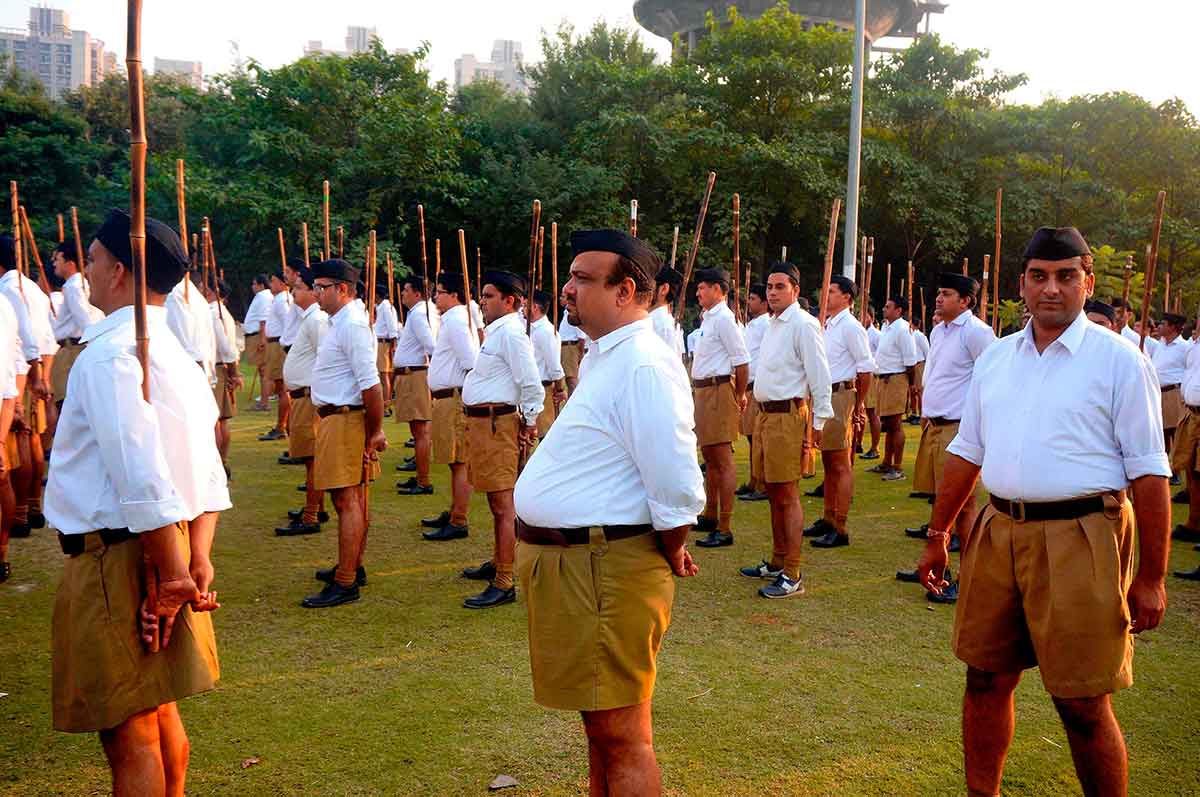
In his recent tour abroad (August 2018) while addressing the International Institute for Strategic Studies Rahul Gandhi stated that "The RSS is trying to change the nature of India. There is no other organization in India that wants to capture India's institutions... It is similar to the idea that exists in the Arab world of the Muslim Brotherhood. The idea is that one ideology should run through every institution and one idea should crush all other ideas,” and that "Muslim Brotherhood was banned after Anwar Sadat's assassination; RSS was banned after Mahatma Gandhi's assassination… And the most interesting one -- women are not allowed in either of these organizations," In response to this BJP spokesperson Sambit Patra retaliated and  “the likes of President Ram Nath Kovind, Prime Minister Narendra Modi and former prime minister Atal Bihari Vajpayee…have a RSS background and Gandhi’s comparison of the organization with an Islamist outfit is “unforgivable”. . 

Some from RSS stable went on to say that one who has not understood India cannot understand RSS. As such there has been various analysis of the nature of RSS politics. Academics and political scientists have tried to unravel the real politics behind its activities. RSS is not just a political organization, it is a supra political organization, where its political wing BJP is a small component of its total activities manifested through myriads of its organizations. Sudhanshu Mittal from BJP in an article states that RSS affiliated organization all have greatly contributed to the nation.

Hundreds of such organizations are active in different sections of society. While not talking of the manipulative role of these organizations, let’s see what some of these have not been doing which is needed and is relevant for social groups. One such point comes to one’s mind about RSS affiliate Bharatiya Kisan Sangh for example. One is witnessing the torment of farmers in the form of suicides, which reflects the deeper agrarian crisis. Have we ever heard the voice of this organization as to how to protect the agrarian sector, how government policies are flawed leading to the critical situation in village? Same question can be raised about agenda of these organizations among Adivasis’s. While one hears a lot about rising anti Christian violence in these areas, one knows that RSS affiliates don’t raise their voice against the displacement and marginalization of Adivasis.  

RSS also claims to be having involved in lots of charity work, its claims generally dominate the media, saying that RSS volunteers are the first to reach the site of calamity. Interestingly Muslim Brotherhood is also prompt and active in the area of charity work. But in both the cases RSS and Muslim Brotherhood, Charity is the superficial point the core agenda is to impose particular type of social relations, those of inequality on the society. At core; the project of both RSS and Muslim Brotherhood is to bring in a social system which is opposed to democratic ethos of equality of all. Surely RSS and Muslim Brotherhood are no clones; still there are some features which are common as their political agenda is similar. Despite all this big paraphernalia of RSS; its core agenda remains Hindu nationalism, it regards the values of Indian Constitution as being Western and is aiming to push the society back to the values given Holy Scriptures. Let’s see what Islamic brotherhood wants? On parallel lines it has stood in opposing the democratic values of equality, calling the very democratic institutions as Western and so the need to promote Islamic values, which as interpreted by them stand for inequality of gender and social groups.

Both are the exclusively male organizations, harping on the past golden era, harping on opposition to modern (called Western by them) values. This should be the defining point in comparing any organization. It is also true that while RSS has trained Pracharaks who in turn float different organizations, rooted in RSS agenda, which have different formal structures. Muslim Brotherhood probably encompasses most of the activities under its own umbrella. Here one can add that the Christian Fundamentalism which came up in US in the decades of 1920s had many similar features. In post colonial societies in particular; organizations deriving their legitimacy in the name of religion; to begin with; have come up in opposition to the rising values of Equality. In India when the Indian National Congress began in 1885, it aimed at an inclusive nation hood cutting across all the religious communities. It also aimed at equality of all.

In contrast Muslim League and Hindu Mahasabha-RSS began from the feudal, landlord sections, joined in by the elite and middle class sections, harping on ancient golden era, the Holy Scriptures and the grand rule of Kings belonging to their religion. RSS in a more clever way floated myriad organizations to ensure a smooth division of labor and indoctrination, cooption of different sections of society for its agenda of Hindu Rashtra and also for opposing the inherent values of Indian Constitution. So that’s about the similarities with the organizations like Muslim Brotherhood and RSS.

Sambit Patra reacting to Rahul Gandhi’s statement called it unforgivable and cited that the likes of Kovind, Vajapyee and present Prime Minster Mr. Modi have RSS background. One appreciates the listing of Mr. Patra. What is shows is so obvious, what it does not cite is that the likes of Godse who killed Mahatma Gandhi, Dara Sing; the one who killed Pastor Stains and Pramod Mutalik whose Sri Ram Sene attacked the girls visiting the pub also have RSS background or association. While Muslim Brotherhood has been labeled as terrorist organization in some countries, the two of the RSS pracharaks are in jail for Ajmer blast. 

Surly both these exclusively male organizations have a lot in common, have the common goal of opposition to democratic ethos, both use religion’s identity to enhance their agenda. The form of organizations and expressions do differ.