The message of the people to oppositional politics at the moment is as clear as it should be. The extremely successful ‘
Bharat Bandh’ of April 2
in protest against the dilution of the SC/ST Act by Dalits, even
without any centrally identifiable leader, was a culmination of the
atrocities against the community exemplified by Rohith Vemula’s suicide,
the Una (Gujarat) lynchings, Bhima Koregaon, and a horse-riding Dalit
boy being killed brutally in Gujarat. The bandh came in the backdrop of
a powerful long march of peasants to Mumbai; growing disenchantment of
the backward castes in Bihar against what they perceive as
disproportionate and selective victimisation of Lalu Prasad while no
action was taken against bigger scams in BJP-ruled states, such as
Vyapam (Madhya Pradesh), rice (Chhattisgarh) and Srijan (Bihar).
These series of events in the era of social media have renewed the
memories of caste-based oppression. Having grown up in the era of Mandal
empowerment since the 1990s, such memories had begun to fade away from
the minds of the new generation of backward and Dalit youth. The return
of ‘Thakur Raj’ in Uttar Pradesh, Nitish Kumar rejoining the BJP in July
2017 and his predictable marginalisation, and intensified communal
polarisation in the last few months has come to be seen as a revival of
upper caste hegemony at the cost of the backward-Dalit empowerment. This
eventually led to the Samajwadi Party-Bahujan Samaj Party alliance in
UP, which was pushed more from below than from above, clinching
electoral victories in the recent by-elections. However, the communal
offensive has further deepened, manifesting itself in widespread
violence across Bengal and Bihar, where the BJP is perceived to be an
emerging hegemon in the 2019 elections. This
has alarmed even the
BJP’s Dalit-Backward allies.
A series of reports from the ground in the
Indian Express, more particularly by
Dipankar Ghose and the
BBC Hindi
on the recent communal violence, testify the growing lumpenisation of
upper caste unemployed youth joining saffron outfits in utter
desperation. Mounting banking scandals, with the scamsters easily being
allowed to flee abroad, growing youth unemployment, particularly in the
last three years; leakage of question papers and atrocities against
Muslims, among others, further re-affirm that the forces fighting for
social and gender justice need a united political coalition
addressing/tapping all this churning.
Why and how can this be done?
A careful reading of history of Bihar (UP and Bengal also) shows
eerie commonalities in the three decades – 1890s, 1920s and 2010s.
Hence, it is instructive to look back at two decades and comparing it
with the decade we are living in.
The two decades had a ‘rash of riots’, and were, “one of the major
peaks in incidence of Hindu-Muslim disturbances”, said Anand A. Yang, a
professor of history, who has specialised in South Asian history,
particularly colonial India.
In these two historical decades, middle class Hindus in the said
provinces were enlisting religion to generate popular support.
Landlords, various Hindu orthodox and reformist organisations such as
Sanatan Dharma, Arya Samaj,
Gaurakshini Sabhas,
sustained by upwardly mobile trading castes were carrying out the
project of communalisation. This was patronised and instigated by
zamindars (and by professionals like advocates), who, according to Yang, debilitated state authority. This is endorsed in detail by
Gyanendra Pandey (1990). Another historian,
Hitendra Patel (2011)
lists such organisations in his study on communalisation of vernacular
intelligentsia in colonial Bihar. The stereotypes of ‘brave Rajputs’ and
‘barbaric Muslims’ were constructed through Hindi literature and press
in the 1890s, and that became a crucial element of identity construction
and mobilisation.
In recent times, Turkey’s vernacular intelligentsia has resorted to
Islamist mobilisation, according to writer and anthropologist
Jenny White (2002), which eventually facilitated the rise of Erdogan to power.

The Hindu Yuva Vahini is making inroads into Bihar after Adityanath’s rise to power in adjacent Uttar Pradesh. Credit: PTI Files
Likewise, in Uttar Pradesh, the Hindi press has played a role in
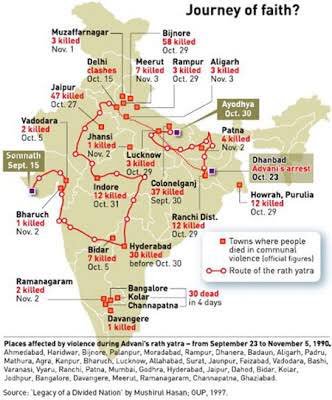
communalisation since the late 1980s, in the wake of the Ram Temple
campaign.
In today’s Bihar, as elsewhere, the zamindars have been replaced by
functionaries of political parties who now prevail upon the police and
bureaucracy in various ways and impede the rule of law. There are
reports on how BJP’s
Arijit Sashwat
(son of a Union minister) in Bhagalpur led the riotous mob on March 17,
2018, and had the temerity to have posted the video on Facebook.
Likewise, Anil Singh of Hindu Yuva Vahini (HYV) along with the BJP MP of
Aurangabad, Sushil Singh, led a v
iolent mob on March 25, 2018. Both are Rajputs, among whom HYV is making inroads after Adityanath’s rise to power in the adjacent Uttar Pradesh.
BJP’s Dinesh Jha
climbed up the minaret of a mosque in Rosera (Samastipur) to hoist a
saffron flag on March 27, 2018. Given the fact that BJP and its allies
rule over Bihar as well as the Centre, these political functionaries
were bold enough to have asserted demonstratively. This was done to
sustain communal polarisation till the next general elections in 2019
for the benefit of the party, as much as to bolster their respective
political careers.
About the 1890s and 1920s, Freitag’s essay (1980), says that
mobilisations were also because of intra-community competition (e,g.,
Shia–Sunni). This formulation finds echo in our times also. In January 2016, there was violence in Kaliachak
(Malda, West Bengal). This was in retaliation of blasphemous remarks
against the Prophet by ‘self-proclaimed Hindu Mahasabha leader’ Kamlesh Tiwari. Tiwari had reacted against SP leader Azam Khan’s disparaging remarks
about the Rashtriya Swayamsevak Sangh in November 2015. Against Tiwari,
a group of Deobandi Sunni Muslims took out a demonstration in Kolkata.
Its rival sub-sect, Barelvis, sought to match it with their own, which
they did in Kaliachak in January 2016. This, however, degenerated into
Hindu-Muslim violence. Overall, there were many such competitive
mobilisations of Barelvis and Deobandis across India, protesting against
Tiwari.
Structures, Planning, Faces
Interestingly, geography and the
modus operandi of the riots
also carry some similarities across the three identified decades. Yang
and Freitag, both historians, explored the structures and planning
involved in religious disturbances and collective violence and studied
the basis for (re)action. They also examined faces in the crowd, finding
an integrative function in the processions taken out in the name of
religion. Common people were incorporated in the process of
sanctification and it defined group solidarity.
On very short notice, thousands used to gather, reaching on horses,
elephants, bicycles, etc., just as now they assemble on motorbikes,
masking their faces and flaunting saffron flags. In the 1890s and in the
1920s, people were intimated either through networks of weekly
haats, where people from many villages in the vicinity gathered, or through
patias (leaflets). Now, mobilisation is done via social media through which messages are spread to feed hatred.
As said, the Bihar districts that witnessed communal violence in our
times almost coincide with those having witnessed the same in the 1890s
and the 1920s.
‘
Rise’ of Muslims, the Other
In the 1920s, alarmed by the increased political participation of
Muslims in the Non- Cooperation Movement (1920-22) and on the issue of
Caliphate seated in Turkey, there was a spurt in communal violence after
the movement was suspended because of police violence and retaliation
by peasants in Chauri Chaura (Gorakhpur) in early February 1922. This
decade witnessed a widening gulf between the two communities with
competitive mobilisations for
Shudhi-Sangathan and
Tabligh-Tanzim, respectively.

The
affluence of a section of Muslims is reflected in big mosques with tall
minarets which, for instance, caught the attention of BJP functionary
Dinesh Jha in Samastipur who climbed up and hoisted a saffron flag.
Credit: Twitter/Md Asif Khan
In contemporary India, the economic affluence of Muslims based in the
Gulf, particularly since the 1980s, and their incremental
participation/representation in rural and urban local bodies as well as
rising investments in local trading has created jealousies and rivalries
in both political and economic spheres. Aurangabad’s big bookshop
ransacked by the rioters last month belonged to a Muslim who had
established it after quitting his job in the Gulf.
The targeting of business interests serves a twin purpose – it
eliminates competition, creates a monopoly for established entities or
an opening for those wanting to make an entry.
The affluence of a section of Muslims is reflected in big mosques
with tall minarets and domes which, for instance, caught the attention
of BJP functionary Dinesh Jha who climbed up and hoisted a saffron flag.
Compare the imposing Masjid of Rosera in Samastipur with as big a
temple that does not exist in that area. Or, have a look at the
photograph of the defiled Hanuman Mandir in Nawada, the architecture of
which compares poorly with many Masjids in the locality. These symbols
are played upon by the saffron outfits.
Economic Crisis
In August 1925, trade rivalries among merchants and shopkeepers
manifested in the form of communal violence in Shahabad. Some historians
have concluded that a crises-ridden economy is more prone to giving
rise to communal hatred and violence. This is precisely what is
happening in India.
Just as 2018 is seen as a time of economic crisis, in the 1920s, too,
traders and agriculturalists were made to believe that Muslims
slaughtering cows was the reason for the agrarian crisis and price rise.
In 1926-27, there were riots in Calcutta and Bihari people living there
went back to Bihar. Soon, anger and panic set in through rumours, which
get more credence in a polarised atmosphere.
Lathis (sticks)
and weapons began to be stored. Anti-social elements seized this
opportunity. Just as now, anti-social elements-cum-representatives of
local bodies (former, incumbent, aspiring) bolster their political
career through such mobilisation.
Mobilising the Oppressed to Resist Communal Hatred
Responding to competitive communal mobilisation in the 1920s, the
Congress, (and the Socialist-Left) forces resorted to addressing peasant
and working class interests and mobilising them with greater vigour,
exemplified most prominently in the Karachi Resolution (1931) and the
Faizpur Agrarian Programme (1936), which reassured the peasantry about
rural indebtedness. The Gandhi-Ambedkar Pact (1932) was an attempt at
social inclusion, howsoever (in)adequate, besides the Motilal Nehru
Report (1929) that failed more because the Hindu Mahasabha reneged on
its promise.
The other unaddressed issue was the
question of the backward castes. Among Muslims, too, this issue was
coming up, articulated by people like Abdul Qaiyum Ansari (1905-74). A
crucial aspect, however, remains under-explored as to whether Ansari
really engaged with Ambedkar and Lohia during 1940s-50s, or even with a
pro-Congress Dalit like Jagjivan Ram (1908-86) thereafter?
More importantly, did Dalits really extend their solidarity with
Ajlaf-Arzal
(backward castes among Muslims)? Or, Ambedkar simply talked of getting
rid of the separatist Muslims by conceding Pakistan to them, as a ‘final
solution’? Are contemporary Dalit movements as much forthcoming for
Arzal demand of inclusion into the Scheduled Castes?
With these issues, the Congress went on to contest the provincial
elections in 1937, in which the majoritarian and separatist forces were
pushed to the margins. (Though it perhaps faltered on being more
accommodative towards such classes after 1938 when competitive
communalism, aided and abetted by the powerful colonial state,
eventually divided India).
Tactical Change in Rioting in our Times
Almost all towns and villages in Bihar having suffered violence in
January and in March 2018 tell us that there has been almost no loss of
human lives. The incendiary slogans in the processions and then loot,
arson of shops and houses, injuring humans, almost invariably short of
fatalities, are the common characteristics of the recent violence.
Why small riots? “Small riots sustain communal consciousness over a
long period by attracting minimum public scrutiny… Big riots need
long-term preparation and lose their effect after a few days…which helps
consolidate Hindu votes that could otherwise be split along caste or
regional lines” Prof
Badri Narayan told the Hindustan Times.
Large-scale violence and massacre
would invite social outrage and a prolonged judicial battle against the
aggressors. Hence, it is generally avoided, particularly after Gujarat
(2002). The Muzaffarnagar riots (2013) and displacement was an outlier,
where too judicial battles are putting the aggressors in trouble.
Moral of the story
A comparative study of communal politics of these three decades
possibly indicate that the solution lies in assertion of civil society
and the political formations committed to pluralist-inclusive
programmes. They must mobilise the peasantry and the oppressed.
As of now, the leading opponent, the Congress, has a confused
socio-economic programme, whereas its potential regional allies hardly
have a clear-cut economic programme for their respective regions. The
situation at the moment desperately demands that when corporate and
crony capital has shifted the polity Right-ward; when the media owned by
them are ‘manufacturing consent’ in favour of the reactionary regime,
and the middle classes have been opiated with the overdose of
communalism, the opposition must unite to formulate pro-poor economic
and socially inclusive programmes, just as the intense communalisation
of the 1980s could be resisted through the agenda of backward
empowerment in the 1990s. The Congress needs to be clear-headed about
its dependable support base. History does suggest that it is certainly
not a fanciful utopian idea.
That is possibly the only way forward to rescue the republic in the coming elections.
Mohammad Sajjad is a professor with the Centre of Advanced Study in History, Aligarh Muslim University, and the author of Muslim Politics in Bihar: Changing Contours.