When ISI became a ‘front for SIMI’
by Muzamil Jaleel (1 October2012)
http://www.indianexpress.com/news/when-isi-became-a--front-for-simi-/1010126/
The posters that landed retired SIMI secy in jail
by Muzamil Jaleel (28 September 2012
http://www.indianexpress.com/news/the-posters-that-landed-retired-simi-secy-in-jail/1008884/
Over a month, four ‘terror’ arrests in Indore for ‘shouting slogans’
by Muzamil Jaleel (27 September 2012)
http://www.indianexpress.com/news/over-a-month-four--terror--arrests-in-indore-for--shouting-slogans-/1008344/
2 years, 5 cities, 6 cases – and ‘proof’ everywhere is the same magazine
by Muzamil Jaleel (26 September 2012)
http://www.indianexpress.com/news/2-years-5-cities-6-cases---and--proof--everywhere-is-the-same-magazine/1007920/
A children’s magazine, newspaper, Urdu poetry – anything can land you in jail
by Muzamil Jaleel (25 September '12)
http://www.indianexpress.com/news/a-children-s-magazine-newspaper-urdu-poetry---anything-can-land-you-in-jail/1007411/
|

Showing posts with label SIMI. Show all posts
Showing posts with label SIMI. Show all posts
October 02, 2012
September 26, 2012
India: The art of Police wrong doing - A children’s magazine, Urdu poetry – anything can land you in jail
From: Indian Express, September 25 2012
by Muzamil Jaleel
In the story of men getting branded “SIMI activists” and charged under the stringent Unlawful Activities (Prevention) Act (UAPA), innocuous objects take the form of “incriminating material”. The list of such “material”, in which anything written in Urdu or Arabic comes right at the top, is by now predictable — and includes Urdu poetry, pamphlets issued by Hindu groups, newspaper articles about the Sangh Parivar, pictures and videos of the Gujarat riots, books on Islam, complaints against discrimination, as well as verses of the Quran.
http://www.indianexpress.com/news/a-children-s-magazine-newspaper-urdu-poetry---anything-can-land-you-in-jail/1007411/
by Muzamil Jaleel
In the story of men getting branded “SIMI activists” and charged under the stringent Unlawful Activities (Prevention) Act (UAPA), innocuous objects take the form of “incriminating material”. The list of such “material”, in which anything written in Urdu or Arabic comes right at the top, is by now predictable — and includes Urdu poetry, pamphlets issued by Hindu groups, newspaper articles about the Sangh Parivar, pictures and videos of the Gujarat riots, books on Islam, complaints against discrimination, as well as verses of the Quran.
http://www.indianexpress.com/news/a-children-s-magazine-newspaper-urdu-poetry---anything-can-land-you-in-jail/1007411/


April 03, 2012
On some social welfare fronts of the Muslim Right
http://articles.timesofindia.indiatimes.com/2012-03-08/hyderabad/31135491_1_pfi-muslims-karnataka-forum
Simi men now in social activists’ garb
Srinath Vudali, TNN Mar 8, 2012, 06.40AM IST
HYDERABAD: State intelligence officials are claiming that several members of the banned Students Islamic Movement of India ( Simi) have joined the Popular Front of India (PFI) and that it was this controversial organization that was behind some recent communal disturbances in the state including last year's Adoni riots.
The PFI, which shot into national prominence when two of its members chopped the hand of a Kerala Christian professor in June 2010 on the charge of blasphemy, claims to be a neo social movement for a new India for equal rights to all Indians, and is a confederation of Muslim organizations in India, as stated on its website, and is active in south India. Formed in November 2006, the PFI includes the Karnataka Forum for Dignity (KFD), the National Development Front (NDF), and Manitha Neethi Pasarai (MNP), which are active in Karnataka, Kerala, and Tamil Nadu, respectively.,
Although PFI claims to be an organization working for only the socio-economic, cultural and political empowerment of the deprived and the downtrodden, state intelligence sources say it is under their scanner for possible militant activities including terrorism.
Sources in the police department said PFI is making every effort to win over the Muslim community in Andhra Pradesh by taking up issues which are emotive and sensitive to their feelings. Specifically, it is concentrating on rural areas where the Muslim population is dominant, they said.
"The activities of PFI are widespread in Rayalaseema, especially in Kurnool district, where it is incidentally headquartered. Though its presence in Hyderabad is presently restricted to some pockets like Chandrayangutta and Shivarampalli, its activities are slowly spreading. However, the backward villages of the state where Muslim population is dominant is their focus area of operation where they take up programmes like 'Sarva Siksha Grams' or 'School Chalo'. But the sole purpose of these activities is to lure Muslim youth towards PFI," the sources said.
After the alleged role of right-wing Hindu activists surfaced in the Mecca Masjid blast, members of PFI have been suspected of having pasted anonymous posters under the caption 'Save India Day' in Old City, Kurnool, Nellore and Kadapa districts saying that innocent Muslims were harassed and arrested while the real culprits were ignored.
Simi men now in social activists’ garb
Srinath Vudali, TNN Mar 8, 2012, 06.40AM IST
HYDERABAD: State intelligence officials are claiming that several members of the banned Students Islamic Movement of India ( Simi) have joined the Popular Front of India (PFI) and that it was this controversial organization that was behind some recent communal disturbances in the state including last year's Adoni riots.
The PFI, which shot into national prominence when two of its members chopped the hand of a Kerala Christian professor in June 2010 on the charge of blasphemy, claims to be a neo social movement for a new India for equal rights to all Indians, and is a confederation of Muslim organizations in India, as stated on its website, and is active in south India. Formed in November 2006, the PFI includes the Karnataka Forum for Dignity (KFD), the National Development Front (NDF), and Manitha Neethi Pasarai (MNP), which are active in Karnataka, Kerala, and Tamil Nadu, respectively.,
Although PFI claims to be an organization working for only the socio-economic, cultural and political empowerment of the deprived and the downtrodden, state intelligence sources say it is under their scanner for possible militant activities including terrorism.
Sources in the police department said PFI is making every effort to win over the Muslim community in Andhra Pradesh by taking up issues which are emotive and sensitive to their feelings. Specifically, it is concentrating on rural areas where the Muslim population is dominant, they said.
"The activities of PFI are widespread in Rayalaseema, especially in Kurnool district, where it is incidentally headquartered. Though its presence in Hyderabad is presently restricted to some pockets like Chandrayangutta and Shivarampalli, its activities are slowly spreading. However, the backward villages of the state where Muslim population is dominant is their focus area of operation where they take up programmes like 'Sarva Siksha Grams' or 'School Chalo'. But the sole purpose of these activities is to lure Muslim youth towards PFI," the sources said.
After the alleged role of right-wing Hindu activists surfaced in the Mecca Masjid blast, members of PFI have been suspected of having pasted anonymous posters under the caption 'Save India Day' in Old City, Kurnool, Nellore and Kadapa districts saying that innocent Muslims were harassed and arrested while the real culprits were ignored.
April 01, 2012
National meet by Muslim right seeks lifiting of Ban on SIMI; Leading lights Human rights circles attend convention
Minority Rights Watch
Lifting ban on SIMI, Solution to stop targeting Muslim Youths: Says National Convention
New Delhi: Making a strong protest against "targeting" of Muslim youth, a convention here on Saturday demanded repeal of Unlawful Activities (Prevention) Act, 1967 and lifting of ban on Students Islamic Movement of India (SIMI). The convention also demanded compensation for all persons acquitted of terrorism charges, prosecution of official responsible for their prosecution and a comprehensive review of all pending terrorism cases by a sitting Supreme Court judge.
The convention entitled "national convention on protection of Muslim youth" was organised by All India Milli Council and supported by all major Muslim organisations including All India Muslim Majlis Mashawarat, Jamaate Islami, Welfare Party, Coordination Committee for Indian Muslims, and Markazi Jamiat Ulema.
Inaugurating the convention, Justice Rajinder Singh Sachchar, former chief justice of Delhi High Court, termed UAPA and sedition laws undemocratic and demanded their repeal.
"No democratic country should have UAPA and sedition laws which hit at the basic freedoms of life, liberty, expression and association. Repeated ban on SIMI is a direct assault on freedom of association", he said.
Recalling Maulana Azad, Justice Sachchar said that he prided in being a Muslim and an Indian. "Muslims are equal citizens of this great country and their patriotism cannot be questioned. They are entitled to have pride in being Muslims and Indians and cannot be subjected to any suspicion or explanation", he said.
Opposing the continued ban on SIMI, Ejaz Ahmad Aslam, Secretary, Jamaate Islami Hind said that it was completely unjustified and illegal. He said, "Appeals against the ban on SIMI are pending in the Supreme Court for more than 10 years now. In the circumstances, continued ban on SIMI was atrocious as the government has not shown any interest in getting the appeals heard by the Supreme Court".

Ravi Nair, Executive Director, South Asia Human Rights Documentation Centre, demanded that intelligence agencies, especially Intelligence Bureau, must be organised by a statute clearly stating their mandate accountability for ensuring rule of law.
He said, "Intelligence Bureau should be governed by a statute ensuring parliamentary control and their accounts should be subjected to audit by the Comptroller and Auditor General of India (India)"
Terming UAPA a blot bigger than TADA and POTA on the country's reputation, Dr. Mohammad Manzoor Alam demanded its repeal. He said that the Unlawful Activities (Prevention) Amendment Bill, 2011, currently pending in the parliament, should be withdrawn "as the first step".
Demanding that SIMI be allowed to function within constitutional and democratic framework of the country, the resolution adopted at the convention said," The continuous ban on the Students Islamic Movement of India (SIMI) since 2001 is unjustified, illegal and unconstitutional. Similarly, the declaration of SIMI as “terrorist organization” is also without basis. The ban on SIMI must be lifted immediately and its name should be removed from the schedule of “terrorist organisations” of the UAPA."
Many victims narrated their stories in the conventions. They said that police in such cases files extraordinarily bulky chargesheets and cites hundreds of witnesses and make every effort to delay trial in these cases. They also alleged that police implicates such persons in multiple case so that such persons are not able come out of jail for years together.
All India Milli Council released an around 500-page report entitled “Scapegoats” documenting stories of people who were acquitted by courts. Milli Council also realeased a list of 300 cases where Muslim youth have been implicated.
See Full Text at: http://minorityrightswatch.blogspot.in/2012/04/stop-harassment-of-innocent-muslim_01.html
October 12, 2010
Can Rahul Gandhi conjure India from Ayodhya?
dawn.com
by Jawed Naqvi
Monday, 11 Oct, 2010
Congress Party President Sonia Gandhi (R) speaks with her son Rahul Gandhi as they sit in the stands during the Commonwealth Games at The Major Dhyan Chand National Stadium in New Delhi, India. The young Congress scion, Rahul Gandhi, was in the news last week for equating the Hindu fascist Rashtriya Swayamsewak Sangh (RSS) with the bigoted Students Islamic Movement of India (SIMI), which stands proscribed as a terrorist organisation. Miffed by the observation, the RSS and its affiliates asked Rahul to have his head examined. SIMI is yet to respond. Maybe Rahul Gandhi needs to clean up his ideological filters but I would leave the head examining to the RSS and SIMI, for they need it more than anyone I know, writes Jawed Naqvi – AFP Photo
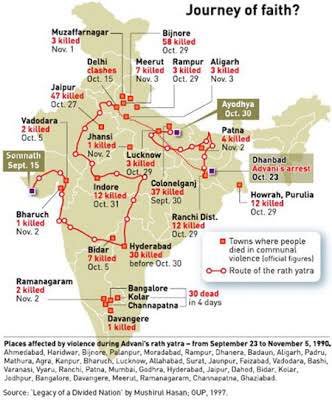
A few days ago I undertook a forbidding journey to the massively guarded rubble of the Babri Mosque – possibly more impregnable than the American Green Zone in Baghdad – to try and understand my instinctive disagreement with Rahul Gandhi when he so easily dismissed rightwing Hindu and Muslim groups as being equally threatening to India’s secular and democratic fabric.
The young Congress scion was in the news last week for equating the Hindu fascist Rashtriya Swayamsewak Sangh (RSS) with the bigoted Students Islamic Movement of India (SIMI), which stands proscribed as a terrorist organisation. Miffed by the observation, the RSS and its affiliates asked Rahul to have his head examined. SIMI is yet to respond. Maybe Rahul Gandhi needs to clean up his ideological filters but I would leave the head examining to the RSS and SIMI, for they need it more than anyone I know.
What is wrong with Rahul Gandhi equating the RSS and SIMI and calling them both fundamentalist groups? First of all, ideally, it ought to come from a party that is perceived credibly as uninvolved in India’s pervasive politics of communal polarisation.
Rahul Gandhi’s Congress party lost the credentials during his father’s 1984-89 rule, when that debonair and urbane gentleman helped rake up the mediaeval Ayodhya controversy to woo votes. Counter-measures to please Muslims by changing their divorce law to keep the community socially regressive at their own request showcased the flip side of the Congress party’s communal equation. That tendency hasn’t waned, it has only become more institutionalised.
Fundamentalism is not a term that can be applied to regressive or rightwing Hindu groups because Hinduism as such has no fundamental precepts in the sense that Judeo-Christian religions have. There is no single book that guides Hinduism and the Ram temple project in Ayodhya was more of a recent effort to “semitise” Hinduism than to pander to the country’s diverse religious needs. The word Hindu itself is relatively recent and did not exist in the Vedic or post Vedic period until about a thousand years ago, the precise date being in dispute.
But there was a religion that Buddhism and to a lesser extent Jainism revolted against. One of its names was Arya Dharma. The word Hindu was applied by foreigners to describe people from the Sindhu river and beyond. Agar aa’n Turk-e-Shirazi, bedast aarad dil e mara/ Be khaal e Hindu yash bakhsham Samarqand o Bukhara ra. The word Hindu was applied by Persia’s Hafiz to describe the alluring dark mole on the cheek of a Turkish boy of Shiraz. Prof Kailash Nath Kaul, Kamala Nehru’s brother, told me years ago that Hindu was used to describe dark coloured people of the Indian subcontinent.
A majority of Indians be they Hindu or Muslim, Sikh or Christian, see themselves in terms of their caste in spite of religious strictures against doing so. “Kaun jaat hau, manaee?” (What’ your caste man?) The standard question is not considered rude in Indian villages even if the urban rulers may offer strong opinions on whether or not there should be a caste-based census in India. The Ayodhya movement was an attempt to not only semitise what is passed off by a minority of its vocal and militant practitioners as Hinduism but also to paper over the caste fault lines that more effectively define Indian society.
The ironclad security and impregnable barricades in Ayodhya are protecting not the idols of Ram and Sita alone after they were placed in the sanctum sanctorum of the Babri mosque in 1949 and later moved to the top of the rubble it turned into in December 1992 but to sustain a social engineering that could define India’s future.
I have been to Ayodhya a few times, both before and after the demolition of the Babri mosque there in December 1992. The security bandobast was never lax. As late as 1991 just before the mosque’s destruction, I had to take off my leather belt and surrender my pen, my camera and the leather wallet to enter the mosque’s precincts. Yet this did not seem quite enough to stall those that were determined to destroy the 16th century building – which they did in 1992. After its demolition the security was beefed up and it included paramilitary sharp shooters. A meandering fence of metal rods guided the devotees to the spot near the functioning temple. All this to protect a heap of rubble that used to be a mosque, and a new, makeshift temple.
This time around I counted five serious security checks with scanners and body searches, including a rare assiduous groping of the private parts. This last act of precaution is not part of the security drill even at the prime minister’s house in Delhi or any of the Indian airports where protection is otherwise considered foolproof. In other words the Ayodhya mosque-turned-shrine has become by far the most protected place in India and possibly anywhere in the world. Because I am taller than the average Indian male and sport a beard, I had more than my fair share of probing questions about my origins. After a walking in line through a barbed wire cage and completing my ‘darshan’ of the idols of Ram I picked up two CDs about the demolition of the mosque for a throwaway price of 20 rupees each but haven’t got around to seeing them. There has been no publicly available footage of the actual demolition of the mosque barring some shots of men climbing atop the domes and digging them with pickaxes. Nirmala Deshpande, the late social activist and Gandhian, told me conspiratorially that the Babri mosque was actually blown up with dynamite and that the government had evidence of it.
To me it is immaterial how the mosque was destroyed. I believe that a mosque would have been built there had there been none in order to destroy it because that was what the political class needed at the time. It was the quarrel between Hindus and Muslims, the separation and consolidation of ‘vote-banks’ that they wanted, not the mosque or the land on which it stood. The tycoon Mukesh Ambani can tell you how easy it is to appropriate land from a Muslim waqf council as he has done to build a magnificent house for himself on the Mumbai sea-face. The obscure mosque was not a significant structure even if it was a beautiful piece of architecture. So many mosques and temples are destroyed everywhere in India and elsewhere to pave the way for this or that project. Several temples have been drowned by the reservoir of the Narmada dam. No one noticed.
Does Rahul Gandhi see how the attempt to semitise an old system of beliefs into a new religion, with a text of precepts and with its own Mecca is under way. The concept of Satan was missing in the young religion of Hinduism so the hunt is on. Is Ravana the demon king slain by Ram going to fit the bill? Or will they find a community of disbelievers to target, as has been happening in Pakistan? When the poet Fahmida Riyaz said “Tum bilkul hum jaise nikle, ab tak kahaa’n chhupe thay bhai….?” (You’ve turned out to be exactly like us (in Pakistan), where have been hiding all these days brother….? she was raising similar questions.
The traditional greeting of Ram Ram, or Jai Ramji ki is sought to be replaced by an aggressive Jai Shri Ram, not very different from the changed phrase to bid farewell in Pakistan has given way to Allah Haafiz instead of more culturally rooted Khuda Haafiz. These are the changes that are waiting to shake India from its moorings. In 2004 Rahul Gandhi described the Bharatiya Janata Party as a joke. Now he is calling its parent body the RSS a fundamentalist group as bad as SIMI. The RSS cannot be equated with SIMI, which is a non-state actor. The RSS is more akin to the Jamaat-i-Islami of Pakistan under Ziaul Haq. It is part of the state structure. Whether it is a joke or a serious threat will depend not on how the courts decide the fate of the Babri mosque-Ram Janmabhoomi row, but how seriously the state is willing to rescue itself from the dispute which will not end with the resolution of the Ayodhya standoff.
by Jawed Naqvi
Monday, 11 Oct, 2010
Congress Party President Sonia Gandhi (R) speaks with her son Rahul Gandhi as they sit in the stands during the Commonwealth Games at The Major Dhyan Chand National Stadium in New Delhi, India. The young Congress scion, Rahul Gandhi, was in the news last week for equating the Hindu fascist Rashtriya Swayamsewak Sangh (RSS) with the bigoted Students Islamic Movement of India (SIMI), which stands proscribed as a terrorist organisation. Miffed by the observation, the RSS and its affiliates asked Rahul to have his head examined. SIMI is yet to respond. Maybe Rahul Gandhi needs to clean up his ideological filters but I would leave the head examining to the RSS and SIMI, for they need it more than anyone I know, writes Jawed Naqvi – AFP Photo
A few days ago I undertook a forbidding journey to the massively guarded rubble of the Babri Mosque – possibly more impregnable than the American Green Zone in Baghdad – to try and understand my instinctive disagreement with Rahul Gandhi when he so easily dismissed rightwing Hindu and Muslim groups as being equally threatening to India’s secular and democratic fabric.
The young Congress scion was in the news last week for equating the Hindu fascist Rashtriya Swayamsewak Sangh (RSS) with the bigoted Students Islamic Movement of India (SIMI), which stands proscribed as a terrorist organisation. Miffed by the observation, the RSS and its affiliates asked Rahul to have his head examined. SIMI is yet to respond. Maybe Rahul Gandhi needs to clean up his ideological filters but I would leave the head examining to the RSS and SIMI, for they need it more than anyone I know.
What is wrong with Rahul Gandhi equating the RSS and SIMI and calling them both fundamentalist groups? First of all, ideally, it ought to come from a party that is perceived credibly as uninvolved in India’s pervasive politics of communal polarisation.
Rahul Gandhi’s Congress party lost the credentials during his father’s 1984-89 rule, when that debonair and urbane gentleman helped rake up the mediaeval Ayodhya controversy to woo votes. Counter-measures to please Muslims by changing their divorce law to keep the community socially regressive at their own request showcased the flip side of the Congress party’s communal equation. That tendency hasn’t waned, it has only become more institutionalised.
Fundamentalism is not a term that can be applied to regressive or rightwing Hindu groups because Hinduism as such has no fundamental precepts in the sense that Judeo-Christian religions have. There is no single book that guides Hinduism and the Ram temple project in Ayodhya was more of a recent effort to “semitise” Hinduism than to pander to the country’s diverse religious needs. The word Hindu itself is relatively recent and did not exist in the Vedic or post Vedic period until about a thousand years ago, the precise date being in dispute.
But there was a religion that Buddhism and to a lesser extent Jainism revolted against. One of its names was Arya Dharma. The word Hindu was applied by foreigners to describe people from the Sindhu river and beyond. Agar aa’n Turk-e-Shirazi, bedast aarad dil e mara/ Be khaal e Hindu yash bakhsham Samarqand o Bukhara ra. The word Hindu was applied by Persia’s Hafiz to describe the alluring dark mole on the cheek of a Turkish boy of Shiraz. Prof Kailash Nath Kaul, Kamala Nehru’s brother, told me years ago that Hindu was used to describe dark coloured people of the Indian subcontinent.
A majority of Indians be they Hindu or Muslim, Sikh or Christian, see themselves in terms of their caste in spite of religious strictures against doing so. “Kaun jaat hau, manaee?” (What’ your caste man?) The standard question is not considered rude in Indian villages even if the urban rulers may offer strong opinions on whether or not there should be a caste-based census in India. The Ayodhya movement was an attempt to not only semitise what is passed off by a minority of its vocal and militant practitioners as Hinduism but also to paper over the caste fault lines that more effectively define Indian society.
The ironclad security and impregnable barricades in Ayodhya are protecting not the idols of Ram and Sita alone after they were placed in the sanctum sanctorum of the Babri mosque in 1949 and later moved to the top of the rubble it turned into in December 1992 but to sustain a social engineering that could define India’s future.
I have been to Ayodhya a few times, both before and after the demolition of the Babri mosque there in December 1992. The security bandobast was never lax. As late as 1991 just before the mosque’s destruction, I had to take off my leather belt and surrender my pen, my camera and the leather wallet to enter the mosque’s precincts. Yet this did not seem quite enough to stall those that were determined to destroy the 16th century building – which they did in 1992. After its demolition the security was beefed up and it included paramilitary sharp shooters. A meandering fence of metal rods guided the devotees to the spot near the functioning temple. All this to protect a heap of rubble that used to be a mosque, and a new, makeshift temple.
This time around I counted five serious security checks with scanners and body searches, including a rare assiduous groping of the private parts. This last act of precaution is not part of the security drill even at the prime minister’s house in Delhi or any of the Indian airports where protection is otherwise considered foolproof. In other words the Ayodhya mosque-turned-shrine has become by far the most protected place in India and possibly anywhere in the world. Because I am taller than the average Indian male and sport a beard, I had more than my fair share of probing questions about my origins. After a walking in line through a barbed wire cage and completing my ‘darshan’ of the idols of Ram I picked up two CDs about the demolition of the mosque for a throwaway price of 20 rupees each but haven’t got around to seeing them. There has been no publicly available footage of the actual demolition of the mosque barring some shots of men climbing atop the domes and digging them with pickaxes. Nirmala Deshpande, the late social activist and Gandhian, told me conspiratorially that the Babri mosque was actually blown up with dynamite and that the government had evidence of it.
To me it is immaterial how the mosque was destroyed. I believe that a mosque would have been built there had there been none in order to destroy it because that was what the political class needed at the time. It was the quarrel between Hindus and Muslims, the separation and consolidation of ‘vote-banks’ that they wanted, not the mosque or the land on which it stood. The tycoon Mukesh Ambani can tell you how easy it is to appropriate land from a Muslim waqf council as he has done to build a magnificent house for himself on the Mumbai sea-face. The obscure mosque was not a significant structure even if it was a beautiful piece of architecture. So many mosques and temples are destroyed everywhere in India and elsewhere to pave the way for this or that project. Several temples have been drowned by the reservoir of the Narmada dam. No one noticed.
Does Rahul Gandhi see how the attempt to semitise an old system of beliefs into a new religion, with a text of precepts and with its own Mecca is under way. The concept of Satan was missing in the young religion of Hinduism so the hunt is on. Is Ravana the demon king slain by Ram going to fit the bill? Or will they find a community of disbelievers to target, as has been happening in Pakistan? When the poet Fahmida Riyaz said “Tum bilkul hum jaise nikle, ab tak kahaa’n chhupe thay bhai….?” (You’ve turned out to be exactly like us (in Pakistan), where have been hiding all these days brother….? she was raising similar questions.
The traditional greeting of Ram Ram, or Jai Ramji ki is sought to be replaced by an aggressive Jai Shri Ram, not very different from the changed phrase to bid farewell in Pakistan has given way to Allah Haafiz instead of more culturally rooted Khuda Haafiz. These are the changes that are waiting to shake India from its moorings. In 2004 Rahul Gandhi described the Bharatiya Janata Party as a joke. Now he is calling its parent body the RSS a fundamentalist group as bad as SIMI. The RSS cannot be equated with SIMI, which is a non-state actor. The RSS is more akin to the Jamaat-i-Islami of Pakistan under Ziaul Haq. It is part of the state structure. Whether it is a joke or a serious threat will depend not on how the courts decide the fate of the Babri mosque-Ram Janmabhoomi row, but how seriously the state is willing to rescue itself from the dispute which will not end with the resolution of the Ayodhya standoff.
June 10, 2009
The Secular State and the Geography of Radicalism
by Irfan Ahmad (Economic and Political Weekly, June 6, 2009)
The burgeoning scholarship on Islamist radicalisation or terrorism – both popular as well as academic – is mostly alarmist. Too often Islamist radicalisation is understood as an offshoot of some deeply entrenched values or that the culture of Islam is incompatible with modernity. This article argues that Islamist radicalisation should be seen as a political phenomenon and that it cannot be divorced from the practices and the role of the State. It focuses on the Students Islamic Movement of India and argues that its radicalisation, manifest in its call for jihad, is largely a consequence of the failure of the Indian secular State to stop the recurring violence against Muslim minority. This article also examines the premises that underpin the media’s portrayal of Islam and Muslims and concludes by raising the issue of vulnerability in writing about Islam and radicalisation
http://www.epw.in/epw/uploads/articles/13591.pdf
The burgeoning scholarship on Islamist radicalisation or terrorism – both popular as well as academic – is mostly alarmist. Too often Islamist radicalisation is understood as an offshoot of some deeply entrenched values or that the culture of Islam is incompatible with modernity. This article argues that Islamist radicalisation should be seen as a political phenomenon and that it cannot be divorced from the practices and the role of the State. It focuses on the Students Islamic Movement of India and argues that its radicalisation, manifest in its call for jihad, is largely a consequence of the failure of the Indian secular State to stop the recurring violence against Muslim minority. This article also examines the premises that underpin the media’s portrayal of Islam and Muslims and concludes by raising the issue of vulnerability in writing about Islam and radicalisation
http://www.epw.in/epw/uploads/articles/13591.pdf
September 15, 2008
Open letter to Prime Minister after Delhi Blasts
AN OPEN LETTER TO THE PRIME MINISTER OF INDIA
September 15, 2008
New Delhi
Dear Dr. Manmohan Singh,
The blasts in Delhi (September 12, 2008) are another in the series of tragic blasts in which scores of people have been killed. We strongly condemn the blasts and demand a proper, unbiased investigation into the same. We demand that the guilty be punished. At the same time it seems that our investigating agencies are ignoring some thing very crucial in the matters of investigating the acts of terror.
The acts of terror have been occurring and Home Ministry is watching helplessly. While the current investigation is totally focused around SIMI, many an alleged culprits have been put behind the bars, despite which now some unknown entity Indian Mujahideen seems to have been projected as being responsible for the current ones. At the same time another stark truth is being deliberately sidelined and undermined. And that relates to the blasts done by Bajrang Dal and Hindu Jagran Samiti. We fail to understand as to why the investigation authorities are turning a blind eye to some of the well established facts.
1. In a serious case of blasts in Nanded in April 2006 two Bajarang Dal workers died when making bombs. Similar incidents of bomb blasts were witnessed in many places around that time, Parabhani, Jalna and Aurangabad in Maharashtra. Most of these were in front of the mosques. The Nanded investigation 'leads' were not followed. On the contrary the investigation in that direction was not pursued at all. The attitude of police in this investigation has been totally lax. Social activists made the complaint about this to Human Rights commission. The commission summoned the Superintendent of police, Nanded, in its hearing held on 17th June. The SP failed to turn up for hearing! There seems to be a deliberate cover up of this important finding of Maharashtra Anti terrorist Squad. ATS did investigate the links of the dead with Bajrang Dal, an RSS affiliate. At the same time the injured were visited in the hospital by the top brass of local BJP and associates. Local BJP MP told the police not to harass those related to the culprits in the wake of the Bajrang Dal involvement in the bomb making. In Nanded, ATS also found fake moustache and pajama kurta, the idea being that the culprits will dress like a Muslim while doing these black deeds.
2. A bomb blast took place at the RSS office at Tenkasi, in the Tirunelveli District of Tamil Nadu on January 24. After a thorough investigation, the Tamilnadu Police had arrested 7 persons belonging to Sangh Parivar outfits. They had confessed that they indulged in this terror act to instigate the local Hindu population against the Muslims.
On further investigation, the Tamilnadu Police arrested Siva Alias Sivanandam, who is the General Secretary of Hindu Munnani at Kadayanallur, a neighbouring town of Tenkasi. Formed in 1980, Hindu Munnani is a frontal organisation of Sangh Parivar operating in Tamilnadu.
Siva, who has earlier worked in quarries in the neighboring state of Kerala had supplied the ammonium nitrate and other raw materials for preparing the bombs.
3. The bombs which exploded in Gadkari Rangayatan on 4th June 2008 injured seven people. Again Maharashtra Anti Terrorist Squad succeeded in nabbing the culprits. The culprits were part of Hindu Janjagaran Samiti (HJS), an outfit of Sanatana Ashram in Panvel. These culprits were also involved in other blasts, in Vashi, Panvel and Ratnagiri. We have not heard anything about the further tracing of this very important lead.
4. On 24th August, in Kanpur two Bajrang Dal workers died while making bombs. Rajiv alias Piyush Mishra and Bhupinder Singh were killed while making crude bombs on Sunday afternoon.
On 25th August, Monday, police recovered some crude hand grenades, lead oxide, red lead, potassium nitrate, bomb pins, timers and batteries from the spot, inside a hostel in Kalyanpur area of Kanpur, about 80 km from Lucknow. No further investigation, why?
Every time there is a bomb blast immediately the agencies and the media declare that it is done by some Muslim organization without any proof. Hundreds of innocent young boys are picked up, what follows are illegal detentions, torture, arrests, harassment of families, forcing the families and victims to sign blank papers. For years these helpless victims are tortured in jails, denied legal aid, even lawyers who try and fight their cases are attacked openly in courts. Their images tarnished for life time. If they are lucky they get let off after years as neither the agencies or the police have any proof against them. The cacophony of stricter laws rises so that a police can extract a confession by third degree torture and present that as evidence. Through this systematic vilification campaign the process of demonization of minorities continued unabated.
If we look at the timing of the terror attacks it is very clear that one and only one political outfit is gaining from it and that is Sangh. With their eyes on the central government their agenda of polarizing the voter is going ahead successfully.
On the other hand there are constant attacks on minorities on one pretext or another. Orissa thousands of Christians have been attacked, rendered homeless, their homes ransacked and looted and burnt down, churches attacked and even orphanages are not left alone.
Karnataka a similar picture is emerging. We have personally briefed very senior people in the government and the Congress party about the Karnataka situation and that it might explode but nothing was done and we have seen what has happened yesterday.
While we write to you now, the police are firing at Muslims in Yakutpura in Vadodara. Yesterday during the Ganpati procession a local dargah was broken down and shops of Muslims looted and ransacked. Already one boy has died and many are injured.
Last few days the only Muslim village Nandepeda in the Dangs, Gujarat has been attacked, ransacked. Villagers have been beaten up brutally including women and children. All men have fled to the jungles. The police not only took away all the goods but before going they poured kerosene into the eatable good so that they could not eat anything too. A proposed VHP rally today was stopped after spending 4 hours on the phone and pressuring various police departments.
UPA had formed the National Integration Council under tremendous pressure. The first agenda papers which were prepared, if you remember, were highly communal and objectionable. A number of us had raised it during the meeting and the Home Minister had replied' treat them as scrap' in your presence. Probably the Home Minister realized that people like us were too uncomfortable to have in the NIC, who would raise these questions. The NIC was never convened again. It was supposed to meet every six months.
The country unfortunately has been given on a platter to the Sangh and the government looks helplessly in providing security to ordinary citizens whether they are victims of terror attacks or victims of the constant attacks by the Sangh Parivar's various outfits.
We hope you will intervene and question why are such clear cases of involvement of RSS affiliates in terror attacks being ignored. It seems the investigating authorities deliberately want to cover up the role of RSS affiliates in these acts of terror. Can the real truth behind the dastardly acts come out without properly investigating these incidents, where the culprits' involvement is very clear? We urge upon you to instruct the investigating authorities to pursue the investigation in an unbiased, honest and professional manner. The life of innocent citizens is at stake and such irresponsible cover will definitely prevent the real truth from coming out. For the sake of fairness, honesty and the values of our constitution, we need to pursue these cases in their logical direction.
Can we look forward to you, Mr. Prime Minister to make your Government to rise above partisan attitude and unravel the truth behind the blasts which are rocking the country in a painful way?
Sincerely
Shabnam Hashmi, Member, National Integration Council
Ram Puniyani, Social Activist, and writer
Sangh as much terror outfit as SIMI
All India Christian Council
PRESS STATEMENT
New Delhi, 15 September 2008
Sangh Parivar must be named together with SIMI in national and media discourse on Terrorism in India Military precision in Karnataka violence exposes deep conspiracy against religious minorities, specially Christian community The following statement was issued by Dr John Dayal, Secretary General, All India Christian Council this morning on the anti Christian violence in Karnataka State.
The All India Christian Council and the Christian community in India have been apprehending the Sangh Parivar attacks in Karnataka, Madhya Pradesh and Chhattisgarh. We fear there may be many more in other states including the national capital, New Delhi. The BJP ruled states have become absolutely inhospitable and indeed hostile to the miniscule Christian community. The Sangh Parivar, which has strengthened itself because of the inaction of the Central Government to act against it, has also made it clear it will also flex its muscles in States ruled by the Congress. Sporadic violence in Andhra Pradesh, attempted desecrations of churches in several other States, and a sustained hate campaign against the community in general and its spokesmen in particular, are indications that the Sangh Parivar is making a major and aggressive thrust to grab absolute power for the Bharatiya Janata party in the General Elections early next year on the Hindutva card.
We are surprised that the Sangh Parivar, specially its militant units Bajrang Dal, Vishwa Hindu Parishad and Vanvasi Kalyan Ashram are not being mentioned in the national Media and public discourse on terrorism at par with SIMI as groups out to destroy the unity and the secular fabric of India. In fact the Sangh Parivar and the SIMI form a dipole, each feeding on the other and threatening innocent citizens of democratic India for their ulterior political motives. Terror is their common weapon. While the SIMI targets citizens at large, the Sangh focuses on Christians and Muslims. The military precision of the timing of the attacks on Churches in Mangalore and other Karnataka districts in the violence on Sunday and Monday speaks of long range and meticulous planning, not surprising as the Sangh has a very large number of serving and retired police and administrative officers in its ranks.
The Christian response is always peaceful, but we expect the State, the national secular civil society, and the international community, to come to our defence. India without a Christian community will be no more than a graveyard of democracy and all that is decent in our ancient civilisation.
The State government must assume full responsibility. The Chief Minister of Karnataka has failed to live to his promise of communal harmony. The State Home Minister is guilty of conniving in the violence, as he disregarded ample warnings that had come in the wake of the Sangh violence in Orissa.
As far as the civil and policies authorities of the affected districts are concerned, they are working as if the Sangh Parivar is their real master and not the constitutionally constituted government. Christian youth are being harassed in Mangalore, many are threatened and police are desecrating places of worship by entering them this morning on the pretext of maintaining law and order. This must cease forthwith. The police must hunt for the real criminals – the Sangh Parivar. We demand the suspension of all senior civil officers of the affected districts and the resignation of the Karnataka Home Minster on moral grounds.
Nothing less will send the correct message that Karnataka, fast slipping into the morass of communal anarchy, is the place where the world must invest.
PRESS STATEMENT
New Delhi, 15 September 2008
Sangh Parivar must be named together with SIMI in national and media discourse on Terrorism in India Military precision in Karnataka violence exposes deep conspiracy against religious minorities, specially Christian community The following statement was issued by Dr John Dayal, Secretary General, All India Christian Council this morning on the anti Christian violence in Karnataka State.
The All India Christian Council and the Christian community in India have been apprehending the Sangh Parivar attacks in Karnataka, Madhya Pradesh and Chhattisgarh. We fear there may be many more in other states including the national capital, New Delhi. The BJP ruled states have become absolutely inhospitable and indeed hostile to the miniscule Christian community. The Sangh Parivar, which has strengthened itself because of the inaction of the Central Government to act against it, has also made it clear it will also flex its muscles in States ruled by the Congress. Sporadic violence in Andhra Pradesh, attempted desecrations of churches in several other States, and a sustained hate campaign against the community in general and its spokesmen in particular, are indications that the Sangh Parivar is making a major and aggressive thrust to grab absolute power for the Bharatiya Janata party in the General Elections early next year on the Hindutva card.
We are surprised that the Sangh Parivar, specially its militant units Bajrang Dal, Vishwa Hindu Parishad and Vanvasi Kalyan Ashram are not being mentioned in the national Media and public discourse on terrorism at par with SIMI as groups out to destroy the unity and the secular fabric of India. In fact the Sangh Parivar and the SIMI form a dipole, each feeding on the other and threatening innocent citizens of democratic India for their ulterior political motives. Terror is their common weapon. While the SIMI targets citizens at large, the Sangh focuses on Christians and Muslims. The military precision of the timing of the attacks on Churches in Mangalore and other Karnataka districts in the violence on Sunday and Monday speaks of long range and meticulous planning, not surprising as the Sangh has a very large number of serving and retired police and administrative officers in its ranks.
The Christian response is always peaceful, but we expect the State, the national secular civil society, and the international community, to come to our defence. India without a Christian community will be no more than a graveyard of democracy and all that is decent in our ancient civilisation.
The State government must assume full responsibility. The Chief Minister of Karnataka has failed to live to his promise of communal harmony. The State Home Minister is guilty of conniving in the violence, as he disregarded ample warnings that had come in the wake of the Sangh violence in Orissa.
As far as the civil and policies authorities of the affected districts are concerned, they are working as if the Sangh Parivar is their real master and not the constitutionally constituted government. Christian youth are being harassed in Mangalore, many are threatened and police are desecrating places of worship by entering them this morning on the pretext of maintaining law and order. This must cease forthwith. The police must hunt for the real criminals – the Sangh Parivar. We demand the suspension of all senior civil officers of the affected districts and the resignation of the Karnataka Home Minster on moral grounds.
Nothing less will send the correct message that Karnataka, fast slipping into the morass of communal anarchy, is the place where the world must invest.
August 16, 2008
SIMI and its Hindutva equivalents, Bajrang Dal, VHP co deserve similar treatment
Indian Express
August 16, 2008
Suspect SIMI? Of course
Indian Muslims must recognise the organisation for what it is: against secular democracy
by Javed Anand
Javed Anand: The special tribunal under the Unlawful Activities (Prevention) Act 2006, headed by Justice Geeta Mittal, recently lifted the ban on the Students Islamic Movement of India (SIMI). The joy with which several mainstream Muslim organisations and much of the Urdu press greeted SIMI’s return to lawful existence proved to be short-lived since the very next day the Supreme Court stayed the tribunal’s verdict. Nonetheless, the misguided show of solidarity with SIMI raises some very disturbing questions. Are Muslim leaders and the Urdu media wilfully blind to the malevolence sheltering in their own backyard? Or, is it that in the interests of “communal balance”, anything goes?
The nefarious nature of SIMI has been evident from the moment it emerged from the womb of the Jamaat-e-Islami (JeI) in 1977. “Character building” to fight against the perceived twin evils of communism and capitalist consumerism with its “degenerate morality” was the declared objective. But in less than a decade this self-styled moral brigade metamorphosed into “the real inheritor” of the legacy of the founder of JeI, Maulana Abul Ala Maududi, who argued that all Muslims must strive for an Islamic state.
True to its ideological mooring, in the ’80s, SIMI produced eye-catching stickers proclaiming “Secularism, NO; Democracy, NO; Nationalism, NO; Polytheism, NO; Only Islam”. These stickers adorned many Muslim homes and shops throughout India. But no one seemed to be unduly perturbed by this dangerous drift of a section of Indian Muslim youth, spreading wings under the loving care of its patron, the JeI. (It was only in the late ’90s that the JeI officially snipped the umbilical cord that organically linked it to SIMI.)
There is a filial relationship that unites different fundamentalisms and there is a sibling relationship between fanaticism, extremism and terrorism. Put differently, there is a thin line that divides one from the other. By the early ’90s, it was talking the language of “jihad” and an “Islamic caliphate.” In SIMI’s case, jihad can mean nothing other than armed struggle?
Don’t trust information doled out by intelligence agencies? What about ex-SIMI members, its founding president and unit chiefs?
Take, for example, Saeed Ahmed Khan, its former Mumbai chief, who confessed last month that he visited Pakistan in 1991 after learning that “the ISI was training Indian youths to cultivate (sic) the culture of jihad”. Khan said that the then SIMI top-brass C.A. Baseer and Asraf Zafari were pushing it in a more militant direction. “It was at this juncture that the gun culture took root in SIMI — these radical preachers toed the line of jihad and brainwashed Indian youths who later turned into anti-Indian jihadis.”
Don’t believe him? What about Dr Ahmadullah Siddiqi, its founder president, who left India in 1981 and has been a professor of journalism and public relations at Western Illinois University, Macomb, USA the last 16 years? In a September 2003 interview, he agreed: “Perhaps the group has been hijacked by elements in other countries and other Muslim societies and not all of them may be, but some of them have become misguided and radical .”
What about yet another ex-SIMI-man, Kanpur’s Haji Mohammed Salees, horrified by what he saw and heard at SIMI’s “Ikhwan Conference” in his city in October 1999? Among the things that shocked Salees was reportedly the war cry of the seven-year-old Gulrez Siddiqui before an audience of over 20,000 people: “Islam ka ghazi, butshikan/ Mera sher, Osama bin Laden (The warrior of Islam, the destroyer of idols/ My lion, Osama bin Laden)”. Those who addressed the gathering, long-distance telephonically, were Hamas founder, Sheikh Yaseen, head of the Jamaat-e-Islami, Pakistan, Qazi Hussain Ahmed, and the imam of the al Aqsa mosque, Israel/Palestine. “It was all a shock for us. We realised they are developing international links. We distanced ourselves,” Salees has said
Two years later, at a gathering of 25,000 Muslim youths in Mumbai, SIMI reiterated that the time has come for Indian Muslims to launch an armed jihad in India with the establishment of an Islamic caliphate as the ultimate aim.
Don’t believe any of them? What about SIMI’s own posters plastered in the by-lanes of Muslim mohallas across the country following the demolition of the Babri mosque, with an invocation: “Ya Ilahi, bhej de Mahmood koi (Oh Allah, send us a Mahmud)”. Who does not know that the reference was to Mahmud Ghaznavi whom fanatics revere as a “But Shikan (Destroyer of Idols)”
Which editor of an Urdu paper can disclaim knowledge of these inflammatory posters? Could it be that Urdu papers never received press releases from SIMI on their official letterhead with a logo depicting a Quran and an AK-47 perched on top of a globe? And who has not heard of SIMI’s open adulation of the Taliban and Osama bin Laden, for both of whom India is Enemy No 3 after the United States and Israel?
Let’s now turn to the provisions of the Unlawful Activities (Prevention) Act. It provides for a ban on any organisation that is inimical to the sovereignty and integrity of India, or is involved in terror acts.
Are the blasts after blasts, in city after city of India in recent years, part of the “jihad” espoused by SIMI? The investigating agencies obviously believe this to be the case. Why else would SIMI activists be routinely detained, arrested, interrogated, charge-sheeted and put on trial? Admittedly, they have yet to establish the terrorism charge against SIMI activists before any court of law in any of the blast cases.
A continuation of the ban on SIMI would need it to be established as guilty of one or more of the charges — secessionist activity, terrorism, spreading communal discord, hostility to Indian constitution — since 2006, the last time the ban was re-imposed. Otherwise a ban cannot legally be re-imposed.
But is it merely a question of law? Should SIMI not also be judged from a socio-political perspective, in terms of its implications for India’s secular-democratic polity? Should any sensible citizen be embracing the Bajrang Dal merely because it has not been convicted under the law of the land? If that is not acceptable, by what logic can Muslim bodies rush to the rescue of SIMI?
Before the first ban was slapped on SIMI in 2001, the chief ministers of Maharashtra, MP and Rajasthan made a strong case before the NDA for a simultaneous ban on SIMI and the Bajrang Dal. And rightly so. But the Vajpayee-led government chose to act against one and not the other. The UPA has done no better.
Why are Hindu extremist organisations also not placed under the scanner of the Unlawful Activities (Prevention) Act? To ask this question is to rightfully demand an end to discriminatory justice and even-handed application of the law of the land against all. Mulayam Singh and Lalu Prasad’s welcoming of the lifting of the ban on SIMI can be explained away in terms of vote-bank politics. But for Indian Muslims to be seen as standing by a self-declared enemy of secular-democratic India is nothing short of suicidal.
The writer is co-editor, “Communalism Combat”, and general secretary, Muslims for Secular Democracy
August 16, 2008
Suspect SIMI? Of course
Indian Muslims must recognise the organisation for what it is: against secular democracy
by Javed Anand
Javed Anand: The special tribunal under the Unlawful Activities (Prevention) Act 2006, headed by Justice Geeta Mittal, recently lifted the ban on the Students Islamic Movement of India (SIMI). The joy with which several mainstream Muslim organisations and much of the Urdu press greeted SIMI’s return to lawful existence proved to be short-lived since the very next day the Supreme Court stayed the tribunal’s verdict. Nonetheless, the misguided show of solidarity with SIMI raises some very disturbing questions. Are Muslim leaders and the Urdu media wilfully blind to the malevolence sheltering in their own backyard? Or, is it that in the interests of “communal balance”, anything goes?
The nefarious nature of SIMI has been evident from the moment it emerged from the womb of the Jamaat-e-Islami (JeI) in 1977. “Character building” to fight against the perceived twin evils of communism and capitalist consumerism with its “degenerate morality” was the declared objective. But in less than a decade this self-styled moral brigade metamorphosed into “the real inheritor” of the legacy of the founder of JeI, Maulana Abul Ala Maududi, who argued that all Muslims must strive for an Islamic state.
True to its ideological mooring, in the ’80s, SIMI produced eye-catching stickers proclaiming “Secularism, NO; Democracy, NO; Nationalism, NO; Polytheism, NO; Only Islam”. These stickers adorned many Muslim homes and shops throughout India. But no one seemed to be unduly perturbed by this dangerous drift of a section of Indian Muslim youth, spreading wings under the loving care of its patron, the JeI. (It was only in the late ’90s that the JeI officially snipped the umbilical cord that organically linked it to SIMI.)
There is a filial relationship that unites different fundamentalisms and there is a sibling relationship between fanaticism, extremism and terrorism. Put differently, there is a thin line that divides one from the other. By the early ’90s, it was talking the language of “jihad” and an “Islamic caliphate.” In SIMI’s case, jihad can mean nothing other than armed struggle?
Don’t trust information doled out by intelligence agencies? What about ex-SIMI members, its founding president and unit chiefs?
Take, for example, Saeed Ahmed Khan, its former Mumbai chief, who confessed last month that he visited Pakistan in 1991 after learning that “the ISI was training Indian youths to cultivate (sic) the culture of jihad”. Khan said that the then SIMI top-brass C.A. Baseer and Asraf Zafari were pushing it in a more militant direction. “It was at this juncture that the gun culture took root in SIMI — these radical preachers toed the line of jihad and brainwashed Indian youths who later turned into anti-Indian jihadis.”
Don’t believe him? What about Dr Ahmadullah Siddiqi, its founder president, who left India in 1981 and has been a professor of journalism and public relations at Western Illinois University, Macomb, USA the last 16 years? In a September 2003 interview, he agreed: “Perhaps the group has been hijacked by elements in other countries and other Muslim societies and not all of them may be, but some of them have become misguided and radical .”
What about yet another ex-SIMI-man, Kanpur’s Haji Mohammed Salees, horrified by what he saw and heard at SIMI’s “Ikhwan Conference” in his city in October 1999? Among the things that shocked Salees was reportedly the war cry of the seven-year-old Gulrez Siddiqui before an audience of over 20,000 people: “Islam ka ghazi, butshikan/ Mera sher, Osama bin Laden (The warrior of Islam, the destroyer of idols/ My lion, Osama bin Laden)”. Those who addressed the gathering, long-distance telephonically, were Hamas founder, Sheikh Yaseen, head of the Jamaat-e-Islami, Pakistan, Qazi Hussain Ahmed, and the imam of the al Aqsa mosque, Israel/Palestine. “It was all a shock for us. We realised they are developing international links. We distanced ourselves,” Salees has said
Two years later, at a gathering of 25,000 Muslim youths in Mumbai, SIMI reiterated that the time has come for Indian Muslims to launch an armed jihad in India with the establishment of an Islamic caliphate as the ultimate aim.
Don’t believe any of them? What about SIMI’s own posters plastered in the by-lanes of Muslim mohallas across the country following the demolition of the Babri mosque, with an invocation: “Ya Ilahi, bhej de Mahmood koi (Oh Allah, send us a Mahmud)”. Who does not know that the reference was to Mahmud Ghaznavi whom fanatics revere as a “But Shikan (Destroyer of Idols)”
Which editor of an Urdu paper can disclaim knowledge of these inflammatory posters? Could it be that Urdu papers never received press releases from SIMI on their official letterhead with a logo depicting a Quran and an AK-47 perched on top of a globe? And who has not heard of SIMI’s open adulation of the Taliban and Osama bin Laden, for both of whom India is Enemy No 3 after the United States and Israel?
Let’s now turn to the provisions of the Unlawful Activities (Prevention) Act. It provides for a ban on any organisation that is inimical to the sovereignty and integrity of India, or is involved in terror acts.
Are the blasts after blasts, in city after city of India in recent years, part of the “jihad” espoused by SIMI? The investigating agencies obviously believe this to be the case. Why else would SIMI activists be routinely detained, arrested, interrogated, charge-sheeted and put on trial? Admittedly, they have yet to establish the terrorism charge against SIMI activists before any court of law in any of the blast cases.
A continuation of the ban on SIMI would need it to be established as guilty of one or more of the charges — secessionist activity, terrorism, spreading communal discord, hostility to Indian constitution — since 2006, the last time the ban was re-imposed. Otherwise a ban cannot legally be re-imposed.
But is it merely a question of law? Should SIMI not also be judged from a socio-political perspective, in terms of its implications for India’s secular-democratic polity? Should any sensible citizen be embracing the Bajrang Dal merely because it has not been convicted under the law of the land? If that is not acceptable, by what logic can Muslim bodies rush to the rescue of SIMI?
Before the first ban was slapped on SIMI in 2001, the chief ministers of Maharashtra, MP and Rajasthan made a strong case before the NDA for a simultaneous ban on SIMI and the Bajrang Dal. And rightly so. But the Vajpayee-led government chose to act against one and not the other. The UPA has done no better.
Why are Hindu extremist organisations also not placed under the scanner of the Unlawful Activities (Prevention) Act? To ask this question is to rightfully demand an end to discriminatory justice and even-handed application of the law of the land against all. Mulayam Singh and Lalu Prasad’s welcoming of the lifting of the ban on SIMI can be explained away in terms of vote-bank politics. But for Indian Muslims to be seen as standing by a self-declared enemy of secular-democratic India is nothing short of suicidal.
The writer is co-editor, “Communalism Combat”, and general secretary, Muslims for Secular Democracy
Subscribe to:
Posts (Atom)