 |
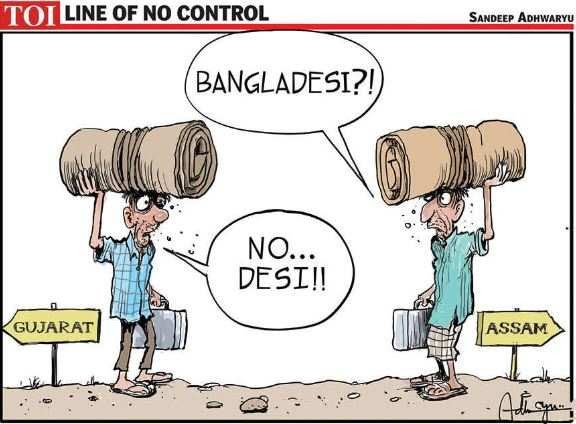
| Cartoon in the Times of India, 10 October 2018 | Sandeep Adhwaryu |
|

Showing posts with label Chauvinism. Show all posts
Showing posts with label Chauvinism. Show all posts
October 10, 2018
Migrants under suspicion and attack in India - Cartoon in the Times of India, 10 October 2018 | Sandeep Adhwaryu


January 19, 2017
Ngaire Woods on The New Xenophobia
The New Xenophobia
Democratic
governments in the West are increasingly losing their bearings. From the
shift toward illiberalism in Poland and Hungary to the Brexit vote in
the United Kingdom and Donald Trump’s victory in the United States’
presidential election, a particularly lethal strain of populism is
infecting societies – and it is spreading.
The appeal of
populism is straightforward. Faced with stagnant wages and a declining
quality of life, people feel frustrated – all the more so when their
leaders keep telling them that things are getting better. Then the
populist appears and promises to shake things up, to defend the
interests of the “people” (though really only some of them), and offers
something arguably more attractive than feasible solutions: scapegoats.
At the top of the
list of scapegoats are the “elites” – established political parties and
corporate leaders. Rather than protecting the “people” from economic
pressure and insecurity, this group, the populist declares, thrives on
the people’s pain. By advancing globalization – by forcing ever-more
openness down the people’s throat – they have accumulated massive
wealth, which they then protect through tax avoidance, offshoring, and
other schemes.
But it is not just
the elites who are blamed. Yes, they have betrayed the people. But one
way they do so is by foisting upon the people equal rights and
opportunities for minorities, immigrants, and foreigners, who “steal”
jobs, threaten national security, and undermine traditional ways of
life.
Trump won the US
presidency partly because of his pledges to deport millions of
undocumented immigrants and ban Muslims from entering the country. The
Brexiteers promised to end free immigration from the European Union.
After the vote, Britain’s Home Secretary Amber Rudd suggested that firms
hiring foreigners should be named and shamed.
Today’s populism
advances a toxic new xenophobia, one that threatens to fracture our
societies. For politicians, it offers an easy means of quickly
transforming people’s fear and powerlessness into an intoxicating mix of
anger and authority. It persuades intimidated (often elderly) voters
that, in the parlance of the Brexiteers, they can “take back control” of
their lives and their countries, primarily by rejecting foreigners.
Demography makes the
new xenophobia particularly dangerous. In much of the West, societies
are becoming increasingly diverse. Hispanics now account for 17.6% of
the US population. One-third of Londoners were born outside the UK. In
France, an estimated 10% of the population is Muslim. And an estimated
20% of Germany’s population have some immigrant background.
In this context, when
politicians campaign for votes by advancing antagonistic and divisive
identity politics, they sow the seeds of animosity, mistrust, and
violence within their own societies. When candidates repeatedly call
Muslims dangerous, for example, no one should be surprised by a surge in
anti-Muslim hate crimes, as has occurred in the wake of both the Brexit
vote and Trump’s victory. Such divided societies require a rising level
of coercion and force to control.
Diversity should be a
strength, one that helps societies to flourish. That is why it is so
important to combat the new xenophobia. One way is by encouraging and
enabling social mixing, interaction, and deliberation among diverse
groups. Extensive psychological research shows
that intergroup contact reduces people’s sense of threat, heightening
the possibilities for building trust across society.
If community centers, schools,
and public locations are places where people of different religions,
cultures, and race meet, xenophobia is less likely to take root. Even
living in an area where others mix can help. This is why the new xenophobia has largely been resisted in Europe’s most diverse cities.
A second way to
combat the new xenophobia is to reinforce the protection of civil
liberties. This means upholding the rule of law, even in the face of
terrorist threats, and ensuring the independence of judges.
Yet, lately, there
have been ominous moves in the opposite direction. Leaders in Hungary
and Poland have been dismantling constitutional protections; France has
used a lengthy state of emergency to suspend rights; and British and
American politicians have publicly denigrated judges. Democracy was
toppled by xenophobes in the 1930s not because of the strength of the
anti-democratic parties, but because of democratic leaders’ failure to uphold their countries’ constitutions.
A third way to fight
the new xenophobia is through innovation. For example, though the
Internet is often viewed as a great equalizer, social media are
contributing to fragmentation. The content to which people are exposed
is filtered, whether through self-selection or algorithms.
The result is echo chambers in
which like-minded people reinforce shared convictions, creating
increasingly polarized silos. But, if social media platforms were
reconfigured in innovative ways, they could have the opposite impact,
creating spaces for citizens from diverse backgrounds to interact.
The threat posed by
the new xenophobia should not be underestimated. Today, no less than in
the past, the rejection of diversity is tantamount to the rejection of
democracy. That is why it must be defended, before its opponents gain
any more ground.
Copyright: Project Syndicate 2017 The New Xenophobia
December 17, 2016
India - Thugs in Karnataka - Mob of linguistic chauvinists assault man for speaking in English
Rakshana Vedhike activists thrash techie for speaking in English
Bangalore Mirror Bureau | Updated: Dec 17, 2016, 11.19 AM IST
Highlights
- J Daniel, who was cornered at the SV Road Metro station and assaulted for speaking in English.
- Karnataka Rakshana Vedhike activists has raised objection to the event organisers speaking in English.
In an apparent case of linguistic chauvinism, a 36-year-old software engineer was chased and allegedly beaten up by a mob of 50 Karnataka Rakshana Vedhike (KRV) activists - because the victim, J Daniel, spoke in English while trying to broker peace between the mob and an event organiser who was playing non-Kannada music at Swami Vivekananda Road metro station on Old Madras Road last Saturday at around 9 pm.
Daniel and his friends were eating at a food festival organised there when the accused raised objection to the event organisers speaking in English. [. . .]
FULL TEXT AT:
http://timesofindia.indiatimes.com/city/bengaluru/mind-your-language-karnataka-rakshana-vedhike-activists-thrash-techie-for-speaking-in-english/articleshow/56031706.cms
Bangalore Mirror Bureau | Updated: Dec 17, 2016, 11.19 AM IST
Highlights
- J Daniel, who was cornered at the SV Road Metro station and assaulted for speaking in English.
- Karnataka Rakshana Vedhike activists has raised objection to the event organisers speaking in English.
In an apparent case of linguistic chauvinism, a 36-year-old software engineer was chased and allegedly beaten up by a mob of 50 Karnataka Rakshana Vedhike (KRV) activists - because the victim, J Daniel, spoke in English while trying to broker peace between the mob and an event organiser who was playing non-Kannada music at Swami Vivekananda Road metro station on Old Madras Road last Saturday at around 9 pm.
Daniel and his friends were eating at a food festival organised there when the accused raised objection to the event organisers speaking in English. [. . .]
FULL TEXT AT:
http://timesofindia.indiatimes.com/city/bengaluru/mind-your-language-karnataka-rakshana-vedhike-activists-thrash-techie-for-speaking-in-english/articleshow/56031706.cms
September 19, 2016
India: Meet The People Who Turned Bengaluru Into A City Of Fear And Despair (T.S. Sudhir)
Huffington Post India
Meet The People Who Turned Bengaluru Into A City Of Fear And Despair
he faultlines can no longer be ignored.
14/09/2016
TS Sudhir
Contributing Editor, HuffPost India
Xinhua News Agency/Getty Images
Vehicles are burnt by protesters at a bus depot in Bengaluru, September 12, 2016. (Xinhua/Stringer via Getty Images)
On Monday, Bengaluru saw for itself how Kannada activism has been hijacked. The preserve of intellectuals till the 1980s, it has progressively been lumpenised. Drawing on the Shiv Sena model of sub-nationalism and extortion to fuel itself, it culminated in manic Monday when competing groups out to control Bengaluru decided to log it out of its global image as India's Silicon Valley.
In a matter of a few hours, Bengaluru crashed into a deep gorge, a valley of fear and despair.
Over 500 people have been detained by the Bengaluru police in the last 24 hours. A majority of them rowdy sheeters in the city, mainly operating out of the northern and eastern parts of Bengaluru. On Monday, they had worked in tandem, converting areas in north and south-west Bengaluru into a theatre of arson, loot and destruction.
Over the past few years, several fringe groups have spread their tentacles in Bengaluru, in the garb of protecting Kannadiga pride. Carrying the red and yellow Kannada flag, the bigger groups are Karnataka Rakshana Vedike, Jaya Karnataka, Kannada Okkoota and Kannada Sena. But as the workload to carry out assignments grew, they have also grown amoeba-like into several smaller branches, available for a hit on speed dial.
It is only ironic that in outsourcing city Bengaluru, the task to derail Bengaluru is outsourced by shady political operators to these roll-call outfits. Bengaluru today is run by these people, whose groups have a track record of fomenting trouble at the drop of a coin.
Vatal Nagaraj is the most visible of these fringe group leaders, a rent-a-cause activist with the dubious claim of having organised over 10,000 protests in the last four decades. This maverick was the most visible face during the Karnataka bandh last week, his protest gulping the tonic of linguistic chauvinism to indulge in rabble-rousing. He took on Biocon chief Kiran Mazumdar Shaw for her sarcastic tweet that Bengaluru should be renamed "Bandh-luru" and warned that anyone living in Karnataka will have to toe its line.
AFP/Getty Images
Bangalore, September 12, 2016. MANJUNATH KIRAN/AFP/Getty Images.
Narayana Gowda heads Karnataka Rakshana Vedike, which agitates on issues as diverse as jobs for Kannadigas, imposition of English over Kannada, Cauvery dispute or Karnataka's border disputes. His Vokkaliga credentials helps him bond with politicians of the same caste, who have turned a blind eye to the Vedike's over-the-top activities.
There are others, with more shades of grey. Muthappa Rai, who heads Jaya Karnataka, was allegedly once a Dawood Ibrahim aide and reportedly involved in several murders. He was arrested in 2002 and extradited from Dubai and was described by filmmaker Ramgopal Varma as the "Bahubali of the underworld". His outfit's website claims a membership of over 7 lakh.
Sridhar, popularly referred to as "Agni" Sridhar, is a former rowdy, who now claims to be an intellectual. He even wrote a script based on the Bengaluru crime scene and directed a Kannada film Thamassu in 2010. His Kannada Sene, established six years ago, has taken on Shiv Sena in the Karnataka-Maharashtra border districts to assert Kannada supremacy.
Most of the youth are aged between 25 and 30 and are either daily wage labourers, construction workers or small-time property dealers. The red and yellow scarf around their neck turns them into a warrior on the street.
It now transpires that the Karnataka bandh on Friday was largely a Nagaraj and Karnataka Rakshana Vedike show, both scoring high on TRPs of a different kind — Turmoil Rating Points. With the Vedike and Jaya Karnataka in direct competition to control Bengaluru, Monday's violence was the result of competition between these fringe groups taking its toll on the city.
Senior police officers confirm that a majority of those picked up owe allegiance to these three outfits, even though all these fringe groups deny any hand in the violence. Most of the youth are aged between 25 and 30 and are either daily wage labourers, construction workers or small-time property dealers. The red and yellow scarf around their neck turns them into a warrior on the street.
Over the years, these fringe groups, emboldened by political protection, freelance for anyone who wants to use their services for a cause or against a rival. Many of them are known to run protection services, like mafia gangs, dividing Bengaluru into zones and areas. They also make their money on big-ticket land deals. Which is why the red and yellow flag today is used by shopkeepers not as a symbol of pride in being a Kannadiga but more to ward off troublemakers.
Senior police officers say this "parallel policing ends up enhancing the brand equity of these hoodlum gangs". Contrast it with how Bengaluru's brand equity has taken a hit with images of arson going viral. The fear factor that Monday has created, most feel, will come in handy when the groups go to collect funds from commercial establishments in the run-up to Karnataka Rajyotsav (Karnataka Formation Day) on 1 November.
The present situation gives Karnataka police an excellent opportunity to purge Bengaluru of these elements. All it needs to do is to seize the cellphones of those detained, peruse their call records, find out who called who in the 72 hours between Friday and Monday and connect the dots. The question is whether the black sheep in the political establishment will greenlight the action plan.
In 2009, when Shankar Bidari was Bengaluru's top cop, the police decided to call the Kannada outfits' bluff and cracked down on them. But in the last two years, they have gained strength again. "The party in power in Karnataka — irrespective of who it is — is apprehensive about taking them on because they fear it will be perceived as anti-Kannada. So, no clear cut orders are given and the police keep waiting," says a senior officer.
The fear factor that Monday has created, most feel, will come in handy when the groups go to collect funds from commercial establishments in the run-up to Karnataka Rajyotsav (Karnataka Formation Day) on 1 November.
The fact is not one but two Bengalurus exist. It suits everyone to showcase only the magnificent Vidhana Soudha, MG Road, Commercial Street and Electronic City as the real Bengaluru. Unfortunately, it also survives cheek-by-jowl with its seedy Siamese twin, which thrives on divisiveness and rancour.
So the "this is not the Bengaluru I know" line is only for those who ignored these faultlines that exist in Karnataka's capital, like in any other developing city. Time for the political and police leadership to draw the Laxman rekha and tell these troublemakers of Bengaluru — This far and no further.
Meet The People Who Turned Bengaluru Into A City Of Fear And Despair
he faultlines can no longer be ignored.
14/09/2016
TS Sudhir
Contributing Editor, HuffPost India
Xinhua News Agency/Getty Images
Vehicles are burnt by protesters at a bus depot in Bengaluru, September 12, 2016. (Xinhua/Stringer via Getty Images)
On Monday, Bengaluru saw for itself how Kannada activism has been hijacked. The preserve of intellectuals till the 1980s, it has progressively been lumpenised. Drawing on the Shiv Sena model of sub-nationalism and extortion to fuel itself, it culminated in manic Monday when competing groups out to control Bengaluru decided to log it out of its global image as India's Silicon Valley.
In a matter of a few hours, Bengaluru crashed into a deep gorge, a valley of fear and despair.
Over 500 people have been detained by the Bengaluru police in the last 24 hours. A majority of them rowdy sheeters in the city, mainly operating out of the northern and eastern parts of Bengaluru. On Monday, they had worked in tandem, converting areas in north and south-west Bengaluru into a theatre of arson, loot and destruction.
Over the past few years, several fringe groups have spread their tentacles in Bengaluru, in the garb of protecting Kannadiga pride. Carrying the red and yellow Kannada flag, the bigger groups are Karnataka Rakshana Vedike, Jaya Karnataka, Kannada Okkoota and Kannada Sena. But as the workload to carry out assignments grew, they have also grown amoeba-like into several smaller branches, available for a hit on speed dial.
It is only ironic that in outsourcing city Bengaluru, the task to derail Bengaluru is outsourced by shady political operators to these roll-call outfits. Bengaluru today is run by these people, whose groups have a track record of fomenting trouble at the drop of a coin.
Vatal Nagaraj is the most visible of these fringe group leaders, a rent-a-cause activist with the dubious claim of having organised over 10,000 protests in the last four decades. This maverick was the most visible face during the Karnataka bandh last week, his protest gulping the tonic of linguistic chauvinism to indulge in rabble-rousing. He took on Biocon chief Kiran Mazumdar Shaw for her sarcastic tweet that Bengaluru should be renamed "Bandh-luru" and warned that anyone living in Karnataka will have to toe its line.
AFP/Getty Images
Bangalore, September 12, 2016. MANJUNATH KIRAN/AFP/Getty Images.
Narayana Gowda heads Karnataka Rakshana Vedike, which agitates on issues as diverse as jobs for Kannadigas, imposition of English over Kannada, Cauvery dispute or Karnataka's border disputes. His Vokkaliga credentials helps him bond with politicians of the same caste, who have turned a blind eye to the Vedike's over-the-top activities.
There are others, with more shades of grey. Muthappa Rai, who heads Jaya Karnataka, was allegedly once a Dawood Ibrahim aide and reportedly involved in several murders. He was arrested in 2002 and extradited from Dubai and was described by filmmaker Ramgopal Varma as the "Bahubali of the underworld". His outfit's website claims a membership of over 7 lakh.
Sridhar, popularly referred to as "Agni" Sridhar, is a former rowdy, who now claims to be an intellectual. He even wrote a script based on the Bengaluru crime scene and directed a Kannada film Thamassu in 2010. His Kannada Sene, established six years ago, has taken on Shiv Sena in the Karnataka-Maharashtra border districts to assert Kannada supremacy.
Most of the youth are aged between 25 and 30 and are either daily wage labourers, construction workers or small-time property dealers. The red and yellow scarf around their neck turns them into a warrior on the street.
It now transpires that the Karnataka bandh on Friday was largely a Nagaraj and Karnataka Rakshana Vedike show, both scoring high on TRPs of a different kind — Turmoil Rating Points. With the Vedike and Jaya Karnataka in direct competition to control Bengaluru, Monday's violence was the result of competition between these fringe groups taking its toll on the city.
Senior police officers confirm that a majority of those picked up owe allegiance to these three outfits, even though all these fringe groups deny any hand in the violence. Most of the youth are aged between 25 and 30 and are either daily wage labourers, construction workers or small-time property dealers. The red and yellow scarf around their neck turns them into a warrior on the street.
Over the years, these fringe groups, emboldened by political protection, freelance for anyone who wants to use their services for a cause or against a rival. Many of them are known to run protection services, like mafia gangs, dividing Bengaluru into zones and areas. They also make their money on big-ticket land deals. Which is why the red and yellow flag today is used by shopkeepers not as a symbol of pride in being a Kannadiga but more to ward off troublemakers.
Senior police officers say this "parallel policing ends up enhancing the brand equity of these hoodlum gangs". Contrast it with how Bengaluru's brand equity has taken a hit with images of arson going viral. The fear factor that Monday has created, most feel, will come in handy when the groups go to collect funds from commercial establishments in the run-up to Karnataka Rajyotsav (Karnataka Formation Day) on 1 November.
The present situation gives Karnataka police an excellent opportunity to purge Bengaluru of these elements. All it needs to do is to seize the cellphones of those detained, peruse their call records, find out who called who in the 72 hours between Friday and Monday and connect the dots. The question is whether the black sheep in the political establishment will greenlight the action plan.
In 2009, when Shankar Bidari was Bengaluru's top cop, the police decided to call the Kannada outfits' bluff and cracked down on them. But in the last two years, they have gained strength again. "The party in power in Karnataka — irrespective of who it is — is apprehensive about taking them on because they fear it will be perceived as anti-Kannada. So, no clear cut orders are given and the police keep waiting," says a senior officer.
The fear factor that Monday has created, most feel, will come in handy when the groups go to collect funds from commercial establishments in the run-up to Karnataka Rajyotsav (Karnataka Formation Day) on 1 November.
The fact is not one but two Bengalurus exist. It suits everyone to showcase only the magnificent Vidhana Soudha, MG Road, Commercial Street and Electronic City as the real Bengaluru. Unfortunately, it also survives cheek-by-jowl with its seedy Siamese twin, which thrives on divisiveness and rancour.
So the "this is not the Bengaluru I know" line is only for those who ignored these faultlines that exist in Karnataka's capital, like in any other developing city. Time for the political and police leadership to draw the Laxman rekha and tell these troublemakers of Bengaluru — This far and no further.
October 13, 2015
India: Shiv Sena is going back to its violent past to stay in the public eye (Sachin Kalbag)
The Hindu, October 13, 2015
Back to the bad old days
by Sachin Kalbag
With its hardline Hindutva stand appropriated by the BJP, and no new ideas on the development front, the Shiv Sena is going back to its violent past to stay in the public eye.
Shiv Sena’s reprehensible attack on Observer Research Foundation’s Sudheendra Kulkarni yesterday (October 12), for organising former Pakistan Foreign Minister Khurshid Mahmud Kasuri’s book launch in Mumbai, is another step back for a party desperately trying to remain relevant both to its voting constituency as well as in the Bharatiya Janata Party-led coalition government in Maharashtra. Last week, it threatened to violently disrupt noted ghazal singer Ghulam Ali’s concert in Mumbai, scaring the organiser into cancelling the event.
http://www.thehindu.com/multimedia/archive/02582/13th_sachin_jpg_2582143a.jpg
The Sena, after a brief affair with liberalism last year with its demand for nightlife licenses and a perceptible shift towards the youth vote, is clearly returning to the platform it was founded upon: hatred for Pakistan (and migrants from within the country) and extreme Hindutva.
Targeting the BJP
What the Sena is really worried about is the BJP, and has taken on the mantle of the largest party’s principal opposition. The Kasuri book launch incident and the Ghulam Ali concert disruption were targeted more at the BJP than at the victims themselves. It is not surprising, therefore, that Aditya Thackeray, who heads the youth wing of the party, said that the “attack was non-violent”. He knows his statement is a mockery of what happened, but he said it because the eventual target was the BJP. His party wants to send a message to the BJP that it can remain in the media and the public eye by resorting to its old tricks.
The Sena, for all its bravado, knows that its hardline Hindutva stand has been appropriated by the BJP, and there is little it can do on the development plank either. The last time it was in power along with the BJP (1995-1999), the Sena was the senior alliance partner with founder Bal Thackeray’s hand-picked man Manohar Joshi as Chief Minister. But what Mumbai really remembers of that coalition government are the 50-plus flyovers in the city and its neighbourhood, planned and executed by BJP’s Nitin Gadkari, the then State Public Works Minister. Mr. Gadkari is now a Minister in the Modi cabinet.
Take their other recent battle. In early September, the BJP collaborated with the Jain community in demanding a meat ban during the penance period of Paryushan. The Shiv Sena, along with its ideological but separated cousin, the Maharashtra Navnirman Sena, sided with the meat eaters. There is a history to this. The Jain community, though not technically Hindu, is identified with the Gujarati community. More than a decade ago, Gujarati Jains and Gujarati Hindus, along with the Marwari community, had teamed up to make the prime South Mumbai localities of Malabar Hill, Marine Drive and Walkeshwar meat-free zones, a move the Sena despised but could do little to reverse. That agitation was led by Mangal Prabhat Lodha, a Marwari real estate tycoon, who is also a BJP MLA and a staunch vegetarian. Those who followed the BJP’s meat-free agenda of the early 2000s will not be surprised about its vegetarian stance now.
The BJP-Sena war has reached such a crescendo that in the Kalyan Dombivali Municipal Corporation (KDMC) elections slated for November 1, the two parties have decided to go to the polls separately, encouraging the Congress and the Nationalist Congress Party to possibly come together, despite their significant differences. The BJP and Sena are now so far divorced that they would rather allow a Congress-NCP alliance to come to power than join hands with each other.
The KDMC elections, though not important in the larger national context, will be a barometer for voters’ perceptions of the two parties. The only thing going for both the Sena and the BJP is the complete indifference of the electorate towards the Congress. On ground, Congress vice-president Rahul Gandhi remains someone to be mocked at, and his repeated gaffes in public rallies are not helping his party either. An emaciated opposition will, therefore, most probably help Sena retain power there, but the fracture with the BJP will not be repaired.
More important, while the BJP has appropriated (or is attempting to appropriate) B.R. Ambedkar’s legacy despite having nothing in common with the father of the Indian Constitution, the Sena is increasingly coming across as a party bereft of ideas. With little manouevring power in the State government, it is left with no option but to go back to its violent roots. This is unfortunate for a party that was being seen as changing its colours in the last year or so.
Issues for the Sena
The two biggest issues that the Sena has taken up in the last 12 months are the extension of licences for eateries and entertainment establishments to remain open through the night, and the yellow sodium vapour lamps along Marine Drive instead of the white LED lamps that the BJP government prefers. Both are inconsequential items on a larger political agenda, but the Sena seems to care for them more than for governance issues. In any case, they lost to the BJP on both points. The scars of that battle run deep in the Sena.
For a party that purports to be connected with the sons of the soil, the Sena has done precious little to bring about awareness or raise money for farmers in the drought-affected areas of the State. Meanwhile, farmers continue to commit suicide in Vidarbha and other areas of severe rain shortfall. Private entities and individuals seem to have responded to the crisis far better than political parties. While the Sena has been attacking the BJP for its inaction in the drought-affected areas, it has not done much on its own.
The vote gain and seat gain in last year’s State elections should have spurred the party into attempting a national footprint. It was one of their stated objectives. Uddhav Thackeray’s leadership on that front has left a lot to be desired. In fact, it has been insipid. Meanwhile, the BJP has made gains in even the Sena strongholds of western Maharashtra. This has eroded the Sena’s grassroots credibility, as it is mainly a cadre-based party with strong on-ground presence across the State, with its hierarchies clearly defined.
A sheer inability to get mass support has spurred the Sena into going back to its violent past. It may have worked in the 1970s and the 1980s, when Bal Thackeray’s anti-migrant mantra struck a raw nerve among Maharashtrians reeling under an already collapsing economic infrastructure in Mumbai thanks to cotton mills being shut down in rapid succession. It is unlikely to work in the second decade of the 21st century.
Aditya Thackeray and his father, therefore, need to reinvent the party, which has not only become irrelevant to the Marathi-speaking population, but also to its core voter base. The refrain in Mumbai after the Ghulam Ali concert cancellation and the attack on Mr. Kulkarni was, “No, not again!” This is a refrain to which the Shiv Sena is turning a deaf ear.
sachin. kalbag@thehindu.co.in
Back to the bad old days
by Sachin Kalbag
With its hardline Hindutva stand appropriated by the BJP, and no new ideas on the development front, the Shiv Sena is going back to its violent past to stay in the public eye.
Shiv Sena’s reprehensible attack on Observer Research Foundation’s Sudheendra Kulkarni yesterday (October 12), for organising former Pakistan Foreign Minister Khurshid Mahmud Kasuri’s book launch in Mumbai, is another step back for a party desperately trying to remain relevant both to its voting constituency as well as in the Bharatiya Janata Party-led coalition government in Maharashtra. Last week, it threatened to violently disrupt noted ghazal singer Ghulam Ali’s concert in Mumbai, scaring the organiser into cancelling the event.
http://www.thehindu.com/multimedia/archive/02582/13th_sachin_jpg_2582143a.jpg
The Sena, after a brief affair with liberalism last year with its demand for nightlife licenses and a perceptible shift towards the youth vote, is clearly returning to the platform it was founded upon: hatred for Pakistan (and migrants from within the country) and extreme Hindutva.
Targeting the BJP
What the Sena is really worried about is the BJP, and has taken on the mantle of the largest party’s principal opposition. The Kasuri book launch incident and the Ghulam Ali concert disruption were targeted more at the BJP than at the victims themselves. It is not surprising, therefore, that Aditya Thackeray, who heads the youth wing of the party, said that the “attack was non-violent”. He knows his statement is a mockery of what happened, but he said it because the eventual target was the BJP. His party wants to send a message to the BJP that it can remain in the media and the public eye by resorting to its old tricks.
The Sena, for all its bravado, knows that its hardline Hindutva stand has been appropriated by the BJP, and there is little it can do on the development plank either. The last time it was in power along with the BJP (1995-1999), the Sena was the senior alliance partner with founder Bal Thackeray’s hand-picked man Manohar Joshi as Chief Minister. But what Mumbai really remembers of that coalition government are the 50-plus flyovers in the city and its neighbourhood, planned and executed by BJP’s Nitin Gadkari, the then State Public Works Minister. Mr. Gadkari is now a Minister in the Modi cabinet.
Take their other recent battle. In early September, the BJP collaborated with the Jain community in demanding a meat ban during the penance period of Paryushan. The Shiv Sena, along with its ideological but separated cousin, the Maharashtra Navnirman Sena, sided with the meat eaters. There is a history to this. The Jain community, though not technically Hindu, is identified with the Gujarati community. More than a decade ago, Gujarati Jains and Gujarati Hindus, along with the Marwari community, had teamed up to make the prime South Mumbai localities of Malabar Hill, Marine Drive and Walkeshwar meat-free zones, a move the Sena despised but could do little to reverse. That agitation was led by Mangal Prabhat Lodha, a Marwari real estate tycoon, who is also a BJP MLA and a staunch vegetarian. Those who followed the BJP’s meat-free agenda of the early 2000s will not be surprised about its vegetarian stance now.
The BJP-Sena war has reached such a crescendo that in the Kalyan Dombivali Municipal Corporation (KDMC) elections slated for November 1, the two parties have decided to go to the polls separately, encouraging the Congress and the Nationalist Congress Party to possibly come together, despite their significant differences. The BJP and Sena are now so far divorced that they would rather allow a Congress-NCP alliance to come to power than join hands with each other.
The KDMC elections, though not important in the larger national context, will be a barometer for voters’ perceptions of the two parties. The only thing going for both the Sena and the BJP is the complete indifference of the electorate towards the Congress. On ground, Congress vice-president Rahul Gandhi remains someone to be mocked at, and his repeated gaffes in public rallies are not helping his party either. An emaciated opposition will, therefore, most probably help Sena retain power there, but the fracture with the BJP will not be repaired.
More important, while the BJP has appropriated (or is attempting to appropriate) B.R. Ambedkar’s legacy despite having nothing in common with the father of the Indian Constitution, the Sena is increasingly coming across as a party bereft of ideas. With little manouevring power in the State government, it is left with no option but to go back to its violent roots. This is unfortunate for a party that was being seen as changing its colours in the last year or so.
Issues for the Sena
The two biggest issues that the Sena has taken up in the last 12 months are the extension of licences for eateries and entertainment establishments to remain open through the night, and the yellow sodium vapour lamps along Marine Drive instead of the white LED lamps that the BJP government prefers. Both are inconsequential items on a larger political agenda, but the Sena seems to care for them more than for governance issues. In any case, they lost to the BJP on both points. The scars of that battle run deep in the Sena.
For a party that purports to be connected with the sons of the soil, the Sena has done precious little to bring about awareness or raise money for farmers in the drought-affected areas of the State. Meanwhile, farmers continue to commit suicide in Vidarbha and other areas of severe rain shortfall. Private entities and individuals seem to have responded to the crisis far better than political parties. While the Sena has been attacking the BJP for its inaction in the drought-affected areas, it has not done much on its own.
The vote gain and seat gain in last year’s State elections should have spurred the party into attempting a national footprint. It was one of their stated objectives. Uddhav Thackeray’s leadership on that front has left a lot to be desired. In fact, it has been insipid. Meanwhile, the BJP has made gains in even the Sena strongholds of western Maharashtra. This has eroded the Sena’s grassroots credibility, as it is mainly a cadre-based party with strong on-ground presence across the State, with its hierarchies clearly defined.
A sheer inability to get mass support has spurred the Sena into going back to its violent past. It may have worked in the 1970s and the 1980s, when Bal Thackeray’s anti-migrant mantra struck a raw nerve among Maharashtrians reeling under an already collapsing economic infrastructure in Mumbai thanks to cotton mills being shut down in rapid succession. It is unlikely to work in the second decade of the 21st century.
Aditya Thackeray and his father, therefore, need to reinvent the party, which has not only become irrelevant to the Marathi-speaking population, but also to its core voter base. The refrain in Mumbai after the Ghulam Ali concert cancellation and the attack on Mr. Kulkarni was, “No, not again!” This is a refrain to which the Shiv Sena is turning a deaf ear.
sachin. kalbag@thehindu.co.in
September 19, 2015
Stop outraging over Marathi – Hindi and English chauvinism is much worse in India (Shoaib Daniyal)
scroll.in
Stop outraging over Marathi – Hindi and English chauvinism is much worse in India
The scale of Hindi- and English-based bigotry far surpasses that of any other language in India. Yet, oddly enough, there is no consternation about this.
Shoaib Daniyal
http://scroll.in/article/756105/stop-outraging-over-marathi-hindi-and-english-chauvinism-is-much-worse-in-india
Stop outraging over Marathi – Hindi and English chauvinism is much worse in India
The scale of Hindi- and English-based bigotry far surpasses that of any other language in India. Yet, oddly enough, there is no consternation about this.
Shoaib Daniyal
http://scroll.in/article/756105/stop-outraging-over-marathi-hindi-and-english-chauvinism-is-much-worse-in-india
August 23, 2015
Assam's sexist media is toeing a dangerous line in the name of tradition & culture
Daily O - 23-08-2015
Assam's sexist media is toeing a dangerous line
A news report pointed out the 'tragedy' of women gradually taking to fewer clothes, while even monkeys having the 'civility' to wear them.
Rini Barman
@barman_rini
This week's top stories include unethical journalism promoted by a regional news channel in Assam. For those who don't know it yet, a blatantly sexist report on women's attire by Pratidin Time has spread like wildfire over social networking websites. A lot of people have opined that this volume of outrage should have prosecuted the regional media much earlier had it been channelised the right way at the right junctures, but we will come back to that later. The news report, as it turns out, pointed out the supposed tragedy of women gradually taking to fewer clothes, while even monkeys having the "civility" to wear them. Taking shots from Guwahati, which is the hub of many young students from the state and outside, the reporter emphasised for about 3.43 minutes how women in urban spaces resort to wearing shorts/half pants, thereby degrading the "traditional" Assamese culture. Now, this branding of women as cultural artefacts is not new. In fact, one journalist went on to say that they have made similar reports of men taking to Western wear as well. Why is this news, is what we must instead be asking. Whom do the regional media appease and whose favours does it stand to lose, if it doesn't shake hands with the society's moral police?
Also read: Our morals don't need policing but our streets do
A couple of other incidents profiled by News Live, NeTv and others may answer this. Images of couples being flogged by the police and cameramen are a regular feature. They sell like hot cakes during Valentine's Day, Saraswati Puja, and New Year's Eve. I would say that our surprise at the 30 couples being taken into custody in the recent Mumbai hotel raids is nothing compared to the daily raids in small town hotels. Aided by news channels, these couples are then asked to testify and apologise in front of the camera, the lesson being "trespassers shall be punished thus". Sometimes, to add fuel to the fiery narrative, these activities are labelled as prostitution. A similar case was the 2012 Guwahati molestation/public stripping of a woman stepping out of a bar.
Also read: India, ban hard-ons next
The consequences of these are definitely psychological. The middle class family lives and dies by this fear, but the media is at best portraying another harsh truth: the discomfort of this class at seeing the tide of purist tradition turning on its head. What you see on camera as blatantly "sexist and misogynist" doesn't pay attention to real life experiences bordering on a woman's attire and its disciplining. Elderly men and women monitoring younger women's attire is a ubiquitous presence at family functions. Zubilee Barua, a popular singer was denied a performance during Bihu because she was not dressed in the "Assamese traditional wear". The newspapers had conflicting views on this issue, and one can be certain that regional channels may fail to define coherently as to what is "Assamese tradition". Yet the charade continues: only last year, during Basant Panchami, NeTV and News Live carried a story on the changing trends of women's clothing styles during a sacred occasion such as the worship of goddess Saraswati. Their clips zoomed in on the faces of women exiting beauty parlours; they were literally chased to answer whether fashion or devotion is important in the current times.
Hemen Rajbongshi shooting women without consent and then branding their attire as "improper" is just the latest in a long line of sexist programming on Assamese TV. He is just one of these many journalists whose work doesn't "disrespect mothers and sisters because they never show their legs in public" and because we, the analysts of his work, don't know what "Assamese culture" is. The good thing about his outrageous defence is that it adequately exposes the cultural cavity between the moral police, the ones who abide by policing and the rest of us who would want to resist it. Now is the perfect time to put into interrogation viral social media posts that say "NE: Dowry-free zone" and "NE respects women as equals", as if there is a one-to-one correspondence between the two.
There isn't.
Responses to the Rajbongshi and the Pratidin Time incident are also divided on similar lines - while most of us agree that the regional media has absolutely no ethics, there are those who feel the northeast region is "liberal" in its attitudes and hence, such media reports are flawed because women's clothes are not leered at. Both these accounts are missing out on how the media, like the institution of family, have now given birth to a new form of self-disciplining on the city streets. Owing to the fears of a sudden arrival of the cameraman from out of nowhere, young men and women police themselves to prevent fatal social embarrassments. Shall some legal interventions be made to curb this lethal stalking/harassing/moral policing by the regional media? Only time will tell.
What we must emphasise is the fact that self-disciplining of individuals is brought about by regressive community training, and this must end before the media reforms itself. The objectification of women, voyeurism, and racist phenotyping tells us loud and clear: media is an extension of the deep-seated fears of a patriarchal society. But in the end, it is not just about patriarchy, it is about how we bow down to dominant power structures and pretend we don't care much about the classes that the media owes its allegiance to.
The regional channels ought to remember that issuing cultural threats only proves to damage the perspective from which younger generations view and understand "Assamese tradition". The greater onus is on writers, cultural activists, intellectuals, journalists and others who must act immediately to address these issues and end senseless, sexist, and unethical journalism.
#Moral police, #Hemen rajbongshi, #Pratidin time
Assam's sexist media is toeing a dangerous line
A news report pointed out the 'tragedy' of women gradually taking to fewer clothes, while even monkeys having the 'civility' to wear them.
Rini Barman
@barman_rini
This week's top stories include unethical journalism promoted by a regional news channel in Assam. For those who don't know it yet, a blatantly sexist report on women's attire by Pratidin Time has spread like wildfire over social networking websites. A lot of people have opined that this volume of outrage should have prosecuted the regional media much earlier had it been channelised the right way at the right junctures, but we will come back to that later. The news report, as it turns out, pointed out the supposed tragedy of women gradually taking to fewer clothes, while even monkeys having the "civility" to wear them. Taking shots from Guwahati, which is the hub of many young students from the state and outside, the reporter emphasised for about 3.43 minutes how women in urban spaces resort to wearing shorts/half pants, thereby degrading the "traditional" Assamese culture. Now, this branding of women as cultural artefacts is not new. In fact, one journalist went on to say that they have made similar reports of men taking to Western wear as well. Why is this news, is what we must instead be asking. Whom do the regional media appease and whose favours does it stand to lose, if it doesn't shake hands with the society's moral police?
Also read: Our morals don't need policing but our streets do
A couple of other incidents profiled by News Live, NeTv and others may answer this. Images of couples being flogged by the police and cameramen are a regular feature. They sell like hot cakes during Valentine's Day, Saraswati Puja, and New Year's Eve. I would say that our surprise at the 30 couples being taken into custody in the recent Mumbai hotel raids is nothing compared to the daily raids in small town hotels. Aided by news channels, these couples are then asked to testify and apologise in front of the camera, the lesson being "trespassers shall be punished thus". Sometimes, to add fuel to the fiery narrative, these activities are labelled as prostitution. A similar case was the 2012 Guwahati molestation/public stripping of a woman stepping out of a bar.
Also read: India, ban hard-ons next
The consequences of these are definitely psychological. The middle class family lives and dies by this fear, but the media is at best portraying another harsh truth: the discomfort of this class at seeing the tide of purist tradition turning on its head. What you see on camera as blatantly "sexist and misogynist" doesn't pay attention to real life experiences bordering on a woman's attire and its disciplining. Elderly men and women monitoring younger women's attire is a ubiquitous presence at family functions. Zubilee Barua, a popular singer was denied a performance during Bihu because she was not dressed in the "Assamese traditional wear". The newspapers had conflicting views on this issue, and one can be certain that regional channels may fail to define coherently as to what is "Assamese tradition". Yet the charade continues: only last year, during Basant Panchami, NeTV and News Live carried a story on the changing trends of women's clothing styles during a sacred occasion such as the worship of goddess Saraswati. Their clips zoomed in on the faces of women exiting beauty parlours; they were literally chased to answer whether fashion or devotion is important in the current times.
Hemen Rajbongshi shooting women without consent and then branding their attire as "improper" is just the latest in a long line of sexist programming on Assamese TV. He is just one of these many journalists whose work doesn't "disrespect mothers and sisters because they never show their legs in public" and because we, the analysts of his work, don't know what "Assamese culture" is. The good thing about his outrageous defence is that it adequately exposes the cultural cavity between the moral police, the ones who abide by policing and the rest of us who would want to resist it. Now is the perfect time to put into interrogation viral social media posts that say "NE: Dowry-free zone" and "NE respects women as equals", as if there is a one-to-one correspondence between the two.
There isn't.
Responses to the Rajbongshi and the Pratidin Time incident are also divided on similar lines - while most of us agree that the regional media has absolutely no ethics, there are those who feel the northeast region is "liberal" in its attitudes and hence, such media reports are flawed because women's clothes are not leered at. Both these accounts are missing out on how the media, like the institution of family, have now given birth to a new form of self-disciplining on the city streets. Owing to the fears of a sudden arrival of the cameraman from out of nowhere, young men and women police themselves to prevent fatal social embarrassments. Shall some legal interventions be made to curb this lethal stalking/harassing/moral policing by the regional media? Only time will tell.
What we must emphasise is the fact that self-disciplining of individuals is brought about by regressive community training, and this must end before the media reforms itself. The objectification of women, voyeurism, and racist phenotyping tells us loud and clear: media is an extension of the deep-seated fears of a patriarchal society. But in the end, it is not just about patriarchy, it is about how we bow down to dominant power structures and pretend we don't care much about the classes that the media owes its allegiance to.
The regional channels ought to remember that issuing cultural threats only proves to damage the perspective from which younger generations view and understand "Assamese tradition". The greater onus is on writers, cultural activists, intellectuals, journalists and others who must act immediately to address these issues and end senseless, sexist, and unethical journalism.
#Moral police, #Hemen rajbongshi, #Pratidin time
April 11, 2015
India: Sena, Leave Shobhaa De Alone, You've Made This Mistake Earlier
ndtv.com - April 10, 2015
Sena, Leave Shobhaa De Alone, You've Made This Mistake Earlier
by Rana Ayyub
(Rana Ayyub is an award-winning investigative journalist and political writer. She is working on a book on Prime Minister Narendra Modi, which will be published later this year.)
What stands exposed as a result of the Shobhaa De controversy is that the Shiv Sena is yet to come to terms with the fact that its playing second fiddle to the BJP in Maharashtra.
In an editorial in party mouthpiece Saamna on Thursday, the Shiv Sena chose to return to its oft-repeated description of anything liberal as pro-Pakistan. Two of its spokespersons appeared on national television last night, making a mockery of themselves as they tried to outdo each other in sounding belligerent.
Shobhaa had tweeted her criticism of a plan by the Maharashtra government to make it compulsory for all Mumbai multiplexes to screen a Marathi film every evening - the government justified the proposal as an initiative to promote regional cinema, those like Shobhaa De said cinemas must be given the freedom to decide when a regional language film should be screened. One of her tweets said local snacks like vada pao and dahi missal would be more suitable accompaniments than popcorn.
On Thursday, senior Sena leaders had sent texts to journalists and editors of news channels to assemble outside Shobhaa De's residence. On display before the curious camerapersons were the Maharashtrian delicacies that Shobhaa had referred to. The home delivery was far from a peace offering.
Sanjay Raut, the Saamna editor, played his usual role by asking Shobhaa De to leave Maharashtra. The BJP led by its young Chief Minister Devendra Fadnavis in the process has proved that it has not just been able to surge ahead of the Sena in terms of numbers but has mastered the art of regressive politics practiced by the Sena in the last few months. The recent introduction of a ban on beef by the state government, the many police cases that have accumulated against the comic group AIB and stars who participated in a public roast - all this has left the Sena feeling that the BJP is stealing its thunder in the right-wing vote bank ahead of important civic elections in the state.
From statements on putting an end to toll taxes to promoting Maharashtrian artists in the state - there is an increasing feeling among the Sena cadre that the BJP has appropriate the Sena's agenda. However, with its farcical protest against Shobha De, the party could do well by remembering how the Marathi voter had thrown them out of power in the past when they targeted Maharashtrian icon PL Deshpande and national hero Sachin Tendulkar.
The party, which made an infamous deal with Enron for a power project when was in office in the 90s, was beleaguered by allegations of corruption. So in the mid-90s, it instituted an award called the Maharashtra Bhushan Puraskar to honour Maharshtrian icons. Noted writer PL Deshpande who was not just a literary genius whose works are included in textbooks in schools and colleges in Maharashtra but was also lauded as a selfless humanitarian. The common Marathi manoos (Maharashtrian for Aam Aadmi) held him on a pedestal; every word written by Deshpande was treated with awe. However, when the same author lashed out at Shiv Sena for its goondaism or hooliganismin the state, Sena chief Bal Thackeray hit back at him calling him a thankless man and said "it was our folly that we presented the award to him". The Sena could do well by remembering the outrage among litterateurs and Maharashtrian scholars like Narayan Surve, then president of the All India Marathi Literature Forum, and historian YD Phadke, who suggested that targeting Deshpande would not be forgiven by voters; and that did happen. The Shiv Sena was voted out of power in 1999 and returned back only in 2014.
Shiv Sena would also want to be reminded that in November 2009 its attack on Sachin Tendulkar had evoked national outrage especially amongst Maharashtrians who treated the cricketer as a demi God. In an interview, Sachin Tendulkar had rightfully stated "Mumbai belongs to India. That is how I look at it. I am a Maharashtrian and I am extremely proud of that. But, I am an Indian first." The comment outraged Shiv Sena so much that in a scathing editorial Bal Thackeray wrote "You said you are proud of being Marathi but are an Indian first. This has hurt the Marathi people. From the cricket pitch you have entered the political pitch. You also said that all Indians have an equal right on Mumbai. What was the need for this? You have become "run-out" on the Marathi pitch. People praise you when you hit fours and sixes. But if you speak against the rights of Marathi people, they will not tolerate it."
A statement uncannily similar to the one made by Saamna on Shobha De who has been an outspoken citizen and a proud Maharashtrian.
In 2015, the Sena led by Uddhav Thackeray who campaigned in the farmer suicide belt of Vidarbha raising the issues of the farmer plight. However that issue was kept on a back-burner with the Sena insecure about the BJP's recent stand on marathi cinema and culture. With its outrage against Shobhaa De, the Sena has sought its fifteen minutes of national news because it believes its leaders were caught napping on the issue of lobbying for Marathi films. The question is, why is the Shiv Sena, which has burnt itself in the past by humiliating its own icons, repeating the same mistake? Has being out of power for three consecutive terms made the Shiv Sena blind to its own history?
Sena, Leave Shobhaa De Alone, You've Made This Mistake Earlier
by Rana Ayyub
(Rana Ayyub is an award-winning investigative journalist and political writer. She is working on a book on Prime Minister Narendra Modi, which will be published later this year.)
What stands exposed as a result of the Shobhaa De controversy is that the Shiv Sena is yet to come to terms with the fact that its playing second fiddle to the BJP in Maharashtra.
In an editorial in party mouthpiece Saamna on Thursday, the Shiv Sena chose to return to its oft-repeated description of anything liberal as pro-Pakistan. Two of its spokespersons appeared on national television last night, making a mockery of themselves as they tried to outdo each other in sounding belligerent.
Shobhaa had tweeted her criticism of a plan by the Maharashtra government to make it compulsory for all Mumbai multiplexes to screen a Marathi film every evening - the government justified the proposal as an initiative to promote regional cinema, those like Shobhaa De said cinemas must be given the freedom to decide when a regional language film should be screened. One of her tweets said local snacks like vada pao and dahi missal would be more suitable accompaniments than popcorn.
On Thursday, senior Sena leaders had sent texts to journalists and editors of news channels to assemble outside Shobhaa De's residence. On display before the curious camerapersons were the Maharashtrian delicacies that Shobhaa had referred to. The home delivery was far from a peace offering.
Sanjay Raut, the Saamna editor, played his usual role by asking Shobhaa De to leave Maharashtra. The BJP led by its young Chief Minister Devendra Fadnavis in the process has proved that it has not just been able to surge ahead of the Sena in terms of numbers but has mastered the art of regressive politics practiced by the Sena in the last few months. The recent introduction of a ban on beef by the state government, the many police cases that have accumulated against the comic group AIB and stars who participated in a public roast - all this has left the Sena feeling that the BJP is stealing its thunder in the right-wing vote bank ahead of important civic elections in the state.
From statements on putting an end to toll taxes to promoting Maharashtrian artists in the state - there is an increasing feeling among the Sena cadre that the BJP has appropriate the Sena's agenda. However, with its farcical protest against Shobha De, the party could do well by remembering how the Marathi voter had thrown them out of power in the past when they targeted Maharashtrian icon PL Deshpande and national hero Sachin Tendulkar.
The party, which made an infamous deal with Enron for a power project when was in office in the 90s, was beleaguered by allegations of corruption. So in the mid-90s, it instituted an award called the Maharashtra Bhushan Puraskar to honour Maharshtrian icons. Noted writer PL Deshpande who was not just a literary genius whose works are included in textbooks in schools and colleges in Maharashtra but was also lauded as a selfless humanitarian. The common Marathi manoos (Maharashtrian for Aam Aadmi) held him on a pedestal; every word written by Deshpande was treated with awe. However, when the same author lashed out at Shiv Sena for its goondaism or hooliganismin the state, Sena chief Bal Thackeray hit back at him calling him a thankless man and said "it was our folly that we presented the award to him". The Sena could do well by remembering the outrage among litterateurs and Maharashtrian scholars like Narayan Surve, then president of the All India Marathi Literature Forum, and historian YD Phadke, who suggested that targeting Deshpande would not be forgiven by voters; and that did happen. The Shiv Sena was voted out of power in 1999 and returned back only in 2014.
Shiv Sena would also want to be reminded that in November 2009 its attack on Sachin Tendulkar had evoked national outrage especially amongst Maharashtrians who treated the cricketer as a demi God. In an interview, Sachin Tendulkar had rightfully stated "Mumbai belongs to India. That is how I look at it. I am a Maharashtrian and I am extremely proud of that. But, I am an Indian first." The comment outraged Shiv Sena so much that in a scathing editorial Bal Thackeray wrote "You said you are proud of being Marathi but are an Indian first. This has hurt the Marathi people. From the cricket pitch you have entered the political pitch. You also said that all Indians have an equal right on Mumbai. What was the need for this? You have become "run-out" on the Marathi pitch. People praise you when you hit fours and sixes. But if you speak against the rights of Marathi people, they will not tolerate it."
A statement uncannily similar to the one made by Saamna on Shobha De who has been an outspoken citizen and a proud Maharashtrian.
In 2015, the Sena led by Uddhav Thackeray who campaigned in the farmer suicide belt of Vidarbha raising the issues of the farmer plight. However that issue was kept on a back-burner with the Sena insecure about the BJP's recent stand on marathi cinema and culture. With its outrage against Shobhaa De, the Sena has sought its fifteen minutes of national news because it believes its leaders were caught napping on the issue of lobbying for Marathi films. The question is, why is the Shiv Sena, which has burnt itself in the past by humiliating its own icons, repeating the same mistake? Has being out of power for three consecutive terms made the Shiv Sena blind to its own history?
India: Mumbai stung by Marathi chauvinism, Hindutva
Most Mumbaikars feel such draconian orders leave a bad taste in the mouth
Published: 21:26 April 10, 2015
Gulf News
By Karuna Madan Correspondent
http://gulfnews.com/news/asia/india/mumbai-stung-by-marathi-chauvinism-hindutva-1.1489690
Mumbai/New Delhi: With the ruling Bharatiya Janata Party’s (BJP) far right social agenda based on Hindu fundamentalism, also called Hindutva, and its hardline ally Shiv Sena sounding the war cry “Maharashtra for Maharashtrians” Mumbai — the glamour and commercial capital of India — is fast losing its sheen.
Just two days ago, Shiv Sena workers led a large protest outside the house of acclaimed writer Shobhaa De, drawing criticism from many. De had objected to Maharashtra government’s plans to force multiplexes to screen a Marathi film every evening. The move provoked fierce criticism from the film industry and others, who accused the government of trying to impose its will on owners of private cinemas.
Although Shiv Sena said it felt De has “no right anymore to live in the state,” the plan was revised on Thursday by the state government, which now says Marathi films can be screened any time between 12pm and 9pm.
However, this morning, an editorial in the Shiv Sena mouthpiece excoriated De for suggesting that the government was indulging in bullying with cinema owners and moviegoers.
Most Mumbaikars feel such draconian orders leave a bad taste in the mouth.
‘May consider goat ban’
Last week, the BJP government justified the ban on the slaughter of cows in the Bombay High Court, telling a two-member bench that it is “making a beginning and may consider a move to ban slaughter of goats as well.”
The bench was hearing two petitions challenging beef ban, enforced by the state government last month. During the hearing, the court asked state Advocate-General Sunil Manohar why only slaughter of cows and their progeny had been banned. To which the government responded by saying “we are making a beginning”.
The beef ban has not gone down well with beef eaters, including many sailors and navy personnel.
Noor Ahmad of Colaba’s Baghdadi restaurant said navy men craved beef items before the ban crippled his business.
“My hotel would be patronised by naval personnel and foreigners, mainly from African and Gulf countries. Now business has dipped by 60 per cent, and the future seems bleak,” Ahmad said.
Maharashtra’s beef trade is controlled largely by Muslims of the Qureshi community, who work as butchers, agents and dealers.
But Hindu farmers from across the state and neighbouring Madhya Pradesh, Rajasthan, Karnataka and Andhra Pradesh were among those who sold their old and infirm cattle to the abattoir. Muslims are stung hard by the recently enforced beef ban in the state.
This is not all, the BJP-Shiv Sena combine has more on their agenda. The state government now wants to regulate opening and closing time of pubs, bars and restaurants in the state. Last month, the BJP asked Mumbai’s police commissioner to withdraw the approval given to an earlier proposal that pubs, bars and restaurants could remain open all night.
Shiv Sena youth leader Aaditya Thackeray had proposed that such places along with certain malls should be allowed to operate 24/7 so that tourists and night shift workers at places like airports and call centres can avail of such facilities in the night. Mumbai’s Police Commissioner and local administration immediately issued orders clearing the plan. Thackeray then went on an overdrive on social media, trying to run away with the credit, leaving BJP high and dry. BJP, in turn, went ahead and stalled the move.
BJP’s Mumbai city President Ashish Shelar dismissed the demand to extend the city’s nightlife saying, “What is important is finding ways to improve the living conditions of the common man. Even pav bhaji and wada pav stalls should be allowed to stay open through the night,” Shelar said.
Most activists and intellectuals feel such ideas to unnecessarily regulate everything are likely to cripple and paralyse portions of Maharashtra, particularly Mumbai, India’s most westernised metropolis and commercial hot spot.
Attacks on migrants
Going back in time, the series of attacks on migrants from Uttar Pradesh (UP) and Bihar, in Maharashtra, following Shiv Sena and Maharashtra Navnirman Sena (MNS) leaders’ critical remarks, centred around language politics and regionalism, hurt sentiments of many.
Shiv Sena and MNS accuse migrants from UP and Bihar of spoiling Maharashtrian culture and not mingling with them. Defending his party’s stand, MNS chief Raj Thackeray explains that the attacks are a reaction to the “provocative and unnecessary show of strength and uncontrolled political and cultural dadagiri of Uttar Pradesh and Bihar migrants and their leaders”.
After his campaign against north Indians, Raj Thackeray on July 14, 2008, asked English medium schools in the state to make Marathi a compulsory subject from first standard, and shop owners to put up nameplates in Marathi. Later, around 50 activists of MNS were arrested in south Mumbai for forcing shop owners to put up Marathi nameplates instead of English signboards.
Published: 21:26 April 10, 2015
Gulf News
By Karuna Madan Correspondent
http://gulfnews.com/news/asia/india/mumbai-stung-by-marathi-chauvinism-hindutva-1.1489690
Mumbai/New Delhi: With the ruling Bharatiya Janata Party’s (BJP) far right social agenda based on Hindu fundamentalism, also called Hindutva, and its hardline ally Shiv Sena sounding the war cry “Maharashtra for Maharashtrians” Mumbai — the glamour and commercial capital of India — is fast losing its sheen.
Just two days ago, Shiv Sena workers led a large protest outside the house of acclaimed writer Shobhaa De, drawing criticism from many. De had objected to Maharashtra government’s plans to force multiplexes to screen a Marathi film every evening. The move provoked fierce criticism from the film industry and others, who accused the government of trying to impose its will on owners of private cinemas.
Although Shiv Sena said it felt De has “no right anymore to live in the state,” the plan was revised on Thursday by the state government, which now says Marathi films can be screened any time between 12pm and 9pm.
However, this morning, an editorial in the Shiv Sena mouthpiece excoriated De for suggesting that the government was indulging in bullying with cinema owners and moviegoers.
Most Mumbaikars feel such draconian orders leave a bad taste in the mouth.
‘May consider goat ban’
Last week, the BJP government justified the ban on the slaughter of cows in the Bombay High Court, telling a two-member bench that it is “making a beginning and may consider a move to ban slaughter of goats as well.”
The bench was hearing two petitions challenging beef ban, enforced by the state government last month. During the hearing, the court asked state Advocate-General Sunil Manohar why only slaughter of cows and their progeny had been banned. To which the government responded by saying “we are making a beginning”.
The beef ban has not gone down well with beef eaters, including many sailors and navy personnel.
Noor Ahmad of Colaba’s Baghdadi restaurant said navy men craved beef items before the ban crippled his business.
“My hotel would be patronised by naval personnel and foreigners, mainly from African and Gulf countries. Now business has dipped by 60 per cent, and the future seems bleak,” Ahmad said.
Maharashtra’s beef trade is controlled largely by Muslims of the Qureshi community, who work as butchers, agents and dealers.
But Hindu farmers from across the state and neighbouring Madhya Pradesh, Rajasthan, Karnataka and Andhra Pradesh were among those who sold their old and infirm cattle to the abattoir. Muslims are stung hard by the recently enforced beef ban in the state.
This is not all, the BJP-Shiv Sena combine has more on their agenda. The state government now wants to regulate opening and closing time of pubs, bars and restaurants in the state. Last month, the BJP asked Mumbai’s police commissioner to withdraw the approval given to an earlier proposal that pubs, bars and restaurants could remain open all night.
Shiv Sena youth leader Aaditya Thackeray had proposed that such places along with certain malls should be allowed to operate 24/7 so that tourists and night shift workers at places like airports and call centres can avail of such facilities in the night. Mumbai’s Police Commissioner and local administration immediately issued orders clearing the plan. Thackeray then went on an overdrive on social media, trying to run away with the credit, leaving BJP high and dry. BJP, in turn, went ahead and stalled the move.
BJP’s Mumbai city President Ashish Shelar dismissed the demand to extend the city’s nightlife saying, “What is important is finding ways to improve the living conditions of the common man. Even pav bhaji and wada pav stalls should be allowed to stay open through the night,” Shelar said.
Most activists and intellectuals feel such ideas to unnecessarily regulate everything are likely to cripple and paralyse portions of Maharashtra, particularly Mumbai, India’s most westernised metropolis and commercial hot spot.
Attacks on migrants
Going back in time, the series of attacks on migrants from Uttar Pradesh (UP) and Bihar, in Maharashtra, following Shiv Sena and Maharashtra Navnirman Sena (MNS) leaders’ critical remarks, centred around language politics and regionalism, hurt sentiments of many.
Shiv Sena and MNS accuse migrants from UP and Bihar of spoiling Maharashtrian culture and not mingling with them. Defending his party’s stand, MNS chief Raj Thackeray explains that the attacks are a reaction to the “provocative and unnecessary show of strength and uncontrolled political and cultural dadagiri of Uttar Pradesh and Bihar migrants and their leaders”.
After his campaign against north Indians, Raj Thackeray on July 14, 2008, asked English medium schools in the state to make Marathi a compulsory subject from first standard, and shop owners to put up nameplates in Marathi. Later, around 50 activists of MNS were arrested in south Mumbai for forcing shop owners to put up Marathi nameplates instead of English signboards.
August 11, 2014
India: Hindi chauvinism & Modi | Kancha Ilaiah
The Asian Age, August 12, 2014
Hindi chauvinism & Modi
Kancha Ilaiah
The anti-English, pro-Hindi movement being spearheaded by the Bharatiya Janata Party is part of yet another retrograde Hindutva project that is holding the nation to ransom once again. A section of Lohiates are also active in this movement, which includes members of the Samajwadi Party, Janata Dal (United) and Aam Aadmi Party.
Historically, the Lohiate Hindi agenda kept the Hindi belt backward. And now Hindutva forces have joined the bandwagon. Though the BJP’s revivalist, chauvinistic tendencies became more visible with their demand to drop the English paper from the Union Public Service Commission preliminary examinations, there were ominous signs of their anti-English ideological underpinnings during the election campaign.
During the campaign, the BJP’s prime ministerial candidate gave interviews to English news channels in Hindi without the assistance of a translator. News anchors of English language channels were forced to interview him in Hindi. Once Narendra Modi bulldozed the English channels, other English-speaking north Indian leaders too started speaking in Hindi on English channels. Thus, legitimising Hindi chauvinism.
The Hindi-vadis are spinning a rural-urban divide argument to advance their agenda which, in essence, is a retrograde step that checkmates development. If urbanisation were the basis for better representation in the civil services, then south India, Gujarat and to an extent Maharashtra would have taken all the jobs. That’s not the case. Often, candidates from the least urbanised states like Uttar Pradesh, Bihar, West Bengal and Orissa do extremely well. The UPSC examination is only a pretext for Hindutva ideologues and other pro-Hindi political forces to impose their Hindi imperium on the nation.
In this whole conspiracy of imposing Hindi as the national language on people who do not know Hindi, especially South Indians who are opposed to its imposition, English channels are playing the role of propagandist. If any leader wants to speak in Hindi, let him/her do so on the Hindi channels. Private English channels like NDTV, Times Now, CNN-IBN, NewsX, Headlines Today have no business to promote Hindi having been registered as English channels. Whatever be the viewership of a Hindi channel, it cannot be considered as a national channel. So far only English channels are considered to be national channels and English papers are considered national papers.
The assumption that Hindi is a national language is a myth. Only 41 per cent of Indians speak Hindi. In any case, the notion of “national” is not number based. It is the spread of that language to the nooks and corners of a country. Though English is spoken by lesser number of people compared to some of the regional languages, the national spread of English is far wider. Secondly, the hunger to educate children of all classes in English is pan-Indian; there is no such hunger to learn Hindi anywhere, including in the Hindi belt.
Mr Modi promised the poor, middle classes, particularly the Other Backward Classes that he belongs to, that they will be made part of development and modernity. Without English spreading to the lower castes, poorer sections, they can never be part of the development that Mr Modi promised. Hindi revivalism seriously threatens the future of children of the poorer communities. Let us not forget that no “Hindi-loving” leader’s children study in Hindi-medium schools. The Hindi agitation is a deceptive agenda not to allow the rural poor to learn English and become equal partners in the process of governance.
Hindutva organisations like Shiksha Sanskriti Utthan Nyas, Shiksha Bachao Andolan Samiti (headed by anti-modern revivalist Dinanath Batra), Akhil Bharatiya Vidyarthi Parishad and so on want to ensure that Mr Modi does not succeed in his modernisation and development agenda. All the cultural wings of the Sangh Parivar are headed by Brahminic elements who want to rundown Mr Modi.
In the Hindu structures of the nation, Mr Modi does not carry the same respect that the former Prime Minister Atal Behari Vajpayee (a Brahmin) carried. Mr Modi may be popular among the masses and may have become the Prime Minister on his own strength, but as he is an OBC, and the structures that control Hindutva cultural and spiritual organisations do not respect him at all. They want him to fail.
The Hindi agitation, the revivalist educational agenda, low-key communal incidents with a Hindutva initiative are all part of the anti-development agenda that go against Mr Modi’s promise to the nation. His promise is not seen as the Sangh Parivar’s promise. And if the Sangh Parivar wants to prove Mr Modi a failure, nobody can stop it. The sooner Mr Modi realises that his biggest enemies are in his own parivar, the better.
The writer is director, Centre for the Study of Social Exclusion and Inclusive Policy, Maulana Azad National Urdu University, Hyderabad
Hindi chauvinism & Modi
Kancha Ilaiah
The anti-English, pro-Hindi movement being spearheaded by the Bharatiya Janata Party is part of yet another retrograde Hindutva project that is holding the nation to ransom once again. A section of Lohiates are also active in this movement, which includes members of the Samajwadi Party, Janata Dal (United) and Aam Aadmi Party.
Historically, the Lohiate Hindi agenda kept the Hindi belt backward. And now Hindutva forces have joined the bandwagon. Though the BJP’s revivalist, chauvinistic tendencies became more visible with their demand to drop the English paper from the Union Public Service Commission preliminary examinations, there were ominous signs of their anti-English ideological underpinnings during the election campaign.
During the campaign, the BJP’s prime ministerial candidate gave interviews to English news channels in Hindi without the assistance of a translator. News anchors of English language channels were forced to interview him in Hindi. Once Narendra Modi bulldozed the English channels, other English-speaking north Indian leaders too started speaking in Hindi on English channels. Thus, legitimising Hindi chauvinism.
The Hindi-vadis are spinning a rural-urban divide argument to advance their agenda which, in essence, is a retrograde step that checkmates development. If urbanisation were the basis for better representation in the civil services, then south India, Gujarat and to an extent Maharashtra would have taken all the jobs. That’s not the case. Often, candidates from the least urbanised states like Uttar Pradesh, Bihar, West Bengal and Orissa do extremely well. The UPSC examination is only a pretext for Hindutva ideologues and other pro-Hindi political forces to impose their Hindi imperium on the nation.
In this whole conspiracy of imposing Hindi as the national language on people who do not know Hindi, especially South Indians who are opposed to its imposition, English channels are playing the role of propagandist. If any leader wants to speak in Hindi, let him/her do so on the Hindi channels. Private English channels like NDTV, Times Now, CNN-IBN, NewsX, Headlines Today have no business to promote Hindi having been registered as English channels. Whatever be the viewership of a Hindi channel, it cannot be considered as a national channel. So far only English channels are considered to be national channels and English papers are considered national papers.
The assumption that Hindi is a national language is a myth. Only 41 per cent of Indians speak Hindi. In any case, the notion of “national” is not number based. It is the spread of that language to the nooks and corners of a country. Though English is spoken by lesser number of people compared to some of the regional languages, the national spread of English is far wider. Secondly, the hunger to educate children of all classes in English is pan-Indian; there is no such hunger to learn Hindi anywhere, including in the Hindi belt.
Mr Modi promised the poor, middle classes, particularly the Other Backward Classes that he belongs to, that they will be made part of development and modernity. Without English spreading to the lower castes, poorer sections, they can never be part of the development that Mr Modi promised. Hindi revivalism seriously threatens the future of children of the poorer communities. Let us not forget that no “Hindi-loving” leader’s children study in Hindi-medium schools. The Hindi agitation is a deceptive agenda not to allow the rural poor to learn English and become equal partners in the process of governance.
Hindutva organisations like Shiksha Sanskriti Utthan Nyas, Shiksha Bachao Andolan Samiti (headed by anti-modern revivalist Dinanath Batra), Akhil Bharatiya Vidyarthi Parishad and so on want to ensure that Mr Modi does not succeed in his modernisation and development agenda. All the cultural wings of the Sangh Parivar are headed by Brahminic elements who want to rundown Mr Modi.
In the Hindu structures of the nation, Mr Modi does not carry the same respect that the former Prime Minister Atal Behari Vajpayee (a Brahmin) carried. Mr Modi may be popular among the masses and may have become the Prime Minister on his own strength, but as he is an OBC, and the structures that control Hindutva cultural and spiritual organisations do not respect him at all. They want him to fail.
The Hindi agitation, the revivalist educational agenda, low-key communal incidents with a Hindutva initiative are all part of the anti-development agenda that go against Mr Modi’s promise to the nation. His promise is not seen as the Sangh Parivar’s promise. And if the Sangh Parivar wants to prove Mr Modi a failure, nobody can stop it. The sooner Mr Modi realises that his biggest enemies are in his own parivar, the better.
The writer is director, Centre for the Study of Social Exclusion and Inclusive Policy, Maulana Azad National Urdu University, Hyderabad
May 12, 2014
India: 2014 Violence in Assam - A statement by NTUI
New Trade Union Initiative
B-137 Dayanand Colony, First Floor, Lajpat Nagar Part IV, Tel: 91-11-26214538 /26486931 Fax: 91-11- 26486931
E-Mail: secretariat@ntui.org.in
New Delhi, 10 May 2014: Unite all working people against organised violence, genocide and chauvinistic politics: The death toll in the premeditated attack in Assam’s Kokrajhar- Baska region of the Bodoland Territorial Autonomous Districts (BTAD) has risen to over 40, a majority being women and children, with several others missing. This is accompanied by mass eviction of innocent people including women and children in this region. This is not the first instance of such a violent genocidal attack in this region. This violence is rooted in the very demand and the subsequent creation of an autonomous Bodoland combining areas of the 8 districts of Kokrajhar, Dhubri, Bongaigaon, Barpeta, Nalbari, Kamrup, Darang and Sonitpur under the Sixth Schedule of the Constitution of India.
The applicability of the Sixth Schedule of the Constitution was intended for predominantly tribal areas (which meant in areas where tribal population was over 90%). As per the 2001 Census, all Sixth Schedule areas have a tribal population ranging from 56% to 98% of the total population except for the BTAD (established in 2003) where the total tribal population was only 38%, while the Bodo population was even lower. The Bodo accord signed in 1993 gave legitimacy to the chauvinist groups, who use organised violence to advance their politics, to suppress the majority non-Bodo population in this region thereby violating the democratic norm and values of society. The Assam government undermined the report of the Bhupinder Singh Committee (which was formed by the then Central Government in 1991) that proposed a democratic framework with multiple levels of autonomy which, if implemented, could have ensured the rights of all communities including the Bodos. The present attack as well as the earlier ones, are carefully orchestrated attempts of extreme-nationalist forces among the Bodos to alter the demographic structure of this region through state-supported violence in order to secure their control over the Bodoland Territorial Council (BTC). The present attack was on the muslim minority population in this region but on earlier occasions the attacks were against the Santhals, also tribals, to ensure the supremacy of the Bodos in this region.
The present spate of violence started with 8 armed Bodo youth attacking a house in Narasinghbari village in Baksa District on 1 May. The next day over 40 Bodo militants surrounded 77 houses in Narayanguri village in the same district and fired indiscriminately. Simultaneously, in Balapara village in Kokrajhar district, armed Bodo youths attacked non-Bodo villagers. Reports from the ground indicate that this ‘planned’ genocidal attack against the muslim population is a reprisal for allegedly not voting for the Bodo People’s Front (BPF) candidate Chandan Brahma, a minister in the state government, in the Lok Sabha election for the Kokrajhar constituency held on 24 April. The violence was a direct fallout of the inflammatory media statement issued by Pramila Rani Brahma, former state Minister and presently the sitting BPF MLA from the Kokrajhar East constituency on 30 April, in which she accused the Muslims in the BTAD of not voting for the BPF and the complete failure of the state machinery to apprehend the situation and ensure safety and security of innocent citizens. The attack has even, in one instance, involved a Forest Ranger and .303 rifles belonging to the Forest Department being used against the targeted minorities. The statement of the BJP presumptive Prime Ministerial candidate Narendra Modi in a rally in neighbouring West Bengal following the attack in Assam lashing out at the state government for being soft on Bangladeshi ‘infiltrators’, was a clear indication of the communal hysteria that is being created across the country against minority religious communities thereby strengthening extreme-nationalist forces and justifying such inhuman and brutal attacks.
There is strong evidence that the orchestrated violence against minorities in Assam has displaced scores of families who have lost their livelihoods. There is emerging evidence that minorities in the BTAD are being discriminated against in employment even for casual and contract jobs. There can never be any doubt that divisive chauvinistic politics and sectarianism affects the working people the most. The NTUI stands in opposition to the politics of chauvinism and hatred and calls upon the Government of Assam:
1. Ensure peace in the region and provide security to the non-Bodo population of the region and take severe action against all those who incite or engage in acts of communal violence.
2. Immediately repeal the Bodo-Accord and implement the Bhupinder Singh Committee recommendations.
Gautam Mody
General Secretary
B-137 Dayanand Colony, First Floor, Lajpat Nagar Part IV, Tel: 91-11-26214538 /26486931 Fax: 91-11- 26486931
E-Mail: secretariat@ntui.org.in
New Delhi, 10 May 2014: Unite all working people against organised violence, genocide and chauvinistic politics: The death toll in the premeditated attack in Assam’s Kokrajhar- Baska region of the Bodoland Territorial Autonomous Districts (BTAD) has risen to over 40, a majority being women and children, with several others missing. This is accompanied by mass eviction of innocent people including women and children in this region. This is not the first instance of such a violent genocidal attack in this region. This violence is rooted in the very demand and the subsequent creation of an autonomous Bodoland combining areas of the 8 districts of Kokrajhar, Dhubri, Bongaigaon, Barpeta, Nalbari, Kamrup, Darang and Sonitpur under the Sixth Schedule of the Constitution of India.
The applicability of the Sixth Schedule of the Constitution was intended for predominantly tribal areas (which meant in areas where tribal population was over 90%). As per the 2001 Census, all Sixth Schedule areas have a tribal population ranging from 56% to 98% of the total population except for the BTAD (established in 2003) where the total tribal population was only 38%, while the Bodo population was even lower. The Bodo accord signed in 1993 gave legitimacy to the chauvinist groups, who use organised violence to advance their politics, to suppress the majority non-Bodo population in this region thereby violating the democratic norm and values of society. The Assam government undermined the report of the Bhupinder Singh Committee (which was formed by the then Central Government in 1991) that proposed a democratic framework with multiple levels of autonomy which, if implemented, could have ensured the rights of all communities including the Bodos. The present attack as well as the earlier ones, are carefully orchestrated attempts of extreme-nationalist forces among the Bodos to alter the demographic structure of this region through state-supported violence in order to secure their control over the Bodoland Territorial Council (BTC). The present attack was on the muslim minority population in this region but on earlier occasions the attacks were against the Santhals, also tribals, to ensure the supremacy of the Bodos in this region.
The present spate of violence started with 8 armed Bodo youth attacking a house in Narasinghbari village in Baksa District on 1 May. The next day over 40 Bodo militants surrounded 77 houses in Narayanguri village in the same district and fired indiscriminately. Simultaneously, in Balapara village in Kokrajhar district, armed Bodo youths attacked non-Bodo villagers. Reports from the ground indicate that this ‘planned’ genocidal attack against the muslim population is a reprisal for allegedly not voting for the Bodo People’s Front (BPF) candidate Chandan Brahma, a minister in the state government, in the Lok Sabha election for the Kokrajhar constituency held on 24 April. The violence was a direct fallout of the inflammatory media statement issued by Pramila Rani Brahma, former state Minister and presently the sitting BPF MLA from the Kokrajhar East constituency on 30 April, in which she accused the Muslims in the BTAD of not voting for the BPF and the complete failure of the state machinery to apprehend the situation and ensure safety and security of innocent citizens. The attack has even, in one instance, involved a Forest Ranger and .303 rifles belonging to the Forest Department being used against the targeted minorities. The statement of the BJP presumptive Prime Ministerial candidate Narendra Modi in a rally in neighbouring West Bengal following the attack in Assam lashing out at the state government for being soft on Bangladeshi ‘infiltrators’, was a clear indication of the communal hysteria that is being created across the country against minority religious communities thereby strengthening extreme-nationalist forces and justifying such inhuman and brutal attacks.
There is strong evidence that the orchestrated violence against minorities in Assam has displaced scores of families who have lost their livelihoods. There is emerging evidence that minorities in the BTAD are being discriminated against in employment even for casual and contract jobs. There can never be any doubt that divisive chauvinistic politics and sectarianism affects the working people the most. The NTUI stands in opposition to the politics of chauvinism and hatred and calls upon the Government of Assam:
1. Ensure peace in the region and provide security to the non-Bodo population of the region and take severe action against all those who incite or engage in acts of communal violence.
2. Immediately repeal the Bodo-Accord and implement the Bhupinder Singh Committee recommendations.
Gautam Mody
General Secretary
April 14, 2014
Narendra Modi as prime minister of India: what will it mean? | deshi sense blog
14 April 2014
deshisense.blogspot.com
Comparisons have been drawn in national and international media between Narendra Modi and Berlusconi, Putin, Abe, and a long list of other right-wing demagogues. The need for such comparisons is understandable (especially in articles in the foreign media trying to explain the significance of the Indian elections to a non-Indian audience). Often these comparisons are accompanied by comforting, but uncertain, noises to the effect that Indian democracy is strong, that even if he comes to power Modi will be "reined in" by the BJP's allies, that Modi has moderated his earlier discourse as he has come closer to national power, etc. You sense some journalists trying to convince themselves as much as anyone else. The reality is that right now we don't know what a Modi victory will mean. But Modi lies at a certain intersection which makes him fairly unique even among ultra-right demagogues.
Ethnic/religious nationalism. He is an avowed ethnic and religious nationalist. Moreover he is embedded in a "family" of chauvinist organisations, the Sangh Parivar, which is unique in itself - no country in the world boasts a comparable network of ethnic supremacist organisations. Their sheer number, the way they manage to reach different audiences from school children to the devout to urban youth, the way they converge when necessary, the way they include paramilitary and terrorist activities as a natural component of their "portfolio" - all are quite amazing. Occasionally a foot-soldier gets sacrificed to the law, but the top brass appear mostly to speak and act with impunity. They run tens of thousands of schools, have tens of thousands of "cells" (apparently 2000 new RSS shakhas have sprung up in the last three months), control tens of thousands of religious bodies, have their people in the judiciary, the police, the civil service, the military, and so forth... Having access to a pre-prepared network of organisations of this kind would make Modi the envy of many would-be dictators.
FULL TEXT AT: http://deshisense.blogspot.com/2014/04/narendra-modi-as-prime-minister-of.html
deshisense.blogspot.com
Comparisons have been drawn in national and international media between Narendra Modi and Berlusconi, Putin, Abe, and a long list of other right-wing demagogues. The need for such comparisons is understandable (especially in articles in the foreign media trying to explain the significance of the Indian elections to a non-Indian audience). Often these comparisons are accompanied by comforting, but uncertain, noises to the effect that Indian democracy is strong, that even if he comes to power Modi will be "reined in" by the BJP's allies, that Modi has moderated his earlier discourse as he has come closer to national power, etc. You sense some journalists trying to convince themselves as much as anyone else. The reality is that right now we don't know what a Modi victory will mean. But Modi lies at a certain intersection which makes him fairly unique even among ultra-right demagogues.
Ethnic/religious nationalism. He is an avowed ethnic and religious nationalist. Moreover he is embedded in a "family" of chauvinist organisations, the Sangh Parivar, which is unique in itself - no country in the world boasts a comparable network of ethnic supremacist organisations. Their sheer number, the way they manage to reach different audiences from school children to the devout to urban youth, the way they converge when necessary, the way they include paramilitary and terrorist activities as a natural component of their "portfolio" - all are quite amazing. Occasionally a foot-soldier gets sacrificed to the law, but the top brass appear mostly to speak and act with impunity. They run tens of thousands of schools, have tens of thousands of "cells" (apparently 2000 new RSS shakhas have sprung up in the last three months), control tens of thousands of religious bodies, have their people in the judiciary, the police, the civil service, the military, and so forth... Having access to a pre-prepared network of organisations of this kind would make Modi the envy of many would-be dictators.
FULL TEXT AT: http://deshisense.blogspot.com/2014/04/narendra-modi-as-prime-minister-of.html
April 03, 2014
September 06, 2013
In India they openly promote of segregation, regionalism and ghettoes | JNU to have separate hostel for students of North East
The Times of India
JNU to have separate hostel for northeast students soon
TNN | Sep 6, 2013, 04.26 AM IST
ITANGAR: Clearing all hurdles for the construction of a 500-bed for northeast students at Jawaharlal Nehru University (JNU) in New Delhi, the varsity authorities have finally identified land for the long awaited hostel.
The Northeast MPs Forum (NEMPF) has been urging the Centre for construction of the proposed hostel in order to cater to the needs of the rising number of students from this region pursuing career in the national capital.
JNU vice-chancellor Sudhir Kumar Sopory and other officials of the university accompanied by NEMPF secretary general Takam Sanjoy and Delhi Police joint commissioner Robin Hibu visited the varsity campus on Wednesday for demarcating the land for the ambitious project, official sources informed here on Thursday.
The project would serve as a panacea for NE students pursuing higher education in New Delhi.
Union DoNER ministry would provide Rs 95 crore for the hostel which will have 50 per cent reservation for the NE girl students.
In a representation to the VC, NEPMF chairman Mukut Mithi said the hostel should be named 'Subansiri Hostel' after the river in Arunachal Pradesh, and suggested co-opting JNU deputy registrar Anthony as liaison officer between the JNU and the NEMPF.
Delhi chief minister Shiela Dixit had given her consent to allot land for the hostel at a high-level meeting in All India Congress Committee (AICC) held under the chairmanship of Union minister Oscar Fernandez on July 16 last. The meeting was attended by DoNER minister Paban Singh Ghatowar, Arunachal Pradesh chief minister Nabam Tuki, his Meghalaya counterpart Mukul Sangma, Mukut Mithi and a host of AICC leaders and MPs form NE, including Sanjoy.
Dixit took up the matter with JNU vice-chancellor after Sanjoy wrote her a letter on July 27, following which the VC had consented to identify land for the purpose within the university campus.
With the allocation of land, it would now be the responsibility of the DoNER ministry to finalize the design and earmark fund to give the go-ahead signal, sources added.
It may be mentioned here that this was one of the commitments given by the Congress Party during the 2009 Delhi University Students' Union election.
"Most of the NE Students' Unions had extended their support to DUSU with this demand," Sanjoy added.
The Delhi-Arunachal Forum (DelAru), a voluntary organization of Arunachalees living in Delhi, had also placed the same demand with the state's MPs.
JNU to have separate hostel for northeast students soon
TNN | Sep 6, 2013, 04.26 AM IST
ITANGAR: Clearing all hurdles for the construction of a 500-bed for northeast students at Jawaharlal Nehru University (JNU) in New Delhi, the varsity authorities have finally identified land for the long awaited hostel.
The Northeast MPs Forum (NEMPF) has been urging the Centre for construction of the proposed hostel in order to cater to the needs of the rising number of students from this region pursuing career in the national capital.
JNU vice-chancellor Sudhir Kumar Sopory and other officials of the university accompanied by NEMPF secretary general Takam Sanjoy and Delhi Police joint commissioner Robin Hibu visited the varsity campus on Wednesday for demarcating the land for the ambitious project, official sources informed here on Thursday.
The project would serve as a panacea for NE students pursuing higher education in New Delhi.
Union DoNER ministry would provide Rs 95 crore for the hostel which will have 50 per cent reservation for the NE girl students.
In a representation to the VC, NEPMF chairman Mukut Mithi said the hostel should be named 'Subansiri Hostel' after the river in Arunachal Pradesh, and suggested co-opting JNU deputy registrar Anthony as liaison officer between the JNU and the NEMPF.
Delhi chief minister Shiela Dixit had given her consent to allot land for the hostel at a high-level meeting in All India Congress Committee (AICC) held under the chairmanship of Union minister Oscar Fernandez on July 16 last. The meeting was attended by DoNER minister Paban Singh Ghatowar, Arunachal Pradesh chief minister Nabam Tuki, his Meghalaya counterpart Mukul Sangma, Mukut Mithi and a host of AICC leaders and MPs form NE, including Sanjoy.
Dixit took up the matter with JNU vice-chancellor after Sanjoy wrote her a letter on July 27, following which the VC had consented to identify land for the purpose within the university campus.
With the allocation of land, it would now be the responsibility of the DoNER ministry to finalize the design and earmark fund to give the go-ahead signal, sources added.
It may be mentioned here that this was one of the commitments given by the Congress Party during the 2009 Delhi University Students' Union election.
"Most of the NE Students' Unions had extended their support to DUSU with this demand," Sanjoy added.
The Delhi-Arunachal Forum (DelAru), a voluntary organization of Arunachalees living in Delhi, had also placed the same demand with the state's MPs.
August 22, 2013
India: Claim for closed, ethnically homogenous and exclusive demands for Statehood in Assam are dangerous
The Hindu
The Hindu, August 22, 2013
Embers that refuse to die
by Sanjay Barbora
More than the multiple demands for Statehood in Assam, it is the insistence on closed, ethnically homogenous and exclusive units that gives cause for concern
It has been almost a year since western Assam’s Bodoland Territorial Autonomous District (BTAD) witnessed unprecedented violence that left hundreds dead and thousands displaced. Since then, there has been a predictable report from the Central Bureau of Investigation pointing to the role of various political entrepreneurs in the clashes and shedding scant light on the layers of complicity between the State and various non-State actors in fomenting trouble. The recent verdict on the formation of the state of Telangana has already led to agitation for separate states in Assam, Bodoland being but one of many competing claims over common territory. One has to remember that ever since India’s independence, questions of belonging, claims to land, resources and political demands for autonomy have been part of an incendiary amalgam that has resulted in thousands of deaths and many more displaced in the State of Assam. These debates are likely to sharpen, now that both Central and State administrations are trying to bully autonomy-seeking activists into tempering their demands for separate homelands.
Historians and linguists mapped people, places and pasts into this area in a manner that lends itself to contestations and conflicts in Assam. This mapping has rested on a finite set of beliefs and ideas that appear with predictable frequency. Hence, indentured workers and immigrant peasant communities were invested with a particular narrative of movement and identity that they find difficult to shake off even now. For all practical purposes, BTAD — like other parts of northeast India — is peopled by two kinds of communities: (a) those who claim a pre-colonial presence and (b) those who came during the colonial period.
Entrapment, resource capture
The demand for Bodoland is actually the culmination of almost 60 years of political mobilisation among the various indigenous tribes in the plains of Assam. The bases of these demands have their roots in the colonial moment of contact between a predominantly European administration and local communities. It is through this 19th century encounter that the political, social and economic structures of the region were to be transformed radically. Among the more salient causes is the fact that the land and forest-based rural economy has been irretrievably transformed. Extrapolating from historical and political scholarship on the region, Belgian scholars Nel Vandekerckhove and Bert Suykens term this process as one of “tribal entrapment,” wherein 19th century colonial policies were responsible for sequestering forests from indigenous tribal groups in the Brahmaputra valley. Between the expanding tea plantations and tightly secured forests, land use rules in the Brahmaputra valley became unfavourable for indigenous communities. This continues to add rancour to political debates and claims for ethnic homelands.
These demands are also an extension of the acrimonious debates of the early 20th century where Assamese nationalists raised the issue of immigration from Bengal and the Gangetic plains, much to the dismay of their counterparts in the mainland. In the 1950s and 1960s, tribal leaders had to remind caste-Hindu Assamese politicians about the need to redistribute power and administrative control to ensure the development of their communities. The idea of losing control over land and the markets — both of which evoked radical nationalist sentiments among the Assamese-speaking political class in the 20th century — had similar echoes among educated tribal leaders, who then looked upon Dispur as the source of their problems. The idea, therefore, of setting up the mirror image of the State — with a secretariat, legislative assembly and university — is a very strong impulse and a rite of passage for leaders in Haflong, Kokrajhar and Diphu that cannot be wished away. However, it is the insistence on closed, ethnically homogenous units that is cause for concern and unfortunately, the homeland demands seem to play right into the script that insists on extreme forms of exclusion. This obfuscates the fact that most homeland demands have actually grown out of coalitions and alliances of disparate groups who felt short-changed by the status quo.
Confronting autonomy
There is a popular belief that Assam, unlike many of its northeastern neighbours, is a multi-ethnic State, where composite identities and cultures are a norm. While this might be a comforting salve in times of conflict, the manner in which communitarian demands have taken on ethnic tones proves otherwise. Since the 1990s, various governments — including the ones led by the Asom Gana Parishad — have cynically created toothless, autonomous councils for every community with a pre-colonial claim to belonging in the Brahmaputra valley. Political scientist Sanjib Baruah likens these councils to the Bantustans of apartheid-era South Africa and in a sense, he is not far off the mark. Assam’s autonomous arrangements are far more tragic though. While every community can aspire to demand a council, perhaps even an autonomous state if its numbers are right, the two largest groups within Assam — Bengali-speaking Muslims and Adivasis — will forever remain outside the ethnic homeland arrangements, since their presence can be clearly dated to the colonial period. Hence, the insiders versus outsider tensions assume serious consequences for all in the State.
Every time there is talk of extending the powers of an autonomous council, other communities, especially those who can never claim a council of their own, are quick to protest. They fear that their land and livelihoods will be lost, that they will be left without a political voice and that they will forever live under the shadow of fear and violence. This suits political entrepreneurs from every community since it reflects the empirical realities of forced displacement from villages and farms that have taken place in almost every district for the last decade. Land, whether as an asset to be acquired or one to be lost, remains the most frequently cited cause for concern for all communities in the State. Therefore, it is hardly surprising that one of the most contentious matters for non-Bodo communities in BTAD is the transfer of the department of land and revenue from Dispur to Kokrajhar.
One is not sure if this means an end to land alienation for indigenous communities and their equally beleaguered neighbours. Agriculture has become just another means of livelihood among many for people of rural Assam, especially in the autonomous areas such as BTAD. For six days a week, rows of cycles are parked outside the enormous gates of Samdrup Jhonkar that borders Bhutan and Baksa district in western Assam. They belong to daily wage earners from the Assam side of the border, who throng out at 5 p.m. every day and return home to villages where dreams of political justice have been subsumed by the crassness of new economic realities.
Unless Assam’s political entrepreneurs are able to comprehend the weight of this transformation of the State’s politics and economy, one is afraid that the cynicism displayed in last year’s violence will reappear. If so, the much-needed efforts to foster dialogue and non-violent debates on the politics of belonging, claims to land and resources and demands for autonomy, will suffer a tremendous setback. On the government’s part, it would be more judicious to initiate dialogue with activists, rather than set them on a path of confrontation that might lead to more violence in the near future.
(Sanjay Barbora is with the Tata Institute of Social Sciences, Guwahati campus. E-mail: xonzoi.barbora@gmail.com)
The Hindu, August 22, 2013
Embers that refuse to die
by Sanjay Barbora
More than the multiple demands for Statehood in Assam, it is the insistence on closed, ethnically homogenous and exclusive units that gives cause for concern
It has been almost a year since western Assam’s Bodoland Territorial Autonomous District (BTAD) witnessed unprecedented violence that left hundreds dead and thousands displaced. Since then, there has been a predictable report from the Central Bureau of Investigation pointing to the role of various political entrepreneurs in the clashes and shedding scant light on the layers of complicity between the State and various non-State actors in fomenting trouble. The recent verdict on the formation of the state of Telangana has already led to agitation for separate states in Assam, Bodoland being but one of many competing claims over common territory. One has to remember that ever since India’s independence, questions of belonging, claims to land, resources and political demands for autonomy have been part of an incendiary amalgam that has resulted in thousands of deaths and many more displaced in the State of Assam. These debates are likely to sharpen, now that both Central and State administrations are trying to bully autonomy-seeking activists into tempering their demands for separate homelands.
Historians and linguists mapped people, places and pasts into this area in a manner that lends itself to contestations and conflicts in Assam. This mapping has rested on a finite set of beliefs and ideas that appear with predictable frequency. Hence, indentured workers and immigrant peasant communities were invested with a particular narrative of movement and identity that they find difficult to shake off even now. For all practical purposes, BTAD — like other parts of northeast India — is peopled by two kinds of communities: (a) those who claim a pre-colonial presence and (b) those who came during the colonial period.
Entrapment, resource capture
The demand for Bodoland is actually the culmination of almost 60 years of political mobilisation among the various indigenous tribes in the plains of Assam. The bases of these demands have their roots in the colonial moment of contact between a predominantly European administration and local communities. It is through this 19th century encounter that the political, social and economic structures of the region were to be transformed radically. Among the more salient causes is the fact that the land and forest-based rural economy has been irretrievably transformed. Extrapolating from historical and political scholarship on the region, Belgian scholars Nel Vandekerckhove and Bert Suykens term this process as one of “tribal entrapment,” wherein 19th century colonial policies were responsible for sequestering forests from indigenous tribal groups in the Brahmaputra valley. Between the expanding tea plantations and tightly secured forests, land use rules in the Brahmaputra valley became unfavourable for indigenous communities. This continues to add rancour to political debates and claims for ethnic homelands.
These demands are also an extension of the acrimonious debates of the early 20th century where Assamese nationalists raised the issue of immigration from Bengal and the Gangetic plains, much to the dismay of their counterparts in the mainland. In the 1950s and 1960s, tribal leaders had to remind caste-Hindu Assamese politicians about the need to redistribute power and administrative control to ensure the development of their communities. The idea of losing control over land and the markets — both of which evoked radical nationalist sentiments among the Assamese-speaking political class in the 20th century — had similar echoes among educated tribal leaders, who then looked upon Dispur as the source of their problems. The idea, therefore, of setting up the mirror image of the State — with a secretariat, legislative assembly and university — is a very strong impulse and a rite of passage for leaders in Haflong, Kokrajhar and Diphu that cannot be wished away. However, it is the insistence on closed, ethnically homogenous units that is cause for concern and unfortunately, the homeland demands seem to play right into the script that insists on extreme forms of exclusion. This obfuscates the fact that most homeland demands have actually grown out of coalitions and alliances of disparate groups who felt short-changed by the status quo.
Confronting autonomy
There is a popular belief that Assam, unlike many of its northeastern neighbours, is a multi-ethnic State, where composite identities and cultures are a norm. While this might be a comforting salve in times of conflict, the manner in which communitarian demands have taken on ethnic tones proves otherwise. Since the 1990s, various governments — including the ones led by the Asom Gana Parishad — have cynically created toothless, autonomous councils for every community with a pre-colonial claim to belonging in the Brahmaputra valley. Political scientist Sanjib Baruah likens these councils to the Bantustans of apartheid-era South Africa and in a sense, he is not far off the mark. Assam’s autonomous arrangements are far more tragic though. While every community can aspire to demand a council, perhaps even an autonomous state if its numbers are right, the two largest groups within Assam — Bengali-speaking Muslims and Adivasis — will forever remain outside the ethnic homeland arrangements, since their presence can be clearly dated to the colonial period. Hence, the insiders versus outsider tensions assume serious consequences for all in the State.
Every time there is talk of extending the powers of an autonomous council, other communities, especially those who can never claim a council of their own, are quick to protest. They fear that their land and livelihoods will be lost, that they will be left without a political voice and that they will forever live under the shadow of fear and violence. This suits political entrepreneurs from every community since it reflects the empirical realities of forced displacement from villages and farms that have taken place in almost every district for the last decade. Land, whether as an asset to be acquired or one to be lost, remains the most frequently cited cause for concern for all communities in the State. Therefore, it is hardly surprising that one of the most contentious matters for non-Bodo communities in BTAD is the transfer of the department of land and revenue from Dispur to Kokrajhar.
One is not sure if this means an end to land alienation for indigenous communities and their equally beleaguered neighbours. Agriculture has become just another means of livelihood among many for people of rural Assam, especially in the autonomous areas such as BTAD. For six days a week, rows of cycles are parked outside the enormous gates of Samdrup Jhonkar that borders Bhutan and Baksa district in western Assam. They belong to daily wage earners from the Assam side of the border, who throng out at 5 p.m. every day and return home to villages where dreams of political justice have been subsumed by the crassness of new economic realities.
Unless Assam’s political entrepreneurs are able to comprehend the weight of this transformation of the State’s politics and economy, one is afraid that the cynicism displayed in last year’s violence will reappear. If so, the much-needed efforts to foster dialogue and non-violent debates on the politics of belonging, claims to land and resources and demands for autonomy, will suffer a tremendous setback. On the government’s part, it would be more judicious to initiate dialogue with activists, rather than set them on a path of confrontation that might lead to more violence in the near future.
(Sanjay Barbora is with the Tata Institute of Social Sciences, Guwahati campus. E-mail: xonzoi.barbora@gmail.com)
March 27, 2013
India: Tamilnadu call for protest against against Sri Lanka Players in IPL is Chauvinism - Editorial
The Hindu, March 27, 2013
Editorial
Chauvinism at its worst
Tamil Nadu Chief Minister Jayalalithaa did more than give her stamp of approval to calls for protests against the participation of Sri Lankan players in the Indian Premier League. By declaring that the State government will permit the matches to be held in Chennai only if the organisers provided an undertaking that no Sri Lankan players, umpires, officials or support staff would participate in these matches, she effectively endorsed chauvinism and discrimination in sport and politics. But the IPL governing council did more harm than Ms Jayalalithaa. Its decision to keep the Sri Lankan players out of the matches in Chennai after talking to the team owners will have larger, long-term repercussions for not only cricket, but also India’s international relations. Protesting against atrocities by the Sri Lankan military is one thing, preventing cricket matches involving Sri Lankan players is entirely another. For a person entrusted with the task of ensuring law and order, Ms Jayalalithaa, in her letter to Prime Minister Manmohan Singh, appeared too eager to surrender her responsibilities. Far from extending assurances on the law and order front, she voiced her apprehension that the participation of Sri Lankan players “will aggravate an already surcharged atmosphere and further offend the sentiments of the people” of Tamil Nadu. To drop the Sri Lankan players on this ground is to blatantly discriminate on the basis of nationality and ethnic identity.
If the IPL is to be open to foreign players, it must be open to all foreign players. For a government to decide who should or should not be in the playing XI, and withhold permission to host the matches on this count, is plain wrong. The IPL organisers evidently took the easy way out. Taking the matches out of Chennai would have involved greater costs than keeping the Sri Lankan players out of the city. Not too long ago, when India’s relations with Pakistan were at an all-time low, the cricketing authorities worked behind the scenes and prevailed upon team owners not to bid for any Pakistani player. But now, the IPL governing council does not have even this fig-leaf. The arm-twisting is in the open. It is not just cricketing logic that is at stake here. That dropping some players and selecting some others will distort the game is the least of the problems. True, teams had bid for and taken players at huge costs, and those who put their money on Sri Lankan stars are at a huge disadvantage. But worse, sport, which brings peoples together, has now been turned into a vehicle of jingoism and ethnic affinities. The effects of such divisive politics will surely be felt beyond the realms of cricket, and for far longer than will be obvious immediately.
Editorial
Chauvinism at its worst
Tamil Nadu Chief Minister Jayalalithaa did more than give her stamp of approval to calls for protests against the participation of Sri Lankan players in the Indian Premier League. By declaring that the State government will permit the matches to be held in Chennai only if the organisers provided an undertaking that no Sri Lankan players, umpires, officials or support staff would participate in these matches, she effectively endorsed chauvinism and discrimination in sport and politics. But the IPL governing council did more harm than Ms Jayalalithaa. Its decision to keep the Sri Lankan players out of the matches in Chennai after talking to the team owners will have larger, long-term repercussions for not only cricket, but also India’s international relations. Protesting against atrocities by the Sri Lankan military is one thing, preventing cricket matches involving Sri Lankan players is entirely another. For a person entrusted with the task of ensuring law and order, Ms Jayalalithaa, in her letter to Prime Minister Manmohan Singh, appeared too eager to surrender her responsibilities. Far from extending assurances on the law and order front, she voiced her apprehension that the participation of Sri Lankan players “will aggravate an already surcharged atmosphere and further offend the sentiments of the people” of Tamil Nadu. To drop the Sri Lankan players on this ground is to blatantly discriminate on the basis of nationality and ethnic identity.
If the IPL is to be open to foreign players, it must be open to all foreign players. For a government to decide who should or should not be in the playing XI, and withhold permission to host the matches on this count, is plain wrong. The IPL organisers evidently took the easy way out. Taking the matches out of Chennai would have involved greater costs than keeping the Sri Lankan players out of the city. Not too long ago, when India’s relations with Pakistan were at an all-time low, the cricketing authorities worked behind the scenes and prevailed upon team owners not to bid for any Pakistani player. But now, the IPL governing council does not have even this fig-leaf. The arm-twisting is in the open. It is not just cricketing logic that is at stake here. That dropping some players and selecting some others will distort the game is the least of the problems. True, teams had bid for and taken players at huge costs, and those who put their money on Sri Lankan stars are at a huge disadvantage. But worse, sport, which brings peoples together, has now been turned into a vehicle of jingoism and ethnic affinities. The effects of such divisive politics will surely be felt beyond the realms of cricket, and for far longer than will be obvious immediately.
March 05, 2013
Blackening the Hoardings of Secular India (Jeff Shawn)
Mutiny
Fundamentalism : Blackening the Hoardings of Secular India
Written by Jeff Shawn on February 24, 2013

The only image that haunts me after a short trip to the royal city of Mysore is the blackened hoarding on the Bangalore- Mysore high way. All that was written in English were blackened with threatening call to use Kannada instead. The extremist, intolerant movements with scant regard for national feelings are playing spoil sport in India’s march towards progress. Add to that religious fundamentalism the situation is spinning out of control.
The discussion on terrorism are mostly confined to those associated with religion. The need of the hour is to analysing the looming threat to the progress raised by the fringe elements in the society which is increasingly becoming visible in the horizon. While innocent comments from aam aadmi are seriously dealt with at quick pace, the fundamentalists elements are allowed a free run and are they are literally running over the unique ideals on which India is built up.
A series of incidents should open the eyes of authorities to reign in the culprits. Hindu fundamentalists asking the organizers to remove nude paintings of Hindu gods in a Bangalore exhibition, Muslim fundamentalist up in arms against Kashmir all girls band Pragash, issuing fatwa which ended up in dismantling the band, Banning Kamal Hassan move Vishwaroopam in Tamil Nadu. Attack on parties, pubs, blackening of hoardings, Call for separate states and the list goes on.
The fundamentalist elements in the society usually has a generous backing of mainstream political parties. Even though the senseless jibes and dangerous diktats are posing serious challenges to the secular framework and fundamental rights enshrined in the constitution. The government machinery remain mute spectators to the fundamentalist rampage and remain ever vibrant to add woes to victims plights.
The Centre and State governments have the duty not to let the fundamentalist forces to flourish. Each new fundamentalist organization shoot themselves to fame by bringing up issues which could be easily tolerated in a secular country. These organizations stir up emotions, misleads people and poisons their mind and thoughts. They are the crucial back ends of major political parties who are responsible for tilting vote backs. Thus they are given a free hand on whatever pervert ideas they subscribe and propagate.
Outright ban doesn’t seem to be a way out but every brainless fundamentalist acts or jibes has to be severely dealt with by the government machineries. The cases registered against them has to reach the logical conclusion. Implementing strict measures would curb the temptation to being new organizations along the narrow mindsets of caste, culture, creed and religion.
India as a nation is a miracle with its mark of diversity and spirit of unity and oneness. The concerted efforts to break this unity should be resisted at any cost. Narrow political interest should not come in the way of national interest. The media too should not fall to the bait of ‘controversy’ and give un wanted coverage and publicity to fundamentalist outbursts.
Why are we seeing more support for fundamentalist movements off late? A fundamentalist rigid mentality is a natural tendency to protect and sustain a culture, religion, language et. al which is fast becoming a minority and losing popular appeal. Along with myriad other reasons globalization seems to be the immediate reason which is fast becoming a melting pot of cultures, languages and traditions.
Migration too has contributed to this phenomena. The pace of migration if increasing in break neck speed. Down in the southern region of India, local buses now display bus routes in Hindi, in nroth India the shops display south Indian languages, the attires and attitudes which used to be the hallmark of a locality is being fast gobbled up the melting pot. This mutual exchange question the traditional power centres in the region or religion. Fundamentalism arise as a reaction to this phenomena.
The society must be allowed to make an organic transition. Together with controlling the fundamentalist forces, the government machinery must make sure that in midst of transition no one is subject to unjust subjugation and neglect and their rights to uphold and promote their customs, traditions, languages and religions are protected.
(The author is on twitter as @jeffshawn )
Photo courtesy: http://mymysore.files.wordpress.com/2010/08/aug-18-railmuseum-011.jpg
Fundamentalism : Blackening the Hoardings of Secular India
Written by Jeff Shawn on February 24, 2013
The only image that haunts me after a short trip to the royal city of Mysore is the blackened hoarding on the Bangalore- Mysore high way. All that was written in English were blackened with threatening call to use Kannada instead. The extremist, intolerant movements with scant regard for national feelings are playing spoil sport in India’s march towards progress. Add to that religious fundamentalism the situation is spinning out of control.
The discussion on terrorism are mostly confined to those associated with religion. The need of the hour is to analysing the looming threat to the progress raised by the fringe elements in the society which is increasingly becoming visible in the horizon. While innocent comments from aam aadmi are seriously dealt with at quick pace, the fundamentalists elements are allowed a free run and are they are literally running over the unique ideals on which India is built up.
A series of incidents should open the eyes of authorities to reign in the culprits. Hindu fundamentalists asking the organizers to remove nude paintings of Hindu gods in a Bangalore exhibition, Muslim fundamentalist up in arms against Kashmir all girls band Pragash, issuing fatwa which ended up in dismantling the band, Banning Kamal Hassan move Vishwaroopam in Tamil Nadu. Attack on parties, pubs, blackening of hoardings, Call for separate states and the list goes on.
The fundamentalist elements in the society usually has a generous backing of mainstream political parties. Even though the senseless jibes and dangerous diktats are posing serious challenges to the secular framework and fundamental rights enshrined in the constitution. The government machinery remain mute spectators to the fundamentalist rampage and remain ever vibrant to add woes to victims plights.
The Centre and State governments have the duty not to let the fundamentalist forces to flourish. Each new fundamentalist organization shoot themselves to fame by bringing up issues which could be easily tolerated in a secular country. These organizations stir up emotions, misleads people and poisons their mind and thoughts. They are the crucial back ends of major political parties who are responsible for tilting vote backs. Thus they are given a free hand on whatever pervert ideas they subscribe and propagate.
Outright ban doesn’t seem to be a way out but every brainless fundamentalist acts or jibes has to be severely dealt with by the government machineries. The cases registered against them has to reach the logical conclusion. Implementing strict measures would curb the temptation to being new organizations along the narrow mindsets of caste, culture, creed and religion.
India as a nation is a miracle with its mark of diversity and spirit of unity and oneness. The concerted efforts to break this unity should be resisted at any cost. Narrow political interest should not come in the way of national interest. The media too should not fall to the bait of ‘controversy’ and give un wanted coverage and publicity to fundamentalist outbursts.
Why are we seeing more support for fundamentalist movements off late? A fundamentalist rigid mentality is a natural tendency to protect and sustain a culture, religion, language et. al which is fast becoming a minority and losing popular appeal. Along with myriad other reasons globalization seems to be the immediate reason which is fast becoming a melting pot of cultures, languages and traditions.
Migration too has contributed to this phenomena. The pace of migration if increasing in break neck speed. Down in the southern region of India, local buses now display bus routes in Hindi, in nroth India the shops display south Indian languages, the attires and attitudes which used to be the hallmark of a locality is being fast gobbled up the melting pot. This mutual exchange question the traditional power centres in the region or religion. Fundamentalism arise as a reaction to this phenomena.
The society must be allowed to make an organic transition. Together with controlling the fundamentalist forces, the government machinery must make sure that in midst of transition no one is subject to unjust subjugation and neglect and their rights to uphold and promote their customs, traditions, languages and religions are protected.
(The author is on twitter as @jeffshawn )
Photo courtesy: http://mymysore.files.wordpress.com/2010/08/aug-18-railmuseum-011.jpg
November 19, 2012
Rohit Chopra on Bal Thackeray’s Poisonous Legacies
The Indian elite’s reaction to Bal Thackeray’s death raises profoundly disturbing question
FULL TEXT AT: http://www.sacw.net/article3324.html
FULL TEXT AT: http://www.sacw.net/article3324.html
November 18, 2012
Bal Thackeray - Leader who brought ethnic politics to Mumbai melting pot
The Hindu, 18 November 2012
by Meena Menon
Bal Thackeray, the man who could bring Mumbai and the entire State of Maharashtra to a standstill by a single command and whose ethnic and communal rhetoric added a strain of perpetual menace to an already fraught metropolis, died on Saturday, November 17. He was 86.
Never one to mince his words, he once famously described himself as the “remote control” of the first Shiv Sena-Bharatiya Janata Party government in Maharashtra in 1995. Two months ago, as the illness to which he eventually succumbed spread, he told Saamna somewhat mirthfully that he didn’t have the remote control for age in his hands.
Ever since Thackeray founded the Shiv Sena, or ‘Army of Shivaji,’ in June 19, 1966, it has set the tone for politics in the State. With his brand of rather vicious humour and fondness for mimicry, he forged a bond with his followers, speaking to people in a language they could understand. Exhorted by his father Prabodhankar Thackeray, young Bal formed the Sena as a social organisation. Its aim: to take care of the Marathi manoos, who were ostensibly slighted in their own State by the steady stream of migrants who flocked to the prosperous region.
Sons of the soil
The secret of his early rise lay in the Sena’s trade unions, which befriended employers and destroyed a once-strong labour movement in Mumbai. So successful was the Thackeray package that the Sena’s aggressive brand of regional politics has been adopted by the fledgling Maharashtra Navnirman Sena (MNS) in toto. Many progressive stalwarts from the State including Dr. Babasaheb Ambedkar, Mahatma Phule and Savitri Phule and Shahu Maharaj had led pioneering struggles for social equality and justice. The Shiv Sena reduced all that to simple demands for regional prominence and a preference given to sons of the soil.
It is a politics that has sustained itself over the years in Mumbai, nourished by issues of increasing migration, poor civic amenities and lack of jobs for local people. With its avowed distance from class and caste politics, despite most of its leaders belonging to the upper castes, the Sena drew its strength from Marathi migrants from the Konkan, who formed the party’s base.
The pipe-smoking, beer-loving self-styled Hindu hriday samrat (‘emperor of Hindu hearts’) was born on January 23, 1926 in Pune into a Chandraseniya Kayastha Prabhu (CKP) family. Later, young Thackeray’s keen interest and skill in drawing got him a job briefly at the Free Press Journal , where he worked with the likes of R.K. Laxman. In 1960, he quit and started a weekly, Marmik , even before the Sena was formed. This he did with his brother, Srikant, father of Raj Thackeray. Marmik is still published. His column, ‘Vacha ani Thand Basa’ (read and keep quiet), became a hit, and he later changed the title to Vacha ani Utha (read and rise).
The Maharashtra State was carved out of the Bombay Presidency, and after a bitter struggle Bombay city was included in it. That was the first major battle which reflected the asmita, or pride, of Marathi-speaking people. Prabodhankar played a major role and his writings in the fortnightly Prabodhan, which earned him his nickname, were widely read. It was he who suggested the name Shiv Sena for his son’s new organisation.
The elder Thackeray, who was a socialist and opposed the caste system, was anti-Communist. He passed on the trait to his son. The Sena’s launch was not ostentatious. Bal Thackeray broke a coconut and spoke on the occasion, before a few people. It was a simple start to what would become a dreaded outfit in later years. The stated rationale of the party was to ensure justice to the Marathi people, who were feeling sidelined by the large Gujarati and South Indian population in the city. While Raj Thackeray today vents his ire against North Indians, it was the migrants from the South that annoyed the Shiv Sena. South Indian and Udupi hotels became the first targets of hatred, and the new Shiv Sainiks, were a ready force to tackle the next enemy.
Use of violence
Thackeray was known more as a cartoonist and writer than as a politician in the initial stages. He was an admirer of Adolf Hitler, whom he referred to in one interview as an artist. After the formation of the party, its first violent initiation led to the Army being called out in 1969 during prolonged riots over the Maharashtra-Karnataka border dispute. From then on, there was no looking back. The border dispute continues to fester, and the Sena has vigorously backed the right of the Marathi-speaking areas in Karnataka to be merged with Maharashtra. Though Thackeray hated politics and famously referred to it as a “ringworm infection,” the Sena had willy-nilly become a political party. Studies at that time showed how Marathi-speaking people were not getting jobs due to migrants, and there was a genuine grouse which the Sena readily took up. But jobs for locals also meant the Sena targeting labour unions from the Left, and breaking them. The murder of Krishna Desai, a Communist Party leader in Parel, sent a chill of terror through the city and the party succeeded in setting up Sena unions everywhere, often supported by employers who were only too glad to have someone on their side.
Communist Party of India (Marxist) leader Ashok Dhawale, in an article in the April-June 2002 issue of The Marxist , wrote: “In December 1967, the CPI headquarters of Mumbai at Dalvi Building in Parel, which is situated in the very midst of the textile area, was savagely attacked by SS hoodlums and almost destroyed. Organised attempts were made to break up Communist public meetings and several leaders and activists of both the CPI and the CPI(M) were physically assaulted. The climax was reached on June 6, 1970, when armed goondas of the SS murdered the sitting MLA of the CPI, Krishna Desai. Krishna Desai was a popular and militant mass leader in the textile belt and had been elected municipal corporator four times before he was elected to the state assembly in 1967. This was the first major political assassination in Mumbai since Independence, and it sent shock waves through the city and State. The leadership of the entire opposition along with thousands of incensed workers, marched in Krishna Desai’s funeral procession. Opposition leaders directly accused the Shiv Sena and the Congress State government in general, and Bal Thackeray and Vasantrao Naik in particular, of being hand in glove in the perpetration of this heinous crime.”
Cultural policing
Apart from taking up the cause of Marathi-speaking youth, the Sena constituted itself as a self-appointed culture police later in its history and targeted Valentine’s Day celebrations, Pakistani artists and writers, among others. However, in a much-publicised event, pop icon Michael Jackson did a concert to raise funds for the Shiv Udyog Sena in 1996 and visited the Thackeray residence. He even used the toilet there — much to the family’s delight.
Given the Sena’s political clout and muscle, Bal Thackeray found that Bollywood was not exempt from his charms or uses. He afforded protection, friendship and support to individuals and groups when needed and there was hardly any film personality, big or small, who did not pay obeisance to him at his residence at crucial moments in their career. One exception was the Communist actor A.K. Hangal. In 1999, Thackeray’s bonhomie with Dilip Kumar ended when he asked the legendary actor to return Pakistan’s highest civilian award, the Nishan e Imtiaz, following the Kargil war, and Kumar refused. Congress MP Sunil Dutt had to approach Thackeray to get Sainiks to back off from disrupting the screenings of his son Sanjay’s film Khalnayak . Thackeray softened his stand and Sanjay, then accused under the provisions of the Terrorist and Disruptive Activities (Prevention) Act (TADA) in relation to the March 1993 Mumbai bomb blasts, managed to get bail in the Supreme Court after 16 months in jail.
A few years ago, the Sena chief praised the secular values of Salman Khan’s father Salim for defying mullahs and celebrating Ganesh Chaturthi every year by bringing home an idol. Salman’s mother Sushila Charak (Salma) is a Hindu. Thackeray reportedly previewed director Ram Gopal Verma’s celluloid hagiography Sarkar, loosely based on his life, and before that in 1995 created a controversy over Mani Ratnam’s Bombay , based on the communal riots in Mumbai. Fear was the key the Sena had with its abilities to disrupt film screenings and cause huge and instant losses.
Tacit Congress help
The growth of the Sena could not have been possible without the tacit support of the Congress, its ally for some years. Chief Ministers Vasantrao Naik and Vasantdada Patil allowed the Sena to run amok to derive political advantage. Both had good relations with the Sena and used it as a tool to scotch the growth of the trade union movement in the city. The Sena’s Sthaniya Lokadhikar Samiti was formed in 1972 to generate jobs. The trade union wing, the Bharatiya Kamgar Sena, was a rival to the unions in public sector undertakings and banks, and in the service industry. Its main plank was to fight for jobs for the local people. The Sena established a network of shakhas in the city on the lines of the Rashtriya Swayamsevak Sangh.
Later, Thackeray supported the Emergency and Indira Gandhi and her son Sanjay in a bid to ensure that he would not be jailed. His support for the Congress continued at various times, with the party breaking ranks with the National Democratic Alliance and backing Pratibha Patil for President. In 2012, Pranab Mukherjee visited Thackeray to seek his support — which was given with alacrity.
Married with three sons, Thackeray mourned his eldest, Bindumadhav, in a car crash in 1996. His wife Meenatai passed away in 1995. His son Jaidev remained estranged from him.
Thackeray’s stand against the Mandal Commission report led to one of his closest lieutenants, Chhagan Bhujbal, parting ways in 1991. This was only a precursor. Thackeray’s preference for his son Uddhav to lead the party led to others like Narayan Rane and later his nephew Raj Thackeray breaking away. The MNS, formed by Raj in 2006, decisively cut into the Marathi vote and helped the Congress in the 2009 Lok Sabha and Assembly elections in the State.
Thackeray endeared himself to his millions of supporters. They looked up to him as a messiah. Here was a man who articulated their deepest frustrations, who protected them against “outsiders,” and whose army was willing to take to the streets for them. There was an emotional bonding between him and the crowds, who loudly appreciated his broadsides full of innuendo, and his mimicking of popular politicians. People looked forward to his annual Dussehra rallies at Shivaji Park. When in 2008, ill-health prevented him from holding forth in his usual style, the large crowd held its breath as Thackeray rambled on his favourite topics, prompted occasionally by his son Uddhav and Manohar Joshi.
Communal politics
Thackeray’s Hindutva politics began at the Durgadi temple/mosque dispute in the late 1960s. It was manifested in the communal riots of Bhiwandi, Jalgaon and Mahad in 1970. The Justice Madan Commission blamed the Sena and other saffron outfits for the riots. The victory of Ramesh Prabhoo in the Vile Parle byelection in 1987 on a Hindutva plank, was a first for the party. It was a political line that would lead to Thackeray being debarred from voting for six years, but he continued to defend it saying it was in his blood.
Hindutva would take the Sena to victory in the 1995 Assembly polls for the first time, a feat it has not managed to repeat. Flush with its triumph after the post-Babri Masjid demolition communal riots, Bal Thackeray and his party even rejected the grave findings of the Justice Srikrishna Commission inquiry report into the communal carnage in Mumbai in December 1992 and January 1993. Using Saamna , a daily it launched in 1990, the Sena unleashed mayhem in the city for two months and nearly a thousand people lost their lives. Thackeray said in a TV interview that he was not a riot master, and added that he had only defended Hindus. But Justice Srikrishna minced no words when he spoke of the second phase of the riots: “From 8 January 1993, at least there is no doubt that the Shiv Sena and Shiv Sainiks took the lead in organising attacks on Muslims and their properties under the guidance of several leaders of the Shiv Sena from the level of the shakha pramukh to the Shiv Sena pramukh Bal Thackeray who like [a] veteran General, commanded his loyal Shiv Sainiks to retaliate by organised attacks against Muslims.”
Though acquitted in one matter, the eight or nine cases against Thackeray and his newspaper for inflammatory writings were not pursued. Not by the Sena-BJP regime which he controlled by remote control. Nor indeed by the Congress-NCP government which followed.
Uncertain legacy
In a party which never had internal elections and in which only one man’s word was law, things were bound to deteriorate. Thackeray now leaves behind a crisis-ridden outfit that will find it difficult to replace his larger-than-life persona. His reticent son Uddhav, the heir, is cast in a very different mould. He is not authoritarian though he cleverly led the Sena to victory in the Mumbai civic polls for the fourth time in 2012.
The worst blow to Thackeray perhaps was the departure of his nephew Raj in 2006, and his success in dividing the Marathi vote in the 15th Lok Sabha elections in Mumbai and Thane, helping the Congress and the Nationalist Congress Party win. Before the 2012 polls to the Brihanmumbai Municipal Corporation, Thackeray in a TV interview wished for his son and nephew to be re-united. On July 16, 2012, Uddhav, who went for a test to Lilavati Hospital, had an unexpected visitor in Raj, who was summoned by his uncle. In a further show of camaraderie, Raj drove his cousin back home and visited him again after an angioplasty was performed a few days later.
There was much debate, fed by the media, on the possible re-unification of the two Senas. Just before his death, Thackeray orchestrated a reunion in the family, even if it was not a political one. And that must have given him some solace. He leaves behind a time-tested formula for electoral gains in Mumbai and the State, but one his nephew Raj and the MNS may profit from even more than his own party.
by Meena Menon
Bal Thackeray, the man who could bring Mumbai and the entire State of Maharashtra to a standstill by a single command and whose ethnic and communal rhetoric added a strain of perpetual menace to an already fraught metropolis, died on Saturday, November 17. He was 86.
Never one to mince his words, he once famously described himself as the “remote control” of the first Shiv Sena-Bharatiya Janata Party government in Maharashtra in 1995. Two months ago, as the illness to which he eventually succumbed spread, he told Saamna somewhat mirthfully that he didn’t have the remote control for age in his hands.
Ever since Thackeray founded the Shiv Sena, or ‘Army of Shivaji,’ in June 19, 1966, it has set the tone for politics in the State. With his brand of rather vicious humour and fondness for mimicry, he forged a bond with his followers, speaking to people in a language they could understand. Exhorted by his father Prabodhankar Thackeray, young Bal formed the Sena as a social organisation. Its aim: to take care of the Marathi manoos, who were ostensibly slighted in their own State by the steady stream of migrants who flocked to the prosperous region.
Sons of the soil
The secret of his early rise lay in the Sena’s trade unions, which befriended employers and destroyed a once-strong labour movement in Mumbai. So successful was the Thackeray package that the Sena’s aggressive brand of regional politics has been adopted by the fledgling Maharashtra Navnirman Sena (MNS) in toto. Many progressive stalwarts from the State including Dr. Babasaheb Ambedkar, Mahatma Phule and Savitri Phule and Shahu Maharaj had led pioneering struggles for social equality and justice. The Shiv Sena reduced all that to simple demands for regional prominence and a preference given to sons of the soil.
It is a politics that has sustained itself over the years in Mumbai, nourished by issues of increasing migration, poor civic amenities and lack of jobs for local people. With its avowed distance from class and caste politics, despite most of its leaders belonging to the upper castes, the Sena drew its strength from Marathi migrants from the Konkan, who formed the party’s base.
The pipe-smoking, beer-loving self-styled Hindu hriday samrat (‘emperor of Hindu hearts’) was born on January 23, 1926 in Pune into a Chandraseniya Kayastha Prabhu (CKP) family. Later, young Thackeray’s keen interest and skill in drawing got him a job briefly at the Free Press Journal , where he worked with the likes of R.K. Laxman. In 1960, he quit and started a weekly, Marmik , even before the Sena was formed. This he did with his brother, Srikant, father of Raj Thackeray. Marmik is still published. His column, ‘Vacha ani Thand Basa’ (read and keep quiet), became a hit, and he later changed the title to Vacha ani Utha (read and rise).
The Maharashtra State was carved out of the Bombay Presidency, and after a bitter struggle Bombay city was included in it. That was the first major battle which reflected the asmita, or pride, of Marathi-speaking people. Prabodhankar played a major role and his writings in the fortnightly Prabodhan, which earned him his nickname, were widely read. It was he who suggested the name Shiv Sena for his son’s new organisation.
The elder Thackeray, who was a socialist and opposed the caste system, was anti-Communist. He passed on the trait to his son. The Sena’s launch was not ostentatious. Bal Thackeray broke a coconut and spoke on the occasion, before a few people. It was a simple start to what would become a dreaded outfit in later years. The stated rationale of the party was to ensure justice to the Marathi people, who were feeling sidelined by the large Gujarati and South Indian population in the city. While Raj Thackeray today vents his ire against North Indians, it was the migrants from the South that annoyed the Shiv Sena. South Indian and Udupi hotels became the first targets of hatred, and the new Shiv Sainiks, were a ready force to tackle the next enemy.
Use of violence
Thackeray was known more as a cartoonist and writer than as a politician in the initial stages. He was an admirer of Adolf Hitler, whom he referred to in one interview as an artist. After the formation of the party, its first violent initiation led to the Army being called out in 1969 during prolonged riots over the Maharashtra-Karnataka border dispute. From then on, there was no looking back. The border dispute continues to fester, and the Sena has vigorously backed the right of the Marathi-speaking areas in Karnataka to be merged with Maharashtra. Though Thackeray hated politics and famously referred to it as a “ringworm infection,” the Sena had willy-nilly become a political party. Studies at that time showed how Marathi-speaking people were not getting jobs due to migrants, and there was a genuine grouse which the Sena readily took up. But jobs for locals also meant the Sena targeting labour unions from the Left, and breaking them. The murder of Krishna Desai, a Communist Party leader in Parel, sent a chill of terror through the city and the party succeeded in setting up Sena unions everywhere, often supported by employers who were only too glad to have someone on their side.
Communist Party of India (Marxist) leader Ashok Dhawale, in an article in the April-June 2002 issue of The Marxist , wrote: “In December 1967, the CPI headquarters of Mumbai at Dalvi Building in Parel, which is situated in the very midst of the textile area, was savagely attacked by SS hoodlums and almost destroyed. Organised attempts were made to break up Communist public meetings and several leaders and activists of both the CPI and the CPI(M) were physically assaulted. The climax was reached on June 6, 1970, when armed goondas of the SS murdered the sitting MLA of the CPI, Krishna Desai. Krishna Desai was a popular and militant mass leader in the textile belt and had been elected municipal corporator four times before he was elected to the state assembly in 1967. This was the first major political assassination in Mumbai since Independence, and it sent shock waves through the city and State. The leadership of the entire opposition along with thousands of incensed workers, marched in Krishna Desai’s funeral procession. Opposition leaders directly accused the Shiv Sena and the Congress State government in general, and Bal Thackeray and Vasantrao Naik in particular, of being hand in glove in the perpetration of this heinous crime.”
Cultural policing
Apart from taking up the cause of Marathi-speaking youth, the Sena constituted itself as a self-appointed culture police later in its history and targeted Valentine’s Day celebrations, Pakistani artists and writers, among others. However, in a much-publicised event, pop icon Michael Jackson did a concert to raise funds for the Shiv Udyog Sena in 1996 and visited the Thackeray residence. He even used the toilet there — much to the family’s delight.
Given the Sena’s political clout and muscle, Bal Thackeray found that Bollywood was not exempt from his charms or uses. He afforded protection, friendship and support to individuals and groups when needed and there was hardly any film personality, big or small, who did not pay obeisance to him at his residence at crucial moments in their career. One exception was the Communist actor A.K. Hangal. In 1999, Thackeray’s bonhomie with Dilip Kumar ended when he asked the legendary actor to return Pakistan’s highest civilian award, the Nishan e Imtiaz, following the Kargil war, and Kumar refused. Congress MP Sunil Dutt had to approach Thackeray to get Sainiks to back off from disrupting the screenings of his son Sanjay’s film Khalnayak . Thackeray softened his stand and Sanjay, then accused under the provisions of the Terrorist and Disruptive Activities (Prevention) Act (TADA) in relation to the March 1993 Mumbai bomb blasts, managed to get bail in the Supreme Court after 16 months in jail.
A few years ago, the Sena chief praised the secular values of Salman Khan’s father Salim for defying mullahs and celebrating Ganesh Chaturthi every year by bringing home an idol. Salman’s mother Sushila Charak (Salma) is a Hindu. Thackeray reportedly previewed director Ram Gopal Verma’s celluloid hagiography Sarkar, loosely based on his life, and before that in 1995 created a controversy over Mani Ratnam’s Bombay , based on the communal riots in Mumbai. Fear was the key the Sena had with its abilities to disrupt film screenings and cause huge and instant losses.
Tacit Congress help
The growth of the Sena could not have been possible without the tacit support of the Congress, its ally for some years. Chief Ministers Vasantrao Naik and Vasantdada Patil allowed the Sena to run amok to derive political advantage. Both had good relations with the Sena and used it as a tool to scotch the growth of the trade union movement in the city. The Sena’s Sthaniya Lokadhikar Samiti was formed in 1972 to generate jobs. The trade union wing, the Bharatiya Kamgar Sena, was a rival to the unions in public sector undertakings and banks, and in the service industry. Its main plank was to fight for jobs for the local people. The Sena established a network of shakhas in the city on the lines of the Rashtriya Swayamsevak Sangh.
Later, Thackeray supported the Emergency and Indira Gandhi and her son Sanjay in a bid to ensure that he would not be jailed. His support for the Congress continued at various times, with the party breaking ranks with the National Democratic Alliance and backing Pratibha Patil for President. In 2012, Pranab Mukherjee visited Thackeray to seek his support — which was given with alacrity.
Married with three sons, Thackeray mourned his eldest, Bindumadhav, in a car crash in 1996. His wife Meenatai passed away in 1995. His son Jaidev remained estranged from him.
Thackeray’s stand against the Mandal Commission report led to one of his closest lieutenants, Chhagan Bhujbal, parting ways in 1991. This was only a precursor. Thackeray’s preference for his son Uddhav to lead the party led to others like Narayan Rane and later his nephew Raj Thackeray breaking away. The MNS, formed by Raj in 2006, decisively cut into the Marathi vote and helped the Congress in the 2009 Lok Sabha and Assembly elections in the State.
Thackeray endeared himself to his millions of supporters. They looked up to him as a messiah. Here was a man who articulated their deepest frustrations, who protected them against “outsiders,” and whose army was willing to take to the streets for them. There was an emotional bonding between him and the crowds, who loudly appreciated his broadsides full of innuendo, and his mimicking of popular politicians. People looked forward to his annual Dussehra rallies at Shivaji Park. When in 2008, ill-health prevented him from holding forth in his usual style, the large crowd held its breath as Thackeray rambled on his favourite topics, prompted occasionally by his son Uddhav and Manohar Joshi.
Communal politics
Thackeray’s Hindutva politics began at the Durgadi temple/mosque dispute in the late 1960s. It was manifested in the communal riots of Bhiwandi, Jalgaon and Mahad in 1970. The Justice Madan Commission blamed the Sena and other saffron outfits for the riots. The victory of Ramesh Prabhoo in the Vile Parle byelection in 1987 on a Hindutva plank, was a first for the party. It was a political line that would lead to Thackeray being debarred from voting for six years, but he continued to defend it saying it was in his blood.
Hindutva would take the Sena to victory in the 1995 Assembly polls for the first time, a feat it has not managed to repeat. Flush with its triumph after the post-Babri Masjid demolition communal riots, Bal Thackeray and his party even rejected the grave findings of the Justice Srikrishna Commission inquiry report into the communal carnage in Mumbai in December 1992 and January 1993. Using Saamna , a daily it launched in 1990, the Sena unleashed mayhem in the city for two months and nearly a thousand people lost their lives. Thackeray said in a TV interview that he was not a riot master, and added that he had only defended Hindus. But Justice Srikrishna minced no words when he spoke of the second phase of the riots: “From 8 January 1993, at least there is no doubt that the Shiv Sena and Shiv Sainiks took the lead in organising attacks on Muslims and their properties under the guidance of several leaders of the Shiv Sena from the level of the shakha pramukh to the Shiv Sena pramukh Bal Thackeray who like [a] veteran General, commanded his loyal Shiv Sainiks to retaliate by organised attacks against Muslims.”
Though acquitted in one matter, the eight or nine cases against Thackeray and his newspaper for inflammatory writings were not pursued. Not by the Sena-BJP regime which he controlled by remote control. Nor indeed by the Congress-NCP government which followed.
Uncertain legacy
In a party which never had internal elections and in which only one man’s word was law, things were bound to deteriorate. Thackeray now leaves behind a crisis-ridden outfit that will find it difficult to replace his larger-than-life persona. His reticent son Uddhav, the heir, is cast in a very different mould. He is not authoritarian though he cleverly led the Sena to victory in the Mumbai civic polls for the fourth time in 2012.
The worst blow to Thackeray perhaps was the departure of his nephew Raj in 2006, and his success in dividing the Marathi vote in the 15th Lok Sabha elections in Mumbai and Thane, helping the Congress and the Nationalist Congress Party win. Before the 2012 polls to the Brihanmumbai Municipal Corporation, Thackeray in a TV interview wished for his son and nephew to be re-united. On July 16, 2012, Uddhav, who went for a test to Lilavati Hospital, had an unexpected visitor in Raj, who was summoned by his uncle. In a further show of camaraderie, Raj drove his cousin back home and visited him again after an angioplasty was performed a few days later.
There was much debate, fed by the media, on the possible re-unification of the two Senas. Just before his death, Thackeray orchestrated a reunion in the family, even if it was not a political one. And that must have given him some solace. He leaves behind a time-tested formula for electoral gains in Mumbai and the State, but one his nephew Raj and the MNS may profit from even more than his own party.
October 31, 2012
India: Sena, MNS oppose Pak cricket team's tour
Published: Wednesday, Oct 31, 2012, 9:30 IST
by Dhaval Kulkarni
The Shiv Sena and MNS have opposed the Pakistan cricket team’s proposed tour of India in December [2012].
http://www.dnaindia.com/mumbai/report_sena-mns-oppose-pak-cricket-teams-tour_1758246
by Dhaval Kulkarni
The Shiv Sena and MNS have opposed the Pakistan cricket team’s proposed tour of India in December [2012].
http://www.dnaindia.com/mumbai/report_sena-mns-oppose-pak-cricket-teams-tour_1758246
Subscribe to:
Posts (Atom)