Editor's note:
This is the fourteenth reported piece in an 18-part series on the
contemporary history of Hindutva in coastal Karnataka. The series
features interviews, videos, archival material and oral histories
gathered over a period of four months.
Read other articles of the series here
***
Raghavendra Bhandari is called 'omelette Bhandari' by those familiar
with his shop, where he sells omelettes in the evening. As he welcomed
me in, I noticed that though his store was small and unkempt, it didn't
stop the consistent trickle of customers. Everybody seemed to recognise
him. Inside the shop, pamphlets of Rashtriya Swayamsevak Sangh (RSS)
programs are scattered here and there. On one wall is a framed photo of
the World Trade Centre with 1973-2001 written on it.
Bhandari tells me how he has seen RSS grow from its initial days as a small
shakha
in Mannaguda to the towering palace-like structure which stands there
now as RSS headquarters. Bhandari was initiated into RSS by his
brothers, one of whom is Chandrashekhar Bhandari, a full-time RSS
karyakarta and the author of
Kadal Theerada Sangavate, an RSS publication which goes into the foundational activities of the RSS in coastal Karnataka.
Bhandari is all smiles when he talks about the founding years of the
Sangh, "We did everything, from cremating unclaimed bodies to providing
affordable catering services." Bhandari said the RSS enjoyed support of
acclaimed businessmen like Panchamahal Vasudev Kamath, one of the
earliest RSS supporters.
When asked about how things are now, Bhandari starts softly grumbling
about the changed political climate. About how the sincerity he saw
during his days as a young RSS
karyakarta is no longer found
among the youth. "Boys come to my shop, distract me and steal cigarette
packets. This is what this generation has become," Bhandari said.
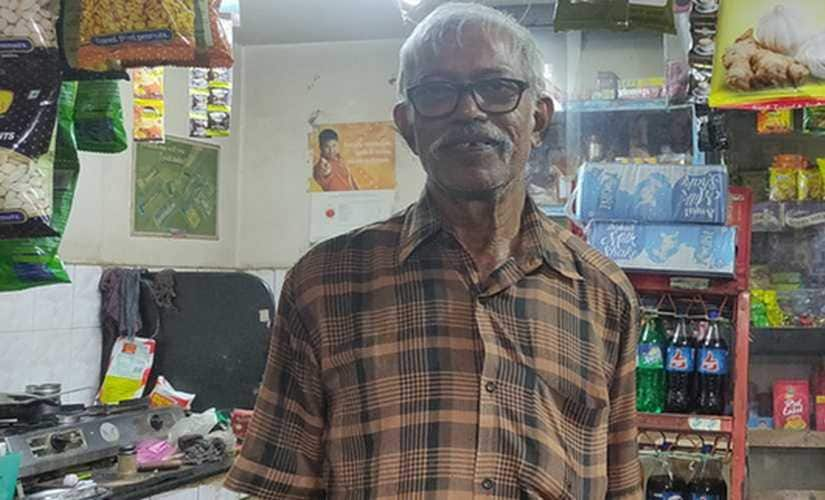
Raghavendra Bhandari at his Mangaluru shop.
Till the 1970s, RSS didn't have a strong mass base in urban coastal
Karnataka. The organisation remained Brahmin-centric, with most leaders
belonging to the Goud Saraswat Brahmin community. But before the years
leading to the Emergency, the RSS leadership spread out with more ease
in semi-urban and rural spaces. Resistance was absent as the model of
tapping into religious and cultural consciousness with nationalistic
overtones was new.
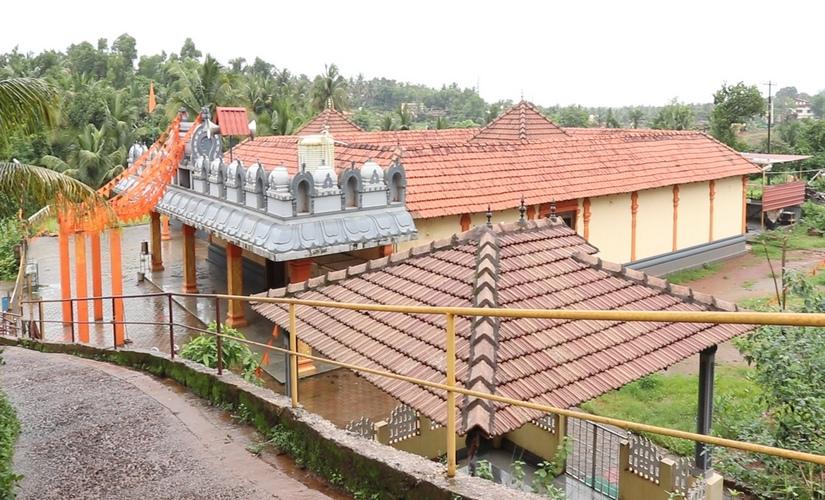
Rajesh Poojary's temple in Kumpala. Greeshma Kuthar
Temples in this land spring up with relative ease, as Rajesh Poojary
tells us. Poojary, a businessman from Thokottu which is 20 kilometres
from Mangaluru, constructed a temple 15 years ago which has become an
adda
for himself and the youth in Kumpala, the Hindu ghetto adjacent to
Ullal. Poojary is the state vice-president of the All India Hindu
Mahasabha. His brother is the priest at the temple. As he recollects the
early influence the RSS had on him, he said, "There were around 30 of
us. Till I started going to the
shakha, I had no knowledge
about figures like Ram or about the Ramayana and Mahabharata. There was
nobody to explain this to us. But the
pracharak at my s
hakha did. My love for my nation started after I joined this
shakha". Poojary added that one of the reasons why everyone was excited about attending the
shakha
was because they got to play sports such as kabbadi and cricket. "The
RSS also encouraged us to organise blood donation camps and help the
poor."
Poojary recounted a recent case of rescue he was involved in, where a
25-year-old Muslim lover of a 32-year-old Hindu widow was beaten up.
Poojary was called by the sister of the woman. Poojary believes this
woman was being exploited by her lover. He quickly added that Muslims
are not all bad. He brought up the case of another woman in his
neighbourhood who alleged that her brother was killed by a miffed Muslim
boyfriend. But it later emerged that she killed him in order to be able
to elope with her boyfriend. "There are such cases too, not denying it.
But some of these Muslims are after our women," he alleged.
Poojary said he believes in love marriages, and that he has helped
more than hundred couples get married. When asked if he has been in
love, he said he has. "There were no cellphones at that time," Poojary
said. "I couldn't keep in touch with her and hence we fell out. I had to
prioritise my work over love". Poojary has had more than 30 cases filed
against him.
Shyamala Madhav was the minister of information and broadcasting when
India went to war against China in 1962. The portfolio wasn't a central
government position, but a school-level leadership position which
Shyamala still recollects fondly. "I made everybody in school pledge
that they'll forego bursting crackers during Diwali and donate the money
towards the war expense", said Shyamala.
"I was very politically aware as a child. And when Jawaharlal Nehru
came to Mangalore to speak about the war, I listened attentively to
everything he had to say," she added. Her first recollection of Jana
Sangh is of the rally that was taken out during Sarvajanika Ganesh
Utsav, which the Jan Sangh started to popularise in the late 1960s.
"There was only one more Ganesh procession in the city and that was from
KMC Medical College," she said. Kasturbha Medical College was
established by educationalist TMA Pai, whose name is associated with the
famous capitation fees legal battle. A banker and a doctor, Pai was the
first to start a private medical college in India.
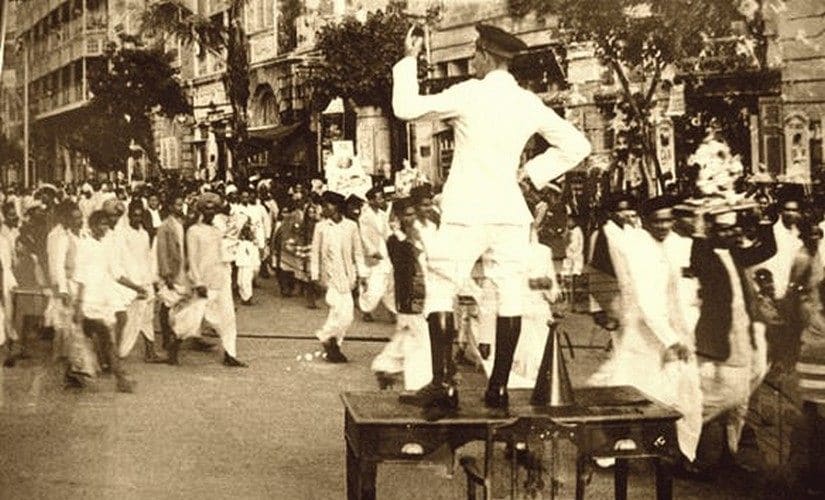
Ganesh Utsav in Bombay in the 1930s. Image courtesy: Homai Vyarawalla
The connection between Ganesh procession from
Sanghaniketan
(RSS headquarters) and KMC is that both were institutions with Goud
Saraswat Brahmins at the helm. My mother recollects visiting
Sanghaniketan a
few times as a child to take a peek at the 'Ganesh idol'. My mother
referred to Ganesh Visarjan as 'their festival' which made me curious.
When I ask if she is referring to the RSS, she replied with an answer
which was even more amusing. She said people like her didn't know what
RSS was in the early 1970s.
Sanghaniketan was a small building
in an area which was not frequented by anybody other than Goud Saraswat
Brahmins. People associated the building with the starting point of the
yearly Ganesh visarjans. Her recollection of the festival is standing by
the road and watching the procession pass, like another Goud Saraswat
Brahmins celebration — the Sharada procession — which starts from Shri
Venkatramana Temple in Car street. This temple, till recently, didn't
allow non-Brahmins to enter, and still doesn't allow let other castes
into its dining hall.
The Ganesh procession became a rallying point for many political
activities. After all, it had a similar history associated with it
outside Karnataka. Bal Gangadhar Tilak conceptualised Ganesh Utsav
celebrations to instil a sense of homogeneous Hindu identity, across
castes, in Maharashtra. RSS founder KB Hedgewar followed Tilak's method
and decades later, so did MS Golwalkar. Golwalkar understood that such
mass cultural celebrations go a long way in creating a support base. He
encouraged his
karyakartas to initiate such activities in their cities.
The Sarvajanika Ganesh Utsav, modelled after Tilak's Ganesh Utsav was a yearly activity organised at
Sanghaniketan. Initiated in 1942 by U Vasudev Shenoy, it was modelled to attract youth to the organisation. An idol would be kept at
Sanghaniketan
for close to a week at the end of which it would be taken across the
city in a procession at the end of which the idol would be immersed in
water.
"Initially, only the Goud Saraswat Brahmin community participated in
this," said Natesh Ullal, a filmmaker from Mangaluru. "But for their
25th year celebrations, they reached out to all communities in the city.
Those interested could create a Ganesh tableau and take part. This
time, even
shudra communities, who otherwise had no role in
such activities took part." What really worked for them is when they
started organising festivals new to the region, such as Raksha Bandhan,
at their
shakhas.
Raksha Bandhan is part of the six religious festivals the RSS
celebrates every year, which was initiated by Hedgewar. These festivals
are points of interaction between the masses and
karyakartas. These festivals are also modes for the RSS to build its membership and propagate religion.
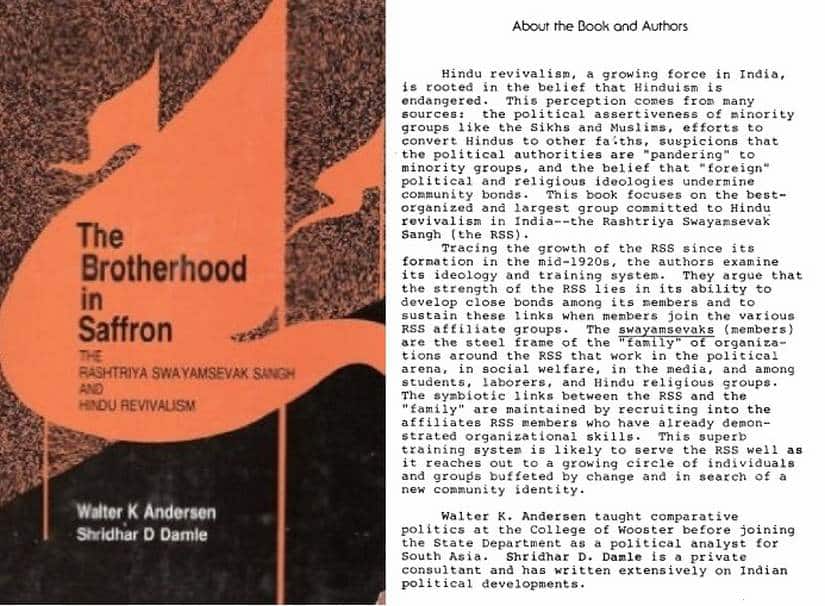
The Brotherhood in Saffron by Walter K Anderson and Shridhar D Damle.
In
The Brotherhood in Saffron: The Rashtriya Swayamsevak Sangh and Hindu Revivalism"by Walter K Anderson and Shridhar D Damle, the six festivals and the reasons why they are celebrated is explained:
"Each year the RSS celebrates six festivals (utsav). These
festivals not only articulate the experience of those taking part, but
like all ritual, they help to shape the spirit of the group. The ritual
year begins with the Hindu New Year (Varsh Pratipad). This utsav
provides the shakha leadership an opportunity to evaluate the previous
year's progress. The date coincides with Hedgewar's birthday and is
sometimes celebrated as Founder's Day.
The second utsav is the Coronation Ceremony of Shivaji (Hindu
Samrajya Divotsav) which is celebrated to honor the "Hindu victory" over
"Muslim Mughal" rule. The baudhiks at this festival frequently
emphasize the "virtues" of strength, bravery, and courage.
The third is Raksha Bandhan, a north Indian celebration that
Hedgewar introduced into the Sangh. The festival provides an opportunity
for a sister to reaffirm her brother's obligation of continuing
protection. She does this by tying a silk thread around her brother's
wrist. In the RSS adaptation of this festival-, the mukhya sakshak or
karyavah gives each swayamsevak a rakhi (a silk thread bracelet) to tie
around the wrist of a fellow swayamsevak. The baudhik will emphasize the
ties of kinship that bind the swayamsevaks together. Groups of
swayamsevaks will also visit those who have either left the RSS or who
only irregularly attend shakha and give them rakhis encouraging them to
renew their fraternal ties.
The fourth festival is Guru Dakshina. On this occasion, the
swayamsevaks offer money to their "guru"-the bhagva dhwaj (the banner).
Most of the RSS funds are raised at this utsav. Each swayamsevak goes
before the banner, offers pranam, and throws flowers on the base of the
banner staff. On each side of the banner are the pictures of "heroes" of
the Hindu nation, such as Hedgewar, Golwalkar, Ramdas Swami, and Guru
Govind Singh. There are also usually pictures of several well-known
Hindu warriors, such as Shivaji and Rana Pratap. Flowers are offered to
these pictures as well. The member puts his offering (contained in a
sealed, unmarked envelope) along with flowers on a thali (a round metal
tray) and presents the offering to the banner. This banner is sometimes
the topic of the baudhik. It is the image of the divine which
swayamsevaks are encouraged to worship.
Dasara, the festival commemorating the victory of Ram over
Ravana, is celebrated with more pomp and on a larger scale than any
other festival. All shakhas in a geographic division of the RSS combine
to perform the rituals.
Prior to the formal function, the RSS band will march through the
city followed by uniformed participants. The public is invited to the
ceremony. A well-known person from the area, often with no RSS
affiliation, presides over the function.
Concluding the festival year is the celebration of Makar Sankrant
(the winter solstice). The major themes of the utsav are personal
renunciation and service to the nation. One part of the ceremony is
meant to teach a behavioural trait considered "virtuous."
These festivals, as a method for gaining popular support, worked in Mangalore.
"Once, girls went to police stations and tied rakhis to policemen.
This became front page news," said Natesh. He believes that the
interpersonal relations the RSS built at the grassroots is what worked
for them. RSS workers were designated to go door to door to inform the
public about the activities of the nearest
shakha.
By the mid-70s, the RSS had spread across the region. So even though
they were banned during the Emergency in 1975, they had a strong network
to facilitate communication. Many Sangh-affiliated leaders such as Ram
Bhat and Prabhakar Bhat were arrested during the Emergency. But since
the base had been built, RSS
karyakartas led activities against the Emergency.
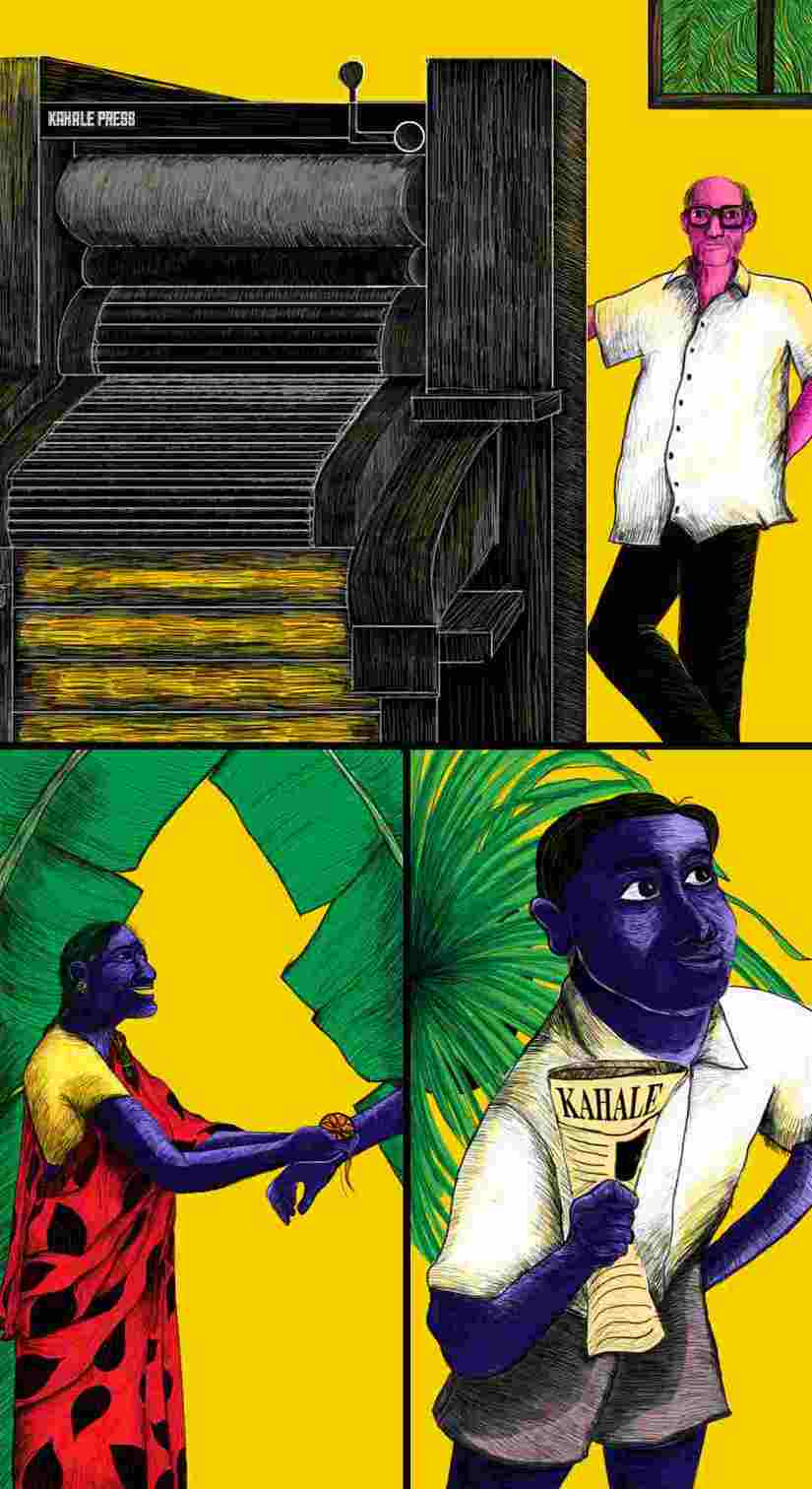
Writer
and poet Aerya LN Alva remembers visiting an underground printing press
run by Ram Bhat’s brother in Sullia where the newsletter ‘Kahale' was
printed. Bottom right: A girl tyiing a rakhi to a policeman at a
station. Bottom left: The messenger boys of ‘Kahale’, the RSS newsletter
during the Emergency. Illustration by Shrujana Niranjani Shridhar.
Natesh was then in his early teens. Like children his age, he would do anything for a
holligae, a local delicacy. "If one was lucky they would get an extra one in weddings, but nobody would indulge you with a
holligae
regularly because it was expensive," he recalled. When he was offered
two a day to circulate a newspaper during the Emergency, he jumped at
the offer. Boys like Natesh delivered
Kahale (the RSS newsletter) during the Emergency.
Kamath (name changed on request) is a businessman from Mangaluru. He
remembered the Ganesh Utsav during the Emergency, in 1976, with distinct
clarity. Fearing violence, the district collector denied permission for
the visarjan.
Sanghaniketan continued the pooja for two weeks
more than the designated seven days, refusing to end the festivities
till they were allowed to take out a procession.
"We were outraged. The government's attempts hurt religious sentiments," Kamath said. "
Sanghaniketan became
a rallying point for this struggle. Word spread across the city and
support flowed in to keep the utsav going. After more than 30 days, we
were allowed to take a silent procession through the city."
When the Emergency was finally lifted, victory marches were organised
across Mangalore by the RSS and its allies. Writer and poet Aerya LN
Alva was celebrated at these rallies.
Alva remembered visiting an underground printing press run by Ram Bhat's brother in Sullia where the newsletter
Kahale was printed. One of Alva's poems
katthey setthu hogiday (the
donkey has died) based on Indira Gandhi's excesses during the Emergency
was republished by the RSS in its newsletter. This poem became popular
overnight. "They tried to arrest me but congressmen such as UT Fareed
saved me," said Alva. "They saw me as a writer and were accepting of my
critique. Thereafter, I received tremendous encouragement from
Dharmasthala Veerendra Hegde and Pejavar Vishwa Theertha. They pushed me
towards VHP and eventually, I became the president of the district".
It was during his tenure as president that the first Hindu Samaja
Utsav was organised in 1981. This model was the vehicle through which
leaders such as Praveen Togadia and Sadhvi Rithambara emerged with their
inflammatory statements calling Muslims "cow-slaughterers and
temple-destroyers", the culmination of which saw riots break out across
the region.
Find latest and upcoming tech gadgets online on Tech2 Gadgets.
Get technology news, gadgets reviews & ratings. Popular gadgets
including laptop, tablet and mobile specifications, features, prices,
comparison.
Updated Date: Apr 19, 2019 20:02:07 IST