|
Showing posts with label Nationalism. Show all posts

October 29, 2021

India: Veer Gatha Project - promoting template of (militaristic) reverence (edit, The Telegraph, Oct 29, 2021)

 The Telegraph

Editorial: High pitch

The Veer Gatha Project must not be allowed to go the way of other seemingly innocuous programmes that seek to surreptitiously indoctrinate young minds


The Editorial Board   |   Published 29.10.21, 03:30 AM

Admiration for national heroes comes naturally to the citizenry. Problems are bound to arise when an elected government deems it necessary to impose a template of reverence. The ministry of education has asked students of central board schools as well as state authorities to prepare projects on the lives of the winners of Gallantry Awards under a month-long ‘Veer Gatha Project’. According to an official circular, the initiative aims to “disseminate the details of acts of bravery and the life stories” of armed forces personnel, thereby raising awareness among schoolchildren about the magnitude of the sacrifices made by those who guard the nation. The initiative has been lauded by several educationists who opine that interactive projects — the defence ministry will organize hour-long programmes for schoolchildren — can help students learn about topics of importance in a more comprehensive manner than can be achieved through rote-learning. Recognizing valour is important. But the methodology of doing so merits examination in the light of the fact that the Bharatiya Janata Party-led government has not only been guilty of encroaching upon educational curriculum but also rolled out several programmes with a pronounced ideological tilt in the garb of celebrating ‘Indian heritage’. Take, for instance, Yoga Day; it aims to instil a holistic approach to health but, curiously, coincides with the death anniversary of K.B. Hedgewar, the founder and first sarsanghchalak of the Rashtriya Swayamsevak Sangh. The celebration of Hindi Divas had also drawn attention after the Central Board of Secondary Education tweeted that Hindi is “our identity”.

The Veer Gatha Project must, therefore, not be allowed to go the way of other seemingly innocuous programmes that seek to surreptitiously indoctrinate young minds in a particular ideological — militaristic? — mooring. Such a proclivity not only infringes upon the autonomy of educational institutions — they, not the government, should have the right to frame curricula — but also presupposes that citizens need to be tutored on the mores of reverence. There is also the question of developing independent, critical thinking as opposed to instilling passive admiration. Would students be allowed to appreciate not only valour but also the conditions — political, historical and strategic — that compel India’s brave jawans to make the ultimate sacrifice?

October 27, 2021

What is the point of Nation Worship Syllabus and its “patriotism” mantra? | Avijit Pathak

Our children don’t need a ‘deshbhakti’ curriculum

Avijit Pathak writes: What they need is a learning community that makes them capable of distinguishing the soothing light of knowledge and wisdom from the glitz of falsehood and propaganda

Written by Avijit Pathak

https://indianexpress.com/article/opinion/columns/children-dont-need-deshbhakti-curriculum-7592407/

March 13, 2021

India: By competing with the BJP in the game of nationalism, Delhi’s AAP is legitimising majoritarian politics | Apoorvanand

AAP’s post-ideology ideology: deshbhakti

By competing with the BJP in the game of nationalism, Delhi’s AAP is legitimising majoritarian politics.

 Written by Apoorvanand |
Updated: March 13, 2021

Nationalism has now been reduced to an item in the annual Delhi government budget. The AAP brand of deshbhakti = 500 tricolours + Bhagat Singh + Ambedkar + yoga+ a sainik school + a military academy + a free ride to the elderly to a temple at Ayodhya built under the supervision of the VHP.

The AAP is competing with the BJP in the game of nationalism or deshbhakti, a term being deceptively used to hide the real majoritarian ideology which drives the politics of the BJP and the Aam Aadmi Party. Is it some consolation that while one practises a bullying majoritarianism, the other manifests an opportunistic version of it?

 [ . . . ]

https://indianexpress.com/article/opinion/columns/delhi-government-budget-aap-bjp-nationalism-7225993/

October 09, 2020

Hindi Article-Gandhi: Godse-Contrasting Nationalism

गाँधी और गोडसे: विरोधाभासी राष्ट्रवाद -राम पुनियानी इस वर्ष गांधी जयंती (2 अक्टूबर 2020) पर ट्विटर पर ‘नाथूराम गोडसे जिन्दाबाद‘ के संदेशों का सैलाब आ गया और इसने इसी प्लेटफार्म पर गांधीजी को दी गई श्रद्धांजलियों को पीछे छोड़ दिया. इस वर्ष गोडसे पर एक लाख से ज्यादा ट्वीट किए गए जबकि पिछले वर्ष इनकी संख्या करीब बीस हजार थी. इस वर्ष बहुसंख्यक ट्वीट, बाट एकाउंटस से भेजे गए. इन्हीं बाट्स से पिछले कुछ हफ्तों से ‘जस्टिस फॉर सुशात’ के संदेश भेजे जा रहे थे. इसमें कोई संदेह नहीं कि पिछले कुछ वर्षों से गोडसे को कुछ ज्यादा ही याद किया जा रहा है. यहां उल्लेखनीय है कि तत्कालीन आरएसएस प्रमुख राजेन्द्र सिंह ने कहा था, “गोडसे अखंड भारत का सपना देखता था. उसका इरादा नेक था परंतु जो रास्ता उसने अपनाया वह उचित नहीं था” (अप्रैल 27, 1998 आउटलुक). यहां यह याद करना प्रासंगिक होगा कि प्रज्ञा सिंह ठाकुर ने संसद में कहा था कि, “नाथूराम गोडसे देशभक्त था, है और रहेगा”. इसी तरह, भाजपा सांसद साक्षी महाराज ने गोडसे को राष्ट्रवादी बताया था. गोडसे को समर्पित एक मंदिर की नींव 2014 में मेरठ में रखी गई थी. कुछ वर्षों पहले ‘मी नाथूराम बोलतोय‘ नाटक का महाराष्ट्र में मंचन हुआ था जिसे देखने भारी संख्या में लोग आते थे. पिछले वर्ष 30 जनवरी को हिन्दू महासभा के कार्यकताओं ने गांधीजी की हत्या के दृश्य का मंचन किया था जिसके दौरान महासभा की पूजा शकुन पांडे ने गांधीजी के पुतले पर तीन बार गोली दागी. गोली लगते ही पुतले से खून बहने लगा और इसके तुरंत बाद दर्शकों को मिठाई बांटी गई. पिछले दिनों अनेक ऐसी घटनाएं हुईं हैं जिनसे ऐसा प्रतीत होता है कि गांधीजी को राष्ट्रपिता मानने वाले देश में उनके हत्यारे के हिन्दू राष्ट्रवाद का प्रभाव बढ रहा है. यह तब जब कि संयुक्त राष्ट्रसंघ ने गांधीजी के सिद्धांतों को सम्मान देते हुए 2 अक्टूबर को विश्व अहिंसा दिवस घोषित किया है. गोडसे के विचारों का प्रचार उस समय किया जा रहा है जब सारी दुनिया में शांति और अहिंसा को समर्पित संस्थाएं स्थापित हो रही हैं. कई विश्वविख्यात नेताओं जैसे मार्टिन लूथर किंग जूनियर और नेल्सन मंडेला ने सार्वजनिक रूप से स्वीकार किया कि उनके आंदोलन गांधीजी से प्रेरित थे. यहां यह स्मरणीय है कि नेल्सन मंडेला ने दक्षिण अफ्रीका में रंगभेद पर आधारित शासन व्यवस्था को जड़ से उखाड़ फेंका था. हमारे देश को भारतीय पहचान के आधार पर एक सूत्र में बांधना गांधी का सर्वाधिक महत्वपूर्ण योगदान था. गांधी ने अपने साम्राज्यवाद एवं ब्रिटेन विरोधी आंदोलन में अहिंसा और सत्याग्रह के अपने सिद्धांतों का उपयोग किया. अपने आंदोलन के सिद्धांतों के विकास की प्रक्रिया में नस्ल और जाति की अपनी समझ के आधार पर उन्होंने सबकी समानता के सिद्धांत को प्रतिपादित किया. उनके इस चिंतन ने उस समय ठोस स्वरूप लिया जब उन्होंने छुआछूत विरोधी आंदोलन और दलितों के लिए आरक्षण का समर्थन किया तथा संविधान का प्रारूप बनाने वाली समिति की अध्यक्षता के लिए डा. अम्बेडकर का नाम प्रस्तावित किया. इसके ठीक विपरीत, मुस्लिम और हिन्दू राष्ट्रवादी अपने-अपने समुदायों के संपन्न वर्ग के हितों के लंबरदार बने रहे और उन्होंने वर्ग, जाति और लिंग के प्राचीन पदक्रम को पुनः स्थापित करने का प्रयास किया. नाथूराम गोडसे, जो आरएसएस का प्रचारक था, हिन्दू राष्ट्रवाद के मूल्यों में आस्था रखता था. स्पष्ट है कि प्राचीन मूल्यों से प्रेरित हिन्दू राष्ट्रवादियों के भारत का मुख्य आधार असमानता थी. “मैंने गांधी की हत्या क्यों की” नामक पुस्तक, जो गोडसे के अदालत में दिए गए बयानों का संग्रह है, किताबों की दुकानों पर बड़े पैमाने पर उपलब्ध करवाई जा रही है. यह किताब देश के अतीत और आजादी के आंदोलन को साम्प्रदायिक चश्में से देखती है. किताब में गोडसे कहता है, “गांधी का व्यक्तित्व विरोधाभासी था. वे आक्रामक शांतिवादी थे, जिन्होंने सत्य और अहिंसा के नाम पर देश पर कई विपत्तियां लादीं. वहीं दूसरी ओर राणा प्रताप, शिवाजी और गुरू गोविंद सिंह, आजादी के लिए उनके योगदान के कारण देशवासियों के मन में हमेशा बसे रहेंगे. पिछले 32 वर्षों के घटनाक्रम, जिसकी पराकाष्ठा गांधीजी के मुस्लिम समर्थक अनशन से हुई, ने मुझे इस नतीजे पर पहुंचने पर मजबूर किया कि गांधी का तुरंत खात्मा किया जाए.” “उनके अनुयायी यह समझ ही न सके कि शिवाजी, राणा प्रताप और गुरू गोविंद सिंह के सामने गांधी बौने हैं और इसी कारण मैंने उनकी हत्या की. मेरी यह मान्यता है कि देश की आजादी के आंदोलन में गांधीजी का योगदान लगभग शून्य है”. गोडसे की इस विचारधारा के ठीक विपरीत, गांधी, भारतीय इतिहास को विभिन्न धर्मों के मानने वालों का इतिहास मानते थे. महात्मा गांधी ने कहा था कि, “मुस्लिम राजाओं के शासन में हिन्दू और हिन्दुओं के शासनकाल में मुसलमान, फले-फूले. दोनों ने महसूस किया कि परस्पर वैमनस्य आत्मघाती है और दोनों को यह पता था कि तलवार की नोंक पर दूसरे को उसका धर्म त्यागने के लिए बाध्य करना संभव नहीं होगा. दोनों ने शांतिपूर्वक साथ रहने का निर्णय किया. अंग्रेजों के आने के बाद झगड़े प्रारंभ हो गए...”(हिन्द स्वराज). यह अफसोस की बात है कि हिन्दू और मुस्लिम सम्प्रदायवादी, देश को लूटने में साम्राज्यवादियों की भूमिका, समानता के लिए सामाजिक परिवर्तन और देश को आजाद करने के लिए साम्राज्यवाद विरोधी आंदोलन के महत्व को नहीं समझते. आज हमारे देश में विरोधाभासी प्रक्रियाओं का प्रभाव नजर आ रहा है. जहां पूरी दुनिया में सामाजिक आंदोलन, अहिंसा और सत्याग्रह के संबंध में गांधी के विचारों के महत्व को महसूस किया जा रहा है वहीं भारत में राष्ट्रवाद के बारे में गांधी के नजरिए की उपेक्षा हो रही है. आज के शासक जहां एक ओर गांधी को राजघाट पर फूल चढ़ाकर अपनी श्रद्धांजलि अर्पित कर रहे हैं वहीं दूसरी ओर वे ऐसी विचारधारा को प्रोत्साहन दे रहे हैं जो गांधीजी की हत्या की जड़ में थी. एक ओर ट्विटर के जरिए योजनाबद्ध तरीके से गोडसे के विचारों का प्रचार किया जा रहा है वहीं दूसरी ओर आरएसएस, जो गोडसे की विचारधारा का मूल स्त्रोत था और जिसका वह प्रचारक था, से दूरी बनाने का प्रयास कर रहा है. अभी तक हिन्दू राष्ट्रवाद की विचारधारा पर्दे के पीछे थी परंतु अब खुल्लम-खुल्ला गोडसे की स्तुति की जा रही है. आज के समय में सत्ताधारियों द्वारा अप्रत्यक्ष रूप से गोडसे की विचाराधारा को स्थापित किया जा रहा है. दूसरी ओर हिन्दुत्व के नाम पर गांधी के महत्व को कम किया जा रहा है. यह हिन्दुत्व न तो संतों की परंपरा का है और ना गांधी की. ऐसा लग रहा है कि गोडसे के भारत के सामने गांधी का भारत कमजोर पड़ रहा है. गांधी का भारत एकता, समावेशिता, स्नेह और करूणा पर आधारित है. आज के सत्ताधारियों द्वारा इन मूल्यों की अवहेलना की जा रही है. (हिंदी रूपांतरणः अमरीश हरदेनिया)

February 05, 2020

India: Gandhi and the Hindutva Right From Nehru to Patel and Ambedkar, the saffron party has appropriated freedom-fighters or tarnished legacies. . - subhash gatade

newsclick.in

Gandhi and the Hindutva Right
From Nehru to Patel and Ambedkar, the saffron party has appropriated freedom-fighters or tarnished legacies. Gandhi, however, poses a different problem. 
- subhash gatade


image.png


‘Death ends all enmity’ (Marnanti Vairani) goes a maxim in Hinduism.
The story also goes that when Ravana was on death bed, Ram had even asked Laxman to go to him and learn something which no other person except a great scholar like him could teach him, declaring that though he has been forced to punish him for his terrible crime, ‘you are no more my enemy’.
It is a different matter that Hindutva supremacists -- who are keen ‘to transform Hinduism from a variety of religious practices into a consolidated ethnic identity’ -- are believers in the exact opposite.
For them, once the enemy is dead, the enmity flares up without any limits. They have no qualms that their adversary is no more to defend himself/ herself.
It has been more than five and half years that they are in power at the Centre and we have been witness to complete vilification, demonisation and obfuscation of many of their adversaries, all great leaders of the anti-colonial struggle. Of course, few were found to be ‘lucky’ enough that were promptly co-opted/appropriated by them, of course, in a sanitised form.
Thus Jawaharlal Nehru, the first Prime Minister of India, who spent more than 11 years in British jail, and was a darling of the youth, and was chosen by Mahatma Gandhi as his successor, and without whose visionary role independence in India could never have been imagined, stands obfuscated and demonised.
Whereas the likes of Sardar Patel, BR Ambedkar and Gandhi are being co-opted and attempts are on surreptitiously and not so surreptitiously to package and present them as icons of the Hindutva movement itself. As an aside, one needs to mention here that it has been years that Gandhi and Ambedkar have been included in their list of ‘Pratahsmarniy’ (worth remembering in the morning).
Interestingly, there is a dual move vis-a-vis Mahatma Gandhi, the ‘greatest Hindu of his times’ -- where one is witness to his ongoing stigmatisation, and simultaneous co-option/appropriation.
One can recall how it started with reduction of the Mahatma as an icon of Swachh Bharat Abhiyan (October 2014) -- and brushing aside his legacy of anti-colonial struggle, or the way Khadi Village Industries Commission, without any qualms, substituted Gandhi’s photo with that of Narendra Modi, who, according to a senior Minister in Haryana’s cabinet, had become a greater brand of Khadi than Gandhi. Or Gandhi’s killer, Nathuram Godse, the first terrorist of independent India, being called a ‘patriot’ on the floor of the House, or his increasing glorification in the country and plans to establish temples to Godse in different parts of the country. The stigmatisation even went to the extent of his assasination being ‘re-enacted’ in Aligarh by activists of a fringe Hindutva formation etc.
The latest in series happens to be utterings of the ‘motor mouth’ senior MP of BJP, Ananth Hegde.
Speaking at a public event in Bengaluru, Hegde described the freedom struggle led by Mahatma Gandhi as "drama" and said his "blood boiled" when he read history and "such people came to be called Mahatma".
Hegde,‘an admirer of Nathuram Godse’, even castigated the whole freedom movement and the freedom fighters, who had “asked the British how they should fight for freedom”. According to him the independence movement was “adjustment, understanding, 20-20 (cricket)”. “Those who never saw a lathi nor received a blow from a lathi are today described as freedom fighters in the pages of history,”
As expected, the outrageous statements made by Hegde, who was even a cabinet minister in the last Modi cabinet, received widespread condemnation. There were calls to take action against him. One also learnt that formally the BJP leadership was said to be uncomfortable with Hegde’s remarks, which has still failed to take any action against Pragya Thakur who had glorified Gandhi’s assassin many a time, and it has supposedly issued a notice to him to explain his remarks.
What is worth underlining is that despite the gravity of the remarks which can be construed as creating disaffection between communities, latest reports mention ‘no sedition case — the preferred weapon these days — had been slapped against Hegde’
Would it be correct to say that Hedge’s remarks were just a slip of the tongue or were deliberately made to provoke controversy to deflect attention from the government’s immediate troubles? Looking at his seniority in the party and his many outrageous statements earlier, which have even led to cases being filed against him earlier, it would be difficult to believe that they were inadvertent or so.
Remember, there is nothing surprising as far as statements by Hegde are concerned, which not only denigrate Mahatma Gandhi but also the great freedom struggle. They resonate with the essential concealed disdain towards the anti-colonial struggle of the Indian people which, according to them, brought to power ‘pseudo-seculars’ and their allies and did great harm to the cause of a Hindu nation. Instances galore show how its’ founders ridiculed the martyrs and made fun of people’s struggle.
This is Hedgewar, the founder member of Rashtriya Swayamsevak Sangh (RSS).
Patriotism is not only going to prison. It is not correct to be carried away by such superficial patriotism.(CP Bhishikar, Sanghavariksh Ke Beej: Dr. Keshavrao Hedgewar, Suruchi, 1994, p. 21.
Here is a quote from Golwalkar, the second supremo of RSS about martyrs:
There is no doubt that such men who embrace martyrdom are great heroes and their philosophy too is pre-eminently manly. They are far above the average men who meekly submit to fate and remain in fear and inaction. All the same, such persons are not held up as ideals in our society. We have not looked upon their martyrdom as the highest point of greatness to which men should aspire. For, after all, they failed in achieving their ideal, and failure implies some fatal flaw in them. (M.S. Golwalkar, Bunch of Thoughts, Sahitya Sindhu, Bangalore, 1996, p. 283)
Third, any student of the independence struggle knows that it is a ‘weak point’ as far as Hindutva formations in general, or RSS in particular, are concerned. Much has been written on the fact that not only did RSS not participate in that struggle and focussed itself on ‘organising Hindus’, but that it even deterred its own activists from joining it.
Interestingly, there is a strong commonality between Hindu communalists as well as Muslim communalists. Neither the Hindu communalists, led by the likes of Savarkar and Golwalkar nor the Muslim communalists, led by the likes of Jinnah, participated in ‘Quit India’ movement. Their support to the British rule also becomes evident when one witnesses that it was the same period when Hindu Mahasabha was running coalition governments in Bengal and parts of today’s Pakistan with Muslim league.
Coming back to the denigration of Gandhi, a key question arises why the Sangh Parivar and its affiliated organisations cannot stop this double move vis-a-vis Gandhi, where they want to appropriate him, co-opt him as well as vilify/demonise him simultaneously.
One can recall an interesting analysis by an educator with background in positive psychology and psychometrics when Hindu Mahasabha activists were arrested along with their leader, Puja Shakuni Pandey, for enacting the scene of Gandhi’s assassination in front of cameras and sharing it online. The video of the said incident went viral where Puja Pandey, called ‘Lady Godse’ by her followers, was found shooting at Gandhi's effigy and celebrating his assassination.
Rohit Kumar had asked:
This is Hindutva’s heyday. The RSS reigns supreme. Gandhi has officially been co-opted and reduced to a pair of glasses and a broom, so why so much hatred for a man who is dead, and for all practical purposes gone from the body politic?
Or has he?
It looks like hate, but could it actually be fear?
Explaining the nuances of behavioural psychology which describe hatred and fear to be two sides of the same coin, he had further asked:
Could it be that the spirit of the Mahatma is alive and well, walking the streets and alleys of India? Satya and ahimsa, as we know, were the ‘weapons’ with which he waged his ‘war’. Is it possible that over the past five years, every time the Hindutva organisations and leaders have seen those two most powerful of all ‘weapons’ in action, they have also seen the spectre of Gandhi?
Looking back, one can see merit in his argument.
How does one explain the Modi-Shah regime, one which looked triumphant till just the other day, being put on the defensive suddenly? The victory of 2019 -- with more number of seats and an increased percentage of votes -- followed by the triumphalism associated with triple talaq move, followed by the overnight dissolution of a state from the map of India, throwing to the bins the agreement reached with the Kashmiri people decades ago and the Ayodhya judgement, everything looks remote now.
Why it is that millions of Indians -- young and old from different sections, regions and strata of society -- suddenly rose up to defend the Constitution, rejecting the anti-constitutional move to make religion a criteria of citizenship. Why it is that the Preamble of the Constitution, which was drafted when Jawaharlal Nehru was the Prime Minister of India, a man which the saffrons have demonised umpteen times, could suddenly become a rallying point of this upsurge of the masses? Why is that Shaheen Bagh --the historic protest by women discriminated since centuries on the basis of religion and gender - has emerged as a new symbol of non-violent resistance, and is inspiring similar such protests the country over?

May 17, 2019

How Hindu nationalism went mainstream in Modi’s India | Amy Kazmin

How Hindu nationalism went mainstream in Modi’s India

As the country goes to the polls, it faces a profound question: is it a multifaith society or a Hindu-first nation?
May 9, 2019 Print this page 87 
 
In a land of many pilgrimage sites, the dusty compound of the Ram Birthplace Trust in the city of Ayodhya is an unusual one. Sandstone columns, lintels and other masonry are piled in the sprawling yard like giant, neglected Lego pieces awaiting assembly. 
 
Some are elaborately carved with buxom apsaras, lions or geometric patterns. Others are defaced by graffiti — mainly the words “Jai Sri Ram” (“Victory to Lord Ram”). Many are blackened from long exposure to the summer heat and battering monsoon rains of India’s northern plains. 
 
Amid these piles of construction materials, religious Hindus from across India gaze and take selfies as guides explain how the masonry will be used for a temple dedicated to Lord Ram — a Hindu deity who is revered as the ideal man and is believed to have been born in Ayodhya. 
 
“All we need is 24 hours to build the temple,” local guide Arjun Pandey explains to a small clutch of visitors, who reverently study a small, Plexiglas-encased model of the planned temple. Pandey prods his charges to chant “Jai Sri Ram” and the words briefly reverberate before the tour moves on. 
 
Bricks donated from Hindus around the world to build a temple in Ayodhya dedicated to Lord Ram, an important Hindu deity. “We’ve had no government help. Faithful Hindu followers have put this together,” says local guide Arjun Pandey © Akshay Mahajan
 
The visitors are led to a surreal image of an imagined temple hanging on a wall. It is, the guide asserts, a depiction of the spectacular shrine that supposedly stood upon Lord Ram’s birthplace until Babur, the 16th-century founder of the Mughal dynasty and a Muslim, ordered it destroyed. 
 
It is this centuries-old historical outrage — for which archaeological and historical evidence is scant — that devout Hindus want to redress by building a new temple. “Nearly 80 per cent of the work is done,” says Pandey, walking past piles of bricks inscribed “Sri Ram” that have been donated by Hindus around the world. “We’ve had no government help. Faithful Hindu followers have put this together.” 
 
All the sandstone pillars in the yard are numbered. The idea is that they can be quickly fitted together through an ingenious “locking system” and then the longed-for Ram Janmabhoomi temple will finally be complete. “All we need,” the guide reiterates as the visitors depart, “is 24 hours.” 
 
When that day may come is an open question, as Lord Ram’s birthplace is the most bitterly contested site in all of India. While devout Hindus consider Ayodhya the location of a historic, Mughal-era injustice that demands rectification, for many Indians — including, but not only, the country’s estimated 190-million-strong Muslim minority — it is the site of a far more recent wound. 
 
Hindu nationalists standing on the Babri mosque hours before it was demolished in December 1992. The activists claimed the mosque had been built on top of Lord Ram’s sacred birthplace © Getty
 
On December 6 1992, in a frenzy of destruction over a few hours, rightwing Hindu activists used axes, hammers and other tools to demolish the 16th-century Babri Masjid, or Babur’s Mosque, which they claimed had been built on top of Lord Ram’s sacred birthplace. 
 
India’s Supreme Court is now hearing a long-running legal case over the future of the site. At present it is surrounded by barbed wire and armed military personnel, though pilgrims can approach for a brief glimpse of the small Lord Ram idol that rests there. 
 
The attack on the Babri Masjid almost three decades ago was not merely the destruction of a historic building. It was an assault on the idea of an inclusive, pluralistic India, as envisaged by Mahatma Gandhi, leader of India’s freedom movement, and his political heir Jawaharlal Nehru, the first post-independence prime minister. 
 
The Ram Birthplace Trust contains carved and numbered pillars for a proposed temple to Lord Ram, an important Hindu deity. In a land of many pilgrimage sites, this dusty compound is somewhat unusual © Akshay Mahajan
 
In their conception of the nation, which was enshrined in India’s liberal constitution adopted in 1950 and set the tone of public life for decades after the end of colonial rule, India should be a secular state that belongs equally to all members of its complex multifaith society — whether from the large heterogeneous Hindu majority or smaller communities that follow the Semitic religions of Islam and Christianity, which have also flourished for centuries in the subcontinent. 
 
But the militant Hindus who tore down the Babri Masjid, and their powerful political patrons from the Bharatiya Janata party (BJP) and its parent organisation the Rashtriya Swayamsevak Sangh (RSS), saw things differently. Influenced by Hindutva — a word that literally means Hindu-ness but has come to stand for the Hindu nationalist political ideology — they believe that India belongs first and foremost to Hindus. 
 
First articulated in Vinayak Damodar Savarkar’s seminal 1923 treatise “Hindutva: Who is a Hindu?”, this world view holds that followers of Islam and Christianity cannot claim equal membership in the Indian nation, and indeed pose an existential threat to it, as their sacred sites lie elsewhere. 
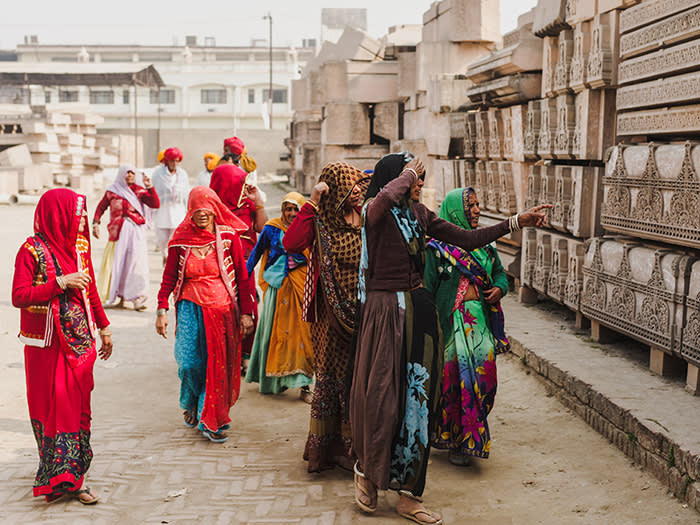
 
Visitors from Rajasthan look at pillars for the proposed Ram Temple. At the compound, sandstone columns, lintels and other masonry are piled in the sprawling yard like giant, neglected Lego pieces awaiting assembly © Akshay Mahajan
 
“Their Holyland is far off in Arabia or Palestine,” Savarkar wrote in what became the de facto manifesto of the RSS, which was established two years later. “Their mythology and Godmen, ideas and heroes are not the children of this soil. Consequently their names and their outlook smack of foreign origin. Their love is divided.” 
 
For nearly a century, this profound ideological battle over the idea of India has simmered under the surface of society, pitting an inclusive vision of a pluralistic, multifaith nation against the Hindu majoritarianism of the RSS, which says Hindus should have primacy in Indian society. 
 
The January 1948 assassination of Mahatma Gandhi by Nathuram Godse — a rightwing Hindu nationalist who blamed Gandhi for capitulating to Muslim pressure and allowing the partition of India to create Muslim-majority Pakistan — cast a long shadow over the RSS, which was briefly banned and struggled for decades to regain public legitimacy. 
 
But today, the debate is once again intensifying, as Prime Minister Narendra Modi, a dedicated RSS activist since his youth, seeks a second five-year mandate from India’s estimated 900 million eligible voters. 
 
The world’s biggest election began last month and is taking place over six weeks so security forces can ensure a free and fair vote. Indian elections are notoriously unpredictable but most expect Modi’s BJP will return to power, though it is likely to be more reliant on coalition partners than in 2014. 
 
India’s prime minister Narendra Modi in Varanasi last month. Modi and other BJP “star campaigners” are running on an agenda of national security, with themes that seem intended to inflame Hindu anxieties © Getty
 Like Modi, Amit Shah, president of the ruling BJP and the prime minister’s most trusted adviser, and many other BJP leaders are committed, life-long RSS activists, sworn to protect the Hindu nation. Other key party figures, such as Yogi Adityanath, the rightwing Hindu monk and militia leader who the BJP installed as Uttar Pradesh’s chief minister in 2017, also subscribe to its core ideals. 
 
Modi’s own reputation was forged in 2002 when he was chief minister of Gujarat state, and a train fire killed 59 Hindu pilgrims returning from Ayodhya. He quickly branded the fire an act of “pre-planned . . . inhuman terrorism”. 
 
Gujarat then erupted in savage communal riots, later described by many scholars as an anti-Muslim pogrom, in which at least 1,000 people, mainly Muslims, were killed. Modi was perceived as doing little to stop the bloodletting, which the RSS later justified as a reaction to the provocation of Hindus. Afterwards, Modi’s supporters feted him as a Hindu Hriday Samrat (Emperor of Hindu Hearts). 
 
Amit Shah, president of the ruling BJP, in Kolkata. Shah has described illegal Muslim immigrants from Bangladesh as “infiltrators” and “termites” that must be thrown out © Getty
 Yet during his first prime ministerial campaign in 2014, Modi played down the Hindutva aspect of his political persona. Instead, under the upbeat slogan “Sabka Saath, Sabka Vikas” (All Together, Development for All), he offered a young, aspirational population a vision of economic modernisation, accelerated growth and the creation of millions of jobs, promising that “good days are coming”. He was rewarded with a decisive victory, with the BJP securing the first single-party majority in the Indian parliament in three decades. 
 
For many Muslims — who account for about 14 per cent of India’s population — that optimistic promise rings hollow. With the gradual rise of the BJP, Muslims have been marginalised politically and pushed out of public institutions such as the police and judiciary. Muslims hold just 4 per cent of seats in the outgoing parliament, down from a peak of 9.6 per cent in 1980. During Modi’s first term, expressions of anti-Muslim hatred have grown more common — and acceptable — in public life. 
 
One symptom of this is a growing number of lynchings of Muslims in relation to cows — animals considered sacred by orthodox Hindus. In September 2015, a Muslim labourer, Mohammad Akhlaq, was murdered by his neighbours in a village outside New Delhi on suspicion of eating beef. Afterwards, officials seized meat samples from the victim’s home to determine if it was beef, which extremists argued would be a mitigating factor in his killing. 
 
Overall, according to Human Rights Watch, between May 2015 and December 2018, 280 people were injured in attacks carried out by vigilantes acting in the name of protecting cows, and 44 people — 36 of them Muslims — were killed. Even as these attacks — often carried out in public and some recorded on video — have drawn national headlines, Modi has said little to condemn or discourage the violence. 
 
Some BJP politicians have even intervened on behalf of those accused of such crimes, whether by paying for their lawyers or defending their actions. “We won’t remain silent if somebody tries to kill our mother — we are ready to kill and be killed,” one BJP parliamentarian commented on Akhlaq’s murder. Several of those accused of that murder, now free on bail, were seated prominently at a recent election rally of Yogi Adityanath. 
 
“If you analyse the past five years, the lynching, the threats — they point to the normalisation of violence against Muslims,” says Ali Khan Mahmudabad, a spokesman for the Uttar Pradesh-based Samajwadi party, which counts Muslims among its supporters. “Distrust of Muslims has been mainstreamed, and that has led to this fear psychosis.” 
 
Even the most educated, secular and assimilated Muslims are affected by the polarising public discourse. “Muslims are seen now only through their Muslim lens. They are no longer athletes or chefs or professors. The politics of today privileges their Muslim identity,” Mahmudabad says. “It’s very clear: as a Muslim now, you are very careful of where you move, what time you move, who you move with, what you wear and what you are carrying with you.” 
 
Modi’s re-election campaign, carried out in the shadow of a brief military showdown with neighbouring Pakistan, has taken on a dark tone. With his government’s patchy economic record making it tough to campaign on hopes of a brighter future as in 2014, the prime minister and other BJP “star campaigners” are running on an agenda of national security, with themes that seem intended to inflame Hindu anxieties. 
 
If you analyse the past five years, they point to the normalisation of violence against Muslims Ali Khan Mahmudabad, Samajwadi party In rally after rally, BJP campaigners have focused on the dangers posed by terrorism from Muslim-majority Pakistan and of illegal Muslim immigrants from Bangladesh — who Amit Shah has described as “infiltrators” and “termites” that must be thrown out. 
 
The BJP also depicts its arch-rival, the secular Congress party led by Jawaharlal Nehru’s great-grandson Rahul Gandhi, and other opposition parties as pandering to the Muslim minority, pushing policies that will directly benefit Pakistan. 
 
“This election is a crossroads not just for majoritarianism — which has always been a kind of undercurrent in the political idiom — but the idea that you search for enemies that make the nation insecure,” says Pratap Bhanu Mehta, a political scientist and vice-chancellor of Ashoka University. 
 
“For nationalism to work as a theme, you have to run this idea that the nation is fundamentally insecure, and that it requires somebody strong to deal with it. This insecurity is said to come from external enemies like Pakistan and China. But what is much more ominous is the internal enemies theme. A range of people who have, broadly speaking, been identified with secularism and the Congress are also being presented as an antinational threat.” 
 
BJP candidate Pragya Singh Thakur (centre) is welcomed at an election rally in Bhopal last month. India's prime minister has defended the controversial candidacy of the Hindu extremist, who he calls a saint © Getty
Among the BJP’s first-time parliamentary candidates is a Hindu extremist called Pragya Singh Thakur, who wears the saffron garb of a Hindu holy woman but has been criminally charged for her alleged involvement in a 2008 bomb attack on a Muslim burial ground, which killed at least six people and injured 100 others. 
 
After about eight years in jail awaiting trial, she was freed on bail on health grounds in 2017, months after a former public prosecutor complained of pressure from the National Investigation Agency to “go soft” on the case after Modi’s election. 
 
The prime minister has defended the controversial candidacy of Thakur, who he calls a saint, saying it was a rebuke to those who “defamed a 5,000-year-old peaceful civilisation” by suggesting a Hindu could also be a terrorist. 
 
It is in this context that many Indians see the 2019 election as a critical turning point that could have profound repercussions on the fabric of Indian society. “If [Modi] wins again,” says Mehta, “it will really be the emphatic political triumph of Hindu nationalism. It will be a mandate to finish the job that the RSS wants finished.” 
 
Not far from the work-yard of the Ram Birthplace Trust in Ayodhya is a 13-acre complex where the World Hindu Council runs guest houses and a Vedic school, focused on imparting the spiritual insights of the ancient Sanskrit Vedas to children. It is also home to Triloki Nath Pande, a 64-year-old farmer’s son, who has dedicated his life to the RSS and its quest to build the Ram Temple. 
 
A stray cow roams freely at the sprawling compound of the Vishwa Hindu Parishad, or World Hindu Council, in Ayodhya © Akshay Mahajan
Pande first encountered the RSS in the 1960s as a schoolboy in a small town in Uttar Pradesh, where the organisation’s dawn drills and stick-fighting sessions — intended to strengthen the self-defence capacities of Hindus once stereotyped by the British as weak and effete — were popular among bored youth. 
 
But amid the poverty of post-independence India, the young man was also deeply impressed by the RSS leaders, who explained how their land — once so prosperous it was known as “the golden bird” — had fallen so far, due to a population divided by language, caste and creed. 
 
He was spellbound by the talk of restoring the glory of India’s lost golden age, before Arabian and central Asian invaders began setting up kingdoms in India in the 13th century — the start of what the RSS today describes as “1,000 years of slavery”, when Hindus lived under the rule of Muslims, including the Mughal dynasty, and then under the British. 
 
“Foreigners came into the country because of constant internal disputes,” Pande explains, as a pair of cows amble by. “Because of their personal egos, and their fight for supremacy, they sacrificed the interests of the nation.” 
 
After training as a teacher, Pande became a full-time RSS organiser. In 1982, he was given the task of launching a “Save the Culture” campaign to prevent Hindus from converting to Christianity or Islam, and to encourage followers of Semitic religions to “return” to the Hinduism of their ancestors. 
 
Then, in 1984, Hindu nationalists hit on a new strategy to restore Hindu pride: to build grand new temples at three sites sacred to Hindus — Ayodhya, Varanasi and Mathura — where mosques then stood. “These three mosques are mocking us,” Pande remembers RSS workers being told at the time. “Those temples have to be restored.” 
 
In October 1984, about 60,000 people marched from Uttar Pradesh’s state capital Lucknow to Ayodhya, where they pledged to “liberate” the site of Lord Ram’s birth. And so began the movement that saw Pande and other RSS volunteers spend years drumming up support to replace the mosque with a grand Ram temple. 
 
Those efforts culminated in the 1992 demolition of the Babri mosque, when a rally of 150,000 BJP and RSS supporters at Ayodhya turned violent. The destruction shocked and dismayed India’s Muslim communities, igniting communal riots that claimed about 2,000 lives. 
 
Triloki Nath Pande (seated), who has dedicated his life to a quest to build the Ram Temple, says: "Foreigners came into the country because of constant internal disputes. Because of their personal egos, and their fight for supremacy, they sacrificed the interests of the nation.” © Akshay Mahajan
As he witnessed the destruction, Pande, who was helping supply food to the crowds, felt a surge of triumph. “I was overwhelmed with joy,” he says. “It was very glorious. The symbol of slavery had been erased.” He is disappointed that the Ram temple has yet to be built but believes it eventually will be — regardless of the Supreme Court’s verdict. 
 
If the judges do not clear the legal hurdles, he thinks a BJP government will issue an emergency ordinance allowing work to proceed. When that day comes, he says, Muslims “will have to decide whether they stand with Babur or with Ram. One is a deity — our ideal of the nation. The other is an invader, an enemy.” 
 
On a recent evening in Bangalore, a hub of India’s IT industry, nearly 200 educated middle-class professionals — IT engineers, corporate managers, bankers and consultants — gathered in a small screening room for the launch of a locally made music video, “Jhonka Hawa Ka” (A Breath of Fresh Air), dedicated to Modi. 
 
The event has the feeling of a religious revival meeting as audience members speak out in praise of the prime minister. “We have to follow the leader,” says one man. “The leader has come and we have to follow the leader faithfully.” Another chimes in: “Finally, after so long, we can voice our Hindutva. Earlier we didn’t have direction. But now the breeze is carrying us.” 
 
Tejasvi Surya, who is standing as a candidate for the ruling BJP in the elections, talks to the media outside a Hindu temple in Bangalore last month. "Caste, cows and curry . . . people must learn our culture in a less prejudicial manner,” he says © Akshay Mahajan
Once the function is over, audience members surround a 28-year-old baby-faced lawyer, Tejasvi Surya, the BJP’s youngest parliamentary candidate and a rising political star. Dressed in khaki trousers and a navy shirt, with gleaming loafers, Surya is the new, tech-savvy, English-speaking face of Hindu nationalism. He was thrust into the public spotlight when he called India’s parliamentary election “a test of the common Indian’s patriotism”. 
 
“If you are with Modi, you are with India, and if you are not with Modi, you are anti-India,” he thunders in a video watched 80,000 times on YouTube and widely circulated on WhatsApp. Weeks after this speech went viral, the young firebrand was tapped by Modi and Shah to run for parliament from Bangalore. 
 
He is using his oratorical skills to promote Hindutva among young educated professionals who yearn for respect in a world where they feel India and its spiritual practices are often viewed with condescension. 
 
“In my visits and interactions with foreigners — even young people of my age — the first question a foreigner asks a Hindu is ‘you have such a rigid and inhuman caste system,’” Surya tells me. “The second is, ‘Why do you guys pray to the cow?’ and ‘Why do you have so many gods?’ And the third is curry. Caste, cows and curry . . . people must learn our culture in a less prejudicial manner,” he says. 
 
Pande’s generation of Hindu nationalists were focused primarily on redressing what they saw as historic wrongs, including religious conversions and the desecration of sacred Hindu sites by the foreign invaders who once ruled their motherland. 
 
Surya represents a new generation of millennial nationalists, whose strongest grievances are against the modern Indian state, shaped by Nehru and his political heirs in the Congress party and other secular parties. Along with old-fashioned marches and protests, this generation of Hindutva warriors relies heavily on the power of social media — including YouTube and WhatsApp — to broadcast its ideas to vast audiences, and generate support for its vision of a more muscular Hindu state. 
 
Describing Hindutva as the “political skeleton essential to practise Hinduism”, Surya believes the Indian state should actively protect Hindu society from threatening forces, including Islamic fundamentalism, Christian missionaries, efforts to erode the Hindu majority and neighbouring Pakistan. 
 
The city of Ayodhya, home to one of the most bitterly contested sites in India © Akshay Mahajan
“As a civilisation, the Hindu society must be aware of the threats that it faces from foreign ideas or agencies or interests from within and outside, which may spoil or hurt the core philosophical freedom the society enjoys,” he says, adding that the state should “actively promote and protect the native cultural and spiritual tradition of our land”, such as incorporating more Indic texts and writers into the school curriculum. 
 
He believes that, since independence, the Indian state “in its quest to be secular, became anti-Hindu in many respects”. India grants some privileges to religious minorities — specifically the autonomy to run their own educational and religious institutions free from state interference — that Hindus do not enjoy. “We need a truly equal country where there is no discrimination between the minority and the majority.” 
 
Muslims, however, must be willing to “compromise to live together” with Hindus by forgoing beef out of respect for majority sensibilities, he says. “There are certain compromises that one makes in the need of the social contract, respecting majority traditions at the state level.” 
 
Surya’s own political journey began in his youth, when he attended weekend religious classes at the local Ramakrishna Mission, which promotes the ideas of Swami Vivekananda, a 19th-century intellectual and monk feted both at home and in the west for challenging colonial-era stereotypes about Hinduism. 
 
“The more I read him, the more I realised how little I knew of the vastness and grandness in Hinduism,” Surya says. His thirst for greater knowledge of Hindu tradition and ideas led him to the National Uplift Library, run by the RSS. 
 
Studying law in Bangalore, he was active in the RSS student wing. In 2012, he led hundreds of fellow students on a 2,000km trip from Bangalore to Kishanganj in West Bengal, where they joined a huge march demanding the expulsion of illegal immigrants from neighbouring Bangladesh. 
 
“Any self-respecting sovereign state must protect its citizens and ensure there are no illegal immigrants in its territory,” he tells me. “Infiltrators — illegal immigrants — must be detected, deported and deleted from whatever government rolls they have fraudulently gotten inside. It will be a very important priority of the government in the coming days.” 
 
The pilgrimage site in Ayodhya is surrounded by barbed wire and armed military personnel, though pilgrims can approach for a brief glimpse of the small Lord Ram idol that rests there © Akshay Mahajan
After graduating in 2013, Surya spent a year writing for conservative publications and volunteering for Modi’s first prime-ministerial campaign. He then began practising law and was appointed to a leadership position in the BJP youth wing and its social media team. 
 
In 2016, he spearheaded protests against plans by the then Congress government in the state of Karnataka to hold public celebrations to mark the birthday of Tipu Sultan, an 18th-century south Indian Muslim ruler who died in a 1799 battle against British East India Company troops. 
 
Often described as India’s “first freedom fighter”, Tipu Sultan was lionised in a 1990s television series, The Sword of Tipu Sultan, based on a best-selling novel that portrayed him as a valiant Indian resisting colonial aggression. 
 
But, citing a Koranic inscription on the handle of Tipu Sultan’s sword, Surya claims the man widely eulogised as the “Tiger of Mysore” was an Islamic fanatic who persecuted Hindus. The proposed birthday holiday, he says, was yet another attempt at the Congress party’s “Muslim appeasement”. 
 
Like his ideological mentors, Surya insists that Indian students should be taught the country’s “unadulterated history”, which he believes is replete with Hindu suffering and victimisation by Muslim rulers. 
 
It is in this context, Surya says, that rebuilding a Ram Temple at Ayodhya, as the BJP says it will do, becomes so important. Though Surya has never been to Ram’s birthplace himself, he says the mosque standing at the site was a reminder of “historical domination and subjugation. The need to restore and rebuild the temple at that very place is the quest of a civilisation to heal its wounds.” 
 
On May 1, as India’s marathon election began to enter its final phase, Modi held a large campaign rally in Ayodhya. He did not get close to the disputed site, to which access remains highly restricted — his speech was held about 25km away. But he began by telling his supporters that he was on “Lord Ram’s turf” and ended his rally by crying “Jai Shri Ram”. 
 
Ritual bathing in the river Sarayu by pilgrims visiting Ayodhya. Devout Hindus consider it the location of a historic, Mughal-era injustice that demands rectification © Akshay Mahajan
Many Indian liberals supported Modi in 2014, hoping for decisive economic reform while turning a blind eye to his Hindutva agenda. This time round, there can be no illusions that a vote for the BJP is simply a vote for faster economic growth. Along with the dream of a developed, prosperous India, the party seems to be grooming voters for the sociopolitical ascendance of the militant Hindu nationalism that cheered the destruction of the Babri mosque. 
 
The mainstreaming of Hindutva ideology under Modi’s leadership has already changed India’s political climate in fundamental ways. Now the country faces an existential question, according to Shashi Tharoor, Congress party leader and author of the book Why I Am a Hindu. 
 
“Is India going to be the India of the freedom struggle and the constitution, which sees every Indian as equal irrespective of their religion, their region, their language, their caste or any other marker of their identity from birth?” he asks. “Or is India going to be redefined as an ethno-religious state in which Hindus will be seen as the constituent elements of the nation, and all other minorities will be here on sufferance, as guests or interlopers?” 
 
Amy Kazmin is the FT’s South Asia bureau chief. Additional reporting by Jyotsna Singh

[The above is reproduced here for educational and non commercial use]

May 01, 2019

We might enter an ‘RSS meets Jio’ ideological world | Pratap Bhanu Mehta

We might enter an ‘RSS meets Jio’ ideological world
What is of interest is that in the new techno-nationalist imagination, the issue is not protecting small producers or indigenous technology etc. The focus is on creating what people believe to be the carriers of national power in the form of large companies.

by Pratap Bhanu Mehta

https://indianexpress.com/article/opinion/columns/the-new-techno-nationalism-technology-elections-5703564/

March 17, 2019

How Hindu nationalists built on the roots of majoritarianism in India and normalised public violence | Thomas Blom Hansen


https://scroll.in/article/916406/how-hindu-nationalists-built-on-the-roots-of-majoritarianism-in-india-and-normalised-public-violence

How Hindu nationalists built on the roots of majoritarianism in India and normalised public violence

Since the 1980s Hindutva discourse increasingly adopted a style of forceful anger that foregrounded hurt sentiments or the theme of Hindu pride.

How Hindu nationalists built on the roots of majoritarianism in India and normalised public violence
Hindu fundamentalists attack the wall of the 16th century Babri Masjid Mosque with iron rods on December 06, 1992. | Douglas E. Curran/AFP
Majoritarianism commonly refers to the idea that pre-existing ethnic, racial or religious majorities have a natural right to dominate a certain political entity. But in reflecting on how this sentiment became acceptable to so many Indians, it may be worth probing a bit deeper into how the very idea of a majority became the ultimate arbiter of political right, might and legitimacy.
Postcolonial India inherited a rich repertoire of political actions and rituals from the nationalist movement. At the heart of this new political vernacular was the notion that the people are always right and that every effective political action must stage this “people” or a community in significant numbers to make a point.
ADVERTISEMENT

Crowds – angry, mobilised, determined or disciplined – became an evermore powerful currency of political transaction in India. The bigger the crowd, the stronger the argument.

In an important article, Dipesh Chakrabarty argued that in the first decades of the new Indian nation state, senior bureaucrats, against all their instincts, had to appear from time to time in front of angry crowds in order to apologise for the non-delivery of some government service. As Indian democracy matured and multiple opposition forces arose this political vernacular of numbers, and the performance of public anger, became more complex.
From the 1990s onwards, the idea of mobilising, or representing, majorities – in states, in elected bodies, as caste coalitions, as religious communities – became an evermore powerful idea. It gradually began to challenge the older ideal of political parties attracting votes across different communities and minorities in order to consolidate a legitimate political majority. The notion of majority itself – bahumat – began to acquire a stronger affective and moral force.
In Sanskrit, bahumata literally means “esteemed by many” and it seems that by the 1990s this aspect of bahumat/majority as something that in and of itself has a moral force began to acquire an ever more effective and visceral reality on the ground. The moral force of a majority – whether defined as a pre-given cultural entity or understood as an electoral proof of the superior force and truth represented by a political formation – emerged in no small measure from regional politics across India.
The linguistic movements of the 1940s and 50s had mobilised powerful sentiments on the assumption of an inherent superiority, and naturalness, of a polity based on the linguistic affinities of a majority as well as the strength of emotional bonds this indexed and made possible.
ADVERTISEMENT

It is no coincidence that prior to the rise of Hindutva most of the morally charged rhetoric of sacrifice, of “treason”, of emotional outrage and attachment, often accompanied by physical attacks on newspapers and public figures, emerged in states where strong linguistic and regional polities had emerged since the 1950s.

Powerful language ideologies drove the movements for the purification and reinvention of modern vernaculars in the latter half of the twentieth century in much of India. These ideologies promised to overcome traditional social and caste-defined diglossia, and to overcome the sense of inferiority vis-à-vis English that was reproduced on a daily basis in the vernacular press and in institutions of government, science, the national press and higher learning. Most importantly, the language movements enabled flourishing vernacular publics to be experienced as culturally intimate in historically unprecedented ways. The vernacular was now that which could be shared and mobilised with many strangers as a medium of intimacy and solidarity vis-à-vis outsiders, as in the case of the regional movements in Andhra Pradesh, Maharashtra and Tamil Nadu. It could also be the medium of less restrained and more nakedly majoritarian sentiments, a “split public” divided between a more formal English-speaking public and a more intimate vernacular sphere.
The vernacular language itself, its grammar, the joy of speaking it, the sharing of references and the sense of community it enabled, became a medium of condensed emotions and a thick sense of community. For Maharashtra, Clare Talwalker posits that the sharing of both modern and classical Marathi among middle-class Hindus generated a certain “kin-fetishism” – an imagined world of familial intimacy and commensality where everyone becomes uncle, sister, brother, etc. This world thrives, she argues, on its supposed contrast to what is perceived to be a more alienating world of stranger sociality in metropolitan areas or in national spaces. This “kin fetishism” has distinct limits and vulnerabilities insofar as it is founded on a preexisting if unstated premise of social and ritual compatibility among upper-caste Hindus.
Some of the most inventive and irreverent writers in Marathi in the past decades are Dalit writers and public intellectuals such as Baburao Bagul, Namdeo Dhasal, Arun Kamble, and Urmila Pawar who both are, and are not, included in the intimacy of modern Marathi. For these figures, some of whom are now included in the Marathi literary canon, mastery of the vernacular was both a platform for critique and a claim for recognition.

This happened not through cultural intimacy but through the creation of a parallel Dalit public sphere, marked by festivals, institutions and symbols that are neither generally known, nor recognised by many caste Hindus in the state.

Like many other segmented publics, the Dalit public sphere is perfectly knowable but not generally known. It is technically public in a linguistic sense but not a general public in any wider social sense. This became very clear after militant Hindus in early January 2018 attacked the annual celebration of the valour of the Mahar soldiers in the defeat of the Peshwa empire in 1818 at Bhima Koregaon. The attacks led to widespread protest by Dalits across the state and made a key element in the annual calendar of events in the Dalit public sphere visible to a much larger audience.
ADVERTISEMENT
What holds such publics together is rather a shared experience of stigmatisation, a shared moral universe, and a claim for recognition as full citizens and humans that cannot be fully captured through a conventional idea of a public sphere as a network of institutions, texts, and linguistic performances. The Dalit public sphere, like other emerging lower caste “counter publics”, asserts the democratic and constitutional rights of the community against the cultural and social hegemony of upper-caste Hindus.
These intensified, segmented and vernacular publics are crucial in understanding the steady deployment of “routine” public violence, such as the destruction of public property – buses, police vans, offices, schools – by protesters of many kinds, acts that are often recorded in police records as acts of “public vandalism” rather than political events or riots, and mostly classified merely as disturbance of public order.
As I indicated above, for the Indian police, the actual prosecution of crime is at best a secondary objective, always subordinated to the maintenance of a semblance of public order which is given inordinate attention in the Indian Penal Code (IPC), that was promulgated in 1860 and since has grown very substantially. Chapter 8 of the IPC is entitled “Offences against Public Tranquility” and it has slowly grown over the decades to consist of as many as eighteen sections ranging from the milder “unlawful assembly” (141) to “rioting with a deadly weapon” (148) all the way to sections 153A (promoting enmity between different groups) and 153B (assertions prejudicial to national integration), the latter carrying more severe punishments, especially if they involve “places of worship or religious ceremonies”. Most of these sections reference groups and communities as those being “incited” or “offended” or harbouring “feelings of ill will” while the legal term “person” is only invoked in the sections referring to those who stand to “benefit” from riots (sections 154-156) or those being “hired” to commit public violence (sections 157–159).
If we look at the official crime statistics since 1960 (and we can be sure these numbers are very under reported) the aggregated number of public offences against public order (all the eighteen sections of the IPC) stood at less than 30,000 across India in the 1960s, climb to above 90,000 in 1980, and above 95,000/year in the early 1990s. After a dip during the early 2000s to under 60,000 per year, the number has been rising since 2012 reaching 73,000 in 2016.
ADVERTISEMENT
In the last decade, the Crime Bureau has started detailing the specific category of riot – as caste (2,500 in 2016), communal (1,200 in 2016), student, or political (1,800 in 2016). The rest of these disturbances – well over 60,000 – fall in the category of “other riots”, defined as “Civil Unrest, Community dispute, Attack on Police, dispute over Water supply”.
What are we to make of this?

Firstly it is clear that staging a riot or a protest of some sort, either against a public institution or another community/hostile neighbours is a very widespread phenomenon indeed.

We actually have no idea what these tens of thousands of incidents registered are about and how they get classified as “other riots”. We know that police personnel have a vested interest in putting as many incidents as possible in this category as they are seen as less serious than the specified caste or communal incidents. We also know that getting a case registered as a public disturbance is a relatively light and bailable offence, low-risk and yet high-profile. It is a way of showing anger, and demonstrating that a group or community is willing to publicly perform this anger and make a point that makes news of some sort.
Secondly, it is obvious that the very provisions of the Indian Penal Code in some ways structure the very forms that political and social protest and expression will take. The IPC defines the perceived injury of religious sentiments of a group/community as an criminal offence (295A) and it bans the incitement of enmity among groups and communities (153A and B). Since such collective offence is banned, it becomes imperative that the effect of the offence is demonstrated, not as individual sentiments but as a mirror of the spirit of the law itself – as a collective sentiment that threatens public order. As a result, being booked under one of the IPC 140s or 150s becomes in itself a form of proof of a collective sentiment and anger, and indeed a part of a political vernacular, a measure of success – something has happened (kuchh to huaa hai).
ADVERTISEMENT
Protesters describe such events as the inevitable effect of pent up anger and outrage, as if the scale of physical destruction is an index of the depth and intensity of their rage. Protesters often blame the offenders for provoking such anger – such as when vigilante groups in Karnataka or Maharashtra routinely blame “immoral youth” for the anger that wells up in themselves, vigilantes, the urge to protect Hindu values that is provoked in them and leads them to beat up and molest middle-class youth. The protesters or vigilantes want the government and various publics to take note but the audience is rarely a general public. The main audience for many protests is more often than not a more segmented caste or community public that is directly affected by certain policies or events.

Such language of outrage and hurt pride has today become the predominant modality justification of public violence in India. However, there is little doubt that Hindu nationalism has played an exceptionally important role in this process.

The Shiv Sena was a particularly radical heir to this politics of popular emotion of the linguistic movements.. The Shiv Sena developed fury (raagin Marathi) and anger (gussa in Hindi) into a public virtue, a increasingly legitimate style of politics whose forceful directness (seeda marpeet) against authorities and perceived enemies of the ordinary Marathi speaker indexed its authenticity and association with a rougher plebeian world. This sentiment was directly relayed by the name of Shiv Sena’s newspaper Saamna (confrontation) which has been pivotal in making a coarser style of colloquial Marathi acceptable and legitimate, if often dismissed as poor taste among the traditional upper-caste and middle-class communities.
Hindu communal politics has historically been framed as militant self-defence against perceived Muslim aggression. However, since the 1980s Hindutva discourse increasingly adopted a style of forceful anger that foregrounded hurt sentiments – such as the presumed historical humiliation of Hindus by the very existence of the Babri Masjid on the birth place of Lord Ram – or the theme of a Hindu pride (Hindu gaurav), presumably resurgent after centuries of humiliation, that was so prominent during the 2002 anti-Muslim pogrom in Gujarat.
The success of the BJP has been based on its capacity to instigate anti-minority violence and then reap the electoral benefits of the emotional wave of aggression and fear that communal riots tend to generate. It is also clear, as Amrita Basu has demonstrated, that there is a direct correlation between the incidence of communal riots and attacks and the growth and importance of Hindu nationalist organisations in different parts of India.
ADVERTISEMENT

In these public actions, even excessive and cruel violence is purified and made just and moral by the imputed injury to a community or a collective emotion that provoked it in the first place..

Violence is purely reactive, spontaneous and therefore inherently just. It is “natural nyaya” as a Shiv Sena activist in Mumbai put it to me many years ago, something that is inherent in a brave and self-respecting man: “if someone slaps me, my hands come out and I slap him. It is natural nyaya (justice)“. In this light, the contemporary gaurakshaks (self-proclaimed cow protectors) and the lynching of mostly Muslim men suspected of transporting beef in 2016-17 appear as less of an aberration than they are extensions of an existing grammar of action whereby righteous anger – especially that of the putative majority community – is already justified and legitimate.
Violence, I propose, has become a “general equivalent” in India’s multiple publics, akin to Marx’s notion of money as the general measure of value of otherwise disparate objects (commodities, capital, debt, etc.). Acts of public violence generate wildly disparate experiences and interpretations of violence – avenging, retributive, sacrificial, or victimising, etc. Often, the experiences of violence are entirely incommensurate with one another, as in the reckoning after major communal riots and other crowd violence. At other times, violence is invisible and incomprehensible to an adjacent public and social world, as in routinised atrocities against Dalits, or the systematic violence visited upon Muslims by police forces across India.
Yet, these experiences and real events are invariably presented, and performed, as public violence – that is extralegal, excessive and exceptional – in order to become visible and intelligible across deeply segmented and antagonistic public worlds. While the thick social context and experience of violence may be impossible to translate, the figures of victims, outraged crowds, or the self-sacrificing activist, or the brutal police action against a crowd, are general equivalents that have the potential to transcend otherwise deeply segregated social and cultural worlds.

Violence is conventionally seen as the limit, if not negation, of political life and civil political discourse. However, violence has become a completely routinised and integral part of the political life in India’s many diverse publics.

Public violence, or the threat thereof, demands attention and it generates reaction. Violence has become deeply intertwined with the more formal, mediated and institutional aspects of India’s modern publics such as newspapers, news channels and social media. As Francis Cody has shown in compelling detail, newspaper reporting and op-eds in the Tamil press always factor in the possibility of violent reprisals in the wake of controversial statements. Similarly, Saamna and other right wing newspapers are open about their reporting bias (or “truth”, as its reporters insist), and they routinely taunt their readers to take “direct action” against their enemies, including offices of newspapers critical of the movement.
ADVERTISEMENT
The street and the editorial office are not categorically different in contemporary India, one civil and objective, the other partisan and rogue, but rather parts of the same vernacular publics where the public performance of anger and fury is every bit as legitimate as a sarcastic op-ed. This indicates that violence is no longer politics by other means but the heart of political life itself. This, I submit, is a deeper and long-term process that must be factored into our understanding of how Indian democracy works.
Excerpted with permission from “Democracy Against the Law: Reflections on India’s Illiberal Democracy”, Thomas Blom Hansen, from Majoritarian State: How Hindu Nationalism is Changing India, edited by Angana P Chatterji, Thomas Blom Hansen and Christophe Jaffrelot, HarperCollins India.