राम पुनियानी
भारत सहित दुनिया के लगभग सभी देशों में भ्रष्टाचार एक बड़ी समस्या है। सन् 2011 में भ्रष्टाचार के विरूद्ध एक बड़ा आंदोलन खड़ा हुआ था, जिसके अंतर्गत जनलोकपाल की नियुक्ति की मांग को लेकर दिल्ली के जंतर-मंतर पर लंबे समय तक धरना भी दिया गया था। इस आंदोलन का मूल स्वर कांग्रेस-विरोधी था। हां, बीच-बीच में संतुलन बनाए रखने के लिए भाजपा का नाम भी ले लिया जाता था। इस आंदोलन के नेता अन्ना हजारे को दूसरे गांधी की पदवी दी गई थी। उस आंदोलन के दौरान दिल्ली के वर्तमान मुख्यमंत्री अरविंद केजरीवाल, अन्ना हजारे के प्रमुख सिपहसालारों में से एक थे। उस समय केजरीवाल के लिए जनलोकपाल की नियुक्ति सबसे बड़ा मुद्दा थी, मानो इस नियुक्ति के होते ही भ्रष्टाचार देश से इस तरह गायब हो जाएगा जैसे गधे के सिर से सींग। उस समय पुडुचेरी की वर्तमान उपराज्यपाल किरण बेदी भी मंच से हुंकार भर रहीं थीं। इस आंदोलन से जो दो अन्य प्रमुख व्यक्ति जुड़े हुए थे वे थे पतंजलि उत्पाद श्रृंखला के मालिक बाबा रामदेव एवं श्री श्री रविशंकर। यह अत्यंत आश्चर्य की बात है कि इन सब ने अब एकदम चुप्पी साध रखी है। ऐसा लग रहा है कि मानो देश से भ्रष्टाचार का खात्मा हो गया हो।
इस आंदोलन ने देश में इस हद तक जुनून पैदा कर दिया था कि लोग अपने हाथों पर ‘मेरा नेता चोर है‘ लिखवाने लगे थे। पीछे पलटकर देखने से अब ऐसा लगता है कि इस आंदोलन का प्राथमिक और एकमात्र लक्ष्य कांग्रेस को निशाना बनाना था। कांग्रेस के शासनकाल में सत्यम कम्प्यूटर्स के राजू की गिरफ्तारी हुई थी। 2जी घोटाले का खुलासा होने पर कई मंत्रियों को अपने पद गंवाने पड़े थे। हाल में एक अदालत में जो निर्णय दिया है, उससे यह स्पष्ट है कि 2जी घोटाला कभी हुआ ही नहीं था। जो लोग उस समय कांग्रेस को कटघरे में खड़ा करने में कोई कसर बाकी नहीं रख रहे थे, वे अब सत्ता के शीर्ष पर हैं और अदालत ने 2जी घोटाले की हवा निकाल दी है।
परंतु यह सब अब अतीत है। ऐसा कहा जाता है कि जनता की याददाश्त बहुत कमजोर होती है। कांग्रेस को भ्रष्टाचार के मुद्दे पर जमकर बदनाम करने के अभियान के अगुआ अब अपनी राजनीति और अपने व्यवसाय को चमकाने में व्यस्त हैं। वर्तमान प्रधानमंत्री नरेन्द्र मोदी, जिन्होंने कांग्रेस-विरोधी लहर का पूरा लाभ उठाया, ने सन् 2014 के आमचुनाव के दौरान दो जुमले उछाले थे। पहला था ‘न खाऊंगा न खाने दूंगा‘ और दूसरा ‘कि जनता उन्हें देश का चौकीदार बनने का मौका दे’। मोदी की प्रचार मशीनरी ने सफलतापूर्वक जनता को यह विश्वास दिला दिया कि मोदी जो कुछ कह रहे हैं, वे ठीक वैसा ही करेंगे।
अब देश पर नीरव मोदी का भूत सिर चढकर बोल रहा है। हीरों के ये व्यापारी, जो दावोस में मोदी के ठीक पीछे खड़े थे, बैंकों के 11,300 करोड़ रूपये लूटकर छूमंतर हो गए हैं। सरकार उन्हें ढूंढ़ नहीं पा रही है। नीरव मोदी ने यह लूट बहुत चतुराई से की। उन्होंने बिना किसी संपार्श्विक प्रतिभूति के पंजाब नेशनल बैंक के अधिकारियों के साथ मिलीभगत कर बैंक से इस आशय का अधिकार पत्र हासिल कर लिया कि वे पंजाब नेशनल बैंक की गारंटी पर अन्य बैंकों से कर्ज ले सकते हैं। उनके मामा मेहुल चौकसी,जिन्हें नरेन्द्र मोदी प्रेमवश ‘मेहुल भाई‘ पुकारते हैं, भी देश से भाग निकले हैं। उन्होंने और नीरव मोदी दोनों ने अपने सभी कर्मचारियों की छुट्टी कर दी है और उन्हें भूख और बेरोजगारी के गर्त मे ढकेल दिया है। केवल ये दोनों ही ऐसे उद्योगपति नहीं हैं जो हमारे प्रधामनंत्री के प्रिय पात्र हैं। रोटोमेक पेन के मालिक श्री कोठारी ने भी बैंकों का खजाना खाली करने में अपना यथाशक्ति योगदान दिया है। यह बात अलग है कि अपवाद स्वरूप वे जेल के सींखचों के पीछे पहुंच गए हैं। इसके पहले भी कई उद्योगपति जनता का धन डकार कर देश से गायब हो चुके हैं। किंगफिशर के विजय माल्या, 9,000 करोड़ रूपये खाकर गायब हैं। सीबीआई ने देश के हवाईअड्डों को केवल यह नोटिस जारी किया कि अगर वे देश से बाहर जाने की कोशिश करें तो उसे सूचना दी जाए। देश की इस सबसे बड़ी जांच एजेंसी ने यह नहीं कहा कि उन्हें देश के बाहर न जाने दिया जाए। इसके पहले, ललित मोदी भी यही फार्मूला अपना चुके हैं। उनके सुषमा स्वराज और वसुंधराराजे सिंधिया से काफी मधुर संबंध बताए जाते हैं।
सन् 2014 के आमचुनाव के दौरान, श्री मोदी ने जो भी वायदे किए थे, उनमें से अधिकांश खोखले साबित हुए हैं। न तो विदेशों में जमा काला धन वापस आया है और ना ही हर भारतीय के खाते में 15 लाख रूपये जमा हुए हैं। महंगाई घटने की बजाए सुरसा के मुख की तरह बढ़ती जा रही है। मोदी ने यह वायदा भी किया था कि वे अंतर्राष्ट्रीय मुद्रा बाजार में रूपये की कीमत बढ़ाने के लिए कदम उठाएंगे। इस सिलसिले में भी कुछ नहीं किया गया। देश की संपत्ति की चौकीदारी करने का वायदा भी अंततः जुमला सिद्ध हुआ। इसमें कोई संदेह नहीं कि हमारी बैंकिग प्रणाली में कई खामियां हैं और इन्हीं खामियों का इस्तेमाल मोदी के खास लोग अपने खजाने भरने के लिए कर रहे हैं। सवाल यह है कि ऐसे लोगों पर नजर रखने वाली प्रणाली क्यों और कैसे असफल हो गई। यह कैसे हुआ कि जनता की गाढ़ी कमाई के अरबों रूपये खाकर घोटालेबाज विदेशों में चैन की बंसी बजा रहे हैं। क्या यह उनकी चतुराई है या फिर मोदी सरकार ने उन्हें देश का धन गठरी में बांधकर विदेश भाग जाने का मौका उपलब्ध करवाया है?
इसमें कोई संदेह नहीं कि मोदी इस देश के कारपोरेट घरानों के डार्लिंग हैं। गुजरात में 2002 के कत्लेआम के बाद उन्होंने विकास का शिगूफा छोड़ा और उसे ‘गुजरात माडल‘ का नाम दिया। इस माडल का मूलमंत्र था बड़े उद्योगपतियों को उनका मुनाफा और संपत्ति बढ़ाने के लिए ज्यादा से ज्यादा सुविधाएं उपलब्ध करवाना। यही कारण है कि रतन टाटा ने नैनो कार का कारखाना पश्चिम बंगाल से हटाकर गुजरात में स्थापित किया और उन्होंने अन्य उद्योगपतियों से भी कहा कि अगर वे गुजरात में अपना धंधा नहीं चला रहे हैं तो वे सही रास्ते पर नहीं हैं। इसी तरह, अंबानी और अडानी ने भी मोदी राज में दिन दूनी रात चौगुनी उन्नति की। नीरव मोदी इन औद्योगिक घरानों के नजदीक हो सकते हैं। शायद मोदी के लिए इन धन कुबेरों की प्रगति ही विकास है।
इससे भी अधिक आश्चर्य की बात यह है कि भ्रष्टाचार के खिलाफ अंतिम सांस तक लड़ने का प्रण करने वाले योद्धा गायब हैं। अन्ना हजारे, केजरीवाल, किरण बेदी और बाबा रामदेव को मानो सांप सूंघ गया है। यहां यह बताना अप्रासंगिक नहीं होगा कि अन्ना हजारे के आंदोलन की पूरी रणनीति विवेकानंद इंटरनेशनल सेंटर ने बनाई थी जो कि आरएसएस का थिंक टैंक है। और इस आंदोलन ने निश्चित तौर पर संघ की संतान भाजपा को दिल्ली में सत्ता में आने में मदद की।
कुल मिलाकर हमारा चौकीदार सोता रहा और नीरव मोदी और उनके जैसे अन्य लुटेरे सरकारी खजाने पर डाका डालकर विदेशों में जा छिपे। अब सार्वजनिक क्षेत्र के बैंकों के निजीकरण की बात कही जा रही है। क्या निजीकरण के बाद जो लोग इन बैंकों का संचालन करेंगे, उन पर हम यह भरोसा कर सकते हैं कि वे उस धन की रक्षा करेंगे, जो जनता उन्हें सौंपेगी? इस समय ज़रूरत इस बात कि है कि जनता के धन के उपयोग का सामाजिक आडिट हो और उस पर जनता का नियंत्रण हो। अब इसमें कोई संदेह नहीं रह गया है कि मोदी, कारपोरेट जगत के प्रति काफी प्रेम भाव रखते हैं। अगर हम अब भी नहीं जागे तो बहुत देर हो जाएगी। (अंग्रेजी से हिन्दी रूपांतरण अमरीश हरदेनिया)
|

Showing posts with label corruption. Show all posts
Showing posts with label corruption. Show all posts
March 05, 2018
February 23, 2014


January 20, 2014
India: The dark side of the aam aadmi | A. Srinivas
Business Line, 20 January 2014
The dark side of the aam aadmi
by A. SRINIVAS
AAP’s response to the attack on African women is deeply disturbing.
The Aam Aadmi Party (AAP) government in Delhi seems to have lost it. Drunk with self-righteousness, it violated all laws and basic decency recently by rounding up and humiliating African women in the middle of the night in south Delhi.
The AAP’s defence is that its volunteers stepped in because the police was doing nothing about an alleged drug and prostitution racket.
Does that entitle them to enter women’s homes without a search warrant and, worse still, at night?
This sort of vigilantism is both disgusting and frightening. What makes matters worse is the shrill defence of the episode, with the chief minister simplistically linking rape to sex and prostitution rackets.
His remarks, besides suggesting the arrogance of a person who is riding a ‘people’s wave’, also betrays a conservative mindset.
Is violence on women merely an offshoot of crime and corruption (that mother of all problems)?
Or is it a problem of patriarchy that is within all of us — in families, in the way we think and act?
Arvind Kejriwal, the Gandhian, should have a thing or two to say about the inner being instead of going along with his Law Minister. Running the government is not about being a pugilist all the time.
But his party is drifting on a cloud of moral righteousness and Kejriwal seems to have forgotten Gandhi for the moment. All we see is a here-and-now, 24x7 zeal, the bizarre search for a clean, pure society (in which Africans can find no place?).
It’s frightening to see these lakhs of AAP volunteers burning with impatience to wipe out ‘corruption’. Corruption becomes a metaphor for dirt, an excuse to externalise the prejudices within us.
Who are these internet-savvy volunteers? If their jottings in Facebook and other websites are anything to go by, they abhor complexity of thought, an engagement with ideas, and particularly, a reference to political history.
“We want to remove corruption now, please do not burden us with your baggage”, is the refrain.
They represent the alarming anti-intellectualism of a section of the middle class, and are, in all likelihood, students or products of engineering and management institutes whose biases have remained intact in the absence of an exposure to liberal streams of thought.
One can only hope that the views of this section do not reflect the core sensibility of the AAP.
Kejriwal’s responses on the issue of the African women as well as on the political rights of Kashmiris betray some sort of connect with this section of the middle class.
Will saner elements in the party be able to alter the tenor of the discourse?
AAP’s enthusiastic volunteers want to see the world slotted into neat categories of ‘good’ and ‘bad’ so that they can actively, if not violently, be part of the solution.
Unable to cope with complexity, they rush to so-called ‘god’men, hyper-personalities such as Kejriwal or Narendra Modi, or, to extend the examples across space and time, the Osama Bin Ladens and even the Charu Mazumdars. They are ‘fundamentalists’.
Insightful views
Salman Akhtar, professor of psychiatry, Jefferson Medical College, has spoken insightfully on the “lure of fundamentalism”.
In his inaugural lecture at the Centre of Psychoanalytic Studies, Delhi University, in May 2005, he observed: “Instead of complexity, fundamentalism offers simplicity, instead of moral ambiguity, fundamentalism offers moral clarity… Instead of cultural impurity and hybridisation, fundamentalism offers purity.”
He went on to say: “Fundamentalism lulls us into a sleep of childhood, a sleep of simplicity but it is worse than childhood because a child is always questioning and attempting to come out of its innocence bit by bit.”
The extent of AAP’s ‘innocence’ is disconcerting.
The experienced elements in the party must strive towards moderation.
One way of jettisoning the muck in the flood of new members (to borrow a metaphor used by AAP leader Yogendra Yadav in a recent interview) is to take clear social and political positions.
‘Corruption’ (the slogan, not the issue) should take a backseat in the party’s lexicon in favour of a more enlightened view of social change.
The party may then shed its ‘fundamentalist’ tendencies.
The dark side of the aam aadmi
by A. SRINIVAS
AAP’s response to the attack on African women is deeply disturbing.
The Aam Aadmi Party (AAP) government in Delhi seems to have lost it. Drunk with self-righteousness, it violated all laws and basic decency recently by rounding up and humiliating African women in the middle of the night in south Delhi.
The AAP’s defence is that its volunteers stepped in because the police was doing nothing about an alleged drug and prostitution racket.
Does that entitle them to enter women’s homes without a search warrant and, worse still, at night?
This sort of vigilantism is both disgusting and frightening. What makes matters worse is the shrill defence of the episode, with the chief minister simplistically linking rape to sex and prostitution rackets.
His remarks, besides suggesting the arrogance of a person who is riding a ‘people’s wave’, also betrays a conservative mindset.
Is violence on women merely an offshoot of crime and corruption (that mother of all problems)?
Or is it a problem of patriarchy that is within all of us — in families, in the way we think and act?
Arvind Kejriwal, the Gandhian, should have a thing or two to say about the inner being instead of going along with his Law Minister. Running the government is not about being a pugilist all the time.
But his party is drifting on a cloud of moral righteousness and Kejriwal seems to have forgotten Gandhi for the moment. All we see is a here-and-now, 24x7 zeal, the bizarre search for a clean, pure society (in which Africans can find no place?).
It’s frightening to see these lakhs of AAP volunteers burning with impatience to wipe out ‘corruption’. Corruption becomes a metaphor for dirt, an excuse to externalise the prejudices within us.
Who are these internet-savvy volunteers? If their jottings in Facebook and other websites are anything to go by, they abhor complexity of thought, an engagement with ideas, and particularly, a reference to political history.
“We want to remove corruption now, please do not burden us with your baggage”, is the refrain.
They represent the alarming anti-intellectualism of a section of the middle class, and are, in all likelihood, students or products of engineering and management institutes whose biases have remained intact in the absence of an exposure to liberal streams of thought.
One can only hope that the views of this section do not reflect the core sensibility of the AAP.
Kejriwal’s responses on the issue of the African women as well as on the political rights of Kashmiris betray some sort of connect with this section of the middle class.
Will saner elements in the party be able to alter the tenor of the discourse?
AAP’s enthusiastic volunteers want to see the world slotted into neat categories of ‘good’ and ‘bad’ so that they can actively, if not violently, be part of the solution.
Unable to cope with complexity, they rush to so-called ‘god’men, hyper-personalities such as Kejriwal or Narendra Modi, or, to extend the examples across space and time, the Osama Bin Ladens and even the Charu Mazumdars. They are ‘fundamentalists’.
Insightful views
Salman Akhtar, professor of psychiatry, Jefferson Medical College, has spoken insightfully on the “lure of fundamentalism”.
In his inaugural lecture at the Centre of Psychoanalytic Studies, Delhi University, in May 2005, he observed: “Instead of complexity, fundamentalism offers simplicity, instead of moral ambiguity, fundamentalism offers moral clarity… Instead of cultural impurity and hybridisation, fundamentalism offers purity.”
He went on to say: “Fundamentalism lulls us into a sleep of childhood, a sleep of simplicity but it is worse than childhood because a child is always questioning and attempting to come out of its innocence bit by bit.”
The extent of AAP’s ‘innocence’ is disconcerting.
The experienced elements in the party must strive towards moderation.
One way of jettisoning the muck in the flood of new members (to borrow a metaphor used by AAP leader Yogendra Yadav in a recent interview) is to take clear social and political positions.
‘Corruption’ (the slogan, not the issue) should take a backseat in the party’s lexicon in favour of a more enlightened view of social change.
The party may then shed its ‘fundamentalist’ tendencies.


January 13, 2014

August 10, 2013
India: Aligarh academics call to oppose religious and communal politics played in UP ; demand reinstatement of suspended IAS officer
From The Times of India
Aligarh academics call for reinstating Durga Nagpal
Ayaskant Das, TNN Aug 9, 2013, 05.33AM IST
NOIDA: The Aligarh-based Forum for Muslim Studies and Analysis and Milat Bidari Muhim Committee have passed a resolution demanding immediate reinstatement of suspended Gautam Budh Nagar sub-divisional magistrate Durga Nagpal during a meeting of non-profit organizations of researchers and academicians.
In yet another resolution passed in the meeting held in Aligarh on Wednesday, the organizations condemned the Akhilesh Yadav-led Samajwadi Party state government for deliberately trying to vitiate the inter-communal atmosphere in Uttar Pradesh for political gains.
Tearing apart the reasons advanced by the state government for issuing suspension orders to Nagpal (viz. her alleged role in the demolition of the wall of an under-construction religious structure in Gautam Budh Nagar), members of both organizations have accused the state government of flexing its muscles to protect the sand mafia.
"About 27 incidents of communal or sectarian violence have been reported in the short tenure of the Akhilesh government. Not a single officer was suspended for these incidents. Nagpal was promptly suspended just on basis of anticipated communal tension," Prof. Razaullah Khan, president of MBMC, said.
During the meeting, the academics said they would remain isolated from the "dirty politics played by SP supremo Mulayam Singh Yadav". "Mulayam's younger brother, Shivpal, had recently misbehaved with a delegation of Muslims from Firozabad. Minorities are being treated like the personal fiefdom of the Yadav clan," said Prof. Humayun Murad.
The SP is being accused by the intellectuals of playing the minority card and encouraging illegal mining to fatten its purses ahead of the 2014 general elections. Even a year after having been voted to power, the party has failed to rein in criminal elements or control the poor law and order situation in the state, said fora members.
"The political elite in the state is emotionally blackmailing minorities in the name of religion. It's happening at a time when poorer sections of minority communities stay deprived of basic amenities like health and education," MBMC member N Jamaal Ansari said.
Participants said they are strongly opposed to the religious and communal politics played in UP. "We have planned to hold a dharna at Jantar Mantar in New Delhi on August 21," Jasim Mohammad, another MBMC member, said.
Aligarh academics call for reinstating Durga Nagpal
Ayaskant Das, TNN Aug 9, 2013, 05.33AM IST
NOIDA: The Aligarh-based Forum for Muslim Studies and Analysis and Milat Bidari Muhim Committee have passed a resolution demanding immediate reinstatement of suspended Gautam Budh Nagar sub-divisional magistrate Durga Nagpal during a meeting of non-profit organizations of researchers and academicians.
In yet another resolution passed in the meeting held in Aligarh on Wednesday, the organizations condemned the Akhilesh Yadav-led Samajwadi Party state government for deliberately trying to vitiate the inter-communal atmosphere in Uttar Pradesh for political gains.
Tearing apart the reasons advanced by the state government for issuing suspension orders to Nagpal (viz. her alleged role in the demolition of the wall of an under-construction religious structure in Gautam Budh Nagar), members of both organizations have accused the state government of flexing its muscles to protect the sand mafia.
"About 27 incidents of communal or sectarian violence have been reported in the short tenure of the Akhilesh government. Not a single officer was suspended for these incidents. Nagpal was promptly suspended just on basis of anticipated communal tension," Prof. Razaullah Khan, president of MBMC, said.
During the meeting, the academics said they would remain isolated from the "dirty politics played by SP supremo Mulayam Singh Yadav". "Mulayam's younger brother, Shivpal, had recently misbehaved with a delegation of Muslims from Firozabad. Minorities are being treated like the personal fiefdom of the Yadav clan," said Prof. Humayun Murad.
The SP is being accused by the intellectuals of playing the minority card and encouraging illegal mining to fatten its purses ahead of the 2014 general elections. Even a year after having been voted to power, the party has failed to rein in criminal elements or control the poor law and order situation in the state, said fora members.
"The political elite in the state is emotionally blackmailing minorities in the name of religion. It's happening at a time when poorer sections of minority communities stay deprived of basic amenities like health and education," MBMC member N Jamaal Ansari said.
Participants said they are strongly opposed to the religious and communal politics played in UP. "We have planned to hold a dharna at Jantar Mantar in New Delhi on August 21," Jasim Mohammad, another MBMC member, said.
India: SP’s sledgehammer tactics are prompted by Durga Sakhti Nagpal’s gender
From: The Times of India
SP’s sledgehammer tactics are prompted by Durga Sakhti Nagpal’s gender
by Arati R Jerath
08 August 2013
It’s no big deal for a ruling party to get rid of an “inconvenient’’ bureaucrat. A quiet transfer to the backwaters does the trick. It’s simple and non-controversial. Curiously, the Samajwadi Party government in Uttar Pradesh used a sledgehammer to slam rookie IAS officer Durga Sakthi Nagpal. She was first suspended, then served a chargesheet and now has the threat of dismissal hanging over her head like a Damocles sword. Her crime? She took on the sand mining mafia flourishing in Greater Noida.
It is indeed surprising that the SP went in for overkill and landed itself in controversy. But party leaders have only made matters worse with a stream of bluster and invectives that smack of a feudal mindset more suited to medieval times than a democratic nation on the cusp of modernity.
Consider the discourse. SP leader Narendra Bhati brags at a rally that he had Nagpal suspended within 41 minutes of a phone call to chief minister Akhilesh Yadav. UP health minister Ahmad Hasan questions her character and family background. SP parliamentary party leader Ram Gopal Yadav says they don’t need the IAS to run the government. Even young affable Akhilesh starts talking like a feudal baron and says punishing errant government officials is like a parent beating a child who has done something wrong.
Durga Nagpal fell victim to a deeply conservative patriarchal mindset that brooks no lip from women. How dare she? That Durga, a mere slip of a girl, dared was an affront to the streak of chauvinism that runs in the SP’s DNA. This is a party that has consistently and almost violently opposed the women’s reservation Bill on spurious grounds.
This is also the party that sent a pack of goons to teach Mayawati a lesson when the BSP toppled Mulayam Singh’s government in Lucknow in 1995. The mood outside the guest-house where Mayawati took shelter before she was sworn in as chief minister was so ugly, it sparked fears that she would have been molested had the mob managed to get inside.
The gender question is just one part of the Durga story. The other equally disturbing aspect is the brazen attempt to give a communal twist to the episode with an eye on the forthcoming general elections. No government would admit to punishing an honest officer to protect corrupt vested interests. But only the SP, which has always pandered to minority vote-bank politics, could have thought of accusing Durga of lighting a communal fire because a half-built unauthorised mosque wall was demolished in a village under her charge.
There is increasing evidence to suggest that the charge was fabricated to suit the party’s brand of politics. The BJP and SP would seem to be two sides of the same coin. If one aims to consolidate the Hindu vote, the other looks to polarise the Muslim vote. It worked once in UP. But this is not the 1990s when the political discourse was domi-nated by the secularism debate. And Muslims are no longer willing to be used as cannon fodder for political gains.
If the SP needs evidence of the changing realities of India in 2013, it should listen to the protests coming from Muslim groups at the manner in which the community is being dragged into the Durga controversy. Several Muslim clerics as well as a committee affiliated to the UP Sunni Central Waqf Board have spoken out in her favour and criticised the SP government for giving a communal colour to a political decision. The voices are scattered but the important thing is that they are coming.
The Durga controversy has come at a bad juncture for the SP. Its boss, Mulayam Singh Yadav, has made no secret of his determination to bid for the prime minister’s post if the 2014 polls throw up a fractured mandate in favour of the regional parties. Surely, he cannot afford the kind of media bashing and political isolation he and his party are facing today over an issue that smacks of poor governance.
India is struggling with economic and social transformation to make the transition to a modern democracy. Progressive forces must unite to weed out the remaining vestiges of feudal thought. The question is: Who will lead the movement for change? Historically, this was the role the Congress played during the freedom struggle. But somewhere down the line, it lost the appetite to challenge the forces of conservatism and orthodoxy.
A case in point is the abject capitulation by Rajiv Gandhi to the Muslim conservatives in his party in what is famously known as the Shah Bano case. He took a bold decision to fight the clerics on a Supreme Court ruling granting alimony to a Muslim divorcee under civil law. But when the pres-sure started mounting, he backed down.
Sonia Gandhi made the right noises in her letter to Prime Minister Manmohan Singh, asking for justice for Durga. But an election is round the corner and the Congress has a dismal record of pandering to vote-bank politics. Can she stay the course?
SP’s sledgehammer tactics are prompted by Durga Sakhti Nagpal’s gender
by Arati R Jerath
08 August 2013
It’s no big deal for a ruling party to get rid of an “inconvenient’’ bureaucrat. A quiet transfer to the backwaters does the trick. It’s simple and non-controversial. Curiously, the Samajwadi Party government in Uttar Pradesh used a sledgehammer to slam rookie IAS officer Durga Sakthi Nagpal. She was first suspended, then served a chargesheet and now has the threat of dismissal hanging over her head like a Damocles sword. Her crime? She took on the sand mining mafia flourishing in Greater Noida.
It is indeed surprising that the SP went in for overkill and landed itself in controversy. But party leaders have only made matters worse with a stream of bluster and invectives that smack of a feudal mindset more suited to medieval times than a democratic nation on the cusp of modernity.
Consider the discourse. SP leader Narendra Bhati brags at a rally that he had Nagpal suspended within 41 minutes of a phone call to chief minister Akhilesh Yadav. UP health minister Ahmad Hasan questions her character and family background. SP parliamentary party leader Ram Gopal Yadav says they don’t need the IAS to run the government. Even young affable Akhilesh starts talking like a feudal baron and says punishing errant government officials is like a parent beating a child who has done something wrong.
Durga Nagpal fell victim to a deeply conservative patriarchal mindset that brooks no lip from women. How dare she? That Durga, a mere slip of a girl, dared was an affront to the streak of chauvinism that runs in the SP’s DNA. This is a party that has consistently and almost violently opposed the women’s reservation Bill on spurious grounds.
This is also the party that sent a pack of goons to teach Mayawati a lesson when the BSP toppled Mulayam Singh’s government in Lucknow in 1995. The mood outside the guest-house where Mayawati took shelter before she was sworn in as chief minister was so ugly, it sparked fears that she would have been molested had the mob managed to get inside.
The gender question is just one part of the Durga story. The other equally disturbing aspect is the brazen attempt to give a communal twist to the episode with an eye on the forthcoming general elections. No government would admit to punishing an honest officer to protect corrupt vested interests. But only the SP, which has always pandered to minority vote-bank politics, could have thought of accusing Durga of lighting a communal fire because a half-built unauthorised mosque wall was demolished in a village under her charge.
There is increasing evidence to suggest that the charge was fabricated to suit the party’s brand of politics. The BJP and SP would seem to be two sides of the same coin. If one aims to consolidate the Hindu vote, the other looks to polarise the Muslim vote. It worked once in UP. But this is not the 1990s when the political discourse was domi-nated by the secularism debate. And Muslims are no longer willing to be used as cannon fodder for political gains.
If the SP needs evidence of the changing realities of India in 2013, it should listen to the protests coming from Muslim groups at the manner in which the community is being dragged into the Durga controversy. Several Muslim clerics as well as a committee affiliated to the UP Sunni Central Waqf Board have spoken out in her favour and criticised the SP government for giving a communal colour to a political decision. The voices are scattered but the important thing is that they are coming.
The Durga controversy has come at a bad juncture for the SP. Its boss, Mulayam Singh Yadav, has made no secret of his determination to bid for the prime minister’s post if the 2014 polls throw up a fractured mandate in favour of the regional parties. Surely, he cannot afford the kind of media bashing and political isolation he and his party are facing today over an issue that smacks of poor governance.
India is struggling with economic and social transformation to make the transition to a modern democracy. Progressive forces must unite to weed out the remaining vestiges of feudal thought. The question is: Who will lead the movement for change? Historically, this was the role the Congress played during the freedom struggle. But somewhere down the line, it lost the appetite to challenge the forces of conservatism and orthodoxy.
A case in point is the abject capitulation by Rajiv Gandhi to the Muslim conservatives in his party in what is famously known as the Shah Bano case. He took a bold decision to fight the clerics on a Supreme Court ruling granting alimony to a Muslim divorcee under civil law. But when the pres-sure started mounting, he backed down.
Sonia Gandhi made the right noises in her letter to Prime Minister Manmohan Singh, asking for justice for Durga. But an election is round the corner and the Congress has a dismal record of pandering to vote-bank politics. Can she stay the course?
February 13, 2013
February 07, 2013
Kancha Ilaiah: The ugly truth
Deccan Chronicle - 04th Feb 2013
Dear Ashis Nandy,
On the question of corruption — how to deploy that concept, and which section of the Indian society (not of the state) deserves to be deployed — it seems you displayed a deep diabolism at the Jaipur Literature Festival. With your statement the debate on corruption shifted from individuals to communities/castes. This is in a way good.
The recent countrywide debate on corruption was confined to individuals, most of them coming from the higher echelons of the Indian civil society and state. Now you have, however, labelled the OBCs, SCs and STs as communities that are most corrupt without saying anything about the corruption of the upper castes, except a cursory reference to upper-caste nepotism. In any case, none of the upper-caste intellectuals in the realm of social science have accepted, so far, that the upper castes are corrupt as a community. Your presumption on that count is also wrong. In fact, there is no debate on castes and communities vis-a-vis corruption.
Using a concept like corruption, which is a hated concept in the public realm, for castes and communities of India that produced all our wealth for centuries but never got anything back is dangerous. The British colonists labe-lled the tribes as “criminal” but the upper castes as “pundits, Desh-mukhs, Sir Desais, Deshpandes” and so on. You seem to have followed them in labelling the most oppressed communities as “most corrupt.” Is it not dangerous to do so while claiming to be their supporter? Does not this harm even the social science discourse?
This is a time when some amount of intellectual intercourse is taking place between the upper-caste subaltern scholars, who denied the existence of caste, and Dalit-Bahujan scholars, who harp upon only caste.
What would happen to a white intellectual who says that “most black Americans are becoming corrupt” without stating that all whites are racist?
What if someone were to say that “most women who are entering the state administration are corrupt and that women labourers are becoming increasingly corrupt,” (just like the tribals who figured in your statement) — would that be acceptable to women activists of India? Would women intellectuals support it?
Take, for example, the very Bengal experiment that you cited. If I use your own analogy, the Bengal OBC/SC/STs are not corrupt because they have not yet come into the state sector.
In other words, the Bengali Bhadralok were/are one of the most corrupt communities of India who pretend to have kept their system “clean”. If I presume that you are using the notion of corruption to the Bengali Bhadralok as a community (made up of three castes: Brahmins, Kayastas and Vaidyas), would they tolerate it? How much intellectual energy has gone into exposing the Bengal Bhadralok manoeuvring? Did they not misuse the law of the land to keep the SC/ST/OBCs out of the educational system?
If we invoke Tarun Tejpal’s epithet that “corruption is an equaliser” then Bengal Communists who ruled that state for 37 years must be treated as the most corrupt group in the world. They subverted the reservation system to ensure that the SC/ST/OBCs do not come anywhere near their Bhadralok Brahminic state. What did the Bengal intellectuals do to fight that corrupt Bhadralok community? The course has not changed during the Mamata Banerjee regime too. What will you do now?
When the Ambedkarites were almost ready to deploy caste in the Indian intellectual discourse, undercutting the class and nation discourse, some of our upper-caste scholars came out with a soft, unidentifiable, Western concept called “subaltern.”
For those of us who realised that there was a deep notion of casteism operating in the whole nationalist and class movements, we also knew that the deployment of the category “subaltern” subverted our agenda. Somehow, the Mandal movement, with the support of the erstwhile Raja — V.P. Singh — the anti-caste ideology began to acquire a foothold in the academic circles. There is a feeling that only to divert the discourse on corruption of upper castes you labelled the SC/ST/OBCs as corrupt by misusing a platform like the Jaipur Literary Festival.
Otherwise how should one understand your theory of corruption that walked on its head?
As the British had done earlier, criminality is now being attributed to the victims of criminals themselves. This is one of the main attributes of colonial intellectualism and it now is seeping into upper-caste intellectual discourse. The tragedy is that such friendly surrogation of casteism was sought to be played out at a place where the women from Jaipur’s Maharaja family were selling tea, whereas the maharajas were hardly around. This shows that there is a change. But the change is more visible among upper-caste women and not so much among upper-caste men.
Yes, the Dalit-Bahujan movements should keep track of such surrogations without losing sight of who is a friend and who is a foe. It should draw lines carefully. Earlier we faced intellectuals who described Ambedkar as a “False God.” There is that word “God” in it. But what is more important is “False.” You labelled the SC/ST/OBCs as corrupt to equalise them with upper castes who are not merely corrupt but exploit also. We, therefore, not only need to debate caste and corruption but caste and exploitation, too.
The game is not yet being played in a levelled field. The men and women in that vastly unlevelled ground are unequal. The very sight of unequal bodies in the ground, which is unlevelled, the fear of losing the game is deep among the short and lean standing there. While pretending to be a friend of the new entrants, do not hint to the umpire that the new entrants are likely to win by using deceptive means. No… no, that is being a deceptive friend.
Dear Ashis Nandy,
On the question of corruption — how to deploy that concept, and which section of the Indian society (not of the state) deserves to be deployed — it seems you displayed a deep diabolism at the Jaipur Literature Festival. With your statement the debate on corruption shifted from individuals to communities/castes. This is in a way good.
The recent countrywide debate on corruption was confined to individuals, most of them coming from the higher echelons of the Indian civil society and state. Now you have, however, labelled the OBCs, SCs and STs as communities that are most corrupt without saying anything about the corruption of the upper castes, except a cursory reference to upper-caste nepotism. In any case, none of the upper-caste intellectuals in the realm of social science have accepted, so far, that the upper castes are corrupt as a community. Your presumption on that count is also wrong. In fact, there is no debate on castes and communities vis-a-vis corruption.
Using a concept like corruption, which is a hated concept in the public realm, for castes and communities of India that produced all our wealth for centuries but never got anything back is dangerous. The British colonists labe-lled the tribes as “criminal” but the upper castes as “pundits, Desh-mukhs, Sir Desais, Deshpandes” and so on. You seem to have followed them in labelling the most oppressed communities as “most corrupt.” Is it not dangerous to do so while claiming to be their supporter? Does not this harm even the social science discourse?
This is a time when some amount of intellectual intercourse is taking place between the upper-caste subaltern scholars, who denied the existence of caste, and Dalit-Bahujan scholars, who harp upon only caste.
What would happen to a white intellectual who says that “most black Americans are becoming corrupt” without stating that all whites are racist?
What if someone were to say that “most women who are entering the state administration are corrupt and that women labourers are becoming increasingly corrupt,” (just like the tribals who figured in your statement) — would that be acceptable to women activists of India? Would women intellectuals support it?
Take, for example, the very Bengal experiment that you cited. If I use your own analogy, the Bengal OBC/SC/STs are not corrupt because they have not yet come into the state sector.
In other words, the Bengali Bhadralok were/are one of the most corrupt communities of India who pretend to have kept their system “clean”. If I presume that you are using the notion of corruption to the Bengali Bhadralok as a community (made up of three castes: Brahmins, Kayastas and Vaidyas), would they tolerate it? How much intellectual energy has gone into exposing the Bengal Bhadralok manoeuvring? Did they not misuse the law of the land to keep the SC/ST/OBCs out of the educational system?
If we invoke Tarun Tejpal’s epithet that “corruption is an equaliser” then Bengal Communists who ruled that state for 37 years must be treated as the most corrupt group in the world. They subverted the reservation system to ensure that the SC/ST/OBCs do not come anywhere near their Bhadralok Brahminic state. What did the Bengal intellectuals do to fight that corrupt Bhadralok community? The course has not changed during the Mamata Banerjee regime too. What will you do now?
When the Ambedkarites were almost ready to deploy caste in the Indian intellectual discourse, undercutting the class and nation discourse, some of our upper-caste scholars came out with a soft, unidentifiable, Western concept called “subaltern.”
For those of us who realised that there was a deep notion of casteism operating in the whole nationalist and class movements, we also knew that the deployment of the category “subaltern” subverted our agenda. Somehow, the Mandal movement, with the support of the erstwhile Raja — V.P. Singh — the anti-caste ideology began to acquire a foothold in the academic circles. There is a feeling that only to divert the discourse on corruption of upper castes you labelled the SC/ST/OBCs as corrupt by misusing a platform like the Jaipur Literary Festival.
Otherwise how should one understand your theory of corruption that walked on its head?
As the British had done earlier, criminality is now being attributed to the victims of criminals themselves. This is one of the main attributes of colonial intellectualism and it now is seeping into upper-caste intellectual discourse. The tragedy is that such friendly surrogation of casteism was sought to be played out at a place where the women from Jaipur’s Maharaja family were selling tea, whereas the maharajas were hardly around. This shows that there is a change. But the change is more visible among upper-caste women and not so much among upper-caste men.
Yes, the Dalit-Bahujan movements should keep track of such surrogations without losing sight of who is a friend and who is a foe. It should draw lines carefully. Earlier we faced intellectuals who described Ambedkar as a “False God.” There is that word “God” in it. But what is more important is “False.” You labelled the SC/ST/OBCs as corrupt to equalise them with upper castes who are not merely corrupt but exploit also. We, therefore, not only need to debate caste and corruption but caste and exploitation, too.
The game is not yet being played in a levelled field. The men and women in that vastly unlevelled ground are unequal. The very sight of unequal bodies in the ground, which is unlevelled, the fear of losing the game is deep among the short and lean standing there. While pretending to be a friend of the new entrants, do not hint to the umpire that the new entrants are likely to win by using deceptive means. No… no, that is being a deceptive friend.
February 02, 2013
Here’s the real reason why sociologist Ashis Nandy should be in the dock of public criticism
Firstpost India
Ashis Nandy’s corruption theory is a load of bull
by R Jagannathan Feb 1, 2013
Here’s the real reason why sociologist Ashis Nandy should be in the dock of public criticism. There is almost no evidence whatsoever to substantiate his observation that the backward classes and Dalits are seen as more corrupt because they are less good at hiding it than their upper class compatriots.
Nandy is facing police investigations for saying at the Jaipur Literary Festival (JLF) last week that “most of the corrupt come from the OBCs and the scheduled castes and now, increasingly, scheduled tribes, and as long as this is the case, the Indian republic will survive.” (Read the full text here)
It is obviously the first half of the sentence that got everyone’s goat, not the second. In fact, if at all India has more corrupt people from the OBCs and SC/STs, it can only be because they constitute a much larger share of the population. The upper castes don’t exceed 15 percent of the population, while OBCs/SCs/STs constitute more than 70 percent.
The convoluted logic Nandy used to make his observation was not intended to show Dalits or OBCs as more corrupt, but merely as being more inept. He is effectively saying that the upper castes are more sophisticated in their corruption while the backwards are really backward in their ability to hide the stuff.
PTI
The convoluted logic Nandy used to make his observation was not intended to show Dalits or OBCs as more corrupt, but merely as being more inept. PTI
Is this really so?
This morning’s Indian Express investigates Bahujan Samaj Party leader Mayawati’s alleged corruption. The story reveals a level of sophistication comparable to those practiced by the so-called upper classes or castes. Says the Express story: “During Mayawati’s third term as CM…the real estate business of one of her younger brothers, Anand Kumar, expanded like never before… Kumar’s companies constitute a key link in an elaborate network of business associations that involve builders in Noida and Greater Noida, national real estate giants Jaypee, Unitech and DLF, and a company linked to the son of Mayawati’s aide and Rajya Sabha member Satish Chandra Misra.”
Anybody who can create a web starting not with oneself, but a relative is hardly unsophisticated. In contrast, we have upper class YS Jagan Mohan Reddy currently cooling his heels in jail for his own property and related deals.
Let’s also not forget, Mayawati has paid no political price whatsoever for any of her land deals, but BS Yeddyurappa, a Lingayat from Karnataka, had to sacrifice his chief ministership for his inability to hide them well. A Dalit has got the better of someone who’s not so backward.
Consider what Nandy said about poor Mayawati’s inability to hide potential corruption compared to the upper classes. “If I do a good turn to Richard Sorabji, he can return the favour by accommodating my nephew at Oxford; if it were in the United States, it would be a substantial fellowship. Ms Mayawati doesn’t have that privilege. She probably has only relatives whose ambition was to be a nurse or run a petrol pump. If she has to oblige somebody or have somebody in the family absorb the money, she will probably have to take the bribe of having 100 petrol pumps, and that is very conspicuous, very corrupt indeed. Our corruption doesn’t look that corrupt, their corruption does.”
Even when it comes to petrol pumps, Nandy has proved himself wrong.
It is worth recalling that it was the sophisticated upper class ministers of the BJP-led NDA who were caught in a petrol pump allotment scam in 2002.
Not only did a Mayawati not get embroiled in any petrol pump scam, but one should contrast the sophisticated web of firms created around her younger brother with the unsophistication of a Sukh Ram, a Brahmin former Telecom Minister in Narasimha Rao’s cabinet, who was caught (and later convicted) for hiding crores in currency under his bed.
Next, let’s hear what Nandy had to say about the inept corruption of tribals. “To the best of my knowledge, the only unrecognised billionaire in India today, in dollar terms, is Madhu Koda. He’s a tribal and I can assure you that Mr Koda must have been a very insecure, unhappy, tense person. And in this kind of situation, the only people you can trust are your own relatives… And if you fit your experiences within this model, you will recognise why this insecurity is there, because politics looks a very impersonal, contractual work to a large part of Indians. They are new to politics. And your family members do not have the capacity to absorb the additional money in a more clever, intelligent way.”
Koda must surely have messed up, but one swallow does not prove Nandy’s theory about guileless tribals. Test this claim against reality – one involving Brahmins and tribals in the same web of corruption.
Brahmin PM Narasimha Rao was convicted for trying to bribe tribal-based Jharkhand Mukti Morcha (JMM) MPs during a trust vote in the early 1990s. As for the JMM MPs themselves, they were not only all acquitted, but have even been able to keep the bribe money as a tax-free “political donation” (read here).
So much for upper caste brilliance in corruption, and tribal underachievement in the same department.
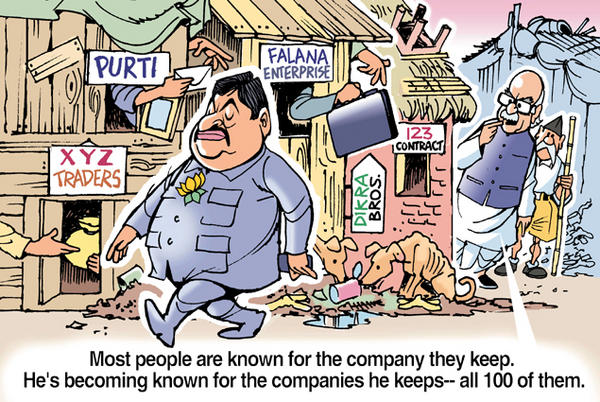
Next, consider Nitin Gadkari, a Brahmin supported by those ultra-Brahmins of the Sangh Parivar. So messily has he organised his Purti Group, that he became an object of ridicule for doing stupid things like making his driver a director. He is having to be rescued by the Pawars of the world.
Contrast this with Andimuthu Raja, a Dalit. You may say that he has got caught, but consider the sheer sophistication of his arguments and behaviour. While his arbitrary change in cutoff dates for allotting spectrum may still get him jail, the Central Bureau of Investigation (CBI) has not got anywhere with the money trail. If Raja has made money, he has hidden it well. Not only that, Raja managed his scam brilliantly by keeping P Chidambaram and Manmohan Singh in the loop, and this is the main reason why these gentlemen are facing a diminution in their reputations. They were saved only by the skins of their teeth and shown to be overlooking Raja’s scams.
And let’s not forget. If Raja did end up in jail, a whole lot of super-sophisticated businessmen – who should know every trick in the book and outside it – also went to jail with him. The Dalit, if anything, did not fare any worse than businessmen with platoons of high-powered lawyers to aid their misdeeds.
It does not matter if Raja actually gets convicted or not, but the fact that he managed to pull a fast one with two Congress politicians from the upper classes tells us that the so-called lower classes are not backward when it comes to corruption.
About corruption of the OBC type, Nandy had this to say: “In the case of Lalu Prasad and Mulayam Singh, and people like them, exactly…there is a sense of desperation, utter desperation and insecurity. Even if you make through corruption millions of rupees, you suspect that you will not be able to get away using the machinery of law or cleverly manipulating your investments in the right way with the right connections because you have none…”.
Can this statement be even remotely true of Mulayam Singh, who is even now sitting pretty and could be a potential PM candidate in a third or federal front in 2014? As for Lalu, when made an accused in the fodder scam, he smartly manoeuvred to make his wife CM of Bihar, and never paid any kind of price for the fodder scam. As far as the national media is concerned, he is still good copy. And he himself has said he does not rule himself out as a future PM.
When it comes to corruption, the truth is no one is backward.
Ashis Nandy’s corruption theory is a load of bull
by R Jagannathan Feb 1, 2013
Here’s the real reason why sociologist Ashis Nandy should be in the dock of public criticism. There is almost no evidence whatsoever to substantiate his observation that the backward classes and Dalits are seen as more corrupt because they are less good at hiding it than their upper class compatriots.
Nandy is facing police investigations for saying at the Jaipur Literary Festival (JLF) last week that “most of the corrupt come from the OBCs and the scheduled castes and now, increasingly, scheduled tribes, and as long as this is the case, the Indian republic will survive.” (Read the full text here)
It is obviously the first half of the sentence that got everyone’s goat, not the second. In fact, if at all India has more corrupt people from the OBCs and SC/STs, it can only be because they constitute a much larger share of the population. The upper castes don’t exceed 15 percent of the population, while OBCs/SCs/STs constitute more than 70 percent.
The convoluted logic Nandy used to make his observation was not intended to show Dalits or OBCs as more corrupt, but merely as being more inept. He is effectively saying that the upper castes are more sophisticated in their corruption while the backwards are really backward in their ability to hide the stuff.
PTI
The convoluted logic Nandy used to make his observation was not intended to show Dalits or OBCs as more corrupt, but merely as being more inept. PTI
Is this really so?
This morning’s Indian Express investigates Bahujan Samaj Party leader Mayawati’s alleged corruption. The story reveals a level of sophistication comparable to those practiced by the so-called upper classes or castes. Says the Express story: “During Mayawati’s third term as CM…the real estate business of one of her younger brothers, Anand Kumar, expanded like never before… Kumar’s companies constitute a key link in an elaborate network of business associations that involve builders in Noida and Greater Noida, national real estate giants Jaypee, Unitech and DLF, and a company linked to the son of Mayawati’s aide and Rajya Sabha member Satish Chandra Misra.”
Anybody who can create a web starting not with oneself, but a relative is hardly unsophisticated. In contrast, we have upper class YS Jagan Mohan Reddy currently cooling his heels in jail for his own property and related deals.
Let’s also not forget, Mayawati has paid no political price whatsoever for any of her land deals, but BS Yeddyurappa, a Lingayat from Karnataka, had to sacrifice his chief ministership for his inability to hide them well. A Dalit has got the better of someone who’s not so backward.
Consider what Nandy said about poor Mayawati’s inability to hide potential corruption compared to the upper classes. “If I do a good turn to Richard Sorabji, he can return the favour by accommodating my nephew at Oxford; if it were in the United States, it would be a substantial fellowship. Ms Mayawati doesn’t have that privilege. She probably has only relatives whose ambition was to be a nurse or run a petrol pump. If she has to oblige somebody or have somebody in the family absorb the money, she will probably have to take the bribe of having 100 petrol pumps, and that is very conspicuous, very corrupt indeed. Our corruption doesn’t look that corrupt, their corruption does.”
Even when it comes to petrol pumps, Nandy has proved himself wrong.
It is worth recalling that it was the sophisticated upper class ministers of the BJP-led NDA who were caught in a petrol pump allotment scam in 2002.
Not only did a Mayawati not get embroiled in any petrol pump scam, but one should contrast the sophisticated web of firms created around her younger brother with the unsophistication of a Sukh Ram, a Brahmin former Telecom Minister in Narasimha Rao’s cabinet, who was caught (and later convicted) for hiding crores in currency under his bed.
Next, let’s hear what Nandy had to say about the inept corruption of tribals. “To the best of my knowledge, the only unrecognised billionaire in India today, in dollar terms, is Madhu Koda. He’s a tribal and I can assure you that Mr Koda must have been a very insecure, unhappy, tense person. And in this kind of situation, the only people you can trust are your own relatives… And if you fit your experiences within this model, you will recognise why this insecurity is there, because politics looks a very impersonal, contractual work to a large part of Indians. They are new to politics. And your family members do not have the capacity to absorb the additional money in a more clever, intelligent way.”
Koda must surely have messed up, but one swallow does not prove Nandy’s theory about guileless tribals. Test this claim against reality – one involving Brahmins and tribals in the same web of corruption.
Brahmin PM Narasimha Rao was convicted for trying to bribe tribal-based Jharkhand Mukti Morcha (JMM) MPs during a trust vote in the early 1990s. As for the JMM MPs themselves, they were not only all acquitted, but have even been able to keep the bribe money as a tax-free “political donation” (read here).
So much for upper caste brilliance in corruption, and tribal underachievement in the same department.
Next, consider Nitin Gadkari, a Brahmin supported by those ultra-Brahmins of the Sangh Parivar. So messily has he organised his Purti Group, that he became an object of ridicule for doing stupid things like making his driver a director. He is having to be rescued by the Pawars of the world.
Contrast this with Andimuthu Raja, a Dalit. You may say that he has got caught, but consider the sheer sophistication of his arguments and behaviour. While his arbitrary change in cutoff dates for allotting spectrum may still get him jail, the Central Bureau of Investigation (CBI) has not got anywhere with the money trail. If Raja has made money, he has hidden it well. Not only that, Raja managed his scam brilliantly by keeping P Chidambaram and Manmohan Singh in the loop, and this is the main reason why these gentlemen are facing a diminution in their reputations. They were saved only by the skins of their teeth and shown to be overlooking Raja’s scams.
And let’s not forget. If Raja did end up in jail, a whole lot of super-sophisticated businessmen – who should know every trick in the book and outside it – also went to jail with him. The Dalit, if anything, did not fare any worse than businessmen with platoons of high-powered lawyers to aid their misdeeds.
It does not matter if Raja actually gets convicted or not, but the fact that he managed to pull a fast one with two Congress politicians from the upper classes tells us that the so-called lower classes are not backward when it comes to corruption.
About corruption of the OBC type, Nandy had this to say: “In the case of Lalu Prasad and Mulayam Singh, and people like them, exactly…there is a sense of desperation, utter desperation and insecurity. Even if you make through corruption millions of rupees, you suspect that you will not be able to get away using the machinery of law or cleverly manipulating your investments in the right way with the right connections because you have none…”.
Can this statement be even remotely true of Mulayam Singh, who is even now sitting pretty and could be a potential PM candidate in a third or federal front in 2014? As for Lalu, when made an accused in the fodder scam, he smartly manoeuvred to make his wife CM of Bihar, and never paid any kind of price for the fodder scam. As far as the national media is concerned, he is still good copy. And he himself has said he does not rule himself out as a future PM.
When it comes to corruption, the truth is no one is backward.
Ashis Nandy's views on caste and corruption must be debated and challenged
From: Outlook Magazine, 11 February 2013
The Nandy Bully
The sorts of corruption that matter are a purview of privileged
S. Anand
“An intellectual man can be a good man but he may easily be a rogue. Similarly an intellectual class may be a band of high-souled persons, ready to help, ready to emancipate erring humanity, or it may easily be a gang of crooks or a body of advocates of narrow clique from which it draws its support.”
—B.R. Ambedkar
“[The] racism of the intelligence...is specific to a dominant class whose reproduction depends, in part, on the transmission of cultural capital, an inherited capital that has the property of being an embodied capital and thus apparently natural and innate.”
—Pierre Bourdieu
Ashis Nandy is a reason-buster. That is his e-mail id, his raison d’etre. And when he makes totally unreasonable comments, his friends expect us to stand and applaud. His acolytes—who have predictably and unimaginatively started an online petition to save his right to free speech and have created a blog dedicated to him—tell us that the political psychologist (a term he uses to describe himself) likes to “illuminate through anecdote, aphorism and irony”. But apparently Dalits, adivasis and OBCs—he lumps together 70 per cent of the population—and those of us non-Dalits whose work requires us to actually know something about caste, cannot understand such nuances.
At the outset, let me state that I am not for Nandy’s arrest—though an absolute right to free speech should make us defend the Thackerays and Akbaruddin Owaisi as well—under the SC/ST Prevention of Atrocities Act, for that would trivialise the realities of caste violence. Like my friends Chandra Bhan Prasad and Kancha Ilaiah have said with such grace and maturity, let us forgive Nandy and not drag him to court.
But first let us look at what exactly Nandy said in Jaipur. Here is a faithful, unedited transcript based on a YouTube video via ABP News. My comments figure in parenthesis, and these are necessary, for what transpired on stage was a performance with gestures, pauses and interruptions adding to the overall effect.
Nandy: How should I put it? Almost a vulgar statement on my part. [Raises his voice and speaks slowly, with deliberate emphasis on each word.] It is a fact that most of the corrupt come from the OBCs, and the Scheduled Castes and now increasingly Scheduled Tribes. And as long as this is the case, [the] Indian Republic will survive... [some interruption, with moderator Urvashi Butalia saying “Alright” as if sensing the tension and wanting to move on; TV journalist Ashutosh is raising his hand in protest, but Nandy soldiers on]. Also, I’ll give an example. One of the states with the least amount of corruption is the state of West Bengal, that is when the CPI(M) was there. And I want to propose to you, draw your attention to the fact that in the last hundred years [pause] nobody from the opp... [opposition? oppressed?], nobody from the OBCs, the Backward Classes, and the Scheduled Castes and the Scheduled Tribes have come anywhere near power in West Bengal. It is an absolutely clean state. [Point made, Nandy wants to pass the mike.]
Ashutosh: Urvashi, sorry...
Urvashi Butalia: Wait...
Ashutosh: I know, I know...I have to respond to this.... I think, I think...this is the classical [sic] case of...
Butalia [again butts in]: Ashutosh, please, please, please...
Ashutosh: This is a classical case of how the elite in India...they perceive the downtrodden, the Dalits, the OBCs, and all...[huge, heartening round of loud applause from the audience]. I think this is the most bizarre statement I have ever heard in this country [more continuous applause].
It’s not just the dirty outsiders who failed to grasp what Nandy later assures us was the case: that he was being pro-Dalit. It was also the presumably elite audience at the ‘DSC’ Jaipur Literary Festival who clapped for Ashutosh. And all this was well before the CSDS/twice-born spin machine cranked into action.
The transcript is of words spoken in just 80 seconds. This is a rushed, media-driven world where people seem to first speak, and then think, if at all. Just when we are to hear Ashutosh say something about the ruling castes, the video feed is cut, and ABP decides to typically amplify only Nandy’s words. The media will do what they are paid to do. (A corporatised media that a 2006 CSDS statistical survey—irony, again!—proved had near-zero representation of Dalits, adivasis and OBCs. And by the way, why can’t CSDS—the Centre for the Study of Developing Societies, which is apparently running as a jobs programme for politically connected academicians who failed to get tenure in the US—ever implement reservation?)
Nandy did not stop with this. He persisted with his efforts at reason-busting in an interview to NDTV’s Barkha Dutt (January 28), where he claimed: “Even in this particular presentation [in Jaipur], I was [being] aggressively pro-Dalit, pro-OBC and pro-adivasi...unless and until you tease out that one sentence, and say ‘you are factually wrong, because this has not been empirically demonstrated’, though I have a feeling that probably I’ll not be shown wrong if you count the number of ticketless travellers and so on and so forth who get away [here Barkha smiles mischievously, a finger on her lips] in the second-class compartments of trains or on the terraces [sic] of railway trains and so on and so forth. There are many such cases. If you take the young urchins who sell tickets in the black outside cinema halls....” When Dutt interjects, Nandy says of his Jaipur utterances: “It is not an accidental slip, it is a Freudian slip.”
The more Nandy tries to explain, the more he sounds rabidly casteist. Ticketless travellers, black-ticket marketers, rickshawwallahs and thelawallahs who have to bribe the police—all these are presumed by Nandy to belong to once-born communities, simply because they are preponderant in India’s population. According to Nandyian logic, then, whoever is in the majority must necessarily be the most corrupt. What he claims as a ‘fact’—that most petty lawbreakers are from the bloc BSP founder Kanshi Ram called ‘bahujan’—is not a fact at all but a tautology, a case of circular reasoning. Even the elite anti-corruption campaigns of Anna Hazare/Arvind Kejriwal had bigger fish in mind. Surely, the corruption that drains India is concentrated in fields like real estate development, arms deals, concessions to rural landowners and SEZs, preferential bids for government contracts, and yes, lit-fests (some of which I’m ashamed to say I’ve attended). The sorts of corruption that matter most are the purview of the privileged, and Dalits do not make up even one per cent of these lucrative fields. They are the victims of corruption, not its beneficiaries. Corruption is not a democratising force, but most fundamentally an extra-legal form of rent-seeking behaviour by elites, that systematically sucks wealth upward. And until Nandy grasps this most basic reality, he should consider refraining from speaking publicly on the topics he knows nothing about.
And yes, the man who triggered this all, Tarun Tejpal, creator of the ‘Essar Thinkfest’, has gotten away with arguing that corruption is a “levelling force” in society, an “equaliser”—why then did Tehelka con Bangaru Laxman, a Dalit, into accepting a paltry Rs 1 lakh “for the party fund” and ensure prison for him? This vulgar understanding of democracy was further turned into a joke by Nandy, who blustered along as if he were sharing a drink with buddy Tejpal in the IIC lawns. Later, Nandy clarified to Barkha: “As long as the poor can be corrupt, it will be like a safety valve for society...it will be better for the republic.... Corruption is about equality and redistributive justice.” Is this all India’s “finest intellect” has to offer?
Whatever the explanations, clarifications and defences, it is quite transparent what Nandy said and meant. Section 3.1.(x) of the PoA Act—invoked when someone “intentionally insults or intimidates with intent to humiliate a member of a Scheduled Caste or a Scheduled Tribe in any place within public view”—was meant to challenge the impunity with which the privileged castes routinely and habitually insult Dalits and adivasis. More than as a matter of freedom of expression, the twice-born have considered it their birthright—janma-siddha adhikaar—to be disparaging of all once-born folk. And Nandy’s words wound as much as the actions of khap panchayats and Ranvir Sena do.
However, it would be a sick irony if police who routinely refuse to file atrocities firs on even the most grossly violent attacks on Dalits were to file one against this completely non-violent pontiff of unreason. That Nandy has been threatened with arrest under this law is a red herring and a gift to him, which serves only to make him a martyr and a cause celebre for the Mandal-hating privileged-caste intellectual establishment. Worse, his arrest could bolster demands for the repeal of this important and seldom implemented law.
Nandy’s views on caste and corruption—quite like his qualified endorsement of RSS chief Mohan Bhagwat’s statement that rapes happen in India, not Bharat (Tehelka, Jan 4, 2013)—must be debated and challenged. Nandy is a master at repackaging elite prejudice as counter-intuitive insight and paradoxical wisdom. But the best cure for these intellectual parlour games is simply to expose his ignorance to light of day.
Thus we should welcome Nandy’s comments as a brazen public expression of the “common sense” racism that the privileged in urban India routinely articulate in private conversations. The privileged who casually dismiss the policy of reservation in education and jobs (rarely implemented in earnest), and who refuse to acknowledge that they have availed of unstated reservation for millennia owing to their exclusive monopoly in various fields, including corruption (even if understood, according to Nandy’s reductive definition, as petty bribe-taking). The privileged who refuse to see caste itself as corruption, as moral depredation.
Before going further, let me pick some nits in what Nandy exactly said, especially since some of his most resourceful and powerful friends in the intellectual establishment—Nandy has at his disposal a large cache of what Bourdieu calls social and cultural capital—have rushed to his defence. These include the feminist publisher Urvashi Butalia, who helpfully parroted out his clarificatory statement (she moderated the Jaipur panel), and three of his former CSDS colleagues—Harsh Sethi (The Hindu, Jan 28, 2013), Yogendra Yadav (Indian Express, Jan 28, 2013) and Shiv Visvanathan (Firstpost, Jan 28, 2013)—who similarly constructed elaborate and contorted explanations to help the unnuanced masses understand that the emperor does have clothes after all.
His choice of words is surely not a result of any momentary lapse of reason. It is clear to anyone who cares to listen what Nandy in fact said and meant. Though it is fascinating to watch a man who scorns empiricism as vulgar western ideology gradually backtrack in a series of interviews, in which ‘a fact’ becomes ‘a hypothesis’, and finally an ‘expectation’. Equally fascinating is the spectacle of a man who has always resisted the idea of state-mandated bureaucratic rationality diligently sticking to state parlance when it comes to referring to Dalits or adivasis—steadfastly using ‘Scheduled Castes’ and ‘Scheduled Tribes’ and ‘OBC’ as if he were a babu in a sarkari department.
When he offers an illustration to corroborate his conclusion (mind you, Nandy’s authority comes not from any actual research, but the certainty of his intuitions), he says West Bengal under the Communists was an “absolutely clean state” because the once-born never had a share in power there. Such a man is marketed as an intellectual “maverick”, but the views he endlessly espouses are just cleverly repackaged versions of the ones most privileged-caste Indians anyway hold. For we, after all, live in Kaliyug, a fallen era when people have moved away from varna-ordained stations in life and have wrested some power.
Much of this narrative fits snugly with—in fact, follows from—Nandy’s larger body of work that valorises pre-modern approaches to community and thought. Which is why his foundational work, The Intimate Enemy (1983), revolves around Gandhi and Tagore, but does not once mention figures like E.V. Ramasamy Periyar, Tarabai Shinde, Jyotirao Phule, Pandita Ramabai, Narayana Guru, the Aulchand-led Kartabhaja movement in early 19th century Bengal or B.R. Ambedkar. Even when writing controversially about Sati in 1987, Nandy invoked Tagore’s poem on Sati as an ideal, but did not engage with Ambedkar’s brilliant essay ‘Castes in India’ (1916) where he argues how Sati (besides child marriage and enforced widowhood) was among the building blocks of the caste system. This non-engagement is actually an estrangement; because Ambedkar’s project of fusing European Enlightenment thought with anti-metaphysical Buddhism does not suit Nandy’s indigenist longing for Gandhi’s revanchist Ram Rajya envisioned in the 1908 tract Hind Swaraj, whose critique of modernity, the West and industrialism comes with an abiding love for varnashrama and women’s enslavement. Nandy would happily cite Aime Cesaire, Frantz Fanon and Albert Memmi, but never Ambedkar, Periyar or Phule who challenge his very hypotheses.
It is such a trajectory that leads Nandy to utter the ultimate racist slur when he condemns entire population groups, not just individuals like A. Raja or Madhu Koda who happen to be Dalit or adivasi. Such views are baked in the crucible of prejudice and ignorance. In the US today, even Republicans would not say something so derogatory of all Hispanics, Blacks or First Nation peoples. When they do, they pay a penalty (not necessarily legal) and are excoriated, not hailed as mavericks. Two examples given by two friends will suffice: from the world of entertainment and from the world of science (just to pique Nandy). In 2011, when America’s highest-paid TV actor Charlie Sheen made anti-Semitic remarks against producer Chuck Lorre, CBS dumped him and discontinued the production of Two and a Half Men, a hit show that had been running for a decade. In 2007, when Nobel-winning biologist James D. Watson, who worked on the Human Genome Project, was quoted in The Times as suggesting that, overall, people of African descent are not as intelligent as people of European descent, the outcry led to the cancellation of his lectures and his eventually being sidelined at the Cold Spring Harbor Laboratory in Long Island.
Nandy’s tendency to make gross generalisations stems from his penchant to essentialise. For him, the coloniser has necessarily been white British power. Internal colonialisms hardly matter. Nandy’s binaristic understanding of coloniser-colonised does not enable him to recognise the colonialism that is played out in almost every village in India where blatant caste-based segregation is practised. Last year, Nandy delivered the Ambedkar University Delhi’s annual lecture on April 14, Ambedkar’s birth anniversary (published in EPW, July 28, 2012). The topic was ‘Theories of Oppression and Another Dialogue of Cultures’. I had hoped the very topic would give Nandy an opportunity to engage with radical anti-caste thought in India. But he disappointingly stuck to familiar ground.
Nandy’s disengagement with issues of caste and anti-caste thought is symptomatic of the apathy of India’s intellectual classes to these issues. Which is why we see feckless intellectuals eager to be complicit in his crime—the slew of luminous signatories to the petition is a virtual who-is-who. One does not have to be a Dalit, adivasi or OBC to be outraged by Nandy’s pronouncements just like one need not be black to see why Watson was so very wrong. In being ashamed of Nandy, we merely have to reach out to our own humanity. But I suppose that would be an unnuanced, anomic, banal and secular expectation.
(Anand is the publisher of Navayana.)
The Nandy Bully
The sorts of corruption that matter are a purview of privileged
S. Anand
“An intellectual man can be a good man but he may easily be a rogue. Similarly an intellectual class may be a band of high-souled persons, ready to help, ready to emancipate erring humanity, or it may easily be a gang of crooks or a body of advocates of narrow clique from which it draws its support.”
—B.R. Ambedkar
“[The] racism of the intelligence...is specific to a dominant class whose reproduction depends, in part, on the transmission of cultural capital, an inherited capital that has the property of being an embodied capital and thus apparently natural and innate.”
—Pierre Bourdieu
Ashis Nandy is a reason-buster. That is his e-mail id, his raison d’etre. And when he makes totally unreasonable comments, his friends expect us to stand and applaud. His acolytes—who have predictably and unimaginatively started an online petition to save his right to free speech and have created a blog dedicated to him—tell us that the political psychologist (a term he uses to describe himself) likes to “illuminate through anecdote, aphorism and irony”. But apparently Dalits, adivasis and OBCs—he lumps together 70 per cent of the population—and those of us non-Dalits whose work requires us to actually know something about caste, cannot understand such nuances.
At the outset, let me state that I am not for Nandy’s arrest—though an absolute right to free speech should make us defend the Thackerays and Akbaruddin Owaisi as well—under the SC/ST Prevention of Atrocities Act, for that would trivialise the realities of caste violence. Like my friends Chandra Bhan Prasad and Kancha Ilaiah have said with such grace and maturity, let us forgive Nandy and not drag him to court.
But first let us look at what exactly Nandy said in Jaipur. Here is a faithful, unedited transcript based on a YouTube video via ABP News. My comments figure in parenthesis, and these are necessary, for what transpired on stage was a performance with gestures, pauses and interruptions adding to the overall effect.
Nandy: How should I put it? Almost a vulgar statement on my part. [Raises his voice and speaks slowly, with deliberate emphasis on each word.] It is a fact that most of the corrupt come from the OBCs, and the Scheduled Castes and now increasingly Scheduled Tribes. And as long as this is the case, [the] Indian Republic will survive... [some interruption, with moderator Urvashi Butalia saying “Alright” as if sensing the tension and wanting to move on; TV journalist Ashutosh is raising his hand in protest, but Nandy soldiers on]. Also, I’ll give an example. One of the states with the least amount of corruption is the state of West Bengal, that is when the CPI(M) was there. And I want to propose to you, draw your attention to the fact that in the last hundred years [pause] nobody from the opp... [opposition? oppressed?], nobody from the OBCs, the Backward Classes, and the Scheduled Castes and the Scheduled Tribes have come anywhere near power in West Bengal. It is an absolutely clean state. [Point made, Nandy wants to pass the mike.]
Ashutosh: Urvashi, sorry...
Urvashi Butalia: Wait...
Ashutosh: I know, I know...I have to respond to this.... I think, I think...this is the classical [sic] case of...
Butalia [again butts in]: Ashutosh, please, please, please...
Ashutosh: This is a classical case of how the elite in India...they perceive the downtrodden, the Dalits, the OBCs, and all...[huge, heartening round of loud applause from the audience]. I think this is the most bizarre statement I have ever heard in this country [more continuous applause].
It’s not just the dirty outsiders who failed to grasp what Nandy later assures us was the case: that he was being pro-Dalit. It was also the presumably elite audience at the ‘DSC’ Jaipur Literary Festival who clapped for Ashutosh. And all this was well before the CSDS/twice-born spin machine cranked into action.
The transcript is of words spoken in just 80 seconds. This is a rushed, media-driven world where people seem to first speak, and then think, if at all. Just when we are to hear Ashutosh say something about the ruling castes, the video feed is cut, and ABP decides to typically amplify only Nandy’s words. The media will do what they are paid to do. (A corporatised media that a 2006 CSDS statistical survey—irony, again!—proved had near-zero representation of Dalits, adivasis and OBCs. And by the way, why can’t CSDS—the Centre for the Study of Developing Societies, which is apparently running as a jobs programme for politically connected academicians who failed to get tenure in the US—ever implement reservation?)
Nandy did not stop with this. He persisted with his efforts at reason-busting in an interview to NDTV’s Barkha Dutt (January 28), where he claimed: “Even in this particular presentation [in Jaipur], I was [being] aggressively pro-Dalit, pro-OBC and pro-adivasi...unless and until you tease out that one sentence, and say ‘you are factually wrong, because this has not been empirically demonstrated’, though I have a feeling that probably I’ll not be shown wrong if you count the number of ticketless travellers and so on and so forth who get away [here Barkha smiles mischievously, a finger on her lips] in the second-class compartments of trains or on the terraces [sic] of railway trains and so on and so forth. There are many such cases. If you take the young urchins who sell tickets in the black outside cinema halls....” When Dutt interjects, Nandy says of his Jaipur utterances: “It is not an accidental slip, it is a Freudian slip.”
The more Nandy tries to explain, the more he sounds rabidly casteist. Ticketless travellers, black-ticket marketers, rickshawwallahs and thelawallahs who have to bribe the police—all these are presumed by Nandy to belong to once-born communities, simply because they are preponderant in India’s population. According to Nandyian logic, then, whoever is in the majority must necessarily be the most corrupt. What he claims as a ‘fact’—that most petty lawbreakers are from the bloc BSP founder Kanshi Ram called ‘bahujan’—is not a fact at all but a tautology, a case of circular reasoning. Even the elite anti-corruption campaigns of Anna Hazare/Arvind Kejriwal had bigger fish in mind. Surely, the corruption that drains India is concentrated in fields like real estate development, arms deals, concessions to rural landowners and SEZs, preferential bids for government contracts, and yes, lit-fests (some of which I’m ashamed to say I’ve attended). The sorts of corruption that matter most are the purview of the privileged, and Dalits do not make up even one per cent of these lucrative fields. They are the victims of corruption, not its beneficiaries. Corruption is not a democratising force, but most fundamentally an extra-legal form of rent-seeking behaviour by elites, that systematically sucks wealth upward. And until Nandy grasps this most basic reality, he should consider refraining from speaking publicly on the topics he knows nothing about.
And yes, the man who triggered this all, Tarun Tejpal, creator of the ‘Essar Thinkfest’, has gotten away with arguing that corruption is a “levelling force” in society, an “equaliser”—why then did Tehelka con Bangaru Laxman, a Dalit, into accepting a paltry Rs 1 lakh “for the party fund” and ensure prison for him? This vulgar understanding of democracy was further turned into a joke by Nandy, who blustered along as if he were sharing a drink with buddy Tejpal in the IIC lawns. Later, Nandy clarified to Barkha: “As long as the poor can be corrupt, it will be like a safety valve for society...it will be better for the republic.... Corruption is about equality and redistributive justice.” Is this all India’s “finest intellect” has to offer?
Whatever the explanations, clarifications and defences, it is quite transparent what Nandy said and meant. Section 3.1.(x) of the PoA Act—invoked when someone “intentionally insults or intimidates with intent to humiliate a member of a Scheduled Caste or a Scheduled Tribe in any place within public view”—was meant to challenge the impunity with which the privileged castes routinely and habitually insult Dalits and adivasis. More than as a matter of freedom of expression, the twice-born have considered it their birthright—janma-siddha adhikaar—to be disparaging of all once-born folk. And Nandy’s words wound as much as the actions of khap panchayats and Ranvir Sena do.
However, it would be a sick irony if police who routinely refuse to file atrocities firs on even the most grossly violent attacks on Dalits were to file one against this completely non-violent pontiff of unreason. That Nandy has been threatened with arrest under this law is a red herring and a gift to him, which serves only to make him a martyr and a cause celebre for the Mandal-hating privileged-caste intellectual establishment. Worse, his arrest could bolster demands for the repeal of this important and seldom implemented law.
Nandy’s views on caste and corruption—quite like his qualified endorsement of RSS chief Mohan Bhagwat’s statement that rapes happen in India, not Bharat (Tehelka, Jan 4, 2013)—must be debated and challenged. Nandy is a master at repackaging elite prejudice as counter-intuitive insight and paradoxical wisdom. But the best cure for these intellectual parlour games is simply to expose his ignorance to light of day.
Thus we should welcome Nandy’s comments as a brazen public expression of the “common sense” racism that the privileged in urban India routinely articulate in private conversations. The privileged who casually dismiss the policy of reservation in education and jobs (rarely implemented in earnest), and who refuse to acknowledge that they have availed of unstated reservation for millennia owing to their exclusive monopoly in various fields, including corruption (even if understood, according to Nandy’s reductive definition, as petty bribe-taking). The privileged who refuse to see caste itself as corruption, as moral depredation.
Before going further, let me pick some nits in what Nandy exactly said, especially since some of his most resourceful and powerful friends in the intellectual establishment—Nandy has at his disposal a large cache of what Bourdieu calls social and cultural capital—have rushed to his defence. These include the feminist publisher Urvashi Butalia, who helpfully parroted out his clarificatory statement (she moderated the Jaipur panel), and three of his former CSDS colleagues—Harsh Sethi (The Hindu, Jan 28, 2013), Yogendra Yadav (Indian Express, Jan 28, 2013) and Shiv Visvanathan (Firstpost, Jan 28, 2013)—who similarly constructed elaborate and contorted explanations to help the unnuanced masses understand that the emperor does have clothes after all.
His choice of words is surely not a result of any momentary lapse of reason. It is clear to anyone who cares to listen what Nandy in fact said and meant. Though it is fascinating to watch a man who scorns empiricism as vulgar western ideology gradually backtrack in a series of interviews, in which ‘a fact’ becomes ‘a hypothesis’, and finally an ‘expectation’. Equally fascinating is the spectacle of a man who has always resisted the idea of state-mandated bureaucratic rationality diligently sticking to state parlance when it comes to referring to Dalits or adivasis—steadfastly using ‘Scheduled Castes’ and ‘Scheduled Tribes’ and ‘OBC’ as if he were a babu in a sarkari department.
When he offers an illustration to corroborate his conclusion (mind you, Nandy’s authority comes not from any actual research, but the certainty of his intuitions), he says West Bengal under the Communists was an “absolutely clean state” because the once-born never had a share in power there. Such a man is marketed as an intellectual “maverick”, but the views he endlessly espouses are just cleverly repackaged versions of the ones most privileged-caste Indians anyway hold. For we, after all, live in Kaliyug, a fallen era when people have moved away from varna-ordained stations in life and have wrested some power.
Much of this narrative fits snugly with—in fact, follows from—Nandy’s larger body of work that valorises pre-modern approaches to community and thought. Which is why his foundational work, The Intimate Enemy (1983), revolves around Gandhi and Tagore, but does not once mention figures like E.V. Ramasamy Periyar, Tarabai Shinde, Jyotirao Phule, Pandita Ramabai, Narayana Guru, the Aulchand-led Kartabhaja movement in early 19th century Bengal or B.R. Ambedkar. Even when writing controversially about Sati in 1987, Nandy invoked Tagore’s poem on Sati as an ideal, but did not engage with Ambedkar’s brilliant essay ‘Castes in India’ (1916) where he argues how Sati (besides child marriage and enforced widowhood) was among the building blocks of the caste system. This non-engagement is actually an estrangement; because Ambedkar’s project of fusing European Enlightenment thought with anti-metaphysical Buddhism does not suit Nandy’s indigenist longing for Gandhi’s revanchist Ram Rajya envisioned in the 1908 tract Hind Swaraj, whose critique of modernity, the West and industrialism comes with an abiding love for varnashrama and women’s enslavement. Nandy would happily cite Aime Cesaire, Frantz Fanon and Albert Memmi, but never Ambedkar, Periyar or Phule who challenge his very hypotheses.
It is such a trajectory that leads Nandy to utter the ultimate racist slur when he condemns entire population groups, not just individuals like A. Raja or Madhu Koda who happen to be Dalit or adivasi. Such views are baked in the crucible of prejudice and ignorance. In the US today, even Republicans would not say something so derogatory of all Hispanics, Blacks or First Nation peoples. When they do, they pay a penalty (not necessarily legal) and are excoriated, not hailed as mavericks. Two examples given by two friends will suffice: from the world of entertainment and from the world of science (just to pique Nandy). In 2011, when America’s highest-paid TV actor Charlie Sheen made anti-Semitic remarks against producer Chuck Lorre, CBS dumped him and discontinued the production of Two and a Half Men, a hit show that had been running for a decade. In 2007, when Nobel-winning biologist James D. Watson, who worked on the Human Genome Project, was quoted in The Times as suggesting that, overall, people of African descent are not as intelligent as people of European descent, the outcry led to the cancellation of his lectures and his eventually being sidelined at the Cold Spring Harbor Laboratory in Long Island.
Nandy’s tendency to make gross generalisations stems from his penchant to essentialise. For him, the coloniser has necessarily been white British power. Internal colonialisms hardly matter. Nandy’s binaristic understanding of coloniser-colonised does not enable him to recognise the colonialism that is played out in almost every village in India where blatant caste-based segregation is practised. Last year, Nandy delivered the Ambedkar University Delhi’s annual lecture on April 14, Ambedkar’s birth anniversary (published in EPW, July 28, 2012). The topic was ‘Theories of Oppression and Another Dialogue of Cultures’. I had hoped the very topic would give Nandy an opportunity to engage with radical anti-caste thought in India. But he disappointingly stuck to familiar ground.
Nandy’s disengagement with issues of caste and anti-caste thought is symptomatic of the apathy of India’s intellectual classes to these issues. Which is why we see feckless intellectuals eager to be complicit in his crime—the slew of luminous signatories to the petition is a virtual who-is-who. One does not have to be a Dalit, adivasi or OBC to be outraged by Nandy’s pronouncements just like one need not be black to see why Watson was so very wrong. In being ashamed of Nandy, we merely have to reach out to our own humanity. But I suppose that would be an unnuanced, anomic, banal and secular expectation.
(Anand is the publisher of Navayana.)
November 01, 2012
A Gadkari may be dispensable as a ‘damaged’ politician, but who will hold the RSS accountable
FRom: The Hindustan Times
Stuck in a time warp
Rajdeep Sardesai
November 01, 2012
Nitin Gadkari isn’t quite known to mind his language. A few weeks after he took over as BJP president, he expressed himself with typical candour to a group of journalists: “I know you must be wondering who is this bloody ‘mota’ guy from nowhere. I want to tell all of you I am on a mission, not here for commission!” Three years later, those words may well come to haunt him as he is slowly pushed into exile from the Delhi durbar.
In this open season against corruption, it would be easy to see Gadkari as yet another high-profile ‘target’ of the growing public anger against political corruption. What might have been dismissed as ‘sharp’ business practices in another period is now evidence of yet another politician trying to wink at the law by a mix of recklessness and subterfuge. Why else would a self-proclaimed ‘social entrepreneur’ choose to set up a maze of fictitious shell companies unless he believed he could get away with it using political clout?
And yet, the eclipse of Gadkari is not just about a popular rage against the neta. It also reflects a growing crisis within the country’s premier Opposition party. In the last three years, in the relentless gaze on the wrongdoings of the UPA 2, the BJP has been in soft focus. And yet, the travails of the BJP at times suggest that its future is just as uncertain as the Congress’s.
The Congress is a private limited company tightly controlled by one family. The BJP, on the other hand, is increasingly resembling a shell company where the directors exist on paper, but the real investors have their address in Keshav Kunj in Nagpur. The Gandhi family may have escaped stern scrutiny but at least its top leaders have to face the people during elections. The RSS leadership, on the other hand, remains an extra-constitutional grouping which can determine the fate of the BJP without being tested in electoral waters. It is this conflict between an elected, accountable BJP leadership and an unelected, unaccountable RSS that lies at the heart of the BJP’s present crisis.
Gadkari was appointed president of the party as a result of this conflict within. The 2009 election debacle, LK Advani’s refusal to retire gracefully and the squabbling between the BJP’s Generation Next leadership appeared to have convinced the RSS that the time had come to stage an internal coup. So, disregarding all claimants from its Delhi parliamentary wing or any of its upwardly mobile chief ministers, the RSS anointed an ‘outsider’ as its president, someone whom they hoped would rise above factional politics. As the friendly neighbourhood swayamsevak from Nagpur, Gadkari was ideally placed to restore the RSS’s dominance over the BJP’s decision-making.
While the RSS has tried to sustain the fiction of being distanced from politics, the fact is that there have been only two periods in the Jan Sangh-BJP’s history where the RSS has actually shown signs of a retreat. The first was in the aftermath of the collapse of the Janata Party experiment when a growing disillusionment with the BJP’s so-called Gandhian socialism and an attraction towards Indira Gandhi’s soft Hindu politics saw many Sangh members drift towards supporting the Congress. The second period was when AB Vajpayee asserted his autonomy in the post-1999 NDA. The personality cult that was built around Vajpayee as the ‘Man India Awaits’ clearly appeared to dwarf the RSS.
But as the Advani-Vajpayee era drew to a close, the RSS decided to reassert itself as the pater familias of the saffron brotherhood. The rise of Narendra Modi has only accelerated this process. Modi, in many ways, is the antithesis of the original vision of a swayamsevak. In the RSS worldview, community matters more than self: common rituals, common training and an austere lifestyle are seen to bind swayamsevaks into an organisational whole where ideology matters more than the individual. Modi may have cut his teeth in an RSS shakha, but clearly he has chosen a highly personalised style of functioning where the organisation becomes subservient to the cult of Modi. In the process, an entire generation of RSS loyalists in Gujarat has been edged out by newer, more ambitious political entrants. Even Sangh offshoots like the VHP have been pushed to the margins in Gujarat.
While Modi’s experiment has met with spectacular success in Gujarat, the RSS is worried that the politics of Gandhinagar could now be replicated on a larger stage in Delhi. It is this fear of Modi above all else which prompted the Sangh to prop up Gadkari as their protective armour. In every interview when the BJP president was asked about the BJP’s prime ministerial contenders, he would smile, “We have six to seven people in our party who can be prime ministers. Narendra Modi is one of them.”
By seeking to equate Modi with other BJP leaders, Gadkari was trying to emphasise the notion of a ‘collective’ leadership, a concept which is fiercely patronised by the RSS. Unfortunately, the Sangh is caught in a time warp, its ideas shaped by the past and not by the changing realities. This is an era of presidential- style politics where individuals have to be strongly projected to define a ‘brand’. A Gadkari-style leader could never be a magnet to attract new voters to the BJP nor could he ever really assert his authority over a fractured party.
However, it is now apparent that the RSS will not admit the failure of its Gadkari experiment. Nor will it loosen the umbilical cord with the BJP and allow it to function as an autonomous political outfit. A second term as party president for the beleaguered Gadkari appears unlikely now. A Gadkari may be dispensable as a ‘damaged’ politician, but who will hold the RSS accountable?
Rajdeep Sardesai is editor-in-chief, IBN 18 network
The views expressed by the author are personal
Stuck in a time warp
Rajdeep Sardesai
November 01, 2012
Nitin Gadkari isn’t quite known to mind his language. A few weeks after he took over as BJP president, he expressed himself with typical candour to a group of journalists: “I know you must be wondering who is this bloody ‘mota’ guy from nowhere. I want to tell all of you I am on a mission, not here for commission!” Three years later, those words may well come to haunt him as he is slowly pushed into exile from the Delhi durbar.
In this open season against corruption, it would be easy to see Gadkari as yet another high-profile ‘target’ of the growing public anger against political corruption. What might have been dismissed as ‘sharp’ business practices in another period is now evidence of yet another politician trying to wink at the law by a mix of recklessness and subterfuge. Why else would a self-proclaimed ‘social entrepreneur’ choose to set up a maze of fictitious shell companies unless he believed he could get away with it using political clout?
And yet, the eclipse of Gadkari is not just about a popular rage against the neta. It also reflects a growing crisis within the country’s premier Opposition party. In the last three years, in the relentless gaze on the wrongdoings of the UPA 2, the BJP has been in soft focus. And yet, the travails of the BJP at times suggest that its future is just as uncertain as the Congress’s.
The Congress is a private limited company tightly controlled by one family. The BJP, on the other hand, is increasingly resembling a shell company where the directors exist on paper, but the real investors have their address in Keshav Kunj in Nagpur. The Gandhi family may have escaped stern scrutiny but at least its top leaders have to face the people during elections. The RSS leadership, on the other hand, remains an extra-constitutional grouping which can determine the fate of the BJP without being tested in electoral waters. It is this conflict between an elected, accountable BJP leadership and an unelected, unaccountable RSS that lies at the heart of the BJP’s present crisis.
Gadkari was appointed president of the party as a result of this conflict within. The 2009 election debacle, LK Advani’s refusal to retire gracefully and the squabbling between the BJP’s Generation Next leadership appeared to have convinced the RSS that the time had come to stage an internal coup. So, disregarding all claimants from its Delhi parliamentary wing or any of its upwardly mobile chief ministers, the RSS anointed an ‘outsider’ as its president, someone whom they hoped would rise above factional politics. As the friendly neighbourhood swayamsevak from Nagpur, Gadkari was ideally placed to restore the RSS’s dominance over the BJP’s decision-making.
While the RSS has tried to sustain the fiction of being distanced from politics, the fact is that there have been only two periods in the Jan Sangh-BJP’s history where the RSS has actually shown signs of a retreat. The first was in the aftermath of the collapse of the Janata Party experiment when a growing disillusionment with the BJP’s so-called Gandhian socialism and an attraction towards Indira Gandhi’s soft Hindu politics saw many Sangh members drift towards supporting the Congress. The second period was when AB Vajpayee asserted his autonomy in the post-1999 NDA. The personality cult that was built around Vajpayee as the ‘Man India Awaits’ clearly appeared to dwarf the RSS.
But as the Advani-Vajpayee era drew to a close, the RSS decided to reassert itself as the pater familias of the saffron brotherhood. The rise of Narendra Modi has only accelerated this process. Modi, in many ways, is the antithesis of the original vision of a swayamsevak. In the RSS worldview, community matters more than self: common rituals, common training and an austere lifestyle are seen to bind swayamsevaks into an organisational whole where ideology matters more than the individual. Modi may have cut his teeth in an RSS shakha, but clearly he has chosen a highly personalised style of functioning where the organisation becomes subservient to the cult of Modi. In the process, an entire generation of RSS loyalists in Gujarat has been edged out by newer, more ambitious political entrants. Even Sangh offshoots like the VHP have been pushed to the margins in Gujarat.
While Modi’s experiment has met with spectacular success in Gujarat, the RSS is worried that the politics of Gandhinagar could now be replicated on a larger stage in Delhi. It is this fear of Modi above all else which prompted the Sangh to prop up Gadkari as their protective armour. In every interview when the BJP president was asked about the BJP’s prime ministerial contenders, he would smile, “We have six to seven people in our party who can be prime ministers. Narendra Modi is one of them.”
By seeking to equate Modi with other BJP leaders, Gadkari was trying to emphasise the notion of a ‘collective’ leadership, a concept which is fiercely patronised by the RSS. Unfortunately, the Sangh is caught in a time warp, its ideas shaped by the past and not by the changing realities. This is an era of presidential- style politics where individuals have to be strongly projected to define a ‘brand’. A Gadkari-style leader could never be a magnet to attract new voters to the BJP nor could he ever really assert his authority over a fractured party.
However, it is now apparent that the RSS will not admit the failure of its Gadkari experiment. Nor will it loosen the umbilical cord with the BJP and allow it to function as an autonomous political outfit. A second term as party president for the beleaguered Gadkari appears unlikely now. A Gadkari may be dispensable as a ‘damaged’ politician, but who will hold the RSS accountable?
Rajdeep Sardesai is editor-in-chief, IBN 18 network
The views expressed by the author are personal
October 29, 2012
RSS functionaries linked with Nitin Gadkari's firm
Maharashtra, Updated Oct 29, 2012
Shoaib Ahmed, CNN-IBN
Nagpur: The Bharatiya Janata Party (BJP) and the Rashtriya Swayamsevak Sangh (RSS) have firmly backed Nitin Gadkari over corruption allegations against him. However, a CNN-IBN investigation has now revealed links between Gadkari's firm Purti and numerous RSS functionaries.
According to the investigation by CNN-IBN, several RSS functionaries serve as directors in Gadkari's company. Documents revealed that an RSS functionary is a founder director of Purti Sugars and Power.
http://ibnlive.in.com/news/rss-functionaries-linked-with-nitin-gadkaris-firm/302872-3-237.html
October 27, 2012
RSS talk of 'impartial probe', ominous signs for Nitin Gadkari's second term
By striding away from the controversy, the RSS has reinvigorated its frisson with the BJP. In 2009, the RSS conferred presidency upon Mr Gadkari against the wishes of senior BJP leaders like LK Advani. Just last month, the BJP's rules were amended, again under considerable pressure from the RSS, to allow Mr Gadkari a second consecutive term as president, a move that may soon be aborted. The shadowy credentials of his vast business empire, and the companies that have invested in it, were first reported on NDTV last weekend. Mr Gadkari had appeared in its studio to counter charges of ghost investors in Purti Power and Sugar Limited, co-founded by him in 2000. He quit as its chairman last year and now holds about 200 shares in the company.
Since then, a series of reports have exhumed other insalubrious details. Some of the companies that have bought equity in Purti share bogus addresses; their directors have included his former driver, an astrologer and a baker. Yesterday, another NDTV expose highlighted that a firm that bought stake in Purti was, a year later, loaned money by Mr Gadkari and his firm, a tactic normally used for money-laundering and round-tripping, which involves selling an asset with the understanding that it will be bought back, often used for tax evasion.
The allegations against Mr Gadkari have peaked just as his party was getting ready to pitch graft within the government as the anchor of its campaign, first in states like Himachal Pradesh and Gujarat, and eventually for the general elections in 2014. The force of the attack is severely undercut by the charges surrounding their top man.
Source: http://www.ndtv.com/article/india/in-rss-talk-of-impartial-probe-ominous-signs-for-nitin-gadkari-s-second-term-284810?pfrom=home-lateststories
Also see: RSS statement seeks distance from Nitin Gadkari
NB: On October 25 Mr Mohan Bhagwat declared the allegations against Mr Gadkari to be an "internal matter of the BJP". But Gadkari was and remains an RSS member, and its choice for BJP president - and his installation proved yet again that the BJP is an RSS front. The RSS knew full well what he did for a living, and some of its members may have been his partners.
All of a sudden they are"saddened by efforts to drag the RSS name into these allegations"; and declare that his position is 'an internal matter' of the BJP! 'Drag the name'! They were the ones who dragged Gadkari into the post! Whence all this assumed innocence? If the very appointment of the BJP President is a concern of the RSS, why is his conduct now an internal matter? The RSS intervenes directly in politics (as it did during the NDA regime) but adopts a self-righteous distance and the mask of a cultural organisation when its chosen instruments run into trouble. Now it's Gadkari's turn to be thrown under the bus..
The RSS is a private army that despite the best efforts of its well-wishers in the Indian elite, has been banned three times, in 1948, 1975 and 1992. Through numerous front organisations, it exercises political power without political responsibility. At the same time it claims to be disinterested in politics. This is what is called 'chhal-kapat' in Hindi. Its adherents have discovered this deceit in due time and at their own cost.
October 25, 2012
Gadkari in Shit - The BJP president’s financial dealings could jeopardise his political career
From: The Hindu, October 26, 2012

Gadkari and the business of politics
The BJP president’s financial dealings reek of cronyism and conflict of interest, and could jeopardise his political career
The current shadow of controversy that hangs over
Bharatiya Janata Party president Nitin Gadkari has its roots in the
distinctive nature of Maharashtra politics, dominated by owners of sugar
mills, cooperative banks, dairies, and educational institutions,
sometimes by all four at once. It’s a trend which might cause alarm
elsewhere but which Maharashtra’s politicians like to present with a
benign spin, that there is nothing wrong with padding your political
base and bank balances as long as it is also in the public good. Who
knows, perhaps in its early years this formula might have made for a
certain kind of progressive politics, absent in the cow-belt States. But
50 years down the line, those same cooperative banks and sugar mills
have been milked dry and run to the ground. The State’s
businessmen-politicians have expanded into areas of hard commerce like
hotels, malls, and luxury apartments. As a natural corollary, builders
and contractors have been made MLAs, MLCs and MPs. Today, Maharashtra
regularly makes headlines as the perfect Petri dish for everything that
ails contemporary Indian politics: cronyism, conflict of interest and
sometimes, outright corruption.
Mr. Gadkari’s own business career reflects the perils of that model.
As
a late entrant to Maharashtra’s politician-businessman club, Mr.
Gadkari began with a sugar mill in Vidarbha in 2001, ostensibly to
encourage the region’s distress-hit cotton farmers to turn to a less
risky crop. Except he chose to locate his plant on the outskirts of
Nagpur, somewhat removed from the cotton-growing, suicide-prone
districts of Vidarbha. At any rate, his description of himself as
politician-cum-social entrepreneur would apply, if at all, to Purti’s
early days. Very swiftly, Purti expanded into areas that made it hard to
justify outright social benefit, like ethanol and alcohol, which it
supplies, among others, to Vijay Mallya’s UB Group. When Purti decided
to expand into power, Vidarbha’s sunrise sector, it brought Mr. Gadkari
in conflict with his own party, which opposed the diversion of water
from Vidarbha’s irrigation dams to a rash of new power projects. On
Purti Group’s website, one of his group companies, Avinash Fuels, says
it has applied for coal mining in Maharashtra, Orissa, Madhya Pradesh
and Chhattisgarh. (The website has since disabled all such pages). But
it retains Purti’s basic description as ‘Vidarbha’s leading business
group’, ‘a Rs. 3000 million company’ — which only shows how far Mr.
Gadkari has come from his self-description as a patron of Vidarbha’s
poor.
While all of this may have opened up Mr.
Gadkari to questions of conflict of interest, our investigation has
raised more serious questions about the source of the capital that
financed Purti’s rapid growth.
In its regulatory
filings, Purti Sugar and Power Pvt Ltd.’s start-up finance came from a
paid-up capital of Rs. 68 crore, raised through the sales of six crore
shares. About 70 per cent of these shares are owned by 18 companies.
Their identity is impossible to ascertain since, as NDTV reporters
discovered, none of them have given accurate addresses. For example,
Earnwell Traders and Swiftsol India, which own shares for about Rs. 5
crore in Purti, gave their address as Govind Karman Chawl in Malad East.
The residents of the chawl had never heard of these companies.
Similarly, another set of investors in Purti, Chariot Investrade,
Regency Equifin and Leverage Fintrade, also gave a false address in
Malad East. One company, Sterlight Fincom, has changed its address three
times in five years. And so on.
Evasive
When
we asked Mr. Gadkari in studio last week about the identity of his
mystery investors, he was evasive. He first said Purti was owned by
10,000 farmers, and he cannot remember each of their names or addresses.
We pointed out that these so-called farmers own only 10 per cent of
Purti, and that the rest are owned by 18 companies. He then said he
“approached many people from the society: industrialists, traders,
businessmen and investors ... and also NRI people”.
But
several of these companies have Mr. Gadkari’s personal staff as their
directors. Ashwami Sales and Marketing, which invested Rs. 3.2 crore in
Purti, has as its director Manohar Panse, Mr. Gadkari’s driver.
Sterlight Fincom, which invested about Rs. 4 crore in Purti, has as its
director Vishnu Sharma, Mr. Gadkari’s astrologer. Why would the
cash-strapped president of a political party borrow money from his own
(presumably even more cash-strapped) employees?
Moreover,
Mr. Gadkari has advanced loans to at least one of these companies that
he is borrowing from. The balance sheet of Regency Equifin, which bought
about 40 lakh shares in Purti, shows an unsecured loan from Nitin
Gadkari of Rs. 26 lakh in 2009, which is reduced to Rs. 16 lakh in 2010.
So not only is Mr. Gadkari borrowing from companies run by his personal
staff, he is also lending money to those companies.
In
his defence of the BJP president, senior party leader Lal Krishna
Advani has said the “allegations [against Gadkari] are about standards
of business and not about misuse of power or corruption”. But in the
words of a chartered accountant, companies that exhibit such features —
ghost directors and addresses, cross-holdings, cronies as directors —
fit the pattern of shell companies used to convert black money into
white. According to this CA, somewhere, six layers back, these companies
would be making cash deposits into a bank account, most likely in a
bank with weak regulatory framework. And while these market practices,
however dubious, are not unusual for businessmen looking for quick
cash-to-cheque conversions, Mr. Gadkari is no ordinary businessman.
Congress leader Digvijay Singh was quick to allege that Mr. Gadkari is
routing kickbacks via these shell companies.
Mr.
Gadkari has vehemently denied this. But one of the early investors in
Purti (and the only one whose identity is known) is Ideal Road Builders,
a subsidiary of Maharashtra’s biggest toll road company, IRB Infra
Developers Ltd. During Mr. Gadkari’s stint as PWD Minister between 1995
and 1999, Ideal Road Builders received six contracts worth Rs. 63 crore.
Just a year after Mr. Gadkari demitted office and started his sugar
factory, Ideal picked up shares worth Rs. 1.85 crore in Purti, later
increasing their shareholding value to Rs. 2.8 crore. D.P. Mhaiskar, a
director in IRB, also picked up Purti shares worth Rs. 4 crore on an
undisclosed date. In 2010, Global Safety Vision, a company with Mr.
Mhaiskar as director, loaned Purti Rs. 164 crore, which Purti used to
wipe out its entire debt. Global’s balance sheet shows a paid-up capital
of only Rs. 1 lakh. Mr. Mhaiskar told The Times of India this week that he had raised the money by selling a chunk of his personal stake in IRB.
Question of equity
Mr.
Gadkari seemed aghast at the suggestion that ex-PWD Minsters should not
accept investments or loans from road contractors. He said the
tendering process to Ideal Road Builders was above board, a claim
contested by the NCP. Mr. Gadkari also said “taking equity is not a
fraud. Equity is not a corruption, equity is a shareholding.” True. But
for a politician and an ex-Minister, it is important to explain the
source of equity. Equity from a road contractor to whom he has awarded
tenders carries a strong whiff of conflict of interest. Equity from
sources whose identity he has not been able to explain carries more
serious implications. Mr. Gadkari has offered himself and his companies
up for an enquiry. The government has responded with far greater
alacrity than it demonstrated in the case of Robert Vadra, ordering
enquiries by tax authorities and the Registrar of Companies into Purti
and its investors.
Regardless of the UPA’s blatant
double standards, the very fact that he is being probed will do no good
to Mr. Gadkari’s political career, poised as it is at a critical
juncture. This is quite apart from the damage any potentially damaging
findings would cause. Would he in hindsight agree, as some in his own
party do, that business and politics do not make for a healthy mix?
(Sreenivasan
Jain is Managing Editor, NDTV. He anchors the ground reportage show,
Truth vs Hype on NDTV 24x7. E-mail: vasu@ndtv.com)
India: RSS Affiliation No Guarantee of Good Values
by Badri Raina
(Mainstream, VOL L No 44, October 20, 2012)
Anjali Damania, the anti-corruption volunteer, is the daughter of an RSS worker of long, and brought up to believe in the values of clean and patriotic conduct. Such are the facts she has revealed in her long sms sent to Shri Nitin Gadkari, the RSS scion, after, as per her averment, her meeting with him on August 14. Shri Gadkari has since denied meeting Anjali, and issued her a legal notice.
In that sms message, and subsequently in a number of television interactions, she has expressed shock that the good clean values taught by the RSS should not have percolated to Shri Gadkari, a reputed RSS pracharak.
Anjali Damania has claimed that she went to see Shri Gadkari upon hearing that a godman named Bhayuji Maharaj had intervened with him to discourage Shri Kirit Saumaya of the BJP from filing a PIL in the matter of the irrigation scandal in Maharashtra.
Certain that Shri Gadkari would take up the anti-corruption cause against the Congress-NCP combine, Anjali has said how distraught she was to be told by Shri Gadkari that he could do no such thing since, as per Anjali’s statement broadcast repeatedly now on the channels, he and Shri Sharad Pawar had good relations, and often did each other favours. As well as the possibility that the BJP could be headed for a seat-sharing arrangement with the NCP. About Kirit Saumaya, Shri Gadkari is reported to have said, according to her, that the former is an eccentric and an arrogant person, and should not be doing what he is doing. At best, Gadkari advised, Saumaya could raise the matter in the party forum, or take a press briefing on the issue.
This has clearly been a moment of painful recogniton for Anajali Damania, and she has challenged Gadkari to a face-off on the issues, including his denial that he ever met her. Further, she says she means to take up the legal challenge through due process as well. Needless to say how very significant this occurrence is: not only is the credibility of the two antagonists, although both from the RSS, at stake, but the great pretence that the RSS/BJP is at the forefront of the anti-corruption crusade could be slated to come apart decisively, and at the hands of a good and well-meaning RSS-affiliated activist.
♦
INDIA’S hoi polloi, of course, needs little proof that the regime of crony money-multiplication plays no favourites and spares few in public life from its all-encompassing tentacles. Indeed, it is now a common experience that the loud and aggressively demonstrative assertions of public religiosity graced by important plenipoten-tiaries that are often on display are deployed as camouflages to keep the nittygritty hidden away under layers of piety and nationalist or community sentiment.
It will be interesting to see how the Anjali Damania-Nitin Gadkari contention will turn out in the days ahead (there is of course the other matter of the coal allocation to a Gadkari favourite in Chhattisgarh also doing the rounds). What seems clear enough is that unregulated and unbridled capitalism rules over all forms of value-orientation, not excluding the holier-than-thou protestations of the RSS.
Speaking of which, political parties seem to score over religious organisations in this one respect though: however crookedly, some accounts are maintained of the moneys they receive, and some audits are done, despite the shameful fact that, barring the CPI, all other parties are currently battling the obligation to come under the RTI regime.
Religious organisations on the other hand seem to have a clear mandate from above never to furnish any account of where their moneys come from, and what they do with the same. In that respect, clearly, religious organisations that seem forever at communal loggerheads belong to one and the same genre.
As Lawrence would have said: no goddess greater than “money, the bitch goddess”.
(Mainstream, VOL L No 44, October 20, 2012)
Anjali Damania, the anti-corruption volunteer, is the daughter of an RSS worker of long, and brought up to believe in the values of clean and patriotic conduct. Such are the facts she has revealed in her long sms sent to Shri Nitin Gadkari, the RSS scion, after, as per her averment, her meeting with him on August 14. Shri Gadkari has since denied meeting Anjali, and issued her a legal notice.
In that sms message, and subsequently in a number of television interactions, she has expressed shock that the good clean values taught by the RSS should not have percolated to Shri Gadkari, a reputed RSS pracharak.
Anjali Damania has claimed that she went to see Shri Gadkari upon hearing that a godman named Bhayuji Maharaj had intervened with him to discourage Shri Kirit Saumaya of the BJP from filing a PIL in the matter of the irrigation scandal in Maharashtra.
Certain that Shri Gadkari would take up the anti-corruption cause against the Congress-NCP combine, Anjali has said how distraught she was to be told by Shri Gadkari that he could do no such thing since, as per Anjali’s statement broadcast repeatedly now on the channels, he and Shri Sharad Pawar had good relations, and often did each other favours. As well as the possibility that the BJP could be headed for a seat-sharing arrangement with the NCP. About Kirit Saumaya, Shri Gadkari is reported to have said, according to her, that the former is an eccentric and an arrogant person, and should not be doing what he is doing. At best, Gadkari advised, Saumaya could raise the matter in the party forum, or take a press briefing on the issue.
This has clearly been a moment of painful recogniton for Anajali Damania, and she has challenged Gadkari to a face-off on the issues, including his denial that he ever met her. Further, she says she means to take up the legal challenge through due process as well. Needless to say how very significant this occurrence is: not only is the credibility of the two antagonists, although both from the RSS, at stake, but the great pretence that the RSS/BJP is at the forefront of the anti-corruption crusade could be slated to come apart decisively, and at the hands of a good and well-meaning RSS-affiliated activist.
♦
INDIA’S hoi polloi, of course, needs little proof that the regime of crony money-multiplication plays no favourites and spares few in public life from its all-encompassing tentacles. Indeed, it is now a common experience that the loud and aggressively demonstrative assertions of public religiosity graced by important plenipoten-tiaries that are often on display are deployed as camouflages to keep the nittygritty hidden away under layers of piety and nationalist or community sentiment.
It will be interesting to see how the Anjali Damania-Nitin Gadkari contention will turn out in the days ahead (there is of course the other matter of the coal allocation to a Gadkari favourite in Chhattisgarh also doing the rounds). What seems clear enough is that unregulated and unbridled capitalism rules over all forms of value-orientation, not excluding the holier-than-thou protestations of the RSS.
Speaking of which, political parties seem to score over religious organisations in this one respect though: however crookedly, some accounts are maintained of the moneys they receive, and some audits are done, despite the shameful fact that, barring the CPI, all other parties are currently battling the obligation to come under the RTI regime.
Religious organisations on the other hand seem to have a clear mandate from above never to furnish any account of where their moneys come from, and what they do with the same. In that respect, clearly, religious organisations that seem forever at communal loggerheads belong to one and the same genre.
As Lawrence would have said: no goddess greater than “money, the bitch goddess”.
October 22, 2012
India: Times of India report on the funding of a firm run by the president the right wing Bharatiya Janata Party
From: The Times of India
Questions swirl around source of funding of Gadkari's firm
Josy Joseph, Anjaya Anparthi, Abhishek Choudhari & Shishir Arya, TNN | Oct 23, 2012,
NEW DELHI/NAGPUR: Grave questions have surfaced over the source of funds for Purti Power and Sugar Ltd, controlled by BJP president Nitin Gadkari. Investigations reveal significant investments and large loans to Purti by a construction firm, Ideal Road Builders (IRB) Group, which had won contracts between 1995 and 1999, when Gadkari was the PWD minister in Maharashtra.
FULL TEXT: http://timesofindia.indiatimes.com/india/Questions-swirl-around-source-of-funding-of-Gadkaris-firm/articleshow/16920160.cms
Questions swirl around source of funding of Gadkari's firm
Josy Joseph, Anjaya Anparthi, Abhishek Choudhari & Shishir Arya, TNN | Oct 23, 2012,
NEW DELHI/NAGPUR: Grave questions have surfaced over the source of funds for Purti Power and Sugar Ltd, controlled by BJP president Nitin Gadkari. Investigations reveal significant investments and large loans to Purti by a construction firm, Ideal Road Builders (IRB) Group, which had won contracts between 1995 and 1999, when Gadkari was the PWD minister in Maharashtra.
FULL TEXT: http://timesofindia.indiatimes.com/india/Questions-swirl-around-source-of-funding-of-Gadkaris-firm/articleshow/16920160.cms
August 22, 2012
India: RSS, 'corruption' and high society Vivekananda International Foundation
From: The Indian Express
At centre of stirs against graft, a body with RSS links, ex-babus
Manoj C G : New Delhi, Mon Aug 20 2012, 02:34 hrs
A high profile institute-cum-think tank in the heart of New Delhi’s diplomatic area in Chanakyapuri, set up on land allotted by the then Narasimha Rao government, a clutch of former intelligence officials running the place, and a group of well-known RSS swayamsewaks — they are the silent force behind the recent anti-corruption movements in the country, especially the one led by Baba Ramdev.
In fact, it was at the Vivekananda International Foundation last year that a decision was taken to form an anti-corruption front under Baba Ramdev — this was just days before Anna Hazare sat on his first fast. The foundation’s director is Ajit Doval, a former director of the Intelligence Bureau. It was at the foundation again that the first serious attempt was made to bring Ramdev and Team Anna members together.
Inaugurated in 2009, the Vivekananda International Foundation is a project of the Vivekananda Kendra, founded in the early 1970s by former RSS general secretary Eknath Ranade and headed now by RSS pracharak P Parameswaran.
It was in April last year that the foundation, together with RSS ideologue K N Govindacharya’s Rashtriya Swabhiman Andolan, organised a seminar on corruption and black money attended by both Ramdev and Team Anna members Arvind Kejriwal and Kiran Bedi.
At the end of the two-day seminar, held on April 1 and 2, an “anti-corruption front” was formed with Ramdev as patron and Govindacharya as convenor. The members included Doval; RSS swayamsewak S Gurumurthy; Bhishm Agnihotri, who was India’s ambassador-at-large during the NDA regime; and Prof R Vaidyanathan of IIM-Bangalore, who co-authored a BJP task force’s report on black money along with Doval and Ved Pratap Vaidik.
The two-page statement at the end of the seminar said that Ramdev had declared an “all-out war on corruption and that the front would announce immediate actionable programmes and reach out to like-minded anti-corruption organisations, institutions and individuals”.
Soon after the seminar, Hazare’s fast began, and in April end, Ramdev announced his June 4 Ramlila Maidan protest — his first public showdown with the UPA government.
Apart from the fact that it operates from government-allotted land, the foundation’s advisory board and executive council consist of a host of former intelligence officials, retired bureaucrats, diplomats and ex-military men. These include former RAW chief A K Verma, ex-Army chief V N Sharma, ex-Navy chief Vijai Singh Shekhawat, ex-air chiefs S Krishnaswamy and S P Tyagi, former BSF chief Prakash Singh, ex-foreign secretary Kanwal Sibal, former deputy national security advisor Satish Chandra and ex-home secretary Anil Baijal.
Asked about the seminar, Doval said it was on an issue of national importance and was attended by, among others, Subramanian Swamy, Justice M N Venkatachaliah, Justice J S Verma, former Lok Sabha secretary general Subhash Kashyap and ex-chief election commissioner N Gopalaswamy.
However, Doval added that while he supported anti-corruption agitations, the Vivekanand Internation Foundation had no role in the protests. “We strongly feel that it is time a stronger, stable, secure and prosperous India plays its destined role in global affairs and finds its deserved place among the comity of nations. Corruption and black money are draining India. We not at all feel defensive about talking about these issues,” he said.
Interestingly, apart from Ramdev and Team Anna members, another of those who had attended the seminar, Swamy, also announced the formation of an anti-graft front — ‘The Action Committee Against Corruption in India’. While Ramdev was the chief guest at its first meeting, the committee’s members included the same cast of Govindacharya, Gurumurthy, Doval and Vaidyanathan.
Asked about Ramdev’s connection to the foundation, Govindacharya said he has been a “frequenter”. “Ramdev and I have been in constant touch since August 2010 (Ramdev had travelled to Gulbarga in December 2010 to attend Govindacharya’s Bharat Vikas Sangam). He used to come to the Vivekananda Foundation. He had a few places in Delhi, but the foundation was the easiest place for him and for others too for meetings,” he said.
Govindacharya also admitted that the seminar hoped to have “some sort of closer coordination” by bringing together the Ramdev and Anna camps.
The RSS ideologue didn’t deny the Sangh link either. Asked if it would be wrong to assume that the Vivekananda Kendra and foundation were all connected with the RSS, he said: “One can deduce that... Organisationally, the RSS doesn’t get involved. Swayamsevaks take initiatives.”
Doval, however, said the foundation was independent and had nothing to do with the RSS. “We had no role in his (Ramdev’s) agitation. None of us went there. We are an independent and registered body. We don’t receive government funding,” he said.
Mukul Kanitkar, who was with the foundation earlier, pointed out that bureaucrats, including those from the PMO, regularly attend seminars organised by the foundation on issues of national security. In fact, Union Culture Minister Kumari Selja is scheduled to release a book called ‘The Historicity of Vedic and Ramayana Era: Scientific evidences from the depths of ocean to the heights of skies’, at the foundation this week.
Despite his association with Ramdev’s campaign, Govindacharya now feels the movement is over. “Both the movements (Anna and Ramdev’s) are lost in the black hole of power and party politics... Ramdev would now become an ally or promoter of the BJP cause,” he said.
At centre of stirs against graft, a body with RSS links, ex-babus
Manoj C G : New Delhi, Mon Aug 20 2012, 02:34 hrs
A high profile institute-cum-think tank in the heart of New Delhi’s diplomatic area in Chanakyapuri, set up on land allotted by the then Narasimha Rao government, a clutch of former intelligence officials running the place, and a group of well-known RSS swayamsewaks — they are the silent force behind the recent anti-corruption movements in the country, especially the one led by Baba Ramdev.
In fact, it was at the Vivekananda International Foundation last year that a decision was taken to form an anti-corruption front under Baba Ramdev — this was just days before Anna Hazare sat on his first fast. The foundation’s director is Ajit Doval, a former director of the Intelligence Bureau. It was at the foundation again that the first serious attempt was made to bring Ramdev and Team Anna members together.
Inaugurated in 2009, the Vivekananda International Foundation is a project of the Vivekananda Kendra, founded in the early 1970s by former RSS general secretary Eknath Ranade and headed now by RSS pracharak P Parameswaran.
It was in April last year that the foundation, together with RSS ideologue K N Govindacharya’s Rashtriya Swabhiman Andolan, organised a seminar on corruption and black money attended by both Ramdev and Team Anna members Arvind Kejriwal and Kiran Bedi.
At the end of the two-day seminar, held on April 1 and 2, an “anti-corruption front” was formed with Ramdev as patron and Govindacharya as convenor. The members included Doval; RSS swayamsewak S Gurumurthy; Bhishm Agnihotri, who was India’s ambassador-at-large during the NDA regime; and Prof R Vaidyanathan of IIM-Bangalore, who co-authored a BJP task force’s report on black money along with Doval and Ved Pratap Vaidik.
The two-page statement at the end of the seminar said that Ramdev had declared an “all-out war on corruption and that the front would announce immediate actionable programmes and reach out to like-minded anti-corruption organisations, institutions and individuals”.
Soon after the seminar, Hazare’s fast began, and in April end, Ramdev announced his June 4 Ramlila Maidan protest — his first public showdown with the UPA government.
Apart from the fact that it operates from government-allotted land, the foundation’s advisory board and executive council consist of a host of former intelligence officials, retired bureaucrats, diplomats and ex-military men. These include former RAW chief A K Verma, ex-Army chief V N Sharma, ex-Navy chief Vijai Singh Shekhawat, ex-air chiefs S Krishnaswamy and S P Tyagi, former BSF chief Prakash Singh, ex-foreign secretary Kanwal Sibal, former deputy national security advisor Satish Chandra and ex-home secretary Anil Baijal.
Asked about the seminar, Doval said it was on an issue of national importance and was attended by, among others, Subramanian Swamy, Justice M N Venkatachaliah, Justice J S Verma, former Lok Sabha secretary general Subhash Kashyap and ex-chief election commissioner N Gopalaswamy.
However, Doval added that while he supported anti-corruption agitations, the Vivekanand Internation Foundation had no role in the protests. “We strongly feel that it is time a stronger, stable, secure and prosperous India plays its destined role in global affairs and finds its deserved place among the comity of nations. Corruption and black money are draining India. We not at all feel defensive about talking about these issues,” he said.
Interestingly, apart from Ramdev and Team Anna members, another of those who had attended the seminar, Swamy, also announced the formation of an anti-graft front — ‘The Action Committee Against Corruption in India’. While Ramdev was the chief guest at its first meeting, the committee’s members included the same cast of Govindacharya, Gurumurthy, Doval and Vaidyanathan.
Asked about Ramdev’s connection to the foundation, Govindacharya said he has been a “frequenter”. “Ramdev and I have been in constant touch since August 2010 (Ramdev had travelled to Gulbarga in December 2010 to attend Govindacharya’s Bharat Vikas Sangam). He used to come to the Vivekananda Foundation. He had a few places in Delhi, but the foundation was the easiest place for him and for others too for meetings,” he said.
Govindacharya also admitted that the seminar hoped to have “some sort of closer coordination” by bringing together the Ramdev and Anna camps.
The RSS ideologue didn’t deny the Sangh link either. Asked if it would be wrong to assume that the Vivekananda Kendra and foundation were all connected with the RSS, he said: “One can deduce that... Organisationally, the RSS doesn’t get involved. Swayamsevaks take initiatives.”
Doval, however, said the foundation was independent and had nothing to do with the RSS. “We had no role in his (Ramdev’s) agitation. None of us went there. We are an independent and registered body. We don’t receive government funding,” he said.
Mukul Kanitkar, who was with the foundation earlier, pointed out that bureaucrats, including those from the PMO, regularly attend seminars organised by the foundation on issues of national security. In fact, Union Culture Minister Kumari Selja is scheduled to release a book called ‘The Historicity of Vedic and Ramayana Era: Scientific evidences from the depths of ocean to the heights of skies’, at the foundation this week.
Despite his association with Ramdev’s campaign, Govindacharya now feels the movement is over. “Both the movements (Anna and Ramdev’s) are lost in the black hole of power and party politics... Ramdev would now become an ally or promoter of the BJP cause,” he said.
December 23, 2011
A new shoulder for RSS and its tenets of Hindutva
by Ram Puniyani
[. . .]
NOW, RSS-BJP politics is entering the new phase. Having reached the acme of anti-minority polarisation, it has found the Hazare movement as the new vehicle for its politics of undermining democratic institutions to bring in a parallel authoritarian structure where the Lokpal plays the big brother. Though this sounds innocuous and is presented as a step to solve the problems, this is likely to create a new institution beyond the control of democratic norms. A few people and groups who are calling the shots and asserting that they are ‘The People’, ‘Anna is above parliament’, will rule through various proxies. This Hazare movement has polarised the social layers according to those who look at either identity issues (Ram Temple) or symptomatic issues (corruption) as the major issues while undermining the problems of Dalits, minorities and other deprived sections of society. Identity issues or matters focussed around symptoms, which are meant to preserve the status quo of political dynamics, is what politics in the name of religion desires.
Since the Ram Temple appeal is fading, those for sociopolitical status quo have jumped on the anti-corruption bandwagon. This is a shrewd move. Marginalised sections feel left out from ‘I am Anna’, ‘We are the People’ type of assertions, the message is that only ‘shining India’ will have say in the shaping of a nation, while the deprived India, will be permanently on the margins.
In a sense, the RSS-Hindutva politics is constantly changing its strategies to communalise, polarise the society and to distract social attention from core issues.
FULL TEXT AT : http://www.tehelka.com/story_main51.asp?filename=Ws211211Ramped.asp
[. . .]
NOW, RSS-BJP politics is entering the new phase. Having reached the acme of anti-minority polarisation, it has found the Hazare movement as the new vehicle for its politics of undermining democratic institutions to bring in a parallel authoritarian structure where the Lokpal plays the big brother. Though this sounds innocuous and is presented as a step to solve the problems, this is likely to create a new institution beyond the control of democratic norms. A few people and groups who are calling the shots and asserting that they are ‘The People’, ‘Anna is above parliament’, will rule through various proxies. This Hazare movement has polarised the social layers according to those who look at either identity issues (Ram Temple) or symptomatic issues (corruption) as the major issues while undermining the problems of Dalits, minorities and other deprived sections of society. Identity issues or matters focussed around symptoms, which are meant to preserve the status quo of political dynamics, is what politics in the name of religion desires.
Since the Ram Temple appeal is fading, those for sociopolitical status quo have jumped on the anti-corruption bandwagon. This is a shrewd move. Marginalised sections feel left out from ‘I am Anna’, ‘We are the People’ type of assertions, the message is that only ‘shining India’ will have say in the shaping of a nation, while the deprived India, will be permanently on the margins.
In a sense, the RSS-Hindutva politics is constantly changing its strategies to communalise, polarise the society and to distract social attention from core issues.
FULL TEXT AT : http://www.tehelka.com/story_main51.asp?filename=Ws211211Ramped.asp
November 07, 2011
RSS was among the major beneficiaries of Karnataka BJP's land scam
From: India Today
How Sangh Parivar benefitted from Yeddyurappa's land largesse
by Aravind Gowda Bangalore, November 1, 2011
RSS general secretary Dattatreya Hosabale may have declared that scam-tainted former chief minister of Karnataka, B. S. Yeddyurappa, is an embarrassment to the BJP because of his involvement in various land scams. But the RSS was among the major beneficiaries of Yeddy's land largesse.
The state government allotted prime commercial lands and residential plots valued at around Rs. 50 crore at throw away prices to as many as six RSS- affiliated organisations and seven leaders from the RSS background whereas more than 3,50,000 people have been waiting patiently for allotment of a plot developed by government agencies. No wonder, the state RSS unit leaders are rallying behind the jailed-Yeddyurappa as a thanks-giving service for his magnanimity.
Jana Seva Vidya Kendra school
The Jana Seva Vidya Kendra school was given 10 acres of land, worth over Rs15 crore.
The RSS-backed organisations, which have been allotted land on a preferential basis by the government through Bangalore Development Authority (BDA) and Greater Bangalore City Corporation (GBCC), include Rashtrotthana Parishath, Jana Seva Vidya Kendra, Samskara Bharathi, Hindu Jagaran Vedike, Mahila Dakshata Samithi and Anantha Shishu Nivasa.
Each of these organisations pays nominal rents ranging between Rs. 1 lakh and Rs. 2 lakh per annum to the government whereas the property in their possession runs into crores of rupees.
Calls to RSS spokespersons, seeking clarification over the issue, were not returned. BJP's Karnataka unit chief K.S. Eshwarappa said he was not aware of the matter. "I need to ascertain the facts before making a comment. I am busy with other commitments. I don't know about any such allotments,"he said.
Though there is no illegality in allotting prime land to these organisations, the government is not fully realising the commercial value of the land, as they pay only a pittance for using the land on a long-term basis. It results in loss to the exchequer.
"Had the government auctioned the land or collected rent on par with the prevailing market rates from these organisations, it would have mobilised resources for development works," Janata Dal (Secular) spokesperson Y. S. V. Dutta said.
Click here to Enlarge
Ironically, applications of several other organisations, including those promoting art, culture and sports, for allotment of subsidised land in the city, are pending approval. "Hundreds of government offices are functioning out of rented premises in Bangalore. Instead of leasing out land to the RSS, the government could have constructed office buildings on the same and save money," Dutta said.
Rashtrotthana Parishath is the biggest beneficiary of Yeddyurappa's allegiance to the Sangh. It got a 906.2 square meters of a civic amenity (CA) site in the upmarket Sadashivanagar for a pittance to run a health care centre. CA sites are allotted only for a specific period (ranging between 10-30 years) but rarely does the BDA recovers such sites, as they get their lease extended easily.
Real estate prices are one of the highest in Sadashivanagar. The market value of the land allotted to the Parishath is least Rs. 13 crore. The Bangalore Development Authority BDA) had leased the land to the Sangh outfit.
The second biggest beneficiary Yeddyurappa's benevolence is the Jana Seva Vidya Kendra, which got over 10 acres of land expand the campus of a Kendra- run residential school. It situated in Channenahalli on the outskirts of Bangalore.
The previous government had acquired the land from the farmers to construct a housing project for the poor. But the Yeddyurappa government arm- twisted the allottees to surrender their land and it was then transferred to the Vidya Kendra. The market value of the property is over Rs. 15 crore,"H. C. Balakrishna, local JD( S) legislator said.
Balakrishna said the villagers have moved court, which has set up a committee to examine the case.
Samskara Bharthi and Hindu Jagaran Vedike - key-affiliates of the RSS - have each been allotted 2,000 sq ft of land at different locations in Bangalore. The combined value of the land allotted to both the organisations on a long-term lease basis is over Rs. 5 crore.
Also, the Anatha Shishu Nivasa got 3,585 sq mt of land in Poornapragna House Building Cooperative Society and the Mahila Dakshaka Samithi 396 sq mt in Vidyaranyapura. The combined market value of both the properties is nearly Rs. 5 crore.
Click here to Enlarge
Yeddyurappa set aside rules to allot land to RSS outfits. They were given residential plots under the 'G' category - which is reserved for achievers in the fields of sports, culture, arts and social service. Plots under this category are priced at between Rs. 6-12 lakh.
Apart from Sangh outfits, RSS leaders also benefited from Yeddy's land largesse. They include those from the Sangh- backed labour union, Bharatiya Mazdoor Sangh, local leaders (Pracharak), writers for RSS' publications and BJP leaders who are close to the Sangh.
"The preferential allotment of residential plots and CA sites to RSS organisations and leaders is in clear violation of the BDA rules. What is their contribution to society? How will the government justify the allotment? Now, people will know why the BJP and Sangh Parivar leaders have not initiated any action against Yeddyurappa, who is behind the bars for murky land deals," state Congress spokesperson V. S. Ugrappa said.
Ugrappa claimed that the state organic farming mission is headed by hardcore RSS leader, A. S. Anand. "Is anybody monitoring what is happening with the mission or its objectives? The BJP government has been too generous with its political masters," he said.
Whenever Yeddyurappa was asked to quit earlier this year in view of the land scam allegations, he held out a "threat" to "expose" senior BJP leaders, who took favours from him.
Clearly, Yeddyurappa knows how to please his bosses both in the party as well as his alma mater, the RSS.
Source : http://indiatoday.intoday.in/story/karnataka-land-scam-b.-s.-yeddyurappa-rss-bjp/1/158133.html
How Sangh Parivar benefitted from Yeddyurappa's land largesse
by Aravind Gowda Bangalore, November 1, 2011
RSS general secretary Dattatreya Hosabale may have declared that scam-tainted former chief minister of Karnataka, B. S. Yeddyurappa, is an embarrassment to the BJP because of his involvement in various land scams. But the RSS was among the major beneficiaries of Yeddy's land largesse.
The state government allotted prime commercial lands and residential plots valued at around Rs. 50 crore at throw away prices to as many as six RSS- affiliated organisations and seven leaders from the RSS background whereas more than 3,50,000 people have been waiting patiently for allotment of a plot developed by government agencies. No wonder, the state RSS unit leaders are rallying behind the jailed-Yeddyurappa as a thanks-giving service for his magnanimity.
Jana Seva Vidya Kendra school
The Jana Seva Vidya Kendra school was given 10 acres of land, worth over Rs15 crore.
The RSS-backed organisations, which have been allotted land on a preferential basis by the government through Bangalore Development Authority (BDA) and Greater Bangalore City Corporation (GBCC), include Rashtrotthana Parishath, Jana Seva Vidya Kendra, Samskara Bharathi, Hindu Jagaran Vedike, Mahila Dakshata Samithi and Anantha Shishu Nivasa.
Each of these organisations pays nominal rents ranging between Rs. 1 lakh and Rs. 2 lakh per annum to the government whereas the property in their possession runs into crores of rupees.
Calls to RSS spokespersons, seeking clarification over the issue, were not returned. BJP's Karnataka unit chief K.S. Eshwarappa said he was not aware of the matter. "I need to ascertain the facts before making a comment. I am busy with other commitments. I don't know about any such allotments,"he said.
Though there is no illegality in allotting prime land to these organisations, the government is not fully realising the commercial value of the land, as they pay only a pittance for using the land on a long-term basis. It results in loss to the exchequer.
"Had the government auctioned the land or collected rent on par with the prevailing market rates from these organisations, it would have mobilised resources for development works," Janata Dal (Secular) spokesperson Y. S. V. Dutta said.
Click here to Enlarge
Ironically, applications of several other organisations, including those promoting art, culture and sports, for allotment of subsidised land in the city, are pending approval. "Hundreds of government offices are functioning out of rented premises in Bangalore. Instead of leasing out land to the RSS, the government could have constructed office buildings on the same and save money," Dutta said.
Rashtrotthana Parishath is the biggest beneficiary of Yeddyurappa's allegiance to the Sangh. It got a 906.2 square meters of a civic amenity (CA) site in the upmarket Sadashivanagar for a pittance to run a health care centre. CA sites are allotted only for a specific period (ranging between 10-30 years) but rarely does the BDA recovers such sites, as they get their lease extended easily.
Real estate prices are one of the highest in Sadashivanagar. The market value of the land allotted to the Parishath is least Rs. 13 crore. The Bangalore Development Authority BDA) had leased the land to the Sangh outfit.
The second biggest beneficiary Yeddyurappa's benevolence is the Jana Seva Vidya Kendra, which got over 10 acres of land expand the campus of a Kendra- run residential school. It situated in Channenahalli on the outskirts of Bangalore.
The previous government had acquired the land from the farmers to construct a housing project for the poor. But the Yeddyurappa government arm- twisted the allottees to surrender their land and it was then transferred to the Vidya Kendra. The market value of the property is over Rs. 15 crore,"H. C. Balakrishna, local JD( S) legislator said.
Balakrishna said the villagers have moved court, which has set up a committee to examine the case.
Samskara Bharthi and Hindu Jagaran Vedike - key-affiliates of the RSS - have each been allotted 2,000 sq ft of land at different locations in Bangalore. The combined value of the land allotted to both the organisations on a long-term lease basis is over Rs. 5 crore.
Also, the Anatha Shishu Nivasa got 3,585 sq mt of land in Poornapragna House Building Cooperative Society and the Mahila Dakshaka Samithi 396 sq mt in Vidyaranyapura. The combined market value of both the properties is nearly Rs. 5 crore.
Click here to Enlarge
Yeddyurappa set aside rules to allot land to RSS outfits. They were given residential plots under the 'G' category - which is reserved for achievers in the fields of sports, culture, arts and social service. Plots under this category are priced at between Rs. 6-12 lakh.
Apart from Sangh outfits, RSS leaders also benefited from Yeddy's land largesse. They include those from the Sangh- backed labour union, Bharatiya Mazdoor Sangh, local leaders (Pracharak), writers for RSS' publications and BJP leaders who are close to the Sangh.
"The preferential allotment of residential plots and CA sites to RSS organisations and leaders is in clear violation of the BDA rules. What is their contribution to society? How will the government justify the allotment? Now, people will know why the BJP and Sangh Parivar leaders have not initiated any action against Yeddyurappa, who is behind the bars for murky land deals," state Congress spokesperson V. S. Ugrappa said.
Ugrappa claimed that the state organic farming mission is headed by hardcore RSS leader, A. S. Anand. "Is anybody monitoring what is happening with the mission or its objectives? The BJP government has been too generous with its political masters," he said.
Whenever Yeddyurappa was asked to quit earlier this year in view of the land scam allegations, he held out a "threat" to "expose" senior BJP leaders, who took favours from him.
Clearly, Yeddyurappa knows how to please his bosses both in the party as well as his alma mater, the RSS.
Source : http://indiatoday.intoday.in/story/karnataka-land-scam-b.-s.-yeddyurappa-rss-bjp/1/158133.html
Subscribe to:
Posts (Atom)