|

Showing posts with label Rashtriya Swayamsevak Sangh. Show all posts
Showing posts with label Rashtriya Swayamsevak Sangh. Show all posts
March 24, 2019
Rashtrya Swayamsevak Sangh by D R Goyal [PDF version]
The final 2000 edition of a much acclaimed 1979 book by Dr. R. Goyal, the well known campaigner against communalism in India is now available for all at: http://www.sacw.net/article14044.html


October 28, 2018
India: Show of Force by Far Right Nationalists of the RSS at New Delhi's elite gated residential complexes
A short video recording of the RSS March (in uniform carrying lathi's and marching to the tune of a band) on 28 October 2018 in New Delhi's East End apartments premises in New Delhi. This kind of RSS show of force in now on display in many urban locations across India.
also a still photo:

SEE ALSO:
To expand its urban reach, RSS to send out ‘apartment pramukhs’:
In Delhi alone, the RSS has identified at least 50 societies, particularly in areas like Saket and Rohini, where apartment pramukhs will fan out.
https://indianexpress.com/article/india/to-expand-its-urban-reach-rss-to-send-out-apartment-pramukhs-5155621/
also a still photo:

SEE ALSO:
To expand its urban reach, RSS to send out ‘apartment pramukhs’:
In Delhi alone, the RSS has identified at least 50 societies, particularly in areas like Saket and Rohini, where apartment pramukhs will fan out.
https://indianexpress.com/article/india/to-expand-its-urban-reach-rss-to-send-out-apartment-pramukhs-5155621/
February 18, 2009
Ram Sena Not Fringe, Its Sangh Parivar In All Its Splendour
The Asian Age
February 18, 2009
RAM SENE NOT FRINGE, IT’S COLOURED SAFFRON
by Inder Malhotra
WHAT began at a Mangalore pub last month and manifested itself menacingly on Valentine’s Day in a number of states — from Karnataka to Haryana, from Madhya Pradesh to Maharashtra — cannot be dismissed as a mere aberration by a small lunatic fringe. It is a dangerous trend which, if unchecked immediately, could talibanise a religion that has been most tolerant for millennia and a country whose legitimate pride lies in its secular traditions and respect for people’s Fundamental Rights.
In the first place, the number of goons and thugs who go on a rampage at will is not as small as it is made out to be. Secondly, the perpetrators of unacceptable barbarity get away easily. Either they are not arrested or, if taken into custody, are let off on bail. No wonder more and more goons are joining their ranks in a milieu in which violence on any pretext is routine. Thirdly, and most gravely, the likes of Pramod Muthalik, who are self-appointed custodians of Hindu culture as well as morals and morality, have the tacit support of the votaries of Hindutva who dominate the principal Opposition party, the Bharatiya Janata Party (BJP). There can be no other explanation for the fact that L.K. Advani, the BJP’s prime ministerial candidate, hasn’t uttered a word of condemnation so far about Valentine’s Day incidents.
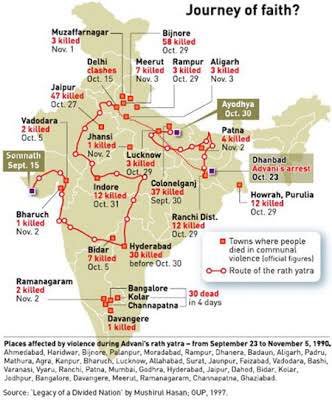
In fact, after the Mangalore outrage, BJP leaders did condemn it and declared emphatically that it was the handiwork of "anti-social elements" with whom their party had nothing whatsoever to do. This pretence could not hold water. The antecedents of Mr Muthalik and his associates showed how close their links were with the saffron party before personal differences drove them to organise a new outfit called Sri Ram Sene. In any case, whatever the names of various senas, all of them are members of the extended Sangh Parivar, presided over by the Rashtriya Swayamsewak Sangh (RSS). Bajrang Dal members, who were hyperactive on Valentine’s Day, have been the Hindtuva camp’s storm-troopers since before Mr Advani’s rath yatra and the demolition of the Babri Masjid. In the circumstances, those who say that parcels of pink knickers should have been sent not to Mr Muthalik but to Mr Advani, Rajnath Singh and the chief minister of Karnataka, B.S. Yeddyurappa, have a point.
It would, of course, be wrong to condemn the BJP governments alone though it is hair-raising that the "saviours" of Hinduism should have attacked a brother and sister duo in Ujjain, Madhya Pradesh, where the saffron party has been returned to power in the recent Assembly elections. In the wake of Mangalore incidents, the newly-appointed Congress chief minister of Rajasthan spoke of "pub culture" in a language indistinguishable from that of the Karnataka chief minister, who pontificated that it was wrong for people to take the law into their hands, but he wouldn’t allow the "pub culture" to grow. The Rajasthan chief minister backtracked only after top Congress leaders frowned on him. On Valentine’s Day, in Maharashtra, ruled by a Congress-led coalition, vandalism by the Hindutva goons was as widespread as in Madhya Pradesh.
And to Congress-ruled Haryana goes the dubious and shameful distinction that one of its assistant sub-inspectors of police, instead of protecting victims of violence, dragged a girl by her hair and treated her in a beastly manner. His suspension means nothing. He’ll be back in his job soon, if past practice is any guide. The Karnataka government’s action in the case of the teenaged girl who committed suicide because she was humiliated and brutalised by the Hindutva hoodlums is nothing short of monstrous. The state police arrested the Muslim boy she was accompanying in a bus but not her assailants. The district superintendent of police’s explanation was that if he had arrested the "real culprits", there would have been a communal riot!
Let there be no mistake that the looming peril is great and the stakes in defeating it are high. The message of the "custodians" of Hindu religion and culture amounts to a wail that Hinduism would be destroyed if some girls drink beer at a pub or if a boy and girl walk hand-in-hand or if a young man presents roses or chocolates to his wife or girlfriend on February 14. What is the remedy prescribed by these paranoid backwoodsmen? To "semitise" the Hindu religion, in the words of historian Romila Thapar, by imposing a strict and uniform code on every Hindu, just as the Wahabbis did in Saudi Arabia in the past and the Taliban are doing in Afghanistan and Pakistan now.
Not only does the Hindu religion have no book and no Pope, but it also doesn’t impose any compulsion on its followers. It is not at all compulsory to go to a temple or to pray. Hundreds of millions worship at temples regularly, and an equal number don’t. Moreover, the notion of a monolithic Hindu culture is ridiculous in such a vast and hugely diverse country. Different patterns prevail in different regions. To give only one example, in Tamil Nadu, for a Hindu to marry his sister’s daughter is not just permitted but is considered the right thing to do. In north India this would be reprehensible incest.
The Indian state and civil society must learn from what has happened in Pakistan. President Asif Ali Zardari has candidly admitted that the Taliban could "take over" the country. Earlier, in an article in Newsline titled "The Saudi-isation of Pakistan", the highly respected Pakistani academic Pervez Hoodbhoy had warned: "It is a matter of time before the fighting (in the wild areas…) shifts to Peshawar and Islamabad (which has already been a witness to the Lal Masjid episode) and engulfs Lahore and Karachi as well". He also explained why. Instead of resisting the religious extremism, "the (Pakistani) state used religion as an instrument of policy". A stage has now been reached where "every incumbent government (is) fearful of taking on powerful religious forces". Let this country not say later that it wasn’t forewarned.
February 18, 2009
RAM SENE NOT FRINGE, IT’S COLOURED SAFFRON
by Inder Malhotra
WHAT began at a Mangalore pub last month and manifested itself menacingly on Valentine’s Day in a number of states — from Karnataka to Haryana, from Madhya Pradesh to Maharashtra — cannot be dismissed as a mere aberration by a small lunatic fringe. It is a dangerous trend which, if unchecked immediately, could talibanise a religion that has been most tolerant for millennia and a country whose legitimate pride lies in its secular traditions and respect for people’s Fundamental Rights.
In the first place, the number of goons and thugs who go on a rampage at will is not as small as it is made out to be. Secondly, the perpetrators of unacceptable barbarity get away easily. Either they are not arrested or, if taken into custody, are let off on bail. No wonder more and more goons are joining their ranks in a milieu in which violence on any pretext is routine. Thirdly, and most gravely, the likes of Pramod Muthalik, who are self-appointed custodians of Hindu culture as well as morals and morality, have the tacit support of the votaries of Hindutva who dominate the principal Opposition party, the Bharatiya Janata Party (BJP). There can be no other explanation for the fact that L.K. Advani, the BJP’s prime ministerial candidate, hasn’t uttered a word of condemnation so far about Valentine’s Day incidents.
In fact, after the Mangalore outrage, BJP leaders did condemn it and declared emphatically that it was the handiwork of "anti-social elements" with whom their party had nothing whatsoever to do. This pretence could not hold water. The antecedents of Mr Muthalik and his associates showed how close their links were with the saffron party before personal differences drove them to organise a new outfit called Sri Ram Sene. In any case, whatever the names of various senas, all of them are members of the extended Sangh Parivar, presided over by the Rashtriya Swayamsewak Sangh (RSS). Bajrang Dal members, who were hyperactive on Valentine’s Day, have been the Hindtuva camp’s storm-troopers since before Mr Advani’s rath yatra and the demolition of the Babri Masjid. In the circumstances, those who say that parcels of pink knickers should have been sent not to Mr Muthalik but to Mr Advani, Rajnath Singh and the chief minister of Karnataka, B.S. Yeddyurappa, have a point.
It would, of course, be wrong to condemn the BJP governments alone though it is hair-raising that the "saviours" of Hinduism should have attacked a brother and sister duo in Ujjain, Madhya Pradesh, where the saffron party has been returned to power in the recent Assembly elections. In the wake of Mangalore incidents, the newly-appointed Congress chief minister of Rajasthan spoke of "pub culture" in a language indistinguishable from that of the Karnataka chief minister, who pontificated that it was wrong for people to take the law into their hands, but he wouldn’t allow the "pub culture" to grow. The Rajasthan chief minister backtracked only after top Congress leaders frowned on him. On Valentine’s Day, in Maharashtra, ruled by a Congress-led coalition, vandalism by the Hindutva goons was as widespread as in Madhya Pradesh.
And to Congress-ruled Haryana goes the dubious and shameful distinction that one of its assistant sub-inspectors of police, instead of protecting victims of violence, dragged a girl by her hair and treated her in a beastly manner. His suspension means nothing. He’ll be back in his job soon, if past practice is any guide. The Karnataka government’s action in the case of the teenaged girl who committed suicide because she was humiliated and brutalised by the Hindutva hoodlums is nothing short of monstrous. The state police arrested the Muslim boy she was accompanying in a bus but not her assailants. The district superintendent of police’s explanation was that if he had arrested the "real culprits", there would have been a communal riot!
Let there be no mistake that the looming peril is great and the stakes in defeating it are high. The message of the "custodians" of Hindu religion and culture amounts to a wail that Hinduism would be destroyed if some girls drink beer at a pub or if a boy and girl walk hand-in-hand or if a young man presents roses or chocolates to his wife or girlfriend on February 14. What is the remedy prescribed by these paranoid backwoodsmen? To "semitise" the Hindu religion, in the words of historian Romila Thapar, by imposing a strict and uniform code on every Hindu, just as the Wahabbis did in Saudi Arabia in the past and the Taliban are doing in Afghanistan and Pakistan now.
Not only does the Hindu religion have no book and no Pope, but it also doesn’t impose any compulsion on its followers. It is not at all compulsory to go to a temple or to pray. Hundreds of millions worship at temples regularly, and an equal number don’t. Moreover, the notion of a monolithic Hindu culture is ridiculous in such a vast and hugely diverse country. Different patterns prevail in different regions. To give only one example, in Tamil Nadu, for a Hindu to marry his sister’s daughter is not just permitted but is considered the right thing to do. In north India this would be reprehensible incest.
The Indian state and civil society must learn from what has happened in Pakistan. President Asif Ali Zardari has candidly admitted that the Taliban could "take over" the country. Earlier, in an article in Newsline titled "The Saudi-isation of Pakistan", the highly respected Pakistani academic Pervez Hoodbhoy had warned: "It is a matter of time before the fighting (in the wild areas…) shifts to Peshawar and Islamabad (which has already been a witness to the Lal Masjid episode) and engulfs Lahore and Karachi as well". He also explained why. Instead of resisting the religious extremism, "the (Pakistani) state used religion as an instrument of policy". A stage has now been reached where "every incumbent government (is) fearful of taking on powerful religious forces". Let this country not say later that it wasn’t forewarned.
June 06, 2008
End of Hindu Rashtra: Birth of the Secular Republic of Nepal
End of Hindu Rashtra: Birth of a new Nepal
Why Jaswant Singh feels Humiliated Over Developments in Nepal !
by Subhash Gatade
Jaswant Singh, the exforeign minister of India, who also handled the finance portfolio for quite sometime, rather could not hide his displeasure in the recently held meeting of the BJP executive.
Of course the immediate provocation for the ex-Army man was neither because of any fresh move by his bete noire in state politics namely Ms Vasundhara Raje Scindia. It also had nothing to do with the manner in which L.K.Advani had flatly denied any knowledge of his not so famous sojourn to Kandahar after the plane hijacking incident.
In fact he shared his piece of mind over recent developments in Nepal. He called it a 'negative development' and a 'danger to India's security' and said that 'as a believer in sanatan Dharma he feels humiliated and as a Hindu, he felt diminished over the ouster of a Hindu king.'
Any close watcher of the Nepal situation would tell you that Jaswant Singh is not alone in having and expressing a negative opinion about the developments in the newest republic which has seen the end of 250 year old monarchy and the end of the 'model Hindu Rashtra' much espoused by the Sangh Parivar organisations. In one of his recent outbursts, Mr Ashok Singhal, the International President of Vishwa Hindu Parishad is reported to have compared Jihadists and Maoists who would together bring further calamity to the tiny country.
It was expected that all such outbursts from the BJP and its allied organisations would be immediately rebuked by the Nepalese leaders. Rambahadur Thapa, a senior leader of NCP (Maoists) called all such utterances 'anti-Nepal' and an 'intervention in the internal affairs of the country' .
Perhaps one needs to ask oneself why does Mr Singh feels pertrubed over the end of a regime which concentrated all power in the hands of a small caucus centred around the King which denied basic human rights to a vast majority of Hindus and which condemned the followers of the other religions to a secondary status. Whether it has to do with emergence of NCP (Maoists) as the single largest party in the new republic which has humbled all the other parties or it has to do with the emergence of the most diverse and representative parliament in the world today. Independent observers have noted that the newly elected Nepalese parliament has more than one third of women and other one third representation is from the different ethnicities and oppressed castes.
Does Mr Singh then think that while he and his formation can benefit themselves from participating in the Democratic process, for the Nepalese people monarchy provides the best solution ?
Jaswant Singh's displeasure and outbursts of other hotheads from the Sangh Parivar once again brings into sharp focus the special relationship enjoyed by them with the ( now defunct) monarchy. To be very frank, it was a relationship which benefitted both the parties. While the Monarchy let the Sangh Parivar organisations spread their network in the Himalayan kingdom, which at times brought them in conflict with local religious heads who did not support their weltanshauung ( world view) on their part BJP and other Sangh Parivar organisations provided crucial support to the beleagured monarchy on very many occasions.
It is now history how VHP working president, Ashok Singhal had exhorted Hindus of the world to follow the great monarch in a conference of Hindu leaders form across the world which was held in Kathmandu. He said : “It is the duty of 900 million Hindus the world over to protect the Hindu samrat (king)..…God has created him to protect Hindu dharma.” In this conference these leaders had deified King Gyanendra as the world’s only Hindu monarch. Mr Singhal had also then proposed to organise a world Hindu meet in New York the coming year under the leadership of King Gyanendra (Indian Express, January 23, 2004). He added that the New York gathering would project Hindus as a global power..…with the Nepal king leading the way.
It did not matter to Mr Singhal then that with his utterances he was showing loyalty to the King of another country much derided by his one time leader and RSS ideologue Golwalkar.In his monograph 'Bunch of Thoughts' he had castigated Muslims, Christians and Communists as the country's main enemies for their "extraterritorial loyalty". It is worth noting that Secular formations and individuals in this part of the world also did not try to put him on the defensive over such a sensitive issue.
Apart from the mutual support they derived from each other the 'Hindu Rashtra' in Nepal under the rule of the king served a deeper ideological purpose for the Sangh Parivar. It acted as a 'model' for its own project of nation building.And the internal social-cultural situation suited its purpose well.
For the Sangh Parivar and its affiliated organisations it was the only state in the world where the `one nation, one people, one culture' weltanschauung of the Hindu rashtra was already in place. It had made religious conversion an offence and where the slaughter of the official national animal, the cow, could be punished by 18 years of rigorous imprisonment or where the state had imposed its own version of `sanatan dharma' on the vast multitude of the people.
The hard facts pertaining to Nepal then were for everyone to see. Being a Hindu rashtra, autocratic rules still persisted in the Himalayan kingdom. Its constitution made the Hindu way of life a basic part of Nepalese life. It stated: "Nepal is a multiethnic, multilingual, democratic, independent, indivisible, sovereign, Hindu and Constitutional Monarchical Kingdom". The richest people in this Hindu rashtra were the royalty, priestly class and the outsiders. The monarchy was so privileged that, according to the constitution "... No question shall be raised in any court about any act performed by His Majesty".
In order to preserve its Hindu character, conversion to any other religion was prohibited. Until 1963, the Nepali state upheld Hindu jurisprudence — formally at least. Fourthly, in view of this ban on conversions 90 per cent of the population was stated to be Hindu. Fifthly, being a Hindu rashtra, all royal claims were legal. The Hindu king could do no wrong. Also, though the constitution guaranted that there won't be any discrimination based on caste, the age-old stranglehold of this institution continued. Untouchables, who constitute 22 per cent of the Nepalese population, were the worst victims. For centuries, Nepal's untouchables have had to stay out of Hindu temples, refrain from drawing water at village wells and have even changed their children's names so that they could get an education. The status of Dalits and backward communities was the same as it was in India 100-125 years ago.
This Hindu rashtra had become the single biggest supplier of people to other countries. The system trained young workers and soldiers for other countries. Statistics of persons leaving this `Ram Rajya' on account of poverty and migrating in search of jobs was really mind-boggling.
Sudheendra Sharma, a social scientist who had written extensively on the religions of Nepal, rightly underlined that "...cultural isolationism from India meant that Nepal was also shielded from influence of the 19th century Hindu renaissance. Furthermore, within the territorial bounds of the nation-state, this policy meantaggressive Sanskritisation and cultural integration of hill ethnic communities based on an orthodox Hindu framework."
It is widely known that Nepal was ushered into a constitutional monarchy as a consequence of a people's movement against the partyless panchayat system in 1990, when a new constitution was adopted by the parliament.But very few people are aware that when the constitution of 1990 was written, there was pressure to make Nepal an officially secular state like India. It could be called the only key demand which was put forward by the Dalits, tribals, women and people from other faiths like Buddhism.
The pressure generated was so great that at one point of time the members of the constitution committee even had to concede to the demand that Nepal won't be declared a Hindu state. This demand created dissensions within the constitution committee as well. However, in the end, the views of the Hindu establishment won the day, and the constitution was decided in favour of making Nepal a Hindu country.
All that is passe now. And despite all the pious wishes and attempts of the BJP leaders and Sangh Parivar organisations, the model Hindu Rashtra has finally been given a decent burial and Nepal is now a secular democratic republic with Maoists at the helm of affairs. Perhaps the agony and pain experienced by the likes of Jaswant Singh and other Hindutva acolytes could be compared to the shock and disbelief experienced by people - who believed in justice and progress - over the dissolution of the Soviet Union.
Of course it need be underlined that Sangh Parivar and affiliated organisations made last ditch efforts to save the monarchy despite the overwhelming majority going against them. When Terai region in Nepal witnessed violent agitation recently the role played by Hindu extremist organisations had also come under scanner. Mr Bharat Bhushan had specifically commented on this aspect in one of the writeups in 'The Telegraph' :
Nepalese political observers also point to the role being played by Hindu extremist organizations from India in fomenting trouble in the Terai to save the king. A high-ranking Rashtriya Swayamsevak Sangh representative from Nagpur is believed to have held a meeting in Gorakhpur with several royalists, including Upendra Yadav and members of the Sadbhavna Party. The role played by the local Indian MP, Mahant Avaidhyanath, is also being questioned by some in this regard. (Royalists Fish In Terai Trouble, 29 th January 2008, The Telegraph)
But as things unfolded before us all their not so pious wishes and attempts could not stop the wheel of history in taking a forward turn in Nepal. In fact, despite all the displeasure shown by the likes of Mr Singh a New Nepal is before us. And now it is upto them to decide whether they would welcome this new face Nepal or stll maintain nostalgia over the bygone era.
Why Jaswant Singh feels Humiliated Over Developments in Nepal !
by Subhash Gatade
Jaswant Singh, the exforeign minister of India, who also handled the finance portfolio for quite sometime, rather could not hide his displeasure in the recently held meeting of the BJP executive.
Of course the immediate provocation for the ex-Army man was neither because of any fresh move by his bete noire in state politics namely Ms Vasundhara Raje Scindia. It also had nothing to do with the manner in which L.K.Advani had flatly denied any knowledge of his not so famous sojourn to Kandahar after the plane hijacking incident.
In fact he shared his piece of mind over recent developments in Nepal. He called it a 'negative development' and a 'danger to India's security' and said that 'as a believer in sanatan Dharma he feels humiliated and as a Hindu, he felt diminished over the ouster of a Hindu king.'
Any close watcher of the Nepal situation would tell you that Jaswant Singh is not alone in having and expressing a negative opinion about the developments in the newest republic which has seen the end of 250 year old monarchy and the end of the 'model Hindu Rashtra' much espoused by the Sangh Parivar organisations. In one of his recent outbursts, Mr Ashok Singhal, the International President of Vishwa Hindu Parishad is reported to have compared Jihadists and Maoists who would together bring further calamity to the tiny country.
It was expected that all such outbursts from the BJP and its allied organisations would be immediately rebuked by the Nepalese leaders. Rambahadur Thapa, a senior leader of NCP (Maoists) called all such utterances 'anti-Nepal' and an 'intervention in the internal affairs of the country' .
Perhaps one needs to ask oneself why does Mr Singh feels pertrubed over the end of a regime which concentrated all power in the hands of a small caucus centred around the King which denied basic human rights to a vast majority of Hindus and which condemned the followers of the other religions to a secondary status. Whether it has to do with emergence of NCP (Maoists) as the single largest party in the new republic which has humbled all the other parties or it has to do with the emergence of the most diverse and representative parliament in the world today. Independent observers have noted that the newly elected Nepalese parliament has more than one third of women and other one third representation is from the different ethnicities and oppressed castes.
Does Mr Singh then think that while he and his formation can benefit themselves from participating in the Democratic process, for the Nepalese people monarchy provides the best solution ?
Jaswant Singh's displeasure and outbursts of other hotheads from the Sangh Parivar once again brings into sharp focus the special relationship enjoyed by them with the ( now defunct) monarchy. To be very frank, it was a relationship which benefitted both the parties. While the Monarchy let the Sangh Parivar organisations spread their network in the Himalayan kingdom, which at times brought them in conflict with local religious heads who did not support their weltanshauung ( world view) on their part BJP and other Sangh Parivar organisations provided crucial support to the beleagured monarchy on very many occasions.
It is now history how VHP working president, Ashok Singhal had exhorted Hindus of the world to follow the great monarch in a conference of Hindu leaders form across the world which was held in Kathmandu. He said : “It is the duty of 900 million Hindus the world over to protect the Hindu samrat (king)..…God has created him to protect Hindu dharma.” In this conference these leaders had deified King Gyanendra as the world’s only Hindu monarch. Mr Singhal had also then proposed to organise a world Hindu meet in New York the coming year under the leadership of King Gyanendra (Indian Express, January 23, 2004). He added that the New York gathering would project Hindus as a global power..…with the Nepal king leading the way.
It did not matter to Mr Singhal then that with his utterances he was showing loyalty to the King of another country much derided by his one time leader and RSS ideologue Golwalkar.In his monograph 'Bunch of Thoughts' he had castigated Muslims, Christians and Communists as the country's main enemies for their "extraterritorial loyalty". It is worth noting that Secular formations and individuals in this part of the world also did not try to put him on the defensive over such a sensitive issue.
Apart from the mutual support they derived from each other the 'Hindu Rashtra' in Nepal under the rule of the king served a deeper ideological purpose for the Sangh Parivar. It acted as a 'model' for its own project of nation building.And the internal social-cultural situation suited its purpose well.
For the Sangh Parivar and its affiliated organisations it was the only state in the world where the `one nation, one people, one culture' weltanschauung of the Hindu rashtra was already in place. It had made religious conversion an offence and where the slaughter of the official national animal, the cow, could be punished by 18 years of rigorous imprisonment or where the state had imposed its own version of `sanatan dharma' on the vast multitude of the people.
The hard facts pertaining to Nepal then were for everyone to see. Being a Hindu rashtra, autocratic rules still persisted in the Himalayan kingdom. Its constitution made the Hindu way of life a basic part of Nepalese life. It stated: "Nepal is a multiethnic, multilingual, democratic, independent, indivisible, sovereign, Hindu and Constitutional Monarchical Kingdom". The richest people in this Hindu rashtra were the royalty, priestly class and the outsiders. The monarchy was so privileged that, according to the constitution "... No question shall be raised in any court about any act performed by His Majesty".
In order to preserve its Hindu character, conversion to any other religion was prohibited. Until 1963, the Nepali state upheld Hindu jurisprudence — formally at least. Fourthly, in view of this ban on conversions 90 per cent of the population was stated to be Hindu. Fifthly, being a Hindu rashtra, all royal claims were legal. The Hindu king could do no wrong. Also, though the constitution guaranted that there won't be any discrimination based on caste, the age-old stranglehold of this institution continued. Untouchables, who constitute 22 per cent of the Nepalese population, were the worst victims. For centuries, Nepal's untouchables have had to stay out of Hindu temples, refrain from drawing water at village wells and have even changed their children's names so that they could get an education. The status of Dalits and backward communities was the same as it was in India 100-125 years ago.
This Hindu rashtra had become the single biggest supplier of people to other countries. The system trained young workers and soldiers for other countries. Statistics of persons leaving this `Ram Rajya' on account of poverty and migrating in search of jobs was really mind-boggling.
Sudheendra Sharma, a social scientist who had written extensively on the religions of Nepal, rightly underlined that "...cultural isolationism from India meant that Nepal was also shielded from influence of the 19th century Hindu renaissance. Furthermore, within the territorial bounds of the nation-state, this policy meantaggressive Sanskritisation and cultural integration of hill ethnic communities based on an orthodox Hindu framework."
It is widely known that Nepal was ushered into a constitutional monarchy as a consequence of a people's movement against the partyless panchayat system in 1990, when a new constitution was adopted by the parliament.But very few people are aware that when the constitution of 1990 was written, there was pressure to make Nepal an officially secular state like India. It could be called the only key demand which was put forward by the Dalits, tribals, women and people from other faiths like Buddhism.
The pressure generated was so great that at one point of time the members of the constitution committee even had to concede to the demand that Nepal won't be declared a Hindu state. This demand created dissensions within the constitution committee as well. However, in the end, the views of the Hindu establishment won the day, and the constitution was decided in favour of making Nepal a Hindu country.
All that is passe now. And despite all the pious wishes and attempts of the BJP leaders and Sangh Parivar organisations, the model Hindu Rashtra has finally been given a decent burial and Nepal is now a secular democratic republic with Maoists at the helm of affairs. Perhaps the agony and pain experienced by the likes of Jaswant Singh and other Hindutva acolytes could be compared to the shock and disbelief experienced by people - who believed in justice and progress - over the dissolution of the Soviet Union.
Of course it need be underlined that Sangh Parivar and affiliated organisations made last ditch efforts to save the monarchy despite the overwhelming majority going against them. When Terai region in Nepal witnessed violent agitation recently the role played by Hindu extremist organisations had also come under scanner. Mr Bharat Bhushan had specifically commented on this aspect in one of the writeups in 'The Telegraph' :
Nepalese political observers also point to the role being played by Hindu extremist organizations from India in fomenting trouble in the Terai to save the king. A high-ranking Rashtriya Swayamsevak Sangh representative from Nagpur is believed to have held a meeting in Gorakhpur with several royalists, including Upendra Yadav and members of the Sadbhavna Party. The role played by the local Indian MP, Mahant Avaidhyanath, is also being questioned by some in this regard. (Royalists Fish In Terai Trouble, 29 th January 2008, The Telegraph)
But as things unfolded before us all their not so pious wishes and attempts could not stop the wheel of history in taking a forward turn in Nepal. In fact, despite all the displeasure shown by the likes of Mr Singh a New Nepal is before us. And now it is upto them to decide whether they would welcome this new face Nepal or stll maintain nostalgia over the bygone era.
May 09, 2008
Rashtriya Swayamsevak Sangh explained by Madhu Limaye
Communalism Combat
May 2008
What is the RSS?
A veteran socialist on an ‘age-old enemy’
by Madhu Limaye
I entered political life in 1937. I was quite young then but as I had passed my matriculation examination at a relatively early age, I also entered college quite early. Quite active in Pune in those days were the RSS and the Savarkarites (followers of Vinayak Damodar Savarkar) on the one hand and nationalist, socialist and leftist political organisations on the other. On May 1, 1937 we took out a march to observe May Day. The marchers were attacked by the RSS and Savarkarites when, among others, the well-known revolutionary Senapati Bapat and our socialist leader, SM Joshi, were injured. We have had serious differences with these Hindutva organisations ever since.
Our first difference with the RSS was over the issue of nationalism. We believed that every citizen had equal rights in the Indian nation. But the RSS and the Savarkarites came up with their notion of Hindu Rashtra. Mohammad Ali Jinnah too was a victim of a similar world view. He believed that India was made up of two nations, the Muslim nation and the Hindu nation. Savarkar too said the same thing.
The other major difference between us was that we dreamt of the birth of a democratic republic while the RSS claimed that democracy was a western concept that was not appropriate for India. In those days members of the RSS were full of praise for Adolf Hitler. Guruji (Madhav Sadashiv Golwalkar) was not only the sarsanghchalak (head) of the RSS; he was its ideological guru as well.
There is amazing similarity between the thoughts of Guruji and the Nazis. One of Guruji’s books, We or Our Nationhood Defined, ran into several editions, its fourth edition having been published in 1947. At one point in the book, Guruji says, "The non-Hindu people in Hindustan must adopt the Hindu culture and language, must learn to respect and hold in reverence Hindu religion, must entertain no ideas but those of the glorification of the Hindu race and culture i.e. they must not only give up their attitude of intolerance and ungratefulness towards this land and its age-old traditions but must also cultivate the positive attitude of love and devotion instead – in a word, they must cease to be foreigners, or may stay in the country wholly subordinated to the Hindu nation, claiming nothing, deserving no privileges, far less any preferential treatment – not even citizen’s rights."
In other words, Guruji wanted to see millions of Indians treated as non-citizens. He wanted all their citizenship rights taken away. Incidentally, these ideas of his were not newly formulated. From the time we were in college (in the mid-1930s), members of the RSS were inclined to follow Hitlerian ideals. In their view, Muslims and Christians in India deserved to be treated the same way that Hitler treated Jews in Germany.
The extent of Guruji’s sympathies for the views of the Nazi Party is evident from the following passage from We or Our Nationhood Defined: "To keep up the purity of the race and its culture, Germany shocked the world by
her purging the country of the Semitic races – the Jews. Race pride at its highest has been manifested here. Germany has also shown how well-nigh impossible it is for races and cultures having differences going to the root, to be assimilated into one united whole, a good lesson for us in Hindustan to learn and profit by" (We or Our Nationhood Defined, 1947, p. 42).
You might say that this is an old book, of a time when India was in the throes of the struggle for independence. But then there is his second book, Bunch of Thoughts. I cite below an example from this "popular publication" which was brought out in November 1966. In this book, while discussing India’s internal security problem, Guruji identifies three internal dangers. One is Muslims, the second Christians and the third Communists. In Guruji’s view, every Indian Muslim, every Christian and every Communist is a danger to the nation’s security. Such is his ideology.
Our second major difference with Guruji and the RSS has to do with the caste question. They are supporters of the caste system while a socialist like me is its greatest enemy. I consider myself to be the biggest enemy of brahminism and the caste system. I am of the firm view that there can be no economic and social equality in India until the caste system and the inequalities based on it are demolished.
But Guruji says, "Another unique feature of our society was the varna vyavastha (caste system, the former occupation-based classification of society) which is today vilified as jati pratha (a rigid caste system)." He adds, "Society was conceived of in the image of an all-powerful god, of four aspects, who was to be worshipped by different people in their own ways as determined by their different capabilities. The Brahmin was considered great because he was the purveyor of knowledge. The Kshatriya was considered equally great because he destroyed the enemies. The Vaishya was no less important than others because through agriculture and commerce he fulfilled a social need. The Sudra too was important for he served society through his workmanship." Here it is very shrewdly being asserted that through his workmanship the Sudra is fulfilling an important social need. But Chanakya’s Arthashastra, from which Guruji takes his inspiration, clearly states that it is the religious duty of the Sudras to serve the Brahmins, the Kshatriyas and the Vaishyas. In a clever subterfuge, Guruji replaces service of the upper castes with "service of society".
The fourth issue on which we differ is that of language. We are in favour of promoting the languages of the people. All regional languages, after all, are indigenous. But what does Guruji have to say on this? Guruji says that for now Hindi should be made the common language for all while the ultimate objective should be to make Sanskrit the national language. He says in his Bunch of Thoughts, "For convenience, Hindi should be given primacy as our link language until such time as Sanskrit is adopted as our national language." Thus Hindi is merely for convenience, the ultimate link language is to be Sanskrit.
We have had differences over this right from the start. Like Mahatma Gandhi and Lokmanya Tilak, we too have always been in favour of the regional languages. We do not wish to impose Hindi on anyone. We would like to see Tamil as the prevalent language in Tamil Nadu, Telugu in Andhra Pradesh, Marathi in Maharashtra and Bengali in West Bengal. If the non-Hindi speaking states wish to adopt English, it should be up to them. We have no differences with them on this. But Sanskrit is the language of a handful of people, the language of a particular caste. Making Sanskrit the national language means the supremacy of a handful of people over others, something we definitely do not want.
Fifth, the national movement for independence had accepted the idea of a federal state. In a confederation, the centre would definitely have certain powers on specific matters but all others would be a subject matter for the states. But following partition, in a bid to strengthen the centre, the Constitution stipulated a concurrent list. As per this list, several subjects were made concurrent, subjects over which both the centre and the states have equal jurisdiction. What was originally meant to be under the domain of different states was included in the concurrent list only to strengthen the centre. Thus the federal state came into existence.
But the RSS and its chief ideologue, Guru Golwalkar, have been consistently opposed to this basic constitutional provision. These people ridicule the very concept of ‘a union of states’ and maintain that this Constitution, which envisages a confederation of states, should be abolished. Guruji says in his Bunch of Thoughts, "The Constitution must be reviewed and the idea of a unitary state should be written into the new Constitution." Guruji wants a unitary or, in other words, a centralised state. He says that this system of states should be done away with. What he wants is one nation, one state, one legislature and one executive. In other words, he wants to abolish state legislatures and state ministries. That means they wish to see the rule of the stick. If they were to capture power, they would doubtless bring into existence a centralised state.
Another issue was the tricolour, the flag chosen by the national movement. Hundreds of Indians sacrificed their lives, thousands bore the brunt of lathis for the honour and glory of our chosen national flag. But surprisingly, the RSS has never accepted the tricolour as the national flag. It always swore by the saffron flag, asserting that the saffron flag has been the flag of Hindu Rashtra since time immemorial.
Just as Guruji rejected the concept of a federal state, similarly, he had no faith in a democratic system. He was of the firm view that democracy is a concept imported from the West and the system of parliamentary democracy did not jell with Indian thought and Indian civilisation. As for socialism, that for him was a totally alien idea. He repeatedly said that all isms, including socialism and democracy, were alien ideas which should be rejected, that Indian society should be founded on Indian culture. Speaking for ourselves, we believe in parliamentary democracy, in socialism, and we aspire to establish socialism consistent with Gandhian principles in India through peaceful means.
While we were engaged in a struggle against the Congress party’s autocratic rule, our leader, Dr Ram Manohar Lohia, was of the opinion that we should join hands with all opposition forces to save the nation and dislodge from power the Congress party which was responsible for our humiliation at the hands of the Chinese. I had lengthy discussions with Doctorsaheb on the issue. This debate went on for two years. I kept insisting throughout that we cannot have any alliance with the RSS and the Jan Sangh. Ultimately, Doctorsaheb asked me, "Do you accept my leadership or not?" I replied, "Yes, I do." He said it wasn’t necessary for us to agree on every issue or for him to have to convince me on every issue. Let there be an issue or two on which we disagreed. And since he was only thinking of a political alliance to defeat a major enemy, I should cooperate with him, let his idea be given a "trial". Perhaps he would be proven right, he said, perhaps I would. I remained convinced however that a clash between the RSS and the Lohiaite ideologies was inevitable.
It is a fact that we formed an alliance with these people (RSS and Jan Sangh) when Mrs Indira Gandhi imposed the emergency, increasingly resorted to dictatorial methods, started promoting Sanjay Gandhi and the Maruti scandal surfaced. Lok Nayak Jaiprakashji believed that if the opposition did not unite under the banner of a single party it would be impossible to defeat Mrs Gandhi and dictatorship. Choudhary Charan Singh was also of the view that we should come together and form a united party. While we were in jail, we were all asked to give our opinions on the need to form such a party and contest elections. I recall sending a message that in my view we must contest elections. Millions of people would participate in elections. Elections are a dynamic process. As the electoral tempo builds up, the shackles of emergency are bound to snap and people are bound to exercise their democratic right. Therefore, I stressed, we must participate in elections.
Since Lok Nayak Jaiprakash Narain and other leaders were of the view that without coming together under the banner of one party we could not succeed, we (socialists) too gave it our consent. But I would like to stress that the understanding that was arrived at was between political parties – the Jan Sangh, the Socialist Party, the Congress (O), the Bharatiya Loktantrik Dal (BLD) and some dissident Congress factions. We did not come to any arrangement with the RSS, nor did we accept any of its demands. What is more, through a letter by Manubhai Patel that was circulated among all of us in jail we learnt that on July 7, 1976 Choudhary Charan Singh had raised the issue of a possible clash of interests because of dual membership when members of the RSS also became members of the new party. In response, the then acting general secretary of the Jan Sangh, Om Prakash Tyagi had said that the proposed party should feel free to formulate whatever membership criteria it wanted. He even said that since the RSS, having faced many constraints, had been dissolved anyway, the question of RSS membership did not arise.
Later, when the constitution of the proposed Janata Party was being drawn up, the subcommittee appointed to draft the constitution proposed that members of any organisation whose aims, policies and programmes were in conflict with the aims, policies and programmes of the Janata Party should not be given membership to the new party. Given the self-evident meaning of such a membership criterion, there was no question of anyone opposing it. However, it is significant that the sole opposition to this came from Sunder Singh Bhandari (Jan Sangh). At a meeting convened in December 1976 to thrash out issues, reference was made to a letter written by Atal Bihari Vajpayee on behalf of the Jan Sangh and the RSS, stating that a section of leaders of the proposed party had agreed that the RSS issue could not be raised in connection with membership of the Janata Party. But several leaders told me that no such assurances were given because the RSS was nowhere in the picture at the time when the idea of a merger of opposition political parties was mooted. I want to clarify that I was in prison at the time and even if there was some secret understanding, I had no part in it.
I can categorically assert that the election manifesto of the Janata Party did not in any way reflect the concerns of the RSS. In fact, each point in the manifesto was clearly spelt out. Is it not a fact that the manifesto of the Janata Party spoke of a socialist society based on secular, democratic and Gandhian principles and in which there was no mention of Hindu Rashtra? The manifesto also assured the minorities equal citizenship rights and vowed to safeguard their rights. In contrast, Guruji wanted to deny equal citizenship rights to the minorities and wanted them to be subservient subjects in a Hindu Rashtra. The Janata Party was committed to decentralisation while Guruji was a hardcore proponent of centralisation. He wanted to abolish separate states, abolish state legislatures and ministries while the Janata Party emphasised the need for greater decentralisation. In other words, the Janata Party had no desire to snatch away the autonomy of states. The manifesto spoke of socialism, social justice and equality. Did the manifesto state that it upholds the caste system? Did it maintain that the Sudras’ duty was to devote their life in the service of others? On the contrary, the manifesto not only promised that the backward castes would have full opportunity to progress, it pledged special policies for them: 25-33 per cent reservation for them in government jobs.
Yes, it is true that members of the RSS did not genuinely accept the provisions of the party’s election manifesto. It was my contention and I had once even complained in writing to Kushabhau Thakre that during discussions you people (RSS, Jan Sangh) very readily agree on matters that you at heart totally disagree with. That is why your motives are suspect. I wrote this letter to him a long time ago and I have always had doubts about the RSS. I have had these doubts since Doctorsaheb’s time (Dr Ram Manohar Lohia died in 1967). But despite this, the fact remains that to fight dictatorship we entered into a political alliance with them.
Since it was Lok Nayak Jaiprakashji’s desire that all parties should merge for a united opposition to dictatorship and since the party manifesto did not make any compromises, I consented to our coming together. At the same time, I would like to say that from the beginning I was very clear in my mind that to emerge as a unified and a credible body the Janata Party would have to do two things. One, the RSS would have to change its ideology and accept the ideal of a secular democratic state. Two, the various organisations that are part of the sangh parivar, such as the Bharatiya Mazdoor Sangh and the Vidyarthi Parishad, would have to dissolve themselves and merge with the secular-minded trade union and student wings of the Janata Party. I was very clear about this from the beginning and as the Janata Party had given me the responsibility to manage the affairs of its trade union and student wings, it was my consistent attempt throughout to ensure that the Vidyarthi Parishad and the Bharatiya Mazdoor Sangh ended their separate existence.
But these people started insisting on their autonomy. In fact, these organisations always function on the dictates of Nagpur (RSS headquarters), they believe in the one leader principle. Take, for example, Guruji himself. Guruji maintained that they create a mind-set which is totally disciplined and where people accept whatever they tell them. This organisation operates on a single principle: one leader. They do not believe in democracy, they have no faith in discussions and debate. They have no economic policy. For example, in his Bunch of Thoughts, Guruji expressed unhappiness over the abolition of the zamindari system in India. Guruji was deeply saddened, deeply disturbed by the abolition of the zamindari system. But he felt no compassion for the poor.
I told members of the RSS that you must abandon your ideal of organising Hindus alone and find a place for people of all religions within your organisation, that you must merge your different class-based organisations with those of the Janata Party. They responded by saying that this could not be done so soon, that there were very many difficulties involved but they did want to change, bit by bit. They continued to give such evasive replies.
From their behaviour I concluded that they had no intention of changing. Especially after the assembly elections of June 1977, when they managed to gain power in four states and one union territory, after which they began to think that with this newly acquired clout they had no need to change. Now that they had already captured four states, they would gradually also gain control of other states and finally even the centre. The leaders of other political parties in the Janata Party were older leaders who would not live long; and they would ensure that no younger (non-RSS, non-Jan Sangh) leader emerged at the top.
As is evident from the pages of the Organiser and Panchjanya (RSS mouthpieces in English and Hindi), they have not spared a single Janata Party leader who is not from their parivar. I, of course, was their special favourite, the target of special attention. They probably devoted more column space to abusing me than they did even for Mrs Indira Gandhi.
For a protracted period I persisted in dialogue with these people. I recall an occasion when Balasaheb Deoras (later RSS sarsanghchalak) visited me at my residence in Mumbai. Subsequently, I met him once again after the 1971 polls. I also had discussions with Madhavrao Mule once before the emergency. On the fourth occasion, I met Balasaheb Deoras and Madhavrao Mule together in May 1977. So no one can claim that I made no attempt to talk to them. But I finally reached the conclusion that they have closed minds in which no new idea can germinate.
On the contrary, the RSS specialises in casting young minds in a particular mould from a very young age. The first thing they do is ‘freeze’ the minds of children and of youth, making them impervious. After this they are rendered incapable of responding to other ideas.
Still, I tried. On one occasion I convened a meeting of all trade union leaders. The representatives of all constituents of the Janata Party attended but the Bharatiya Mazdoor Sangh boycotted the meeting. Not just that, they hurled abuses at me for no apparent reason. Similar efforts were made with the Vidyarthi Parishad and the Yuva Morcha but despite all attempts at a merger, they held aloof. This is only because of the RSS’ desire to function as a "super party".
Their aim is not only to enter into every aspect of people’s life but also to control it. In an article written for The Indian Express around that time, George Fernandes used the example of Dattopant Thengdi to make the same point. Thengdi responded by saying that the RSS intended to have all of society under its sway, it would leave no aspect of a person’s life untouched, it would establish its hegemony in every department of life. Thengdi, of course, was saying nothing new. Similar views have been repeatedly asserted by Guruji in his We or Our Nationhood Defined, as also in Bunch of Thoughts. No totalitarian organisation allows any space for freedom, its tentacles reach everywhere: art, music, economy, culture. This is the essence of any fascist organisation.
The fact is that the RSS wanted to capture the Janata Party and through it to take control of the state apparatus. For this they simultaneously dangled the carrot of the prime minister’s chair before several Janata Party leaders. On the one hand, they went on assuring Morarji Desai to the end that he was their choice for prime minister. Every now and then they would promise Choudhary Charan Singh that they would support his claim to be prime minister. Concurrently, they kept giving similar assurances to Chandra Shekhar, Jagjivan Ram and George Fernandes. Not once did they dare to make me a similar offer. When I once jokingly mentioned this to Vajpayee, he quipped, "Why you, Nanaji (Deshmukh) has never made me such a promise either. They want neither you nor me as prime minister." Anyway, they never made any such suggestion to me, knowing only too well that I would not deny others their due nor would I allow others to deny mine. Perhaps they think, you can’t fool this man so what’s the point of promising him anything – it will only make him (Limaye) even more cautious.
What these people (the RSS) do on the odd occasion is however of little importance. Has the RSS ever said that they have abandoned Guruji’s way of thinking? Only Atalji says that we should all accept the principles of composite nationalism, democracy, socialism, social justice, etc because we cannot move forward without them in today’s world. But Atalji is the only one who says this. I do not trust the other sanghis. These people pleaded for pardon while in prison, Balasaheb Deoras congratulated Indira Gandhi when the Supreme Court ruled in her favour in the Raj Narain case. So I have no faith in the utterances of these people. I am of the firm belief that I could only have trusted these people (erstwhile Jan Sangh leaders in the Janata Party) if they had ousted RSS leaders from the party, expelled them from the working committee, placed restrictions on RSS activities and, in particular, expelled people like Nanaji Deshmukh, Sunder Singh Bhandari and company from the party.
(Translated by Javed Anand.)
(May 1 marks the 31st anniversary of the united Janata Party and also the 86th birth anniversary of senior socialist leader, the late Madhu Limaye. The above piece, penned by Limaye soon after the split in the Janata Party, was published by the Hindi weekly, Ravivar, in 1979. Though dated, many of the issues he raises in the article are relevant even today.)
May 2008
What is the RSS?
A veteran socialist on an ‘age-old enemy’
by Madhu Limaye
I entered political life in 1937. I was quite young then but as I had passed my matriculation examination at a relatively early age, I also entered college quite early. Quite active in Pune in those days were the RSS and the Savarkarites (followers of Vinayak Damodar Savarkar) on the one hand and nationalist, socialist and leftist political organisations on the other. On May 1, 1937 we took out a march to observe May Day. The marchers were attacked by the RSS and Savarkarites when, among others, the well-known revolutionary Senapati Bapat and our socialist leader, SM Joshi, were injured. We have had serious differences with these Hindutva organisations ever since.
Our first difference with the RSS was over the issue of nationalism. We believed that every citizen had equal rights in the Indian nation. But the RSS and the Savarkarites came up with their notion of Hindu Rashtra. Mohammad Ali Jinnah too was a victim of a similar world view. He believed that India was made up of two nations, the Muslim nation and the Hindu nation. Savarkar too said the same thing.
The other major difference between us was that we dreamt of the birth of a democratic republic while the RSS claimed that democracy was a western concept that was not appropriate for India. In those days members of the RSS were full of praise for Adolf Hitler. Guruji (Madhav Sadashiv Golwalkar) was not only the sarsanghchalak (head) of the RSS; he was its ideological guru as well.
There is amazing similarity between the thoughts of Guruji and the Nazis. One of Guruji’s books, We or Our Nationhood Defined, ran into several editions, its fourth edition having been published in 1947. At one point in the book, Guruji says, "The non-Hindu people in Hindustan must adopt the Hindu culture and language, must learn to respect and hold in reverence Hindu religion, must entertain no ideas but those of the glorification of the Hindu race and culture i.e. they must not only give up their attitude of intolerance and ungratefulness towards this land and its age-old traditions but must also cultivate the positive attitude of love and devotion instead – in a word, they must cease to be foreigners, or may stay in the country wholly subordinated to the Hindu nation, claiming nothing, deserving no privileges, far less any preferential treatment – not even citizen’s rights."
In other words, Guruji wanted to see millions of Indians treated as non-citizens. He wanted all their citizenship rights taken away. Incidentally, these ideas of his were not newly formulated. From the time we were in college (in the mid-1930s), members of the RSS were inclined to follow Hitlerian ideals. In their view, Muslims and Christians in India deserved to be treated the same way that Hitler treated Jews in Germany.
The extent of Guruji’s sympathies for the views of the Nazi Party is evident from the following passage from We or Our Nationhood Defined: "To keep up the purity of the race and its culture, Germany shocked the world by
her purging the country of the Semitic races – the Jews. Race pride at its highest has been manifested here. Germany has also shown how well-nigh impossible it is for races and cultures having differences going to the root, to be assimilated into one united whole, a good lesson for us in Hindustan to learn and profit by" (We or Our Nationhood Defined, 1947, p. 42).
You might say that this is an old book, of a time when India was in the throes of the struggle for independence. But then there is his second book, Bunch of Thoughts. I cite below an example from this "popular publication" which was brought out in November 1966. In this book, while discussing India’s internal security problem, Guruji identifies three internal dangers. One is Muslims, the second Christians and the third Communists. In Guruji’s view, every Indian Muslim, every Christian and every Communist is a danger to the nation’s security. Such is his ideology.
Our second major difference with Guruji and the RSS has to do with the caste question. They are supporters of the caste system while a socialist like me is its greatest enemy. I consider myself to be the biggest enemy of brahminism and the caste system. I am of the firm view that there can be no economic and social equality in India until the caste system and the inequalities based on it are demolished.
But Guruji says, "Another unique feature of our society was the varna vyavastha (caste system, the former occupation-based classification of society) which is today vilified as jati pratha (a rigid caste system)." He adds, "Society was conceived of in the image of an all-powerful god, of four aspects, who was to be worshipped by different people in their own ways as determined by their different capabilities. The Brahmin was considered great because he was the purveyor of knowledge. The Kshatriya was considered equally great because he destroyed the enemies. The Vaishya was no less important than others because through agriculture and commerce he fulfilled a social need. The Sudra too was important for he served society through his workmanship." Here it is very shrewdly being asserted that through his workmanship the Sudra is fulfilling an important social need. But Chanakya’s Arthashastra, from which Guruji takes his inspiration, clearly states that it is the religious duty of the Sudras to serve the Brahmins, the Kshatriyas and the Vaishyas. In a clever subterfuge, Guruji replaces service of the upper castes with "service of society".
The fourth issue on which we differ is that of language. We are in favour of promoting the languages of the people. All regional languages, after all, are indigenous. But what does Guruji have to say on this? Guruji says that for now Hindi should be made the common language for all while the ultimate objective should be to make Sanskrit the national language. He says in his Bunch of Thoughts, "For convenience, Hindi should be given primacy as our link language until such time as Sanskrit is adopted as our national language." Thus Hindi is merely for convenience, the ultimate link language is to be Sanskrit.
We have had differences over this right from the start. Like Mahatma Gandhi and Lokmanya Tilak, we too have always been in favour of the regional languages. We do not wish to impose Hindi on anyone. We would like to see Tamil as the prevalent language in Tamil Nadu, Telugu in Andhra Pradesh, Marathi in Maharashtra and Bengali in West Bengal. If the non-Hindi speaking states wish to adopt English, it should be up to them. We have no differences with them on this. But Sanskrit is the language of a handful of people, the language of a particular caste. Making Sanskrit the national language means the supremacy of a handful of people over others, something we definitely do not want.
Fifth, the national movement for independence had accepted the idea of a federal state. In a confederation, the centre would definitely have certain powers on specific matters but all others would be a subject matter for the states. But following partition, in a bid to strengthen the centre, the Constitution stipulated a concurrent list. As per this list, several subjects were made concurrent, subjects over which both the centre and the states have equal jurisdiction. What was originally meant to be under the domain of different states was included in the concurrent list only to strengthen the centre. Thus the federal state came into existence.
But the RSS and its chief ideologue, Guru Golwalkar, have been consistently opposed to this basic constitutional provision. These people ridicule the very concept of ‘a union of states’ and maintain that this Constitution, which envisages a confederation of states, should be abolished. Guruji says in his Bunch of Thoughts, "The Constitution must be reviewed and the idea of a unitary state should be written into the new Constitution." Guruji wants a unitary or, in other words, a centralised state. He says that this system of states should be done away with. What he wants is one nation, one state, one legislature and one executive. In other words, he wants to abolish state legislatures and state ministries. That means they wish to see the rule of the stick. If they were to capture power, they would doubtless bring into existence a centralised state.
Another issue was the tricolour, the flag chosen by the national movement. Hundreds of Indians sacrificed their lives, thousands bore the brunt of lathis for the honour and glory of our chosen national flag. But surprisingly, the RSS has never accepted the tricolour as the national flag. It always swore by the saffron flag, asserting that the saffron flag has been the flag of Hindu Rashtra since time immemorial.
Just as Guruji rejected the concept of a federal state, similarly, he had no faith in a democratic system. He was of the firm view that democracy is a concept imported from the West and the system of parliamentary democracy did not jell with Indian thought and Indian civilisation. As for socialism, that for him was a totally alien idea. He repeatedly said that all isms, including socialism and democracy, were alien ideas which should be rejected, that Indian society should be founded on Indian culture. Speaking for ourselves, we believe in parliamentary democracy, in socialism, and we aspire to establish socialism consistent with Gandhian principles in India through peaceful means.
While we were engaged in a struggle against the Congress party’s autocratic rule, our leader, Dr Ram Manohar Lohia, was of the opinion that we should join hands with all opposition forces to save the nation and dislodge from power the Congress party which was responsible for our humiliation at the hands of the Chinese. I had lengthy discussions with Doctorsaheb on the issue. This debate went on for two years. I kept insisting throughout that we cannot have any alliance with the RSS and the Jan Sangh. Ultimately, Doctorsaheb asked me, "Do you accept my leadership or not?" I replied, "Yes, I do." He said it wasn’t necessary for us to agree on every issue or for him to have to convince me on every issue. Let there be an issue or two on which we disagreed. And since he was only thinking of a political alliance to defeat a major enemy, I should cooperate with him, let his idea be given a "trial". Perhaps he would be proven right, he said, perhaps I would. I remained convinced however that a clash between the RSS and the Lohiaite ideologies was inevitable.
It is a fact that we formed an alliance with these people (RSS and Jan Sangh) when Mrs Indira Gandhi imposed the emergency, increasingly resorted to dictatorial methods, started promoting Sanjay Gandhi and the Maruti scandal surfaced. Lok Nayak Jaiprakashji believed that if the opposition did not unite under the banner of a single party it would be impossible to defeat Mrs Gandhi and dictatorship. Choudhary Charan Singh was also of the view that we should come together and form a united party. While we were in jail, we were all asked to give our opinions on the need to form such a party and contest elections. I recall sending a message that in my view we must contest elections. Millions of people would participate in elections. Elections are a dynamic process. As the electoral tempo builds up, the shackles of emergency are bound to snap and people are bound to exercise their democratic right. Therefore, I stressed, we must participate in elections.
Since Lok Nayak Jaiprakash Narain and other leaders were of the view that without coming together under the banner of one party we could not succeed, we (socialists) too gave it our consent. But I would like to stress that the understanding that was arrived at was between political parties – the Jan Sangh, the Socialist Party, the Congress (O), the Bharatiya Loktantrik Dal (BLD) and some dissident Congress factions. We did not come to any arrangement with the RSS, nor did we accept any of its demands. What is more, through a letter by Manubhai Patel that was circulated among all of us in jail we learnt that on July 7, 1976 Choudhary Charan Singh had raised the issue of a possible clash of interests because of dual membership when members of the RSS also became members of the new party. In response, the then acting general secretary of the Jan Sangh, Om Prakash Tyagi had said that the proposed party should feel free to formulate whatever membership criteria it wanted. He even said that since the RSS, having faced many constraints, had been dissolved anyway, the question of RSS membership did not arise.
Later, when the constitution of the proposed Janata Party was being drawn up, the subcommittee appointed to draft the constitution proposed that members of any organisation whose aims, policies and programmes were in conflict with the aims, policies and programmes of the Janata Party should not be given membership to the new party. Given the self-evident meaning of such a membership criterion, there was no question of anyone opposing it. However, it is significant that the sole opposition to this came from Sunder Singh Bhandari (Jan Sangh). At a meeting convened in December 1976 to thrash out issues, reference was made to a letter written by Atal Bihari Vajpayee on behalf of the Jan Sangh and the RSS, stating that a section of leaders of the proposed party had agreed that the RSS issue could not be raised in connection with membership of the Janata Party. But several leaders told me that no such assurances were given because the RSS was nowhere in the picture at the time when the idea of a merger of opposition political parties was mooted. I want to clarify that I was in prison at the time and even if there was some secret understanding, I had no part in it.
I can categorically assert that the election manifesto of the Janata Party did not in any way reflect the concerns of the RSS. In fact, each point in the manifesto was clearly spelt out. Is it not a fact that the manifesto of the Janata Party spoke of a socialist society based on secular, democratic and Gandhian principles and in which there was no mention of Hindu Rashtra? The manifesto also assured the minorities equal citizenship rights and vowed to safeguard their rights. In contrast, Guruji wanted to deny equal citizenship rights to the minorities and wanted them to be subservient subjects in a Hindu Rashtra. The Janata Party was committed to decentralisation while Guruji was a hardcore proponent of centralisation. He wanted to abolish separate states, abolish state legislatures and ministries while the Janata Party emphasised the need for greater decentralisation. In other words, the Janata Party had no desire to snatch away the autonomy of states. The manifesto spoke of socialism, social justice and equality. Did the manifesto state that it upholds the caste system? Did it maintain that the Sudras’ duty was to devote their life in the service of others? On the contrary, the manifesto not only promised that the backward castes would have full opportunity to progress, it pledged special policies for them: 25-33 per cent reservation for them in government jobs.
Yes, it is true that members of the RSS did not genuinely accept the provisions of the party’s election manifesto. It was my contention and I had once even complained in writing to Kushabhau Thakre that during discussions you people (RSS, Jan Sangh) very readily agree on matters that you at heart totally disagree with. That is why your motives are suspect. I wrote this letter to him a long time ago and I have always had doubts about the RSS. I have had these doubts since Doctorsaheb’s time (Dr Ram Manohar Lohia died in 1967). But despite this, the fact remains that to fight dictatorship we entered into a political alliance with them.
Since it was Lok Nayak Jaiprakashji’s desire that all parties should merge for a united opposition to dictatorship and since the party manifesto did not make any compromises, I consented to our coming together. At the same time, I would like to say that from the beginning I was very clear in my mind that to emerge as a unified and a credible body the Janata Party would have to do two things. One, the RSS would have to change its ideology and accept the ideal of a secular democratic state. Two, the various organisations that are part of the sangh parivar, such as the Bharatiya Mazdoor Sangh and the Vidyarthi Parishad, would have to dissolve themselves and merge with the secular-minded trade union and student wings of the Janata Party. I was very clear about this from the beginning and as the Janata Party had given me the responsibility to manage the affairs of its trade union and student wings, it was my consistent attempt throughout to ensure that the Vidyarthi Parishad and the Bharatiya Mazdoor Sangh ended their separate existence.
But these people started insisting on their autonomy. In fact, these organisations always function on the dictates of Nagpur (RSS headquarters), they believe in the one leader principle. Take, for example, Guruji himself. Guruji maintained that they create a mind-set which is totally disciplined and where people accept whatever they tell them. This organisation operates on a single principle: one leader. They do not believe in democracy, they have no faith in discussions and debate. They have no economic policy. For example, in his Bunch of Thoughts, Guruji expressed unhappiness over the abolition of the zamindari system in India. Guruji was deeply saddened, deeply disturbed by the abolition of the zamindari system. But he felt no compassion for the poor.
I told members of the RSS that you must abandon your ideal of organising Hindus alone and find a place for people of all religions within your organisation, that you must merge your different class-based organisations with those of the Janata Party. They responded by saying that this could not be done so soon, that there were very many difficulties involved but they did want to change, bit by bit. They continued to give such evasive replies.
From their behaviour I concluded that they had no intention of changing. Especially after the assembly elections of June 1977, when they managed to gain power in four states and one union territory, after which they began to think that with this newly acquired clout they had no need to change. Now that they had already captured four states, they would gradually also gain control of other states and finally even the centre. The leaders of other political parties in the Janata Party were older leaders who would not live long; and they would ensure that no younger (non-RSS, non-Jan Sangh) leader emerged at the top.
As is evident from the pages of the Organiser and Panchjanya (RSS mouthpieces in English and Hindi), they have not spared a single Janata Party leader who is not from their parivar. I, of course, was their special favourite, the target of special attention. They probably devoted more column space to abusing me than they did even for Mrs Indira Gandhi.
For a protracted period I persisted in dialogue with these people. I recall an occasion when Balasaheb Deoras (later RSS sarsanghchalak) visited me at my residence in Mumbai. Subsequently, I met him once again after the 1971 polls. I also had discussions with Madhavrao Mule once before the emergency. On the fourth occasion, I met Balasaheb Deoras and Madhavrao Mule together in May 1977. So no one can claim that I made no attempt to talk to them. But I finally reached the conclusion that they have closed minds in which no new idea can germinate.
On the contrary, the RSS specialises in casting young minds in a particular mould from a very young age. The first thing they do is ‘freeze’ the minds of children and of youth, making them impervious. After this they are rendered incapable of responding to other ideas.
Still, I tried. On one occasion I convened a meeting of all trade union leaders. The representatives of all constituents of the Janata Party attended but the Bharatiya Mazdoor Sangh boycotted the meeting. Not just that, they hurled abuses at me for no apparent reason. Similar efforts were made with the Vidyarthi Parishad and the Yuva Morcha but despite all attempts at a merger, they held aloof. This is only because of the RSS’ desire to function as a "super party".
Their aim is not only to enter into every aspect of people’s life but also to control it. In an article written for The Indian Express around that time, George Fernandes used the example of Dattopant Thengdi to make the same point. Thengdi responded by saying that the RSS intended to have all of society under its sway, it would leave no aspect of a person’s life untouched, it would establish its hegemony in every department of life. Thengdi, of course, was saying nothing new. Similar views have been repeatedly asserted by Guruji in his We or Our Nationhood Defined, as also in Bunch of Thoughts. No totalitarian organisation allows any space for freedom, its tentacles reach everywhere: art, music, economy, culture. This is the essence of any fascist organisation.
The fact is that the RSS wanted to capture the Janata Party and through it to take control of the state apparatus. For this they simultaneously dangled the carrot of the prime minister’s chair before several Janata Party leaders. On the one hand, they went on assuring Morarji Desai to the end that he was their choice for prime minister. Every now and then they would promise Choudhary Charan Singh that they would support his claim to be prime minister. Concurrently, they kept giving similar assurances to Chandra Shekhar, Jagjivan Ram and George Fernandes. Not once did they dare to make me a similar offer. When I once jokingly mentioned this to Vajpayee, he quipped, "Why you, Nanaji (Deshmukh) has never made me such a promise either. They want neither you nor me as prime minister." Anyway, they never made any such suggestion to me, knowing only too well that I would not deny others their due nor would I allow others to deny mine. Perhaps they think, you can’t fool this man so what’s the point of promising him anything – it will only make him (Limaye) even more cautious.
What these people (the RSS) do on the odd occasion is however of little importance. Has the RSS ever said that they have abandoned Guruji’s way of thinking? Only Atalji says that we should all accept the principles of composite nationalism, democracy, socialism, social justice, etc because we cannot move forward without them in today’s world. But Atalji is the only one who says this. I do not trust the other sanghis. These people pleaded for pardon while in prison, Balasaheb Deoras congratulated Indira Gandhi when the Supreme Court ruled in her favour in the Raj Narain case. So I have no faith in the utterances of these people. I am of the firm belief that I could only have trusted these people (erstwhile Jan Sangh leaders in the Janata Party) if they had ousted RSS leaders from the party, expelled them from the working committee, placed restrictions on RSS activities and, in particular, expelled people like Nanaji Deshmukh, Sunder Singh Bhandari and company from the party.
(Translated by Javed Anand.)
(May 1 marks the 31st anniversary of the united Janata Party and also the 86th birth anniversary of senior socialist leader, the late Madhu Limaye. The above piece, penned by Limaye soon after the split in the Janata Party, was published by the Hindi weekly, Ravivar, in 1979. Though dated, many of the issues he raises in the article are relevant even today.)
January 27, 2008
'Software shakhas' draw IT pros to RSS
The Times of India
28 Jan 2008
'Software shakhas' draw IT pros to RSS
Gautam Siddharth,TNN
The Rashtriya Swayamsevak Sangh is adding colour to India’s booming IT sector: saffron.
Efforts to induct young, upwardly mobile IT professionals into its fold have gained momentum in "cybercities" across the country: from Pune to Hyderabad, and from Chennai to Noida.
RSS is drawing young professionals in substantial numbers in these cities to events called "IT Milans" with the ultimate aim of using the networking skills of the young to spread its message.
These "software shakhas" contain everything — from power-point presentations on RSS's community work to yoga. In fact, video conferences will soon be added to this list.
IT professionals gather once a week in these cities and their numbers are rising.
"The first software shakha was held in Bangalore in 2003-04. It's a new experiment to connect with emerging sections of professionals," says Ram Madhav, former RSS spokesman.
"At the Pune IT Milan, more than 1,000 turned up, which isn't a bad number."
"The number of youths joining IT companies is increasing. We've introduced IT Milan to groom professionals towards RSS’s way of thinking," says Pune-based Katcheshwar Sahane, western Maharashtra prant sanghachalak of RSS.
28 Jan 2008
'Software shakhas' draw IT pros to RSS
Gautam Siddharth,TNN
The Rashtriya Swayamsevak Sangh is adding colour to India’s booming IT sector: saffron.
Efforts to induct young, upwardly mobile IT professionals into its fold have gained momentum in "cybercities" across the country: from Pune to Hyderabad, and from Chennai to Noida.
RSS is drawing young professionals in substantial numbers in these cities to events called "IT Milans" with the ultimate aim of using the networking skills of the young to spread its message.
These "software shakhas" contain everything — from power-point presentations on RSS's community work to yoga. In fact, video conferences will soon be added to this list.
IT professionals gather once a week in these cities and their numbers are rising.
"The first software shakha was held in Bangalore in 2003-04. It's a new experiment to connect with emerging sections of professionals," says Ram Madhav, former RSS spokesman.
"At the Pune IT Milan, more than 1,000 turned up, which isn't a bad number."
"The number of youths joining IT companies is increasing. We've introduced IT Milan to groom professionals towards RSS’s way of thinking," says Pune-based Katcheshwar Sahane, western Maharashtra prant sanghachalak of RSS.
June 08, 2007
Sangh Spreads its cloak in American Campus
Combat Law
8 June, 2007
SANGH SPREADS ITS CLOAK IN AMERICAN CAMPUS
by Girish Agrawal
That the sangh parivar, the ‘family’ of organisations spawned and controlled by the Rashtriya Swayamsevak Sangh (RSS), has an extensive overseas presence is no secret. That the overseas arms of the sangh, just like the parent body RSS, have Hindutva as their guiding ideology, take direction from the RSS, and could not care less about the social, constitutional or political integrity of India, has also never been in doubt. But the depths to which the sangh will sink to spread its ideology of hate and recruit foot-soldiers has only now been exposed by the Campaign to Stop Funding Hate (CSFH) in its recently released report called Lying Religiously: The Hindu Students Council and the Politics of Deception. (The report is available at: http://hsctruthout.stopfundinghate.org/).
This report reveals that the sangh has spread its web of hatred in universities across North America to ensnare young Indian-Americans through the Hindu Students Council (HSC), an organisation based in North America, which “publicly claims to provide a space to learn about Hindu heritage and culture and draws it membership primarily from the Indian-American student community.”
The CSFH, of which the writer is a member, is a voluntary organisation based in the US. The organisation tracks the activities of the sangh parivar in the US and in the wake of the anti-Muslim pogroms in Gujarat, was instrumental in researching and releasing a report documenting the fund-raising activities of the sangh in the U.S. (see The Foreign Exchange of Hate: IDRF and the American Funding of Hindutva, available at http://stopfundinghate.org/sacw/index.html). Having watched with growing worry as the sangh spread its message of hate among young people in North America, CSFH decided to publish some of its research into the sangh’s activities among youth in the hope that exposing these activities to the light of day will stop, or at least slow the spread of the Hindutva poision.
The Hindu Students Council (HSC) was formed in 1990 by a group of sangh parivar activists. They claimed that the organisation was being formed to assist Hindu students who struggle with the “loss and isolation” due to their “upbringing in a dual culture Hindu and Judeo-Christian?” The HSC targeted the so-called second and third generations, that is, the children and grandchildren of Indians who had migrated to the US in waves starting in the 1960s.
Even though the HSC wrapped itself in a cloak of ‘culture,’ the goal was not simply indoctrination of young people in Hindutva ideology, but also to plant the seed of a new generation of sangh leadership.
As Vijay Prashad notes in a recent article in ZMag (“Multicultu-ralism Kills Me”), “the HSC was never simply about the identity struggles of those whom it called Hindu Americans. It was also the youthful fingers of the long-arm of Hindutva-supremacy in India.”
The report by CSFH, hereafter shortened to Lying Religiously, points out that even though HSC was started as a project by the VHP of America, and had no independent legal existence until just after the Gujarat violence of 2002, when it registered as a non-profit, tax-exempt organisation in the U.S., separate from the VHP of America, perhaps in an attempt to put some legal distance between itself and other sangh parivar entities responsible for the brutal, terrorist violence unleashed against Muslims in Gujarat.
Ordinary HSC members are largely unaware of the ideological and organisational links with the VHP and the larger sangh parivar. The authors of Lying Religiously further make the point that this lack of awareness is not accidental, the sangh has followed a deliberate strategy of hiding intimate connections between HSC and various parts of the sangh parivar. This practice of deception, of hiding its true hate-filled nature behind a mask of “heritage and culture,” is of course not unique to the HSC, but is how the sangh parivar always operates when it does not hold the reins of power.
Ordinary HSC members are largely unaware of the ideological and organisational links with the VHP and the larger sangh parivar
Lying Religiously challenges the claims by HSC of being a non-partisan, non-political, cultural and spiritual/religious organisation. It “documents the history, organisation, and political links of HSC and demonstrates that it is part of the sangh parivar. These findings sharply contradict the public face HSC presents in the US as a spiritual and religious body. The information presented in this report locates and documents the origins and institutional links of HSC, and throws light on the concealed purposes behind the creation of such an organisation. This report shows that HSC has deep-rooted connections—institutional, personal, and political—with the sangh parivar.”
HSC was molded through the sangh’s vision to woo American youth to Hindutva, and as such, the vision for the organisation is created not by students who join a chapter of this seemingly liberal organisation on their campus today, but was established almost 15 years ago by the VHP. In 1993, months after the destruction of the 500-year-old historic Babri Masjid by its goons, the sangh organised a sort of victory celebration worldwide, part of which was the World Vision 2000 conference held in Washinton, DC. Ashok Singhal, the leader of the VHP in India, attended the conference, and singled out HSC for attention:
“Now, the first project we have in mind is strengthening the Hindu Students Council … . This is the generation which is going to throw up the [sangh] leadership of the future. We therefore feel that they should be the focus of our attention.”
Lying Religiously points out that although HSC has an extensive web presence, nowhere does it clearly identify its roots and connections, or its agenda. “No connection or affiliation with the RSS, the VHP, the Bajrang Dal, the BJP or any other part of the sangh parivar is acknowledged. And all HSC chapters are careful not to openly articulate a sectarian agenda.”
The report details the history of the HSC as a project of the sangh parivar, started and controlled by the VHP of America, and how, at the beginning, it not just acknowledged its links with the sangh, but declared them proudly. But as it grew and matured, HSC made a “deliberate effort to disguise, often disown, this connection” with the sangh. The strategy appears to be aimed at attracting a wider membership to HSC who would not join if they knew that “HSC was an offshoot of an extremist organisation with a record of directing violence against minority groups in India.”
In the wake of the release of ‘Lying Religiously’, the Hindu Students Council claimed in a press release that it is not hiding anything, on the contrary, it is “open about its activities,” and does such things as “hosting speakers, performing community service, holding poojas, celebrating festivals, and participating in interfaith discussions.” The last claim, of interfaith amity, articulated by the national HSC on its website as “Sarve Api Sukhina Santu Sarve Santu Niramayah” (Let everybody be happy, healthy, and blessed), is particularly cruel given the sangh’s anti-Muslim politics. As noted in Lying Religiously, “[t]he rhetoric of HSC’s self-presentation flows easily into the North American framework of ‘liberal multiculturism’ where each cultural group (mostly ‘ethnic’ minorities and religious groups) has, in principle, its own separate, unique space to perform its identity.” As Vijay Prashad notes in his ZMag article [referenced above], “Multiculturalism in the US provided cover for the cruel, cultural chauvinism in India.”
The report presents a lot of specific information in making its argument that the strength of the denial by HSC of its connections with the sangh gets suppressed “at moments of crisis, planning and celebration in the sangh family. … At … politically significant moments, HSC is present along with other members of the sangh family.”
In addition to all the evidence about the façade of independence and liberalism presented by HSC being underlain by deep connections to the sangh parivar, a final bit of evidence presented in ‘Lying Religiously’, about the electronic connection between HSC and the sangh parivar, is extremely interesting.
“HSC, as the most technologically savvy segment of the sangh, is in charge of the electronic infrastructure of almost the entire sangh parivar. Not only are core and flagship institutions of the sangh – the RSS itself, the VHP in India, the VHP of America, Seva Bharati in India and the IDRF in the US – all located on [a] network based in San Diego and run by HSC, but even small and minor Sangh institutions such as collegegrading.com (an ABVP front), balagokulam.org (an HSS outfit), and indiafriends.org (an HSS front) reside on the same cluster.” (emphasis added.)
The network referred to in the above quote from Lying Religiously is the Global Hindu Electronic Network, or GHEN, maintained and run by HSC. A copyright notice for GHEN says: “Please note that entire collection of GHEN websites is copyrighted 1998-1999, Global Hindu Electronic Networks, Hindu Students Council.” A map of the Class C IP addresses of the various websites shows that they all reside on the same server or cluster of servers based in San Diego in the U.S., controlled and run by one of the founders of HSC. No more evidence is required to demonstrate the true strength of the ‘family’ connection between the Hindu Students Council and the sangh parivar in India and elsewhere.
The writer is a US-based human rights activist
8 June, 2007
SANGH SPREADS ITS CLOAK IN AMERICAN CAMPUS
by Girish Agrawal
That the sangh parivar, the ‘family’ of organisations spawned and controlled by the Rashtriya Swayamsevak Sangh (RSS), has an extensive overseas presence is no secret. That the overseas arms of the sangh, just like the parent body RSS, have Hindutva as their guiding ideology, take direction from the RSS, and could not care less about the social, constitutional or political integrity of India, has also never been in doubt. But the depths to which the sangh will sink to spread its ideology of hate and recruit foot-soldiers has only now been exposed by the Campaign to Stop Funding Hate (CSFH) in its recently released report called Lying Religiously: The Hindu Students Council and the Politics of Deception. (The report is available at: http://hsctruthout.stopfundinghate.org/).
This report reveals that the sangh has spread its web of hatred in universities across North America to ensnare young Indian-Americans through the Hindu Students Council (HSC), an organisation based in North America, which “publicly claims to provide a space to learn about Hindu heritage and culture and draws it membership primarily from the Indian-American student community.”
The CSFH, of which the writer is a member, is a voluntary organisation based in the US. The organisation tracks the activities of the sangh parivar in the US and in the wake of the anti-Muslim pogroms in Gujarat, was instrumental in researching and releasing a report documenting the fund-raising activities of the sangh in the U.S. (see The Foreign Exchange of Hate: IDRF and the American Funding of Hindutva, available at http://stopfundinghate.org/sacw/index.html). Having watched with growing worry as the sangh spread its message of hate among young people in North America, CSFH decided to publish some of its research into the sangh’s activities among youth in the hope that exposing these activities to the light of day will stop, or at least slow the spread of the Hindutva poision.
The Hindu Students Council (HSC) was formed in 1990 by a group of sangh parivar activists. They claimed that the organisation was being formed to assist Hindu students who struggle with the “loss and isolation” due to their “upbringing in a dual culture Hindu and Judeo-Christian?” The HSC targeted the so-called second and third generations, that is, the children and grandchildren of Indians who had migrated to the US in waves starting in the 1960s.
Even though the HSC wrapped itself in a cloak of ‘culture,’ the goal was not simply indoctrination of young people in Hindutva ideology, but also to plant the seed of a new generation of sangh leadership.
As Vijay Prashad notes in a recent article in ZMag (“Multicultu-ralism Kills Me”), “the HSC was never simply about the identity struggles of those whom it called Hindu Americans. It was also the youthful fingers of the long-arm of Hindutva-supremacy in India.”
The report by CSFH, hereafter shortened to Lying Religiously, points out that even though HSC was started as a project by the VHP of America, and had no independent legal existence until just after the Gujarat violence of 2002, when it registered as a non-profit, tax-exempt organisation in the U.S., separate from the VHP of America, perhaps in an attempt to put some legal distance between itself and other sangh parivar entities responsible for the brutal, terrorist violence unleashed against Muslims in Gujarat.
Ordinary HSC members are largely unaware of the ideological and organisational links with the VHP and the larger sangh parivar. The authors of Lying Religiously further make the point that this lack of awareness is not accidental, the sangh has followed a deliberate strategy of hiding intimate connections between HSC and various parts of the sangh parivar. This practice of deception, of hiding its true hate-filled nature behind a mask of “heritage and culture,” is of course not unique to the HSC, but is how the sangh parivar always operates when it does not hold the reins of power.
Ordinary HSC members are largely unaware of the ideological and organisational links with the VHP and the larger sangh parivar
Lying Religiously challenges the claims by HSC of being a non-partisan, non-political, cultural and spiritual/religious organisation. It “documents the history, organisation, and political links of HSC and demonstrates that it is part of the sangh parivar. These findings sharply contradict the public face HSC presents in the US as a spiritual and religious body. The information presented in this report locates and documents the origins and institutional links of HSC, and throws light on the concealed purposes behind the creation of such an organisation. This report shows that HSC has deep-rooted connections—institutional, personal, and political—with the sangh parivar.”
HSC was molded through the sangh’s vision to woo American youth to Hindutva, and as such, the vision for the organisation is created not by students who join a chapter of this seemingly liberal organisation on their campus today, but was established almost 15 years ago by the VHP. In 1993, months after the destruction of the 500-year-old historic Babri Masjid by its goons, the sangh organised a sort of victory celebration worldwide, part of which was the World Vision 2000 conference held in Washinton, DC. Ashok Singhal, the leader of the VHP in India, attended the conference, and singled out HSC for attention:
“Now, the first project we have in mind is strengthening the Hindu Students Council … . This is the generation which is going to throw up the [sangh] leadership of the future. We therefore feel that they should be the focus of our attention.”
Lying Religiously points out that although HSC has an extensive web presence, nowhere does it clearly identify its roots and connections, or its agenda. “No connection or affiliation with the RSS, the VHP, the Bajrang Dal, the BJP or any other part of the sangh parivar is acknowledged. And all HSC chapters are careful not to openly articulate a sectarian agenda.”
The report details the history of the HSC as a project of the sangh parivar, started and controlled by the VHP of America, and how, at the beginning, it not just acknowledged its links with the sangh, but declared them proudly. But as it grew and matured, HSC made a “deliberate effort to disguise, often disown, this connection” with the sangh. The strategy appears to be aimed at attracting a wider membership to HSC who would not join if they knew that “HSC was an offshoot of an extremist organisation with a record of directing violence against minority groups in India.”
In the wake of the release of ‘Lying Religiously’, the Hindu Students Council claimed in a press release that it is not hiding anything, on the contrary, it is “open about its activities,” and does such things as “hosting speakers, performing community service, holding poojas, celebrating festivals, and participating in interfaith discussions.” The last claim, of interfaith amity, articulated by the national HSC on its website as “Sarve Api Sukhina Santu Sarve Santu Niramayah” (Let everybody be happy, healthy, and blessed), is particularly cruel given the sangh’s anti-Muslim politics. As noted in Lying Religiously, “[t]he rhetoric of HSC’s self-presentation flows easily into the North American framework of ‘liberal multiculturism’ where each cultural group (mostly ‘ethnic’ minorities and religious groups) has, in principle, its own separate, unique space to perform its identity.” As Vijay Prashad notes in his ZMag article [referenced above], “Multiculturalism in the US provided cover for the cruel, cultural chauvinism in India.”
The report presents a lot of specific information in making its argument that the strength of the denial by HSC of its connections with the sangh gets suppressed “at moments of crisis, planning and celebration in the sangh family. … At … politically significant moments, HSC is present along with other members of the sangh family.”
In addition to all the evidence about the façade of independence and liberalism presented by HSC being underlain by deep connections to the sangh parivar, a final bit of evidence presented in ‘Lying Religiously’, about the electronic connection between HSC and the sangh parivar, is extremely interesting.
“HSC, as the most technologically savvy segment of the sangh, is in charge of the electronic infrastructure of almost the entire sangh parivar. Not only are core and flagship institutions of the sangh – the RSS itself, the VHP in India, the VHP of America, Seva Bharati in India and the IDRF in the US – all located on [a] network based in San Diego and run by HSC, but even small and minor Sangh institutions such as collegegrading.com (an ABVP front), balagokulam.org (an HSS outfit), and indiafriends.org (an HSS front) reside on the same cluster.” (emphasis added.)
The network referred to in the above quote from Lying Religiously is the Global Hindu Electronic Network, or GHEN, maintained and run by HSC. A copyright notice for GHEN says: “Please note that entire collection of GHEN websites is copyrighted 1998-1999, Global Hindu Electronic Networks, Hindu Students Council.” A map of the Class C IP addresses of the various websites shows that they all reside on the same server or cluster of servers based in San Diego in the U.S., controlled and run by one of the founders of HSC. No more evidence is required to demonstrate the true strength of the ‘family’ connection between the Hindu Students Council and the sangh parivar in India and elsewhere.
The writer is a US-based human rights activist
May 26, 2007
Resist Saffronisation of MS University in Baroda
SAVE THE AUTONOMY OF M.S.UNIVERSITY,BARODA
AND RESIST ALL OUT SAFFRONISATION
The vandalism in the fine arts by the saffron brigade with the help of the police and complicity with the V.C. and the University authority has been nakedly exposed. This act by the saffron brigade is the culmination of the saffronisation of the MSU which had crept the University under the BJP rule in the state for more than one decade and the process accelerated after the Gujarat Carnage 2002.There are more than -nine Universities in the state besides the professional Universities.
How ever the teachers as well as the students of MSU are resisting the saffronisation facing all odds. The saffron brigade is out to destroy the power of resistance of the students and teachers and trample the autonomy of the MSU and there by pave the path for the absolute control of the university by the saffron brigade.
It is needless to mention that the autonomy of the universities is trampled systematically following the policy of National Policy of Education and the directives of GAT and WTO. Be it the Congress Government or the left Government led by CPM or any other regional parties, all the ruling parties are taking away the autonomy of the Universities. The previous NDA and the BJP Government are no exception in this respect All the ruling parties have put their person of choice as the VC along with the syndicate and senate members. The appointments are made on the criteria of their loyalty to their parties who can toe their line and policy. The ruling Congress Govt. in the country has nakedly practiced this undemocratic exercise since independence, which created a bad precedent in the country and later followed by other ruling parties. The Syllabus is framed to shun the rational and scientific outlook. In a nutshell the democratization of the education has been thrown to the abyss. The BJP when came to power is too toeing the same line more aggressively. The Sangha Parivar in it's bid to pursue the Hindutva ideology, . is going for all out saffronisation destroying the very fabric of democratic, secular and scientific education, where ever they are incontrol of Govt.
THE VANDALISM IN FINE ARTS PLANNED OUT LONG BACK
The development of the shameful incident in Fine Arts of MSU was too fast to comprehend. The way the faculty of fine arts invaded by the saffron brigade led by Niraj Jain with police and Chandramohan was ,beaten,arrested and send to the jail for five days followed by the suspension of Prof. Shivji Panniker, all these could not have happened without a meticulously planned strategy, which could have been built up long back. The opportune time of examination was chosen to rouse the sentiments to hook the Fine Arts, which is ire to the MSU authority because it did not comply with the VC Dr. Manoj Soni. Prior to the episode of Fine Arts a security guard at the instance of the warden of M.A. hall beat a student from fine arts faculty. This action was strongly protested by the entire faculty of the fine arts including the teaching staff. The tussle between the fine arts faculty particularly Prof Panikkar (who all along behind the students) and the MSU authority was fuming. So the attitude of the MSU authority was to teach them a lesson.
SAFFRONISATION IS BUILT SYSTEMATICALY FOR LAST TEN YERS
The worried UGC asked an explanation about the vandalism from the MSU authority. The VC has sent a seven-page reply justifying the vandalism by Niraj Jain. The VC had also shown the scant respect to the worried Chancellor of the University Ms. Mrinalini Devi Power.
Now it is clear that Niraj Jain acted on behalf of the VC. No FIR was launched against him. Rather Niraj Jain could boastingly declare in the VC office in presence of the delegation of the Fine Arts led by Prof. Panikkar" dare to file FIR against me".
Not surprisingly the VC Dr. Manoj Soni got the pat of the Education Minister of the state Ms. Anandini Patel after the episode in Fine Arts.
The autonomy of the MSU is in danger The VC Dr. Manoj Soni is out to saffronise it. The Saffron brigade wants to generate a controversy on the question of art so that the issue of autonomy is side tracked and side by side the religious passion of the people roused to reap benefit from the ensuing assembly election in the state. So, all the effort must be concentrated to save the total unity of the students and teachers and citizens to on save the autonomy of the MSU. The Saffron brigade and the ABVP are out to confuse and divide the students. NSUI too is not lagging behind.
Freedom of Arts - literature is very vital for a healthy society. There may be divergent views on this sensitive issue. Accredited artist of high caliber, high taste and culture can understand the finer aesthetics of arts. What is beauty or what is pornography cannot be understood by either by police, judiciary or bureaucracy. The way the exhibition displayed by the students meant for the academic evaluation of the annual examination ransacked by the saffron brigade with the help of the police armed with the magistrate order, under the nose of the VC and the administrative authority is untninkable. Right thinking persons were appalled by this fascist like act and came out in openly to protest and expressed solidarity with MSU Fine Arts is a unique event.
This arrogant step of M.S.U. Authority in connivance with BJP-RSS has not occurred all of a sudden, it has been developing since about last ten years.
Let us look up the matter and genesis of how BJP-RSS is trying to control M.S.U
ABOUT M.S.U.
Maharaja Sayaji Rao University of Baroda is the only English medium University of Gujarat, which attracts students and teachers across length and breadth of the country. Maharaja Sayaji Rao, the erstwhile ruler of Baroda, had started Baroda College in 1890’s. Because of his endeavor, Aurobindo Ghosh, the known revolutionary of his age, had become the Vice-Principal of the Baroda College. In pre-independence India, Baroda became the important center of learning after Bombay in the educational map of western India. After independence, with the University Act of 1949, this Baroda College became the full-fledged University. One of its founder Syndicate member, the great philosopher, S. Radhakrishnan, drafted an act of the university on the basis of academic freedom and autonomy from state control. This is the only university in Gujarat, where the Governor is not the Chancellor but from the royal family of Gaekwad. At present, M.S.U. have about 35 thousand students across 13 faculties, with about 1500 teaching staff. Many of its faculties are known worldwide
.
2002 GUJARAT CARNAGE AND M.S.U.
The 2002 Gujarat Carnage left a deep scar on the wall of the university. Penetration of RSS influence among teachers and staff in education institutes was much before the BJP came to power in 1995. In 2002 carnage also, many senate and syndicate members of university were justifying the attacks on minorities. A senior professor and known social activist, Prof. J.S. Bandukwalla’s house was attacked and burnt. He had to flee out of country. Many teachers felt that university should come out in support of the professor and condemn the attack. The conspiracy of silence crept MSU authority.
TOTAL CONTROL OF MSU BY BJP/RSS
After 2002 carnage, MSU was totally under control by BJP/RSS. University Syndicate is the highest decision body, which formulates rules and regulation in university was totally controlled by Sangh Parivar in 2003.It was first time in the history of MSU where there was no voice of dissent in MSU syndicate meeting. Many non-academics, persons of low caliber were made senate members by Gujarat government. Virtually 2003-04 was death knell for MSU as various anti- students, anti-education measures were taken by MSU authority
One has to step into the shoes of the ideological line of the ruling BJP Government and RSS to reach the ladder of higher position. After 2002 carnage most of the VCs appointed in various Universities of Gujarat due to their allegiance to the ruling party. The present VC Dr. Soni became the VC because he praised Narendra Modi and eulogized the Carnage. The University magazine of the Arts Faculty was not allowed to publish a resolution condemning the Carnage2002.and there was no official condemnation on the attack of Dr. Bandukwalla during the carnage.
ABSENCE OF DEMOCRATIC ENVIORNMENT
The free atmosphere of debate and discussions are vandalized since long by the saffron brigade. ABVP activist destroyed the placards against the US invasion over Iraq of the All India D.S.O. In September 2002, RSS syndicate members and ABVP activist stalled a seminar organized by Dept. of History along with UGC where Mr. Asghar Ali Engineer was the main speaker. In 2003, All India Democratic Students Organization was denied permission for organizing a cultural festival in Arts faculty hall where even outside Organisation including religious organizations holds programme. After successful hostel and Common University Act movement All India DSO was denied to hold any debates, discussion in faculties. These both movements saw a rise of democratic mass movement in MSU. Similar incidents can be cited in numbers.
HOSTEL MOVEMENT 2004:A BLOW TO SAFFRON FORCE
In June 2004, when students were leaving after completion of exams, M.S.U. Syndicate decided to close down two boys’ hostels viz. Lal Bahadur Shashtri (L.B.S.) Hall and Manubhai Mehta (M.M.) Hall and also introduced some major changes in the hostel administration like centralization of power in hands of Chief Warden etc. M.S.U. being residential university has 12 boys' hostel and 4 girls' hostel, which are very less, compared to the strength of the students. These hostels can accommodate only 3500 students.
All India D.S.O. launched movement against the closer of two hostels and various agitation programmes were taken. A Hostel Students’ Struggle Committee was formed. Ultimately, University Authority had to bow down as students’ Gheraoed Vice-Chancellor for about 8 hours on 15th August 2004. This was for the first time that BJP-RSS Syndicate bowed down before democratic movement.
MSU UNDER PRESENT VICE-CHANCELLOR MANOJ SONI
Dr. Manoj Soni, the present Vice-Chancellor of M.S.U. was a student of Political Science from M.S.U. Before becoming Vice-Chancellor, he was a reader in Political Science Department at Sardar Patel University, Anand. On 17th April 2005 Dr. Manoj Soni took over the charge of V.C. What surprised many was his inexperience of managing such prestigious University. Ironically, he has even applied for the post of reader in Political Science Department in M.S.U. His proximity with Narendra Modi was one of the factors for becoming V.C. Many believe he was the brain behind the drafting of Common University Act. He is the youngest V.C. of M.S.U., which BJP-RSS lobby tried to compare with Shyamaprasad Mukherjee and Aurobindo Ghosh. But those who oppose Common University Act viewed him as a man specially brought by Modi Government to create a ground for Common University Act.
VICE-CHANCELLOR’S TRUE COLOUR
On taking over as Vice-Chancellor on 17th April 2005, Manoj Soni created an image as University Student has come back home. He created a popular halo around him. He would go alone in any Department or Hostel mess, dining with students. In June 2005, Baroda witnessed worst kind of floods. V.C. would move around in University in Bicycle created an image of Popular V.C. But he could not keep up his image for long. The Arts faculty century old dome was renovated. University authority invited the C.M. Mr. Narendar Modi and education minister Ms. Anandiben Patel for the inaugurational ceremony. On 17th July 2005, this rededication ceremony was disrupted by flood-affected peoples led by congress, as news of CM coming for programme flashed in the local media. But both CM and Education minister did not come. Next day VC Monaj Soni sat on hunger strike with battery of BJP/RSS leaders, paving the way for political interference in University affairs. What came, as shock to many in MSU was the way some agitating students were lathi-charged before VC and instead of intervening he said, “ they were shouting for justice, and justice is given to them.”
The Common University Act(CUA) could not be implemented due to successful teachers- students united movement but the VC Dr. Soni is alwayas trying to apply the spirit of UCA directly and indirectly, like victimizing the students,punish the members of the teaching faculties,interfering in the day to day academic affairs of the academics functioning of the faculties and there by trample the academic freedom and autonomy and run the University under the thumb of the administration directed by the Govt. from Gandhinagar.This very aspect is totally reflected in his cladenstine involve ment in the worst kind of episode in the Fine Arts.
THE ANTI-STUDENT MEASURES
Students’ community had played important role in various movements to safeguard University autonomy and conducted movement against anti-education polices of university authority and state government. To gag this rising students voice, MSU authority banned students’ election in 2005-06. Students Action com mittee was formed and movement was launched against this step. which was held after one year in 2006 with very little scope of democratic space in the elction. .
During this same year anti-student posture of VC was witnessed during the agitation of MA Hindi admission problem. Some girls’ students lied down outside VC office in during the agitation. VC Monaj Soni instead of hearing their plea simply walked over the agitating girls students. This movement was victorious but the arrogance of VC shocked everyone in Baroda.
VICTIMASATION OF NON-BJP/RSS TEACHERS
A BJP cell of the teachers was formed to contest the Senate and syndicate body. As said earlier the University teachers are lured to be promoted to the level of VC in other Universities and Dean of faculties, rectors of the hostels if they toe the line of the saffron brigade.
The hostels wardens were selected on their pro RSS leanings. The sakhas are allowed to run inside the campus.
Same goes with the recently appointed of teachers. In 2006 the selection committee appointed by VC suggested Prof. Surekha Devi, head of Chemistry dept. as dean of Science Faculty. As a procedure university syndicate has to approve the decision of selection committee, but they rejected the decision without giving any reason. A lady teacher of Home science faculty was not promoted because of bias attitude. She field a case in Gujarat High court stating that herself being a Hindu and marrying a Muslim is the reason behind the bias in part of the University. Prof Bharat Mehta the reader of the dept. of Gujarati literature was not promoted in the career advancement promotion to post of Professor because of his secular credential and involvement in save education movement.
The atmosphere is so created that any opposition to saffron brigade may land you in trouble as an impression is created that whole city is under the control of the BJP. Dare not to oppose. It is obvious that with out the approval from the Gandhinager the VC cannot act in such an authoritarian way. As the election is around the corner it is trying to create an impression of strong Hindutva in the society.
.
RESISTENCE TO SAFFRONISATION
In spit of all out effort of saffronisation the attempt has been foiled time and again. A BJP cell of M.S.University teachers' panel in the election of the Syndicate and senate in the university was formed before the last senate election held in dec.2006 –feb.2007 resulted into a setback to Sangh Parivar, as about 15-16 members were defeated. Three sitting syndicate members were also defeated. This was the result of direct interference of state government in university affairs. Dr I.I. Pandya, president of BUTA (Baroda University Teachers Association.) a critic of state government and university has been elected, as syndicate member. This is a silver lining in this dark cloud. Another landmark was successful students strike on 14th December. 2006. Students and teachers whole-heartedly supported the all India strike called against WTO – GATS and make it a historic success. All India DSO called this student’s strike.
ROLE OF BUTA
University teachers under the Baroda University Teachers Association is doing it's best to resist all undemocratic measures of the University Authority. Prof. I.I Pandya is very active and has invited all kinds of displeasure from Dr. Soni. The BUTA has been rightly and effectively voiced against the suspension of Prof. Paniker
ROLE OF ALL INDIA DSO
Under these circumstances the All India D.S.O has been working very hard to fight against the University authority and save the autonomy of the University. It works with the BUTA, All India Save Education Committee to fight for the common cause. All India DSO spearheaded a historic hostel movement last 2004 may to August for three long months. This successful movement created a ground to fight against the Common University Act with BUTA and All India Save Education Committee. The citizens of Baroda and the state have too always sided with the cause.
After the Fine Arts incident took place, All India DSO was first to submit the memorandum to the VC on 10th May and sent the same to the Governor of Gujarat Ministry of HRD and UGC. And demanded the revoking the suspension order on Prof. Panikkar and withdraw cases against Chandramohan and file FIR against Niraj Jain
It also took up the cause of the beaten students by the warden and staged demonstration along with the students of Fine Arts. All India DSO is tying it best facing all odds against the saffronisation in the
APPEAL-Under this circumstance unity of the students and the teachers are of paramount important to preserve the autonomy and democratic functioning of the University. The Saffron brigade will make all kinds of mischievous methods to divide and confuse the students on the issue of Fine Arts, which has to be foiled at any cost.It is the call of the hour for all democratic minded people to come forward to stall the saffronisation of the education and at the same time fight for the preserving the autonomy of the Universities
Written by-
Mukesh Semwal, Research scholar in Political Science Dept. MSU
President- All India D.S.O. MSU Date-21-5-07
AND RESIST ALL OUT SAFFRONISATION
The vandalism in the fine arts by the saffron brigade with the help of the police and complicity with the V.C. and the University authority has been nakedly exposed. This act by the saffron brigade is the culmination of the saffronisation of the MSU which had crept the University under the BJP rule in the state for more than one decade and the process accelerated after the Gujarat Carnage 2002.There are more than -nine Universities in the state besides the professional Universities.
How ever the teachers as well as the students of MSU are resisting the saffronisation facing all odds. The saffron brigade is out to destroy the power of resistance of the students and teachers and trample the autonomy of the MSU and there by pave the path for the absolute control of the university by the saffron brigade.
It is needless to mention that the autonomy of the universities is trampled systematically following the policy of National Policy of Education and the directives of GAT and WTO. Be it the Congress Government or the left Government led by CPM or any other regional parties, all the ruling parties are taking away the autonomy of the Universities. The previous NDA and the BJP Government are no exception in this respect All the ruling parties have put their person of choice as the VC along with the syndicate and senate members. The appointments are made on the criteria of their loyalty to their parties who can toe their line and policy. The ruling Congress Govt. in the country has nakedly practiced this undemocratic exercise since independence, which created a bad precedent in the country and later followed by other ruling parties. The Syllabus is framed to shun the rational and scientific outlook. In a nutshell the democratization of the education has been thrown to the abyss. The BJP when came to power is too toeing the same line more aggressively. The Sangha Parivar in it's bid to pursue the Hindutva ideology, . is going for all out saffronisation destroying the very fabric of democratic, secular and scientific education, where ever they are incontrol of Govt.
THE VANDALISM IN FINE ARTS PLANNED OUT LONG BACK
The development of the shameful incident in Fine Arts of MSU was too fast to comprehend. The way the faculty of fine arts invaded by the saffron brigade led by Niraj Jain with police and Chandramohan was ,beaten,arrested and send to the jail for five days followed by the suspension of Prof. Shivji Panniker, all these could not have happened without a meticulously planned strategy, which could have been built up long back. The opportune time of examination was chosen to rouse the sentiments to hook the Fine Arts, which is ire to the MSU authority because it did not comply with the VC Dr. Manoj Soni. Prior to the episode of Fine Arts a security guard at the instance of the warden of M.A. hall beat a student from fine arts faculty. This action was strongly protested by the entire faculty of the fine arts including the teaching staff. The tussle between the fine arts faculty particularly Prof Panikkar (who all along behind the students) and the MSU authority was fuming. So the attitude of the MSU authority was to teach them a lesson.
SAFFRONISATION IS BUILT SYSTEMATICALY FOR LAST TEN YERS
The worried UGC asked an explanation about the vandalism from the MSU authority. The VC has sent a seven-page reply justifying the vandalism by Niraj Jain. The VC had also shown the scant respect to the worried Chancellor of the University Ms. Mrinalini Devi Power.
Now it is clear that Niraj Jain acted on behalf of the VC. No FIR was launched against him. Rather Niraj Jain could boastingly declare in the VC office in presence of the delegation of the Fine Arts led by Prof. Panikkar" dare to file FIR against me".
Not surprisingly the VC Dr. Manoj Soni got the pat of the Education Minister of the state Ms. Anandini Patel after the episode in Fine Arts.
The autonomy of the MSU is in danger The VC Dr. Manoj Soni is out to saffronise it. The Saffron brigade wants to generate a controversy on the question of art so that the issue of autonomy is side tracked and side by side the religious passion of the people roused to reap benefit from the ensuing assembly election in the state. So, all the effort must be concentrated to save the total unity of the students and teachers and citizens to on save the autonomy of the MSU. The Saffron brigade and the ABVP are out to confuse and divide the students. NSUI too is not lagging behind.
Freedom of Arts - literature is very vital for a healthy society. There may be divergent views on this sensitive issue. Accredited artist of high caliber, high taste and culture can understand the finer aesthetics of arts. What is beauty or what is pornography cannot be understood by either by police, judiciary or bureaucracy. The way the exhibition displayed by the students meant for the academic evaluation of the annual examination ransacked by the saffron brigade with the help of the police armed with the magistrate order, under the nose of the VC and the administrative authority is untninkable. Right thinking persons were appalled by this fascist like act and came out in openly to protest and expressed solidarity with MSU Fine Arts is a unique event.
This arrogant step of M.S.U. Authority in connivance with BJP-RSS has not occurred all of a sudden, it has been developing since about last ten years.
Let us look up the matter and genesis of how BJP-RSS is trying to control M.S.U
ABOUT M.S.U.
Maharaja Sayaji Rao University of Baroda is the only English medium University of Gujarat, which attracts students and teachers across length and breadth of the country. Maharaja Sayaji Rao, the erstwhile ruler of Baroda, had started Baroda College in 1890’s. Because of his endeavor, Aurobindo Ghosh, the known revolutionary of his age, had become the Vice-Principal of the Baroda College. In pre-independence India, Baroda became the important center of learning after Bombay in the educational map of western India. After independence, with the University Act of 1949, this Baroda College became the full-fledged University. One of its founder Syndicate member, the great philosopher, S. Radhakrishnan, drafted an act of the university on the basis of academic freedom and autonomy from state control. This is the only university in Gujarat, where the Governor is not the Chancellor but from the royal family of Gaekwad. At present, M.S.U. have about 35 thousand students across 13 faculties, with about 1500 teaching staff. Many of its faculties are known worldwide
.
2002 GUJARAT CARNAGE AND M.S.U.
The 2002 Gujarat Carnage left a deep scar on the wall of the university. Penetration of RSS influence among teachers and staff in education institutes was much before the BJP came to power in 1995. In 2002 carnage also, many senate and syndicate members of university were justifying the attacks on minorities. A senior professor and known social activist, Prof. J.S. Bandukwalla’s house was attacked and burnt. He had to flee out of country. Many teachers felt that university should come out in support of the professor and condemn the attack. The conspiracy of silence crept MSU authority.
TOTAL CONTROL OF MSU BY BJP/RSS
After 2002 carnage, MSU was totally under control by BJP/RSS. University Syndicate is the highest decision body, which formulates rules and regulation in university was totally controlled by Sangh Parivar in 2003.It was first time in the history of MSU where there was no voice of dissent in MSU syndicate meeting. Many non-academics, persons of low caliber were made senate members by Gujarat government. Virtually 2003-04 was death knell for MSU as various anti- students, anti-education measures were taken by MSU authority
One has to step into the shoes of the ideological line of the ruling BJP Government and RSS to reach the ladder of higher position. After 2002 carnage most of the VCs appointed in various Universities of Gujarat due to their allegiance to the ruling party. The present VC Dr. Soni became the VC because he praised Narendra Modi and eulogized the Carnage. The University magazine of the Arts Faculty was not allowed to publish a resolution condemning the Carnage2002.and there was no official condemnation on the attack of Dr. Bandukwalla during the carnage.
ABSENCE OF DEMOCRATIC ENVIORNMENT
The free atmosphere of debate and discussions are vandalized since long by the saffron brigade. ABVP activist destroyed the placards against the US invasion over Iraq of the All India D.S.O. In September 2002, RSS syndicate members and ABVP activist stalled a seminar organized by Dept. of History along with UGC where Mr. Asghar Ali Engineer was the main speaker. In 2003, All India Democratic Students Organization was denied permission for organizing a cultural festival in Arts faculty hall where even outside Organisation including religious organizations holds programme. After successful hostel and Common University Act movement All India DSO was denied to hold any debates, discussion in faculties. These both movements saw a rise of democratic mass movement in MSU. Similar incidents can be cited in numbers.
HOSTEL MOVEMENT 2004:A BLOW TO SAFFRON FORCE
In June 2004, when students were leaving after completion of exams, M.S.U. Syndicate decided to close down two boys’ hostels viz. Lal Bahadur Shashtri (L.B.S.) Hall and Manubhai Mehta (M.M.) Hall and also introduced some major changes in the hostel administration like centralization of power in hands of Chief Warden etc. M.S.U. being residential university has 12 boys' hostel and 4 girls' hostel, which are very less, compared to the strength of the students. These hostels can accommodate only 3500 students.
All India D.S.O. launched movement against the closer of two hostels and various agitation programmes were taken. A Hostel Students’ Struggle Committee was formed. Ultimately, University Authority had to bow down as students’ Gheraoed Vice-Chancellor for about 8 hours on 15th August 2004. This was for the first time that BJP-RSS Syndicate bowed down before democratic movement.
MSU UNDER PRESENT VICE-CHANCELLOR MANOJ SONI
Dr. Manoj Soni, the present Vice-Chancellor of M.S.U. was a student of Political Science from M.S.U. Before becoming Vice-Chancellor, he was a reader in Political Science Department at Sardar Patel University, Anand. On 17th April 2005 Dr. Manoj Soni took over the charge of V.C. What surprised many was his inexperience of managing such prestigious University. Ironically, he has even applied for the post of reader in Political Science Department in M.S.U. His proximity with Narendra Modi was one of the factors for becoming V.C. Many believe he was the brain behind the drafting of Common University Act. He is the youngest V.C. of M.S.U., which BJP-RSS lobby tried to compare with Shyamaprasad Mukherjee and Aurobindo Ghosh. But those who oppose Common University Act viewed him as a man specially brought by Modi Government to create a ground for Common University Act.
VICE-CHANCELLOR’S TRUE COLOUR
On taking over as Vice-Chancellor on 17th April 2005, Manoj Soni created an image as University Student has come back home. He created a popular halo around him. He would go alone in any Department or Hostel mess, dining with students. In June 2005, Baroda witnessed worst kind of floods. V.C. would move around in University in Bicycle created an image of Popular V.C. But he could not keep up his image for long. The Arts faculty century old dome was renovated. University authority invited the C.M. Mr. Narendar Modi and education minister Ms. Anandiben Patel for the inaugurational ceremony. On 17th July 2005, this rededication ceremony was disrupted by flood-affected peoples led by congress, as news of CM coming for programme flashed in the local media. But both CM and Education minister did not come. Next day VC Monaj Soni sat on hunger strike with battery of BJP/RSS leaders, paving the way for political interference in University affairs. What came, as shock to many in MSU was the way some agitating students were lathi-charged before VC and instead of intervening he said, “ they were shouting for justice, and justice is given to them.”
The Common University Act(CUA) could not be implemented due to successful teachers- students united movement but the VC Dr. Soni is alwayas trying to apply the spirit of UCA directly and indirectly, like victimizing the students,punish the members of the teaching faculties,interfering in the day to day academic affairs of the academics functioning of the faculties and there by trample the academic freedom and autonomy and run the University under the thumb of the administration directed by the Govt. from Gandhinagar.This very aspect is totally reflected in his cladenstine involve ment in the worst kind of episode in the Fine Arts.
THE ANTI-STUDENT MEASURES
Students’ community had played important role in various movements to safeguard University autonomy and conducted movement against anti-education polices of university authority and state government. To gag this rising students voice, MSU authority banned students’ election in 2005-06. Students Action com mittee was formed and movement was launched against this step. which was held after one year in 2006 with very little scope of democratic space in the elction. .
During this same year anti-student posture of VC was witnessed during the agitation of MA Hindi admission problem. Some girls’ students lied down outside VC office in during the agitation. VC Monaj Soni instead of hearing their plea simply walked over the agitating girls students. This movement was victorious but the arrogance of VC shocked everyone in Baroda.
VICTIMASATION OF NON-BJP/RSS TEACHERS
A BJP cell of the teachers was formed to contest the Senate and syndicate body. As said earlier the University teachers are lured to be promoted to the level of VC in other Universities and Dean of faculties, rectors of the hostels if they toe the line of the saffron brigade.
The hostels wardens were selected on their pro RSS leanings. The sakhas are allowed to run inside the campus.
Same goes with the recently appointed of teachers. In 2006 the selection committee appointed by VC suggested Prof. Surekha Devi, head of Chemistry dept. as dean of Science Faculty. As a procedure university syndicate has to approve the decision of selection committee, but they rejected the decision without giving any reason. A lady teacher of Home science faculty was not promoted because of bias attitude. She field a case in Gujarat High court stating that herself being a Hindu and marrying a Muslim is the reason behind the bias in part of the University. Prof Bharat Mehta the reader of the dept. of Gujarati literature was not promoted in the career advancement promotion to post of Professor because of his secular credential and involvement in save education movement.
The atmosphere is so created that any opposition to saffron brigade may land you in trouble as an impression is created that whole city is under the control of the BJP. Dare not to oppose. It is obvious that with out the approval from the Gandhinager the VC cannot act in such an authoritarian way. As the election is around the corner it is trying to create an impression of strong Hindutva in the society.
.
RESISTENCE TO SAFFRONISATION
In spit of all out effort of saffronisation the attempt has been foiled time and again. A BJP cell of M.S.University teachers' panel in the election of the Syndicate and senate in the university was formed before the last senate election held in dec.2006 –feb.2007 resulted into a setback to Sangh Parivar, as about 15-16 members were defeated. Three sitting syndicate members were also defeated. This was the result of direct interference of state government in university affairs. Dr I.I. Pandya, president of BUTA (Baroda University Teachers Association.) a critic of state government and university has been elected, as syndicate member. This is a silver lining in this dark cloud. Another landmark was successful students strike on 14th December. 2006. Students and teachers whole-heartedly supported the all India strike called against WTO – GATS and make it a historic success. All India DSO called this student’s strike.
ROLE OF BUTA
University teachers under the Baroda University Teachers Association is doing it's best to resist all undemocratic measures of the University Authority. Prof. I.I Pandya is very active and has invited all kinds of displeasure from Dr. Soni. The BUTA has been rightly and effectively voiced against the suspension of Prof. Paniker
ROLE OF ALL INDIA DSO
Under these circumstances the All India D.S.O has been working very hard to fight against the University authority and save the autonomy of the University. It works with the BUTA, All India Save Education Committee to fight for the common cause. All India DSO spearheaded a historic hostel movement last 2004 may to August for three long months. This successful movement created a ground to fight against the Common University Act with BUTA and All India Save Education Committee. The citizens of Baroda and the state have too always sided with the cause.
After the Fine Arts incident took place, All India DSO was first to submit the memorandum to the VC on 10th May and sent the same to the Governor of Gujarat Ministry of HRD and UGC. And demanded the revoking the suspension order on Prof. Panikkar and withdraw cases against Chandramohan and file FIR against Niraj Jain
It also took up the cause of the beaten students by the warden and staged demonstration along with the students of Fine Arts. All India DSO is tying it best facing all odds against the saffronisation in the
APPEAL-Under this circumstance unity of the students and the teachers are of paramount important to preserve the autonomy and democratic functioning of the University. The Saffron brigade will make all kinds of mischievous methods to divide and confuse the students on the issue of Fine Arts, which has to be foiled at any cost.It is the call of the hour for all democratic minded people to come forward to stall the saffronisation of the education and at the same time fight for the preserving the autonomy of the Universities
Written by-
Mukesh Semwal, Research scholar in Political Science Dept. MSU
President- All India D.S.O. MSU Date-21-5-07
May 18, 2007
Fears for Democracy in India

(The Chronicle Review
May 18, 2007)
Fears for Democracy in India
by Martha C. Nussbaum
On February 27, 2002, the Sabarmati express train arrived in the station of Godhra, in the state of Gujarat, bearing a large group of Hindu pilgrims who were returning from a trip to the purported birthplace of the god Rama at Ayodhya (where, some years earlier, angry Hindu mobs had destroyed the Babri mosque, which they claimed was on top of the remains of Rama's birthplace). The pilgrimage, like many others in recent times, aimed at forcibly constructing a temple over the disputed site, and the mood of the returning passengers, frustrated in their aims by the government and the courts, was angrily emotional. When the train stopped at the station, the Hindu passengers got into arguments with Muslim passengers and vendors. At least one Muslim vendor was beaten up when he refused to say Jai Sri Ram ("Hail Rama"). As the train left the station, stones were thrown at it, apparently by Muslims.
Fifteen minutes later, one car of the train erupted in flames. Fifty-eight men, women, and children died in the fire. Most of the dead were Hindus. Because the area adjacent to the tracks was made up of Muslim dwellings, and because a Muslim mob had gathered in the region to protest the treatment of Muslims on the train platform, blame was immediately put on Muslims. Many people were arrested, and some of those are still in detention without charge — despite the fact that two independent inquiries have established through careful sifting of the forensic evidence that the fire was most probably a tragic accident, caused by combustion from cookstoves carried on by the passengers and stored under the seats of the train.
In the days that followed the incident, wave upon wave of violence swept through the state. The attackers were Hindus, many of them highly politicized, shouting slogans of the Hindu right, along with "Kill! Destroy!" and "Slaughter!" There is copious evidence that the violent retaliation was planned before the precipitating event by Hindu extremist organizations that had been waiting for an occasion. No one was spared: Young children were thrown into fires along with their families, fetuses ripped from the bellies of pregnant women. Particularly striking was the number of women who were raped, mutilated, in some cases tortured with large metal objects, and then set on fire. Over the course of several weeks, about 2,000 Muslims were killed.
Most alarming was the total breakdown in the rule of law — not only at the local level but also at that of the state and national governments. Police were ordered not to stop the violence. Some egged it on. Gujarat's chief minister, Narendra Modi, rationalized and even encouraged the murders. He was later re-elected on a platform that focused on religious hatred. Meanwhile the national government showed a culpable indifference. Prime Minister Atal Behari Vajpayee suggested that religious riots were inevitable wherever Muslims lived alongside Hindus, and that troublemaking Muslims were to blame.
While Americans have focused on President Bush's "war on terror," Iraq, and the Middle East, democracy has been under siege in another part of the world. India — the most populous of all democracies, and a country whose Constitution protects human rights even more comprehensively than our own — has been in crisis. Until the spring of 2004, its parliamentary government was increasingly controlled by right-wing Hindu extremists who condoned and in some cases actively supported violence against minority groups, especially Muslims.
What has been happening in India is a serious threat to the future of democracy in the world. The fact that it has yet to make it onto the radar screen of most Americans is evidence of the way in which terrorism and the war on Iraq have distracted us from events and issues of fundamental significance. If we really want to understand the impact of religious nationalism on democratic values, India currently provides a deeply troubling example, and one without which any understanding of the more general phenomenon is dangerously incomplete. It also provides an example of how democracy can survive the assault of religious extremism.
In May 2004, the voters of India went to the polls in large numbers. Contrary to all predictions, they gave the Hindu right a resounding defeat. Many right-wing political groups and the social organizations allied with them remain extremely powerful, however. The rule of law and democracy has shown impressive strength and resilience, but the future is unclear.
The case of Gujarat is a lens through which to conduct a critical examination of the influential thesis of the "clash of civilizations," made famous by the political scientist Samuel P. Huntington. His picture of the world as riven between democratic Western values and an aggressive Muslim monolith does nothing to help us understand today's India, where, I shall argue, the violent values of the Hindu right are imports from European fascism of the 1930s, and where the third-largest Muslim population in the world lives as peaceful democratic citizens, despite severe poverty and other inequalities.
The real "clash of civilizations" is not between "Islam" and "the West," but instead within virtually all modern nations — between people who are prepared to live on terms of equal respect with others who are different, and those who seek the protection of homogeneity and the domination of a single "pure" religious and ethnic tradition. At a deeper level, as Gandhi claimed, it is a clash within the individual self, between the urge to dominate and defile the other and a willingness to live respectfully on terms of compassion and equality, with all the vulnerability that such a life entails.
This argument about India suggests a way to see America, which is also torn between two different pictures of itself. One shows the country as good and pure, its enemies as an external "axis of evil." The other picture, the fruit of internal self-criticism, shows America as complex and flawed, torn between forces bent on control and hierarchy and forces that promote democratic equality. At what I've called the Gandhian level, the argument about India shows Americans to themselves as individuals, each of whom is capable of both respect and aggression, both democratic mutuality and anxious domination. Americans have a great deal to gain by learning more about India and pondering the ideas of some of her most significant political thinkers, such as Sir Rabindranath Tagore and Mohandas Gandhi, whose ruminations about nationalism and the roots of violence are intensely pertinent to today's conflicts.
A ccording to the Huntington thesis, each "civilization" has its own distinctive view of life, and Hinduism counts as a distinct "civilization." If we investigate the history of the Hindu right, however, we will see a very different story. Traditional Hinduism was decentralized, plural, and highly tolerant, so much so that the vision of a unitary, "pure" Hinduism that could provide the new nation, following independence from Britain in 1947, with an aggressive ideology of homogeneity could not be found in India: The founders of the Hindu right had to import it from Europe.
The Hindu right's view of history is a simple one. Like all simple tales, it is largely a fabrication, but its importance to the movement may be seen by the intensity with which its members go after scholars who present a more nuanced and accurate view: not only by strident public critiques, but by organized campaigns of threat and intimidation, culminating in some cases in physical violence. Here's how the story goes:
Once there lived in the Indus Valley a pure and peaceful people. They spoke Vedic Sanskrit, the language of the gods. They had a rich material culture and a peaceful temper, although they were prepared for war. Their realm was vast, stretching from Kashmir in the north to Sri Lanka (Ceylon) in the south. And yet they saw unity and solidarity in their shared ways of life, calling themselves Hindus and their land Hindustan. No class divisions troubled them, nor was caste a painful source of division. The condition of women was excellent.
That peaceful condition went on for centuries. Although from time to time marauders made their appearance (for example, the Huns), they were quickly dispatched. Suddenly, rudely, unprovoked, invading Muslims put an end to all that. Early in the 16th century, Babur, founder of the Mughal dynasty, swept through the north of Hindustan, vandalizing Hindu temples, stealing sacred objects, building mosques over temple ruins. For 200 years, Hindus lived at the mercy of the marauders, until the Maharashtrian hero Shivaji rose up and restored the Hindu kingdom. His success was all too brief. Soon the British took up where Babur and his progeny had left off, imposing tyranny upon Hindustan and her people. They can recover their pride only by concerted aggression against alien elements in their midst.
What is wrong with that picture? Well, for a start, the people who spoke Sanskrit almost certainly migrated into the subcontinent from outside, finding indigenous people there, probably the ancestors of the Dravidian peoples of South India. Hindus are no more indigenous than Muslims. Second, it leaves out problems in Hindu society: the problem of caste, which both Gandhi and Tagore took to be the central social issue facing India, and obvious problems of class and gender inequality. (When historians point to evidence of these things, the Hindu right calls them Marxists, as if that, by itself, invalidated their arguments.) Third, it leaves out the tremendous regional differences within Hinduism, and hostilities and aggressions sometimes associated with those. Fourth, it omits the evidence of peaceful coexistence and syncretism between Hindus and Muslims for a good deal of the Mughal Empire, including the well-known policies of religious pluralism of Akbar (1542-1605).
In the Hindu-right version of history, a persistent theme is that of humiliated masculinity: Hindus have been subordinate for centuries, and their masculinity insulted, in part because they have not been aggressive and violent enough. The two leading ideologues of the Hindu right responded to the call for a warlike Hindu masculinity in different ways. V.D. Savarkar (1883-1966) was a freedom fighter who spent years in a British prison in the Andaman Islands, and who may have been a co-conspirator in the assassination of Gandhi. M.S. Golwalkar (1906-73), a gurulike figure who was not involved in the independence struggle, quietly helped build up the organization known as RSS (Rashtriya Swayamsevak Sangh, or National Volunteers Association), now the leading social organization of the Hindu right. Savarkar's "Hindutva: Who Is a Hindu?," first published in 1923, undertook to define the essence of Hinduness for the new nation; his definition was exclusionary, emphasizing cultural homogeneity and the need to use force to ensure the supremacy of Hindus.
Golwalkar's We, or Our Nationhood Defined was published in 1939. Writing during the independence struggle, Golwalkar saw his task as describing the unity of the new nation. To do that, he looked to Western political theory, and particularly to Germany, where what he called "race pride" helped bring "under one sway the whole of the territory" that was originally held by the Germani. By purging itself of Jews, he wrote, "Germany has also shown how well nigh impossible it is for Races and cultures, having differences going to the root, to be assimilated into one united whole, a good lesson for us in Hindusthan to learn and profit by."
In the end, Golwalkar's vision of national unity was not exactly that of Nazi Germany. He was not very concerned with purity of blood, but rather with whether Muslim and Christian groups were willing to "abandon their differences, and completely merge themselves in the National Race." He was firmly against the civic equality of any people who retained their religious and ethnic distinctiveness.
At the time of independence, such ideas of Hindu supremacy did not prevail. Nehru and Gandhi insisted not only on equal rights for all citizens, but also on stringent protections for religious freedom of expression in the new Constitution. Gandhi always pointedly included Muslims at the very heart of his movement. He felt that respect for human equality lay at the heart of all genuine religions, and provided Hindus with strong reasons both for repudiating the caste hierarchy and for seeking relationships of respect and harmony with Christians and Muslims. A devout Muslim, Maulana Abdul Kalam Azad, was one of his and Nehru's most trusted advisers, and it was to him that Gandhi turned to accept food when he broke his fast unto death, a very pointed assault on sectarian ideas of purity and pollution. Gandhi's pluralistic ideas, however, were always contested.
On January 30, 1948, Gandhi was shot at point-blank range by Nathuram Godse, a member of the Hindu political party Mahasabha and former member of the RSS, who had long had a close, reverential relationship with Savarkar. At his sentencing on November 8, 1949, Godse read a book-length statement of self-explanation. Although it was not permitted publication at the time, it gradually leaked out. Today it is widely available on the Internet, where Godse is revered as a hero on Hindu-right Web sites.
Godse's self-justification, like the historical accounts of both Savarkar and Golwalkar, saw contemporary events against the backdrop of centuries of "Muslim tyranny" in India, punctuated by the heroic resistance of Shivaji in the 18th century. Like Savarkar, Godse described his goal as that of creating a strong, proud India that could throw off the centuries of domination. He was appalled by Gandhi's rejection of the warlike heroes of classical Hindu epics and his inclusion of Muslims as full equals in the new nation, and argued that Gandhi exposed Indians to subordination and humiliation. Nehru believed that the murder of Gandhi was part of a "fairly widespread conspiracy" on the part of the Hindu right to seize power; he saw the situation as analogous to that in Europe on the eve of the fascist takeovers. And he believed that the RSS was the power behind this conspiracy.
Fast-forward now to recent years. Although illegal for a time, the RSS eventually re-emerged and quietly went to work building a vast social network, consisting largely of groups for young boyscalled shakha, or "branches"which, through clever use of games and songs, indoctrinate the young into the confrontational and Hindu-supremacist ideology of the organization. The idea of total obedience and the abnegation of critical faculties is at the core of the solidaristic movement. Each day, as members raise the saffron flag of the warlike hero Shivaji, which the movement prefers to the tricolor flag of the Indian nation (with its Buddhist wheel of law reminding citizens of the emperor Ashoka's devotion to religious toleration), they recite a pledge that begins: "I take the oath that I will always protect the purity of Hindu religion, and the purity of Hindu culture, for the supreme progress of the Hindu nation." The organization also makes clever use of modern media: A nationally televised serial version of the classic epic Ramayana in the late 1980s fascinated viewers all over India with its concocted tale of a unitary Hinduism dedicated to the single-minded worship of the god Rama. In 1992 Hindu mobs, with the evident connivance of the modern political wing of the RSS, the party known as the BJP (Bharatiya Janata Party, or National People's Party), destroyed a mosque in the city of Ayodhya that they say covers the remains of a Hindu temple marking Rama's birthplace.
Politically, the BJP began to gather strength in the late 1980s, drawing on widespread public dissatisfaction with the economic policies of the post-Nehru Congress Party (although it was actually Congress, under Rajiv Gandhi, that began economic reforms), and playing, always, the cards of hatred and fear. It was during its ascendancy, in a coalition government that prevented it from carrying out all its goals, that the destruction of the Ayodyha mosque took place. The violence in Gujarat was the culmination of a series of increasingly angry pilgrimages to the Ayodyha site, where the Hindu right has attempted to construct a Hindu temple over the ruins, but has been frustrated by the courts. Although the elections of 2004 gave a negative verdict on the BJP government, it remains the major opposition party and controls governments in some key states, including Gujarat.
For several years, I have studied the Gujarat violence, its basis and its aftermath, looking for implications for how we should view religious violence around the world. One obvious conclusion is that each case must be studied on its own merits, with close attention to specific historical and regional factors. The idea that all conflicts are explained by a simple hypothesis of the "clash of civilizations" proves utterly inadequate in Gujarat, where European ideas were borrowed to address a perceived humiliation and to create an ideology that has led to a great deal of violence against peaceful Muslims. Indeed, the "clash of civilizations" thesis is the best friend of the perpetrators because it shields them and their ideology from scrutiny. Repeatedly in interviews with leading members of the Hindu right, I was informed that no doubt, as an American, I was already on their side, knowing that Muslims cause trouble wherever they are.
What we see in Gujarat is not a simplistic, comforting thesis, but something more disturbing: the fact that in a thriving democracy, many individuals are unable to live with others who are different, on terms of mutual respect and amity. They seek total domination as the only road to security and pride. That is a phenomenon well known in democracies around the world, and it has nothing to do with an alleged Muslim monolith, and, really, very little to do with religion as such.
This case, then, informs us that we must look within, asking whether in our own society similar forces are at work, and, if so, how we may counteract them. Beyond that general insight, my study of the riots has suggested four very specific lessons.
The rule of law: One of the most appalling aspects of the events in Gujarat was the complicity of officers of the law. The police sat on their hands, the highest officials of state government egged on the killing, and the national government gave aid and comfort to the state government.
However, the institutional and legal structure of the Indian democracy ultimately proved robust, playing a key role in securing justice for the victims. The Supreme Court and the Election Commission of India played constructive roles in postponing new elections while Muslims were encouraged to return home, and in ordering changes of venue in key trials arising out of the violence. Above all, free national elections were held in 2004, and those elections, in which the participation of poor rural voters was decisive, delivered a strongly negative verdict on the policies of fear and hate, as well as on the BJP's economic policies. The current government, headed by Manmohan Singha Sikh and India's first minority prime ministerhas announced a firm commitment to end sectarian violence and has done a great deal to focus attention on the unequal economic and political situation of Muslims in the nation, as well as appointing Muslims to key offices. On balance, then, the pluralistic democracy envisaged by Gandhi and Nehru seems to be winning, in part because the framers of the Indian state bequeathed to India a wise institutional and constitutional structure, and traditions of commitment to the key political values that structure embodies.
It should be mentioned that one of the key aspects of the founders' commitments, which so far has survived the Hindu-right challenge, is the general conception of the nation as a uni-ty around political ideals and values, particularly the value of equal entitlement, rather than around ethnic or religious or linguistic identity. India, like the United States, but unlike most of the nations of Europe, has rejected such exclusionary ways of characterizing the nation, adopting in its Constitution, in public ceremonies, and in key public symbols the political conception of its unity. Political structure is not ev-erything, but it can supply a great deal in times of stress.
The news media and the role of intellectuals: One of the heartening aspects of the Gujarat events was the performance of the national news media and of the community of intellectuals. Both print media and television kept up unceasing pressure to document and investigate events. At the same time, many scholars, lawyers, and leaders of nongovernnmental organizations converged on Gujarat to take down the testimony of witnesses, help them file complaints, and prepare a public record that would stand up in court. The only reason I felt the need to write about these events further is that their analyses have, by and large, not reached the American audience.
We can see here documentation of something long ago observed by the Indian economist and philosopher Amartya Sen in the context of famines: the crucial role of a free press in supporting democratic institutions. (Sen pointed out that there has not been a famine in recent times in a nation where a free press brings essential information to the public; in China, by contrast, in the late 1950s and early 60s, famine was allowed to continue unabated, because news of what was happening in rural areas did not leak out.) And we can study here what a free press really means: I would argue that it requires a certain absence of top-down corporate control and an easy access to the major news media for intellectual voices from a wide range of backgrounds.
Education and the importance of critical thinking and imagination: So far I have mentioned factors that have helped the Indian democracy survive the threat of quasi-fascist takeover. But there are warning signs for the future. The public schools in Gujarat are famous for their complete lack of critical thinking, their exclusive emphasis on rote learning and the uncritical learning of marketable skills, and the elements of fascist propaganda that easily creep in when critical thinking is not cultivated. It is well known that Hitler is presented as a hero in history textbooks in the state, and nationwide public protest has not yet led to any change. To some extent, the rest of the nation is better off: National-level textbooks have been rewritten to take out the Hindu right's false ideological view of history and to substitute a more nuanced view. Nonetheless, the emphasis on rote learning and on regurgitation of facts for national examinations is distressing everywhere, and things are only becoming worse with the immense pressure to produce economically productive graduates.
The educational culture of India used to contain progressive voices, such as that of the great Tagore, who emphasized that all the skills in the world were useless, even baneful, if not wielded by a cultivated imagination and refined critical faculties. Such voices have now been silenced by the sheer demand for profitability in the global market. Parents want their children to learn marketable skills, and their great pride is the admission of a child to the Indian Institutes of Technology or the India Institutes of Management. They have contempt for the humanities and the arts. I fear for democracy down the road, when it is run, as it increasingly will be, by docile engineers in the Gujarat mold, unable to criticize the propaganda of politicians and unable to imagine the pain of another human being.
In the United States, by some estimates fully 40 percent of Indian-Americans hail from Gujarat, where a large proportion belong to the Swaminarayan sect of Hinduism, distinctive for its emphasis on uncritical obedience to the utterances of the current leader of the sect, whose title is Pramukh Swami Maharaj. On a visit to the elaborate multimillion-dollar Swaminarayan temple in Bartlett, Ill., I was given a tour by a young man recently arrived from Gujarat, who delighted in telling me the simplistic Hindu-right story of India's history, and who emphatically told me that whenever Pramukh Swami speaks, one is to regard it as the direct voice of God and obey without question. At that point, with a beatific smile, the young man pointed up to the elaborate marble ceiling and asked, "Do you know why this ceiling glows the way it does?" I said I didn't, and I confidently expected an explanation invoking the spiritual powers of Pramukh Swami. My guide smiled even more broadly. "Fiber-optic cables," he told me. "We are the first ones to put this technology into a temple." There you see what can easily wreck democracy: a combination of technological sophistication with utter docility. I fear that many democracies around the world, including our own, are going down that road, through a lack of emphasis on the humanities and arts and an unbalanced emphasis on profitable skills.
The creation of a liberal public culture: How did fascism take such hold in India? Hindu traditions emphasize tolerance and pluralism, and daily life tends to emphasize the ferment and vigor of difference, as people from so many ethnic, linguistic, and regional backgrounds encounter one another. But as I've noted, the traditions contain a wound, a locus of vulnerability, in the area of humiliated masculinity. For centuries, some Hindu males think, they were subordinated by a sequence of conquerors, and Hindus have come to identify the sexual playfulness and sensuousness of their traditions, scorned by the masters of the Raj, with their own weakness and subjection. So a repudiation of the sensuous and the cultivation of the masculine came to seem the best way out of subjection. One reason why the RSS attracts such a following is the widespread sense of masculine failure.
At the same time, the RSS filled a void, organizing at the grass-roots level with great discipline and selflessness. The RSS is not just about fascist ideology; it also provides needed social services, and it provides fun, luring boys in with the promise of a group life that has both more solidarity and more imagination than the tedious world of government schools.
S o what is needed is some counterforce, which would supply a public culture of pluralism with equally efficient grass-roots organization, and a public culture of masculinity that would contend against the appeal of the warlike and rapacious masculinity purveyed by the Hindu right. The "clash within" is not so much a clash between two groups in a nation that are different from birth; it is, at bottom, a clash within each person, in which the ability to live with others on terms of mutual respect and equality contends anxiously against the sense of being humiliated.
Gandhi understood that. He taught his followers that life's real struggle was a struggle within the self, against one's own need to dominate and one's fear of being vulnerable. He deliberately focused attention on sexuality as an arena in which domination plays itself out with pernicious effect, and he deliberately cultivated an androgynous maternal persona. More significantly still, he showed his followers that being a "real man" is not a matter of being aggressive and bashing others; it is a matter of controlling one's own instincts to aggression and standing up to provocation with only one's human dignity to defend oneself. I think that in some respects, he went off the tracks, in his suggestion that sexual relations are inherently scenes of domination and in his recommendation of asceticism as the only route to nondomination. Nonetheless, he saw the problem at its root, and he proposed a public culture that, while he lived, was sufficient to address it.
In a quite different way, Tagore also created a counterimage of the Indian self, an image that was more sensuous, more joyful than that of Gandhi, but equally bent on renouncing the domination that Tagore saw as inherent in European traditions. In works such as Nationalism and The Religion of Man, Tagore described a type of joyful cosmopolitanism, underwritten by poetry and the arts, that he also made real in his pioneering progressive school in Santiniketan.
After Gandhi, however, that part of the pluralist program has languished. Though he much loved and admired both Gandhi and Tagore, Nehru had contempt for religion, and out of his contempt he neglected the cultivation of what the radical religions of both men had supplied: images of who we are as citizens, symbolic connections to the roots of human vulnerability and openness, and the creation of a grass-roots public culture around those symbols. Nehru was a great institution builder, but in thinking about the public culture of the new nation, his focus was always on economic, not cultural, issues. Because he firmly expected that raising the economic level of the poor would cause them to lose the need for religion and, in general, for emotional nourishment, he saw no need to provide a counterforce to the powerful emotional propaganda of the Hindu right.
Today's young people in India, therefore, tend to think of religion, and the creation of symbolic culture in general, as forces that are in their very nature fascist and reactionary because that is what they have seen in their experience. When one tells them the story of the American civil-rights movement, and the role of both liberal religion and powerful pluralist rhetoric in forging an anti-racist civic culture, they are quite surprised. Meanwhile, the RSS goes to work unopposed in every state and region, skillfully plucking the strings of hate and fear. By now pluralists generally realize that a mistake was made in leaving grass-roots organization to the right, but it is very difficult to jump-start a pluralist movement. The salient exception has been the women's movement, which has built at the grass roots very skillfully.
It is comforting for Americans to talk about a clash of civilizations. That thesis tells us that evil is outside, distant, other, and that we are perfectly all right as we are. All we need do is to remain ourselves and fight the good fight. But the case of Gujarat shows us that the world is very different. The forces that assail democracy are internal to many, if not most, democratic nations, and they are not foreign: They are our own ideas and voices, meaning the voices of aggressive European nationalism, refracted back against the original aggressor with the extra bile of resentment born of a long experience of domination and humiliation.
The implication is that all nations, Western and non-Western, need to examine themselves with the most fearless exercise of critical capacities, looking for the roots of domination within and devising effective institutional and educational countermeasures. At a deeper level, the case of Gujarat shows us what Gandhi and Tagore, in their different ways, knew: that the real root of domination lies deep in the human personality. It would be so convenient if Americans were pure and free from flaw, but that fantasy is yet another form that the resourceful narcissism of the human personality takes on the way to bad behavior.
Martha C. Nussbaum is a professor in the philosophy department, law school, divinity school, and the college at the University of Chicago. Her book The Clash Within: Democracy, Religious Violence, and India's Future will be published this week by Belknap Press of Harvard University Press.
http://chronicle.com
Section: The Chronicle Review
Volume 53, Issue 37, Page B6
Subscribe to:
Posts (Atom)