|
Showing posts with label Shri Ram Sena. Show all posts

September 03, 2018

India: Hindutva extremists planned the assassination of Gauri Lankesh a year before

India Today

Gauri Lankesh's murder was planned a year before: Exclusive details

HIGHLIGHTS

  • Mastermind of Lankesh's assassination Amol Kale was former Hindu Janajagruti Samiti convener
  • Amol Kale hired alleged killer Parashuram Waghmare who's member of Sri Ram Sene
  • Weapon used to murder Lankesh's was procured, manufactured by Sharad Kalaskar
Gauri Lankesh's murder was planned a year before: Exclusive details of the killing
Gauri Lankesh was killed on September 5, 2017
The idea of creating a 'Hindu Rashtra' led to four activists being murdered by one nameless underground organisation. The organisation has members from Sanathan Sanstha, Hindu Janjagruthi Samithi and many other right wing organisations, according to the Special Investigation Team (SIT).
The mastermind of Gauri Lankesh's assassination Amol Kale was a former Hindu Janajagruti Samiti convener and another accused Amit Degwekar was a sadhak in the Sanathan Sanstha.
The nameless underground organisation had a hit list with 26 names across the country and it consisted of 60 people who were planning to execute the assassinations. The SIT shared as many as 14 names on the hit list with Maharashtra Police and Anti-Terrorism Squad (ATS).
The recent arrests of many right-wing members in Mumbai, Maharashtra were based on the information provided by Karnataka SIT. According to the information the detonators and weapons were in possession of members of many right-wing organisations.
UNEARTHING GAURI LANKESH'S MURDER PLOT
The SIT has found that the plan to kill Gauri Lankesh started almost a year before the actual murder took place on September 5, 2017. Amol Kale hired the alleged killer Parashuram Waghmare - a member of Sri Ram Sene.
Waghmare was told to kill Lankesh for the sake of saving Hindu dharam. Kale then took Waghmare to an isolated three-acre land in Khanapur, Belgaum to practice shooting using an air pistol.
Waghmare first came to Bengaluru in July 2017 and did a recce of Gauri's house.
DAY OF THE MURDER
According to the police, Waghmare didn't know any of his associates by name. He only knew them through their aliases. Waghmare was told that someone will pick him up on a bike and he has to pull the trigger of the 7.65 mm country-made pistol.
On September 5 at 8.09 pm, Waghmare arrived on a black motorcycle outside Lankesh's house and assassinated her.
He was accompanied by another man Ganesh Miskin. Ganesh was also carrying a gun, if in case Waghmare failed to hit the target.
Once Gauri Lankesh was shot, Ganesh Miskin and Waghmare rushed towards Mysore Road and met another accused Amit Baddi, who was waiting in a Maruti Omni van. Waghmare and Ganesh Miskin, upon reaching the spot at Mysore Road, handed over the gun, bike, clothes, helmet, and shoes to Amit Baddi.
Both the shooters then headed towards Nelanmangala, which is on the outskirts of Bengaluru, to meet another associate Bharat Kurne.
Kurne helped them to board a bus to North Karnataka.
Meanwhile, Amit Baddi took the gun, clothes and the bike to a safe house in Kumbalgodu. The belongings along with the murder weapon were removed from the safe house by Sudhanva Gondhalekar 10 days later. Gondhalekar was recently arrested in Maharashtra.
ROLE OF EACH ACCUSED
Investigating officers feel that the murder was meticulously planned and micro-managed by mastermind Amol Kale. The SIT has arrested 12 people till now in Gauri Lankesh's murder case.
1. KT Naveen Kumar - Abettor of the conspiracy; was involved in procuring arms for next assassination
2. Sujith Kumar - Recruiter of the murderer (Parashuram Waghmare)
3. Amol Kale - Mastermind of the assassination
4. Amit Degwekar - Deputy head of the group
5. Manohar Edave - Involved in conspiring the murder
6. Parashuram Waghmare - The alleged shooter
7. Rajesh Bangera - Arms trainer
8. Ganesh Maskin - Bike rider
9. Amit Baddi - Collected weapon and took it to safe place
10. Suresh - House owner where weapon was hidden
11. Bharat Kurne - Owner of land where Waghmare practised shooting in 2017
12. Mohan Naik - Rented a house for weapon to be kept after the murder
FOUR MURDERS ONE DIARY
When Amol Kale was arrested a few months ago, the SIT found a diary in his possesson which had some codes. They cracked the codes and managed to get names and numbers of the other accused in the murder.
When the investigators dug deep into the information in the diary, they realised Amol Kale was also involved in murders of Govind Pansare, Narendra Dabholkar and MM Kalburgi.
Till Kalburgi's murder, Dr Virendra Tawde was heading the nameless organisation, but after his arrest, Amol Kale took over as the head of the group. The information in the diary was shared by the SIT with their counterparts in Maharashtra and many right-wing members were put under surveillance, which resulted in the recent arrests.
WEAPON USED FOR MURDER
Sources in SIT said that the weapon used for Gauri Lankesh's murder and other murders was procured and manufactured by Sharad Kalaskar, who was also arrested by the ATS.
SIT believes that the two guns were used for all four murders.
On the day of the murder, the gang carried two guns. In Pansare's killing both guns were used. In Gauri, Kalburgi, Dhabolkar killing, one gun was used, but the second gun was present at the crime scene.
- Said a source from SIT
According to SIT, the weapons seized by ATS in Mumbai consist of these two guns. SIT will now seek the custody of the weapon and send it to forensic laboratory for tests.
HABITUAL OFFENDERS
Amol Kale and gang allegedly threw petrol bombs at a theater in Belgaum during the screening of controversial movie Padmaavat. The SIT also unearthed another plot where the same gang had gone to a western music concert in Pune on 2017's New Year's Eve.
The mission was aborted as the gang found CCTV cameras and became alert, and the plan was shelved.

June 18, 2018

India: Sri Ram Sene's Muthalik equates Gauri Lankesh's murder to 'dog's death' ANI | Bengaluru

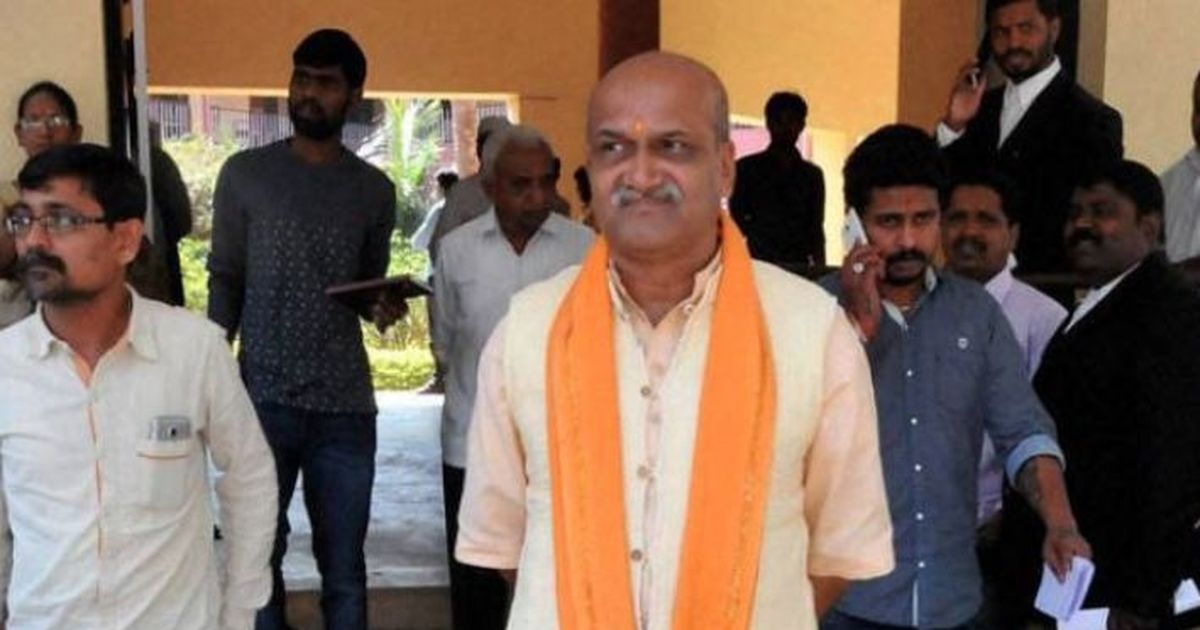
Sri Ram Sene (SRS) president Pramod Muthalik courted controversy on Sunday by comparing the murder of slain journalist-activist Gauri Lankesh to a dog's death.

Addressing a gathering in Bengaluru on Sunday, Muthalik lambasted critics and said no one questioned the murder of four journalists in both Maharashtra and Karnataka, which took place when the Congress was ruling both states.

"No one questioned the Congress government's failure. Instead, they are asking why is Prime Minister (Narendra) Modi silent and not speaking on Gauri Lankesh's death. Many wanted PM Modi to react after Gauri Lankesh's death. Why should Modi react if some dog dies in Karnataka?" Muthalik declared.

Further, Muthalik once again clarified that Parashuram Waghmore, who is the main accused in the Gauri Lankesh murder case, was not associated with SRS.
READ FULL TEXT HERE: https://www.theweek.in/news/india/2018/06/18/muthalik-gauri-lankesh-murder-death-dog.html?__twitter_impression=true

March 20, 2018

India - Mangaluru pub assault: How the prosecution derailed the case against the Sri Ram Sene

scroll.in

moral policing

Mangaluru pub assault: How the prosecution derailed the case against the Sri Ram Sene

The trial court said in its verdict that the prosecution failed to produce the assaulted women as witnesses or any video evidence.

On January 24, 2009, television channels across India broadcast a video of a group of men slapping women at a pub in Mangaluru, dragging them by their hair and accusing them of having loose morals. The mob were members of the Sri Ram Sene, a Hindutva organisation in Karnataka. Its chief Pramod Muthalik had described the idea of women going to pubs a “cultural invasion”.
Many of the men were arrested in the following weeks. Nine years later, a trial court on Monday acquitted all the accused, including Muthalik, for lack of evidence. In its poorly-drafted 30-page verdict, the court detailed how the police had failed to build a case.
The prosecution not only failed to produce the assaulted women as witnesses, it also did not produce any video evidence, despite there being plenty of it. This effectively killed the case and allowed Muthalik to proclaim, “This judgement is the answer for those who opposed us and called us goons. For nine years, Pramod Muthalik and Sri Ram Sene were defamed. I thank the court.”

No witnesses, no evidence

The verdict said the women who were assaulted were the best witnesses in the case. However, the investigating officer had told the court that he “could not procure their presence”. The judge said:
“In order to prove the same the investigating officer did not procure the presence of women customers in this case and also not cited them as witnesses in the charge sheet. The women customers are the victims and they are the best witnesses in this case. If the investigating officer examined them the real truth would come out it.”
Next, the court said the police had failed to produce documentary evidence. The videos played on repeat by television channels were not part of the case file. The judgement read:
“In order to prove the involvement of the accused persons those videos and photographs are plays very important role and those videos and photographs are the material evidence in this case. In order to prove the same the investigating officer did not produce the videos and photographs before this court. Non-production of the videos and photographs is fatal to the prosecution case.”
To make matters worse, the complainant in the case turned hostile and claimed not to have seen the accused on the day of the assault. The police inspector put in change of the case was not included as a witness. There was even a delay in dispatching the first information report to the court. “The delay in dispatching the FIR is not explained. The delay in dispatching the FIR is also fatal to the prosecution case,” said the court, citing a Supreme Court precedent.

March 13, 2018

Caught Assaulting Women In Pub, Pramod Muthalik And Co Let Off

Bengaluru:  Young women ran as they were chased by goons, slapped, kicked and dragged by their hair. As the terrified women tried to dodge the blows, some tripped and others were pushed to the ground. Visuals of this hooliganism at a pub in Mangaluru disgusted the nation and led to calls for toughest punishment. But nine years on, 25 attackers and their controversial chief Pramod Muthalik have been let off by a court that said on Monday there wasn't enough evidence. The court order has revived the feelings of revulsion and outrage that citizens felt in 2009. 

https://www.ndtv.com/india-news/mangalore-pub-attackers-let-off-despite-assault-video-10-points-1823220?pfrom=home-topscroll

June 18, 2017

At sixth All India Hindu Convention 132 Right-Wing Hindu organisations demand creation of Hindu theocratic state by 2023 (report in scroll.in)

scroll.in - 18 June 2017

right turn

‘Establish a Hindu Rashtra by 2023’: What 132 Right-Wing Hindu organisations demanded in Goa

The sixth All India Hindu Convention also asked for construction of a grand Ram temple in Ayodhya and a ban on cattle slaughter and religious conversions.

Declare India a Hindu rashtra, ban cattle slaughter and declare the cow India’s national animal, ban all religious conversions, start the construction of a grand Ram temple in Ayodhya: these were some of the resolutions passed by the sixth All India Hindu Convention in Goa on Saturday.
The four-day event, which began on Wednesday with 300 participants from 132 Hindu groups, was organised by the Goa-headquartered Hindu Janjagruti Samiti and its sister organisation, the Sanatan Sanstha, at the Ramnathi temple complex in the state’s Ponda region. The Samiti’s national guide, Dr Charudatt Pingale, said the next course of action was a national campaign against corruption and injustice that would unite all Hindus.
“The government does not listen to the people, nor does it work against corruption,” Pingale alleged. As a result, he said, the convention has decided to intensify its campaigns against corruption in the bureaucracy, malpractices in the medical field, donations and capitation fees in education, and to protect the nation and dharma.
There are also plans to get the organisations’ activists to file more applications under the Right to Information Act towards this end, and to organise right to information camps for their activists and lawyers. Camps on providing first aid and on self-defence were also proposed.
Furthermore, the Hindu Janjagruti Samiti and Sanatan Saunstha will hold 45 district-level and 10 provincial Hindu conventions in the coming months.

Message to the BJP

Participating in the convention, Bharatiya Janata Dal MLA from Telangana T Raja Singh, who is the founder of the Shri Ram Yuva Sena, gave his party a deadline of 2019 to start the construction of a Ram mandir in Ayodhya. He threatened to quit the party and unite “one crore” Hindus if the Central and state governments failed to start work on the temple by then. However, he professed to have “great faith in Yogi Adityanath” – the chief minister of Uttar Pradesh, who visited the makeshift Ram temple in Ayodhya on May 31 and spoke of building the mandir by consensus.
Singh also said the BJP should work out a national agenda to stop cow slaughter.
Another participant, Bharat Raksha Manch national secretary Anil Dhir, said the BJP had during the 2014 Lok Sabha election campaign promised to deport “illegal Bangladesh settlers”. Three years hence, he said, “not even hundred have been deported”. Claiming that these settlers have spread across economic sectors and regions and now number four crore, Dhir said the Centre ought to detect and deport them. “At least detect and delete them from the electoral rolls” while giving them work permits, he added.
Dhir claimed to have been part of the BJP’s campaign in 2014, and said many of its promises remain unfulfilled, such as on one rank one pension for retired defence personnel and the declassification of papers pertaining to Netaji Subhas Chandra Bose.
The BJP was the object of Hindu Janjagruti Samiti national spokesman Ramesh Shinde’s attention, too, as he said, “If you are in power due to some promises, then you have to fulfil them. It is the duty of Hindu organisations to show them the correct path.” He added, “Criticism does not mean opposition.”
Bengaluru-based lawyer Amrutesh NP, meanwhile, criticised the BJP government in Goa for banning the entry of Sri Ram Sene convenor Pramod Muthalik, calling it a shame. “We are pursuing the matter in the Supreme Court and I hope to attend the next press conference with Pramod in Goa,” he said.
The state had announced the ban in 2015 after Muthalik threatened to stop “pub culture” in the tourist state, and it has been extending the ban ever since.
The ruling BJP – which is making a conscientous effort to take the middle ground in a state with a sizeable Christian population, which it hopes to wean away from the Congress – has distanced itself from the convention. The event did not see any participation from the Rashtriya Swayamsevak Sangh, the BJP’s ideological parent, either.

Controversial start

The convention got off to a controversial start with Sadhvi Saraswati of Madhya Pradesh likening the consumption of beef to “eating one’s mother” and saying all beef-eaters should be hanged. She also called for Hindus to keep arms “for self-defence”. The state Congress demanded that Goa Chief Minister Manohar Parrikar take action against her.
Asked if the Hindu Janjagruti Samiti endorsed Saraswati’s view, Ramesh Shinde said “it was her personal viewpoint”. However, the organisation’s website put up excerpts of her speech and did not remove them even after the controversy.
As the convention wound up on Saturday, a two-day meeting of lawyers to chalk out a roadmap for a legal strategy to “establish a Hindu Rashtra by 2023” got underway under the Hindu Vidhidnya (Lawyer) Parishad. This lawyers’ group counts the bail granted in April to Sadhvi Pragya Singh Thakur – accused of plotting the 2008 blasts in Maharashtra’s Malegaon town that left six people dead – as one of its victories. It has also represented Sanatan Sanstha members accused in the 2009 blast outside a church in Madgaon in Goa.
After the lawyers’ meeting, a special training session or adhiveshan for activists will be held in the state’s Mahalaxmi temple from Monday till Wednesday (June 19-21).

May 27, 2017

India: AAP leader moves Supreme Court seeking protection of life, citing threat from ‘Right-wing bodies’

The Hindu

AAP leader moves SC citing threat from ‘Right-wing bodies’

Krishnadas Rajagopal
NEW DELHI, May 25, 2017 00:00 IST

On hit list?The AAP leader said communications addressed to Home Minister Rajnath Singh and the Delhi Police chief about the threats had gone unanswered.File photo

Ashish Khetan files plea under Section 32 of Constitution, matter posted for June 5

Social activist and Aam Aadmi Party (AAP) leader Ashish Khetan on Wednesday moved the Supreme Court with an urgent plea seeking protection of life, liberty and freedom of speech and expression from “radical Right-wing extremist” organisations.

Receiving death threats

In a mentioning before the Vacation Bench of L. Nageswara Rao and Navin Sinha, Mr. Khetan’s counsel and advocate Sunil Fernandes said his client had been receiving death threats from these organisations.

The court has now posted the case for June 5.

Mr. Khetan said communications addressed to Union Home Minister Rajnath Singh and the Delhi Police Commissioner about the threats had gone unanswered. In his writ petition, he said that even Chief Minister Arvind Kejriwal had written to the Home Minister, but to no avail.

The petition filed under Article 32 of the Constitution said that “to the utter shock and dismay of the petitioner [Khetan], neither the Home Department under the aegis of Rajnath Singh nor the Police Commissioner, Delhi, had responded to the threats”.

Mr. Khetan, who is vice-chairman of the Dialogue and Development Commission of Delhi, named Sanatan Sanstha, Abhinav Bharat, Hindu Janajagruti Samiti, Hindi Rakshak Samiti, Bajrang Dal, Durga Vahini, Sri Ram Sene, Vishwa Hindu Parishad in his petition.

“Such radical organisations have in the last couple of years carried out several murderous attacks on those who do not share their ideology and those who are rationalists, secularists, free-thinkers, anti-superstition and critical thinkers. Many members of these organisations have been convicted for their involvement in mass violence in several parts of the country,” the petition said.

‘Genuine basis’

The AAP leader alleged that such organisations had gained in prominence since 2014 and that the government had failed to discharge its duty to safeguard liberty and free speech.

“These organisations have sought to silence the voices of people like the petitioner by threats, intimidation, violence and even outright murder,” the petition said.

It added that Mr. Khetan had “genuine and reasonable basis” to believe that he would meet a fate similar to noted rationalists and public intellectuals like Dr. Narendra Dabholkar, Govind Pansare and M.M. Kalburgi. “He [Khetan] has been threatened that he is next in line,” the petition said.

‘Chilling reminder’

Alleging that these organisations flaunt their contempt for constitutional democracy, Mr. Khetan compared them to organisations allegedly operating in Pakistan.

“They rely on supremacist ideology of their religion and inferiority of other faiths. They take recourse to the bullet rather than informed debate and discussion,” the AAP leader contended.

He added that he had worked on several investigative articles on right-wing extremist organisations during his 17-year career as a journalist.

Mr. Khetan said the threats issued to him were a “chilling reminder of the growing confidence of the anti-national and fascist forces who want to crush all dissent”.

Mr. Khetan’s petition also mentioned that threats had been directed at a CBI officer – Nanda Kumar Nair.

May 13, 2017

Book Review: Seema Chishti on Dhirendra Jha's 'Shadow Armies'

The Indian Express

Fringe Benefits
How different sections of society were seduced by the Hindutva narrative and an elaborate division of labour in its ranks paid off
Written by Seema Chishti | Updated: May 13, 2017 1:20 am

Name: Shadow Armies: Fringe Organisations and Foot Soldiers of Hindutva
Author: Dhirendra K Jha
Publisher: Juggernaut
Pages: 229
Price: Rs 499

Randomness, coincidence, and probability have haunted scientists, mathematicians and even purveyors of spirituality for centuries. This has generated theorems and ideas that try to explain random events. Albert Einstein’s famous allusion to God not playing dice has been subjected to a million interpretations.

But on a contemporary note, the “randomness” of the violence visited by cow vigilantes, often little-reported attacks on people for their food habits, way of life, choice of life partners and even contraception has been raising some serious questions. Is it really random, a throw of dice best consigned to the crime pages of newspapers? The killings of Govind Pansare, Narendra Dabholkar, MM Kalburgi, Pehlu Khan and Muhammad Akhlaq, or the hangings in Latehar — how “random” is it all?

This is a question that journalist Dhirendra K Jha has sought to answer in this book. A quick read, it combines historical reference, fresh interviews and a look at the affairs of the fringe armies after the present government took office in May 2014.

The Sanatan Sanstha, the Bajrang Dal, the Sri Ram Sene, the Hindu Aikya Vedi, the Rashtriya Sikh Sangat, Bhonsala Military School and Abhinav Bharat are described in considerable detail, including their origins and inspiration. Each chapter analyses a group, its footprint and objectives and the social groups they target for followers. Jha lays bare the interconnections between organisations and the years of groundwork they have put in. He shows how the RSS and its brother organisations blow hot and cold, associating with and dissociating from the fringe at the right time. So, what appears to be an apolitical mob attack is actually a response learned over time.

Amidst tension around the Babri Masjid issue, especially in UP, the Bajrang Dal was formed in 1991 as a “well-considered strategy where an affiliate organisation lower down the hierarchy was deployed to keep an issue alive for future exploitation…” Meanwhile, “the more important fronts kept relatively quiet to prevent any embarrassment for the BJP government.”

Abhinav Bharat, which “would have remained mired in obscurity had it not been for the bomb blast on September 29, 2008” in Malegaon, actually had a leader, the late Himani Savarkar, who spoke of the need for “blast-for-blast” reprisals. She was asked to restrain herself so that the organisation could remain above ground as long as possible.

The chapter on the Bhonsala Military School is especially instructive: on trips to Italy, BS Moonje picked up ideas on fascist education (directly inspired by the Central Military School for Physical Education) and other related pedagogical practices.

Jha’s book weaves a complex narrative of how different sections of society were seduced by the Hindutva narrative and “fringe” armies were set up for different objectives, an elaborate division of labour which paid off in times of bans and adversity. In better times, the intricate Hindutva web offers flexibility — the Hindu Aikya Vedi in Kerala seamlessly lent its president to head the BJP’s Kerala unit in 2015.

There is now much interest in the Hindu Yuva Vahini, nurtured through disputed graveyards, property, food, love affairs, even travel and cricket disputes sometimes, to drive a Hindu-Muslim wedge deeply into all aspects of life. Founded in the shadow of the Gujarat riots in 2002 as the Goraksha Manch, it was renamed and subsumed in an aggressive Hindu Yuva Vahini. Its founder, Adityanath, is now chief minister of Uttar Pradesh. It has been a very short journey from the “fringe” to the mainstream.

April 27, 2017

Connecting the dots: The BJP, Hindutva and fringe organisations (Book Review) IANS April 26, 2017

Connecting the dots: The BJP, Hindutva and fringe organisations (Book Review)

IANS April 26, 2017

Title: Shadow Armies: Fringe Organisations and Foot Soldiers of Hindutva; Author: Dhirendra K. Jha; Publisher: Juggernaut; Pages: 228; Price: Rs 499

The rise of the Bharatiya Janata Party (BJP) from two seats in 1984 to a staggering 282 in 2014 may be seen as the growing appeal of its ideology -- Hindutva -- among the masses, but this compelling work of extraordinary research provides enough evidence to suggest that the ruling party's advance over the last three decades is not its journey alone and has been accompanied by the steady progress of fringe organisations which, in turn, have been the "foot soldiers" of its ideology.

From Yogi Adityanath's Hindu Yuva Vahini in eastern Uttar Pradesh and the "love jihad" obsessed Sri Ram Sene in Mangalore to the Sanatan Sanstha, whose members have been arrested for the murder of rational thinkers Narendra Dabholkar, Govind Pansare and M.M. Kalburgi, the direct outcome of the activities of almost all of these eight organisations -- polarisation -- has not only served to foster a pro-Hindutva environment but has, indeed, brought about long-term electoral gains for the BJP.

It is perhaps the first book of its kind that has carefully studied the functioning and evolution of fringe organisations in the country and linked, with evidence, their connection to a mainstream political party.

Author Dhirendra K. Jha, a journalist, combines substantial research of eight Hindu rightwing organisations across India and their BJP connections with flawless prose to prove his point in "Shadow Armies: Fringe Organisations and Foot Soldiers of Hindutva".

Jha asserts that India has witnessed "astonishing growth in the politics of Hindutva" and, by providing careful insights into the structures as well as the evolution of such organisations, claims that there is a common connection between all such forces.

The Rashtriya Swayamsevak Sangh (RSS) is the vanguard of this ideology and, according to the book, all these organisations, directly or indirectly, function under the guidance of the RSS to ensure that one particular community, the Hindus, have the exclusive right to define our national identity.

But, some may argue, the BJP is the only RSS outfit given to politics and the RSS does not necessarily claim to be the vanguard of all such Hindutva forces.

The author narrates numerous anecdotes and examples to convey, quite clearly, to his readers that in practice most of its affiliates work as "political instruments" to convert India into a Hindu Rashtra. Their purpose and intentions are achieved in the name of protecting Hinduism, which ultimately swings electoral gains in favour of the BJP.

"Though the RSS publicly eschews politics, as the parent body it not only supplies much of the strategic and ideological direction as well as cadres and leaders to the BJP and other associates, but also has its hand -- directly or through its affiliates -- in several communal conflagrations. It is these attacks on minorities that lead to the kind of polarisation necessary for the growth of Hindutva politics," Jha says bluntly in the introduction.

The author is struck by the "omnipresence" of these pan-Indian outfits and finds that their divisive agenda is carried out in a highly "equivocal" manner.

"Whenever these other bodies create a controversy, the RSS and the BJP promptly label them 'fringe organisations'. The fact, however, is that they are active parts of the Sangh Parivar, working as buffer organisations for doing the dirty work the BJP and the RSS were once obliged to do themselves," Jha maintains.

Jha argues that the RSS and the VHP are the biggest "shadow organisations" of the BJP and that except for contesting elections, they do almost everything that a mainstream political party would do -- mobilise masses, develop issues for political polarisation, and play a role in identifying electoral candidates and managing booth-level campaigns.

The findings of the book suggest that a central focus of all of the eight organisations revolves around the portrayal of Muslims as a threat to Hindus. Though the practitioners would never say this in public, Jha claims, the objective of these activities is always to create false fear among Hindus and stoke the polarisation of their votes in favour of the party leading the forces of Hindutva.

The eight fringe organisations that figure in the book are Sanatan Sanstha, Hindu Yuva Vahini, Bajrang Dal, Sri Ram Sene, Hindu Aika Vedi, Abhinav Bharat, Bhonsala Military School and Rashtriya Sikh Sangat. The author has, obviously, researched and compared, wherever necessary, the functioning of these bodies with the RSS and the VHP.

"Shadow Armies" is a scholarly offering and a result of research that attempts to unravel what has generally escaped both the imagination and research of leading writers. Jha's book will stay relevant as long as the fringe organisations continue to stir controversies and may well be regarded as an apt contemporary investigation into the Hindutva brigade.

(This review is based on an advance copy received from Juggernaut. The book is available in stores from April 26, 2017. Saket Suman can be contacted at saket.s@ians.in)

--IANS

ss/vm/sac

(This story has not been edited by Business Standard staff and is auto-generated from a syndicated feed.)

source URL: http://www.business-standard.com/article/news-ians/connecting-the-dots-the-bjp-hindutva-and-fringe-organisations-book-review-117042600284_1.html

January 31, 2017

India: 2010 news report on Pramod Muthalik & Co of Sri Ram Sene in Karnataka playing 'Rent a Riot'

The Hindu

Rama Sene chief, aides exposed in ‘rent-a-riot' sting operation

Sri Rama Sene president Pramod Muthalik, and top aides of his outfit, were caught on camera agreeing to vandalise an art exhibition in return for money in an undercover investigation by the magazine Tehelka broadcast on news channel Headlines Today on Thursday night.
According to a press release issued by the channel, the right wing outfit, which shot to fame after attacking women in a pub in Mangalore last year, was seen accepting a “a token contribution of Rs. 10,000 to the cause of Hindutva” from an undercover Tehelka reporter who posed as an artist. The “artist” told Mr. Muthalik he wanted to “shoot to fame like artist M.F. Husain.” Mr. Muthalik put the reporter in touch with his aides who would help vandalise the artist's exhibition at a “sensitive Muslim-dominated locality,” the press release stated. The investigation took six weeks to complete.
Mr. Muthalik is seen agreeing to stage what the channel called the “rent-a-riot” operation in Mangalore or Bangalore. Vasant Kumar Bhavani, Sri Rama Sene's Bangalore head, also suggested that Karnataka Minister for Wakf and Minorities Welfare Mumtaz Ali Khan be invited as the chief guest for the proposed exhibition. It was decided that 50 “boys” would be sent to do the job along the lines of the Mangalore incident, the release stated.
According to the release, the reporter met national vice-president of the Sri Rama Sene, Prasad Attavar, in prisons in Mangalore and Bellary to discuss how the riot would be staged.
“The investigations establish how the self-styled custodians of ‘Hindu culture' function…They are not ideological custodians of ‘Hindu culture.' Their ideology, in fact, appears to be dictated by cold calculation of hard cash,” the release stated.

March 01, 2016

India: Kerala TV news anchor gets 2,000 threat calls after discussion on Mahishasur Jayanti, 5 arrested are connected to BJP, RSS and Hindutva groups, including Sri Rama Sena

Indian Express

TV news anchor gets 2,000 threat calls after discussion on Mahishasur Jayanti, 5 arrested
She has received over 2,000 abusive calls on her cellphone, allegedly from activists and sympathisers of various pro-Hindutva groups, accusing her of calling Durga a “sex worker” during the show.

Written by Arun Janardhanan
Chennai Updated: Mar 1, 2016

[photo Caption]I was called a prostitute: Sooryakumar

ON FRIDAY night, she moderated a spirited discussion on a popular Malayalam TV news show on whether celebrating Mahishasur Jayanti could be considered an act of treason.

Since then, Sindhu Sooryakumar, chief coordinating editor of Asianet News TV, says she has received over 2,000 abusive calls on her cellphone, allegedly from activists and sympathisers of various pro-Hindutva groups, accusing her of calling Durga a “sex worker” during the show.

The irony: a video of the show, seen by The Indian Express, shows that those two words were read out by V V Rajesh, BJP state secretary, while quoting from pamphlets that he claimed were distributed on the JNU campus and later produced in Parliament by HRD Minister Smriti Irani.

On Monday, Kerala Police arrested five people based on a complaint filed by the journalist. G Sparjan Kumar, Commissioner of Police, Thiruvananthapuram city, told The Indian Express: “All of those arrested are connected to BJP, RSS and Hindu groups, including Sri Rama Sena.”

One of the five, from Thiruvananthapuram, told police that he got Sooryakumar’s number from a WhatsApp group called Sanga Dhwani, where a member shared her personal number and asked others to call and abuse her “for a Facebook post on Durga”.

Three others, who were arrested from Kannur, are members of Sri Rama Sena, the pro-Hindutva group involved in the Mangalore pub attack of 2009 and several other cases of moral policing.

“I have been getting a call every minute. The main allegation is that I abused Durga, calling her a sex worker,” Sooryakumar told The Indian Express.

“Most of the abusers called me a prostitute and abused me. Some threatened me while others didn’t even know what the charge was. I got a call this morning from someone asking whether I was Durga. Another person called me sometime ago, saying I had posted something against Durga on Facebook, and that he wanted to abuse me for that,” she said.

Sooryakumar added that BJP’s Rajesh assured her that he would assist in any investigation. “He said that he has clarified the situation to many of the party’s cadre who had called him. However, his party’s leadership still hasn’t disowned the rumour being spread in their circles,” she said.

Sooryakumar added that BJP-RSS leaders of the state have also remained silent. “All they have done is issue a general statement about freedom of the press,” she said.

On Monday, BJP’s Kerala chief Kummanam Rajasekharan evaded questions on the issue. “The BJP is a party that supports freedom of the press,” he told reporters. Later, in a Facebook post on his official account, Rajasekharan wrote that his party “has nothing to do with this issue”.

Police chief Kumar said investigators were tracing the Facebook user who first posted the rumour about Sooryakumar using derogatory words to describe Durga. He added that they were also tracing the WhatsApp groups that circulated the personal number of the journalist.

Sooryakumar said that routine operations of Asianet News Studio have also been affected with the channel’s numbers being inundated with “hundreds of calls” from those who could not reach her directly.

The state’s journalists’ union, meanwhile, organised a protest and a march to the Kerala Secretariat on Monday, seeking action against the culprits.

November 19, 2015

India: organisations like Hindu Sena and Sanatan Sanstha are attempting to set the agenda with BJP in power

How fringe organisations like Hindu Sena and Sanatan Sanstha are attempting to set the agenda with BJP in power

Suman Layak & Indulekha Aravind, ET Bureau Nov 8, 2015, 09.43AM IST

(Having a parivar power seems…)
Temples in Ramnathim in central Goa can be global symbols of integration as they imbibe Islamic, European and Hindu traditions in their architecture. They were built in the 16th century, when multiple Hindu idols in Portugueseruled Goa were shifted to the Maratharuled area around Ponda (50 kilometres south-east of Panjim) in search of a safe haven.
By the time the Portuguese acquired the area they had become more tolerant rulers and did not damage the temples. They were rebuilt in the 18th and 19th centuries. The blend of architectural styles is apparent.
Unlike traditional Indian temples, each of the three large temples in the Ramnathim village has a perfect dome over its sanctum sanctorum. The front part of the buildings look like churches.


Each temple has a lighthouse-like pillar built in front. The pillars are used to light a lamp at the top to let people know about the location of the temple.
A usual stop on south Goa tours, Ramnathim sees a lot of foreign, non-Hindu visitors every day.
These visitors buy their offerings to the Gods, like other Hindu devotees, from the flower sellers at the gate and offer a puja like everyone else. A Brazilian doctor has even donated a collection of coins to the Shanta Durga temple trust, the largest temple in the village.
Instead of celebrating integration, the village of Ramnathim today, however, is seeing a battle of its own, a battle within Hinduism if you like — between a Hindu society steeped in tradition and Hinduism's more aggressive proponents.
Ramnathim is also home to the Sanatan Sanstha, which espouses a more codified version of Hinduism and seeks a dominant role for Hindus in Indian society. Its members are also prime suspects in the murder of rationalist and Communist Party of India (CPI) leader Govind Pansare.
In Ramnathim, a local group led by the elected panchayat member, is resisting Sanatan's presence and wants it to leave the village.
It's probably the first such resistance against the Hindu right wing, but its echo can be found in the various voices speaking out against the Hindu fringe in India, especially after the lynching of Mohammad Akhlaq in Dadri over an allegation of possession of beef.
Deconstructing the Ultra-right
Sanatan Sanstha is probably the largest among what are called 'fringe-organisations' of the Indian Hindu right wing — that are not part of the Rashtriya Swyamsevak Sangh-Bharatiya Janata Party family (the family includes, among others, Vishwa Hindu Parishad and Bajrang Dal).
However, having the parivar in power seems to have emboldened these organisations to try and force their own agenda and their methods are sometimes violent, often sophisticated and increasingly assertive.
Sanatan even has a clone, called Hindu Janajagruti ( just in case the Sanatan is ever banned). The Sanatan Sanstha was founded and is led by Jayant Athavale, a former hypnotherapist.
In September a member of Sanatan, Sameer Gaikwad, was arrested for the February 2015 murder of Pansare. Another accused member, absconding at present, is wanted for an old case of bombing.
A group of young men, led by the local panchayat member of Ramnathim, Sharmila Lotlikar (Bandora Panchayat), wants the Sanatan Ashram evicted out of the village. On October 11, a public meeting held in Ramnathim to discuss the ouster of Sanatan saw participants coming from different parts of Goa. Vishnu Wagh, BJP MLA from St Andre, has also lent his support to the "evict Sanatan" movement.
According to Sanatan Sanstha spokesperson Abhay Vartak, establishing a Hindu rashtra in India is one among the many goals of the organisation, and it is mainly focused on spiritually enriching the life of its members. However, the organisation has a reputation for reacting with violence against people who oppose it, something Vartak denies.


Apart from its members being suspected in the Pansare murder, in the recent past, it has had other serious brushes with the law. It had longstanding feud with another rationalist Narendra Dabholkar. Like Pansare, Dabholkar too had been murdered in 2013.
Sanatan members were convicted for blasts in Thane on Mumbai's outskirts (2008) and one absconding accused in the Pansare murder, Rudra Patil is also an accused in the blasts in Goa's second largest city by population, Margao, in 2007. It has also got into trouble for opposing local Goan traditions like the Narkasur festival, when processions are taken out with the effigy of a demon. Sanatan seems to have irked rationalists on one side and the local villagers on the other. Dilip Gaitonde, secretary of the managing committee of the Shanta Durga temple, explains how Sanatan's religion is different from that practiced in the temples in the village.

October 03, 2015

India: HJS, Shiv Sena come out in support of Far Right Sanatan Sanstha

Saturday , 3 October 2015
HJS, Shiv Sena come out in support of Sanatan Sanstha
HJS Goa convenor Dr Manoj Solanki and immediate past president of Shiv Sena Ramesh Naik along with Dr Durgesh Samant, former editor of Sanatan Prabhat addressing media

HJS, Shiv Sena come out in support of Sanatan Sanstha


PANAJI: Hindu Janajagruti Samiti (HJS) and Shiv Sena have extended support to the Sanatan Sanstha which has its headquarters in Ramnathi village in Ponda.
On Thursday, HJS Goa convenor Dr Manoj Solanki and immediate past president of Shiv Sena Ramesh Naik alongwith Dr Durgesh Samant, former editor of Sanatan Prabhat, the mouthpiece of Sanatan Sanstha addressed the media jointly. They condemned the demand by Saurabh Lotlikar, president of Ramnath Yuvak Sangh and villagers to ban or shift the organisation’s base from Ramnathi village.
Dr Samant terming the demand unconstitutional said “Saurabh Lotlikar and his group have made the demand without any valid reason.”
Stating that during the 2009 Margao blasts case too these allegations had surfaced, Samant said, “Sanstha was not even charge-sheeted then.”
Extending support to Pramod Muthalik-led Sri Ram Sena, Dr Samant said, “Sri Ram Sena should not have been banned by the Goa government. When the Karnataka government has not banned, why the Goa government should do so?”
Responding to the ban on media entry to the Sanatan Sanstha Ashram in Ramnathi, Dr Samant said, “During the on-going issue we have realised that there is a media trial going on. Some sections of the media have misquoted the representatives of the ashram. Due to media trial the trust has decided not to allow media inside the ashram premises.”
The three were flanked by four seekers of the Sanstha living in the vicinity of the ashram.

October 01, 2015

India: Rioting and right wing in communal cauldron north Karnataka (Sudipto Mondal)

Hindustan Times - Sep 30, 2015

Rioting and right wing in communal cauldron north Karnataka

  • Sudipto Mondal, Hindustan Times, Bengaluru
Parveen Momin and Mehboob Momin stand amid the ruins of their house that was attacked with petrol bombs by alleged activists of the Sri Rama Sene in Mudhol, Bagalkot. (HT Photo)

There was a communal riot every day in north Karnataka for six straight days to Monday. What was the police doing, and can they be trusted to put out future fires?
Luckily nobody died but hundreds were injured and properties worth crores were lost in the riots: Mudhol-September 23, Chikkodi and Surpur-24th, Dharwad and Surpur-25th, Dharwad and Koujalagi-26th, Belgaum-27th and 28th.
There were signs everywhere for weeks that riots might break out in the state. The incident -- where Hindu Jagarana Vedike activists stripped a Muslim man at a marketplace in Mangalore, tied him to a pole and flogged him for an hour in full public view for being friends with a Hindu girl on August 24 -- was a sign.
The broad daylight assassination of rationalist MM Kalburgi on August 30 in Dharwad was a sign. The open threats issued to rationalists and intellectuals after Professor Kalburgi’s killing were also signs that something big might happen.
The riot during Ganesh puja in Janata colony of Mudhol was slow cooking for weeks before it was served on the night of September 23rd. Hindus and Muslims in the area had clashed just two months earlier during the procession of Durgowwa, a local Hindu deity.
There were a few close shaves during Ramadan as well.
A week before the Ganesh puja, the Sri Rama Sene entered this restive theatre and put up a large banner about the festival outside the local mosque. Not to be outdone, the Muslims promptly put up a poster of their own outside the mosque in the name of Tipu Sultan.
Despite all these signs, and the fact that Janata Colony was classified a ‘sensitive area’, the police gave the Sene permission to take the Ganesh procession in front of the mosque. The rioting started around 8pm, as soon as the procession reached the mosque. And when that happened, there weren’t enough policemen deployed on the spot to control the violence.
Things calmed down only around 3am when reinforcements, led by superintendent of police Ravikanthe Gowda arrived from neighbouring Belgaum district.
The Sri Rama Sene’s north Karnataka chief Basavaraja Mahalingeshwar, who was leading the procession in Janata colony alleges that the trouble started when stones came flying out of the mosque. Speaking to HT, he readily admits that his men burnt and destroyed around 10 Muslim properties in retaliation.

State police have been unable to contain communal clashes and various incidents that have plagued Karnataka in the recent months.
Official records show that at least twice that number of Muslim properties were looted and attacked -- not just with stones but also burning tyres and petrol bombs indicating that the violence was planned in advance. Yet, of the 90 men arrested, only 30 were from the Sene.
In Belgaum city, there were minor clashes and incidents of stone-throwing in the crowded Khade Bazar, Khadolkar Galli and Kacheri road areas for at least 24 hours before the main riot erupted around midnight on 28th.
Strangely, the bulk of the police force was withdrawn by the police commissioner S Ravi just hours before. A tenuous peace returned only at dawn the next day.
The same trend was witnessed in Surpur and Dharwad city where tension slowly built up over weeks before the main riot.
Koujalagi and Chikkodi in Belgaum rural were the only two places where riots were nipped in the bud. These two backward towns were also on the boil in the days leading to riots there after the Sri Rama Sene carried out an aggressive campaign against cattle slaughter ahead of Eid. But when the main riot broke, SP Ravikanthe Gowda’s men were well prepared for it.
“Every riot is preventable. No rioter is stronger or smarter than the police,” IPS officer Gopal Hosur, now retired, had said at his first press interaction in Mangalore after taking charge as inspector general in February 2009, one of the most violent periods in the history of the region since Independence.
Also read: How Siddaramaiah has let Karnataka’s secularists down
Just a month earlier, the Sri Rama Sene had molested and beaten women who were partying at a pub. A few months earlier, Bajrang Dal and Vishwa Hindu Parishad activists had attacked dozens of churches in coastal Karnataka.
Riots, murders and vigilante attacks had become daily occurrences and BS Yeddyuppa’s BJP government was being accused of shielding the Hindutva extremists who were holding the region to ransom. It seemed Hosur didn’t have a chance.
Nobody was sniggering when he was transferred to the state capital 18 months later. Hosur and his core group of officers, each of whom he had handpicked and brought in from other districts, had delivered 18 of the most peaceful months coastal Karnataka had seen in a very long time.
Of course, they had a tough time; there were dozens of vigilante attacks on intercommunity couples and many small attacks and counter attacks. But Hosur and his men gave as good as they got.
By the time the regime, under pressure from the RSS, started transferring these officers, they had sent hundreds of communal elements, Hindus and Muslims, to jail.
The main architect of the pub attack, Prasad Attavara, was sent on a long jail term after his links with overseas underworld gangs was exposed by the police. His arrest along with several other Sri Rama Sene leaders led to a situation where there was no official spokesperson left for the organisation apart from Pramod Muthalik.
In the process Hosur’s troops proved that it is possible for the police to triumph, even in coastal Karnataka where the rioters are well organised, ferociously motivated and enjoy powerful patronage.
Those of the view that the Congress is a secular party and the BJP is a communal force still find Gopal Hosur’s farewell speech in Mangalore hard to stomach. The outgoing officer, who many conveniently assumed was anti-BJP, surprised them by giving the entire credit to BS Yeddyurappa and the then BJP government for allowing him to work without political interference.
What then went wrong in north Karnataka this last week? Neither are groups such as the Sri Rama Sene and Bajrang Dal strong there nor do they enjoy the sympathies of the present government.
More importantly, the last six riots are indication that the situation might worsen and possibly spread to other parts of the state. When they have failed to contain these minor, mohalla-level skirmishes, can the Karnataka Police be trusted to act decisively in the face of bigger challenges?
And what about Mangalore, that viciously polarised town of coastal Karnataka, where policemen went with Bajrang Dal activists to a discothèque last Saturday night and forced all the women out because they were allegedly ‘violating Indian culture’ by dancing.
Since the murder of Professor Kalburgi by suspected Hindutva extremists, chief minister Siddaramaiah has been promising that communal outfits will tied down.
Since he hasn’t delivered on that promise yet, the chief minister will obviously have to demand more from his home minister and the police force. Siddaramaiah might also want to find out how Yeddyurappa succeeded, albeit briefly, where he has failed totally.

September 29, 2015

India: Sri Rama Sene founder brands Karnataka writer Bhagwan a devil

http://www.dailymail.co.uk/indiahome/indianews/article-3252597/He-named-Shaitan-Sri-Rama-Sene-founder-brands-Karnataka-writer-Bhagwan-devil.html

'He should be named Shaitan': Sri Rama Sene founder brands Karnataka writer Bhagwan a devil

By Mail Today Bureau

Published: 22:13 GMT, 28 September 2015

Prof KS Bhagwan was abused for his comments on the Hindu gods

The ongoing tussle between rationalists and Hindu groups is taking an ugly turn in Karnataka, with the Sri Rama Sene founder Pramod Muthalik terming award-winning writer Prof KS Bhagwan as shaitan (devil).

“It is such an irony that somebody with the name Bhagwan is deriding Hindu gods. He should be named as Shaitan (devil). I am appalled with the soft stand of the government towards him. He continues to insult Hindu gods and hurt the sentiments of millions of Hindus,” alleged Muthalik, whose followers have also filed complaints against Bhagwan.

Muthalik’s comments came hours after Bhagwan held Lord Rama and Krishna, along with saints Sankaracharya and Madhwacharya, responsible for caste-based discrimination in the society and claimed that Lord Rama had oppressed women during his reign.

“I don’t understand why people want Ram rajya. He was against equal rights for women. He drove his wife to forest without giving her any rights. He discriminated against women and Dalits… I am not saying these because there are such direct references to Rama in Ramayana,” he told a gathering in Bengaluru on Sunday.

Bhagwan did not spare even south Indian saints Sankaracharya and Madhwacharya, who are also worshiped as gods.

“These acharyas created a separate identity for the priestly class by promoting them. According to them, non-Brahmins were not eligible to study the Vedas. Is it not discrimination? Why were Dalits and other non-Brahmins prevented from acquiring education and knowledge? These are stark realities, which no one dares to question,” he contended.

His latest comments drew sharp criticism from the Hindu groups, leaders of the BJP and the RSS.

One of the powerful religious gurus of Karnataka, Vishweshateertha Swamiji of Pejawar Mutt, who also happens to be the key architect of the Ram Janmabhoomi movement, termed Bhagwan ‘ignorant’.

“He is taking sections of Ramayana out of context and issuing controversial statements. He has not studied Ramayana properly. I invite him to an open debate on the topic,” he said.

BJP legislator G Madhusudan, who comes from the RSS background, demanded immediate action against Bhagwan.

“No writer would get away by insulting gods of other religions. Why is the government quiet when it comes to taking action against Bhagwan? It is clear that the government is playing to the gallery,” he said.

Meanwhile, the police have registered multiple cases under different sections of the law against Bhagwan, who has vowed to fight it.

“I am more than willing to fight these cases legally. Let them file more complaints against me, the truth will never change,” he said.

September 23, 2015

India:: Kalburgi case: Sriram Sene threatens to destroy writers’ houses

 
Kalburgi case: Sriram Sene threatens to destroy writers’ houses
Sriram Sene district president Manjunath Bavi addressing mediapersons at Reporters Guild in Raichur on Saturday. PHOTO: SANTOSH SAGAR.
Sriram Sene, a right wing outfit, threatened to destroy the houses of poet Chennaveera Kanavi and writer Giraddi Govindaraj if the duo failed to provide substantial evidence to prove their allegation of Sriram Sene’s involvement in the M.M. Kalburgi murder case.
Addressing a media conference at Reporters' Guild here on Saturday, Manjunath Bavi, district president of the outfit, said that Chennaveera Kanavi, Giraddi Govindaraja and the Swamiji of Tontadarya Math of Gadag, who led 138 rationalists in the recent protest in Dharwad against the murder of Kalburgi, had submitted a memorandum to the Assistant Commissioner of Dharwad alleging the involvement of Sriram Sene in the murder.
“We give a month’s time to provide evidences to establish their allegations. If they fail to provide, we will destroy the houses of Chennaveer Kanavi and Giraddi Govindaraj. We will also issue notice to all 138 people who participated in the agitation, seeking substantial evidences to prove their allegations,” he said.
He said that he had lost faith in the Constitution and the judicial system considering their “failure to deliver justice” to majority Hindus in the country.
“There are many judgments, including one on Ram Mandir-Babri Masjid issue, that went against the Hindus. Since they have failed to deliver justice, we are forced to do it... We are like this only,” he said.
Justifying the fire-arms training to the activists of his organisation, he said that one such training camp would be organised in Raichur as well.
Bapurao Harijanwada and Rajachandra Ramanagowda of Hindu Jagarana Vedike and Veerendra Gawli of Sriram Sene were present.

September 22, 2015

Will cut off tongues of writers for insulting Hindu gods: Sri Rama Sene

indiatoday.intoday.in

The epic Hindu literature are followed by millions of Hindus, as sacred texts. People will not tolerate the belittling of the Ramayana characters, who are worshiped. They will cut off the tongues of writers if they do not stop insulting Hindu gods, Siddalinga Swami said.

Aravind Gowda | Mail Today | Bengaluru, September 22

http://indiatoday.intoday.in/story/will-cut-off-tongues-of-writers-for-insulting-hindu-gods-sri-rama-sene/1/479760.html

September 06, 2015

India: In coastal Karnataka, history of communalism is yet to be written

In coastal Karnataka, history of communalism is yet to be written

MM Kalburgi's murder is the latest in a series of violent events perpetrated by fundamentalists in coastal Karnataka, where all the major communities are guilty of encouraging an atmosphere of intolerance. In this photo, Bajrang Dal activists shout slogans during a protest rally in Bangalore against the terrorist attack inside the makeshift temple in Ayodhya in 2005. (AFP Photo)


I can't remember if I was slapped, shoved or punched. But the night of September 1, 2008 was the first time I was attacked on the crime beat in Mangalore.
That night, a group of activists from the Hindu Jagarana Vedike were ransacking a Christian missionary hospital and attacking its staff because a Hindu girl, who had consumed poison, could not be saved by the doctors there. They were accusing the hospital staff of neglecting the girl because she was Hindu.
The bearded Hindu Jagarana Vedike leader who hit me for taking a snap of the violence was a Catholic Christian. His name was Franklin Montiero. He was not the first Christian I had met in the Sangh Parivar in Mangalore, which is called the Rome of the East for its sizable Catholic population.

A few weeks earlier, the Sri Rama Sene had shut down the city to protest against the Ram Sethu shipping canal project. They surrounded me when I took images of them attacking a shopkeeper who had defied their ban near the Mangalore prison. A large, burly, menacing-looking man suddenly burst onto the scene and yelled at the Sene activists in Tulu. They immediately backed down and apologised to me. My hero introduced himself as a journalist, dog breeder, Karate champion, event manager, real estate agent and member of the BJP minority morcha. He was also a Catholic.
Read: Bangalore Muslim boy asked to recite Hindu prayer, 'humiliated'
The karate champion promised to find me a house on rent close to my office and after many postponements we finally agreed to meet on Sunday, September 14, 2008. That morning, I got a frantic call from him around 8 am. "They have attacked us! They have attacked us!" he shouted into the phone straining to be heard over the hundreds of loud voices in the background.
In a well coordinated move, the Bajrang Dal had attacked around 20 churches across the twin coastal districts of Dakshina Kannada and Udupi. When I reached the 350-year-old Milagres Church where all the shocked Catholics of the city had gathered, I found the Karate champ sobbing like a baby. "I am quitting the BJP and the Sangh parivar," he said.
http://www.hindustantimes.com/Images/popup/2015/9/0609htthink19.jpg
Many Catholics, who had either been supporters of the Sangh or indifferent to its attacks on Muslims in coastal Karnataka until then, moved away from the Hindutva fold that day. But Franklin Montiero stayed back and went on to become the State Vice President of the BJP's minority morcha.

There doesn't seem to be any authoritative scholarship on the history of communalism in coastal Karnataka, which according to some is the third most important centre for the Sangh after Nagpur and Pune. For now, the story is best told through the personal histories of common people who live here. It is a story of shifting loyalties and changing identities.
These stories offer some insight into two recent incidents that made national headlines: the public stripping of a Muslim man in Mangalore for speaking to a Hindu woman and the assassination of rationalist Professor MM Kalburgi 400 km away in Dharwad.
Catholics like Montiero, for instance, were raised on family stories about the first time the community was attacked over two centuries ago. In 1784, suspecting the Catholics of being British spies, Tipu Sultan had razed at least two dozen churches in the region, including the Milagres Church. When the first RSS shakhas started sprouting in the region during the 1940s, many Catholic businessmen actively supported the growth of militant Hindutva as a means to contain the common enemy, the Muslims.
A Catholic priest invoked this shared history at a peace committee meeting at the Deputy Commissioner's office in Mangalore a few days after the church attacks. He told the Sangh leaders at the gathering, who were accusing Christian missionaries of converting lowered caste Hindus: "We are the same people. We were also Saraswat Brahmins like you. Both of us suffered equally under Tipu Sultan."
At the Nehru football stadium where I used to play football, a group of Muslim players told me another interesting story. A group of footballers from the Catholic part of town had approached them a day after the church attacks and asked them for help in exacting revenge. "We laughed and asked them, 'Where were you when we were getting attacked all these years?' There was no answer," one of the Muslim players told me.
For many in the outside world, Mangalore's history starts with the pub attack of January 2009 when Sri Rama Sene activists hit and molested girls who were partying. The attack led activists based in Delhi to form the "consortium of loose, forward and pub going women" which started the Pink Chaddi campaign.

But by then, hundreds of simple women - dressed in saris, churidars and burkhas - who were neither "forward" nor "pub going" had been attacked by right wing groups merely for speaking to men from another community.
Many trace the origins of this vigilantism to the 1998 communal riots in Surathkal near Mangalore. Eight people were killed in those riots that started when the Hindu Jagarana Vedike attacked a Muslim man for dating a Hindu girl. Since then, the trend has been that the police file cases against the victims of these vigilante attacks under ambiguous laws relating to public indecency. The recent stripping of the Muslim man was the 140th such incident this year alone.
Read: After Kalburgi murder, Bajrang Dal leader says another rationalist next
The Surathkal riots also provided an entry point for the Muslim fundamentalist organisation Karnataka Forum for Dignity (KFD). Until the riots, the KFD was active only in Kerala where it was called the National Development Front. They are now known as the Popular Front of India (PFI).
Secular groups such as the Karnataka Communal Harmony Forum regularly shared the stage with the KFD/PFI whenever they held protests against the communalism of the Sangh. The 'secularists' would demand proof when asked how they could ally with one communal group to counter another.
That proof presented itself on the evening of October 6, 2009 when activists of the PFI attacked a Hindu boy in front of the Deputy Commissioner's office in Mangalore for dating a Muslim girl. When I called him for a reaction, the then district secretary of the PFI, Ataullah, claimed responsibility for the attack only to retract his statement when the incident created a huge uproar. Ties between the PFI and the communal harmony forum soured after the incident and today, they no longer share a stage. This year, activists of the PFI have been held responsible for six of the 140 vigilante attacks in the region.
http://www.hindustantimes.com/Images/popup/2015/9/0609htthink20.jpg
However, the PFI did not give birth to Islamic fundamentalism in coastal Karnataka, which has been a major centre for liberal Sufi Islam. Increasingly ghettoised by the rise of the Hindu Right and abandoned by the Congress, the Beary Sunni Muslims of the region had started turning to religion in a big way as early as the 1970s.
Young Beary men, who went to West Asia in search of a fortune, brought back not just material wealth but also an interpretation of Islam that ran counter to Sufisim. Groups such as the Tablighi Jamaat and the Jamat-e-Islami had gained a huge following in the area by the time the turbulence of the Ram Janmabhoomi movement hit the Konkan coast in 1992.
The polarising events of those years propelled one man from the region onto the national stage - the seer of the Udupi Pejawar Mutt, Vishveshwara Theertha Swami. A disciple of the second RSS chief MS (Guruji) Golwalkar, the soft-spoken pontiff, now 84, is seen by many as the man who laid the foundation for the Sangh in Coastal Karnataka.
In 1969, Theerta organised the first ever state-level conference of the Vishwa Hindu Parishad. Golwalkar was the chief guest at the event, which also saw the participation of many Congress leaders of the time. Four years earlier, in 1965, the then Mysore Maharaja and founder President of the VHP, Jaya Chamrajendra Wodeyar Bahadur, had organised the third national executive meeting of the outfit at his summer palace.
During an interview at his Bangalore ashram on Wednesday, Theertha recalled those days fondly and said, "When he came to Udupi in 1969, Guruji praised me in front of 65,000 people for helping the Mysore Maharaja with the national executive meeting."
He said that before the 1960s, the Sangh barely had any presence in coastal Karnataka. "Cows were being slaughtered by thousands but nobody was speaking out against it. That's when we started the VHP to take up this issue seriously."
Police records from the 1960s show that it was a period when a series of attacks were launched against Muslim cattle traders. The years of the Emergency added further heft to the VHP with many Congress and even some young Left leaders joining its ranks. This was also the period when the VHP started spreading its footprint to other regions of Karnataka such as Hubli-Dharwad, Raichur and Bagalkot.
But for some, even the VHP was too soft. By the late 1970s, the Hindu Yuva Sene took on the responsibility of cow protection in the coast. This group made way for the even more militant Hindu Jagarana Vedike in the 1990s. And the Gujarat riots of 2002 allowed the Bajrang Dal to replace the Jagarana Vedike to spearhead the Hindutva movement in coastal Karnataka.
People such as Franklin Montiero, Ataulla and the Pejawara pontiff are bound to contest this version of events. But it stands to reason that everybody is entitled to a telling of this story in a region which has been torn asunder by competitive communalism that has led to riots, curfews, killings and vigilante attacks for the last 50 years.
And the task of writing a definitive history of all this is as difficult as catching all the fish in the Arabian sea.

September 03, 2015

In Scholar MM Kalburgi's Murder, Sri Ram Sene Man Arrested for Sharing Threatening Tweet

NDTV.com

In Scholar MM Kalburgi's Murder, Man Arrested for Sharing Threatening Tweet
All India | Edited by Deepshikha Ghosh

http://www.ndtv.com/india-news/scholar-mm-kalburgi-murder-sri-ram-sene-activist-arrested-over-threatening-tweet-1213897

September 04, 2014

India: Hindu Far Right to submit Memo seeking firearm licences

Indian Express

Govt urged to provide firearm licences to Hindu outfit leaders
Press Trust of India | Coimbatore | September 3, 2014 5:13 pm

Summary
Muthalik said Tamil Nadu government should follow Kerala and introduce prohibition in phases.
Tweet This

Controversial right wing outfit Sri Ram Sene’s chief Pramod Muthalik on Wednesday said he would submit a memorandum to Prime Minister Narendra Modi highlighting the need for providing licences for firerams for self-protection for leaders of Hindu outfits considering increasing incidents of attacks on them.

As providing police protection was limited to certain areas, it was necessary for the leaders to carry firearms, since there was threat to them from various quarters, including extremist forces, who were carrying sophisticated weapons, Muthalik told reporters here, adding, similar petitions would be submitted to the Union Home Minister Rajnath Singh and State Chief Minister Jayalalithaa.

The government can also consider providing such licences to all those who face threats, including Dalits, who are also becoming target of attacks, he said.

He claimed in Tamil Nadu alone, 127 workers of Hindu outfits were murdered in the last 10 years.

On sexual assaults on women, including minor girls, he said the Government and school managements should come out with a dress code for the students, since attire was also one of the reasons for such heinous crime.

He also said government should ban forcible conversions.

Muthalik said Tamil Nadu government should follow Kerala and introduce prohibition in phases, which would decrease crime rate.

Muthalik, who hit the headlines in 2009 after members of his organisation attacked boys and girls at a pub in Mangalore, submitted a memorandum highlighting the need for providing licences for firearms for Hindu outfit leaders and others facing threats to the city police commissioner.

Source URL: http://indianexpress.com/article/india/india-others/govt-urged-to-provide-firearm-licences-to-hindu-outfit-leaders/