(People's Democracy, August 17, 2008)
Ram Setu: A Myth Or Reality
by Suraj Bhan
THE traditional knowledge and values have been critically examined, rejected or transformed in the successive ages by the creative and developing societies. The Ram Setu controversy reflects that the reality behind the myth of the Ram Setu has not been grasped by a section of the elite and is being utilised by the regressive forces under the Ram Setu protection movement. The writ petition filed in court in 2007 and the withdrawal of the affidavit by the ASI on behalf of the central government are an evidence of this. The right wing political parties want the historians, scientists and the nation to believe, despite the scientific assertions to the contrary made by GSI and other institutions and scholars that the Ram Setu was man made. The present note aims at re-examining the literary, archaeological and geological data in brief to examine the falsity of this claim.
The Valmiki Ramayan in its present form aims at the objective of promoting the Vaisnava cult by employing myths and miracles. The story of Rama also emphasises the role he played in protecting the varna system and the patriarchic values of family in the Brahmanical culture. The propagation of Vaisnava and the Rama cults through precept and practice, creation of stupendous literature, religious institutions and depiction of the myths, legends and miracles for communicating the message through art and architectural forms made the cults popular among the believers engrossed in conditions of helplessness.
The earliest reference to Rama or Rama’s Bridge occurs in the Ramayana of Valmiki. Although the Brahmanical tradition pushes back the antiquity of Ramayana to remote past, the archaeological excavations at Ayodhya, the birth place of Rama, places the foundation of Ayodhya not earlier than the seventh century BC. The earliest Buddhist literature (Pali Tripitakas) having no reference to the story of Ram places Ramayana even later than the rise of Buddhism (c500 BC). The scientific historians generally date Ramayana in its present form between C 400 BC and CAD 200.
The story of Ramayana broadly moves around the birth of the hero at Ayodhya, his marriage with Sita, departure for exile and sojourn in the Vindhyan forests and abduction of Sita by Ravana, the king of Lanka, discovery of Sita with the help of Sugriva, Hanumana and their vanara followers, the construction of bridge over the sea with the help of Sea God (Varuna), Nala the son of Visvakarma, the divine architect, and the vanaras to cross over to Lanka to rescue Sita after defeating Ravana.
The Ram Setu in Hindu tradition is believed to be a bridge over the sea connecting Rameshvaram island in Tamilnadu with Mannar island (Ceylon or Sri Lanka). Ramayana only states that after the Sea God agreed to quite the waves in the sea, the vanaras filled the waters with tree trunks and stone slabs. Soon a hundred yojana long and ten yojana wide bridge came into existence for Rama’s armies to cross over to Lanka. The Ramayana gives no idea about the type of the bridge, nature and numbers of its pillars, the plan of the bridge, the cementing material, tools and technology in its construction. A construction of a floating bridge of stone slabs with a span of 30 kilometers over the sea is unmistakably a miracle performed by Rama, the incarnation of Vishnu.
Scientists do not accept miracles. O H K Spate (India and Pakistan, London,. Pp 727-728) opines on the basis of his scientific understanding that the Adam’s Bridge (Ram Setu) “is basically a coral reef killed by uplift and consolidated into coral rock”. The Encyclopedia Britannica, (Volume-1, 1766, p. 129) also suggests that “Adam’s Bridge (Rama’s bridge) is a chain of sand banks between the islands of Mannar near north-western cost and lying between the Gulf of Mannar on the south-west and Pak Strait on north-east”. The Gazettier of India (Indian Union Vol-1 pg 57) mentions that in the north of the Gulf “two narrow necks of land, one coming from the Indian side and the other from Ceylon are connected by sub-merged reef, Adam’s Bridge, hardly four metres below sea level. This is conclusive evidence of the rise of sea level since post glacial time which caused submergence of the connecting link between India and Ceylon.”
Professor H D Sankalia in his attempt to separate reality from myths in Ramayana came to the conclusion that Ramayana knew little about the geography of south India. It mentions no important features like river settlements and Megalithic monuments except mountains. He further questions the availability of Sal, Ashoka and other trees and stone slabs on the Tamil coast covered with sand dunes called Teris and growing very few palm trees near Rameshvaram.
He also notes that a lot of imagination was used to locate Lanka on Trikuta hill surrounded by sea and provided with golden pillars, fortification walls, iron gates and a moat. This has not been discovered so far. He locates Lanka near Bilaspur in eastern Vindhyas instead. Geologists and archaeologists found no evidence of manmade bridge between Rameshwarm and Mannar island (Sri Lanka) also.
The study of inscriptions from south India suggests that the legend of Rama reached south India not before the fifth century AD. The Talgunda inscription of fifth century attests it. The sculpture of ten headed Ravana is mentioned in the Mamalapuram inscription of 630 AD. The Adivaraha cave at Mamallapuram has an inscription of eighth century which refers to the Avataras of Vishnu. The Chola inscriptions mention several Ram shrines in Tamil land.
It appears from the art and architectural remains in south India that Buddhism had reached coast by Christian era. But there is no evidence of Vaishnava or Ram temples in south India about this time. Even the Sangam literature (300 BC-AD 300) makes no mention of Rameshvaram or Ram Setu. The earliest reference to Rameshvram temple occurs in Tevaramhymns of seventh century saints – Appar, Gnana Sambandar. The temple is described as a thatched shelter. A number of Hindu temples, both Saiva and Vaishnava were constructed in south India in the succeeding centuries. The present Rameshvaram temple was repaired and enlarged by Nayakas and Setupatis in the seventeenth and eighteenth centuries. It seems that Lanka and Ram Setu were names applied to the phenomena in south India only from the sixth or seventh centuries AD when the Brahmanical tradition reached there. Earlier these names might have been applied to some spots in the eastern Vindhyas near Bilaspur as suggested by Professor Sankalia.
The controversy between the mythological or historical character of Ram Setu were brought to fore by images taken by space shuttles and space capsules of NASA some years back. The images have created an illusion of a ribbon like cause-way below the sea level The data was misread and misinterpreted as the evidence for the Ram Setu or Adam’s Bridge and that it was manmade. Confusion thus created was cleared by NASA which termed the formation as a Tombolo or a deposition land form such as a land bar between the Island and the mainland shores and that this is a natural formation resulting from the wave action. Such Tombolos are reported to have been found at several places in the world. Thus the Ram Setu or Adam’s Bridge formation was explained as a series of barrier island caused by tidal action and sedimentation.
The confusion once created by NASA images was further sorted out by the scientific investigation undertaken by the Geological Survey of India (GSI) during December 2002-March 2003. After studying the data from the sea bed as well as the boreholes, the GSI concluded that the Rameshvaram island evolved 1,25,000 years BP. The sea bed rock between Rameswaram and Thalai Mannar remained exposed above sea level between 18000 and 7000 years BP and provided a land passage between Indian sub continent and Sri Lanka. The study further attested that there was no evidence of manmade structure on the present sea bed or on the surface level between Dhanush Koti tip and the islands in the sea, supposed to be part of Ram Setu.
The Space Application Centre, Ahmedabad reached the conclusion on the basis of a similar study that the Adam’s Bridge is not a manmade structure. It comprised of 103 small patch reefs in a linear pattern. It further established that the reef system is a ribbon reef type. An article published in the Journal of the Indian society of Remote Sensing stated that the Adam’s Bridge showed nothing other than coral sand and corroborated not only the views held by geologists and archaeologists but also explained the formation of the so called Ram Setu (Adam’s Bridge) and proved that it is not an ancient monument made by man.
the literary, archaeological and geological investigations have demonstrated beyond doubt that the Ram Setu or Adam’s Bridge is not a manmade structure. Propaganda being indulged in by the right wing political parties and their ideologues is totally unscientific.
Scientific knowledge is essential to understand the historical context. It helps people to organise to build a knowledge-based society and to look forward to create a genuine democratic political and social culture ensuring equity and justice.
|

Showing posts with label Ram Sethu. Show all posts
Showing posts with label Ram Sethu. Show all posts
August 25, 2008
July 26, 2008
Defence of Ram Sethu project by referring to religious scriptures goes against secular principles
Mail Today
25 July 2008
Comment
Citing the scripture is not a good idea
JUST as we thought that the United Progressive Alliance government had emerged from a serious crisis and could focus on the more serious task of governance, it has put its foot in its mouth and created a needless controversy. Perhaps, as is being alleged by the Opposition, it is paying the price for the support during the trust vote of a vital constituent of the UPA — whose advocacy of the Sethusamudram Shipping Project is well known. Yet, the government has committed the very mistake it did earlier when it told the Supreme Court that Lord Rama had never existed. That time, the government had to beat a hasty retreat for needlessly sitting in judgment on a religious belief. This time, strangely enough, it has cited religious texts, the Padma Purana and Kamba Ramayan , to claim that the Ram Sethu had been destroyed by Lord Rama himself and hence could not be an object of worship. Those who formulate the government’s legal position seem to have forgotten that they represent the government of a secular party which governs a secular country. It would have been perfectly valid for the government to argue for the continuance of the project on the basis of economic considerations. The canal across the natural formation, known as the Adam’s Bridge or Sethusamudram, does drastically reduce the distance for ships traveling between the eastern and western seaboards of the country. The use of a religious text to argue the case also obfuscates the more tangible objections that have been raised against the project on economic, geological, ecological and strategic grounds. Besides responding to these objections with the help of considered opinion, the government needs to explain why the project cannot pursue an alternate path which delivers the same results, as the Supreme Court reiterated on Wednesday. The latter course will ensure the economic gains, even while meeting the objections of those who argue that it was indeed a bridge built by Lord Rama.
25 July 2008
Comment
Citing the scripture is not a good idea
JUST as we thought that the United Progressive Alliance government had emerged from a serious crisis and could focus on the more serious task of governance, it has put its foot in its mouth and created a needless controversy. Perhaps, as is being alleged by the Opposition, it is paying the price for the support during the trust vote of a vital constituent of the UPA — whose advocacy of the Sethusamudram Shipping Project is well known. Yet, the government has committed the very mistake it did earlier when it told the Supreme Court that Lord Rama had never existed. That time, the government had to beat a hasty retreat for needlessly sitting in judgment on a religious belief. This time, strangely enough, it has cited religious texts, the Padma Purana and Kamba Ramayan , to claim that the Ram Sethu had been destroyed by Lord Rama himself and hence could not be an object of worship. Those who formulate the government’s legal position seem to have forgotten that they represent the government of a secular party which governs a secular country. It would have been perfectly valid for the government to argue for the continuance of the project on the basis of economic considerations. The canal across the natural formation, known as the Adam’s Bridge or Sethusamudram, does drastically reduce the distance for ships traveling between the eastern and western seaboards of the country. The use of a religious text to argue the case also obfuscates the more tangible objections that have been raised against the project on economic, geological, ecological and strategic grounds. Besides responding to these objections with the help of considered opinion, the government needs to explain why the project cannot pursue an alternate path which delivers the same results, as the Supreme Court reiterated on Wednesday. The latter course will ensure the economic gains, even while meeting the objections of those who argue that it was indeed a bridge built by Lord Rama.


February 02, 2008
Setu stalled, for sake of Ram bhakt
The Telegraph
February 2, 2008
Setu stalled, for sake of Ram bhakt
by Bhavna Vij-Aurora
New Delhi, Feb. 1: The government is apparently willing to annoy an ally rather than the Ram bhakt.
It has decided to stall the Sethusamudram project by going in for a comprehensive appraisal by the Archaeological Survey of India.
The decision was taken yesterday by a group of ministers amid protests by believers that the proposed canal would damage or destroy the Adam’s Bridge, believed to have been built by Ram’s monkey army on its way to Lanka.
The ASI has been tasked with deciding if the setu is a man-made or a natural structure and if it has any cultural significance in the context of India-Sri Lanka relations.
Realising that the issue was extremely emotive and had the potential to create a “Hindu vote-bank”, the Centre has asked the ASI to undertake a spot survey as well as an underwater study by its team of marine archaeologists.
The fate of the Rs 2,400-crore ship canal project now depends on the report the ASI will hand in.
The decision was taken despite shipping minister and DMK leader T.R. Baalu writing to Prime Minister Manmohan Singh for an early resolution to the imbroglio.
Sources said the DMK had been pressuring the government to take a quick decision and complete the project before the 2009 elections.
A survey by the ASI means an indefinite delay for the project, which would have provided a direct channel between the east and west coasts and spared ships the bother of going around Sri Lanka.
Union culture minister Ambika Soni reportedly told the GoM — specially formed for the project — that the ASI had never done such a survey before, so it would be very difficult to say anything based on experience.
She said the study would neither be easy nor would be it be completed fast, recalling a survey at Nagarjunakonda that had taken about six years.
A suggestion at the GoM meeting was to get international experts under the aegis of the Unesco to do the survey so that it would be “more neutral and acceptable”.
“The argument was that such a measure would ensure that there are no problems in the future. But the GoM agreed on an ASI survey,” the source said.
The project has been getting entangled in newer problems everyday. Just when environment issues were getting sorted out, the Coast Guard raised concerns about threats to the country’s security. Last week, the navy chief said the canal would not be of any help as it would not be wide enough for big ships to pass through.
February 2, 2008
Setu stalled, for sake of Ram bhakt
by Bhavna Vij-Aurora
New Delhi, Feb. 1: The government is apparently willing to annoy an ally rather than the Ram bhakt.
It has decided to stall the Sethusamudram project by going in for a comprehensive appraisal by the Archaeological Survey of India.
The decision was taken yesterday by a group of ministers amid protests by believers that the proposed canal would damage or destroy the Adam’s Bridge, believed to have been built by Ram’s monkey army on its way to Lanka.
The ASI has been tasked with deciding if the setu is a man-made or a natural structure and if it has any cultural significance in the context of India-Sri Lanka relations.
Realising that the issue was extremely emotive and had the potential to create a “Hindu vote-bank”, the Centre has asked the ASI to undertake a spot survey as well as an underwater study by its team of marine archaeologists.
The fate of the Rs 2,400-crore ship canal project now depends on the report the ASI will hand in.
The decision was taken despite shipping minister and DMK leader T.R. Baalu writing to Prime Minister Manmohan Singh for an early resolution to the imbroglio.
Sources said the DMK had been pressuring the government to take a quick decision and complete the project before the 2009 elections.
A survey by the ASI means an indefinite delay for the project, which would have provided a direct channel between the east and west coasts and spared ships the bother of going around Sri Lanka.
Union culture minister Ambika Soni reportedly told the GoM — specially formed for the project — that the ASI had never done such a survey before, so it would be very difficult to say anything based on experience.
She said the study would neither be easy nor would be it be completed fast, recalling a survey at Nagarjunakonda that had taken about six years.
A suggestion at the GoM meeting was to get international experts under the aegis of the Unesco to do the survey so that it would be “more neutral and acceptable”.
“The argument was that such a measure would ensure that there are no problems in the future. But the GoM agreed on an ASI survey,” the source said.
The project has been getting entangled in newer problems everyday. Just when environment issues were getting sorted out, the Coast Guard raised concerns about threats to the country’s security. Last week, the navy chief said the canal would not be of any help as it would not be wide enough for big ships to pass through.
December 10, 2007
Experts committee gives Sethus-amudram Ship Channel Project green signal
Indian Express
Staying clear of Ram, Govt panel gets back: No proof of man-made structure, go on with Sethu
Anubhuti Vishnoi
Posted online: Sunday, December 09, 2007 at 0000 hrs
NEW DELHI, DECEMBER 8: Forced to call off work on the Rs 2,427-crore Sethus-amudram Ship Channel Project after an embarrassing affidavit doubting the existence of Ram kicked off a political storm, the Ministry of Shipping can now heave a sigh of relief.
The Sunday Express has learnt that an expert committee report, factoring in views from diverse quarters, has given the green signal for the flagship project to resume. The report, running into 150 pages and two volumes, has stated in its recommendations that “there is no evidence — archaeological or scientific — to prove the existence of any man-made structure.”
Stung the last time, the committee has safely steered clear of “Ram,” even refraining from using the term “Ram setu” anywhere. And has underlined its existence as a geo-morphological feature/formation similar to those found in several parts of the world. Photos of similar features of chains of shoals have been included in the report. The expert committee report has also cleared the current alignment as the most feasible.
“The report clearly says that there is no tangible evidence to prove any man-made structure at the project location. The Adam’s bridge or Ram Setu is like several other geo-morphological features. The committee, however, has taken viewpoints of all those who wrote to it and appeared before it for a personal hearing. These views have also been put in the report. Its recommendations are in favour of the project after having examined all issues,” a senior official said.
The project envisages dredging of a near 90-km-long channel across the Palk Straits between India and Sri Lanka that will allow ships sailing between the east and west costs of India to have a straight passage through India’s territorial waters, instead of having to circumvent Sri Lanka. This will cut an estimated 780 km and up to 30 hours in sailing distance and time.
The 10-member committee received several representations. Over 2,000 applications from states were posted to the committee for or against the project and with suggestions. Several personal hearings were also held.
So much so that with the massive response to the committee — 130 persons appeared before it within a fortnight of it being formed — the committee sought more than the stipulated one-month time from the government to submit its report.
That report is due to be submitted to the Supreme Court by December 11 but sources told The Sunday Express that the government is likely to buy a little more time to examine the report before submitting it. With the Ministry of Culture’s affidavit having caused enough damage to the project, the UPA wants to tread very carefully this time.
The views raised before the committee span the entire gamut of issues on the controversial project ranging from economic viability to environmental, navigational, security, historical, religious, social and developmental factors.
The expert panel recently came in for criticism with several people questioning the credibility and neutrality of its members, many of whom are actively associated with the project. But the apex court turned down the plea made by Janata Party President Subramaniam Swamy — he has also testified to the committee — that the panel be scrapped and replaced by “independent experts.”
The committee was constituted by the government in October and invited objections and suggestions from all concerned including the petitioners in the cases in the Supreme Court having interest in the project.
Its members are: Prof S Ramachandran, Chairman of the Monitoring Committee on Environmental Impact Issues for the Sethusamudram Shipping Channel Project and Vice Chancellor of Madras University; S R Wate, Deputy Director, National Environmental Engineering Research Institute (NEERI), Nagpur; R K Jain, Managing Director, Indian Ports Association; M. Sakthivel, president of Aqua Culture Foundation of India; R S Sharma, former professor of History, Delhi University; Dilip K. Biswas, former chairman of the Central Pollution Control Board; J R B Alfred, former Director of Zoological Survey of India, Kolkata; P. Jagadeesan, former Vice-Chancellor of Bharatidasan University, Tiruchi; Y. Vaikuntham, former VC of Kakatiya University and K. Paddayya, director, Deccan College, Pune.
Staying clear of Ram, Govt panel gets back: No proof of man-made structure, go on with Sethu
Anubhuti Vishnoi
Posted online: Sunday, December 09, 2007 at 0000 hrs
NEW DELHI, DECEMBER 8: Forced to call off work on the Rs 2,427-crore Sethus-amudram Ship Channel Project after an embarrassing affidavit doubting the existence of Ram kicked off a political storm, the Ministry of Shipping can now heave a sigh of relief.
The Sunday Express has learnt that an expert committee report, factoring in views from diverse quarters, has given the green signal for the flagship project to resume. The report, running into 150 pages and two volumes, has stated in its recommendations that “there is no evidence — archaeological or scientific — to prove the existence of any man-made structure.”
Stung the last time, the committee has safely steered clear of “Ram,” even refraining from using the term “Ram setu” anywhere. And has underlined its existence as a geo-morphological feature/formation similar to those found in several parts of the world. Photos of similar features of chains of shoals have been included in the report. The expert committee report has also cleared the current alignment as the most feasible.
“The report clearly says that there is no tangible evidence to prove any man-made structure at the project location. The Adam’s bridge or Ram Setu is like several other geo-morphological features. The committee, however, has taken viewpoints of all those who wrote to it and appeared before it for a personal hearing. These views have also been put in the report. Its recommendations are in favour of the project after having examined all issues,” a senior official said.
The project envisages dredging of a near 90-km-long channel across the Palk Straits between India and Sri Lanka that will allow ships sailing between the east and west costs of India to have a straight passage through India’s territorial waters, instead of having to circumvent Sri Lanka. This will cut an estimated 780 km and up to 30 hours in sailing distance and time.
The 10-member committee received several representations. Over 2,000 applications from states were posted to the committee for or against the project and with suggestions. Several personal hearings were also held.
So much so that with the massive response to the committee — 130 persons appeared before it within a fortnight of it being formed — the committee sought more than the stipulated one-month time from the government to submit its report.
That report is due to be submitted to the Supreme Court by December 11 but sources told The Sunday Express that the government is likely to buy a little more time to examine the report before submitting it. With the Ministry of Culture’s affidavit having caused enough damage to the project, the UPA wants to tread very carefully this time.
The views raised before the committee span the entire gamut of issues on the controversial project ranging from economic viability to environmental, navigational, security, historical, religious, social and developmental factors.
The expert panel recently came in for criticism with several people questioning the credibility and neutrality of its members, many of whom are actively associated with the project. But the apex court turned down the plea made by Janata Party President Subramaniam Swamy — he has also testified to the committee — that the panel be scrapped and replaced by “independent experts.”
The committee was constituted by the government in October and invited objections and suggestions from all concerned including the petitioners in the cases in the Supreme Court having interest in the project.
Its members are: Prof S Ramachandran, Chairman of the Monitoring Committee on Environmental Impact Issues for the Sethusamudram Shipping Channel Project and Vice Chancellor of Madras University; S R Wate, Deputy Director, National Environmental Engineering Research Institute (NEERI), Nagpur; R K Jain, Managing Director, Indian Ports Association; M. Sakthivel, president of Aqua Culture Foundation of India; R S Sharma, former professor of History, Delhi University; Dilip K. Biswas, former chairman of the Central Pollution Control Board; J R B Alfred, former Director of Zoological Survey of India, Kolkata; P. Jagadeesan, former Vice-Chancellor of Bharatidasan University, Tiruchi; Y. Vaikuntham, former VC of Kakatiya University and K. Paddayya, director, Deccan College, Pune.
September 28, 2007
Violating Secularism: UPA’s capitulation to the Sangh Parivar on Ram Sethu
(Frontline
Sep. 22-Oct. 05, 2007)
COLUMN
The question of faith
PRAFUL BIDWAI
The UPA’s capitulation to the Sangh Parivar on Ram Sethu violates its obligation to defend secularism and hands a victory to majoritarian politics.
V. SUDERSHAN
Union LAW Minister H.R. Bharadwaj.
CONTRARY to what much of the corporate media claim, it is not the Left, with its 59 members in the Lok Sabha, which wields an effective veto over important policies and decisions of the United Progressive Alliance (UPA). That privilege belongs to two “cultural” organisations that are not even officially represented in Parliament: the Rashtriya Swayamsewak Sangh (RSS) and the Vishwa Hindu Parishad (VHP).
It is they who decided that the UPA’s original prime ministerial nominee (Sonia Gandhi) would not occupy that office in 2004. It is they who push the UPA “anti-terrorism” agenda in an Islamophobic direction and threaten to sabotage the peace process with Pakistan. Again, they alone can ensure that the government goes slow on implementing the Sachar Committee’s or the Srikrishna Commission’s recommendations.
Recently, the VHP laid down the line on what would happen to the Sethusamudram Ship Channel Project if it interfered with Ram Sethu. All it took was a few rowdy VHP demonstrations on September 12 for the UPA to execute a U-turn by withdrawing an affidavit, filed by the Archaeological Survey of India (ASI) before the Supreme Court, which holds that the sandbar structure is a geological, not man-made, formation.
At the political level, the VHP-RSS position was articulated, as always, by the Bharatiya Janata Party (BJP), their parliamentary face, alter ego, and ventriloquist. L.K. Advani registered a protest with Prime Minister Manmohan Singh during a dinner for a visiting dignitary. And that was the end of any rational discussion on the subject. Out came attack upon venomous attack on the ASI affidavit: Its denial of Rama’s existence constitutes “blasphemy” and an “insult to the Hindus”. As Advani claimed, “the government has sought to negate all that the Hindus consider sacred… and wounded the very idea of India”.
Since September 13, there has not been a squeak from the Congress or the UPA, barring the Dravida Munnetra Kazhagam (DMK), in defence of the affidavit or by way of a counter-attack on the BJP under whose leadership the National Democratic Alliance (NDA) originally approved the Sethusamudram project. Instead, UPA Ministers have been vying with one another to sing paeans to Rama and to the myth surrounding Ram Sethu.
The worst offender is Union Law Minister H.R. Bharadwaj, who abjectly apologised and said: “Lord Rama is an integral part of Indian culture and ethos… and cannot be a matter of debate or litigation… His existence can’t be put to the test… The whole world exists because of Rama.” He melodramatically added: “Just as the Himalayas are the Himalayas, the Ganga is the Ganga, Rama is Rama… It’s a question of faith. There is no requirement of proof to establish something based on faith.”
Now, Bharadwaj is none other than the Minister of State for Law in the mid-1980s who advised Rajiv Gandhi to commit two acts of “appeasement” in rapid succession: Open the gates of the Babri Masjid, and amend laws to neutralise the effect of the Shah Bano judgment. These were calculated to please, respectively, communally minded Hindus and Muslims, but alienated both communities, gave a massive boost to Hindutva, and ensured the BJP’s rise from a mere two Lok Sabha seats to 89 seats. But let that pass. The ministerial statements’ primary thrust was that if someone believes in the description of the Sethu and its provenance offered in the Ramayana or Tulasidas’ Ramacharitamanas, that belief must be respected as the basis on which to make decisions about development projects.
However, the ASI’s affidavit – actually, there are two – limits itself to rejecting the claim that scriptures or mythological texts like the Ramayana constitute historical proof that Ram Sethu is a man-made structure. As historians go, the texts do not establish the existence of the “characters” they refer to. The ASI had no other way of countering the contentions of the pro-Hindutva petitioners based primarily on the Ramayana and Ramacharitamanas, especially their claim that these offer clinching evidence that the Sethu was built by Rama’s followers. The ASI could not have left that contention unrefuted. Yet, nowhere does it show disrespect to these texts.
As the historian D.N. Jha argues, paragraphs 4-6 and 20-23 of the document, “which have been construed to belittle the importance of Ram in Indian culture and to question his existence/historicity, contain, in fact, the most sensible view based on the available evidence”. In a nutshell, they hold that mythological texts “cannot be said to be a historical record to incontrovertibly prove the existence of the characters or the occurrence of the events depicted therein.” Contrary to the spin put on it by the media, the affidavit is deferential to the texts: “The ASI is aware of and duly respects the deep religious import bestowed upon these texts by the Hindu community across the globe….” Yet, “the study of human history, which is the primary object of the ASI… must be carried out in a scientific manner, using available technological aids, and… tangible material evidence.”
The ASI then painstakingly shows that such evidence (for example, human remains, “whether… bones... or other artefacts”) and other corroborative material, is lacking. It also quotes studies by the Space Applications Centre, Ahmedabad, which “conclusively” show that the Sethu formation is purely natural, and says that those who interpret the imagery collected by the National Aeronautics and Space Administration (NASA) as “proof” of a man-made structure misread it. NASA has clarified that remote visual images cannot prove or disprove the existence of man-made structures.
According to the Geological Survey of India (GSI), which recently investigated the area around Adam’s Bridge by drilling holes into submerged rocks, there is “no evidence” of man-made structures. It found three distinct cycles of sedimentation of clay, limestone and sandstone, which occurred thousands of years before any human settlement in peninsular India.
Jha specifically argues that it would not have been enough for the ASI to say the Sethu “is not man-made” – full stop. That, he says, “would have been only a half-truth, and there is a very thin line between a half-truth and falsehood”. Jha holds that through its affidavit, the ASI partially retrieved the credibility it lost because of its past partisanship of Hindutva.
Even if the ASI had been more guarded and diplomatic in wording the affidavit, it is unlikely that that would have muted the strident objections raised by Hindutva fanatics. They chose to take offence not only because they have a purely literalist interpretation of mythological texts and little respect for the complexity and diversity of the Hindu tradition, but also because they believe that “Hindu sensibilities”, “concerns” and “sentiments” must be accorded special respect in India because Hindus form a majority of its population. This proposition flagrantly violates the constitutional imperative of secularism, which requires that we attempt a basic separation of religion from politics, and more narrowly, that we do not favour or privilege one religion over any other. Yet, the UPA and a host of media commentators have granted legitimacy to this obnoxious proposition, which is profoundly undemocratic, being founded on the doctrine of majoritarianism.
Democracy in some sense is the opposite of majoritarianism because it recognises and respects minority rights and defends numerically small ethnic and religious groups against the tyranny of the majority. That is why democracies codify fundamental rights, systems of legal protection, and conventions and norms – and not just accept political representation decided by majority vote.
The likes of Advani advance yet another offensive proposition. This is the charge that through the ASI affidavit, the UPA has “wounded the very idea of India”. This is based on the view that the true and authentic idea of India must be a Hindu one. Real secularism, as opposed to “pseudo- secularism”, cannot be irreligious, or apathetic or hostile to Hinduism – because India is quintessentially Hindu.
This blatantly denies India’s pluralism and richness as a diverse, multi-lingual, multi-ethnic, multi-cultural and multi-religious society. It negates not just India’s present, but its past. Different religions and faiths, as well as non-religious belief systems, have flourished in India for 2,000 years. Hinduism as we know it today is only one of them.
Besides, no secular democracy can exclude or marginalise faiths other than the majority’s. By handing over an easy victory to Hindu majoritarianism without even putting up a fight, the UPA has done just that. Meanwhile, the compelling arguments against Sethusamudram – economic, ecological and logistical – have all fallen by the wayside.
Sep. 22-Oct. 05, 2007)
COLUMN
The question of faith
PRAFUL BIDWAI
The UPA’s capitulation to the Sangh Parivar on Ram Sethu violates its obligation to defend secularism and hands a victory to majoritarian politics.
V. SUDERSHAN
Union LAW Minister H.R. Bharadwaj.
CONTRARY to what much of the corporate media claim, it is not the Left, with its 59 members in the Lok Sabha, which wields an effective veto over important policies and decisions of the United Progressive Alliance (UPA). That privilege belongs to two “cultural” organisations that are not even officially represented in Parliament: the Rashtriya Swayamsewak Sangh (RSS) and the Vishwa Hindu Parishad (VHP).
It is they who decided that the UPA’s original prime ministerial nominee (Sonia Gandhi) would not occupy that office in 2004. It is they who push the UPA “anti-terrorism” agenda in an Islamophobic direction and threaten to sabotage the peace process with Pakistan. Again, they alone can ensure that the government goes slow on implementing the Sachar Committee’s or the Srikrishna Commission’s recommendations.
Recently, the VHP laid down the line on what would happen to the Sethusamudram Ship Channel Project if it interfered with Ram Sethu. All it took was a few rowdy VHP demonstrations on September 12 for the UPA to execute a U-turn by withdrawing an affidavit, filed by the Archaeological Survey of India (ASI) before the Supreme Court, which holds that the sandbar structure is a geological, not man-made, formation.
At the political level, the VHP-RSS position was articulated, as always, by the Bharatiya Janata Party (BJP), their parliamentary face, alter ego, and ventriloquist. L.K. Advani registered a protest with Prime Minister Manmohan Singh during a dinner for a visiting dignitary. And that was the end of any rational discussion on the subject. Out came attack upon venomous attack on the ASI affidavit: Its denial of Rama’s existence constitutes “blasphemy” and an “insult to the Hindus”. As Advani claimed, “the government has sought to negate all that the Hindus consider sacred… and wounded the very idea of India”.
Since September 13, there has not been a squeak from the Congress or the UPA, barring the Dravida Munnetra Kazhagam (DMK), in defence of the affidavit or by way of a counter-attack on the BJP under whose leadership the National Democratic Alliance (NDA) originally approved the Sethusamudram project. Instead, UPA Ministers have been vying with one another to sing paeans to Rama and to the myth surrounding Ram Sethu.
The worst offender is Union Law Minister H.R. Bharadwaj, who abjectly apologised and said: “Lord Rama is an integral part of Indian culture and ethos… and cannot be a matter of debate or litigation… His existence can’t be put to the test… The whole world exists because of Rama.” He melodramatically added: “Just as the Himalayas are the Himalayas, the Ganga is the Ganga, Rama is Rama… It’s a question of faith. There is no requirement of proof to establish something based on faith.”
Now, Bharadwaj is none other than the Minister of State for Law in the mid-1980s who advised Rajiv Gandhi to commit two acts of “appeasement” in rapid succession: Open the gates of the Babri Masjid, and amend laws to neutralise the effect of the Shah Bano judgment. These were calculated to please, respectively, communally minded Hindus and Muslims, but alienated both communities, gave a massive boost to Hindutva, and ensured the BJP’s rise from a mere two Lok Sabha seats to 89 seats. But let that pass. The ministerial statements’ primary thrust was that if someone believes in the description of the Sethu and its provenance offered in the Ramayana or Tulasidas’ Ramacharitamanas, that belief must be respected as the basis on which to make decisions about development projects.
However, the ASI’s affidavit – actually, there are two – limits itself to rejecting the claim that scriptures or mythological texts like the Ramayana constitute historical proof that Ram Sethu is a man-made structure. As historians go, the texts do not establish the existence of the “characters” they refer to. The ASI had no other way of countering the contentions of the pro-Hindutva petitioners based primarily on the Ramayana and Ramacharitamanas, especially their claim that these offer clinching evidence that the Sethu was built by Rama’s followers. The ASI could not have left that contention unrefuted. Yet, nowhere does it show disrespect to these texts.
As the historian D.N. Jha argues, paragraphs 4-6 and 20-23 of the document, “which have been construed to belittle the importance of Ram in Indian culture and to question his existence/historicity, contain, in fact, the most sensible view based on the available evidence”. In a nutshell, they hold that mythological texts “cannot be said to be a historical record to incontrovertibly prove the existence of the characters or the occurrence of the events depicted therein.” Contrary to the spin put on it by the media, the affidavit is deferential to the texts: “The ASI is aware of and duly respects the deep religious import bestowed upon these texts by the Hindu community across the globe….” Yet, “the study of human history, which is the primary object of the ASI… must be carried out in a scientific manner, using available technological aids, and… tangible material evidence.”
The ASI then painstakingly shows that such evidence (for example, human remains, “whether… bones... or other artefacts”) and other corroborative material, is lacking. It also quotes studies by the Space Applications Centre, Ahmedabad, which “conclusively” show that the Sethu formation is purely natural, and says that those who interpret the imagery collected by the National Aeronautics and Space Administration (NASA) as “proof” of a man-made structure misread it. NASA has clarified that remote visual images cannot prove or disprove the existence of man-made structures.
According to the Geological Survey of India (GSI), which recently investigated the area around Adam’s Bridge by drilling holes into submerged rocks, there is “no evidence” of man-made structures. It found three distinct cycles of sedimentation of clay, limestone and sandstone, which occurred thousands of years before any human settlement in peninsular India.
Jha specifically argues that it would not have been enough for the ASI to say the Sethu “is not man-made” – full stop. That, he says, “would have been only a half-truth, and there is a very thin line between a half-truth and falsehood”. Jha holds that through its affidavit, the ASI partially retrieved the credibility it lost because of its past partisanship of Hindutva.
Even if the ASI had been more guarded and diplomatic in wording the affidavit, it is unlikely that that would have muted the strident objections raised by Hindutva fanatics. They chose to take offence not only because they have a purely literalist interpretation of mythological texts and little respect for the complexity and diversity of the Hindu tradition, but also because they believe that “Hindu sensibilities”, “concerns” and “sentiments” must be accorded special respect in India because Hindus form a majority of its population. This proposition flagrantly violates the constitutional imperative of secularism, which requires that we attempt a basic separation of religion from politics, and more narrowly, that we do not favour or privilege one religion over any other. Yet, the UPA and a host of media commentators have granted legitimacy to this obnoxious proposition, which is profoundly undemocratic, being founded on the doctrine of majoritarianism.
Democracy in some sense is the opposite of majoritarianism because it recognises and respects minority rights and defends numerically small ethnic and religious groups against the tyranny of the majority. That is why democracies codify fundamental rights, systems of legal protection, and conventions and norms – and not just accept political representation decided by majority vote.
The likes of Advani advance yet another offensive proposition. This is the charge that through the ASI affidavit, the UPA has “wounded the very idea of India”. This is based on the view that the true and authentic idea of India must be a Hindu one. Real secularism, as opposed to “pseudo- secularism”, cannot be irreligious, or apathetic or hostile to Hinduism – because India is quintessentially Hindu.
This blatantly denies India’s pluralism and richness as a diverse, multi-lingual, multi-ethnic, multi-cultural and multi-religious society. It negates not just India’s present, but its past. Different religions and faiths, as well as non-religious belief systems, have flourished in India for 2,000 years. Hinduism as we know it today is only one of them.
Besides, no secular democracy can exclude or marginalise faiths other than the majority’s. By handing over an easy victory to Hindu majoritarianism without even putting up a fight, the UPA has done just that. Meanwhile, the compelling arguments against Sethusamudram – economic, ecological and logistical – have all fallen by the wayside.
Myth, History and Politics
Frontline
Sep. 22-Oct. 05, 2007
MYTH, HISTORY AND POLITICS
by K.N. Panikkar
Now that Ayodhya is no more a potent force, Ram Sethu has emerged as a possible alternative.
THE HINDU PHOTO LIBRARY
DECEMBER 6,1992. Kar sevaks atop the dome of the Babri Masjid at Ayodhya.
EVER since Ayodhya became a disputed territory, Rama has been at the centre stage of the political mobilisation by Hindu communal forces. The incidents associated with the Rama Katha were invoked one after the other to appeal to the religious sentiments of Hindus. It began with a claim to the birthplace of Rama at Ayodhya, around which Hindu religious sentiments were so aroused as to lead to the destruction of the Babri Masjid. In the movement culminating in this vandalism, several symbols linked with Rama such as Rama Jyoti, Rama Paduka and Rama Shila were floated.
Yet, over the years, the political appeal of Rama has waned despite his strong presence in the religious life of believers. The temple issue was indeed kept alive through occasional religious assemblies and demonstrations. Nevertheless, Rama ceased to be of much emotional value that would provide political advantage to Hindu communal forces. In the elections of 2004, the Ram temple did not figure as an issue at all. This can be taken as an indication that believers were inclined to abandon the Sangh Parivar’s aggressive Rama and return to worshipping his benign image, looking upon Rama Katha, as they had for centuries, as an “allegory of the life of the spirit as it journeyed through the world”.
Rama was almost lost to the political Hindu and was being resurrected to his rightful place in the religious life of believers. It is in this context that the Ram Sethu project has come in handy for the Sangh Parivar, to revive the appeal of Rama in order to breathe some life into its sagging fortunes. Once again the Parivar is bracing up to claim Rama for the communal cause. In the process it is attempting to turn myth into history, blurring the distinction between the two, in order to gain legitimacy for its political project.
The question of whether the Archaeological Survey of India (ASI) should have filed an affidavit in the Supreme Court denying the historical existence of Rama has led to differences of opinion. The government has hastened to disclaim the affidavit and withdraw it, obviously fearing a Hindu backlash. Unlike the Ayodhya issue, even the secular voice has been rather muted. However, implicit in the affidavit is an important question regarding our approach to the past: Is there a distinction between myth and history?
Mythic Character
The ASI, it appeared, was conscious of this distinction in projecting the mythological character of Rama. The distinction does not imply a counterposition of myth and history as false and true. Myth is a way in which the human mind comes to grips with reality, and therefore, it can be said that it refers to reality. Yet, myth in itself is not reality. What the ASI has tried to state is that Rama was not a historical figure but a mythic character.
Similarly, the Ramayana being a literary piece, which was not originally a religious text but only sacralised later, contains many events and incidents that are products of imagination. It would therefore be futile to try to correlate them with historical fact and establish their authenticity. Such a view is not in any way a denigration of Rama or a critical reflection on the Ramayana. The Ramayana’s literary quality, whether in the original Sanskrit or in regional languages, is well known. So are the ethical and moral values it foregrounds, which exercise considerable influence over the life of believers.
However, devotion to Rama and the influence of the epic have nothing to do with the historical veracity of Rama Katha. Devotees consider Rama an incarnation and do not test his deeds by the yardstick of historical truth. They are moved by their devotion and hardly approach the epic from a rational viewpoint or try to locate it historically. Whether the Ramayana is historically true or not is not a factor in their devotion. The Sangh Parivar has been trying for long to impute to incidents in the epic a historical quality to legitimise popular belief, under a false notion that belief would be reinforced by historical truth.
The panic reaction of the government in withdrawing the affidavit in effect endorses the Sangh Parivar’s attempt to equate myth with history. Like the Sangh Parivar, the government seems to subscribe to the view that ascribing mythic character to Rama and the Ramayana is to undermine their importance and to injure the sentiments of believers. It overlooks the fact that believers consider Rama an incarnation. Traditional religious sources represent him so. The Matsya Purana, for instance, gives the following account: “There is also the account of the pastimes of Lord Rama, spoken by Valmiki – an account originally related by Brahma in one billion verses. That Ramayana was later summarised by Narada and related by Valmiki, who then presented it to mankind.” What accounts for the devotion to Rama and the veneration of the Ramayana are not their historical veracity but their divinity.
Many Ramayanas
K. MURALI KUMAR
BHARATIYA JANATA PARTY workers at a rally in Bangalore on July 6, 2005, condemning the terrorist attack on the disputed Ram Janmabhoomi site at Ayodhya the previous day and the UPA government's security lapse.
In an attempt to attribute historical authenticity to the epic and its protagonist, the Sangh Parivar has been striving to privilege one single version of the Ramayana. But the Ramayana has several versions. It is difficult to ascertain the exact number as all of them are not written but are orally transmitted, both in India as well as in other Asian countries. A.K. Ramanujan has argued that these different “tellings” – a term he prefers to versions or variants as these imply an invariant or original text – differ from one another. They are not mere divergences from Valmiki’s rendering but entirely different tellings.
Highlighting the multivocal existence of Rama Katha, Paula Richman has drawn attention to the many Ramayanas, of which Valmiki’s composition is one, Tulsi’s another, Kamban’s another, the Buddhist Jataka yet another and the Jaina tradition yet another. Along with them, there are also innumerable folk narratives, extant not only in India but also in almost all the countries of Asia. They were not Valmiki’s Ramayana adapted to local conditions but substantially different from one another, both in form and content. In the Buddhist version, Rama and Sita are originally brother and sister, a fact that once aroused the ire of the Sangh Parivar.
Women’s folksongs from Andhra Pradesh challenge the accepted values of a male-dominated society by questioning the integrity of Rama and foregrounding the theme of the suffering that husbandly neglect causes a wife. Thus, the Rama Katha prevalent in different communities is vastly different and defies any attempt to identify a universally applicable text. All of them draw upon locally specific cultural traits, which impart to them a distinct character. Recent studies on different Rama Katha traditions demonstrate the different tellings of Rama’s story that vary with regional literary tradition, social location, gender, religious affiliation, colonial context, intended audience, and so on.
K.R. Srinivasa Iyengar’s edited work highlights the Asian variations of the Ramayana, and the essays in the volume edited by Avadesh Kumar Singh focus on the way the epic has found expression in regional languages. The many Ramayanas connote that the events and incidents in the different versions of the epic are not historical facts but mythical representations or literary imaginations. The debate on whether the Ramayana is a true story or whether Rama is a historical figure is, therefore, off the mark.
The issue of Ram Sethu requires to be situated in the general context of the mythological character of the Ramayana. The Sethu Bandhan encapsulates within it several qualities of Rama and the character of the epic. Sethu Bandhan was a humanly impossible task that was made possible only by the divine powers of Rama. The description of Sethu Bandhan in one version of the Ramayana is as follows: “During the first day of construction, monkeys laid a hundred and twenty miles of rocks, which floated upon the ocean. They worked very swiftly, and were happy to see the bridge take shape. The second day, they set down a hundred and sixty miles of rocks; the third day, a hundred and sixty-eight miles; and the fourth day, their strength increasing, they completed a hundred and seventy-six miles. On the fifth and final day, the monkeys constructed a hundred and eighty-four miles of bridge, up to Mount Suvala on the northern shore of Lanka. Thus when the bridge was finished, it was eighty miles wide and eight hundred miles long.”
Obviously, a vanar sena would not have achieved this feat. The question, however, is not its possibility or impossibility but how it enriches the mythical and divine quality of Rama. Obviously Sethu Bandhan is a myth.
But then, when myths become part of the belief system, they can be put to use for different purposes. Nobody in India has understood this better than the Sangh Parivar as is evident from the manner in which they have manipulated the myth and history of Ayodhya. Ram Sethu is an opportunity they are unlikely to let go of easily.
The distinction between history and myth is well recognised. Myths are in a way the opposite of historical facts, in the sense that, unlike historical facts, what constitutes a myth is not verifiable. Despite this, myths and history cannot be counterpoised as true and false.
THE HINDU PHOTO LIBRARY
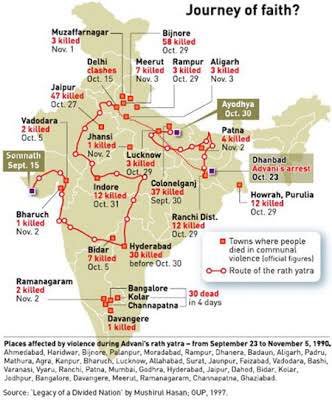
L.K. ADVANI ON the Somnath-Ayodhya rath yatra of 1991. Sixteen years later, the BJP apparently hopes Ram Sethu will yield the same political mileage as Ram temple.
In fact, myths also represent reality but represent it symbolically and metaphorically. Yet, myth masks reality. Therefore, myths are illusory representations of man and his world. Given their illusory nature, myths may not help to unravel the historicity of an event. Most myths are in a way timeless. Nevertheless, myths being a reflection of reality constitute a source of historical reconstruction and a means to understanding reality. Given this overlap, myths are used for a variety of purposes. They often serve as an agency of legitimisation, as in the case of Parasurama reclaiming land from the sea. They may also be employed for explaining a natural phenomenon, as in the case of Helios’ chariot in Greek mythology.
The use of myths has been integral to the politics of the Sangh Parivar. Beginning with the movement for the construction of the temple at Ayodhya, the Sangh Parivar has been engaged in providing authenticity to various myths surrounding the life of Rama. The central issue of the Ayodhya movement was the identification of the exact birthplace of Rama, which was difficult to ascertain owing to the lack of evidence. Local tradition identifies Ayodhya through a popular myth, which runs as follows: “After Treta Yuga when Ram was supposed to have been born Ayodhya could not be located. While Vikramaditya was looking for Ayodhya, a saint told him to leave a calf loose and the place at which the calf secreted milk would be the place where Ayodhya was located. Vikramaditya did as he was told, and where the calf secreted milk he located Ayodhya.” This mythical story became the basis for the identification of Ayodhya as well as the birthplace of Rama.
In the accounts given by leaders of the Vishwa Hindu Parishad (VHP), the place of birth becomes an indisputable fact of history. Following this identification, the VHP accorded historical status to a series of myths. These include the existence of the Ram temple at the site of the Babri Masjid and the attempts by Hindus to reclaim the temple through 77 battles against the Muslims in which 300,000 sacrificed their lives. These myths have now become authentic histories; not only are they paraded as historical facts, they have found place in textbooks as authentic history. Over a period of time, many of these facts could become part of popular history also.
The politics of the Sangh Parivar is essentially irrational. The attempt to turn myth into history and to use it for political advantage is rooted in irrationality. Now that Ayodhya is no more a potent force, Ram Sethu has emerged as a possible alternative. The Sangh Parivar is gearing up to exploit it. Would the ruling establishment take a rational and scientific stand and not succumb to the fear of the irrational?
K.N. Panikkar, a former professor of history at Jawaharlal Nehru University and a former vice-chancellor of Sree Sankaracharya University of Sanskrit, is currently the chairman of the Kerala Council for Historical Research.
Sep. 22-Oct. 05, 2007
MYTH, HISTORY AND POLITICS
by K.N. Panikkar
Now that Ayodhya is no more a potent force, Ram Sethu has emerged as a possible alternative.
THE HINDU PHOTO LIBRARY
DECEMBER 6,1992. Kar sevaks atop the dome of the Babri Masjid at Ayodhya.
EVER since Ayodhya became a disputed territory, Rama has been at the centre stage of the political mobilisation by Hindu communal forces. The incidents associated with the Rama Katha were invoked one after the other to appeal to the religious sentiments of Hindus. It began with a claim to the birthplace of Rama at Ayodhya, around which Hindu religious sentiments were so aroused as to lead to the destruction of the Babri Masjid. In the movement culminating in this vandalism, several symbols linked with Rama such as Rama Jyoti, Rama Paduka and Rama Shila were floated.
Yet, over the years, the political appeal of Rama has waned despite his strong presence in the religious life of believers. The temple issue was indeed kept alive through occasional religious assemblies and demonstrations. Nevertheless, Rama ceased to be of much emotional value that would provide political advantage to Hindu communal forces. In the elections of 2004, the Ram temple did not figure as an issue at all. This can be taken as an indication that believers were inclined to abandon the Sangh Parivar’s aggressive Rama and return to worshipping his benign image, looking upon Rama Katha, as they had for centuries, as an “allegory of the life of the spirit as it journeyed through the world”.
Rama was almost lost to the political Hindu and was being resurrected to his rightful place in the religious life of believers. It is in this context that the Ram Sethu project has come in handy for the Sangh Parivar, to revive the appeal of Rama in order to breathe some life into its sagging fortunes. Once again the Parivar is bracing up to claim Rama for the communal cause. In the process it is attempting to turn myth into history, blurring the distinction between the two, in order to gain legitimacy for its political project.
The question of whether the Archaeological Survey of India (ASI) should have filed an affidavit in the Supreme Court denying the historical existence of Rama has led to differences of opinion. The government has hastened to disclaim the affidavit and withdraw it, obviously fearing a Hindu backlash. Unlike the Ayodhya issue, even the secular voice has been rather muted. However, implicit in the affidavit is an important question regarding our approach to the past: Is there a distinction between myth and history?
Mythic Character
The ASI, it appeared, was conscious of this distinction in projecting the mythological character of Rama. The distinction does not imply a counterposition of myth and history as false and true. Myth is a way in which the human mind comes to grips with reality, and therefore, it can be said that it refers to reality. Yet, myth in itself is not reality. What the ASI has tried to state is that Rama was not a historical figure but a mythic character.
Similarly, the Ramayana being a literary piece, which was not originally a religious text but only sacralised later, contains many events and incidents that are products of imagination. It would therefore be futile to try to correlate them with historical fact and establish their authenticity. Such a view is not in any way a denigration of Rama or a critical reflection on the Ramayana. The Ramayana’s literary quality, whether in the original Sanskrit or in regional languages, is well known. So are the ethical and moral values it foregrounds, which exercise considerable influence over the life of believers.
However, devotion to Rama and the influence of the epic have nothing to do with the historical veracity of Rama Katha. Devotees consider Rama an incarnation and do not test his deeds by the yardstick of historical truth. They are moved by their devotion and hardly approach the epic from a rational viewpoint or try to locate it historically. Whether the Ramayana is historically true or not is not a factor in their devotion. The Sangh Parivar has been trying for long to impute to incidents in the epic a historical quality to legitimise popular belief, under a false notion that belief would be reinforced by historical truth.
The panic reaction of the government in withdrawing the affidavit in effect endorses the Sangh Parivar’s attempt to equate myth with history. Like the Sangh Parivar, the government seems to subscribe to the view that ascribing mythic character to Rama and the Ramayana is to undermine their importance and to injure the sentiments of believers. It overlooks the fact that believers consider Rama an incarnation. Traditional religious sources represent him so. The Matsya Purana, for instance, gives the following account: “There is also the account of the pastimes of Lord Rama, spoken by Valmiki – an account originally related by Brahma in one billion verses. That Ramayana was later summarised by Narada and related by Valmiki, who then presented it to mankind.” What accounts for the devotion to Rama and the veneration of the Ramayana are not their historical veracity but their divinity.
Many Ramayanas
K. MURALI KUMAR
BHARATIYA JANATA PARTY workers at a rally in Bangalore on July 6, 2005, condemning the terrorist attack on the disputed Ram Janmabhoomi site at Ayodhya the previous day and the UPA government's security lapse.
In an attempt to attribute historical authenticity to the epic and its protagonist, the Sangh Parivar has been striving to privilege one single version of the Ramayana. But the Ramayana has several versions. It is difficult to ascertain the exact number as all of them are not written but are orally transmitted, both in India as well as in other Asian countries. A.K. Ramanujan has argued that these different “tellings” – a term he prefers to versions or variants as these imply an invariant or original text – differ from one another. They are not mere divergences from Valmiki’s rendering but entirely different tellings.
Highlighting the multivocal existence of Rama Katha, Paula Richman has drawn attention to the many Ramayanas, of which Valmiki’s composition is one, Tulsi’s another, Kamban’s another, the Buddhist Jataka yet another and the Jaina tradition yet another. Along with them, there are also innumerable folk narratives, extant not only in India but also in almost all the countries of Asia. They were not Valmiki’s Ramayana adapted to local conditions but substantially different from one another, both in form and content. In the Buddhist version, Rama and Sita are originally brother and sister, a fact that once aroused the ire of the Sangh Parivar.
Women’s folksongs from Andhra Pradesh challenge the accepted values of a male-dominated society by questioning the integrity of Rama and foregrounding the theme of the suffering that husbandly neglect causes a wife. Thus, the Rama Katha prevalent in different communities is vastly different and defies any attempt to identify a universally applicable text. All of them draw upon locally specific cultural traits, which impart to them a distinct character. Recent studies on different Rama Katha traditions demonstrate the different tellings of Rama’s story that vary with regional literary tradition, social location, gender, religious affiliation, colonial context, intended audience, and so on.
K.R. Srinivasa Iyengar’s edited work highlights the Asian variations of the Ramayana, and the essays in the volume edited by Avadesh Kumar Singh focus on the way the epic has found expression in regional languages. The many Ramayanas connote that the events and incidents in the different versions of the epic are not historical facts but mythical representations or literary imaginations. The debate on whether the Ramayana is a true story or whether Rama is a historical figure is, therefore, off the mark.
The issue of Ram Sethu requires to be situated in the general context of the mythological character of the Ramayana. The Sethu Bandhan encapsulates within it several qualities of Rama and the character of the epic. Sethu Bandhan was a humanly impossible task that was made possible only by the divine powers of Rama. The description of Sethu Bandhan in one version of the Ramayana is as follows: “During the first day of construction, monkeys laid a hundred and twenty miles of rocks, which floated upon the ocean. They worked very swiftly, and were happy to see the bridge take shape. The second day, they set down a hundred and sixty miles of rocks; the third day, a hundred and sixty-eight miles; and the fourth day, their strength increasing, they completed a hundred and seventy-six miles. On the fifth and final day, the monkeys constructed a hundred and eighty-four miles of bridge, up to Mount Suvala on the northern shore of Lanka. Thus when the bridge was finished, it was eighty miles wide and eight hundred miles long.”
Obviously, a vanar sena would not have achieved this feat. The question, however, is not its possibility or impossibility but how it enriches the mythical and divine quality of Rama. Obviously Sethu Bandhan is a myth.
But then, when myths become part of the belief system, they can be put to use for different purposes. Nobody in India has understood this better than the Sangh Parivar as is evident from the manner in which they have manipulated the myth and history of Ayodhya. Ram Sethu is an opportunity they are unlikely to let go of easily.
The distinction between history and myth is well recognised. Myths are in a way the opposite of historical facts, in the sense that, unlike historical facts, what constitutes a myth is not verifiable. Despite this, myths and history cannot be counterpoised as true and false.
THE HINDU PHOTO LIBRARY
L.K. ADVANI ON the Somnath-Ayodhya rath yatra of 1991. Sixteen years later, the BJP apparently hopes Ram Sethu will yield the same political mileage as Ram temple.
In fact, myths also represent reality but represent it symbolically and metaphorically. Yet, myth masks reality. Therefore, myths are illusory representations of man and his world. Given their illusory nature, myths may not help to unravel the historicity of an event. Most myths are in a way timeless. Nevertheless, myths being a reflection of reality constitute a source of historical reconstruction and a means to understanding reality. Given this overlap, myths are used for a variety of purposes. They often serve as an agency of legitimisation, as in the case of Parasurama reclaiming land from the sea. They may also be employed for explaining a natural phenomenon, as in the case of Helios’ chariot in Greek mythology.
The use of myths has been integral to the politics of the Sangh Parivar. Beginning with the movement for the construction of the temple at Ayodhya, the Sangh Parivar has been engaged in providing authenticity to various myths surrounding the life of Rama. The central issue of the Ayodhya movement was the identification of the exact birthplace of Rama, which was difficult to ascertain owing to the lack of evidence. Local tradition identifies Ayodhya through a popular myth, which runs as follows: “After Treta Yuga when Ram was supposed to have been born Ayodhya could not be located. While Vikramaditya was looking for Ayodhya, a saint told him to leave a calf loose and the place at which the calf secreted milk would be the place where Ayodhya was located. Vikramaditya did as he was told, and where the calf secreted milk he located Ayodhya.” This mythical story became the basis for the identification of Ayodhya as well as the birthplace of Rama.
In the accounts given by leaders of the Vishwa Hindu Parishad (VHP), the place of birth becomes an indisputable fact of history. Following this identification, the VHP accorded historical status to a series of myths. These include the existence of the Ram temple at the site of the Babri Masjid and the attempts by Hindus to reclaim the temple through 77 battles against the Muslims in which 300,000 sacrificed their lives. These myths have now become authentic histories; not only are they paraded as historical facts, they have found place in textbooks as authentic history. Over a period of time, many of these facts could become part of popular history also.
The politics of the Sangh Parivar is essentially irrational. The attempt to turn myth into history and to use it for political advantage is rooted in irrationality. Now that Ayodhya is no more a potent force, Ram Sethu has emerged as a possible alternative. The Sangh Parivar is gearing up to exploit it. Would the ruling establishment take a rational and scientific stand and not succumb to the fear of the irrational?
K.N. Panikkar, a former professor of history at Jawaharlal Nehru University and a former vice-chancellor of Sree Sankaracharya University of Sanskrit, is currently the chairman of the Kerala Council for Historical Research.
Government should have stood by ASI
(Frontline
Volume 24 - Issue 19 :: Sep. 22-Oct. 05, 2007)
‘Government should have stood by ASI’
T.K. RAJALAKSHMI
Interview with Suraj Bhan, former Professor of Archaeology, Kurukshetra University.
THE HINDU
The affidavit was based on a scientific understanding of history, says Suraj Bhan.
SURAJ Bhan, who taught archaeology at Kurukshetra University, is a member of the Central Advisory Board of Archaeology of the Archaeological Survey of India (ASI). He is the sectional president, Archaeology, Indian History Congress, and also the president of the Association of the Study of History and Archaeology. Currently a member of the Indian Council for Historical Research, he was part of a team of four scholars who participated in the dialogue convened by the Central government between representatives of the Babri Masjid Action Committee and the Vishwa Hindu Parishad. The team presented an independent report to the government. Very recently, he was called as a witness in the Allahabad High Court in a case relating to the excavation of the Babri Masjid-Ram Janmabhoomi site at Ayodhya.
Disappointed by the Centre’s decision to withdraw the ASI affidavit, which in his opinion was based on a scientific understanding, Suraj Bhan explained in an interview to Frontline why he thought the ASI had been wronged in this case for reasons of political expediency.
The ASI held that there was no scientific basis or rationale for the assertion that Adam’s Bridge had any historical significance and that the issue had to be approached in a scientific and rational manner. Do you think there was something wrong with its assertion and assessment?
There is no archaeological or geological evidence to support that there was a man-made bridge between Ceylon [Sri Lanka] and India. Whatever is seen in satellite photographs, [taken] both by NASA [National Aeronautics and Space Administration] and our own satellites, is an underwater ridge. In geological times, Ceylon and India were connected and later, probably as a result of continental drift, they got disconnected. This happened some 7,000 years ago, after which a channel appeared and the land link between the two islands disappeared. The ridge is there, and it is visible, and the colour of the water can be distinguished. At many places at the top of the ridge where it is not very deep, the water is not blue. Because of the effects of wave action, the top of the ridge looks softened and kind of flattish and appears to be a wide kind of a road. There is no historical evidence at all to say that a bridge was constructed between the island and the mainland. The rock below the water appears to a layman as a bridge and therefore the impression that it is Ram Sethu. Valmiki Ramayana was composed only after 400 B.C.; it is not all that early in history. There is no evidence to date any portion of the Ramayana before 400 B.C. Even Ayodhya, which is associated with the Ramayana, is not dated earlier than 700 B.C. Excavations by B.B. Lal have shown that the earliest settlement at Ayodhya was not before the seventh century B.C.
There was nothing wrong in the affidavit. The ASI had clearly stated that the formation known as Ram Sethu or Adam’s Bridge was not a man-made construction but rather a natural formation made up of shoals and sand bars, which owed their shape to years of wave action and sedimentation. As far as historicity is concerned, they referred to the fact that historically there was no evidence to attach the historicity of Ram with the Sethu, and that is factual.
Archaeological evidence is an important tool for determining the veracity of historical events. Why, then, was the ASI made to retract from its position?
The propaganda against the ASI’s affidavit is baseless. The government should not have withdrawn it as it was based on a scientific understanding of history. The ASI has been unnecessarily charged with hurting religious feelings. Archaeology has nothing to do with religion. It has to do with material evidence, which is simply not there in this case. Archaeology does not take positions for or against any religion. The issue has been twisted for political purposes, and it is unfortunate that the government succumbed to the propaganda. It should have taken a stand. The suspension of the two ASI officials is not justified at all. We are a secular state, the archaeologist is a scientist and archaeology a historical science.
How does archaeology strike a fine balance between faith and historical evidence, especially if an issue concerns a majority religious community?
Any science or scientific evidence can be twisted. There can be misuse of archaeology, too. In this case, if some people felt that the ASI was incorrect, then they should have relied on the geological evidence. There have been attempts to play around with archaeological evidence in the past as well. The question of a Ram temple existing at Ayodhya arose simply because some fragments of medieval temples dating to the 8th and 9th century A.D. were found scattered around the Ram Janmabhoomi site. But above these levels were found two monuments of Islamic character, which were between the Babri Masjid and the Rajput levels that showed that these Islamic constructions were made in the Sultanate period. This meant that the Babri Masjid did not lie directly above the Rajput period levels. But a propaganda was initiated, which went on for some time. When the first excavations were made by the ASI, these facts were buried. In fact, myth-making has been going on for some time with a few people going as far as to identify the Indus civilisation with that of the Aryans and viewing the available evidence out of context.
In Gujarat, in the excavations of Lothal, there was found a freshwater tank at the east of the town and the then excavator, in what was pure manipulation, tried to prove that it was the oldest dockyard in the world, and at that time the ASI accepted it. Fortunately, about Ram Sethu there is no such archaeological myth; it is a myth created by vested interests. The problem is that the ASI has allowed itself to be manipulated in the past, that is why it became possible for some sections to doubt its veracity.
Archaeology works as a scientific discipline. Archaeologists are scientists; they are not directly concerned with any religion, but if there are some people who have some faith about some material phenomenon, the archaeologist can verify whether it is man-made or not. But the archaeologist is not supposed to be concerned with religious sentiments when he/she is discussing the concerned material phenomena. They are neither believers nor non-believers. The scientist, historian and the archaeologist have to tell the truth irrespective of religious sentiments involved. The withdrawal of the affidavit by the government is a setback to the ASI. It is the political scene that does not allow scientists to work freely. Historians are not allowed to speak the truth especially if what they say is related to a king of some community or personalities associated with some faiths. This is a fascist approach where we want myths to be accepted by scientists. Everything becomes a sensitive issue; at the same time we desire freedom of expression as well. I really don’t know where all of this will lead to; this is like taking us back to the Puranic age.
Do you feel that the ASI is not competent to comment on the historical veracity of Ram Sethu or for that matter any other structure? Also, by withdrawing the affidavit, do you think that the government has questioned the credibility of its own institution and that of archaeology as a discipline?
The ASI is a major government department. It is expected to give authentic evidence, and it is also expected that the government of the day will ask the ASI as far as Ram Sethu is concerned. The ASI was asked its opinion, and it gave it by rightly stating that what is called Ram Sethu is not a man-made construction but an image of the ridge below the water that connects the mainland and the island.
The whole episode of withdrawing the affidavit has been demoralising for the scientific community. I repeat that the government should not have withdrawn the affidavit. It should have stood by the ASI as the latter did not defend or offend any religion. What it stated was borrowed from other scholars, and it is already well established that the characters in the Ramayana and the Mahabharata have not been established historically.
Volume 24 - Issue 19 :: Sep. 22-Oct. 05, 2007)
‘Government should have stood by ASI’
T.K. RAJALAKSHMI
Interview with Suraj Bhan, former Professor of Archaeology, Kurukshetra University.
THE HINDU
The affidavit was based on a scientific understanding of history, says Suraj Bhan.
SURAJ Bhan, who taught archaeology at Kurukshetra University, is a member of the Central Advisory Board of Archaeology of the Archaeological Survey of India (ASI). He is the sectional president, Archaeology, Indian History Congress, and also the president of the Association of the Study of History and Archaeology. Currently a member of the Indian Council for Historical Research, he was part of a team of four scholars who participated in the dialogue convened by the Central government between representatives of the Babri Masjid Action Committee and the Vishwa Hindu Parishad. The team presented an independent report to the government. Very recently, he was called as a witness in the Allahabad High Court in a case relating to the excavation of the Babri Masjid-Ram Janmabhoomi site at Ayodhya.
Disappointed by the Centre’s decision to withdraw the ASI affidavit, which in his opinion was based on a scientific understanding, Suraj Bhan explained in an interview to Frontline why he thought the ASI had been wronged in this case for reasons of political expediency.
The ASI held that there was no scientific basis or rationale for the assertion that Adam’s Bridge had any historical significance and that the issue had to be approached in a scientific and rational manner. Do you think there was something wrong with its assertion and assessment?
There is no archaeological or geological evidence to support that there was a man-made bridge between Ceylon [Sri Lanka] and India. Whatever is seen in satellite photographs, [taken] both by NASA [National Aeronautics and Space Administration] and our own satellites, is an underwater ridge. In geological times, Ceylon and India were connected and later, probably as a result of continental drift, they got disconnected. This happened some 7,000 years ago, after which a channel appeared and the land link between the two islands disappeared. The ridge is there, and it is visible, and the colour of the water can be distinguished. At many places at the top of the ridge where it is not very deep, the water is not blue. Because of the effects of wave action, the top of the ridge looks softened and kind of flattish and appears to be a wide kind of a road. There is no historical evidence at all to say that a bridge was constructed between the island and the mainland. The rock below the water appears to a layman as a bridge and therefore the impression that it is Ram Sethu. Valmiki Ramayana was composed only after 400 B.C.; it is not all that early in history. There is no evidence to date any portion of the Ramayana before 400 B.C. Even Ayodhya, which is associated with the Ramayana, is not dated earlier than 700 B.C. Excavations by B.B. Lal have shown that the earliest settlement at Ayodhya was not before the seventh century B.C.
There was nothing wrong in the affidavit. The ASI had clearly stated that the formation known as Ram Sethu or Adam’s Bridge was not a man-made construction but rather a natural formation made up of shoals and sand bars, which owed their shape to years of wave action and sedimentation. As far as historicity is concerned, they referred to the fact that historically there was no evidence to attach the historicity of Ram with the Sethu, and that is factual.
Archaeological evidence is an important tool for determining the veracity of historical events. Why, then, was the ASI made to retract from its position?
The propaganda against the ASI’s affidavit is baseless. The government should not have withdrawn it as it was based on a scientific understanding of history. The ASI has been unnecessarily charged with hurting religious feelings. Archaeology has nothing to do with religion. It has to do with material evidence, which is simply not there in this case. Archaeology does not take positions for or against any religion. The issue has been twisted for political purposes, and it is unfortunate that the government succumbed to the propaganda. It should have taken a stand. The suspension of the two ASI officials is not justified at all. We are a secular state, the archaeologist is a scientist and archaeology a historical science.
How does archaeology strike a fine balance between faith and historical evidence, especially if an issue concerns a majority religious community?
Any science or scientific evidence can be twisted. There can be misuse of archaeology, too. In this case, if some people felt that the ASI was incorrect, then they should have relied on the geological evidence. There have been attempts to play around with archaeological evidence in the past as well. The question of a Ram temple existing at Ayodhya arose simply because some fragments of medieval temples dating to the 8th and 9th century A.D. were found scattered around the Ram Janmabhoomi site. But above these levels were found two monuments of Islamic character, which were between the Babri Masjid and the Rajput levels that showed that these Islamic constructions were made in the Sultanate period. This meant that the Babri Masjid did not lie directly above the Rajput period levels. But a propaganda was initiated, which went on for some time. When the first excavations were made by the ASI, these facts were buried. In fact, myth-making has been going on for some time with a few people going as far as to identify the Indus civilisation with that of the Aryans and viewing the available evidence out of context.
In Gujarat, in the excavations of Lothal, there was found a freshwater tank at the east of the town and the then excavator, in what was pure manipulation, tried to prove that it was the oldest dockyard in the world, and at that time the ASI accepted it. Fortunately, about Ram Sethu there is no such archaeological myth; it is a myth created by vested interests. The problem is that the ASI has allowed itself to be manipulated in the past, that is why it became possible for some sections to doubt its veracity.
Archaeology works as a scientific discipline. Archaeologists are scientists; they are not directly concerned with any religion, but if there are some people who have some faith about some material phenomenon, the archaeologist can verify whether it is man-made or not. But the archaeologist is not supposed to be concerned with religious sentiments when he/she is discussing the concerned material phenomena. They are neither believers nor non-believers. The scientist, historian and the archaeologist have to tell the truth irrespective of religious sentiments involved. The withdrawal of the affidavit by the government is a setback to the ASI. It is the political scene that does not allow scientists to work freely. Historians are not allowed to speak the truth especially if what they say is related to a king of some community or personalities associated with some faiths. This is a fascist approach where we want myths to be accepted by scientists. Everything becomes a sensitive issue; at the same time we desire freedom of expression as well. I really don’t know where all of this will lead to; this is like taking us back to the Puranic age.
Do you feel that the ASI is not competent to comment on the historical veracity of Ram Sethu or for that matter any other structure? Also, by withdrawing the affidavit, do you think that the government has questioned the credibility of its own institution and that of archaeology as a discipline?
The ASI is a major government department. It is expected to give authentic evidence, and it is also expected that the government of the day will ask the ASI as far as Ram Sethu is concerned. The ASI was asked its opinion, and it gave it by rightly stating that what is called Ram Sethu is not a man-made construction but an image of the ridge below the water that connects the mainland and the island.
The whole episode of withdrawing the affidavit has been demoralising for the scientific community. I repeat that the government should not have withdrawn the affidavit. It should have stood by the ASI as the latter did not defend or offend any religion. What it stated was borrowed from other scholars, and it is already well established that the characters in the Ramayana and the Mahabharata have not been established historically.
September 27, 2007
Where fusion cannot work -- faith and history
(The Hindu
September 28, 2007)
Where fusion cannot work — faith and history
by Romila Thapar
Faith and history have been brought into conflict once again by being forced to jointly occupy the same public space in contemporary India. In effect, there should be no conflict if it is recognised that the two are irreconcilable and that they cannot be fused together. They are independent of each other. Their premises, their methods of enquiry, and their formulations are dissimilar. So instead of trying to conflate them, it might be better to concede the difference and m aintain the distance.
When historians speak of the historicity of person, place, or event, they require evidence — singular or plural — that proves the existence of any of these and this evidence is based on data relating to space and time. The two important spaces in the Valmiki Ramayana are Ayodhya and Lanka, on the location of which scholarly opinion differs.
The location of Lanka, for example, has been disputed by Indian scholars for the past century and remains unidentified with any certainty. Some have located it in the Vindhyas — in Amarkantak or in Chota Nagpur — and others in the Mahanadi delta. The identification with present day Sri Lanka is problematic. The earliest name for Ceylon judging by Indian and Greek and Latin references of the Mauryan and post-Mauryan period was Tamraparni (Taprobane in Greek). Ashoka in the third century BC, in one of his edicts, mentions Tamraparni as on the frontier. Later, the more commonly used name was Sinhala or Sinhala-dvipa, (Silam or Sieledib in Greek). It would seem that the name Lanka was a later adoption of the centuries AD.
This becomes puzzling for the historian. If Valmiki was referring to Ceylon, then the name should have been the one by which the island was known, either Tamraparni or else Sinhala, at the time of his composition. But since the name used is Lanka, which at this time appears not to have been the name for Ceylon, then perhaps Lanka was located elsewhere. The location of the Ram Setu would have to be reconsidered. This has been suggested by scholars who have argued that the setu was more likely located in a small expanse of water in central India and not in the Palk Straits. Nor is the setu referred to in every version of the story. Alternatively, if Lanka in the text is a reference to Ceylon, then the composition of the Valmiki poem would have to be dated to a later period when the island came to be called Lanka. All this uncertainty is quite apart from the question of the technical viability of building a bridge across a wide stretch of sea in the centuries BC.
It is said that the Ram Setu is cultural heritage and therefore cannot be destroyed even if it is a natural geological formation and not man-made. Has the idea become the heritage? To search for a non-existent man-made structure takes away from the imaginative leap of a fantasy and denies the fascinating layering of folk-lore. It would be more appropriate to recognise the undersea formations in the Palk Straits as a natural heritage and protect the relevant areas. We pay no attention to the fact that such marine parks are as important to our ecological future as those visible on the landscape.
That Rama is central to variant versions of the story is, in itself, not evidence of historicity. If the variants contradict each other as they do, this may create problems for those who believe that only one of the variants is true. But multiple variants enrich the interest of historical and comparative analyses in assessing the degree to which each approximates, if at all, to the historical past or what the divergence symbolises.
The two closest in time to the Valmiki are the Buddhist and Jaina variants. The Buddhist version in the Dasaratha Jataka differs entirely from the Valmiki. Rama is the son of the raja of Varanasi; exile is to the Himalayas; and there is no kidnapping of Sita by Ravana.
The earliest of many Jaina versions, the Padmacharita of Vimalasuri, dating to the centuries AD, contradicts all earlier versions and states that it is doing so in order to present the correct version of what happened. It differs substantially from the Valmiki narrative. Ravana is not a demonic villain but a human counter-hero. It presents the story in the conceptual framework of Jainism.
These other versions might be objected to or dismissed by the person who has faith in the Valmiki version since the other versions differ. What is of interest to the historian is not the number of variant versions, which is impressively large, but why major changes were introduced into these.
This does not happen with the biographies of those who were known to be historical figures and who founded belief systems: the Buddha, Jesus Christ, Mohammad. Their biographies adhere largely to a single story-line and this helps to endorse the ‘official’ narrative of their life. Their existence is recorded in other sources as well that are not just narratives of their lives but have diverse associations. The historicity of the Buddha, for example, is established, among other things, by the fact that a couple of centuries after he died, the emperor Ashoka on a visit to Lumbini had a pillar erected to commemorate the Buddha’s place of birth. This is recorded in an inscription on the pillar.
If the current debate had grown from a genuine sense of enquiry, historians might have participated. Human activity has a historical context and this is open to historical comment. But it is only too evident that the issue of the Ram Setu has become a matter of political strategy on the part of those who are mobilising in the name of faith, and on the part of those who are reacting to the mobilisation. From the point of view of archaeology and history, the Archaeological Survey of India was correct in stating that there is to date no evidence to conclusively prove the historicity of Rama. The annulling of this statement was also a political act. Reliably proven evidence is of the utmost significance to history but not so to faith. Blasphemy does not lie in doubting historicity.
The historian is not required to pronounce on the legitimacy of faith. But the historian can try and explain the historical context to why, in a particular space and time, a particular faith acquires support. And we need to remind ourselves that our heritage has been constantly enriched not just by those of faith but also by those who contend with faith.
If there is a strong faith — in the religious sense — among millions of people, then it does not require to be protected through massive demonstrations and the killing of innocent persons, through political mobilisation. Nor do archaeology and history have to be brought in to keep that faith intact. Faith finds its own place and function, as do archaeology and history. And the place and function of each is separate.
To say that the partial removal of an underwater formation in the Palk Straits is going to hurt the faith of millions is not giving faith its due. Is faith so fragile that it requires the support of an underwater geological formation believed to have been constructed by a deity? Making faith into a political issue in order to win elections is surely offensive to faith?
What is at issue is not whether Rama existed or not, or whether the underwater formation or a part of it was originally a bridge constructed at his behest. What is at issue is a different and crucial set of questions that require neither faith nor archaeology but require intelligent expertise: questions that are being wilfully diverted by bringing in faith. Will the removal of a part of the natural formation eventually cause immense ecological damage and leave the coasts of south India and Sri Lanka open to catastrophes, to potential tsunamis in the future? Or can it be so planned that such a potentiality is avoided?
What would be the economic benefits of such a scheme in enhancing communication and exchange? Would the benefits reach out to local communities and if so, how? Equally important, one would like to know precisely what role will be played by the multinational corporations and their associates in India. Who will finance and control the various segments of such an immense project? It is only when such details are made transparent that we will also get some clues to the subterranean activities that are doubtless already simmering. These are the questions that should be asked of this project and that at this point in time should be occupying public space.
(Romila Thapar is a distinguished historian of ancient India. She is the author of several books, including Asoka and the Decline of the Mauryas, 1961; A History of India: Volume I, 1966; Early India: From the Origins to AD 1300, 2002; and Somanatha: The Many Voices of History, 2005. An expanded version of this article will be published in Economic and Political Weekly, 29 September 2007.)
September 28, 2007)
Where fusion cannot work — faith and history
by Romila Thapar
Faith and history have been brought into conflict once again by being forced to jointly occupy the same public space in contemporary India. In effect, there should be no conflict if it is recognised that the two are irreconcilable and that they cannot be fused together. They are independent of each other. Their premises, their methods of enquiry, and their formulations are dissimilar. So instead of trying to conflate them, it might be better to concede the difference and m aintain the distance.
When historians speak of the historicity of person, place, or event, they require evidence — singular or plural — that proves the existence of any of these and this evidence is based on data relating to space and time. The two important spaces in the Valmiki Ramayana are Ayodhya and Lanka, on the location of which scholarly opinion differs.
The location of Lanka, for example, has been disputed by Indian scholars for the past century and remains unidentified with any certainty. Some have located it in the Vindhyas — in Amarkantak or in Chota Nagpur — and others in the Mahanadi delta. The identification with present day Sri Lanka is problematic. The earliest name for Ceylon judging by Indian and Greek and Latin references of the Mauryan and post-Mauryan period was Tamraparni (Taprobane in Greek). Ashoka in the third century BC, in one of his edicts, mentions Tamraparni as on the frontier. Later, the more commonly used name was Sinhala or Sinhala-dvipa, (Silam or Sieledib in Greek). It would seem that the name Lanka was a later adoption of the centuries AD.
This becomes puzzling for the historian. If Valmiki was referring to Ceylon, then the name should have been the one by which the island was known, either Tamraparni or else Sinhala, at the time of his composition. But since the name used is Lanka, which at this time appears not to have been the name for Ceylon, then perhaps Lanka was located elsewhere. The location of the Ram Setu would have to be reconsidered. This has been suggested by scholars who have argued that the setu was more likely located in a small expanse of water in central India and not in the Palk Straits. Nor is the setu referred to in every version of the story. Alternatively, if Lanka in the text is a reference to Ceylon, then the composition of the Valmiki poem would have to be dated to a later period when the island came to be called Lanka. All this uncertainty is quite apart from the question of the technical viability of building a bridge across a wide stretch of sea in the centuries BC.
It is said that the Ram Setu is cultural heritage and therefore cannot be destroyed even if it is a natural geological formation and not man-made. Has the idea become the heritage? To search for a non-existent man-made structure takes away from the imaginative leap of a fantasy and denies the fascinating layering of folk-lore. It would be more appropriate to recognise the undersea formations in the Palk Straits as a natural heritage and protect the relevant areas. We pay no attention to the fact that such marine parks are as important to our ecological future as those visible on the landscape.
That Rama is central to variant versions of the story is, in itself, not evidence of historicity. If the variants contradict each other as they do, this may create problems for those who believe that only one of the variants is true. But multiple variants enrich the interest of historical and comparative analyses in assessing the degree to which each approximates, if at all, to the historical past or what the divergence symbolises.
The two closest in time to the Valmiki are the Buddhist and Jaina variants. The Buddhist version in the Dasaratha Jataka differs entirely from the Valmiki. Rama is the son of the raja of Varanasi; exile is to the Himalayas; and there is no kidnapping of Sita by Ravana.
The earliest of many Jaina versions, the Padmacharita of Vimalasuri, dating to the centuries AD, contradicts all earlier versions and states that it is doing so in order to present the correct version of what happened. It differs substantially from the Valmiki narrative. Ravana is not a demonic villain but a human counter-hero. It presents the story in the conceptual framework of Jainism.
These other versions might be objected to or dismissed by the person who has faith in the Valmiki version since the other versions differ. What is of interest to the historian is not the number of variant versions, which is impressively large, but why major changes were introduced into these.
This does not happen with the biographies of those who were known to be historical figures and who founded belief systems: the Buddha, Jesus Christ, Mohammad. Their biographies adhere largely to a single story-line and this helps to endorse the ‘official’ narrative of their life. Their existence is recorded in other sources as well that are not just narratives of their lives but have diverse associations. The historicity of the Buddha, for example, is established, among other things, by the fact that a couple of centuries after he died, the emperor Ashoka on a visit to Lumbini had a pillar erected to commemorate the Buddha’s place of birth. This is recorded in an inscription on the pillar.
If the current debate had grown from a genuine sense of enquiry, historians might have participated. Human activity has a historical context and this is open to historical comment. But it is only too evident that the issue of the Ram Setu has become a matter of political strategy on the part of those who are mobilising in the name of faith, and on the part of those who are reacting to the mobilisation. From the point of view of archaeology and history, the Archaeological Survey of India was correct in stating that there is to date no evidence to conclusively prove the historicity of Rama. The annulling of this statement was also a political act. Reliably proven evidence is of the utmost significance to history but not so to faith. Blasphemy does not lie in doubting historicity.
The historian is not required to pronounce on the legitimacy of faith. But the historian can try and explain the historical context to why, in a particular space and time, a particular faith acquires support. And we need to remind ourselves that our heritage has been constantly enriched not just by those of faith but also by those who contend with faith.
If there is a strong faith — in the religious sense — among millions of people, then it does not require to be protected through massive demonstrations and the killing of innocent persons, through political mobilisation. Nor do archaeology and history have to be brought in to keep that faith intact. Faith finds its own place and function, as do archaeology and history. And the place and function of each is separate.
To say that the partial removal of an underwater formation in the Palk Straits is going to hurt the faith of millions is not giving faith its due. Is faith so fragile that it requires the support of an underwater geological formation believed to have been constructed by a deity? Making faith into a political issue in order to win elections is surely offensive to faith?
What is at issue is not whether Rama existed or not, or whether the underwater formation or a part of it was originally a bridge constructed at his behest. What is at issue is a different and crucial set of questions that require neither faith nor archaeology but require intelligent expertise: questions that are being wilfully diverted by bringing in faith. Will the removal of a part of the natural formation eventually cause immense ecological damage and leave the coasts of south India and Sri Lanka open to catastrophes, to potential tsunamis in the future? Or can it be so planned that such a potentiality is avoided?
What would be the economic benefits of such a scheme in enhancing communication and exchange? Would the benefits reach out to local communities and if so, how? Equally important, one would like to know precisely what role will be played by the multinational corporations and their associates in India. Who will finance and control the various segments of such an immense project? It is only when such details are made transparent that we will also get some clues to the subterranean activities that are doubtless already simmering. These are the questions that should be asked of this project and that at this point in time should be occupying public space.
(Romila Thapar is a distinguished historian of ancient India. She is the author of several books, including Asoka and the Decline of the Mauryas, 1961; A History of India: Volume I, 1966; Early India: From the Origins to AD 1300, 2002; and Somanatha: The Many Voices of History, 2005. An expanded version of this article will be published in Economic and Political Weekly, 29 September 2007.)
Ram Setu: UPA’s Embarrassing Chapter
(Navhind Times
September 27, 2007)
Ram Setu: UPA’s Embarrassing Chapter
by Praful Bidwai
THE retreat beaten by the United Progressive Alliance on the Ram Setu or Adam’s Bridge controversy pertaining to the Setusamudram ship canal project will go down as one of the most embarrassing chapters of its tenure. Having told the Supreme Court through an affidavit filed by the Archaeological Survey of India (ASI) that there is no clinching evidence to prove that the shoal/sandbar structure in the Palk Strait is man-made, it executed a 180-degree turn as soon as it sensed that the Vishwa Hindu Parishad and Bharatiya Janata Party might cynically exploit the issue by misconstruing the affidavit’s contents as “an insult to the Hindu community”.
The retreat began just one hour after Mr LK Advani registered a protest with the Prime Minister, Dr Manmohan Singh during a dinner for a visiting dignitary. The thrust of the Sangh Parivar’s criticism of the affidavit is that it denies the existence of Ram and constitutes “blasphemy” and an “insult to the Hindus”. As Mr Advani put it, “The government has sought to negate all that the Hindus consider sacred … and wounded the very idea of India.”
Some secular liberals too described the affidavit as overreaching, excessive or tactless because it goes beyond saying that the Ram Setu is a natural formation, and comments on the historicity of sacred texts like the Ramayana and Tulasidas’s ‘Ramacharitamanas’. The dominant media spin was also that the ASI ignored religious sentiments by “denying Ram’s existence”.
However, a close look at the affidavit shows that it merely rejects the proposition that such texts and scriptures constitute an incontrovertible historical record which proves that the Ram Setu is a man-made structure, or establishes the existence of the “characters” or “events” they refer to. The ASI was compelled to say this because the petitioners (who oppose the Sethusamudram project) relied primarily on the Ramayana and ‘Ramacharitamanas’ as clinching evidence that the Setu was built under Lord Rama’s instructions by an army of monkeys.
Leaving that contention unrefuted would have meant giving in to the idea that faith must always trump history, archaeology, even geology—which explains the existence of special natural formations like Adam’s Bridge—, and accepting that the project must be scrapped for reasons grounded in myths and scriptures, not fact.
Yet, the affidavit is extremely deferential and sensitive to the texts’ religious significance: “The ASI is aware of and duly respects the deep religious import bestowed upon these texts by the Hindu community across the globe…” But it argues that no material evidence, such as human remains, inscriptions, monuments or other artefacts, has been discovered at the site, which would corroborate the mythological account.
A three-year study by the Geological Survey of India around Rameswaram and Adam’s Bridge, based on drilling holes into the submerged rock, also found “no evidence” of man-made structures. Rather, it revealed three distinct cycles of sedimentation of clay, limestone and sandstone. According to geologists at the Centre for Earth Sciences at Thiruvananthapuram, the sedimentation was a natural phenomenon: “a man-made process cannot put clay, limestone and sandstone in sequence.” The phenomenon took place thousands of years before any human settlement in peninsular India.
Historians concur with this. Indeed, they cannot even agree on the likely dates for the events described in the Ramayana. Besides, the Ramayana has multiple versions; new stories and legends were added to it over many centuries. The Setu cannot be considered a historical reality because material or archaeological evidence to authenticate its alleged origins has not been found.
The ASI succinctly summarised all these facts. It could perhaps have been even more diplomatic in wording its affidavit than it was. But it’s extremely doubtful if that would have satisfied those opposing the project on grounds that aren’t amenable to reason, or to historical or scientific debate.
Yet, the mere threat of an agitation by the Sangh Parivar against the “pseudo-secularism” of the UPA so unnerved the government than it abjectly and unthinkingly apologised. The Union Law Minister, Mr H R Bharadwaj said, “Lord Rama is an integral part of Indian culture and ethos … and cannot be a matter of debate or of litigation… His existence can’t be put to the test…The whole world exists because of Rama ..”
It’s worth recalling that it’s the same Mr Bhardwaj who was Minister of State for Law in the mid-1980s, and who advised Rajiv Gandhi to commit two acts of “appeasement” within one month: first, open the gates of the Babri masjid and trigger a viciously communal mobilisation, and second, amend laws effectively to annul the Shah Bano verdict. These disastrous moves alienated the Congress from both communities, strengthened Hindutva as never before, and ensured the BJP’s meteoric rise from a mere 2 Lok Sabha seats in 1984 to 89 in 1989. The rest is history.
Last fortnight too, the UPA cravenly capitulated to the VHP-BJP’s bullying, without as much as making even token criticism of their stance or their gross distortion of the ASI affidavit. Instead, it instantly started looking for scapegoats within—the ASI, its senior directors, ministry of culture, Ms Ambika Soni—without remotely affirming the affidavit’s secular basis. All that had happened for the UPA to change its mind was just a few VHP marches on one day!
The UPA’s disgraceful U-turn buoyed up the Sangh Parivar. Perhaps many secular liberals felt relieved that the UPA had quickly defused the gathering crisis by withdrawing the ASI affidavit, thus preventing another hysterical mobilisation on a religious-political issue. Whatever the reason, such passivity doesn’t bode well for Indian society.
Three broad conclusions should be drawn from this episode. First, it demonstrates the weak-kneed character of the UPA’s response to majoritarian communalism rather than the strength of the popular sentiment on the Ram Setu issue, which is, if anything, diffuse and unfocused. The UPA simply didn’t have the stomach to assert the relevant scientific-historical arguments in self-defence. It just caved in to the Sangh Parivar’s pressure. In the process, it legitimised the communal claim that there is an overwhelming “Hindu sentiment” on the Ram Setu.
In reality, the Hindus are an extraordinarily complex, large and diverse community. The myths and legends which it accepts about Rama and Ravana differ widely not just between the North and the South, but within different regions too. In any case, one doesn’t have to believe in the historicity of the Setu to be a good practising Hindu.
Second, it’s simply false to argue that Indian secularism has to be rooted in the culture of the religious majority to be authentic and acceptable, and that such culture must include myths and legends or particular scriptures, while excluding archaeology, history and science. Secularism involves a basic separation of religion and politics. In the Indian case, secularism derives as much from a universal notion of citizenship cutting across religious lines, as from the imperative of tolerance and inter-communal harmony.
Finally, the UPA through its capitulation has violated the Constitutional mandate to uphold secular values and not to privilege a particular religion or the belief systems of some of its adherents. This mandate is part of the basic structure of the Constitution. It dictates that decisions about development projects should be taken on social, environmental and economic grounds, not on mythological ones.
Each time the Indian state bends to fundamentalist or communal pressure, it compromises itself, and allows public reason to be trumped by religious belief or private prejudice. This is unbecoming of a society that aspires to modernity, tolerance and pluralism.
September 27, 2007)
Ram Setu: UPA’s Embarrassing Chapter
by Praful Bidwai
THE retreat beaten by the United Progressive Alliance on the Ram Setu or Adam’s Bridge controversy pertaining to the Setusamudram ship canal project will go down as one of the most embarrassing chapters of its tenure. Having told the Supreme Court through an affidavit filed by the Archaeological Survey of India (ASI) that there is no clinching evidence to prove that the shoal/sandbar structure in the Palk Strait is man-made, it executed a 180-degree turn as soon as it sensed that the Vishwa Hindu Parishad and Bharatiya Janata Party might cynically exploit the issue by misconstruing the affidavit’s contents as “an insult to the Hindu community”.
The retreat began just one hour after Mr LK Advani registered a protest with the Prime Minister, Dr Manmohan Singh during a dinner for a visiting dignitary. The thrust of the Sangh Parivar’s criticism of the affidavit is that it denies the existence of Ram and constitutes “blasphemy” and an “insult to the Hindus”. As Mr Advani put it, “The government has sought to negate all that the Hindus consider sacred … and wounded the very idea of India.”
Some secular liberals too described the affidavit as overreaching, excessive or tactless because it goes beyond saying that the Ram Setu is a natural formation, and comments on the historicity of sacred texts like the Ramayana and Tulasidas’s ‘Ramacharitamanas’. The dominant media spin was also that the ASI ignored religious sentiments by “denying Ram’s existence”.
However, a close look at the affidavit shows that it merely rejects the proposition that such texts and scriptures constitute an incontrovertible historical record which proves that the Ram Setu is a man-made structure, or establishes the existence of the “characters” or “events” they refer to. The ASI was compelled to say this because the petitioners (who oppose the Sethusamudram project) relied primarily on the Ramayana and ‘Ramacharitamanas’ as clinching evidence that the Setu was built under Lord Rama’s instructions by an army of monkeys.
Leaving that contention unrefuted would have meant giving in to the idea that faith must always trump history, archaeology, even geology—which explains the existence of special natural formations like Adam’s Bridge—, and accepting that the project must be scrapped for reasons grounded in myths and scriptures, not fact.
Yet, the affidavit is extremely deferential and sensitive to the texts’ religious significance: “The ASI is aware of and duly respects the deep religious import bestowed upon these texts by the Hindu community across the globe…” But it argues that no material evidence, such as human remains, inscriptions, monuments or other artefacts, has been discovered at the site, which would corroborate the mythological account.
A three-year study by the Geological Survey of India around Rameswaram and Adam’s Bridge, based on drilling holes into the submerged rock, also found “no evidence” of man-made structures. Rather, it revealed three distinct cycles of sedimentation of clay, limestone and sandstone. According to geologists at the Centre for Earth Sciences at Thiruvananthapuram, the sedimentation was a natural phenomenon: “a man-made process cannot put clay, limestone and sandstone in sequence.” The phenomenon took place thousands of years before any human settlement in peninsular India.
Historians concur with this. Indeed, they cannot even agree on the likely dates for the events described in the Ramayana. Besides, the Ramayana has multiple versions; new stories and legends were added to it over many centuries. The Setu cannot be considered a historical reality because material or archaeological evidence to authenticate its alleged origins has not been found.
The ASI succinctly summarised all these facts. It could perhaps have been even more diplomatic in wording its affidavit than it was. But it’s extremely doubtful if that would have satisfied those opposing the project on grounds that aren’t amenable to reason, or to historical or scientific debate.
Yet, the mere threat of an agitation by the Sangh Parivar against the “pseudo-secularism” of the UPA so unnerved the government than it abjectly and unthinkingly apologised. The Union Law Minister, Mr H R Bharadwaj said, “Lord Rama is an integral part of Indian culture and ethos … and cannot be a matter of debate or of litigation… His existence can’t be put to the test…The whole world exists because of Rama ..”
It’s worth recalling that it’s the same Mr Bhardwaj who was Minister of State for Law in the mid-1980s, and who advised Rajiv Gandhi to commit two acts of “appeasement” within one month: first, open the gates of the Babri masjid and trigger a viciously communal mobilisation, and second, amend laws effectively to annul the Shah Bano verdict. These disastrous moves alienated the Congress from both communities, strengthened Hindutva as never before, and ensured the BJP’s meteoric rise from a mere 2 Lok Sabha seats in 1984 to 89 in 1989. The rest is history.
Last fortnight too, the UPA cravenly capitulated to the VHP-BJP’s bullying, without as much as making even token criticism of their stance or their gross distortion of the ASI affidavit. Instead, it instantly started looking for scapegoats within—the ASI, its senior directors, ministry of culture, Ms Ambika Soni—without remotely affirming the affidavit’s secular basis. All that had happened for the UPA to change its mind was just a few VHP marches on one day!
The UPA’s disgraceful U-turn buoyed up the Sangh Parivar. Perhaps many secular liberals felt relieved that the UPA had quickly defused the gathering crisis by withdrawing the ASI affidavit, thus preventing another hysterical mobilisation on a religious-political issue. Whatever the reason, such passivity doesn’t bode well for Indian society.
Three broad conclusions should be drawn from this episode. First, it demonstrates the weak-kneed character of the UPA’s response to majoritarian communalism rather than the strength of the popular sentiment on the Ram Setu issue, which is, if anything, diffuse and unfocused. The UPA simply didn’t have the stomach to assert the relevant scientific-historical arguments in self-defence. It just caved in to the Sangh Parivar’s pressure. In the process, it legitimised the communal claim that there is an overwhelming “Hindu sentiment” on the Ram Setu.
In reality, the Hindus are an extraordinarily complex, large and diverse community. The myths and legends which it accepts about Rama and Ravana differ widely not just between the North and the South, but within different regions too. In any case, one doesn’t have to believe in the historicity of the Setu to be a good practising Hindu.
Second, it’s simply false to argue that Indian secularism has to be rooted in the culture of the religious majority to be authentic and acceptable, and that such culture must include myths and legends or particular scriptures, while excluding archaeology, history and science. Secularism involves a basic separation of religion and politics. In the Indian case, secularism derives as much from a universal notion of citizenship cutting across religious lines, as from the imperative of tolerance and inter-communal harmony.
Finally, the UPA through its capitulation has violated the Constitutional mandate to uphold secular values and not to privilege a particular religion or the belief systems of some of its adherents. This mandate is part of the basic structure of the Constitution. It dictates that decisions about development projects should be taken on social, environmental and economic grounds, not on mythological ones.
Each time the Indian state bends to fundamentalist or communal pressure, it compromises itself, and allows public reason to be trumped by religious belief or private prejudice. This is unbecoming of a society that aspires to modernity, tolerance and pluralism.
Crossing the Sethu Rubicon
(The New Indian Express
September 26, 2007)
Crossing the Sethu Rubicon
by P Radhakrishnan
The ongoing controversy and hullabaloo over the alignment cutting across the Adam's Bridge-Ramar Sethu - the undersea ridge between Rameswaram and the Sri Lankan coast ˜ in the Sethusamudram Shipping Channel Project (SSCP) is the latest in a series which should raise a number of issues about the nexus between faith and politics, and its fallout for development. Of these at least seven are relevant not only in the context of the Ramar-Sethu row but also in other contexts where faith is often a bogey for diversionary politics and short-term political gains.
One, in a country where democracy and secularism are still nascent in the minds of its unwashed millions and pale before faith, what the pillars of democracy - legislature, executive, and judiciary - the intelligentsia as a class, and the media at large should do is to wean people away from peripheral and superficial aspects of faith, and faithbased politics through systematic inculcation of and pragmatic approach to diversity and development.
It is our failure to do this that caused demolition of the Babri Masjid on December 6, 1992. In retrospect many of us would admit that the demolition could have been averted if we had a parliament (central legislature) which was not made up at that time ˜ as it is to a large extent even today - of politicians who carried their faith ˜ inevitably a cultural baggage - only within themselves as a personal matter. That is precisely how the politicians could be edifying to the masses and tell them about faith "thus far, no further", that is faith is essentially a personal matter which should have no spill over and spin off effects in public spaces and should not be a matter of public insignia.
The same could be said about our judiciary which has on occasions digressed instead of trying to bring to bear upon itself pragmatic secularism, secularist pragmatism, and secular and rational humanism as hallmarks of a secular judiciary. The recent pronouncement by a high court judge in his judgment that Bhagavad Gita should be made the national Dharmashastra, which caused a furore in different parts of the country, is only part of a longer story.
The same is true of the executive: the demolition was the culmination of the drifting and dithering of the Narasimha Rao government. If the media was sensational then it is more so now on its incessant pursuit of instant hype. More so when the younger generation of the media persons (in particular of the TV channels) has hardly any sense of history and society.
Two, as globalisation comes to mean development of material and human resources at a fast pace and turning technology itself into spiritualism, those developing countries which do not chant the globalisation mantra, adapt to its needs, pace, and rhythm, and harness resources for their own development, are bound to be left behind and even caught up in the eddy of a complex process of planetary dimensions. This means that we cannot afford anymore to live in the past and the present simultaneously, and if there are roadblocks on our path to development which are not of vital concern to the nation, we ought to remove them and keep going.
It is from this perspective that the Ramar-Sethu row should be understood. The issue is not one of faith but of development. Those who genuinely believe Rama as real, as divine, as an avatar, and who should continue to be revered and worshipped, already have a surfeit of sites and structures in different parts of the country. Even if Ram-Sethu was a creation or legacy of Rama, it is as archaic as Rama and is only peripheral in the scheme of divine things in modern social settings; no devotee has any access to it. In an age of lebensraum religious communities have begun to give up some of their traditional belief systems and related practices and reconcile to the needs of modernity. One example is Christianity, which has in principle accepted cremation as against burial for want of space, and in some places where cremation has not yet been adopted the practice of burial itself is undergoing different forms of change for making space to the new-comers. Another example is Islam. Some of the middle-east countries have not let mosques stand in the way of their development projects. A third example is Hinduism. For want of space sections of them who practised burial in the past have switched to cremation. However, as a country India is probably an exception where sites of faith hinder development. We have any number of such sites even in the highways and bye-ways, and even if these sites are unused and totally neglected for ages they are not removed for fear of communal orgy. Far from vouching for our democratic, diversity, pluralistic and secular credentials this clearly shows our lack of political and administrative will.
Three, if comprehensive feasibility studies have convinced the government that the SSCP will indeed contribute to national development and futuristic impact-assessment studies have convincingly shown that the project will have no adverse ecological, environmental, and social effects, the government should not feel hamstrung by cries of faith. If for some reason the feasibility and impact assessment studies have shown that the dredging is not worth the money being spent on it the government should not have undertaken it at all. But as of now we do not have adequate information on this.
Four, as the idea of dredging away the Ramar-Sethu dates back to the 1860s if not earlier, which got formally crystallised after India's independence, citizens have a right to know why the attempts since the 1950s at dredging did not materialise, why they were abandoned, and if they were abandoned what was the determining role of faith vs. feasibility.
Fifth, as the decision for dredging was taken during the NDA government at the Centre the BJP's sudden love of Rama in the sea-bed of Ravana is political chicanery at its worst.
Six, what was the role of the Archaeological Survey of India in a matter which is essentially in the realm of the Geological Survey of India? By involving the ASI the government itself has unwittingly given the Ramar-Sethu a heritage status and invited trouble.
Seven, in a development project such as the SSCP what should be the role of the judiciary? Should it stay the project merely because it has been petitioned, or should it have dismissed the petitions outright on grounds that in development projects conceived by the executive it will interfere only if there is flagrant interference with and violation of faith that too as an interpretation of the constitutional provisions concerning the right to belief and religion and not in the context of heritage?
The writer is senior professor of sociology at the Madras Institute of Development Studies, Chennai
September 26, 2007)
Crossing the Sethu Rubicon
by P Radhakrishnan
The ongoing controversy and hullabaloo over the alignment cutting across the Adam's Bridge-Ramar Sethu - the undersea ridge between Rameswaram and the Sri Lankan coast ˜ in the Sethusamudram Shipping Channel Project (SSCP) is the latest in a series which should raise a number of issues about the nexus between faith and politics, and its fallout for development. Of these at least seven are relevant not only in the context of the Ramar-Sethu row but also in other contexts where faith is often a bogey for diversionary politics and short-term political gains.
One, in a country where democracy and secularism are still nascent in the minds of its unwashed millions and pale before faith, what the pillars of democracy - legislature, executive, and judiciary - the intelligentsia as a class, and the media at large should do is to wean people away from peripheral and superficial aspects of faith, and faithbased politics through systematic inculcation of and pragmatic approach to diversity and development.
It is our failure to do this that caused demolition of the Babri Masjid on December 6, 1992. In retrospect many of us would admit that the demolition could have been averted if we had a parliament (central legislature) which was not made up at that time ˜ as it is to a large extent even today - of politicians who carried their faith ˜ inevitably a cultural baggage - only within themselves as a personal matter. That is precisely how the politicians could be edifying to the masses and tell them about faith "thus far, no further", that is faith is essentially a personal matter which should have no spill over and spin off effects in public spaces and should not be a matter of public insignia.
The same could be said about our judiciary which has on occasions digressed instead of trying to bring to bear upon itself pragmatic secularism, secularist pragmatism, and secular and rational humanism as hallmarks of a secular judiciary. The recent pronouncement by a high court judge in his judgment that Bhagavad Gita should be made the national Dharmashastra, which caused a furore in different parts of the country, is only part of a longer story.
The same is true of the executive: the demolition was the culmination of the drifting and dithering of the Narasimha Rao government. If the media was sensational then it is more so now on its incessant pursuit of instant hype. More so when the younger generation of the media persons (in particular of the TV channels) has hardly any sense of history and society.
Two, as globalisation comes to mean development of material and human resources at a fast pace and turning technology itself into spiritualism, those developing countries which do not chant the globalisation mantra, adapt to its needs, pace, and rhythm, and harness resources for their own development, are bound to be left behind and even caught up in the eddy of a complex process of planetary dimensions. This means that we cannot afford anymore to live in the past and the present simultaneously, and if there are roadblocks on our path to development which are not of vital concern to the nation, we ought to remove them and keep going.
It is from this perspective that the Ramar-Sethu row should be understood. The issue is not one of faith but of development. Those who genuinely believe Rama as real, as divine, as an avatar, and who should continue to be revered and worshipped, already have a surfeit of sites and structures in different parts of the country. Even if Ram-Sethu was a creation or legacy of Rama, it is as archaic as Rama and is only peripheral in the scheme of divine things in modern social settings; no devotee has any access to it. In an age of lebensraum religious communities have begun to give up some of their traditional belief systems and related practices and reconcile to the needs of modernity. One example is Christianity, which has in principle accepted cremation as against burial for want of space, and in some places where cremation has not yet been adopted the practice of burial itself is undergoing different forms of change for making space to the new-comers. Another example is Islam. Some of the middle-east countries have not let mosques stand in the way of their development projects. A third example is Hinduism. For want of space sections of them who practised burial in the past have switched to cremation. However, as a country India is probably an exception where sites of faith hinder development. We have any number of such sites even in the highways and bye-ways, and even if these sites are unused and totally neglected for ages they are not removed for fear of communal orgy. Far from vouching for our democratic, diversity, pluralistic and secular credentials this clearly shows our lack of political and administrative will.
Three, if comprehensive feasibility studies have convinced the government that the SSCP will indeed contribute to national development and futuristic impact-assessment studies have convincingly shown that the project will have no adverse ecological, environmental, and social effects, the government should not feel hamstrung by cries of faith. If for some reason the feasibility and impact assessment studies have shown that the dredging is not worth the money being spent on it the government should not have undertaken it at all. But as of now we do not have adequate information on this.
Four, as the idea of dredging away the Ramar-Sethu dates back to the 1860s if not earlier, which got formally crystallised after India's independence, citizens have a right to know why the attempts since the 1950s at dredging did not materialise, why they were abandoned, and if they were abandoned what was the determining role of faith vs. feasibility.
Fifth, as the decision for dredging was taken during the NDA government at the Centre the BJP's sudden love of Rama in the sea-bed of Ravana is political chicanery at its worst.
Six, what was the role of the Archaeological Survey of India in a matter which is essentially in the realm of the Geological Survey of India? By involving the ASI the government itself has unwittingly given the Ramar-Sethu a heritage status and invited trouble.
Seven, in a development project such as the SSCP what should be the role of the judiciary? Should it stay the project merely because it has been petitioned, or should it have dismissed the petitions outright on grounds that in development projects conceived by the executive it will interfere only if there is flagrant interference with and violation of faith that too as an interpretation of the constitutional provisions concerning the right to belief and religion and not in the context of heritage?
The writer is senior professor of sociology at the Madras Institute of Development Studies, Chennai
September 26, 2007
Text of Petition - Condemning Communalisation of Sethuraman Project
COASTAL STRUGGLE SOLIDARITY
A124/6, First Floor, Katwaria Sarai, New Delhi-16
Ph, +91 9871880686 Email: css@movingrepublic.org
With the recent debate on Sethusamudram and the subsequent violence in Bangalore, we feel that there is a conscious attempt to take over a genuine issue concerning environment and fisherpeople's lives by the communal forces. The secular forces and fisherpeople's organisations in this country have expressed their strong dissent against these developments. We are enclosing a statement by a large number of concerned people, fisherpeople's organisations and civil society groups on the recent debate on Sethusamudram Project. We request you to provide adequate coverage in you pubication and support the spirit of secularism, ecology and coastal people's lives.
Thanking you,
Shree Prakash,
For Coastal Struggle Solidarity,
New Delhi
Mobile: 9871880686
--
CONDEMN KILLINGS!!
CONDEMN COMMUNALISATION OF SETHUSAMUDRAM PROJECT!!
We, the undersigned civil society groups, people's movements, human rights organisations and concerned individuals condemn the killings of innocent people and destruction of public property by Hindutva-inspired communal forces recently. A mob, now identified as members of Sangh Parivar organizations, attacked a Tamil Nadu public transport bus in Bangalore recently and burned down the vehicle that was carrying 26 passengers. Two passengers were killed and their bodies were charred beyond recognition. This attack was a part of conscious and systematic efforts of the religious fundamentalist forces to undermine the real issues concerning Sethusamudram Project and to make political capital by flaring up the emotions of the people and dividing them on religious and provincial lines.
The Sethusamudram Project was introduced by the BJP while they were in power at the centre without considering the ecological and human problems. The Sethusamudram Project will endanger a rich biosphere reserve with 400 endangered species, including sea turtles, dolphins, dugongs and whales. The project will destroy the livelihood of 15 Lakh people who depend on fishing and allied areas in the waters where the canal will be dug. Several fisher people's organisations and human rights groups had protested against the project for a long time without getting any recognition from the mainstream political parties. Today the effort by the communal-fundamentalist forces is to divert the real issues concerning the project and generate political gain in view of the forthcoming elections.
We feel that there is an immediate need to stop any further violence &
communalisation of this issue. Hence we call upon all secular forces and social
movements to take a strong stand to condemn these efforts of communal
forces and recognise the real struggles of fisher people. We call upon the civil
society to support the fisher people's struggles to protect the coast from all
destructive developmental projects including Sethusamudram project
The Undersigned
1. Just. H.Suresh, Formal Judge, High court Mumbai
2. Praful Bidwai, Journalist & Writer
3. Arundhati Roy, Activist, Writer
4. Aruna roy
5. Vinod Raina, BGVS, New Delhi
6. Gabriele Dietrich, NAPM
7. Shripad Dharamadhikary, Manthan
8. Bruce Rich, Environmental Defense
9. T.Peter, President KSMTF & Secretary, NFF
10.Gilbert, Tamil Nadu – Pondicherry Fisher people's Forum
11.Anton Gomez, National Union of Fisherpeople
12.R. Mangaiyarselvam, Founder, Meenavar Viduthalai Vengaigal
(Fisherpeople Liberation Tigers)
13.V. Gowrilingam, President, Kancheepuram District Fisher people
Federation,
14.Dr. M. E. Raja, Ph D, General Secretary, National Union of Fishermen,
15.J. Kosumani, President, Tamilnadu Fisherpeople Progressive Assoociation,
16.K. Bharathi, President, South Indian Fishermen's Welfare Association,
17.B. Maran, President, Tamilnadu Fisher People Movement.
18.Dunu Roy , Hazards Centre
19.Kamala Bhasin, SANGAT, New Delhi
20.Harsh Kapoor, South Asia Citizens Web
21.Dr. T.T Sreekumar, Academic, National University of Singapore
22.Madhumitha Dutta, Corporate Accountability Desk
23.Nityanand Jayaraman, Corporate Accountability desk
24. Anivar Aravind, moving Republic, Kerala
25. Wilfred D'Costa, INSAF
26.Benny Kuruvila, FOCUS on Global South Mumbai
27.Mohaji BHAP, Chandigad
28.Prasad Chacko, Action Aid
29.Jacob Nellithanam, Richaria Campaign
30.Mahendra Kumar Rauson, NCDHR, Bihar
31.K.P. Sasi, Visual Search
32.Jai Prakash, PEACE
33.I.K.Shukla, Writer, Los Angeles
34.Himanshu Upadhyaya, Intercultural Resources
35.P.T. George, Intercultural Resources
36.Abhishek Srivastava, Freelance Journalist
37.Navin Kumar, Star News
38.Lalit Batra, researcher
39. Hitendra, Human Rights Law Network
40.Amarjit Singh,
41.S. Majumdar, HRLN
42.Nandini Oza , Manthan, Badwani
43.Praveen, Delhi University
44.Anja K , Researcher
45.Geetanjali, NBA
46.Supriya , DU student
47.Ankitha, DU student
48.Amit , JNU student
49.Harsh Dobhal , Combat law
50.Renu Khanna , PUCL, Baroda
51.Debaranjan, PSSP, Kashipur
52.J.John, Centre for Education & Communication, New Delhi
53.Badar, PEACE, Delhi
54.Surekha, HRLN
55.Andrea Wright, TISS.MADS
56.Lalhlieupuii , JNU student
57.Lalrindiki , Student, Mizoram
58. Nima Lamu Yolmo, JNU student, Darjeling
59.Preeti, Activist
60.Rajesh rangarajan, Activist
61.Vidya Rangan, Activist
62.Sunayana JNU student
63.Simpreet Singh, NAPM
64.Sheena kanwar, Activist
65.Swastika Sanghmithra, Activist
66.Subir Dey , JNU Student
67.Kasturi Sharma, JNU Student
68.Shrikanth , HRLN
69.S. Hussaini, IT consultant
70.Sanja Sharma, HRLN
71.Sarojini, Samad
72.Ritwik
73.Anshu Malviya, poet, Activist, UP
74.Grace Pelly, HRLN
75.HR Hiramat, NCPNR, Karnataka
76.Smriti, HRLN
77.E.P Menon, IDF , Bangalore
78.Pradeep Kumar, SVP, UP
79.Jharna Jhavera, Janmadhyam
80.Mihir Engineer , BOSS institute Kolkotta,
81.Sulak Sivaraksa, SEM, Tailand
82.Irfan Ahmed, Lokmach, Insaf
83.Kousal K, Activist Bihar,
84.Binod Tyagi, Lok Manch, Bihar
85.Rakesh, PEACE
86.Jitendra C, PEACE
87.Anant Deo N, INSAF Bihar
88.Ganesh Prasad, INSAF, UP
89.Ranjeet Kumar Singh, PUCE, INSAF, UP
90.Chittaranjan Singh, PUCL, INSAF, UP
91.Raghavendra kumar Advocate MP
92.Jithendra Kumar, Journalist
93.Umpiliha DSW
94.Mohan Rao, JNU
95.Beena, SAMA
96.Sarojini, SAMA
97.Riwik, SAMA
98.Pakhi, SAMA
99.Jacqulin J, NAPM
100.Deepa Naveen, Activist
101.Swathi Mukharji, JMIICR
102.Mallika Virdi MAATI, Utharghand
103.Jasamia Sarma, Student
104.Anil Tharayath Varghese, NCAS, Pune
105.Ajay, People's watch, Kerala
106.Pradeep Esteves, Activist, Bangalore
107.Savad Rahman, Journalist, Kerala
108.Satyajit Roy
109.Pritham K Chakravarthy- Theatre Activist
110.Sukla Sen, EKTA (Committee for Communal Amity), Mumbai
111.Satya Sivaraman, Journalist
112.Nilanjana Biswas, Freelance Writer, Bangalore
113.Gaurav Dwivedi, Manthan, Badwani, MP
114.Shrish Khare, Manthan, Badwani, MP
115.Edwin, Openspace, Bangalore
116.Manohar.R, South India Cell for Human Rights Education &
Monitoring(SICHREM), Bangalore
117.Rohan D'Souza
118.Nasiruddin Haider Khan
119.Deepak Roy, Film Maker
120.Ranjana Padhi, Activist, Delhi
121.Renu Ghosh, Film maker, Kolkotta
122.K.C. Santhosh Kumar, Activist, Kerala
123. Anuja Jain, Student, New York University
124.Ranjit Thankappan
125.Madhuresh Kumar, CACIM, New Delhi
126.Ashim Jain, Bangalore
127.Souparna Lahiri, NFFPFW
128.K.M.Venugopalan. Writer & Activist, Kerala
129.Carol Geeta, SAMEEKSHA, Ajmeer
130. Raja Swamy, Bangalore
131.Soman Nair, Delhi
132.KH Hussain, Kerala Forest Research Institute
133.Rakesh Sharma, Filmmaker
134.Sushovan Dhar, Vikas Adhyayan Kendra, Mumbai
135.Bobby Kunhu
136.Tapas Ray, Researcher, Urban Affairs and Public Policy, University of
Delaware
137.Asmita Collective, Secunderabad, A.P.
138.Prathibha Ganesan , JNU Student
139.Ranjan Panda, Journalist and Social Worker
140.Ullash Kumar R K, Bangalore
141.Monica Narula, Sarai
142.Benny Francis, Journalist, Chennai
143.Ranjit Panicker, Centre for Post Graduate Studies, Thrissur
144. Raktim Mukhopadhyayu, Bangiya Unnayan Parishad
145.Rosemary Viswanath, EQUATIONS
146.Sukanya Kanarally, Gelathi e-monthly, Karnataka
147.Anindo Banerjee, PRAXIS
148.Aditi Chandra , University of Minnesota
149.Alpana Kannabiran – ASMITA
150.Dr.Pratiksha Baxi - Associate Prof Center for the Study of Law and
Governance, JNU
151.Aanchal Kapur – Kriti
152.Suman Bisht – Kriti
153.Priya Bajpai - Human Rights Law Network
154.Ram - Intercultural Resources
155.Mira Shiva - Initiative for health equity and Society
156.Rahul Chowdhary - Advocate, LIFE
157.Dr. Tapanj Kalita - G B Pant Hospital
158.Dr. Harish Chandra - G B Pant Hospital
159.S A Joshi - Chartered Accountant
160.Anil Patwal - Chartered Accountant
161.Vinay - All India Drug Action Network
162.Mukesh - Hazard Center
163.Niteesh Vikram
164.Priyanka Pandey
165.Rameeta Sagar
166.Sonal
167.Saharsha Sabharwal
168.Umaira Rizvi
169.Huma Maqsood
170.Dr. Yasir
171.Sivija Singh
172.Jagpreet
173.Himmat Singh
174.Reva Dutta
175.Shashvat Pandit
176.Shreya Kumar
177.Varun Tandon
178.Nanaki Singh
179.Phea Suri
180.Shalini Sharma
181.Sreejitha PV , Translator ,New Delhi
182.Sudeep.K.S , New delhi
183. V. Kumaravel, Vangakadal Meen Thozhilalar Sangam, TN
184.Biji, M.phil scholar, Mahatma Gandhi University
A124/6, First Floor, Katwaria Sarai, New Delhi-16
Ph, +91 9871880686 Email: css@movingrepublic.org
With the recent debate on Sethusamudram and the subsequent violence in Bangalore, we feel that there is a conscious attempt to take over a genuine issue concerning environment and fisherpeople's lives by the communal forces. The secular forces and fisherpeople's organisations in this country have expressed their strong dissent against these developments. We are enclosing a statement by a large number of concerned people, fisherpeople's organisations and civil society groups on the recent debate on Sethusamudram Project. We request you to provide adequate coverage in you pubication and support the spirit of secularism, ecology and coastal people's lives.
Thanking you,
Shree Prakash,
For Coastal Struggle Solidarity,
New Delhi
Mobile: 9871880686
--
CONDEMN KILLINGS!!
CONDEMN COMMUNALISATION OF SETHUSAMUDRAM PROJECT!!
We, the undersigned civil society groups, people's movements, human rights organisations and concerned individuals condemn the killings of innocent people and destruction of public property by Hindutva-inspired communal forces recently. A mob, now identified as members of Sangh Parivar organizations, attacked a Tamil Nadu public transport bus in Bangalore recently and burned down the vehicle that was carrying 26 passengers. Two passengers were killed and their bodies were charred beyond recognition. This attack was a part of conscious and systematic efforts of the religious fundamentalist forces to undermine the real issues concerning Sethusamudram Project and to make political capital by flaring up the emotions of the people and dividing them on religious and provincial lines.
The Sethusamudram Project was introduced by the BJP while they were in power at the centre without considering the ecological and human problems. The Sethusamudram Project will endanger a rich biosphere reserve with 400 endangered species, including sea turtles, dolphins, dugongs and whales. The project will destroy the livelihood of 15 Lakh people who depend on fishing and allied areas in the waters where the canal will be dug. Several fisher people's organisations and human rights groups had protested against the project for a long time without getting any recognition from the mainstream political parties. Today the effort by the communal-fundamentalist forces is to divert the real issues concerning the project and generate political gain in view of the forthcoming elections.
We feel that there is an immediate need to stop any further violence &
communalisation of this issue. Hence we call upon all secular forces and social
movements to take a strong stand to condemn these efforts of communal
forces and recognise the real struggles of fisher people. We call upon the civil
society to support the fisher people's struggles to protect the coast from all
destructive developmental projects including Sethusamudram project
The Undersigned
1. Just. H.Suresh, Formal Judge, High court Mumbai
2. Praful Bidwai, Journalist & Writer
3. Arundhati Roy, Activist, Writer
4. Aruna roy
5. Vinod Raina, BGVS, New Delhi
6. Gabriele Dietrich, NAPM
7. Shripad Dharamadhikary, Manthan
8. Bruce Rich, Environmental Defense
9. T.Peter, President KSMTF & Secretary, NFF
10.Gilbert, Tamil Nadu – Pondicherry Fisher people's Forum
11.Anton Gomez, National Union of Fisherpeople
12.R. Mangaiyarselvam, Founder, Meenavar Viduthalai Vengaigal
(Fisherpeople Liberation Tigers)
13.V. Gowrilingam, President, Kancheepuram District Fisher people
Federation,
14.Dr. M. E. Raja, Ph D, General Secretary, National Union of Fishermen,
15.J. Kosumani, President, Tamilnadu Fisherpeople Progressive Assoociation,
16.K. Bharathi, President, South Indian Fishermen's Welfare Association,
17.B. Maran, President, Tamilnadu Fisher People Movement.
18.Dunu Roy , Hazards Centre
19.Kamala Bhasin, SANGAT, New Delhi
20.Harsh Kapoor, South Asia Citizens Web
21.Dr. T.T Sreekumar, Academic, National University of Singapore
22.Madhumitha Dutta, Corporate Accountability Desk
23.Nityanand Jayaraman, Corporate Accountability desk
24. Anivar Aravind, moving Republic, Kerala
25. Wilfred D'Costa, INSAF
26.Benny Kuruvila, FOCUS on Global South Mumbai
27.Mohaji BHAP, Chandigad
28.Prasad Chacko, Action Aid
29.Jacob Nellithanam, Richaria Campaign
30.Mahendra Kumar Rauson, NCDHR, Bihar
31.K.P. Sasi, Visual Search
32.Jai Prakash, PEACE
33.I.K.Shukla, Writer, Los Angeles
34.Himanshu Upadhyaya, Intercultural Resources
35.P.T. George, Intercultural Resources
36.Abhishek Srivastava, Freelance Journalist
37.Navin Kumar, Star News
38.Lalit Batra, researcher
39. Hitendra, Human Rights Law Network
40.Amarjit Singh,
41.S. Majumdar, HRLN
42.Nandini Oza , Manthan, Badwani
43.Praveen, Delhi University
44.Anja K , Researcher
45.Geetanjali, NBA
46.Supriya , DU student
47.Ankitha, DU student
48.Amit , JNU student
49.Harsh Dobhal , Combat law
50.Renu Khanna , PUCL, Baroda
51.Debaranjan, PSSP, Kashipur
52.J.John, Centre for Education & Communication, New Delhi
53.Badar, PEACE, Delhi
54.Surekha, HRLN
55.Andrea Wright, TISS.MADS
56.Lalhlieupuii , JNU student
57.Lalrindiki , Student, Mizoram
58. Nima Lamu Yolmo, JNU student, Darjeling
59.Preeti, Activist
60.Rajesh rangarajan, Activist
61.Vidya Rangan, Activist
62.Sunayana JNU student
63.Simpreet Singh, NAPM
64.Sheena kanwar, Activist
65.Swastika Sanghmithra, Activist
66.Subir Dey , JNU Student
67.Kasturi Sharma, JNU Student
68.Shrikanth , HRLN
69.S. Hussaini, IT consultant
70.Sanja Sharma, HRLN
71.Sarojini, Samad
72.Ritwik
73.Anshu Malviya, poet, Activist, UP
74.Grace Pelly, HRLN
75.HR Hiramat, NCPNR, Karnataka
76.Smriti, HRLN
77.E.P Menon, IDF , Bangalore
78.Pradeep Kumar, SVP, UP
79.Jharna Jhavera, Janmadhyam
80.Mihir Engineer , BOSS institute Kolkotta,
81.Sulak Sivaraksa, SEM, Tailand
82.Irfan Ahmed, Lokmach, Insaf
83.Kousal K, Activist Bihar,
84.Binod Tyagi, Lok Manch, Bihar
85.Rakesh, PEACE
86.Jitendra C, PEACE
87.Anant Deo N, INSAF Bihar
88.Ganesh Prasad, INSAF, UP
89.Ranjeet Kumar Singh, PUCE, INSAF, UP
90.Chittaranjan Singh, PUCL, INSAF, UP
91.Raghavendra kumar Advocate MP
92.Jithendra Kumar, Journalist
93.Umpiliha DSW
94.Mohan Rao, JNU
95.Beena, SAMA
96.Sarojini, SAMA
97.Riwik, SAMA
98.Pakhi, SAMA
99.Jacqulin J, NAPM
100.Deepa Naveen, Activist
101.Swathi Mukharji, JMIICR
102.Mallika Virdi MAATI, Utharghand
103.Jasamia Sarma, Student
104.Anil Tharayath Varghese, NCAS, Pune
105.Ajay, People's watch, Kerala
106.Pradeep Esteves, Activist, Bangalore
107.Savad Rahman, Journalist, Kerala
108.Satyajit Roy
109.Pritham K Chakravarthy- Theatre Activist
110.Sukla Sen, EKTA (Committee for Communal Amity), Mumbai
111.Satya Sivaraman, Journalist
112.Nilanjana Biswas, Freelance Writer, Bangalore
113.Gaurav Dwivedi, Manthan, Badwani, MP
114.Shrish Khare, Manthan, Badwani, MP
115.Edwin, Openspace, Bangalore
116.Manohar.R, South India Cell for Human Rights Education &
Monitoring(SICHREM), Bangalore
117.Rohan D'Souza
118.Nasiruddin Haider Khan
119.Deepak Roy, Film Maker
120.Ranjana Padhi, Activist, Delhi
121.Renu Ghosh, Film maker, Kolkotta
122.K.C. Santhosh Kumar, Activist, Kerala
123. Anuja Jain, Student, New York University
124.Ranjit Thankappan
125.Madhuresh Kumar, CACIM, New Delhi
126.Ashim Jain, Bangalore
127.Souparna Lahiri, NFFPFW
128.K.M.Venugopalan. Writer & Activist, Kerala
129.Carol Geeta, SAMEEKSHA, Ajmeer
130. Raja Swamy, Bangalore
131.Soman Nair, Delhi
132.KH Hussain, Kerala Forest Research Institute
133.Rakesh Sharma, Filmmaker
134.Sushovan Dhar, Vikas Adhyayan Kendra, Mumbai
135.Bobby Kunhu
136.Tapas Ray, Researcher, Urban Affairs and Public Policy, University of
Delaware
137.Asmita Collective, Secunderabad, A.P.
138.Prathibha Ganesan , JNU Student
139.Ranjan Panda, Journalist and Social Worker
140.Ullash Kumar R K, Bangalore
141.Monica Narula, Sarai
142.Benny Francis, Journalist, Chennai
143.Ranjit Panicker, Centre for Post Graduate Studies, Thrissur
144. Raktim Mukhopadhyayu, Bangiya Unnayan Parishad
145.Rosemary Viswanath, EQUATIONS
146.Sukanya Kanarally, Gelathi e-monthly, Karnataka
147.Anindo Banerjee, PRAXIS
148.Aditi Chandra , University of Minnesota
149.Alpana Kannabiran – ASMITA
150.Dr.Pratiksha Baxi - Associate Prof Center for the Study of Law and
Governance, JNU
151.Aanchal Kapur – Kriti
152.Suman Bisht – Kriti
153.Priya Bajpai - Human Rights Law Network
154.Ram - Intercultural Resources
155.Mira Shiva - Initiative for health equity and Society
156.Rahul Chowdhary - Advocate, LIFE
157.Dr. Tapanj Kalita - G B Pant Hospital
158.Dr. Harish Chandra - G B Pant Hospital
159.S A Joshi - Chartered Accountant
160.Anil Patwal - Chartered Accountant
161.Vinay - All India Drug Action Network
162.Mukesh - Hazard Center
163.Niteesh Vikram
164.Priyanka Pandey
165.Rameeta Sagar
166.Sonal
167.Saharsha Sabharwal
168.Umaira Rizvi
169.Huma Maqsood
170.Dr. Yasir
171.Sivija Singh
172.Jagpreet
173.Himmat Singh
174.Reva Dutta
175.Shashvat Pandit
176.Shreya Kumar
177.Varun Tandon
178.Nanaki Singh
179.Phea Suri
180.Shalini Sharma
181.Sreejitha PV , Translator ,New Delhi
182.Sudeep.K.S , New delhi
183. V. Kumaravel, Vangakadal Meen Thozhilalar Sangam, TN
184.Biji, M.phil scholar, Mahatma Gandhi University
September 23, 2007
Condemn Killings!! Condemn Communalisation of Sethusamudram Project!!
Dear Friends,
Please Endorse the statement within 24th September Midnight by sending
a mail at css@movingrepublic.org
~ Regards
Anivar Aravind
For Coastal struggle Solidarity
CONDEMN KILLINGS!! CONDEMN COMMUNALISATION OF SETHUSAMUDRAM PROJECT!!
We, the undersigned civil society groups, people's movements, human rights organisations and concerned individuals condemn the killings of innocent people and destruction of public property by Hindutva-inspired communal forces recently. A mob, now identified as members of Sangh Parivar organizations, attacked a Tamil Nadu public transport bus in Bangalore recently and burned down the vehicle that was carrying 26 passengers. Two passengers were killed and their bodies were charred beyond recognition. This attack was a part of conscious and systematic efforts of the religious fundamentalist forces to undermine the real issues concerning Sethusamudram Project and to make political capital by flaring up the emotions of the people and dividing them on religious and provincial lines.
The Sethusamudram Project was introduced by the BJP while they were in power at the centre without considering the ecological and human problems.
The Sethusamudram Project will endanger a rich biosphere reserve with 400 endangered species, including sea turtles, dolphins, dugongs and whales. The project will destroy the livelihood of 15 Lakh people who depend on fishing and allied areas in the waters where the canal will be dug. Several fisher people's organisations and human rights groups had protested against the project for a long time without getting any recognition from the mainstream political parties. Today the effort by the communal-fundamentalist forces is to divert the real issues concerning the project and generate political gain in view of the forthcoming elections.
We feel that there is an immediate need to stop any further violence &
communalisation of this issue. Hence we call upon all secular forces and social movements to take a strong stand to condemn these efforts of communal forces and recognise the real struggles of fisher people. We call upon the civil society to support the fisher people's struggles to protect the coast from all destructive developmental projects including
Sethusamudram project
The Undersigned
1.Just. H. Suresh, Formal Judge, High court Mumbai
2.Praful Bidwai, Journalist & Writer
3.Arundhati Roy, Activist, Writer
4.Vinod Raina, BGVS, New Delhi
5.Gabriele Dietrich, NAPM
6.Prasad Chacko, Action Aid
7.Shripad Dharamadhikary, Mandhan
8.Bruce Rich, Environmental Defense
9.Dunu Roy , Hazards Centre
10.Kamala Bhasin, SANGAT, New Delhi
11.T.Peter, President KSMTF & Secretary, NFF
12.Gilbert, Tamil Nadu - Pondicherry Fisher people's Forum
13.Anton Gomus, National Union of Fisherpeople
14.Madhumitha Dutta, Corporate Accountability Desk
15.Nityanand Jayaraman, Corporate Accountability desk
16.R. Mangaiyarselvam, Founder, Meenavar Viduthalai Vengaigal (Fisherpeople Liberation Tigers)
17.V. Gowrilingam, President, Kancheepuram District Fisher people Federation,
18.Dr. M. E. Raja, Ph D, General Secretary, National Union of Fishermen,
19.J. Kosumani, President, Tamilnadu Fisherpeople Progressive Assoociation,
20.K. Bharathi, President, South Indian Fishermen's Welfare Association,
21.B. Maran, President, Tamilnadu Fisher People Movement.
22. Anivar Aravind, moving Republic, Kerala
23. Wilfred D'Costa, INSAF
24.Benny Kuruvia, FOCUS on Global South Mumbai
25.Mohaji BHAP, Chandigad
26.Jacob Nellithanam, Richaria Campaign
27.Mahendra Kumar Rauson, NCDHR, Bihar
28.K.P. Sasi, Visual Search
29.Jai Prakash, PEACE
30.Himanshu Upadhyaya, Intercultural Resources
31.P.T. George, Intercultural Resources
32.Abhishek Srivastava, Freelance Journalist
33.Navin Kumar, Star News
34.Lalit Batra, researcher
35. Hitendra, Human Rights Law Network
36.Amarjit Singh,
37.S. Majumdar, HRLN
38.Nandini Oza , Manthan, Badwani
39.Praveen, Delhi University
40.Anja K , Researcher
41.Geetanjali, NBA
42.Supriya , DU
43.Ankitha, DU student
44.Amit , JNU student
45.Harsh Dobhal , Combat law
46.Renu Khanna , PUCL, Baroda
47.Debaranjan, PSSP, Kashipur
48.J.John, Centre for Education & Communication, New Delhi
49.Badar, PEACE, Delhi
50.Surekha, HRLN
51.Andrea Wright, TISS.MADS
52.Lalhlieupuii , JNU student
53.Lalrindiki , Student, Mizoram
54. Nima Lamu Yolmo, JNU student, Darjeling
55.Preeti, Activist
56.Rajesh rangarajan, Activist
57.Vidya Rangan, Activist
58.Sunayana JNU student
59.Simpreet Singh, NAPM
60.Sheena kanwar, Activist
61.Swastika Sanghmithra, Activist
62.Subir Dey , JNU Student
63.Kasturi Sharma, JNU Student
64.Shrikanth , HRLN
65.S. Hussaini, IT consultant
66.Sanja Sharma, HRLN
67.Sarojini, Samad
68.Ritwik
69.Anshu Malviya, poet, Activist, UP
70.Grace Pelly, HRLN
71.HR Hiramat, NCPNR, Karnataka
72.Smriti, HRLN
73.E.P Menon, IDF , Bangalore
74.Pradeep Kumar, SVP, UP
75.Jharna Jhavera, Janmadhyam
76.Aruna roy
77.Mihir Engineer , BOSS institute Kolkotta,
78.Sulak Sivaraksa, SEM, Tailand
79.Irfan Ahmed, Lokmach, Insaf
80.Kousal K, Activist Bihar,
81.Binod Tyagi, Lok Manch, Bihar
82.Rakesh, PEACE
83.Jitendra C, PEACE
84.Anant Deo N, INSAF Bihar
85.Ganesh Prasad, INSAF, UP
86.Ranjeet Kumar Singh, PUCE, INSAF, UP
87.Chittaranjan Singh, PUCL, INSAF, UP
88.Raghavendra kumar Advocate MP
89.Jithendra Kumar, Journalist
90.Umpiliha DSW
91.Mohan Rao, JNU
92.Beena, SAMA
93.Sarojini, SAMA
94.Riwik, SAMA
95.Pakhi, SAMA
96.Jacqulin J, NAPM
97.Deepa Naveen, Activist
98.Swathi Mukharji, JMIICR
99.Mallika Virdi MAATI, Utharghand
100.Jasamia Sarma, Student
Please Endorse the statement within 24th September Midnight by sending
a mail at css@movingrepublic.org
~ Regards
Anivar Aravind
For Coastal struggle Solidarity
CONDEMN KILLINGS!! CONDEMN COMMUNALISATION OF SETHUSAMUDRAM PROJECT!!
We, the undersigned civil society groups, people's movements, human rights organisations and concerned individuals condemn the killings of innocent people and destruction of public property by Hindutva-inspired communal forces recently. A mob, now identified as members of Sangh Parivar organizations, attacked a Tamil Nadu public transport bus in Bangalore recently and burned down the vehicle that was carrying 26 passengers. Two passengers were killed and their bodies were charred beyond recognition. This attack was a part of conscious and systematic efforts of the religious fundamentalist forces to undermine the real issues concerning Sethusamudram Project and to make political capital by flaring up the emotions of the people and dividing them on religious and provincial lines.
The Sethusamudram Project was introduced by the BJP while they were in power at the centre without considering the ecological and human problems.
The Sethusamudram Project will endanger a rich biosphere reserve with 400 endangered species, including sea turtles, dolphins, dugongs and whales. The project will destroy the livelihood of 15 Lakh people who depend on fishing and allied areas in the waters where the canal will be dug. Several fisher people's organisations and human rights groups had protested against the project for a long time without getting any recognition from the mainstream political parties. Today the effort by the communal-fundamentalist forces is to divert the real issues concerning the project and generate political gain in view of the forthcoming elections.
We feel that there is an immediate need to stop any further violence &
communalisation of this issue. Hence we call upon all secular forces and social movements to take a strong stand to condemn these efforts of communal forces and recognise the real struggles of fisher people. We call upon the civil society to support the fisher people's struggles to protect the coast from all destructive developmental projects including
Sethusamudram project
The Undersigned
1.Just. H. Suresh, Formal Judge, High court Mumbai
2.Praful Bidwai, Journalist & Writer
3.Arundhati Roy, Activist, Writer
4.Vinod Raina, BGVS, New Delhi
5.Gabriele Dietrich, NAPM
6.Prasad Chacko, Action Aid
7.Shripad Dharamadhikary, Mandhan
8.Bruce Rich, Environmental Defense
9.Dunu Roy , Hazards Centre
10.Kamala Bhasin, SANGAT, New Delhi
11.T.Peter, President KSMTF & Secretary, NFF
12.Gilbert, Tamil Nadu - Pondicherry Fisher people's Forum
13.Anton Gomus, National Union of Fisherpeople
14.Madhumitha Dutta, Corporate Accountability Desk
15.Nityanand Jayaraman, Corporate Accountability desk
16.R. Mangaiyarselvam, Founder, Meenavar Viduthalai Vengaigal (Fisherpeople Liberation Tigers)
17.V. Gowrilingam, President, Kancheepuram District Fisher people Federation,
18.Dr. M. E. Raja, Ph D, General Secretary, National Union of Fishermen,
19.J. Kosumani, President, Tamilnadu Fisherpeople Progressive Assoociation,
20.K. Bharathi, President, South Indian Fishermen's Welfare Association,
21.B. Maran, President, Tamilnadu Fisher People Movement.
22. Anivar Aravind, moving Republic, Kerala
23. Wilfred D'Costa, INSAF
24.Benny Kuruvia, FOCUS on Global South Mumbai
25.Mohaji BHAP, Chandigad
26.Jacob Nellithanam, Richaria Campaign
27.Mahendra Kumar Rauson, NCDHR, Bihar
28.K.P. Sasi, Visual Search
29.Jai Prakash, PEACE
30.Himanshu Upadhyaya, Intercultural Resources
31.P.T. George, Intercultural Resources
32.Abhishek Srivastava, Freelance Journalist
33.Navin Kumar, Star News
34.Lalit Batra, researcher
35. Hitendra, Human Rights Law Network
36.Amarjit Singh,
37.S. Majumdar, HRLN
38.Nandini Oza , Manthan, Badwani
39.Praveen, Delhi University
40.Anja K , Researcher
41.Geetanjali, NBA
42.Supriya , DU
43.Ankitha, DU student
44.Amit , JNU student
45.Harsh Dobhal , Combat law
46.Renu Khanna , PUCL, Baroda
47.Debaranjan, PSSP, Kashipur
48.J.John, Centre for Education & Communication, New Delhi
49.Badar, PEACE, Delhi
50.Surekha, HRLN
51.Andrea Wright, TISS.MADS
52.Lalhlieupuii , JNU student
53.Lalrindiki , Student, Mizoram
54. Nima Lamu Yolmo, JNU student, Darjeling
55.Preeti, Activist
56.Rajesh rangarajan, Activist
57.Vidya Rangan, Activist
58.Sunayana JNU student
59.Simpreet Singh, NAPM
60.Sheena kanwar, Activist
61.Swastika Sanghmithra, Activist
62.Subir Dey , JNU Student
63.Kasturi Sharma, JNU Student
64.Shrikanth , HRLN
65.S. Hussaini, IT consultant
66.Sanja Sharma, HRLN
67.Sarojini, Samad
68.Ritwik
69.Anshu Malviya, poet, Activist, UP
70.Grace Pelly, HRLN
71.HR Hiramat, NCPNR, Karnataka
72.Smriti, HRLN
73.E.P Menon, IDF , Bangalore
74.Pradeep Kumar, SVP, UP
75.Jharna Jhavera, Janmadhyam
76.Aruna roy
77.Mihir Engineer , BOSS institute Kolkotta,
78.Sulak Sivaraksa, SEM, Tailand
79.Irfan Ahmed, Lokmach, Insaf
80.Kousal K, Activist Bihar,
81.Binod Tyagi, Lok Manch, Bihar
82.Rakesh, PEACE
83.Jitendra C, PEACE
84.Anant Deo N, INSAF Bihar
85.Ganesh Prasad, INSAF, UP
86.Ranjeet Kumar Singh, PUCE, INSAF, UP
87.Chittaranjan Singh, PUCL, INSAF, UP
88.Raghavendra kumar Advocate MP
89.Jithendra Kumar, Journalist
90.Umpiliha DSW
91.Mohan Rao, JNU
92.Beena, SAMA
93.Sarojini, SAMA
94.Riwik, SAMA
95.Pakhi, SAMA
96.Jacqulin J, NAPM
97.Deepa Naveen, Activist
98.Swathi Mukharji, JMIICR
99.Mallika Virdi MAATI, Utharghand
100.Jasamia Sarma, Student
September 22, 2007
Don't Mix Myth And History
The Times of India
21 September 2007
Don't Mix Myth And History
by Harbans Mukhia
In some ways the controversy about whether Ram actually existed or is a character imagined in a work of fiction takes us back to debates on history in the 19th and a major part of the 20th century. Then the positivist school saw history as an exact science, or at least as having pretensions of being an exact science. It was based on the assumption that the facts of history were as precise and objective as those of the natural sciences and were capable of yielding as unambiguous a meaning. In so doing history was set apart, even set in opposition, to mythology which had no basis as an objective reality.
If the question is posed to a historian or an archaeologist whether Ram actually existed as a historical figure and whether events narrated in the epic Ramayana are to be treated on a par with objective facts, the answer would be a resounding no. The Archaeological Survey of India’s famous paragraph submitted in its report to the Supreme Court cannot be faulted on this count.
Historians and archaeologists look for a certain kind of evidence such as historical chronicles, epigraphs, coins and monuments and have a close look at the chronological proximity of the evidence to the events to which they bear witness. The further a piece of evidence from the event is located, the less its value. No evidence of this nature would testify to the historical existence of the figures and events described in epics, just as names, persons, events described in a novel, however realistic, are still imaginary.
However, does it imply that mythology, epics and novels are to be dismissed as unreflective of any kind of reality because the nature of historical evidence does not bear out their existence? Under positivist assumptions, yes. But then positivism itself is far from being the ultimate truth and has suffered severe questioning in recent decades. Mythology, fiction, poetry and paintings relate to a different genre of reality, that could for convenience be grouped under culture, of which religion also becomes an important segment, even as the two are far from being synonymous.
In that sense culture and mythology too acquire the characteristics of an objective social reality, which governs our attitudes and behaviour. The cultural presence of Ram in India is quite beyond measure in terms of objective history.
Even those of us who are devout atheists do not forget to light the lamps on the night of Diwali when the mythological Ram returned from his imaginary exile of 14 years, however we might explain it. The stories from the Ramayana, Mahabharata and various other mythological sources imbibed in our childhood remain part of our cultural subconscious, even when we turn away from them in defence of our atheism.
It is also true that there is not one story of Ram and his exile, but several. We only have to see Paula Richman's marvellous book, The Many Ramayanas, to appreciate the diversities in the tale. However, the treatment of Ram as a mythological, rather than a historical figure, does not in any way undermine his cultural presence in people's lives.
We just have to look around and see the variations of Ram attached to the names of persons, mostly of men, but often also of women, to make a quick assessment of the enormity of his cultural presence. If he were indeed a historical figure, ruling over a minor regional kingdom in Ayodhya, Ram would probably have been relegated to a footnote in a history of the region and forgotten.
Should then this enormous cultural presence of Ram be treated as evidence that the so-called Ram Setu across the sea was actually built by his vanar sena? That would hardly be a tenable inference. For, mythology by its very nature is not evidence of historical artefacts, just as the notion of a pushpak vimana in the
Ramayana is hardly evidence of a flourishing aircraft industry in the time of Ram. How does the secular Indian state handle issues of this nature? Here it becomes entirely a political question, completely independent of the issues of Ram’s historicity or otherwise. One political party, when in power, sanctions the canal project with great fanfare; out of power it smells an opportunity to get rid of its present doldrums, rattle the government and create a popular wave in its favour. All it needs to do is to stage a few demonstrations and TV channels and newspapers lap them up.
The Indian electorate has shown on several occasions that it is not willing to be swayed by issues of this nature. Remember the defeat of the BJP in the Hindi belt in the wake of the demolition of the Babri masjid? If the UPA government has the will to call the sangh parivar's bluff on Ram Setu, it could still go ahead with the project after satisfying the Supreme Court. But the government went down on its knees even as the first few pictures of a few score protestors appeared on the TV screens. It was Indian democracy at its worst.
(The writer was a professor of history at JNU.)
21 September 2007
Don't Mix Myth And History
by Harbans Mukhia
In some ways the controversy about whether Ram actually existed or is a character imagined in a work of fiction takes us back to debates on history in the 19th and a major part of the 20th century. Then the positivist school saw history as an exact science, or at least as having pretensions of being an exact science. It was based on the assumption that the facts of history were as precise and objective as those of the natural sciences and were capable of yielding as unambiguous a meaning. In so doing history was set apart, even set in opposition, to mythology which had no basis as an objective reality.
If the question is posed to a historian or an archaeologist whether Ram actually existed as a historical figure and whether events narrated in the epic Ramayana are to be treated on a par with objective facts, the answer would be a resounding no. The Archaeological Survey of India’s famous paragraph submitted in its report to the Supreme Court cannot be faulted on this count.
Historians and archaeologists look for a certain kind of evidence such as historical chronicles, epigraphs, coins and monuments and have a close look at the chronological proximity of the evidence to the events to which they bear witness. The further a piece of evidence from the event is located, the less its value. No evidence of this nature would testify to the historical existence of the figures and events described in epics, just as names, persons, events described in a novel, however realistic, are still imaginary.
However, does it imply that mythology, epics and novels are to be dismissed as unreflective of any kind of reality because the nature of historical evidence does not bear out their existence? Under positivist assumptions, yes. But then positivism itself is far from being the ultimate truth and has suffered severe questioning in recent decades. Mythology, fiction, poetry and paintings relate to a different genre of reality, that could for convenience be grouped under culture, of which religion also becomes an important segment, even as the two are far from being synonymous.
In that sense culture and mythology too acquire the characteristics of an objective social reality, which governs our attitudes and behaviour. The cultural presence of Ram in India is quite beyond measure in terms of objective history.
Even those of us who are devout atheists do not forget to light the lamps on the night of Diwali when the mythological Ram returned from his imaginary exile of 14 years, however we might explain it. The stories from the Ramayana, Mahabharata and various other mythological sources imbibed in our childhood remain part of our cultural subconscious, even when we turn away from them in defence of our atheism.
It is also true that there is not one story of Ram and his exile, but several. We only have to see Paula Richman's marvellous book, The Many Ramayanas, to appreciate the diversities in the tale. However, the treatment of Ram as a mythological, rather than a historical figure, does not in any way undermine his cultural presence in people's lives.
We just have to look around and see the variations of Ram attached to the names of persons, mostly of men, but often also of women, to make a quick assessment of the enormity of his cultural presence. If he were indeed a historical figure, ruling over a minor regional kingdom in Ayodhya, Ram would probably have been relegated to a footnote in a history of the region and forgotten.
Should then this enormous cultural presence of Ram be treated as evidence that the so-called Ram Setu across the sea was actually built by his vanar sena? That would hardly be a tenable inference. For, mythology by its very nature is not evidence of historical artefacts, just as the notion of a pushpak vimana in the
Ramayana is hardly evidence of a flourishing aircraft industry in the time of Ram. How does the secular Indian state handle issues of this nature? Here it becomes entirely a political question, completely independent of the issues of Ram’s historicity or otherwise. One political party, when in power, sanctions the canal project with great fanfare; out of power it smells an opportunity to get rid of its present doldrums, rattle the government and create a popular wave in its favour. All it needs to do is to stage a few demonstrations and TV channels and newspapers lap them up.
The Indian electorate has shown on several occasions that it is not willing to be swayed by issues of this nature. Remember the defeat of the BJP in the Hindi belt in the wake of the demolition of the Babri masjid? If the UPA government has the will to call the sangh parivar's bluff on Ram Setu, it could still go ahead with the project after satisfying the Supreme Court. But the government went down on its knees even as the first few pictures of a few score protestors appeared on the TV screens. It was Indian democracy at its worst.
(The writer was a professor of history at JNU.)
Ram Sethu: Indian state bends to fundamentalist pressure
The News International
September 22, 2007
Trumped by a religious myth
by Praful Bidwai
India's United Progressive Alliance came to power in 2004 on a secular platform. But it has now beaten an ignominious retreat on the Ram Setu (Adam's Bridge) issue pertaining to the proposed Sethusamudram ship-canal project in the Palk Straits by caving in to the Sangh Parivar.
Having told the Supreme Court through an affidavit filed by the Archaeological Survey of India (ASI) that there is no clinching evidence that the shoal/sandbar structure in the Gulf of Mannar was built by Lord Rama's followers, it executed a U-turn as soon as it sensed that the Vishwa Hindu Parishad and Bharatiya Janata Party might exploit it by misconstruing it as "anti-Hindu."
The Sangh Parivar contends that the affidavit denies Ram's existence and constitutes "blasphemy" and an "insult to the Hindus." As L K Advani claimed, "the government has sought to negate all that the Hindus consider sacred … and wounded the very idea of India."
Following media spin, some secular liberals too wrongly described the affidavit as overreaching or tactless because it callously "denies Ram's existence, goes beyond saying that the Setu is a natural formation, and comments on the historicity of sacred texts like the Ramayana and Tulasidas's Ramacharitamanas.
However, a close look shows that the affidavit merely rejects the view that such texts are an incontrovertible historical record which proves that the Setu is a man-made structure. The ASI had to say this because the communal petitioners moving the court relied primarily on the Ramayana and Ramacharitamanas as clinching evidence that the Setu was man-made.
Leaving that contention unrefuted would have meant giving in to the idea that faith must always trump history, archaeology, even geology -- which explains the existence of natural formations like Adam's Bridge -- and accepting that the project must be scrapped because of myths and scriptures, not fact.
Yet, the affidavit is extremely deferential to the scriptures: "The ASI is aware of and duly respects the deep religious import bestowed upon these texts by the Hindu community across the globe…" Yet, it argues that no material evidence, such as human remains or other artefacts, has been discovered at the site, which would corroborate the mythological account.
It also quotes studies by the Space Applications Centre, Ahmedabad, which "conclusively" show that the Setu formation is purely natural, and says that the imagery collected by the US National Aeronautics and Space Administration (NASA) cannot be interpreted as "proof" of a man-made structure. NASA itself has clarified that remote visual images cannot prove or disprove this.
Historians also concur that the Setu cannot be considered a man-made entity because no material evidence to authenticate this has been found. That's not all. A Geological Survey of India study around Adam's Bridge, based on drilling holes into submerged rocks, also found "no evidence" of man-made structures. It revealed three cycles of sedimentation of clay, limestone and sandstone -- a natural phenomenon which occurred thousands of years before humans settled in peninsular India.
The ASI succinctly summarised all this. It could have been more diplomatic in wording its affidavit. But it's doubtful if that would have satisfied those opposing the project on grounds not amenable to reason or scientific debate.
Yet, the mere threat of an agitation by the Sangh Parivar against disturbing the Setu through the canal project so unnerved the government that it abjectly apologised for the affidavit. Law Minister H R Bhardwaj said: "Lord Rama is an integral part of Indian culture and ethos … and cannot be a matter of debate … His existence can't be put to the test… The whole world exists because of Rama."
Bhardwaj got melodramatically poetic: "Just as the Himalayas are the Himalayas, the Ganga is the Ganga, Rama is Rama… It's a question of faith. There is no requirement of proof" for such faith.
The same Bhardwaj was minister of state for law in the mid-1980s, and advised Rajiv Gandhi to commit two acts of "appeasement" within one month: first, open the gates of the Babri Masjid and trigger a communal mobilisation, and second, amend laws to annul the Shah Bano verdict. These disastrous moves alienated the Congress from both communities, and ensured the BJP's meteoric rise from a mere two Lok Sabha seats in 1984 to 89 in 1989. The rest is history.
Last week too, the UPA cravenly capitulated to the VHP-BJP's bullying, without making even token criticism of their gross distortion of the ASI affidavit. Instead, it started looking for scapegoats within -- the ASI's senior directors and Culture Minister Ambika Soni. All that made the UPA change its mind was a few VHP marches in one day!
The UPA's disgraceful U-turn buoyed up the Sangh Parivar, which has been in ideological and organisational disarray, as evidenced by new power struggles within the BJP, and growing tensions between it and the VHP/RSS.
It's a sign of the relative acceptance that soft-Hindutva continues to enjoy among the Indian elite that the UPA's appeasement of the Parivar has attracted very little criticism from the mainstream media. Perhaps many liberals felt relieved that the UPA quickly defused the crisis by withdrawing the ASI affidavit, thus preventing another hysterical mobilisation on a religious-political issue.
Whatever the reason, such passivity doesn't bode well for Indian society.
Three conclusions follow. First, this episode demonstrates the UPA's weak-kneed response to majoritarian communalism rather than the strength of the popular sentiment on the Ram Setu issue, which is, if anything, diffuse. The UPA simply didn't have the stomach to assert the relevant scientific-historical arguments in self-defence. By caving in to the Parivar, it legitimised the communal claim that there's an overwhelming "Hindu sentiment" on the Ram Setu.
In reality, the Hindus are an extraordinarily complex, large and diverse community. Hindu myths and legends about Rama and Ravana differ widely not just between the North and the South, but within the regions too. Any view that artificially homogenises this diversity distorts reality.
Indeed, it's doubtful if many devout Hindus even know about the Setu -- just as most of them probably hadn't even heard of Ram Janmabhoomi until the Sangh Parivar launched its agitation after the Babri Masjid's gates had been unlocked. In any case, one doesn't have to believe in the Setu's historicity to be a good Hindu.
Second, it's simply false to argue that to be "authentic," Indian secularism must be rooted in the culture of the religious majority, and that such culture must include myths and scriptures, while excluding archaeology, history and science.
Secularism involves the basic separation of religion and politics. In the Indian case, secularism derives as much from universal citizenship cutting across religious lines, as from the imperative of tolerance and inter-communal harmony.
Finally, by capitulating to the Parivar, the UPA has violated the Constitutional mandate to uphold secular values and not to privilege a particular religion or belief system. This mandate is part of the Basic Structure of the Indian Constitution. It dictates that decisions about development projects should be taken on social, environmental and economic grounds, not mythological ones.
Each time the Indian state bends to fundamentalist pressure, it compromises itself, and allows public reason to be trumped by religious belief or private prejudice. This isn't the mark of a society that aspires to modernity, tolerance and pluralism.
The writer is a Delhi-based researcher, peace and human rights activist, and former newspaper editor.
September 22, 2007
Trumped by a religious myth
by Praful Bidwai
India's United Progressive Alliance came to power in 2004 on a secular platform. But it has now beaten an ignominious retreat on the Ram Setu (Adam's Bridge) issue pertaining to the proposed Sethusamudram ship-canal project in the Palk Straits by caving in to the Sangh Parivar.
Having told the Supreme Court through an affidavit filed by the Archaeological Survey of India (ASI) that there is no clinching evidence that the shoal/sandbar structure in the Gulf of Mannar was built by Lord Rama's followers, it executed a U-turn as soon as it sensed that the Vishwa Hindu Parishad and Bharatiya Janata Party might exploit it by misconstruing it as "anti-Hindu."
The Sangh Parivar contends that the affidavit denies Ram's existence and constitutes "blasphemy" and an "insult to the Hindus." As L K Advani claimed, "the government has sought to negate all that the Hindus consider sacred … and wounded the very idea of India."
Following media spin, some secular liberals too wrongly described the affidavit as overreaching or tactless because it callously "denies Ram's existence, goes beyond saying that the Setu is a natural formation, and comments on the historicity of sacred texts like the Ramayana and Tulasidas's Ramacharitamanas.
However, a close look shows that the affidavit merely rejects the view that such texts are an incontrovertible historical record which proves that the Setu is a man-made structure. The ASI had to say this because the communal petitioners moving the court relied primarily on the Ramayana and Ramacharitamanas as clinching evidence that the Setu was man-made.
Leaving that contention unrefuted would have meant giving in to the idea that faith must always trump history, archaeology, even geology -- which explains the existence of natural formations like Adam's Bridge -- and accepting that the project must be scrapped because of myths and scriptures, not fact.
Yet, the affidavit is extremely deferential to the scriptures: "The ASI is aware of and duly respects the deep religious import bestowed upon these texts by the Hindu community across the globe…" Yet, it argues that no material evidence, such as human remains or other artefacts, has been discovered at the site, which would corroborate the mythological account.
It also quotes studies by the Space Applications Centre, Ahmedabad, which "conclusively" show that the Setu formation is purely natural, and says that the imagery collected by the US National Aeronautics and Space Administration (NASA) cannot be interpreted as "proof" of a man-made structure. NASA itself has clarified that remote visual images cannot prove or disprove this.
Historians also concur that the Setu cannot be considered a man-made entity because no material evidence to authenticate this has been found. That's not all. A Geological Survey of India study around Adam's Bridge, based on drilling holes into submerged rocks, also found "no evidence" of man-made structures. It revealed three cycles of sedimentation of clay, limestone and sandstone -- a natural phenomenon which occurred thousands of years before humans settled in peninsular India.
The ASI succinctly summarised all this. It could have been more diplomatic in wording its affidavit. But it's doubtful if that would have satisfied those opposing the project on grounds not amenable to reason or scientific debate.
Yet, the mere threat of an agitation by the Sangh Parivar against disturbing the Setu through the canal project so unnerved the government that it abjectly apologised for the affidavit. Law Minister H R Bhardwaj said: "Lord Rama is an integral part of Indian culture and ethos … and cannot be a matter of debate … His existence can't be put to the test… The whole world exists because of Rama."
Bhardwaj got melodramatically poetic: "Just as the Himalayas are the Himalayas, the Ganga is the Ganga, Rama is Rama… It's a question of faith. There is no requirement of proof" for such faith.
The same Bhardwaj was minister of state for law in the mid-1980s, and advised Rajiv Gandhi to commit two acts of "appeasement" within one month: first, open the gates of the Babri Masjid and trigger a communal mobilisation, and second, amend laws to annul the Shah Bano verdict. These disastrous moves alienated the Congress from both communities, and ensured the BJP's meteoric rise from a mere two Lok Sabha seats in 1984 to 89 in 1989. The rest is history.
Last week too, the UPA cravenly capitulated to the VHP-BJP's bullying, without making even token criticism of their gross distortion of the ASI affidavit. Instead, it started looking for scapegoats within -- the ASI's senior directors and Culture Minister Ambika Soni. All that made the UPA change its mind was a few VHP marches in one day!
The UPA's disgraceful U-turn buoyed up the Sangh Parivar, which has been in ideological and organisational disarray, as evidenced by new power struggles within the BJP, and growing tensions between it and the VHP/RSS.
It's a sign of the relative acceptance that soft-Hindutva continues to enjoy among the Indian elite that the UPA's appeasement of the Parivar has attracted very little criticism from the mainstream media. Perhaps many liberals felt relieved that the UPA quickly defused the crisis by withdrawing the ASI affidavit, thus preventing another hysterical mobilisation on a religious-political issue.
Whatever the reason, such passivity doesn't bode well for Indian society.
Three conclusions follow. First, this episode demonstrates the UPA's weak-kneed response to majoritarian communalism rather than the strength of the popular sentiment on the Ram Setu issue, which is, if anything, diffuse. The UPA simply didn't have the stomach to assert the relevant scientific-historical arguments in self-defence. By caving in to the Parivar, it legitimised the communal claim that there's an overwhelming "Hindu sentiment" on the Ram Setu.
In reality, the Hindus are an extraordinarily complex, large and diverse community. Hindu myths and legends about Rama and Ravana differ widely not just between the North and the South, but within the regions too. Any view that artificially homogenises this diversity distorts reality.
Indeed, it's doubtful if many devout Hindus even know about the Setu -- just as most of them probably hadn't even heard of Ram Janmabhoomi until the Sangh Parivar launched its agitation after the Babri Masjid's gates had been unlocked. In any case, one doesn't have to believe in the Setu's historicity to be a good Hindu.
Second, it's simply false to argue that to be "authentic," Indian secularism must be rooted in the culture of the religious majority, and that such culture must include myths and scriptures, while excluding archaeology, history and science.
Secularism involves the basic separation of religion and politics. In the Indian case, secularism derives as much from universal citizenship cutting across religious lines, as from the imperative of tolerance and inter-communal harmony.
Finally, by capitulating to the Parivar, the UPA has violated the Constitutional mandate to uphold secular values and not to privilege a particular religion or belief system. This mandate is part of the Basic Structure of the Indian Constitution. It dictates that decisions about development projects should be taken on social, environmental and economic grounds, not mythological ones.
Each time the Indian state bends to fundamentalist pressure, it compromises itself, and allows public reason to be trumped by religious belief or private prejudice. This isn't the mark of a society that aspires to modernity, tolerance and pluralism.
The writer is a Delhi-based researcher, peace and human rights activist, and former newspaper editor.
Subscribe to:
Posts (Atom)