|
Showing posts with label Politics. Show all posts

May 04, 2024

Video: Insights into the Manipur Tragedy - One Year On with Senior Advocate Colin Gonsalves

 <iframe width="560" height="315" src="https://www.youtube.com/embed/VXef4SOe_C8?si=pGrrTNwyZG2nrPgz" title="YouTube video player" frameborder="0" allow="accelerometer; autoplay; clipboard-write; encrypted-media; gyroscope; picture-in-picture; web-share" referrerpolicy="strict-origin-when-cross-origin" allowfullscreen></iframe>

April 14, 2024

A Sound Democracy - Music, Movement and a Mob

 https://vimeo.com/908795359

Video: Release of the volume IN DEFENCE OF THE REPUBLIC by Constitutional Conduct Group April 13, 2024


https://www.youtube.com/live/ZvldhJRK-sc?si=4gJbJVCBvHPXLkT2

April 03, 2024

February 28, 2024

India: From 'Love Jihad' to' Lion Jihad' -- Editorial, Deccan Herald, 26 Feb 2024

Deccan Herald

From 'Love Jihad' to' Lion Jihad'

But the controversy over a lion called Akbar and a lioness called Sita could only be considered as the natural culmination of the absurdity that defied romance, good sense and the law.

But the controversy over a lion called Akbar and a lioness called Sita could only be considered as the natural culmination of the absurdity that defied romance, good sense and the law.
The controversy erupted after two lions were brought from a zoological park in Tripura to West Bengal’s Safari Park in Siliguri.
The question basically was whether a ‘Muslim’ lion and a ‘Hindu’ lioness could cohabit in the same cage. It did not matter that the male is an emperor, and the naming even became blasphemy because the female was a goddess.
The Viswa Hindu Parishad (VHP) took the matter to the Calcutta High Court.
There are no laws regarding the naming of animals and the legal issues involved in the matter are not clear.
The court did not issue any direction but the judge suggested to the state government to consider giving the animals some other names to ensure that the “controversy is put to rest”.
The court also observed that animals should not be named after revered figures like gods, mythological heroes, freedom fighters, or Nobel laureates. If the court’s observation is to be the norm, hundreds of elephants would lose their names and many other animals their identity.
In any case, the ‘lion jihad’ conspiracy theorists’ problem was not calling the animals Akbar and Sita but allowing them to live in the same cage.
A jurisprudence of animal nomenclature may be needed and perhaps it may be forthcoming because the judge has allowed the petitioners to amend their writ into a public interest petition to be heard later.
The state government shifted its responsibility by telling the court that the naming had actually been done in Tripura. It would not have liked to face an ‘animal jihad’ agitation now.
The lion and the lioness have now been separated and would be brought together only if they get new names or are de-named. But how do you de-name an animal? By notification? We make the animal world a mirror image of ours and introduce all our prejudices and stupidities into it.
It was reported from Kerala some years ago, perhaps with some exaggeration, that an elephant with a Christian name was barred entry into a temple.
Should our foolishness and religious prejudices be taken to such ridiculous lengths? Let lions and elephants and other animals be, and let them live their lives. We are making their life difficult in many ways. What right have we got to separate an animal couple for no fault of theirs?

(Published 26 February 2024, 22:24 IST)

But the controversy over a lion called Akbar and a lioness called Sita could only be considered as the natural culmination of the absurdity that defied romance, good sense and the law.

Read more at: https://www.deccanherald.com/opinion/editorial/from-love-jihad-to-lion-jihad-2911255

January 22, 2024

Controversial Hindu Temple Opens in India -- BBC World report on 22 Jan 2024

 https://twitter.com/khanumarfa/status/1749380576728256620

 It’s a moment of triumph for Hindu majoritarianism.<br>Modi has tried to fundamentally change character of India from a secular society to a theocratic state.<br>Muslims of India had accepted court’s verdict but for many the temple will remain a symbol of injustice. --Arfa Khanum Sherwani (@khanumarfa)

When Was Ram Mandir Project Not Political? | Jyoti Punwani

 rediff.com

 When Was Ram Mandir Project Not Political?

In saying this, the Opposition is either being naive or hypocritical, argues Jyoti Punwani.
 

IMAGE: A worker decorates the entrance gate on the eve of the pran pratishtha ceremony in Ayodhya, January 21, 2024. Photograph: Shrikant Singh/ANI Photo

Does one have to be a Mumbaikar to associate the new Ram temple in Ayodhya with blood on the streets?

Wasn't the demolition of the Babri Masjid the foundation of this grand temple? What followed that demolition?


A generation may have grown up after December 6, 1992, which has no memory of the communal violence that broke out in Mumbai hours after the Babri Masjid fell. But even if one counts only those directly affected by the violence which claimed 900 lives, there would be at least 10,000 Mumbaikars for whom Ayodhya will forever be associated with bloodshed and ruin.


The RSS and Opindia have been visiting the families of those (the number varies from 16 to 28) who died in the police firing in 1990, when BJP/RSS supporters had gathered in Ayodhya to damage the Babri Masjid, in defiance of prohibitory orders.


What of the families of those who were killed by fellow Indians for no other reason than religious hatred? Not just in Mumbai, the December 6 demolition sparked riots in Surat, Ahmedabad, Kanpur, Delhi, Bhopal, and Ayodhya itself where 17 persons were killed on that very day.
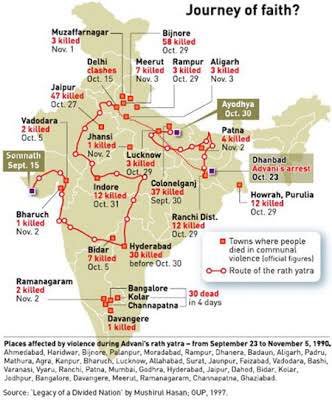
What of those killed earlier, in the wake of L K Advani's rath yatra in 1990? Aimed at whipping up Hindu sentiments in favour of building the Ram temple at the very spot where stood the Babri Masjid, the yatra left a trail of blood through Uttar Pradesh, as well as in cities such as Indore, Hyderabad.
These lives wouldn't matter to the RSS, but surely they should to the Opposition? Why has no party bothered to visit these families and find out how the violent Ram Mandir campaign changed their lives?
***
Indeed, the Opposition's stand on the Ayodhya consecration is puzzling. Their only objection seems to be that the BJP has hijacked a religious event for political benefit.
In saying this, the Opposition is either being naive or hypocritical. When was the Ram Mandir project not political? L K Advani decided to go on his rath yatra with a political aim: to counter the political upheaval caused by reservations for OBCs introduced by then prime minister V P Singh, in accordance with the Mandal Commission recommendations.
The character of the campaign was political. L K Advani linked Ram to nationalism; a Ram drohi was automatically a desh drohi.


The country was declared categorically and exclusively for Hindus: 'Yeh desh Hinduon ka/na kisi ke baap ka.' Musalmans were called gaddars (traitors) and given just two places to go to: Kabristan ya Pakistan. Not one of the slogans that emerged from the Babri Masjid Ram Janmabhoomi movement that spanned six years, was religious.


It was during this movement that the greeting 'Jai Siya Ram' became the war cry 'Jai Sri Ram'. In January 1993, during the second phase of the Mumbai post-demolition riots, Muslims were lynched to chants of 'Jai Sri Ram'.


The initial phase of the Ayodhya campaign took the BJP from two seats in 1984 to 86 seats in the 1989 Lok Sabha. Since then, the BJP has blatantly milked the Ayodhya Ram Mandir for electoral purposes. A more critical press than what exists today invariably wrote edits on this cynical use of religious feelings.
Given this background, how can we expect the consecration of this temple to be religious, and not political?


IMAGE: Sadhus and devotees near the Hanuman Garhi Mandir on the eve of the pran pratishtha ceremony in Ayodhya, January 21, 2024. Photograph: Rahul Singh/ANI Photo
***


The Opposition could well have given another reason for not attending the consecration. The new temple has been built after demolishing another's place of worship, at the cost of thousands of innocent lives. How can such a structure be a place of worship?


By making no reference to the violence at the heart of the Ayodhya project, the Opposition has shown that Muslims, killed for no reason other than their faith during this long campaign, barely feature in their consciousness. It seems the constituents of INDIA simply take Muslim votes for granted.


IMAGE: Vishwa Hindu Parishad workers in Prayagraj carrying pots containing water of the Ganga move towards Ayodhya ahead of the pran prathistha ceremony. Photograph: ANI Photo


***


Muslims certainly are nowhere in the grand national celebration that the government, with the full throated support of a fawning media, is conducting on January 22. Or maybe they are.
This State-backed national event is also being projected as a kind of triumph, the 'beginning of India's cultural revival and national pride', to quote Defence Minister Rajnath Singh.


If a nation's pride depends on building a temple after destroying a mosque, implicit in that pride is the humiliation of those who held the mosque in reverence. Also implicit is the exclusion of other faiths from the nation's pride.


With the Government of India backing this event, India can now boast of joining the company of theocratic nations. For those who prided themselves for being citizens of a secular country, where all communities are equally valued, at least officially, January 22, 2024 can only be a day of mortification.
Feature Presentation: Aslam Hunani/Rediff.com

December 31, 2023

India: With the Ayodhya Ceremony, has the inclusive India of his dreams been lost asks Harsh Mander


Harsh Mander: With the Ayodhya ceremony, has the inclusive India of my dreams been lost forever?

The idea of a humane country of equal citizenship has taken a bad knock.


December 29, 2023

From Babri Demolition to Ram Temple: Trajectory of Indian Politics | Ram Puniyani


https://thewire.in/politics/from-babri-masjid-demolition-to-the-inauguration-of-ram-temple-the-trajectory-of-indian-politics

From Babri Demolition to Ram Temple: Trajectory of Indian Politics


Ram Puniyani


When India became independent, Nehru’s ‘Tryst with Destiny’ speech set the tone for future course which India planned to undertake. He pledgedThe service of India means the service of the millions who suffer. It means the ending of poverty and ignorance and disease and inequality of opportunity…The ambition of the greatest man of our generation has been to wipe every tear from every eye. That may be beyond us, but as long as there are tears and suffering, so long our work will not be over.” And in this direction he defined the temples of Modern India in the speech while inaugurating Bhakra Nangal dam. A report in HT archive describes it thus; “with great feeling the Prime Minister described these sites as “temples and places of worship” where thousands of human beings were engaged in great constructive activity for the benefit of millions of their fellow beings.   

The ‘Temples of Modern India’ phrase was the underlying theme for conceptualizing the public sectors, educational institutions also promoting the scientific temper, health facilities, and academies for promotion of culture and what have you. The nearly four-five decades’ journey with this undercurrent of ‘Modern Temples’ was to be turned upside down from the decades of 1980s when on one side the response to Shah Bano fiasco of dealing with minorities opened the floodgates of divisive politics. The communal forces unleashed a massive propaganda war against the religious minorities. At the same time the affirmative action for downtrodden, the Mandal Commission implementation gave the fillip to temple politics which was already in the strategy books of Hindu nationalists.

In contrast to Nehru’s ‘temples of Modern India’, the search for ‘temples underneath the mosque’ brought to the fore the Babri Mosque dispute. The RSS progeny BJP took birth (1980) wearing the clothes of ‘Gandhian Socialism’ with moderate posing Atal Bihari Vajpayee at the helm. He was steeped in the RSS ideology. He wrote Hindu Tan Man-Hindu jeevan (Hindu soul and body-Hindu life), and masked his Hindu nationalist politics with élan. He yielded his place to Lal Krishna Advani, who came up with the slogan of “Mandir Vahin Banayengain’ (We will build the temple where Babri mosque is located).

RSS Combine was able to create a perception that Lord Ram was born precisely at the spot where the mosque is located. Ram rath Yatra, got more muscles after the Mandal Commission implementation. This yatra left a series of trails of violence. In the wake of L.K. Advani’s rath yatra, nearly 1,800 people died in different parts of India around 1990. This yatra was aborted when Lalu Yadav arrested Advani.

The mosque was demolished on 6th December 1992, by the Kar Sevaks, some selected ones of which had well rehearsed the demolition. Advani, Joshi and Uma Bharati were sitting on the stage from where the slogan, Ek Dhakka Aur do, Babri Masjid Tod do (Give one more push, break the Babri Mosque) and “ye to kevel Jhanki hai Kashi Mathura baki hai” (this is just the beginning, Kashi Mathra will follow). After demolition violence did follow in Mumbai, Bhopal, Surat and many other places. To cut the long story short, the legal system bent over backwards to give the verdict of the case based on ‘faith’, while naming those who led the demolition, but not giving them any punishment for the crimes committed by the. The judiciary in all its wisdom or lack of it; gave the whole Babri Mosque land to the “Hindu Side”.

In the glee of this ‘success’ by RSS combine; large funds were collected from home and abroad and a huge temple is ready to be inaugurated by the Prime Minister himself with all Hindu rituals. This will be a ceremony undertaken by the head of a ‘formally secular’ state. Babri Masjid was a regular election plank till it was demolished and after that building of ‘grand Ram Temple’ was the part of BJP’s election manifestos and electoral promises. The communal violence shot up on a regular basis along with the ghettoisation of Muslim community, the polarization and the rise of the electoral might of BJP.

The present plight is well summed up by A M Singh, “Since coming to power, much of the BJP’s political discourse has exacerbated communal tensions between Hindus and Muslims. Their actions have followed suit, with the abrogation of Article 370 in the Indian Constitution and the passage of the Citizenship Amendment Act (CAA) in 2019... By redefining and remanufacturing Indian citizenship on the principles of Hindutva, the BJP government has broken the fate and legacy of India’s secularism enshrined in its constitution.” Now a ghettoized Muslim community has been pushed to the margins as second class citizens.

Now as the temple is to be inaugurated all round efforts are on to mobilize the large section of Hindus around this. In America and other countries, a large number of NRI’s are preparing for the occasion by organizing different programs. Here at home all the progeny of RSS has been activated to mobilize the Hindus for the occasion, either by visiting the new temple or to visit the local temples and perform rituals.

There are minor controversies about who has been invited and who is left out. Lal Krishna Advani, the Chief architect of demolition movement and his close aide Murali Manohar Joshi were initially advised by the temple trust, not to visit the inauguration due to their old age and biting cold in Ajodhya, on second thought VHP, the overarching organization has invited them.

As Babri demolition helped this sectarian politics to come to power, the inauguration of the temple seems to be yet another mechanism to consolidate the polarization and to reap electoral dividends. Large number of special trains and buses are being planned for the occasion. Temple politics has reached its acme.

It is time to recall Nehru’s concept of “temples of Modern India’ with promotion of scientific temper! Currently religiosity and faith blind faith are being heightened. As India started coming out of the colonial darkness it also ensured a direction where the ‘last person in the line’ was to be the primary focus. With the politics revolving around Ram Temple, to be followed by temples in Kashi and Mathura, the deprivations of ‘last person’ and Nehru’s ‘Tryst with Destiny’ promises have been dumped along with holding him responsible for all the ills of the country!

India: Mixing Religion with Politics | Aditya Mukherjee

Deccan Herald

Mixing Religion with Politics

The BJP government has decided to remind us that genuine patriotism stems from taking pride in the construction of the Ram temple, which serves as an affirmation of our religious faith.

Aditya Mukherjee
Last Updated 28 December 2023 

January 2024 will be a defining moment for the BJP under the prime ministership of Narendra Modi: the inauguration of the new Ram Temple in Ayodhya

The BJP government has decided to remind us that genuine patriotism stems from taking pride in the construction of the Ram temple, which serves as an affirmation of our religious faith. Moreover, Lord Ram, as we all know, was an inspiring cultural symbol of India. It is believed that an estimated cost of around Rs 1,800 crore has been incurred in building this temple.
Even the Congress might avoid criticising Modi’s initiative to construct the Ram temple in Ayodhya due to political expediency. The reason is that the party cannot afford to alienate Hindu voters ahead of the upcoming general elections. While Rahul Gandhi claims to be a Janeudhari Hindu and a devotee of Lord Shiva, Kamal Nath attempted to project himself as a more devout follower of Hinduism than Shivraj Singh Chouhan during the recently concluded assembly elections in Madhya Pradesh. Ayodhya has remained a political hot potato for close to four decades ever since Rajiv Gandhi, as prime minister, ordered the unlocking of the small shrine to Ram at the disputed site. Since then, the issue has perpetually smoldered. Thus, this anticipated contest of religious assertions has underscored that the temple issue remains a persistent factor in the ever-fluctuating political landscape of our country. The construction of religious structures can serve as a distraction from addressing other important socio-economic problems.

[ . . . ]

https://www.deccanherald.com/opinion/mixing-religion-with-politics-2828476

India: Is Modi Bigger Than Ram? Why Politics in Name of Ram Temple?


Is Modi Bigger Than Ram? Why Politics in Name of Ram Temple?

Newsclick Team |
In this episode of Bol Ke Lab Azad Hain Tere, Abhisar Sharma discusses how the Bharatiya Janata Party is planning to use the inauguration of Ram Mandir on January 22, 2024, to project its politics, and how it will use this day to glorify the Prime Minister’s image.


https://www.newsclick.in/modi-bigger-ram-why-politics-name-ram-temple

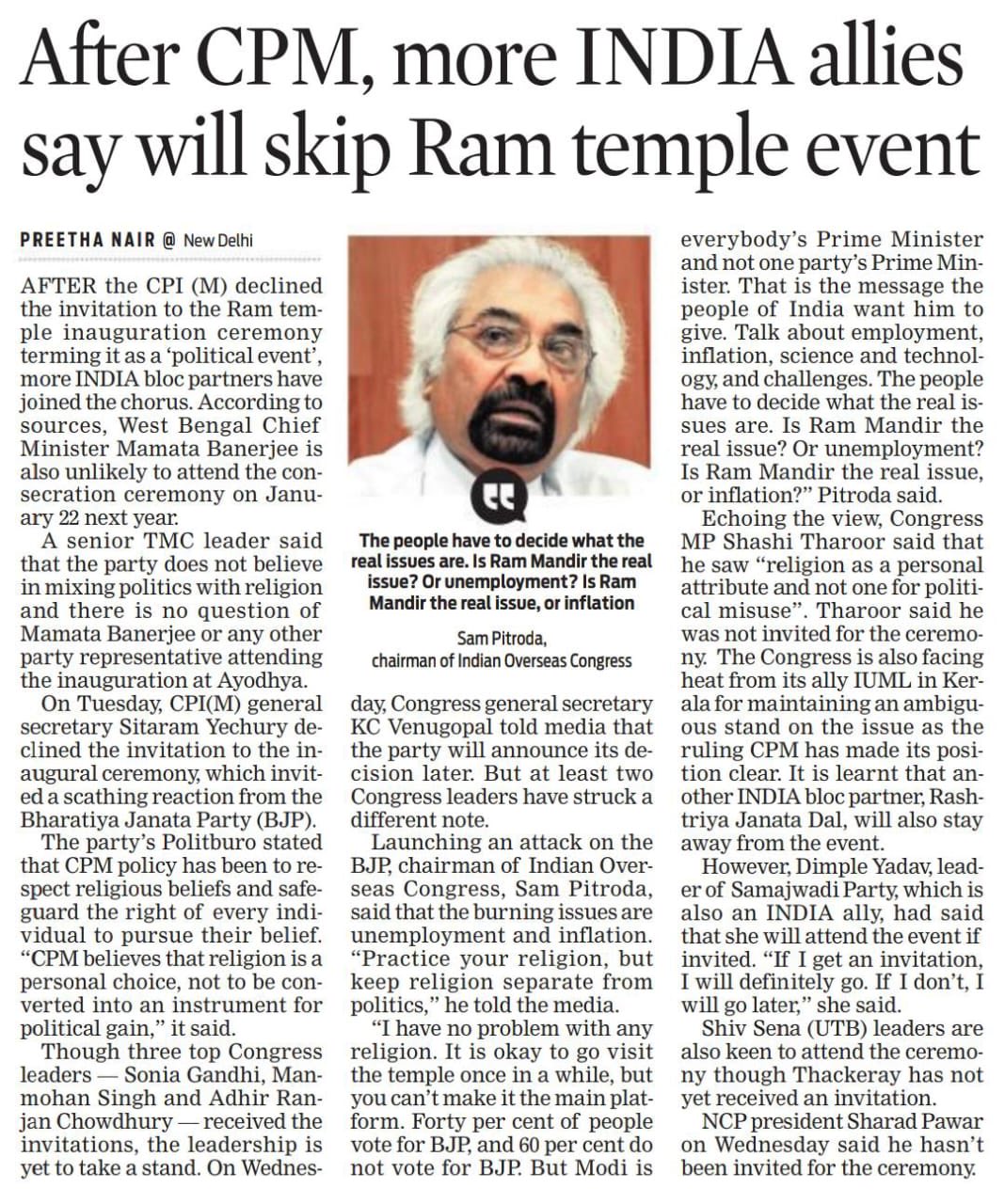
India: After CPM's stand more INDIA alliance members likey to skip Ram temple consecration ceremony in Jan 2024


June 22, 2023

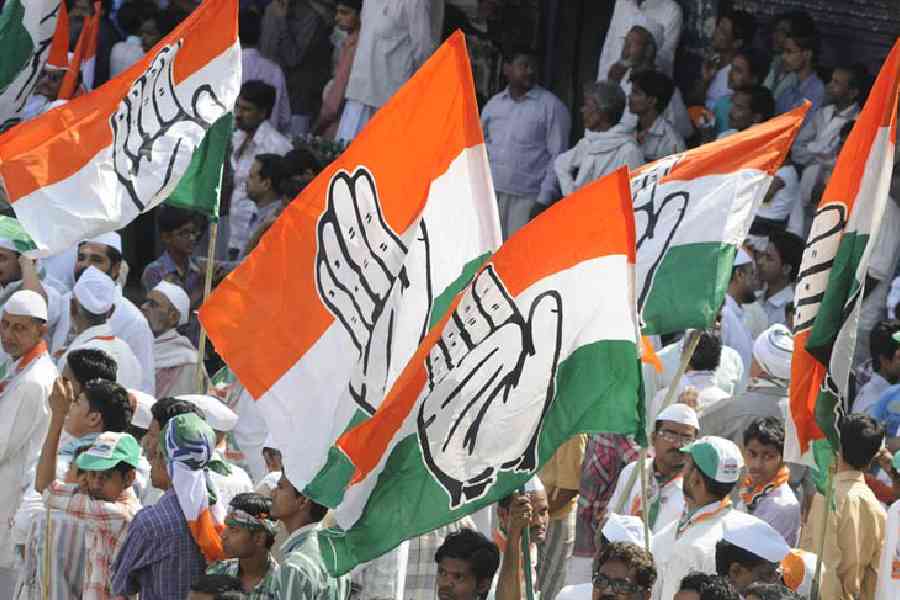
India: Congress playing the ‘soft’ Hindutva card in Madhya Pradesh - Edit, The Telegraph, June 20, 2023

 The Telegraph

Clear path: Editorial on Congress playing the ‘soft’ Hindutva card in Madhya Pradesh

A credible national Opposition must stand for something definite, maybe secularism and the Constitution. Using religion, however ‘softly’, destroys the clarity of the party’s image

The Editorial Board Published 20.06.23, 06:41 AM

Sourced by the Telegraph

Going back may sometimes be a good thing. The newly-elected Congress government in Karnataka is taking steps to change the direction which the previous Bharatiya Janata Party government had set for the state. For the BJP, Karnataka had seemed to provide an entry to the south; hence it was important to harden it ideologically, including cornering minority communities socially and economically. The introduction of the Karnataka Right to Protection of Freedom of Religion Act, 2022, better known as the anti-conversion law, ostensibly intended to prevent conversion by coercion or ‘allurement’, reportedly made even voluntary conversion impossible. Its presence created distrust among communities and undermined the notion and practice of secularism. The Congress government has decided to repeal this law, which is important in itself while signalling harmony and equality. Alongside, the state government is also returning textbooks to the form they were before the BJP government dropped certain chapters on history and progressive social reformers and the work of selected writers. The latter inserted accounts of Rashtriya Swayamsevak Sangh ideologues such as K.B. Hedgewar, V.D. Savarkar and others. The Congress’s moves could represent a force of correction that would counter the BJP’s divisive, religion-based politics. That children are being asked to read the Preamble to the Constitution in school emphasises this, while training the children in peaceful co-existence and respect.

So it is disappointing to believers in secularism that the same Congress is determinedly playing up religion, or ‘soft’ Hindutva, in Madhya Pradesh ahead of the assembly elections. The symbolism surrounding Priyanka Vadra’s visit to the state to inaugurate the party’s campaign bristled with religious symbols, including her prayers and invocations to the Narmada and the ubiquitous presence of Hanuman and his mace — is it competing with the sengol? Five priests blew conch shells to mark the beginning of the campaign. But Kamal Nath’s government had fallen within months in spite of the Congress’s soft Hindutva. Is the large percentage of Hindus in the state the reason for repeating the strategy? A credible national Opposition must stand for something definite, maybe secularism and the Constitution. Using religion, however ‘softly’, whenever strategic destroys the clarity of the Congress’s image and suggests an unbecoming cynicism. Religion should have nothing to do with politics in India. The party’s political approach in Karnataka is an example for the entire Opposition.


April 07, 2023

Spike in anti-Muslim rallies since BJP retook India’s Maharashtra | MN Parth (aljazeera -

 The recent Ram Navami festival was the latest concerted attempt to ignite religious tensions in India’s richest state.

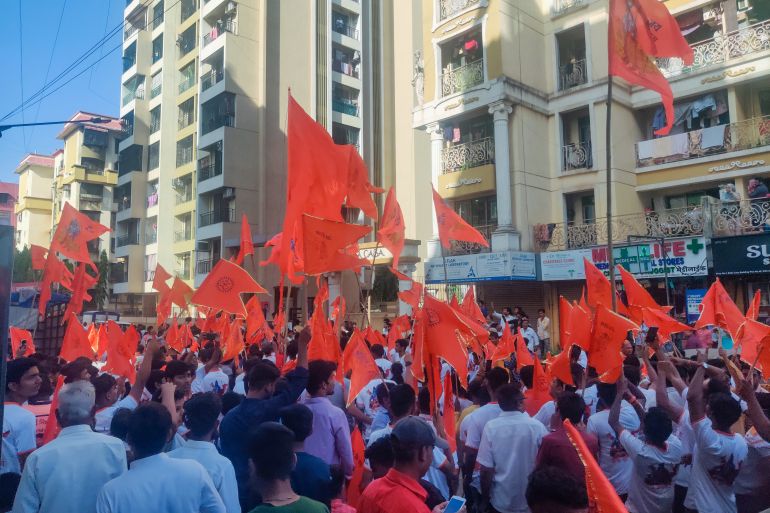
Mumbai hate rally
A Ram Navami rally in a Mumbai neighbourhood in Maharashtra [Parth MN/Al Jazeera]

April 04, 2023

India: Ramnavami Procession and Instigation of Violence | Ram Puniyani

https://www.newsclick.in/worshipping-lord-ram-and-divisive-political-goals

Worshipping Lord Ram and Divisive Political Goals

Ram Puniyani

Ram Navami (the day celebrated as Lord Ram’s birthday) 2023 saw acts of violence in many places, the majority of which were in Howrah, Chatrapati Sambhaji Nagar (called Aurangabad earlier), some Mumbai suburbs, Delhi and places in Bihar among others. Last few years these have become a regular part of social phenomenon, with ever increasing intensity. The large section of media has presented the story of these Ram Navami processions being stoned and so the consequent violence, the nature of aggressive slogans, the well armed participants, the provocative acts in front of mosques are generally underplayed or missing from these narratives. Last year also there were such incidents of which the one in Khargone drew attention. In this case on the pretext of stone throwing 51 households of the minority community were bulldozed by the state with the BJP Government in power.

The nature of celebration of Ram Navami has seen a drastic change during the last few years. The processions are taken out with youth waving the naked swords, this year one was spotted with a pistol. There is loud music and slogans abusive to Muslims are shouted in gay abundance. The route of the processions is another interesting part of the tragic tale; they generally ensure to pass through the Muslim majority area, irrespective of whether there is permission for that or not. Attempts to throw Gulal on the mosques are the minimum, the attempt to climb the mosque and hoist saffron flag on the mosque is fairly mandatory.

In West Bengal, where the mayhem was created by the processions, while BJP leadership is blaming Mamata for going soft on Muslims CM Mamata Bannerjee stated, “Religion never condones unrest, religion speaks of peace... This was BJP’s plan to create riots. Yesterday, the BJP did it in about 100 places in the country. The Howrah incident is very unfortunate. We repeatedly said the procession should not take that route. However, criminals entered with guns, petrol bombs, bulldozers and various other things, and attacked where minorities live…  This was done by BJP, Hindu Mahasangh, Bajrang Dal… and the different names that they have. They attacked directly and intentionally,…” 

Earlier also the country has witnessed the violence in the context of processions. During the British period, the Muslim Communalists competed with equal vehemence using Ganpati immersion, Shiv Jayanti processions, Ram Navami processions; Muharram etc. Post Independence the prevalent biases among large sections of society and police in particular have turned a blind eye to the processions which insist on going through the areas not permitted by the administration. At one level this happens regularly as the organizers and participants of these know that they have protection from the state.

Their plea is that how dare anyone prevent them from going to any area? We know that giving provocative slogans is a crime, carrying weapons is also a crime then how come these processions flaunt these basic norms? Here comes in the role of communalized administration irrespective of the Government in power.

While the media focuses on the stone throwing, it totally remains silent on provocative slogans, open display of arms. Post Independence there have been Judicial inquiries in cases of violence provoked by processions. Advocate Chander Uday Singh in his prologue to the detailed report by the ‘Citizens and Lawyers Initiative’, which looks into the sharp spike in events leading to communal violence during Ram Navami and Hanuman Jayanti in April 2022 gives an account of major processions and the violence which followed the processions. Report confirms that the processions involve targeting Muslim places of worship or Muslim-majority localities. Few major examples will give us the deeper dynamics of these processions.

In Bhagalpur violence the route was one of the major issues, “A commission of enquiry consisting of Justice Ram Nandan Prasad, Justice Ram Chandra Prasad Sinha, and Justice S. Shamsul Hasan, retired judges of the Patna High Court, found that though tension over Ramshila processions had already been building up in Bhagalpur for at least a year prior to 1989, yet the Administration and Police had turned a blind eye to it. The Commission noted that there was no application to route the 1989 procession through Tatarpur, and that the license issued to the procession’s organizers did not mention Tatarpur (para 578).

Commission of inquiry in Kota 1989, came to similar conclusions. Justice S. N. Bharava of the commission concluded, … “Taking an overall view of the evidence on record, I am of the view that it was the precisionists who had started shouting objectionable and provocative slogans and it was only on account of the provocation by these objectionable slogans that the Muslim community also reciprocated the same.”

In Bhivandi-Jalgaon riots, Justice Madon concluded that “the immediate or proximate cause of the Bhiwandi disturbances was the deliberate misbehavior of the processionists in the Shiv Jayanti procession, which was taken out in Bhiwandi on May 7, 1970, in order to provoke the Muslims and … the processionists from the villages, had participated in the procession carrying lathis to which Bhagwa flags and banners were tied in order to circumvent the ban under section 37(1) of the Bombay Police Act, 1951, prohibiting the carrying of weapons,…”.

While the role of those who get provoked and throw the first stone cannot be undermined, the point is the clever manipulation of such festivals/procession to create a situation in which communal violence is the outcome. This in turn leads to the polarization and an increase in the strength of the communal party. To quote the Yale University research finding yet again, “riots produce ethnic polarization that benefits ethno-religious parties at the expense of the Congress… Analyzing the effect of riots on the vote share of “Hindu nationalist parties”, the paper notes that “the BJS/BJP saw a 0.8 percentage point increase in their vote share following a riot in the year prior to an election”.

The increasing intensity of this phenomenon can clearly be correlated to the attempt by communal parties to further polarize the society to get electoral politics in times to come. The reports that bulldozers are being roped into these processions should be a matter of serious concern for our society.

March 31, 2023

India: Religious processions the most common cause of communal violence ....

A Single Factor Is Common to All Communal Riots During Religious Processions in India

https://thewire.in/communalism/riots-religious-processions-ram-navami