Resources for all concerned with culture of authoritarianism in society, banalisation of communalism, (also chauvinism, parochialism and identity politics) rise of the far right in India (and with occasional information on other countries of South Asia and beyond)
Who benefits from communal violence? BJP occupies the high moral ground, pushing the narrative of good governance and development, while VHP and Bajrang Dal are free to propagate religious polarisation. PinterestLinkedinGmailFacebook Messenger
Bharat Bhushan
Flames rise from shops and other structures set ablaze by miscreants during fresh violence in Haryana. Credit: PTI PhotoFlames rise from shops and other structures set ablaze by miscreants during fresh violence in Haryana. Credit: PTI Photo
The Bharatiya Janata Party (BJP) used to claim that there are no communal riots when it is in power. With the communal rioting in Manipur and Haryana, both run by the BJP, that claim lies exposed. The Manipur violence initiated between ‘ethnic’ communities has fast acquired the colour of a Hindu-Christian confrontation. The Muslims of Nuh in the Mewat region of Haryana where the violence started do not have a sterling reputation — with the violent criminals among them having graduated from cattle thievery to cybercrime. They claim to have been provoked by two videos released by cow-vigilante and Bajrang Dal activists. The videos called upon Hindus to join a religious procession on Monday in Nuh and visit temples in Mewat in large numbers. The videos, according to the police, infuriated the Muslim community, and they gathered in large numbers on July 31 to disrupt the procession. Only a detailed enquiry will show who lit the communal fuse, but who does a surcharged communal atmosphere help? The question is as relevant in Manipur as it is in Haryana. The conflict in Manipur has made BJP Chief Minister N Biren Singh virtually unassailable despite the utter failure of law and order in the state. He has consolidated the Meitei Hindus behind him. Prime Minister Narendra Modi cannot find it in himself to caution Singh to follow ‘Raj Dharma’, as he himself was advised by former Prime Minister Atal Bihari Vajpayee in 2002. In Haryana, the BJP is faced with declining popularity. After the 2019 state legislative election, it had to rely on Dushyant Chautala’s Jannayak Janta Party to form a government. Then with the farmers’ agitation in 2020-21 the Jat farmers turned their back on the BJP. The Jats form 27 per cent of the population and dominate 40 of the 90 assembly constituencies. Their disproportionate influence in Haryana politics is evident from the fact that in 33 out of 57 years of its existence, Haryana has been ruled by Jat chief ministers. The non-Jat chief ministers who have together ruled the state for 22 years, have had short tenures. Khattar will be only the second non-Jat Chief Minister other than Bhajan Lal to complete a 10-year tenure next year.
Elections to the Haryana legislature are due in October 2024. The state sends 10 MPs to the Lok Sabha. The BJP had won all 10 seats in the 2019 general election. It is unlikely to repeat the feat in April-May 2024, without the consolidation of Hindu votes. To achieve that, the hostile Jat farmer will have to be mobilised through their Hindu identity rather than through their caste and economic status. Communal polarisation will do that. That is why the communal violence in Nuh has significance beyond Mewat. It has already spread to the adjoining areas of Gurugram, Faridabad, and Palwal. Nor is it likely to be limited to the boundaries of Haryana. Already, sister Hindutva organisations of the BJP — the Vishwa Hindu Parishad (VHP) and the Bajrang Dal — have organised protests on August 2 in Delhi stopping traffic on the Faridabad-Delhi highway and protesting in RK Puram-I, Nirman Vihar, and Ghonda in Delhi. There were VHP protests in adjoining Noida in Uttar Pradesh as well. Could it be that the BJP has governance as its priority and the communal incidents are the handiwork of autonomous Hindutva militants? Modi recently advised party MPs to let the government’s work for the poor take precedence in the 2024 general election over the Ram temple at Ayodhya and the abrogation of Article 370 in Jammu and Kashmir. This seems to suggest that the governance train is on a different track than the communal one. Far from there being an airgap between the BJP and the Hindutva militants, they are in fact two strands of the same DNA — one prepares the ground for the other’s climb to power. Polarisation on made up communal issues such as wearing the hijab, refusal to sing or shout ‘Vande Mataram’, ‘love jihad’, reclaiming mosques as Hindu temples, etc. help to heat up the atmospherics before the BJP enters an electoral battle. The pattern is clear. When in power the BJP occupies the high moral ground, pushing the narrative of good governance and development and the militias of VHP and Bajrang Dal are left free to propagate religious polarisation on the ground. This collaboration was evident earlier also in the Ram temple agitation, the destruction of the Babri masjid, the Gujarat riots, and now in incidents of Ram navami violence in March, and now in Nuh. Ethnic militias like Arambai Tenggol and Meitiei Leepun play a somewhat similar role in Manipur. In Haryana, the VHP and the Bajrang Dal are being resuscitated because the BJP needs every Lok Sabha seat it won in the state in 2024, and Khattar is also unsure of winning a third term for the BJP. Already he has promised to use the Recovery of Damages to Property During Disturbance to Public Order Act against the ‘rioters’. There are no prizes for guessing who might face the State’s wrath. It is likely that communal tension justified as ‘Hindu anger’ against the Nuh violence will spread to Delhi (where the BJP won all seven Lok Sabha seats in 2019). It will not be a surprise if in the coming months communal poison is injected into other north Indian states where Hindutva forces need to strengthen the BJP’s electoral position. The election-going states are under the greatest threat of communal polarisation. The BJP had won 24 out of 25 Lok Sabha seats in Rajasthan, 28 out of 29 in Madhya Pradesh and nine out of 11 in Chhattisgarh. These states will have assembly elections in December. The BJP would like to build the momentum for the 2024 general election by winning all of them. It will need more than the rhetoric of good governance to do that. These states might also see new life being breathed into the VHP and the Bajrang Dal. (Bharat Bhushan is a Delhi-based journalist.)
If the people of Manipur have lost all faith and given up the demand for ‘normalcy’, who can blame them?
Tribals
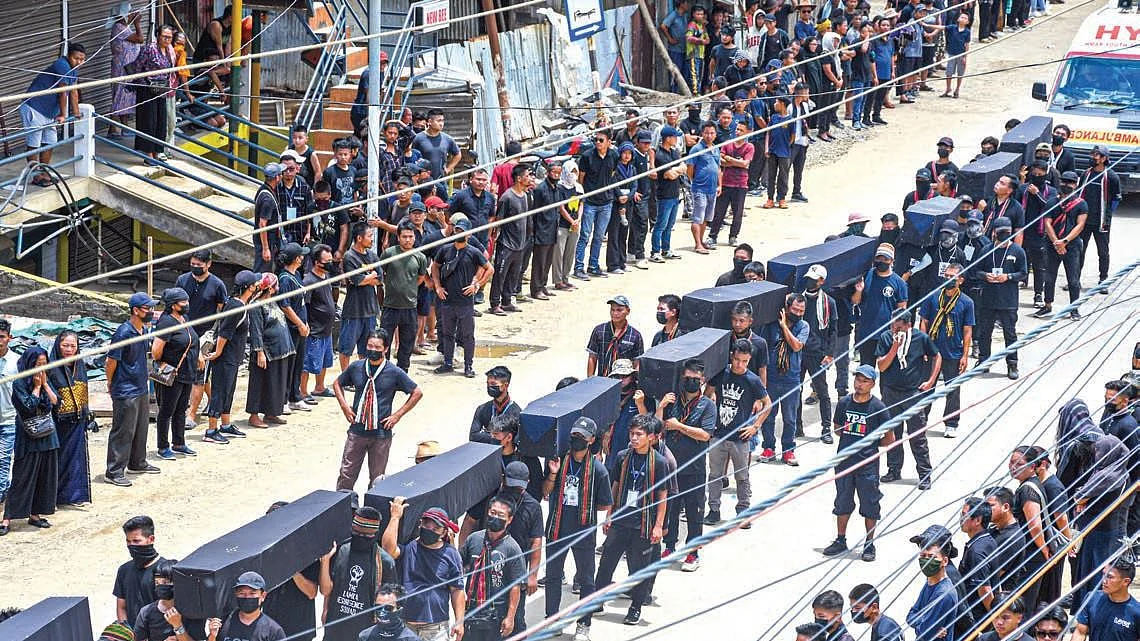
in Churachandpur take out a silent protest march with dummy coffins to
symbolise the dead in the bloody ethnic clashes in Manipur, 20 June 2023
(Getty Images)
The
day after the shocking video clip of two disrobed women being groped
and dragged about by a mob went viral, the Manipur Tribals’ Forum in New
Delhi declared: “We can no longer dream and think of living in a
so-called Meitei-centric state of Manipur. Separate administration for
Kuki–Hmar–Zomi–Mizo–Unau tribal areas in the form of a Union Territory
with legislature or a new state or merger with Mizoram are the only
solutions now for lasting peace.”
What was being demanded by a
faction for the past two months has now gained enough currency to be
spelt out as consensus—literally, the point of no return has been
crossed. The complete breakdown of law and order in the state for the
past 80 days was no secret, given blood-curdling stills and video
footage of mindless violence.
Security forces in Manipur were made
to look ineffectual because they could not get past human shields to
enforce the law and arrest those that raped and killed in cold blood.
The so-called ‘women defenders’ of community pride, the Meira Paibis too
ensured that the security forces were reduced to a state of
helplessness not often seen before.
What does lack clarity is the
number of arms and quantity of ammunition recovered from the militants.
It was officially admitted that 4,000 sophisticated firearms and 6 lakh
rounds of ammunition had been looted in the first few days of the
‘ethnic clash’ that began on 3 May.
But if accountability were
fixed and action taken against the officials and police officers
responsible, a conspiracy of silence must have blocked it out. The point
of no return has also been reached because refugee camps in the hill
areas have been left to fend for themselves with little food, clothing
or medicine.
The bulk of the relief material, it is alleged, is
being distributed in the refugee camps of Imphal, which are hosting (a
smaller number of) Meitei refugees displaced from the hills.
The
Mizoram government and civil society organisations have come together to
support the refugees, but conditions in the camps are far from ideal.
There has been little improvement even after Congress leader Rahul
Gandhi visited and called on Manipur’s governor to ‘apprise’ her of what
the people in her own state urgently required.
Even as this
humanitarian crisis is unfolding, with both Meiteis and Kukis becoming
victims, the Manipur police and the government of chief minister N.
Biren Singh have been shamelessly partisan. When Meitei assailants
killed a Naga woman last week, the Nagas threatened an agitation if the
culprits were not arrested within 48 hours. Not only were 10 alleged
‘culprits’ rounded up quickly, the state government announced a grant of
Rs 10 lakh on compassionate grounds.
While
the attempt was to soothe the Nagas, the Kuki tribes were
understandably upset that they did not merit similar consideration. The
government was deliberately driving a wedge between the tribes, it was
felt (the Nagas had remained neutral in the conflict till now).
Unverified accounts also claim that Naga churches were by and large
spared, while most of the 400 churches set alight conducted services for
Kuki communities.
An article written by Kuki-Zo academic H.
Sitlhou opened up a can of worms by claiming that the Meiteis had
carefully constructed fake narratives and videos to discredit the
Kuki-Zo people and legitimise the relentless attacks on their women.
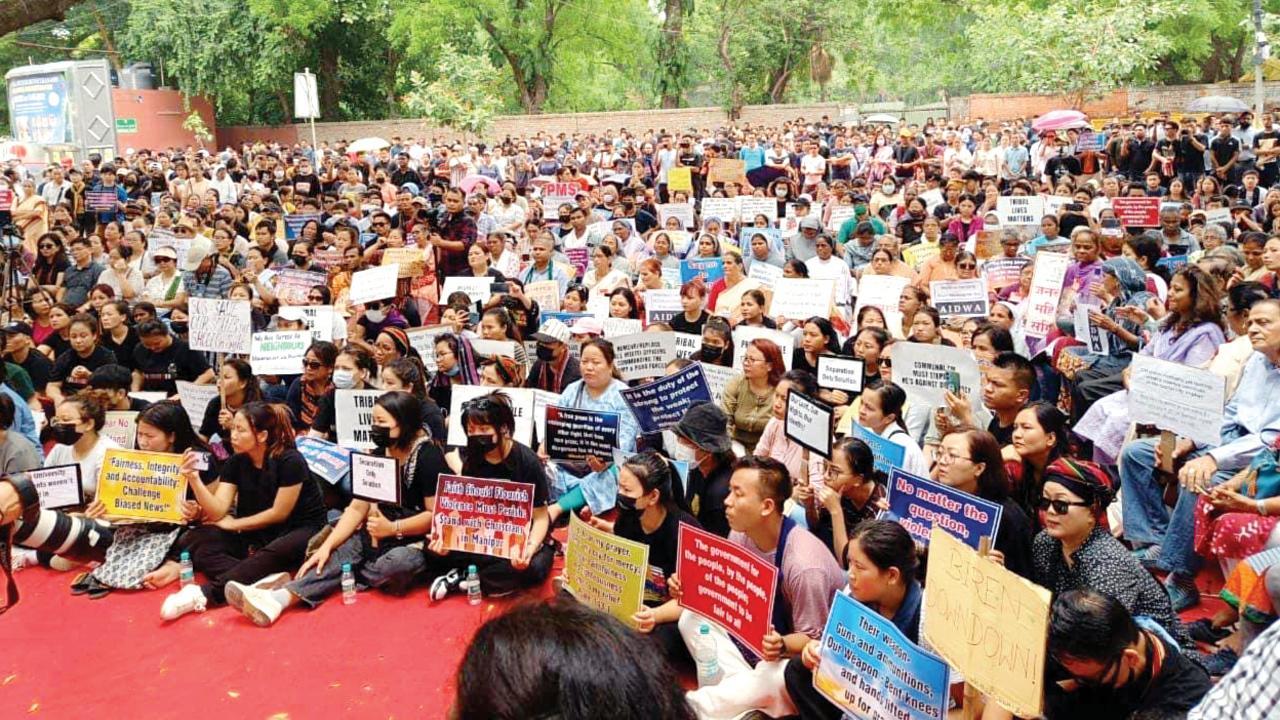
Kuki women protest
in New Delhi against the raging violence in Manipur (Getty Images)
Certainly,
from the manner in which these attacks have been carried out, they seem
to have been carefully planned—perhaps over months—before being
unleashed on the Kukis who organised a peaceful protest rally on 3 May
against the Meitei demand for scheduled tribe (ST) status.
It was
one such fake video claiming Meitei women had been sexually violated by
Kuki men that led to the attack next day on the Kuki women seen in the
viral video. These are tactics applied in wars against a foreign nation
so that the aggressor can claim they are fighting a ‘just’ war.
***
History
is being repeated in strange ways, while the government of India
chooses to wait and watch even as Meitei and Kuki-Zo peoples engage in a
fight to the death, literally.
The over 50,000 (by conservative
accounts) lodged in refugee camps in Mizoram and elsewhere see the odd
video emerge from the Manipur valley—where it appears a select group
does have access to the internet despite the ban—and they wonder whether
life can ever be ‘normal’ again. And what might that ‘normal’ look
like?
The attack on the Kuki-Zo women paraded naked
while their private parts are violated by lumpen elements is not the
‘latest’ incident; rather, it was one of the first. But what it seems to
have achieved is to shake the collective conscience of the nation, even
forcing the prime minister to break his silence for the first time.
Yet
the unforgivably tardy words of shock and condemnation do little to
allay suspicion and cynicism. What the state requires is visible,
effective action, not mere words and ‘concern’. Indeed, what is
happening now in Manipur has been allowed to happen under the watch of
governments both at the Centre and the state, believe many.
ADVERTISEMENT
A
cosmetic press note circulated by the Manipur Police of a ‘zero FIR’
filed two weeks after the women were paraded does little to assuage the
people’s feeling of having been wronged. Is the intelligence wing of the
Manipur Police defunct that they cannot identify the faces in the
video? Or has the whole policing system collapsed to become nothing but a
tool of the state?
How could armed miscreants from the valley
have had a free run for two-and-a-half months when 60,000 uniformed
personnel are stationed in Manipur? That the Manipur Police is not a
neutral force has been proved repeatedly, becoming mute spectators to
violence unleashed by the majority community.
The Kuki women
violated in the video were ‘rescued’ from the police— yet the FIR took
two weeks to lodge! Clearly ethnic loyalties trump loyalty to the
Constitution and the rule of law. There is dismay among Manipuri
citizens at the scale and ferocity of the violence, suggesting a
carefully planned pogrom.
The mandarins in the nation’s foreign
ministry, however, responded to the European Parliament’s resolution
censuring the violence with the line that events in Manipur were India’s
‘internal matter’. But what does this mean? Has the government in Delhi
decided to allow the warring factions to decide the final victor in a
gladiatorial fight with the whole state for their arena?
A
conflict that can last for 80 days, with guns blazing and bombs lighting
up the skies daily, can only mean one of two things: either the rule of
law has collapsed or the violence has been carefully orchestrated with
the intent of driving out the tribal communities from the hills.
Branding the entire community with a broad brush as ‘illegal migrants’
is a convenient narrative for the government of Manipur.
Sadly,
the rest of the 1.4 billion Indians don’t seem to share the pain and
grief of the Kuki-Zo people. Is it because they are of a different race
and religion? What does this say about India’s concern for the
North-East? In the early days of the conflict, serving and retired
servicemen were heard lamenting that India’s No. 1 adversary (China)
would be watching Manipur with glee, considering that militant outfits
in the region have been known to get arms training from that country.
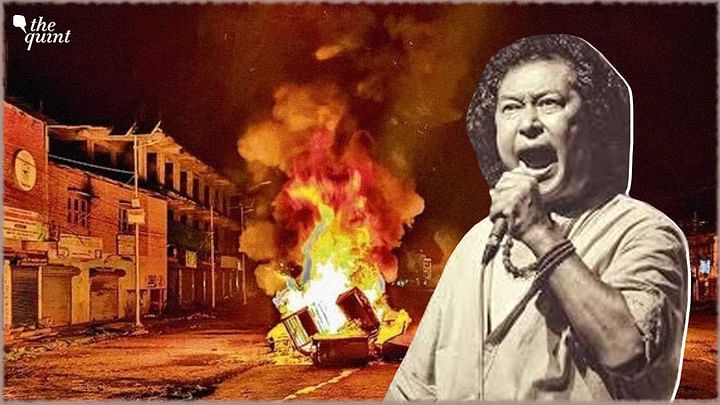
Meitei pop singer Tapta who called for an ethnic cleansing of Kukis in one of his songs
But
two-and-a-half months later, ‘India’ seems not overly concerned about
the loss of lives or the defiant attitude of the Meiteis in the valley.
An FIR was lodged belatedly and only grudgingly against Meitei pop
singer Tapta, who in one of his songs called for every Kuki person to be
killed. He had defiantly told the media that as he was singing in a war
zone, his lyrics were bound to reflect the ‘war’.
Meanwhile, New
Delhi’s unwillingness or inability to replace the Manipur chief minister
has now prompted even neighbouring states to wonder if this model of
vote-bank politics which involves viciously polarising a community may
be ‘allowed’ to play out in their neighbourhood as well.
If the
greed for the land in the hills—which the Meiteis have been eyeing for
decades but are restricted from by their non-tribal status— was the main
issue, successive governments could have initiated dialogue to find a
solution. Land reforms are a vital part of governance, but it is
possible only if there is a rule of law to ensure justice.
Manipur
has been largely blacked out by the internet shutdown since early May,
of course. In fact, the ban is only partial. The powerful elite have
always had access to it. It’s the hoi polloi who suffer the ignominy of
not even being able to tell the stories of the unspeakable atrocities
that have been visited on them in what is increasingly being described
as a civil war.
The barbaric acts of parading naked women, using
rape as revenge and the brutal killing of a young village volunteer and
hanging his head on a pole were glossed over by a panelist who
attributed this to the fact that many communities in the North-East were
literal ‘head-hunters’ in the past.
The insensitive statement was
a chilling reminder that a medieval past can still creep up on us in
the 21st century. All that is required is a provocative narrative, even
if it happens to be fake. What we have seen in Manipur is the
weaponisation of words to feed a cycle of unending violence. In a few
more days, the violence will enter its fourth month, which shows that
the aggressors were well prepared. It takes preparation and training to
keep the fires raging for so long.
The violence in Manipur is neither sudden nor random. Does that even explain why the Modi government is an apathetic onlooker?
Updated on: 24 July,2023 06:58 AM IST | Mumbai Ajaz Ashraf
|
The Prime Minister cannot
criticise or sack the Manipur Chief Minister, for the latter is pursuing
the anti-minority model that the former had invented 21 years ago
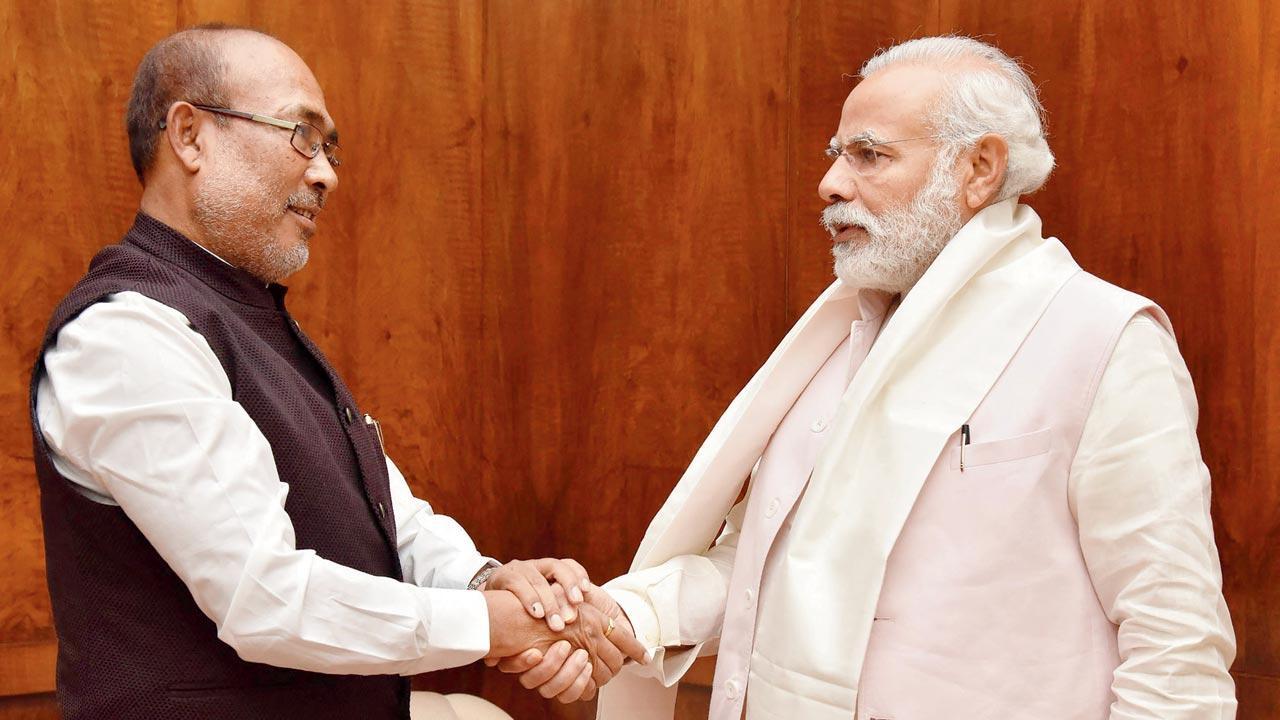
Manipur Chief Minister Biren Singh and Prime Minister Narendra Modi, in New Delhi. File pic/AFP
The nation must thank Prime Minister Narendra Modi
not only for belatedly breaking his silence on Manipur, but also for
the language he used to condemn the parading of two Kuki women stripped
naked in public there, with one of them brutally gang-raped. Modi said
his heart was filled with “anger and sorrow” at the barbaric act
captured in a video that went viral.
His remark is in sharp contrast to the regret he expressed, in 2013, over the 2002 Gujarat riots.
If “someone else is driving a car and we’re sitting behind, even then
if a puppy comes under the wheel, will it be painful or not? Of course,
it is. If I’m a chief minister or not, I’m a human being. If something
bad happens anywhere, it is natural to be sad,” Modi told the Reuters
news agency.
Modi’s
sensitivity seems to have deepened ever since he became the Prime
Minister in 2014. But he had as the Gujarat Chief Minister provided a
model of politics that other chief ministers could follow to enhance
their popularity. This model involves an elected leader demonising the
minorities, whether religious or ethnic, and rallying the majority
community behind himself or herself.
This
is precisely the model Manipur Chief Minister N Biren Singh has
adopted. In April, a month before Manipur slipped into mayhem, he told
the Organiser, the mouthpiece of the Rashtriya Swayamsevak Sangh, “The
indigenous people of the state have been reduced to the status of
second-class citizens after the ‘foreigner Kuki’ immigrants took control
of the social, political and economic affairs.”
Singh claimed that villages along India’s international border had
seen a substantial rise in the Kuki population, which he said was on
account of militant Kuki outfits, flush with black money generated
through the drug trade, facilitating the influx of illegal immigrants
from Myanmar into Manipur. “No need of doing politics; if we cannot
protect our people from dying,” Singh told the Organiser.
It would seem that to “protect” his own people from “dying,” Singh
has let the Meiteis war against Kukis, with the police idly watching
killings and rapes being committed. In May-end, he framed the violence
as nothing more than his government’s “operations against the terrorists
who have been attacking civilians with sophisticated weapons.” He
projected the 40 who had been killed until then as terrorists. Weeks
later, Singh blamed the “foreign hand” (read China) for lighting the
fire in Manipur.
Singh’s remarks echo the statements Modi made in 2002, which can be
read in Manoj Mitta’s The Fiction of Fact-Finding: Modi & Godhra. On
February 27, 2002, when a train at Godhra was set ablaze, Modi said the
arson was a pre-planned conspiracy involving terrorists, triggering a
reaction against Muslims. In Gujarat then, as in Manipur in 2023, the
police allowed Hindu mobs to go berserk.
Soon, Modi went on Doordarshan to appeal for peace, but did not
demonstrate the neutrality expected of a chief minister. About the
burning of the train, he said, “The culprits will get full punishment
for their sins… We will set an example that nobody, not even in his
dreams, thinks of committing a heinous crime like this.” As for the
violence against Muslims, Modi said, “I can appreciate your [Hindu]
sentiments. But I appeal to you with folded hands, we must maintain
peace and self-restraint.”
In an interview to Zee TV, he blamed Ehsan Jafri, the former MP who
was hacked to death, for sparking the Gulberg Society massacre. The
reason: Jafri, whose calls for help to the administration went
unanswered, had fired to disperse an armed mob about to break into the
housing society.
At a rally, months after the riots, Modi advocated the closure of
relief camps established for displaced Muslims thus: “Should we open
child producing centres?” He was alluding to the unfounded belief that
India’s developmental advantage is eroded because of the Muslim
population growing at a higher rate than the national average. “We are
five and ours are 25,” he quipped sarcastically.
Modi launched a diatribe against Chief Election Commissioner JM
Lyngdoh for postponing the Gujarat Assembly Election, highlighting his
Christian identity by taking his full name—James Michael Lyngdoh—at
election rallies. At one meeting, Modi said, “Some asked [me], is he
[Lyngdoh] a relation of Sonia Gandhi? I said, perhaps they meet in
Church.”
Modi wrote a letter, in August 2003, to then President APJ Abdul
Kalam, claiming that the allegations of human rights violations were
being raised by vested interests. “They are identifying stray incidents
and exaggerating them with the sole objective of slowing the pace of
development,” Modi noted. Sounds familiar, doesn’t it?
These examples from Modi’s past explain why he cannot criticise or
sack Singh, for the latter is pursuing the model of politics the former
invented 21 years ago—and perfected it since then. The Gujarat riots
enabled Modi to capture the commanding heights of Indian politics. Singh
has already become a household name countrywide, a rare achievement for
chief ministers from the Northeast. Let’s face it: the blood of the
minorities has increasingly become the fuel powering the rise of
leaders.
The writer is a senior journalist
Send your feedback to mailbag@mid-day.com
The views expressed in this column are the individual’s and don’t represent those of the paper
18-year-old gang-raped in Manipur after women vigilantes hand her over to armed men
FIR says Meira Paibis women’s group handed
her over to four armed men; after a brutal assault, gangrape, murder
threats, she arrived at Bishnupur police station but did not trust
Meitei police to take her home
July 22, 2023 10:11 pm | Updated July 23, 2023 07:20 am IST - NEW DELHI
Manipur: Did Mass Arms Loot Strengthen the Mob to Sexually Assault Women?
Any
violent mob would not think twice before doing anything gruesome,
including rapes and parading women naked, knowing that police are left
with no weaponry, said a retired police officer.
File photo of violence in Manipur. Photo: Twitter/@MangteC
New Delhi:
The FIR lodged in the case of rape of two Kuki women which happened on
May 4 puts the onus on the police for not doing enough to prevent the
horrendous tragedy. “However they [the rape survivors and two of their
family members] were blocked on the way [when they were trying to flee
because of the attack] by a mob and snatched them from the custody of
police team by the violent mob near Toubul.”-
The
FIR, which was lodged on May 18 at Kangpokpi police station, was later
transferred to Yairipok police station under Thoubal district. The rape
was committed at B.Phainom village which comes under the Yairipok police
station.
Did the mass loot of police armoury
by the violent mobs across the state, beginning on May 4, strengthen the
resolve of this particular mob which raped and paraded the two Kuki
women?
It may be mentioned here that The Wire
had reported earlier how weapons of all types had been stolen by groups
of people from various police stations and the police personnel
deployed there hardly could offer any resistance. Various FIRs lodged
earlier into the loot of police weapons say the mobs looted weapons even
like Insas rifles, SLR rifles, AK assault rifles to pistols, magazines
and whatever weaponry they found.
The complainant – the village chief of B. Phainom village – who lodged an FIR in [ . . . ]
The Editors Guild of India has been
watching and reading with great concern the coverage of the Manipur violence by
sections of the media, including local, regional, and national. It is a matter
of regret that instead of objective and fact based reporting, there is a
noticeable bias in the coverage that is contributing to divisiveness and
violence.
EGI calls on all journalists and media
houses to exercise all professional standards of journalism in the coverage of
this conflict tearing apart the state. For those who need a reminder, we list
below the basic tenets to be followed in reporting conflict, as the media plays
an extremely important role in such sensitive situations.
EGI expects all editors and newsrooms, as well as reporters to adhere to the following accepted norms of
journalism in these difficult times:
·Report facts, not rumours.
Check and cross check
·Do not become part of
information wars
·Do not take sides, report
factually
·Do not contribute to
proliferation or escalation of the conflict
·Do not call for violence
·Avoid victimising language
such as ‘devastated, defenceless’ or demonising adjectives such as brutal,
vicious, barbaric
·Avoid using stereotypes,
do not build images of the ‘enemy’
In short, the coverage should avoid
inciting conflict, hatred or enmity while bringing out all details of the
violence and the situation on the ground. Provocative language has to be
shunned and peace efforts supported. The basic tenets of good journalism have
to be followed as it is imperative for the fourth pillar of democracy to end
the violence and usher in peace through honest, restrained, ethical coverage.
As
they saw the smoke rising up from torched houses nearby, Nancy
Chingthianniang and her family knew they urgently needed to escape. It
was early May and all around them, Manipur – a state in the north-east of India – had begun to burn,
as members of the dominant Meitei ethnic group violently clashed with
the minority Kukis in some of the region’s worst ethnic conflict in
living memory.
As a minority Kuki living in the
state capital of Imphal, where the Meitei tribe dominate in number and
political power, 29-year-old Chingthianniang feared for her life; news
had already reached them of relatives and neighbours being targeted by
Meitei gangs. Late that night, five members of the family piled into a
car and headed for a Kuki-controlled area of the state.
It’s
a journey painfully imprinted on Chingthianniang’s memory. As they
neared a camp where Kukis were taking refuge, a mob of about 100 people,
all from the Meitei community, surrounded their car and began to smash
it with wooden rods and iron bars.
Chingthianniang
was pulled from the vehicle by her hair. Shuddering, she recalls how
they were paraded by female members of the mob who shouted at the men in
their group “Go rape them, we are allowing you these tribals – rape
them!”
The mob began to brutally beat
Chingthianniang’s husband, Sasang. “We tried to protect him, shield him
as rods and sticks were hit on us,” she said. “But he was separated from
us and lynched. I cannot forget how his lifeless body was being hit by
iron rods, even once he was dead.”
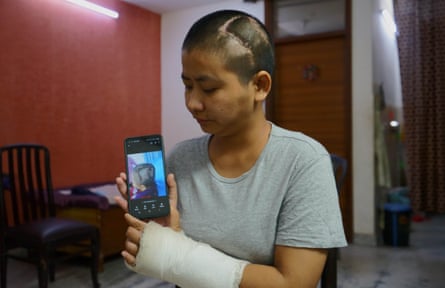
Nancy Chingthianigng was attacked and injured by a mob in Manipur Photograph: Aakash Hassan/The Guardian
Sasang’s
mother, who had tried to save her son from the mob, was also killed.
Pursued by the Meitei attackers, Chingthianniang ran to a nearby army
camp and, rattling the gates, pleaded with soldiers to help her.
Instead, they shooed her away, and as the enraged mob descended upon
her, she was beaten until she fell unconscious.
She
awoke a few days later in a hospital ICU, having undergone several
surgeries on her head. It was only days later the news was broken that
her husband and mother-in-law had not survived. Their bodies remain in
the morgue in Imphal, with relatives too fearful to collect them.
Chingthianniang
has since fled to her sister-in-law in New Delhi, where thousands from
Manipur have sought refuge from the conflict that continues to rage.
Unable to numb the traumas of that night, she relives it constantly in
her mind. “I am wondering how I can survive all this,” she says, pale
and shaken.
Since the attack on Chingthianniang
and her family in May, the conflict between the Meiteis and the Kukis
in Manipur has only escalated. About 130 people, predominantly Kukis,
have died while more than 60,000 have been displaced and hundreds of
relief camps have been established in a situation that has pushed the
state to the brink of civil war.
A history of violence
Manipur
is now carved up into two fiercely protected ethnic zones, with the
lowlands and valleys controlled by the Meiteis, and the Kukis in control
of the hills. Venturing into the territory of the opposing tribe is
described as a “death sentence”.
While
the state and central government – both controlled by prime minister
Narendra Modi’s ruling Bharatiya Janata party (BJP) – have insisted that
the situation is “slowly improving”, those on the ground tell another
story. Curfews and restrictions remain in large parts of the state and
the internet has repeatedly been shut down. Thousands of additional army
and paramilitary personnel have been deployed, while both sides have
formed their own vigilante armed groups. This week, eight more have died
in clashes.
Analysts
say government efforts to bring peace in the region have largely failed
so far and the tensions could escalate further, risking destabilising
other states in India’s volatile north-east region such as Mizoram,
Nagaland and Assam. The BJP state government in Manipur is dominated by
the majority Meiteis, leading to mass distrust among Kuki leaders, while
Modi has remained publicly silent on the conflict. The only high
profile BJP minister to visit the state has been the home minister, Amit
Shah. His visit did little to ease the ethnic tensions.
The spark for the unrest was a state court ruling on 27 Marchwhich
gave the dominant Meitei community “tribal status”, entitling them to
the same economic benefits and quotas in government jobs and education
as the minority Kuki community, as well as allowing Meiteis to purchase
land in the hills, where the Kukis predominately live. The decision was
later stayed by the supreme court, which called it “factually wrong”.
The
case stirred up an already fractious situation in a state that has been
no stranger to ethnic conflicts and insurgencies since independence.
The 2021 military coup in the neighbouring country of Myanmar raised
tensions again after thousands of refugees, who are more ethnically
aligned with the Kukis, fled over the border into Mizoram state and then Manipur, leading to fears among the Meiteis that their community risked being displaced.
A
protest on 3 May by Kuki students over the court ruling was met with
violence, and within hours ethnic groups had begun to clash. Houses,
shops, churches, temples and businesses were destroyed and about 60
people were killed in the first two days of violence.
Since
then, clashes and the torching of villages have continued apace. More
than 4,000 weapons have been looted from police armouries and officers
say they are often unable to control the anarchy that descends on to the
streets, described by India’s deputy foreign minister – whose house was
among those recently attacked with petrol bombs – as “a complete
breakdown of law and order”.
‘Foreigners on our own land’
Both
sides have now bunkered down in an effort to protect their own
territories. In Leimaran, a Meitei-controlled village surrounded by
paddy fields, a group of “village defence volunteers” – made up of about
150 farmers, teachers and local businessmen – have all taken up arms in
the conflict.
Their village of just 400
households is just a few kilometres from a Kuki stronghold, making it
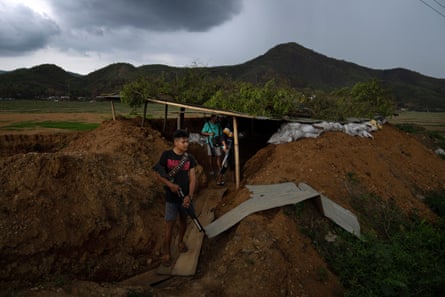
effectively a frontier in this ethnic fight. Villagers have put up seven
bunkers on the western side of the village and armed men keep a vigil
day and night.
Armed Meitei community members behind a bunker as they keep watch on rival Kuki bunkers. Photograph: Altaf Qadri/AP
The
road between the two villages has been barricaded and exists now as an
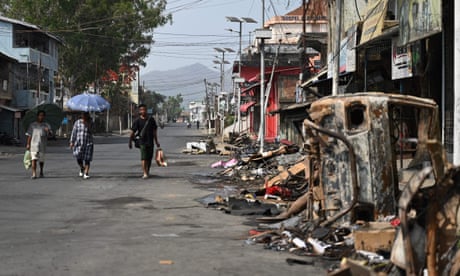
eerily silent buffer zone, lined with scorched, deserted homes and
burned-out cars and trucks. Military personnel have been stationed every
few metres.
“This is how every Meitei village
is preparing,” says Aheibam Dinamani Singh, 42, a professor at a local
government engineering college, who leads the defence group. “I am a
teacher but right now my priority is to procure a gun and defend my
community. The situation has reached a point where only guns can decide
the future course.”
On the other side of the
military checkpoint, just a few kilometres away, is the Kuki village of
Maitain, where a border has been built with bunkers and sandbags, and
where a similar group of Kuki locals keep watch for enemies who were
once their neighbours. Like many Kukis, the sentries support calls for
an independent Kuki state, arguing that they can no longer live
alongside the Meiteis. “We are posted here day and night and will keep
protecting our area till we achieve our goal,” says Hemkholien, 52.
“They
call us foreigners on our own land. We are facing existential threat,”
says Mawi, 48, who is an activist with Zomi council, an association of
Kuki and other tribal groups. “We have faced systemic injustices over
the years at the hands of the majority community. How can we live with
them?”
But the Meitei tribe say that splitting
the state would bring their entire identity into question and warn that
they are ready to fight it at any cost.
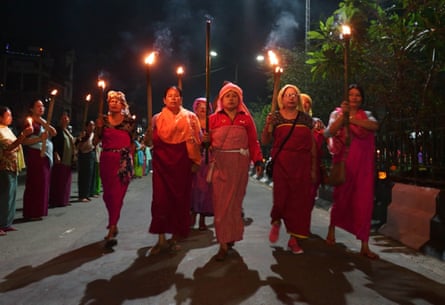
Protesters, holding a torchlight vigil for return of peace, in Imphal, the capital of Manipur Photograph: Aakash Hassan/The Guardian
“The
current border of Manipur is what our forefathers have fought for by
shedding blood. We cannot let it be divided,” says Samaradra Meitei, 29,
a Meitei activist holding his gun inside a bunker. “The separation of
Manipur is not acceptable to us. We will fight for it and there will be
lots of bloodshed.”
While some have sought to
cast a communal light on the conflict – as the Meiteis are Hindus, the
dominant religion in India, and the Kukis are Christians, who are in a
tiny minority and have suffered persecution under the Hindu nationalist
BJP government – those on the ground insist the unrest is not about
religion.
The role of neighbouring Myanmar also
threatens to further stir up the violence, with the country’s military
junta backing the Meiteis and the rebel fighters of Myanmar supporting
the Kukis. Activists from both sides acknowledge that the fighting is
being fuelled by an inflow of weapons such as automatic rifles, grenades
and rocket launchers from Myanmar into Manipur.
Police,
army officials and leaders from both communities have confirmed that
militants fighting in Myanmar have also crossed over the border and are
launching attacks on opposing communities. The Guardian also witnessed
the presence of these militants, with automatic rifles, among the
village defence volunteers of both communities.
This
week, the Manipur chief minister, N Biren Singh, said the army would
begin clearing the bunkers and defence structures built by both sides in
the hills and valleys, but Kuki leaders say they would oppose any such
measures.
“People are building bunkers on both
sides, they are positioning guns,” says Jang Kaopao Haokip, 55, a Kuki
farmer whose house and entire village were burned down in the violence.
“New Delhi should understand that this is preparation for war.”
The civil war in Manipur has lasted nearly 70 days. US ambassador to India Eric Garcetti has offered to help defuse the crisis as Prime Minister Narendra Modi maintains a studied silence. The levels of cruelty inflicted by the warring Meiteis and Kuki-Zos on one another beggars description. David Theik, 31, a Kuki youth guarding his village, was not just beheaded but his head was stuck on a pole and his body severed to pieces. Such cruelty also suggests that the hatred between the two communities runs deep and is beyond repair. Each group has taken a hardened stance and believes its people are victims. This victimhood mentality has pushed the warring factions to retaliate and vow revenge against one another in what seems a fight to the finish.
The Meiteis believe they are wronged by a system which deprives them of their rights as Manipur’s indigenous people. They are defined as non-tribals as they adopted Vaishnavism, a form of Hinduism that came from Bengal. The British had already executed their carefully crafted "divide and rule" policy after they entered the Northeast after the 1826 Treaty of Yandaboo. They demarcated the hills as the ancestral homes of the Kuki-Zo tribes and the Imphal Valley, just a tenth of Manipur’s land area, as the natural habitat of Meiteis. That this absurd arrangement, including colonial laws like the Eastern Bengal Frontier Regulation Act 1873, now called Inner Line Permit, should be allowed to continue after 1947, when India became independent, reveals the lack of thinking of Indian rulers who took over from the British.
The Meiteis, roughly 53 per cent of Manipur’s population, feel a deep sense of injustice as they are unable to buy land and settle in the hills, while the Kuki-Zo and Nagas, who virtually own the hills, can also settle in the Imphal Valley. That this would blow up into full-scale warfare was inevitable. Remember that both Meiteis and Kuki-Zo people have their share of armed militia, who have been agitating over perceived and real injustices. To that add the Naga militants — the NSCN(I-M) — whose turf is the Ukhrul region, also in the Manipur hills. While the NSCN(I-M) has been in talks with the Government of India since 1997, and Kuki outfits too are on a Suspension of Operations (SoO) agreement, the fact remains that these are weaponised societies. In the valley there are at least three dozen militant outfits demanding sovereignty, but essentially counter-checking the hill-based militants. That a turf war would break out sooner or later was predictable.
The problem today is that all militants are heavily armed and are being let loose by their communities on the plea that they are defending their villages and people. Lt. Gen. K. Himalay Singh (Retd), a Meitei and the first person from the Northeast to reach three-star rank in the Army, said recently: "Where society is weaponised, there will be violence. The current violence is based on aspirations and fears of one group that faces an uncertain future." Obviously, he was alluding to the Meiteis’ fear of their land being overrun by "illegal immigrants" from Myanmar. A narrative was created that the Kuki-Zo are growing poppy and that trade in cocaine was growing phenomenally, destroying young lives. According to Babloo Loithangbam of Human Rights Alert, Manipur’s drug trade is in the range of `50,000 crores annually, much above Manipur’s state budget. Obviously, this isn’t unknown to the Manipur government, and the drugs trade isn’t entirely run by the Kuki-Zo people; a number of drug lords are also well-heeled Meitei elite.
The immediate spark was the Meitei demand for Scheduled Tribe status, which the Kuki-Zo people felt was an infringement into their rights and would deprive them of jobs and educational opportunities as Meiteis are already a majority and benefit as all development in Manipur is valley-centric. All institutions of governance and learning are in Imphal while the hills remained undeveloped. Another problem is Article 371-C, which envisages governance autonomy for the hills, but has never been implemented properly. What may have worked better for the tribes is the Sixth Schedule of the Constitution, as implemented in the Bodoland Territorial Council, which has substantial Central funding for institutions of learning and other development infrastructure that could prevent the out-migration of Kuki-Zo people in large numbers in search of employment.
Violence is embedded in inequalities. Political scientist Neera Chandhoke says the moral evaluation of any political violence should be determined by two facts — whether it is used to counter the State’s larger violence or to overcome the bigger injustices, structured inequalities and constant neglect of popular aspirations. The Manipur violence is a legacy left behind by the British, which the Indian State never had the time or inclination to resolve as the region itself was seen as conflict ridden. The Naga insurgency had started with India’s Independence. There may have been a fear that tinkering with the governance norms left by the British could trigger fresh conflicts in areas beyond Nagaland. Even today, India is yet to comprehend its northeastern periphery and the angst of people in this region, which shares just one per cent of its borders with India and 99 per cent with foreign countries.
The Manipur conflict has now crossed its borders, with Mizoram bearing the brunt of hosting over 20,000 displaced Kuki-Zo people, who are bound by kinship ties. The Kuki-Zo have dug in their heels to not settle for anything less than separate self-governance, severed from Manipur. If this is granted to the Kuki-Zo, it will have its repercussions in Tripura where the Tipra Motha, a party representing the aspirations of tribals that is demanding self-governance and an empowered Sixth Schedule with rights over tribal lands. Manipur’s Nagas too won’t acquiesce to the Kuki-Zo demand as their living spaces are a continuum, with no definite borders. But what’s worrying is the demonstration by Meitei and Kuki-Zo militia that they can freely use arms. This may be replicated by other armed groups like Assam’s Bodos, who want a separate state, and the Garos in Meghalaya. The militia in these states are not totally disarmed. A small spark could push the tribal groups to take to arms.
There are over 40,000 security forces in Manipur now, but they haven’t been able to contain the violence. What happens if a similar conflict erupts in other states where militancy lurks below the surface. Is the Indian State ready to accede to demands to redraw state boundaries? Is anyone even thinking of these possibilities?
The writer is a prominent social activist and the editor of The Shillong Times
Trigger Warning: The article contains description of hate speech.
"Where
have I written this song from? I am writing it from a war zone. This is
not a song written during a state of peace. What will be the lyrics
be?" asked Tapta, when asked about his latest song that has caused quite
some furore in Manipur.
Amidst the ethnic violence
that engulfed the state since 3 May, Jayenta Loukrakpam, known by his
stage name Tapta, a popular Meitei singer based in Imphal, released a
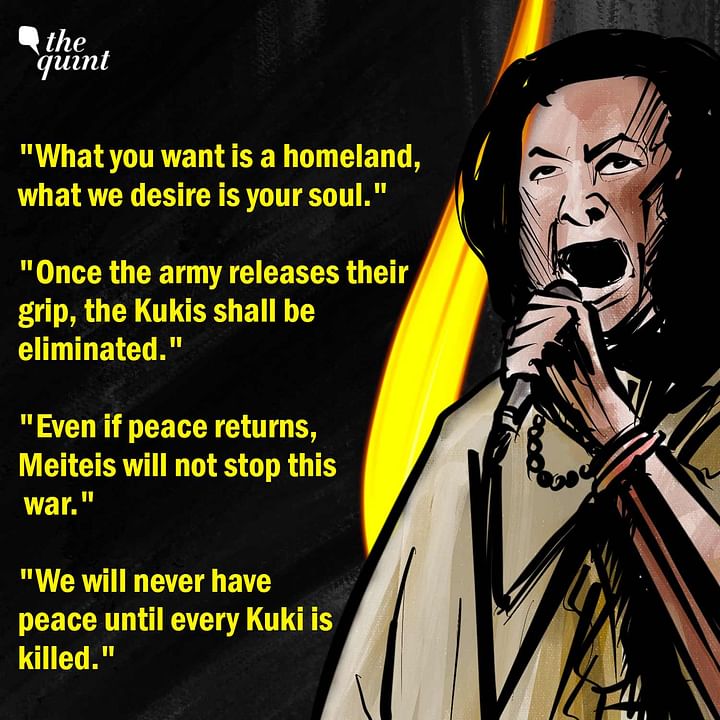
controversial song on Friday, 7 July. Among other things, the song says
"Meiteis will never have peace until every Kuki is killed."
There
are other lines as well from the song that could qualify as hate speech
or even incitement to genocide. Here are some of the lines.
Some of the lyrics from Tapta's new song.
(Illustration: Chetan Bhakuni/The Quint)
The lyrics also contain a derogatory claim about the Indian Army. The song with the aforementioned lyrics can be found below.
Tapta
entered the music scene in Manipur with a hard-hitting debut album
called 'Power of Attraction', and has cultivated a cult following ever
since, having a fanbase among across all communities in Manipur.
The Quint spoke to Tapta about his extremely controversial song. In a telephone conversation. here is what he had to say in his defence.
'They Started This War': Tapta Blames Kukis for Violence
"I
put out this song on Friday, 7 July. Violence has been going on since 3
May. I waited for two months before writing the song, two months. Kukis
don’t want to live with us. I might also release another song in the
coming Friday. Kukis are committing crimes, that’s why I have written
this song," asserted the 57-year-old Meitei singer.
When asked about his lyrics that accuse the Indian Army of siding with the Kuki community, Tapta told The Quint
that he was told this by the Meiteis living in Churachandpur and
Moirang. "They have said that because of the Kukis, there is no peace.
They have said these things, and therefore, I have written it into a
song."
Tapta then went on to blame the Kukis for the ongoing violence.
"They
(the Kukis) have said that they will kill us. They are still preparing
to attack. They started this war, we were living in peace. It was their
solidarity march. Who all participated in that, do you know? They burned
houses and killed people. In Churachandpur, in Moreh. They have guns,
We don’t have anything, not even guns. The indigenous Kuki militants
plus migrant Kuki terrorists plus the Indian central force, all of them
combined are attacking the Meiteis. What have Meiteis done wrong? We
have not done anything. Meiteis are only defending. They have guns,
snipers, and sophisticated automatic rifles. What do we have?"
Tapta, in conversation with The Quint
The
award winning musician, however, also went to say that Meiteis want
peace and that they will welcome the Kukis with open arms. "Through my
song, I am telling the Kukis, that you are still welcome. We want peace.
But if they don’t, then we shall see," Tapta added, in what appeared to
be a veiled threat.
Tapta's main defense throughout the conversation for his genocidal song was that he is writing in the context of a war zone.
"Where
have I written this song from? I am writing it from a war zone. This is
not a song written during a state of peace. What will be lyrics be? You
are sitting in Delhi. How will you understand? I am not writing it
sitting in Delhi. I am writing it in Imphal. Understand the sentiment.
Before this, what did I write? For two months, I was hoping for peace.
But peace did not come. I waited for two months. Waited for peace,
waited for PM Modi. Neither came."
Tapta, in conversation with The Quint
When
repeatedly questioned about how his song contravenes his desire for
peace, the singer merely said, "Why don't the indigenous Kukis
surrender? Otherwise, more Meiteis will die."
When asked about
his Kuki fanbase, "Yes, I have Kuki fans, but they are harming us. They
are with Kuki terrorists. We will warmly welcome the Kukis if they stop
the violence. Why are the Kukis staying with the terrorists? Why are
they demanding Kukiland?"
He added that he is not afraid of going
to jail. "Even if they file a police complaint, I am not scared of jail.
They can send me to jail. This is for my motherland. I can become a
martyr for Manipur. Meiteis have done nothing wrong. Kukis have done us
wrong."
The Quint reached out to multiple
authorities within the state's police department including the director
general of police, the superintendent of police and the station officer
in Imphal, and the SP in Bishnupur, to ask whether the police have taken
any cognisance of the song and the hate speech in its lyrics. None of
them responded to The Quint's calls or emails This article shall be updated with their responses as soon as they come.
However, Churachandpur Superintendent of Police Karthik Malladi did tell The Quint that
no police complaint has been filed at the district police station, and
no Kuki leader or organisation has approached the police regarding the
same, yet.
'Tried to Get Him to Take Down the Song': Meitei Community Leaders Criticise Song and Singer
Many in the Meitei community have not reacted positively to the song.
Deben,
a peace activist who works for interfaith relations and harmony with an
organisation called the Interfaith Forum for Peace and Harmony in
Manipur, told The Quint that Tapta's song is unacceptable.
"The
song is absolutely unacceptable. I have even contacted a woman activist
in the Meitei community, about the the interfaith forum would do about
Tapta's song. Since we don't have access to the internet, there is no
documentation of what hate campaigns have been going on, from both sides
though, I should add. I have asked to collect evidence of such hate
campaigns, so that the forum can deal with them."
Deben, Meitei peace activist
He
went on to add, "Look, we are clear. We want a cessation of violence.
This is my personal statement, and not the forum's. We want both sides
to stop the violence and the hate campaigns," he asserted.
Similarly, Heigrujam Nabashyam, chairman of the World Meitei Council, told The Quint,
"The moment I got know about the song, I tried to get him to delete, to
take down the song. Is it still there on the internet? I don't agree
with these lyrics at all. I tried to tell him through a third party,
someone who knows him, to tell him to take down the song."
When
told that the song was still getting circulated on YouTube and Twitter,
Nabashyam said: "Look, Tapta may be a great singer. But human beings
are human beings! There is some talk that the Kuki militants under the
SoO (suspension of operations) agreement are backed by the army. So, we
are requesting the government, the prime minister, and the home
minister, to scrap SoU. Then peace and normalcy can return."
For
context, the SoO pact was signed in 2008, a tripartite agreement between
25 Kuki insurgent groups, the Government of India, and the state of
Manipur. According to the agreement, state and central security forces,
including state and central forces would not launch military operations
against the insurgent groups, and the latter would also maintain peace
with the primary objective of engaging in dialogue. However, in March
earlier this year, the BJP-led Manipur government decided to withdraw
from the agreement.
Ninglun Hanghal, a Kuki based in Imphal
expressed shock when asked about the song. "Tapta is a very popular
band. I am shocked to hear the song. I didn't expect this from him at
all. It's very sad that the situation has deteriorated to this extent."
As
of now, Tapta's song continues to circulate around the internet. No
police complaint has been filed, and the police or the judiciary do not
seem to have taken suo moto cognisance of the hate speech in the song.
(At The Quint, we are answerable only to our audience. Play an active role in shaping our journalism by becoming a member. Because the truth is worth it.)
Updated on: 26 June,2023 08:16 AM IST | Mumbai Ajaz Ashraf
Chilling accounts of Kuki women sexually assaulted by Meitei mobs echo the experience of Gujarat’s lionhearted survivor of 2002
Kukis stage a protest over the ongoing violence in Manipur, at Jantar Mantar in New Delhi on June 24. Pic/Damlemsang
On July 15, 2004, a group of Manipuri women assembled in front of Imphal’s Kangla Fort, the Assam Rifles headquarters, took off their clothes and held aloft a banner that declared: “Indian Army
Rape Us.” These Meitei women were protesting against the Assam Rifles
soldiers accused of raping and killing 32-year-old Manorama Thangjam.
Images of their protest became iconic representations of resistance
against uniformed men violating women in conflict zones.
In sharp contrast to the 2004 protest at the Kangla Fort,
Meitei women have not only been part of mobs hunting and killing Kukis,
but they have also reportedly egged on men to rape Kuki women caught in
the bloody maelstrom of Manipur’s ethnic-religious conflict.
Take
Hahat, a resident of B Phainom village, Kangpokpi district, whose
account to the Kuki Women’s Forum, a civil society group, makes for a
chilling read. On May 4, the village repulsed the raid by a Meitei mob
comprising men and women. The Meiteis regrouped and attacked again. With
their defence crumbling, the residents, including Hahat, fled to the
hills. Once at a safe distance, Hahat watched the horror unfold: her
brother and his son were executed. Her niece and the village chief’s
wife were disrobed, paraded around naked, and raped.
Hahat’s
account echoes the experience of Bilkis Bano during the 2002 Gujarat
riots. Then 21 years old and pregnant, Bilkis and her extended family
fled Radhikpur village, in Dahod district, at the outbreak of violence
across Gujarat. The fleeing villagers were waylaid by a group of men
armed with swords and sickles. Bano, her mother and three other women
were gangraped. Eight were killed, another six went missing. Bano
survived, and went on to courageously wage her struggle for justice. It
is a cruel twist of history that the land of Meira Paibis, or Women
Torch Bearers, who led the iconic 2004 Kangla Fort protest, has spawned
its own Bilkis Banos: vulnerable women raped, assaulted and left to die.
There seems to have been a demonic strategy to incite Meiteis to rape
Kuki women and justify these barbaric actions as retaliatory in nature,
a strategy laid bare by Hoineilhing Sitlhou, assistant professor at the
University of Hyderabad, in a piece she wrote for NewsClick. Fake news
about Kukis raping Meitei women was first spread via social media and
word of mouth. The sexual assaults on Kukis were then projected as
retribution.
Here are some instances of fake news that Sitlhou cited in her piece.
It was claimed that Kukis, in their stronghold of Churachandpur
district, had raped Meitei women. Manipur’s Director General of Police
denied it forthwith. It was bandied around that a Meitei nurse in
Churachandpur had been raped; her father went to a local TV channel to
deny it. Imphal’s Shija Hospital scotched rumours that the bodies of 37
Meitei rape victims were in its morgue.
Yet just about every rape survivor or eyewitness to the violence
against women told Sitlhou that the Meitei assailants spoke of the
violation of their women even as they proceeded to sexually assault
Kukis. The survivors also testified to the participation of Meitei women
in the violence against their Kuki counterparts.
For instance, employees at a car-wash company in Imphal hid two Kuki
girls as a Meitei mob of men and women came searching for them. Under
duress, an employee revealed their hideout. The two girls were gagged
and dragged to another room, where they were mercilessly beaten and
tortured. Their fathers, in their testament to the Kuki Women’s Forum,
said, “Shockingly, women were among the perpetrators.” The two girls are
dead, their bodies lying in a government hospital’s morgue. A doctor
there told a family member of one of the two girls that “maybe” they
were raped.
Kim (name changed), 18, was abducted from Checkon, in Imphal, and
ferreted away to a Meitei locality, where a group of men and, yes,
women, battered her with rifle butts. Her hair was snipped off to break
her resistance to the men’s sexual advances. The Meitei women did not
intervene. Kim courageously, and miraculously, escaped from her captors.
Her medical report confirmed she had been raped.
Bilkis Bano not only symbolises the vulnerability of women during
spells of social chaos, but also the resolve of the weak to secure
justice. The first step to justice requires an impartial investigation
into the reports of rape discussed above. As Tracy Mate, of the Kuki
Women’s Forum, says, “Justice is not served until the voices of rape
victims are heard, their pain acknowledged, and their rights protected.”
For the Forum’s Daisy Mate Munluo, though, justice has quite another
meaning: “Associating with Meiteis only leads to our oppression. For me,
justice means Kukis must have their separate administration. Families
of survivors deserve separation from their tormentors.”
Gujarat’s Bilkis Bano suffered during the rule of the Bharatiya
Janata Party, which is the ruling party in Manipur, where its Bilkis
Bano and the families of those who did not survive the ordeal of rape
struggle to find closure to their suffering. It is for the readers to
figure out whether the BJP factor, common to the social breakdown in
Gujarat and Manipur, is merely a coincidence.


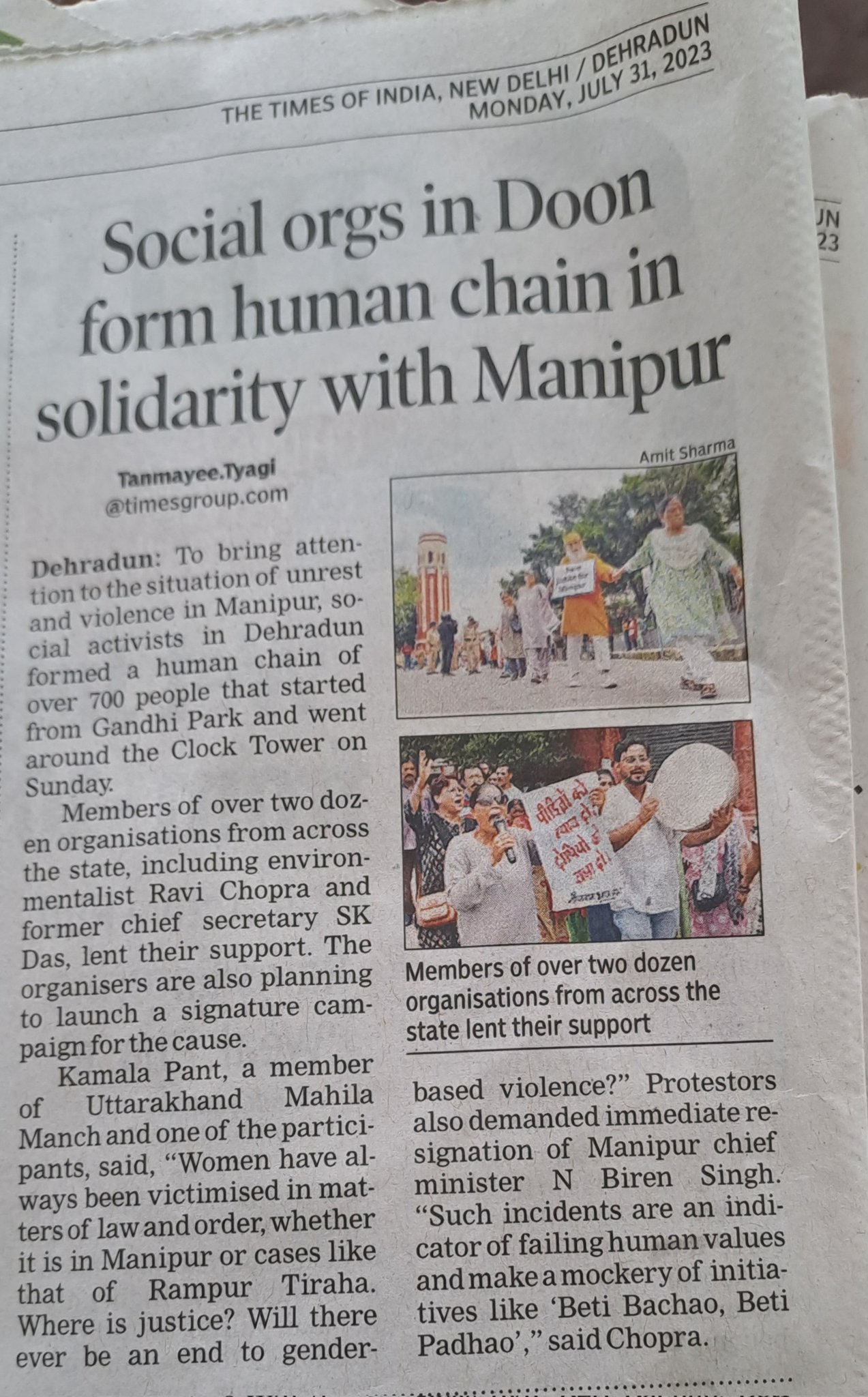


 The nation must thank Prime Minister Narendra Modi
not only for belatedly breaking his silence on Manipur, but also for
the language he used to condemn the parading of two Kuki women stripped
naked in public there, with one of them brutally gang-raped. Modi said
his heart was filled with “anger and sorrow” at the barbaric act
captured in a video that went viral.
The nation must thank Prime Minister Narendra Modi
not only for belatedly breaking his silence on Manipur, but also for
the language he used to condemn the parading of two Kuki women stripped
naked in public there, with one of them brutally gang-raped. Modi said
his heart was filled with “anger and sorrow” at the barbaric act
captured in a video that went viral.

 On July 15, 2004, a group of Manipuri women assembled in front of