Four Decades of Nellie: Isn’t an Apology Due?
The Nellie massacre of 1983 killed thousands in Assam. In the larger Assamese society, the tragedy is either underplayed or justified.
by Jyotirmoy Talukdar
|

Showing posts with label Nellie Massacre. Show all posts
Showing posts with label Nellie Massacre. Show all posts
February 20, 2023
India: Four Decades after the Nellie massacre in Assam, the tragedy is either underplayed or justified. | Jyotirmoy Talukdar


November 05, 2017
India: Pogroms and politics - Nellie, Delhi, Bombay and Gujarat are dots on a learning curve
The Telegraph, November 5, 2017
Pogroms and politics
- Nellie, Delhi, Bombay and Gujarat are dots on a learning curve
Mukul Kesavan
Pogroms in republican India don't hurt the parties that organize them. They help their cause. The Congress won the largest mandate in India's electoral history after Congressmen helped murder thousands of Sikhs in Delhi in 1984. Forty nine per cent of the vote. Four hundred and four seats. This wasn't the accidental outcome of a tragedy; the Congress milked the pogrom in its election campaign. The Rediffusion advertisements that Rajiv Gandhi ran asked potential voters to vote for the Congress if their taxi driver made them nervous. Why? Because Sikhs were often taxi drivers and the Congress, as the pogrom demonstrated, had a way with Sikhs. Congressmen accused of leading or organizing the violence remained members of parliament, ministers and senior party functionaries for decades after the pogrom.
The previous year, in February 1983, at least 2,000 Bengali Muslims were killed in Nellie in Assam. The All Assam Students Union that led the massive agitation against the enrolment of illegal Bangladeshi migrants into Assam's voter rolls before the Nellie massacre did very well out of its mobilization and the bloody aftermath. It turned itself into a political party, the Asom Gana Parishad, and handily won the state assembly elections of 1985. Prafulla Kumar Mahanta served two terms as the chief minister of Assam. No one was tried or sentenced for the 2,191 people killed (the official death toll, the unofficial estimates are several times higher); all the cases were dropped after the Assam Accord was signed. The Tiwari Commission report into the massacre was never made public.
The Bombay 'riots' of December 1992 and January 1993 were, in fact, an ongoing pogrom in the wake of the Babri Masjid demolition. At least 900 people were killed. The Shiv Sena's role in inciting anti-Muslim mobs and organizing violence was reported by journalists and criticized in the report written by Justice B.N. Srikrishna. But Shiv Sena politicians and complicit policemen didn't serve time for their role in the violence. The Srikrishna report was shelved and the Shiv Sena reaped a rich political harvest soon after. In the 1995 assembly elections that followed the violence (the pogrom and the subsequent terrorist bombings organized by Muslim ganglords like Dawood Ibrahim), the Shiv Sena formed the government of Maharashtra as the senior partner in a coalition with the Bharatiya Janata Party.
The Gujarat pogrom of 2002 was initially seen by A.B. Vajpayee and some of his colleagues as politically unacceptable, but it came to be viewed as Narendra Modi's national calling card. The criticism he received for the Gujarat government's alleged complicity in the violence was deftly turned into an occasion for aggrieved Gujarati pride and the pogrom itself became something of a badge of honour, evidence of a Hindu strongman's short way with an entitled minority. The butchery in Naroda Patiya, the rapes, the systematic destruction of mosques and dargahs, the deliberate marginalization of Gujarati Muslims as treacherous aliens came to be seen as signs of nationalist virility not communal savagery. The serious allegations against Modi and Amit Shah were formally dismissed by tribunals and courts and the BJP politicians who were sent to jail had their sentences lightened by bail and parole. Most importantly, Modi won election after election in Gujarat and finally swept the 2014 general elections to become the prime minister of India, not despite the Gujarat pogrom but in large part because of it.
In the twenty years between 1983 and 2002, it is retrospectively obvious that the organized, large-scale killing of religious minorities in the name of Hindu grievance became a springboard to political power. This is not the same as arguing that in every case the killings were premeditated; it is to say, though, that politicians and political parties learn through experience and Nellie, Delhi, Bombay and Gujarat were dots on a steep learning curve. (This is not an exhaustive list. The killing of a thousand people in Bhagalpur in 1989, more than ninety per cent of whom were Muslims, was every bit as bloody as the four pogroms detailed here.)
These two decades see two sorts of lessons learnt: a) the potential of violence as both a political statement and a form of mobilization in the name of Hindu grievance and b) the impunity with which this violence could be inflicted because of the institutional bias in the civil administration and the police against minorities in general and Muslims in particular.
The point about Hindu grievance is crucial. In Assam, the grievance was illegal Bangladeshi - Bengali Muslim - immigration. This was a deeply felt issue given the huge demographic shifts that occurred in the build-up to and the aftermath of the war of 1971. The AASU leaders argued at the time that they were opposed to all illegal migrants from Bangladesh, not just Bengali Muslims, and some of them might have been sincere, but given the faith of the majority of the migrants, the conflation of Bangladeshi and Muslim was inevitable.
Also, no other migrants offer political returns of the sort that Muslims do. The migration of Bangladeshi Muslims is resisted by locals in the Northeast as a creeping transformation of their homelands. The case of Tripura is instructive in this context. Massive migration, first from East Pakistan and then Bangladesh, turned a small tribal state into a state with a large Bengali majority in the space of two decades. For aboriginal communities in the Northeast, the fate of Tripura became a cautionary tale but this 'swamping' had no political resonance because the Bengali migrants in question were overwhelmingly Hindu. Hindu migration cannot be an occasion for violence of the Nellie sort: the State wouldn't permit it.
The grievance in 1984 was two-headed: the assassination of a charismatic prime minister and the pre-history of Khalistani terrorism. It was politically possible because a communalized police force was willing to do the bidding of feral Congress politicians and Rajiv Gandhi was willing to look the other way. The importance of 'Hindu' feeling was evident again in the Bhagalpur pogrom when Rajiv Gandhi cancelled the transfer of the superintendent of police of Bhagalpur who had allowed the mobs to rampage unchecked in the face of protests from local Hindus and the Vishwa Hindu Parishad.
In 1992-93, the Shiv Sena and the BJP used the burning of the Radhabai chawl in Bombay as a provocation for violence against Muslims generally. In Gujarat, it was the burning of the railway coach and the ghastly deaths of the Hindus inside that became both the cue for the pogrom at the time and the justification for it afterwards. The politics of provocation is unequal: for a Muslim to argue that the razing of the Babri Masjid and the killing of Muslims in the wake of the vandalism were reasons enough for him to set about Hindus in his neighbourhood would be absurd, but when the roles are reversed, Hindu grievance is always plausible and violence in its name is invariably profitable.
Why have pogroms in the majoritarian cause become drivers of Indian politics over the past thirty five years? One answer is that they haven't. India's republican history is dotted with communal riots and these eruptions are just more of the same. This is clever but untrue. The scale of the violence, the complicity of the police and the administration and, most of all, the immediate political dividends that accrue represent a real change in the nature of republican politics. The reasons for that change need another column.
Pogroms and politics
- Nellie, Delhi, Bombay and Gujarat are dots on a learning curve
Mukul Kesavan
Pogroms in republican India don't hurt the parties that organize them. They help their cause. The Congress won the largest mandate in India's electoral history after Congressmen helped murder thousands of Sikhs in Delhi in 1984. Forty nine per cent of the vote. Four hundred and four seats. This wasn't the accidental outcome of a tragedy; the Congress milked the pogrom in its election campaign. The Rediffusion advertisements that Rajiv Gandhi ran asked potential voters to vote for the Congress if their taxi driver made them nervous. Why? Because Sikhs were often taxi drivers and the Congress, as the pogrom demonstrated, had a way with Sikhs. Congressmen accused of leading or organizing the violence remained members of parliament, ministers and senior party functionaries for decades after the pogrom.
The previous year, in February 1983, at least 2,000 Bengali Muslims were killed in Nellie in Assam. The All Assam Students Union that led the massive agitation against the enrolment of illegal Bangladeshi migrants into Assam's voter rolls before the Nellie massacre did very well out of its mobilization and the bloody aftermath. It turned itself into a political party, the Asom Gana Parishad, and handily won the state assembly elections of 1985. Prafulla Kumar Mahanta served two terms as the chief minister of Assam. No one was tried or sentenced for the 2,191 people killed (the official death toll, the unofficial estimates are several times higher); all the cases were dropped after the Assam Accord was signed. The Tiwari Commission report into the massacre was never made public.
The Bombay 'riots' of December 1992 and January 1993 were, in fact, an ongoing pogrom in the wake of the Babri Masjid demolition. At least 900 people were killed. The Shiv Sena's role in inciting anti-Muslim mobs and organizing violence was reported by journalists and criticized in the report written by Justice B.N. Srikrishna. But Shiv Sena politicians and complicit policemen didn't serve time for their role in the violence. The Srikrishna report was shelved and the Shiv Sena reaped a rich political harvest soon after. In the 1995 assembly elections that followed the violence (the pogrom and the subsequent terrorist bombings organized by Muslim ganglords like Dawood Ibrahim), the Shiv Sena formed the government of Maharashtra as the senior partner in a coalition with the Bharatiya Janata Party.
The Gujarat pogrom of 2002 was initially seen by A.B. Vajpayee and some of his colleagues as politically unacceptable, but it came to be viewed as Narendra Modi's national calling card. The criticism he received for the Gujarat government's alleged complicity in the violence was deftly turned into an occasion for aggrieved Gujarati pride and the pogrom itself became something of a badge of honour, evidence of a Hindu strongman's short way with an entitled minority. The butchery in Naroda Patiya, the rapes, the systematic destruction of mosques and dargahs, the deliberate marginalization of Gujarati Muslims as treacherous aliens came to be seen as signs of nationalist virility not communal savagery. The serious allegations against Modi and Amit Shah were formally dismissed by tribunals and courts and the BJP politicians who were sent to jail had their sentences lightened by bail and parole. Most importantly, Modi won election after election in Gujarat and finally swept the 2014 general elections to become the prime minister of India, not despite the Gujarat pogrom but in large part because of it.
In the twenty years between 1983 and 2002, it is retrospectively obvious that the organized, large-scale killing of religious minorities in the name of Hindu grievance became a springboard to political power. This is not the same as arguing that in every case the killings were premeditated; it is to say, though, that politicians and political parties learn through experience and Nellie, Delhi, Bombay and Gujarat were dots on a steep learning curve. (This is not an exhaustive list. The killing of a thousand people in Bhagalpur in 1989, more than ninety per cent of whom were Muslims, was every bit as bloody as the four pogroms detailed here.)
These two decades see two sorts of lessons learnt: a) the potential of violence as both a political statement and a form of mobilization in the name of Hindu grievance and b) the impunity with which this violence could be inflicted because of the institutional bias in the civil administration and the police against minorities in general and Muslims in particular.
The point about Hindu grievance is crucial. In Assam, the grievance was illegal Bangladeshi - Bengali Muslim - immigration. This was a deeply felt issue given the huge demographic shifts that occurred in the build-up to and the aftermath of the war of 1971. The AASU leaders argued at the time that they were opposed to all illegal migrants from Bangladesh, not just Bengali Muslims, and some of them might have been sincere, but given the faith of the majority of the migrants, the conflation of Bangladeshi and Muslim was inevitable.
Also, no other migrants offer political returns of the sort that Muslims do. The migration of Bangladeshi Muslims is resisted by locals in the Northeast as a creeping transformation of their homelands. The case of Tripura is instructive in this context. Massive migration, first from East Pakistan and then Bangladesh, turned a small tribal state into a state with a large Bengali majority in the space of two decades. For aboriginal communities in the Northeast, the fate of Tripura became a cautionary tale but this 'swamping' had no political resonance because the Bengali migrants in question were overwhelmingly Hindu. Hindu migration cannot be an occasion for violence of the Nellie sort: the State wouldn't permit it.
The grievance in 1984 was two-headed: the assassination of a charismatic prime minister and the pre-history of Khalistani terrorism. It was politically possible because a communalized police force was willing to do the bidding of feral Congress politicians and Rajiv Gandhi was willing to look the other way. The importance of 'Hindu' feeling was evident again in the Bhagalpur pogrom when Rajiv Gandhi cancelled the transfer of the superintendent of police of Bhagalpur who had allowed the mobs to rampage unchecked in the face of protests from local Hindus and the Vishwa Hindu Parishad.
In 1992-93, the Shiv Sena and the BJP used the burning of the Radhabai chawl in Bombay as a provocation for violence against Muslims generally. In Gujarat, it was the burning of the railway coach and the ghastly deaths of the Hindus inside that became both the cue for the pogrom at the time and the justification for it afterwards. The politics of provocation is unequal: for a Muslim to argue that the razing of the Babri Masjid and the killing of Muslims in the wake of the vandalism were reasons enough for him to set about Hindus in his neighbourhood would be absurd, but when the roles are reversed, Hindu grievance is always plausible and violence in its name is invariably profitable.
Why have pogroms in the majoritarian cause become drivers of Indian politics over the past thirty five years? One answer is that they haven't. India's republican history is dotted with communal riots and these eruptions are just more of the same. This is clever but untrue. The scale of the violence, the complicity of the police and the administration and, most of all, the immediate political dividends that accrue represent a real change in the nature of republican politics. The reasons for that change need another column.
July 17, 2015
India: 32 years after Nellie, a documentary finds sorrow, indifference, and a refusal to forget
‘What the Fields Remember’, Subasri Krishnan’s film on the horrors of the Nellie massacre of 1982, suggest that victims carry the burden of remembering mass violence.
Nandini Ramnath (scroll - 16 july 2015)
http://scroll.in/article/741061/32-years-after-nellie-a-documentary-finds-sorrow-indifference-and-a-refusal-to-forget
Nandini Ramnath (scroll - 16 july 2015)
http://scroll.in/article/741061/32-years-after-nellie-a-documentary-finds-sorrow-indifference-and-a-refusal-to-forget
July 06, 2015
India: a film about Nellie Massacre
http://www.indiaresists.com/what-the-fields-remember-a-film-about-nellie-massacre-filmmakers-note/
What the Fields Remember: a film about Nellie Massacre [Filmmaker’s Note]
June 29, 2015
Subasri Krishnan | What the fields remember
6My first memory of the Nellie massacre is a faint one. I was 8-years old and lived in Tinsukia, Assam briefly. Apart from the name “Nellie”, that somehow managed to implant itself in my memory, I have no recollection of anything else. It may have been because there were actually no conversations around it or maybe my memory was storing the name and the place for some other time. I will never know. After that, I never ever heard about the massacre, until I chanced upon Teresa Rahman’s article in Tehelka in 2006. That piece went into detail the horrors of what had happened on 18th February, 1983 and how the survivors were still waiting for justice. This time, I tried to find out more about what had happened, but except for a few online pieces, here and there, there wasn’t anything much that had been written on Nellie at the time. A few people I spoke to did help me with pointing towards academic articles and books on Assam, but it was as if Nellie had ceased to be part of people’s conversation, except as a footnote or guest appearance in the list of places where mass violence had taken place in India.
I eventually forgot about Nellie, and moved on to make other films. Shut. Forgotten. In June 2013, I read this wonderful piece by Jaspreet Singh in the New York Times about his memory of the 1984 anti-Sikh riots, and the importance and complexity of memorialization. Reading this piece, in a strange way, brought back the Nellie massacres to my mind, and questions around why do our collective memories choose to remember some events and obliterate others? How are our collective memories of public events shaped? And why were Nellie massacres never part of our collective memories?
I started work on What the Fields Remember in October 2013, and from February 2014-February 2015, I made four trips to Assam as part of my research and filming. I met survivors from various villages and the town of Nellie. Some refused to speak to me, as they did not want to revisit a past they had managed to bury and move on. Some were more than forthcoming and were still waiting for an acknowledgement from the State and citizens of India – a belated apology, among other things. And with a very few, I began a tenuous relationship, each of us relating to each other from our private universes, and over a period of time, building a relationship – and this I believe is the privilege and gift of documentary filmmaking. One of them (Sirajuddin Ahmed), was dismissive of me the first time I met him along with Amit Mahanti (the cinematographer and editor of the film). He was wary and watchful to begin with, but never judgmental and always helpful – even though he didn’t particularly see the point of the film being made after all these years. But we managed to strike some kind of a comradeship, and he even agreed to be interviewed in front of the camera, on his own terms and time. His questions to me, and of the world, ended up shaping the film to a large extent as it stands today.
I wanted to make the film as a way to engage with my questions and dilemmas around the idea of collective memory and amnesia and what we choose to memorialize. But somewhere along the way, the film changed. Whose memory and amnesia was I talking about? Mine and of those who inhabit the world and class I do? We may have forgotten, but for the people who went through what happened on 18th February, there was no forgetting. They live with it even today, some more private than the others. And they know that “justice” is not a word that will ever be part of their vocabulary. The film, in some ways, had morphed into a different kind of memory-making.
I decided not to focus too much on the larger political events that had shaped the survivors’ personal histories, not because it is not important, but because every time the question of justice for the survivors of the Nellie massacre comes up, Assam’s complex political history becomes the smokescreen. It is as if the complexity of the times and justice were/are mutually exclusive.
I then decided to make the film entirely through account of the survivors of the Nellie massacre. I chose to focus my lens on Abdul Khayer and Sirajuddin Ahmed’s personal histories and their ideas of memory, violence, justice, politics and hopefully through their narratives, the larger ideas of collective memory and amnesia have also come through.
What the Fields Remember: a film about Nellie Massacre [Filmmaker’s Note]
June 29, 2015
Subasri Krishnan | What the fields remember
6My first memory of the Nellie massacre is a faint one. I was 8-years old and lived in Tinsukia, Assam briefly. Apart from the name “Nellie”, that somehow managed to implant itself in my memory, I have no recollection of anything else. It may have been because there were actually no conversations around it or maybe my memory was storing the name and the place for some other time. I will never know. After that, I never ever heard about the massacre, until I chanced upon Teresa Rahman’s article in Tehelka in 2006. That piece went into detail the horrors of what had happened on 18th February, 1983 and how the survivors were still waiting for justice. This time, I tried to find out more about what had happened, but except for a few online pieces, here and there, there wasn’t anything much that had been written on Nellie at the time. A few people I spoke to did help me with pointing towards academic articles and books on Assam, but it was as if Nellie had ceased to be part of people’s conversation, except as a footnote or guest appearance in the list of places where mass violence had taken place in India.
I eventually forgot about Nellie, and moved on to make other films. Shut. Forgotten. In June 2013, I read this wonderful piece by Jaspreet Singh in the New York Times about his memory of the 1984 anti-Sikh riots, and the importance and complexity of memorialization. Reading this piece, in a strange way, brought back the Nellie massacres to my mind, and questions around why do our collective memories choose to remember some events and obliterate others? How are our collective memories of public events shaped? And why were Nellie massacres never part of our collective memories?
I started work on What the Fields Remember in October 2013, and from February 2014-February 2015, I made four trips to Assam as part of my research and filming. I met survivors from various villages and the town of Nellie. Some refused to speak to me, as they did not want to revisit a past they had managed to bury and move on. Some were more than forthcoming and were still waiting for an acknowledgement from the State and citizens of India – a belated apology, among other things. And with a very few, I began a tenuous relationship, each of us relating to each other from our private universes, and over a period of time, building a relationship – and this I believe is the privilege and gift of documentary filmmaking. One of them (Sirajuddin Ahmed), was dismissive of me the first time I met him along with Amit Mahanti (the cinematographer and editor of the film). He was wary and watchful to begin with, but never judgmental and always helpful – even though he didn’t particularly see the point of the film being made after all these years. But we managed to strike some kind of a comradeship, and he even agreed to be interviewed in front of the camera, on his own terms and time. His questions to me, and of the world, ended up shaping the film to a large extent as it stands today.
I wanted to make the film as a way to engage with my questions and dilemmas around the idea of collective memory and amnesia and what we choose to memorialize. But somewhere along the way, the film changed. Whose memory and amnesia was I talking about? Mine and of those who inhabit the world and class I do? We may have forgotten, but for the people who went through what happened on 18th February, there was no forgetting. They live with it even today, some more private than the others. And they know that “justice” is not a word that will ever be part of their vocabulary. The film, in some ways, had morphed into a different kind of memory-making.
I decided not to focus too much on the larger political events that had shaped the survivors’ personal histories, not because it is not important, but because every time the question of justice for the survivors of the Nellie massacre comes up, Assam’s complex political history becomes the smokescreen. It is as if the complexity of the times and justice were/are mutually exclusive.
I then decided to make the film entirely through account of the survivors of the Nellie massacre. I chose to focus my lens on Abdul Khayer and Sirajuddin Ahmed’s personal histories and their ideas of memory, violence, justice, politics and hopefully through their narratives, the larger ideas of collective memory and amnesia have also come through.
April 11, 2015
India: A festering sore on Indian democracy (Cover story Tehelka, 2015-04-11 , Issue 15 )
http://www.tehelka.com/a-festering-sore-on-indian-democracy/
Tehelka Magazine, Volume 12 Issue 15, Dated 11 April 2015
A festering sore on Indian democracy
A multitude of massacres in the name of religion has put India’s secular polity to test. A flashback on the travesty of justice. By Pradyot Lal, NK Bhoopesh & Anurag Tripathi
MORADABAD
MORBIDITY AT LARGE
13 August 1980
• Official toll: 450; independent probes reckon that to be one-third of the likely number of casualties
• In the aftermath of the riots, Allahabad High Court judge Justice MP Saxena was asked to inquire
• Three-and-a-half decades later, his findings remain virtually consigned to a waste paper basket, with even avowedly secular parties not having the courage to pick up the gauntlet
If ever a comprehensive study is undertaken to determine the role of law-enforcing agencies in ‘helping’ spread communal riots in free India, what happened in somnolent Moradabad where all that glitters is brass is instructive. Around 3,000 namazis had turned up at the idgah to render Friday prayers when some pigs mysteriously found their way there causing instant commotion. What followed was even more macabre, as the Provincial Armed Constabulary (PAC) personnel on duty failed to chase away the offending animals in time. Instead, as brickbatting of the police and PAC personnel ensued, they indiscriminately opened fire causing several in the congregation to die instantly. There was already enough tension between the factory owners and the artisans who were usually drawn from different communities. The demographic structure of the city, however, was not reflected in its political representation.
Two generations after the riot, the scars are yet to heal. As sociologist Satish Sabherwal and historian Mushirul Hasan averred a couple of months after the riots, neither the then UP chief minister Vishwanath Pratap Singh nor the leaders at the Centre went beyond offering palliatives to the victims. This was ‘democratic’ India’s second tryst with the PAC after the revolt in its ranks in the mid-1970s had threatened to upstage the Congress in Uttar Pradesh.
Shame! Bodies of infants killed during the 1983 massacre in Nellie, Nagaon district, Assam, await burial
Shame! Bodies of infants killed during the 1983 massacre in Nellie, Nagaon district, Assam, await burial, Photo: Courtesy The Milli Gazette
NELLIE MASSACRE
SIX HOURS OF MAYHEM
18 February 1983
• Official toll: 2,191; unofficial and independent agencies reckon twice that number was approximate to the truth
• Affected area: Central Assam, especially Nellie in Nagaon district
• The SK Tiwari Commission ostensibly conducted an inquiry, but it was caught up in a political and social maelstrom. Only three copies of its report exist and no political party has thought it worthwhile to do anything concrete
THE immediate cause is difficult to decipher. One was the anti-foreigner issue that the then ascendant All Asom Students Union (AASU) raised to a feverish pitch, leading to deportation of alleged aliens and mass murder. The terms of the movement were hazy since many of the so-called refugees had either come before Partition or during the turmoil in Bangladesh during its liberation struggle. The death of Lok Sabha MP Hiralal Patwari made fresh polls necessary in one of the constituencies but the Congress government thought it prudent to order fresh Assembly polls in 1983. AASU opposed the decision and boycotted the polls. As the then Assam DGP KPS Gill recalls, there were at least 23 highly sensitive constituencies where elections should not have been held, and Nellie was one of them. Whether there had indeed been a sudden infiltration of illegal immigrants could not be verified. AASU thought that to be the case and stirred an agitation that the state administration failed to control. Two years later, the then prime minister Rajiv Gandhi signed a peace accord with AASU and the Nellie massacre was sought to be erased from public memory.
Wounded An injured Sikh man being carried away on a cart in Delhi during the 1984 riots, Photo: Courtesy Vijay Saluja
Wounded An injured Sikh man being carried
away on a cart in Delhi during the 1984 riots, Photo: Courtesy Vijay Saluja
ANTI-SIKH RIOTS
72 HOURS OF SHAME
Delhi and other parts of India
31 October – 4 November 1984
• Total casualties in Delhi alone: 2,733 Sikhs; some human rights bodies say it was much higher
• Worst-affected areas included Trilokpuri, which epitomised the grisly and planned nature of the massacre
• Eight different commissions, convictions extremely few
Thirty-one years ago in New Delhi, Kanpur and Bokaro, murderous attacks were launched against Sikhs by mobs organised and instigated by mainly Congress politicians bent upon using the tragic assassination of Indira Gandhi as an occasion for political manipulation and gain. In the capital, the police stood mute witness to the killing of 2,733 Sikhs. That inaction and the failure to register cases or properly investigate those that were eventually filed are testimony to the official patronage the killings enjoyed. Rajiv Gandhi, who had just been sworn in as the prime minister, made light of the pogrom, describing it as a reaction to the killing of his mother. He infamously said, “When a big tree falls the earth shakes.” Senior Congress leaders such as HKL Bhagat, Jagdish Tytler and Kamal Nath, who were identified by the survivors and eyewitnesses as instigators of the violence, were rewarded with ministerial berths. A Commission of Inquiry headed by Justice Ranganath Mishra concluded, astonishingly, that the organised massacre was a spontaneous and “involuntary reaction” by ordinary citizens stricken by grief at Indira Gandhi’s assassination. Subsequent commissions indicted the police for acts of commission and omission but the bitter reality is that the victims of the massacre are no closer to justice today than they were in 1984.
The fact that the politicians and police officers responsible for the violence not only escaped indictment but also prospered had grave implications for minorities elsewhere in India. The riot system perfected by the Congress on the streets of Delhi was unveiled again in Bombay in 1993 and, finally, by the BJP government of Gujarat in 2002. There have been demands to construct at least a memorial for the victims, but they have fallen on deaf ears. Non-Congress governments have been equally lackadaisical and cavalier in their attitude. Some ultra-Hindutva organisations and individuals, unhinged formally from the saffron brigade, also joined the unprecedented, brutal pogrom that damaged India’s secular image irrevocably and gave rise to secessionist tendencies.
Easy targets Armed personnel round up Muslim men in Hashimpura during the 1987 riots
Easy targets Armed personnel round up Muslim men in Hashimpura on 22 May 1987, Photos: Praveen Jain
HASHIMPURA MASSACRE
SELECTIVE WARFARE
22 May 1987
• Death toll: 42 Muslim men
• In 2015, a Delhi court acquitted all the PAC men accused of killing 42 Muslims
Vibhuti Narain Rai, the then SSP, Ghaziabad (UP), found that more than 150 Muslim men had been taken away by the PAC in a truck at gunpoint towards a canal that flows parallel to the Meerut-Ghaziabad Road and that the sound of gunshots had been heard from that direction. It was late in the night but he got a team of 20 police personnel ready and rushed to the spot. Dead bodies were scattered along the canal bank. In that ghostly silence, he began to examine the bodies to see if anyone was alive in the heap of corpses. At last he found a man who was still not dead, brought him to Ghaziabad, got him admitted to a hospital and proceeded to file an FIR against the PAC personnel for their heinous crime.
Babuddin Ansari is one of the survivors of the massacre. He is a native of Muzaffarpur, Bihar, but fate had trapped him in Hashimpura in May 1987 as he was visiting some relatives with his father. According to his account, he took a bullet on his shoulder when the PAC men had first opened fire on the people held captive in a police truck near the Gang canal in Muradnagar. By the time they moved the truck away from the canal, 25 of the men had been killed. The truck was driven a little further and then stopped near the Hindon river bridge where the rest of the captives — 16 of them — were killed. In this group, Babuddin was the only one who survived. He was the sixth person to be thrown into the river, but before that, he was shot again — this time in his leg.
Luckily for him, he fell near the embankment and held onto a rock. He recalls seeing bodies being thrown from the Hindon bridge one by one. Meanwhile, some policemen came flashing their torches at the river. Babuddin thought they were sent by the PAC men, so every time they threw the light upon the river, he would duck into the water. Finally, a policeman touched his head with a rifle and asked his name. From there, he was taken to the superintendent of police, who assured him of help. The Ghaziabad police then picked up his belongings from Hashimpura. Next day, he was escorted back to his home state.
Some of the survivors and relatives of the victims are still hopeful of getting justice even after a Delhi court acquitted the accused PAC jawans on 24 March 2015 citing the prosecution’s inability to establish that they were the same jawans who had fired those fatal shots.
Close shave Security personnel look on as a Muslim woman is rescued from rioters in Bhagalpur
Close shave Security personnel look on as a
Muslim woman is rescued from rioters in
Bhagalpur 1989
BHAGALPUR MASSACRE
TWO MONTHS OF MADNESS
24 October – 23 December 1989
• Official toll: 1,070
• Started as a police-people clash and degenerated into communal violence
• Justice elusive 25 years later, with Nitish Kumar periodically assuring action against the culprits, many of whom are already dead
Hindu-Muslims tensions had escalated during the Muharram and Bisheri Puja festivities in August 1989. As part of the Ayodhya campaign, the Vishwa Hindu Parishad (VHP) had organised a ‘Ramshila’ procession in Bhagalpur. The procession aimed to collect bricks for the proposed Ram temple at Ayodhya. One such procession passing through Fatehpur village provoked brickbatting and arson on 22 October.
Prior to the outbreak of the riots, two rumours about the killing of Hindu students started doing the rounds: one was that Muslims had killed nearly 200 Hindu students of the university; the other that 31 Hindu boys had been murdered and their bodies dumped in a well at the Sanskrit College. Moreover, the political and criminal rivalries in the area also played a role in inciting the riots.
On 24 October, the Ramshila processions from various parts of the district were to proceed to the Gaushala area, from where they would move on to Ayodhya. The procession coming from Parbatti area passed peacefully through Tatarpur, a Muslim-dominated area, after its leader Mahadev Prasad Singh told the Hindus not to raise any provocative slogans. Sometime later, another massive procession from Nathnagar arrived at Tatarpur, escorted by the police. Some members of the procession shouted slogans such as ‘Hindi, Hindu, Hindustan‘. Bombs hurled indiscriminately at this stage are considered to have triggered these riots.
The mobs attacked shops owned by the Muslims on the Nathnagar road (later renamed as Lord Mahavir Path). The rioters also attempted to storm the Muslim-dominated locality of Assanandpur, but the locals fired at them from the rooftops. The mob then turned to the Hindu-dominated locality, Parbatti, where it massacred at least 40 Muslims. As the news of the violence reached the other Ramshila processions at Gaushala, the Hindus went on a rampage, killing Muslims, looting their shops and destroying their property.
On 25 October, an 8,000-strong mob looted and destroyed Madaninagar, a Muslim settlement, turning it into a ghost town. They also attacked Kanjhiagram, a nearby locality. Bhatoria, a Muslim-dominated village, was attacked twice — on October 25, and again on October 27. Many Muslims were killed. Alleged police atrocities further fuelled the violence.
According to contemporary accounts, on 26 October, at least 11 Muslims were killed in the Brahmin-dominated Parandarpur village. The same day, 18 Muslims, including 11 children, were killed in public view, in the Nayabazar area of Bhagalpur. Around 44 Muslims, including 19 children, were provided refuge by some local Hindus in the Jamuna Kothi building. At 11.30 am, a 70-strong mob entered the Jamuna Kothi with swords, axes, hammers and lathis. Within 10 minutes, 18 Muslims were killed. Some of the children were beheaded, some had their limbs cut off while the others were thrown off the third floor. A woman called Bunni Begum had her breasts chopped off. Some other Muslims, who had been provided refuge by the Hindus in the nearby buildings, managed to survive. In Assanandpur, the Muslims also escorted several Hindu students residing in a hostel to safety.
Lynch mob Sword-wielding rioters took over the streets of Mumbai for several days in December 1992
Lynch mob Sword-wielding rioters took over the streets of Mumbai for several days in December 1992
MUMBAI RIOTS
MEGAPOLIS GONE BERSERK
December 1992 – January 1993
• Official death toll: 267; the unofficial figure, as deposed before the Justice Srikrishna Commission, was twice that number
• Cause: The Babri Masjid demolition had serious repercussions across the country and the city that suffered the most was Mumbai
• Status: The revelations made by Justice Srikrishna failed to enlighten the political masters
A cosmopolitan city by nature, which hitherto had other priorities, was submerged in a communal deluge from December 1992 to January 1993. The city witnessed one of the worst riots during this period, which left deep scars on the city’s soul. The December 1992 events constituted the first phase of a communal riot that was to be repeated on a larger scale in January 1993.
The Justice BN Srikrishna Commission of Inquiry stated that there had been a build-up of communal fervour among the Hindus and Muslims in the weeks preceding the demolition of the Babri Masjid. As news of the demolition spread across the city on 6 December, Muslim gathered on the streets even as the Hindutva outfits took out victory processions.
The Shiv Sena led by its acerbic leader Balasaheb Thackeray celebrated the demolition by conducting a rally in the Dharavi slum. The situation deteriorated further on 7 and 8 December.
At many places, the violence took the form of a police-versus-Muslims confrontation. As per media reports, more than 210 people died in Mumbai and 57 in the areas adjoining the metropolis. Out of them, 137 (more than half the total casualties) fell to police bullets.
Unofficial records claim that the actual toll was more than 400. The situation was said to have been brought under control by 12 December, but according to the Justice Srikrishna Commission, stray incidents of violence continued to occur until 5 January when the second, deadlier phase of the riot started.
HYDERABAD RIOTS
A CITY PROVOKED
October-December 1990
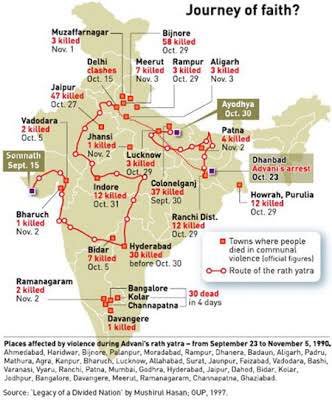
• Cause: Local trouble exacerbated by LK Advani’s Rath Yatra and his subsequent arrest
• Consequence: The Congress party’s secular image was irrevocably dented
Walled city Hyderabad witnessed one of the worst communal riots in 1990. The city’s proud record was besmirched beyond recognition. On 9 October 1990, the city police gunned down a notorious criminal and some politicians gave this a communal angle. As per the Justice Heeraman Singh Commission of Inquiry, this eventually resulted in communal clashes. The second trigger for the clashes was the arrest of LK Advani in Bihar on 23 October. After Advani’s arrest, the BJP and some Muslim organisations distributed provocative pamphlets in Hyderabad. More than 11 people were killed in the communal clashes that followed between 29 October and 1 November in Hyderabad and its neighbouring Ranga Reddy district. Communal tension between the two communities was at its peak and to worsen the situation, two rumours started doing the rounds in the city. One was of the stabbing of a poor Hindu hawker in Karwar area on 7 December and the second was about the discovery of the bodies of a woman and her child in the Sabzimandi area. As per official records, the massacre that followed resulted in the killing of 134 people and 300 getting severely injured. The unofficial count of the dead was between 200 and 300. There was a clear pattern to the killings, with women and children being particularly targeted. Many were burned alive or stoned to death.
Various reports indicated that the violence was encouraged by some Congress dissidents in order to precipitate the overthrowing of the then chief minister Chenna Reddy, who, indeed, was forced to step down after the riots.
COIMBATORE
COMBUSTION AT LARGE
December 1997 – February 1998
• Death toll: At least 70, in two phases
• Cause: From business rivalry to divisive strains, the combustion in the city was expertly manufactured
That business is thicker than blood was proved during the Coimbatore riots. The riots that took place in 1997-98 were, perhaps, unique in nature as they were triggered by mounting tension between the Hindu and Muslim communities over the rising graph of Muslim businesses in the city.
The extremist Hindutva outfit Hindu Munnani’s leader Rama Gopalan had come to Coimbatore several times, asking Hindus to purchase only from Hindu shops. Moreover, relations between the police and the Muslims were at an all-time low after the bombing of the RSS office in Madras in 1993. The police were constantly on the lookout for members of Al-Ummah, an organisation led by SA Basha, one of the prime suspects behind the blast. The trust deficit between the police and the Muslims came to a boiling point when three young Al-Ummah members murdered a police constable. A section of the police, in connivance with the Hindu Munnani, targetted Muslim establishments. The violence the ensued lead to the death of 20 people.
While the situation was returning to normal, on 14 February 1998, a series of bomb blasts occurred in Coimbatore in which around 50 persons were killed and 200 injured. The bombings were carried out by Al-Ummah members in retaliation for the killing of Muslims by the police in November-December 1997. In the hours following the explosions, Hindu mobs attacked Muslim shops and properties. The government had to send in the army.
A judicial committee formed on 7 April 2000 under Justice PR Gokulakrishnan to probe the serial bombings confirmed that Al-Ummah was responsible for the blasts. The committee tabled its final report in the Tamil Nadu Assembly on 18 May 2000 and its recommendations were accepted in principle by the state government. The trial began on 7 March 2002 and as many as 1,300 witnesses were examined. Basha was found guilty of hatching a criminal conspiracy to trigger a series of explosions and was sentenced to life along with 12 others.
SOPORE MASSACRE
VALLEY OF TEARS
6 January 1993
• Official toll: 55 killed in firing by the BSF
• Follow-up: Several BSF personnel were suspended and a CBI inquiry ordered; in 2013, the CBI filed a closure report saying the witnesses failed to identify the lawbreakers
• Status: A judicial commission headed by Justice Amarjeet Choudhary was constituted but its term expired before it could submit its report
Many human rights activists consider Sopore, a town in Baramulla district of Jammu and Kashmir, to be synonymous with State repression in the sensitive border state. It all started after militants attacked BSF personnel at Baba Yousuf Lane near Sopore on 6 January 1993, killing one of them. But what happened after that in the town was unheard of in Kashmir’s recent history. In retaliation to the attack by the militants, the BSF men went berserk killing 55 civilians. Some eyewitness accounts claimed that the troopers also set many houses on fire. The BSF men also attacked a bus, killing the driver and 15 passengers on the spot. The Indian government’s estimate was that 50 homes and 250 shops were burnt down, though human rights activists claim that more than 450 shops were destroyed.
Even as the massacre evoked sharp responses from human rights organisations across the world, the Indian government initially defended the security forces saying that the civilian casualties were the result of a gun battle with the militants. But there were hardly any takers for the government’s version in Kashmir. Despite a curfew being imposed, thousands of people thronged the streets to protest against the killings, forcing the government to constitute a one-member judicial commission under Justice Amarjeet Choudhary.
The commission’s term expired in 1994 before it could come out with a report and the government did not grant it an extension. Some BSF personnel were suspended to pacify the people of Kashmir and a CBI inquiry was also ordered. The CBI filed a closure report in the court in 2013 saying that the witnesses could not identify the culprits. The investigating agency’s submission in the court that the victims’ kin should not get access to the documents related to the case also drew flak from many quarters. The unending wait of the victims in Sopore bears testimony to how the judiciary often fails to deliver justice in cases of atrocities by agencies of the State.
War cry A Bajrang Dal activist with an iron rod shouts slogans during the mayhem in Gujarat 2002, Photo: AFP
War cry A Bajrang Dal activist with an iron rod shouts slogans during the mayhem in Gujarat 2002, Photo: AFP
GUJARAT RIOTS
THE UNENDING TRAGEDY
February-March 2002
• Death toll: At least 2,000
• Status: The wounds of Gujarat are yet to be healed and the changed complexion of the Centre has not helped; the apex court, however, seems keen to strike out for justice
The parallels between 1984 and 2002 are uncanny. Like Rajiv Gandhi’s ‘Newtonian’ logic, Narendra Modi, anointed in 2001 as the chief minister of Gujarat, described the killing of innocent Muslims in his state as a spontaneous reaction to the burning of Hindu train passengers at Godhra. Activists of the BJP and other Sangh Parivar outfits led the mobs at various places and some, such as Maya Kodnani, were rewarded with plum ministerial posts. The Gujarat Police used the same tactics as their Delhi counterparts to ensure that investigations in the major riot cases went nowhere. The big difference between the aftermaths of the two riots, of course, is the greater degree of intervention by the Supreme Court in the case of Gujarat. The court intervened proactively when it became apparent that Modi’s government was not going to provide justice.
The Gujarat riots have been interpreted subjectively rather than objectively, depending upon where you stand. Some analysts call it a genocide or pogrom, whereas others describe it as a carnage or riot. Whichever way one looks at it, what happened in Gujarat in 2002 left an indelible mark on the secular fabric of the country. Some people even accused Modi of directing the police to allow the mob frenzy to go unchecked.
It all started with the burning of Coach S6 of the Sabarmati Express at the Godhra railway station on the morning of 27 February 2002. Fifty-seven people, including 25 women and 15 children, returning from a kar seva ceremony at the Babri Masjid site in Ayodhya were charred to death. The Gujarat government claimed that a mob of local Muslims had carried out the heinous crime. It constituted a judicial commission under Justice GT Nanavati to look into the reasons and conspiracy, if any, behind the carnage. Six years later, the commission submitted its report, largely upholding the government’s version of the incident.
When the UPA government came to power in 2004, Lalu Prasad Yadav, the then railway minister, constituted a committee to investigate the incident. This committee rejected the conspiracy theory and concluded that it was a case of accidental fire. It cited forensic reports to claim that the fire had started inside the train compartment. The Gujarat High Court, however, quashed the findings and concluded that the committee was constituted with mala fide intentions.
In February 2011, a court convicted 31 Muslims for the Godhra carnage, which is widely believed to be the trigger for the state-wide violence that followed in its wake.
The worst incident happened at Naroda Patiya in Ahmedabad. On 28 February, a mob of more than 1,000 activists of the Bajrang Dal and other Sangh Parivar outfits attacked the Muslim-dominated locality and killed 97 people. They looted and torched Muslim homes and gangraped women. The allegation that the Gujarat Police had connived with the mob was upheld by the court when it convicted Kodnani, who was the BJP MLA from Naroda constituency at the time of the incident and went on to become a minister in the Modi government from 2007 to 2009. A total of 32 people were convicted in the Naroda Patiya case.
The Gulbarg Society massacre also took place on 28 February. VHP and Bajrang Dal activists attacked the housing society where former Lok Sabha MP Ehsan Jafri lived. The 72-year-old Congress leader was killed along with 34 others. Many people went missing. It was later concluded that altogether about 70 people had been killed in the attack.
In 2007, TEHELKA did a sting operation (GUJARAT 2002: The Truth in the words of the men who did it) in which 14 VHP or Bajrang Dal activists — including Madan Chawal and Haresh Bhatt, who was the national coordinator of the Bajrang Dal in 2002 and went on to become the BJP MLA from Godhra — were caught on camera admitting their role in the riots. The Supreme Court appointed a Special Investigation Team (SIT) headed by former CBI director RK Raghavan after serious allegations were raised against the then Modi government. But in its final report, the SIT found nothing to suggest Modi’s involvement in abetting the violence. Human rights organisations, however, continue to cry foul about this report.
Remains of the day A Bodo man sits in a burnt down room at his home in Kokrajhar, Assam
Remains of the day A Bodo man sits in a burnt down room at his home in Kokrajhar, Assam
KOKRAJHAR RIOTS
ETHNIC CAULDRON
July 2012
• Cause: Tension between locals and perceived “illegal migrants” from Bangladesh, which has been a perennial problem in the state since the 1950s
• Status: Political pussyfooting and periodic flare-ups are endemic
What happened in July 2012 in Assam left the nation in a state of shock. It put the spotlight back on ethnic violence in Assam, which has so far claimed the lives of a huge number of people and displaced many more. The ethnic Bodo tribe has clashed with migrants, mainly Bangla-speaking Muslims, several times since the 1950s.
The violence in Kokrajhar, a district in lower Assam bordering West Bengal, Bangladesh and Bhutan, could easily find a place among the 10 biggest communal clashes in Independent India. On 20 July 2012, four Bodo youngsters were lynched in Kokrajhar, allegedly by Muslim migrants, and then the native Bodos encircled villages dominated by Bangla-speaking Muslims and torched Muslim houses. These incidents had a domino effect across the state. The riots went on unabated for several days and eventually left more than 80 people dead and more than 50,000 displaced.
Even as the violence spread across more than 400 villages, a blame game ensued with the state government holding the Centre responsible for the failure to halt the violence and vice-versa. On 27 July, Assam Chief Minister Tarun Gogoi accused the then UPA government of delaying the deployment of the army in the riot-hit areas. The then prime minister Manmohan Singh visited riot-affected Kokrajhar the very next day and called the violence “a blot on the face of India”.
An indefinite curfew and shoot-at-sight orders had been enforced in Kokrajhar district since 26 July, along with a night curfew in Chirang and Dhubri districts. The prime minister ordered an inquiry committee to be set up to look into the violence and directed the state government to provide security so that the affected people could return home.
According to media reports, the army was initially reluctant to deploy its troops and sought a clarification from the defence ministry as the situation “seemed to have communal overtones”. When the situation deteriorated rapidly and another request was made, the ministry authorised army deployment on 25 July.
On 7 August, the Centre ordered a CBI probe into the ethnic clashes in the state and on 19 September, the investigation agency made the first arrests — that of five young men who were accused of involvement in the alleged lynching of the Bodo youths on 20 July. However, nothing substantial came out of the CBI enquiry and the state continues to witness ethnic clashes from time to time.
MUZAFFARNAGAR VIOLENCE
MANUFACTURED MAYHEM
August – September 2013
• Cause: A seemingly minor incident flared up into a massive denouement
• Status: The saffron brigade used the riots to manipulate and polarise even as the Samajwadi Party government hemmed and hawed
The Muzaffarnagar riots can easily qualify as the worst phase of violence in Uttar Pradesh in recent history. This was the first time in the past two decades that the army had to be brought in to restore law and order. The last time the army had been deployed was to contain the riots that erupted in the aftermath of the Babri Masjid demolition.
The 2013 riots in Muzaffarnagar and neighbouring districts in western UP were the outcome of political one-upmanship between the BJP and the Samajwadi Party. Both the parties brazenly manipulated the people with an eye on the impending Assembly bypolls in the state.
The situation in the district started deteriorating since 27 August, when two young Jat men were beaten to death in Kawal village, following the killing of a Muslim youth. The clashes occurred over an alleged incident of eve-teasing.
The Jats organised a ‘panchayat’ in Jaansat town on 31 August and demanded action against those who killed the two young men from the community. They also asked for the removal of the superintendent of police of Shamli district for his allegedly partisan conduct and declared that a ‘mahapanchayat’ would be organised on 7 September in Nagla Mandaur if the demands were not met.
On 5 September, the BJP gave a call for ‘Muzaffarnagar bandh’. To pre-empt the ‘mahapanchayat’, the administration imposed prohibitory orders under Section 144 of the CrPC in the entire district and deployed the PAC and the Rapid Action Force.
As soon as reports of attacks on participants of the mahapanchayat started doing the rounds, the situation went out of control. The police had to beat a hasty retreat in many places as the well-armed rioters outnumbered them. The district administration immediately imposed curfew. At least 62 people, including 42 Muslims and 20 Hindus, were killed in the violence, 93 injured and more than 50,000 displaced from their homes and villages. The displaced people found shelter in ill-equipped relief camps, where some of the children died in the following winter due to the freezing cold.
The Supreme Court held the Samajwadi Party prima facie guilty of negligence in preventing the violence and ordered it to immediately arrest all the accused irrespective of their political affiliation.
pradyot@tehelka.com | bhoopesh@tehelka.com | anurag@tehelka.com
Tehelka Magazine, Volume 12 Issue 15, Dated 11 April 2015
A festering sore on Indian democracy
A multitude of massacres in the name of religion has put India’s secular polity to test. A flashback on the travesty of justice. By Pradyot Lal, NK Bhoopesh & Anurag Tripathi
MORADABAD
MORBIDITY AT LARGE
13 August 1980
• Official toll: 450; independent probes reckon that to be one-third of the likely number of casualties
• In the aftermath of the riots, Allahabad High Court judge Justice MP Saxena was asked to inquire
• Three-and-a-half decades later, his findings remain virtually consigned to a waste paper basket, with even avowedly secular parties not having the courage to pick up the gauntlet
If ever a comprehensive study is undertaken to determine the role of law-enforcing agencies in ‘helping’ spread communal riots in free India, what happened in somnolent Moradabad where all that glitters is brass is instructive. Around 3,000 namazis had turned up at the idgah to render Friday prayers when some pigs mysteriously found their way there causing instant commotion. What followed was even more macabre, as the Provincial Armed Constabulary (PAC) personnel on duty failed to chase away the offending animals in time. Instead, as brickbatting of the police and PAC personnel ensued, they indiscriminately opened fire causing several in the congregation to die instantly. There was already enough tension between the factory owners and the artisans who were usually drawn from different communities. The demographic structure of the city, however, was not reflected in its political representation.
Two generations after the riot, the scars are yet to heal. As sociologist Satish Sabherwal and historian Mushirul Hasan averred a couple of months after the riots, neither the then UP chief minister Vishwanath Pratap Singh nor the leaders at the Centre went beyond offering palliatives to the victims. This was ‘democratic’ India’s second tryst with the PAC after the revolt in its ranks in the mid-1970s had threatened to upstage the Congress in Uttar Pradesh.
Shame! Bodies of infants killed during the 1983 massacre in Nellie, Nagaon district, Assam, await burial
Shame! Bodies of infants killed during the 1983 massacre in Nellie, Nagaon district, Assam, await burial, Photo: Courtesy The Milli Gazette
NELLIE MASSACRE
SIX HOURS OF MAYHEM
18 February 1983
• Official toll: 2,191; unofficial and independent agencies reckon twice that number was approximate to the truth
• Affected area: Central Assam, especially Nellie in Nagaon district
• The SK Tiwari Commission ostensibly conducted an inquiry, but it was caught up in a political and social maelstrom. Only three copies of its report exist and no political party has thought it worthwhile to do anything concrete
THE immediate cause is difficult to decipher. One was the anti-foreigner issue that the then ascendant All Asom Students Union (AASU) raised to a feverish pitch, leading to deportation of alleged aliens and mass murder. The terms of the movement were hazy since many of the so-called refugees had either come before Partition or during the turmoil in Bangladesh during its liberation struggle. The death of Lok Sabha MP Hiralal Patwari made fresh polls necessary in one of the constituencies but the Congress government thought it prudent to order fresh Assembly polls in 1983. AASU opposed the decision and boycotted the polls. As the then Assam DGP KPS Gill recalls, there were at least 23 highly sensitive constituencies where elections should not have been held, and Nellie was one of them. Whether there had indeed been a sudden infiltration of illegal immigrants could not be verified. AASU thought that to be the case and stirred an agitation that the state administration failed to control. Two years later, the then prime minister Rajiv Gandhi signed a peace accord with AASU and the Nellie massacre was sought to be erased from public memory.
Wounded An injured Sikh man being carried away on a cart in Delhi during the 1984 riots, Photo: Courtesy Vijay Saluja
Wounded An injured Sikh man being carried
away on a cart in Delhi during the 1984 riots, Photo: Courtesy Vijay Saluja
ANTI-SIKH RIOTS
72 HOURS OF SHAME
Delhi and other parts of India
31 October – 4 November 1984
• Total casualties in Delhi alone: 2,733 Sikhs; some human rights bodies say it was much higher
• Worst-affected areas included Trilokpuri, which epitomised the grisly and planned nature of the massacre
• Eight different commissions, convictions extremely few
Thirty-one years ago in New Delhi, Kanpur and Bokaro, murderous attacks were launched against Sikhs by mobs organised and instigated by mainly Congress politicians bent upon using the tragic assassination of Indira Gandhi as an occasion for political manipulation and gain. In the capital, the police stood mute witness to the killing of 2,733 Sikhs. That inaction and the failure to register cases or properly investigate those that were eventually filed are testimony to the official patronage the killings enjoyed. Rajiv Gandhi, who had just been sworn in as the prime minister, made light of the pogrom, describing it as a reaction to the killing of his mother. He infamously said, “When a big tree falls the earth shakes.” Senior Congress leaders such as HKL Bhagat, Jagdish Tytler and Kamal Nath, who were identified by the survivors and eyewitnesses as instigators of the violence, were rewarded with ministerial berths. A Commission of Inquiry headed by Justice Ranganath Mishra concluded, astonishingly, that the organised massacre was a spontaneous and “involuntary reaction” by ordinary citizens stricken by grief at Indira Gandhi’s assassination. Subsequent commissions indicted the police for acts of commission and omission but the bitter reality is that the victims of the massacre are no closer to justice today than they were in 1984.
The fact that the politicians and police officers responsible for the violence not only escaped indictment but also prospered had grave implications for minorities elsewhere in India. The riot system perfected by the Congress on the streets of Delhi was unveiled again in Bombay in 1993 and, finally, by the BJP government of Gujarat in 2002. There have been demands to construct at least a memorial for the victims, but they have fallen on deaf ears. Non-Congress governments have been equally lackadaisical and cavalier in their attitude. Some ultra-Hindutva organisations and individuals, unhinged formally from the saffron brigade, also joined the unprecedented, brutal pogrom that damaged India’s secular image irrevocably and gave rise to secessionist tendencies.
Easy targets Armed personnel round up Muslim men in Hashimpura during the 1987 riots
Easy targets Armed personnel round up Muslim men in Hashimpura on 22 May 1987, Photos: Praveen Jain
HASHIMPURA MASSACRE
SELECTIVE WARFARE
22 May 1987
• Death toll: 42 Muslim men
• In 2015, a Delhi court acquitted all the PAC men accused of killing 42 Muslims
Vibhuti Narain Rai, the then SSP, Ghaziabad (UP), found that more than 150 Muslim men had been taken away by the PAC in a truck at gunpoint towards a canal that flows parallel to the Meerut-Ghaziabad Road and that the sound of gunshots had been heard from that direction. It was late in the night but he got a team of 20 police personnel ready and rushed to the spot. Dead bodies were scattered along the canal bank. In that ghostly silence, he began to examine the bodies to see if anyone was alive in the heap of corpses. At last he found a man who was still not dead, brought him to Ghaziabad, got him admitted to a hospital and proceeded to file an FIR against the PAC personnel for their heinous crime.
Babuddin Ansari is one of the survivors of the massacre. He is a native of Muzaffarpur, Bihar, but fate had trapped him in Hashimpura in May 1987 as he was visiting some relatives with his father. According to his account, he took a bullet on his shoulder when the PAC men had first opened fire on the people held captive in a police truck near the Gang canal in Muradnagar. By the time they moved the truck away from the canal, 25 of the men had been killed. The truck was driven a little further and then stopped near the Hindon river bridge where the rest of the captives — 16 of them — were killed. In this group, Babuddin was the only one who survived. He was the sixth person to be thrown into the river, but before that, he was shot again — this time in his leg.
Luckily for him, he fell near the embankment and held onto a rock. He recalls seeing bodies being thrown from the Hindon bridge one by one. Meanwhile, some policemen came flashing their torches at the river. Babuddin thought they were sent by the PAC men, so every time they threw the light upon the river, he would duck into the water. Finally, a policeman touched his head with a rifle and asked his name. From there, he was taken to the superintendent of police, who assured him of help. The Ghaziabad police then picked up his belongings from Hashimpura. Next day, he was escorted back to his home state.
Some of the survivors and relatives of the victims are still hopeful of getting justice even after a Delhi court acquitted the accused PAC jawans on 24 March 2015 citing the prosecution’s inability to establish that they were the same jawans who had fired those fatal shots.
Close shave Security personnel look on as a Muslim woman is rescued from rioters in Bhagalpur
Close shave Security personnel look on as a
Muslim woman is rescued from rioters in
Bhagalpur 1989
BHAGALPUR MASSACRE
TWO MONTHS OF MADNESS
24 October – 23 December 1989
• Official toll: 1,070
• Started as a police-people clash and degenerated into communal violence
• Justice elusive 25 years later, with Nitish Kumar periodically assuring action against the culprits, many of whom are already dead
Hindu-Muslims tensions had escalated during the Muharram and Bisheri Puja festivities in August 1989. As part of the Ayodhya campaign, the Vishwa Hindu Parishad (VHP) had organised a ‘Ramshila’ procession in Bhagalpur. The procession aimed to collect bricks for the proposed Ram temple at Ayodhya. One such procession passing through Fatehpur village provoked brickbatting and arson on 22 October.
Prior to the outbreak of the riots, two rumours about the killing of Hindu students started doing the rounds: one was that Muslims had killed nearly 200 Hindu students of the university; the other that 31 Hindu boys had been murdered and their bodies dumped in a well at the Sanskrit College. Moreover, the political and criminal rivalries in the area also played a role in inciting the riots.
On 24 October, the Ramshila processions from various parts of the district were to proceed to the Gaushala area, from where they would move on to Ayodhya. The procession coming from Parbatti area passed peacefully through Tatarpur, a Muslim-dominated area, after its leader Mahadev Prasad Singh told the Hindus not to raise any provocative slogans. Sometime later, another massive procession from Nathnagar arrived at Tatarpur, escorted by the police. Some members of the procession shouted slogans such as ‘Hindi, Hindu, Hindustan‘. Bombs hurled indiscriminately at this stage are considered to have triggered these riots.
The mobs attacked shops owned by the Muslims on the Nathnagar road (later renamed as Lord Mahavir Path). The rioters also attempted to storm the Muslim-dominated locality of Assanandpur, but the locals fired at them from the rooftops. The mob then turned to the Hindu-dominated locality, Parbatti, where it massacred at least 40 Muslims. As the news of the violence reached the other Ramshila processions at Gaushala, the Hindus went on a rampage, killing Muslims, looting their shops and destroying their property.
On 25 October, an 8,000-strong mob looted and destroyed Madaninagar, a Muslim settlement, turning it into a ghost town. They also attacked Kanjhiagram, a nearby locality. Bhatoria, a Muslim-dominated village, was attacked twice — on October 25, and again on October 27. Many Muslims were killed. Alleged police atrocities further fuelled the violence.
According to contemporary accounts, on 26 October, at least 11 Muslims were killed in the Brahmin-dominated Parandarpur village. The same day, 18 Muslims, including 11 children, were killed in public view, in the Nayabazar area of Bhagalpur. Around 44 Muslims, including 19 children, were provided refuge by some local Hindus in the Jamuna Kothi building. At 11.30 am, a 70-strong mob entered the Jamuna Kothi with swords, axes, hammers and lathis. Within 10 minutes, 18 Muslims were killed. Some of the children were beheaded, some had their limbs cut off while the others were thrown off the third floor. A woman called Bunni Begum had her breasts chopped off. Some other Muslims, who had been provided refuge by the Hindus in the nearby buildings, managed to survive. In Assanandpur, the Muslims also escorted several Hindu students residing in a hostel to safety.
Lynch mob Sword-wielding rioters took over the streets of Mumbai for several days in December 1992
Lynch mob Sword-wielding rioters took over the streets of Mumbai for several days in December 1992
MUMBAI RIOTS
MEGAPOLIS GONE BERSERK
December 1992 – January 1993
• Official death toll: 267; the unofficial figure, as deposed before the Justice Srikrishna Commission, was twice that number
• Cause: The Babri Masjid demolition had serious repercussions across the country and the city that suffered the most was Mumbai
• Status: The revelations made by Justice Srikrishna failed to enlighten the political masters
A cosmopolitan city by nature, which hitherto had other priorities, was submerged in a communal deluge from December 1992 to January 1993. The city witnessed one of the worst riots during this period, which left deep scars on the city’s soul. The December 1992 events constituted the first phase of a communal riot that was to be repeated on a larger scale in January 1993.
The Justice BN Srikrishna Commission of Inquiry stated that there had been a build-up of communal fervour among the Hindus and Muslims in the weeks preceding the demolition of the Babri Masjid. As news of the demolition spread across the city on 6 December, Muslim gathered on the streets even as the Hindutva outfits took out victory processions.
The Shiv Sena led by its acerbic leader Balasaheb Thackeray celebrated the demolition by conducting a rally in the Dharavi slum. The situation deteriorated further on 7 and 8 December.
At many places, the violence took the form of a police-versus-Muslims confrontation. As per media reports, more than 210 people died in Mumbai and 57 in the areas adjoining the metropolis. Out of them, 137 (more than half the total casualties) fell to police bullets.
Unofficial records claim that the actual toll was more than 400. The situation was said to have been brought under control by 12 December, but according to the Justice Srikrishna Commission, stray incidents of violence continued to occur until 5 January when the second, deadlier phase of the riot started.
HYDERABAD RIOTS
A CITY PROVOKED
October-December 1990
• Cause: Local trouble exacerbated by LK Advani’s Rath Yatra and his subsequent arrest
• Consequence: The Congress party’s secular image was irrevocably dented
Walled city Hyderabad witnessed one of the worst communal riots in 1990. The city’s proud record was besmirched beyond recognition. On 9 October 1990, the city police gunned down a notorious criminal and some politicians gave this a communal angle. As per the Justice Heeraman Singh Commission of Inquiry, this eventually resulted in communal clashes. The second trigger for the clashes was the arrest of LK Advani in Bihar on 23 October. After Advani’s arrest, the BJP and some Muslim organisations distributed provocative pamphlets in Hyderabad. More than 11 people were killed in the communal clashes that followed between 29 October and 1 November in Hyderabad and its neighbouring Ranga Reddy district. Communal tension between the two communities was at its peak and to worsen the situation, two rumours started doing the rounds in the city. One was of the stabbing of a poor Hindu hawker in Karwar area on 7 December and the second was about the discovery of the bodies of a woman and her child in the Sabzimandi area. As per official records, the massacre that followed resulted in the killing of 134 people and 300 getting severely injured. The unofficial count of the dead was between 200 and 300. There was a clear pattern to the killings, with women and children being particularly targeted. Many were burned alive or stoned to death.
Various reports indicated that the violence was encouraged by some Congress dissidents in order to precipitate the overthrowing of the then chief minister Chenna Reddy, who, indeed, was forced to step down after the riots.
COIMBATORE
COMBUSTION AT LARGE
December 1997 – February 1998
• Death toll: At least 70, in two phases
• Cause: From business rivalry to divisive strains, the combustion in the city was expertly manufactured
That business is thicker than blood was proved during the Coimbatore riots. The riots that took place in 1997-98 were, perhaps, unique in nature as they were triggered by mounting tension between the Hindu and Muslim communities over the rising graph of Muslim businesses in the city.
The extremist Hindutva outfit Hindu Munnani’s leader Rama Gopalan had come to Coimbatore several times, asking Hindus to purchase only from Hindu shops. Moreover, relations between the police and the Muslims were at an all-time low after the bombing of the RSS office in Madras in 1993. The police were constantly on the lookout for members of Al-Ummah, an organisation led by SA Basha, one of the prime suspects behind the blast. The trust deficit between the police and the Muslims came to a boiling point when three young Al-Ummah members murdered a police constable. A section of the police, in connivance with the Hindu Munnani, targetted Muslim establishments. The violence the ensued lead to the death of 20 people.
While the situation was returning to normal, on 14 February 1998, a series of bomb blasts occurred in Coimbatore in which around 50 persons were killed and 200 injured. The bombings were carried out by Al-Ummah members in retaliation for the killing of Muslims by the police in November-December 1997. In the hours following the explosions, Hindu mobs attacked Muslim shops and properties. The government had to send in the army.
A judicial committee formed on 7 April 2000 under Justice PR Gokulakrishnan to probe the serial bombings confirmed that Al-Ummah was responsible for the blasts. The committee tabled its final report in the Tamil Nadu Assembly on 18 May 2000 and its recommendations were accepted in principle by the state government. The trial began on 7 March 2002 and as many as 1,300 witnesses were examined. Basha was found guilty of hatching a criminal conspiracy to trigger a series of explosions and was sentenced to life along with 12 others.
SOPORE MASSACRE
VALLEY OF TEARS
6 January 1993
• Official toll: 55 killed in firing by the BSF
• Follow-up: Several BSF personnel were suspended and a CBI inquiry ordered; in 2013, the CBI filed a closure report saying the witnesses failed to identify the lawbreakers
• Status: A judicial commission headed by Justice Amarjeet Choudhary was constituted but its term expired before it could submit its report
Many human rights activists consider Sopore, a town in Baramulla district of Jammu and Kashmir, to be synonymous with State repression in the sensitive border state. It all started after militants attacked BSF personnel at Baba Yousuf Lane near Sopore on 6 January 1993, killing one of them. But what happened after that in the town was unheard of in Kashmir’s recent history. In retaliation to the attack by the militants, the BSF men went berserk killing 55 civilians. Some eyewitness accounts claimed that the troopers also set many houses on fire. The BSF men also attacked a bus, killing the driver and 15 passengers on the spot. The Indian government’s estimate was that 50 homes and 250 shops were burnt down, though human rights activists claim that more than 450 shops were destroyed.
Even as the massacre evoked sharp responses from human rights organisations across the world, the Indian government initially defended the security forces saying that the civilian casualties were the result of a gun battle with the militants. But there were hardly any takers for the government’s version in Kashmir. Despite a curfew being imposed, thousands of people thronged the streets to protest against the killings, forcing the government to constitute a one-member judicial commission under Justice Amarjeet Choudhary.
The commission’s term expired in 1994 before it could come out with a report and the government did not grant it an extension. Some BSF personnel were suspended to pacify the people of Kashmir and a CBI inquiry was also ordered. The CBI filed a closure report in the court in 2013 saying that the witnesses could not identify the culprits. The investigating agency’s submission in the court that the victims’ kin should not get access to the documents related to the case also drew flak from many quarters. The unending wait of the victims in Sopore bears testimony to how the judiciary often fails to deliver justice in cases of atrocities by agencies of the State.
War cry A Bajrang Dal activist with an iron rod shouts slogans during the mayhem in Gujarat 2002, Photo: AFP
War cry A Bajrang Dal activist with an iron rod shouts slogans during the mayhem in Gujarat 2002, Photo: AFP
GUJARAT RIOTS
THE UNENDING TRAGEDY
February-March 2002
• Death toll: At least 2,000
• Status: The wounds of Gujarat are yet to be healed and the changed complexion of the Centre has not helped; the apex court, however, seems keen to strike out for justice
The parallels between 1984 and 2002 are uncanny. Like Rajiv Gandhi’s ‘Newtonian’ logic, Narendra Modi, anointed in 2001 as the chief minister of Gujarat, described the killing of innocent Muslims in his state as a spontaneous reaction to the burning of Hindu train passengers at Godhra. Activists of the BJP and other Sangh Parivar outfits led the mobs at various places and some, such as Maya Kodnani, were rewarded with plum ministerial posts. The Gujarat Police used the same tactics as their Delhi counterparts to ensure that investigations in the major riot cases went nowhere. The big difference between the aftermaths of the two riots, of course, is the greater degree of intervention by the Supreme Court in the case of Gujarat. The court intervened proactively when it became apparent that Modi’s government was not going to provide justice.
The Gujarat riots have been interpreted subjectively rather than objectively, depending upon where you stand. Some analysts call it a genocide or pogrom, whereas others describe it as a carnage or riot. Whichever way one looks at it, what happened in Gujarat in 2002 left an indelible mark on the secular fabric of the country. Some people even accused Modi of directing the police to allow the mob frenzy to go unchecked.
It all started with the burning of Coach S6 of the Sabarmati Express at the Godhra railway station on the morning of 27 February 2002. Fifty-seven people, including 25 women and 15 children, returning from a kar seva ceremony at the Babri Masjid site in Ayodhya were charred to death. The Gujarat government claimed that a mob of local Muslims had carried out the heinous crime. It constituted a judicial commission under Justice GT Nanavati to look into the reasons and conspiracy, if any, behind the carnage. Six years later, the commission submitted its report, largely upholding the government’s version of the incident.
When the UPA government came to power in 2004, Lalu Prasad Yadav, the then railway minister, constituted a committee to investigate the incident. This committee rejected the conspiracy theory and concluded that it was a case of accidental fire. It cited forensic reports to claim that the fire had started inside the train compartment. The Gujarat High Court, however, quashed the findings and concluded that the committee was constituted with mala fide intentions.
In February 2011, a court convicted 31 Muslims for the Godhra carnage, which is widely believed to be the trigger for the state-wide violence that followed in its wake.
The worst incident happened at Naroda Patiya in Ahmedabad. On 28 February, a mob of more than 1,000 activists of the Bajrang Dal and other Sangh Parivar outfits attacked the Muslim-dominated locality and killed 97 people. They looted and torched Muslim homes and gangraped women. The allegation that the Gujarat Police had connived with the mob was upheld by the court when it convicted Kodnani, who was the BJP MLA from Naroda constituency at the time of the incident and went on to become a minister in the Modi government from 2007 to 2009. A total of 32 people were convicted in the Naroda Patiya case.
The Gulbarg Society massacre also took place on 28 February. VHP and Bajrang Dal activists attacked the housing society where former Lok Sabha MP Ehsan Jafri lived. The 72-year-old Congress leader was killed along with 34 others. Many people went missing. It was later concluded that altogether about 70 people had been killed in the attack.
In 2007, TEHELKA did a sting operation (GUJARAT 2002: The Truth in the words of the men who did it) in which 14 VHP or Bajrang Dal activists — including Madan Chawal and Haresh Bhatt, who was the national coordinator of the Bajrang Dal in 2002 and went on to become the BJP MLA from Godhra — were caught on camera admitting their role in the riots. The Supreme Court appointed a Special Investigation Team (SIT) headed by former CBI director RK Raghavan after serious allegations were raised against the then Modi government. But in its final report, the SIT found nothing to suggest Modi’s involvement in abetting the violence. Human rights organisations, however, continue to cry foul about this report.
Remains of the day A Bodo man sits in a burnt down room at his home in Kokrajhar, Assam
Remains of the day A Bodo man sits in a burnt down room at his home in Kokrajhar, Assam
KOKRAJHAR RIOTS
ETHNIC CAULDRON
July 2012
• Cause: Tension between locals and perceived “illegal migrants” from Bangladesh, which has been a perennial problem in the state since the 1950s
• Status: Political pussyfooting and periodic flare-ups are endemic
What happened in July 2012 in Assam left the nation in a state of shock. It put the spotlight back on ethnic violence in Assam, which has so far claimed the lives of a huge number of people and displaced many more. The ethnic Bodo tribe has clashed with migrants, mainly Bangla-speaking Muslims, several times since the 1950s.
The violence in Kokrajhar, a district in lower Assam bordering West Bengal, Bangladesh and Bhutan, could easily find a place among the 10 biggest communal clashes in Independent India. On 20 July 2012, four Bodo youngsters were lynched in Kokrajhar, allegedly by Muslim migrants, and then the native Bodos encircled villages dominated by Bangla-speaking Muslims and torched Muslim houses. These incidents had a domino effect across the state. The riots went on unabated for several days and eventually left more than 80 people dead and more than 50,000 displaced.
Even as the violence spread across more than 400 villages, a blame game ensued with the state government holding the Centre responsible for the failure to halt the violence and vice-versa. On 27 July, Assam Chief Minister Tarun Gogoi accused the then UPA government of delaying the deployment of the army in the riot-hit areas. The then prime minister Manmohan Singh visited riot-affected Kokrajhar the very next day and called the violence “a blot on the face of India”.
An indefinite curfew and shoot-at-sight orders had been enforced in Kokrajhar district since 26 July, along with a night curfew in Chirang and Dhubri districts. The prime minister ordered an inquiry committee to be set up to look into the violence and directed the state government to provide security so that the affected people could return home.
According to media reports, the army was initially reluctant to deploy its troops and sought a clarification from the defence ministry as the situation “seemed to have communal overtones”. When the situation deteriorated rapidly and another request was made, the ministry authorised army deployment on 25 July.
On 7 August, the Centre ordered a CBI probe into the ethnic clashes in the state and on 19 September, the investigation agency made the first arrests — that of five young men who were accused of involvement in the alleged lynching of the Bodo youths on 20 July. However, nothing substantial came out of the CBI enquiry and the state continues to witness ethnic clashes from time to time.
MUZAFFARNAGAR VIOLENCE
MANUFACTURED MAYHEM
August – September 2013
• Cause: A seemingly minor incident flared up into a massive denouement
• Status: The saffron brigade used the riots to manipulate and polarise even as the Samajwadi Party government hemmed and hawed
The Muzaffarnagar riots can easily qualify as the worst phase of violence in Uttar Pradesh in recent history. This was the first time in the past two decades that the army had to be brought in to restore law and order. The last time the army had been deployed was to contain the riots that erupted in the aftermath of the Babri Masjid demolition.
The 2013 riots in Muzaffarnagar and neighbouring districts in western UP were the outcome of political one-upmanship between the BJP and the Samajwadi Party. Both the parties brazenly manipulated the people with an eye on the impending Assembly bypolls in the state.
The situation in the district started deteriorating since 27 August, when two young Jat men were beaten to death in Kawal village, following the killing of a Muslim youth. The clashes occurred over an alleged incident of eve-teasing.
The Jats organised a ‘panchayat’ in Jaansat town on 31 August and demanded action against those who killed the two young men from the community. They also asked for the removal of the superintendent of police of Shamli district for his allegedly partisan conduct and declared that a ‘mahapanchayat’ would be organised on 7 September in Nagla Mandaur if the demands were not met.
On 5 September, the BJP gave a call for ‘Muzaffarnagar bandh’. To pre-empt the ‘mahapanchayat’, the administration imposed prohibitory orders under Section 144 of the CrPC in the entire district and deployed the PAC and the Rapid Action Force.
As soon as reports of attacks on participants of the mahapanchayat started doing the rounds, the situation went out of control. The police had to beat a hasty retreat in many places as the well-armed rioters outnumbered them. The district administration immediately imposed curfew. At least 62 people, including 42 Muslims and 20 Hindus, were killed in the violence, 93 injured and more than 50,000 displaced from their homes and villages. The displaced people found shelter in ill-equipped relief camps, where some of the children died in the following winter due to the freezing cold.
The Supreme Court held the Samajwadi Party prima facie guilty of negligence in preventing the violence and ordered it to immediately arrest all the accused irrespective of their political affiliation.
pradyot@tehelka.com | bhoopesh@tehelka.com | anurag@tehelka.com
March 19, 2009
Communalism and Authoritarianism
dawn.com, 19 March, 2009
Caste, communalism and coup – Jawed Naqvi
by Jawed Naqvi
THERE were at least two occasions in recent memory when the exultation on Indian TV channels was telling.
Gen Musharraf staged a military coup in Pakistan and at about the same time, in India, then prime minister Atal Behari Vajpayee was heading for the majestic British-built presidential palace for a swearing-in ceremony of his newly elected government.
More recently, as India’s independent election commission announced the dates for the next parliamentary polls in April, a fractious and querulous coalition government in Pakistan was making a largely atavistic deal with Taliban fanatics in the scenic Swat valley.
This week the boot was on the other foot. As much of Pakistan united in a largely peaceful national campaign to clean up the all-encompassing mess dumped in its judicial and political arteries by the last round of military rule, news headlines in India were riveted to its own variant of atavism.
Although caste-based politics and communal mobilisation had a start before Indian independence, their resurgent manifestation as a popular ploy in the country’s democratic journey deserves closer scrutiny. Much outrage was expressed in Wednesday’s papers over Varun Gandhi’s abusive election campaign, in which he threatened to chop the hands of Indian Muslims and send them to Pakistan. (It was a string of filthy speeches but enough for TV channels to seek an improvement in their TRP ratings. Put it to the fallout of global recession!)
Varun Gandhi is Rahul Gandhi’s younger first cousin, both being grandsons of Indira Gandhi, and great grandsons of Jawaharlal Nehru himself. Indian newspapers found it particularly scandalous that the scion of the house of Nehru, the erudite, liberal and secular founder leader of Indian democracy could indulge in dirty street slang. For a knockout blow he even abused Mahatma Gandhi, who though unrelated to India’s ruling Gandhi clan, has served as an ageless mascot for a host of parties.
It would make sense to berate a young first-time candidate in the fray for straying from the line. But that is putting it mildly. What the Indian media will not discuss is that the young Gandhi is a product of decades of the communalisation that has given India many a popular government both at the centre and in the states. Their coyness is nothing but a sleight of hand, for it fortifies the very tendencies that the media and indeed a section of the middle classes appear to want to reject.
For months if not years Varun Gandhi has been spewing communal venom in his columns through the rightwing journal, Organiser. Every significant Hindu leader has patronised the journal, which is treated with reverence reserved for a party mouthpiece.
Of course, that is where the sleight of hand comes in. The question that will not be asked is whether and why Atal Behari Vajpayee, before India’s opinion makers anointed him as a moderate leader and before he began to compare himself with Nehru, gave exactly the same speech as his younger party colleague did the other day.
When did Vajpayee, whose Enoch Powell-like “rivers of blood” speech in Assam led to the infamous Nellie massacre of Muslim women and children by enraged Hindus in 1983, become a moderate leader?
Indira Gandhi had to personally throw out copies of the India Today magazine from the Delhi’s Vigyan Bhavan where the Non Aligned Movement was holding a summit conference. She was naturally embarrassed that the world would see the cover, which showed piles of dead bodies of Nellie victims. That was the contribution of Vajpayee to his heir Varun Gandhi’s upbringing. The supposedly moderate Vajpayee made another contribution to India’s communal cauldron. He revived in one stroke the foundation of Muslim zealots in Assam. Today, they have gained worrying electoral clout in the sensitive state.
Again that may have been the precise purpose of the rightwing BJP and it could partly explain the vested interest that exists in creating the communal Muslim genie. It is hardly a coincidence that the Rashtriya Swayamsevak Sangh, rightwing Hinduism’s ideological fountainhead, issued an appeal the other day — even as Varun Gandhi was laying into the Muslims in his constituency in the Himalayan foothills — to increase the salaries of the muezzins of thousands of Indian mosques. The Muslim clergy is both a necessary counterpoint and a potential ally of majority communalism in India.
Outrage over Varun Gandhi’s fulminations was also laced with words of sympathy for the BJP’s current prime ministerial candidate Lal Kishan Advani. The brash and irresponsible Gandhi was out to tarnish the image of the moderate Advani, it was claimed. The lament was uniformly shared across the mainstream media. Moderate Advani? When did the charioteer of Ayodhya whose men tore down a nondescript mosque to assert their nationalist identity become the mild mannered, soft-spoken liberal he is made out to be? Oh well, look at the alternative, we are cautioned. Would you prefer Narendra Modi of Gujarat instead? The offered choice is deliberately false. Both the worthies are role models for the impressionable and still-groping-in-the-dark Varun Gandhi.
Communalism like a military coup is a means of shepherding recalcitrant citizens towards a choice offered by the state that they would be otherwise reluctant to accept. A happy tiding for both India and Pakistan is that enough people are still around to resist the state’s insidious manoeuvres, failing which we would quickly collapse into a South Asian variant of fascism.
Instigating a communal standoff between India’s religious communities has come to serve another strategic purpose. It helps paper over the far deeper fault lines of caste. Part of the purpose behind Advani’s chariot journey to Ayodhya was to neutralise the disruptive effects of caste polarisation on Hindu society that was unleashed by the Mandal Commission’s recommendations for caste-based affirmative action. Hindutva was resurrected to counter it. That the upper-caste Muslim clergy too would lose its stranglehold on their community has remained a less discussed outcome of the Mandal report.
Since 1991, with the rise of free-market-driven corporate enterprises in India, the role of business clubs has increased dramatically in guiding and honing communal politics across the country. Big-time money is at stake in keeping the embers of religious strife alive. The recent public patronage extended by leading tycoons to Narendra Modi’s communally driven governance in Gujarat is an example of this aspect of Indian democracy.
While it is reassuring that mainstream Pakistan has succeeded in saving democracy from another grievous blow from the military there is little to suggest that the worst is behind us. The deal with the Taliban in Swat remains ominous, even more so if it was clinched to serve interests other than the nation’s own. India had a brief fling with authoritarian rule but its merrily regressive religious underpinning has ensured that a democratic façade serves the purpose of manufacturing consent well without recourse to overt state violence.
The writer is Dawn’s correspondent in Delhi.
Caste, communalism and coup – Jawed Naqvi
by Jawed Naqvi
THERE were at least two occasions in recent memory when the exultation on Indian TV channels was telling.
Gen Musharraf staged a military coup in Pakistan and at about the same time, in India, then prime minister Atal Behari Vajpayee was heading for the majestic British-built presidential palace for a swearing-in ceremony of his newly elected government.
More recently, as India’s independent election commission announced the dates for the next parliamentary polls in April, a fractious and querulous coalition government in Pakistan was making a largely atavistic deal with Taliban fanatics in the scenic Swat valley.
This week the boot was on the other foot. As much of Pakistan united in a largely peaceful national campaign to clean up the all-encompassing mess dumped in its judicial and political arteries by the last round of military rule, news headlines in India were riveted to its own variant of atavism.
Although caste-based politics and communal mobilisation had a start before Indian independence, their resurgent manifestation as a popular ploy in the country’s democratic journey deserves closer scrutiny. Much outrage was expressed in Wednesday’s papers over Varun Gandhi’s abusive election campaign, in which he threatened to chop the hands of Indian Muslims and send them to Pakistan. (It was a string of filthy speeches but enough for TV channels to seek an improvement in their TRP ratings. Put it to the fallout of global recession!)
Varun Gandhi is Rahul Gandhi’s younger first cousin, both being grandsons of Indira Gandhi, and great grandsons of Jawaharlal Nehru himself. Indian newspapers found it particularly scandalous that the scion of the house of Nehru, the erudite, liberal and secular founder leader of Indian democracy could indulge in dirty street slang. For a knockout blow he even abused Mahatma Gandhi, who though unrelated to India’s ruling Gandhi clan, has served as an ageless mascot for a host of parties.
It would make sense to berate a young first-time candidate in the fray for straying from the line. But that is putting it mildly. What the Indian media will not discuss is that the young Gandhi is a product of decades of the communalisation that has given India many a popular government both at the centre and in the states. Their coyness is nothing but a sleight of hand, for it fortifies the very tendencies that the media and indeed a section of the middle classes appear to want to reject.
For months if not years Varun Gandhi has been spewing communal venom in his columns through the rightwing journal, Organiser. Every significant Hindu leader has patronised the journal, which is treated with reverence reserved for a party mouthpiece.
Of course, that is where the sleight of hand comes in. The question that will not be asked is whether and why Atal Behari Vajpayee, before India’s opinion makers anointed him as a moderate leader and before he began to compare himself with Nehru, gave exactly the same speech as his younger party colleague did the other day.
When did Vajpayee, whose Enoch Powell-like “rivers of blood” speech in Assam led to the infamous Nellie massacre of Muslim women and children by enraged Hindus in 1983, become a moderate leader?
Indira Gandhi had to personally throw out copies of the India Today magazine from the Delhi’s Vigyan Bhavan where the Non Aligned Movement was holding a summit conference. She was naturally embarrassed that the world would see the cover, which showed piles of dead bodies of Nellie victims. That was the contribution of Vajpayee to his heir Varun Gandhi’s upbringing. The supposedly moderate Vajpayee made another contribution to India’s communal cauldron. He revived in one stroke the foundation of Muslim zealots in Assam. Today, they have gained worrying electoral clout in the sensitive state.
Again that may have been the precise purpose of the rightwing BJP and it could partly explain the vested interest that exists in creating the communal Muslim genie. It is hardly a coincidence that the Rashtriya Swayamsevak Sangh, rightwing Hinduism’s ideological fountainhead, issued an appeal the other day — even as Varun Gandhi was laying into the Muslims in his constituency in the Himalayan foothills — to increase the salaries of the muezzins of thousands of Indian mosques. The Muslim clergy is both a necessary counterpoint and a potential ally of majority communalism in India.
Outrage over Varun Gandhi’s fulminations was also laced with words of sympathy for the BJP’s current prime ministerial candidate Lal Kishan Advani. The brash and irresponsible Gandhi was out to tarnish the image of the moderate Advani, it was claimed. The lament was uniformly shared across the mainstream media. Moderate Advani? When did the charioteer of Ayodhya whose men tore down a nondescript mosque to assert their nationalist identity become the mild mannered, soft-spoken liberal he is made out to be? Oh well, look at the alternative, we are cautioned. Would you prefer Narendra Modi of Gujarat instead? The offered choice is deliberately false. Both the worthies are role models for the impressionable and still-groping-in-the-dark Varun Gandhi.
Communalism like a military coup is a means of shepherding recalcitrant citizens towards a choice offered by the state that they would be otherwise reluctant to accept. A happy tiding for both India and Pakistan is that enough people are still around to resist the state’s insidious manoeuvres, failing which we would quickly collapse into a South Asian variant of fascism.
Instigating a communal standoff between India’s religious communities has come to serve another strategic purpose. It helps paper over the far deeper fault lines of caste. Part of the purpose behind Advani’s chariot journey to Ayodhya was to neutralise the disruptive effects of caste polarisation on Hindu society that was unleashed by the Mandal Commission’s recommendations for caste-based affirmative action. Hindutva was resurrected to counter it. That the upper-caste Muslim clergy too would lose its stranglehold on their community has remained a less discussed outcome of the Mandal report.
Since 1991, with the rise of free-market-driven corporate enterprises in India, the role of business clubs has increased dramatically in guiding and honing communal politics across the country. Big-time money is at stake in keeping the embers of religious strife alive. The recent public patronage extended by leading tycoons to Narendra Modi’s communally driven governance in Gujarat is an example of this aspect of Indian democracy.
While it is reassuring that mainstream Pakistan has succeeded in saving democracy from another grievous blow from the military there is little to suggest that the worst is behind us. The deal with the Taliban in Swat remains ominous, even more so if it was clinched to serve interests other than the nation’s own. India had a brief fling with authoritarian rule but its merrily regressive religious underpinning has ensured that a democratic façade serves the purpose of manufacturing consent well without recourse to overt state violence.
The writer is Dawn’s correspondent in Delhi.
March 08, 2009
Nellie massacre of 1983: None punished to this day in 2009
From Tehelka Magazine, Vol 6, Issue 10, Dated Mar 14, 2009
An Untold Shame
3,300 people were massacred in Assam but no one is punished. TERESA REHMAN recovers a tell-all report
INFORMATION RECEIVED that last night, about one thousand Assamese people of surrounding villages of Nellie armed with deadly weapons assembled at Nellie by beating of drums. Minority people are in panic and apprehending attack at any moment. Submission for immediate action to maintain peace.” This vital wireless message warning of impending calamity went ignored. In a six-hour attack on February 18, 1983, armed mobs attacked and killed as many as 1,800 Muslims (unofficial claims: 3,300) across 14 villages in Assam’s central district of Nagaon, on the pretext that they were illegal migrants from Bangladesh. One of the worst cases of religious-ethnic cleansing in independent India, the “Nellie massacre” remains unpunished to this day. Now, TEHELKA has accessed a report an inquiry commission submitted a quarter century ago but was buried away. It lays bare the shocking way in which the official machinery ignored the warnings and allowed the gruesome killings to happen.
Asked by the state government to inquire into the lapses that let the tragedy occur, a retired IAS officer, Tribhuvan Prasad Tewary, wrote the 600-page report in 1984. The report says that on February 15, three days before the massacre, some members of the public approached police officer Jahiruddin Ahmed, in-charge of Nagaon Police Station, and informed him that nearly 1,000 indigenous Assamese had “assembled with deadly weapons” at Nellie since the night before and were “beating drums”. The report says Ahmed sent a wireless message to the Commandant of an Assam Police battalion stationed at Morigaon some 70 kms from Nellie, to a police officer in that town, and to another police officer at a nearby police station. Intriguingly, Ahmed did not inform Nagaon’s Superintendent of Police (SP). (Nellie was then part of Nagaon district but is now in Morigaon district. The two districts are adjacent). Ahmed told the Commission he did not inform the Nagaon SP because the latter was not available at the time. The Commission called this “specious”. Ahmed subsequently withdrew it.
The responses of other officials were also perplexing. The Commandant of the Assam Police battalion, MNA Kabir, told the Commission he hadn’t seen Ahmed’s wireless message until after the tragedy because his wife had received it. Pramode Chetia, a police officer with the Morigaon police station, said the message had been left on his table. Yet another police officer, Bhadra Kanta Chetia, of the nearby Jagiroad police station, said the missive had been placed in his “put-up basket”, the bureaucrat’s name for the tray of pending files. Said the Tewary Commission report: “Had these three officers been careful about their dak [correspondence] there would, perhaps, have been some effective preventive action at Nellie.”
HARD NUMBERS
Death count: 1,800 (official) 3,300 (unofficial)
Villages affected: 14
Cases filed: 668
Chargesheets submitted: 310
Compensation for survivors: Rs 2,000 and tin to build a house
Compensation for kin of dead: Rs 5,000
Even higher-ups in the state police knew that the locals apprehended trouble. On February 15, local Hindus had written to Nagaon’s deputy SP, PC Bordoloi, saying that they feared Muslims might attack them. The same day, this application was brought to the notice of KPS Gill, who was inspector-general of Assam at the time. (Years later, Gill earned fame as the police chief who put down terrorism in Punjab). Gill ordered police officer Bhadra Kanta Chetia of Jagiroad to organise patrolling and form peace committees.
Chetia visited the village of Borbori — one of the 14 villages where Muslims were killed — on February 17, a day before the massacre. At Borbori, locals had pleaded with Chetia for armed posts but he had refused saying he hadn’t enough men. However, Chetia told the Tewary Commission that dozens of uniformed men of the CRPF and Assam Police had gone with him to Borbori.
Chetia was informed of the Nellie killings soon after they began on the morning of February 18. But he didn’t rush to ground zero because, as he told the Commission, he didn’t know the way to those villages. Instead, he sent two junior officers with about 70 CRPF men. When Chetia did set out for Nellie the next day, he got involved in a high drama at a local river, rescuing about 200 people from drowning. “[The rescue was] a miraculous task indeed,” the Tewary Commission report says. “But in the process, he forgot his primary responsibility towards the villages where [a] great tragedy was being enacted.”
Painstaking though the Commission’s report is, it underestimates the slaughter, saying that only 661 Muslims were killed (of which 143 dead bodies were identified). The Assam Government had, however, acknowledged that at least 1,800 had been killed. Villagers maintain that at least 3,300 were killed.
In fact, the Tewary Commission’s voluminous report tries to somehow explain away the violence by speaking of how “the issue of [Bangladeshi] foreigners and language have been agitating the minds of the people for the last several decades, exploding into violent incidents on several occasions”.
Activist Harsh Mander, who quit the IAS to protest the 2002 Gujarat riots, visited Nellie last November in his capacity as a Commissioner appointed by the Supreme Court on the issue of Right to Food. “The survivors persisted in their resolve that they wanted to be heard,” he wrote after meeting them. “It was impossible for me to refuse them.”
Unfortunately, successive state governments have refused to publish the Tewary Commission report. In 2004, the state’s Home Ministry stopped Japanese scholar Makiko Kimura from reading her paper on the Nellie massacre at a seminar in Guwahati. No reason was given for denying her permission to attend the seminar.
These, survivors say, are naked attempts to deny them justice and keep the tragedy forgotten.
An Untold Shame
3,300 people were massacred in Assam but no one is punished. TERESA REHMAN recovers a tell-all report
INFORMATION RECEIVED that last night, about one thousand Assamese people of surrounding villages of Nellie armed with deadly weapons assembled at Nellie by beating of drums. Minority people are in panic and apprehending attack at any moment. Submission for immediate action to maintain peace.” This vital wireless message warning of impending calamity went ignored. In a six-hour attack on February 18, 1983, armed mobs attacked and killed as many as 1,800 Muslims (unofficial claims: 3,300) across 14 villages in Assam’s central district of Nagaon, on the pretext that they were illegal migrants from Bangladesh. One of the worst cases of religious-ethnic cleansing in independent India, the “Nellie massacre” remains unpunished to this day. Now, TEHELKA has accessed a report an inquiry commission submitted a quarter century ago but was buried away. It lays bare the shocking way in which the official machinery ignored the warnings and allowed the gruesome killings to happen.
Asked by the state government to inquire into the lapses that let the tragedy occur, a retired IAS officer, Tribhuvan Prasad Tewary, wrote the 600-page report in 1984. The report says that on February 15, three days before the massacre, some members of the public approached police officer Jahiruddin Ahmed, in-charge of Nagaon Police Station, and informed him that nearly 1,000 indigenous Assamese had “assembled with deadly weapons” at Nellie since the night before and were “beating drums”. The report says Ahmed sent a wireless message to the Commandant of an Assam Police battalion stationed at Morigaon some 70 kms from Nellie, to a police officer in that town, and to another police officer at a nearby police station. Intriguingly, Ahmed did not inform Nagaon’s Superintendent of Police (SP). (Nellie was then part of Nagaon district but is now in Morigaon district. The two districts are adjacent). Ahmed told the Commission he did not inform the Nagaon SP because the latter was not available at the time. The Commission called this “specious”. Ahmed subsequently withdrew it.
The responses of other officials were also perplexing. The Commandant of the Assam Police battalion, MNA Kabir, told the Commission he hadn’t seen Ahmed’s wireless message until after the tragedy because his wife had received it. Pramode Chetia, a police officer with the Morigaon police station, said the message had been left on his table. Yet another police officer, Bhadra Kanta Chetia, of the nearby Jagiroad police station, said the missive had been placed in his “put-up basket”, the bureaucrat’s name for the tray of pending files. Said the Tewary Commission report: “Had these three officers been careful about their dak [correspondence] there would, perhaps, have been some effective preventive action at Nellie.”
HARD NUMBERS
Death count: 1,800 (official) 3,300 (unofficial)
Villages affected: 14
Cases filed: 668
Chargesheets submitted: 310
Compensation for survivors: Rs 2,000 and tin to build a house
Compensation for kin of dead: Rs 5,000
Even higher-ups in the state police knew that the locals apprehended trouble. On February 15, local Hindus had written to Nagaon’s deputy SP, PC Bordoloi, saying that they feared Muslims might attack them. The same day, this application was brought to the notice of KPS Gill, who was inspector-general of Assam at the time. (Years later, Gill earned fame as the police chief who put down terrorism in Punjab). Gill ordered police officer Bhadra Kanta Chetia of Jagiroad to organise patrolling and form peace committees.
Chetia visited the village of Borbori — one of the 14 villages where Muslims were killed — on February 17, a day before the massacre. At Borbori, locals had pleaded with Chetia for armed posts but he had refused saying he hadn’t enough men. However, Chetia told the Tewary Commission that dozens of uniformed men of the CRPF and Assam Police had gone with him to Borbori.
Chetia was informed of the Nellie killings soon after they began on the morning of February 18. But he didn’t rush to ground zero because, as he told the Commission, he didn’t know the way to those villages. Instead, he sent two junior officers with about 70 CRPF men. When Chetia did set out for Nellie the next day, he got involved in a high drama at a local river, rescuing about 200 people from drowning. “[The rescue was] a miraculous task indeed,” the Tewary Commission report says. “But in the process, he forgot his primary responsibility towards the villages where [a] great tragedy was being enacted.”
Painstaking though the Commission’s report is, it underestimates the slaughter, saying that only 661 Muslims were killed (of which 143 dead bodies were identified). The Assam Government had, however, acknowledged that at least 1,800 had been killed. Villagers maintain that at least 3,300 were killed.
In fact, the Tewary Commission’s voluminous report tries to somehow explain away the violence by speaking of how “the issue of [Bangladeshi] foreigners and language have been agitating the minds of the people for the last several decades, exploding into violent incidents on several occasions”.
Activist Harsh Mander, who quit the IAS to protest the 2002 Gujarat riots, visited Nellie last November in his capacity as a Commissioner appointed by the Supreme Court on the issue of Right to Food. “The survivors persisted in their resolve that they wanted to be heard,” he wrote after meeting them. “It was impossible for me to refuse them.”
Unfortunately, successive state governments have refused to publish the Tewary Commission report. In 2004, the state’s Home Ministry stopped Japanese scholar Makiko Kimura from reading her paper on the Nellie massacre at a seminar in Guwahati. No reason was given for denying her permission to attend the seminar.
These, survivors say, are naked attempts to deny them justice and keep the tragedy forgotten.
December 18, 2008
November 27, 2007
New Book on the Nellie Carnage - 'Nellie 1983, written by Diganta Sarma'
Tehelka Magazine, Vol 4, Issue 46, Dated Dec 01 , 2007
assam
Nellie: Carnage Catches Up
Assam’s apathy to the massacre that killed 3,300 Muslims has lasted through successive governments since 1983. Damning new revelations may finally see justice done
TERESA REHMAN
Guwahati
ALMOST 25 YEARS after the barbaric Nellie massacre of February 18, 1983, government failure to ensure justice to the survivors has come back to haunt Assam’s ruling Congress government in the run-up to panchayat polls in the state due to begin from December 31. The Opposition Assam United Democratic Front (AUDF) has started raking up the issue and is set to make it one of their main poll planks. Hafiz Rashid Ahmed Choudhury, the AUDF working president, says, “The publication of the TD Tewari Commission report on the Nellie massacre and the action taken report will be one of our main issues in the coming panchayat polls. We want to expose the hypocrisy of the Congress which plays with the lives of the minorities and uses them as mere votebanks.”
The infamous Nellie Massacre, in which 3,300 people were killed in a six-hour-long attack, took place shortly after a round of state polls, an election opposed by the All-Assam Students’ Union (AASU), the student body leading the movement against so-called illegal migrants from Bangladesh. In the course of the elections, more than 500 AASU volunteers were killed. Polling was held on February 14 and voter turnout was low. Four days later, villages under the jurisdiction of the Nellie police outpost became the scene of a barbaric mass-murder.
The massacre has returned to the public consciousness with the recent publication of a book titled Nellie 1983, written by Diganta Sarma, a journalist with Assamese weekly Saadin. It has been just over a month since its release, but the book has already become a best-seller, evoking much public debate. Among its other revelations, the book also has a chapter exclusively given over to a special investigation into the government-promoted myth that no eyewitness could identify the attackers. Sarma’s book unveils the existence of a police chargesheet according to which one Nurjaman Bhuyan, a resident of Borbari village, had identi-fied 13 of the Nellie attackers.
Claims Sarma, “Bhuyan could identify the faces of 13 people who lived in the vicinity of his village. He had seen them either in the market or in the field. These 13 people were among those who burnt down Bhuyan’s house and killed 12 members of his family.” Bhuyan was also injured in the attack but had a miraculous escape and survived to lodge an FIR in the Jagiroad Police station. A copy of the document is with Sarma — the case number was 86/83, GR No 231/83. The attackers Bhuyan had named in the FIR include: Bidhu Rai, BharatHazarika, Uma Kakati, Bakul Kakati, Hareswar Rabha, Raja Ram Rabha, Barana Das, Loknath Das, Bogiram Das, Nagen Deka, Bimal Deka, Bhumi Senapati, Prafulla Master and others. The police had registered a case against the accused under Indian Penal Code sections 147, 146, 326, 379, 436, 302 and 307. The police had also filed chargesheet (No 70) and submitted it in court in 1985. Three other persons — Gajen Rabha, Tengabor Kro and Golap Bordoloi — were further named as accused in the case.
Sarma, who has reprinted the chargesheet in his book, adds, “The chargesheet stands as a vital document of the massacre. In fact, the residents of Nellie are planning to use this book as evidence and file a case in the Supreme Court to demand an enhanced ex-gratia payment as was granted to the victims of the anti-Sikh riots.” AUDF’S Choudhury points that the book and the chargesheet can be used as evidence and the court may reopen the cases again. THE RECORDS at the Jagiroad police station say that while 688 cases had been filed in connection with the Nellie massacre, the police submitted chargesheets in only 310. The remaining 378 cases were closed after a final report said there was no evidence against those accused. However, even the cases in which chargesheets were filed did not go very far either. All cases were dropped when the Asom Gana Parishad, the political party representing the AASU, came to power under the chief ministership of Prafulla Kumar Mahanta. For government authorities now, the issue is long dead.
After 25 years of waiting for justice, the victims of the Nellie carnage now need to critically introspect on how best to gather their collective strength for a push for justice. At the time of the massacre, the victims were so traumatised they did not even realise that they had been deprived of compensation or, for that matter, of any kind of justice. Assamese society, too, was sharply divided and not sympathetic to the Nellie victims; no outcry was made over the fact that the findings of the Tewari Commision report were never made public.
Says Debabrata Sarma, Secretary, United Revolutionary Movement Council of Assam, “The issue is relevant even today as the political history of Assam since 1983 has revolved around Assamese nationalism and the foreigner’s issue. Around 10,000 people were butchered during the Assam agitation and ULFA has only perpetuated the politics of murder. For peace to return to Assam, we need to undergo a catharsis. It’s the call of history — it’s better late than never.”
assam
Nellie: Carnage Catches Up
Assam’s apathy to the massacre that killed 3,300 Muslims has lasted through successive governments since 1983. Damning new revelations may finally see justice done
TERESA REHMAN
Guwahati
ALMOST 25 YEARS after the barbaric Nellie massacre of February 18, 1983, government failure to ensure justice to the survivors has come back to haunt Assam’s ruling Congress government in the run-up to panchayat polls in the state due to begin from December 31. The Opposition Assam United Democratic Front (AUDF) has started raking up the issue and is set to make it one of their main poll planks. Hafiz Rashid Ahmed Choudhury, the AUDF working president, says, “The publication of the TD Tewari Commission report on the Nellie massacre and the action taken report will be one of our main issues in the coming panchayat polls. We want to expose the hypocrisy of the Congress which plays with the lives of the minorities and uses them as mere votebanks.”
The infamous Nellie Massacre, in which 3,300 people were killed in a six-hour-long attack, took place shortly after a round of state polls, an election opposed by the All-Assam Students’ Union (AASU), the student body leading the movement against so-called illegal migrants from Bangladesh. In the course of the elections, more than 500 AASU volunteers were killed. Polling was held on February 14 and voter turnout was low. Four days later, villages under the jurisdiction of the Nellie police outpost became the scene of a barbaric mass-murder.
The massacre has returned to the public consciousness with the recent publication of a book titled Nellie 1983, written by Diganta Sarma, a journalist with Assamese weekly Saadin. It has been just over a month since its release, but the book has already become a best-seller, evoking much public debate. Among its other revelations, the book also has a chapter exclusively given over to a special investigation into the government-promoted myth that no eyewitness could identify the attackers. Sarma’s book unveils the existence of a police chargesheet according to which one Nurjaman Bhuyan, a resident of Borbari village, had identi-fied 13 of the Nellie attackers.
Claims Sarma, “Bhuyan could identify the faces of 13 people who lived in the vicinity of his village. He had seen them either in the market or in the field. These 13 people were among those who burnt down Bhuyan’s house and killed 12 members of his family.” Bhuyan was also injured in the attack but had a miraculous escape and survived to lodge an FIR in the Jagiroad Police station. A copy of the document is with Sarma — the case number was 86/83, GR No 231/83. The attackers Bhuyan had named in the FIR include: Bidhu Rai, BharatHazarika, Uma Kakati, Bakul Kakati, Hareswar Rabha, Raja Ram Rabha, Barana Das, Loknath Das, Bogiram Das, Nagen Deka, Bimal Deka, Bhumi Senapati, Prafulla Master and others. The police had registered a case against the accused under Indian Penal Code sections 147, 146, 326, 379, 436, 302 and 307. The police had also filed chargesheet (No 70) and submitted it in court in 1985. Three other persons — Gajen Rabha, Tengabor Kro and Golap Bordoloi — were further named as accused in the case.
Sarma, who has reprinted the chargesheet in his book, adds, “The chargesheet stands as a vital document of the massacre. In fact, the residents of Nellie are planning to use this book as evidence and file a case in the Supreme Court to demand an enhanced ex-gratia payment as was granted to the victims of the anti-Sikh riots.” AUDF’S Choudhury points that the book and the chargesheet can be used as evidence and the court may reopen the cases again. THE RECORDS at the Jagiroad police station say that while 688 cases had been filed in connection with the Nellie massacre, the police submitted chargesheets in only 310. The remaining 378 cases were closed after a final report said there was no evidence against those accused. However, even the cases in which chargesheets were filed did not go very far either. All cases were dropped when the Asom Gana Parishad, the political party representing the AASU, came to power under the chief ministership of Prafulla Kumar Mahanta. For government authorities now, the issue is long dead.
After 25 years of waiting for justice, the victims of the Nellie carnage now need to critically introspect on how best to gather their collective strength for a push for justice. At the time of the massacre, the victims were so traumatised they did not even realise that they had been deprived of compensation or, for that matter, of any kind of justice. Assamese society, too, was sharply divided and not sympathetic to the Nellie victims; no outcry was made over the fact that the findings of the Tewari Commision report were never made public.
Says Debabrata Sarma, Secretary, United Revolutionary Movement Council of Assam, “The issue is relevant even today as the political history of Assam since 1983 has revolved around Assamese nationalism and the foreigner’s issue. Around 10,000 people were butchered during the Assam agitation and ULFA has only perpetuated the politics of murder. For peace to return to Assam, we need to undergo a catharsis. It’s the call of history — it’s better late than never.”
June 15, 2007
Nellie back on centrestage - Activist to depict memories of pogrom in innovative play
(The Telegraph
June 15, 2007, )
It was a tragedy of epic proportions, which will now be chronicled for the world on the proscenium. Twenty-five years after Nellie - independent India's worst communal pogrom, which saw thousands being massacred in the sleepy hamlet of Assam on a single day - theatre director and activist Parnab Mukherjee is ready with an adaptation of that event for the stage.
Memories of the Bodies, based on the story of an orphan who lost his entire family during the carnage, is the fruit of three years of research by one of India‚s most well-known stage personalities. The play will debut in February next year, exactly 25 years after the gruesome incident shook the country. Mukherjee disclosed that the play is "a theatrical poem based on the true story of survival and struggles of an orphan, now a man 25 years old".
Aware that the subject he is handling is rather controversial, Mukherjee clarified that his work has nothing to do with politics. "It is the touching story of a man who lost his entire family when he was just a month old. I am an artist. I have nothing to do with politics. I tell stories related to the lives, struggles and survival of ordinary human beings," Mukherjee said over telephone from Calcutta.
The play is currently in its pre-production stage, disclosed the theatre activist, who has extensively portrayed issues centred around the region for nearly a decade now. Describing his forthcoming play as "a series of images", he added that "the play will be a large collage describing the events that lead to the massacre as well as its fallout". Apart from the usual flow of narrative, the play will also deploy a lot of photographs, installations and graphic works to make its images visually more stark and realistic. Visual designer Gautam Bagoria will handle the graphics for the play and sculptor Sanchayan Ghosh will design its installation works.
"I have collected a large number of photographs from different people during my 11 visits to Nellie," said Mukherjee. The main reason why Mukherjee has decided to highlight the struggles of the villagers who survived the massacre is because he wishes to draw the attention of the world community to the issue. "Nobody is bothered about the sufferings. Survivors are yet to be compensated. While victims and survivors of the 1984 Sikh riots have been compensated, nobody is talking about compensating the Nellie riot victims," said the activist.
[. . .].
June 15, 2007, )
It was a tragedy of epic proportions, which will now be chronicled for the world on the proscenium. Twenty-five years after Nellie - independent India's worst communal pogrom, which saw thousands being massacred in the sleepy hamlet of Assam on a single day - theatre director and activist Parnab Mukherjee is ready with an adaptation of that event for the stage.
Memories of the Bodies, based on the story of an orphan who lost his entire family during the carnage, is the fruit of three years of research by one of India‚s most well-known stage personalities. The play will debut in February next year, exactly 25 years after the gruesome incident shook the country. Mukherjee disclosed that the play is "a theatrical poem based on the true story of survival and struggles of an orphan, now a man 25 years old".
Aware that the subject he is handling is rather controversial, Mukherjee clarified that his work has nothing to do with politics. "It is the touching story of a man who lost his entire family when he was just a month old. I am an artist. I have nothing to do with politics. I tell stories related to the lives, struggles and survival of ordinary human beings," Mukherjee said over telephone from Calcutta.
The play is currently in its pre-production stage, disclosed the theatre activist, who has extensively portrayed issues centred around the region for nearly a decade now. Describing his forthcoming play as "a series of images", he added that "the play will be a large collage describing the events that lead to the massacre as well as its fallout". Apart from the usual flow of narrative, the play will also deploy a lot of photographs, installations and graphic works to make its images visually more stark and realistic. Visual designer Gautam Bagoria will handle the graphics for the play and sculptor Sanchayan Ghosh will design its installation works.
"I have collected a large number of photographs from different people during my 11 visits to Nellie," said Mukherjee. The main reason why Mukherjee has decided to highlight the struggles of the villagers who survived the massacre is because he wishes to draw the attention of the world community to the issue. "Nobody is bothered about the sufferings. Survivors are yet to be compensated. While victims and survivors of the 1984 Sikh riots have been compensated, nobody is talking about compensating the Nellie riot victims," said the activist.
[. . .].
September 25, 2006
Nellie revisited : 23 years on . . .
Tehelka
September 30 , 2006
NELLIE REVISITED
THE HORROR’S NAGGING SHADOW
Twenty-three years after 3,300 men, women and children were massacred in Nellie, survivors want to bury memories that won’t go away. The State’s callous indifference to their continuing plight hasn’t helped
Teresa Rehman
Nellie, Assam
The noisy table fan provides relief from the sweltering heat as 25-year-old Babul Ahmed is bent over his sewing machine. His small tailoring shop in the nondescript town of Nellie in Morigaon district in Assam is situated right next to the mosque on the national highway. “Have I heard of the Nellie massacre?” he says with a half-smile.
He is a soft-spoken man. “Why won’t I know about it? I lost my parents and a younger brother that day. I was two years old. One of our maids ran away with me and saved my life.” His maternal grandfather raised him and he studied up to class nine. Now he pays Rs 300 as rent for his small tailoring shop. “I was too young then to realise what had happened. But I was orphaned on that day. I was scarred for life.”
Babul says there are many like him. “Every family in my village on the banks of river Dimal, has a horror story to narrate,” he says. Bugduba Habi, his village, is inaccessible by car. “You will have to walk a long way; I don’t think you will be able to make it though. It’s a harsh life for us here.”
The survivors of the Nellie massacre, possibly the worst pogrom in the history of independent India, live in difficult terrain which is submerged under floodwaters half the year. The mud-track that connects Bugduba Habi with the national highway breaks off midway at a nullah, which has to be crossed by a makeshift bridge consisting of a bamboo pole laid horizontally. Though situated just a few kilometres from the national highway, Bugduba Habi and the surrounding villages have no electricity. The dilapidated boundary wall of a graveyard built as a memorial to the massacre victims is an apt reflection on the state of things.
It has been 23 years now, but the marshy field near Dimal river still brings back memories of that fateful Friday — 18 February, 1983, when 3,300 people were killed in a six-hour-long attack. The massacre took place shortly after an election was held in Assam, an election opposed by the All-Assam Students’ Union (AASU), the student body leading the movement against “illegal migrants” from Bangladesh. More than 500 AASU volunteers had been killed around election time. Polling was held on February 14 and voter turnout had been low. On February 18, villages under the jurisdiction of the Nellie police outpost, inhabited by “illegal immigrants” of Bangladeshi origin, became the scene of a ghastly mass-murder.
Altogether 14 villages — Alisingha, Khulapathar, Basundhari, Bugduba Beel, Bugduba Habi, Borjola, Butuni, Indurmari, Mati Parbat, Muladhari, Mati Parbat no. 8, Silbheta, Borburi and Nellie — were devastated. Mohammad Muslimuddin, a 65-year-old farmer from Basundhari village, recalls the day, his eyes becoming wet. “It was around 8am in the morning when, attired in white dhotis and kurtas, they came from all directions with machetes, guns, bows and arrows. I hid myself at a linseed field till around 3pm when the crpf men came. I shudder when I think of that day, when I lost my sister and mother in the carnage.”
Ruhul Amin, who was eight years old at the time, had a narrow escape when a bullet grazed against his neck. His father Mohammad Akbar Ali, 55, says that his mother and three sisters died that day. “We are not Bangladeshis. We are very much Indians. We have been staying here since ages,” he says It seems that barring the victims’ families and the survivors, everyone, including the Assam government, wants to forget Nellie. “Why are you trying to flog a dead horse,” replies a senior bureaucrat when asked about Nellie. When the TD Tewari Commission submitted its 600-page report on the massacre to the Assam government in May 1984, the then Congress government headed by Hiteswar Saikia decided to keep it under wraps. The Asom Gana Parishad (AGP) government that came to power in December 1985 also kept it confidential.
In November 2004, the Assam government stopped the Japanese scholar Makiko Kimura from giving a talk titled “Memories of a Massacre: Competing narratives of the Nellie incident”. The lecture had to be called off 30 minutes before it was scheduled to start after the State Home Commissioner and Secretary faxed a letter to the okd Institute of Social Change in Guwahati, asking it not to hold the lecture “without consultation with the state government”.
The records at the Jagiroad police station say that while 688 cases had been filed in connection with the Nellie killings, the police submitted chargesheets only in 310. The remaining 378 cases were closed after a final report said there was no evidence. However the chargesheet cases did not go very far. All cases were dropped when the Asom Gana Parishad, the political party representing AASU, came to power under the chief ministership of Prafulla Kumar Mahanta. For government authorities now, the chapter is closed.
But for the survivors, even after 23 long years, coming to terms with reality is still a daily struggle. Reliving the memories has made the atmosphere at the Bugduba Habi village square, near the ramshackle lower primary school and the local mosque, surcharged.
Resentment surfaces as soon as there is talk of February 18, 1983. A young man from a corner says, “Don’t add salt to our wounds. Please go from here. It hurts to talk about our past.” In the blistering heat, other villagers in the square murmur in agreement.
Thirty-five-year-old Fatema Khatun’s anger and outrage reflects the mood among the survivors. Waving a handmade fan to beat the scorching heat, she says, “3,300 of us were killed on a single day and the rest of us are being made to die everyday — with no schools, no electricity, no roads, no infrastructure whatsoever. Look at this school here with 450 students and only two teachers who are invariably absent. Our blood boils when we think of what happened on that day and what we are made to endure everyday. Aren’t we human beings?”
She did get the survivor’s compensation — Rs 2,000 and three bundles of tin to build a new house. The compensation for every person who died was Rs 5,000 and every wounded person got Rs 1,500 (in many cases a percentage of the amount was palmed off by middlemen).
As curious young children gather around businessman Abdul Aziz, he shows the scars on his body left by numerous spear wounds. A sturdy youth of 18 then, his was a case of survival of the fittest. But the memories of the day when he lost 10 members of his family leave him stricken. “It has been 23 years now. Different people come and take reports and do nothing to improve our plight. It’s sad that we had to undergo such agony simply because we decided not to boycott the elections as rightful citizens of a democratic country. But we did not even get a hearing in the court of law,” says Aziz. He was among a group of 200 who tried to hide in some bushes. “We were attacked with spears. Somehow I managed to escape. We were killed like dogs and we were compensated with meagre amounts.”
These survivors do not know about the recent package of enhanced ex-gratia and relief and rehabilitation assistance to the victims of 1984 anti-Sikh riots granted by the Union Cabinet, amounting to Rs 715 crore. This enhanced ex-gratia for the victims of the anti-Sikh riots might set a precedent. Hafiz Rashid Ahmed Choudhury, working president of the Assam United Democratic Front (AUDF) formed recently to represent the interests of the minority says, “We have been demanding publication of the Tiwari Commission report as the culpability and responsibility of the horrific crime lies in it. Other things are undisputed but we need the commission report to fight their legal battle. We are planning to file a pil on behalf of the survivors to make the report public.”
In Nellie the survivors are tired of repeating their experiences. Taizul Haq’s mother, two sons, younger brother’s wife and daughter were hacked to death. “When Indira Gandhi came to visit us, we told her that we do not want to come back here. But she assured us that she would provide us with everything, right from a lamp to light our houses. But we have been waiting and are still waiting,” he says.
Mohammad Shahabuddin had gone to Naogaon on some official work that day and escaped the carnage. But his wife and son were not as lucky and he did not even get to see their bodies. “Nobody has cared for us and I don’t expect anything more,” he says. He points to Mohammad Nurjamal, who was only a year old then. For two days he remained in his dead mother’s lap. The 22-year-old young man never went to school and now earns his livelihood as a daily-wage labourer. He is known to behave peculiarly at times. He pounces on the photographer, “Let me see my photo. Let me see my photo.”
Khudeja Bano, a grandmother now, says she saw the Dimal and Basundhari Beel (pond) turn red. She did get a compensation of Rs 5,000 for her dead child after staying in the relief camp for nearly a year. “My two-year-old son was in somebody’s hand and fell down and died in the melee that followed. Houses were burning and people were being hacked to death.
I don’t know why and where they killed us,” she says.
Things look peaceful now. The area has many people from the Tiwa tribe and falls under the jurisdiction of the Tiwa Autonomous Council. Komal Chandra Pator is the former executive member of the autonomous council. “It was like a storm which had swept everyone. People came from all sides, and most of them were outsiders. Many children had died and 80 percent of them cultivated in my land. I had seen them since my childhood and they are not Bangladeshis,” he says. “A lot of these bodies were buried near my field. Sometimes I see women coming and shedding tears in remembrance near these mass graves. But now everything is calm.”
However, that old tensions and divides still exist is clear from what Rama Deuri, an executive member of the council says: “These people, who are mostly from the Muslim community do not fall under our jurisdiction. We are not responsible for development of their area.”
With everyone passing the buck, life for the survivors of the massacre is still difficult. There are only four lower primary schools in this region — in Basundhari, Alisingha, Muladhari and Mati Parbat villages. For further education, children have to traverse to Nellie or Dharamtul on foot during the dry season and by country boats during floods.
Sixty-five-year-old Nurjahan Begum’s husband Mohammad Mumtazuddin died in her arms of a neck wound inflicted by a machete. “Even today, when we think of the incident, my body starts shaking and legs start to tremble. I did receive Rs 5,000 as compensation for my dead husband, but it seems like a brutal joke.” Her son, Abdul Jalil, a rice merchant, says, “On that day, I felt that even the life of a fish was worth more than that of a human being. My father was hacked to death. I touched his neck but not a drop of tear fell. I felt numb.”
The Nellie survivors wage a daily fight to numb their senses and their pain — a fight they will perhaps have to wage every day of their lives. And the grim reality that is their present does not offer much succour as they grapple with the demons of the past — no infrastructure, no development, a meagre compensation and no justice. They all ask the same thing: “As human beings, don’t we deserve a fair hearing in the court of law and a compensation that is adequate given the magnitude and enormity of our suffering?”
Writer’s e-mail: rteresa@rediffmail.com
September 30 , 2006
NELLIE REVISITED
THE HORROR’S NAGGING SHADOW
Twenty-three years after 3,300 men, women and children were massacred in Nellie, survivors want to bury memories that won’t go away. The State’s callous indifference to their continuing plight hasn’t helped
Teresa Rehman
Nellie, Assam
The noisy table fan provides relief from the sweltering heat as 25-year-old Babul Ahmed is bent over his sewing machine. His small tailoring shop in the nondescript town of Nellie in Morigaon district in Assam is situated right next to the mosque on the national highway. “Have I heard of the Nellie massacre?” he says with a half-smile.
He is a soft-spoken man. “Why won’t I know about it? I lost my parents and a younger brother that day. I was two years old. One of our maids ran away with me and saved my life.” His maternal grandfather raised him and he studied up to class nine. Now he pays Rs 300 as rent for his small tailoring shop. “I was too young then to realise what had happened. But I was orphaned on that day. I was scarred for life.”
Babul says there are many like him. “Every family in my village on the banks of river Dimal, has a horror story to narrate,” he says. Bugduba Habi, his village, is inaccessible by car. “You will have to walk a long way; I don’t think you will be able to make it though. It’s a harsh life for us here.”
The survivors of the Nellie massacre, possibly the worst pogrom in the history of independent India, live in difficult terrain which is submerged under floodwaters half the year. The mud-track that connects Bugduba Habi with the national highway breaks off midway at a nullah, which has to be crossed by a makeshift bridge consisting of a bamboo pole laid horizontally. Though situated just a few kilometres from the national highway, Bugduba Habi and the surrounding villages have no electricity. The dilapidated boundary wall of a graveyard built as a memorial to the massacre victims is an apt reflection on the state of things.
It has been 23 years now, but the marshy field near Dimal river still brings back memories of that fateful Friday — 18 February, 1983, when 3,300 people were killed in a six-hour-long attack. The massacre took place shortly after an election was held in Assam, an election opposed by the All-Assam Students’ Union (AASU), the student body leading the movement against “illegal migrants” from Bangladesh. More than 500 AASU volunteers had been killed around election time. Polling was held on February 14 and voter turnout had been low. On February 18, villages under the jurisdiction of the Nellie police outpost, inhabited by “illegal immigrants” of Bangladeshi origin, became the scene of a ghastly mass-murder.
Altogether 14 villages — Alisingha, Khulapathar, Basundhari, Bugduba Beel, Bugduba Habi, Borjola, Butuni, Indurmari, Mati Parbat, Muladhari, Mati Parbat no. 8, Silbheta, Borburi and Nellie — were devastated. Mohammad Muslimuddin, a 65-year-old farmer from Basundhari village, recalls the day, his eyes becoming wet. “It was around 8am in the morning when, attired in white dhotis and kurtas, they came from all directions with machetes, guns, bows and arrows. I hid myself at a linseed field till around 3pm when the crpf men came. I shudder when I think of that day, when I lost my sister and mother in the carnage.”
Ruhul Amin, who was eight years old at the time, had a narrow escape when a bullet grazed against his neck. His father Mohammad Akbar Ali, 55, says that his mother and three sisters died that day. “We are not Bangladeshis. We are very much Indians. We have been staying here since ages,” he says It seems that barring the victims’ families and the survivors, everyone, including the Assam government, wants to forget Nellie. “Why are you trying to flog a dead horse,” replies a senior bureaucrat when asked about Nellie. When the TD Tewari Commission submitted its 600-page report on the massacre to the Assam government in May 1984, the then Congress government headed by Hiteswar Saikia decided to keep it under wraps. The Asom Gana Parishad (AGP) government that came to power in December 1985 also kept it confidential.
In November 2004, the Assam government stopped the Japanese scholar Makiko Kimura from giving a talk titled “Memories of a Massacre: Competing narratives of the Nellie incident”. The lecture had to be called off 30 minutes before it was scheduled to start after the State Home Commissioner and Secretary faxed a letter to the okd Institute of Social Change in Guwahati, asking it not to hold the lecture “without consultation with the state government”.
The records at the Jagiroad police station say that while 688 cases had been filed in connection with the Nellie killings, the police submitted chargesheets only in 310. The remaining 378 cases were closed after a final report said there was no evidence. However the chargesheet cases did not go very far. All cases were dropped when the Asom Gana Parishad, the political party representing AASU, came to power under the chief ministership of Prafulla Kumar Mahanta. For government authorities now, the chapter is closed.
But for the survivors, even after 23 long years, coming to terms with reality is still a daily struggle. Reliving the memories has made the atmosphere at the Bugduba Habi village square, near the ramshackle lower primary school and the local mosque, surcharged.
Resentment surfaces as soon as there is talk of February 18, 1983. A young man from a corner says, “Don’t add salt to our wounds. Please go from here. It hurts to talk about our past.” In the blistering heat, other villagers in the square murmur in agreement.
Thirty-five-year-old Fatema Khatun’s anger and outrage reflects the mood among the survivors. Waving a handmade fan to beat the scorching heat, she says, “3,300 of us were killed on a single day and the rest of us are being made to die everyday — with no schools, no electricity, no roads, no infrastructure whatsoever. Look at this school here with 450 students and only two teachers who are invariably absent. Our blood boils when we think of what happened on that day and what we are made to endure everyday. Aren’t we human beings?”
She did get the survivor’s compensation — Rs 2,000 and three bundles of tin to build a new house. The compensation for every person who died was Rs 5,000 and every wounded person got Rs 1,500 (in many cases a percentage of the amount was palmed off by middlemen).
As curious young children gather around businessman Abdul Aziz, he shows the scars on his body left by numerous spear wounds. A sturdy youth of 18 then, his was a case of survival of the fittest. But the memories of the day when he lost 10 members of his family leave him stricken. “It has been 23 years now. Different people come and take reports and do nothing to improve our plight. It’s sad that we had to undergo such agony simply because we decided not to boycott the elections as rightful citizens of a democratic country. But we did not even get a hearing in the court of law,” says Aziz. He was among a group of 200 who tried to hide in some bushes. “We were attacked with spears. Somehow I managed to escape. We were killed like dogs and we were compensated with meagre amounts.”
These survivors do not know about the recent package of enhanced ex-gratia and relief and rehabilitation assistance to the victims of 1984 anti-Sikh riots granted by the Union Cabinet, amounting to Rs 715 crore. This enhanced ex-gratia for the victims of the anti-Sikh riots might set a precedent. Hafiz Rashid Ahmed Choudhury, working president of the Assam United Democratic Front (AUDF) formed recently to represent the interests of the minority says, “We have been demanding publication of the Tiwari Commission report as the culpability and responsibility of the horrific crime lies in it. Other things are undisputed but we need the commission report to fight their legal battle. We are planning to file a pil on behalf of the survivors to make the report public.”
In Nellie the survivors are tired of repeating their experiences. Taizul Haq’s mother, two sons, younger brother’s wife and daughter were hacked to death. “When Indira Gandhi came to visit us, we told her that we do not want to come back here. But she assured us that she would provide us with everything, right from a lamp to light our houses. But we have been waiting and are still waiting,” he says.
Mohammad Shahabuddin had gone to Naogaon on some official work that day and escaped the carnage. But his wife and son were not as lucky and he did not even get to see their bodies. “Nobody has cared for us and I don’t expect anything more,” he says. He points to Mohammad Nurjamal, who was only a year old then. For two days he remained in his dead mother’s lap. The 22-year-old young man never went to school and now earns his livelihood as a daily-wage labourer. He is known to behave peculiarly at times. He pounces on the photographer, “Let me see my photo. Let me see my photo.”
Khudeja Bano, a grandmother now, says she saw the Dimal and Basundhari Beel (pond) turn red. She did get a compensation of Rs 5,000 for her dead child after staying in the relief camp for nearly a year. “My two-year-old son was in somebody’s hand and fell down and died in the melee that followed. Houses were burning and people were being hacked to death.
I don’t know why and where they killed us,” she says.
Things look peaceful now. The area has many people from the Tiwa tribe and falls under the jurisdiction of the Tiwa Autonomous Council. Komal Chandra Pator is the former executive member of the autonomous council. “It was like a storm which had swept everyone. People came from all sides, and most of them were outsiders. Many children had died and 80 percent of them cultivated in my land. I had seen them since my childhood and they are not Bangladeshis,” he says. “A lot of these bodies were buried near my field. Sometimes I see women coming and shedding tears in remembrance near these mass graves. But now everything is calm.”
However, that old tensions and divides still exist is clear from what Rama Deuri, an executive member of the council says: “These people, who are mostly from the Muslim community do not fall under our jurisdiction. We are not responsible for development of their area.”
With everyone passing the buck, life for the survivors of the massacre is still difficult. There are only four lower primary schools in this region — in Basundhari, Alisingha, Muladhari and Mati Parbat villages. For further education, children have to traverse to Nellie or Dharamtul on foot during the dry season and by country boats during floods.
Sixty-five-year-old Nurjahan Begum’s husband Mohammad Mumtazuddin died in her arms of a neck wound inflicted by a machete. “Even today, when we think of the incident, my body starts shaking and legs start to tremble. I did receive Rs 5,000 as compensation for my dead husband, but it seems like a brutal joke.” Her son, Abdul Jalil, a rice merchant, says, “On that day, I felt that even the life of a fish was worth more than that of a human being. My father was hacked to death. I touched his neck but not a drop of tear fell. I felt numb.”
The Nellie survivors wage a daily fight to numb their senses and their pain — a fight they will perhaps have to wage every day of their lives. And the grim reality that is their present does not offer much succour as they grapple with the demons of the past — no infrastructure, no development, a meagre compensation and no justice. They all ask the same thing: “As human beings, don’t we deserve a fair hearing in the court of law and a compensation that is adequate given the magnitude and enormity of our suffering?”
Writer’s e-mail: rteresa@rediffmail.com
Subscribe to:
Posts (Atom)