|
Showing posts with label Democracy. Show all posts

March 29, 2019

India: If Narendra Modi returns to power, whatever we have seen so far will look like a benign trial run

The Wire, 28 March 2019

The Next Five Years Could Change India Forever

If Narendra Modi returns to power, whatever we have seen so far will look like a benign trial run.
When Indira Gandhi suddenly announced elections in January 1977, indicating the end of the national Emergency that had been imposed in June 1975, the country was surprised. There had been no hint at all that the Emergency was going to be lifted and certainly nothing to suggest that normal democracy would resume.
Opposition leaders were freed from jail and restrictions on the media were lifted. The media rediscovered its spine, the leaders went into a huddle to plan how to fight the Congress and the young were galvanised. A new spirit of freedom was in the air.
The elections were crucial, if for nothing else than to show Mrs Gandhi that India would not accept any threats to its democracy and that all those who subverted fundamental rights would be discarded. Various parties came together under one banner and solemnly swore to put aside their differences and put up a joint front. Atal Bihari Vajpayee, whose Jan Sangh had merged with the Janata Party, said that it would not fall apart because the leaders had to keep the trust of the masses.
We know what happened eventually, but at that crucial moment, everyone understood the importance of those particular elections. A victory for the Congress would have legitimised the Emergency; that would have changed India in fundamental ways.
Also read: Maharashtra’s VBA, an Alliance of the Excluded, is Attempting a Social Transformation
The elections in 2019 too have the potential to change India as we know it forever. The last five years have seen unprecedented hatred, bigotry and assaults on not just individuals or communities, but on the whole super structure of what makes India what it is – a secular liberal democracy, with robust institutions that are supposed to uphold its democratic values. Those institutions have been under relentless attack and if they have held so far, it is because the foundations were strong. The next wave of attacks will be on the foundations and once that is achieved and the institutions subverted, a ‘new India’ will be created, one that will be completely different from what we have now.
It is sometimes difficult to recall what India was just half a decade ago. It was not a golden age, not at all, and there was no dearth of problems small and big, but it was not a time when a citizen could be hauled out of his home and killed for speaking, eating or simply being from the ‘wrong’ religion or caste. No one was an ‘anti-national’ – in effect, a traitor – for expressing a point of view that did not fit in with the ruling party’s views, no journalist was abused as a ‘presstitute’, and certainly no former prime minister was accused of plotting with the Pakistanis to defeat the current incumbent. The sorriest part was that such statements and allegations came from ministers, not from trolls, who should have known better. In fact, it was the complete surrender of any sensibility
A salesman watches Prime Minister Narendra Modi addressing to the nation, on TV screens inside a showroom in Mumbai, March 27, 2019. Credit: Reuters/Francis Mascarenhas
The Indian media was obsessive in its criticism of the UPA government, especially in the last two to three years of UPA-II. It looked like a sustained campaign to discredit the Manmohan Singh government and, correspondingly, prop up candidate Narendra Modi as a fresh alternative. Nothing wrong with criticising the government, but that spirit vanished the moment Modi took power. Now much of the mainstream media not just vocally and shrilly supports Modi, it does everything in its power to undermine the opposition. Those who maintain a pretence of neutral professionalism – balance, objectivity, fairness, both sides and all that – do it in a way that legitimises the worst kind of behaviour.
Every institution, from the various cultural, social, educational organisations directly under the government’s control or dependent on government funding, has been taken over, some by stealth, others quite blatantly, some with threats of holding back the money, others by infiltrating the governing bodies. In almost every case, the government’s appointees are mostly mediocre time servers or apparatchiks, with little or no intellectual ability or heft. That is hardly surprising – the Sanghi, Hindutva obsessed right-wing has grown up on a steady diet of conspiracy theories, bogus mythology instead of history and hatred for a wide assortment of enemies, real and imagined. Formal education – in history, science, economics or indeed the arts – has always been anathema.
This has engendered a single-minded obsession of ‘righting the wrongs of the past’. This past could be as recent as the immediate post-independence period, when the much reviled Jawaharlal Nehru created the secular and modern Indian nation state, to the mythical past, when Bharatvarsh was a Golden Land, untroubled by Muslim invaders, where everyone lived peacefully and in perfect harmony in accordance with their caste and social status.
Also read: BJP is Replicating the Shiv Sena Model in Assam. This Should Worry the AGP
Every effort to suborn an institution or lynch a beef-eating Muslim is one more step towards re-establishing that social equilibrium and bringing back Ram Rajya. Modern democracy is seen as a foreign import grafted on to a reluctant India; it is time to uproot it. When sundry BJP members say that the constitution will be changed, they mean it. Or when a leader, an MP no less, declares that this will be the last elections if Narendra Modi wins, he should be taken seriously. That is what they have been told all along and that is what could well happen.
It is not as if another party winning will change things around rapidly. The poison that has entered the Indian system will not vanish so soon, whatever the results the elections throw up. The other parties have not necessarily shown a robust commitment to protect institutions, nor do they inspire confidence in their total faith in democratic processes. The media is so far sold out that redemption is impossible – it will continue on its self-destructive path and can be disregarded in any serious discussion of Indian democracy unless it can show that it can uphold the professional principles of being a watch dog. And political parties, especially in the opposition but also in the government, are not suddenly going to change their ways of treating parliament with contempt.
But there is a qualitative difference. A repeat of the last five years will accelerate the destruction of Indian democracy and eventually, of India itself. Then whatever we have seen so far will look like a benign trial run; the real thing will be brutal and ruthless. That is what has to be halted at any cost. The Janata Party experiment was a disaster, but it acted as the brakes for any similar adventure for a long time.
The same situation has arisen now. As a people who want nothing more than peace, harmony, security and an economy that benefits everyone in a society that is inclusive, we have to think of not just the next five years but the next five decades and beyond. It is the duty of this generation to save the generations to come. A mistake now could prove costly for a long time.

February 25, 2017

India: Democracy makes majorities | Dipankar Gupta

The Times of India - February 25, 2017

Democracy makes majorities: How India’s Hindu “majority” is an outcome of Independence and constitutional process

 
Pakistan’s new Hindu Marriage Act prohibits polygamy among Hindus, but can it reel the big fish in? There is no parallel law yet, nor is there one in the making, that would restrain Muslim men to monogamy in Pakistan. Paradoxically then, while the majority of Pakistanis is still bound by undemocratic norms, the minority there is relatively liberated. In Pakistan, Hindu men can have only one lawfully wedded wife while Muslims can have as many as four at a time, though only a fraction of the population is willing to chance it.
This has often promoted the belief that Hinduism is democracy friendly and citizenship enabling. While it is true that both the Hindu Marriage Act (1955) and the Hindu Succession Act (1956) were great achievements of independent India, it is also true that their passage through Parliament was heavily contested, with not a wishbone at work. Traditionalists, inside and outside Congress, strongly opposed these bills and it required a huge effort by Nehru and Ambedkar, among others, to see them through.
 
This much is well known. What is, however, not equally appreciated, and fully baked into our brains, is that the Hindu “majority”, such as we know it to be, is actually a creation of these post-Independence laws. Before they came into being, not just marriage, even inheritance and guardianship norms differed from place to place, from community to community in India. In some cases, succession was governed by the Mitakshara system, in others the Dayabhaga; and each had dashboards flashing different schools.
Nor could one ignore the many matrilineal communities that had to also conform to this newly minted uniform standard. The Delhi high court in two recent judgments, one in 2015 and the other in 2016, overturned Hindu tradition yet again and brought about a greater consolidation of the majority. It first decreed that a Hindu mother could be the single guardian of her child and later also allowed a woman to be “karta” in a Hindu Undivided Family unit.
Where then were the Hindus before the mid 1950s, other than a scattered lot with diverse customs? The community we consider to be in overwhelming “majority” today is an outcome of these laws and did not predate them. The “majority”, in other words, is a creation of liberal democracy – from the many came one, under the watchful eye of the Constitution. Therefore, the first government of independent India deserves a further credit: it not only created a majority, but also tamed it. This is an enormous task that easily frightens many new nations, but India was different.
The first job then in democracy and citizenship making is the creation of just such a “majority”, and this is rarely ever a gift bequeathed by tradition. Instead of being shamefaced about this majority, we should celebrate it as a laser-focussed republican moment. The Hindu of independent India is a new creature and, in strictly legal terms, its personal code is a creation of the present. A good democracy alters many aspects of tradition to create a “majority”, and there is nothing so unusual about this.
Just as Hindus had to be disciplined before they could become a “majority”, so also were Christians in the Western world. There is simply no majority culture that emerged out of any democracy that has not been burnished and moulded by the concerns of citizenship. What we know as Italy today was a powder keg of viciously divisive forces; the Sardinians against Bourbons against Sicilians, and all of them against a unified nation-state. Yet, for a long time now they have all been Italians.
Likewise, Quakers, Presbyterians and Methodists are presently part of the Christian majority in Britain, but a little over a hundred years ago they were classified as “dissenters”. Consequently, they were denied government jobs; they could not even earn degrees from Oxford or Cambridge. All of this sounds unreal today as these sects are now chartered members of the Protestant “majority” in the United Kingdom. Since then there has been further progress. In 2013 a new law was passed that even allows a British monarch to marry a Catholic. This enlarged the Christian majority from just being a Protestant one, erasing completely the memory of the 1780 massacre of Catholics.
A similar process took place in America when, post World War II, Jewish people began to be considered as “white folks”. Till the 1920s, Jewish students were discouraged from entering elite educational institutions in the United States. Perhaps, World War II brought home the wisdom to conservative Christian establishments that Jewish talent would be hugely beneficial to America’s well-being.
Taken together this should easily expose the myth of a pre-existing “majority” in a democracy. If, at times, it appears as if the majority has to do little adjusting, leaving the burden on minorities alone, then that is an optical illusion. This conclusion overlooks how a good and vibrant democracy has long been at work to merge hitherto disparate groups and sects, to form a majority. If democracies, step by step, by incessant crafting and cajoling, create majorities, the same methods must be put to work to merge those who still see themselves as outliers and minorities.
After all, a majority is known by the minorities it embraces.

November 24, 2015

India: Signs of parliamentary decline | Lokniti-CSDS survey says 38.9 % approve of "We should get rid of Parliament and elections and have a strong leader"

The Indian Express

Winter is coming
Unless government engages Opposition, Parliament will be about ordinances and obstruction.

Written by Christophe Jaffrelot | Updated: November 24, 2015 8:23 am

Parliament house in New Delhi on July 24th 2015. Express photo by Ravi Kanojia.

The last monsoon session of Parliament was one of the most dysfunctional in Indian history, with no non-money bills passed in the Rajya Sabha, and eight bills cleared by the Lok Sabha after the speaker suspended 25 Congress MPs. None of the government’s priority bills was put to a vote in the Upper House. In fact, the Rajya Sabha could work for only 9 per cent of its allotted time, and Lok Sabha for 48 per cent, because of continuous disruptions by the Opposition. In the last five years, things have been worse only once, in 2010, when the Rajya Sabha could work for only 2 per cent of the allotted time because of disruptions by the BJP, which was protesting the 2G spectrum scandal. Clearly, the Congress was paying back the BJP in the same coin, and had the same demands: Corrupt ministers and chief ministers have to go; Parliament can only function after their resignations.

But India has witnessed additional signs of parliamentary decline under the Narendra Modi government. The cabinet system enshrined in the Constitution implies that the prime minister heads a team of ministers responsible before Parliament, an institution where debates are supposed to make democracy work. These institutions have been eroding for years, but at least more than just a couple of people were in the driving seat. In the present government, fewer ministers than in the previous one really matter.

Second, Parliament has lost its importance. While Modi described Parliament as the “temple of democracy”, he has, so far, not attended as many of its meetings per year as his predecessors. Instead of promoting inside Parliament the bills he needs passed, Modi has resorted to more ordinances than recent governments. In one year, he has issued about 14 ordinances. In contrast, UPA 2 issued only 25 ordinances (four per year). This is not only because of the NDA’s lack of a majority in the Rajya Sabha. The frequent promulgation of ordinances has more to do with a managerial ethos according to which the government should deliver quickly. In that view, parliamentary work is seen as a waste of time — and the disruptions of the monsoon session, telecast on TV, might have reaffirmed this impression in the eyes of many citizens. An increasingly large minority has turned towards anti-parliamentarism, as is evident from a recent Lokniti-CSDS survey that shows that 38.9 per cent of respondents “strongly approve” or “somewhat approve” of the following proposition: “We should get rid of Parliament and elections and have a strong leader decide things.” The percentages are almost the same when “strong leader” is replaced with “the army” or “experts”.

This result-oriented brand of politics is part of the “Gujarat model”, which was to mean business in many different senses of the word. The Gujarat Assembly did not sit for more than 150 days in 2008-12 (that is, 30 days a year, on average) and 154 days during the previous legislature, in contrast to the 1980s and 1990s, when it met for more than 200 days during each full term of the assembly. Similarly, as Gujarat chief minister, Modi related directly to the state bureaucracy and only a handful of ministers mattered — such as Amit Shah, who held more than 10 portfolios.

But this trend is affecting all states, where assemblies and ministers are becoming more irrelevant. In 2014, the assemblies of Bihar, Maharashtra, Uttar Pradesh, West Bengal, Tamil Nadu, Karnataka, Madhya Pradesh, Rajasthan and Odisha worked between 35 and 59 days. Some winter sessions only lasted for two to five days (in Gujarat, UP, MP and Bihar) and some monsoon sessions simply did not take place — not to say anything about super-short budget sessions (whose brevity needs to be qualified because of the role of legislative committees).

This was on par with the hyper-concentration of ministerial portfolios in the hands of chief ministers. UP CM Akhilesh Yadav gets 35 ministerial departments, Bihar CM Nitish Kumar 19 in his previous government, Rajasthan CM Vasundhara Raje 16, Haryana CM Manohar Lal Khattar 14, and Gujarat CM Anandiben Patel 13, like Kerala CM Oomen Chandy. Others, including the CMs of West Bengal, Andhra Pradesh, Maharashtra and Karnataka, keep nine to 10 portfolios. The most collegial CM of a large state seems to be Naveen Patnaik of Odisha, who keeps only three portfolios, including home. Interestingly, most CMs retain the home ministry.

This concentration of power is a reflection of the power structure prevailing in most of the ruling parties these CMs belong to. While state leaders of the BJP and Congress have to report to the party’s heads, state parties have often become the property of one man/ woman, or even one family. How can parliamentary democracy prevail when there is no democracy within the ruling party?

Whether this arrangement is conducive to efficacy remains to be seen. But it diminishes the democratic potential of important checks-and-balances institutions. All the more so as some CMs who have a clear majority resort to ordinances. Raje is a case in point. In December 2014, her government issued two ordinances that set conditions for candidates to contest rural local body elections. The fact that these measures were taken without debate in the assembly goes against the spirit of parliamentarism.

The coming winter session of the Lok Sabha may see changes because of the BJP’s defeat in Bihar, which may make the government more interested in being a team player, since it will not get a majority in the Rajya Sabha in the foreseeable future. Indeed, if the Union government wants to defuse legislative paralysis, it will engage the Opposition and bargain. Otherwise, ordinances and obstruction will remain the order of the day. That may happen if India’s rulers want to continue to resort to ordinances and don’t mind giving a bad name to parliamentarism — or even seek to foster anti-parliamentarism.
The writer is senior research fellow at CERI-Sciences Po/CNRS, Paris, professor of Indian Politics and Sociology at King’s India Institute, London, and non-resident scholar at the Carnegie Endowment for International Peace.
- See more at: http://indianexpress.com/article/opinion/editorials/winter-is-coming-3/

June 18, 2015

India: Anhad Releases Report on the 365 days (June 2014-June 2015) of the Narendra Modi Government

This report published by Anhad on 18 June 2015 documents the intense and multi pronged attack on democratic rights of citizens and on secular values enshrined in India’s constitution by the government of Prime Minister Narendra Modi. The report takes stock of the first full year of the Modi Government from June 2014 to June 2015. This 194 page report is edited by John Dayal and Shabnam Hashmi and has been published by ANHAD a Delhi based non profit body.


365 Days Democracy and Secularism Under The Modi Regime - A Report [PDF]
edited by John Dayal and by Shabnam Hashmi
(18 June 2015)

February 05, 2015

Indian Democracy at Cross Roads (Ram Puniyani)

Asghar Ali Engineer Memorial Lecture

Anniversary of - Chavi-Wall Newspaper Bhuvaneshwar, Jan 29 2015


India Democracy at the Crossroads under Current Political Dispensation

Ram Puniyani

I begin this lecture paying tribute to my very dear friend, Dr. Asghar Ali Engineer, with whom I had the rare privilege of working with for close to two decades. Dr. Engineer was a unique scholar-activist, totally committed to the dream and vision of a humane society that honours the values of diversity and where human rights for all are the defining point.

In this regard, he may have been among the first persons who realized the dangers of divisive communal politics. It was he who set the trend seeking the causal factors behind communal violence, doing his own meticulous investigation after such riots. He contributed massively to reforms that took place in the Bohra community, on the issues of secularism and finally, in the interpretation of Islam. We need to learn a lot from him in order to strive for a society that values peace, amity and compassion.

Where are we standing today? What are the major threats to Indian democracy, today, even more menacing with the coming of the Modi Government?

The factors contributing to his victory have been several. The unstinted support given to him by India’s corporate; the fanatical zeal of the RSS and its lakhs of volunteers; the role of a corporate controlled media; the false projection of the ‘Gujarat model of development’; the polarization of society along religious lines; and last, but not the least, the discrediting of the Congress through the campaigns launched by Anna Hazare, Baba Ramdev and Arvind Kejriwal that culminated in the formation of AAP party.

The promise of Achhe Din – Good Times – has vanished into thin air. Despite the steep fall in the prices of crude oil in the World, the overall ‘cost of living’ continues to going up. The promise that all the black money stacked abroad will be brought back within six months or so and that we would be surprised to see 15 lakh deposited in our accounts, has been forgotten. The pattern of (good?) governance is only visible in the centralization of power around one person, Modi. Gradually the cabinet system of governance is giving way to one man’s autocratic ways, with secretaries of Government departments reporting directly to the PM.

On the domestic front obstacles are being created with the funding of NGOs, Greenpeace being the major victim. The welfare schemes begun by the previous Government have come under the chopping block. The corporate world that richly funded Modi’s campaign, smiles all the way to their coffers, given the ‘no holds barred’ permissions for reckless industrialization that bypass all environmental, social and economic controls. There has been a great amount of pomp and show on display, and around this much hype created around the persona of the new prime minister.

The losers in all of this have been the weaker sections of society. The ‘labour reforms’ brought in by this government will do away with whatever little protective clauses are there for them. The land acquisition by industrialists is being made easy at the cost of those who own the lands. The other social welfare schemes needed for the poor, the right to food and health are under the threat of being done away with too.

The intimidation of religious minorities has been stepped up. One central minister Sadhvi Niranjan Jyoti was emboldened enough to call all non-Hindus as haramzade, illegitimate. Another saffron robed BJP leader went on to glorify Nathuram Godse for his ‘patriotism’ while also advising Hindu women to produce more children. Godse, the murderer of Mahatma Gandhi has now been glorified by Hindutva elements, emboldened as they have been by the current government. Christmas Day was declared as ‘Good Governance Day’ in a move to undermine this festival. Demands are made that the Gita, the Hindu holy book be made the ‘national book’ of India. Attacks on churches and mosques have been taking place at regular intervals. The statements that we are Hindus and this is a Hindu Rashtra have become more and more assertive.

Through all this Narendra Modi maintains a studious silence, being as all this is, an integral part of the agenda of the BJP and its parent organization, the RSS. Their basic goal is to take the country towards the narrow concept of Hindu nationalism, a sectarian nationalism not different from either Muslim extremism or Christian fundamentalism.

In this context, it helps to recall that the streams of ‘religious nationalism’ in India came up as a reaction to the rise of Indian nationalism, when the feudal lords and kings came together to form the United India Patriotic Association (UIPA) in 1888, later joined by elites from the middle class and the upper castes. From the UIPA, on one side emerged the Muslim League and on the other, the Hindu Mahasabha, both positing a religious nationalism.

Taking up the goal of a Hindu nation formulated by the Hindu Mahasabha’s Savarkar, the RSS was formed in 1925 and began indoctrinating in the ideology that India was a ‘Hindu’ nation, where Christians and Muslims were foreigners. This was in sharp contrast to the inclusive notions of nationalism articulated by other leaders from Mahatma Gandhi to Bhagat Singh to Dr. Ambedkar.

What must be remembered is that the communal organizations kept themselves aloof from the freedom movement and chose instead to spread hatred, bringing communal violence to the fore. Such violence only increased in intensity and we collectively suffered a massive tragedy in the form of partitioning the country that saw suffering of severe proportion on both sides, mass migration and unprecedented violence.

It helps to keep in mind that the colonial British policy of ‘divide and rule’ was ably assisted by communal organizations on both sides of the fence. It was an RSS-indoctrinated pracharak, a preacher, Nathuram Godse who murdered Mahatma Gandhi – the first major attack of Hindu nationalism on a broader Indian nationalism.

While the RSS on the one hand ignored the freedom movement, on the other hand it its swayamsevaks in the narrow ideology of Hindu nationalism, and it was these volunteers, in turn, who infiltrated the police, bureaucracy and other components of state machinery. They also spawned subordinate organizations – the Akhil Bharatiya Vidyarthi Parishad, Vanvasi Kalyan Ashram, Vishwa Hindu Parishad, and Bajrang Dal; women relatives of RSS supporters formed the Rashtra Sevika Samiti under the guidance of RSS.

And right through this, the RSS harped on issues of ‘identity’ – like the one related to ‘cow protection’; intimidating religious minorities with the ‘Indianization of Muslims’ campaign, hinting Muslims were not Indian.

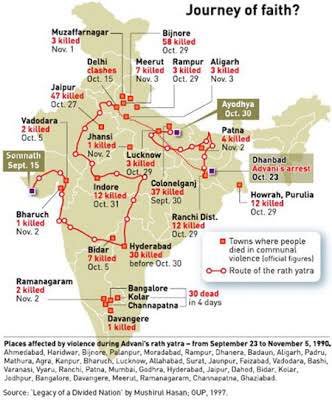
By the time the 80s broke, the Hindutva battalion’s word of mouth propaganda, aided by sections of the media and the re-writing of history in our school books, led to ‘social common sense’ with Muslims presented in negative light. This presence was enhanced along even narrower lines when they shamelessly demolished the Babri Masjid, rolling the Rath Yatra of Advani and leaving violence in its wake.

This only ensured the violence would intensify. The so-called ‘identity’ was now projected as the only. This deepened the polarization along religious lines, leading to the massive violence in Mumbai, Surat, and Bhopal in 1992-93, culminating in the now infamous Gujarat violence in 2002.

It was not only Muslims being targeted. From the late 80s, the other minority community, Christians, were also brought into the vortex of communal violence, projected as indulging in ‘conversions’. This divisive violence in Adivasi areas led to the brutal killing of Pastor Graham Stains along with his two innocent sons in 1999, and later to the horrific killings in Kandhamal in 2008.

All this is nothing more than what was articulated by the major RSS ideologue, M.S. Golwalkar, who claimed that India was a Hindu Rashtra from times immemorial, that religious minorities should live at the mercy of majority or be totally denied their rights as citizens.

The year 2015 marks is the second time that BJP is in the seat of power. When it ruled in 1998, with a coalition NDA, the BJP as a party did not have simple majority, so its agenda was low key. It was not quite though. It communalized the school text books, ‘saffronized’ education, and gave importance to faith based subjects like Astrology and Paurohitya, the training of Hindu priests. It also tested the waters to change the Constitution and formed the ‘Constitution Review Committee’.

With the BJP now having a simple majority, their agenda unfolds in an uninhibited manner. They have wrought changes in all national bodies, people with their communal mindset now occupying positions of importance. One Prof. K. Sudarshan Rao, head of the Indian Council of Historical Research, while a nonentity among professional historians, holds that the caste system was beneficial and presents the complex mythology of the Ramayana and Mahabharata, the two great epics, as lived history. Sanskrit is being promoted despite the fact that it was never a language of masses.

While the promotion of a scientific temper is the guiding principle of our Constitution, this government now promotes an orthodox, obscurantist ideology as being central to the arena of science. We are now told that ancient India had all the technology in aviation science and plastic surgery – all intended to show primacy over current developments in science and technology. India has contributed much by way of the works of Charat, Sushrut and Aryabhat but to claim ancient Indian science more advanced is merely to assert ‘we are the best’, a path in tune with the retrograde direction of the Hindutva brigade.

A democracy has to ensure that the values of liberty, equality and fraternity are paramount. With the Modi Government’s Hindutva agenda, they have now attempted to tamper with the Constitution by removing the words ‘Secularism’ and ‘Socialism’. The total bypassing of the concerns of the minorities and those is a grave danger to the very values which were at the core of India’s freedom movement. We are now at that crucial juncture of history where the very existence of the Indian Constitution is at stake.

We need to wake up in right earnest and face this threat. What is required is a multi pronged movement based on the rights and concerns of Dalits, women, workers, Adivasis and minorities in particular. We need to form alliances and platforms to coordinate our campaigns for the defence of our democratic rights. All those standing for democracy and secularism need to come together in solidarity. We have to hold hands and march together to protect our democracy. We need to work towards isolation of communal forces by pushing for alliance of non communal political formations. Sectarian politics, Hindu Nationalism, is akin to that of fascist and fundamentalist regimes, having some features of one and some features of the other.

In such a dispensation, the democratic space stands to lose. Symptoms of this are visible in the banning of some books and introduction of others, like penned by RSS ideologue Dinanath Batra.

It is therefore more important than ever before that the space in the social, print and TV media be reclaimed. We must resolve to work seriously to promote diversity, pluralism and those liberal values which go with our human and democratic values.

.--

Response only to

ram.puniyani@gmail.com

September 22, 2013

India:A.G. Noorani on Modi and democracy

dawn.com

Modi and democracy

A.G. Noorani

21 September 2013

THE Bharatiya Janata Party’s (BJP) nomination on Sept 13 of Gujarat Chief Minister Narendra Modi as its prime ministerial candidate for the 2014 general elections caused little surprise.

The sole dissenter was L.K. Advani who was embittered by the party’s defeat in two successive elections in 2004 and 2009 which proved a fatal blow to his own long nursed prime ministerial ambitions.

In 1984, the BJP won a humiliating two seats in the Lok Sabha. In 1989 it bagged 85. Advani, having succeeded Atal Behari Vajpayee as BJP president in 1986, persuaded the party in 1989 to make Babri Masjid an issue in the election. His campaign culminated in the demolition of the mosque in 1992.

Advani moulded the political climate by espousing the ideology of Hindutva. He knew that he would not be accepted as prime minister and yielded the palm to Vajpayee in 1995. When his chance came in 2004 the people snubbed him. All his supporters deserted him and rushed to support Modi’s anointment. They had no choice. They all dread the Rashtriya Swayamsevak Sangh’s (RSS) wrath. Its cadres run the organisation and its supremo, Mohan Bhagwat, lays down the law on crucial issues.

Narendra Modi is quintessentially an RSS man having joined it when he was in his teens. The least educated among the BJP leaders, Modi formally joined the RSS in 1971 where he soon made a mark for his exceptional skills as an organiser. He was an Advani favourite and it was Advani who saved his bacon after the massacre of Muslims in Ahmedabad in 2002 when Vajpayee was for sacking Modi as chief minister of Gujarat at the time.

Modi has never looked back. He spread the myth of ‘development in Gujarat’, won the support of India’s big business and industrialists, and acquired a reputation as a ‘strongman’. Within the state, he decimated all rivals and demoralised the civil service and the police.

There are some, even within the RSS, who look askance at his highly personalised style of politics; ruthlessness; intolerance of dissent; and proneness to shoot from the hip. But he is a first-rate campaigner and an ardent champion of the RSS’ Hindutva ideology in its most extreme form.

His image was not improved when the Supreme Court transferred some of the more important riot cases out of the state with an unflattering but highly significant mention of Nero. There have been scores of ‘encounters’ by the state police and charges galore of complicity by some in the government.

Some in the BJP will rue the day they extended their support to him. He is certain to personalise the election campaign. He will wage the campaign with no holds barred, presenting himself as Hindutva’s mascot defending the country against its enemies within and without.

On Sept 15, a mere two days after his coronation, Modi addressed a massive gathering of ex-servicemen. A former army chief, retired Gen V. K. Singh was present on the dais. “We need to change the government in Delhi as the solution lies in the hands of the centre. We need a strong, patriotic government to ensure the safety of our soldiers and sovereignty of our nation.” With these remarks, Modi let loose a tirade against Pakistan.

He will be tested next November when elections are held to the assemblies of four states — Madhya Pradesh, Rajasthan, Delhi and Chhattisgarh. Madhya Pradesh has a BJP ministry headed by the mild-mannered Shivraj Singh Chouhan whom Advani had sought to build up as an alternative to Modi. Chouhan was among the last to switch loyalty to Modi. In all probability he will return to power; the only question is the size of the majority he acquires.

Rajasthan has a Congress ministry which a strong BJP opposition is trying to remove. Modi is certain to pitch in here with all his skills and ferocity. Chhattisgarh is not that important but Delhi, the capital, is. Chief Minister Sheila Dixit faces a serious challenge.

These polls will provide a trailer for the general elections next year. But of far greater consequence is the future of India’s democracy and its credo of secularism when a major opposition party is led by a figure as divisive as Modi.

Advani once foresaw the effect of a narrow ideology on the electorate. In an interview ironically to the RSS organ Panchjanya, in late 1980, he said: “In India a party based on ideology can at the most come to power in a small area. It cannot win the confidence of the entire country — neither the Communist Party nor the Jan Sangh in its original form. The Jan Sangh was initially built as a party based on ideology but slowly it departed from that course. The appeal increased to the extent the ideology got diluted. Wherever the ideology was strong, its appeal diminished.”

But a decade later, he championed the ideology of Hindutva and succeeded in propelling the BJP to power. If Modi follows suit, how far will he succeed?

There is another aspect to this. A democracy rests on a national consensus. It was bad enough that from 1980 onwards the BJP went as far as it did in wrecking the consensus.

Balfour wisely warned against this danger: “Let the political parties be reduced to two (admittedly the most convenient number for cabinet government), but let the chasm dividing them be so profound that a change of administration would in fact be a revolution disguised under a constitutional procedure”.

That would be enough to wreck parliamentary democracy. The peril acquires added menace if the challenge to the system is posed by a political party wedded to the cult of hate.

The writer is an author and a lawyer based in Mumbai.

August 17, 2013

Reinvention of Communal Identities and Implications for Democracy | Saumya Saxena

EPW, Vol - XLVIII No. 34, August 24, 2013

Special Articles

This paper places communal identities in the context of representative politics in India's plural democracy. It seeks to understand how social groups become politicised entities and what the implications are for democracy. It also attempts to move beyond the conception of community-based identity to encompass the multiplicity of identities that emerged in the past few decades and began to alter political agendas.
http://www.epw.in/special-articles/reinvention-communal-identities-and-implications-democracy.html

August 01, 2013

India: Obsessive measurement devalues the democratic order | Ananya Vajpeyi

The Telegraph, 1 August 2013

A FRENZY OF COUNTING - Obsessive measurement devalues the democratic order

Ananya Vajpeyi

In the lead up to the 2014 general elections, India seems consumed by a frenzy of counting. How much is the annual growth rate? What is the extent of poverty? How much debt is the country facing? How much has inflation grown? What is the value of the rupee, and how much further did it plummet of late? How will vote-share change between the various political parties? How many percentage points did the popularity of this leader increase and of that one fall? The discourses of economic development and electoral democracy are becoming completely saturated with statistics. Recently, economists Amartya Sen and Jean Drèze on the one hand, and Jagdish Bhagwati and Arvind Panagariya on the other, have dominated the front pages of newspapers with their mutually opposed economic and political diagnoses and prescriptions. The CSDS-Lokniti Election Tracker survey, conducted across states over many months, puts charts and graphs in the headlines and on television channels.

Accompanied by interpretation and commentary, the numbers do help us to get a sense of the escalating crisis in our economy, and also provide a warning that a regime change at the Centre, with the Bharatiya Janata Party coming back to power, is not unlikely next year. In this way, counts and calculations of all types are an important component of the political conversation. The numbers paint a picture, give us yet another means to understand the complex and contradictory events in which we are immersed. This much is both common to many democracies and also desirable, in that citizens of a free country ought to have access to information that directly affects their everyday reality, presented in as clear a form as possible.

The trouble begins, though, when the counting spills out of discussions about development and elections into other areas of discourse, and this is a problem that is directly attributable to the new entrant in national politics, Narendra Modi. His political style entails a language of measurement applied in areas of our collective life where it is not just inappropriate — it is immoral.

We are slowly becoming exposed to a political language in which violence, too, falls within the purview of measurement. In this hitherto-unfamiliar atmosphere, violence is measured in the following ways: it is either denied altogether (nothing criminal and culpable happened to Muslims in Gujarat 2002: the damage to the minority community there amounts to zero); or it is cancelled out relative to other violence (the number of the dead in Delhi in 1984 cancels out and justifies the number of the dead in Gujarat in 2002); or it is compared and contrasted in terms of lives lost and harm done, but only to be used as a weapon of blame against others (fatalities in riots and pogroms under Congress or Left administrations in some states provide a justification for fatalities under BJP administrations elsewhere; the “action” of X number of Hindu killings in Godhra explains — and exonerates -— the “reaction” of Y number of Muslim killings in Ahmedabad, where Y is many times X). In this calculus, books are balanced in such a way as to allow Modi to state repeatedly that he cannot apologize or express remorse for what happened under his watch as Gujarat’s chief minister, because he has never been proven, personally, to be “guilty”.

Dead Sikhs, dead Muslims, dead Kashmiris, dead Maoists, dead Dalits, dead tribals — how many were there, and how many make up for the dead Hindus at the end of any given episode of state-sponsored or quasi-spontaneous, sectarian strife? The PR machine of Modi, his coterie of supportive journalists and intellectuals, his sometimes self-appointed and other times carefully hand-picked spokespersons in print and broadcast media, social media, and academic institutions, busily go about measuring violence, counting the dead, dividing and diminishing communities, and decimating the foundations of tolerance, civility and a basic respect for human life and fundamental rights that underpin our democracy.

The claim is that more of “us” died than “them”. Or maybe in absolute numbers fewer of “us” died, but the value of one of “us” is always more than the value of one of “them”, so even if more of “them” died, “we” suffered more. “We” are more in sheer numbers — since “we” are the majority — so it follows that “we” are more than equal in terms of our value to society, who counts and who is worth what. If critics of Modi bring up 2002, an episode of protracted violence that overwhelmingly targeted Muslims, his defenders scurry to bring out their ledgers and balance-sheets, eager to prove, first, that on the whole no harm was done and, second, that nobody except them knows how to calculate the true costs and casualties of communalism.

In his short and very important tract, Fear of Small Numbers: An Essay on the Geography of Anger (2006), the cultural anthropologist, Arjun Appadurai, elucidates how majoritarianism works, through the “anxiety of incompleteness” and “predatory identities”. In any diverse society, the majority is not the whole: it is continually plagued by the anxiety that what constitutes the difference between itself and the entirety of the nation is precisely the small non-majority: the minority. (There could be multiple, even smaller minorities, of course, but let us set aside that scenario for the sake of simplicity of argument and look at the picture only in terms of a majority and a single minority).

If the minority were eliminated, the majority would be one with the totality, it would become the nation itself, purified and homogeneous. The minority, howsoever small its number, keeps the majority from constituting a complete, undivided and undifferentiated national community. The anxiety generated by this incompleteness of the majority leads that majority to become predatory upon the minority, seeking to close the gap between itself and the nation. The minority, even though it might be numerically no match for the majority, is seen as a source of threat, and a kind of anticipatory revenge is visited upon it in order to get rid of it altogether.

The state of Gujarat under Modi’s rule — not just in early 2002, but throughout the three terms of his administration since 2001 — exemplifies this fear of small numbers. Through mass violence, through a systematic denial of justice, through the failure to rehabilitate and compensate victims of the 2002 pogrom, through lopsided economic policies, through the hijacking of state institutions as well as through all of the cultural, symbolic and rhetorical resources at the disposal of Hindutva ideology and its vehicle, the sangh parivar, Gujarat’s Muslims under Modi have been reduced to second-class citizens.

It is not just that their votes do not count. The fact is that the community itself no longer adds up to so much as a blip on Modi’s development agenda, never mind on his conscience. But all the number-crunching in the world is not going to be able to conceal their pathetic socio-economic condition, the erosion of their political status, and the repudiation of their human rights that Modi has comprehensively achieved in the past decade or more — a situation that he unapologetically promises to extend to all Muslims across India should he become prime minister next year.

There should be no uncertainty or doubt about the real manifesto for the 2014 elections: Narendra Modi intends to bring to a final conclusion the incomplete realization of the two-nation theory and the incomplete project of Partition. If he cannot physically remove 175 million Muslims from the Hindu rashtra, he can do the next-best thing, which is to ensure that they simply do not count.

February 28, 2013

India: Majoritarianism remains the rule

Indian Express, 28 February 2013

By the majority, for the majority

by Javed Anand

In theory, democracy may mean "government of the people, by the people, for the people". But from the history of democracies, it is evident that in multi-cultural, multi-racial or multi-ethnic societies, to start with, democracies are, at best, "government of the majority, by the majority, for the majority". At times, they even degenerate into mobocracy, under the watch of a partisan state. Democracies self-check, evolve and mature only to the extent they show fidelity to the inviolable universal principles of human rights, civil liberties, constitutional governance.

Indian democracy is no exception. At its best, majoritarianism remains the rule, irrespective of the party in power. For proof, read the report of the high-powered Sachar Committee for abundant evidence of institutionalised discrimination against the country's Muslims. At its worst, there is state-complicit, even state-sponsored, mob terror unleashed on India's religious minorities. The most gruesome examples of these are the targeting of Muslims (Nellie, 1983; Bhagalpur, 1989; Bombay, 1992-93; Gujarat, 1992 and 2002), Sikhs (Delhi, 1984), Kashmiri Pandits (J&K, 1989), Christians (Kandhamal, 2008).

Any honest appraisal of Ashutosh Varshney's articles in these pages ('Modi needs a Vajpayee', December 25, 2012 and 'Why India must allow hyphens', February 13, 2013) must factor in this grim reality of India's nascent democracy. Far from doing so, intervening in the "great debate" triggered by Varshney, first Harsh Gupta and Rajeev Mantri ('One versus group', February 13, 2013) and then the BJP's official spokesperson, Nirmala Sitharaman ('The tyranny of hyphens', February 20, 2013), misread or misinterpret others' arguments and shoot off at tangents in their eagerness to promote the BJP's prime ministerial aspirant-in-chief, Narendra Modi. Sitharaman even makes the fanciful claim that Varshney's arguments violate the Constitution.

If Varshney's ideal democracy is a "salad bowl" — where carrots and cucumbers, tomatoes and turnips retain their distinctive identity but together make for a wholesome treat — the ideal for Gupta, Mantri and Sitharaman is the "melting pot". In the vocabulary of political science, the former is called integration that celebrates diversity, the latter assimilation of the minority within the majority. Varshney points to American democracy as a good example of the former, France as that of the latter. Nowhere does Varshney portray the US as heaven on earth. This does not stop Sitharaman from enumerating Uncle Sam's imperfections to trash Varshney's preference for colourful social salad over monochrome soup. But she is silent on whether her Sangh Parivar would like the French model replicated in India: no gods and goddesses, no puja paath, no trace of religion in schools, police stations, train stations, banks, government offices.

What is Hindutva's offer: secularism or cultural hegemony?

Deliberately or otherwise, Gupta and Mantri misinterpret what Will Kymlicka, the Canadian political philosopher and leading proponent of multiculturalism, means by "external protections" (which he supports) and "internal restrictions" (which he opposes). Stated simply, the former means protecting minorities from majoritarian hegemony; the latter grants to minorities the "right to culture" so long as they do not trample upon the rights and liberties of individuals or "minorities within minorities". The Gupta, Mantri and Sitharaman trio take serious issue with the Indian Muslim male's right to multiple spouses. Kymlicka without doubt will agree with them, and so do I. The unjust, anti-women Muslim Personal Law must go. Yet, who else but "cultural nationalists" would reduce a debate on minority rights to the polygamy issue?

As for the rights of religious and linguistic minorities to establish and administer educational institutions, the threesome might wish to note that they are embedded in the fundamental rights section of the Constitution and are part of the universally recognised "external protections" that a civilised democracy assures to minorities to preserve their language, script, culture. Who would dare deny to the Gujarati-speaking in Mumbai, for example, the right to run their educational institutions?

Were Kymlicka addressing the Indian reality, like Varshney, he too would focus on the main story: the twin malaise of institutionalised discrimination and the rampant "culture of impunity" (whereby perpetrators of mass crimes go unpunished). Understandably, such an approach does not suit Modi loyalists, for doing so would bring the "Modi problem" into sharp relief. Two examples should suffice.

Institutionalised discrimination: Having accepted the findings of the Sachar Committee and pledged to implement its recommendations, the Union government has made a miserly start through a scheme of scholarships to students from minority communities. The scheme is being implemented across the country for the last few years. The Modi government, however, doggedly refuses to implement it, claiming it amounts to "minority appeasement". A division bench of the Gujarat High Court ruled that a "scheme for affirmative action" is not unconstitutional. The Modi government, most likely, will appeal in the Supreme Court.

Culture of impunity: In her end-August 2012 judgment delivered in the Naroda Patiya carnage case, Judge Jyotsna Yagnik sentenced 32 persons to life imprisonment. Maya Kodnani, a BJP MLA in 2002, was singled out for 28 years in prison as the judge found her guilty of "criminal conspiracy" and of being the "kingpin" of the worst carnage of 2002 (97 killed). Could Modi, chief minister and home minister of Gujarat since 2002, have been clueless about this when he appointed her a cabinet minister in 2007?

In the case currently before a magistrate's court in Ahmedabad, Zakia Jafri, survivor of the massacre at Gulberg Society, claims Modi and 61 others were also part of the conspiracy. Notwithstanding all the development claims of Modi and his supporters, the dead of Gujarat 2002 must be accounted for. Way to go for a civilised democracy.

The writer is co-editor, 'Communalism Combat', and general secretary, Muslims for Secular Democracy
- See more at: http://www.indianexpress.com/news/by-the-majority-for-the-majority/1080758/0#sthash.E9zpURdf.dpuf

February 14, 2013

India: Freedom of expression will continue to remain under siege

The Hindu, February 14, 2013

The rising menace of intolerance

by Soli J. Sorabjee

Freedom of expression will continue to remain under siege unless all groups accept that people can have different opinions and beliefs in a free country

“Our tradition teaches tolerance; our philosophy preaches tolerance; our Constitution practises tolerance; let us not dilute it.” These stirring sentiments were expressed by Justice Chinnappa Reddy in a Supreme Court judgment pronounced in August 1986 which invalidated expulsion from school of students belonging to Jehova’s Witness faith. Regrettably, over the years, tolerance has been replaced by the rising menace of intolerance which strikes at various fields of human endeavour and creativity: writings, music, drama, paintings and movies.

Intolerance stems from an invincible assumption of the infallibility of one’s beliefs and a dogmatic conviction about their rightness. An intolerant society cannot tolerate expression of ideas and views which challenge its current doctrines and conventional wisdom. Consequently, unconventional and heterodox thoughts and views have to be suppressed. That is the prime motivation for censorship.

Extent of dissent

One criterion to determine whether a country is truly democratic is the extent of dissent permitted. A liberal democracy is one in which all groups in the country accept the fact that in a free country, people can have different opinions and beliefs and shall have equal rights in voicing them without fear of legal penalties or social sanctions. Right to dissent and tolerance of dissent are sine qua non of a liberal democratic society.

Today we have reached a stage where expression of a different point of view is viewed with resentment and hostility and there are vociferous demands for bans. The banning itch has become infectious. Sikhs are offended by certain words in the title of a movie; Christians want the movie, The Da Vinci Code, banned because they find some portions hurtful. The ban was struck down by the Andhra Pradesh High Court. No one dare write an authentic and critical biography of a revered religious or political leader. The American author James Laine who wrote a biography of Shivaji in which there were unpalatable remarks about Shivaji was sought to be prosecuted which was quashed by the Supreme Court. Worse, the prestigious Bhandarkar Institute at Pune where Laine had done some research was vandalised. That was mobocracy in action. The exhibition of M.F. Husain’s paintings was stopped by intimidation followed by vandalism of the premises. The exhibition The Naked and the Nude at the Art Gallery in Delhi is threatened with dire consequences because it is considered obscene by the Vishwa Hindu Parishad women’s wing. The musical performance by a teenage girl rock band in Kashmir was coerced into silence because the music was termed un-Islamic by a popular religious leader. There are media reports that Mani Ratnam’s latest movie Kadal has come under fire on account of Christian ire that it has ‘hurt’ the feelings of the community. One wonders whether we are hell bent on emulating the Taliban.

Fortunately, our Supreme Court has been a valiant defender of freedom of expression. The well known actor Khushboo faced several criminal prosecutions on account of her remarks on premarital sex and its prevalence in metropolitan cities which were considered to be against the dignity of Tamil women and ruined the culture and morality of the people of Tamil Nadu. The Supreme Court quashed the criminal proceedings on the ground that “under our constitutional scheme different views are allowed to be expressed by the proponents and opponents. … Morality and criminality are far from being coextensive. An expression of opinion in favour of non-dogmatic and non-conventional morality has to be tolerated and the same cannot be a ground to penalise the author.”

The movie, Bandit Queen, was banned on the ground of obscenity because of the very brief scene of frontal nudity of the bandit Phoolan Devi in the movie. The Supreme Court struck down the ban and ruled that nakedness is not per se obscene. The Court emphasised that the Censor Tribunal which is a multi-member body comprised of persons who gauge public reactions to films had approved exhibition of the movie. This aspect was also highlighted by the Supreme Court in its judgment in T. Kannan.

Exhibition of movies is included in the fundamental right of freedom of expression guaranteed by the Constitution. One of the reasons frequently assigned for imposing a ban is that it hurts the sentiments of a certain section of people in society. ‘Hurt feelings’ is a slippery slope for banning expression. Any book or movie or play which criticises certain practices and advocates reforms will ‘hurt’ the sentiments of the status-quoists. For example, the abolition of Sati or the abolition of certain superstitious practices in the name of religion. Criticism should not be equated with causing offence. In the context of hurt feelings, the Supreme Court has repeatedly laid down that the standard to be applied for judging the film should be that of an ordinary man of common sense and prudence and not that of “hypersensitive” persons who sense offence in every scene or perceive hurt in every statement. The right method is to vigorously refute the criticism by rebutting its reasoning and data on which its conclusions are based.

Another ground for imposing a ban is the bogey about apprehension of breach of law and order and outbreak of violence in view of threats by certain groups about the exhibition of the movie. As far back as November 2000, the Supreme Court in KM Shankarappa’s case categorically ruled that “once an expert body has considered the impact of the film on the public and has cleared the film, it is no excuse to say that there may be a law and order situation. … In such a case, the clear duty of the government is to ensure that law and order is maintained by taking appropriate actions against persons who choose to breach the law.”

The same bogey of breach of law and order and violence was raised by the State of Tamil Nadu regarding exhibition of the movie, Ore Oru Gramathile. The Supreme Court firmly rejected the State’s plea in its decision in Rangarajan in March 1989 in these words: “Freedom of expression cannot be suppressed on account of threat of demonstration and processions or threats of violence. That would tantamount to negation of the rule of law and a surrender to blackmail and intimidation.” The Court reiterated that “it is the duty of the State to protect freedom of expression. The State cannot plead its inability to handle the hostile audience problem. It is its obligatory duty to prevent it and protect the freedom of expression.” It is noteworthy that the Supreme Court endorsed the celebrated dictum of the European Court of Human Rights that freedom of expression guarantees “not only views that are generally received but also those that offend, shock or disturb the State or any sector of the population. Such are the demands of that pluralism, tolerance and broadmindedness without which there is no democratic society.”

During the hearing of the writ petition regarding the movie Dam999, certain observations were made orally off the cuff by the Supreme Court about law and order problems that may arise because of the exhibition of a movie. The writ petition was in fact dismissed as infructuous because the period of the ban had expired. There is no mention or discussion of the decision in Rangarajan at all in the operative part of the Supreme Court order. The salutary principle laid down in the Rangarajan decision has been approved in three subsequent decisions of the Supreme Court. It firmly holds the field and has not been diluted at all.

In contravention of the law

Banning of the movie Vishwaroopam by the State of Tamil Nadu was clearly in contravention of the law laid down by our Supreme Court. The sad part is that Kamal Haasan, producer of the movie, agreed to carry out cuts in the movie as demanded by certain Muslim groups. It was not a settlement but surrender by Mr. Haasan albeit for pragmatic reasons. However it lays down a bad precedent because it concedes to certain intolerant groups demanding a ban, a veto or appellate power over the decision of an expert body like the Censor Board.

Our Constitution prescribes certain fundamental duties to be performed by citizens (Article 51-A). One duty of paramount importance which should be performed is the duty to practise tolerance. Otherwise democracy, a basic feature of our Constitution, will be under siege and the cherished right to freedom of expression will be held hostage by an intolerant mindless mob.

(Soli J. Sorabjee is a former Attorney General of India)

January 25, 2013

What I want is neither a Ram Rajya or a Buddha Rajya, but in fact a Lok Rajya

Deccan Chronicle, 25 January 2013

Of religions, castes and men: Kancha Ilaiahm Ajay Navaria, Nirupama Dutt debate at Jaipur Literature Festival

PTI

Jaipur: Coming down heavily on the caste structure in Hindu religion, author Kancha Ilaiah today advocated adopting the Buddha’s ideology as a way to achieve secularism in the country, generating a lively debate among the fellow panelists at the Jaipur Literature Festival here.

Religious conversion, caste structure within religions and position of dalits after conversion were the main talking points of the session titled “God as a Political Philospoher: Dalit Perspectives on Buddhism,” where Ilaiah engaged with author Ajay Navaria and poet Nirupama Dutt.

“A dalit who converts to Christianity can become a pastor or be an equal in the mosque or can touch the Guru Granth Sahib. But he can do none of this in Hinduism. He cannot become anything,” Ilaiah said.

“No dalit can become a priest in a Hindu temple,” said the author of “Why I am not a Hindu” who also pointed out that Buddhism has always advocated the ideas of equality, abolition of caste structure, notion of justice and women’s rights.

However, fellow author and panelist Ajay Navaria, whose collection of stories “Unclaimed Terrain” translated into English has recently been published, disagreed over the issue of the benefits accruing to dalits from conversion and the adoption of Buddhism as the main religion.

“Conversion does not solve any problem. In fact, there is a category in administration of a ‘New Buddhist’ where a person’s original caste is mentioned in brackets even after adopting another religion,” he argued, questioning then the purpose of going through conversion.

“I am not here to advocate Hinduism. But the dalits can go into any religion but their identity is that of an untouchable. They are not liberated even there,” Navaria said, adding, “Religion cannot solve the problem.”

Furthering his argument, poet Nirupama Dutt highlighted the problem of caste structures within religions.

Dutt, who hails from Punjab, drew attention to the phenomenon of Gurudwaras being based on caste. “Today one can find separate Gurudwaras for Sikh Jats, Kabir panthis and the tanners,” she said.

“While Sikhism does not recognize caste, just like in the case of Islam, the situation of the ground is very different from the one visualised in scriptures,” added Dutt.

Drawing attention to the ground realities in countries where religion forms the basis of law, Navaria said the country would not become secular and discrimination-free just by adopting Buddhism.

“I don’t like religion based systems because they end liberty...no religion is detached from caste,” he added.

Even as the panelists disagreed on various issues, they did agree on one thing – that the aim should be that of a caste-free society.

“I don’t agree that caste cannot be abolished or that equality cannot come to India,” Ilaiah said.

And while Navaria disagreed with him on how to achieve this goal, he did outline his vision for India. “What I want is neither a Ram Rajya or a Buddha Rajya, but in fact a Lok Rajya.”

February 28, 2012

Ten years after the 2002 carnage - Narendra Modi, the BJP and democracy

by Christophe Jaffrelot

Ten years after the 2002 carnage, in spite of repeated attempts by the Supreme Court and the determination of the victims as well as (suspended) policemen, NGOs and media persons, justice has not been delivered and reconciliation between Hindus and Muslims has not taken place in Gujarat. Whatever happens to Chief Minister Narendra Modi legally, he has already been held guilty on several counts, regarding violence of an unprecedented magnitude since Partition; he has not punished the policemen who let the massacres take place. On the contrary, they have been promoted; he has not given Muslim victims and their kin the compensation to which they were entitled and he has never apologised to the Muslim citizens of his state. In spite of that, he remains the strongest political leader of Gujarat and may also become an all-India leader. [. . .].
http://www.sacw.net/article2557.html

April 20, 2011

Invitation to Press: KN Panikkar and Mahesh Bhatt to speak on anti corruption campaign and democracy" (22 April 2011)

Media Invite

Prof KN Panikkar and Mahesh Bhatt will address a press conference on

’Anti Corruption Campaign and Indian Democracy in Search of An Alternative’

On April 22, 2011 at IWPC, 5 Windsor Place, New Delhi at 12 noon.

Please depute a reporter and a camera person to cover the press conference.

Shabnam Hashmi

Anhad

October 13, 2010

Faith cannot be the basis of any judgement

Hinudstan Times, 5 October 2010

by Shohini Ghosh

http://tinyurl.com/36naprb

October 12, 2010

The Ayodhya Judgment: Any retreat to pre-modernity is dangerous for democracy

The Telegraph (Calcutta), 12 October 2010


by Prabhat Patnaik

There are three obvious problems with the Allahabad High Court judgment on the Babri Masjid issue. Each of them in isolation is potentially damaging for the constitutional fabric of the country; together they can cause irreparable harm.

The first is the obliteration of the distinction between “fact” and “faith”, which represents a serious retrogression to pre-modernity. In medieval times, witches were burned because people believed that they engaged in evil deeds. A premise of modernity is that this and other such “beliefs” cannot be accepted as “facts”, that there has to be independent and credible evidence on the basis of which alone a “fact” can be established. Hence the verdict of the Lucknow bench that Ram was born at the very spot which was the sanctum sanctorum of the Babri Masjid, because “people” believed this to be the case, is as mystifying as it is retrograde.

There are, to start with, the obvious, but weighty, questions of who these “people” are, how many such “people” must be there to qualify being called “the people”, and what evidence the Lucknow bench had, even regarding the views of the “people”, other than what it might have gathered as a result of the activities, claims and mobilizations of a few Hindu organizations which professed to speak in the name of the “people”. To take the word of organizations that claim to speak in the name of the “people” as the voice of the “people” is dangerous enough. But to take the “beliefs” of the “people”, even assuming these are indeed the well-established “beliefs” of a very large number of people, as synonymous with “facts” strikes at the very root of the rationality that must underlie a modern society.

The second disturbing aspect of the judgment is the obliteration of the distinction between “negotiation” and adjudication. The outcome of negotiations always depends upon the relative strengths of the protagonists. Hence in any situation of conflict, especially of the “either-or” sort, where the relatively stronger protagonist is absolutely intransigent over its claim, negotiations necessarily work to the detriment of the relatively weaker protagonist. In the present context, where the Hindu organizations were intransigent, any process of settlement through negotiations would necessarily have worked against the organizations belonging to the minority community. Since the latter considered this unfair, it went to the court of law. The basic reason for its going to the court therefore, or even for the matter being referred to the court, is that the outcome arrived at on the basis of relative strengths is not universally accepted as “fair”. The court is supposed to be fair because it does not settle issues on the basis of relative strengths but entirely on the basis of evidence, facts and legal provisions. The picture of justice, depicted as a maiden, typically has her eyes covered for this very reason, namely that justice is blind to the relative strengths, positions, powers, and pulls of the protagonists. The rationale of adjudication lies in the fact that its outcome is decided on principles entirely different from those underlying negotiations.

This is why the judiciary is different from societal (as opposed to State) institutions like khap panchayats. The latter are pre-modern, and hence anti-democratic, for two distinct reasons: first, the attitudes of such panchayats are pre-modern, based, as mentioned earlier, on “faith”, “beliefs”, “customs” and practices rather than “facts”; second, the decisions of these societal organizations necessarily and directly reflect the relative strengths of the protagonists and the power relations existing among them. The judiciary, by contrast, being a part of the State, and hence based on a Constitution that guarantees equality before the law for everyone, is supposed to function with its eyes closed, uninfluenced by the relative strengths of the protagonists.

But when the outcome of adjudication itself becomes de jure dependent upon the relative strengths of the protagonists, then that represents a dangerous trend, a retrogression from modernity and democracy. And this is exactly what the Allahabad High Court judgment has done: it has based itself not on “facts” and law but on considerations of what might be acceptable. Since what might be acceptable depends upon the relative strengths of the protagonists, adjudication in this case has ceased to remain adjudication; it has got influenced by the relative strengths of the protagonists.

It is not surprising that after the verdict the Hindutva forces are talking about rapprochement, about peaceful settlement, about negotiated solutions. This is because their “reservation outcome”, that is, the “worst case scenario” possible from their point of view, as expressed by the Allahabad High Court verdict, is already favourable enough for them; they can only improve upon their position, by buying up the one-third share that the high court has given to the waqf board, and hence getting exclusive rights over the entire disputed land.

The third problem with the judgment is that it has accepted the demolition of the Babri Masjid, an act that was a direct violation of the law of the land, as a fait accompli; and by remaining silent on this fait accompli while giving a verdict that echoes in essence what those who undertook the demolition were claiming, it has implicitly rationalized post facto that horrendous and unlawful act of demolition.

True, this court was not supposed to pronounce any verdict on the demolition; it was concerned with a property dispute. But, the obvious question arises: would it have given the land under the central dome of the Babri Masjid to “the Hindus” if the mosque were still standing? If it had done so, then it would have had to implicitly condone an act of demolition since the Hindu outfits then would have been legally entitled to do what they wish, with the land over which they had been given legal rights. And if it had not done so, then it means that the demolition has affected their verdict, that is, that the legal outcome of a property dispute has been affected by an act of illegal demolition: the Hindu outfits have benefited from their illegal action of demolishing a 500-year-old mosque.

The fact that the high court verdict has been taken in a calm manner by the people of the country is gratifying. It is symptomatic of the maturity of the people and also of the fact that communal issues are being pushed into the background as more basic issues of material life claim the people’s attention. In this context, many have welcomed the Allahabad High Court judgment as putting an end to the longstanding controversy so that the country can move on. They feel that keeping the issue alive by going to the Supreme Court should be avoided, and are therefore unhappy with criticisms of the high court judgment.

This position is understandable; but it is erroneous for two reasons. First, any retreat to pre-modernity of the sort that the verdict has displayed is fraught with serious consequences that go beyond the specific issue under consideration, that is, the Ram Janmabhoomi-Babri Masjid issue. If “fact” and “faith” are not distinguished, if adjudication is influenced by the relative bargaining strengths of the protagonists, and if a patently unlawful act brings legal dividends to those who perpetrated it, then it augurs ill for democracy in the country.

Secondly, issues like this leave behind wounds that fester and can cause damage later even if there is no immediate cause for concern. Justice needs to be done, in a manner that is in conformity with the blindness of the maiden. That is the only firm basis on which a modern State can be built; and the resolution of even specific issues like this lies ultimately in the building of such a modern State. Hopefully, the Supreme Court to which the matter will be referred will be mindful of the pitfalls of quick fixes and will uphold scrupulously the cause of law.

The author is professor, Centre for Economic Studies, Jawaharlal Nehru University, New Delhi

April 26, 2009

Secularism and Democracy under Siege from Hindutva

Mainstream Weekly
25 April 2009

Kandhamal Violence: Secularism and Democracy under Siege

by Sunny Jacob, 26 April 2009

In the light of the recent violence in Kandhamal every right thinking person of this country must be concerned of the dangers to democracy and the secularist ideals of our nation. The violence that started in December 2007 had already destroyed the backbone of the minority Christian community of Kandhamal. The killing of the Swami, which from day one the Christian leaders and churches condemned in the strongest terms, and unequivocally stated that they had no role in it at all, was used as a lame excuse and as part of the larger conspiracy of the fundamentalist organisations that went on attacking innocent Christians all over Kandhamal and many other parts of Orissa. Even after the claims by the Maoists that they have done the crime, the goons of the fanatics went on destroying the Christian churches, properties, houses, people and their belongings. This second phase of violence has shocked the entire Christian community in India and shaken the basic foundation of our democracy and secularism.

The magnitude of vandalism perpetrated by the religious fanatics indeed reveals that a section of Indian politicians have no faith in the secular and democratic Constitution of India. They simply do not believe in the sanctity of our Constitution. Otherwise how can any one justify the violence and arson, rape and looting, attacks and obstructions, threat and use of muscle power? It is consoling to know that all these are done by a minuscule section of the Hindu community who are the foot-soldiers of the Sangh Parivar. However, what is sickening and shocking is the stoic silence of the majority who know the truth about all these happenings, yet prefer to do nothing against the fundamentalist forces which are bent on destroying not only the minority communities but also the essence of Hinduism itself. The utterances of Sangh Parivar leaders and the writings of so-called intellectuals like Swapan Dasgupta and Chandan Mitra are in fact destroying the very foundation of our cherished democracy and secularism. These so-called intellectual faces of the Sangh Parivar are not far too different from the Hindutva mascots like Narendra Modi and Varun Gandhi. They are merely an expression of a deep ideology that is fundamentalist and fanatic. Knowingly or unknowingly they are attacking the very foundation of our secular nationhood.

The Indian Constitution guarantees the freedom of religions. It does not protect or promote any particular religion. In fact it remains neutral to all religions. Secularism seems to have created some doubts in the minds of some people. The main cause for this confusion is the deliberate work of the Hindutva forces in general and the BJP in particular. They coined the word ‘pseudo-secular’ to brand all the secular political parties and defame them in order to create confusion among the public at large.

The meaning of secularism is derived from the word secular, which means worldly or material, not spiritual or religious. It is a concept of social and ethical value; therefore, it is defined as a view of life based on the premise that religion and religious considerations should be ignored or purposely excluded in order to evolve a system of social ethics based upon a doctrine.

This shows clearly that there is no religious and spiritual involvement on the part of the state. According to Prof S.N. Dhyani, “in the civil management and administration of the state, religious or spiritual considerations should be strictly excluded”. Therefore, secularism is a modern progressive philosophy which is mainly based on independent rational thinking with a scientific temper. In a secular society religion, to a great extent, is a personal matter, which has no place in socio-political issues because that is what breeds what we call communalism and sectarianism. Today, unfortunately, communalism and sectarianism are the dangers to our great nation, and these give rise to both terrorism and extremism.

The idea of secularism, in fact, originated in the West. The secular understanding separates the State and Religion in such a way that one does not impinge upon the other. The concern is to make sure that religion does not divide people on social and political matters. In theocratic countries the state fulfils religious ideals and politics is subordinated to religious ideals and tenets. All relations between the state and individuals are essentially regulated and governed with reference to state religion.

India has a long tradition of pluralism. This country not only gave birth to many religions but it has been hospitable to many other alien religions. Besides, today Article 25 of the Constitution of the Indian Republic guarantees to the followers of all religions the freedom to practise and propagate their religion. India is the only country in South Asia where secularism is not only the basic feature of the Constitution but also the symbol of its composite culture, tolerance and equalitarian social order. The state shows neutrality in its policies regarding the religious matters of individuals. The state gives equal treatment, recognition and position to all religions. No discrimination is displayed in employment, educational, political and economic matters on the basis of religion. The laws of the state are formulated, implemented and analysed on a secular basis. It is clear now that the attitude of impartiality towards all religions is made secure by the Constitution. There is no ‘state religion’ in India. There is not just the separation of state and religion, but ‘sarvadharma samabhava’ is the vision of Indian Constitution. This is the meaning of Indian secularism.

Democracy theoretically means the rule of the majority. But this rule enshrines the spirit of the rule of law and consensus, not merely the rule of numbers. An ideal democracy guarantees unambiguously freedom to save life and full opportunity to every section of society, especially minorities, to blossom and prosper, lead a dignified life with full freedom to assert their own welfare.

¨

However, there are many anomalies in the practice of democracy in our country. The powerful classes and castes had always framed their own methodology to remain in power and maintain the status quo. In a democracy the majority always matters. In India the majority is always poor. But the ruling class has explored ways and means to divide their unity in the name of religion, caste, ethnicity and language. The more the number of political parties are, the more divided they become. A modern state exists only because it adheres to a certain fundamental ethos of civil society. No nation worth the name can survive without this ethos. It gives the state legitimacy. When this legitimacy is threatened and defiled, no democratic nation or state can function and hold its ground. Thus in order to have a democratic state, we need a democratic social order. Hence, the principles forming the basis of a democratic social order would also govern the state.

Fraternity, equality and liberty are the essential principles forming the basis of a free democratic social order. Fraternity is the disposition of an individual to treat men as the object of reverence and the desire to be in unity with his fellow beings. If this is undermined there cannot be any democracy. It will be like letting the violent mob to rule over the country. Signs of that are seen in Kandhamal, Mumbai, Karnataka, Assam, Manipur, Darjeeling, Bihar, and J&K. In fact fraternity is the other name of democracy.

Equality meant exactly a free social order, where equivalence in measure, amount, number, degree, value or quality rests. Ambedkar emphasised the idea of equality of consideration which meant none would have a claim to better treatment than another, in advance of good grounds being produced. Liberty falls under two classes: civil liberty and political liberty. Civil liberty refers to i) liberty of movement; ii) liberty of speech, through reading, writing, and discussion; iii) liberty of action, which had to be formal and real. Political liberty consists in the right of the individual to share in the framing of the laws and in the making and unmaking of governments. The government has to, therefore, derive its power from those whose rights it is charged to protect.

Today the concepts of secularism and democracy have been sought to be converted into mischievous slogans. They are put forward as forcible concepts rather than moral and spiritual values. The incidence of communal violence is the most disturbing phenomenon for secularism and democracy. After 70 to 80 years of work the forces of Hindutva have not brought any equality in society. They worked hard to politicise Hinduism but never to democratise it. The BJP, RSS, VHP and BD together under the umbrella named ‘Hindutva’ are a big threat to secularism and democracy of India. Why?

Their declarations of India having only one culture, one language and one religion and being one Hindu nation are nothing but sheer calls to destroy secularism and democracy in the country. The Sangh wants to change the Indian Constitution and abolish the rights of the religious minorities and promote their mono-cultural vision. Any party that does not respect the values enshrined in our Constitution by their actions is striking at the very root of the democratic state order.

A social order based on the values of equality, justice, liberty, dignity and fraternity is the vision of our Constitution. No doubt ours is a sovereign, secular, democratic state. Not merely separation of religion from the state but equal respect to all the religions is the vision of the Indian Constitution.

But Hindutva regards secularism and democracy as threats to its growth. Distorting their meaning and doing away with secularism and democracy are the only weapons left in the hands of Hindutvavadis for their survival. Hence Hindutva poses a major danger to secularism and democracy. Our nation cannot afford to be ruled by fascist forces. We cannot allow mob mentality to be a norm for our governance. We cannot even imagine a repeat of Kandhamal anywhere in the country.

Sunny Jacob S.J. teaches at Loyala School, Bhubaneswar. His e-mail is: sunnyjsj(at)gmail.com

November 17, 2008

Fascism in its liberal womb

Economic Times
17 Nov 2008

by Pothik Ghosh

We need to distinguish one from the other, even at the risk of appearing undesirably divisive. For, in the long run, more harm than good would be
done if this difference is obscured now for some tenuous gains on the Hindu-Muslim brotherhood front. The point of this comparison is not to legitimise the idea of ‘lesser evil’.

The point is to recognise the difference in political structures and processes constitutive of each of those strains of terror, if only to come up with a composite solution to the larger problem of civic violence of which both Islamism and Hindutva have become indivisible halves. There is absolutely no doubt that both the Islamists and the footsoldiers of Hindutva seek to close the liberal space through their terroristic campaigns, both covert and overt.

But what is more germane is that while the former seeks to subvert liberal democracy by challenging it from the vantage point of opposition and resistance, the latter strives towards the same goal by using the language of liberal statecraft and manipulating its institutions. It would, indeed, be a pity if dubious and equivocal concepts such as “nationalist alienation”, which the BJP has of late been offering by way of ideological apology for acts of ‘cultural nationalist’ violence, obscure the real condition of majoritarian fascism.
[. . .]
Read More

October 23, 2008

Whither Indian Democracy?

Whither India: Qualitative change in Polity

Ram Puniyani

Last six months have been most disturbing on the Indian political scene. As far as the values of integration are concerned they are being attacked very severely by terrorist-communal forces. First, we saw the series of bomb blasts, Bangalore, Ahmedabad, Delhi and Malegaon. It was projected by the authorities that all these acts are due to Jehadi Muslim groups that police have succeeded in cracking the network. One outcome of this was the Batla house encounter in which police, bravely killed the terrorists. It put out a version that now the terror ring has been busted and kingpins have been arrested. It is another matter that later the relevant-uncomfortable questions were raised and satisfactory answers to these were not forthcoming. On the top of this the claim that Malegaon blasts were done by SIMI proved to be false as the investigation showed the possibility of ABVP/Bajrang Dal being involved in same.

During the same time two Bajrang dal Activists got killed while making bomb in Kanpur, two activists of Hindu Jagran Samiti were involved in placing the bombs in Thane due to which seven people got injured. During this time again in Tenkasi, Tamil Nadu, the bombs went off near RSS office and as usual the cry of wolf was made, but the wolf here had different shades than what RSS wanted to propagate, as most of those planting the bombs turned out to be Hindus, with affiliation, which are not difficult to guess.

During the same time the anti Christian violence was orchestrated and launched in Orissa to begin with, later on spilling to Karnataka. The pretext first was that Christians have beaten Swami Laxmananand (December 2007) and later that Christians have killed the swami. Interestingly a Maoist group claimed to have killed him but the RSS combine stated that they don't believe in the claim of Maoists, meaning there by that they have the right to decide who the culprit is!

The third tragedy related to the Hindu Muslim violence in Burhanpur, Dhulia and few other places on the slightest pretext of tearing a banner or some such. What is disturbing is the way things are shaping in the country. The anti Muslim hate propaganda, which has been sustained on various myths have gradually been taking he shape of deep rooted perceptions. Earlier lot of planning and bigger pretext was needed to unleash the violence, now even a small pretext suffices to initiate the mayhem. Some of the properties are well marked in advance for destroying. The loss of lives of minorities is many times more than their presence in population.

The stereotyping of Muslim community through reporting of acts of terror has boosted the negative perception of the community in a serious way. At the same time the there is a realization that there are two set of laws, that they will not get justice and that their feeling of insecurity in the society is going up by leaps and bounds. One does not know whether this disturbs the ruling coalition or not. For Muslim minorities to keep faith in the Governemnt in such circumstances is not difficult, it is impossible.

Christian minority was not the target till quite late. As the hate propaganda based on make believe forcible conversions, allurement, insult of our gods, foreign money keep percolating in the society, and a silent sanction for attacking them started building up. Now even a slightest pretext is sufficient to undertake the despicable violence against the community.

This is a clear case as to how already a social mind set has been created, through word of mouth propaganda and media where by the minorities have been demonized and now the violence against them has become the order of the day. Even the global phenomenon of terrorism and local phenomenon has added on to the same and in this case Islamic terrorism, and 'all terrorists are Muslims' has been made the fodder of social thinking. As such, starting from Golwalkar, RSS's formulation that Muslims and Christians are threats to Hindu nation, to the present day, there is a consistent worsening of the level of demonization of minorities.

These entire social phenomenons are raising a deeper question related to our democracy. Democracy not only ensures that are citizens are treated equally it also stands for giving affirmative action for weaker sections of society. As such the litmus test of democracy is the welfare and security of minorities. Here we see that as to how the marginal stream which came up during freedom movement and kept aloof from it, the Hindutva vehicle, RSS, has been successfully working, using the democratic space to abolish, precisely the democratic values which gave it a space to stand. While totally defamed after Gandhi murder by one of its followers, its acceptability began with Jayapraksh Narayan letting it run the movement, which led to emergency and later formation of Janata Party. RSS began by spreading hate against Muslims and Christians, formulated by its founders and penned by its ideologue, M.S. Golwalkar. Golwalkar instructed that Muslims, Christians and Communists are the threat to Hindu nation. The RSS shakhhas kept spreading this ceaselessly and it became a part of social common sense over a period of time.

RSS also planted its swayamsevaks in different walks of social and political life, education, media, police, bureaucracy etc. Once its political child, Jana Sangh became part of Janata party, it ensured that large number of swaymsevaks become part of media establishment. And later during NDA regime, this game of theirs' had a field day. Capping these efforts through Vanvasi Kalyan Ashram, social engineering got intensified in Adivasi areas. With US administration coining the word 'Islamic terrorism' and that propaganda that Madrassas are the dens of training terrorists; RSS completed its indoctrination module.

The deadly poison it spread against minorities first spread hate and created divides in the communities, leading to 'hate other', which in turn forms the base of communal violence. Communal violence in Indian context gets assistance from the communalized state apparatus, sections of police in particular leading to polarization of communities and rise to political power of the communal party. The conveyer belt begins from demonizing other and leads to the RSS's political child becoming politically strong. That's how a political party which managed two seats in parliament in1984 elections has become formidable electoral force today, knocking the democratic values and imposing the religion based nationalism.

Though not in power in center, its machinations are polarizing the society all over, creating divisions in the society, rampaging the rule of law and paving the way for creeping fascism. What is happening today is reminder of how things happened in Germany, with Hitler leading the carnage. Beginning with hate Jews and then Christian minorities, then Communists and trade unionists paved the way for the stifling atmosphere of fascism, authoritarian state with social base. Today we seem to be helplessly watching a similar situation. While RSS combine is behaving like a rampaging bull, Bajrang Dal planting bombs, its workers carrying arms openly, distributing trishuls en masse, the state ruled by so called secular combine, UPA alliance seems to be a helpless observer, as the whole machinery itself seems to be affected by the communal virus.

Where do we go from here? Opposition to this fascist politics, fighting it tooth and nail cannot be postponed by a single minute. The time has come that all those believing in democracy and welfare of all need to come together and put and end to the politics of hate. Popular front at social and political level is the need of the day. The power seeker political formations may not look beyond their personal gains but the social movements need to put the pressure in the right direction for these political people to hang together before we are hanged separately. It is not just a question of opposition to one political formation. The question is can we let the RSS version of Hindusim destroy the Kabir and Gandhi version of Hinduism and religion? The question is can we let the innocent minorities be the scapegoats for the fascist politics to keep on going? Should we let the democratic space be usurped by those wanting to bring in a nation state in the name of religion?

Whether India will nurture the values of freedom movement and strive for human rights of all depends on us, as in no time in past the very concept of democracy has been stifled as much as we are witnessing today.

--