|
Showing posts with label Chhattisgarh. Show all posts

June 28, 2024

India: Strongly Condemn Vicious Communal Assault on Muslims - CPI(M) Statement June 27, 2024


Communist Party of India (Marxist)

June 27, 2024

Press Statement

The Polit Bureau of the Communist Party of India (Marxist) has issued the
following statement:

Strongly Condemn Vicious Communal Assault on Muslims

The Polit Bureau of the Communist Party of India (Marxist) condemns the
spate of attacks against members of the Muslim community in various parts of the country in the period since the election results were announced.

In Chhattisgarh’s capital Raipur, three Muslim men transporting bullocks
were branded as cow-smugglers and killed by so-called cow vigilantes. In
Aligarh, a Muslim man was beaten to death on allegations of theft.

In Mandala, Madhya Pradesh, eleven houses of Muslims were demolished within 24 hours after alleged reports of "beef" being recovered from their
refrigerators.

In Lucknow’s Akbarnagar, a predominantly Muslim area, homes of over a
thousand families were bulldozed for the construction of the riverfront.

People belonging to the Hindu community in the neighbourhood have come out in open protest against the allotment of a flat to a Muslim woman in in a
low-income group housing complex under the Chief Minister’s Housing Scheme in Gujarat’s Vadodara.

In Himachal Pradesh’s Nahan, the shop of a Muslim was looted and vandalised after allegations that he had sacrificed a cow during Eid-al-Adha. A case has also been registered against him for the alleged cow slaughter. All the other 16 Muslim shop-owners in the town have been forced to flee following the incident.

In Delhi’s Sangam Vihar there are reports of residents fleeing the area
after provocative speeches made by members of Hindutva outfits, following
the recovery of a cow carcass near a place of worship.

Such sharpening of communal assaults following the setbacks suffered by the BJP in the Lok Sabha elections highlight the fact that the BJP and the
Hindutva communal forces will intensify their attempts at polarization with
a renewed vengeance.

The Polit Bureau of the CPI(M) calls upon all its units to remain vigilant
against such unscrupulous manoeuvres by the BJP and other communal outfits.

Party units throughout the country should organize protest actions
immediately against the vicious attempts at vitiating the atmosphere and
seeking to divert the attention of the people.

Muralidharan

For CPI(M) Central Committee Office

May 02, 2023

India: Bajrang Dal men attack Christian religion prayer at home Chhattisgarh - cops detain prayer participants

 The Telegraph (May 2, 2023)

Chhattisgarh: Attack on Christian service at home

Dr Sahu and several other prayer participants allegedly taken to police station, detained and threatened with jail for ‘disturbing peace’
Policemen outside the home where the prayer service was disrupted
Sourced by the Telegraph

Animesh Bisoee   |   Jamshedpur   |   Published 02.05.23, 06:16 AM

About 100 alleged Bajrang Dal members barged into a private home and attacked a group of Christians participating in a prayer service on Sunday afternoon in the Chhattisgarh village of Amleshwar, part of chief minister Bhupesh Baghel’s Assembly constituency of Patan.

When the police were called, they stood and watched as the intruders assaulted some of the Christians, Dr Vinay Sahu, the dentist at whose home the service was being held, told TheTelegraph.

Advertisement

Dr Sahu and several other prayer participants were allegedly taken to the police station, detained and threatened with jail for “disturbing peace”. No case has been filed against the attackers, Chhattisgarh Christian Forum president Arun Pannalal said.

Pannalal said that about 50 Christians were praying at Dr Sahu’s home in Amleshwar, located in Durg district and about 16km from state capital Raipur.

“All of a sudden, a mob of unarmed Bajrang Dal members started shouting and forced the members to open the door of the house. They abused the members and accused them of carrying out conversions. They threatened to assault them. Some of the Christians informed the local police,” Pannalal said.

“The police came but, instead of acting against the intruding Bajrang Dal members, began threatening the dentist. They took several Christian members to the local police station. They asked why they had conducted a prayer service at a private home and threatened to send them to jail for ‘disturbing the peace’.”

He added: “They detained nearly 20 people (Christians) in the police station. It was only after we reached the police station and exerted pressure that they released them in the evening.”

ADVERTISEMENT

Dr Sahu said that he and nine other Christians had been taken into preventive arrest before being released at 8pm on a personal recognisance (PR) bond, which is a written undertaking to appear in court whenever required.

Dr Sahu said the Bajrang Dal — youth wing of the Vishwa Hindu Parishad — had carried out a similar attack on a prayer service at his home in 2021.

“We have been conducting prayer services at our house since 2019. A similar protest was held at our house by the Bajrang Dal in 2021, and that time too we were threatened with violence if we did not stop the prayers,” Dr Sahu said.

“But it’s our house and we haven’t ever forced anyone to attend the service. All those attending the prayer service on Sunday were Christians. Nor do we use mikes and cause noise pollution. We fail to understand the reason for the protest and such attacks.”

Dr Sahu said that “about five” of the Christians had suffered bruises and were treated at local clinics.

“We were surprised that the Bajrang Dal members attacked our members right in front of the police, who remained mute spectators,” he said.

“More than 100 Bajrang Dal supporters were in the police station when we were taken there.”

Durg superintendent of police Abhishek Pallava told this newspaper that “it was a small incident and has been resolved” before hanging up.

Pannalal said he was thinking of petitioning the high court for a directive to the police to act against the Bajrang Dal attackers.

January 07, 2023

India: In Bastar, an RSS campaign led by a BJP leader stoked violence against Christian Adivasis | Malini Subramaniam

 scroll.in

In Bastar, an RSS campaign led by a BJP leader stoked violence against Christian Adivasis

There was a clear build-up to the worst ever wave of violence against Christian believers in the region that has led many to leave their homes.

 
https://scroll.in/article/1041348/in-bastar-an-rss-campaign-led-by-a-bjp-leader-stoked-violence-against-christian-adivasis

January 06, 2023

South Asia Forum for Freedom of Religion or Belief Condemns the Violence on Christians in Chhattisgarh!


South Asia Forum for Freedom of Religion or Belief Condemns the Violence on Christians in Chhattisgarh!
The South Asia Forum for Freedom of Religion or Belief (SAFFORB) strongly condemns violence against the Christian residents of numerous villages of Narayanpur and Kondagaon districts in the state of Chhattisgarh. There is an organised campaign to forcibly convert Christian Adivasis to Hindu religion. This campaign escalated from 9th December 2022. By 18th December 2022, there were a series of attacks in about 18 villages in Narayanpur district and 15 villages in Kondagaon district displacing about a thousand Christian Adivasis from their villages. Those displaced were told to give up their Christian faith and convert to Hindu religion, failing which they were ordered to leave the village or face dire consequences, including death. Many Christian Adivasis were gravely assaulted and beaten with lathis, tires, rods. At least two dozen people had to be hospitalised with injuries like fracture of collar bone and other such injuries. A few Christian Adivasis, according to a fact-finding report of Centre for Study of Society and Secularism, United Christian Forum and other organizations, one Mr. Manglu Koram and members of 21 Christian families from Madamnar village were forcibly taken to the village tihad (temple) where the priest forcefully sprinkled some water on them and conducted some rituals and declared them to be Hindus. They also forcibly took away copies of the bible from their homes. Likewise, 18 families from Udidgaon village and 3 families from Fulhadgaon, 3 families from Putanchandagaon village were also forcibly converted. Even persons with disabilities and pregnant women were not spared from the brutal violence. On 2nd January 2023, a Catholic Church in Narayanpur was attacked by a violent mob desecrating the idols of Jesus Christ and Mother Mary. The District Superintendent of Police was hit on his head and other police personnel were injured.
The District Administration ignored the early warning consisting of threats and intimidations targeting Christian Adivasis. These intimidations, which tantamounted to breach of peace in the locality, were reported but no action was taken. Even after an escalated and violent campaign against the Christian Adivasis from 9th December onwards, no notice or action was taken. No FIR was filed even though the survivors of this attack filed their complaints with the Benur Police Station in the Narayanpur district. In Temrugaon, three Christian Adivasis were beaten in the presence of 10 to 15 policemen. The policemen neither stopped the attack nor filed FIR of the incident.  As a result, the violence against Christians Adivasis kept on escalating. 
The administration is functioning on the proposition that both sides are guilty in the conflict, and in fact the DM described the conflict as a minor scuffle. The wrong that the district administration is alluding to is that according to them the Christian Adivasis have disowned the traditional religious beliefs. Every Indian citizen, including the Adivasis are within their legal rights to profess and practice any beliefs. The proposition that this is merely a minor scuffle in which both parties are wrong is becoming an excuse for inaction in stopping the violence. The inaction has emboldened the perpetrators of violence and are becoming a law unto themselves.
We therefore demand:
1. Immediate steps should be taken to facilitate return of Christian Adivasis to their villages with dignity and security. 
2. Legal action should be undertaken without any further delay against the perpetrators of the violence inflicted upon the Christian Adivasis. Strict action to be taken against those involved in the forcible conversions that have taken place. 
3. Strict action should be taken as per law against those police officers who were responsible for inaction against the perpetrators of violence inflicted on the Christian Adivasis and for non-registration of FIRs.
4. The homes and prayer houses of the Christian Adivasis that were damaged during the attacks should be rebuilt by the State, and victims of violence must be adequately compensated for the pain agony suffered, apart from the loss of property (house, agricultural harvest, cattle, etc.) and livelihood ensured.

Signatories to the statement are:
1) Masooma Ranalvi, Working Group Member of SAFFORB, Goa.
2) Dr. D. K. Giri, New Delhi.
3) Dhirendra Panda, Co-ordinator, National Solidarity Forum, Bhubaneshwar.
4) Irfan Engineer, Director, Centre for Study of Society and Secularism, Mumbai.

December 29, 2022

India: Report in Hindustan Times on campaign to forcibly convert Christian tribals into Hindus in Bastar

Organised campaign to convert Christian Adivasis to Hindus in Chhattisgarh: Report

Updated on Dec 27, 2022

There was an “organised campaign” to forcibly convert Christian tribals into Hindus in Bastar’s Narayanpur and Kondagaon districts, a team of civil society representatives said in a report on Monday after visiting more than 30 villages in districts where attacks allegedly took place against Christians. State authorities, however, denied that the violence was related to forcible religious conversions.

 “From December 9, 2022 to December 18, there was a series of attacks in about 18 villages in Narayanpur district and 15 villages in Kondagaon district, displacing about 1,000 Christian Adivasis from their own villages,” said the report of a fact-finding team led by Irfan Engineer, director of the Centre for Study of Society and Secularism, and Brijendra Tiwari, convener of the All India People’s Forum, Chhattisgarh.

 [ . . . ]

https://www.hindustantimes.com/cities/others/organised-campaign-to-convert-christian-adivasis-to-hindus-in-chhattisgarh-report-101672112898407.html

December 27, 2022

India: Forcible Conversions in Narayanpur and Chhattisgarh - I by Irfan Engineer

Forcible Conversions in Narayanpur and Chhattisgarh - I
By Irfan Engineer
The Hindu nationalists have quite successfully propagated that Christians are converting Hindus with either inducements, fraud or through coercion on such a large scale that there would be a demographic imbalance sooner rather than later. My visit to villages in Narayanpur and Kondagaon in the state of Chhattisgarh as a member of fact-finding team constituted by CSSS, UCF, AIPF and AILAJ showed once again that the shoe fits on the other foot. It is the Christians who are being subjected to violence, threats and forced displacements if they do not convert to Hindu religion. Some Christians have been converted forcibly, while others who resisted were forced to leave their villages and seek refuge from violence elsewhere.
According to Adv. Sonisingh Jhali, All India People’s Forum, based in Jadalpur and who has been helping the displaced Christian Adivasis, more than one thousand of them have been displaced from their villages. According to the District Collector & Magistrate of Narayanpur, 250 have been displaced from the villages in his district and have sought shelter in indoor stadium of the district. However, another about 150 displaced are in the Kondagaon Panchayat Bhavan, while many have sought refuge in various churches.
We met Ram Poyam (35 years) and 16 others, including 6 children, 8 women and three men, on 22nd December in the Nayapada Church in Pharasgaon. Two children were studying in 7th Standard. According to Poyam, a Halba Adivasi, there was a death in their  village – Chalka – on 9th December, for which all the villagers had assembled. The assembled villagers, about one hundred in number, marched towards the homes of Christian Adivasis after the funeral and asked them to convert to Hindu religion. The Adivasis call themselves “vishwasu” (those who have faith in Jesus Christ) and not Christian as, according to them, they have not yet converted to Christianity, in as much as they have not declared themselves to be Christians through an affidavit for the purposes of government records. Those who have filed affidavits are called as paper Christians as against vishwasu.  When the vishwasus refused to give up their faith in Jesus Christ, led by the sarpanch of the village, Sevakram Netam, the villagers heaped abuses and threat on the vishwasus and given two alternatives – either face death or leave the village. Besides the sarpanch, they were abused by Chandulal Netam, Samluram Netam, and the traditional leader Jigru. All of them belonged to the Gondwana Samaj, an organisation of Gond Adivasis. The hundred villagers stood there surrounding the homes of the 17 vishwasus until they decided to leave. As they left on foot and some on motorbike, they were not allowed to lock their homes. However, according to the information that the vishwasus have, their homes have not been damaged. They filed a complaint with the police, but no FIR was registered. The Town Inspector (TI) took them to their village to plead with the villagers to allow them to stay in the village. The villagers refused and the TI did tamely returned as if he was not an official of the state charged with the duty to maintain law and order and protect rights of the vulnerable citizens.
The Vishwasus would contribute their share for the traditional village festivals but would not partake in the prasad offered to the traditional gods. They otherwise lived their lives as other Adivasis – they lived by collecting tendu leaves, Mahua flowers, fishing, farming their small land holdings. These 17 persons had become vishwasus at different times after the year 2015, mostly because they suffered from some “incurable” illness. They believed that they were cured by praying to Lord Jesus. Sugri Nag (F-27 years) and her mother Shanwari Nag (60) had come to the Church. Both of them converted, even as their other relatives strongly opposed them, as Sugri’s father suffered a paralytic stroke on 15th February 2021. Father converted too, but Sugri’s brother did not convert. The three of them live in peace.
If in Chalka the vishwasus left the village without being physically assaulted, all vishwasus were not as lucky. In Chimdi village, 12 houses of vishwasus were demolished along with their prayer centre. With inaction of the state, the attacks became more and more violent by the day till one thousand were displaced from nearly 40 villages.
There was one thing common among all the vishwasus we met during our 3-day visit to Narayanpur and Kondagaon, though they belonged to different churches – they would not touch alcohol with a barged pole. Giving up their drinking habits, they could spend the money saved (on an average, Rs. 3,000/- per month) on education of their children and wearing better clothes. 
The 17 vishwasus of Chalka belong to “New India Church”. Different villages had different and independent Churches. Independent Church means one pastor centric Church. The pastor of the Church too was from among the Adivasi community not trained in any well-established seminary. The pastor would attend prayer meetings in other towns and would pick up doctrines of faith in those meetings. A confident vishwasu who was fast learner in the prayer meetings and could gather his own following and had the ability to stand up to the opposition from other villagers would become a pastor. The vishwasus themselves faced various challenges in retaining their faith. Becoming a vishwasu not only helped healing of a disease and improvement of one’s life by giving up drinking, it also meant developing leadership qualities, having followers and becoming more confident. Normally, Adivasis are forced to live a subdued life in presence of non-Adivasis as they are treated as backward, uncivilized, and what not, even by the administrative machinery of the state. The displaced 17 vishwasus from Chalka village whom we met in Nayapada Church told us that the TI as well as Kondagaon district collector told them that they (the vishwasus) were also at fault as they had abandoned their age-old traditions, and that they would not partake ‘prasad’. The TI and the Kondagaon district collector both told them to convert to Hinduism to be able to return to their villages. The vishwasus, however, were firm in their faith and refuse to embrace Hinduism now. They confronted these mighty powerful officials of the state and told them to take legal action on those who had turned them out of their villages and they would be able to return to their villages. It is their faith that gives them this confidence to stand up to the mighty state officials, sort of remind them of their duties and assert their faith in the face of opposition from the huge majority within their village. It is because of this that number of Christian vishwasus are growing in these districts and not because some established Church are propagating Christianity and seeking conversions – material improvement in their lives by giving up drinking, fellowship with other vishwasus, leadership opportunities as pastors and development of confidence as Lord Jesus is with them. In fact, established churches have completely ignore them. We didn’t find them coming to their help as they faced eviction from their homes, or speaking up for them. Aren’t the Adivasi vishwasus Christian enough or important enough for the established Church to speak up for them? … to be continued


--
Irfan Engineer
Director,
Centre for Study of Society and Secularism

October 05, 2021

India’s Christians in Chhattisgarh in fear as BJP's propaganda on ‘forced conversions’ grow | Hannah Ellis-Petersen in: The Guardian, 4 Oct 2021

The Guardian 

 India’s Christians living in fear as claims of ‘forced conversions’ swirl Christians in Chhattisgarh say Hindu nationalist BJP has revived claims to tarnish reputation of rival Congress

 Hannah Ellis-Petersen in Chhattisgarh Mon 4 Oct 2021 01.00 BST 

It was a stifling July afternoon when the crowd moved into the small district of Lakholi, in the Indian state of Chhattisgarh, and gathered outside the house of Tamesh War Sahu. Sahu, a 55-year-old volunteer with the Home Guard who had begun following Christianity more than five years previously, had never before had issues with his neighbours.

But now, more than 100 people had descended from surrounding villages and were shouting Hindu nationalist slogans outside his front door. Sahu’s son Moses, who had come out to investigate the noise, was beaten by the mob, who then charged inside.

As the men entered the house, they shouted death threats at Sahu’s wife and began tearing posters bearing Bible quotes down from the walls. Bibles were seized from the shelves and brought outside where they were set alight, doused in water and the ashes thrown in the gutter. “We will teach you a lesson,” some people were heard to shout. “This is what you get for forcing people into Christianity.”

Sahu’s family was not the only one attacked that day. Four other local Christian households were also targeted by mobs, led by the Hindu nationalist vigilante group Bajrang Dal, known for their aggressive and hardline approach to “defending” Hinduism. “We had never had any issue before but now our local community has turned against us,” said Sahu.

Since the beginning of the year there have been similar attacks across Chhattisgarh, already the Indian state with the second highest number of incidents against Christians. In some villages, Christian churches have been vandalised, in others pastors have been beaten or abused. Congregations have been broken up by mobs and believers hospitalised with injuries. The police, too, stand accused – of making threats to Christians, hauling them into police stations and carrying out raids on Sunday prayer services.

The attacks have coincided with renewed attention on a longstanding claim from rightwing Hindu groups: that a string of forced conversions are taking place in Chhattisgarh. Such claims have been made by senior figures in the ruling Hindu nationalist Bharatiya Janata party (BJP), which governs India but is in opposition in the state government, as well as rightwing vigilante groups.

Speeches, rallies and press statements in recent months have openly attacked Christian pastors and activists for allegedly converting, through force and coercion, tens of thousands of people from tribal communities and poor, lower-caste Hindu families. They allege they are lured into churches by proselytising pastors offering cash payments, free medical assistance and foreign trips, funded by foreign donors. No evidence has been presented for these claims.

Dozens of “anti-conversion” rallies have been held across Chhattisgarh in the past month, as well as direct violent action On 29 August, 100 people, led by members of another rightwing group, Hindu Sara Ja Jagtar Samiti, tried to attack three churches in the district of Kawardha.

In the first church, in Polmi village, Pastor Moses Logan was conducting the Sunday prayer service when the mob burst in. Logan’s wife and mother were badly beaten, the church curtains torn down, musical instruments smashed and furniture destroyed. Logan’s clothes were ripped as the mob grabbed him and marched him to the local police station, where they attempted unsuccessfully to get a police report filed against him for conducting forced conversions.

As Logan’s car left the police station that night with an escort for safety, it was set upon by people waiting outside, who threw boulders and sticks and smashed the windscreens.

Hindu nationalist groups have attempted to file dozens of similar police reports against members of the Christian community, and in multiple incidents mobs have charged into police stations to try to force the arrest of pastors.

Senior BJP figures told the Guardian that forced conversions were now at the forefront of their agenda in the state.

“We are loudly challenging this issue because it will change the demography of the country and is a threat to law and order,” said Brijmohan Agrawal, a BJP former minister in Chhattisgarh who has spoken at several anti-conversion rallies. “These conversions are foreign funded and so those are who are lured in and converted will also be turned against India. Their patriotism then comes under question.”

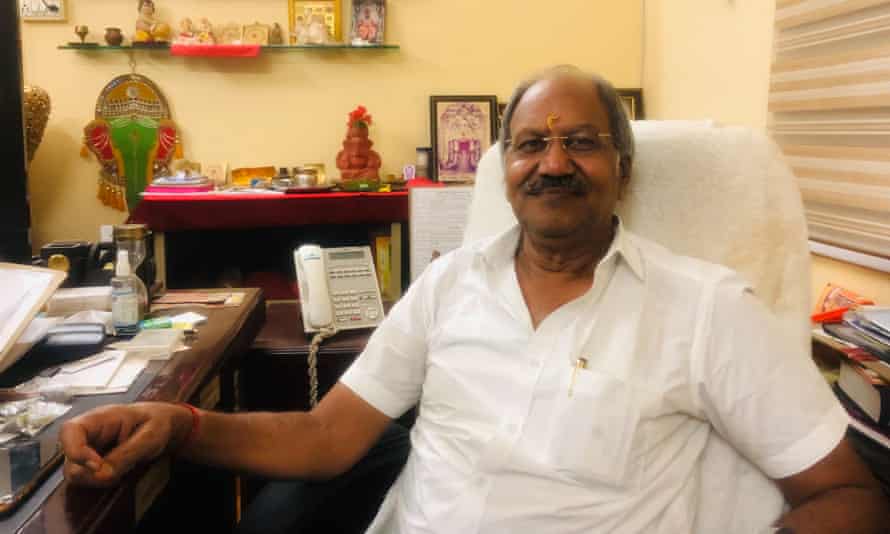
Brijmohan Agrawal
The BJP MP Brijmohan Agrawal has been at the forefront of the anti-conversion campaign in Chhattisgarh. Photograph: Hannah Ellis-Petersen/The Guardian

Yet the Christian community in Chhattisgarh, which according to the last census numbers about 500,000, denies all charges of forced conversion as false and unfounded. Those who spoke to the Guardian said they had no outside funding and were involved in no active proselytising, as per the state law, though Bibles are often distributed in rural villages and slum areas.

Many members of tribal communities and lower-caste families in Chhattisgarh do attend church services, and they are referred to as “believers” rather than Christians. However, most spoke of first coming to church of their own accord seeking community or on the recommendation of a friend or neighbour. While dozens of complaints have been recently made to police against pastors, no official police reports have been filed nor any arrests made, owing to lack of evidence.

Chhattisgarh is one of nine Indian states that already have draconian laws regulating religious conversions. Those wishing to change their religion are required to gain permission from the local district magistrate, and anyone carrying out forced conversions can be punished with a three-year jail sentence.

Instead, many in the Christian community allege that they have become a political target, saying that the conversion claims has been revived by the BJP as a way to divide voters down religious lines and tarnish the reputation of the Congress party, which rules the Chhattisgarh state government.

“There have never been any tensions between Hindus and Christians before, this is a completely political issue,” said Obed Das, a pastor in Durg district who was recently threatened after he was accused of forced conversions.

Amit Sahu, the state president of the BJP youth wing in Chhattisgarh, claimed that tens of thousands of pastors and Christian activists were involved in forced conversions and said the plan was to catch them and “fill the jails”.

He said that across the state, BJP workers were being instructed to make lists of Christians they believed were converting tribal and Hindu families and keep them under surveillance. “When our party workers are aggressive, then no one can save these pastors,” said Sahu. “We will do anything to save our religion, to save our culture, to save our country.”

The impact on the Christian community has been palpable. Many spoke of being demonised in their own communities and living in fear or in hiding. Those who spoke to the Guardian agreed to do so only in remote locations so they would not be seen. Pastor Ashish Nag, of Good Shepherd church in Bagbahara, who was among those recently reported to the police for forced conversions, said he had been told he was now a target.

“I am worried and scared,” said Nag. “I have been told I’m under surveillance from these Hindu groups, and they report on my movements and who comes to my church.”

Harish Sahu, 43, a pastor at New Life Fellowship ministry church in Bhatagon, Raipur, had a police report filed against seven members of Bajrang Dal who had attacked him in a police station, and two arrests have been made, but police are now stationed outside his church during Sunday service for protection.

There are signs that the claims of forced conversions are now being taken up by the BJP and rightwing groups in other states such as Uttar Pradesh, Karnataka and Madhya Pradesh.

Some of the threats in Chhattisgarh have come directly from the BJP rather than fringe groups. In early August, Pastor Benu Mehananda, of Church of God church in Shamma, Raipur, was accused by two local BJP leaders of carrying out forced conversions. Standing outside his church, they told him if he did not leave the community he would end up like Graham Staines, the Australian Christian missionary who was burned alive with his two sons by members of Bajrang Dal in neighbouring state of Odisha in 1999.

“The BJP has no issue to attract voters here so they are using conversion to polarise the voters down religious lines,” said Mehanada. “The impact for Christians is terrifying. Some families have stopped coming to my services.”

Rishi Mishra, the state coordinator for Bajrang Dal, said: “Religious conversion is the biggest problem in Chhattisgarh and the top of our agenda. Until recently, this problem was limited to rural areas and the tribal belt. But of late they have started their work of religious conversions in urban areas, in an open and fearless manner.”

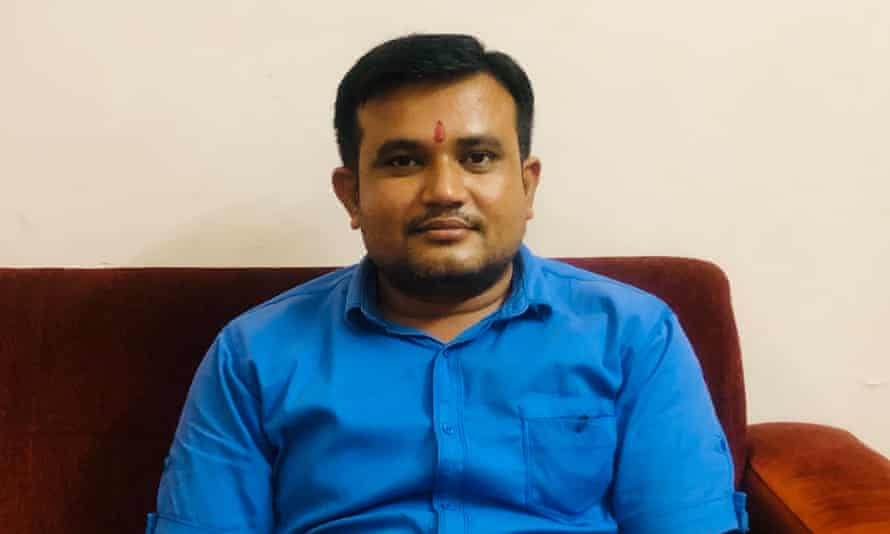
Rishi Mishra
Rishi Mishra: ‘Whoever attempts to convert Hindus should be in fear of Bajrang Dal.’ Photograph: Hannah Ellis-Petersen/The Guardian

Mishra claimed that even when they presented police with evidence and witnesses of forced conversions, the police refused to file cases due to pressure from the ruling Congress government. He said Bajrang Dal was also working to convert many of the believers back to Hinduism, and that they had succeeded with 15 families so far.

“Bajrang Dal was established for dealing with things in an aggressive manner,” he said. “Whoever attempts to convert Hindus should be in fear of Bajrang Dal. Bajrang Dal was created for this very purpose. “

Mahendra Chhabda, a member of the ruling Congress government in Chhattisgarh and chair of the minority commission, said forced conversions were not a problem in the state. However, he said he had had a meeting recently with leaders of the Christian community and advised them to stop distributing Bibles to try to ease tensions.

“The BJP and other groups are talking about forced conversions but I have never been presented with evidence for a single case where a person says they have been forced to convert or given benefits to come to church,” said Chhabda. “All over India the BJP have been targeting Muslims to win votes. Now in Chhattisgarh they have decided to come for the Christians.”

Additional reporting by Mohammad Sartaj Alam


original here : https://www.theguardian.com/world/2021/oct/04/india-christians-living-in-fear-claims-forced-conversions

April 29, 2019

India 2019 National Elections: BJP leadership gave the RSS its nod to take over the poll strategy in Chhattisgarh state

BJP lets RSS take charge in Chhattisgarh

From choosing candidates to running BJP’s voter-contact events, the Sangh has taken over
Firstpost print Edition
Every evening for over a month, Dr S Krishnan, a paediatrician in Bilaspur, has been rushing from his clinic to the Railway Colony on a crucial mission. So does lawyer Atul Saxena, who makes a beeline for Shankar Nagar after work. The two professionals want to see Prime Minister Narendra Modi win the Lok Sabha elections, and they are willing to go from door to door to make it happen.
Both Krishnan and Saxena volunteer for the Rashtriya Swayamsevak Sangh (RSS) and have a background in the Akhil Bharatiya Vidyarthi Parishad (ABVP). They are part of a grass-roots effort to revive the Bharatiya Janata Party (BJP) in Chhattisgarh. Indeed, the RSS has picked up the reins of the elections here.
A few months ago, the scene was quite different. In December 2018, Chhattisgarh was swept by the Congress in the Assembly elections, ousting the 15-year-old BJP-led government. At that time, a distance had grown between the RSS and BJP. A section of the Sangh had decided not to support “corrupt and arrogant” BJP leaders. There was also disgruntlement at the BJP’s dismissal of the RSS’s suggestion to replace some sitting MLAs.
Things changed post-February, when the top BJP leadership gave the Sangh its nod to take over the poll strategy. The objective: to divert the common person’s anger against the previous BJP-led Chhattisgarh government, and create a narrative around Modi and nationalism. One of the first moves was choosing fresh candidates for all 11 Lok Sabha constituencies. Ten of these candidates came from a Sangh background, and were trained in shakhas. The decision was arrived at during a closed-door Atma Manthan (introspection) meeting at Jagriti Mandal in Raipur, and presided over by the organisation’s prant pracharak (state head).
The primary focus of the Sangh, especially from the second phase of polling, was to reassert the slogan “Desh-hit mein Modi ko jitaana hai (Make Modi win for the good of the nation)”. This gained momentum after Modi’s visit to Korba and Bhatapara districts on 16 April, where party cadres were out in full force.
A key part of the RSS’ strategy has been the implementation of a contact programme which has been conducted with surgical precision from the district to booth level. The Sangh’s sampark vibhag (public relations department) asked its foot soldiers—comprising professionals, traders and students—to contact (sampark) voters; build a strong bond (sambandh) and communicate with them (samvad) on issues of national interest; this, it is hoped, will bolster pro-Modi sentiments. In this enterprise, RSS shakhas acted as nodal agencies. Lists of households were handed to groups of volunteers who were tasked with making repeated contact with their targets. Different groups were formed with specific duties and areas assigned to them. The RSS through monthly meetings of senior functionaries in Raipur and weekly meetings at local levels monitored the progress.
While the RSS has not openly asked people to vote for the BJP, all stops have been pulled out from closed-door meetings of RSS functionaries to chai pe charcha’with local BJP leaders and senior citizens, to rousing cries of Jai Shri Ram at BJP roadshows and rallies. [ . . . ]

Full Text here: https://www.firstpost.com/politics/bjp-lets-rss-take-charge-in-chhattisgarh-6523551.html

July 13, 2017

India - Hindutva Terror: Swami Parmatamanand, Chhattisgarh Sanskrit Board chairman wants cow vigilantes honoured

Hindustan Times

Honour people who murdered cow killer, says Chhattisgarh Sanskrit Board chairman

Swami Parmatamanand is also heard questioning Prime Minister Narendra Modi’s statement that killing people in the name of “gau bhakti (cow worship)” is unacceptable

india Updated: Jul 10, 2017 16:52 IST
Ritesh Mishra
Swami Parmatamanand reportedly made the statement at an event titled Virat Hindu Sammelan.
Swami Parmatamanand reportedly made the statement at an event titled Virat Hindu Sammelan.(Video screengrab)
 
People who killed the gau hathyara (cow killer) in Rajasthan should be honoured, Chhattisgarh’s Sanskrit Board chairman — a post deemed as equivalent to cabinet minister rank — has been heard saying in a video that has gone viral.  
Swami Parmatamanand reportedly made the statement at an event titled Virat Hindu Sammelan in Ambikapur district on Sunday, but he did not name Pehlu Khan, a dairy farmer who was assaulted in Alwar on April 1 and died two days later.
Parmatamanand could not be immediately reached for comment on his speech during which he is heard saying, “Mere Ved mein likha hai ki gau hatyare ko sheeshe ki goli se maaro... kshama na karo. Aur Rajasthan mein jisne uss gau hatyare ko mara, uska swagat karo Chhattisgarh mein bula ke (It is written in Vedas that those who kill cows should be killed. Those who killed the cow killer in Rajasthan should be invited to Chhattisgarh and honoured).”
He is also heard questioning Prime Minister Narendra Modi’s statement that killing people in the name of “gau bhakti (cow worship)” is unacceptable.
The video of Swami Parmatamanand on social media


Parmatamanand is heard saying, “How can the prime minister say that gau rakhshaks are criminals? Kuch gau rakshak gunde ho sakte hain... par humare Bajrang Dal aur sabhi gau sewak gunde nahin hain (How can the prime minister say that cow protectors are criminals? It is possible that a few are goons... but our Bajrang Dal and all those who serve cows are not).”
He is also heard saying that English schools should be banned in the country. “Mein ek din ka pradhan mantri banta toh saare English schools band kara deta (I would close all English schools if made prime minister for a day).”
Incidentally, the state government is yet to notify cabinet minister rank for Parmatamanand. “He took charge as the Sanskrit Board chairman in May and the notification hasn’t come so far,” said a government official who did not want to be named.

September 06, 2016

India: In Chhattisgarh, Hindutva Groups Use Pro-Adivasi Laws For Communal Ends

The Wire

By Ajoy Ashirwad Mahaprashasta on 06/09/2016 •

Testimonies provided by Christians to a fact-finding team show a surge of communal attacks – threats, violence and persecution – against the community.

File photo of members of the Christian community protesting in Raipur against attacks on churches. Credit: PTI

On May 25, 2016, Saradi Bai, an elderly Christian woman from Bhadhisgaon village in Chhattisgarh’s Bastar district, died a natural death. But in the days that followed, an chain of unnatural, divisive events flooded the tribal hamlet. Soon after she died, the local unit of Bajrang Dal, a militant Hindutva organisation active in several parts of India, led a campaign to deny her a rightful burial. Led by local Hindutva activists, the group said that Christians could not be allowed to carry out their religious rituals, bury her in a casket or place a cross in her grave. They argued that any Christian ritual is a violation of section 129 (C) of Panchayats (Extension to Scheduled Areas) Act, 1996 (PESA), which gives the gram sabha “the power to safeguard and preserve the traditions and customs of the people, their cultural identity and community resources and customary mode of dispute resolution”.

In the last two years, the sudden burst of Hindutva aggression in the region, especially under the stewardship of the Bajrang Dal, has unnerved Christians. But denying basic burial rights to an elderly woman left the minority community flabbergasted like never before. With no other alternative, Saradi Bai’s family were forced to seek police intervention. After hectic negotiations through the day, the Bajrang Dal allowed her to be buried in a coffin but without a cross on her grave. It also said that no Christian burials will be allowed in the village henceforth.

This event that polarised the village on religious lines prompted around 200 Christians of the village to appeal at the constitutional offices of the sub-divisional magistrate (SDM), tehsildar, police and sarpanch asking for a separate burial ground for Christians. “The sarpanch refused to accept our application, while the SDM and others are yet to respond,” said pastor Pilaram Kawde of Bhadhisgaon while talking about the state government’s apathy.

Meanwhile, Saradi Bai’s husband Sukhdev Netam died on June 6, leading to yet another round of similar events in the village. “They (Bajrang Dal activists) declared that they did not recognise the authority of the police, tehsildar, SDM or anyone else,” said Kawde. Netam was finally buried while the police kept guard. This time, the Bajrang Dal went a step ahead and threatened to kill if the community tried to bury Netam.

Recurring events

The communal attacks against Christians in the village began around September last year. Kawde laid the foundations for a prayer hall on his own land, for which he has all the papers. However, the panchayat, under the influence of the Bajrang Dal according to Kawde, refused to give him a no objection certificate (NOC). “The panchayat orally refused to issue a NOC for construction. I asked them to give me the order in writing. When they failed to do so for several days, I resumed construction. I was then given a written notice citing sections 55 (1) and 55 (2) of the Chhattisgarh Gram Panchayat Act 1993 saying I cannot be allowed to construct a place of worship for Christians because ‘people of big-big castes and religions live in this village, and every Dusshera even the Roopshila Devi Ma joins the celebrations,’ and that the panchayat has the right to demolish the prayer hall,” Kawde said.

This attack on the Christian community in the Adivasi-dominated Bastar region is not an isolated one. Kawde claimed that Christians in many other villages have been prevented from burying their dead, fueling a demand for separate burial grounds among the community.

Several other narratives of this kind were brought to light in a recently published fact-finding report by the All India People’s Forum (AIPF), a collective comprising a few political, non-governmental and student organisations. The AIPF team comprised former Madhya Pradesh MLA Sunilam, former Jharkhand MLA and CPI(ML) member Vinod Singh, All India Progressive Women’s Association secretary Kavita Krishnan, Brijendra Tiwari of the All India Central Council of Trade Unions (AICCTU), Amlan Bhattacharya of the People’s Union for Civil Liberties (PUCL), and lawyers Aradhana Bhargava, Ajoy Dutta and Amlendu Choudhary. The team was assisted and accompanied by Bastar-based researcher Bela Bhatia and Dantewada-based activist Soni Sori.

The report, which also documented many testimonies of people highlighting large-scale human rights’ violations by the police and state-sponsored vigilante groups, raised several such incidents where Christians have been systematically targeted by Hindutva groups in southern Chhattisgarh, also the hotbed of the Communist Party of India (Maoist)’s operations.

The fact-finding team found that that at several villages in Bastar – including Karmari, Bade Thegli, Sirisguda and Belar – section 129 (C) of the Chhattisgarh Gram Panchayat Act have been wrongly invoked by the supporters of Hindutva to restrict access of Christians in villages where they have been living for centuries.

Following PESA’s enactment in 1996, the Panchayati Raj rules applies to the scheduled areas like Bastar. Originally an empowering Act to give the Adivasi-run gram sabha the powers to take its own decisions, the Hindutva groups, in the last few years, have used PESA’s provisions to equate Adivasi customs and traditions with the Hindu religion in order to prohibit non-Hindu practices.

Apart from section 129 (C), they have often used section 55 of the same act, which has provisions to prevent land alienation in scheduled areas, stipulating that prior permission of the panchayat is needed to build new houses, change the design of the houses and so on, according to their political convenience.

Bajrang Dal or land mafia?

Most victim testimonies in the report suggest a nexus between the regional land mafia and the Bajrang Dal. In most cases, the Bajrang Dal has attacked spaces which the Christians use for social gatherings. For instance, in the Karmari village of Bastar, Christians were stopped by the Bajrang Dal from constructing a community hall in their rightfully-owned ancestral land. The gram panchayat gave an NOC for the hall, but made a U-turn when construction actually started in June 2015. “…I was summoned by the gram panchayat to explain the construction. I told them I had the NOC and that I wanted to construct a community bhawan because Christians do not have a hall for social gatherings like marriages and so on. The panchayat leader told me I was not allowed to construct the building. If the governor and other authorities upheld my right to construct, they said they could call the Bajrang Dal to get me beaten up,” said pastor John Masih of Karmari.

He added that when he went ahead with the construction the Bajrang Dal held a rally, pressurised other villagers to participate and gheraoed the police station. The SDM stopped the construction after the protest. But when he showed all the documents, the collector issued a letter of permission for the construction.

Refusing to budge, the gram sabha held a meeting in September 2015, ostensibly to discuss drought relief. Masih said that the panchayat leaders mobilised the crowd to stop construction of the hall. Met with a violent protests at the construction site, Masih ran away. “But two women – Ludri and Phulo Baghel – who were working at the site were badly beaten with bamboo sticks, kicked and punched. They surrounded us and did not let us go out of the village,” said Masih.

The police did not come to the site despite several calls. Masih said when they finally came, it named only four assailants in the FIR while he had given 12 names. The accused persons are out on bail now. Masih said that he was told by the sub-inspector of the station that he cannot protect them because ‘one community’ is increasing too much.

Despite several complaints at higher offices, the officials have not been able to start construction at the designated site. In this period, the gram panchayat passed a communally-charged resolution invoking section 129 (C) that reads like this, “To stop forced conversion by outside religious campaigners and to prevent them from using dergogatory language against Hindu deities and customs, Karmari gram sabha bans religious activities such as prayers, meetings, and propaganda of all non-Hindu religions.”

The report also talked to victims of similar attacks by the Bajrang Dal in Ara village of Balrampur in northern Chhattisgarh, Karkapal and Mudhota villages in Bastar. Son Singh Jhali, the lawyer who is handling a number of such cases, explained how a mob of around 25 Bajrang Dal activists vandalised a church in Ara.

“On June 5, 2016, the mob led by Chhotu Jaiswal, Sonu Gupta, Bipin Gupta, Chhotu Gupta and others attacked the church during Sunday prayers. They vandalised the church; beat up the pastor, his wife and three others. They made a video of the attack and circulated it on social media…The pastor and his wife were illegally detained for two and half days…No FIR was registered against the assailants – instead a case (with charges of conversion, rioting, etc.) has been registered against the pastor who still languishes in jail,” said Jhali.

“There are several false cases of rioting against Christian pastors. In fact, any complaints against those who attack Christians are immediately followed by counter-complaints,” he added.

Similarly, pastor Abhimanik narrated a 2014 incident in his village Mudhota. “A mob of 35 entered the church and beat up everyone, including women and children, and told them to become Hindu or else prepare to be killed.” The pastor said that following this round of violence, the police organised a meeting between the two groups. But the meeting was hugely skewed in favour of the Bajrang Dal, which had mobilised around 400 of their activists as opposed to only 70-75 Christians.

The meeting was supposed to be held in the presence of the police, but the police did not come. “They (Bajrang Dal activists) then attacked the Christians, chased them into the jungle; several were badly injured,” he said. The pastor said that the mob did not let the police and the ambulance enter the village. When the injured finally managed to reach the government hospital without an ambulance, the doctors refused to treat them because “the hospital (staff) was threatened and under pressure”.

In a similar situation, he accused the police of favouring the Dal activists. Following this incident, the pastor said, Christians were refused to draw water from the village tube well. “On November 3, 2014, a meeting was called at the collector’s office…The Bajrang Dal demanded that the Christians do ‘ghar wapsi’ (reconversion to Hinduism). The collector tried to reason with them but they claimed that ‘ghar wapsi’ had the sanction of section 129 (C) of the Gram Panchayat Act.”

The report also documented the attack on Christians in Karkapal village of Jagdalpur. Pastor Munne Lal Pal narrated how despite necessary permission to build a boundary wall in their traditional graveyard, the Bajrang Dal demolished it, citing that the land has been encroached upon. “They kicked and danced on the graves, raising Jai Shri Ram slogans…Three graves were also flattened. The authorities present did nothing to stop the attackers.” He said that the police did not file our complaint till some 60 pastors and hundreds of community members protested at the police station.

The report said that many Hindutva groups have attacked Christians in several other villages. In Tumasnar village of Kanker, they were beaten up for standing up to extortion activities by Bajrang Dal members during Hindu festivals. In this village, the Christians allege that a Hindutva group has been telling villagers to boycott the Christians socially and economically, threatening them with violence if they did not comply. In Sirisguda of Bastar, Christians were stopped from using the government ration shop. The proprietor of the shop was threatened by the Bajrang Dal members. The panchayat secretary, who is a BJP activist, refused to acknowledge the food inspector’s intervention in the matter. Later, many Chrisitans were beaten up for filing a complaint at the inspector’s office. Such was their boycott, that the gram sabha passed a resolution on May 17, 2014 saying that non-Hindus cannot live in the village. However, the Bilaspur high court deemed the gram sabha order unconstitutional.

Similarly, in Parapur village of Bastar, many Christian women were beaten up brutally for allegedly doing “witchcraft” on Hindus.

The high court order

The police, according to the report, is strongly complicit with the Bajrang Dal’s activities against Christians in Bastar. The state administration has failed to take any commensurate action. The report notes that the Hindutva groups operate with a great degree of impunity under the BJP-led state government.

The violence unleashed by the Hindu right in Chhattisgarh has manifold consequences. One, it seeks to subvert the laws that empower Adivasi groups and give them decision-making powers. Two, the incidents suggest a gradual overtaking of community organisations like gram sabhas by Hindutva groups like the Bajrang Dal, resulting in a false, ahistorical branding of tribal heritage as part of the ‘Hindu’ culture. Three, the physical violence unleashed by the Hindu right on non-Hindus living in Bastar for centuries is matched with the stronger degree of social and economic violence, pushing the minorities to live in a climate of insecurity and fear. Four, more often than not, the Hindutva campaign is a larger story about land grab and displacement of Christians. Five, the incidents reveal how the relief systems have been duly subverted in Chhattisgarh.

As attacks on Christians are on the rise in Chhattisgarh, the only silver lining for the minority community is a Bilaspur high court order on October 16, 2015 which took note of the Hindu right’s efforts to foment communal violence in Adivasi villages. In the case Chhattisgarh Christian Forum and others versus State of Chhattisgarh and others, the high court said, “…the impugned resolution shall not come exercise of fundamental right to preach and propagate of religion and their faith.” (sic)

The high court decision to uphold the constitutional right of people to practice their own religion and prevent communal interpretations of PESA has given some hope to the minority community in Chhattisgarh. Yet, the state government has a lot to answer for the unruly mobs that enjoy immense impunity under the BJP regime.

July 01, 2016

India: RSS-backed magazine targets Ashoka

The Indian Express

RSS-backed magazine targets Ashoka: ‘He was reason for India’s decline… (but) worshipped as great’
The RVKP is affiliated to the Sangh Parivar as a part of the RSS’s tribal wing, the Vanvasi Kalyan Ashram, which is headquartered in Chhattisgarh.

Written by Mahim Pratap Singh | Jaipur | Published:July 1, 2016

After Mughal Emperor Akbar, the Sangh Parivar has now raised questions about the legacy of Emperor Ashoka. A publication backed by the RSS has claimed that Ashoka’s conversion to Buddhism and his promotion of ahimsa opened India’s borders to foreign invaders.

It has also accused followers of Buddhism under Ashoka of having played a seditious role by assisting Greek invaders thinking they would destroy “Vedic religion” and pave the way for dominance of Buddhism.

The article was published in the May issue of the mouthpiece of the Rajasthan Vanvasi Kalyan Parishad.

The RVKP is affiliated to the Sangh Parivar as a part of the RSS’s tribal wing, the Vanvasi Kalyan Ashram, which is headquartered in Chhattisgarh.

While the article recognises Ashoka’s greatness as a world leader before his conversion to Buddhism, it quickly moves past that to note that after his conversion he started over-promoting some principles related to ahimsa.

“It was India’s misfortune that the same Emperor Ashoka, who became the reason for India’s decline…we worshiped him as great…It would have been better if, like Bhagwan Buddha, Emperor Ashoka too, would give up his kingdom, become a monk and promote Buddhism…(then) India would not have had to face such a mountain of hardship,” noted the article published in the magazine, Bappa Raval.

It further added that “instead, he (Ashoka) turned the entire empire into a giant monastery for promoting Buddhism. It was because of the Buddhist leaders of Magadha that Greek invaders returned to conquer India…Buddhist monks propagated seditious, senseless, anti-India ideas among their disciples that Buddhism did not believe in caste or nation. Whenever foreign invaders sympathetic to Buddhism attacked India, these Buddhists colluded with them, instead of fighting them bravely.”

The article is part of “Bharat: Kal, Aaj, Aur Kal (Bharat: Yesterday, Today and Tomorrow)”, a series of essays on India’s history that is featured regularly in the magazine. RVKP office bearer and magazine editor Dr. Radhika Ladha, who authored the article, said she did not mean to accuse Buddhists or Emperor Ashoka of anything.

“All I wanted to say was that although our ancestors were great luminaries, our country has had to face so much due to certain small mistakes on their part. I never called Buddhists seditious…it was only meant to convey their poor understanding during that period,” Ladha told The Indian Express.

“My perspective was that we should learn from our mistakes and lead the country on to a path of prosperity and development,” she added.

The RVKP, established in 1978, works with six Scheduled Tribes in Rajasthan across 3000 tribal villages. It operates residential schools, hospitals and sports training centres in scheduled areas.

March 07, 2016

India: Right-wing activists attack and vandalize Raipur church in in Chhattisgarh

The Times of India

Raipur church vandalised during Sunday service
Ishita Mishra | TNN | Mar 7, 2016

RAIPUIR: Claiming it to be a function for religious conversion, alleged right-wing activists attacked and vandalized a Church in Chhattisgarh during Sunday prayer, injuring five people including two women.

Situated in Kachana colony of the state capital, a group of youth stormed the prayer hall, raising "Jai Sriram" slogans, and began attacking the worshippers. An FIR has been lodged against unidentified persons under serious sections.

According to eye witnesses, around 15 people on 8-9 bikes arrived at the spot while the Sunday prayer was going-on in the church, a red-coloured small room situated at the end of the road which further had just barren fields.

Chanting the name of Lord Ram (Jai Shree Ram), the men entered inside the church, attacked women, ripped their clothes off and also thrashed infants. Furniture and fans were also vandalized by the miscreants who warned the people who were taking part in the prayer to become Hindu.

"They began alleging that people were being converted here. They fled before police could reach at the spot. However the cops could recover three of the bikes. They desecrated the Bible and some of the pictures that were hung on the wall," informed Chhattisgarh Christian Forum President Arun Pannalal.

While the people who were observing the prayer left the spot after police's interrogation, the locals of the area seemed irritated with rounds of questions put-up by cops and media.

"Humko kuch nahi pata. Hum ghar p nahi the," rued a woman who was living in the house neighbouring the church and left inside.

There were few pair of slippers which could be seen scattered outside the single roomed-church which the locals claimed didn't belonged to either Protestant or Catholic Christians. The view of the room from the broken window pane was enough to prove that the disturbing elements were in large numbers.

The locals however praised the role of police in the incident as the cops who reached at the spot immediately after attack asked the churchgoers to continue their prayers before interrogating them.

Claiming it to be an attack on their religion, Pannalal said that it was a matter of shame for the government that minorities were being constantly attacked in Chhattisgarh. The attacks are almost half of a dozen in numbers in past two months.

"This is the sixth attack on churchgoers in Chhattisgarh in the past six weeks. We are trying to get a first information report filed," Pannalal said.

Talking to city superintendent of police Neeraj Chandrakar informed that police is trying to get the addresses of the bike owners to trace them.

"An FIR has been lodged against unidentified men under section 147 (disturbing law and order), 452 (House-trespass after preparation for hurt, assault or wrongful restraint), 295 (injuring or defiling place of worship with intent to insult the religion of any class) and 323 (voluntarily causes hurt). Medical has been conducted of those who are hurt," added the cop.

Some policemen who were guarding the locality claimed that the matter is actually of land dispute. "The church was built in an encroached land," said a policeman who refused to be quoted.

February 26, 2015

India: Chhattisgarh: Government staff may join RSS; no service rules under violation

Chhattisgarh: Government staff may join RSS; no service rules under violation

By: Express News Service | Raipur | February 26, 2015 10:34 am

Kicking off a political storm, the Chhattisgarh government has issued a notification that allows government servants to join RSS and participate in its activities.

The Chhattisgarh Civil Services (Conduct) Rules 1965 prohibit a government servant from taking part in politics. “No government servant shall be member of, or be otherwise associated with, any political party or any organisation which takes part in politics nor shall he take part in, subscribe in aid of, or assist in any other manner, any political movement or activity,” states Rule 5(1).

However, the state government, in a notification dated February 23, with the subject line “regarding participation of government servants in activities of RSS”, said that “as far as Rule 5(1) of Chhattisgarh Civil Services (Conduct) Rules 1965 is concerned, its restriction does not apply to RSS”.

The notification was signed by Additional Secretary (General Administration Department) K R Mishra, and copies were marked to almost all major government officer-bearers in the state, including Principal Secretary to Governor; Chief Minister’s Office; Principal Secretary, Vidhan Sabha Secretariat; Registrar General, High Court; Public Service Commission; Human Rights Commission; Lok Ayog; Information Commission and all collectors and divisional commissioners.

Opposing the notification, the Congress termed it as “politicisation of administration”. “It is an unconstitutional move with clear political colours. It will indoctrinate government servants. They will go to shakhas and will no longer remain impartial,” said former chief minister Ajit Jogi.

“It is an attempt by the government to force officers to visit RSS shakhas. It will blur the dividing line between the government and a political party. The BJP’s top leadership is annoyed with Raman Singh. He wants to save his chair and please them. The present move confirms his desperation,” said PCC chief Bhupesh Baghel. “Officers will now openly speak and work in favour of RSS-BJP. It will damage democracy in Chhattisgarh,” he added.

Welcoming the move, the RSS claimed that it was not a political organisation. “This rule was made by the British but still continues. This government has done a good thing. The RSS is not a political party, we are a social organisation,” said Deepak Vispute, RSS’s Chhattisgarh Sar Sanghchalak.

Asked about the RSS’s involvement in campaigning for the BJP, he said: “We never asked people to vote for BJP. RSS ne wahi kaha jo Election Commission ne kaha — matdaan karo. We only asked people to vote for rashtra hit.”

When pointed out that RSS leaders occupy top political posts, Vispute said: “Our swayamsevaks are in various fields. Some of them are in politics also, but we are a cultural organisation.”

Countering the RSS, Baghel said: “The RSS claim is bogus. Everyone knows that it is into deep politics and controls BJP.” Several officers also expressed their displeasure with the move.

Earlier, the Centre had held that the RSS and Jamaat-e-Islami are political organisations and “participation in them by government servants would attract provisions of sub-rule (1) of Rule 5 of the Central Civil Services (Conduct) Rules, 1964.” In its 1966 order, the Centre had said that “any government servant who is a member of or is otherwise associated with the aforesaid organisations or with their activities is liable to disciplinary action.”

The Union Ministry of Home Affairs had clarified to The Indian Express last year, in response to an RTI application, that the 1966 order is “still applicable.”

In Himachal Pradesh, the previous BJP government withdrew the memorandum (restricting its employees from participating in RSS activities) with immediate effect on January 24, 2008. In Madhya Pradesh, the BJP government issued a clarification on August 21, 2006 that the “restrictions are not applicable to the RSS”.
— With ENS, New Delhi


source: http://indianexpress.com/article/india/politics/government-staff-may-join-rss-no-service-rules-being-violated-chhattisgarh/99/

February 08, 2015

India: Behind Sangh Parivar’s Ghar Wapsi, The politics Of Power And Profit (Ajaya Kumar Singh in countercurrents.org)

http://www.countercurrents.org/singh060215.htm

Behind Sangh Parivar’s Ghar Wapsi, The politics Of Power And Profit

By Ajaya Kumar Singh

06 February, 2015
Countercurrents.org

The news reports of series of attacks and forced conversion of Christians were trickled in from Bastar region, home to one of the largest Adivasi habitations in India, even before the Indian Parliament was stalled on conversion issue. A few of us, concerned citizens in India, planned for a fact finding mission to the region on the eve of Christmas 2014. Some of the state Christian leaders discouraged us from undertaking such an independent fact finding team as Sangh Parivar had already intimidated the community by creating fear and insecurities. The local Christian leaders were of the opinion that our visit could be an alibi for further violence that the Sangh was trying to initiate. Hence, we postponed our fact finding mission. Yet, a team of four of us went ahead to understand the ground realities in Chattisgarh. The following is the result of our observations.

The Politics of `Ghar Wapsi’ (Return Home) in Chattishgarh

Chattisgarh is one of the major Adivasi populated states in India. The Census Report of 2001 says that the share of tribal population in Chattisgarh was 31.76%, while the 2011 report says that it was 30.62%. It means that there was a decrease of 1.14% in the Adivasi population in the area . As per the Census Report, Chattisgarh is a home for 94.7 % Hindus, while the share of Muslim and Christian population is noted to be 1.97% and 1.92% of respectively. However, there is still a population of Adivasis in Chattisgarh, who do not belong to any of the established religions of Hinduism, Christianity or Islam. These Adivasis still worship their own indigenous Gods and these spiritualities related to nature can not be equated to any of the existing established religions. It is obvious that the Census Report has included these indigenous spiritualities also as a part of Hinduism. This perhaps will fall within the category of violation of identity and faith enshrined in the Indian Constitution. However, the ministry of Tribal Empowerment portal has classified Adivasis following different religions in the state with 93.7% following Hinduism; Christian, Muslim and other religion and persuations with a share of 4.7%, 1.4% and 0.1% respectively.i

The newly carved state of Chattisgarh along with states like Odisha, Jharkhand, Madhya Pradesh and Gujurat have witnessed unprecedented ‘Ghar Wapsi (Return Home) politics since early 1980s. Late Dilip Singh Judeo, former Minister of State for Environment and Forests in Bharatiya Janata Party, whch led National Democratic Alliance government was known as `Ghar Wapsi Guru’, and spearheaded `successful’ successful Ghar Wapsi campaign to bring back the ‘converted Christian Adivasis’ into Hinduism in Jashpur region. The Bharatiya Janata Party (BJP) seized power in the state since 2000, and the hate campaign against the Christian community and their propogands became stronger and violent.

Bastar Under Siege

We were quite anxious to go to the villages of Bastar as soon as we arrived in Jagdalpur. A young pastor, who came to brief us about the situations informed us, `We (pastors) cannot go by bike to the affected villages as the fanatics know us quite well’. `We could hire a taxi’, I suggested. But the response was: `No, we should not. The taxi owner/driver could be a Sangh Parivar worker or sympathiser. Our movements are tracked. That could be fatal’. The anxiety and fear was quite palpable among the local community leaders and pastors in the Bastar region. Suresh Yadav, a native of Haryana and President of the Viswa Hindu Parishad (VHP) has become a rallying point of Hindutva brigade and he is known to be a fearsome face for the minority communites.

Madhota: Seed of Poison Sown by BJP Member of Parliament

Mangal Mandavi is still reeling under shock of Madhota village of Bastar Region. He was brutally attacked as he did not yield into Sangh Parivar’s demands of ‘Ghar Wapsi’, while some of his relatives were forcefully converted into Hinduism, he said: `I thought I would die; but I have survived’.

In the village of Madhota which has a population of 4,000 people, there are 35 Christian families. They are all Adivasis. There were no conflicts within the community before 10-15 years even though their family members chose the religion of their choice and practiced their faith without any qualm about it. Things began to change when the outsiders (the non-tribal Sangh Parivar workers) started visiting the village and held secret parleys and meetings with non-christians. The first major conflict broke in the village in 2008 as they broke the church of the Christians. During the last six months, it has been nightmare for the Adivasi Christians, as VHP workers have resumed intimidating them to become Hindus, as well as promising them a better future with such conversion. Dinesh Kashyap, the tribal Member of Parliament from Bharatiya Janata Party (BJP) and his associates were quite successful to divide the tribal community as Christians and Hindus even though some Christians have refused to toe their lines during the second week of October, 2014.

“By now, with the ‘success’ of `Ghar Wapsi’, the VHP became more furious and aggressive as some of the Christians did not join the ‘Ghar Wapsi’, and therefore they attacked us again on October 19, 2014”, said Sindhu Kumar Das, the village pastor, who almost lives in hiding today. He had been beaten up thrice and was slapped with false cases; of conversion and creating ill will among the community by the police when he approached them for protection.

`When we were praying in the church in the morning, a strong group of VHP workers got inside the Church with slogans, `Kill the Christians, chase them unless they become Hindus and mercilessly started beating us’, the injured villager said. The villagers went to the police station to lodge the complaints. But the police refused. The police, in turn, taunted them to become Hindus so that that the problem could be solved forever. Finally, after the district administration intervened in the dispute, the Police Inspector yielded and informed them that the police would call for a peace meeting of both communities.

The peace meeting was fixed on October 25, 2014. `Nearly 30 members of the minority community gathered at the proposed time. There was no sign of police presence for three hours or so, eventhough the meeting was called by the police itself. Then in flash of seconds, nearly 70 VHP workers descended on the venue and assualted the Christians with serious bodily injuries. Ambulances were brought in. Yet, the injured were not taken to the hospital until the police arrived. “Even before the injured ones reached the hospital, four VHP workers had got themselves admitted with complaints of physical attacks by the Christians’, said a Jagdalpur based community leader.

`The police arrested a few each from both parties on the ground of `creating enimity among the communities’. It was an obvious case of conspiracy by the administration to get minority members harassed, attacked and later slapped with false cases and sent to jails so that they remain fearful and leave leave the religion,’ explained Bhupendra Khora, who assists the affected and injured ones.

Mangal and another 10 families have remained as Christians. `We do feel isolated and alienated in the village as we are not allowed to take water from the bore well. The only relief is that the threats do not come from the newly converted Adivasis to Hinduism, who still share our concerns and are still sympathetic to us. Nobody seems to be sure how long the church would survive in this panchayat.’

Sirishguda Gram Sabha: Non-Hindu Religious Activities Banned!

Sirishguda Gram Sabha as a part of Bodangi police station is one of 50 Gram Panchayats in Jagdalpur district has passed a resolution under Section 129 (G) of the Chhattisgarh Panchayat Raj Act banning all `Non-hindu religious campaigns, prayers and speeches in the villages in view of the outsiders (non-Hindu) religious groups taking advantage of simple Hindu Adivasi and are converting them and facilitating caste discriminations and untouchability practices’.

The resolution calls for total prohibition of any religious programe/activity other than that of Hinduism, as it is a threat to cultural and religious traditions as well as social unity of the village. It further resolves not to allow any place (land) for establishment for any religious building/centre.

Siva Mondavi, 36 year old, pastor of Brethern Church says: `We used to be 55 Christian families which lived in the village. Since seven months, we are being harassed and intimidated by the Sangh Parivar as we refused the `Ghar Wapsi’ programme organized by them.

The VHP workers instigated the ‘Hindu’ Adivasis to refuse the ‘Christian’ Adivasis for common burial ground. The conflicts further aggravated with forceful demand of higher donation ‘chanda’ from Christians for a Hindu religious festival.

Mandovi further said, “When we refused to pay the donation, the VHP stopped providing us ration provisions.”

‘The district administration sent the food supply inspectors to settle the ration issue once complaints reached them. The food supply inspectors were chased away and Christians who gathered for the meeting were also assaulted. Eight Christian men and two women sustained severe injuries and they had to be hospitalized. The fanatics were even trying to stop the injured being taken in the ambulances. The police as usual came after the Christians were attacked’.

Apprehension on Community Cleansing

The stories of Adivasi Christians of Madhota and Sirisguda villages are not just isolated cases. Local christian leader, Mr. Khora observes that “ there is a pattern in police refusal to register complaints. To make the matters worse, the Christians are slapped with counter cases only to harass and intimidate, with the help of the police in nexus with Sangh Parivar elements, so that the tribal Christians do not sustain the threats and pressures and yield into `Ghar Waspsi’.

The villages are under siege with the loss of unity and the community bonding that has been a characterstic of the Adivasi habitation and it is under threat today. The district administration appears to play a second fiddle to the Hinduvta (Hindu nationalists or right wing) forces.

Fr. Abraham Kanampala, Vicar General of Jagadalpur Diocese and Bastar President of VHP that issued a joint statement; agreeing that the term `Father’ can be replaced and addressed as `Pracharya’ or `Up-pracharya’ in Catholic Schools, putting up photographs of “Maa Saraswati” in schools and work together for the development of the region.

`We are peace loving and sensitive citizens. We have agreed to accommodate local sentiments as goodwill measures and harmony for the people in the area’, Fr.Kanampala, a CMI priest, explained the reason behind the joint statement. The Carmelites of Mary Imaculate (CMI) congregation in collaboration with the Diocese runs several reputed schools and hospitals in the region.

Arun Pannalal, President, Chattisgarh Christian Forum (CCF) has a different take. “The Joint Press Meet and statement might set a precedent and the Hindutva forces could play a mischief and try to impose themselves on our schools all over'.

Navneet Chand, Youth Leader of Bastar Masih Mahasangh is quite upset and said, “National Church leadership cannot be mute spectators to happenings to the anti-Christian attacks. We need support and accompaniment of guidance on how to respond with nationally well funded, coordinated and orchestrated religious motivated violences led by the Sangh Parivar. The community is in depair and directionless."

As the attacks mount on the community, the battle of faith continues. Senior Christian leader, Arun Pannalal believes, `We depend on judiciary no matter in which direction verdict goes'.

Goldy M. George, Dalit-Adivasi activist sees a ‘diabolic plan of the Hindutva brigade in attacking selected Catholic Schools in cities while terrorising non-Catholic Christians in villages. Defaming the institutes and carrying on the violent attacks on the community both in cities and rural villages seems to be the strategy on their module'.

`The Church leadership seemed to fail to see what awaits for the community, a sinister design to eliminate them not just in Chattishgarh, but all over in India. Moreover, the leadership looks surrendering to the Hindutva regime exposing the marginalised community into more marginalisaiton, intimidations and violence. The community cleansing is on,” said Rajendra Sail, former State President of Peoples’ Union for Civil Liberties (PUCL), Chattishgarh.

`I am afraid to say that I apprehend genocide if the hate campaign, intimidations and threats continue against the Adivasi Christians. The resurgent Hindutva groups seem to be successful on their strategy as the administration becomes a willing partner to provide cover for the criminal activities of these forces,' said Ajaya T. G, a noted independent documentary film maker and senior functionary of Peoples’ Union for Civil Liberties (PUCL), Chattisgarh, probably the only civil society group in Chattisgarh, that went for fact finding mission in the aftermath of `Ghar Wapsi' and violent attacks on the villagers.

‘Sangham’ Salwa Judum in the making

`Chattisgarh, the new steel capital of India, is the richest state in terms of mineral wealth that includes diamonds, besides two other Indian states and posses almost all coal deposits in the country. All the tin ore reserves in India are found in this state; and its iron ore deposits are world class quality', posts a Mumbai based professional information and consultancy portal, Steel World.ii

“The mineral rich state of Chhattisgarh will be in a position to produce 32 per cent of country’s total steel production by 2015 and also will share about 35 per cent of country’s total cement production', stated State Chief Minister Raman Singh

Chattisgarh Government’s Mineral Policy of 2001 states: `The State of Chattisgarh was carved out of erstwhile Madhya Pradesh state to provide deference to its distinctive historical, social background and natural resources. The basic purpose of its formation would be defeated if the natural resources are not used due to constraints of stringent forest laws and environment problems'.iii

The mineral-diamond-coal rich politics is a similar play of Arabian Oil Politics. It is no coincidence that Jindal Cement plant was commissioned in Raigarh-Jashpur in 1991 while Mahendra Karma, a tribal leader, the leader of the opposition in Legislative Assembly, started the first movement of Naxalites knonwn as ‘Jan Jagaran Abhiyan’ and later christened “Salwa Judum”iv as the state signed agreements with Tata and Eassar groups to counter Naxalites in the same year itself. It is no wonder Mr.Judeo came to the limelight with his “Ghar Wapsi’ movement in the same time and the region, where Jindal has had the plant. He toed the lines of his father Vijaybhushan Singh Deo, the patron of Vanvasi Kalyan Ashram. The controversies of Mr Judeo being caught in camera for acceptance of the bribe for granting mining rights in the states of Chattisgarh and Odisha as a Minister for Environment and Forests and body blow by the Supreme Court of India declared Salwa Judum, the militia to be illegal and unconstitutional, and ordered it’s disbanding only vitiatied the atmosphere of the region. Tragically, both Mr Judeo and Mr.Karma’ lives ended with sickness and Maoists Bullets respectively in 2013 giving rise to turf war to claim their legacy.v

There is a fierce competition to claim the legacies of Judeo and Karma; to be recognized and resourceful. Gram Panchayat resolution under Section 129 C of the Chhattisgarh Panchayati Act is not just relligio-political, but is part of a well knit plan of corporate communal agenda to control the natural resources and tribal community in the region.

‘Late Ramakant Keshav, an associate of two former RSS Chiefs and a relative of 3rd RSS Chief Balasaheb Deoras arrived in Jashpur in 1948 and founded Akhil Bharatiya Vanvasi Kalyan Ashram in 1951 where he devoted his life to ameliorate the material and spiritual state of these hapless tribal people. The late Vijaybhushan Singh Deo and son Dilip Singh Judeo of Jashpur helped in his mission. The work was two-fold: To bring back those tribals who were converted to Christianity and to inculcate in them a strong sense of belonging to the Indian culture and religion. Another most commendable mission that was accomplished during his time was the work of Niyogi Commission’. (Organiser, RSS mouthpiece).vi

The Niyogi report heavily influenced by Sangh Parivar contours pitch for the canard.

‘The Sangh Parivar recasting Adivasi as part of Hindu religion and Hindu Rastra with three fold strategies: Hinduising Tribals as necessary for National Integration, using its influence to secure electoral gains and gearing towards communal tensions and violence.’vii

The disturbing trend is that the Christian Adivasis are being intimidated and even lynched with deadly combination of political feudal king of Jaspur royal family with Vanvasi Kalyan Asharam which is a face of Sangh Parivar in the region, fuelling the hate campaign and portraying the Christian community as harmful to the nation building. The documentary, Fishers of Men has documented the tragic case of Christian Adivasi beaten to death by a frenzied Hindu mob, which accused him of destroying a Hindu (Shiva) Temple. Dilip Singh Judev, former Central Minister of India, Patron of Operation Ghar Wapasi explains:

Over there, there was a 150-year-old Shiva temple, which these [the Christian] people went and destroyed. Now if you go and destroy our heritage...go on breaking our temples in this manner and if you expect us to sit quietly and watch...we will not tolerate it… We are not sitting at home wearing bangles. (Outlookindia: Adivasi vs Vanvasi: The Hinduization of Tribals in India)viii

Nandini Sundar, a Professor of Sociology, University of Delhi, who keeps eyes on Adivasi and Chattisgarh region and has authored ‘Adivasi Politics and State Responses: Historical Processes and Contemporary Concerns’ captures the concerns as she explains:

`While both Hindu and Christian organizations practice some kind of boundary keeping for their people, what distinguishes the RSS organizations is the slow penetration of hate. What they are producingis not just Hindu adivasis but bodies for Hindutva, as shown by the involvement of adivasis in the genocide of Muslims in Gujarat in 2002. While there has been some focus on RSS ghar vapsi or ‘reconversion ceremonies’, in fact the maximum and most effective work of conversion takes place through everyday conversation in hostels or satsang kendras'.ix

It is shocking to note that the Christian Adivasi is being killed by another Adivasi known as Hindu and such instigated events could explain the alarming divide of the Adivasi community, in the name of the religion they they have been co opted with.

Subhash Gatade, the author of the book, ‘Godse Children: Hindutva Terror in India says, ‘Articulate sections of the Dalit movement rightly knew that the essence of Hindu Rashtra is restoration of Brahminical supremacy and relegation of the Dalits to a secondary status, much on the lines of Manusmriti, the sacred edicts of the Hindus. People very well knew how the triumvirate of Hindutva Savarkar- Hedgewar and Golwalkar glorified Manusmriti’.x He believes the same thing could be said of Adivasis too, who have become ‘foot soldiers’ of hindutva forces.

The point of concern for the civil society for the future of India is being captured by Outlook correspondent in Ahmedabad: ‘Of all the disturbing facts that have emerged from the postmortem of the communal carnage in Gujarat, the most baffling and alarming is the large-scale participation of Dalits and tribals in the rioting. Even more shocking: the tribals, who have little in common with mainstream Hinduism, brandished weapons, looted and killed as they violently avenged the 'attack on Hindus' These outfits seem to have succeeded in indoctrinating the tribals with the view that they are indeed Hindus and that Muslims are their enemies. Says Achyut Yagnik, political scientist: The Sangh has systematically made inroads among Dalits and tribals and is using them as instruments of Hindutva. This is being achieved with extended government patronage. A systematic Hindutva campaign is on in the tribal region. (Outlook Magazine: Poisoned Edge: The Sangh Exploits Dalit and tribal frustration to recruit soldiers for hindutva’s war, it was revealed).xi

The Adivasi being torn apart and having huge collateral damages of life and properties in the conflicts between Maoist and agents of Salwa Judum, officially disbanded yet active in order to protect the economic and ecological interests of tribals of the region. The lynching of Christian Adivasi by a Hindu mob (I presume it is a non-Christian Adivasi) for destroying Shiva temple, reflects acute religious cultural warfare, and the loss of Adivasi interests and identity.

The cooperation among the communal and corporate forces with the tacit support of the state machinery for the grounding of Sangha (Parivar) Salwa Judum is in the making. If the State and civil society acts in time, turf war over resources reducing the communities to end up in bloody history, can be regulated. There is a need for pressure on the State to play its constitutional role and respect its own mandate. The State faces the play of BJP, Sangh Parivar and Corporate giants to capture power politics, religious-cultural rights, land and forest rights respectively. If that happens, it could be combination of Odisha’s Kandhamal and Kalinga Nagar violence as well as Gujarat communal violence where saffronised Adivasis and Dalits were instigated to kill Muslim dalits. The Adivasi will be on the edge if the Sangh Salwa Judum gets consolidated further.

Writer could be contacted: ajaysingho@gmail.com

i http://tribal.nic.in/WriteReadData/CMS/Documents/201410170519295222004StatisticalProfileofSTs2013.pdf

ii www.steelworld.com/coverstory0209.pdf

iii chhattisgarhmines.gov.in/states-mp.htm

iv http://en.wikipedia.org/wiki/Salwa_Judum

v http://www.jindalsteelpower.com/businesses/raigarh.html,/ http://en.wikipedia.org/wiki/Salwa_Judum

vi http://organiser.org/Encyc/2013/12/23/The-legend-called-Balasaheb-deshpande.aspx?NB=&lang=4&m1=&m2=&p1=&p2=&p3=&p4=&PageType=N

vii http://www.outlookindia.com/article/Adivasi-vs-Vanvasi-The-Hinduization-of-Tribals-in-India/217974

viii http://www.outlookindia.com/article/Adivasi-vs-Vanvasi-The-Hinduization-of-Tribals-in-India/217974

ix http://www.scribd.com/doc/110485849/Adivasi-Politics-and-State-Responses#scribd

x http://kafila.org/2009/01/26/the-new-footsoldiers/

xi http://www.outlookindia.com/article/Poisoned-Edge/216292