scroll.in
|

Showing posts with label Bastar. Show all posts
Showing posts with label Bastar. Show all posts
January 07, 2023
December 29, 2022
India: Report in Hindustan Times on campaign to forcibly convert Christian tribals into Hindus in Bastar
Organised campaign to convert Christian Adivasis to Hindus in Chhattisgarh: Report
Updated on Dec 27, 2022There was an “organised campaign” to forcibly convert Christian tribals
into Hindus in Bastar’s Narayanpur and Kondagaon districts, a team of
civil society representatives said in a report on Monday after visiting
more than 30 villages in districts where attacks allegedly took place
against Christians. State authorities, however, denied that the violence
was related to forcible religious conversions.
“From December 9, 2022 to December 18, there was a series of attacks in about 18 villages in Narayanpur district and 15 villages in Kondagaon district, displacing about 1,000 Christian Adivasis from their own villages,” said the report of a fact-finding team led by Irfan Engineer, director of the Centre for Study of Society and Secularism, and Brijendra Tiwari, convener of the All India People’s Forum, Chhattisgarh.
[ . . . ]


February 08, 2015
India: Behind Sangh Parivar’s Ghar Wapsi, The politics Of Power And Profit (Ajaya Kumar Singh in countercurrents.org)
http://www.countercurrents.org/singh060215.htm
Behind Sangh Parivar’s Ghar Wapsi, The politics Of Power And Profit
By Ajaya Kumar Singh
06 February, 2015
Countercurrents.org
The news reports of series of attacks and forced conversion of Christians were trickled in from Bastar region, home to one of the largest Adivasi habitations in India, even before the Indian Parliament was stalled on conversion issue. A few of us, concerned citizens in India, planned for a fact finding mission to the region on the eve of Christmas 2014. Some of the state Christian leaders discouraged us from undertaking such an independent fact finding team as Sangh Parivar had already intimidated the community by creating fear and insecurities. The local Christian leaders were of the opinion that our visit could be an alibi for further violence that the Sangh was trying to initiate. Hence, we postponed our fact finding mission. Yet, a team of four of us went ahead to understand the ground realities in Chattisgarh. The following is the result of our observations.
The Politics of `Ghar Wapsi’ (Return Home) in Chattishgarh
Chattisgarh is one of the major Adivasi populated states in India. The Census Report of 2001 says that the share of tribal population in Chattisgarh was 31.76%, while the 2011 report says that it was 30.62%. It means that there was a decrease of 1.14% in the Adivasi population in the area . As per the Census Report, Chattisgarh is a home for 94.7 % Hindus, while the share of Muslim and Christian population is noted to be 1.97% and 1.92% of respectively. However, there is still a population of Adivasis in Chattisgarh, who do not belong to any of the established religions of Hinduism, Christianity or Islam. These Adivasis still worship their own indigenous Gods and these spiritualities related to nature can not be equated to any of the existing established religions. It is obvious that the Census Report has included these indigenous spiritualities also as a part of Hinduism. This perhaps will fall within the category of violation of identity and faith enshrined in the Indian Constitution. However, the ministry of Tribal Empowerment portal has classified Adivasis following different religions in the state with 93.7% following Hinduism; Christian, Muslim and other religion and persuations with a share of 4.7%, 1.4% and 0.1% respectively.i
The newly carved state of Chattisgarh along with states like Odisha, Jharkhand, Madhya Pradesh and Gujurat have witnessed unprecedented ‘Ghar Wapsi (Return Home) politics since early 1980s. Late Dilip Singh Judeo, former Minister of State for Environment and Forests in Bharatiya Janata Party, whch led National Democratic Alliance government was known as `Ghar Wapsi Guru’, and spearheaded `successful’ successful Ghar Wapsi campaign to bring back the ‘converted Christian Adivasis’ into Hinduism in Jashpur region. The Bharatiya Janata Party (BJP) seized power in the state since 2000, and the hate campaign against the Christian community and their propogands became stronger and violent.
Bastar Under Siege
We were quite anxious to go to the villages of Bastar as soon as we arrived in Jagdalpur. A young pastor, who came to brief us about the situations informed us, `We (pastors) cannot go by bike to the affected villages as the fanatics know us quite well’. `We could hire a taxi’, I suggested. But the response was: `No, we should not. The taxi owner/driver could be a Sangh Parivar worker or sympathiser. Our movements are tracked. That could be fatal’. The anxiety and fear was quite palpable among the local community leaders and pastors in the Bastar region. Suresh Yadav, a native of Haryana and President of the Viswa Hindu Parishad (VHP) has become a rallying point of Hindutva brigade and he is known to be a fearsome face for the minority communites.
Madhota: Seed of Poison Sown by BJP Member of Parliament
Mangal Mandavi is still reeling under shock of Madhota village of Bastar Region. He was brutally attacked as he did not yield into Sangh Parivar’s demands of ‘Ghar Wapsi’, while some of his relatives were forcefully converted into Hinduism, he said: `I thought I would die; but I have survived’.
In the village of Madhota which has a population of 4,000 people, there are 35 Christian families. They are all Adivasis. There were no conflicts within the community before 10-15 years even though their family members chose the religion of their choice and practiced their faith without any qualm about it. Things began to change when the outsiders (the non-tribal Sangh Parivar workers) started visiting the village and held secret parleys and meetings with non-christians. The first major conflict broke in the village in 2008 as they broke the church of the Christians. During the last six months, it has been nightmare for the Adivasi Christians, as VHP workers have resumed intimidating them to become Hindus, as well as promising them a better future with such conversion. Dinesh Kashyap, the tribal Member of Parliament from Bharatiya Janata Party (BJP) and his associates were quite successful to divide the tribal community as Christians and Hindus even though some Christians have refused to toe their lines during the second week of October, 2014.
“By now, with the ‘success’ of `Ghar Wapsi’, the VHP became more furious and aggressive as some of the Christians did not join the ‘Ghar Wapsi’, and therefore they attacked us again on October 19, 2014”, said Sindhu Kumar Das, the village pastor, who almost lives in hiding today. He had been beaten up thrice and was slapped with false cases; of conversion and creating ill will among the community by the police when he approached them for protection.
`When we were praying in the church in the morning, a strong group of VHP workers got inside the Church with slogans, `Kill the Christians, chase them unless they become Hindus and mercilessly started beating us’, the injured villager said. The villagers went to the police station to lodge the complaints. But the police refused. The police, in turn, taunted them to become Hindus so that that the problem could be solved forever. Finally, after the district administration intervened in the dispute, the Police Inspector yielded and informed them that the police would call for a peace meeting of both communities.
The peace meeting was fixed on October 25, 2014. `Nearly 30 members of the minority community gathered at the proposed time. There was no sign of police presence for three hours or so, eventhough the meeting was called by the police itself. Then in flash of seconds, nearly 70 VHP workers descended on the venue and assualted the Christians with serious bodily injuries. Ambulances were brought in. Yet, the injured were not taken to the hospital until the police arrived. “Even before the injured ones reached the hospital, four VHP workers had got themselves admitted with complaints of physical attacks by the Christians’, said a Jagdalpur based community leader.
`The police arrested a few each from both parties on the ground of `creating enimity among the communities’. It was an obvious case of conspiracy by the administration to get minority members harassed, attacked and later slapped with false cases and sent to jails so that they remain fearful and leave leave the religion,’ explained Bhupendra Khora, who assists the affected and injured ones.
Mangal and another 10 families have remained as Christians. `We do feel isolated and alienated in the village as we are not allowed to take water from the bore well. The only relief is that the threats do not come from the newly converted Adivasis to Hinduism, who still share our concerns and are still sympathetic to us. Nobody seems to be sure how long the church would survive in this panchayat.’
Sirishguda Gram Sabha: Non-Hindu Religious Activities Banned!
Sirishguda Gram Sabha as a part of Bodangi police station is one of 50 Gram Panchayats in Jagdalpur district has passed a resolution under Section 129 (G) of the Chhattisgarh Panchayat Raj Act banning all `Non-hindu religious campaigns, prayers and speeches in the villages in view of the outsiders (non-Hindu) religious groups taking advantage of simple Hindu Adivasi and are converting them and facilitating caste discriminations and untouchability practices’.
The resolution calls for total prohibition of any religious programe/activity other than that of Hinduism, as it is a threat to cultural and religious traditions as well as social unity of the village. It further resolves not to allow any place (land) for establishment for any religious building/centre.
Siva Mondavi, 36 year old, pastor of Brethern Church says: `We used to be 55 Christian families which lived in the village. Since seven months, we are being harassed and intimidated by the Sangh Parivar as we refused the `Ghar Wapsi’ programme organized by them.
The VHP workers instigated the ‘Hindu’ Adivasis to refuse the ‘Christian’ Adivasis for common burial ground. The conflicts further aggravated with forceful demand of higher donation ‘chanda’ from Christians for a Hindu religious festival.
Mandovi further said, “When we refused to pay the donation, the VHP stopped providing us ration provisions.”
‘The district administration sent the food supply inspectors to settle the ration issue once complaints reached them. The food supply inspectors were chased away and Christians who gathered for the meeting were also assaulted. Eight Christian men and two women sustained severe injuries and they had to be hospitalized. The fanatics were even trying to stop the injured being taken in the ambulances. The police as usual came after the Christians were attacked’.
Apprehension on Community Cleansing
The stories of Adivasi Christians of Madhota and Sirisguda villages are not just isolated cases. Local christian leader, Mr. Khora observes that “ there is a pattern in police refusal to register complaints. To make the matters worse, the Christians are slapped with counter cases only to harass and intimidate, with the help of the police in nexus with Sangh Parivar elements, so that the tribal Christians do not sustain the threats and pressures and yield into `Ghar Waspsi’.
The villages are under siege with the loss of unity and the community bonding that has been a characterstic of the Adivasi habitation and it is under threat today. The district administration appears to play a second fiddle to the Hinduvta (Hindu nationalists or right wing) forces.
Fr. Abraham Kanampala, Vicar General of Jagadalpur Diocese and Bastar President of VHP that issued a joint statement; agreeing that the term `Father’ can be replaced and addressed as `Pracharya’ or `Up-pracharya’ in Catholic Schools, putting up photographs of “Maa Saraswati” in schools and work together for the development of the region.
`We are peace loving and sensitive citizens. We have agreed to accommodate local sentiments as goodwill measures and harmony for the people in the area’, Fr.Kanampala, a CMI priest, explained the reason behind the joint statement. The Carmelites of Mary Imaculate (CMI) congregation in collaboration with the Diocese runs several reputed schools and hospitals in the region.
Arun Pannalal, President, Chattisgarh Christian Forum (CCF) has a different take. “The Joint Press Meet and statement might set a precedent and the Hindutva forces could play a mischief and try to impose themselves on our schools all over'.
Navneet Chand, Youth Leader of Bastar Masih Mahasangh is quite upset and said, “National Church leadership cannot be mute spectators to happenings to the anti-Christian attacks. We need support and accompaniment of guidance on how to respond with nationally well funded, coordinated and orchestrated religious motivated violences led by the Sangh Parivar. The community is in depair and directionless."
As the attacks mount on the community, the battle of faith continues. Senior Christian leader, Arun Pannalal believes, `We depend on judiciary no matter in which direction verdict goes'.
Goldy M. George, Dalit-Adivasi activist sees a ‘diabolic plan of the Hindutva brigade in attacking selected Catholic Schools in cities while terrorising non-Catholic Christians in villages. Defaming the institutes and carrying on the violent attacks on the community both in cities and rural villages seems to be the strategy on their module'.
`The Church leadership seemed to fail to see what awaits for the community, a sinister design to eliminate them not just in Chattishgarh, but all over in India. Moreover, the leadership looks surrendering to the Hindutva regime exposing the marginalised community into more marginalisaiton, intimidations and violence. The community cleansing is on,” said Rajendra Sail, former State President of Peoples’ Union for Civil Liberties (PUCL), Chattishgarh.
`I am afraid to say that I apprehend genocide if the hate campaign, intimidations and threats continue against the Adivasi Christians. The resurgent Hindutva groups seem to be successful on their strategy as the administration becomes a willing partner to provide cover for the criminal activities of these forces,' said Ajaya T. G, a noted independent documentary film maker and senior functionary of Peoples’ Union for Civil Liberties (PUCL), Chattisgarh, probably the only civil society group in Chattisgarh, that went for fact finding mission in the aftermath of `Ghar Wapsi' and violent attacks on the villagers.
‘Sangham’ Salwa Judum in the making
`Chattisgarh, the new steel capital of India, is the richest state in terms of mineral wealth that includes diamonds, besides two other Indian states and posses almost all coal deposits in the country. All the tin ore reserves in India are found in this state; and its iron ore deposits are world class quality', posts a Mumbai based professional information and consultancy portal, Steel World.ii
“The mineral rich state of Chhattisgarh will be in a position to produce 32 per cent of country’s total steel production by 2015 and also will share about 35 per cent of country’s total cement production', stated State Chief Minister Raman Singh
Chattisgarh Government’s Mineral Policy of 2001 states: `The State of Chattisgarh was carved out of erstwhile Madhya Pradesh state to provide deference to its distinctive historical, social background and natural resources. The basic purpose of its formation would be defeated if the natural resources are not used due to constraints of stringent forest laws and environment problems'.iii
The mineral-diamond-coal rich politics is a similar play of Arabian Oil Politics. It is no coincidence that Jindal Cement plant was commissioned in Raigarh-Jashpur in 1991 while Mahendra Karma, a tribal leader, the leader of the opposition in Legislative Assembly, started the first movement of Naxalites knonwn as ‘Jan Jagaran Abhiyan’ and later christened “Salwa Judum”iv as the state signed agreements with Tata and Eassar groups to counter Naxalites in the same year itself. It is no wonder Mr.Judeo came to the limelight with his “Ghar Wapsi’ movement in the same time and the region, where Jindal has had the plant. He toed the lines of his father Vijaybhushan Singh Deo, the patron of Vanvasi Kalyan Ashram. The controversies of Mr Judeo being caught in camera for acceptance of the bribe for granting mining rights in the states of Chattisgarh and Odisha as a Minister for Environment and Forests and body blow by the Supreme Court of India declared Salwa Judum, the militia to be illegal and unconstitutional, and ordered it’s disbanding only vitiatied the atmosphere of the region. Tragically, both Mr Judeo and Mr.Karma’ lives ended with sickness and Maoists Bullets respectively in 2013 giving rise to turf war to claim their legacy.v
There is a fierce competition to claim the legacies of Judeo and Karma; to be recognized and resourceful. Gram Panchayat resolution under Section 129 C of the Chhattisgarh Panchayati Act is not just relligio-political, but is part of a well knit plan of corporate communal agenda to control the natural resources and tribal community in the region.
‘Late Ramakant Keshav, an associate of two former RSS Chiefs and a relative of 3rd RSS Chief Balasaheb Deoras arrived in Jashpur in 1948 and founded Akhil Bharatiya Vanvasi Kalyan Ashram in 1951 where he devoted his life to ameliorate the material and spiritual state of these hapless tribal people. The late Vijaybhushan Singh Deo and son Dilip Singh Judeo of Jashpur helped in his mission. The work was two-fold: To bring back those tribals who were converted to Christianity and to inculcate in them a strong sense of belonging to the Indian culture and religion. Another most commendable mission that was accomplished during his time was the work of Niyogi Commission’. (Organiser, RSS mouthpiece).vi
The Niyogi report heavily influenced by Sangh Parivar contours pitch for the canard.
‘The Sangh Parivar recasting Adivasi as part of Hindu religion and Hindu Rastra with three fold strategies: Hinduising Tribals as necessary for National Integration, using its influence to secure electoral gains and gearing towards communal tensions and violence.’vii
The disturbing trend is that the Christian Adivasis are being intimidated and even lynched with deadly combination of political feudal king of Jaspur royal family with Vanvasi Kalyan Asharam which is a face of Sangh Parivar in the region, fuelling the hate campaign and portraying the Christian community as harmful to the nation building. The documentary, Fishers of Men has documented the tragic case of Christian Adivasi beaten to death by a frenzied Hindu mob, which accused him of destroying a Hindu (Shiva) Temple. Dilip Singh Judev, former Central Minister of India, Patron of Operation Ghar Wapasi explains:
Over there, there was a 150-year-old Shiva temple, which these [the Christian] people went and destroyed. Now if you go and destroy our heritage...go on breaking our temples in this manner and if you expect us to sit quietly and watch...we will not tolerate it… We are not sitting at home wearing bangles. (Outlookindia: Adivasi vs Vanvasi: The Hinduization of Tribals in India)viii
Nandini Sundar, a Professor of Sociology, University of Delhi, who keeps eyes on Adivasi and Chattisgarh region and has authored ‘Adivasi Politics and State Responses: Historical Processes and Contemporary Concerns’ captures the concerns as she explains:
`While both Hindu and Christian organizations practice some kind of boundary keeping for their people, what distinguishes the RSS organizations is the slow penetration of hate. What they are producingis not just Hindu adivasis but bodies for Hindutva, as shown by the involvement of adivasis in the genocide of Muslims in Gujarat in 2002. While there has been some focus on RSS ghar vapsi or ‘reconversion ceremonies’, in fact the maximum and most effective work of conversion takes place through everyday conversation in hostels or satsang kendras'.ix
It is shocking to note that the Christian Adivasi is being killed by another Adivasi known as Hindu and such instigated events could explain the alarming divide of the Adivasi community, in the name of the religion they they have been co opted with.
Subhash Gatade, the author of the book, ‘Godse Children: Hindutva Terror in India says, ‘Articulate sections of the Dalit movement rightly knew that the essence of Hindu Rashtra is restoration of Brahminical supremacy and relegation of the Dalits to a secondary status, much on the lines of Manusmriti, the sacred edicts of the Hindus. People very well knew how the triumvirate of Hindutva Savarkar- Hedgewar and Golwalkar glorified Manusmriti’.x He believes the same thing could be said of Adivasis too, who have become ‘foot soldiers’ of hindutva forces.
The point of concern for the civil society for the future of India is being captured by Outlook correspondent in Ahmedabad: ‘Of all the disturbing facts that have emerged from the postmortem of the communal carnage in Gujarat, the most baffling and alarming is the large-scale participation of Dalits and tribals in the rioting. Even more shocking: the tribals, who have little in common with mainstream Hinduism, brandished weapons, looted and killed as they violently avenged the 'attack on Hindus' These outfits seem to have succeeded in indoctrinating the tribals with the view that they are indeed Hindus and that Muslims are their enemies. Says Achyut Yagnik, political scientist: The Sangh has systematically made inroads among Dalits and tribals and is using them as instruments of Hindutva. This is being achieved with extended government patronage. A systematic Hindutva campaign is on in the tribal region. (Outlook Magazine: Poisoned Edge: The Sangh Exploits Dalit and tribal frustration to recruit soldiers for hindutva’s war, it was revealed).xi
The Adivasi being torn apart and having huge collateral damages of life and properties in the conflicts between Maoist and agents of Salwa Judum, officially disbanded yet active in order to protect the economic and ecological interests of tribals of the region. The lynching of Christian Adivasi by a Hindu mob (I presume it is a non-Christian Adivasi) for destroying Shiva temple, reflects acute religious cultural warfare, and the loss of Adivasi interests and identity.
The cooperation among the communal and corporate forces with the tacit support of the state machinery for the grounding of Sangha (Parivar) Salwa Judum is in the making. If the State and civil society acts in time, turf war over resources reducing the communities to end up in bloody history, can be regulated. There is a need for pressure on the State to play its constitutional role and respect its own mandate. The State faces the play of BJP, Sangh Parivar and Corporate giants to capture power politics, religious-cultural rights, land and forest rights respectively. If that happens, it could be combination of Odisha’s Kandhamal and Kalinga Nagar violence as well as Gujarat communal violence where saffronised Adivasis and Dalits were instigated to kill Muslim dalits. The Adivasi will be on the edge if the Sangh Salwa Judum gets consolidated further.
Writer could be contacted: ajaysingho@gmail.com
i http://tribal.nic.in/WriteReadData/CMS/Documents/201410170519295222004StatisticalProfileofSTs2013.pdf
ii www.steelworld.com/coverstory0209.pdf
iii chhattisgarhmines.gov.in/states-mp.htm
iv http://en.wikipedia.org/wiki/Salwa_Judum
v http://www.jindalsteelpower.com/businesses/raigarh.html,/ http://en.wikipedia.org/wiki/Salwa_Judum
vi http://organiser.org/Encyc/2013/12/23/The-legend-called-Balasaheb-deshpande.aspx?NB=&lang=4&m1=&m2=&p1=&p2=&p3=&p4=&PageType=N
vii http://www.outlookindia.com/article/Adivasi-vs-Vanvasi-The-Hinduization-of-Tribals-in-India/217974
viii http://www.outlookindia.com/article/Adivasi-vs-Vanvasi-The-Hinduization-of-Tribals-in-India/217974
ix http://www.scribd.com/doc/110485849/Adivasi-Politics-and-State-Responses#scribd
x http://kafila.org/2009/01/26/the-new-footsoldiers/
xi http://www.outlookindia.com/article/Poisoned-Edge/216292
Behind Sangh Parivar’s Ghar Wapsi, The politics Of Power And Profit
By Ajaya Kumar Singh
06 February, 2015
Countercurrents.org
The news reports of series of attacks and forced conversion of Christians were trickled in from Bastar region, home to one of the largest Adivasi habitations in India, even before the Indian Parliament was stalled on conversion issue. A few of us, concerned citizens in India, planned for a fact finding mission to the region on the eve of Christmas 2014. Some of the state Christian leaders discouraged us from undertaking such an independent fact finding team as Sangh Parivar had already intimidated the community by creating fear and insecurities. The local Christian leaders were of the opinion that our visit could be an alibi for further violence that the Sangh was trying to initiate. Hence, we postponed our fact finding mission. Yet, a team of four of us went ahead to understand the ground realities in Chattisgarh. The following is the result of our observations.
The Politics of `Ghar Wapsi’ (Return Home) in Chattishgarh
Chattisgarh is one of the major Adivasi populated states in India. The Census Report of 2001 says that the share of tribal population in Chattisgarh was 31.76%, while the 2011 report says that it was 30.62%. It means that there was a decrease of 1.14% in the Adivasi population in the area . As per the Census Report, Chattisgarh is a home for 94.7 % Hindus, while the share of Muslim and Christian population is noted to be 1.97% and 1.92% of respectively. However, there is still a population of Adivasis in Chattisgarh, who do not belong to any of the established religions of Hinduism, Christianity or Islam. These Adivasis still worship their own indigenous Gods and these spiritualities related to nature can not be equated to any of the existing established religions. It is obvious that the Census Report has included these indigenous spiritualities also as a part of Hinduism. This perhaps will fall within the category of violation of identity and faith enshrined in the Indian Constitution. However, the ministry of Tribal Empowerment portal has classified Adivasis following different religions in the state with 93.7% following Hinduism; Christian, Muslim and other religion and persuations with a share of 4.7%, 1.4% and 0.1% respectively.i
The newly carved state of Chattisgarh along with states like Odisha, Jharkhand, Madhya Pradesh and Gujurat have witnessed unprecedented ‘Ghar Wapsi (Return Home) politics since early 1980s. Late Dilip Singh Judeo, former Minister of State for Environment and Forests in Bharatiya Janata Party, whch led National Democratic Alliance government was known as `Ghar Wapsi Guru’, and spearheaded `successful’ successful Ghar Wapsi campaign to bring back the ‘converted Christian Adivasis’ into Hinduism in Jashpur region. The Bharatiya Janata Party (BJP) seized power in the state since 2000, and the hate campaign against the Christian community and their propogands became stronger and violent.
Bastar Under Siege
We were quite anxious to go to the villages of Bastar as soon as we arrived in Jagdalpur. A young pastor, who came to brief us about the situations informed us, `We (pastors) cannot go by bike to the affected villages as the fanatics know us quite well’. `We could hire a taxi’, I suggested. But the response was: `No, we should not. The taxi owner/driver could be a Sangh Parivar worker or sympathiser. Our movements are tracked. That could be fatal’. The anxiety and fear was quite palpable among the local community leaders and pastors in the Bastar region. Suresh Yadav, a native of Haryana and President of the Viswa Hindu Parishad (VHP) has become a rallying point of Hindutva brigade and he is known to be a fearsome face for the minority communites.
Madhota: Seed of Poison Sown by BJP Member of Parliament
Mangal Mandavi is still reeling under shock of Madhota village of Bastar Region. He was brutally attacked as he did not yield into Sangh Parivar’s demands of ‘Ghar Wapsi’, while some of his relatives were forcefully converted into Hinduism, he said: `I thought I would die; but I have survived’.
In the village of Madhota which has a population of 4,000 people, there are 35 Christian families. They are all Adivasis. There were no conflicts within the community before 10-15 years even though their family members chose the religion of their choice and practiced their faith without any qualm about it. Things began to change when the outsiders (the non-tribal Sangh Parivar workers) started visiting the village and held secret parleys and meetings with non-christians. The first major conflict broke in the village in 2008 as they broke the church of the Christians. During the last six months, it has been nightmare for the Adivasi Christians, as VHP workers have resumed intimidating them to become Hindus, as well as promising them a better future with such conversion. Dinesh Kashyap, the tribal Member of Parliament from Bharatiya Janata Party (BJP) and his associates were quite successful to divide the tribal community as Christians and Hindus even though some Christians have refused to toe their lines during the second week of October, 2014.
“By now, with the ‘success’ of `Ghar Wapsi’, the VHP became more furious and aggressive as some of the Christians did not join the ‘Ghar Wapsi’, and therefore they attacked us again on October 19, 2014”, said Sindhu Kumar Das, the village pastor, who almost lives in hiding today. He had been beaten up thrice and was slapped with false cases; of conversion and creating ill will among the community by the police when he approached them for protection.
`When we were praying in the church in the morning, a strong group of VHP workers got inside the Church with slogans, `Kill the Christians, chase them unless they become Hindus and mercilessly started beating us’, the injured villager said. The villagers went to the police station to lodge the complaints. But the police refused. The police, in turn, taunted them to become Hindus so that that the problem could be solved forever. Finally, after the district administration intervened in the dispute, the Police Inspector yielded and informed them that the police would call for a peace meeting of both communities.
The peace meeting was fixed on October 25, 2014. `Nearly 30 members of the minority community gathered at the proposed time. There was no sign of police presence for three hours or so, eventhough the meeting was called by the police itself. Then in flash of seconds, nearly 70 VHP workers descended on the venue and assualted the Christians with serious bodily injuries. Ambulances were brought in. Yet, the injured were not taken to the hospital until the police arrived. “Even before the injured ones reached the hospital, four VHP workers had got themselves admitted with complaints of physical attacks by the Christians’, said a Jagdalpur based community leader.
`The police arrested a few each from both parties on the ground of `creating enimity among the communities’. It was an obvious case of conspiracy by the administration to get minority members harassed, attacked and later slapped with false cases and sent to jails so that they remain fearful and leave leave the religion,’ explained Bhupendra Khora, who assists the affected and injured ones.
Mangal and another 10 families have remained as Christians. `We do feel isolated and alienated in the village as we are not allowed to take water from the bore well. The only relief is that the threats do not come from the newly converted Adivasis to Hinduism, who still share our concerns and are still sympathetic to us. Nobody seems to be sure how long the church would survive in this panchayat.’
Sirishguda Gram Sabha: Non-Hindu Religious Activities Banned!
Sirishguda Gram Sabha as a part of Bodangi police station is one of 50 Gram Panchayats in Jagdalpur district has passed a resolution under Section 129 (G) of the Chhattisgarh Panchayat Raj Act banning all `Non-hindu religious campaigns, prayers and speeches in the villages in view of the outsiders (non-Hindu) religious groups taking advantage of simple Hindu Adivasi and are converting them and facilitating caste discriminations and untouchability practices’.
The resolution calls for total prohibition of any religious programe/activity other than that of Hinduism, as it is a threat to cultural and religious traditions as well as social unity of the village. It further resolves not to allow any place (land) for establishment for any religious building/centre.
Siva Mondavi, 36 year old, pastor of Brethern Church says: `We used to be 55 Christian families which lived in the village. Since seven months, we are being harassed and intimidated by the Sangh Parivar as we refused the `Ghar Wapsi’ programme organized by them.
The VHP workers instigated the ‘Hindu’ Adivasis to refuse the ‘Christian’ Adivasis for common burial ground. The conflicts further aggravated with forceful demand of higher donation ‘chanda’ from Christians for a Hindu religious festival.
Mandovi further said, “When we refused to pay the donation, the VHP stopped providing us ration provisions.”
‘The district administration sent the food supply inspectors to settle the ration issue once complaints reached them. The food supply inspectors were chased away and Christians who gathered for the meeting were also assaulted. Eight Christian men and two women sustained severe injuries and they had to be hospitalized. The fanatics were even trying to stop the injured being taken in the ambulances. The police as usual came after the Christians were attacked’.
Apprehension on Community Cleansing
The stories of Adivasi Christians of Madhota and Sirisguda villages are not just isolated cases. Local christian leader, Mr. Khora observes that “ there is a pattern in police refusal to register complaints. To make the matters worse, the Christians are slapped with counter cases only to harass and intimidate, with the help of the police in nexus with Sangh Parivar elements, so that the tribal Christians do not sustain the threats and pressures and yield into `Ghar Waspsi’.
The villages are under siege with the loss of unity and the community bonding that has been a characterstic of the Adivasi habitation and it is under threat today. The district administration appears to play a second fiddle to the Hinduvta (Hindu nationalists or right wing) forces.
Fr. Abraham Kanampala, Vicar General of Jagadalpur Diocese and Bastar President of VHP that issued a joint statement; agreeing that the term `Father’ can be replaced and addressed as `Pracharya’ or `Up-pracharya’ in Catholic Schools, putting up photographs of “Maa Saraswati” in schools and work together for the development of the region.
`We are peace loving and sensitive citizens. We have agreed to accommodate local sentiments as goodwill measures and harmony for the people in the area’, Fr.Kanampala, a CMI priest, explained the reason behind the joint statement. The Carmelites of Mary Imaculate (CMI) congregation in collaboration with the Diocese runs several reputed schools and hospitals in the region.
Arun Pannalal, President, Chattisgarh Christian Forum (CCF) has a different take. “The Joint Press Meet and statement might set a precedent and the Hindutva forces could play a mischief and try to impose themselves on our schools all over'.
Navneet Chand, Youth Leader of Bastar Masih Mahasangh is quite upset and said, “National Church leadership cannot be mute spectators to happenings to the anti-Christian attacks. We need support and accompaniment of guidance on how to respond with nationally well funded, coordinated and orchestrated religious motivated violences led by the Sangh Parivar. The community is in depair and directionless."
As the attacks mount on the community, the battle of faith continues. Senior Christian leader, Arun Pannalal believes, `We depend on judiciary no matter in which direction verdict goes'.
Goldy M. George, Dalit-Adivasi activist sees a ‘diabolic plan of the Hindutva brigade in attacking selected Catholic Schools in cities while terrorising non-Catholic Christians in villages. Defaming the institutes and carrying on the violent attacks on the community both in cities and rural villages seems to be the strategy on their module'.
`The Church leadership seemed to fail to see what awaits for the community, a sinister design to eliminate them not just in Chattishgarh, but all over in India. Moreover, the leadership looks surrendering to the Hindutva regime exposing the marginalised community into more marginalisaiton, intimidations and violence. The community cleansing is on,” said Rajendra Sail, former State President of Peoples’ Union for Civil Liberties (PUCL), Chattishgarh.
`I am afraid to say that I apprehend genocide if the hate campaign, intimidations and threats continue against the Adivasi Christians. The resurgent Hindutva groups seem to be successful on their strategy as the administration becomes a willing partner to provide cover for the criminal activities of these forces,' said Ajaya T. G, a noted independent documentary film maker and senior functionary of Peoples’ Union for Civil Liberties (PUCL), Chattisgarh, probably the only civil society group in Chattisgarh, that went for fact finding mission in the aftermath of `Ghar Wapsi' and violent attacks on the villagers.
‘Sangham’ Salwa Judum in the making
`Chattisgarh, the new steel capital of India, is the richest state in terms of mineral wealth that includes diamonds, besides two other Indian states and posses almost all coal deposits in the country. All the tin ore reserves in India are found in this state; and its iron ore deposits are world class quality', posts a Mumbai based professional information and consultancy portal, Steel World.ii
“The mineral rich state of Chhattisgarh will be in a position to produce 32 per cent of country’s total steel production by 2015 and also will share about 35 per cent of country’s total cement production', stated State Chief Minister Raman Singh
Chattisgarh Government’s Mineral Policy of 2001 states: `The State of Chattisgarh was carved out of erstwhile Madhya Pradesh state to provide deference to its distinctive historical, social background and natural resources. The basic purpose of its formation would be defeated if the natural resources are not used due to constraints of stringent forest laws and environment problems'.iii
The mineral-diamond-coal rich politics is a similar play of Arabian Oil Politics. It is no coincidence that Jindal Cement plant was commissioned in Raigarh-Jashpur in 1991 while Mahendra Karma, a tribal leader, the leader of the opposition in Legislative Assembly, started the first movement of Naxalites knonwn as ‘Jan Jagaran Abhiyan’ and later christened “Salwa Judum”iv as the state signed agreements with Tata and Eassar groups to counter Naxalites in the same year itself. It is no wonder Mr.Judeo came to the limelight with his “Ghar Wapsi’ movement in the same time and the region, where Jindal has had the plant. He toed the lines of his father Vijaybhushan Singh Deo, the patron of Vanvasi Kalyan Ashram. The controversies of Mr Judeo being caught in camera for acceptance of the bribe for granting mining rights in the states of Chattisgarh and Odisha as a Minister for Environment and Forests and body blow by the Supreme Court of India declared Salwa Judum, the militia to be illegal and unconstitutional, and ordered it’s disbanding only vitiatied the atmosphere of the region. Tragically, both Mr Judeo and Mr.Karma’ lives ended with sickness and Maoists Bullets respectively in 2013 giving rise to turf war to claim their legacy.v
There is a fierce competition to claim the legacies of Judeo and Karma; to be recognized and resourceful. Gram Panchayat resolution under Section 129 C of the Chhattisgarh Panchayati Act is not just relligio-political, but is part of a well knit plan of corporate communal agenda to control the natural resources and tribal community in the region.
‘Late Ramakant Keshav, an associate of two former RSS Chiefs and a relative of 3rd RSS Chief Balasaheb Deoras arrived in Jashpur in 1948 and founded Akhil Bharatiya Vanvasi Kalyan Ashram in 1951 where he devoted his life to ameliorate the material and spiritual state of these hapless tribal people. The late Vijaybhushan Singh Deo and son Dilip Singh Judeo of Jashpur helped in his mission. The work was two-fold: To bring back those tribals who were converted to Christianity and to inculcate in them a strong sense of belonging to the Indian culture and religion. Another most commendable mission that was accomplished during his time was the work of Niyogi Commission’. (Organiser, RSS mouthpiece).vi
The Niyogi report heavily influenced by Sangh Parivar contours pitch for the canard.
‘The Sangh Parivar recasting Adivasi as part of Hindu religion and Hindu Rastra with three fold strategies: Hinduising Tribals as necessary for National Integration, using its influence to secure electoral gains and gearing towards communal tensions and violence.’vii
The disturbing trend is that the Christian Adivasis are being intimidated and even lynched with deadly combination of political feudal king of Jaspur royal family with Vanvasi Kalyan Asharam which is a face of Sangh Parivar in the region, fuelling the hate campaign and portraying the Christian community as harmful to the nation building. The documentary, Fishers of Men has documented the tragic case of Christian Adivasi beaten to death by a frenzied Hindu mob, which accused him of destroying a Hindu (Shiva) Temple. Dilip Singh Judev, former Central Minister of India, Patron of Operation Ghar Wapasi explains:
Over there, there was a 150-year-old Shiva temple, which these [the Christian] people went and destroyed. Now if you go and destroy our heritage...go on breaking our temples in this manner and if you expect us to sit quietly and watch...we will not tolerate it… We are not sitting at home wearing bangles. (Outlookindia: Adivasi vs Vanvasi: The Hinduization of Tribals in India)viii
Nandini Sundar, a Professor of Sociology, University of Delhi, who keeps eyes on Adivasi and Chattisgarh region and has authored ‘Adivasi Politics and State Responses: Historical Processes and Contemporary Concerns’ captures the concerns as she explains:
`While both Hindu and Christian organizations practice some kind of boundary keeping for their people, what distinguishes the RSS organizations is the slow penetration of hate. What they are producingis not just Hindu adivasis but bodies for Hindutva, as shown by the involvement of adivasis in the genocide of Muslims in Gujarat in 2002. While there has been some focus on RSS ghar vapsi or ‘reconversion ceremonies’, in fact the maximum and most effective work of conversion takes place through everyday conversation in hostels or satsang kendras'.ix
It is shocking to note that the Christian Adivasi is being killed by another Adivasi known as Hindu and such instigated events could explain the alarming divide of the Adivasi community, in the name of the religion they they have been co opted with.
Subhash Gatade, the author of the book, ‘Godse Children: Hindutva Terror in India says, ‘Articulate sections of the Dalit movement rightly knew that the essence of Hindu Rashtra is restoration of Brahminical supremacy and relegation of the Dalits to a secondary status, much on the lines of Manusmriti, the sacred edicts of the Hindus. People very well knew how the triumvirate of Hindutva Savarkar- Hedgewar and Golwalkar glorified Manusmriti’.x He believes the same thing could be said of Adivasis too, who have become ‘foot soldiers’ of hindutva forces.
The point of concern for the civil society for the future of India is being captured by Outlook correspondent in Ahmedabad: ‘Of all the disturbing facts that have emerged from the postmortem of the communal carnage in Gujarat, the most baffling and alarming is the large-scale participation of Dalits and tribals in the rioting. Even more shocking: the tribals, who have little in common with mainstream Hinduism, brandished weapons, looted and killed as they violently avenged the 'attack on Hindus' These outfits seem to have succeeded in indoctrinating the tribals with the view that they are indeed Hindus and that Muslims are their enemies. Says Achyut Yagnik, political scientist: The Sangh has systematically made inroads among Dalits and tribals and is using them as instruments of Hindutva. This is being achieved with extended government patronage. A systematic Hindutva campaign is on in the tribal region. (Outlook Magazine: Poisoned Edge: The Sangh Exploits Dalit and tribal frustration to recruit soldiers for hindutva’s war, it was revealed).xi
The Adivasi being torn apart and having huge collateral damages of life and properties in the conflicts between Maoist and agents of Salwa Judum, officially disbanded yet active in order to protect the economic and ecological interests of tribals of the region. The lynching of Christian Adivasi by a Hindu mob (I presume it is a non-Christian Adivasi) for destroying Shiva temple, reflects acute religious cultural warfare, and the loss of Adivasi interests and identity.
The cooperation among the communal and corporate forces with the tacit support of the state machinery for the grounding of Sangha (Parivar) Salwa Judum is in the making. If the State and civil society acts in time, turf war over resources reducing the communities to end up in bloody history, can be regulated. There is a need for pressure on the State to play its constitutional role and respect its own mandate. The State faces the play of BJP, Sangh Parivar and Corporate giants to capture power politics, religious-cultural rights, land and forest rights respectively. If that happens, it could be combination of Odisha’s Kandhamal and Kalinga Nagar violence as well as Gujarat communal violence where saffronised Adivasis and Dalits were instigated to kill Muslim dalits. The Adivasi will be on the edge if the Sangh Salwa Judum gets consolidated further.
Writer could be contacted: ajaysingho@gmail.com
i http://tribal.nic.in/WriteReadData/CMS/Documents/201410170519295222004StatisticalProfileofSTs2013.pdf
ii www.steelworld.com/coverstory0209.pdf
iii chhattisgarhmines.gov.in/states-mp.htm
iv http://en.wikipedia.org/wiki/Salwa_Judum
v http://www.jindalsteelpower.com/businesses/raigarh.html,/ http://en.wikipedia.org/wiki/Salwa_Judum
vi http://organiser.org/Encyc/2013/12/23/The-legend-called-Balasaheb-deshpande.aspx?NB=&lang=4&m1=&m2=&p1=&p2=&p3=&p4=&PageType=N
vii http://www.outlookindia.com/article/Adivasi-vs-Vanvasi-The-Hinduization-of-Tribals-in-India/217974
viii http://www.outlookindia.com/article/Adivasi-vs-Vanvasi-The-Hinduization-of-Tribals-in-India/217974
ix http://www.scribd.com/doc/110485849/Adivasi-Politics-and-State-Responses#scribd
x http://kafila.org/2009/01/26/the-new-footsoldiers/
xi http://www.outlookindia.com/article/Poisoned-Edge/216292
November 24, 2014
India: Bastar Catholic schools will have Maa Saraswati
Indian Express
No ‘Father’, Bastar Catholic schools will have Maa Saraswati
Written by Ashutosh Bhardwaj | Raipur | Posted: November 24, 2014 3:18 am
Under intense pressure from the VHP, the Catholic missionaries of Bastar have agreed that principals in their schools, normally referred to as “Father”, would now be addressed as “Pracharya”, or “Up-pracharya”, or “Sir”.
The missionaries have also agreed to put up photographs of “Maa Saraswati” and “great personalities who have worked for national interest” in their educational institutions.
A statement saying the missionaries agreed to the above was issued following a meeting between the VHP and the missionaries in Jagdalpur in Bastar on Sunday. It was signed jointly by Bastar district VHP president Suresh Yadav and the spokesperson of the Bastar Catholic Community, Abraham Kannampala.
The Catholics run 22 schools in the tribal district of Bastar, spread over an area bigger than Kerala.
As per the joint statement, “notice boards and assemblies of all Catholic educational institutions of Bastar” should specify that instead of “Father”, principals be addressed as Pracharya or Up-Pracharya or Sir.
The statement added, “The Catholic community expresses regret if any community, religion or society was hurt by our community.”
While the VHP has been targeting missionaries for long over issues in Bastar, and “Ghar Vapasi” programmes have been undertaken in interior villages to reconvert neo-Christians, the recent controversy began a few days ago when, during an address in Bastar, the Bishop of Jagdalpur church said a missionary school should be established with every church in the region.
The VHP immediately dispatched a letter to the Bastar Commissioner, with copies to Chief Minister Raman Singh and the Governor, saying “the address aimed to promote communalism and narrow-mindedness”. The letter also alleged instances when “Chirsitian missionaries put non-democratic pressure on Hindu society and administration on the pretext of education”.
The VHP demanded that “Father be immediately replaced by Pracharya or Guruji” and statues of “Maa Saraswati be installed”.
In Sunday’s statement, the missionaries clarified that “they have no intention” to follow the suggestion given by the Bishop.
Asserting that the statement “upholds the sentiments of Hindu students and community,” VHP leader Suresh Yadav justified the demand that principals not be called Father, saying they had been seeking it for long.
“We asked these missionaries what was the meaning of father? Father means pita. We have only one father, how can we address a teacher as father?
They said that their Bible says so, and that they consider God father. We asked them that Bible is a religious book, why do they bring it to educational institutions?” he said.
“In other English-medium schools, no one uses Father for teacher. Why only here? Addressing a teacher as father puts emotional pressure on students and their parents,” he added.
Yadav said there was no contradiction in calling Saraswati “Maa”, though. “Maa and behenji are words of respect. We address older women as mataji, younger women as behenji. Matayen aur behanen, we say before any address. But we never address an old man as pita.”
The spokesperson for the Bastar Catholic Community said they didn’t intend to hurt anyone. “We never pressure anyone to say Father. We also agreed to installing statues of Saraswati and noted personalities. We already have their photographs in our schools.”
About the Bishop’s address, Kannampala said he had given the example of Kerala where churches used to have educational institutes when that state had poor education. “There was no intention to hurt anyone’s feelings,” he said.
- See more at: http://indianexpress.com/article/india/india-others/no-father-bastar-catholic-schools-will-have-maa-saraswati/99/#sthash.MWt6VTAz.dpuf
No ‘Father’, Bastar Catholic schools will have Maa Saraswati
Written by Ashutosh Bhardwaj | Raipur | Posted: November 24, 2014 3:18 am
Under intense pressure from the VHP, the Catholic missionaries of Bastar have agreed that principals in their schools, normally referred to as “Father”, would now be addressed as “Pracharya”, or “Up-pracharya”, or “Sir”.
The missionaries have also agreed to put up photographs of “Maa Saraswati” and “great personalities who have worked for national interest” in their educational institutions.
A statement saying the missionaries agreed to the above was issued following a meeting between the VHP and the missionaries in Jagdalpur in Bastar on Sunday. It was signed jointly by Bastar district VHP president Suresh Yadav and the spokesperson of the Bastar Catholic Community, Abraham Kannampala.
The Catholics run 22 schools in the tribal district of Bastar, spread over an area bigger than Kerala.
As per the joint statement, “notice boards and assemblies of all Catholic educational institutions of Bastar” should specify that instead of “Father”, principals be addressed as Pracharya or Up-Pracharya or Sir.
The statement added, “The Catholic community expresses regret if any community, religion or society was hurt by our community.”
While the VHP has been targeting missionaries for long over issues in Bastar, and “Ghar Vapasi” programmes have been undertaken in interior villages to reconvert neo-Christians, the recent controversy began a few days ago when, during an address in Bastar, the Bishop of Jagdalpur church said a missionary school should be established with every church in the region.
The VHP immediately dispatched a letter to the Bastar Commissioner, with copies to Chief Minister Raman Singh and the Governor, saying “the address aimed to promote communalism and narrow-mindedness”. The letter also alleged instances when “Chirsitian missionaries put non-democratic pressure on Hindu society and administration on the pretext of education”.
The VHP demanded that “Father be immediately replaced by Pracharya or Guruji” and statues of “Maa Saraswati be installed”.
In Sunday’s statement, the missionaries clarified that “they have no intention” to follow the suggestion given by the Bishop.
Asserting that the statement “upholds the sentiments of Hindu students and community,” VHP leader Suresh Yadav justified the demand that principals not be called Father, saying they had been seeking it for long.
“We asked these missionaries what was the meaning of father? Father means pita. We have only one father, how can we address a teacher as father?
They said that their Bible says so, and that they consider God father. We asked them that Bible is a religious book, why do they bring it to educational institutions?” he said.
“In other English-medium schools, no one uses Father for teacher. Why only here? Addressing a teacher as father puts emotional pressure on students and their parents,” he added.
Yadav said there was no contradiction in calling Saraswati “Maa”, though. “Maa and behenji are words of respect. We address older women as mataji, younger women as behenji. Matayen aur behanen, we say before any address. But we never address an old man as pita.”
The spokesperson for the Bastar Catholic Community said they didn’t intend to hurt anyone. “We never pressure anyone to say Father. We also agreed to installing statues of Saraswati and noted personalities. We already have their photographs in our schools.”
About the Bishop’s address, Kannampala said he had given the example of Kerala where churches used to have educational institutes when that state had poor education. “There was no intention to hurt anyone’s feelings,” he said.
- See more at: http://indianexpress.com/article/india/india-others/no-father-bastar-catholic-schools-will-have-maa-saraswati/99/#sthash.MWt6VTAz.dpuf
July 22, 2014
chhattisgarh: attacks on christians
Outlook Magazine, July 28, 2014
chhattisgarh: attacks on christians
Streak Of Violence: The few Christians in Bastar and Surguja face sporadic Hindu ire
Yashwant Dhote
Chhattisgarh doesn’t have religious minorities to speak of—they are a mere two per cent of its population. That should make it an oasis of communal harmony. Right? Well, not quite, as several admittedly small but significant incidents this year expose how fragile the social fabric really is in parts of the state, notably in Bastar and Surguja.
If it was a church that was destroyed this March by people, allegedly with the help of the police, the next month it was a funeral service that was attacked and the grave filled up. In June, Christians at Sirisguda were refused rations from the pds outlets after they refused to give donations for a Hindu temple. This month, when a food inspector arrived to register complaints, the complainants were attacked and beaten up. Nine of them had to be hospitalised.
Things are no better in the adjacent areas of Madhya Pradesh, where according to Sajan K. George, president of the Global Council of Indian Christians (GCIC), mobs searched the belongings of passengers and those found in possession of the Bible were beaten up.
There’s more. As many as 50 village councils in Bastar are said to have adopted resolutions banning the entry of “non-Hindu missionaries”. Bastar district magistrate Ankit Anand admits to only three villages adopting such resolutions, which he says are unconstitutional and illegal. But that is of small consolation to church leaders, who complain of increasing instances of persecution by the majority community. “Unless legal and deterrent action is taken against the mischief-makers, there is no guarantee that such incidents will not recur,” says a parish priest at Raipur.
The sporadic violence has surprised observers, who say that the state has long been a bastion of the VHP-RSS, and with 98 per cent of the population being Hindu, there really is no reason for the majority community to feel threatened. Not even in Bastar, where Christians constitute barely 0.7 per cent of the population, and the tribal population remains a robust 30.63 per cent.

Prodigal’s Return A ghar wapasi in progress. (Photograph by Prabhat Mishra)
The results of the Vidhan Sabha election last year could hold a pointer to what is happening in Bastar and Surguja, according to observers. Both districts had overwhelmingly favoured the BJP in the previous two elections. In 2013, however, it was the Congress which won eight out of the 12 seats in Bastar, and seven out of the eight seats in Surguja. The Sangh parivar seems to have singled out the Christian missionaries for a turnaround in electoral fortunes, though religion could not have played much of a role in the outcome, since the Christian community is minuscule.
It doesn’t appease VHP leader Suresh Yadav. “Christian missionary activity is going on unabated, but the state government is not bothered,” he told Outlook. Yadav alleges that 59 Christian families in Sirisguda had first attacked the Hindus and instigated unrest by refusing to give donations for the annual ‘puja’. “We are no longer Hindus and we no longer visit the temple,” they reportedly argued and said they were not obliged to pay for Hindu rites.
“Judeo would wash the feet of three or four tribals and get himself photographed.”Kawasi Lakhma, Congress MLA
Yadav, however, has no answer when asked why tribals in Bastar are still opting to get converted despite the strong RSS-VHP presence. Both Bastar and Surguja have a large network of Saraswati Shishu Mandirs and Ekal Vidyalayas, schools manned by solitary teachers and promoted by the RSS. But while BJP leaders privately concede that RSS volunteers are not committed as they used to be, Yadav continues to blame Christian missionaries for instigating tribals, misleading them and luring them to change their religion. Remarkably, while Chhattisgarh has had a stringent anti-conversion law since 2004 when the BJP formed the government here, its provisions are yet to be invoked in the state.
Congress MLA Deepak Baij accuses the Sangh parivar of fomenting trouble for political reasons. “They are desperately searching for a scapegoat to explain their poll debacle in these areas and have zeroed in on this bogus claim of forcible conversion,” he tells Outlook. Christian missionaries, he held, have been around in the area for a long time and he was yet to come across cases of forcible conversion. Significantly, former MLA Beduram Kashyap, who lost to Baij, also conceded that conversions had been taking place for a long time and it would be incorrect to say that they increased after the BJP was defeated. “We try to persuade tribals to remain in the Hindu fold, but if they still opt for conversion, what can be done?” says Kashyap.
Congress MLA Kawasi Lakhma says the conversions have happened because of the complete lack of government agency in matters of health, education and food, gaps which the Christian missionaries are filling. There have been such conversions even in the Jagdalpur urban area, which has been electing a BJP MLA for the past three elections, Lakhma claims. He doesn’t think much of the Ghar Wapasi reconversion programme the late Dilip Singh Judeo of Jashpur had initiated. “Judeo would wash the feet of three or four tribals and get himself photographed doing so,” he says sarcastically. Judeo’s nephew and BJP Rajya Sabha member Ranvijay Singh Judeo says he will resume the reconversion campaign soon.
Meanwhile, Dwarkapeeth Shankaracharya Swaroopanand Saraswati also chose to fish in the troubled waters. “Why would people change their religion if the government fulfils their needs?” he asks. He supports the ban on the entry of Christian missionaries, declaring that foreign funds sent to the church should not be used for converting people. The government, he claims, exercises far greater control over Hindu temples, which is unfair, he feels.
The minister in charge of Bastar, Prem Prakash Pandey, questions the very reports of forcible conversions. “We have not received a single such complaint since 2004,” he asserts. Pandey, say sources in the government, was alarmed enough to give VHP activists in Bastar a dressing down. Any communal disturbance in Bastar would reflect poorly on the BJP government in the state, he told a VHP delegation.
He, however, failed to assuage church leaders in the state. How can the state government fail to react to ban orders, they ask. “Nobody can be forced to change his faith,” quips Father Sebastian of the Catholic Church at Raipur. “If he does, he does so of his own free will.”
By Yashwant Dhote in Raipur
chhattisgarh: attacks on christians
Streak Of Violence: The few Christians in Bastar and Surguja face sporadic Hindu ire
Yashwant Dhote
Chhattisgarh doesn’t have religious minorities to speak of—they are a mere two per cent of its population. That should make it an oasis of communal harmony. Right? Well, not quite, as several admittedly small but significant incidents this year expose how fragile the social fabric really is in parts of the state, notably in Bastar and Surguja.
If it was a church that was destroyed this March by people, allegedly with the help of the police, the next month it was a funeral service that was attacked and the grave filled up. In June, Christians at Sirisguda were refused rations from the pds outlets after they refused to give donations for a Hindu temple. This month, when a food inspector arrived to register complaints, the complainants were attacked and beaten up. Nine of them had to be hospitalised.
Things are no better in the adjacent areas of Madhya Pradesh, where according to Sajan K. George, president of the Global Council of Indian Christians (GCIC), mobs searched the belongings of passengers and those found in possession of the Bible were beaten up.
There’s more. As many as 50 village councils in Bastar are said to have adopted resolutions banning the entry of “non-Hindu missionaries”. Bastar district magistrate Ankit Anand admits to only three villages adopting such resolutions, which he says are unconstitutional and illegal. But that is of small consolation to church leaders, who complain of increasing instances of persecution by the majority community. “Unless legal and deterrent action is taken against the mischief-makers, there is no guarantee that such incidents will not recur,” says a parish priest at Raipur.
The sporadic violence has surprised observers, who say that the state has long been a bastion of the VHP-RSS, and with 98 per cent of the population being Hindu, there really is no reason for the majority community to feel threatened. Not even in Bastar, where Christians constitute barely 0.7 per cent of the population, and the tribal population remains a robust 30.63 per cent.
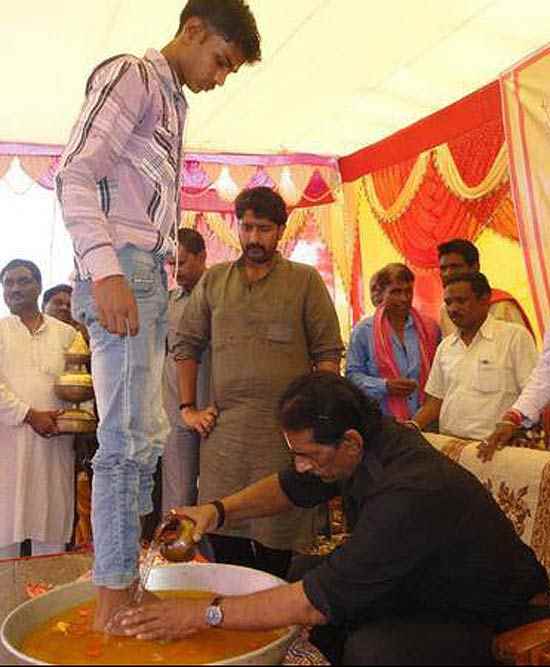
Prodigal’s Return A ghar wapasi in progress. (Photograph by Prabhat Mishra)
The results of the Vidhan Sabha election last year could hold a pointer to what is happening in Bastar and Surguja, according to observers. Both districts had overwhelmingly favoured the BJP in the previous two elections. In 2013, however, it was the Congress which won eight out of the 12 seats in Bastar, and seven out of the eight seats in Surguja. The Sangh parivar seems to have singled out the Christian missionaries for a turnaround in electoral fortunes, though religion could not have played much of a role in the outcome, since the Christian community is minuscule.
It doesn’t appease VHP leader Suresh Yadav. “Christian missionary activity is going on unabated, but the state government is not bothered,” he told Outlook. Yadav alleges that 59 Christian families in Sirisguda had first attacked the Hindus and instigated unrest by refusing to give donations for the annual ‘puja’. “We are no longer Hindus and we no longer visit the temple,” they reportedly argued and said they were not obliged to pay for Hindu rites.
“Judeo would wash the feet of three or four tribals and get himself photographed.”Kawasi Lakhma, Congress MLA
Yadav, however, has no answer when asked why tribals in Bastar are still opting to get converted despite the strong RSS-VHP presence. Both Bastar and Surguja have a large network of Saraswati Shishu Mandirs and Ekal Vidyalayas, schools manned by solitary teachers and promoted by the RSS. But while BJP leaders privately concede that RSS volunteers are not committed as they used to be, Yadav continues to blame Christian missionaries for instigating tribals, misleading them and luring them to change their religion. Remarkably, while Chhattisgarh has had a stringent anti-conversion law since 2004 when the BJP formed the government here, its provisions are yet to be invoked in the state.
Congress MLA Deepak Baij accuses the Sangh parivar of fomenting trouble for political reasons. “They are desperately searching for a scapegoat to explain their poll debacle in these areas and have zeroed in on this bogus claim of forcible conversion,” he tells Outlook. Christian missionaries, he held, have been around in the area for a long time and he was yet to come across cases of forcible conversion. Significantly, former MLA Beduram Kashyap, who lost to Baij, also conceded that conversions had been taking place for a long time and it would be incorrect to say that they increased after the BJP was defeated. “We try to persuade tribals to remain in the Hindu fold, but if they still opt for conversion, what can be done?” says Kashyap.
Congress MLA Kawasi Lakhma says the conversions have happened because of the complete lack of government agency in matters of health, education and food, gaps which the Christian missionaries are filling. There have been such conversions even in the Jagdalpur urban area, which has been electing a BJP MLA for the past three elections, Lakhma claims. He doesn’t think much of the Ghar Wapasi reconversion programme the late Dilip Singh Judeo of Jashpur had initiated. “Judeo would wash the feet of three or four tribals and get himself photographed doing so,” he says sarcastically. Judeo’s nephew and BJP Rajya Sabha member Ranvijay Singh Judeo says he will resume the reconversion campaign soon.
Meanwhile, Dwarkapeeth Shankaracharya Swaroopanand Saraswati also chose to fish in the troubled waters. “Why would people change their religion if the government fulfils their needs?” he asks. He supports the ban on the entry of Christian missionaries, declaring that foreign funds sent to the church should not be used for converting people. The government, he claims, exercises far greater control over Hindu temples, which is unfair, he feels.
The minister in charge of Bastar, Prem Prakash Pandey, questions the very reports of forcible conversions. “We have not received a single such complaint since 2004,” he asserts. Pandey, say sources in the government, was alarmed enough to give VHP activists in Bastar a dressing down. Any communal disturbance in Bastar would reflect poorly on the BJP government in the state, he told a VHP delegation.
He, however, failed to assuage church leaders in the state. How can the state government fail to react to ban orders, they ask. “Nobody can be forced to change his faith,” quips Father Sebastian of the Catholic Church at Raipur. “If he does, he does so of his own free will.”
By Yashwant Dhote in Raipur
April 13, 2009
Bastar’s tribals Hinduised through silent work done by RSS over decades
The Hindu
April 14, 2009
The Hinduised face of Bastar’s tribals
by Aarti Dhar
Jagdalpur
BJP is reaping the rewards of the silent work done over decades by RSS organisations
FILE Photo: Akhilesh Kumar
Tribal women during an election meeting at Jagdalpur in Bastar district in 2008.
For people who worshipped nature and knew only one God (Buddhadev) the new deities are now Shiva, Durga and Hanuman. Chanting of the Gayatri mantra, Hanuman Chalisa and Vande Mataram appears to come naturally to them; and Gayatri Parivar, the Brahma Kumaris, Art of Living and Baba Ramdev are now their inspiration.
Welcome to the new face of tribal culture in Chhattisgarh’s Bastar region: temples on the roadsides, Ramlila on stage and the worship of Ganesha during the annual 10-day Ganesha festival.
This changed socio-religious character of the tribal population has also impacted on the voting pattern, the beneficiary being the Bharatiya Janata Party (BJP).
The BJP is now reaping the rewards of a long campaign by the various outfits of the Rashtriya Swayamsewak Sangh (RSS). This tribal support has greatly strengthened the party in the State. Right from the 2003 Assembly elections, the tribal vote has been polled in favour of the BJP and the trend is likely to continue in 2009, unless something dramatic happens.
The BJP now has a dedicated cadre in terms of voters. “The biggest beneficiary of the silent work carried out by the RSS outfits has been the BJP,” says Yogendra Kaushik of the Vanvasi Kalyan Ashram. Decades ago when the Rashtriya Swayamsewak Sangh (RSS) and its related organisations started work in the tribal regions of the State — Bastar and Surguja — it was to provide basic amenities like healthcare and education that would also help check the increasing influence of Christian missionaries.
The RSS started institutions like the Vanvasi Kalyan Ashrams, Ekal Vidyalaya and Saraswati Shishu Mandirs to provide informal education to tribal children that also included lessons on Indian “culture, religion and tradition.” Basic healthcare was provided by women through “Arogya Vidhi” or alternative medicine.
The schools and ashrams were opened in areas where no government facility was available; the children were subsequently shifted to government schools, but the lessons in Hindutva continued to ensure that they were not lured by the Church or Left ideologies. “We have also lost teachers to naxalites, who have opposed our work tooth and nail. It is not easy for us,” Mr. Kaushik explains.
The changed politics has become more evident in the recent past with tribals shifting their support from the Congress to the BJP.
The young men and women coming out of these institutions year after year swell the cadres of the Hindutva organisations. Over 500 Ekal Vidyalayas are functioning in the Bastar region alone. Vanvasi Kalyan Asanvasi Kalyan Ashrams are present in Orchha, Lanjoda, Barsur and Bhanpuri where children from Salwa Judum camps have also been enrolled.
April 14, 2009
The Hinduised face of Bastar’s tribals
by Aarti Dhar
Jagdalpur
BJP is reaping the rewards of the silent work done over decades by RSS organisations
FILE Photo: Akhilesh Kumar
Tribal women during an election meeting at Jagdalpur in Bastar district in 2008.
For people who worshipped nature and knew only one God (Buddhadev) the new deities are now Shiva, Durga and Hanuman. Chanting of the Gayatri mantra, Hanuman Chalisa and Vande Mataram appears to come naturally to them; and Gayatri Parivar, the Brahma Kumaris, Art of Living and Baba Ramdev are now their inspiration.
Welcome to the new face of tribal culture in Chhattisgarh’s Bastar region: temples on the roadsides, Ramlila on stage and the worship of Ganesha during the annual 10-day Ganesha festival.
This changed socio-religious character of the tribal population has also impacted on the voting pattern, the beneficiary being the Bharatiya Janata Party (BJP).
The BJP is now reaping the rewards of a long campaign by the various outfits of the Rashtriya Swayamsewak Sangh (RSS). This tribal support has greatly strengthened the party in the State. Right from the 2003 Assembly elections, the tribal vote has been polled in favour of the BJP and the trend is likely to continue in 2009, unless something dramatic happens.
The BJP now has a dedicated cadre in terms of voters. “The biggest beneficiary of the silent work carried out by the RSS outfits has been the BJP,” says Yogendra Kaushik of the Vanvasi Kalyan Ashram. Decades ago when the Rashtriya Swayamsewak Sangh (RSS) and its related organisations started work in the tribal regions of the State — Bastar and Surguja — it was to provide basic amenities like healthcare and education that would also help check the increasing influence of Christian missionaries.
The RSS started institutions like the Vanvasi Kalyan Ashrams, Ekal Vidyalaya and Saraswati Shishu Mandirs to provide informal education to tribal children that also included lessons on Indian “culture, religion and tradition.” Basic healthcare was provided by women through “Arogya Vidhi” or alternative medicine.
The schools and ashrams were opened in areas where no government facility was available; the children were subsequently shifted to government schools, but the lessons in Hindutva continued to ensure that they were not lured by the Church or Left ideologies. “We have also lost teachers to naxalites, who have opposed our work tooth and nail. It is not easy for us,” Mr. Kaushik explains.
The changed politics has become more evident in the recent past with tribals shifting their support from the Congress to the BJP.
The young men and women coming out of these institutions year after year swell the cadres of the Hindutva organisations. Over 500 Ekal Vidyalayas are functioning in the Bastar region alone. Vanvasi Kalyan Asanvasi Kalyan Ashrams are present in Orchha, Lanjoda, Barsur and Bhanpuri where children from Salwa Judum camps have also been enrolled.
Subscribe to:
Posts (Atom)