|
Showing posts with label Delhi. Show all posts

February 16, 2024

India: Forging Communal Space: Negotiating Streets and Practices in Delhi, 1922–65 | Saeed Ahmad


Abstract

This paper examines space-making in the Jangpura-Bhogal locality of Delhi by documenting communal conflicts in the late 1920s and 1950s. First, it addresses the production of a Hindu religious space by disavowing Muslim ritual practices under a colonial regime seeking to control religious conflict. Second, it unpacks the diverse mechanisms used to produce a Sikh political space during a nascent postcolonial state’s management of linguistic subnationalisms. Grounded in power relations and cohesions around multiple social registers, these variegated spatial claims were made through political and religious processions, petitions and physical violence. These communal geographies highlight the importance of neighbourhood histories.

https://www.tandfonline.com/doi/full/10.1080/00856401.2024.2303836

February 03, 2024

Business as Usual? Bazars and Communalism in Colonial Delhi, 1913–32 | Anish Vanaik

Abstract

This paper uncovers a hitherto unnoticed pattern of communal segregation among establishments located in some of Delhi’s most important bazars. It demonstrates that this pattern, emerging between 1913 and 1932, was driven by structural features of the ways in which Delhi’s trade and retail interacted with communal violence in the 1920s. Those features include the dislocating effects of communal violence on bazars. More strident political activity by merchants, however, was important fuel to this fire. Merchants did not, also, restrict themselves to repeating communal tropes developed elsewhere. Their self-organisation gave shape to a conception of ‘Hindu’ and ‘Muslim’ trades. Rather than see a communal ‘pre-Partition’ in the 1930s, this evidence suggests that communal segregation was already well on the rise in the 1920s. Business as usual, then, was a source of deepening communal antagonisms rather than, as is sometimes assumed, a source of everyday bonhomie.


https://www.tandfonline.com/doi/full/10.1080/00856401.2024.2283683?src=exp-la

August 04, 2023

India: Who benefits from communal violence? asks Bharat Bhushan

Deccan Herald -  Aug 04 2023

 Who benefits from communal violence?
BJP occupies the high moral ground, pushing the narrative of good governance and development, while VHP and Bajrang Dal are free to propagate religious polarisation.
 PinterestLinkedinGmailFacebook Messenger

Bharat Bhushan


Flames rise from shops and other structures set ablaze by miscreants during fresh violence in Haryana. Credit: PTI PhotoFlames rise from shops and other structures set ablaze by miscreants during fresh violence in Haryana. Credit: PTI Photo


The Bharatiya Janata Party (BJP) used to claim that there are no communal riots when it is in power. With the communal rioting in Manipur and Haryana, both run by the BJP, that claim lies exposed.
The Manipur violence initiated between ‘ethnic’ communities has fast acquired the colour of a Hindu-Christian confrontation. The Muslims of Nuh in the Mewat region of Haryana where the violence started do not have a sterling reputation — with the violent criminals among them having graduated from cattle thievery to cybercrime. They claim to have been provoked by two videos released by cow-vigilante and Bajrang Dal activists. The videos called upon Hindus to join a religious procession on Monday in Nuh and visit temples in Mewat in large numbers. The videos, according to the police, infuriated the Muslim community, and they gathered in large numbers on July 31 to disrupt the procession.
Only a detailed enquiry will show who lit the communal fuse, but who does a surcharged communal atmosphere help? The question is as relevant in Manipur as it is in Haryana.
The conflict in Manipur has made BJP Chief Minister N Biren Singh virtually unassailable despite the utter failure of law and order in the state. He has consolidated the Meitei Hindus behind him. Prime Minister Narendra Modi cannot find it in himself to caution Singh to follow ‘Raj Dharma’, as he himself was advised by former Prime Minister Atal Bihari Vajpayee in 2002.
In Haryana, the BJP is faced with declining popularity. After the 2019 state legislative election, it had to rely on Dushyant Chautala’s Jannayak Janta Party to form a government. Then with the farmers’ agitation in 2020-21 the Jat farmers turned their back on the BJP. The Jats form 27 per cent of the population and dominate 40 of the 90 assembly constituencies. Their disproportionate influence in Haryana politics is evident from the fact that in 33 out of 57 years of its existence, Haryana has been ruled by Jat chief ministers. The non-Jat chief ministers who have together ruled the state for 22 years, have had short tenures. Khattar will be only the second non-Jat Chief Minister other than Bhajan Lal to complete a 10-year tenure next year.

Elections to the Haryana legislature are due in October 2024. The state sends 10 MPs to the Lok Sabha. The BJP had won all 10 seats in the 2019 general election. It is unlikely to repeat the feat in April-May 2024, without the consolidation of Hindu votes. To achieve that, the hostile Jat farmer will have to be mobilised through their Hindu identity rather than through their caste and economic status. Communal polarisation will do that.
That is why the communal violence in Nuh has significance beyond Mewat. It has already spread to the adjoining areas of Gurugram, Faridabad, and Palwal. Nor is it likely to be limited to the boundaries of Haryana. Already, sister Hindutva organisations of the BJP — the Vishwa Hindu Parishad (VHP) and the Bajrang Dal — have organised protests on August 2 in Delhi stopping traffic on the Faridabad-Delhi highway and protesting in RK Puram-I, Nirman Vihar, and Ghonda in Delhi. There were VHP protests in adjoining Noida in Uttar Pradesh as well.
Could it be that the BJP has governance as its priority and the communal incidents are the handiwork of autonomous Hindutva militants? Modi recently advised party MPs to let the government’s work for the poor take precedence in the 2024 general election over the Ram temple at Ayodhya and the abrogation of Article 370 in Jammu and Kashmir. This seems to suggest that the governance train is on a different track than the communal one.
Far from there being an airgap between the BJP and the Hindutva militants, they are in fact two strands of the same DNA — one prepares the ground for the other’s climb to power. Polarisation on made up communal issues such as wearing the hijab, refusal to sing or shout ‘Vande Mataram’, ‘love jihad’, reclaiming mosques as Hindu temples, etc. help to heat up the atmospherics before the BJP enters an electoral battle.
The pattern is clear. When in power the BJP occupies the high moral ground, pushing the narrative of good governance and development and the militias of VHP and Bajrang Dal are left free to propagate religious polarisation on the ground. This collaboration was evident earlier also in the Ram temple agitation, the destruction of the Babri masjid, the Gujarat riots, and now in incidents of Ram navami violence in March, and now in Nuh. Ethnic militias like Arambai Tenggol and Meitiei Leepun play a somewhat similar role in Manipur.
In Haryana, the VHP and the Bajrang Dal are being resuscitated because the BJP needs every Lok Sabha seat it won in the state in 2024, and Khattar is also unsure of winning a third term for the BJP. Already he has promised to use the Recovery of Damages to Property During Disturbance to Public Order Act against the ‘rioters’. There are no prizes for guessing who might face the State’s wrath. It is likely that communal tension justified as ‘Hindu anger’ against the Nuh violence will spread to Delhi (where the BJP won all seven Lok Sabha seats in 2019). It will not be a surprise if in the coming months communal poison is injected into other north Indian states where Hindutva forces need to strengthen the BJP’s electoral position.
The election-going states are under the greatest threat of communal polarisation. The BJP had won 24 out of 25 Lok Sabha seats in Rajasthan, 28 out of 29 in Madhya Pradesh and nine out of 11 in Chhattisgarh. These states will have assembly elections in December. The BJP would like to build the momentum for the 2024 general election by winning all of them. It will need more than the rhetoric of good governance to do that. These states might also see new life being breathed into the VHP and the Bajrang Dal.
(Bharat Bhushan is a Delhi-based journalist.)

India: Delhi Police files 26 FIRS against VHP and Pajrag Dal over unauthorised protests in Delhi


March 31, 2023

India: ‘don’t need permission to celebrate their God & Delhi Police works under them’ --Organisers of Ram Navami rally in Delhi (Report in The Print, March 30, 2023)


‘Who are Delhi Police to stop us’: Ram Navami rally brings back memories of violence in Jahangirpuri

Police say permission granted for curtailed Ram Navami procession Thursday. Organisers assert that they ‘don’t need permission to celebrate their God & Delhi Police works under them’.

April 26, 2022

India: Jahangirpuri violence in Delhi - Why Chief Minister Arvind Kejriwal's silence is jarring | BBC news

https://www.bbc.com/news/world-asia-india-61187484

Jahangirpuri violence: Why Arvind Kejriwal's silence is jarring

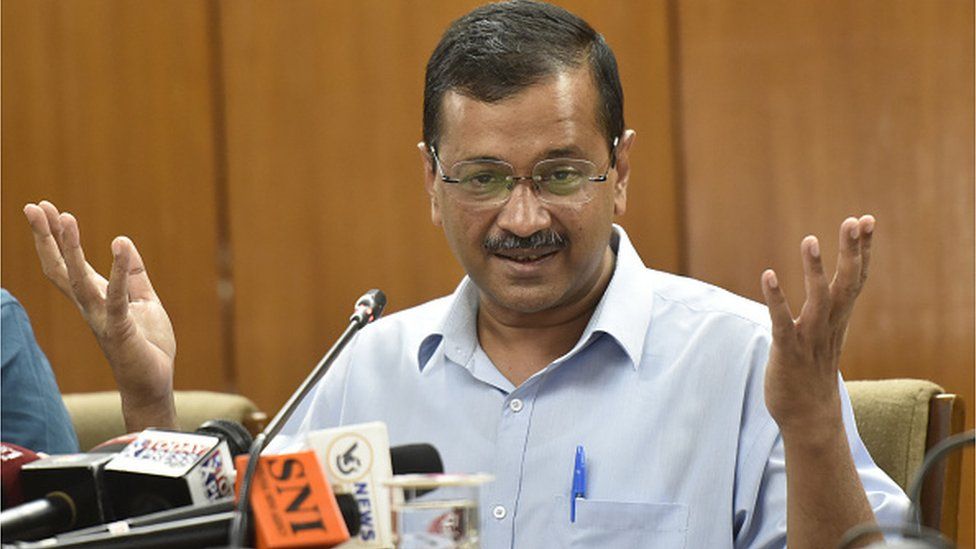
Arvind KejriwalImage source, Getty Images
Image caption,
Critics say Arvind Kejriwal's response to last week's religious violence and demolitions has been underwhelming

Delhi Chief Minister Arvind Kejriwal's stand on recent religious violence in India's capital and the subsequent police crackdown on Muslims may be politically expedient, but critics question whether it's moral, writes the BBC's Geeta Pandey in Delhi.

An anti-corruption crusader, Mr Kejriwal entered politics a decade ago promising to clean up the political system and focus on development.

In Delhi, where his Aam Aadmi Party (AAP) has been in power since 2013, they have been credited with turning around government-run schools, setting up affordable neighbourhood clinics and providing cheap water and electricity. Recently, they expanded their footprint to Punjab by sweeping the state election.

Mr Kejriwal has often said that his party believes in equality of all religions and justice for all. In a country where politics relies heavily on caste and religious divisions, many found AAP's promise to refrain from "divisive politics" refreshing and hoped it would become a viable alternative to the big national parties.

But since last week, after Delhi's Jahangirpuri neighbourhood was shaken by Hindu-Muslim violence, critics have been asking why he is not speaking up for the city's Muslims.

Hindus and Muslims have blamed each other for the violence, which broke out after a Hindu religious procession marched past a mosque while celebrating a festival.

Afterwards, the federal government, led by Prime Minister Narendra Modi's Hindu nationalist Bharatiya Janata Party (BJP), sent in its police forces, which arrested mostly Muslim men.

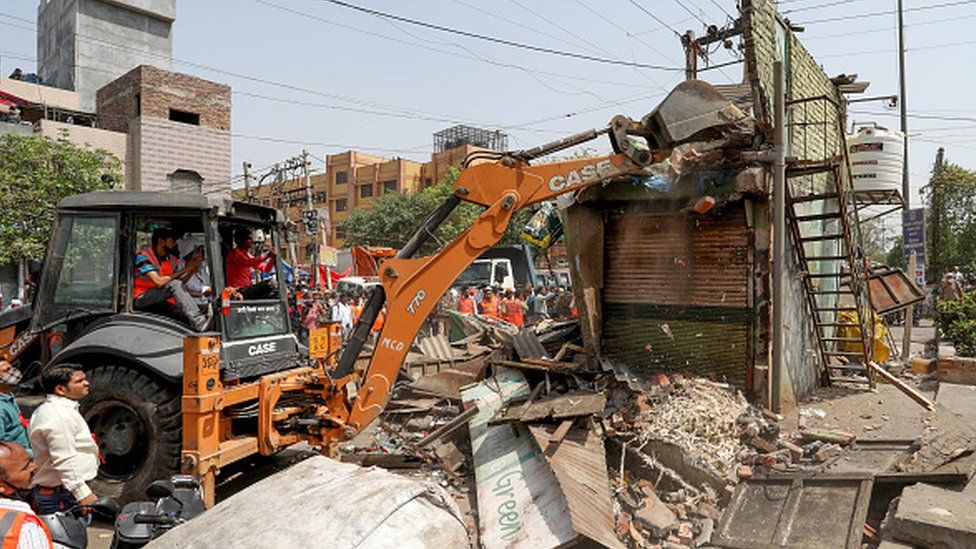
The civic authorities, also controlled by the BJP, brought in bulldozers - officially to demolish illegal encroachments but widely seen to be aimed at "teaching a lesson to Muslim rioters" as most shops and businesses targeted belonged to the community.

The crackdown hasn't come as a surprise - anti-Muslim violence has risen in India in recent years and there have been similar actions in some BJP-ruled states recently.

But critics say Mr Kejriwal's response has been rather underwhelming. More than a week has passed since the violence, but he has not visited the area.

And his condemnation of the incident has been selective - he's criticised the "stone-pelters who attacked the Hindu procession" but not the armed marchers who allegedly chanted provocative religious slogans, some of which have been used in recent years to mock Muslims.

A bulldozer demolishes a structure during a joint anti-encroachment drive conducted by North Delhi Municipal Corporation at JahangirpuriImage source, Getty Images
Image caption,
The demolitions in Jahangirpuri took place days after the area witnessed communal clashes

This has led some critics to call out his reaction.

"It's the responsibility of the government to stand up for all citizens. But Mr Kejriwal has behaved like the chief minister of Hindus," says Ashutosh, senior journalist and a former member of Mr Kejriwal's party.

The chief minister's tweet criticising the stone-pelters, he says, is "offensive because he's failed to condemn what caused the stone pelting. The crowd was armed, they jeered Muslims and raised offensive and abusive slogans".

Ashutosh, who uses only one name, says Mr Kejriwal thinks that if he criticises the demolition, people will construe that he is supporting Muslims. In a country where 80% of the population is Hindu, he says, Mr Kejriwal is catering to a majoritarian vote bank.

"It's unfortunate that Mr Kejriwal does not have the moral courage to stand up for universal values," he says.

Mr Kejriwal's response to the riots and the demolitions is also drawing comparisons with other opposition parties and leaders who strongly condemned last week's events.

In particular, Communist leader Brinda Karat won much admiration when she turned up at the demolition site with a court decree ordering a halt to the drive.

Presentational white space
The BBC is not responsible for the content of external sites.View original tweet on Twitter
Presentational white space

After widespread criticism of Mr Kejriwal and his government on social media, AAP finally sent two of its legislators to the violence-affected area last Thursday - a day after the demolitions.

I spoke to two AAP lawmakers - Pawan Sharma, who was among the legislators who visited Jahangirpuri, and Abdul Rehman.

Defending the party's decision to not comment on the religious violence, they insisted that "AAP is not silent but we choose not to indulge in the politics of Hindu-Muslim or temple-mosque".

"We believe in equality of all religions. We do politics of development, we focus on education and health, we provide cheap water and power to people."

Mr Sharma said the party had condemned the demolitions, the way it was carried out, and blamed the BJP for the mess.

"How did these encroachments happen in the first place? Why did the civic bodies, controlled by the BJP for the past 15 years, allow these illegal constructions to go ahead?" he asked.

In Jahangirpuri, the men and women who lost their livelihoods in the demolitions accuse Mr Kejriwal and his party of abandoning them in their hour of need. They include poor daily-wage workers, ragpickers, scrap dealers and roadside vendors.

"No party has visited us. The government is for everyone, but it seems there's no one for us," Anwari Bibi told me when I visited the area after the demolitions.

Sareja, who uses only one name, said, "Mr Kejriwal has washed his hands of all responsibilities. For everything, he blames the central government."

Their neighbour, Sheikh Safijuddin, said Mr Kejriwal "doesn't care for us anymore. He got what he wanted from us - our votes".

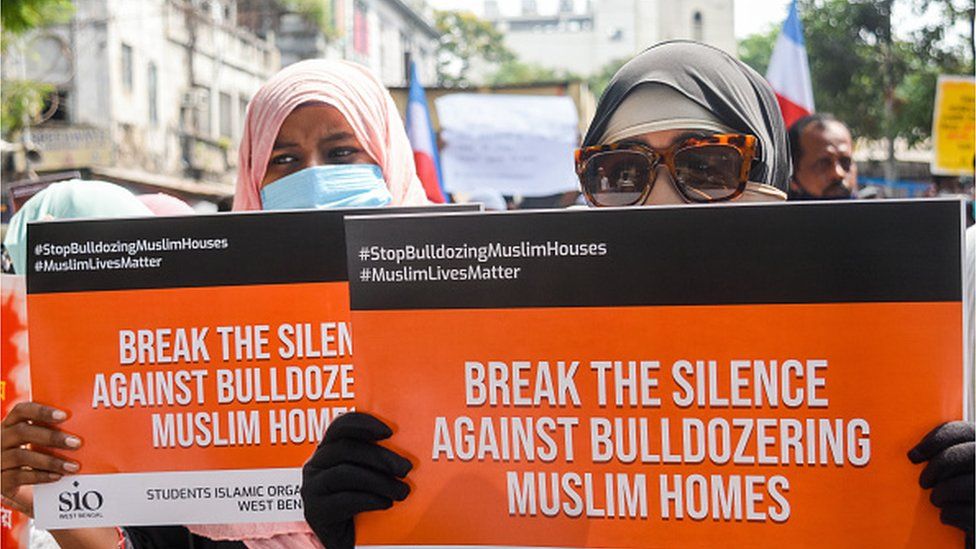
A protest against Jahangirpuri demolitions in West BengalImage source, NuPhoto
Image caption,
Protests have been held against the demolitions in Jahangirpuri

Senior journalist Rakesh Dixit alleges the Delhi government has behaved like "a bystander" during the riots and the demolitions because it serves their purpose.

Mr Kejriwal, he says, has adopted "a policy of conservatism without offending Muslims". He's not shy about flaunting his religion in public - after his election win in 2020, he led a procession to a Hindu temple to offer prayers. He also often talks about equality and respect for all religions.

But, Mr Dixit says, AAP is no longer a party with difference. "It's driven by political exigencies like any other party. It realises that Hindu nationalism will remain the dominant sentiment in the foreseeable future, so Muslims have become dispensable for them."

He points out that this is not the first time "Mr Kejriwal has kept mum while Muslims have been targeted", such as when they protested against a controversial citizenship bill or during the Delhi riots of 2020. He was also among the first to support the Indian government's decision to revoke Kashmir's special status.

"They choose their ideology based on what helps their cause at a particular time or in a particular place. At the moment their eyes are set on the forthcoming state elections in Himachal Pradesh and Gujarat where Muslim populations are small and societies are already polarised," he says.

"By distancing itself from Muslims, AAP is trying to ensure that it does not lose the Hindu votes in those states".

April 12, 2022

India: Meat less - Editorial on systematic targeting of a community | The Telegraph, April 12, 20


Meat less: Editorial on systematic targeting of a community

That Karnataka and Delhi should be linked through similar divisive campaigns does not augur well


The Editorial Board   |   Published 12.04.22, 12:23 AM

Hatred is not noble; it is riddled with spite. Going door to door asking people not to buy halal meat is spiteful, as is distributing pamphlets at the marketplace on the same theme. But that does not deter members of the Hindu Janajagruti Samiti and other right-wing groups from thus urging the majority community in Karnataka to boycott halal meat. They tried to ban its sale on Varshadodaku, when meat-eating is common in all communities. The Karnataka chief minister took some time to decide that his government will look into the demand to boycott halal meat; this does not entirely paper over the fact that the Bharatiya Janata Party is not inimical to the campaign. The hijab controversy had culminated in the Karnataka High Court’s ruling disallowing hijabs in educational institutions. This was followed by the campaign banning non-Hindu traders from opening stalls on or near temple premises and that against halal meat. Both target the economy of the minority community. If these moves prosper, the worst sufferers would be farmers who raise livestock; they have already been hit with a beef ban. But the BJP national general secretary steadily pointed his finger: allegedly, the minority community is waging economic jihad through the sale of halal meat. Is all this a build-up to the state elections next year?      

The BJP’s role in the unconstitutional efforts to change people’s diet and to intervene in a community’s right to conduct trade freely is also obvious in Delhi. The BJP mayors of south and east Delhi ordered all meat shops to be closed for the period of Navratri because, according to them, people do not eat even garlic or onions then. The Akhil Bharatiya Vidyarthi Parishad has — unsurprisingly — been accused of thuggery in the Jawaharlal Nehru University campus after a clash over the consumption of non-vegetarian food. Not only do these transgressions ignore the non-Hindu population, but they also imply conformity with their ideas of Hindutva among the majority community, which is far from homogenous in diet or belief. Since no one but the municipal commissioner can decide to close down shops, no formal order was issued. Whether or not the mayors succeeded in this instance is irrelevant. What stands out is the systematic targeting of a community, together with the indifference to rules, laws and the Constitution. That Karnataka and Delhi should be linked through similar divisive campaigns does not augur well. Only the refusal of people across communities to accept such bullying will turn these efforts to naught.

February 16, 2021

India: Aam Aadmi Party (AAP) wants to compete with BJP by dipping into its poisonous Hindutva lexicon

 Apoorvanand: By playing Hindutva politics, AAP is stirring up trouble

AAP has, however, now decided that it was not enough to merely look Hindu. It seeks to replace the BJP by dipping into its poisonous Hindutva lexicon.

https://scroll.in/article/987022/apoorvanand-by-playing-hindutva-politics-aap-is-stirring-up-trouble

June 10, 2018

Revealed: Archive of Delhi Police Secret files on RSS activity and plans Oct-Dec 1947

Historical Archive

India: Scans of Delhi Police and Intelligence Files on Activities of the RSS in 1947

http://www.sacw.net/article13797.html

July 01, 2016

India: Part-time Businessman, Full-time Gaurakshak (Seema Guha in Arre)

Arré

by Seema Guha June 28, 2016

Their tongues are calling for a law banning cow slaughter; their eyes keeping tabs on meat-eaters and Muslims. Vigilante gaurakshaks are prepared to kill to protect the cow.

Kapil Prabhakar was in his IP Extension office in East Delhi, sorting some papers related to his milk-distribution business, when his phone rang. He ignored it. It had been a busy morning; he was tired and hungry. He reached for the stainless-steel lunch box his wife had packed for him when the phone rang again. It was 1:50 pm. He answered it reluctantly. The lunch box remained unopened that day.

A volunteer from Punjab was on the line. Three truckloads of cows had left the state that morning. They had been driven through neighbouring Haryana and were heading towards East Delhi. Prabhakar was being called to the rescue.

Time was of the essence. Prabhakar knew that despite a ban on truck movement during the day, the Delhi Police allowed lorries to go through. He reached out to his core team, and about 37 swung into action. They asked volunteers to spread the word and get people out to Shastri Park close to the main road towards Ghazipur. In less than an hour, about a 1,000 people were squatting in the middle of the road.

Around 3:30 pm, the trucks were spotted. Two ambulances, fitted with cranes, were already in place. Nineteen cows and 12 bulls were “rescued”. The police asked the crowd to disperse. The operation was a success, but Prabhakar was not satisfied.

“The police allowed the drivers and their helpers free passage,” he said. “They should have been put behind bars.” According to him, the truckers were armed with country-made guns, talwars, and knives. Prabhakar admits, sometimes the chase can be in vain, as the police may be on the take and allow drivers to get away. “We are getting them to co-operate more.”

“The government spends crores on saving the tiger, why can’t it spend that money on cows?”

The East Delhi head of the Vishwa Hindu Parishad’s Bharatiya Gau Vansh Rakshan Evam Samvardhan Samiti (cow-protection and improvement organisation), is a man on a mission. The 52-year-old, self-employed graduate, who owns a Mother Dairy dealership and foundry, believes it’s his life’s calling to protect cows. Aside from a countrywide ban on cow slaughter, he also wants the cow to be declared India’s national animal. His argument is flawless. “The government spends crores on saving the tiger, why can’t it spend that money on cows,” he asks. The idea of extinction has never crossed his razor-sharp mind. But then logic has never had any place in fanatical ideology.

***

Born into an orthodox Brahmin family from Himachal Pradesh, Prabhakar grew up in Delhi. His father, who worked for HSBC, was a devout Hindu, who ensured religion was an integral part of the upbringing of his six children. Although the elder Prabhakar wasn’t a member of the Rashtriya Swayvamsevak Sangh, he believed in the organisation’s ideology. As the youngest in the family, Prabhakar began visiting RSS shakhas when he was eight, playing around and observing the adults.

Gaurakshak3

This group of vigilantes in Rajasthan’s Ramgarh is just one of dozens of such groups that have emerged since the beef ban.

Allison Joyce/Getty Images

It’s a tradition that’s being passed on. One of his sons is an engineer, and his nephew is an aspiring model in Mumbai – they are both members of cow-protection groups. Prabhakar sees no contradiction between modern pursuits and traditional beliefs. “I have been to five-star hotels… also to discotheques,” he says earnestly, sitting cross-legged at a temple in South Ganesh Nagar. “I was a good break-dancer in my youth.”

Over the course of the evening, he spells out how groups like his are successfully rescuing ill and ageing cows across India, through a zealous network of volunteers and informers. They are ordinary people: shopkeepers, cobblers, house help. Women working in housing societies are especially valuable in keeping tabs on meat-eaters. “Close to 10,000 people have our numbers,” Prabhakar says. “We take their call anytime of the day or night. We rescue 20-25 cows every month.”

The demand for a ban on cow slaughter is not new. Soon after Independence, the first president Rajendra Prasad had made the same appeal to Mahatma Gandhi. Since the Narendra Modi-led BJP came to power in 2014, the cow slaughter issue reached a fever pitch with cases as extreme as the Dadri lynching.

But according to Prabhakar, Modi is not the reason for their pro-bovine activities. “The move began eight years ago when the VHP decided to take a decorated cow around localities on festive days, to promote respect,” says Prabhakar. But he admits that it helps having a pro-cow government. “We have a cabinet where, from the prime minister downwards, all have a special place in their heart for cows.”

Flattered by the interest in his favourite subject, he now launches into a listing of its virtues. “Every part of the cow is useful to us,” he says, insisting high blood pressure can be cured if a patient runs his palms over a cow’s body. “If that doesn’t work, I’m ready to pay for doctors and medicine for a lifetime,” he says grandly, sweeping modern medicine aside with one dismissive wave of his hairy hand.

And he is hardly alone. This line of thinking is embraced by the old, the young, the unlettered, and the highly educated. Akilesh Vishwakarma, for instance is a bright 34-year-old science graduate from Allahabad University, who uses science to justify politics. “All farmers believe that unless they use fertilisers and pesticides filled with chemicals, their plants will not be healthy,” he says. “My mission is to teach them to use cow dung as fertiliser and pesticides made from cow urine.” The East Delhi gaurakshaks are planning to promote soap, phenyl, and agarbattis made from cow urine and dung, under the brand name “Goband”.

When asked about the violence vigilante gaurakshaks and self-proclaimed defenders of Hindu dharma have unleashed on Muslims, Akhilesh says blandly, “They are not true followers of religion. Many of them are uneducated and get misled. My religion respects every other religion.”

Gaurakshak2

Members of a vigilante group try to free cows from the back of a truck in Ramgarh.

Allison Joyce/Getty Images

Prabhakar agrees, with the infallible logic and conviction displayed most often by right-wing bhakts on social media. “First, we Hindus don’t want to kill. We don’t want to hurt anyone. But please respect our sentiments. If you don’t, we can’t help some of the hotheads.”

With this convenient “we-can’t-help-it” disclaimer, Prabhakar signs off and gets back to work, glad to have delivered his views on the subject. The more people he converts, the higher the chances of his cows becoming part of currency, stamps, and maybe one day, the symbol of the Indian government. The sky is the limit.


Seema Guha is a senior journalist writing mainly on India’s foreign policy. She has covered conflict situations in the northeast and has reported extensively on the ethnic war in Sri Lanka. She also contributes to openDemocracy, a prestigious international website.

May 25, 2016

African diplomatic community to boycott Africa Day celebrations due to everyday racism and afro-phobia in India - Killing Of Student In Delhi's Vasant Vihar

NDTV
African Community Seeks Strong Action Against Killing Of Student In Delhi
All India | Indo-Asian News Service | Updated: May 25, 2016

New Delhi: The African diplomatic community in India has decided to boycott this year's Africa Day celebrations over safety of its nationals, and is seeking strong action against the killing of a Congolese student in New Delhi last week.

"The Group of African Heads of Mission have met and deliberated extensively on this latest incidence in the series of attacks to which members of the African community have been subjected to in the last several years," said Eritrean Ambassador Alem Tsehage Woldemariam, who is also dean of the Group of African Heads of Mission, in a statement.

A Congolese student, Masonda Ketada Olivier, 29, was beaten to death by a group of men in South Delhi's Vasant Kunj after an argument over hiring an autorickshaw on May 21. Oliver was hit on the head with a brick, leading to his death.

"They strongly condemn the brutal killing of this African and calls on the Indian government to take concrete steps to guarantee the safety and security of Africans in India," it said.

The police had arrested one person a few hours after the murder.

According to Mr Woldemariam's statement, Oliver and his friend Samuel had gone to meet another friend, and while on their way back, he flagged down an auto-rickshaw which stopped a few metres away. However, as he tried to board it, three locals standing nearby boarded it. An argument ensued following which Oliver was thrashed.

"They pushed Oliver to the ground and kicked him in the face and abdomen repeatedly. One of the Indians picked up a large stone from the roadside and hit Oliver on the head," the statement said. A passer-by who stopped to help was also beaten up and the attackers ran away when they saw that Oliver was unconscious.

Oliver was rushed to a private hospital where he was referred to the All India Institute of Medical Sciences (AIIMS) Trauma Centre but he died on the way.

Mr Woldemariam stated that the African heads of mission in Delhi have noted with deep concern that "several attacks and harassment of Africans have gone unnoticed without diligent prosecution and conviction of perpetrators".

He said that given the climate of fear and insecurity in Delhi, "the African heads of mission are left with little option than to consider recommending their governments not to send new students to India, unless and until their safety can be granted".

"Accordingly, the Indian government is strongly enjoined to take urgent steps to guarantee the safety of Africans in India including appropriate programmes of public awareness that will address the problems of racism and Afro-phobia in India," he said, and called on the media, civil society, think tanks, research institutions, parliamentarians, politicians and community leaders to play major roles in addressing the stereotypes and prejudices against Africans in India.

As for the Africa Day celebrations being organised by the Indian Council for Cultural Relations (ICCR) on May 26 here, Mr Woldemariam said that they have requested that the event be postponed, and the African nations have also decided not to participate in the celebrations, except for a cultural troupe from Lesotho.

"This is because the African community in India, including students, is in a state of mourning in memory of the slain African students in the last few years, including Oliver," it added.

April 30, 2016

India: Delhi University drops 'India’s Struggle for Independence', the book under criticism by the Hindu Right

The Hindu

Delhi University drops controversial book
Updated: April 30, 2016 07:45 IST | Staff Reporter

Delhi University has decided to stop the sale and distribution of a Hindi translation of the book titled “India’s Struggle for Independence”, which has been part of DU’s History curriculum for over two decades.

The book has been in the limelight for its reference to Bhagat Singh as a “revolutionary terrorist”.

Chapter 20 of the book has called Bhagat Singh, Chandra Shekhar Azad, Surya Sen and others “revolutionary terrorists”. The book also calls the Chittagong movement a “terrorist act”, and the killing of British police officer John Sanders an “act of terrorism.

Bhagat Singh’s family had raised objections to the reference and written to Union Minister Smriti Irani, who, on April 27, asked Delhi University vice-chancellor Yogesh Tyagi to “reconsider” the use of the book.

The book has been criticised for calling Bhagat Singh a “revolutionary terrorist”

February 12, 2016

India: 'No To Valentines Day Ads' Moral Police Using Advertising Billiboard Space Train Platforms for State Run Delhi Subway Train Network

[two news reports are posted below]

The Indian Express

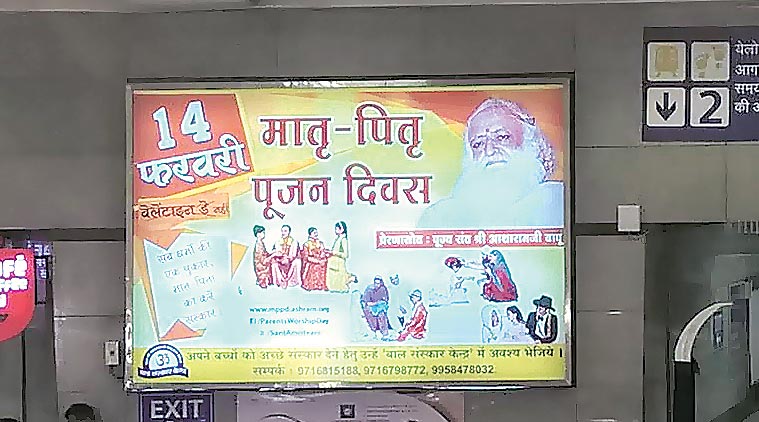
Worship parents on Feb 14, say no to Valentine’s: Ads on Metro


The advertisements by a group called Bal Sanskar Kendra went on to offer “help” and asked parents to send their children to them to inculcate “achhe sanskar” (good values).
By: Express News Service
Delhi

valentines day, valentines day protest, metro ad, valentines metro ad, delhi metro, delhi metro ad, delhi news The advertisements by a group called Bal Sanskar Kendra offer “help” and ask parents to send their children to them to inculcate “achhe sanskar” (good values). Express

When commuters boarded the Delhi Metro Monday, they were greeted by an advertisement campaign of a religious group which proposed celebrating Valentine’s Day as ‘Matri Pitri Pujan Diwas’ and endorsed police action against couples displaying their love in public.

Billboards and posters, put up across stations on the busy Yellow and Blue Lines, drew a sharp contrast between two young children “worshipping” their parents and a file photo of a couple being punished by police for celebrating Valentine’s Day in a public park in Raipur.

The advertisements by a group called Bal Sanskar Kendra went on to offer “help” and asked parents to send their children to them to inculcate “achhe sanskar” (good values).

The “inspiration” for the idea is said to be self-styled godman Asaram Bapu who is lodged in jail in connection with the rape of a minor. Asaram’s picture looms above the two contrasting images with Valentine’s Day struck out in red.

In some other advertisements, children from different communities are seen paying obeisance to their parents.

As pictures of the campaign went viral on social media, Delhi Metro ordered an inquiry into the allotment of the advertisements.

“The Delhi Metro always endeavours to ensure that the advertisements displayed inside the Delhi Metro trains or premises have no objectionable or indecent portrayal of people, products etc. The advertisements were displayed by a private contractor as all the advertising space inside the Delhi Metro premises are allotted to specialised agencies who in turn allot them to interested advertisers. The matter is being thoroughly examined and taken up with the contractor concerned for appropriate necessary action,” Anuj Dayal, Executive Director, Corporate Communications, said.

Officials said that the advertisements are most likely to be pulled down, though members of Bal Sanskar Kendra maintained they had paid for the advertisements to be up until February 14.

“We are not aware of any directive to pull down the advertisements. We have already paid Delhi Metro for this and have put up posters and hoardings across 50 Metro stations, mostly on the busy Yellow and Blue Line for awareness among commuters. We believe the day should be observed as Matri Pitri Pujan Diwas and not Valentine’s Day,” said D N Singh, a functionary of Bal Sanskar Kendra.

“This is already observed in Chhattisgarh and should be done in Delhi too. We have organised a massive gathering at Ramlila Maidan on Sunday where children will come with their parents and we will observe the day. That is our culture,” Singh said.

Ritesh Sharma, a regular commuter, said, “It is ironical that the Delhi Metro, a symbol of development, has such regressive advertisements. When I saw these on my way to work this morning, I was in shock.”

o o o


The Hindustan Times

Worship parents on Feb 14, reject Valentine’s Day: Ads on Delhi Metro

HT Correspondent, Hindustan Times, New Delhi | Updated: Feb 09, 2016 10:08 IST


Worship your parents this Valentines’ Day, says a series of advertisement billboards put up at Delhi Metro stations by a religious group that batted for police action against couples.

The ads, put up across 35 stations allegedly by an organisation of self-styled godman Asaram Bapu, advocating Matri Pitru Pujan Diwas has left commuters enraged, prompting the Delhi Metro Rail Corporation (DMRC) to examine the matter. Asaram is in jail in connection with a sexual assault case.

On the posters has a link to the website http://www.mppd.ashram.org/, which claims to be “Inspired by Pujya Asharam Ji Bapu”.

Watch the video of Asaram saying how on Valentine’s Day one should worship one’s parents: https://youtu.be/F0lODJHaPMA

The billboards and posters put up inside the stations show two contrasting frames: one of two children worshipping their parents while the other shows a young couple holding each other’s ears as cops stand near them.

“Police should take strong action against those celebrating Valentine’s Day in broad daylight. Don’t celebrate Valentine’s Day,” the message in the posters says.

According to a DMRC spokesperson, the ads were put by a private contractor. All the ad space inside the Delhi Metro premises is allotted to specialised agencies who allot them to interested advertisers. “The matter is being thoroughly examined and taken up with the contractor concerned for necessary action,” he said.

A DMRC executive said the company followed the Delhi Outdoor Advertising Policy, 2008 and did not have its own policy in this regard.

January 18, 2016

India: RSS shakhas bloom in Delhi

Mail Today

In Sangh shine, shakhas bloom in Delhi

Data show that the rise of the BJP to power coincides with the rise in the number of shakhas in Delhi.
Siddhartha Rai
New Delhi, January 18, 2016 | Posted by Mriganka Sen | UPDATED 09:05 IST


From just 1,407 shakhas in 2012 to 1,820 till October 2015, the Rashtriya Sawayamsevak Sangh (RSS) has come a long way in the Capital. So, what is the reason for the spike in the number of shakhas in Delhi? RSS maintains it is in lieu of the increasing appeal of cultural nationalism among people.

The RSS, the ideological parent of the Bharatiya Janata Party (BJP), seems to be have garnered maximum strength so far as the growth in the number of 'shakhas' across the Capital goes in 2015 as compared to years immediately preceding it.

However, the Sangh had been successful in maintaining a consistent number of these local organisational gatherings even before 2015.

In 2012, the number of RSS shakhas stood at 1,407. In 2013, shakhas recorded a slight increase to 1,493, though in 2014, a marginal dip was also seen that pegged the number to 1,477. According to the RSS, in this period, the average number hovered between 1450 and 1500.

The real spike in the number was recorded in 2015 when in March the number of shakhas was recorded at 1,710. The number further grew to 1,820 in October last year.

While the Sangh has always tried to dissociate itself and its organisational rise or fall with the governments at the Centre or the state level, data shows that the rise of the BJP to power coincides with the rise in the number of shakhas in at least the Capital.

"It doesn't really matter whether the BJP is in power or no. The RSS is a cultural organisation which works on its own plans. We have never believed in aid of any kind from the governments of the day," Tuli argued.

However, what the RSS is ready to believe is that talks of dipping popularity of the BJP-led NDA government at Centre do not seem to be tenable in the face of the rising popularity of the RSS among the people, especially the youth.

"For sometime now, the Opposition has been trying to peddle the canard that the Narendra Modiled government's popularity is on the wane, that the tide of cultural nationalism is on the ebb, but look at the numbers. While, they want to push the idea of our waning appeal, common people are coming to join the RSS in huge numbers," Tuli said.

"After a long phase of anti-Hindu governmental attitude at the Centre, people too have come to realise that we are true nationalists. They are gravitating to us as we are giving their sentiments a voice and for our pro-Hindu stand," said another senior RSS functionary though he did not want to be named.

Going by the statistics maintained by RSS Delhi, the demographic-geographical expansion in the number of shakhas that was registered since 2012, had been witnessed across the social divide in Delhi. On the one hand, while a healthy growth in the number of shakhas was recorded in the affluent South Delhi area and Dwarka area, on the other, the lower and lower-middle class North East Delhi also performed well to compete for becoming the highest grosser.

"While for long the RSS has been derided by those sitting across us on the table of nationalism for being anti-poor and Dalit, the organisation has been able to bridge the gulf between the rich and the poor," Delhi prant prachar pramukh Rajiv Tuli told Mail Today.

"In Delhi, while the rich and affluent have come forward to join the Sangh hence the rise in the number of shakhas, the North East part of the Capital called as 'Yamuna Vihar Vibhag', most of which is dotted by humble dwellings of slums and the lower social order, too has come forward to match the growth in the North.

The two have emerged as the biggest additions to the number of shakhas, though the figues have increased for Delhi as a whole," he added.

October 21, 2015

Announcement in (HINDI): Protest against the killing of dalits in Faridabad, Haryana : 21st October 2015, 3:00pm, Haryana Bhawan


दादरी…
दनकौर…..

और अब फरीदाबाद में दलित बच्चों के जले हुए शव….

अगला कौन सा दलित ?
अगला कौन सा मुस्लमान ?

कहाँ है हरियाणा सरकार ?
कहाँ है उत्तर प्रदेश सरकार ?
कहाँ है केंद्रीय सरकार ?

सरकार की साम्प्रदायिक एवं हिन्दुत्ववादी रणनीतियों
का विरोध करते हुए एक धरना प्रदर्शन

21 अक्टूबर 2015
3 :00 बजे
हरियाणा भवन , मंडी हाउस

न यहाँ राष्ट्रवाद चलेगा !!
न यहाँ मनु का राज चलेगा !!
लोगों को जबरदस्ती हिन्दू बनाना बंद करो !!
समाज का भगवाकरण बंद करो !!!

हरियाणा सरकार होश में आओ !! केंद्रीय सरकार होश में आओ !!

दिल्ली समर्थक समूह , जन आदोलनों का राष्ट्रीय समन्वय (एनएपीएम)
Contact : 9582671784, 9643349452

September 09, 2015

India: North West Delhi - Tensions in Bhalaswa [news reports at 23.58 hrs 9 sept 2015]


7 injured in clash between communities in northwest Delhi

Press Trust of India | New Delhi September 9, 2015 Last Updated at 23:02 IST
http://www.business-standard.com/article/pti-stories/7-injured-in-clash-between-communities-in-northwest-delhi-115090901469_1.html

Powerpuff girl kicks snatcher, lands him in jail
Nitisha Kashyap | Sep 9, 2015, 11.45 PM IST
http://timesofindia.indiatimes.com/city/delhi/Powerpuff-girl-kicks-snatcher-lands-him-in-jail/articleshow/48891339.cms

September 08, 2015

India: Censorship, moral policing and more: ABVP emerges as the big bad campus bully (FIrst Post)

by FP Staff  Jan 12, 2015
The BJP's student wing ABVP has turned into a big campus bully. Not only has it campaigned against the “forced conversion of Hindu girls”, but it is also against live-in relationships, worked to stop a beer festival in Chennai and raised a number of other 'serious' moral issues in Delhi University.
And now they may be dictating what kinds of talks and lectures can be held inside universities.
According to an Indian Express report, possibly under pressure from the ABVP, Lucknow University authorities have expelled the Uttar Pradesh president of rival student body All India Student’s Association (AISA) — the youth wing of the Communist Party of India (Marxist-Leninist) for organising a discussion on 'Love Jihad' in the the University in November.
According to the report, the ABVP disrupted the talk and even manhandled CPI(ML) Politburo member Kavita Krishnan while she was delivering her address.
AISA activists said the permission to hold the talk was cancelled at the last moment under pressure from ABVP. They were also denied security.
“It is atrocious and shocking that a student has been penalised for holding a seminar inside a university. The administration is claiming that they never gave the permission while in reality, they withdrew it at the last moment,” Kavita Krishnan told The Indian Express.
AFP
AFP
The report also noted that in a video posted online, ABVP workers can be heard threatening AISA workers with “desh hai pukarta, pukarti hai Bharati; khoon se tilak karo, goliyon se aarti.
This is not the first time ABVP has acted like a bully.
In April last year, before the Lok Sabha Elections, an ABVP member, Raju Rawat roughed up a  professor of Zoology at Delhi University for purportedly making derogatory remarks against BJP’s prime ministerial candidate Narendra Modi. "He made fun of me and said, ‘chaiwallas are not equipped to come and take university decisions’. I lost my temper and hit him," Raju told The Hindu , justifying his actions.
In 2011, a Professor of Bhagwant Rao Mandloi Agriculture College in Madhya Pradesh's Khandwa district died of shock after witnessing members of the ABVP beating up a fellow teacher.
According to India Today reports, ABVP members barged into college dean P P Shastri's office claiming one professor, Choudhary was seeking sexual favours from female students in return for giving good marks. But the dean denied receiving any such complaint. ABVP members then lost their cool and attacked Choudhary and smeared his face with black paint. Professor Sunder Singh Thakur,  who was present on the scene, tried to intervene but was allegedly manhandled. He suffered a heartattack after witnessing the incident.
Then Prof Sabharwal of Madhav College in Ujjain died after a beating by people believed to be from the student wing on August 26, 2006. ABVP state president (Madhya Pradesh) Shashi Ranjan Singh Akela and organising secretary Vimal Tomar were leading an agitation against cancellation of the college union polls that day.
"In an attempt to save his colleague Prof M L Nath from rampaging activists, Prof Sabharwal took the worst of the blows and died in the brawl. Over a thousand persons were at the spot when the alleged murder took place. Akela, Tomar, Vishal Rajoria, Pankaj Mishra, Sudhir Yadav and Hemant Dubey were the ABVP activists arrested for the alleged murder by Devas Gate police in Ujjain," reported ToI.
However in 2009, almost three years after the death of professor Harbhajan Singh Sabharwal in Ujjain, a district and additional sessions court in Nagpur acquitted all six accused. The judge observed that 'justice could not be done to Sabharwal' as the prosecution 'miserably failed' to prove the charges against the accused, reported Times of India.