https://twitter.com/HindutvaWatchIn/status/1781134993718137192
A year and a half ago, Hindus and Muslims clashed in the streets of one of Britain’s most diverse cities. What lay behind the violence?
by Yohann Koshy

A year and a half ago, Hindus and Muslims clashed in the streets of one of Britain’s most diverse cities. What lay behind the violence?
On Saturday 17 September 2022, the weekend before the Queen’s funeral, 300 men marched through Leicester. Their faces were hidden by Covid masks and balaclavas as they made their way to Green Lane Road in Highfields, an area in east Leicester with a large Muslim population. On WhatsApp, it had been billed as a Hindu neighbourhood safety march. “It’s very important for every Hindu to attain [sic] this meeting,” an organiser wrote. “Otherwise in future, we will have to live in fear.”
It was early evening, and as the men passed rows of terrace houses, redbrick warehouses and the Piccadilly Cinemas, which was advertising a Hindi-language epic set during the British Raj, they chanted “Jai Shree Ram” (“Victory to Lord Rama”). This phrase has long been an innocuous declaration of religious faith, but in recent decades, it has become associated with the politics of Hindu nationalism in India, where militants use it as a rallying cry in campaigns of intimidation and violence against minorities, particularly Muslims. The men also shouted other slogans that have become associated with the Hindu right: “Bharat Mata Ki Jai” (“Victory to Mother India”) and “Vande Mataram” (“Praise Mother [India]”).
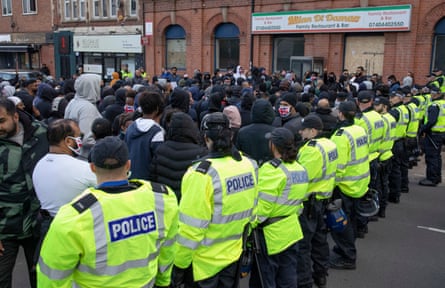
As word spread on WhatsApp, counter-demonstrations of mainly Muslim men soon formed. Many local police officers had been seconded to London for the state funeral, but those that remained were hastily scrambled to try to keep the crowds apart. One man, filming on his phone, appealed to a police officer to make arrests. “I don’t know what they’re saying,” the officer admitted. “The problem is if we arrest one person, the whole fucking lot go up.”
What started as a group of Hindus marching to a “Muslim area” ended with groups of Muslims following them to the city’s “Hindu area” – Belgrave Road, about 1.5 miles north, a lively high street of jewellery shops and restaurants. By the time night fell, fights were breaking out. A young Hindu man driving a car was attacked, his head slashed, after a false rumour spread that he had tried to run people over. The chaos spilled over into local businesses. I spoke to someone who was having dinner at about 9pm in a dosa restaurant on Belgrave Road when a young man ran inside, barefoot, looking for shelter after he’d been attacked; a couple of other men who were bleeding tried to get in, too. Terrified, the restaurant owners brought down the shutters and turned off the lights.
A standoff between the two groups formed across Belgrave Road, with bottles flying through the air, and lasted until the police dispersed them in the early hours of the morning. It was there that the most incendiary video from the night was captured: a man jumped up on the walls of a Hindu temple and tore down a saffron-coloured religious flag; another clip shows a flag being set alight. These images went viral, becoming a visual shorthand for the intensity of the religious discord. The next day, at about 4pm, a crowd of Muslim men tried to march down Belgrave Road, shouting “Allahu Akbar” against a line of police. Within a few days, the disorder seemed to be spreading across the Midlands: there was a rowdy protest outside a Hindu temple in Smethwick, just west of Birmingham, in response to (aborted) plans to host a talk by a Hindu nationalist ideologue from India.
Speak to people in Leicester about why this all happened and you will hear different starting points. Even by beginning this story with the march on 17 September, I will have irked those who think a more appropriate starting point is late August, when a house in which Hindus were celebrating a religious festival was egged, or, a few days after that, when a Hindu man was stabbed in the arm, reportedly by a Muslim assailant. (The victim would go on to be one of the organisers of the march, though he later said that his aim had been just to organise “a normal protest”.) Or 28 August, when India beat Pakistan at cricket in the Asia Cup in Dubai and jubilant fans chanted “Pakistan Murdabad” – “Death to/Down with Pakistan” – in the streets and a fight broke out. Or even as far back as May, when a group of young men allegedly asked someone if he was Muslim before attacking him.
But it was the violence of 17 and 18 September that turned a local story into something much bigger. About 370,000 people live in Leicester; according to data gathered in the 2021 census, 23.5% are Muslim and 17.9% are Hindu, and the majority of both groups have Indian heritage. With sizable Somali and eastern European populations, the city is what sociologists call “super-diverse”. After the 2021 census, Leicester became, alongside Birmingham, one of the first British cities to have a non-white majority. But while white racist politics have been a feature of Leicester’s history – from the National Front picking up thousands of votes in the 1970s to the English Defence League marching on the city in 2010 – this kind of large-scale violent enmity between Hindus and Muslims was new. “It’s not something we have ever seen on the streets of Leicester,” Sharmen Rahmen, a former councillor, told me last June.
Suddenly, politicians, diplomats, activists, influencers, pressure groups and the global media turned their attention to Leicester. To many observers, it seemed that India’s often violent, sectarian politics were playing out on Britain’s streets. On Monday 19 September, the Indian high commission in London released a remarkably undiplomatic statement condemning “the violence perpetrated against the Indian community in Leicester and vandalisation of premises and symbols of Hindu religion”. Although Leicester’s Pakistani population is small (3.4% in 2021), the Pakistan high commission saw fit to issue its own statement, condemning the “systematic campaign of violence and intimidation that has been unleashed against the Muslims of the area”. In India, a demonstration was held under the banner “UK Save Hindus”, while Indian newspapers reported on “communal clashes” in the UK and the hashtag #HindusUnderAttack trended on Twitter. India’s foreign affairs minister raised the issue with the UK government.
The city was profoundly shaken, and the after-effects are still being felt. Last year, Britain’s then home secretary, Suella Braverman, gave a speech in which she cited Leicester as an example of the “failure” of multiculturalism. Two investigations are under way – one set up by communities secretary Michael Gove and chaired by Lord Ian Austin, who resigned from the Labour party under Jeremy Corbyn and was ennobled by Boris Johnson, and the other chaired by a former UN special rapporteur and based at Soas University of London. Leicester’s mayor, Peter Soulsby, has said that he worries neither “will be seen as being truly impartial”.
Yet there is a striking – and under-remarked – aspect to what happened in Leicester: the events of that weekend were, at least on the surface, relatively minor. A year on, 32 people had been found guilty of crimes including public order offences, possessing weapons and affray. Nobody was killed or put in a critical condition. As one observer told me, there are more dangerous football matches. The sheer scale of the response, in other words, was not to do with the scale of the violence.
What made the “disturbances”, “disorder”, “riots”, “unrest” – no one can agree on a single term – so potent is that they seemed to expose hidden fault lines running through England, not least the changing character of the country’s racial politics amid conditions of austerity, low economic growth and new migration flows. And beyond these national considerations lurks a bigger question: how the ultra-nationalist atmosphere of Narendra Modi’s India might be spreading beyond its borders.
On a quiet day last summer, Sanjay Modhwadia showed me around his garment factory in east Leicester. There was almost nobody inside, except for his business partner, Alkesh, who was working in an office perfumed by burning incense, and Alkesh’s young children, who were running around with mischievous, summer-holiday freedom. Sewing machines had been put away. Rolls of fabric lay in storage. Outside the entrance, a sign that used to note job vacancies – hemmers, lockstitchers, overlockers – was now covered up.
Modhwadia embodies two trends that help make sense of what happened in Leicester: the struggling economy in the city’s east, and its factional local politics. Tall and easy-going, he drove me around the garment district near Green Lane Road in a white SUV. “The clothing business has totally dried up,” he said, speaking in confident but imperfect English. (Modhwadia came to Britain from Gujarat in the early 1990s.)
There were 1,000 garment factories in Leicester in 2020; that number is now estimated to have halved. Industry insiders cite energy costs, outsourcing, a higher minimum wage and the effects of a major scandal in 2020, during the pandemic, when the “open secret” of minimum wage underpayment in the industry was brought into the open. Workers in some factories were being paid as little as £3.50 an hour; the fast-fashion brand Boohoo saw more than £1bn wiped off its value. I asked Modhwadia if he thought unemployment in the sector could have contributed to the unrest in 2022. He agreed that it was possible. “Every day more than 20 people are calling me for [a] job,” he said.
Modhwadia is well placed to answer these questions because he is not just a local businessman. He is also a Conservative councillor. In fact, he was the Tory party’s candidate for city mayor in last year’s elections, attracting 26,422 votes and giving Peter Soulsby (35,002) a fright. Soulsby is a powerful figure in the city, having been Labour council leader, a member of parliament, and elected mayor over his several decades in Leicester politics. “I just missed little bit from city mayor,” Modhwadia told me, laughing at the improbability of it all.
Modhwadia, who is Hindu, only entered politics recently. He became a councillor after winning a byelection in October 2022, one month after the violence. During the campaign, a photograph circulated on social media of his Labour rival standing next to a cardboard cut-out of Narendra Modi. The notion that Labour’s candidate was pro-Modi, or even a member of his Hindu nationalist party, the BJP, spread locally. (The candidate denied being a BJP member.) There was a 19-point swing in Modwadhia’s favour, and Labour dropped to third place, behind the Greens. The episode seemed to confirm a suspicion: Indian politics was a ghost at the table in Leicester.
Then there was the run-up to local elections last year, when the Labour party told 19 of its own councillors that they wouldn’t be allowed to stand. The news was picked up by the Times of India and Indian TV news, which reported that all of the party’s Hindu councillors had been blocked. In parts of east Leicester, a leaflet with the words “Labour party removes all Hindu councillors” was distributed. Outside observers assumed the decision had something to do with the disorder of 2022, but it seems to have ultimately been a story familiar to followers of Labour party politics – one of centralism and control. The blocked councillors were from different religious backgrounds, but most of them had voted that same year to abolish the elected mayor post, going against Soulsby in a high-stakes vote. (Soulsby’s office did not respond to requests for comment.)
When the local elections came, Labour paid the price. While the rest of England seemed to be voting against the Conservatives – the party lost more than 1,000 councillors – there was a blue wave in Leicester, with Tories winning 17 seats on the city council. The new councillors, many of them from a Hindu background, performed particularly well in wards with large Hindu populations. After the results, Soulsby told BBC Leicester that he believed religion had been “weaponised”. (Other observers told me the rift between Labour and Leicester’s Hindus could be traced back to 2019, when one of the city’s MPs chaired a party conference session that contested India’s claims to the disputed territory of Kashmir. During the general elections that year, the Overseas Friends of the BJP UK openly canvassed across the country, trying to tempt voters away from the “anti-India” Labour party.)
Local politics can be brutal. It is where the political is always personal. But there is something else that makes it particularly fraught: austerity. Since 2010, council spending on services other than social care in Leicester has been cut by at least 50%. A small but telling example: if you had walked by the city’s customer service centre in 2019 and looked at the opening hours in the window, it would have said Monday to Friday. Now it is only open two days a week. Rita Patel, a former assistant mayor of Leicester, told me that cuts had reduced the city’s finances to the “bare bones” and that it was no longer able to help newly arrived migrants find their feet. She also spoke of Leicester’s bruising experience with the pandemic – it went through the country’s longest lockdown.
Austerity has perverse consequences: when Labour-run councils administer the cuts, it can be local Tories who benefit. But it also has psychological effects. As public resources dwindle, politics acquires an edge of desperation. Communities compete for what remains. In June, Patel told me she believed the city was heading for a black hole in its finances. By October, I was reading that it was “almost inevitable” that Leicester would follow several other councils and effectively declare bankruptcy. All of this in a city that was once considered to be one of the richest in Europe.
It wasn’t until the second half of the century that Leicester acquired the badge it still wears today, as a bustling example of multicultural England. When the writer JB Priestley visited Leicester in the early 1930s, it struck him as rather dull. “It seemed,” he wrote, “to lack character, to be busy and cheerful and industrial and built of red brick, and to be nothing else.”
The first significant cohort of Asian settlers came after the second world war. It was a relatively small community – less than 5,000 by 1961 – but it established itself socially and culturally. The major migration wave came in the late 60s and 70s and largely comprised Asian “twice migrants” – those who had settled in countries such as Kenya and Uganda under the auspices of British colonialism. When those countries gained independence and pursued “Africanisation” policies, many Asians left. In the case of Uganda, they were expelled with 90 days’ notice.
There is a darkly funny story about why so many Ugandan Asians chose Leicester. In 1972, the city council took out an advert in the Uganda Argus telling people that the city was full and that conditions weren’t as good as when previous migrants had arrived. The joke is that rather than putting people off, it simply alerted them to the fact that there was already an Asian community in Leicester – and so they came. Residents I spoke to were full of piquant stories of settling in the city over the decades, from the first time they saw falling snow to the corner-shop owner who imported reels of Bollywood films for the homesick.
Gurharpal Singh, a political scientist who has lived and studied the Asian settlement of Leicester, arrived from Punjab in 1964 when he was eight years old. “I’ve seen it move from very much a white city to now a melting pot,” he told me when we met at the University of Leicester campus. He remembers dreading school football matches in the whiter west of the city – because the Asians would get beaten up afterwards. “When I tell this to my kids, they say, ‘Oh, how traumatic,’ and I say: ‘Well, that was just part of the game.’”
Over time, Leicester developed a reputation as being a “model” for multiculturalism, in part because it avoided strife such as the 2001 “race riots” in northern mill-towns – when the far-right provoked violence with British-Asians. In a 2003 paper for Unesco, Singh tried to work out why this was. He chalked it down to three factors. First, many of the migrants who came in the 60s and 70s were of professional backgrounds. They set up small businesses or they found jobs in a “buoyant” local economy that needed male and female workers. Second, they didn’t compete for social housing, as happened elsewhere, instead choosing cheap private housing in inner-city areas such as Belgrave and Highfields. Third, the local Labour party recognised the electoral value of the Asian vote, and the city council embraced multiculturalism as policy.
The “Leicester model” was always somewhat illusory. “Because the underlying reality of Leicester was it was a partition city,” Singh told me. Asians tended to live in east Leicester, the white working class in the west and the more affluent in the south. But one thing that did unite south Asians of all faiths in Britain was a common enemy: racism. The National Front campaigned heavily in Leicester after the Ugandan Asians arrived, and often received sympathetic coverage in the local press. Joining the resistance were organisations from the Indian Workers’ Association to local outfits like the Highfields and Belgrave Defence Campaign. In the 70s and 80s, south Asians involved in organised anti-racism often identified as black, which connoted a political affiliation as much as a racial identity, and helped build bridges between disparate groups. In Leicester, people were doubly united by a regional ancestry and language, as many of them were originally from Gujarat. People in the city I spoke to said that, growing up in the 70s, 80s or 90s, religion was not a significant source of division.
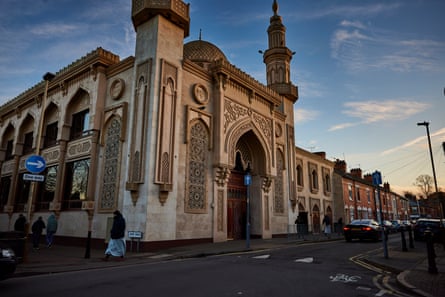
But communities were, slowly, drifting apart. After the 1981 riots across England – inner-city revolts against unemployment and police violence – central and local governments made funds available for ethnic minority groups; these paid for things like salaries, community outreach officers and religious festivals. Some believe that this was an imperfect but valuable response to the racism of the time. Others argue that these initiatives blunted the edges of anti-racist politics. The inner-city funds in Leicester, Singh wrote, “became the basis of establishing a patron-client relationship between the local authority and ethnic community groups”. This arrangement dissipated the unity that had once existed between minority groups, said Priya Thamotheram, who runs a community centre in Leicester. “Now,” he told me, “it’s not about what is common between us, what unifies us, it’s more about what’s unique about us that we can pitch in and get some funding.”
These national trends were accelerated by global events. Various factors – the fatwa against Salman Rushdie, 9/11, the “war on terror”, the rise of Islamophobia – increased the salience of Muslim identities. Meanwhile, Hindu nationalist politics, with its master theme of asserting Hindu pride, took off electorally in India in the 90s with the success of the BJP, and rippled across the diaspora. The Muslim Council of Britain was formed in 1997; the Hindu Forum of Britain in 2004. Political blackness, and even the broader notion of “Asian” identity, receded into history as religion came to the fore.
Something else has changed since the heyday of the Leicester model: more Indians have migrated to the city. This matters because many of the young men who marched to Green Lane Road in September 2022 were drawn from relatively new migrant communities. In particular, they hailed from Daman and Diu, two coastal territories next to Gujarat. These places were not colonised by Britain, but Portugal, which only relinquished its Indian colonies in 1961. Through this twist of history, many people from Daman and Diu are eligible for Portuguese citizenship. Some ended up settling in Britain as European citizens before Brexit. At the time of the 2021 census, there were 18,862 Portuguese passport holders in Leicester – that’s 5.1% of the city’s population, the largest such proportion in the UK.
The Daman and Diu communities disturb the stereotypical image of Hindus in Britain as well-off professionals. Many work in Leicester’s garment sector or in warehouse jobs. (One of the city’s biggest employers is a company called Samworth Brothers, where staff and agency workers make salads and pastries for high-street brands.) It is not unusual for multiple families to live under one roof. Perhaps because of their hardship, Daman and Diu people are also culturally self-confident: they celebrate their Hinduism proudly. In the area around Green Lane Road, you can often tell which houses they live in because of the religious iconography in the windows and doors. (Crucifixes and verses from the Qur’an also adorn some house fronts.)
Last summer, I visited an office on Belgrave Road called Daman and Diu NRI Services (NRI stands for Non-Resident Indian). I waited as the owner, Ashwin Patel, spoke in Gujarati to a young woman who needed help. Her husband had died, he later told me, and he was explaining available services such as bereavement support. I asked what was the main problem facing Daman and Diu people in Leicester. His answer was simple: “No jobs.” It struck me that these recent migrants had arrived in a very different country to their Asian forebears – one with less explicit racism, but with a threadbare public realm and an economy more suited to the interests of asset owners than people who have nothing but their labour to sell.
One day, in the city centre, I met a Muslim man from Daman who had come over before Brexit and was now working as an UberEats delivery driver. He seemed bemused by my interest in him, and didn’t want me to quote him by name, because he thought his English wasn’t good enough. He spoke in an unvarnished, direct way about the violence. He said his friends had been involved in some fights, but that things have calmed down. He suggested that it was normal that the Hindus didn’t like them. It’s like in India, he said. “You can be friends growing up and then never speak as adults.”
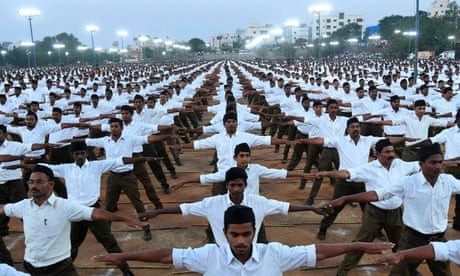
Perhaps the core disagreement about what actually happened in Leicester in September 2022 concerns the question of outside involvement. Faith groups and some councillors have referred to unnamed “outsiders” who they blame for stirring up discontent in an otherwise harmonious city. One common refrain after the violence was that the RSS was behind it. The uniformed, quasi-paramilitary group, which is the ideological parent of India’s ruling BJP, dreams of transforming secular India into an avowedly Hindu nation, in which minorities, particularly Muslims and Christians, pay fealty to Hindu supremacy as a condition of their continued presence. Although Indian secularism since independence has been less robust in practice than its liberal cheerleaders like to believe, under Modi – an RSS member since he was a teenager – the Hindu nationalist vision has been pursued with a zeal that would have once seemed unimaginable. The Daman and Diu marchers have been described by some Muslim activists as “RSS thugs”, adopting tactics familiar from India, where provocative marches are a staple of Hindu supremacist groups.
The notion that the RSS were openly organising in Leicester does seem fanciful. But what is interesting – and has not been widely reported – is that Leicester houses the UK headquarters of a group that is widely understood to be the overseas arm of the RSS, the Hindu Swayamsevak Sangh (HSS). “The HSS is organised in the exact same way as the RSS in India,” using the same titles and ranks, says Prof Christophe Jaffrelot, an expert in Hindu nationalism at King’s College London.
Founded in 1966 by east African Asians, today the HSS UK claims to run more than 100 weekly shakhas, or branches, across Britain, attended by more than 2,000 people. There is a focus on yoga, games, youth activities, charity and active citizenship. Last summer, I visited a building near Belgrave Road that houses the group’s head office. On the ground floor is a bookshop that sells religious and pro-RSS literature, alongside colourful children’s books. I bought a copy of Delhi Riots: The Untold Story, which gives a revisionist account of communal violence that took place in Delhi in 2020 and left at least 53 dead, the majority Muslim. (The book argues that the violence was ultimately caused by jihadists in cahoots with the far left.) I started speaking to two men, perhaps in their 70s, who appeared to work there. One was friendly even after I told him I was writing about Leicester; he carried on speaking until the other man ever so gently raised his hand, indicating to his friend that he should stop.
The HSS UK’s trustees have told the Charity Commission that there is no formal connection between it and the RSS, only an “ideological commonality”, as the commission put it. But the group’s relationship with the RSS is public and visible. Its Leicester headquarters were inaugurated in 1995 by the man who was then the RSS’s supreme chief. In 2016, the current RSS leader was the guest of honour at the HSS’s 50-year celebration in Hertfordshire.
The HSS UK has said that “to the best of [its] knowledge, none of those participating in HSS (UK) activity have been attacked nor involved in the unrest in Leicester”. But its presence in the city, and that of other groups, speaks to the existence of infrastructure and ideologues stretching back decades. And it serves as a corrective to the simplistic notion that such ideas were only recently “imported” into Leicester by “outsiders” or easily scapegoated migrants.
A constellation of organisations that could be described as following Hindutva – the name given to the ideology of Hindu nationalism – exist in Britain, as the academic Edward TG Anderson explains in his new book, Hindu Nationalism in the Indian Diaspora. Their discourse has recurring themes: there are appeals to ideas of the model minority citizen (it is observed that Hindus are underrepresented in prison populations), a keen sense of victimhood (there is an effort to popularise the idea of “Hinduphobia”) and the notion the British Hindus have failed to organise themselves as effectively as other minority groups. The sense that Hindus are under threat is common. “There are many challenges that our community is facing,” the HSS UK’s president, Dhiraj Shah, is reported to have said at a 2020 conference. “Once I heard that in Leicester almost every week three or four Hindus are being converted. Now, I cannot confirm, but this gives the scale of things that are happening in our community.”
The words reminded me of a poster I saw in the window of the Daman community centre in Leicester. Organised by a different group, it advertised a “Hindu Awareness Campaign” seminar on “grooming and religious conversion in the UK”. Talk of “grooming” is familiar on the British far right, but it has also long been a source of political anxiety for Hindu nationalists in India, where it takes the form of a great replacement-style conspiracy theory that frames Hindu women as the victims of a “love jihad”, seduced and converted by Muslim men. (The president of the community centre did not respond to requests for comment. The HSS UK did not agree to arrange an interview with Dhiraj Shah, and the organisation declined to respond to questions via email, stating that “given the narrow scope of the questioning and the track record of the Guardian coverage on issues such as the riots in Leicester we do not have any confidence that the Guardian will provide fair and holistic coverage of HSS (UK)”.)
Hinduism is an astonishingly complex faith with numerous sects and traditions, and many Hindus I spoke to in Leicester had never even heard of these organisations. The claims of nationalist groups in the diaspora to speak for some kind of unified community ignore this irrepressible diversity. According to a 2021 YouGov survey, 37% of British Hindus said they approved of Modi’s performance as prime minister and 43% said they disapproved. Many simply won’t know that much or care about these kinds of issues at all.
But size or support isn’t everything in politics: what matters is organisational nous. Some of these groups have patiently cultivated links with MPs and demonstrated their willingness to knock on doors. It has not been lost on the Labour party that its support among British Indians, particularly Hindus, has waned. Historically, British Indians were reliable Labour voters, but a recent survey suggested that only 30% of British Indians voted Labour in the 2019 general election and the majority of Hindu voters went Tory. Much of this will be down to secular processes, like increasing wealth, and its electoral significance can be overstated. But any Tory political strategist worth their wage will be thinking about how to take advantage of it.
On a grey November afternoon last year, I walked out of Leicester train station just as a huge, slow-moving crowd snaked into view. An estimated 5,000 people were marching in support for the people of Gaza. As the crowd turned on to the high street, a bucket’s worth of what appeared to be water was dropped from a balcony above, narrowly missing people. The crowd looked up with an air of bewilderment at the person on the balcony, who was now yelling at them, and carried on towards the clock tower in the city centre, where people were giving speeches. There were representatives from the Socialist party and the Greens, and Leicester East’s MP Claudia Webbe was there. (Formerly Labour, Webbe sits as an independent after she was convicted in 2021 of harassment of a love rival and ejected from the Labour party.) They spoke about Israel’s war in Gaza in a secular, humanitarian language. Then a man who was introduced as a “community activist, a social media activist” took up the microphone.
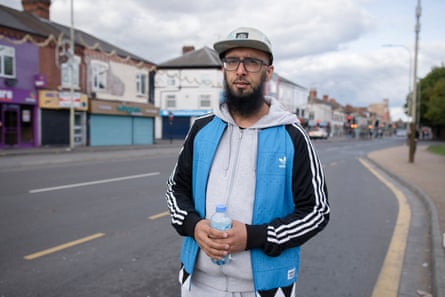
Lots of people in Leicester have an opinion about Majid Freeman. Some see him as a troublemaker who stirred up enmity between Hindus and Muslims during those tense summer months in 2022. Others say that they don’t agree with everything he says, but recognise that he reaches people in the community that mainstream Muslim organisations don’t. With his trademark baseball cap and long beard, Freeman is a distinctive and ubiquitous presence in east Leicester. He has more than 43,000 Instagram followers – a lot when your focus is one city.
Freeman’s politics are neither left nor right: what seems to motivate him is advancing the interests of Muslims. In his speech that day, Freeman castigated the Labour MP for Leicester South, Jonathan Ashworth, who abstained in the ceasefire vote at parliament. He then turned his attention to the city’s “Muslim organisations”, which he framed as aloof, timid and complicit. “We need to ask these organisations to stop having private meetings with [politicians],” Freeman said. “There’s no public accountability.” He didn’t mention any by name, but I took him to be referring to the Federation of Muslim Organisations (FMO), founded in 1983 and seen by Leicester officialdom as the main Muslim community organisation. He ended his speech with a call and response of “Takbir – Allahu Akbar.”
People with an unfavourable view of Freeman will talk about his provocative social media posts in the run-up to the violence. In early September 2022, he shared a false rumour that a Muslim teenager had almost been kidnapped, though he deleted the posts and published a correction on Twitter when found out it wasn’t true. Later that month, he shared a video on Twitter that purported to show a recording of Daman and Diu people holding late-night religious festivities in mixed residential neighbourhoods, which was often cited that year as a source of inter-community tensions. “Is this normal acceptable behaviour?” he wrote. “Listen to the drunken mobs screaming at the end like hyenas at 3am. They felt invincible until now.” Things had only improved, he said, after Muslims started “patrolling the streets and making their presence known”.
To those who see him as belligerent, though, Freeman might point out that as the violence peaked on the night of 17 September, he intervened to protect a Hindu man from a mob. Sky news ran a story about it: “Hindu man thanks Muslim activist who stepped in to save him during night of Leicester violence”. (Freeman declined to be interviewed on the record, but he sent me a statement, maintaining his “profound love for Leicester”, his “strong connections with my Hindu neighbours, rooted in mutual respect and understanding” and his efforts “to bridge divides and foster dialogue between disparate groups”.)
Freeman is part of a digital ecosystem of religious-activist “influencers”. On Sunday 18 September 2022, two men known as Ali Dawah and Mohammed Hijab travelled from London to Leicester, where they met him. They are well-known figures in online Muslim circles and were recognised by people on the ground. “Hijab and Dawah belong to the most conservative modern variant of Sunni Islam,” Ashraf Hoque, an anthropologist at University College London, told me. “For them, it is a fundamental religious obligation for all Muslims to spread and purify the faith.” Emerging from the debating culture of Speakers’ Corner in Hyde Park, they are confident pundits, publishing an array of content on subjects like Islam, foreign affairs and Canadian culture warrior Jordan Peterson.
The video Dawah posted on his YouTube channel (headline: MUSLIMS SEVERE MESSAGE TO HINDUTVA – THIS IS NOT INDIA!!!) is a fascinating insight into what happens when influencers meet real-world politics. A group of Muslim men stand at the bottom of Belgrave Road, against a line of riot police. Hijab, a commanding and bullish figure, pushes his way through the front and tries to address them. “They’re more likely to listen to me than you,” he tells a police officer. He tries to make a speech about “strategic goals” but struggles to get their undivided attention. One person in the crowd says that these people aren’t from Leicester and that they’re just here for social media “clout”. Dawah doesn’t disagree, arguing that publicising what is happening is exactly the point .
Eventually, things fizzled out on that Sunday, but not before Hijab gave a speech in which he referred to the “Hindutva” marchers as “violent vegetarians”. In another clip, he appears to poke fun at Hindu beliefs, arguing that the marchers had been reincarnated as “cowardly” men. (He later said that his language was hyperbolic and that he did not intend to mock Hinduism as a religion.) There is some laughter from the crowd, but it seems unsure of itself. On YouTube, the top-rated comment below the video when I watched it appeared to document the creation of communal consciousness in real time: “I wasnt much religious before but after hearing this ... damn i am so proud of myself for being a hindu😊.”
‘Long-distance nationalism” was the historian Benedict Anderson’s term for the patriotic activity of a diaspora. Writing in the 1990s, Anderson gave the example of Hindus in Britain and North America who raised funds for the campaign to build a temple in Ayodhya, India, in a location that many believe to be the birthplace of the deity Rama. Last month, Modi inaugurated that temple in a spectacular ceremony that was the culmination of a decades-long campaign, pivoting on the destruction of a mosque on the site in 1992. In Leicester, there was a peaceful march in which devotees chanted “Jai Shree Ram”. Keith Vaz, the former MP for Leicester East, who is still influential in his old constituency, gave a speech in a temple in which he paid tribute to prime minister Modi “for the work that he has done”. A fog of calm has descended over the city, but, every now and again, a potential flashpoint like this looms into view.
During my several visits to the city last year, I asked people what, if anything, had really changed since September 2022. “I think we’d be better prepared from a policing perspective,” said Neil Chakraborti, a professor at Leicester University. “But in terms of thinking about the causes and digging more deeply, beyond the superficial ‘Let’s have dialogue with community leaders’ response? I’m not sure.” Last year, the government said it was expecting its review to be finished in 2024; now it is saying it might be early 2025. “Some people just want to forget about it,” said Rita Patel, the former assistant mayor. “There are other people who’ve been around a long time who see, like me, that unless you deal with the underlying issues, all that will happen is it’ll come back at the worst possible time.”
Patel pointed out that Leicester’s women hardly seemed to feature in all this. Yes, it was men on the street. But “the women are the ones who have to provide the solutions and, you know, clear up in the aftermath”. One hopeful event that took place while I was reporting on the city was a protest in the garment sector. Organised by Labour Behind the Label, which campaigns for workers’ rights in the industry, it saw 500 people, mainly women, gathered in a park in east Leicester in October 2023. They condemned the industry’s low wages and demanded better conditions. I also came across a drive to unionise workers at Samworth Brothers, the food processing company where many migrants work. This is the kind of work that hints at a different way of living together, in which shared goals become more salient than religious differences.
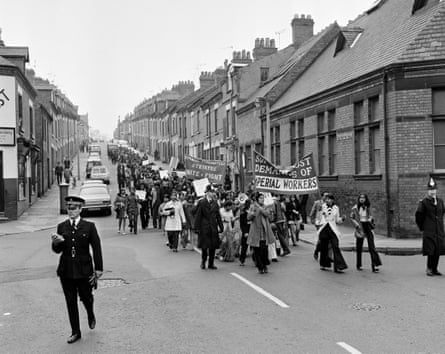
An iconic, influential strike was once led by Asian women in Leicester. In 1974, hundreds of Asian employees at the Imperial Typewriters Company walked off in protest at being denied the same promotions and bonuses as their white colleagues. The Transport and General Workers Union did not recognise the strike as official. Fighting the racism of their employer and union, the workers were assertive, overturning white prejudices about docile brown-skinned folk. “The strike at Imperial Typewriters,” a correspondent for Race Today wrote, “has, apart from anything else, put paid to certain myths.”
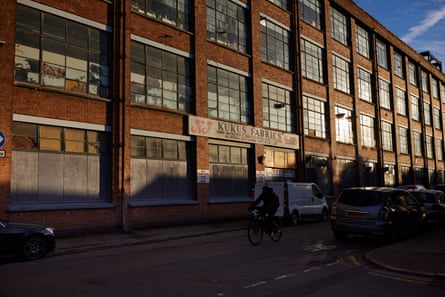
The huge factory building is still there, near Green Lane Road, with its sans-serif sign saying IMPERIAL. When JB Priestley visited it in the 1930s, he noted the “enterprise and ingenuity” of the workers assembling the typewriters. The ground floor is now used for different things: there are kitchen supply shops and even a gym. One weekday morning in November, I let myself in and nervously climbed a staircase, finding a few padlocked, empty studios where garment producers once worked. With its broken windows and dirty corridors, the building felt like an abandoned monument. A man who looked after it told me much of the space is now used for storage, and that no more than 100 people work there on any given day. The building told a story of the trajectory of the British economy, from industries that needed masses of people in one physical space, toiling side by side, to smaller, siloed forms of working and being.
Afterwards I went across the road to a branch of Chaiiwalla, a chain of Indian cafes. As I sipped a hot, sweet cup of tea, a woman entered with her husband. They were looking for work. Years ago they might have been taken on by Imperial or the garment sector. There was no chance of that now. The man behind the counter said that there weren’t any vacancies here, but that she should try a branch elsewhere in town. The couple left and idled on the pavement outside. It was cold, about 6C, but the man was wearing sandals with no socks. He looked tired and a little lost. I asked him when he came to Britain. “Ten days ago,” he said. From where in India? “Tamil Nadu.” I told him that’s where my grandfather lives, and he nodded politely. What did they make of this country so far, I wondered, and how did they feel about the India they had left behind? I asked if they wanted a cup of tea, but his wife seemed suspicious. She said that they had to go, and so they did.


https://www.tandfonline.com/doi/abs/10.1080/09546553.2023.2204032?journalCode=ftpv20
vice.com - Oct 26, 2022
https://www.telegraphindia.com/opinion/leicester-calling-defender-of-the-faith/cid/1888640
" The symmetry of the responses of the Pakistani and Indian high commissions to the recent communal violence in Leicester neatly illustrates the evolution of the Indian State under the Bharatiya Janata Party."
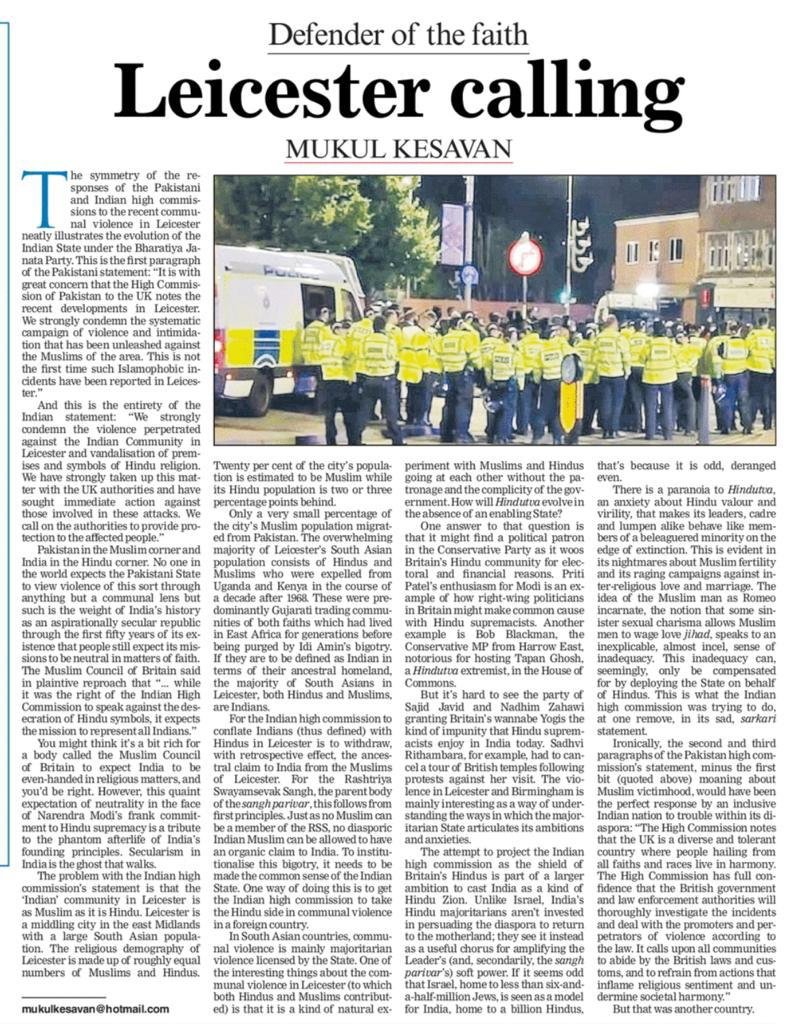
"They were coming past our mosques, taunting the community and physically beating people up randomly," reportedly said Majid Freeman, a local of Belgrave Road in the eastern part of Leicester.
How far right uses video games and tech to lure and radicalise teenage recruit
After a 13-year-old was sentenced last week, a young victim of radicalisation talks about how white supremacists target children
John was 15 when a member of his Facebook group volunteered to become Britain’s “first white suicide bomber”. Another advocated attending Friday prayers at the local mosque and “slaying people where they stood”. Another wanted to firebomb the place of worship.
Ultimately, no blood was spilt. Police soon raided several homes linked to the group. John and a friend – also 15 and an adherent of far-right ideology – buried an arsenal of knives and machetes to ensure officers never found them.
John became increasingly radicalised by an online barrage of far-right disinformation. “Posts of homeless British soldiers were set against Muslim families being given free homes. Now I know the posts were all fake, but the 15-year-old me didn’t bother to fact-check.”
[ . . . ]