|
Showing posts with label L K Advani. Show all posts

November 09, 2022

India: Allahabad High Court dismisses appeal against acquittal of LK Advani, others [Babri Masjid demolition]

[Babri Masjid demolition] Allahabad High Court dismisses appeal against acquittal of LK Advani, others

The plea challenged the 2020 judgment by the Special CBI court which held that there was nothing on record to establish the existence of a conspiracy to demolish the Babri Masjid.

https://www.barandbench.com/news/litigation/babri-masjid-demolition-allahabad-high-court-dismisses-appeal-against-acquittal-lk-advani

May 26, 2019

India: Disciples of Savarkar, LK Advani, Nathu Ram Godse, Pragya Singh Thakur ... the list is long


April 06, 2019

India: BJP Leaders who ignited a deadly fire | Ruchir Joshi

Leaders who ignited a deadly fire
Ruchir Joshi
April 04, 2019 00:15 IST

BJP leaders M.M. Joshi and L.K. Advani during a BJP national executive meeting, in New Delhi. File | Photo Credit: V. Sudershan

There is limited satisfaction in seeing L.K. Advani and M.M. Joshi being retired

https://www.thehindu.com/opinion/op-ed/leaders-who-ignited-a-deadly-fire/article26725236.ece

March 06, 2017

India - Babri Masjid Demolition Case: Won't Accept Dropping Of Charges Against LK Advani On Technical Grounds, Says Top Court (A Vaidyanathan)


New Delhi: 

Highlights

  1. LK Advani was cleared of conspiracy charges by lower court in Babri case
  2. CBI has challenged High Court order confirming lower court decision
  3. Supreme Court may announce order on March 22
Senior BJP leader LK Advani and other BJP leaders may face trial in the decades-old Babri mosque demolition case, the Supreme Court indicated today. The court is expected to reveal on March 22 whether or not conspiracy charges will be revived against Mr Advani, 89, and other leaders like Murli Manohar Joshi and Union Minister Uma Bharti. The charge was dropped by lower courts.

Mr Advani, Mr Joshi and a dozen others including Vinay Katiyar and Kalyan Singh - the Governor of Rajasthan - were released by a court in Raebareli from conspiracy charges in the razing of the 16th century Babri mosque in Ayodhya in December 1992 by Hindu activists who believed it was built on the birthplace of Lord Ram. [. . .]

http://www.ndtv.com/india-news/babri-demolition-wont-accept-dropping-of-charges-against-lk-advani-on-technical-grounds-says-top-cou-1666583

April 01, 2015

India: Babri ghost returns to haunt Advani (various reports)

The Telegraph (Calcutta), April 1 , 2015

Babri ghost returns to haunt Advani
Our Legal Correspondent

New Delhi, March 31: The Supreme Court has asked BJP leaders L.K. Advani and Murli Manohar Joshi to say why the "criminal conspiracy" charge against them in the Babri Masjid demolition case should not be reinstated, on an appeal by an Ayodhya resident.

Haji Mehboob Ahmed, 72, a petitioner in the title suit, has filed the appeal against the 2010 Allahabad High Court order that upheld a 2001 trial court order dropping the conspiracy charge against Advani and 19 others.

A bench of Chief Justice H.L. Dattu and Justice Arun Misra issued notices to all the accused, who are also respondents in a similar appeal filed by the CBI in February 2013 against the May 2010 high court order.

Justice Dattu told senior counsel Kapil Sibal, appearing for Ahmed, that he would have to convince the court why his appeal has been filed so late.

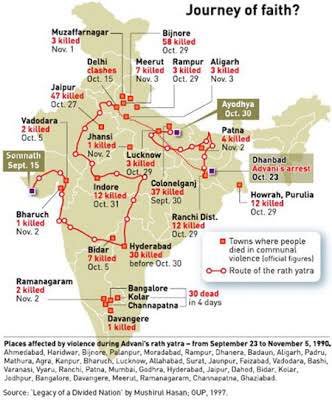
Ahmed told The Telegraph from Ayodhya that he had approached the Supreme Court because he was afraid the case would be diluted now that the BJP was in power at the Centre. (See chart)

During the brief hearing, additional solicitor-general Neeraj Kishan Kaul sought and was granted three weeks' time to argue on the merits of the CBI appeal against the BJP leaders.

When the appeal against the discharge of Advani and the others - Union minister Uma Bharti and Rajasthan governor Kalyan Singh among them - was filed in 2013, the UPA was in power at the Centre. Now, when the CBI is to justify that appeal, it is under a BJP government.

There are two sets of cases - one against Advani and others who were on the dais at Ram Katha Kunj in Ayodhya on December 6, 1992, when the Babri mosque was demolished, and another against lakhs of unknown karsevaks who were in and around the disputed structure and were actually involved in the demolition.

The CBI had chargesheeted Advani and 19 others under Sections 153A (promoting enmity between classes), 153B (imputations, assertions prejudicial to national integration) and 505 (false statements, rumours etc. circulated with the intent to cause mutiny or disturb public peace) of the Indian Penal Code.

It had subsequently invoked the charge under Section 120B (criminal conspiracy), which was quashed by the special CBI court.

Upholding the special court's order, the high court had said the CBI at no point of time, either during the trial at Rae Bareli or in its revision petition, had ever stated that there was an offence of criminal conspiracy against the senior BJP leaders.

Besides Advani, Joshi, Uma Bharti and Singh, the others against whom the charge was dropped included Satish Pradhan, C.R. Bansal, Ashok Singhal, Giriraj Kishore, Sadhvi Ritambhara, V.H. Dalmia, Mahant Avaidhynath, R.V. Vedanti, Param Hans Ram Chandra Das, Jagdish Muni Maharaj, B.L. Sharma, Nritya Gopal Das, Dharam Das, Satish Nagar and Moreshwar Save.

Shiv Sena founder Bal Thackeray's name was removed from the list of accused persons after his death.

o o o

The Indian Express

Babri Masjid demolition case: Courts are ‘the only way ahead when accused are in govt’, says Haji Mehboob
Written by Seema Chishti | New Delhi | Published on:April 1, 2015 1:32 am
Haji Mehboob, 77, is a well-known figure in Ayodhya for residents as well as the journalists who travel there every so often to report on the mandir-masjid dispute.

A member of the Aman Committee, he is held in high regard but his standing was not able to prevent the arson and looting that accompanied the demolition of the Babri Masjid in 1992. He fled to a neighbouring village relatively untouched by the tension. His Ayodhya home is just a stone’s throw from what used to be the Babri Masjid.

Asked what prompted him to petition the Supreme Court at a time when the BJP was in a full majority in the Centre and L K Advani had been awarded the Padma Bhushan just hours earlier, he replied, “I believe that there is justice and I have full faith in the Supreme Court. [. . .]
http://indianexpress.com/article/india/india-others/babri-masjid-demolition-case-courts-are-the-only-way-ahead-when-accused-are-in-govt-says-haji-mehboob/

o o o

Babri Masjid demolition case: Sitaram Yechury lauds SC notice to Advani
Tuesday, 31 March 2015 - 6:46pm IST | Place: New Delhi | Agency: ANI

http://www.dnaindia.com/india/report-babri-masjid-demolition-case-sitaram-yechury-lauds-sc-notice-to-advani-2073519

April 23, 2014

June 28, 2013

Dr Syama Prasad Mookerjee: The Hindutva Icon Who Betrayed the Freedom Struggle of India

by Shamsul Islam

Dr Syama Prasad Mookerjee (1901-1953) is a prominent Hindutva icon for the RSS/BJP camp. It was he who, on the advice of M.S. Golwalkar, founded the Bharatiya Jana Sangh (BJS) in 1951 and became the first president of the political arm of the RSS. He died in Srinagar, Jammu and Kashmir, on 23 June 1953, when he was under arrest. His death is mourned every year as 'End Article 370 Day' and 'Save Kashmir Day'.
This year too, meetings were organized to highlight the 'sacrifice' of Dr Mookerjee for Jammu and Kashmir. L.K. Advani and Narendra Modi addressed gatherings at Delhi and Madhopur, Punjab, respectively. Dr Mookerjee was lauded as a great nationalist and patriot. Advani in his blog (http://blog.lkadvani.in/blog-in- english/salutations-to-a-great-martyr) on 23 June 2013, under the title SALUTATIONS TO A GREAT MARTYR, apart from giving details of Dr Mookerjee's founding of the BJS, the Kashmir campaign, his arrest at Madhopur and subsequent death at the state hospital in Srinagar, declared him to be 'a great leader' and a 'great patriot right from his birth'. He went on to add that 'We in the BJP owe our position in India's politics to the sacrifices and exertions of thousands who have preceded us, and above all to the vision and martyrdom of Dr Mookerjee.'
On the same day, Narendra Modi wrote the following, which was reproduced in the blog of Advani:
“Today we remember the great Syama Prasad Mookerjee, a statesman, thinker and a patriot who devoted his life towards strengthening national integration. The founder of the Bharatiya Jana Sangh, he left us on this day exactly 59 years back in 1953...Remembering him, Advaniji has penned a heart-touching blog today “SALUTATIONS TO A GREAT MARTYR!” which I would like to share with you.”
The rhetoric of these two ‘Iron Men’ of the RSS/BJP camp needs to be cross- checked with the contemporary documents available. Perusal of these documents clearly shows that the claim that Dr Syama Prasad Mookerjee was a 'great leader' and a 'great patriot right from his birth' is a farce. Dr Mookerjee did not participate in the Freedom Struggle launched to liberate India from British rule. If patriotism means being part of the Freedom Struggle and making sacrifices, Dr Mookerjee not only kept aloof from it but also betrayed it by siding with the British rulers and the Muslim League. He was a great votary of the partition of Bengal on the eve of
India’s independence.
In pre-Independence times he was a prominent leader of the Hindu Mahasabha, which was led by V.D. Savarkar. When in 1942 during the Quit India movement the British rulers were asked to quit India, they responded to this mass movement by unleashing a reign of terror. While hundreds of people died in police firings, the Hindu Mahasabha, with the Muslim League led by M.A. Jinnah, ran coalition governments in Sind, Bengal and NWFP. This is corroborated by the following words of 'Veer' Savarkar (from his presidential speech to the 24th session of the Hindu Mahasabha at Kanpur in 1942):
“In practical politics also the Mahasabha knows that we must advance through reasonable compromises. Witness the fact that only recently in Sind, the Sind-Hindu-Sabha on invitation had taken the responsibility of joining hands with the League itself in running coalition Government. The case of Bengal is well known. Wild Leaguers whom even the Congress with all its submissiveness could not placate grew quite reasonably compromising and sociable as soon as they came in contact with the HM and the Coalition Government, under the premiership of Mr Fazlul Huq and the able lead of our esteemed Mahasabha leader Dr Syama Prasad Mookerji, functioned successfully for a year or so to the benefit of both the communities.”
In Sind, the Hindu Mahasabha entered into an alliance with the Muslim League and formed the government after the great secular prime minister (at that time chief ministers were designated prime ministers) Allah Baksh was dismissed by the British Governor for his support to the Quit India Movement. He headed the Ittehad (unity) Party government. It was a mass based secular party consisting of Muslims, Hindus and Sikhs which did not allow the Muslim League to enter Sind, a Muslim majority province. He was murdered by Muslim League goons in 1943. Later on a coalition government between the Muslim League and Hindu Mahasabha was formed in NWFP also.
In a more shocking development, the Hindu Mahasabha of Dr Mookerjee decided to help the British rulers in World War II. It was the time when Subhash Chandra Bose, known as Netaji, was organizing the INA (Azad Hind Fauj) in a military campaign to force the British out. The extent to which the Hindu Mahasabha was willing to help the British masters is clear from the following directive issued by Savarkar as President of the Mahasabha:
“So far as India's defence is concerned, Hindudom must ally unhesitatingly, in a spirit of responsive co-operation, with the war effort of the Indian government in so far as it is consistent with the Hindu interests, by joining the
Army, Navy and the Aerial forces in as large a number as possible and by securing an entry into all ordnance, ammunition and war craft factories.... Again it must be noted that Japan's entry into the war has exposed us directly and immediately to the attack by Britain’s enemies. Consequently, whether we like it or not, we shall have to defend our own hearth and home against the ravages of the war and this can only be done by intensifying the government's war effort to defend India. Hindu Mahasabhaites must, therefore, rouse Hindus especially in the provinces of Bengal and Assam as effectively as possible to enter the military forces of all arms without losing a single minute.” [Cited in V.D. Savarkar, Samagra Savarkar Wangmaya: Hindu
Rashtra Darshan, vol. 6, Maharashtra Prantik Hindusabha, Poona, 1963, p.
460]
The Hindu Mahasabha was in direct contact with the then British Viceroy and the Commander-in-Chief of the British armed forces for organizing resources, both human and material, for the British war effort. It organized armed forces recruitment camps. Savarkar even called upon all those Hindus who had offered to join British armed forces to “be perfectly amenable and obedient to the military discipline and order which may prevail there provided always that the latter do not deliberately aim to humiliate Hindu Honour.” [Cited in A.S. Bhide (ed.), Vinayak Damodar Savarkar's
Whirlwind Propaganda: Extracts from the President's Diary of his Propagandist
Tours, Interviews from December 1937 to October 1941, na, Bombay, 1940, p.
xxviii]
It may not be out of place to say here that I posted a comment on Advani's blog referring to Dr Mookerjee's participation in a Muslim League government in Bengal, as narrated by Savarkar, on 23 June 2013 at 9.14 a.m., requesting his comments. In a short while it was removed. I reposted it at 10.43 but the same story was repeated. But my comment re-appeared on 26 June, again without any response. It is true that the blog belongs to the RSS/BJP leader, Advani, and that he has the absolute right to decide what appears on it. However, I feel that since he had made statements he should have responded to my query, 'Was Dr Mookerjee a patriot for a democratic- secular India?’ His silence suggests to me that he knows that bluff has its limitations.
It is not that I am unsympathetic. Even a master of sophistry cannot deal with the contradiction that the Hindu Mahasabha helped to run provinces for the British rulers precisely when a much larger number of Indians was asking the British to leave India. Even Advani cannot explain away the eagerness of Dr Mookerjee's mentor, Savarkar, to aid the British war effort when countless Indians so badly wanted 'the Jewel in the [British] Crown' to be their own land again that Subhas Bose even undertook military action. We should never forget that when the Hindu Mahasabha led by Savarkar and Dr Mookerjee was facilitating the colonial masters’ war efforts,

the freedom fighters were raising the slogan, “na ek bhai, na ek pai” (not a man, not a paisa for the War).
Finally, as a student of Indian politics and history, I request Advani to reveal the source of his information that Dr Mookerjee was a 'great patriot right from his birth', about which no one else knows anything. I have been denied a response by Advani in his blog but am hopeful that this write-up will secure an explanation from the RSS patriarch to enrich the nation’s memory about Dr Syama Prasad Mookerjee.
[With thanks to Mr Mukul Dube for suggestions]

June 26, 2013

Modi-Advani and Sangh's Agenda -Ram Puniyani

Modi, Advani and Sangh’s Agenda

Ram Puniyani

The nomination of Narendra Modi as the chief of campaign committee of BJP for 2014 elections (June 2013) has created more than a storm in the tea cup. Incidentally it is the first time ever that such a nomination has created 24x7 news and controversy. It has a lot to do with the propaganda machinery, which Modi has created around him. The atmosphere being created is that this nomination is like being nominated as the Prime Ministerial candidate or a prelude to it, which may be true. The major opposition to this came from Modi’s own mentor Lal Krishna Advani, who for quite some time has been the one to promote and protect Modi. It is his politics due to which Modi has his present stature and power within BJP and in Gujarat. Advani was the one to suggest his name as the Chief Minister of Gujarat, when Gujarat’s political fortunes were declining, and Modi revived those electoral fortunes, the linkage between carnage 2002 and Modi’s rise to power is a matter of conjecture.

With the discernible role of Modi in Gujarat violence, the then Prime Minister Atal Bihari Vajpayee wanted Modi to be sacked but it was Advani, who saved Modi’s skin. Even earlier it was Advani who promoted Modi to the forefront. The reason was nothing personal; it was the matching political agenda of both these swayamsevaks, Modi and Advani, who were working in tandem to enhance the creeping communalism in the polity of the nation. They are swayamsevaks of RSS and have been major players in the RSS agenda of Hindu Rashtra. Advani, having brought BJP to the forefront from two seats in 1984 Lok Sabha elections to the later 161 in the post Babri demolition elections and to further peak of 182 in 1999, with the further polarization. Advani’s communal actions catapulted BJP and it became the major opposition party and then came to the seat of power in Center for close to six years. Advani, being a shrewd politician knew that though he is the one responsible for the BJP’s enhanced fortunes, he also realized that his divisive actions will prevent other political parties to enter in to an alliance with BJP. It is because of this that he pushed forward the name of a fellow swayamsevak, Atal Bihari Vajpayee, who managed to keep a moderate image despite having the same agenda of Hindu rashtra.

After Vajpayees innings as PM, Advani’s Prime Ministerial ambitions forced him to adopt a moderate image. The demolisher-in-chief of Babri mosque started making moderate noises to the extent that he picked up Jinnah’s speech in Pakistan Constituent Assembly on 11th August 1947, to call him a secular leader. This speech alone cannot be the base of evaluating Jinnah, as it is the same Jinnah, who was the Chief of Muslim League and he was the one who gave the muscles and teeth to the communal ideology of ‘Two Nation Theory, the ideology which was shared both by Hindu and Muslim communalists. Calling Jinnah secular was probably overkill as by that time RSS combine had consolidated the Hindus around ‘hate Muslims and hate Jinnah’. To swallow this statement from Advani was a bit too much for the patriarch, RSS, and so Advani was dumped. RSS as such also wanted a change of guard keeping the age factor in mind. For the lack of any credible face, Advani had to be resurrected again for 2009 general elections.

As such RSS had also some reservations about giving the command to Modi as RSS wants the primacy of organization over individuals. Modi overshadows the organization to which he belongs. But in case of Modi, RSS seems to have made an exception as Modi has cultivated his appeal through carefully constructed propaganda and through the communal polarization brought in by his role in the Gujarat carnage. RSS politics is an Indian version of supra authoritarian politics, couched in the identity of religion, it’s a sort of fascist politics. Fascist politics needs a charismatic mass leader, so in deference to the political contingency RSS has loosened its reservations about Modi and has to accept his uncontrollable rise.

In the whole drama, as it is unfolding, the divisive image of Modi is making other NDA allies to shift away from BJP. These allies have to nurture their own constituencies amongst minorities, so they cannot easily accept the leadership of Modi. So the already deflated NDA will be further deflated and barring the diehard Hindutva Shiv Sena and communal Akali Dal all others may desert the ship which is likely to be captained by Modi. In this case what is noteworthy is the role of RSS. While Advani raised the banner of revolt, it was only a phone call from RSS supremo that Advani did a climb down. For swayamsevaks trained by RSS, there is no question of defying the dictates from Nagpur. This is for number of reasons. One that these swaymasevaks are taught that their primary loyalty is to RSS and Hindu Rashtra. One recalls that when the previous avatar of BJP, Bhartiya Jansangh merged into Janata party after the lifting of emergency in 1977, the other constituents of Janata party asked the Jansangh members to severe their links with RSS. The Jansangh components broke away from Janata Party leading to split in Janata party and retained their umbilical cord and their ideology with RSS. Atal Bihari Vajpayee the supposedly moderate face of BJP, in Staten Island, in US, while talking in to the NRIs reaffirmed that he is primarily a swayamsevak and later a Prime Minister.

Apart from ideological factors there are electoral factors which are operative as well. The main strength of BJP at electoral level comes from the RSS volunteers, who sweat it out to make their nominees win. The organization of BJP is tightly controlled by RSS through the organizing secretaries of BJP, who are the nominees from RSS. RSS felt rewarded as Ram Temple issue picked up, Advani’s divisive Rath Yatra led to series of acts of violence and communal polarization went to higher levels, which were electorally profitable to the Hindutva politics. Today the stage has come where on one hand the BJP has been declining in the electoral arena and on the other the regional parties are coming up with big strength. These regional parties are more focused on their local issues, so one does not know which way they will turn after the election results.

The whole episode has demonstrated two major things. It has shown the polarizing impact of Narendra Modi. People also perceive that he is dictatorial in his attitude and when in power he is capable of usurping all the power to himself. This authoritarian character is being projected as his being ‘powerful’. The other leaders in Gujarat have perceived it and ex BJP leaders have either been marginalized to the full. One cannot be very hopeful about the attitude of the regional and other parties out for keeping power irrespective of values. One recalls that when BJP emerged as the largest single party in 1996 no other party was willing to ally with it. But just a couple of years later so many of these parties hovered around BJP to share some power as NDA. RSS-BJP-Modi may be banking on this historical experience to woo the other parties, still it seems a difficult task as at that time the sobering presence of Vajpayee was instrumental in making the other parties fall in to delusion and have the some part of the cake of power.

Today the challenge for secular movement remains quite mammoth. The ‘social common sense’ is heavily biased against religious minorities, their plight is becoming close to second class citizens. The threat of Modi coming to power does not seem imminent but one cannot say what role BJP-RSS combine will play to come to power. Earlier also one has seen that after every communal violence, the communal formations become stronger. Communalists know it too well. It is a dangerous portent for the country. The simmering acts of religious violence are strengthening the communal forces at grass root level. What about Federal front of regional parties? It will be like a sack of potatoes, with so many prime ministerial aspirants and diverse political agendas. What about third front? Can it come up as a coalition of all and sundry? The third front can be viable only on the ground of democratic, secular and pro poor programs. Who can take the lead for that is the million rupee question. While dumping Advani and selecting Modi, RSS has given a clear signal that it is going to orchestrate the aggressive Hinduta, authoritarian leader with fascist agenda and to try to impose Hindu rashtra on the secular democratic India. The creeping fascism hidden behind the persona of Modi and the organization called RSS needs to be engaged with in right earnest on democratic grounds.

June 25, 2013

Christophe Jaffrelot: A tale of two BJPs

A tale of two BJPs
by Christophe Jaffrelot

The Indian Express, June 25 2013

Today, Advani and Modi represent two visions of the party and its possibilities

The Jana Sangh and then the BJP have always oscillated between a strategy of ethno-religious mobilisation and a more moderate approach to politics. Deendayal Upadhyaya had shown the way when he tried to combine a militant anti-cow slaughter movement in 1966-67 and a new kind of association with opponents of the Congress (including some leftists), with whom the Jana Sangh formed coalition governments (the famous Samyukta Vidhayak Dal governments) in 1967. That was the golden age of Lohia's "non-Congressism".

This tension is in the DNA of the BJP: on the one hand, as an offshoot of the RSS, it has to promote a Hindu nationalist agenda, on the other hand, as a political party, it has to broaden its base by diluting its ideology. After more than six decades (the Jana Sangh had been founded in 1951), the trajectory of the party remains a zigzag. Certainly, the Jana Sangh had given up its Hindi-only policy as early as the 1960s in order to expand southwards. But the Hindutva agenda has surfaced repeatedly, largely because its architects did not see any contradiction between ethno-religious mobilisations and the electoral process: after all, the polarisation of voters along religious lines could only help the BJP in a country where Hindus were in a majority.

Indeed, the Ayodhya movement and its long list of yatras and riots (culminating in the 1989 Bhagalpur violence, when around 1,000 people died) catapulted the BJP from 2 to 85 MPs. And the man on the rath, soon after, was L.K. Advani himself. Is he now preaching moderation only to differentiate himself from Narendra Modi?

In fact, Advani realised soon after the demolition of the Babri Masjid that this kind of technique had its own limitations and would never take the party to power. He said it plainly after the BJP failed to form the government in 1996, in spite of its electoral victory. "Though we were the largest party, we failed to form a government. It was felt that on an ideological basis we couldn't go further. So we embarked on the course of alliance-based coalitions." (Interview of L.K. Advani in Outlook, October 25, 1999).

The NDA took shape in this context and the BJP and its partners evolved a "National Agenda for Governance", from which the mainstays of the Sangh Parivar's programme were removed, including the idea that a Ram temple had to be built in Ayodhya, the abolition of Article 370 of the Constitution granting some autonomy to Jammu and Kashmir, and the establishment of a uniform civil code aimed at depriving the religious minorities of certain features of their particular juridical identity. Most BJP allies did not appreciate their Hindu nationalist connotations. Not only did they not share the Hindutva ideology, they were also keen not to alienate their Muslim voters, and the BJP leaders acknowledged that, including Advani, in spite of the fact that he was supposed to be the radical face of the NDA when Vajpayee was supposed to be the moderate "mask" (as he was to say later).

Advani had been in a position to argue in favour of his approach to coalition politics till the NDA won and gave the RSS access to the corridors of power — and shielded Modi during the 2002 killings. But his position became untenable after he lost in 2004, and even more in 2009. In 2004, the RSS attributed the BJP's electoral defeat to the dilution of its ideology and Advani, as party president, was openly criticised by RSS chief K. Sudarshan. In an unprecedented move, the latter said during a TV interview that Advani and Vajpayee should make room for new faces. Advani, during the party's national executive meeting on September 18, 2005, declared: "an impression has gained ground that no political or organisational decision can be taken without the consent of the RSS functionaries. This perception will do no good to either the party or the RSS... the BJP as a political party is accountable to the people, its performance being periodically put to test in elections. So in a democratic, multi-party polity, an ideologically driven party like the BJP has to function in a manner that enables it to keep its basic ideological stances intact and at the same time expand itself to reach the large sections of the people outside the layers of all ideology."

At the end of 2005, Advani was removed from the BJP's presidency and Rajnath Singh took over from him. After the BJP's defeat in the 2009 general elections, when Advani had been projected by the party as its prime ministerial candidate, he was removed from the post of leader of the opposition in the Lok Sabha and the RSS imposed Nitin Gadkari, a rather unknown figure, at the helm of the party. For many reasons, including allegations of corruption, Gadkari never seemed to be in a position to take the party to battle in 2014.

But by promoting Narendra Modi in spite of the recommendations of Advani, the new BJP president, Rajnath Singh, not only alienated the senior most figure of the Sangh Parivar, but also turned his back on the strategy that the party leaders had evolved in the 1990s. Indeed, he took the risk of breaking an NDA that was already shrinking. In 2004, the national executive committee of the JD(U) had reportedly issued a resolution declaring: "We joined the National Democratic Alliance only after the three controversial issues (construction of a Ram temple at Ayodhya, Article 370 and Uniform Civil Code) had been removed from the agenda of the NDA. If any effort is now made to revive them, we shall have to take another road."

The JD(U) has taken another road this month without waiting for these items to stage a comeback on the BJP's agenda. Incidentally, they may not come back at all. But that does not matter: the post-2002 image of Modi is enough to suggest that the BJP is back to its Hindutva agenda.

Why have Rajnath Singh and his colleagues taken the risk to break the NDA further? Probably because they had no other leader to fight the 2014 election effectively and because they thought that Modi was in a position to create a (mini) wave — with the financial support of the corporate sector — on a non-communal, development-oriented programme. Indeed, his "hat trick" in Gujarat has shown that he is an energetic (and rich) campaigner and a marketing master who may attract middle class voters across the country. But a Modi-led BJP — which has recently lost its only state in the south — will remain far from an absolute majority, even with the backing of the urban dwellers (who are much more numerous in Gujarat, at 44 per cent, than in the rest of the country, at about 30 per cent). By the way, the limitations of Imran Khan in Pakistan show that urban voters are not yet in a position to decide the fate of governments in South Asia.

If the BJP is to govern again, it will be in a coalition, as Advani keeps telling the Sangh Parivar — and Modi is not a coalition man. Not only are most of the potential allies of the BJP afraid of him, but he has never worked in a coalition and has alienated a large number of senior BJP members in Gujarat.

The BJP will probably continue to oscillate between two brands of politics for quite some time.

The writer is senior research fellow at CERI-Sciences Po/ CNRS (Paris), professor of Indian Politics and Sociology at King's India Institute, London, and non-resident scholar at the Carnegie Endowment for International Peace

June 19, 2013

Behind the Advani drama

Kashmir Times

Behind the Advani drama
A politician's need to stay relevant
By Praful Bidwai

So what did BJP veteran LK Advani achieve by dramatically resigning from three party positions - only to withdraw his resignation equally dramatically? On the face of it, nothing, not even assurances. It's tempting to view his retreat as the ignominious defeat of an old man who remains unreconciled to the closing of the BJP's Vajpayee-Advani era and the party's inevitable transition to a new leadership.
If Advani wanted to stop Narendra Modi from becoming first amongst equals in the BJP's second-generation leaders, he certainly failed. His reported attempt to limit the powers of the BJP's central election committee, headed by Modi, through the creation of a separate "election management committee" with a role in the choice of candidates for the next Lok Sabha polls, hasn't succeeded either.
Yet, it would be myopic to conclude that all that Advani managed to convey through his conduct was peevish, graceless reluctance to accept Modi's elevation. Cold logic suggests that Advani actually succeeded on three counts. First, he insinuated contention and conflict into what many in the BJP regard as a simple and natural decision to give Modi his due. This highlighted the fractious nature of the party leadership. By deploring the BJP's "current functioning" and "direction", and implicitly accusing Modi of being "concerned just with [his] personal agendas", he also struck a chord with those in the BJP who see Modi as a megalomaniac and an autocrat who doesn't respect the Sangh Parivar's discipline and tradition of collective leadership.
Second, Advani presented himself as an alternative pole or centre of power within the BJP which can be trusted to articulate the ambitions and concerns of other party chief ministers or leaders with a degree of popular support, who want a say in allotting tickets and would resist any attempt by Modi to influence the process unduly. The leaders include Madhya Pradesh's Shivraj Singh Chauhan (who openly challenged Modi's claim about Gujarat's unique "development" record, and was kept out of the BJP's central parliamentary board), Chhattisgarh's Raman Singh, and former Rajasthan CM Vasundhara Raje. It's a safe bet that such leaders would rally around Advani and Murli Manohar Joshi (temporarily allied with Advani) in limiting Modi's influence in the election committee. Advani's role here is important to them.
Third, Advani's stance instantly evoked sympathy from some BJP allies - expectedly, from the Janata Dal (United), which opposes Modi, and less expectedly, the Shiv Sena - who stressed their high comfort level with and faith in Advani as the National Democratic Alliance's main negotiator-interlocutor. Remarkably, Advani never quit the NDA chair. The perception that Advani isn't cut from the same cloth as Modi is mistaken. They both share a strong commitment to Hindutva and an anti-Nehruvian nation-building agenda based on Hindu primacy. Advani came to Modi's rescue at a critical juncture - after the 2002 pogrom, which deeply embarrassed the BJP until Vajpayee suddenly veered away by emphasising raj dharma.
Thanks to these gains, Advani will continue to remain significant within the BJP even though his chances of making - leave alone winning - a credible bid for the prime minister's job are remote. He will have more than mere nuisance value.
The crisis also highlights the BJP's degeneration and the RSS's stranglehold on it as its ideological mentor, political arbiter and organisational gatekeeper. RSS chief Bhagwat had to intervene to resolve the crisis. This dependence on an unelected body doesn't speak highly of the BJP or bode well for our democracy.

June 14, 2013

Why Advani is the lesser evil (Mukul Kesavan)

The Telegraph - 14 June 2013

ALIEN VERSUS PREDATOR
- Why Advani is the lesser evil
Mukul Kesavan

Nitish Kumar and the leaders of the Janata Dal (United) were so exercised by the nomination of Narendra Modi to the chairmanship of the Bharatiya Janata Party’s election campaign committee, that they threatened to quit the National Democratic Alliance. They declared that only a BJP led by a secular statesman like L.K. Advani was acceptable as an alliance partner.

How the world turns. On December 6, 1992, Lal Krishna Advani would have made an unlikely mascot for a ‘secular’ coalition. The campaign for a Ram temple in Ayodhya, which he stoked and led, had climaxed in the razing of the Babri Masjid by kar sevak hordes in his presence. For years afterwards, Advani and his party made political capital out of that violent ‘achievement’ and the NDA’s years in office were, in large part, the wages of vandalism. So, when Modi is contrasted with Advani as if Modi were a communal monster and Advani a secular stalwart, and when the daily newspapers you read allow this comparison to pass without comment as if it were an obvious truth, you are entitled to wonder if Indian politics plays out in some alternate dimension to the one in which you usually live.

But Nitish Kumar and his friends aren’t wrong: Narendra Modi represents a mutation in majoritarian politics that is, in fact, scarier than Advani’s agenda. The principle difference between Modi’s and Advani’s brands of bigotry is this: Advani and Vajpayee wanted the BJP to replace the Congress as India’s party of government without anyone noticing, whereas Modi chooses to flaunt the anti-Muslim persona that made him politically potent.

Advani and Vajpayee, struggling against a post-Nehruvian consensus controlled by his daughter, Indira Gandhi, sought political respectability for Hindutva. Hindu nationalism had to be made the principal actor in Indian politics, costumed not in saffron but in republican motley. So even as Advani successfully lampooned the Congress’s stock- in-trade pluralism as ‘pseudo- secularism’, he tried to stake the BJP’s claim to a venerable republican value by invoking a ‘positive’ secularism.

The classic example of this strategy was the BJP leadership’s response to the razing of the Babri Masjid. Even as Advani mobilized the kar sevak hordes that brought down the mosque, he denied inciting the destruction in his testimony before the Liberhan Commission. He described the day of the demolition as one of the sadder days in his life. The manner in which the extemporized temple had come into existence, he said, was unfortunate but its reality was irreversible. In this way Advani wanted to take the credit for the makeshift Ram Mandir while avoiding any liability for the illegal razing of the mosque or the violence that followed it.

Vajpayee’s entire prime ministership was premised on the assumption that his distance from the BJP’s Ram Mandir vanguard made him more acceptable to coalition partners. Despite Advani’s plaintive protestations of sorrow, he was so identified with the Ram Mandir movement that he couldn’t be the face of the coalition government. Cruelly for Advani, despite his critical role in the BJP’s electoral success, the rules of republican decorum demanded a cuddlier mascot: Vajpayee.

Advani’s Jinnah epiphany, when he rediscovered the Qaid-e-Azam as a secular statesman on a visit to Karachi in 2005, should be read as an eccentric episode in his ongoing campaign to recast himself as a non-sectarian ‘statesman’ and the natural successor to Vajpayee.

Narendra Modi, on the other hand, has no interest in reprising Vajpayee. There is no ideological difference between him and Advani in the matter of Hindutva; the difference lies in Modi’s willingness to be explicitly majoritarian and his ability to leverage this candour (or brazenness) into political success and popularity.

Modi’s Babri Masjid moment came after the Gujarat pogrom in 2002; unlike Advani, he expressed no strategic ‘regret’ and in the decade that has passed since the killings, he has doubled down on this unrepentant position. He made Maya Kodnani, recently convicted of instigating the most horrific violence during the 2002 pogrom, a minister in the Gujarat government. At his insistence, Amit Shah, arrested and then released on bail for the kidnapping and murder of Sohrabuddin Sheikh and his wife Kauserbi, has been given the responsibility for organizing the BJP’s general election campaign in Uttar Pradesh. Far from distancing himself from the penumbra of violence that has attended the BJP’s communal politics, Modi has worn it like a political halo.

In itself, this would have merely been thuggish posturing, but since Modi backed up this sinister bravado by winning three state elections in Gujarat, success has made this association with violence and the violent not a stigma but a mark of decisiveness and strength, a sign that says, here walks a man who plays politics on his terms. After ten years of increasingly corrupt United Progressive Alliance rule, led by an inert prime minister and his dynastic patrons, Modi’s Hindu machismo might well resonate with sections of India’s large urban ‘middle class’.

Where Advani sought to obscure his majoritarian sins through proforma ‘regret’ and various forms of spin on ‘positive’ secularism, Modi’s genius has been to find legitimacy not in the mantras of republican politics but in the Indian businessman’s wholly secular passion for profit. The ideological transformation set in train by liberalization has been the notion that growth is a panacea: it will lift the poor out of poverty, expand the cake so that everyone gets more to share and, more generally, render irrelevant the affirmative action, the quotas, the social engineering that have made the state an interfering, wasteful Leviathan instead of the enabling agent it ought to be.

The reason that Tata and Mittal and Ambani line up to adore Modi is not necessarily because they are communal; it’s because Modi has tweaked one of Nehru’s nostrums and sold himself as the politician who believes that businesses are the temples of modern India. This is music to entrepreneurial ears and, from there, it is but a step for the tycoon to reconcile himself to the reciprocal notion that the Ram Temple is the unfinished business of modern India.

Modi is a leader that businessmen like doing business with; his short way with Muslims, bleeding hearts and the politically correct becomes a virtue in this context, a sign of Will, a guarantee that, in Modi, business has found the political enforcer who can deliver business opportunity without expensive social unrest. Businessmen, specially the great extractive entrepreneurs of modern India, the men who dig and mine money out of the earth, need powerful politicians who are decisive enough to legally displace inconveniently located humans and popular enough to get away with it. Provincial parties have tried to facilitate the operations of Tata and Vedanta, but Modi, with the BJP in tow, could deliver India.

Advani was right in thinking that communal politics is a dirty business, but his choice of hand-sanitizer was mistaken. Artfully denying responsibility for violent Hindu mobilization, and top-dressing it with a new spin on secularism, didn’t help Advani become prime minister. He can be forgiven for being roiled up by the thought that Modi’s determination not to back away from the pogrom of 2002 made him politically virile. Modi’s success in using business-friendly governance as a kind of secular deodorant must be even more infuriating.

But for those hostile to majoritarian politics in general, Advani’s thwarted ambitions are unimportant. What is important and encouraging is the early recognition by the Biju Janata Dal and the JD(U) that a Modi-led BJP is an exponentially more dangerous and malevolent party. If describing Advani as a secular statesman is the rhetorical whopper Nitish Kumar and Naveen Patnaik must tell to forestall Modi or break the NDA, well, it’s a small price to pay.
mukulkesavan@hotmail.com

June 11, 2013

India: LK Advani withdraws resignation from BJP,, Modi untouched

The Times of India

Advani grabs lifeline, meekly withdraws resignation
TNN | Jun 12, 2013, 12.22 AM IST

LK Advani on Tuesday heeded the advice of the RSS to withdraw his resignation from key party posts.

No change in decision to elevate Modi, Rajnath says

NEW DELHI: It turned out to be a storm in a teacup. Within a day of his "revolt" against the present crop of "self-seeking" BJP leaders, party elder L K Advani heeded the advice of the RSS to withdraw his resignation from key party posts on the assurance that his concerns would be addressed by the leadership.

Although Advani's protest was against leaders who were "now concerned with their personal agendas", it was seen really as a protest against Narendra Modi's elevation as the chairman of the party's election committee. In that context, Tuesday's dramatic de-escalation marks Advani's acquiescence into Modi's rise to the pole position in BJP as also the authority of the RSS to intervene in the party's internal affairs.

The climbdown came hours after party chief Rajnath ruled out any reversal of his decision to hand over the reins of the 2014 poll campaign to Modi. It was facilitated by a bunch of committed Advani supporters who roped in the RSS chief Mohan Bhagwat to speak with the senior leader and help him get out of the bind he had put himself in on Monday by acting in anger.

An RSS favourite for long, Advani has had been resentful of Sangh's alleged involvement in BJP affairs since it forced him to step down as party chief in the wake of his praise for Pakistan's founder Jinnah.

"This afternoon RSS chief Mohan Bhagwat spoke to Advani and asked him to respect BJP parliamentary board's decision and continue to guide the party in national interest. Advani has decided to accept Bhagwat's advice," said Rajnath at a press conference at Advani's residence, in which Advani himself was missing. "BJP president (Rajnath Singh) will discuss the modalities of addressing these concerns with Advani," Rajnath further said.

This is the third time that Advani has withdrawn his resignation. He resigned as party president in 2005 over the furore over his Jinnah remarks and then again in 2009 as the Leader of the Opposition after the BJP's debacle in the Lok Sabha election, only to resume his responsibilities. But this retreat stood out because of its swiftness and because Advani had raised the ante really high, targeting virtually the entire party leadership.

The sharp turnaround reinforced the estimate that the veteran, once famous for his astute political understanding, did not think through his resignation move, and that the re-think was prompted by a belated recognition that he was out of step with the enthusiasm among the cadre for Modi.

Significantly, even before the curtain came down on the resignation drama, BJP appeared not too distressed by Advani's angry resignation. Party chief Rajnath Singh went to Rajasthan to address party workers, while Modi spent the day with farmers at a conference on livestock and dairy development. Amidst this business-as-usual vibes, Arun Jaitley took off for Europe for his annual vacation.

A confident Modi later reacted to the reversal of Advani's resignation by tweeting: "I had said yesterday that Advani Ji will not disappoint lakhs of karyakartas. Today, I wholeheartedly welcome his decision."

In fact, the respectful tone of the statement and the stress on leadership's willingness to address the issue raised by Advani could not dull the overwhelming perception that it was the stalwart who blinked first in the remarkably brief showdown. The impression that the leadership had prevailed was derived also from Rajnath's refusal to take a second look at his choice of Modi as the poll panel chief - an assignment which is seen as a stepping stone for the CM to be projected as the party's PM candidate.

Advani's keenness for an early resolution was also brought out by the way he settled for a mediation by the RSS, which was ironical given that he was supposedly resentful of the "micro-management" of the BJP's internal affairs by the Nagpur-based mother saffron outfit.

Sources said that the sympathizers of the protesting leader got the former chief Nitin Gadkari, known for his proximity to RSS, to talk to Bhagwat. Advani readily agreed to call off his protest after Bhagwat said that he would advise Rajnath to consider the issues raised by him, sources raised.

However, the assurance to "consider" may be difficult to fulfill, given the serious nature of Advani's accusations. In his resignation letter, Advani had criticised the party leaders for pursuing their personal agendas. "How do you address such a concern without carrying out a purge?" asked a party office bearer, who felt that RSS and party leadership had thrown a lifeline to Advani and the assurance was actually a post-dated cheque of dubious value.

Apart from his opposition to Modi's elevation, sources in the party said that Advani's protest against RSS's interference actually was a pointer to his resentment against RSS joint secretary and the Sangh's main liaison person in the BJP, Suresh Soni, and Ram Lal, another RSS functionary who has been on loan to the BJP.

Soni, who works in tandem with Rajnath, is said to be a thorn in Advani's flesh. Besides being crucial for appointments which were opposed by Advani supporters, the senior Sangh functionary actively championed Modi's case to be declared BJP's PM candidate.

Sources in both BJP and RSS dismissed the suggestion that Soni or Ram Lal could be removed from the BJP desk to appease Advani. "The Sangh does not act under pressure. Any complain against Soni ji and Ram Lal ji will be decided only on merit. We don't think reflecting cadre enthusiasm for Modi will be treated as a crime," said a source close to the Sangh leadership.

June 10, 2013

Narendra Modi triggering a new politics which India has to confront (Shiv Visvanathan)

The Hindu, June 11, 2013

Saviour for a party bereft of ideas

by Shiv Visvanathan

The ascent of Narendra Modi and the shoddy treatment of L.K. Advani signal the advent of a new politics that India will have to confront

There is poignancy to politics which lies in the multiple levels of drama. The recent events in the Bharatiya Janata Party can be seen crassly as an anointing, a crowning and an elevation of Narendra Modi as campaign manager for the BJP for 2014. Such a statement misses the sheer ecology of dramas around the event. What one is witnessing is a struggle for power, an agony of decision-making, a battle of generations where the new seems less welcoming than the old. Straddling it all is a man dubbed the Nestor or Bhishma Pitamah of the BJP, L.K. Advani.

Shrewd & generous

Mr. Advani is more than a wise man, he is a man who could have been king. He was the strategic genius of the BJP and it was he who managed its electoral fortunes. He had both the shrewdness and the generosity to realise that when the BJP came to power earlier, Atal Bihari Vajpayee would be a more uniting factor than he himself was. Magnanimously, Mr. Advani stood aside. Now decades later he realises Mr. Modi is not a Vajpayee and stands worried. He faces a party whose cadres are tom-toming for the Gujarat Chief Minister and he realises things are more complex. He senses that the Modi juggernaut is a pre-emptive politics and it might damage the party. Mr. Advani stands as a man who faces the irony that his swansong may be an act of tempered refusal. The BJP may have anointed Mr. Modi in Goa, but for Mr. Advani the ritual appears premature. He refused to put his imprimatur on the act by refusing to attend the final days of the meeting. The slapstick protest by Mr. Modi’s younger supporters against Mr. Advani’s decision captured the final irony of his career, that a man who fought for unity is condemned as divisive.

Mr. Advani’s resignation from all party posts came like a bombshell. It was an act of closure, a message to Mr. Modi and his ilk that the norms of respect, statesmanship cannot be wished away. His statement was a message that the BJP cannot be held to ransom by one man; a BJP proud of its processes of consultation and consensus finds its reputation in a shambles. The fate of Mr. Advani represents the deeper crisis of the BJP. It has been trounced in Karnataka; it also realises that while the Congress might be invertebrate and supine, the BJP also appears listless. Given the crisis, Rajnath Singh and Arun Jaitley might think that Mr. Modi supplies the right dose of adrenalin. But Mr. Advani, Sushma Swaraj and others fear Mr. Modi might completely fragment a party in crisis instead of being a galvanic force propelling the BJP into the future. It is not just a question of internal dynamics of a party, its decisional rituals, its ideologies, the contending ambitions within it; it is also the question of coalitions. It is clear the future of all parties lies temporarily in coalitions. Coalitions demand consensus, adjustments, the fine art of political management and statesmanship. It is clear that Mr. Modi is not a carrier of such values.

Nitish Kumar factor

This became clear in Nitish Kumar’s response to Mr. Modi. The Bihar Chief Minister felt that Mr. Modi might be adequate for Gujarat but he could hardly lead the nation. One must admit Nitish has nursed such ambitions. The media battle between the Gujarat and Bihar model of development served as a surrogate battle between the national claims of the two men. There was, however, a deeper issue. Nitish was pointing to the fact that national level politics was a consensual affair, a way of life that carried others along. He claimed that Mr. Modi threatened the secular sense of the nation. Nitish’s electoral losses in the recent elections however dulled the sheen around his comments.

One needed a scrap of pictures to understand the body language of the events that followed. While Mr. Advani played Achilles in his tent, the BJP appointed Mr. Modi BJP campaign manager in Goa. The act of acclamation was no longer unanimous. Ms Swaraj’s body language showed that the seeds of doubt had already been sown. The sense of disquiet was obvious despite the best efforts of the party’s media managers to paper it over.

Meanwhile, the man at the centre of the storm appeared triumphant. The tentative edges to Mr. Modi’s behaviour dissolved quickly and in addressing the party he was at his imperial best. He lashed out at the Congress contending it had violated the norms and rules of federalism, had prevented any non-Congress State from succeeding economically. He claimed that the Congress encouraged terror through its ambivalent attitude to Naxalism. His diatribes were predictable and reasonably effective, but criticising the Congress party, which is a pincushion of errors, is child’s play today. Yet Mr. Advani’s absence was already haunting the eloquence of the Modi script. Backstage would not let go of front-stage and even in his moment of victory, Mr. Modi was a man surrounded by caveats.

The question that confronts the expert and the spectator is: how does one read a scene like this? One has to also ask what all this means for the future of politics, elections and democracy. The overt drama at Goa fades away before the historical and futuristic questions it raises.

There is a bombast to the event that one has to deflate. Mr. Modi is not yet king, he is far away from being king. A party bereft of ideas sees him as saviour. One must admit that he has won three rounds of elections in Gujarat. His reign has been so complete that a younger generation has almost no memories of Congress rule. The rise of Narendra Modi has to be seen as a deeper fable about the fate of Indian politics. He is not just a persona, he becomes a collection of collective symptoms.

A Narendra Modi can only rise in an India bereft of ideas, a country content to play with old clichés like development, governance, security as if they were freshly minted currency. Mr. Modi is a hybrid created out of an updated swadeshi rhetoric which now manifests itself as a technocratic and corporate, and a loose World Bank vocabulary we call governance.

As an administrator, he has been more than competent, placing Gujarat high on the vector of growth but mixed on human development. Mr. Modi appeals to the middle class, to the dream of development, to the idea of a strong middle class-driven India. Yet, he carries the taint of the 2002 riots and an almost visceral hate for the Muslim. He also represents a new BJP where the old pracharak has modernised as a technocrat. Deep down he is an authoritarian man ill at ease with dissent or coalitions. Yet he lacks the charisma to carry India. He does not quite represent Mr. India because he does not embody all the values of our Constitution.

Race for aspirations

Narendra Modi represents new forces we need to comprehend. He represents a new, aspirational India, two-thirds of which is below the age of 35. He appeals to the upwardly mobile in search of efficiency, who are tired of corruption and also tired of the Congress, either as a stale Socialist Party or because of its dynastic model playing Hamlet intermittently. Such an India is both swadeshi and diasporic, more hawk-like in its attitudes internally and externally. It seeks an image of toughness and a sense of recognition. Mr. Modi seems to guarantee these deliverables in a way no other party can. It is a question of perception and he seems to be winning this race for aspirations.

Fortunately, India is multi-generational in its memory and for many groups he does not quite fit the virtues of tolerance, the slowness of politics. Even those opposed to the BJP were surprised by the shoddy treatment meted out to Mr. Advani. It is also clear that the BJP is a graceless party.

Beyond the internal schism, Mr. Modi raises important issues. In returning a halo to ‘development’ as something individual and collective, aspirational and nationalist, he is promising a speeded up India that the other parties have not dreamt of. In this, he is triggering a new politics which India has to confront. Narendra Modi is the change that we have to decide whether we want to be.

(Shiv Visvanathan is Research Fellow, The Compost Heap)

Drama and Crisis in BJP, Top leader Advani resigns

Advani resigns from all positions in BJP

A day after Narendra Modi became BJP's campaign committee chief, Advani resigned from all party posts - the national executive, parliamentary board, election committee.

Text of L K Advani's resignation Letter

April 28, 2013

Advani versus Modi build-up in BJP

The Telegraph, April 28 , 2013

by RADHIKA RAMASESHAN

New Delhi, April 27: If there was one big political takeaway from Friday’s turnout of clerics at Ramdev’s Yog Peeth in Haridwar to back Narendra Modi as the BJP’s Prime Minister candidate, it was a certificate handed out by Sri Sri Vishwesara Teerth Swami of Udupi’s Pejawar Math.

In Modi, the swami glimpsed “Ram” and “Krishna” who, he claimed, would together take on the UPA’s “Ravana of corruption”.

The swami’s presence was bad news for L.K. Advani and his cabal in the BJP. For years, Advani, Ananth Kumar and M. Venkaiah Naidu — Kumar and Naidu are MPs from Karnataka where the Pejawar Math is housed — were his votaries. To an extent, the pontiff helped Advani stave off the VHP’s attacks for praising Mohammed Ali Jinnah.

The first sign that the Udupi swami had divined that Modi’s stars were shining in the Sangh was when another old follower of his, Uma Bharti, changed her tune on the Gujarat chief minister.

Until recently, Uma has consistently pitched for Advani as Prime Minister.

On April 21, she told journalists in Bhopal that Modi was a “strong” leader and, therefore, the “right” candidate to address the nation’s insecurities arising out of clashes on the Indo-Pak border, Maoist insurgency, terrorism, corruption and so on. She ticked off Nitish Kumar for speaking out against Modi.

BJP sources said the change in Uma was “induced” by the Udupi swami.

Uma reminded Nitish that he never thought twice about sharing public space with her despite her identification with Hindutva and “my refusal to apologise for my role in the Ayodhya movement”. So why was he raising the Gujarat violence whenever Modi’s name cropped up?

The Pejawar Math swami has conspicuously abstained from intervening in the Karnataka polls, signalling that he was “unhappy” with the state of affairs in the BJP, a source said.

His presence in Haridwar was not the only sign of impending trouble for Advani and his team, said sources.

As the BJP prepares for a debacle in Karnataka, the knives are being sharpened for Advani, Sushma Swaraj and Kumar in the blame-game that normally follows a setback. Sources alleged the trio were “responsible” for B.S. Yeddyurappa’s ouster that is projected to cost the BJP heavily.

In Bangalore yesterday, Uma urged the BJP brass to shed their “egos” and get Yeddyurappa back into the party.

Regardless of the impending storm in Karnataka, Modi — he has addressed just one meeting in Bangalore and that too on a request from Karnataka leaders — was “determinedly” thrusting himself into the national frame, “unruffled” by the noises against him from within the NDA, said sources.

Sources said he was likely to be appointed campaign committee head in June, a post that will “ratify” his veto in candidates’ selection and other crucial areas. “We did not want to do it before Karnataka. Once it is done, it will be clear to Advani and the others that the BJP means business,” a source said.

In Gandhinagar today, Modi commented at length on the Centre’s “failed” foreign policy on the sidelines of an official event. He reportedly said that as the Centre was “preoccupied in saving itself”, it had no time to save Indians in incidents like the legal battle over the Italian marines, beheading of Indian soldiers on the Pakistan border, Chinese “incursions” and Sarabjit Singh’s plight in a Pakistan jail.

April 16, 2013

Not condoning delay in Babri case will cause irreparable loss: CBI to SC

The Hindu, 16 April 2013

PTI

Not condoning delay in filing appeal against the Allahabad High Court’s order on dropping conspiracy charge against BJP leader L. K. Advani and others in the Babri Masjid demolition case would cause irreparable loss, the CBI told the Supreme Court on Tuesday.

The agency contended before a bench of Justices H. L. Dattu and J. S. Khehar that delay in approaching apex court against HC order be condoned and its appeal against Mr. Advani and others be heard on merit.

The bench, however, said that it will decide on condonation of delay only after hearing the contentions of Mr. Advani and others who have sought dismissal of CBI’s plea on the ground of delay. “In normal case we would have done it but in this there is objection from the other side. We will first hear all sides on the issue,” the bench said when senior advocate P. P. Rao, appearing for CBI, pleaded for condonation of 167 days delay.

The bench posted the case for hearing on July 17.

CBI in its affidavit said that if delay is not condoned then it would cause failure of justice as the accused would get away without facing trial for serious offence.

“The delay in filing the SLP is not intentional and deliberate, but bona fide. In case the delay in preferring the SLP is not condoned, it will result in irreparable loss and injury to the State and the failure of justice by letting off the accused without facing trial for serious offences. The purpose of filing of this SLP in public interest would be frustrated,” the affidavit said.

The agency said that delay was caused because the then Solicitor General (SG) had to go through the voluminous documents before approving the draft of appeal and he was also busy in other cases including 2G case.

“Time has been consumed because the appealing party was the state and it had to be circumspective and take all necessary steps before challenging the impugned order of the High Court. The delay has been occasioned because everyone associated with the matter was cautious keeping in mind the sensitivity involved in the matter and wanted to exercise due diligence,” the affidavit said.

The affidavit was filed in response to apex court’s order directing that an affidavit be filed by a senior law officer of the central government after noting that the delay of 167 days was caused because of a law officer.

The affidavit, however, has been filed by Neeraja Gotru, DIG in CBI saying that the then SG has ceased to hold office and there is no officer in office of present SG who is conversant with the facts of the case.

The apex court was hearing CBI’s appeal challenging the verdicts of a special CBI court and the Allahabad High Court dropping conspiracy charge against Mr. Advani, Kalyan Singh, Uma Bharti, Vinay Katiyar and Murli Manohar Joshi.

The others against whom the charge was dropped included Satish Pradhan, C R Bansal, Ashok Singhal, Giriraj Kishore, Sadhvi Ritambhara, V H Dalmia, Mahant Avaidhynath, R V Vedanti, Param Hans Ram Chandra Das, Jagdish Muni Maharaj, B L Sharma, Nritya Gopal Das, Dharam Das, Satish Nagar and Moreshwar Save.

CBI has challenged in the Supreme Court the May 21, 2010 order of the high court, which had upheld a special court’s decision to drop the charge against the leaders.

The High Court had at that time, however, allowed CBI to proceed with other charges against Mr. Advani and others in a Rae Bareily court, under which the case falls.

The May 2010 order of the High Court had said there was no merit in CBI’s revision petition against the May 4, 2001 order of the special court which had directed dropping of criminal conspiracy charge against them.

There are two sets of cases - one against Mr. Advani and others who were on the dais at Ram Katha Kunj in Ayodhya in December 1992 when the Babri Masjid was demolished, while the other case was against lakhs of unknown ‘karsevaks’ who were in and around the disputed structure.

CBI had chargesheeted Mr. Advani and 20 others under sections 153A (promoting enmity between classes), 153B (imputations, assertions prejudicial to national integration) and 505 (false statements, rumours etc circulated with the intent to cause mutiny or disturb public peace) of IPC.

It had subsequently invoked charges under section 120B (criminal conspiracy) of IPC which was quashed by the special court whose decision was upheld by the high court. Bal Thackeray’s name was removed from the list of accused persons after his death.

While upholding the special court’s order, the High Court had said CBI at no point of time, either during the trial at Rae Bareily or in its revision petition, ever stated that there was offence of criminal conspiracy against the leaders.

February 01, 2013

India: RSS and VHP advise BJP

From India Today

RSS and VHP advise BJP to go back to its Hindutva roots
Rajnath Singh
BJP president Rajnath Singh.


Go back to the basics - this seems to be the message that the RSS and the VHP gave the BJP leadership during their joint meeting on Thursday.

The brainstorming session, which took place at the RSS office in Jhandewalan, was attended by BJP chief Rajnath Singh and leaders L.K. Advani and Sushma Swaraj, RSS sarkaryavah Suresh 'Bhaiyyaji' Joshi and sahsarkaryavahs Dattatreya Hosabale and Suresh Soni, and VHP leaders Ashok Singhal and Pravin Togadia.

The primary purpose of the meeting, according to a BJP leader, was to "iron out the creases in the BJP's relationship with the RSS and the VHP" - aimed at working out a better mechanism to coordinate between the ideological and political wing of the Sangh parivar.

After the meet, Rajnath said there are no differences between the BJP and the RSS and the VHP. He also stated that the BJP's PM candidate was not discussed.

VHP international working president Togadia, a known baiter of Narendra Modi, said the Gujarat CM was not even mentioned during the meeting.

The RSS and the VHP are said to have communicated to the BJP that it needs to go back to its Hindutva roots, which includes reviving the Ram Mandir issue.

The three entities are said to have evolved a strategy to keep the heat on the UPA over Home Minister Sushilkumar Shinde's statement on Saffron terror. The VHP is planning to enlist the support of sadhus to mobilise the public.

January 26, 2013

India: A severe turf war inside the RSS for control of top party post in BJP

Governance Now

Bhagwat-Soni turf war took Gadkari's head, not Advani's stand
The fight was not between Gadkari and Advani, who is too weak to impact the race. It was between RSS chief Mohan Bhagwat and his lieutenant Suresh Soni

Ajay Singh | New Delhi | January 25 2013


If conspiracies, power games, corruption, crime and unexpected twists and turns characterise a racy thriller, the election of the president of the BJP was a perfect political potboiler. On the face of it, Nitin Gadkari’s nomination for a second term was a foregone conclusion backed as he was by RSS chief Mohan Bhagwat, the godfather of the sangh parivar. But behind the scenes it was a cloak and dagger game of revenge and retribution of the highest order in which a sideshow (Gadkari's continuance) hogged the headlines while the real slugfest, a severe turf war in the parent RSS, was hidden from public view.


The BJP leadership, except for veteran LK Advani, had readily acquiesced to the RSS’s plan and ratified the amendment to the party’s constitution to pave the way for Gadkari’s second term in September 2012. A perception was created in the saffron brotherhood and outside that Bhagwat’s fondness for Gadkari would see him through effortlessly. This perception was so strong that even Bhagwat, Gadkari and their loyalists mistook it for reality and considered it a done deal. In their elation they seemed to have forgotten one basic truth: that much like the crime syndicates, closed social organisations and political parties, too, thrive on conspiracies.

Away from public glare, the seeds of the conspiracy were sown in a piffling event in Bhopal in the middle of December 2012: the election of the president of the BJP in Madhya Pradesh. Prabhat Jha, the incumbent was denied a second term by Gadkari at the behest of chief minister Shivraj Singh Chauhan. Little did Gadkari realise then that he had scripted the first chapter of the palace coup that would subsequently cost him his own second term. For, Jha owed his political relevance to a very powerful benefactor in the RSS: Suresh Soni.

Soni hails from MP and has a domineering presence in the affairs of the BJP there. The relationship between Soni and Jha is a matter of intense gossip within the parivar and it was a given that Soni would want Jha to continue as state unit president. Soni had a similar role at the national level by virtue of being the interface between the RSS and the BJP. Unlike other RSS pracharaks, Soni, a joint general secretary, picked up the nuances of politics and got himself well-entrenched by playing benefactor to a host of senior BJP leaders. Rajnath Singh, Yashwant Sinha and Sanjay Joshi are some of the leaders known to be close to Soni.

That position of pre-eminence changed with the installation of Gadkari as BJP president. Not only did Gadkari have a direct line with Bhagwat, but Bhagwat himself started getting directly involved in the BJP affairs, unlike the RSS chiefs before him. This grossly undermined Soni’s influence and he was locked in a silent, running feud with Bhagwat. The marching orders to Jha were designed to further marginalise Soni in his own backyard. Confident of his clout within the RSS Gadkari looked quite unconcerned to the resentment brewing around him on account of his bullish and hectoring conduct.

Soni was obviously not the one to watch helplessly as his wings were being clipped. Weeks before Jha’s sacking, either by coincidence or otherwise, shady financial deals in Gadkari’s Purti group started hitting the headlines. Gadkari was cocksure of getting away with blue murder because of Bhagwat’s open support. This hubris proved to be short-lived as a murder story was thrown into the plot. Ram Jethmalani and son Mahesh Jethmalani started talking about the mysterious death of a teenage girl whose body was found in Gadkari’s car in 2009. Reports also sought to show a connection between the murder and the dubious affairs of Purti by pointing out that the driver of the car in which the body was found also figured as “director” on the Purti board. The intent was to clearly unnerve Gadkari’s benefactors in the RSS, particularly Bhagwat.

It had the opposite effect. Insiders admit that Bhagwat’s stubbornness stiffened as he saw in it a wider conspiracy to discredit him, the RSS and Gadkari. He believed that a powerful group of BJP leaders close to Advani and a section of the RSS pracharaks (full-timers) owing allegiance to Soni were at the centre of this conspiracy. Bhagwat summoned the services of chartered accountant and sangh ideologue S Gurumuthy – assisted by BJP leader and former journalist Balbir Punj – to impress upon Advani the futility of opposing Gadkari. Advani did not dilute his stance though he avoided a direct confrontation with the Sangh.

Advani even mediated a truce between Gadkari and Ram Jethmalani that resulted in the latter’s suspension being revoked but remained firm on Gadkari. RSS general secretary Bhaiyya-ji Joshi was pressed into service many times to bring around Advani, a job that Soni would have done in normal circumstances. Advani was unrelenting. He made it clear that he was averse to Gadkari’s continuation simply because it would compromise the BJP’s position vis-a-vis the Congress. But that was about it. After three years of being sidelined by Gadkari and standing alone in his moral stance against the latter, Advani was too weak to be able to change the course of things single-handedly.

There are certain maxims which are applicable equally to the underworld and politics. One such maxim is that “the enemy’s enemy is a friend”. Soni had played a critical role in marginalising Advani in the wake of the Jinnah episode in 2005. He virtually played cat’s paw for the RSS then and accompanied Bhagwat to Advani’s house to tell him in no uncertain terms that he (Advani) should step down as party president. Advani’s resistance to Gadkari came in handy for Soni to settle scores with Bhagwat who was gradually sidelining him in the RSS and the BJP. Other leaders of the BJP lacking Advani’s stature and guts found a ready soul mate in Soni and aligned their boats secretively with his.

Even at this stage, the Bhagwat-Gadkari combine was so confident of carrying the day that they set an early date for the nomination (January 23).

Gadkari’s imposition as the party president was guided by the singular impulse of Bhagwat to establish his hegemony over the party. This riled the BJP’s cadre which was rightly assessed by Advani and exploited by Soni and his protégés. To this cauldron was added the sudden raids by the income-tax department into the Purti deals. Coming just a day before his anointment, this was just the stroke of luck that the Bhagwat baiters were looking for (though it is difficult to believe that it was just a providential intervention on their behalf). This coupled with stories about the mysterious death of Yogita Thakre on May 19, 2009, inside the Honda car of Gadkari, alarmed the Sangh leadership.

Television channels went ballistic about the raids on the BJP president’s firms. The RSS realised that it had ceded the moral ground to Advani and started to back off. Meantime, a close associate of Yashwant Sinha, a known protégé of Soni, collected nomination papers from the party’s 11, Ashoka Road headquarters in New Delhi. This was a deliberate pressure tactic to suggest that for the first time in its history the election of the party president would actually be contested if Gadkari was not taken out of the equation.

Suddenly, and for the first time, Bhagwat realised that he had bitten off more than he could chew. Even at this stage if he had stood his ground on Gadkari he could have perhaps called Sinha’s bluff. But the prospect of carrying the can on behalf of a lame-duck BJP president in an election year must have dawned on him and he blinked first.

Advani who was humiliated and thrown out by the RSS in 2006 won sweet revenge and Soni demonstrated that he was no pushover. A temporary truce has been established with the ascension of Rajnath Singh who has cultivated an image of being everybody’s man. But it is unlikely that the blood-letting within the saffron brotherhood will cease. Like the BJP, the RSS is also divided into various powerful groups. But the position of the Sarsanghchalak of the RSS has always towered over these factions and feuds. It is not often that the RSS chief gets directly involved in a fight and is outsmarted by one of his own. And that has a sinister foreboding for the Sangh Parivar where faction leaders are fascinated by the motto of Mario Puzo’s Godfather: Revenge is a dish best served cold.

January 11, 2013

Bring All The Owaisis, Muslim and Hindu to book (Shirish Koyal)

[excellent article calling for action against all the Owaisis, both Muslim and Hindu. But where it gets jarring and unacceptable is in its defence of the charges of sedition. I think the rules pertaining to Hate speech need to be invoked instead of the 'sedition' which is fast becoming standard fare. . .]


From: The Times of India

The Owaisis, both Muslim and Hindu, must be brought to justice

Shirish Koyal

10 January 2013, 03:39 PM IST

I should thank the fracture I have suffered. My foot set in plaster of Paris, I lay immobilised when I decided to find out what exactly Akbaruddin Owaisi, the Majlis-e-Ittehadul Muslimeen (MIM) leader, had said. This was after reading the reassuring news that he had at last been arrested for making inflammatory speeches in Andhra Pradesh. It was all on YouTube. With all the time (otherwise, a scarce commodity) at my disposal, I logged on.

Shock is not the word to describe my reaction to the speech; it’s much more. The speeches were not just inflammatory; they were a naked aggression on the unity of India, made through derogatory references to Hindus, their religious practices and their deities. A diatribe like Owaisi’s can offend the feelings of anybody in his senses. The MIM leader’s communalism was unabashed — just like that of his party — mocking Hindus and their religion more than pandering to the base instincts of the morons who applauded every venomous word dropping out of his mouth.

Owaisi did make perfunctory references to poverty among Muslims, their insecurity and lack of opportunities. The fact is that the MIM has, in its 86 years of existence, only helped to keep these issues alive, knowing well how to keep the communal pot boiling. It has controlled Hyderabad’s Old City, where Muslims are concentrated, through the power of muscle and money. Even those who vote for the MIM know how phoney the outfit is.

Videos of Owaisi’s incendiary speeches led me to a clip that showed a verbal clash between him and Andhra Pradesh chief minister Kiran Reddy in the legislative assembly. Even there, the tone and tenor of Akbaruddin’s speech were the same. There was no doubt he was striving to drive a wedge between people. Even his elder brother, Asaduddin, who heads the MIM, speaks as if Muslims are the only people who exist and matter.

Akbaruddin’s rants brought back memories of speeches made by Narendra Modi, Pravin Togadia, Vinay Katiyar, Uma Bharti, Sadhvi Rithambara and the Thackerays. L.K. Advani didn’t sound much different in the Sangh Parivar’s “mandir-wahin-banayenge” days. Their derogatory references to Muslims have never brought any glory to the Hindu religion. These people are on the opposite side of the communal divide they have created together with the likes of the Owaisis. But the reality is that there can’t be people more similar. Their thought and language are alike; their ideologies are communally motivated; their world view equally constricted; their opposition to liberal, modern thought is strikingly similar. One can call them two sides of the same coin.

It’s just right that Akbaruddin Owaisi has been charged with sedition and waging war against the state, besides other serious offences. It’s time all Owaisis, Muslim or Hindu, are given similar treatment and punished. Never mind if they are potential Prime Ministers. Hope Akbaruddin’s case will make peddlers of hate think twice.

Poet Sahir Ludhianvi's description of communal politicians fits the Owaisis accurately:

ये दीन के ताजर, ये वतन बेचने वाले

इंसानों की लाशों के कफन बेचने वाले

ये महलों में बैठे हुए कातिल, ये लुटेरे

काँटों के एवज रूह-ए-चमन बेचने वाले

(These traders of religion, these sellers of the nation

Sellers of shrouds on human corpses

These killers sitting in palaces, these looters

Barterers of the garden's soul for thorns)

May 06, 2012

CBI to move SC against BJP top 10 leaders

Deccan Chronicle, May 6, 2012

By Pramod Kumar
DC
New Delhi
CBI is planning to approach Supreme Court (SC) for clearance to add names of 10 top BJP and Sangh Parivar leaders in the Babri Masjid demolition case under trial before a special court in Lucknow.

Sources said currently L.K. Advani, M.M. Joshi, Uma Bharti, Vinay Katiyar and others were facing
trial for lesser charges in a special court at Raebareli where the case was transferred from Lucknow due to certain legal technicalities.

The first FIR No. 197 of 1992 against 47 persons contains offences under sections 395, 397, 332, 337, 238, 295, 297 and 153A of IPC, which deal with dacoity, robbery, hurting public servants, outraging religious feelings, trespassing into a burial place and promoting enmity among religious groups.

Top BJP and Sangh Parivar leaders whose names figure in the second FIR No. 198 before the Raebareli court face charges under sections 152A, 153B, 505, 147 and 149.

These sections deal with promoting enmity among people of different religion, casting imputation on national integration, making statements aimed at creating mischief, rioting and unlawful assembly.

“Since both FIRs do not contain serious charges such as criminal conspiracy, CBI wants to add names of top BJP and Sangh Parivar leaders in the Lucknow case,” the sources said.

They said if CBI succeeds in getting a Supreme Court nod, it would have to file a supplementary charge sheet in the Lucknow court, which apparently would include the charge of criminal conspiracy under IPC section 120B.