|

Showing posts with label Hyderabad. Show all posts
Showing posts with label Hyderabad. Show all posts
December 09, 2023
May 05, 2022
India: Hyderabad Man Killed Over Interfaith Marriage | The Quint, May 5, 2022
'I Fell at Everyone's Feet': Wife of Hyd Man Killed Over Interfaith Marriage
Nagaraju, a Dalit man, was stabbed to death in Hyderabad over his marriage to a woman from the Muslim community.
Updated:


September 29, 2019
India -Hyderabad: Bajrang Dal Tells Garba & Dandiya Organisers to Make Aadhaar Mandatory to block entry of non hindus
Hyderabad: Bajrang Dal Tells Garba and Dandiya Organisers to Make Aadhaar Mandatory
The outfit said this would help the organisers prevent the entry of 'non-Hindu youth'.
[ . . .]
https://thewire.in/communalism/bajrang-dal-hyderabad-dandiya-garba-aadhaar
The outfit said this would help the organisers prevent the entry of 'non-Hindu youth'.
[ . . .]
https://thewire.in/communalism/bajrang-dal-hyderabad-dandiya-garba-aadhaar
May 28, 2018
Hyderabad 1948: India's hidden massacre by Mike Thomson / BBC
BBC News, 24 September 2013
When India was partitioned in 1947, about 500,000 people died in communal rioting, mainly along the borders with Pakistan. But a year later another massacre occurred in central India, which until now has remained clouded in secrecy.
In September and October 1948, soon after independence from the British Empire, tens of thousands of people were brutally slaughtered in central India.
Some were lined up and shot by Indian Army soldiers. Yet a government-commissioned report into what happened was never published and few in India know about the massacre. Critics have accused successive Indian governments of continuing a cover-up.
The massacres took place a year after the violence of partition in what was then Hyderabad state, in the heart of India. It was one of 500 princely states that had enjoyed autonomy under British colonial rule.
When independence came in 1947 nearly all of these states agreed to become part of India.
But Hyderabad's Muslim Nizam, or prince, insisted on remaining independent. This refusal to surrender sovereignty to the new democratic India outraged the country's leaders in New Delhi.
After an acrimonious stand-off between Delhi and Hyderabad, the government finally lost patience.
Historians say their desire to prevent an independent Muslim-led state taking root in the heart of predominantly Hindu India was another worry.
Members of the powerful Razakar militia, the armed wing of Hyderabad's most powerful Muslim political party, were terrorising many Hindu villagers.
This gave the Prime Minister, Jawaharlal Nehru, the pretext he needed. In September 1948 the Indian Army invaded Hyderabad.
In what was rather misleadingly known as a "police action", the Nizam's forces were defeated after just a few days without any significant loss of civilian lives. But word then reached Delhi that arson, looting and the mass murder and rape of Muslims had followed the invasion.
Determined to get to the bottom of what was happening, an alarmed Nehru commissioned a small mixed-faith team to go to Hyderabad to investigate.
It was led by a Hindu congressman, Pandit Sunderlal. But the resulting report that bore his name was never published.
Historian Sunil Purushotham from the University of Cambridge has now obtained a copy of the report as part of his research in this field.
The Sunderlal team visited dozens of villages throughout the state.
At a number of places members of the armed forces brought out Muslim adult males... and massacred them
Sunderlal report
At each one they carefully chronicled the accounts of Muslims who had survived the appalling violence: "We had absolutely unimpeachable evidence to the effect that there were instances in which men belonging to the Indian Army and also to the local police took part in looting and even other crimes.
"During our tour we gathered, at not a few places, that soldiers encouraged, persuaded and in a few cases even compelled the Hindu mob to loot Muslim shops and houses."
The team reported that while Muslim villagers were disarmed by the Indian Army, Hindus were often left with their weapons. The mob violence that ensued was often led by Hindu paramilitary groups.
In other cases, it said, Indian soldiers themselves took an active hand in the butchery: "At a number of places members of the armed forces brought out Muslim adult males from villages and towns and massacred them in cold blood."
The investigation team also reported, however, that in many other instances the Indian Army had behaved well and protected Muslims.
The backlash was said to have been in response to many years of intimidation and violence against Hindus by the Razakars.
In confidential notes attached to the Sunderlal report, its authors detailed the gruesome nature of the Hindu revenge: "In many places we were shown wells still full of corpses that were rotting. In one such we counted 11 bodies, which included that of a woman with a small child sticking to her breast. "
And it went on: "We saw remnants of corpses lying in ditches. At several places the bodies had been burnt and we would see the charred bones and skulls still lying there."
The Sunderlal report estimated that between 27,000 to 40,000 people lost their lives.
No official explanation was given for Nehru's decision not to publish the contents of the Sunderlal report, though it is likely that, in the powder-keg years that followed independence, news of what happened might have sparked more Muslim reprisals against Hindus.
It is also unclear why, all these decades later, there is still no reference to what happened in the nation's schoolbooks. Even today few Indians have any idea what happened.
The Sunderlal report, although unknown to many, is now open for viewing at the Nehru Memorial Museum and Library in New Delhi.
There has been a call recently in the Indian press for it to be made more widely available, so the entire nation can learn what happened.
It could be argued this might risk igniting continuing tensions between Muslims and Hindus.
"Living as we are in this country with all our conflicts and problems, I wouldn't make a big fuss over it," says Burgula Narasingh Rao, a Hindu who lived through those times in Hyderabad and is now in his 80s.
"What happens, reaction and counter-reaction and various things will go on and on, but at the academic level, at the research level, at your broadcasting level, let these things come out. I have no problem with that."
When India was partitioned in 1947, about 500,000 people died in communal rioting, mainly along the borders with Pakistan. But a year later another massacre occurred in central India, which until now has remained clouded in secrecy.
In September and October 1948, soon after independence from the British Empire, tens of thousands of people were brutally slaughtered in central India.
Some were lined up and shot by Indian Army soldiers. Yet a government-commissioned report into what happened was never published and few in India know about the massacre. Critics have accused successive Indian governments of continuing a cover-up.
The massacres took place a year after the violence of partition in what was then Hyderabad state, in the heart of India. It was one of 500 princely states that had enjoyed autonomy under British colonial rule.
When independence came in 1947 nearly all of these states agreed to become part of India.
But Hyderabad's Muslim Nizam, or prince, insisted on remaining independent. This refusal to surrender sovereignty to the new democratic India outraged the country's leaders in New Delhi.
After an acrimonious stand-off between Delhi and Hyderabad, the government finally lost patience.
Historians say their desire to prevent an independent Muslim-led state taking root in the heart of predominantly Hindu India was another worry.
Members of the powerful Razakar militia, the armed wing of Hyderabad's most powerful Muslim political party, were terrorising many Hindu villagers.
This gave the Prime Minister, Jawaharlal Nehru, the pretext he needed. In September 1948 the Indian Army invaded Hyderabad.
In what was rather misleadingly known as a "police action", the Nizam's forces were defeated after just a few days without any significant loss of civilian lives. But word then reached Delhi that arson, looting and the mass murder and rape of Muslims had followed the invasion.
Determined to get to the bottom of what was happening, an alarmed Nehru commissioned a small mixed-faith team to go to Hyderabad to investigate.
It was led by a Hindu congressman, Pandit Sunderlal. But the resulting report that bore his name was never published.
Historian Sunil Purushotham from the University of Cambridge has now obtained a copy of the report as part of his research in this field.
The Sunderlal team visited dozens of villages throughout the state.
At a number of places members of the armed forces brought out Muslim adult males... and massacred them
Sunderlal report
At each one they carefully chronicled the accounts of Muslims who had survived the appalling violence: "We had absolutely unimpeachable evidence to the effect that there were instances in which men belonging to the Indian Army and also to the local police took part in looting and even other crimes.
"During our tour we gathered, at not a few places, that soldiers encouraged, persuaded and in a few cases even compelled the Hindu mob to loot Muslim shops and houses."
The team reported that while Muslim villagers were disarmed by the Indian Army, Hindus were often left with their weapons. The mob violence that ensued was often led by Hindu paramilitary groups.
In other cases, it said, Indian soldiers themselves took an active hand in the butchery: "At a number of places members of the armed forces brought out Muslim adult males from villages and towns and massacred them in cold blood."
The investigation team also reported, however, that in many other instances the Indian Army had behaved well and protected Muslims.
The backlash was said to have been in response to many years of intimidation and violence against Hindus by the Razakars.
In confidential notes attached to the Sunderlal report, its authors detailed the gruesome nature of the Hindu revenge: "In many places we were shown wells still full of corpses that were rotting. In one such we counted 11 bodies, which included that of a woman with a small child sticking to her breast. "
And it went on: "We saw remnants of corpses lying in ditches. At several places the bodies had been burnt and we would see the charred bones and skulls still lying there."
The Sunderlal report estimated that between 27,000 to 40,000 people lost their lives.
No official explanation was given for Nehru's decision not to publish the contents of the Sunderlal report, though it is likely that, in the powder-keg years that followed independence, news of what happened might have sparked more Muslim reprisals against Hindus.
It is also unclear why, all these decades later, there is still no reference to what happened in the nation's schoolbooks. Even today few Indians have any idea what happened.
The Sunderlal report, although unknown to many, is now open for viewing at the Nehru Memorial Museum and Library in New Delhi.
There has been a call recently in the Indian press for it to be made more widely available, so the entire nation can learn what happened.
It could be argued this might risk igniting continuing tensions between Muslims and Hindus.
"Living as we are in this country with all our conflicts and problems, I wouldn't make a big fuss over it," says Burgula Narasingh Rao, a Hindu who lived through those times in Hyderabad and is now in his 80s.
"What happens, reaction and counter-reaction and various things will go on and on, but at the academic level, at the research level, at your broadcasting level, let these things come out. I have no problem with that."
October 31, 2015
Amidst a growing atmosphere of intolerance and hate politics an open Letter to The President of India and The Prime Minister of India by citizens Groups in Hyderbad
Report on Meeting for
Open Letter to
The President of India and The Prime Minister of India
By Citizens of Hyderabad
Signed on 31st October 2015- Press Club, Somajiguda, Hyderabad
Over 60 civil society organisations and groups of Hyderabad comprising of academics, activists, journalists, writers, poets, artists, trade and student unions, professionals and concerned citizens came together to organise a Meeting to Sign an Open Letter to the President and Prime Minister of India against the growing intolerance and violence in the country and to demand immediate condemnation and action.
Prominent personalities and people from different sections of society participated in large numbers and endorsed the Open Letter. The Open Letter will be submitted to the President of India and the Prime Minister of India. Copy of the Letter and list of organizers is appended.
Open Letter to
The President of India and The Prime Minister of India
We the Citizens of Hyderabad and of India express our deep anguish and outrage against the onslaught on liberal ethos of India through attacks and killing of writers, Muslims, Christians, Dalits, and other members of minority and marginalised communities amidst a growing atmosphere of intolerance and hate politics.
We are appalled to be witness to the fringe extremes of society being allowed to occupy the center stage with impunity, issuing dictates and resorting to violence to enforce what, how and who everyone should eat, dress, write, speak to, meet, and live. We also condemn instances of intolerant responses to this growing tide of hatred that is equally undemocratic and reprehensible. The most horrifying and dangerous aspect of it all is that even some Members of Parliament, and Ministers of the Union and State Governments are engaged in intolerant and insensitive pronouncements leading to spread of intolerance and hatred.
As a result, Rule of Law is being replaced by Mob Violence masquerading as instant justice evidenced in the numerous instances of attacks on people across the country on grounds of faith, caste, ideology, expression of views, and cultural practices culminating in killings and lynchings that we are afraid may soon become a norm and a daily occurrence if unchecked.
It is with deep distress we note that both the President of India and the Prime Minister of India (the current custodians of the great Indian Civilization that is defined by values of inclusion and tolerance) have not directly condemned and denounced any of the acts of aggression and violence that manifest routinely in myriad forms, the lynching in Dadri and the burning alive of the two Dalit toddlers in Haryana being two of the many recent instances. In the current context, merely indirect references and general censures are an affront to our Constitutional morality and the Indian ethos of justice. In fact, such token gestures only serve to embolden the divisive forces to resort to even more violence for some narrow and immediate political gains. Continued silence and inaction or insufficient action on your part in the emerging scenario, especially by those in positions of authority, can only tear asunder the fabric of Indian society weaved together over centuries.
Let us not allow ourselves to be deflected from the path of development and as a unified polity, enunciated by the Prime Minister in his opening speech in the Parliament. As aggrieved citizens, we demand that His Excellency the President of India and The Hon’ble Prime Minister of India immediately, unequivocally and specifically condemn the hate crimes and mob violence that have been perpetrated; designate special investigation teams and courts to bring all the culprits to book (irrespective of who they are) and ensure exemplary punishment that would deter anyone seeking to engage in violence and hate crimes.
It is incumbent on every citizen of India to uphold and further the values of our Constitution and glorious civilization. As the guardians of our nation at this critical juncture in our history, your resolve is a must to prevent the degeneration that is fast seeping into the vitals of our society and help reclaim the core values essential for any civilization. What you do will determine our slide into barbarianism or our reemergence as civilized human beings.
The world is watching and history will judge you by your actions today.
Dated: 31st October 2015
Organised by:
1. AIPSO
2. AISF
3. All India Sunni Ulema Board, Hyd
4. Aman Vedika
5. Andhra Pradesh, Telengana Social Service Forum
6. APSA
7. Arya Pratinidhi Sabha
8. Association for Peoples Civil Rights
9. AWAAZ
10. Bandhan
11. Bazm e Shah e Moosa Quadri
12. Centre for Information, Training, Research and Action
13. CHATRI
14. Christian Front
15. Clarician Fathers
16. COVA
17. Dalit Bahujan Front
18. Dalit Muslim and Christian Reservation Forum
19. Dalit Stree Shakti
20. Darul Arab
21. Forum for A Better Hyderabad
22. Forum of Religious for Justice and Peace
23. Good Samaritans Home
24. HRLN
25. Hum Sab Hindustani Trust
26. Human Rights Forum
27. Human Welfare Society
28. Hyderabad Zindabad
29. ICAN
30. INSAF
31. Interfaith Forum
32. Interfaith Sufi Ashram
33. International Sikh Centre for Interfaith Relations
34. Kasturba Gandhi Peace Centre
35. Koshish
36. Minorities Sub-Plan Research Action Committee
37. Movement for Peace and Justice
38. MSI
39. NAPM
40. Neighbourhood Community Network
41. PARA
42. PIN
43. POW
44. PUCAAR
45. Sakshi – Human Rights Watch
46. Samatha Sainik Dal
47. SC, ST and BC Commission, Telugu Catholic Bishops Council
48. Seva Niketan, Secunderabad.
49. Siddhartha Buddha Vihara Trust
50. Society for Promotion of Tolerance
51. Society of the Devine World
52. St. Vincent Nilayam, Venkatapuram, Hyderabad.
53. St. Theresa's Convent, Arul colony, Hyderabad
54. St. Theresa's High School, Arul Colony, Hyderabad.
55. Tehreek Khair e Ummath
56. Telangana Christian Forum
57. Telugu Praja Front
58. The March
59. TVV
60. United Forum for RTI
61. United Front for Dalit Christian Rights
62. World Without Borders
63. Youth TRAC
Prepared by:
Mazher Hussain
Executive Director
COVA
Ph: 9394544244
April 11, 2015
India: A festering sore on Indian democracy (Cover story Tehelka, 2015-04-11 , Issue 15 )
http://www.tehelka.com/a-festering-sore-on-indian-democracy/
Tehelka Magazine, Volume 12 Issue 15, Dated 11 April 2015
A festering sore on Indian democracy
A multitude of massacres in the name of religion has put India’s secular polity to test. A flashback on the travesty of justice. By Pradyot Lal, NK Bhoopesh & Anurag Tripathi
MORADABAD
MORBIDITY AT LARGE
13 August 1980
• Official toll: 450; independent probes reckon that to be one-third of the likely number of casualties
• In the aftermath of the riots, Allahabad High Court judge Justice MP Saxena was asked to inquire
• Three-and-a-half decades later, his findings remain virtually consigned to a waste paper basket, with even avowedly secular parties not having the courage to pick up the gauntlet
If ever a comprehensive study is undertaken to determine the role of law-enforcing agencies in ‘helping’ spread communal riots in free India, what happened in somnolent Moradabad where all that glitters is brass is instructive. Around 3,000 namazis had turned up at the idgah to render Friday prayers when some pigs mysteriously found their way there causing instant commotion. What followed was even more macabre, as the Provincial Armed Constabulary (PAC) personnel on duty failed to chase away the offending animals in time. Instead, as brickbatting of the police and PAC personnel ensued, they indiscriminately opened fire causing several in the congregation to die instantly. There was already enough tension between the factory owners and the artisans who were usually drawn from different communities. The demographic structure of the city, however, was not reflected in its political representation.
Two generations after the riot, the scars are yet to heal. As sociologist Satish Sabherwal and historian Mushirul Hasan averred a couple of months after the riots, neither the then UP chief minister Vishwanath Pratap Singh nor the leaders at the Centre went beyond offering palliatives to the victims. This was ‘democratic’ India’s second tryst with the PAC after the revolt in its ranks in the mid-1970s had threatened to upstage the Congress in Uttar Pradesh.
Shame! Bodies of infants killed during the 1983 massacre in Nellie, Nagaon district, Assam, await burial
Shame! Bodies of infants killed during the 1983 massacre in Nellie, Nagaon district, Assam, await burial, Photo: Courtesy The Milli Gazette
NELLIE MASSACRE
SIX HOURS OF MAYHEM
18 February 1983
• Official toll: 2,191; unofficial and independent agencies reckon twice that number was approximate to the truth
• Affected area: Central Assam, especially Nellie in Nagaon district
• The SK Tiwari Commission ostensibly conducted an inquiry, but it was caught up in a political and social maelstrom. Only three copies of its report exist and no political party has thought it worthwhile to do anything concrete
THE immediate cause is difficult to decipher. One was the anti-foreigner issue that the then ascendant All Asom Students Union (AASU) raised to a feverish pitch, leading to deportation of alleged aliens and mass murder. The terms of the movement were hazy since many of the so-called refugees had either come before Partition or during the turmoil in Bangladesh during its liberation struggle. The death of Lok Sabha MP Hiralal Patwari made fresh polls necessary in one of the constituencies but the Congress government thought it prudent to order fresh Assembly polls in 1983. AASU opposed the decision and boycotted the polls. As the then Assam DGP KPS Gill recalls, there were at least 23 highly sensitive constituencies where elections should not have been held, and Nellie was one of them. Whether there had indeed been a sudden infiltration of illegal immigrants could not be verified. AASU thought that to be the case and stirred an agitation that the state administration failed to control. Two years later, the then prime minister Rajiv Gandhi signed a peace accord with AASU and the Nellie massacre was sought to be erased from public memory.
Wounded An injured Sikh man being carried away on a cart in Delhi during the 1984 riots, Photo: Courtesy Vijay Saluja
Wounded An injured Sikh man being carried
away on a cart in Delhi during the 1984 riots, Photo: Courtesy Vijay Saluja
ANTI-SIKH RIOTS
72 HOURS OF SHAME
Delhi and other parts of India
31 October – 4 November 1984
• Total casualties in Delhi alone: 2,733 Sikhs; some human rights bodies say it was much higher
• Worst-affected areas included Trilokpuri, which epitomised the grisly and planned nature of the massacre
• Eight different commissions, convictions extremely few
Thirty-one years ago in New Delhi, Kanpur and Bokaro, murderous attacks were launched against Sikhs by mobs organised and instigated by mainly Congress politicians bent upon using the tragic assassination of Indira Gandhi as an occasion for political manipulation and gain. In the capital, the police stood mute witness to the killing of 2,733 Sikhs. That inaction and the failure to register cases or properly investigate those that were eventually filed are testimony to the official patronage the killings enjoyed. Rajiv Gandhi, who had just been sworn in as the prime minister, made light of the pogrom, describing it as a reaction to the killing of his mother. He infamously said, “When a big tree falls the earth shakes.” Senior Congress leaders such as HKL Bhagat, Jagdish Tytler and Kamal Nath, who were identified by the survivors and eyewitnesses as instigators of the violence, were rewarded with ministerial berths. A Commission of Inquiry headed by Justice Ranganath Mishra concluded, astonishingly, that the organised massacre was a spontaneous and “involuntary reaction” by ordinary citizens stricken by grief at Indira Gandhi’s assassination. Subsequent commissions indicted the police for acts of commission and omission but the bitter reality is that the victims of the massacre are no closer to justice today than they were in 1984.
The fact that the politicians and police officers responsible for the violence not only escaped indictment but also prospered had grave implications for minorities elsewhere in India. The riot system perfected by the Congress on the streets of Delhi was unveiled again in Bombay in 1993 and, finally, by the BJP government of Gujarat in 2002. There have been demands to construct at least a memorial for the victims, but they have fallen on deaf ears. Non-Congress governments have been equally lackadaisical and cavalier in their attitude. Some ultra-Hindutva organisations and individuals, unhinged formally from the saffron brigade, also joined the unprecedented, brutal pogrom that damaged India’s secular image irrevocably and gave rise to secessionist tendencies.
Easy targets Armed personnel round up Muslim men in Hashimpura during the 1987 riots
Easy targets Armed personnel round up Muslim men in Hashimpura on 22 May 1987, Photos: Praveen Jain
HASHIMPURA MASSACRE
SELECTIVE WARFARE
22 May 1987
• Death toll: 42 Muslim men
• In 2015, a Delhi court acquitted all the PAC men accused of killing 42 Muslims
Vibhuti Narain Rai, the then SSP, Ghaziabad (UP), found that more than 150 Muslim men had been taken away by the PAC in a truck at gunpoint towards a canal that flows parallel to the Meerut-Ghaziabad Road and that the sound of gunshots had been heard from that direction. It was late in the night but he got a team of 20 police personnel ready and rushed to the spot. Dead bodies were scattered along the canal bank. In that ghostly silence, he began to examine the bodies to see if anyone was alive in the heap of corpses. At last he found a man who was still not dead, brought him to Ghaziabad, got him admitted to a hospital and proceeded to file an FIR against the PAC personnel for their heinous crime.
Babuddin Ansari is one of the survivors of the massacre. He is a native of Muzaffarpur, Bihar, but fate had trapped him in Hashimpura in May 1987 as he was visiting some relatives with his father. According to his account, he took a bullet on his shoulder when the PAC men had first opened fire on the people held captive in a police truck near the Gang canal in Muradnagar. By the time they moved the truck away from the canal, 25 of the men had been killed. The truck was driven a little further and then stopped near the Hindon river bridge where the rest of the captives — 16 of them — were killed. In this group, Babuddin was the only one who survived. He was the sixth person to be thrown into the river, but before that, he was shot again — this time in his leg.
Luckily for him, he fell near the embankment and held onto a rock. He recalls seeing bodies being thrown from the Hindon bridge one by one. Meanwhile, some policemen came flashing their torches at the river. Babuddin thought they were sent by the PAC men, so every time they threw the light upon the river, he would duck into the water. Finally, a policeman touched his head with a rifle and asked his name. From there, he was taken to the superintendent of police, who assured him of help. The Ghaziabad police then picked up his belongings from Hashimpura. Next day, he was escorted back to his home state.
Some of the survivors and relatives of the victims are still hopeful of getting justice even after a Delhi court acquitted the accused PAC jawans on 24 March 2015 citing the prosecution’s inability to establish that they were the same jawans who had fired those fatal shots.
Close shave Security personnel look on as a Muslim woman is rescued from rioters in Bhagalpur
Close shave Security personnel look on as a
Muslim woman is rescued from rioters in
Bhagalpur 1989
BHAGALPUR MASSACRE
TWO MONTHS OF MADNESS
24 October – 23 December 1989
• Official toll: 1,070
• Started as a police-people clash and degenerated into communal violence
• Justice elusive 25 years later, with Nitish Kumar periodically assuring action against the culprits, many of whom are already dead
Hindu-Muslims tensions had escalated during the Muharram and Bisheri Puja festivities in August 1989. As part of the Ayodhya campaign, the Vishwa Hindu Parishad (VHP) had organised a ‘Ramshila’ procession in Bhagalpur. The procession aimed to collect bricks for the proposed Ram temple at Ayodhya. One such procession passing through Fatehpur village provoked brickbatting and arson on 22 October.
Prior to the outbreak of the riots, two rumours about the killing of Hindu students started doing the rounds: one was that Muslims had killed nearly 200 Hindu students of the university; the other that 31 Hindu boys had been murdered and their bodies dumped in a well at the Sanskrit College. Moreover, the political and criminal rivalries in the area also played a role in inciting the riots.
On 24 October, the Ramshila processions from various parts of the district were to proceed to the Gaushala area, from where they would move on to Ayodhya. The procession coming from Parbatti area passed peacefully through Tatarpur, a Muslim-dominated area, after its leader Mahadev Prasad Singh told the Hindus not to raise any provocative slogans. Sometime later, another massive procession from Nathnagar arrived at Tatarpur, escorted by the police. Some members of the procession shouted slogans such as ‘Hindi, Hindu, Hindustan‘. Bombs hurled indiscriminately at this stage are considered to have triggered these riots.
The mobs attacked shops owned by the Muslims on the Nathnagar road (later renamed as Lord Mahavir Path). The rioters also attempted to storm the Muslim-dominated locality of Assanandpur, but the locals fired at them from the rooftops. The mob then turned to the Hindu-dominated locality, Parbatti, where it massacred at least 40 Muslims. As the news of the violence reached the other Ramshila processions at Gaushala, the Hindus went on a rampage, killing Muslims, looting their shops and destroying their property.
On 25 October, an 8,000-strong mob looted and destroyed Madaninagar, a Muslim settlement, turning it into a ghost town. They also attacked Kanjhiagram, a nearby locality. Bhatoria, a Muslim-dominated village, was attacked twice — on October 25, and again on October 27. Many Muslims were killed. Alleged police atrocities further fuelled the violence.
According to contemporary accounts, on 26 October, at least 11 Muslims were killed in the Brahmin-dominated Parandarpur village. The same day, 18 Muslims, including 11 children, were killed in public view, in the Nayabazar area of Bhagalpur. Around 44 Muslims, including 19 children, were provided refuge by some local Hindus in the Jamuna Kothi building. At 11.30 am, a 70-strong mob entered the Jamuna Kothi with swords, axes, hammers and lathis. Within 10 minutes, 18 Muslims were killed. Some of the children were beheaded, some had their limbs cut off while the others were thrown off the third floor. A woman called Bunni Begum had her breasts chopped off. Some other Muslims, who had been provided refuge by the Hindus in the nearby buildings, managed to survive. In Assanandpur, the Muslims also escorted several Hindu students residing in a hostel to safety.
Lynch mob Sword-wielding rioters took over the streets of Mumbai for several days in December 1992
Lynch mob Sword-wielding rioters took over the streets of Mumbai for several days in December 1992
MUMBAI RIOTS
MEGAPOLIS GONE BERSERK
December 1992 – January 1993
• Official death toll: 267; the unofficial figure, as deposed before the Justice Srikrishna Commission, was twice that number
• Cause: The Babri Masjid demolition had serious repercussions across the country and the city that suffered the most was Mumbai
• Status: The revelations made by Justice Srikrishna failed to enlighten the political masters
A cosmopolitan city by nature, which hitherto had other priorities, was submerged in a communal deluge from December 1992 to January 1993. The city witnessed one of the worst riots during this period, which left deep scars on the city’s soul. The December 1992 events constituted the first phase of a communal riot that was to be repeated on a larger scale in January 1993.
The Justice BN Srikrishna Commission of Inquiry stated that there had been a build-up of communal fervour among the Hindus and Muslims in the weeks preceding the demolition of the Babri Masjid. As news of the demolition spread across the city on 6 December, Muslim gathered on the streets even as the Hindutva outfits took out victory processions.
The Shiv Sena led by its acerbic leader Balasaheb Thackeray celebrated the demolition by conducting a rally in the Dharavi slum. The situation deteriorated further on 7 and 8 December.
At many places, the violence took the form of a police-versus-Muslims confrontation. As per media reports, more than 210 people died in Mumbai and 57 in the areas adjoining the metropolis. Out of them, 137 (more than half the total casualties) fell to police bullets.
Unofficial records claim that the actual toll was more than 400. The situation was said to have been brought under control by 12 December, but according to the Justice Srikrishna Commission, stray incidents of violence continued to occur until 5 January when the second, deadlier phase of the riot started.
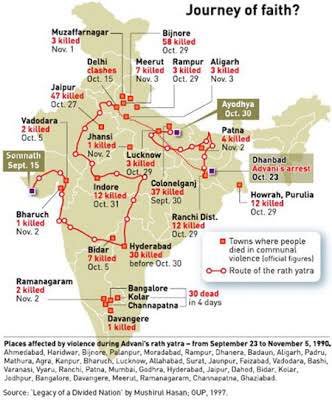
HYDERABAD RIOTS
A CITY PROVOKED
October-December 1990
• Cause: Local trouble exacerbated by LK Advani’s Rath Yatra and his subsequent arrest
• Consequence: The Congress party’s secular image was irrevocably dented
Walled city Hyderabad witnessed one of the worst communal riots in 1990. The city’s proud record was besmirched beyond recognition. On 9 October 1990, the city police gunned down a notorious criminal and some politicians gave this a communal angle. As per the Justice Heeraman Singh Commission of Inquiry, this eventually resulted in communal clashes. The second trigger for the clashes was the arrest of LK Advani in Bihar on 23 October. After Advani’s arrest, the BJP and some Muslim organisations distributed provocative pamphlets in Hyderabad. More than 11 people were killed in the communal clashes that followed between 29 October and 1 November in Hyderabad and its neighbouring Ranga Reddy district. Communal tension between the two communities was at its peak and to worsen the situation, two rumours started doing the rounds in the city. One was of the stabbing of a poor Hindu hawker in Karwar area on 7 December and the second was about the discovery of the bodies of a woman and her child in the Sabzimandi area. As per official records, the massacre that followed resulted in the killing of 134 people and 300 getting severely injured. The unofficial count of the dead was between 200 and 300. There was a clear pattern to the killings, with women and children being particularly targeted. Many were burned alive or stoned to death.
Various reports indicated that the violence was encouraged by some Congress dissidents in order to precipitate the overthrowing of the then chief minister Chenna Reddy, who, indeed, was forced to step down after the riots.
COIMBATORE
COMBUSTION AT LARGE
December 1997 – February 1998
• Death toll: At least 70, in two phases
• Cause: From business rivalry to divisive strains, the combustion in the city was expertly manufactured
That business is thicker than blood was proved during the Coimbatore riots. The riots that took place in 1997-98 were, perhaps, unique in nature as they were triggered by mounting tension between the Hindu and Muslim communities over the rising graph of Muslim businesses in the city.
The extremist Hindutva outfit Hindu Munnani’s leader Rama Gopalan had come to Coimbatore several times, asking Hindus to purchase only from Hindu shops. Moreover, relations between the police and the Muslims were at an all-time low after the bombing of the RSS office in Madras in 1993. The police were constantly on the lookout for members of Al-Ummah, an organisation led by SA Basha, one of the prime suspects behind the blast. The trust deficit between the police and the Muslims came to a boiling point when three young Al-Ummah members murdered a police constable. A section of the police, in connivance with the Hindu Munnani, targetted Muslim establishments. The violence the ensued lead to the death of 20 people.
While the situation was returning to normal, on 14 February 1998, a series of bomb blasts occurred in Coimbatore in which around 50 persons were killed and 200 injured. The bombings were carried out by Al-Ummah members in retaliation for the killing of Muslims by the police in November-December 1997. In the hours following the explosions, Hindu mobs attacked Muslim shops and properties. The government had to send in the army.
A judicial committee formed on 7 April 2000 under Justice PR Gokulakrishnan to probe the serial bombings confirmed that Al-Ummah was responsible for the blasts. The committee tabled its final report in the Tamil Nadu Assembly on 18 May 2000 and its recommendations were accepted in principle by the state government. The trial began on 7 March 2002 and as many as 1,300 witnesses were examined. Basha was found guilty of hatching a criminal conspiracy to trigger a series of explosions and was sentenced to life along with 12 others.
SOPORE MASSACRE
VALLEY OF TEARS
6 January 1993
• Official toll: 55 killed in firing by the BSF
• Follow-up: Several BSF personnel were suspended and a CBI inquiry ordered; in 2013, the CBI filed a closure report saying the witnesses failed to identify the lawbreakers
• Status: A judicial commission headed by Justice Amarjeet Choudhary was constituted but its term expired before it could submit its report
Many human rights activists consider Sopore, a town in Baramulla district of Jammu and Kashmir, to be synonymous with State repression in the sensitive border state. It all started after militants attacked BSF personnel at Baba Yousuf Lane near Sopore on 6 January 1993, killing one of them. But what happened after that in the town was unheard of in Kashmir’s recent history. In retaliation to the attack by the militants, the BSF men went berserk killing 55 civilians. Some eyewitness accounts claimed that the troopers also set many houses on fire. The BSF men also attacked a bus, killing the driver and 15 passengers on the spot. The Indian government’s estimate was that 50 homes and 250 shops were burnt down, though human rights activists claim that more than 450 shops were destroyed.
Even as the massacre evoked sharp responses from human rights organisations across the world, the Indian government initially defended the security forces saying that the civilian casualties were the result of a gun battle with the militants. But there were hardly any takers for the government’s version in Kashmir. Despite a curfew being imposed, thousands of people thronged the streets to protest against the killings, forcing the government to constitute a one-member judicial commission under Justice Amarjeet Choudhary.
The commission’s term expired in 1994 before it could come out with a report and the government did not grant it an extension. Some BSF personnel were suspended to pacify the people of Kashmir and a CBI inquiry was also ordered. The CBI filed a closure report in the court in 2013 saying that the witnesses could not identify the culprits. The investigating agency’s submission in the court that the victims’ kin should not get access to the documents related to the case also drew flak from many quarters. The unending wait of the victims in Sopore bears testimony to how the judiciary often fails to deliver justice in cases of atrocities by agencies of the State.
War cry A Bajrang Dal activist with an iron rod shouts slogans during the mayhem in Gujarat 2002, Photo: AFP
War cry A Bajrang Dal activist with an iron rod shouts slogans during the mayhem in Gujarat 2002, Photo: AFP
GUJARAT RIOTS
THE UNENDING TRAGEDY
February-March 2002
• Death toll: At least 2,000
• Status: The wounds of Gujarat are yet to be healed and the changed complexion of the Centre has not helped; the apex court, however, seems keen to strike out for justice
The parallels between 1984 and 2002 are uncanny. Like Rajiv Gandhi’s ‘Newtonian’ logic, Narendra Modi, anointed in 2001 as the chief minister of Gujarat, described the killing of innocent Muslims in his state as a spontaneous reaction to the burning of Hindu train passengers at Godhra. Activists of the BJP and other Sangh Parivar outfits led the mobs at various places and some, such as Maya Kodnani, were rewarded with plum ministerial posts. The Gujarat Police used the same tactics as their Delhi counterparts to ensure that investigations in the major riot cases went nowhere. The big difference between the aftermaths of the two riots, of course, is the greater degree of intervention by the Supreme Court in the case of Gujarat. The court intervened proactively when it became apparent that Modi’s government was not going to provide justice.
The Gujarat riots have been interpreted subjectively rather than objectively, depending upon where you stand. Some analysts call it a genocide or pogrom, whereas others describe it as a carnage or riot. Whichever way one looks at it, what happened in Gujarat in 2002 left an indelible mark on the secular fabric of the country. Some people even accused Modi of directing the police to allow the mob frenzy to go unchecked.
It all started with the burning of Coach S6 of the Sabarmati Express at the Godhra railway station on the morning of 27 February 2002. Fifty-seven people, including 25 women and 15 children, returning from a kar seva ceremony at the Babri Masjid site in Ayodhya were charred to death. The Gujarat government claimed that a mob of local Muslims had carried out the heinous crime. It constituted a judicial commission under Justice GT Nanavati to look into the reasons and conspiracy, if any, behind the carnage. Six years later, the commission submitted its report, largely upholding the government’s version of the incident.
When the UPA government came to power in 2004, Lalu Prasad Yadav, the then railway minister, constituted a committee to investigate the incident. This committee rejected the conspiracy theory and concluded that it was a case of accidental fire. It cited forensic reports to claim that the fire had started inside the train compartment. The Gujarat High Court, however, quashed the findings and concluded that the committee was constituted with mala fide intentions.
In February 2011, a court convicted 31 Muslims for the Godhra carnage, which is widely believed to be the trigger for the state-wide violence that followed in its wake.
The worst incident happened at Naroda Patiya in Ahmedabad. On 28 February, a mob of more than 1,000 activists of the Bajrang Dal and other Sangh Parivar outfits attacked the Muslim-dominated locality and killed 97 people. They looted and torched Muslim homes and gangraped women. The allegation that the Gujarat Police had connived with the mob was upheld by the court when it convicted Kodnani, who was the BJP MLA from Naroda constituency at the time of the incident and went on to become a minister in the Modi government from 2007 to 2009. A total of 32 people were convicted in the Naroda Patiya case.
The Gulbarg Society massacre also took place on 28 February. VHP and Bajrang Dal activists attacked the housing society where former Lok Sabha MP Ehsan Jafri lived. The 72-year-old Congress leader was killed along with 34 others. Many people went missing. It was later concluded that altogether about 70 people had been killed in the attack.
In 2007, TEHELKA did a sting operation (GUJARAT 2002: The Truth in the words of the men who did it) in which 14 VHP or Bajrang Dal activists — including Madan Chawal and Haresh Bhatt, who was the national coordinator of the Bajrang Dal in 2002 and went on to become the BJP MLA from Godhra — were caught on camera admitting their role in the riots. The Supreme Court appointed a Special Investigation Team (SIT) headed by former CBI director RK Raghavan after serious allegations were raised against the then Modi government. But in its final report, the SIT found nothing to suggest Modi’s involvement in abetting the violence. Human rights organisations, however, continue to cry foul about this report.
Remains of the day A Bodo man sits in a burnt down room at his home in Kokrajhar, Assam
Remains of the day A Bodo man sits in a burnt down room at his home in Kokrajhar, Assam
KOKRAJHAR RIOTS
ETHNIC CAULDRON
July 2012
• Cause: Tension between locals and perceived “illegal migrants” from Bangladesh, which has been a perennial problem in the state since the 1950s
• Status: Political pussyfooting and periodic flare-ups are endemic
What happened in July 2012 in Assam left the nation in a state of shock. It put the spotlight back on ethnic violence in Assam, which has so far claimed the lives of a huge number of people and displaced many more. The ethnic Bodo tribe has clashed with migrants, mainly Bangla-speaking Muslims, several times since the 1950s.
The violence in Kokrajhar, a district in lower Assam bordering West Bengal, Bangladesh and Bhutan, could easily find a place among the 10 biggest communal clashes in Independent India. On 20 July 2012, four Bodo youngsters were lynched in Kokrajhar, allegedly by Muslim migrants, and then the native Bodos encircled villages dominated by Bangla-speaking Muslims and torched Muslim houses. These incidents had a domino effect across the state. The riots went on unabated for several days and eventually left more than 80 people dead and more than 50,000 displaced.
Even as the violence spread across more than 400 villages, a blame game ensued with the state government holding the Centre responsible for the failure to halt the violence and vice-versa. On 27 July, Assam Chief Minister Tarun Gogoi accused the then UPA government of delaying the deployment of the army in the riot-hit areas. The then prime minister Manmohan Singh visited riot-affected Kokrajhar the very next day and called the violence “a blot on the face of India”.
An indefinite curfew and shoot-at-sight orders had been enforced in Kokrajhar district since 26 July, along with a night curfew in Chirang and Dhubri districts. The prime minister ordered an inquiry committee to be set up to look into the violence and directed the state government to provide security so that the affected people could return home.
According to media reports, the army was initially reluctant to deploy its troops and sought a clarification from the defence ministry as the situation “seemed to have communal overtones”. When the situation deteriorated rapidly and another request was made, the ministry authorised army deployment on 25 July.
On 7 August, the Centre ordered a CBI probe into the ethnic clashes in the state and on 19 September, the investigation agency made the first arrests — that of five young men who were accused of involvement in the alleged lynching of the Bodo youths on 20 July. However, nothing substantial came out of the CBI enquiry and the state continues to witness ethnic clashes from time to time.
MUZAFFARNAGAR VIOLENCE
MANUFACTURED MAYHEM
August – September 2013
• Cause: A seemingly minor incident flared up into a massive denouement
• Status: The saffron brigade used the riots to manipulate and polarise even as the Samajwadi Party government hemmed and hawed
The Muzaffarnagar riots can easily qualify as the worst phase of violence in Uttar Pradesh in recent history. This was the first time in the past two decades that the army had to be brought in to restore law and order. The last time the army had been deployed was to contain the riots that erupted in the aftermath of the Babri Masjid demolition.
The 2013 riots in Muzaffarnagar and neighbouring districts in western UP were the outcome of political one-upmanship between the BJP and the Samajwadi Party. Both the parties brazenly manipulated the people with an eye on the impending Assembly bypolls in the state.
The situation in the district started deteriorating since 27 August, when two young Jat men were beaten to death in Kawal village, following the killing of a Muslim youth. The clashes occurred over an alleged incident of eve-teasing.
The Jats organised a ‘panchayat’ in Jaansat town on 31 August and demanded action against those who killed the two young men from the community. They also asked for the removal of the superintendent of police of Shamli district for his allegedly partisan conduct and declared that a ‘mahapanchayat’ would be organised on 7 September in Nagla Mandaur if the demands were not met.
On 5 September, the BJP gave a call for ‘Muzaffarnagar bandh’. To pre-empt the ‘mahapanchayat’, the administration imposed prohibitory orders under Section 144 of the CrPC in the entire district and deployed the PAC and the Rapid Action Force.
As soon as reports of attacks on participants of the mahapanchayat started doing the rounds, the situation went out of control. The police had to beat a hasty retreat in many places as the well-armed rioters outnumbered them. The district administration immediately imposed curfew. At least 62 people, including 42 Muslims and 20 Hindus, were killed in the violence, 93 injured and more than 50,000 displaced from their homes and villages. The displaced people found shelter in ill-equipped relief camps, where some of the children died in the following winter due to the freezing cold.
The Supreme Court held the Samajwadi Party prima facie guilty of negligence in preventing the violence and ordered it to immediately arrest all the accused irrespective of their political affiliation.
pradyot@tehelka.com | bhoopesh@tehelka.com | anurag@tehelka.com
Tehelka Magazine, Volume 12 Issue 15, Dated 11 April 2015
A festering sore on Indian democracy
A multitude of massacres in the name of religion has put India’s secular polity to test. A flashback on the travesty of justice. By Pradyot Lal, NK Bhoopesh & Anurag Tripathi
MORADABAD
MORBIDITY AT LARGE
13 August 1980
• Official toll: 450; independent probes reckon that to be one-third of the likely number of casualties
• In the aftermath of the riots, Allahabad High Court judge Justice MP Saxena was asked to inquire
• Three-and-a-half decades later, his findings remain virtually consigned to a waste paper basket, with even avowedly secular parties not having the courage to pick up the gauntlet
If ever a comprehensive study is undertaken to determine the role of law-enforcing agencies in ‘helping’ spread communal riots in free India, what happened in somnolent Moradabad where all that glitters is brass is instructive. Around 3,000 namazis had turned up at the idgah to render Friday prayers when some pigs mysteriously found their way there causing instant commotion. What followed was even more macabre, as the Provincial Armed Constabulary (PAC) personnel on duty failed to chase away the offending animals in time. Instead, as brickbatting of the police and PAC personnel ensued, they indiscriminately opened fire causing several in the congregation to die instantly. There was already enough tension between the factory owners and the artisans who were usually drawn from different communities. The demographic structure of the city, however, was not reflected in its political representation.
Two generations after the riot, the scars are yet to heal. As sociologist Satish Sabherwal and historian Mushirul Hasan averred a couple of months after the riots, neither the then UP chief minister Vishwanath Pratap Singh nor the leaders at the Centre went beyond offering palliatives to the victims. This was ‘democratic’ India’s second tryst with the PAC after the revolt in its ranks in the mid-1970s had threatened to upstage the Congress in Uttar Pradesh.
Shame! Bodies of infants killed during the 1983 massacre in Nellie, Nagaon district, Assam, await burial
Shame! Bodies of infants killed during the 1983 massacre in Nellie, Nagaon district, Assam, await burial, Photo: Courtesy The Milli Gazette
NELLIE MASSACRE
SIX HOURS OF MAYHEM
18 February 1983
• Official toll: 2,191; unofficial and independent agencies reckon twice that number was approximate to the truth
• Affected area: Central Assam, especially Nellie in Nagaon district
• The SK Tiwari Commission ostensibly conducted an inquiry, but it was caught up in a political and social maelstrom. Only three copies of its report exist and no political party has thought it worthwhile to do anything concrete
THE immediate cause is difficult to decipher. One was the anti-foreigner issue that the then ascendant All Asom Students Union (AASU) raised to a feverish pitch, leading to deportation of alleged aliens and mass murder. The terms of the movement were hazy since many of the so-called refugees had either come before Partition or during the turmoil in Bangladesh during its liberation struggle. The death of Lok Sabha MP Hiralal Patwari made fresh polls necessary in one of the constituencies but the Congress government thought it prudent to order fresh Assembly polls in 1983. AASU opposed the decision and boycotted the polls. As the then Assam DGP KPS Gill recalls, there were at least 23 highly sensitive constituencies where elections should not have been held, and Nellie was one of them. Whether there had indeed been a sudden infiltration of illegal immigrants could not be verified. AASU thought that to be the case and stirred an agitation that the state administration failed to control. Two years later, the then prime minister Rajiv Gandhi signed a peace accord with AASU and the Nellie massacre was sought to be erased from public memory.
Wounded An injured Sikh man being carried away on a cart in Delhi during the 1984 riots, Photo: Courtesy Vijay Saluja
Wounded An injured Sikh man being carried
away on a cart in Delhi during the 1984 riots, Photo: Courtesy Vijay Saluja
ANTI-SIKH RIOTS
72 HOURS OF SHAME
Delhi and other parts of India
31 October – 4 November 1984
• Total casualties in Delhi alone: 2,733 Sikhs; some human rights bodies say it was much higher
• Worst-affected areas included Trilokpuri, which epitomised the grisly and planned nature of the massacre
• Eight different commissions, convictions extremely few
Thirty-one years ago in New Delhi, Kanpur and Bokaro, murderous attacks were launched against Sikhs by mobs organised and instigated by mainly Congress politicians bent upon using the tragic assassination of Indira Gandhi as an occasion for political manipulation and gain. In the capital, the police stood mute witness to the killing of 2,733 Sikhs. That inaction and the failure to register cases or properly investigate those that were eventually filed are testimony to the official patronage the killings enjoyed. Rajiv Gandhi, who had just been sworn in as the prime minister, made light of the pogrom, describing it as a reaction to the killing of his mother. He infamously said, “When a big tree falls the earth shakes.” Senior Congress leaders such as HKL Bhagat, Jagdish Tytler and Kamal Nath, who were identified by the survivors and eyewitnesses as instigators of the violence, were rewarded with ministerial berths. A Commission of Inquiry headed by Justice Ranganath Mishra concluded, astonishingly, that the organised massacre was a spontaneous and “involuntary reaction” by ordinary citizens stricken by grief at Indira Gandhi’s assassination. Subsequent commissions indicted the police for acts of commission and omission but the bitter reality is that the victims of the massacre are no closer to justice today than they were in 1984.
The fact that the politicians and police officers responsible for the violence not only escaped indictment but also prospered had grave implications for minorities elsewhere in India. The riot system perfected by the Congress on the streets of Delhi was unveiled again in Bombay in 1993 and, finally, by the BJP government of Gujarat in 2002. There have been demands to construct at least a memorial for the victims, but they have fallen on deaf ears. Non-Congress governments have been equally lackadaisical and cavalier in their attitude. Some ultra-Hindutva organisations and individuals, unhinged formally from the saffron brigade, also joined the unprecedented, brutal pogrom that damaged India’s secular image irrevocably and gave rise to secessionist tendencies.
Easy targets Armed personnel round up Muslim men in Hashimpura during the 1987 riots
Easy targets Armed personnel round up Muslim men in Hashimpura on 22 May 1987, Photos: Praveen Jain
HASHIMPURA MASSACRE
SELECTIVE WARFARE
22 May 1987
• Death toll: 42 Muslim men
• In 2015, a Delhi court acquitted all the PAC men accused of killing 42 Muslims
Vibhuti Narain Rai, the then SSP, Ghaziabad (UP), found that more than 150 Muslim men had been taken away by the PAC in a truck at gunpoint towards a canal that flows parallel to the Meerut-Ghaziabad Road and that the sound of gunshots had been heard from that direction. It was late in the night but he got a team of 20 police personnel ready and rushed to the spot. Dead bodies were scattered along the canal bank. In that ghostly silence, he began to examine the bodies to see if anyone was alive in the heap of corpses. At last he found a man who was still not dead, brought him to Ghaziabad, got him admitted to a hospital and proceeded to file an FIR against the PAC personnel for their heinous crime.
Babuddin Ansari is one of the survivors of the massacre. He is a native of Muzaffarpur, Bihar, but fate had trapped him in Hashimpura in May 1987 as he was visiting some relatives with his father. According to his account, he took a bullet on his shoulder when the PAC men had first opened fire on the people held captive in a police truck near the Gang canal in Muradnagar. By the time they moved the truck away from the canal, 25 of the men had been killed. The truck was driven a little further and then stopped near the Hindon river bridge where the rest of the captives — 16 of them — were killed. In this group, Babuddin was the only one who survived. He was the sixth person to be thrown into the river, but before that, he was shot again — this time in his leg.
Luckily for him, he fell near the embankment and held onto a rock. He recalls seeing bodies being thrown from the Hindon bridge one by one. Meanwhile, some policemen came flashing their torches at the river. Babuddin thought they were sent by the PAC men, so every time they threw the light upon the river, he would duck into the water. Finally, a policeman touched his head with a rifle and asked his name. From there, he was taken to the superintendent of police, who assured him of help. The Ghaziabad police then picked up his belongings from Hashimpura. Next day, he was escorted back to his home state.
Some of the survivors and relatives of the victims are still hopeful of getting justice even after a Delhi court acquitted the accused PAC jawans on 24 March 2015 citing the prosecution’s inability to establish that they were the same jawans who had fired those fatal shots.
Close shave Security personnel look on as a Muslim woman is rescued from rioters in Bhagalpur
Close shave Security personnel look on as a
Muslim woman is rescued from rioters in
Bhagalpur 1989
BHAGALPUR MASSACRE
TWO MONTHS OF MADNESS
24 October – 23 December 1989
• Official toll: 1,070
• Started as a police-people clash and degenerated into communal violence
• Justice elusive 25 years later, with Nitish Kumar periodically assuring action against the culprits, many of whom are already dead
Hindu-Muslims tensions had escalated during the Muharram and Bisheri Puja festivities in August 1989. As part of the Ayodhya campaign, the Vishwa Hindu Parishad (VHP) had organised a ‘Ramshila’ procession in Bhagalpur. The procession aimed to collect bricks for the proposed Ram temple at Ayodhya. One such procession passing through Fatehpur village provoked brickbatting and arson on 22 October.
Prior to the outbreak of the riots, two rumours about the killing of Hindu students started doing the rounds: one was that Muslims had killed nearly 200 Hindu students of the university; the other that 31 Hindu boys had been murdered and their bodies dumped in a well at the Sanskrit College. Moreover, the political and criminal rivalries in the area also played a role in inciting the riots.
On 24 October, the Ramshila processions from various parts of the district were to proceed to the Gaushala area, from where they would move on to Ayodhya. The procession coming from Parbatti area passed peacefully through Tatarpur, a Muslim-dominated area, after its leader Mahadev Prasad Singh told the Hindus not to raise any provocative slogans. Sometime later, another massive procession from Nathnagar arrived at Tatarpur, escorted by the police. Some members of the procession shouted slogans such as ‘Hindi, Hindu, Hindustan‘. Bombs hurled indiscriminately at this stage are considered to have triggered these riots.
The mobs attacked shops owned by the Muslims on the Nathnagar road (later renamed as Lord Mahavir Path). The rioters also attempted to storm the Muslim-dominated locality of Assanandpur, but the locals fired at them from the rooftops. The mob then turned to the Hindu-dominated locality, Parbatti, where it massacred at least 40 Muslims. As the news of the violence reached the other Ramshila processions at Gaushala, the Hindus went on a rampage, killing Muslims, looting their shops and destroying their property.
On 25 October, an 8,000-strong mob looted and destroyed Madaninagar, a Muslim settlement, turning it into a ghost town. They also attacked Kanjhiagram, a nearby locality. Bhatoria, a Muslim-dominated village, was attacked twice — on October 25, and again on October 27. Many Muslims were killed. Alleged police atrocities further fuelled the violence.
According to contemporary accounts, on 26 October, at least 11 Muslims were killed in the Brahmin-dominated Parandarpur village. The same day, 18 Muslims, including 11 children, were killed in public view, in the Nayabazar area of Bhagalpur. Around 44 Muslims, including 19 children, were provided refuge by some local Hindus in the Jamuna Kothi building. At 11.30 am, a 70-strong mob entered the Jamuna Kothi with swords, axes, hammers and lathis. Within 10 minutes, 18 Muslims were killed. Some of the children were beheaded, some had their limbs cut off while the others were thrown off the third floor. A woman called Bunni Begum had her breasts chopped off. Some other Muslims, who had been provided refuge by the Hindus in the nearby buildings, managed to survive. In Assanandpur, the Muslims also escorted several Hindu students residing in a hostel to safety.
Lynch mob Sword-wielding rioters took over the streets of Mumbai for several days in December 1992
Lynch mob Sword-wielding rioters took over the streets of Mumbai for several days in December 1992
MUMBAI RIOTS
MEGAPOLIS GONE BERSERK
December 1992 – January 1993
• Official death toll: 267; the unofficial figure, as deposed before the Justice Srikrishna Commission, was twice that number
• Cause: The Babri Masjid demolition had serious repercussions across the country and the city that suffered the most was Mumbai
• Status: The revelations made by Justice Srikrishna failed to enlighten the political masters
A cosmopolitan city by nature, which hitherto had other priorities, was submerged in a communal deluge from December 1992 to January 1993. The city witnessed one of the worst riots during this period, which left deep scars on the city’s soul. The December 1992 events constituted the first phase of a communal riot that was to be repeated on a larger scale in January 1993.
The Justice BN Srikrishna Commission of Inquiry stated that there had been a build-up of communal fervour among the Hindus and Muslims in the weeks preceding the demolition of the Babri Masjid. As news of the demolition spread across the city on 6 December, Muslim gathered on the streets even as the Hindutva outfits took out victory processions.
The Shiv Sena led by its acerbic leader Balasaheb Thackeray celebrated the demolition by conducting a rally in the Dharavi slum. The situation deteriorated further on 7 and 8 December.
At many places, the violence took the form of a police-versus-Muslims confrontation. As per media reports, more than 210 people died in Mumbai and 57 in the areas adjoining the metropolis. Out of them, 137 (more than half the total casualties) fell to police bullets.
Unofficial records claim that the actual toll was more than 400. The situation was said to have been brought under control by 12 December, but according to the Justice Srikrishna Commission, stray incidents of violence continued to occur until 5 January when the second, deadlier phase of the riot started.
HYDERABAD RIOTS
A CITY PROVOKED
October-December 1990
• Cause: Local trouble exacerbated by LK Advani’s Rath Yatra and his subsequent arrest
• Consequence: The Congress party’s secular image was irrevocably dented
Walled city Hyderabad witnessed one of the worst communal riots in 1990. The city’s proud record was besmirched beyond recognition. On 9 October 1990, the city police gunned down a notorious criminal and some politicians gave this a communal angle. As per the Justice Heeraman Singh Commission of Inquiry, this eventually resulted in communal clashes. The second trigger for the clashes was the arrest of LK Advani in Bihar on 23 October. After Advani’s arrest, the BJP and some Muslim organisations distributed provocative pamphlets in Hyderabad. More than 11 people were killed in the communal clashes that followed between 29 October and 1 November in Hyderabad and its neighbouring Ranga Reddy district. Communal tension between the two communities was at its peak and to worsen the situation, two rumours started doing the rounds in the city. One was of the stabbing of a poor Hindu hawker in Karwar area on 7 December and the second was about the discovery of the bodies of a woman and her child in the Sabzimandi area. As per official records, the massacre that followed resulted in the killing of 134 people and 300 getting severely injured. The unofficial count of the dead was between 200 and 300. There was a clear pattern to the killings, with women and children being particularly targeted. Many were burned alive or stoned to death.
Various reports indicated that the violence was encouraged by some Congress dissidents in order to precipitate the overthrowing of the then chief minister Chenna Reddy, who, indeed, was forced to step down after the riots.
COIMBATORE
COMBUSTION AT LARGE
December 1997 – February 1998
• Death toll: At least 70, in two phases
• Cause: From business rivalry to divisive strains, the combustion in the city was expertly manufactured
That business is thicker than blood was proved during the Coimbatore riots. The riots that took place in 1997-98 were, perhaps, unique in nature as they were triggered by mounting tension between the Hindu and Muslim communities over the rising graph of Muslim businesses in the city.
The extremist Hindutva outfit Hindu Munnani’s leader Rama Gopalan had come to Coimbatore several times, asking Hindus to purchase only from Hindu shops. Moreover, relations between the police and the Muslims were at an all-time low after the bombing of the RSS office in Madras in 1993. The police were constantly on the lookout for members of Al-Ummah, an organisation led by SA Basha, one of the prime suspects behind the blast. The trust deficit between the police and the Muslims came to a boiling point when three young Al-Ummah members murdered a police constable. A section of the police, in connivance with the Hindu Munnani, targetted Muslim establishments. The violence the ensued lead to the death of 20 people.
While the situation was returning to normal, on 14 February 1998, a series of bomb blasts occurred in Coimbatore in which around 50 persons were killed and 200 injured. The bombings were carried out by Al-Ummah members in retaliation for the killing of Muslims by the police in November-December 1997. In the hours following the explosions, Hindu mobs attacked Muslim shops and properties. The government had to send in the army.
A judicial committee formed on 7 April 2000 under Justice PR Gokulakrishnan to probe the serial bombings confirmed that Al-Ummah was responsible for the blasts. The committee tabled its final report in the Tamil Nadu Assembly on 18 May 2000 and its recommendations were accepted in principle by the state government. The trial began on 7 March 2002 and as many as 1,300 witnesses were examined. Basha was found guilty of hatching a criminal conspiracy to trigger a series of explosions and was sentenced to life along with 12 others.
SOPORE MASSACRE
VALLEY OF TEARS
6 January 1993
• Official toll: 55 killed in firing by the BSF
• Follow-up: Several BSF personnel were suspended and a CBI inquiry ordered; in 2013, the CBI filed a closure report saying the witnesses failed to identify the lawbreakers
• Status: A judicial commission headed by Justice Amarjeet Choudhary was constituted but its term expired before it could submit its report
Many human rights activists consider Sopore, a town in Baramulla district of Jammu and Kashmir, to be synonymous with State repression in the sensitive border state. It all started after militants attacked BSF personnel at Baba Yousuf Lane near Sopore on 6 January 1993, killing one of them. But what happened after that in the town was unheard of in Kashmir’s recent history. In retaliation to the attack by the militants, the BSF men went berserk killing 55 civilians. Some eyewitness accounts claimed that the troopers also set many houses on fire. The BSF men also attacked a bus, killing the driver and 15 passengers on the spot. The Indian government’s estimate was that 50 homes and 250 shops were burnt down, though human rights activists claim that more than 450 shops were destroyed.
Even as the massacre evoked sharp responses from human rights organisations across the world, the Indian government initially defended the security forces saying that the civilian casualties were the result of a gun battle with the militants. But there were hardly any takers for the government’s version in Kashmir. Despite a curfew being imposed, thousands of people thronged the streets to protest against the killings, forcing the government to constitute a one-member judicial commission under Justice Amarjeet Choudhary.
The commission’s term expired in 1994 before it could come out with a report and the government did not grant it an extension. Some BSF personnel were suspended to pacify the people of Kashmir and a CBI inquiry was also ordered. The CBI filed a closure report in the court in 2013 saying that the witnesses could not identify the culprits. The investigating agency’s submission in the court that the victims’ kin should not get access to the documents related to the case also drew flak from many quarters. The unending wait of the victims in Sopore bears testimony to how the judiciary often fails to deliver justice in cases of atrocities by agencies of the State.
War cry A Bajrang Dal activist with an iron rod shouts slogans during the mayhem in Gujarat 2002, Photo: AFP
War cry A Bajrang Dal activist with an iron rod shouts slogans during the mayhem in Gujarat 2002, Photo: AFP
GUJARAT RIOTS
THE UNENDING TRAGEDY
February-March 2002
• Death toll: At least 2,000
• Status: The wounds of Gujarat are yet to be healed and the changed complexion of the Centre has not helped; the apex court, however, seems keen to strike out for justice
The parallels between 1984 and 2002 are uncanny. Like Rajiv Gandhi’s ‘Newtonian’ logic, Narendra Modi, anointed in 2001 as the chief minister of Gujarat, described the killing of innocent Muslims in his state as a spontaneous reaction to the burning of Hindu train passengers at Godhra. Activists of the BJP and other Sangh Parivar outfits led the mobs at various places and some, such as Maya Kodnani, were rewarded with plum ministerial posts. The Gujarat Police used the same tactics as their Delhi counterparts to ensure that investigations in the major riot cases went nowhere. The big difference between the aftermaths of the two riots, of course, is the greater degree of intervention by the Supreme Court in the case of Gujarat. The court intervened proactively when it became apparent that Modi’s government was not going to provide justice.
The Gujarat riots have been interpreted subjectively rather than objectively, depending upon where you stand. Some analysts call it a genocide or pogrom, whereas others describe it as a carnage or riot. Whichever way one looks at it, what happened in Gujarat in 2002 left an indelible mark on the secular fabric of the country. Some people even accused Modi of directing the police to allow the mob frenzy to go unchecked.
It all started with the burning of Coach S6 of the Sabarmati Express at the Godhra railway station on the morning of 27 February 2002. Fifty-seven people, including 25 women and 15 children, returning from a kar seva ceremony at the Babri Masjid site in Ayodhya were charred to death. The Gujarat government claimed that a mob of local Muslims had carried out the heinous crime. It constituted a judicial commission under Justice GT Nanavati to look into the reasons and conspiracy, if any, behind the carnage. Six years later, the commission submitted its report, largely upholding the government’s version of the incident.
When the UPA government came to power in 2004, Lalu Prasad Yadav, the then railway minister, constituted a committee to investigate the incident. This committee rejected the conspiracy theory and concluded that it was a case of accidental fire. It cited forensic reports to claim that the fire had started inside the train compartment. The Gujarat High Court, however, quashed the findings and concluded that the committee was constituted with mala fide intentions.
In February 2011, a court convicted 31 Muslims for the Godhra carnage, which is widely believed to be the trigger for the state-wide violence that followed in its wake.
The worst incident happened at Naroda Patiya in Ahmedabad. On 28 February, a mob of more than 1,000 activists of the Bajrang Dal and other Sangh Parivar outfits attacked the Muslim-dominated locality and killed 97 people. They looted and torched Muslim homes and gangraped women. The allegation that the Gujarat Police had connived with the mob was upheld by the court when it convicted Kodnani, who was the BJP MLA from Naroda constituency at the time of the incident and went on to become a minister in the Modi government from 2007 to 2009. A total of 32 people were convicted in the Naroda Patiya case.
The Gulbarg Society massacre also took place on 28 February. VHP and Bajrang Dal activists attacked the housing society where former Lok Sabha MP Ehsan Jafri lived. The 72-year-old Congress leader was killed along with 34 others. Many people went missing. It was later concluded that altogether about 70 people had been killed in the attack.
In 2007, TEHELKA did a sting operation (GUJARAT 2002: The Truth in the words of the men who did it) in which 14 VHP or Bajrang Dal activists — including Madan Chawal and Haresh Bhatt, who was the national coordinator of the Bajrang Dal in 2002 and went on to become the BJP MLA from Godhra — were caught on camera admitting their role in the riots. The Supreme Court appointed a Special Investigation Team (SIT) headed by former CBI director RK Raghavan after serious allegations were raised against the then Modi government. But in its final report, the SIT found nothing to suggest Modi’s involvement in abetting the violence. Human rights organisations, however, continue to cry foul about this report.
Remains of the day A Bodo man sits in a burnt down room at his home in Kokrajhar, Assam
Remains of the day A Bodo man sits in a burnt down room at his home in Kokrajhar, Assam
KOKRAJHAR RIOTS
ETHNIC CAULDRON
July 2012
• Cause: Tension between locals and perceived “illegal migrants” from Bangladesh, which has been a perennial problem in the state since the 1950s
• Status: Political pussyfooting and periodic flare-ups are endemic
What happened in July 2012 in Assam left the nation in a state of shock. It put the spotlight back on ethnic violence in Assam, which has so far claimed the lives of a huge number of people and displaced many more. The ethnic Bodo tribe has clashed with migrants, mainly Bangla-speaking Muslims, several times since the 1950s.
The violence in Kokrajhar, a district in lower Assam bordering West Bengal, Bangladesh and Bhutan, could easily find a place among the 10 biggest communal clashes in Independent India. On 20 July 2012, four Bodo youngsters were lynched in Kokrajhar, allegedly by Muslim migrants, and then the native Bodos encircled villages dominated by Bangla-speaking Muslims and torched Muslim houses. These incidents had a domino effect across the state. The riots went on unabated for several days and eventually left more than 80 people dead and more than 50,000 displaced.
Even as the violence spread across more than 400 villages, a blame game ensued with the state government holding the Centre responsible for the failure to halt the violence and vice-versa. On 27 July, Assam Chief Minister Tarun Gogoi accused the then UPA government of delaying the deployment of the army in the riot-hit areas. The then prime minister Manmohan Singh visited riot-affected Kokrajhar the very next day and called the violence “a blot on the face of India”.
An indefinite curfew and shoot-at-sight orders had been enforced in Kokrajhar district since 26 July, along with a night curfew in Chirang and Dhubri districts. The prime minister ordered an inquiry committee to be set up to look into the violence and directed the state government to provide security so that the affected people could return home.
According to media reports, the army was initially reluctant to deploy its troops and sought a clarification from the defence ministry as the situation “seemed to have communal overtones”. When the situation deteriorated rapidly and another request was made, the ministry authorised army deployment on 25 July.
On 7 August, the Centre ordered a CBI probe into the ethnic clashes in the state and on 19 September, the investigation agency made the first arrests — that of five young men who were accused of involvement in the alleged lynching of the Bodo youths on 20 July. However, nothing substantial came out of the CBI enquiry and the state continues to witness ethnic clashes from time to time.
MUZAFFARNAGAR VIOLENCE
MANUFACTURED MAYHEM
August – September 2013
• Cause: A seemingly minor incident flared up into a massive denouement
• Status: The saffron brigade used the riots to manipulate and polarise even as the Samajwadi Party government hemmed and hawed
The Muzaffarnagar riots can easily qualify as the worst phase of violence in Uttar Pradesh in recent history. This was the first time in the past two decades that the army had to be brought in to restore law and order. The last time the army had been deployed was to contain the riots that erupted in the aftermath of the Babri Masjid demolition.
The 2013 riots in Muzaffarnagar and neighbouring districts in western UP were the outcome of political one-upmanship between the BJP and the Samajwadi Party. Both the parties brazenly manipulated the people with an eye on the impending Assembly bypolls in the state.
The situation in the district started deteriorating since 27 August, when two young Jat men were beaten to death in Kawal village, following the killing of a Muslim youth. The clashes occurred over an alleged incident of eve-teasing.
The Jats organised a ‘panchayat’ in Jaansat town on 31 August and demanded action against those who killed the two young men from the community. They also asked for the removal of the superintendent of police of Shamli district for his allegedly partisan conduct and declared that a ‘mahapanchayat’ would be organised on 7 September in Nagla Mandaur if the demands were not met.
On 5 September, the BJP gave a call for ‘Muzaffarnagar bandh’. To pre-empt the ‘mahapanchayat’, the administration imposed prohibitory orders under Section 144 of the CrPC in the entire district and deployed the PAC and the Rapid Action Force.
As soon as reports of attacks on participants of the mahapanchayat started doing the rounds, the situation went out of control. The police had to beat a hasty retreat in many places as the well-armed rioters outnumbered them. The district administration immediately imposed curfew. At least 62 people, including 42 Muslims and 20 Hindus, were killed in the violence, 93 injured and more than 50,000 displaced from their homes and villages. The displaced people found shelter in ill-equipped relief camps, where some of the children died in the following winter due to the freezing cold.
The Supreme Court held the Samajwadi Party prima facie guilty of negligence in preventing the violence and ordered it to immediately arrest all the accused irrespective of their political affiliation.
pradyot@tehelka.com | bhoopesh@tehelka.com | anurag@tehelka.com
November 03, 2014
Hyderabad 1948: India's hidden massacre ( Mike Thomson)
BBC - News Magazine, 24 September 2013

Some were lined up and shot by Indian Army soldiers. Yet a government-commissioned report into what happened was never published and few in India know about the massacre. Critics have accused successive Indian governments of continuing a cover-up.
The massacres took place a year after the violence of partition in what was then Hyderabad state, in the heart of India. It was one of 500 princely states that had enjoyed autonomy under British colonial rule.
When independence came in 1947 nearly all of these states agreed to become part of India.
 But Hyderabad's Muslim Nizam, or prince, insisted on remaining
independent. This refusal to surrender sovereignty to the new democratic
India outraged the country's leaders in New Delhi.
But Hyderabad's Muslim Nizam, or prince, insisted on remaining
independent. This refusal to surrender sovereignty to the new democratic
India outraged the country's leaders in New Delhi.
After an acrimonious stand-off between Delhi and Hyderabad, the government finally lost patience.

This gave the Prime Minister, Jawaharlal Nehru, the pretext he needed. In September 1948 the Indian Army invaded Hyderabad.
In what was rather misleadingly known as a "police action", the Nizam's forces were defeated after just a few days without any significant loss of civilian lives. But word then reached Delhi that arson, looting and the mass murder and rape of Muslims had followed the invasion.
Determined to get to the bottom of what was happening, an alarmed Nehru commissioned a small mixed-faith team to go to Hyderabad to investigate.
It was led by a Hindu congressman, Pandit Sunderlal. But the resulting report that bore his name was never published.
Historian Sunil Purushotham from the University of Cambridge has now obtained a copy of the report as part of his research in this field.
 Pandit Sunderlal's team concluded that between 27,000 and 40,000 died
The Sunderlal team visited dozens of villages throughout the state.
Pandit Sunderlal's team concluded that between 27,000 and 40,000 died
The Sunderlal team visited dozens of villages throughout the state.
The team reported that while Muslim villagers were disarmed by the Indian Army, Hindus were often left with their weapons. The mob violence that ensued was often led by Hindu paramilitary groups.
In other cases, it said, Indian soldiers themselves took an active hand in the butchery: "At a number of places members of the armed forces brought out Muslim adult males from villages and towns and massacred them in cold blood."
The investigation team also reported, however, that in many other instances the Indian Army had behaved well and protected Muslims.
 The Nizam of Hyderabad was a powerful
prince. In this picture taken in 1899, the Nizam, Mahbub Ali Khan, and
his party pose with tiger skins
The backlash was said to have been in response to many years of intimidation and violence against Hindus by the Razakars.
The Nizam of Hyderabad was a powerful
prince. In this picture taken in 1899, the Nizam, Mahbub Ali Khan, and
his party pose with tiger skins
The backlash was said to have been in response to many years of intimidation and violence against Hindus by the Razakars.
In confidential notes attached to the Sunderlal report, its authors detailed the gruesome nature of the Hindu revenge: "In many places we were shown wells still full of corpses that were rotting. In one such we counted 11 bodies, which included that of a woman with a small child sticking to her breast. "
And it went on: "We saw remnants of corpses lying in ditches. At several places the bodies had been burnt and we would see the charred bones and skulls still lying there."
The Sunderlal report estimated that between 27,000 to 40,000 people lost their lives.
 A Shiite shrine built by the seventh Nizam to perpetuate his mother's memory
No official explanation was given for Nehru's decision not to
publish the contents of the Sunderlal report, though it is likely that,
in the powder-keg years that followed independence, news of what
happened might have sparked more Muslim reprisals against Hindus.
A Shiite shrine built by the seventh Nizam to perpetuate his mother's memory
No official explanation was given for Nehru's decision not to
publish the contents of the Sunderlal report, though it is likely that,
in the powder-keg years that followed independence, news of what
happened might have sparked more Muslim reprisals against Hindus.
It is also unclear why, all these decades later, there is still no reference to what happened in the nation's schoolbooks. Even today few Indians have any idea what happened.
The Sunderlal report, although unknown to many, is now open for viewing at the Nehru Memorial Museum and Library in New Delhi.
There has been a call recently in the Indian press for it to be made more widely available, so the entire nation can learn what happened.
It could be argued this might risk igniting continuing tensions between Muslims and Hindus.
"Living as we are in this country with all our conflicts and problems, I wouldn't make a big fuss over it," says Burgula Narasingh Rao, a Hindu who lived through those times in Hyderabad and is now in his 80s.
"What happens, reaction and counter-reaction and various things will go on and on, but at the academic level, at the research level, at your broadcasting level, let these things come out. I have no problem with that."
Hyderabad 1948: India's hidden massacre
When
India was partitioned in 1947, about 500,000 people died in communal
rioting, mainly along the borders with Pakistan. But a year later
another massacre occurred in central India, which until now has remained
clouded in secrecy.
In September and October 1948, soon after independence from
the British Empire, tens of thousands of people were brutally
slaughtered in central India. Some were lined up and shot by Indian Army soldiers. Yet a government-commissioned report into what happened was never published and few in India know about the massacre. Critics have accused successive Indian governments of continuing a cover-up.
The massacres took place a year after the violence of partition in what was then Hyderabad state, in the heart of India. It was one of 500 princely states that had enjoyed autonomy under British colonial rule.
When independence came in 1947 nearly all of these states agreed to become part of India.
After an acrimonious stand-off between Delhi and Hyderabad, the government finally lost patience.
Find out more
- Listen to Mike Thomson's report on Document, The Hyderabad Massacre, on BBC Radio 4 at 16:00 BST on Tuesday 24 September or catch it later on the BBC iPlayer.
Historians say their desire to
prevent an independent Muslim-led state taking root in the heart of
predominantly Hindu India was another worry.
Members of the powerful Razakar militia, the armed wing of
Hyderabad's most powerful Muslim political party, were terrorising many
Hindu villagers. This gave the Prime Minister, Jawaharlal Nehru, the pretext he needed. In September 1948 the Indian Army invaded Hyderabad.
In what was rather misleadingly known as a "police action", the Nizam's forces were defeated after just a few days without any significant loss of civilian lives. But word then reached Delhi that arson, looting and the mass murder and rape of Muslims had followed the invasion.
Determined to get to the bottom of what was happening, an alarmed Nehru commissioned a small mixed-faith team to go to Hyderabad to investigate.
It was led by a Hindu congressman, Pandit Sunderlal. But the resulting report that bore his name was never published.
Historian Sunil Purushotham from the University of Cambridge has now obtained a copy of the report as part of his research in this field.
Pandit Sunderlal's team concluded that between 27,000 and 40,000 died
“Start Quote
Sunderlal reportAt a number of places members of the armed forces brought out Muslim adult males... and massacred them”
At each one they carefully
chronicled the accounts of Muslims who had survived the appalling
violence: "We had absolutely unimpeachable evidence to the effect that
there were instances in which men belonging to the Indian Army and also
to the local police took part in looting and even other crimes.
"During our tour we gathered, at not a few places, that
soldiers encouraged, persuaded and in a few cases even compelled the
Hindu mob to loot Muslim shops and houses."The team reported that while Muslim villagers were disarmed by the Indian Army, Hindus were often left with their weapons. The mob violence that ensued was often led by Hindu paramilitary groups.
In other cases, it said, Indian soldiers themselves took an active hand in the butchery: "At a number of places members of the armed forces brought out Muslim adult males from villages and towns and massacred them in cold blood."
The investigation team also reported, however, that in many other instances the Indian Army had behaved well and protected Muslims.
The Nizam of Hyderabad was a powerful
prince. In this picture taken in 1899, the Nizam, Mahbub Ali Khan, and
his party pose with tiger skins
In confidential notes attached to the Sunderlal report, its authors detailed the gruesome nature of the Hindu revenge: "In many places we were shown wells still full of corpses that were rotting. In one such we counted 11 bodies, which included that of a woman with a small child sticking to her breast. "
And it went on: "We saw remnants of corpses lying in ditches. At several places the bodies had been burnt and we would see the charred bones and skulls still lying there."
The Sunderlal report estimated that between 27,000 to 40,000 people lost their lives.
A Shiite shrine built by the seventh Nizam to perpetuate his mother's memory
It is also unclear why, all these decades later, there is still no reference to what happened in the nation's schoolbooks. Even today few Indians have any idea what happened.
The Sunderlal report, although unknown to many, is now open for viewing at the Nehru Memorial Museum and Library in New Delhi.
There has been a call recently in the Indian press for it to be made more widely available, so the entire nation can learn what happened.
It could be argued this might risk igniting continuing tensions between Muslims and Hindus.
"Living as we are in this country with all our conflicts and problems, I wouldn't make a big fuss over it," says Burgula Narasingh Rao, a Hindu who lived through those times in Hyderabad and is now in his 80s.
"What happens, reaction and counter-reaction and various things will go on and on, but at the academic level, at the research level, at your broadcasting level, let these things come out. I have no problem with that."
May 15, 2014
India: Press release on communal violence in Hyderabad [May 14 2014]
Interfaith Forum - Press release on communal violence in Hyderabad
Posted: 14 May 2014 11:20 AM PDT
Condemnation of Communal Violence in Sikh Chawni:
Interfaith Forum Demands Judicial Enquiry
We the members of Interfaith Forum strongly condemn the incidence of violence in Kishan Bagh between the Sikh and the Muslim communities in the morning of 14th May 2014. It is very unfortunate that some vested interests seemed to have succeeded in their aim to bring Muslims and Sikhs at loggerheads by damaging Sikh religious flag at Sikh Chowni, Kishan Bagh, Hyderabad in the intervening night of 13-14 May 2014. In retaliation, it is reported that innocent passerby was lethally attacked in morning hours of 14th May 2014. The City Police force that had come to control the situation resorted to firing that resulted in the death of three persons and one is reported to be in serious condition. These deaths have led to further escalation of tensions in other sensitive areas of the city also.
We unequivocally condemn both the incidents of desecrating the Sikh Religious Flag by the anti social elements and also strongly condemn the retaliatory attacks on innocent passerby and taking lives of breadwinners rendering the entire society in the state of shock. There is also a need to properly assess the need and appropriateness of police firing to control the situation that is leading to further aggravation of the situation. After elections this incident should be deemed to have been perpetrated to create animosity between Muslims and Sikhs for political mileage.
We appeal to the aggrieved residents of the area and citizens of Hyderabad to observe restraint so that innocent citizens are protected and the perpetrators are punished. Our resolve must to be to remain united to fight against divisive forces.
We demand from the government to conduct a judicial probe into these happenings and offenders should be arrested without loss of time and punished stringently through special courts set up for the purpose. We also demand that it is high time that police should stop using live ammunition and use rubber pellets to control crowds without any loss of life as is the practice in most of the developed countries in the world.
We appeal to citizens of Hyderabad to ensure rumors do not vitiate the peaceful atmosphere of the city and to prevent any untoward incidences in their localities and ensure peace in the entire city.
Nanak Singh Nishter,
Director, International Sikh Centre
for Interfaith Relations; and
President, COVA. Hyderabad
Jain Ratan Surender Luniya,
President, Jain Teerth Kulpak
Sultan Bazar, Hyderabad.
Rev. Fr. Anthoniraj Thumma
Executive Secretary,
ANDHRA PRADESH BISHOPS’ COUNCIL,
Hyderabad.
Mazher Hussain
Executive Director, COVA
Mr. M. Veda Kumar,
President,
Forum For Better Hyderabad
Muneeruddin Mujahid,
President,
Tehreek Khair e Ummah
Omim Debara,
Social Activist.
Khalid Rasool Khan,
President,
All IndiaMuslim Sangham, Hyderabad.
Bro. Varghese Theckanath s.g.
Director
Montfort Social Institute (MSI)
Hyderabad.
Ven.K. Sangha Rakshita Mahathera
Chairman & Chief Abbot.
Ananda Budha Vihar Trust, Mahindra Hills,
Secunderabad.26
Mohammed Turab
Convener,
Interfaith Forum
Shaik Prof. Anwar Khan
Retd. Principal
Anwar-Ul-Uloom College,
Hyderabad
Moulana Hamid Shuttari
President
Sunni Millat Board
Mohd Afzal Ali
General Secretary
State Minority Cell
EDP
Posted: 14 May 2014 11:20 AM PDT
Condemnation of Communal Violence in Sikh Chawni:
Interfaith Forum Demands Judicial Enquiry
We the members of Interfaith Forum strongly condemn the incidence of violence in Kishan Bagh between the Sikh and the Muslim communities in the morning of 14th May 2014. It is very unfortunate that some vested interests seemed to have succeeded in their aim to bring Muslims and Sikhs at loggerheads by damaging Sikh religious flag at Sikh Chowni, Kishan Bagh, Hyderabad in the intervening night of 13-14 May 2014. In retaliation, it is reported that innocent passerby was lethally attacked in morning hours of 14th May 2014. The City Police force that had come to control the situation resorted to firing that resulted in the death of three persons and one is reported to be in serious condition. These deaths have led to further escalation of tensions in other sensitive areas of the city also.
We unequivocally condemn both the incidents of desecrating the Sikh Religious Flag by the anti social elements and also strongly condemn the retaliatory attacks on innocent passerby and taking lives of breadwinners rendering the entire society in the state of shock. There is also a need to properly assess the need and appropriateness of police firing to control the situation that is leading to further aggravation of the situation. After elections this incident should be deemed to have been perpetrated to create animosity between Muslims and Sikhs for political mileage.
We appeal to the aggrieved residents of the area and citizens of Hyderabad to observe restraint so that innocent citizens are protected and the perpetrators are punished. Our resolve must to be to remain united to fight against divisive forces.
We demand from the government to conduct a judicial probe into these happenings and offenders should be arrested without loss of time and punished stringently through special courts set up for the purpose. We also demand that it is high time that police should stop using live ammunition and use rubber pellets to control crowds without any loss of life as is the practice in most of the developed countries in the world.
We appeal to citizens of Hyderabad to ensure rumors do not vitiate the peaceful atmosphere of the city and to prevent any untoward incidences in their localities and ensure peace in the entire city.
Nanak Singh Nishter,
Director, International Sikh Centre
for Interfaith Relations; and
President, COVA. Hyderabad
Jain Ratan Surender Luniya,
President, Jain Teerth Kulpak
Sultan Bazar, Hyderabad.
Rev. Fr. Anthoniraj Thumma
Executive Secretary,
ANDHRA PRADESH BISHOPS’ COUNCIL,
Hyderabad.
Mazher Hussain
Executive Director, COVA
Mr. M. Veda Kumar,
President,
Forum For Better Hyderabad
Muneeruddin Mujahid,
President,
Tehreek Khair e Ummah
Omim Debara,
Social Activist.
Khalid Rasool Khan,
President,
All IndiaMuslim Sangham, Hyderabad.
Bro. Varghese Theckanath s.g.
Director
Montfort Social Institute (MSI)
Hyderabad.
Ven.K. Sangha Rakshita Mahathera
Chairman & Chief Abbot.
Ananda Budha Vihar Trust, Mahindra Hills,
Secunderabad.26
Mohammed Turab
Convener,
Interfaith Forum
Shaik Prof. Anwar Khan
Retd. Principal
Anwar-Ul-Uloom College,
Hyderabad
Moulana Hamid Shuttari
President
Sunni Millat Board
Mohd Afzal Ali
General Secretary
State Minority Cell
EDP
February 14, 2014

January 22, 2014
India: Destruction of Hyderabad - Reviewed by: Muzamil Jaleel (Indian Express, 18 Jan 2014)
Book Review
Destruction of Hyderabad
Author: AG Noorani
Reviewed by: Muzamil Jaleel
Available at: Tulika Books, Tulika Publishers, 24/1 Ganapathy Colony Third Street, Teynampet, Chennai - 600018, Tamilnadu, India Pages: 388 Price: Rs 825. http://www.tulikabooks.com/
Review:
Destruction of Hyderabad (Jan 18, 2014, Indian Express)
The recent public spat between the leadership of the BJP and the Congress about the political legacy of Vallabhbhai Patel has led to a debate on the ideological moorings of the first home minister of independent India. BJP's prime ministerial candidate Narendra Modi, who plans to set up a 600-foot-high statue of Patel in Gujarat, designed an entire poll campaign around the memory of the Congress stalwart, even as PM Manmohan Singh countered that Patel was "in principle a secular man".
Constitutional expert AG Noorani's thoroughly researched Destruction of Hyderabad, a revisionist account of the "police action" led by the Indian army against the government of Nizam of Hyderabad in 1948, sheds new light on this debate. To do so, it cites a detailed record of letters, diaries, memoirs and diplomatic exchanges between various players - it also reproduces in full the Sunderlal committee report on the massacre of Hyderabad's Muslim population.
A four-member goodwill mission led by Pandit Sunderlal had spent a month in Hyderabad at the request of Nehru in November 1948. The report filed at the end of it estimated that 27,000-40,000 people died in communal violence during and after the "police action". It was never made public by the Indian government, as Patel repudiated the report, says Noorani. Noorani's account questions the narratives put forth by the "court historians of Indian nationalism" who misleadingly called an army operation "police action". But it is the contrasting portraits of Jawaharlal Nehru and Patel which explain why the BJP is so eager to claim Patel's legacy ahead of the crucial general elections this year. "Their (Nehru and Patel) differences were fundamental and stemmed from their different conceptions of what India should be. Nehru was not against the military option (to annex Hyderabad) in principle. He supported it only as a last resort. For Patel, it was the first resort. He had no patience with talks," Noorani writes.
In Noorani's telling, Nehru was contemptuous of the Nizam's government but bore no malice towards him. He also held Hyderabad's culture in high regard. In contrast, "Patel hated the Nizam personally and was ideologically opposed to Hyderabad's composite culture. Nehru's concern was to [defeat] Hyderabad's secessionist venture. Patel wanted to go further. He wanted to destroy Hyderabad and its culture completely. In Hyderabad, as in Kashmir, Nehru was an ardent Indian nationalist. On both states, Vallabhbhai Patel was a strident Hindu nationalist", he writes. When Patel repeatedly described Hyderabad as an "ulcer in the heart of India", the metaphor, says Noorani, revealed a vindictive mindset .
The Babri Masjid demolition, Noorani argues, was an outcome of similar divisions within the Congress where the contradictory legacies of Nehru and Patel continued to inform the politics of several leaders. One of them, Andhra Pradesh Congressman P V Narasimha Rao, says Noorani, "nursed old grudges" and "presided over the demolition of the Babri Masjid".
http://indianexpress.com/article/india/india-others/book-review-destruction-of-hyderabad/0/
Destruction of Hyderabad
Author: AG Noorani
Reviewed by: Muzamil Jaleel
Available at: Tulika Books, Tulika Publishers, 24/1 Ganapathy Colony Third Street, Teynampet, Chennai - 600018, Tamilnadu, India Pages: 388 Price: Rs 825. http://www.tulikabooks.com/
Review:
Destruction of Hyderabad (Jan 18, 2014, Indian Express)
The recent public spat between the leadership of the BJP and the Congress about the political legacy of Vallabhbhai Patel has led to a debate on the ideological moorings of the first home minister of independent India. BJP's prime ministerial candidate Narendra Modi, who plans to set up a 600-foot-high statue of Patel in Gujarat, designed an entire poll campaign around the memory of the Congress stalwart, even as PM Manmohan Singh countered that Patel was "in principle a secular man".
Constitutional expert AG Noorani's thoroughly researched Destruction of Hyderabad, a revisionist account of the "police action" led by the Indian army against the government of Nizam of Hyderabad in 1948, sheds new light on this debate. To do so, it cites a detailed record of letters, diaries, memoirs and diplomatic exchanges between various players - it also reproduces in full the Sunderlal committee report on the massacre of Hyderabad's Muslim population.
A four-member goodwill mission led by Pandit Sunderlal had spent a month in Hyderabad at the request of Nehru in November 1948. The report filed at the end of it estimated that 27,000-40,000 people died in communal violence during and after the "police action". It was never made public by the Indian government, as Patel repudiated the report, says Noorani. Noorani's account questions the narratives put forth by the "court historians of Indian nationalism" who misleadingly called an army operation "police action". But it is the contrasting portraits of Jawaharlal Nehru and Patel which explain why the BJP is so eager to claim Patel's legacy ahead of the crucial general elections this year. "Their (Nehru and Patel) differences were fundamental and stemmed from their different conceptions of what India should be. Nehru was not against the military option (to annex Hyderabad) in principle. He supported it only as a last resort. For Patel, it was the first resort. He had no patience with talks," Noorani writes.
In Noorani's telling, Nehru was contemptuous of the Nizam's government but bore no malice towards him. He also held Hyderabad's culture in high regard. In contrast, "Patel hated the Nizam personally and was ideologically opposed to Hyderabad's composite culture. Nehru's concern was to [defeat] Hyderabad's secessionist venture. Patel wanted to go further. He wanted to destroy Hyderabad and its culture completely. In Hyderabad, as in Kashmir, Nehru was an ardent Indian nationalist. On both states, Vallabhbhai Patel was a strident Hindu nationalist", he writes. When Patel repeatedly described Hyderabad as an "ulcer in the heart of India", the metaphor, says Noorani, revealed a vindictive mindset .
The Babri Masjid demolition, Noorani argues, was an outcome of similar divisions within the Congress where the contradictory legacies of Nehru and Patel continued to inform the politics of several leaders. One of them, Andhra Pradesh Congressman P V Narasimha Rao, says Noorani, "nursed old grudges" and "presided over the demolition of the Babri Masjid".
http://indianexpress.com/article/india/india-others/book-review-destruction-of-hyderabad/0/
September 27, 2013
India: Charges Against Students for promting enmity on grounds of religion, race etc - Unsigned Student Pamphlet from Hyderabad,
OUTSOURCING DISCIPLINE, POLICING CULTURAL RESISTANCE
The English and Foreign Languages University has filed a criminal case (dated: 11/09/13) against six students (four students from the SC/ST/OBC communities and two women students) with the Osmania Police Station (Case Details: Crime No. 350/2013 U/S 153 (A) IPC). They are charged with the grave offence of,
"Promoting enmity between different groups on ground of religion, race, place of birth, residence, language, etc. and doing acts prejudicial to maintenance of harmony..."
The memo served by the police does not provide any details of the “offence” the said students have allegedly committed. We can only surmise that the complaint has been filed for organizing and/or participating in the EFLU Asura Week (9th September to 15th September).
As part of the EFLU Asura Week, which was meant to reclaim the university space for marginalized cultural practices, each day of the week dedicated to an Asura icon and programmes were held for students to participate in. These programmes consisted of a face-painting competition, art installation (Theme: Surpanakha), a public canvas painting (Theme: Memories of Oppression), open forum (Resisting Dominance: Articulating Cultural Resistance) and an academic seminar (Title: Reinterpreting Indian History: Redefining Secularism in University Spaces).
We would like to point out that the University administration, at no point, expressed any discontent—official or unofficial—with the organization of the Asura Week. The administration has in fact over-rided all procedures of enquiry and disciplinary action provided in the University Ordinance (warning, written apology, bond of good behaviour etc.) and approached the police. As you may be aware, this is not the first time that the university proctorial board has failed to follow the requisite procedure and made students vulnerable to police action.
The present administration is systematically demolishing all possibilities of resistance and debate in the name of “discipline”, and “security”. It seems practically impossible to express one’s differences with dominant notions and ideas without being accused of indiscipline, criminality, violence etc. Even if the administration was compelled to find “indiscipline” in activities such as face-painting, academic debates, etc., why has there been no attempt to communicate this to the concerned participants?
The Supreme Court explicitly orders,
“…that acts of indiscipline and misbehavior on the part of the students must primarily be dealt within the institution and by exercise of the disciplinary authority of the teachers over the students and of the management of the institutions over the teachers and students. Students ought on to ordinarily be subjected to police action unless it be unavoidable. The students going to educational institutions for learning should not remain under constant fear of being dealt with by police and sent to jail and face the courts. The faith in the teachers for the purpose of maintaining discipline should be restored and the responsibility fixed by emphasizing the same.” (Supreme Court of India, 4th May 2001; Equivalent Citations: AIR 2001 SC 2814, 2001 (3) SCALE 503, (2001) 6 SCC 577)
In the absence of any official objection from the administration, we are utterly shocked by these severe allegations. The concerned students await a written intimation from the Registrar and the Proctor describing the exact nature of the “provocation” that led the administration to approach the police. We feel that such an action on the part of the administration is not only excessive but amounts to intimidation and threats against students who participate in any form of democratic critique (protest, protest-art, academic discussions, general body meetings etc.).
We, as students of this University will not accept such criminalization of cultural expressions from marginalized communities. We shall not be silent to attempts to curb and decimate our democratic rights of critique and discourse. And we strongly condemn the inefficacy of an administration that has to solely depend on police force to initiate any dialogue with its students.
The English and Foreign Languages University has filed a criminal case (dated: 11/09/13) against six students (four students from the SC/ST/OBC communities and two women students) with the Osmania Police Station (Case Details: Crime No. 350/2013 U/S 153 (A) IPC). They are charged with the grave offence of,
"Promoting enmity between different groups on ground of religion, race, place of birth, residence, language, etc. and doing acts prejudicial to maintenance of harmony..."
The memo served by the police does not provide any details of the “offence” the said students have allegedly committed. We can only surmise that the complaint has been filed for organizing and/or participating in the EFLU Asura Week (9th September to 15th September).
As part of the EFLU Asura Week, which was meant to reclaim the university space for marginalized cultural practices, each day of the week dedicated to an Asura icon and programmes were held for students to participate in. These programmes consisted of a face-painting competition, art installation (Theme: Surpanakha), a public canvas painting (Theme: Memories of Oppression), open forum (Resisting Dominance: Articulating Cultural Resistance) and an academic seminar (Title: Reinterpreting Indian History: Redefining Secularism in University Spaces).
We would like to point out that the University administration, at no point, expressed any discontent—official or unofficial—with the organization of the Asura Week. The administration has in fact over-rided all procedures of enquiry and disciplinary action provided in the University Ordinance (warning, written apology, bond of good behaviour etc.) and approached the police. As you may be aware, this is not the first time that the university proctorial board has failed to follow the requisite procedure and made students vulnerable to police action.
The present administration is systematically demolishing all possibilities of resistance and debate in the name of “discipline”, and “security”. It seems practically impossible to express one’s differences with dominant notions and ideas without being accused of indiscipline, criminality, violence etc. Even if the administration was compelled to find “indiscipline” in activities such as face-painting, academic debates, etc., why has there been no attempt to communicate this to the concerned participants?
The Supreme Court explicitly orders,
“…that acts of indiscipline and misbehavior on the part of the students must primarily be dealt within the institution and by exercise of the disciplinary authority of the teachers over the students and of the management of the institutions over the teachers and students. Students ought on to ordinarily be subjected to police action unless it be unavoidable. The students going to educational institutions for learning should not remain under constant fear of being dealt with by police and sent to jail and face the courts. The faith in the teachers for the purpose of maintaining discipline should be restored and the responsibility fixed by emphasizing the same.” (Supreme Court of India, 4th May 2001; Equivalent Citations: AIR 2001 SC 2814, 2001 (3) SCALE 503, (2001) 6 SCC 577)
In the absence of any official objection from the administration, we are utterly shocked by these severe allegations. The concerned students await a written intimation from the Registrar and the Proctor describing the exact nature of the “provocation” that led the administration to approach the police. We feel that such an action on the part of the administration is not only excessive but amounts to intimidation and threats against students who participate in any form of democratic critique (protest, protest-art, academic discussions, general body meetings etc.).
We, as students of this University will not accept such criminalization of cultural expressions from marginalized communities. We shall not be silent to attempts to curb and decimate our democratic rights of critique and discourse. And we strongly condemn the inefficacy of an administration that has to solely depend on police force to initiate any dialogue with its students.
September 11, 2013
India: BJP youth wing vandalises theatre, disrupts film on Kashmir in Hyderbad
From: The Hindu
HYDERABAD, September 8, 2013
Updated: September 8, 2013 02:16 IST
BJP youth wing vandalises theatre, disrupts film on Kashmir
Staff Reporter
Activists of the Bharatiya Janata Yuva Morcha (BJYM), youth wing of the BJP, disrupted a short film show on Kashmir and allegedly assaulted the show organisers after barging into the L.V. Prasad preview theatre at Banjara Hills here on Saturday afternoon.
The attackers were accompanied by a Kashmiri pandit, Rahul Razdan, working as software engineer here. The group barged into the theatre raising slogans against the organisers claiming that the movie was against the Indian government and the Army.
They damaged furniture and glasses and ransacked whatever object was on their way. The mob first went into the projector room on the third floor, destroyed the monitor and tried to take away a laptop. Filmmaker Siddartha Gigoo, who was invited for the show, too was assaulted.
The show was part of the film festival, “Kashmir, Before Our Eyes.” It was held in few other cities across the country earlier.
The Banjara Hills police said Rahul had come to the theatre along with the BJYM workers claiming that they would observe a ‘silent protest.’
“We have caught nine of them, including Rahul, after a chase,” the police said. Cases under Sections 143 (unlawful assembly), 145 (joining or continuing unlawful assembly), 147 (rioting), 148 (rioting, armed with deadly weapons) and 353 (deterring a public servant from discharging his duties) of the IPC were registered against them.
Ajay Raina, filmmaker and curator of the festival, said 50-60 students led by a Kashmiri pandit barged into the venue just before the screening was to start and began to smash the equipment. “They injured one person and stole my laptop which had all the films we planned to screen. However, we have decided not to cower before vandalism,” he said.
o o o
From: New Indian Express
50-member mob disrupts Kashmiri film fest in city
By Express News Service - HYDERABAD
Published: 08th September 2013 08:35 AM
Last Updated: 08th September 2013 08:35 AM
As many as 50 people disrupted ‘Kashmir - Before Our Eyes’- a six-day film festival which was scheduled to be conducted at Prasad’s labs on Saturday afternoon, a documentary filmmaker whose work was supposed to be screened on Saturday evening said.
“There were hardly around 5-6 people at the venue when around 50 people barged into the control room of the Prasad Labs’ preview theatre. They broke glass windows and vandalised equipment used for screening and took away one Ajay Raina’s laptop, who is a film maker and the curator” Sanjay Kak, a documentary filmmaker said.
“We were trying to show different shades of Kashmir in the festival, if anybody had any issue, it could have been sorted out by talking but such attacks were not called for” Subhadra Jalali, one of the organiser said and added that all the filmmakers are migrants from Kashmir. Sanjay informed that a young technician working at the lab was hospitalised after he was beaten up by the mob when he stopped them from snatching away the laptop.
“I don’t think he knows anything about the issue, the innocent boy was beaten up by the mob”, informed Subhadra. “The mob also attacked and tried to drag me to the ground floor, but I resisted” Sanjay said. An organiser said that the talks were going on at the venue as per schedule and the remaining programs will be conducted at another venue.
The festival was conducted successfully in other states and it is scheduled to be held at Pune and Delhi in the end of this month.
HYDERABAD, September 8, 2013
Updated: September 8, 2013 02:16 IST
BJP youth wing vandalises theatre, disrupts film on Kashmir
Staff Reporter
Activists of the Bharatiya Janata Yuva Morcha (BJYM), youth wing of the BJP, disrupted a short film show on Kashmir and allegedly assaulted the show organisers after barging into the L.V. Prasad preview theatre at Banjara Hills here on Saturday afternoon.
The attackers were accompanied by a Kashmiri pandit, Rahul Razdan, working as software engineer here. The group barged into the theatre raising slogans against the organisers claiming that the movie was against the Indian government and the Army.
They damaged furniture and glasses and ransacked whatever object was on their way. The mob first went into the projector room on the third floor, destroyed the monitor and tried to take away a laptop. Filmmaker Siddartha Gigoo, who was invited for the show, too was assaulted.
The show was part of the film festival, “Kashmir, Before Our Eyes.” It was held in few other cities across the country earlier.
The Banjara Hills police said Rahul had come to the theatre along with the BJYM workers claiming that they would observe a ‘silent protest.’
“We have caught nine of them, including Rahul, after a chase,” the police said. Cases under Sections 143 (unlawful assembly), 145 (joining or continuing unlawful assembly), 147 (rioting), 148 (rioting, armed with deadly weapons) and 353 (deterring a public servant from discharging his duties) of the IPC were registered against them.
Ajay Raina, filmmaker and curator of the festival, said 50-60 students led by a Kashmiri pandit barged into the venue just before the screening was to start and began to smash the equipment. “They injured one person and stole my laptop which had all the films we planned to screen. However, we have decided not to cower before vandalism,” he said.
o o o
From: New Indian Express
50-member mob disrupts Kashmiri film fest in city
By Express News Service - HYDERABAD
Published: 08th September 2013 08:35 AM
Last Updated: 08th September 2013 08:35 AM
As many as 50 people disrupted ‘Kashmir - Before Our Eyes’- a six-day film festival which was scheduled to be conducted at Prasad’s labs on Saturday afternoon, a documentary filmmaker whose work was supposed to be screened on Saturday evening said.
“There were hardly around 5-6 people at the venue when around 50 people barged into the control room of the Prasad Labs’ preview theatre. They broke glass windows and vandalised equipment used for screening and took away one Ajay Raina’s laptop, who is a film maker and the curator” Sanjay Kak, a documentary filmmaker said.
“We were trying to show different shades of Kashmir in the festival, if anybody had any issue, it could have been sorted out by talking but such attacks were not called for” Subhadra Jalali, one of the organiser said and added that all the filmmakers are migrants from Kashmir. Sanjay informed that a young technician working at the lab was hospitalised after he was beaten up by the mob when he stopped them from snatching away the laptop.
“I don’t think he knows anything about the issue, the innocent boy was beaten up by the mob”, informed Subhadra. “The mob also attacked and tried to drag me to the ground floor, but I resisted” Sanjay said. An organiser said that the talks were going on at the venue as per schedule and the remaining programs will be conducted at another venue.
The festival was conducted successfully in other states and it is scheduled to be held at Pune and Delhi in the end of this month.
March 27, 2013
Dilsukhnagar Blasts:Full text of the Fact-finding report by Civil Liberties Monitoring Committee
Introduction
Once again Hyderabad is shaken under the bomb blasts. This is not the first blast in the history of Hyderabad. Before this many bomb blasts have taken place at public places in Hyderabad. 18 May 2007 and 25 August 2007 bomb blasts are needed to be mentioned. It is also fact that in the name of bomb blasts Muslims were continuously targeted. Due to the struggle of Civil Liberties Monitoring Committee, Muslim youth were acquitted by the courts and the government also paid compensation to them. Until now these Muslim youth were unable to stabilize themselves and the twin blasts took place at Dilsukhnagar area of Hyderabad. And this was more than terror for Muslims. Because, as usual Media played its role by labeling and targeting Muslims and the Muslim youth again became the target of the police. Everyone expected that the situation in Hyderabad must be bad because the Congress party and the condition of its government is worse and it is known from the history that whenever the Congress governments condition is worse and conflict between the fractions of the party occurs the peaceful atmosphere of Hyderabad is disturbed by making it worse, so that under it their political gains can be achieved. Simultaneously it was also felt that to sabotage the Telangana movement a big incident might take place and whatever may happen it will happen in Hyderabad itself; but a common person did not think that bomb blasts will take place once again and all of a sudden these many people will be killed. In order to understand the disrupt of the peaceful heart of Hyderabad Dil-Sukh (Dilsukhnagar), the facts such as the political conditions of Andhra Pradesh, the clashes in Congress party and Congress government, Telangana movement, Shinde’s statement on Hindu terrorism, the politics of BJP on Shinde statement, then the Parliament and Assembly sessions and the later facts should also be taken into consideration. In brief, the timings of the Dilsukhnagar bomb blasts of Hyderabad have an importance.
Keeping the above things in mind, the fact finding committee of Civil Liberties Committee, on different dates and time visited Dilsukhnagar bomb blast site, the nearby places and the various hospitals where the victims were admitted and spoke to different people, officials, victims to know the details of the bomb blasts.
The facts
The evening of 21st February was crowded at Dilsukhnagar. During this time, people come out of their offices, students on the road increase after the college and tutorials and coaching centers timings, families come out on evenings for shopping purposes because this area is famous for shopping malls. There are many business establishments in this area such as shopping Malls, electric and electronic shops, hardware shops, hotels, Tiffin centers, cinema halls, mobile shops, medical shops, colleges, coaching centers and many other small and big shops. Along with this there is a famous Saibaba Mandir, where blast had taken place earlier in the year 2001. This area and business is dominated by the Andhra region people.
The evening of 21st February was crowded at Dilsukhnagar. During this time, people come out of their offices, students on the road increase after the college and tutorials and coaching centers timings, families come out on evenings for shopping purposes because this area is famous for shopping malls. There are many business establishments in this area such as shopping Malls, electric and electronic shops, hardware shops, hotels, Tiffin centers, cinema halls, mobile shops, medical shops, colleges, coaching centers and many other small and big shops. Along with this there is a famous Saibaba Mandir, where blast had taken place earlier in the year 2001. This area and business is dominated by the Andhra region people.
As the evening was busy and jam packed suddenly twin blasts occurred between 6.50 to 7.10 pm with a gap of three minutes between two blasts at two places one in front of Konark theatre near Anand Tiffin centre and another before Venkatadri theatre beside the bus stop. There is a distance of about 100 meters between these two places. As per the peoples version these two bombs were placed on cycles. According to the eye witness, Mani Kumar, MCA student, L.B. Nagar, the blasts were so powerful that people were blown into the air up to 10 feet high and fell down. Most of them who died were professionals and students in the age group of 19-30 years of age. Immediately after the blasts people ran helter skelter, they were unable to understand as to what happened suddenly and people ran to save their lives. As per the information received, these bombs were made by using Improvised Explosive Device (IED) in which highly explosive material was used but these were not time bombs. The city was already under high alert due to Telangana movement and present political situation of Andhra Pradesh and immediately after the blasts, Red Alert was declared all over the city. At the place of incidents itself 15 people died on the spot and hundreds got injured. Police station is very near by to the places of incidents. Police personnel are always present in that area, so they were able to reach there immediately. The locals made calls for the ambulance and the injured were shifted to hospitals. The injured were shifted to various hospitals such as Yashoda, Omni, Care, Asra and Osmania hospitals. Those who were severely injured were shifted to Yashoda, whereas, the dead were shifted to Osmania hospital. Locals also informed that lot of problems took place to shift the injured to the hospitals, because the local police failed to control the public who had gathered at the spot.
The dead persons were identified as Eijaz, Polytechnic student Amberpet, Mohammed Rafeeq Hafiz Baba Nagar, Vijaykumar and Rajshekhar of Mancherial, A. Ramulu Warasiguda, Amanullah Khan Chanchalguda, Vijaykumar Adilabad, Sudhakar Rao Karimnagar, Ganga Triveni Karimnagar, Sonia U Reddy Kandigal Gate, S. Anand Kurnool, B. Lakshmi Saroor Nagar, M. Venkateshwar Malakpet, Chugaram Gaddiannaram, M. Shiva Ramannapet, Rajaiah Himayat Nagar, Swapna Reddy Uppuguda, P. Kulkarni Dilsukhnagar, K. Harish Engineering student Dilukhnagar, Raju, Anand, Venkatesh, Srinivas Reddy, Ramulu Jamia Osmania, Venkateshwar Rao Trupti and Shivani. All these dead bodies were shifted to Osmania Hospital Mortuary, the bodies were in a pool of blood and their clothes were torn the stretchers were not sufficient; all the bodies were dumped at one place. People present at the hospital were stunned by seeing the scene of dead bodies.
The severely injured were Sanna Reddy Karimnagar, Swati B.N.Reddy Nagar, Suri Chaitanya puri, Md. Jaweed Zahirabad, Vignesh L.B. Nagar, Monika Hyderabad, Md. Ajju Omer Hyderabad, Sunni Omer Hyderabad, Gopal Reddy, B.N. Reddy Nagar, Narsimha Reddy, Sudha Hyderabad, Rupa Dilsukhnagar, Abdul Wasey Mirza, Samad Omer, Shiva Kumar, Ram Murthy, Rajitha, Ram Kumar, Parasuram, Panduranga Reddy, Srinivas Rao, Mallikarjun, Azeemuddin Santoshnagar, P. Gangaram and his relatives Gangulamma, Ravinder, Archana, Anil, Lakshmi were shifted to Yashoda Hospital, Malakpet.
The conditions of the dead and severely injured
The feelings of the near relatives of the persons who died in the blasts cannot be expressed in mere words. In brief, they did not ever imagine that they would get such news about their near and dear ones and would see their dead bodies. One youth Mohammed Rafeeq who died in the bomb blast, was working in the leather shop. On the tragic day he started from home in the morning and did not return in the evening. His father got a call from his elder son asking them to reach Osmania Hospital immediately. The family members got worried and went to the hospital and found their son’s dead body in a pool of blood. The father of the deceased Mr. Ameeruddin said, ‘my son’s untimely death has ruined our lives’.
The feelings of the near relatives of the persons who died in the blasts cannot be expressed in mere words. In brief, they did not ever imagine that they would get such news about their near and dear ones and would see their dead bodies. One youth Mohammed Rafeeq who died in the bomb blast, was working in the leather shop. On the tragic day he started from home in the morning and did not return in the evening. His father got a call from his elder son asking them to reach Osmania Hospital immediately. The family members got worried and went to the hospital and found their son’s dead body in a pool of blood. The father of the deceased Mr. Ameeruddin said, ‘my son’s untimely death has ruined our lives’.
Sapna a resident of Chatrinaka, Hyderabad was also one of them who got killed in the blasts. She is the youngest among 4 children to her parents. She had lost her father some 15 years back and they belong to lower middle class family. After her fathers’ expiry her only brother managed the house and married off two sisters. Unable to see the difficulties faced by the brother in managing the house, she also decided to help him financially and joined as a receptionist at Islamia Engineering and Management Institute at Bandlaguda. She stayed at the college hostel itself. While working she also joined in MBA course at the same college thinking that if the qualifications are improved she can get a good job. On the tragic day she called her family and informed that she will be reaching home in about one hour after completing her project work. One hour passed but she did not reach home, but a call came from her college informing that Sapna has died in the blasts. The family did not know that the wait for their sister would be never ending. They went to the place of blast and to all the hospitals but did not find their sister. Finally they reached Osmania Hospital where her body was lying in Mortuary. Sapna’s mother who already had lost her husband went under deep shock with the death of her daughter and became a statue like person. Her brother said that, ‘after completing her studies, we thought she will get a better job and she will lead a happy life, but this tragedy took place…. we were waiting for her after her call, but we never thought that this waiting for her would turn into never ending wait for her’.
17 years Aijaz Ahmed, a polytechnic student of Sanjay Gandhi college resident of Amberpet lost his life in these blasts. According to his father, ‘these blasts have taken away my son a father only can understand the tragedy of loosing a son’. He also said that, ‘to perform the last rites of a young son is the most difficult part for a father’. There were a number of his fellow non-Muslim students present at his funeral. His teacher Mr. Muralidhar Gupta said that their college has lost a bright student.
Ravi Kumar 25 years of age, native of Karimnagar district and an aspirant to become police Sub-Inspector died at Yashoda Hospital after battling for life for 13 days. Due to blast he received severe multiple intestinal injuries and limb injuries. While in the hospital his kidneys also failed. He and his friend Tirupati went to have snacks, Tirupati died on the spot. Ravi’s brother, Amrutha Kumar said, ‘no financial help and no console can neither help us nor wipe our tears. We will miss him all our life’.
Tragedy
The mindset of Media and police has become in such a manner, that whenever any tragedy or incidence happens, they consider only Muslims are responsible for such acts. This mindset has reached to such an extent that if a Muslim is dead or injured in the blast the media and police start their investigation from that person itself. And they question him as to why he was present at the blast scene. And if at all a person gets injured twice in different blasts, then the media and police completely suspect him as how can he be present at the blast site two times. They look at him with suspect and never think of what is he going through mentally and physically. One of such case is of Abdul Wasif Mirza who is 25 years old and severely injured in Dilsukhnagar bomb blast. Earlier when the Makkah Masjid blast took place he was 19 years old and he was severely injured in that blast too. That time it took 2 years for him to recover completely due to severe injuries on leg and stomach because of which he also had to drop his college studies. Till now some pellets are still in his body from previous blast. On this ill fated day he went to Dilsukhnagar for business purpose along with his cousin who was selling clothes on foot path and incidentally he once again came under the attack of bomb blast and he suffered with severe injuries on his back and left lumbar. Then from the blast victim he was turned into prime suspect by police and media only because he is a Muslim. Within no time media and police started harassing him through investigation and interrogated him on his hospital bed whereas the doctors were saying that speaking to him is dangerous to his life. Police started collecting the past and old record of Abdul Wasif Mirza and also his record prior to 2007.
The mindset of Media and police has become in such a manner, that whenever any tragedy or incidence happens, they consider only Muslims are responsible for such acts. This mindset has reached to such an extent that if a Muslim is dead or injured in the blast the media and police start their investigation from that person itself. And they question him as to why he was present at the blast scene. And if at all a person gets injured twice in different blasts, then the media and police completely suspect him as how can he be present at the blast site two times. They look at him with suspect and never think of what is he going through mentally and physically. One of such case is of Abdul Wasif Mirza who is 25 years old and severely injured in Dilsukhnagar bomb blast. Earlier when the Makkah Masjid blast took place he was 19 years old and he was severely injured in that blast too. That time it took 2 years for him to recover completely due to severe injuries on leg and stomach because of which he also had to drop his college studies. Till now some pellets are still in his body from previous blast. On this ill fated day he went to Dilsukhnagar for business purpose along with his cousin who was selling clothes on foot path and incidentally he once again came under the attack of bomb blast and he suffered with severe injuries on his back and left lumbar. Then from the blast victim he was turned into prime suspect by police and media only because he is a Muslim. Within no time media and police started harassing him through investigation and interrogated him on his hospital bed whereas the doctors were saying that speaking to him is dangerous to his life. Police started collecting the past and old record of Abdul Wasif Mirza and also his record prior to 2007.
After surviving twice from the bomb blast what did he gain, he became the prime suspect and target of police and media. He became the starting point of investigation. This is called “Mind set-up” of police and media. Instead of expressing solidarity with this youth and his family who were under trauma they were forced to explain and defend themselves. His father with the folding hands appealed to the media to leave them alone, whatever the matter is the court will decide and we leave the matter on the court. With this one example we can say how prejudiced our “Civilized Media” is! The fate of a Muslim is such that he is seen only in the terms of terrorist even if he gets injured or dies. This is not the first time, we have witnessed the same when the Muslims injured and died in the Lumbini Park and Gokul Chat bomb blasts. This is the biggest tragedy for the Muslims even when they get injured; some of them did not even go to the hospital due to the fear of police harassment and media trial.
When the conditions were such in the Hyderabad, the central and state government were issuing controversial statements. Central Home Minister said that information had been passed to the Andhra Pradesh government about any untoward incident might take place, but DGP said that nothing particular was informed and Chief Minister Kiran Kumar said that receiving such information is routine for the state government.
Post Dilsukhnagar bomb blast conditions in Hyderabad
Due to the OB Vans of electronic media and persons from political parties especially the BJP who gathered largely, there was delay in shifting the victims and injured persons to the hospital. This way the police personnel failed to protect the scene of incident/offence. BJP workers gathered in large numbers and started giving anti-Muslim slogans. Local businessmen said to the fact finding team that they were unable to understand why anti-Muslim slogans were raised, as there were bodies of Muslims also lying on the scene and were not shifted. The scene of offence was also disturbed badly due to this gathering. Till the investigating agencies reached at the scene, according to the sources, almost most of the evidence was destroyed. The investigating agencies were unable to carry their work due to heavy presence of media personnel and the huge rush of politicians; and they expressed anguish that due to the presence of the above they were unable to carry their work and hence the vital clues and evidence was damaged badly by the huge presence of mob. Later all the investigating agencies reached at the spot including IB, SB, Counter Intelligence, Task Force, NIA and even National Security Guard officials, though NSG is not investigating agency but a special group to fight against terrorists and it was sent to the spot where bomb blast had taken place. It is a matter of deep thought as to why the NSG was sent, is it to create high sensitivity at the national level?
Everything was alright and normal in Hyderabad before the blasts took place. But immediately after the blasts, situation changed completely. City came under red alert immediately. Concentration of police on Masjids and Muslim populated areas increased as if they have information that people belonging to these areas are behind the blasts. Muslim youth once again became the target of the investigating agencies. Because of media’s anti Muslim attitude they were giving the Muslim names as blast accused by giving the reference of police sources. A fear complex developed in Muslim community because of the past experiences of targeting innocents and also because the non-Muslim communities were looking at Muslim community with suspicion due to media propaganda against Muslims. Everywhere there were discussions about Muslims including educational institutions, public places etc and as such gap increased between the communities and enmity and hatred thus increased. Seeing this tense situation DGP himself announced that the police department has not named any organization. Then NIA also issued a press release that investigation is going on and they have not named any organization or arrested any person. But the common Muslim mentally suffered.
The role of police
Immediately Hyderabad and Cyberabad police started the investigation of the blast with the prejudiced mind. They started abducting and detaining Muslim youth in illegal manner. It is very surprising that they were calling by phone and detaining those Muslim youth, who were acquitted by the courts from the Makkah Masjid bomb blast case, got the compensation as well as character certificate. Apart from these youth many other youth were also detained for almost 100 hours. They were humiliated and tortured; they were questioned by the police and its agencies about Maqbool’s background and any relation with him. They were also questioning whether can Maqbool carry those blasts, or make others to carry those blasts, do these youth know anything about it. The police also asked these youth, ‘do you have any anger on the torture done and on the wrong implication in the false cases in the past and with this reason can anyone do such blasts to take revenge of that torture done by police on you’. On this the youth answered that, ‘your government had released Maqbool on the basis of good character and then later arrested in the year 2012. We know only this much about him and any further things you can ask Maqbool itself as he is in your custody’. On asking who can carry these blasts, the youth answered, ‘earlier Assemanand and RSS outfits Abhinav Bharat and Hindu Vahini had done the blasts, they might have done it again and also recently Togadia also said that he will turn Hyderabad into another Ayodhya’. On this police reacted angrily and shouted on these youth saying, ‘do not take their names, they cannot do these blasts as they are nationalists but not terrorists’.
Media role and high drama
After representations and building pressure in various ways, police released these youth by binding over them. Maqbool was brought to Hyderabad from Tihar Jail, New Delhi in the first week of March to NIA Hyderabad office for investigation of blasts. The media and the police presented him in dramatic manner by repeatedly broadcasting him on electronic media by releasing one to one minute news and also telecasted where ever the NIA took him to different places in Hyderabad in connection of blast investigation. The investigation should take place in the investigation room, whereas the investigation was taking place in the media rooms, 9pm programmes on Channels as well as on the roads. It should be noted that there are strong anti- Muslim elements among police and media who are propagating hatred in the public by telecasting each minute information and the programme of NIA (this was not public programme of NIA, it was secret programme but it was made public by the media through live telecast). With this, one can understand what kind of investigation was taking place in connection of blasts and the outcome of the above things. After so much drama taking place, NIA recently announced reward of ten lakhs for providing the bomb blast culprit name. This means that till now all the media houses and the police sources providing the information is completely false propaganda as well as cheating and misguiding the public and spreading hatred against Muslim community.
Still, the investigation of blasts is not in right direction. This time the feelings of Muslims are hurt to large extent due to the biased reporting of media. Anyhow the image of police is bad, but this time, media’s image has become worse than the police image. Now, Muslims are thinking that always one name is brought forward i.e. IM and now Muslims believe strongly that IM is nothing but INDIAN MEDIA which is dividing the people by propagating hatred only for the sake of their TRP ratings. This act is worst than terrorist act!
Just two examples
A youth who was already detained, tortured, jailed and later acquitted by the Court and much later the government of Andhra Pradesh tendered apology as well as issued character certificate, after the Dilsukhnagar bomb blast was made target once again by the police. According to his own words, ‘after acquittal till now, we were trying to come back to normalcy, but the Dilsukhnagar blasts brought a big disturbance in our lives once again. Immediately after the blasts police came in private vehicles and asked me to come along with them till the car, on the pretext that the higher official is in the car and want to speak for few minutes, but as I went till car with them, they made me forcefully sit in the vehicle and in this manner abducted me from my home. As soon as the media came to know this, they started giving scrolling on the various channels that the main culprit of the blasts has been caught. In this way media labeled me as a terrorist once again’.
Another Muslim girl student explained that, ‘after the Dilsukhnagar bomb blasts while I was travelling in the bus I gave my bag to one of the lady who was seated to hold my bag as the bus was full, immediately that woman said, ‘you are TURKOLLU (Muslims) (this word in Telugu language is used for Muslims with full hatred) and I will not take the bag. This girl’s concern and question is after each blast why Muslims are being suspected and discriminated? Why always Muslim community is named as terrorist? She said that media is creating bad image about Muslims and propagating hate among the communities. This is a big blot on media.
Conclusion
During the process of fact finding this committee observed that a particular mind set up is prevalent among various government agencies and media therefore, to establish their hegemony they are targeting Muslim community by showing them as global terrorists. Due to this type of attitude, the Muslim community is passing through a psychological trauma. At every step they are made to feel insecure and second class citizens. After every blast police starts investigation with a Muslim by keeping in mind that Muslims are terrorists. Because of this innocents are becoming targets and real criminals are roaming freely. There is lack of political will in the government to take action against the real terrorists. The clear example is the recent statement of Home Minister of India on ‘Hindu Terrorism’ and RSS and BJP are running the terrorist training camps. However, from all the sides, right, left and centre all the political forces started criticizing Central Home Minister and mounted such a pressure that he had to take back his statement. With this one can understand how strong the Hindutva is which forced the central Home Minister to bow down. Media also played irresponsible role by telecasting false stories and projecting a community as terrorists. Hatred increased because of media. This committee strongly feels that media has done that act which even the terrorists were unable to!
During the process of fact finding this committee observed that a particular mind set up is prevalent among various government agencies and media therefore, to establish their hegemony they are targeting Muslim community by showing them as global terrorists. Due to this type of attitude, the Muslim community is passing through a psychological trauma. At every step they are made to feel insecure and second class citizens. After every blast police starts investigation with a Muslim by keeping in mind that Muslims are terrorists. Because of this innocents are becoming targets and real criminals are roaming freely. There is lack of political will in the government to take action against the real terrorists. The clear example is the recent statement of Home Minister of India on ‘Hindu Terrorism’ and RSS and BJP are running the terrorist training camps. However, from all the sides, right, left and centre all the political forces started criticizing Central Home Minister and mounted such a pressure that he had to take back his statement. With this one can understand how strong the Hindutva is which forced the central Home Minister to bow down. Media also played irresponsible role by telecasting false stories and projecting a community as terrorists. Hatred increased because of media. This committee strongly feels that media has done that act which even the terrorists were unable to!
If at all the government is serious about the blasts, investigations and counter terrorism and f it wants to curb the real terrorists then it first of all it should change its mind set-up, build and prove strong political will and instead of prejudiced type of investigation it should be based on facts and scientific manner. Policing should be professional but not communal and media should be restricted to deliver the news but not investigation and trial in the 9 pm bulletin.
At last but not least one should observe in all this process as to who lost and who gained! Media gained TRP ratings, police gained unaccounted money in the name of security check-up, Muslims lost confidence, the present Congress government safely protected itself from real issues, Telangana movement diluted, BJP gained relief from the tag of saffron terrorism, and actual terrorists are roaming freely. It is a strange co-incidence that after a week of bomb blast a Telugu movie named Mahankali on terrorism was released and became a box-office hit!!!
Email: civillibertiesindia@gmail.com
Subscribe to:
Posts (Atom)