|
Showing posts with label Partition. Show all posts

March 15, 2019

India: Hindu Militarism and Partition in 1940s United Provinces | William Gould

Hindu Militarism and Partition in 1940s United Provinces: Rethinking the Politics of Violence and Scale

Published online: 03 Feb 2019

August 14, 2017

India: A minority like no other - Partition didn't do to the Muslims what 'secular' India has done Asad Zaidi (Catchnews)

Catchnews.com - 14 August 2017

In the small Rajput state of Karauli (in eastern Rajasthan), ruled from the Sultanate era by largely non-literate Jadon rulers claiming direct descent from Lord Krishna, freedom and partition both arrived late.
The freedom came as the news of India's declaration of Independence, causing serious anxiety among the sections of the population associated with or dependent on the durbar. The general populace felt some excitement for a few days and settled back in their old ways, waiting to see how things would pan out.
The news of the partition, however, had a far more immediate impact.
There were violent attacks on the Muslim populations, rural and urban, in the adjoining Jat state of Bharatpur, clearly initiated by the state forces. Many families came looking for shelter with their relatives living in Karauli.
The events in Bharatpur, that were reaching a level of ethnic cleansing, were strongly disliked by the people in Karauli as well as the Raj durbar. The Karauli durbar strictly forbade any action by word or deed against the Muslims living in the realm.
Many Muslim families from the areas of Bharatpur, who survived the violence, some of them relatives on my father’s side, eventually migrated to Pakistan. Within a few years, they lost touch with us. They all were too preoccupied with survival issues in the small towns and rural locations in the interiors of west Punjab and Sindh.
By the time I was born they were half forgotten. When I grew up a bit, I found that only my grandmother would speak of these forgotten relatives – no one else knew or remembered.
Bharatpur and Karauli, Alwar and Jaipur presented a stark contrast to the rest of India at the critical juncture of 1947-48. The clear lesson that Muslims in these areas learnt was that the personal, political and ideological predilections of a ruler, or ruling group, can determine the fate of large populations in the event of inter-religious strife and contestation.
They reached the firm conclusion – “If the rulers are secular, secularism shall prevail”. Nothing would shake this belief.

Talking politics & politicians

As a teenager, I often heard my father, maternal uncle and their friends talk of Nehru, Maulana Azad and Sardar Patel (Jawaharlal, Abulkalam and Patel in their conversation).
They considered Nehru as an icon of secularism, a guarantor of social peace and justice – “Jab tak Nehru hai, Musalman ke sath na-insafi nahin hogi (As long as Nehru is there, there will be no injustice against the Muslims)”. Maulana Azad was seen as a noble scholar but an ineffectual politician, unable to take on his rivals, letting Jinnah take the lead.
Nehru’s performance on national and international stage was favourably commented upon. They saw Nehru as the saviour and the real visionary. They trusted him. They admired Patel as a tough administrator, a great enforcer with a single flaw – that he was rabidly anti-Muslim. My uncle would often say: “Bahut qabil tha, ek hi kami thi ki Musalman ke khoon ka pyasa tha. (He was very capable, but the only shortcoming he had was that he bayed for Muslim blood).”
Life went on. Muslims in my town were not wrong in their belief in the secular guarantee implied in the new constitutional order. They saw themselves roughly at the same location as most other people. They managed as well as anybody from a similar socio-economic profile from other communities.
By 1970s, however, this guarantee was no longer there and the Muslims seemed to sense it. Now there was no distinction between areas where Partition had seen violence and where it hadn't. This was true across the country. The Nehruvian order had given way.
The competitiveness over resources, over jobs, and political assertiveness of OBCs, Dalits, regional blocks, and the activism around reservation left the Muslims out as bystanders with no claim.
For Muslims to demand or claim anything as a community was simply seen as dangerous communalism, it could remind everybody of Partition and divisiveness. The dramatic decline in their socio-economic profile and systematic discrimination against them in all walks of life did not register with the Indian state or the political parties across the spectrum.
It is another matter that the Hindutva forces had started asserting the religious identity precisely during these decades.

Divide, rule and blame game

Two kinds of Muslim politicians found acceptance within the system – the ones who would prove their ‘secularism’ by pandering to the existing biases about Muslims and keeping aloof from their plight; and the ones who appear to be rabble rousers and 'identitarians' but are primarily middlemen seeking favour with the system.

There has been an unspoken consensus among liberals that Muslims as people do not need politics or political representation. They should be kept out.
Sachar Committee Report did document the state of the Muslims in India. Yet things remained the same – in fact, they even worsened under the new economic dispensation. The systematic communal killings that have dotted the map of post-Independence India, the collusion of the state machinery in the genocidal violence, the comprehensive attack on their culture, food, dress, appearance, small means of livelihood have gradually pushed them to the wall.
The anti-Muslim hate campaigns and the bogey of ‘terrorism’ is a thriving joint enterprise by the state institutions, political groups and media. Hatred and prejudice against them had not triumphed so much in the history of India before this, not even during the worst times of Partition which involved hundreds of thousands dead and millions displaced. The complicity of media, liberal intelligentsia and large parts of the populace had never been so enormous.
This is not just a consequence or the legacy of history – Partition and the barbarity that accompanied it, or the after-effects of ‘divide and rule’. It is the rise of the anti-secular state.
All the symptoms of fascism and Nazism are on display, and Muslims are the natural 'other' that fascism requires. Our intelligentsia, including some faces on the Parliamentary Left, do recognise the symptoms but deny the disease.
If you talk about the state of terrible siege Muslims face all over northern and western India, they will say it is not just about Muslims. Sure, but they are its worst victims. But what about...Whataboutery is the simplest escape route.
In many areas, it has become impossible for Muslims to venture out without apprehension, free from a sense of danger. Public spaces, avenues of public expression have shrunk like never before. This is where the Muslims stand today, with India at 70, at a very different location from the Hindu majority, and a place very different from the other minorities.
Edited by Jhinuk Sen
First published: 14 August 2017, 13:59 IST

March 24, 2017

India: Gorakhpur and the Ghost of Gangadhar Adhikari (Rahul Pandita)

(Open Magazine - 24 March 2017)


Whether liberals like it or not, the story of Hindu consolidation is not over yet


AFTER YOGI ADITYANATH was declared Uttar Pradesh’s Chief Minister, his supporters and closet supporters have been arguing that he deserves a chance. That, he is getting already, whether some people like it or not. On social media, his supporters have mauled even right-wingers who have expressed their disagreement with this decision; they see Adityanath’s shift from Gorakhpur to Lucknow as the new dawn of militant Hindutva.

On his part, Adityanath has said in a statement in the Lok Sabha that his government will uphold law and order and that there will be no discrimination against anyone. But it is clear that there will be an assertion on Hindutva lines even if he ensures that no communal riots break out in the state. His guidelines to the police include strict action against cow slaughter, while the sealing of some slaughterhouses is underway. The new government is allocating 25 acres of land for setting up a Ramayana museum in Ayodhya.
Unlike his predecessors, Adityanath will have no use of the symbolism of skullcaps and chequered Arab scarves. A day after he was sworn in as Chief Minister, priests from the Gorakhnath math conducted a special puja at his official residence, painting swastikas with vermillion on both sides of the main gate. This is what his supporters expected and this is what he has professed. Those who stand in opposition to Adityanath may put up video clip after clip of his anti-Muslim and anti-women remarks on social media. But those who are happy with his ascension to UP’s throne see this as a special attribute and not a handicap.
This mandate of 2017 in UP is different from the one Atal Bihari Vajpayee got in 1998 or 1999; it is not even like 2014 when Narendra Modi won a clear majority. In 2014, people voted for Modi for different reasons. Some voted for him as a mascot of Hindutva. Some voted for him in the name of development; some stood in long queues because they wanted a Prime Minister ‘as strong as Indira Gandhi’. In 2014, the vote was overwhelmingly for Modi, rather than the BJP. It is the same this year in UP, except that a clear consolidation of Hindu votes has happened this time, putting the BJP at an advantage which it is likely to be replicated in other elections. The 2017 vote is not for bridges or hospitals, but for Hindutva. This election has also exposed the implausibility of a Dalit-Muslim alliance. Whereas a significant number of Dalits and other backwards castes voted for Modi, it is also an election where the Muslim vote has become irrelevant. The BJP’s pro-poor schemes like Ujjwala (for LPG gas connections) may have worked to Modi’s advantage, but the people who voted for him have mostly done so on the ‘shamshaan versus kabristaan’ narrative of cremation grounds and graveyards. And an obvious embodiment of that mandate is Yogi Adityanath.
Why has it happened? It is pertinent to go back to what the scholar Bhagwan Josh calls the nationalist core of Indian politics. In an article published in The Times of India on August 4th, 1993, Josh argues that ‘the historical process of the formation of the Indian nation and nation-state is structured through nationalism—a nationalism which more or less overlaps with the Hindu cultural internality… a pragmatic form of politics which does not take nationalism as its point of departure would always remain provincial and factional.’ Josh writes that the Congress party has had an encompassing vision of nationalism over what he calls the three codes of mass consciousness: caste, class and community. Barring Congress, other parties would use one of these codes to align themselves with a group of people. The communists, for example, use the class code, while parties like the Bahujan Samaj Party use caste. The BJP, which was largely seen as aligned with the (Hindu) community code, has now been able to break into other codes. In the UP elections, the party has made inroads into Mayawati’s vote base. The RSS-BJP combine has worked among Dalits and backwards castes, making many of them a part of the Hindu umbrella. Many among UP’s Nishads (a community of boatmen), for example, have been co-opted with the story of Kewat who helped Lord Rama cross the River Ganga in his boat. While Ujjwala is a scheme any Left government would have been proud of, demonetisation has surprisingly worked in favour of the Modi Government. While the poor were badly hit, the message that it managed to convey to them is that it has hit the rich more and will eventually benefit the have-nots. As far as the community is concerned, Adityanath offers the best key to its code.
The BJP’s ideology, of course, appeals to those who have a belief in Savarkarite militarism. But why have so many liberal Hindus, the type who are heard talking about building a hospital rather than a temple at the disputed site in Ayodhya, also taken refuge under Modi’s umbrella? Some answers may lie in a recent article in the Financial Times written by the British commentator David Goodhart in which he cites reasons why he broke up with his ‘liberal London tribe’. Goodhart divides British society into largely two sections, the Anywheres ‘who value autonomy and fluidity’ and the Somewheres who are more rooted and ‘prioritise group attachments and security’. Both worldviews have a right to exist, but, as Goodhart says, ‘on the so-called ‘security and identity’ issues that have loomed large in recent years, they have created a dismayingly large gulf in British society.’ This is also true of India currently. Islamist extremism and the threat of terrorism have not remained confined to Kashmir. The turning of a blind eye to Muslim fundamentalism, as practised by the Congress party and followed zealously by the Left and by Lohiaites, and their utter disregard of the Hindu identity have led to a large chasm that the Modi-led BJP has effectively filled. As more and more Hindus think their interests are being threatened, they are gravitating towards a more assertive form of Hindutva.
The over-ground sympathisers of Maoists have organised several events where they openly supported Kashmir’s call for azaadi, and embraced the pro-Pakistan radical Islamist leader, Syed Ali Shah Geelani
It is easy to dismiss this fear by asking how a Hindu can feel threatened in a Hindu-majority country. But as Goodhart writes: ‘an emotionally mature liberalism must also accept that white majorities, not just minorities, in western societies have ethnic attachments too…’ Goodhart is speaking in very particular terms. But the crisis that skewed liberalism has perpetuated in India is far more sinister. And it begins long ago, even before India’s independence, with a man named Gangadhar Adhikari.
IN 1942, THE Communist Party of India (CPI) passed a resolution in favour of the creation of Pakistan. It endorsed the formation of Pakistan as a front against British colonialism. The resolution was based on a thesis propagated by one of the party’s senior leaders, Gangadhar Adhikari. Advocating a Balkanisation of India, the Adhikari thesis said that India was never a united country and that the idea of ‘one nation, one people, one language’ never existed at any point in the country’s history. Adhikari advocated a declaration of rights that would ‘give to the Muslims wherever they are in an overwhelming majority in a contiguous territory which is their homeland, the right to form their autonomous states and even to separate if they so desire’. It was just a reflection of Stalin’s definition of a nation, which, as the historian Ishtiaq Ahmed has pointed out, Stalin ensured remains just an exercise on paper. The historian Dilip Simeon has pointed at the CPI’s ‘erratic conflation of nation, nationality, sub-regional and regional identity and its refusal to theorise communal politics and its resultant decision to support what it called the ‘democratic core’ or the ‘just essence’ of the Pakistan demand’.
After 1942, the Left’s romance with Islamist movements continued and became more brazen. It became a malaise that Goodhart distinctly recognises when he refers to the liberal instincts of ‘the far greater concern for suffering in distant lands than just around the corner, the blank incomprehension of religious or national feeling and the disdain for the ordinary people we were meant to champion’. So, while the Left would take out rallies in support of the Palestinian cause, it completely ignored the plight of Kashmiri Pandits who were brutalised as a minority in Kashmir in 1990 and hounded out of their homeland. A veteran Kashmiri communist, Rishi Dev went to the communist leader HKS Surjeet to talk to him about the plight of Pandits; Surjeet dismissed his concerns by saying: Aisi baatein hoti rehti hain (these things happen).
On the Left’s mistake, both in India and abroad, of understanding political Islam, the scholar Sumanta Banerjee writes: ‘[the Left] hopes to conflate the Islamic ideological opposition to the western neocolonial order (an opposition which is rooted to a great extent to the Islamic feudal and patriarchal resistance against democratic and social reforms, which they brand as ‘western’), with their own secular and progressive idea of anti-imperialism. That such an alliance, born of immediate expediency, can never work for long should be evident from past experiences. But some among the Left (and also liberal bourgeois human rights activists) continue today to nurture the same illusion.’ While the mainstream Left kept on committing mistakes, the extreme Left took it to an audacious level by aligning itself with the Taliban after the US offensive. “We feel that the Islamic upsurge should not be opposed as it is basically anti-US and anti-imperialist in nature. We, therefore, want it to glow,” said the slain Maoist leader, Kishenji, in a newspaper interview.
In her book The Taste of Ashes on the aftermath of totalitarianism in eastern Europe, Marci Shore refers to Vaclav Havel’s samizdat essay of 1978, ‘The power of the powerless,’ in which he wrote of a greengrocer who hangs a board every morning in his shop window that reads: ‘Workers of the world unite.’ The greengrocer, says Marci, did not believe this message, the words meant nothing to him; nonetheless he obliged the communist regime by displaying the sign. In India, since communists were not in a position to impose an iron curtain, they tried to impose a social iron curtain of sorts. More than caring about poor workers and other marginalised sections of society, one became a true communist by hating his country, expressing disdain for gods and Hindu religious and cultural beliefs and standing in solidarity with Muslim sub-nationalism and fundamentalism in Kashmir and elsewhere.
In September 2009, Maoist ideologue Kobad Ghandy was arrested in Delhi. It created a buzz among middle-class folks in big cities who were mostly oblivious of what the Maoist movement was largely about. Since Ghandy received a lot of media coverage, people began to show an interest in the happenings in Bastar. Many felt sympathetic towards Ghandy and the movement he espoused. Here was a man who, by virtue of his background and education, could have become anything anywhere in the world, but had chosen to ‘fight for the rights of Adivasis’. Before this sympathy could change the narrative, the over-ground sympathisers of Maoists organised public event after event in Delhi and other cities where they openly supported Kashmir’s call for azaadi, sharing a dais with and embracing the pro-Pakistan radical Islamist leader, Syed Ali Shah Geelani. A few months later, 76 security personnel were mowed down in Tadmetla in Chhattisgarh’s Sukma district and the whole thing was over.
In her book, Double Bind: The Muslim Right, the Anglo-American Left, and Universal Human Rights, Meredith Tax exposes how the Left chose a Taliban militant, Moazzam Begg, to highlight the issue of torture of prisoners by the US in Guantanamo. In 2010, Amnesty International invited Begg to propagate his views. One of Amnesty’s unit heads, Gita Sahgal, went public protesting against this move to partner with an Islamic fundamentalist. She was suspended, and Amnesty called its decision to let Begg use its platform as ‘defensive jihad’. In India, Amnesty is now issuing statements that Adityanath should publicly retract his statements against Muslims. In the process, it has exposed itself as an organisation with double standards and has lost its relevance in the human rights discourse. It is this hypocrisy and blindness to one stream of extremism that is giving rise to the likes of Donald Trump. When a historian like Faisal Devji suggests (in an interview to The Guardian’s John Sutherland) that “if one wants a reference point for al-Qaida, some other movement that channelises the same impulses for similar reasons, look no further than environmentalism,” then you know how deep-rooted this problem is and how so many Somewheres are behaving and voting in a particular way.
There is no doubt that the new Hindutva assertion poses several problems. The biggest among them is that a section of people who have gotten emboldened by recent victories and are turning into vigilantes—the case of the Jaipur hotel being one such example. As Pratap Bhanu Mehta points out in a recent piece on UP’s Chief Minister: if Adityanath is indeed the popular choice, then the crisis of Indian democracy deepens.
That may be so. But Adityanath is indeed the new reality—a reality that will have more layers in the coming days. This is New India. How it plays out is another matter.

August 15, 2016

India: We Best Remember Partition When We Connect the Dots from 1947 to 1984 and 2002 (Ravinder Kaur)

The Wire - 15 August 2016

We Best Remember Partition When We Connect the Dots from 1947 to 1984 and 2002
By Ravinder Kaur on 15/08/2016

Urvashi Butalia in her acclaimed work The Other Side of Silence (1998) recounts how partition came alive for her in the aftermath of 1984 anti-Sikh pogrom in Delhi. In the refugee camps where she volunteered, she often heard the older people say ‘this is like partition again.’ She writes, “it took 1984 to make me understand how ever-present partition was in our lives too, to recognise that it could not be so easily put away inside the covers of history books. I could no longer pretend that this was a history that belonged to another time, to someone else.’

The human suffering of partition has been documented extensively since Butalia’s work was published nearly two decades ago. An entire generation of younger scholars was inspired to look to the human experience of brutal violence, loss and displacement to make full sense of the event of partition. That partition was not just a timeline of political decisions and confabulations among the elite leaders – Nehru, Jinnah and Mountbatten – was homed in forcefully via oral histories and personal accounts of those whose lives were violently disrupted by high level politics. The effort to put individual trauma at the heart of partition history has by now become a vastly popular project – both within and beyond academy. Examples include the California based ‘1947 Partition Archive’ and the ‘Partition Museum’ project among others that seek to memorialise partition by collecting and exhibiting memories and objects that we are left with. These are laudable projects. To underline non-partisanship, these efforts are even publicised as ‘apolitical’ that solely focus on what is popularly called the ‘human dimension’ of partition.

Yet there is something deeply unsettling in this increasingly depoliticised notion of human suffering in this memorialisation project. And more so when the memorialised past stands in isolation from the present. This wish to remember and memorialise partition inevitably invites parallels to memorialisation projects in the USA, Japan and Israel among others. The 9/11 memorial in New York, the Hiroshima peace memorial, and Yad Vashem in Jerusalem are some notable examples of public remembrance of human tragedy that mass violence inflicts. The idea is not only to honour the dead, to heal the wounds and to give voice to those silenced, but also to serve as a deterrent for future generations, as a reminder of destruction that human beings are capable of unleashing. In short, choosing to remember or forget, to publicly speak or remain silent are always deeply political gestures.

A quick look, however, at hundreds of personal testimonies amassed by now shows that the complexities of partition politics have been ironed over within this highly affective albeit simple narrative of human suffering. The human subject in this project is a free-floating agent disconnected from the realm of ‘politics’ – a word almost invoked with disapproval– where politics is largely understood as state or national level negotiations by big leaders. That personal and collective negotiations, transgressions and compromises underpinning messy social relations in everyday life also constitute politics is barely acknowledged. The subject of memorialisation we increasingly meet is mostly a passive victim of circumstances and almost never a willing participant in the events that unfolded. In other words, the space for complexities and contradictions is steadily erased once the affective project of memorialisation begins overshadowing the project of critical history.

The question that interests me concerns the work of public memorialisation in refashioning specific histories. Or put differently, the kind of remembrance of human suffering that is shaped within this depoliticised space, and its secession from the messiness of everyday life. One might argue that memorialisation precisely entails sacralisation of suffering, an acknowledgement of the wound inflicted on the victim, and therefore beyond debate. In the context of partition history, we are yet to make full sense of this unfolding moment when the wound, the suffering is not only publicly acknowledged but also memorialised. A few trends, however, are already visible.

For one, partition memorialisation now marks it as a unique event set apart from other events of communal violence. Indeed, the scale of violence and the historical background of India and Pakistan’s independence from the British colonial rule make it distinct. Yet, on the ground, the stories of organised mass murders, sexual violence and loss of property sound familiar. This quest to mark partition as a unique event reminds one of the debates on Holocaust that stress on its uniqueness, its difference from other events of genocide in the world. To be sure, all histories are unique and context specific, but the claims of uniqueness are essential to any mobilisation of collective identities.

What work, then, does the discourse of partition’s uniqueness perform? To begin with, it readily disconnects partition from Delhi 1984, Gujarat 2002, Muzzafarnagar 2013 and many other instances of mass violence that have occurred in postcolonial India and Pakistan. This is ironical given that it was the 1984 pogrom that generated widespread interest in the partition violence. Yet partition memory projects remain silent, and almost never connect the dots between 1947 and 2013.

Two plausible reasons underpinning this silence might be considered. First, any acknowledgment of the human suffering of 1947 together with that of 1984, 2002 and 2013 would mean recognizing the inherently political and contentious nature of violence – the political patronage, police complicity, the organized operators on the ground, the otherwise decent people who decide to overlook brutality, and delayed justice in court rooms. This would also take away the cover of ‘apolitical’ from human suffering. After all, it is not human folly, but state machinery that fails to protect its subjects. To bring partition out of the covers of history books would require taking a stand for not all violence is reciprocal or equally weighted.

Second, the memorialisation of partition allows us to collectively project our anger and despair away from the present instances of collective violence. The partition testimonies enable us to talk, and put in the public domain the horror of mass violence but without the intense contentiousness of 1984 or 2002. After nearly seven decades, partition has come to occupy a safe zone where horror at mass murders and rapes can be expressed aloud without attracting retaliation. This is what probably makes it unique in some ways.

Perhaps the project of memorialisation can be turned around and pressed forward – to document, record and speak of ‘our partitions,’ as Butalia had originally suggested. After all, once we have stripped the partition memory project of its historical uniqueness, what we are left with is brutal violence and loss that speaks of our times.

Ravinder Kaur is the author of Since 1947: partition Narratives among the Punjabi Migrants of Delhi, Oxford University Press, 2007.

June 28, 2016

Comic Strip: Bombay and Partition of 1947

https://imgur.com/a/3Ey5K


May 02, 2016

Review of Shamsul Islam's book 'Muslims Against Partition: Revisiting the Legacy of Allah Bakhsh and Other Patriotic Muslims' by Professor Anand Teltumbde

Economic and Political Weekly, Vol. 51, Issue No. 18, 30 Apr, 2016
Book Reviews
Sinners of the Partition
Anand Teltumbde

Anand Teltumbde (tanandraj[at]gmail.com) is a writer and civil rights activist with the Committee for the Protection of Democratic Rights, Mumbai.

Muslims against Partition: Revisiting the Legacy of Allah Bakhsh and Other Patriotic Muslims by Shamsul Islam; Pharos Media, 2015; pp 216, ₹250.

Think of the darkness and the great coldIn this valley, which resounds with misery.

— Brecht, The Threepenny Opera

Those who have somehow reconciled with the mythologised history of ancient India will surely be surprised by the continuing trend of myth-making even in modern times. Partition of India has largely been covered by thick layers of deliberate untruths to construct communal narratives demonising Muslims. Not many people know that a majority of Muslims did not approve of the idea and large numbers of them actually opposed it. These facts, however, remain largely unexplored except in a few scholarly treatises. The present book by a noted scholar and a progressive activist-thinker Shamsul Islam, devoted to exposing these truths to the larger public, is not only a welcome contribution but also a timely one, given that Hindutva forces are falsifying our history with a fascist zeal.

False Two-nation Theory

Pakistan is a product of the infamous “two-nation theory” that urged Hindus and Muslims to constitute two nations, instead of a single unified nation. It is based on the cultural, political, religious, economic and social dissimilarities between them. In spite of living together for centuries, they could not forget their individual cultures and civilisation.

The question is not about the invalidity of the two-nation theory, it is about who originated it. India’s right-wing establishment projects Muslims, who have been its biggest victims, as the originators of this idea. The truth is that it was actively propagated ideologically and organisationally by Hindu nationalist leaders much before any organisation of the Muslims was born and was more vigorously pursued during later years, culminating into partition.

It is clear that the upper caste/class Hindu elites could not stomach a history of Muslim rulers for nearly half a millennium (from the 12th to the 17th century) and dreamt of re-establishing their supremacy when the British left India. While they wanted to see India re-emerge as an economic power and adopt capitalism, they were equally nostalgic about their status in the bygone era. There was thus a reform movement to tinker with customs and traditions without affecting the basic structure of the classical Hindu society. In this schema, they perceived the presence of the Muslims as an obstacle. This anti-Muslim sentiment existed even before the emergence of the Hindu Mahasabha, the extremist torchbearer of Hindu interests. The book provides details of how the Hindu nationalists had propounded the idea of the two-nation theory much before the Muslim League practitioners came to emulate them.

Islam projects Raj Narain Basu (1826–99), the maternal grandfather of Aurobindo Ghosh, and his close associate Naba Gopal Mitra (1840–94) as the co-fathers of the two-nation theory and Hindu nationalism in India (p 55). Basu, as he observes, not only propagated the superiority of Hinduism over other religions but also justified casteism. He was the first person to conceive of the idea of Maha Hindu Samiti (All India Hindu Association) and helped in the formation of Bharat Dharma Mahamandal, a precursor of Hindu Mahasabha. Naba Gopal had organised Hindu melas from 1867 to 1880 and propagated the idea of national unity on the basis of Hindu religion. He believed that through this organisation Hindus would be able to establish an Aryan nation in India (Singh 2000). The noted historian R C Majumdar rightly called him the progenitor of the two-nation theory, half a century before Jinnah came out with his. These activities inspired many Bengali intellectuals like Bankim Chandra Chatterjee (father of neo-Hinduism) and Aurobindo Ghosh to reinforce the ideas of the Hindu nation.

Before any Muslims claimed division on religious grounds, the Hindu nationalists had several movements during colonial times to segregate people according to their religion. The most prominent of them was the Arya Samaj founded in April 1875 whose dominant mission was shuddhi (purification), which was reconversion of Muslims and Christians into Hinduism (Berglund 2004). The prejudice was evident in the term shuddhi as though Islam and Christianity were impure.

Many a people who were associated with the Arya Samaj began mobilising the Hindu masses. In Punjab, Lala Lajpat Rai, a prominent Arya Samaj leader, who would emerge as a leader of one of the militant factions of the Congress, known by the triumvirate—Lal-Bal-Pal (Lal for Lala Lajpat Rai, Bal for Bal Gangadhar Tilak and Pal for Bipin Chandra Pal), was actively involved in organising Hindu sabhas in Punjab and later the Hindu Mahasabha. Lokmanya Tilak, the other leader of the triumvirate, belonged to the Chitpawan lineage in Maharashtra which revolted against the British to regain its lost kingdom in Peshwai (rule of Peshawas). Tilak is credited as the fountainhead of the idea of Hindutva, developed later formally by V D Savarkar. He had constructed the “Aryan theory of race,” claiming a white racial stock for upper caste Indians and accepted Vedas as their core literature. Tilak was also the first to try and unite a large section of the masses around Brahminical leadership around the celebration of Ganesh festival to win back the popular participation of lower caste people who participated in Muharram festival, under the influence of Sufi saints (Morey and Tickell 2005). Later Tilak went on to launch the celebration of the birth anniversary (jayanti) of Shivaji, not as a national hero but as one who broke the Mughal hold on Western India and opened the way for rampage of Maratha armies through much of India. Tilakites’ projection of Swami Ramdas, a Brahmin, as Shivaji’s guru, reflected the re-establishment of Brahminical hegemony. Tilak’s nationalism thus had strong undercurrents of Brahmanical supremacy and dislike of Muslims. Similar anti-Muslim prejudice, albeit not so blatant, has been highlighted by scholars in Bipin Chandra Pal. Even other so-called moderate leaders of the Congress were imbued with a Hindu bias, thus gradually alienating the Muslims. Madan Mohan Malaviya and B S Munje, for instance, lent support in creating a communal divide in India.

Organisations for the Divide

It is generally recorded that the foundation of Hindu Mahasabha in 1915 was in response to the founding of the Muslim League in 1906 in Dhaka and the subsequent Morley–Minto reforms of 1909 that granted communal representation to the Muslims. But this is completely erroneous as seen before. A brief history of the Hindu Mahasabha is that its precursors, Hindu sabhas, had sprung up in Bengal since 1867 and in Lahore since 1882, even before the birth of the Indian National Congress. In Punjab, these sabhas were established in almost every district by 1906. On the foundation of these Hindu sabhas, Lala Lajpat Rai, Lal Chand and Shadi Lal founded the Punjab Hindu Sabha in 1909 (Bapu 2013). The Hindu Mahasabha was founded much later in 1914 in Amritsar with its headquarters in Haridwar, where it held its first session in 1915. V D Savarkar, after his release from the Cellular Jail in 1921 as per the terms of his clemency that he would not participate in any revolutionary activities, seemingly devoted himself to help the colonial regime by promoting Hindu communalism. He wrote a treatise, Hindutva, espousing Hindu nationalism. As is well known, the Hindu Mahasabha catalysed the birth of another organisation, Rashtriya Swayamsevak Sangh (RSS) in 1925, on the pattern of the fascist organisation in Italy to execute the project.

The Muslim League was born from a literary movement begun at the Aligarh Muslim University, called the Muhammadan Educational Conference. It was founded by Syed Ahmad Khan in 1886, with a self-imposed ban on discussing politics. At its December 1906 conference in Dhaka, the conference removed this ban and adopted a resolution to form an All India Muslim League as a political party, with the objective of defining and advancing the civil rights of Indian Muslims. Pakistan figured much later in its agenda when in its 1940 conference at Lahore, Mohammad Ali Jinnah justified the two-nation theory and creation of Pakistan, as the homeland for the Muslims. The Lahore Resolution adopted on 23 March 1940 in this conference formed the foundation for Pakistan’s first constitution. However, even this did not go unchallenged. The Muslim League split on the issue opposing Jinnah’s speech. The All-India Jamhur Muslim League (AIJML) was formed to oppose the idea of Pakistan, which was later merged with the Congress. Most people on the Muslim side still talked of autonomy and not physical partition. Even Jinnah had the same conception and met Gandhi in 1944 in Bombay but failed to achieve agreement on an autonomous region within a single-state solution.

Vested interests still attribute Pakistan to the intransigence of Jinnah. It may be noted that the partition was actually announced openly for the first time by Lala Lajpat Rai, who was then the president of the Hindu Mahasabha in his newspaper Tribune in 1925. It was a full eight years before Chaudhry Rehmat Ali who is credited with the idea of Pakistan wrote the “Now or Never” pamphlet proposing a separate homeland for the Muslims; five years before Allama Muhammad Iqbal’s first exposition of the two-nation theory in his presidential address in the conference of Muslim League on 29 December 1930; and 10 years before Jinnah would articulate his justification for Pakistan. Except for Rehmat Ali, both Iqbal as well as Jinnah, while justifying the two-nation theory, did not mean separate state of Pakistan. The Hindu leaders always meant physical separation.

Contributions of the Book

Beyond the Muslim League the two-nation theory as well as the idea of Pakistan was vehemently opposed by many Muslims. As its name suggests this has been the core theme of the book. Islam devotes full four chapters of his book—Chapters 5 to 8—to these details. Three of them are focused on the main hero of this opposition movement, Allah Bakhsh, a prominent politician of Sindh. Within a month of the Lahore Declaration, he had organised a massive conference, Azad Muslim Conference, at Delhi from 27–30 April 1940, which, judged by the number of delegates and popular enthusiasm, appeared much more representative of Muslim opinion in the country than the Muslim League (p 81). While refuting the argument for Pakistan Allah Bakhsh made many profound points such as common nationality and composite culture shared by Hindus and Muslims (pp 89, 91); and that communalism was the creation of ruling castes and classes among Muslims and Hindus (p 90). Bakhsh was murdered after three years by three professional assailants. In Chapter 8, Islam provides salient details of many Muslim organisations and individuals which fought against the “divisive” politics of the Muslim League in order to build an all-inclusive India (p 117).

In order to prove that mass sentiments were not in favour of partition and that many Muslims emoted in favour of a united India, Islam marshals instances in Urdu poetry. In the next chapter he discusses the reasons for the failure of the “patriotic” Muslims to thwart partition and indicates Muslim League’s reign of terror, Hindutva politics of polarisation, and Congress vacillation and betrayal to be the reasons. He surprisingly misses out the role of the colonial rulers in engineering communal divide, skilfully accentuating it in its own strategic interests and the later role of imperialism in shaping the Indian subcontinent in a manner which would serve its long-term interests. Of course, it would not have been possible if there had not been comprador classes of elites with ambitions that resonated with the imperialist plan. Another point that may disturb a discerning reader is that the book despite possessing all requisite facts makes it out as though the Muslim League was the culprit for partition. It might serve the purpose of highlighting patriotism of the Muslims who opposed the partition but it reinforces the popular notion that the Muslim League was the main culprit which, in view of the above facts, is grossly erroneous. The real sinners of the partition have to be located among the Hindu elites, who wanted to revive their supremacist rule once the British left the country. Muslim League came much later, in reaction to their demand for separation.

In the present context of extremist overtures of the Hindutva outfits against Muslims backed by the massive Gobblesque propaganda, this book will definitely prove to be a valuable contribution to the small band of secularists in the country. Although the fascist machine does not run on truths, it is certainly scared of them. And in that this book will surely prove to be a weapon in the arsenal of people who are resisting the Hindutva juggernaut, which is fast creating conditions in the country which might threaten its unity.

References

Bapu, Prabhu (2013): Hindu Mahasabha in Colonial North India, 1915–1930: Constructing Nation and History, New York: Routledge, p 17.

Berglund, Henrik (2004): “Religion and Nationalism: Politics of BJP,” Economic & Political Weekly, Vol 39, No 10, 6 March, pp 1064–70, http://www.epw.in/journal/2004/10/special-articles/religion-and-nationalism.html, accessed on 16 March 2016.

Morey, Peter and Alex Tickell (eds) (2005): “Introduction,” Alternative Indias: Writing, Nation and Communalism, Amsterdam: Rodopi, p xiii.

Singh, Nagendra K (2000): Encyclopaedia of the Indian Biography, Delhi: APH Publications, pp 588–90

March 13, 2016

India: Lower house of Parliament Passes Bill to amend Enemy Property Act - new reports and resources


http://pib.nic.in/newsite/PrintRelease.aspx?relid=134302

Press Information Bureau
Government of India
Ministry of Home Affairs
08-January-2016 16:15 IST

Enemy Property Ordinance, 2016 Promulgated

The President of India has promulgated the Enemy Property (Amendment and Validation) Ordinance, 2016 on January 07, 2016 to make amendments to the Enemy Property Act, 1968.

The amendments through the Ordinance include that once an enemy property is vested in the Custodian, it shall continue to be vested in him as enemy property irrespective of whether the enemy, enemy subject or enemy firm has ceased to be an enemy due to reasons such as death etc; that law of succession does not apply to enemy property; that there cannot be transfer of any property vested in the Custodian by an enemy or enemy subject or enemy firm and that the Custodian shall preserve the enemy property till it is disposed of in accordance with the provisions of the Act.

The above amendments to the Enemy Property Act, 1968 will plug the loopholes in the Act to ensure that the enemy properties that have been vested in the Custodian remain so and they do not revert back to the enemy subject or enemy firm.

The Enemy Property Act was enacted in the year 1968 by the Government of India, which provided for the continuous vesting of enemy property in the Custodian. The Central Government through the Custodian of Enemy Property for India is in possession of enemy properties spread across many states in the country. In addition, there are also movable properties categorized as enemy properties.

To ensure that the enemy property continues to vest in the Custodian, appropriate amendments were brought in by way of an Ordinance in the Enemy Property Act, 1968 by the then Government in 2010.

This Ordinance, however lapsed on 6th September, 2010 and a bill was introduced in the Lok Sabha on July 22, 2010. However, this bill was withdrawn and another bill with modified provisions was introduced in the Lok Sabha on 15th November, 2010. This bill was thereafter referred to the Standing Committee. However, the said bill could not be passed during the 15th term of the Lok Sabha and it lapsed.

In the wake of the Indo-Pak war of 1965 and 1971, there was migration of people from India to Pakistan. Under the Defence of India Rules framed under the Defence of India Act, the Government of India took over the properties and companies of such persons who had taken Pakistani nationality. These enemy properties were vested by the Central Government in the Custodian of Enemy Property for India.

After the 1965 war, India and Pakistan signed the Tashkent Declaration on 10.01.1966. The Tashkent Declaration inter alia included a clause, which said that the two countries would discuss the return of the property and assets taken over by either side in connection with the conflict. However, the Government of Pakistan disposed of all such properties in their country in the year 1971 itself.


o o o

The Hindu
New Delhi, March 10, 2016

LS passes Bill to amend Enemy Property Act

PTI

Centre turns down Opposition demand to refer the Bill to Standing Committee.

The Lok Sabha on Wednesday passed a Bill to amend a 48-year-old law to guard against claims of succession or transfer of properties left by people who migrated to Pakistan and China after the wars.

The Enemy Property (Amendment and Validation) Bill, 2016, which amends the Enemy Property Act, 1968, was passed by voice vote amid the government’s assertion that the measure should not be seen from the prism of religion or caste.

A demand by the Opposition for sending it to the Standing Committee of Parliament was turned down.

Replying to a debate on the Bill, Home Minister Rajnath Singh said, “It does not pertain to Pakistan alone, but also to those Chinese who left India after the 1962 China-India War. Even their property comes under the ambit of this Bill.” In the wake of the India-Pakistan war of 1965 and 1971, there was migration of people from India to Pakistan and under the Defence of India Rules framed under the Defence of India Act. The government of India took over the properties and companies of such persons who had taken Pakistani nationality. These enemy properties were vested by the Union government in the Custodian of Enemy Property for India.

The amendments include that once an enemy property is vested in the Custodian, it shall continue to be vested in him as enemy property irrespective of whether the enemy, enemy subject or enemy firm has ceased to be an enemy due to reasons such as death. The new Bill ensures that the law of succession does not apply to enemy property; that there cannot be transfer of any property vested in the Custodian by an enemy or enemy subject or enemy firm and that the Custodian shall preserve the enemy property till it is disposed of in accordance with the Act. The amendments are aimed at plugging the loopholes in the Act to ensure that the enemy properties that have been vested in the Custodian remain so and do not revert to the enemy subject or firm.

o o O

No court appeal, no succession law: How Bill keeps enemy property with Custodian
The Indian Express explains the changes made this week to the 1968 Enemy Property Act, intended to plug loopholes that have allowed courts to honour claims by heirs of people who left India in the wake of wars with China and Pakistan.

Written by Sagnik Chowdhury
- See more at: http://indianexpress.com/article/explained/no-court-appeal-no-succession-law-how-bill-keeps-enemy-property-with-custodian/

o o o

16,000 'enemy properties' worth crores in India, several in city
TNN | Jan 14, 2016
http://timesofindia.indiatimes.com/city/mumbai/16000-enemy-properties-worth-crores-in-India-several-in-city/articleshow/50582909.cms

other relevant material:

Jan 2016 Ordinance in the Gazette of India
https://tinyurl.com/j8n9wd5


Related but older material:

cpiml.org > Liberation > Year 2010 > Oct 10

Politics of the 'Enemy Property' Act

Zahid Khan

Can property inherited by Indian citizens from their ancestors or relatives who migrated to Pakistan at the time of Partition be designated as 'Enemy Property'? The Supreme Court said in 2005 that the "Answer is (an) emphatic No." The erstwhile Raja of Mahmudabad had opted to go to Pakistan at the time of Partition; his son Mohammad Amir Mohammad Khan who remained in India waged a 32-year legal battle to claim the properties worth crores of rupees inherited from his father, which the Government had confiscated under the Enemy Property Act 1968. This Act, enacted in the aftermath of the 1965 war, affects not just the property of the "Raja" Mahmudabad, but the 2,168 properties of ordinary Muslims in many states, inherited from those who renounced their Indian citizenship and migrated to Pakistan at the time of Partition. In 2005, the Supreme Court restored this property to Amir Mohammad Khan and settled the question by emphatically stating that the Enemy Property Act 1968 could not be said to apply to properties of Indian citizens: "The definition of enemy (under the Act – ed/-)... excludes citizens of India as an enemy.... Under the circumstances, the respondent, who was born in India and his Indian citizenship not being in question cannot by any stretch of imagination be held to be enemy or enemy subject ... Similarly...the property belonging to an Indian could not be termed an enemy property.”
Naturally, after this landmark verdict in the Mahmudabad case, others began seeking restoration of similar properties. Alarmingly, the UPA Government recently made a move to undermine and overrule the 2005 Supreme Court verdict, through an ordinance promulgated on July 2 2010 which stated that even courts were not entitled to alter the status of any property that was once declared 'enemy property’. Note that in Indian democracy, an ordinance is an executive tool to be used only in urgent situations when Parliament is not in session. Why, in this case, did the UPA Government suddenly resort to an ordinance when the monsoon session of Parliament was upcoming, and that too, not to address any urgent matter but in fact to overturn a matter settled decisively several years ago by the apex court?
In August, the Government then tabled the Enemy Property (Amendment and Validation) Bill 2010 in Parliament to block all legal Indian heirs from going to court to reclaim properties that once belonged to those who left for Pakistan during Partition. However, in the wake of objections by Muslim MPs, the Government was forced to amend the Bill, permitting Indian-born legal heirs to claim such properties, on condition that they establish their status to the satisfaction of the government. Even the amended Bill, however, amounts to a restriction of the rights of Indian citizens – most of them Muslims. In the first place, the Bill stipulates that lower courts cannot be approached, and also that the Bill will have retrospective effect, which means that those who have won legal battles in Court would have to approach Court all over again. In particular, these changes will affect the rights of poor Muslims, who will be forced to bear the expense of legal battles in higher Courts, and, even if they have won such battles in the past, repeat the harassment, humiliation and expense of having to 'prove' their Indian citizenship yet again. Following fresh protests against the Bill, the Government eventually deferred the Bill to the next session of Parliament.
Predictably, the UPA Government's move to open the "Enemy Property" issue (long-settled by the apex Court) put wind in the sails of the BJP, which is demanding that the Bill remain on the lines of the July 2 ordnance, barring Indian Muslims from claiming inheriting any properties left behind by those who migrated to Pakistan after Partition. A law that identifies Pakistan as an ‘enemy nation’ in perpetuity and stigmatises Indian Muslims’ property as ‘enemy property,’ allowing endless scope for harassment of Muslims to prove their citizenship and patriotism – what better fodder could the BJP ask for? And it has been provided to them on a platter by the Congress!
It is worth recalling that international conventions do not allow for any country to be designated an ‘enemy’ country in peacetime, and regulations pertaining to ‘enemy property’ pertain only to times of actual war.
This is not the first time in independent India that Muslims have paid for opting to remain in the land of their birth. Soon after independence, the Evacuee Property Law which was in force from 1947-1956, was used to deprive Muslims of their businesses, shops, houses, land, inheritance and assets on a large scale, and sowed the seeds of alienation of Indian Muslims. With the deferment of the Enemy Property (Amendment and Validation) Bill 2010, Indian Muslims have now got a temporary reprieve. If this Bill is eventually passed, it is bound to deepen the alienation of Muslims. BJP’s very politics rests on communalism and deliberate alienation of minorities – but this time the ‘Enemy Property’ issue has exposed the hollowness of Congress’ claims of being a defender of ‘secularism’ and minorities’ rights and dignity.

December 11, 2015

Book Review: Kuldeep Kumar on Shamsul Islam's 'Muslims Against Partition'

Metroplus / The Hindu, December 11, 2015

Hindi belt

The myth of for and against

  • Jacket of the book.
    Jacket of the book.
  • A scene of migration during Partition Photo Special Arrangement.
    A scene of migration during Partition Photo Special Arrangement.
  • Khan Abdul Ghaffar Khan Photo Special Arrangement.
    special arrangement
    Khan Abdul Ghaffar Khan Photo Special Arrangement.

A timely book by Shamsul Islam demolishes stereotypes associated with the role of Muslim masses during Partition

The standard narrative about the Partition, actively propagated by the Hindu communalists and innocently believed by most Hindus, puts the onus on the Muslim masses that supported the Muslim League’s demand for a separate country. It is not uncommon to hear people referring to an area where Muslims live in substantial numbers as “Pakistan”. However, as a recently published book tells us, the reality is very different.
“Muslims Against Partition”, written by Shamsul Islam, the multi-talented theatre activist, anti-communal propagandist and political scientist, and published by Pharos Media and Publishing Pvt. Ltd., offers an eye-opening account of the way a large number of Muslim political leaders, thinkers and organisations opposed the idea of Pakistan and actively worked against it. Renowned historian Harbans Mukhia has penned a thought-provoking foreword wherein he praises the writer for drawing our attention to the ambivalent attitude of the Congress to the question of communalism as it had many leaders who were sympathetic to the “exclusivist Hindu cause”.
All of us know about prominent Muslim leaders like Khan Abdul Ghaffar Khan, M. A. Ansari, Asaf Ali and Maulana Abul Kalam Azad who fiercely opposed the communal politics of the Muslim League. However, since they were in the Congress, their opposition to the creation of a separate homeland for the subcontinent’s Muslims is generally ignored. What is remembered is the fact that the Muslim League led by Muhammad Ali Jinnah was successful in mobilising the Muslim elite as well as Muslim masses in support of its Pakistan demand and had won most of the Muslim seats in the 1946 election to provincial assemblies.
However, most people remain unaware that this fact conceals a vital aspect of reality. The Sixth Schedule of the 1935 Act had restricted the franchise on the basis of tax, property and educational qualifications, thus excluding the mass of peasants, the majority of shopkeepers and traders, and many others. Thus, as Shamsul Islam informs us quoting from Austin Granville’s book on the Indian Constitution, only 28.5 per cent of the adult populations of the provinces could cast their votes in the 1946 provincial assembly elections. This makes it amply clear that the Pakistan demand was not supported by the majority of Muslims because only a small percentage of the Muslim population was eligible to vote.
Nationalist Muslims had started expressing themselves as early as 1883 when the Congress was not even born and nationalism was in the early stages of its inception. Shamsul Islam’s book contains a very informative chapter on Muslim patriotic individuals and organisations. It tells us the inspiring story of Shibli Nomani who established a National School in Azamgarh in 1883 and actively opposed the Muslim League agenda of cooperation with the British and opposition to the Hindus. Nomani, who died a year after Jinnah’s entry into the League in 1913, castigated the organisation because “everyday the belief which is propagated, the emotion which is instigated is (that) Hindus are suppressing us and we must organise ourselves.” In a chapter titled “Two-Nation Theory: Origin and Hindu-Muslim Variants”, Shamsul Islam underlines the fact that much before the Muslim League came up with the two-nation theory, leaders such as Madan Mohan Malaviya, B. S. Moonje and Lajpat Rai were championing the cause of a Hindu nation. Much before them, Raj Narain Basu (1826-1899), maternal grandfather of Aurobindo Ghosh, and his close associate Naba Gopal Mitra (1840-1894) had emerged as the co-fathers of Hindu nationalism. Eminent historian R. C. Majumdar has remarked that “Naba Gopal forestalled Jinnah’s theory of two nations by more than half a century”. So, the onus for spreading the belief that Hindus and Muslims constituted two separate nations that could not peacefully co-exist with each other should first be placed at the door of Hindu leaders.
Of all the Muslim leaders who were opposed to the idea of Partition, the case of Allah Bakhsh seems to be most interesting.
When British Prime Minister Winston Churchill made a derogatory reference to the Indian freedom struggle and Quit India Movement, Allah Bakhsh, who as head of the Ittehad Party was the Premier (chief minister) of Sind, decide to return his titles of Khan Bahadur and Order of the British Empire (OBE). Consequently, he was dismissed by the Viceroy. Later, he was assassinated by supporters of the Muslim League and his murder paved the way for the entry of the separatist organisation into Sind. The rest, as they say, is history.

August 21, 2015

August 16, 2015

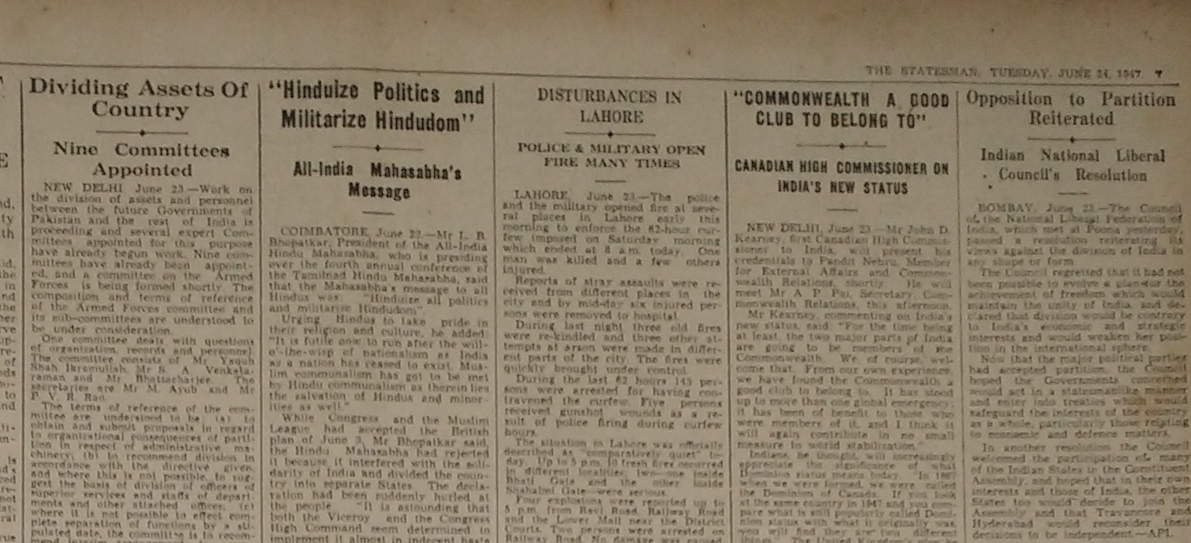
"Hinduize Politics and Militarize Hinduism" - All India Hindu Mahasabha's Message The Statesman of June 24, 1947

On the inside pages of the Statesman, though, an ominous portent on the same date the Punjab partition was voted on: a Hindu Mahasabha rejection of the Mountbatten Plan and calls to militarise.


The Debate on the Idea Pakistan: Audio recording of Lecture by Prof Venkat Dhulipala

http://sacw.net/article11483.html

October 09, 2014

India: Hindustani Versus Sanskritized Hindi – Saeed Naqvi

Caravan Daily

Hindustani Versus Sanskritized Hindi – Saeed Naqvi

Saeed Naqvi is a former newspaper editor and a widely travelled Indian political analyst and commentator on diplomatic affairs
Hindustani Versus Sanskritized Hindi – Saeed Naqvi


Indian Prime Minister Narendra Modi speaks during the 69th session of the United Nations General Assembly, at the UN headquarters in New York, on Sept. 27, 2014. (Xinhua/Wang Lei/IANS)

Modi’s Hindi, learnt presumably as an RSS pracharak, is dry and, to a novice like me, forbidding. Not just me, there are Macaulay’s children and millions of votaries of the new consumerism — they will all be more comfortable with Hindustani. Hence the case for the prime minister to use a more intelligible Hindustani than a heavily Sanskritized Hindi

SAEED NAQVI

I did not understand a word of what our prime minister said at the United Nations General Assembly. Well, except for words like “taaqatwar”, “rozgar” and “zahir”, all other words were beyond my comprehension. I had to fall back on translation.

What confounded me even more were the one liners on top of the TV screen.

“Modi’s befitting reply to Sharif.”

This was baffling. I may have lost Modi’s syntax but I did not hear him mention “Sharif” even once. But the anchors would not give up.

“The UNGA hall was empty when Sharif spoke; it was packed when Modi did”.

Another chipped in: “I think we should cut out this Indo-Pak hyphenation”.

The anchors were possessed by a seering desire to be nasty with Nawaz Sharif, Pakistan, and anything associated with either. As an answer to their prayer, up popped the heads of two ex Pakistani generals from distant Karachi and Islamabad, grinning from ear to ear, in cheerful anticipation of being punched for the next hour. Why they show up is a mystery.

Yes, to revert to that difficulty in accessing the Hindi used by Narendra Modi. Why did I find it so disconcerting?

It is immaterial what my belief is because in a world comfortable with denominational identity, it is tempting to place me in a coop with other Indian Muslims. This would be a bad fit. Indeed it would be a cacophony. Muslims would speak Malayalam in Kerala, Tamil in Tamil Nadu, Bengali in Bengal and so on. Modi’s elevated Hindi would pose the same problems in the regions – for Hindus and Muslims alike. They have all learnt to understand Bollywood Hindustani. That should be the queue.

In Kerala, for instance, it was accepted in the 1980s, that Mohammad Koya spoke the wittiest Malayalam in the state assembly. As chief minister, he once invited me to dinner which was something of a culture shock to both of us. He spoke little Hindi or English and I spoke no Malayalam. He left a strong Malayali imprimatur on the meal by having me sample five varieties of bananas by way of dessert.

Hindi cascades from its Sanskritic heights, then picks up the flavours of Awadhi, Brajbhasha, Bhojpuri and lilts of a hundred rural, pastoral dialects, across the Indo-Gangetic plains.

Dilute the Sanskritic bit and add some Persian instead and you have the scale of Urdu. The language can be stately and inaccessible to the untrained.

When writers elevate their diction, as Maulana Azad did, the verse quoted is generally in Persian. But the finest writers and poets have brought it down to the level of popular literature where it becomes Hindustani. It was the boast of Arzoo Lucknawi that in his collection of poetry, “Surili Bansuri”, Melodious Flute, there is not a single Persian or Arabic word.

In the vast stretch of the cow-belt, an area called Awadh, was where Hindus and Muslims together refined and enriched Urdu. The first great prose writer of Urdu was Pandit Ratan Nath Sarshar. One of the great ghazal poets of the 20th century was Raghupati Sahay Firaq Gorakhpuri. Urdu became the central column of what people in this region called India’s Ganga-Jamuni tehzeeb or culture. (Tragic consequences of Partition on Urdu in Pakistan is another sad story.)

When the Congress party, without consulting the people, signed up for the Partition of India on June 3, 1947, this lot panicked. What would happen to their beloved Urdu? In divided India, Hindi would have to be the national language. What would happen to Urdu?

Saiyyid Mohammad Askari wrote:

“Hai dua yeh ki mukhalif jo/Hain dharey mil jaaen/Aaj phir Kausar o Ganga ke/Kinarey mil jaaen.”

(Let us pray that these opposing currents become a stream/May the banks of Kausar, river of paradise, become one with the Ganga)

Josh Malihabadi wailed:

“Chalne lagi zabaan pe churi inteqaam ki,/Chhaanti gayeen lughat se jo lafzein theen kaam ki/Rahman hi baat chali phir na Ram ki/Guddi se khich gayee jo zubaan thi awaam ki”

(The vengeful knife reached for our mother tongue/Choice words were wrenched from dictionaries/

No heed paid to Ram or Allah,/Tongues pulled out from the throat, men became speechless.)

This was not hyperbole in 1950.

This love for Urdu cost the Muslims dear. While the enlightened Hindu took to Western education exactly as Macaulay had willed, Muslims saw the package of Westernization, language included, with disdain. Later they settled for Hindustani. But what would happen to the Urdu script? Trapped in such considerations, a whole community lost the race for modernity.

Atal Bihari Vajpayee’s reversal to Hindi was moderate cultural assertion. There was lilt and melody in his makeup. Modi’s Hindi, learnt presumably as an RSS pracharak, is dry and, to a novice like me, forbidding. Not just me, there are Macaulay’s children and millions of votaries of the new consumerism – they will all be more comfortable with Hindustani.

December 31, 2013

India: The silence of Muzaffarnagar | Shiv Visvanathan

The Asian Age,Dec 31, 2013

The silence of Muzaffarnagar

Shiv Visvanathan

From Partition to Muzaffarnagar, the history of riots has been a celebration of rape. Muzaffarnagar sounds like it’s a part of the UP badlands, while pundits hair-split words like responsibility and secularism.

If you were to ask most citizens what the most exciting event of the year was, most would talk excitedly about the rule of the Aam Aadmi Party. If you were to detain them a bit further and ask what event disturbed them the most, they would stumble, think, mention gangrapes, corruption and then lapse into silence. A friend facilely replied Dhoom 3. Few today would talk of Muzaffarnagar — the well of silence surrounding it is not just the silence of Hindu majoritarianism gloating in anticipation of the rise of Narendra Modi. It is not merely the silencing of the media owned by corporate interests. Indifference is no one’s particular patent. Corporate dons, journalists, citizens, all claim a stake in it. The silence of Muzaffarnagar is the most disturbing event of the year.
Muzaffarnagar summons the memory of every riot since Partition. It echoes all of them and yet every riot is singular. Every riot as an act of violence adds to the grammar of evil. If Partition or the history of silence after Partition emphasised the enormity of rape, every riot after that added to the degradation of women. The degradation was at two levels; first in the nature of violence as rape and secondly in the nature of silence that followed it. The grammar of riots changed between 1984 and 2012. Grammar is important in decoding a riot. It creates an early warning system to the nature of evil in our society. The sad thing is that grammarians sound cold blooded next to the passion of the victim.
A few keywords stand out as tuning forks. The first is memory: both official and unofficial. Official memory, official histories of riot often create pre-emptive histories. They close camps long before the victims are rehabilitated. Worse, they deny further history, or even the legitimacy of pain.
Mr Modi refused to accept responsibility for the camps. Not to be outdone, Mulayam Singh Yadav claimed that those in the Muzaffarnagar camps were plants of the Bharatiya Janata Party and the Congress.
Mr Yadav’s idiocy was amply supplemented by the affable illiteracy of the secretary, Anil Gupta. Immaculately dressed, aptly bespectacled, the Indian Administrative Service officer explained that his surveys indicated that there were very few deaths in the camps. Like a United Nations health expert, he then expanded affably that “people do not die of cold, otherwise how can people live in Siberia”. This piece of Socratic wisdom has enshrined Mr Gupta in the annals of governance. Yet, it reveals something more fundamental — the transition that political scientist Chandrika Parmar mapped between silence and indifference.
Silence has many triggers. One can suffer from compassion fatigue where members of a community get tired of repeated reports of pain. There is an indifference that emerges from a distorted idea of justice, that the victim deserved it. Here riots and rape merge, in that the community is seen as a justified object of violence as revenge and the victim is seen as a seductress, a threat to the public good. Suddenly the logic of official policy and sociology erases the pain and voice of the victim. It is now a vagrant, a deviant, a piece of pathology. Indifference is more lethal than silence because it erases the life story of the victim. What was once geography of pain becomes an empty space devoid of history.
There is a third kind of silence which has many variants, each a particular dialect of power. There is the silence of the majority Jat Hindu which exterminates another in the guise of justice or honour killing. A small act of misunderstanding or a minor fracas gets amplified into what is literally a collective execution of men and a systematic rape of women. It is ruthless, systematic, implacable, repetitive and diabolical. One cannot understand how a society, especially a majoritarian group, can return to normalcy after that. It is weird that the Jats of Muzaffarnagar feel they have retained their honour. One wonders what honour means to a society in this context when its sense of decency, its integrity as a normative society lies in tatters.
To the silence of the majority, we add the silence of the media. Newspapers and magazines with the exception of Outlook which featured a freelancer’s outstanding report, were indifferent. It was as if beyond being an electoral issue Muzaffarnagar was not an “exciting” issue. NDTV with Srinivasan Jain tried to sustain memory. It was heroic but not quite successful. Party silence, media silence, majoritarian silence and the silence of human rights groups combined to create the greater silence of Muzaffarnagar, a grinding searing silence that makes Muslims wonder if India still remains a decent society.
There is a discrepancy to the very narratives of violence. One talks of murder yet these stories are coy about rape. From Partition to Muzaffarnagar, the history of riots has been a tacit celebration of rape. Muzaffarnagar sounds like it’s a part of the Uttar Pradesh badlands, while pundits hair-split words like responsibility and secularism. Electoral logic of the BJP, Samajwadi Party and the Congress can dispense with the ordinary Muslim. He is either electoral fodder as minoritarian vote or the fodder of violence to stoke communal fears.
India feels it has reached a positive turn of history. The AAP is in power in Delhi and the Modi juggernaut is moving relentlessly to crush the Congress. Both events seem to signal a middle class, majoritarian victory. In the tumult of that moment, they might ask, so what if a few Muslims died. That is the sadness of history. It is also the final obituary of any democracy.

The writer is a social science nomad

August 22, 2013

India: Tamas, once again on TV

Daily News and Analysis

Tamas, once in the eye of the storm, is back

Aug 21, 2013, 8:12 IST | Agency: DNA

Jyoti Punwani

Is anyone watching Tamas? It’s at prime time, but on the History channel. When it was first telecast in 1988, a Hindu and a Muslim separately went to court asking for a ban, the BJP protested on the streets, progressive groups held counter demonstrations in support, and director Govind Nihalani received threats.

This was a different country then. The air was toxic after the Shah Bano judgment and the opening of the locks to the Babri Masjid; Operation Blue Star, Indira Gandhi’s assassination and the massacre of Sikhs; Khalistanis on the rampage and innocent Sikhs being killed off in “encounters’’, the Meerut riots and the Maliana massacre; and 18-year-old Roop Kanwar’s ‘sati’ in Rajasthan. Hindus, Muslims, Sikhs, Rajputs, were all being instigated by self-styled leaders.

In such an atmosphere, right into our homes, came never-before seen images of Partition, a period no film-maker had dared portray. These weren’t general visuals, but very specific ones with definite communal overtones: a pig being killed to be thrown outside a mosque; a leader initiating a hesitant teenager wearing those giveaway khaki shorts, into violence against neighbours who belonged to another community; open communal hostility between Muslim Leaguers and Congressmen.

We saw all this over two consecutive days last week. In 1988, we had one episode a week, that too at 10pm, not prime time. Does the absence of any reaction today mean that no one’s watching Tamas, or that we’ve grown up, or both?

For viewers used to the flashy, unreal soaps of the last decade, Tamas is that rare thing: a TV serial that actually leaves you disturbed, full of doubts and questions. Too much brainwork is involved viewing it. Also, it cuts too close. Why rake up old, awful memories, the generation that had witnessed Partition had asked then. Twenty five years later, there may be few left of that generation. But their children have seen some pretty gruesome things too. The bloodshed leading to the demolition of the Babri Masjid, and its aftermath, that left no one untouched, may have occurred 20 years back, but it’s hardly been a popular theme among film-makers. Ditto for the 2002 Gujarat violence. Not all the TV discussions on communal violence can come close to seeing Hindu-Muslim-Sikh hatreds acted out on screen by artists known for getting under the skin of their characters, under a director who has never cared to dress up ugly situations. Tamas today is as exceptional a serial as it was in 1988, and leaves you as shaken as it did then.

Is it as relevant? Aren’t the same khaki-shorts occupying centre-stage in politics today? For all his appeal, Narendra Modi wouldn’t have become the star campaigner against the Congress without the approval of those old RSS men. The starry-eyed youngsters following him may find it worthwhile to watch Tamas to understand the ideology that has moulded him. So may their counterparts, who listen with awe to the recordings of the Owaisi brothers’ incendiary speeches.

Asaduddin and Akbaruddin Owaisi, in whom many young Muslims see the promise of a bold new leadership, are the true inheritors of the Muslim League ideology that sees Indian Muslims as having a political identity separate from Hindus.

Alas, there are no secular do-gooders left in the Congress of today. All the more reason to learn what Gandhiji, now much reviled, was capable of inspiring among ordinary Indians, and also how the tallest Congressmen betrayed their followers by accepting Partition.

If you haven’t yet, watch Tamas today.

The author is a Mumbai-based freelance journalist.

November 07, 2012

Text of Romila Thapar's intervention at an event marking 10 years of Gujarat Genocide (9 oct in Jamia Milia)

Would those who encouraged the victimisers to kill in Gujarat be willing to apologise or make a conciliatory gesture to the victims? That would be a confession of guilt and guilt is what Narendra Modi is constantly denying

FULL text at: http://www.sacw.net/article3287.html

March 18, 2012

Letting Azad win

Hindustan Times, March 15, 2012

Letting Azad win

by Ramachandra Guha,

In the third week of March 1940, Maulana Abul Kalam Azad delivered the presidential address at the annual meeting of the Indian National Congress, held that year in Ramgarh in Bihar. Azad here spoke of secularism as India’s “historic destiny”, proof of which was in “our languages, our poetry, our literature, our culture , our dress, our manners and our customs”, all of which bore the “stamp of our joint endeavour” (as Hindus and as Muslims). Azad insisted that “whether we like it or not, we have now become an Indian nation, united and indivisible. No fantasy or artificial scheming to separate or divide can break this unity”.

A few days later, the Muslim League met for its annual meeting in Lahore, where its president, Muhammad Ali Jinnah, put forward a radically different point of view. Hindus and Muslims, he believed, “belong to two different civilisations which are based mainly on conflicting ideas and conceptions”. Jinnah thought it “a dream that Hindus and Muslims can evolve a common nationality”.

In the short-term, Jinnah won the debate. In 1947, Pakistan was created as a separate homeland for the Muslims of the subcontinent. Azad was deeply demoralised by this defeat, but his friend and comrade, Jawaharlal Nehru, set out to win the argument in the long-term. Millions of Muslims had stayed behind in India; to these, Nehru offered the ideal, and hope, of a common citizenship in a secular State.

Partition had been accompanied by ethnic cleansing and bloody riots. Remarkably, the first decade-and-a-half of Independence was largely free of Hindu-Muslim violence. This was in good part due to Nehru’s leadership. He helped make Muslims feel secure in a largely Hindu nation; at the same time, he kept the forces of Hindutva extremism at bay.

In 1963, after the theft of a relic of the Prophet Muhammad from a shrine in Kashmir, there was violence against Hindus in what was then East Pakistan, followed by violence against Muslims in West Bengal and Orissa. In 1969, there was a major riot in Ahmedabad. The 1970s also saw some serious bouts of Hindu-Muslim rioting (in Moradabad and Jamshedpur, among other places). However, it was really in the 1980s and 1990s that the Gandhi-Azad-Nehru ideal of a secular India came under serious threat.

The communal polarisation of those decades was enabled by two grossly cynical moves — the annulling by Rajiv Gandhi of the Supreme Court judgement in the Shah Bano case, and the rath yatra of LK Advani. These two acts helped fuel a wave of religious violence across northern and western India, a violence so regular and widespread that those decades still seem, to one who lived through them, to be best captured in the title of a book by MJ Akbar, Riot after Riot. Notably, in all states except Jammu and Kashmir, Muslims suffered massively. Despite being a minority, far more Muslim lives were burnt, and Muslim homes burnt, than Hindu ones. There were now real fears that India was becoming a Hindu Pakistan.

This cycle ended with the Gujarat riots of 2002. In the decade since, there has been no serious Hindu-Muslim riot in India. This is the first 10-year-period since Jawaharlal Nehru’s death of which this can be said. Indeed, the diminution of sectarian conflict is the one genuinely cheering thing about India today, small consolation — but consolation nevertheless — in the face of corruption scandals, growing economic inequalities, galloping environmental degradation, et. al.

My own impression, based on travels around the country and conversations with a variety of Indians, is that this cooling of communal tempers is occurring independently and simultaneously on both sides of the spectrum. Hindus who once went along with the Ayodhya movement now see the futility of constructing a nation’s agenda around a single temple. Having witnessed (and suffered) the BJP in power in New Delhi, they now know that far from being a ‘party with a difference’, it is driven by greed and personal ambition. Meanwhile, the ordinary Muslim is breaking free of the reactionary mullahs who once presumed to speak for the community. He, and increasingly she, is no longer moved by talk of the past glories of Islam — rather, they seek education and jobs in the modern economy.

The contrast with Pakistan in this respect can be striking. In Lahore, once a showpiece of cosmopolitanism, the women on the streets are mostly in burqas. In Bihar, once a byword for backwardness, Muslim girls go unaccompanied on cycles to school. Barely a handful of Indian Muslims have joined terrorist organisations; whereas tens of thousands of Pakistanis have done so. Indian Islam retains its diverse and plural character; Pakistani Islam has increasingly gone the Wahabi way. Here, unlike there, Shias, Ahmediyas, Khojas and Ismailis are not under threat from Sunni fundamentalists.

Have Nehru and Azad then finally won the argument? Is, will, must, secularism be India’s destiny? It is too early to say. The social peace of the past decade, the shedding of reactionary tendencies by Hindus and Muslims, could yet be reversed by the scheming of politicians. The bans on cow-slaughter and the mandatory teaching of the Bhagvad Gita in BJP-ruled states are inimical to the secularism that the nation’s founders sought. So are the job quotas for Muslims so energetically pursued by the Congress. Pace Azad, these schemes are not so much artificial as malevolent. The former seek to provoke Muslims; the latter, to placate them. Neither is consistent with the claims of equal citizenship. For the sake of Hindus, Muslims, and India itself, these schemes must be withdrawn, or, through the pressure of democratic public opinion, be made to fail.

Ramachandra Guha is the current holder of the Philippe Roman Chair in History and International Affairs, London School of Economics. The views expressed by the author are personal

November 28, 2009

Against Partition: April 1946 Interview with Abul Kalam Azad

From Covert Magazine

THE MAN WHO KNEW THE FUTURE

by Matbooat Chattan Lahore

Congress president Maulana Abul Kalam Azad gave the following interview to journalist Shorish Kashmiri for a Lahore based Urdu magazine, Chattan, in April 1946. It was a time when the Cabinet Mission was holding its proceedings in Delhi and Simla. Azad made some startling predictions during the course of the interview, saying that religious conflict would tear apart Pakistan and its eastern half would carve out its own future. He even said that Pakistan’s incompetent rulers might pave the way for military rule. According to Shorish Kashmiri, Azad had earmarked the early hours of the morning for him and the interview was conducted over a period of two weeks. This interview has not been published in any book so far — neither in the Azad centenary volumes nor in any other book comprising his writing or speeches — except for Kashmiri’s own book Abul Kalam Azad, which was printed only once by Matbooat Chattan Lahore, a now-defunct publishing house. Former Union Cabinet Minister Arif Mohammed Khan discovered the book after searching for many years and translated the interview for COVERT

Q: The Hindu Muslim dispute has become so acute that it has foreclosed any possibility of reconciliation. Don’t you think that in this situation the birth of Pakistan has become inevitable?

A: If Pakistan were the solution of Hindu Muslim problem, then I would have extended my support to it. A section of Hindu opinion is now turning in its favour. By conceding NWFP, Sind, Balochistan and half of Punjab on one side and half of Bengal on the other, they think they will get the rest of India — a huge country that would be free from any claims of communal nature. If we use the Muslim League terminology, this new India will be a Hindu state both practically and temperamentally. This will not happen as a result of any conscious decision, but will be a logical consequence of its social realities. How can you expect a society that consists 90% of Hindus, who have lived with their ethos and values since prehistoric times, to grow differently? The factors that laid the foundation of Islam in Indian society and created a powerful following have become victim of the politics of partition. The communal hatred it has generated has completely extinguished all possibilities of spreading and preaching Islam. This communal politics has hurt the religion beyond measure. Muslims have turned away from the Quran. If they had taken their lessons from the Quran and the life of the Holy Prophet and had not forged communal politics in the name of religion then Islam’s growth would not have halted. By the time of the decline of the Mughal rule, the Muslims in India were a little over 22.5 million, that is about 65% of the present numbers. Since then the numbers kept increasing. If the Muslim politicians had not used the offensive language that embittered communal relations, and the other section acting as agents of British interests had not worked to widen the Hindu-Muslim breach, the number of Muslims in India would have grown higher. The political disputes we created in the name of religion have projected Islam as an instrument of political power and not what it is — a value system meant for the transformation of human soul. Under British influence, we turned Islam into a confined system, and following in the footsteps of other communities like Jews, Parsis and Hindus we transformed ourselves into a hereditary community. The Indian Muslims have frozen Islam and its message and divided themselves into many sects. Some sects were clearly born at the instance of colonial power. Consequently, these sects became devoid of all movement and dynamism and lost faith in Islamic values. The hallmark of Muslim existence was striving and now the very term is strange to them. Surely they are Muslims, but they follow their own whims and desires. In fact now they easily submit to political power, not to Islamic values. They prefer the religion of politics not the religion of the Quran. Pakistan is a political standpoint. Regardless of the fact whether it is the right solution to the problems of Indian Muslims, it is being demanded in the name of Islam. The question is when and where Islam provided for division of territories to settle populations on the basis of belief and unbelief. Does this find any sanction in the Quran or the traditions of the Holy Prophet? Who among the scholars of Islam has divided the dominion of God on this basis? If we accept this division in principle, how shall we reconcile it with Islam as a universal system? How shall we explain the ever growing Muslim presence in non-Muslim lands including India? Do they realise that if Islam had approved this principle then it would not have permitted its followers to go to the non-Muslim lands and many ancestors of the supporters of Pakistan would not have had even entered the fold of Islam? Division of territories on the basis of religion is a contraption devised by Muslim League. They can pursue it as their political agenda, but it finds no sanction in Islam or Quran. What is the cherished goal of a devout Muslim? Spreading the light of Islam or dividing territories along religious lines to pursue political ambitions? The demand for Pakistan has not benefited Muslims in any manner. How Pakistan can benefit Islam is a moot question and will largely depend on the kind of leadership it gets. The impact of western thought and philosophy has made the crisis more serious. The way the leadership of Muslim League is conducting itself will ensure that Islam will become a rare commodity in Pakistan and Muslims in India. This is a surmise and God alone knows what is in the womb of future. Pakistan, when it comes into existence, will face conflicts of religious nature. As far as I can see, the people who will hold the reins of power will cause serious damage to Islam. Their behaviour may result in the total alienation of the Pakistani youth who may become a part of non-religious movements. Today, in Muslim minority states the Muslim youth are more attached to religion than in Muslim majority states. You will see that despite the increased role of Ulema, the religion will lose its sheen in Pakistan.

Q: But many Ulema are with Quaid-e-Azam [M.A. Jinnah].

A: Many Ulema were with Akbare Azam too; they invented a new religion for him. Do not discuss individuals. Our history is replete with the doings of the Ulema who have brought humiliation and disgrace to Islam in every age and period. The upholders of truth are exceptions. How many of the Ulema find an honourable mention in the Muslim history of the last 1,300 years? There was one Imam Hanbal, one Ibn Taimiyya. In India we remember no Ulema except Shah Waliullah and his family. The courage of Alf Sani is beyond doubt, but those who filled the royal office with complaints against him and got him imprisoned were also Ulema. Where are they now? Does anybody show any respect to them?

Q: Maulana, what is wrong if Pakistan becomes a reality? After all, “Islam” is being used to pursue and protect the unity of the community.

A: You are using the name of Islam for a cause that is not right by Islamic standards. Muslim history bears testimony to many such enormities. In the battle of Jamal [fought between Imam Ali and Hadrat Aisha, widow of the Holy Prophet] Qurans were displayed on lances. Was that right? In Karbala the family members of the Holy Prophet were martyred by those Muslims who claimed companionship of the Prophet. Was that right? Hajjaj was a Muslim general and he subjected the holy mosque at Makka to brutal attack. Was that right? No sacred words can justify or sanctify a false motive.

If Pakistan was right for Muslims then I would have supported it. But I see clearly the dangers inherent in the demand. I do not expect people to follow me, but it is not possible for me to go against the call of my conscience. People generally submit either to coercion or to the lessons of their experience. Muslims will not hear anything against Pakistan unless they experience it. Today they can call white black, but they will not give up Pakistan. The only way it can be stopped now is either for the government not to concede it or for Mr Jinnah himself — if he agrees to some new proposal.

Now as I gather from the attitude of my own colleagues in the working committee, the division of India appears to be certain. But I must warn that the evil consequences of partition will not affect India alone, Pakistan will be equally haunted by them. The partition will be based on the religion of the population and not based on any natural barrier like mountain, desert or river. A line will be drawn; it is difficult to say how durable it would be.

We must remember that an entity conceived in hatred will last only as long as that hatred lasts. This hatred will overwhelm the relations between India and Pakistan. In this situation it will not be possible for India and Pakistan to become friends and live amicably unless some catastrophic event takes place. The politics of partition itself will act as a barrier between the two countries. It will not be possible for Pakistan to accommodate all the Muslims of India, a task beyond her territorial capability. On the other hand, it will not be possible for the Hindus to stay especially in West Pakistan. They will be thrown out or leave on their own. This will have its repercussions in India and the Indian Muslims will have three options before them:

1. They become victims of loot and brutalities and migrate to Pakistan; but how many Muslims can find shelter there?
2. They become subject to murder and other excesses. A substantial number of Muslims will pass through this ordeal until the bitter memories of partition are forgotten and the generation that had lived through it completes its natural term.
3. A good number of Muslims, haunted by poverty, political wilderness and regional depredation decide to renounce Islam.

The prominent Muslims who are supporters of Muslim League will leave for Pakistan. The wealthy Muslims will take over the industry and business and monopolise the economy of Pakistan. But more than 30 million Muslims will be left behind in India. What promise Pakistan holds for them? The situation that will arise after the expulsion of Hindus and Sikhs from Pakistan will be still more dangerous for them. Pakistan itself will be afflicted by many serious problems. The greatest danger will come from international powers who will seek to control the new country, and with the passage of time this control will become tight. India will have no problem with this outside interference as it will sense danger and hostility from Pakistan.

The other important point that has escaped Mr Jinnah’s attention is Bengal. He does not know that Bengal disdains outside leadership and rejects it sooner or later. During World War II, Mr Fazlul Haq revolted against Jinnah and was thrown out of the Muslim League. Mr H.S. Suhrawardy does not hold Jinnah in high esteem. Why only Muslim League, look at the history of Congress. The revolt of Subhas Chandra Bose is known to all. Gandhiji was not happy with the presidentship of Bose and turned the tide against him by going on a fast unto death at Rajkot. Subhas Bose rose against Gandhiji and disassociated himself from the Congress. The environment of Bengal is such that it disfavours leadership from outside and rises in revolt when it senses danger to its rights and interests.

The confidence of East Pakistan will not erode as long as Jinnah and Liaquat Ali are alive. But after them any small incident will create resentment and disaffection. I feel that it will not be possible for East Pakistan to stay with West Pakistan for any considerable period of time. There is nothing common between the two regions except that they call themselves Muslims. But the fact of being Muslim has never created durable political unity anywhere in the world. The Arab world is before us; they subscribe to a common religion, a common civilisation and culture and speak a common language. In fact they acknowledge even territorial unity. But there is no political unity among them. Their systems of government are different and they are often engaged in mutual recrimination and hostility. On the other hand, the language, customs and way of life of East Pakistan are totally different from West Pakistan. The moment the creative warmth of Pakistan cools down, the contradictions will emerge and will acquire assertive overtones. These will be fuelled by the clash of interests of international powers and consequently both wings will separate. After the separation of East Pakistan, whenever it happens, West Pakistan will become the battleground of regional contradictions and disputes. The assertion of sub-national identities of Punjab, Sind, Frontier and Balochistan will open the doors for outside interference. It will not be long before the international powers use the diverse elements of Pakistani political leadership to break the country on the lines of Balkan and Arab states. Maybe at that stage we will ask ourselves, what have we gained and what have we lost.

The real issue is economic development and progress, it certainly is not religion. Muslim business leaders have doubts about their own ability and competitive spirit. They are so used to official patronage and favours that they fear new freedom and liberty. They advocate the two-nation theory to conceal their fears and want to have a Muslim state where they have the monopoly to control the economy without any competition from competent rivals. It will be interesting to watch how long they can keep this deception alive.

I feel that right from its inception, Pakistan will face some very serious problems:
1. The incompetent political leadership will pave the way for military dictatorship as it has happened in many Muslim countries.
2. The heavy burden of foreign debt.
3. Absence of friendly relationship with neighbours and the possibility of armed conflict.
4. Internal unrest and regional conflicts.
5. The loot of national wealth by the neo-rich and industrialists of Pakistan.
6. The apprehension of class war as a result of exploitation by the neo-rich.
7. The dissatisfaction and alienation of the youth from religion and the collapse of the theory of Pakistan.
8. The conspiracies of the international powers to control Pakistan.
In this situation, the stability of Pakistan will be under strain and the Muslim countries will be in no position to provide any worthwhile help. The assistance from other sources will not come without strings and it will force both ideological and territorial compromises.

Q: But the question is how Muslims can keep their community identity intact and how they can inculcate the attributes of the citizens of a Muslim state.

A: Hollow words cannot falsify the basic realities nor slanted questions can make the answers deficient. It amounts to distortion of the discourse. What is meant by community identity? If this community identity has remained intact during the British slavery, how will it come under threat in a free India in whose affairs Muslims will be equal participants? What attributes of the Muslim state you wish to cultivate? The real issue is the freedom of faith and worship and who can put a cap on that freedom. Will independence reduce the 90 million Muslims into such a helpless state that they will feel constrained in enjoying their religious freedom? If the British, who as a world power could not snatch this liberty, what magic or power do the Hindus have to deny this freedom of religion? These questions have been raised by those, who, under the influence of western culture, have renounced their own heritage and are now raising dust through political gimmickry.

Muslim history is an important part of Indian history. Do you think the Muslim kings were serving the cause of Islam? They had a nominal relationship with Islam; they were not Islamic preachers. Muslims of India owe their gratitude to Sufis, and many of these divines were treated by the kings very cruelly. Most of the kings created a large band of Ulema who were an obstacle in the path of the propagation of Islamic ethos and values. Islam, in its pristine form, had a tremendous appeal and in the first century won the hearts and minds of a large number of people living in and around Hejaz. But the Islam that came to India was different, the carriers were non-Arabs and the real spirit was missing. Still, the imprint of the Muslim period is writ large on the culture, music, art, architecture and languages of India. What do the cultural centres of India, like Delhi and Lucknow, represent? The underlying Muslim spirit is all too obvious.

If the Muslims still feel under threat and believe that they will be reduced to slavery in free India then I can only pray for their faith and hearts. If a man becomes disenchanted with life he can be helped to revival, but if someone is timid and lacks courage, then it is not possible to help him become brave and gutsy. The Muslims as a community have become cowards. They have no fear of God, instead they fear men. This explains why they are so obsessed with threats to their existence — a figment of their imagination.

After British takeover, the government committed all possible excesses against the Muslims. But Muslims did not cease to exist. On the contrary, they registered a growth that was more than average. The Muslim cultural ethos and values have their own charm. Then India has large Muslim neighbours on three sides. Why on earth the majority in this country will be interested to wipe out the Muslims? How will it promote their self interests? Is it so easy to finish 90 million people? In fact, Muslim culture has such attraction that I shall not be surprised if it comes to have the largest following in free India.

The world needs both, a durable peace and a philosophy of life. If the Hindus can run after Marx and undertake scholarly studies of the philosophy and wisdom of the West, they do not disdain Islam and will be happy to benefit from its principles. In fact they are more familiar with Islam and acknowledge that Islam does not mean parochialism of a hereditary community or a despotic system of governance. Islam is a universal call to establish peace on the basis of human equality. They know that Islam is the proclamation of a Messenger who calls to the worship of God and not his own worship. Islam means freedom from all social and economic discriminations and reorganisation of society on three basic principles of God-consciousness, righteous action and knowledge. In fact, it is we Muslims and our extremist behaviour that has created an aversion among non-Muslims for Islam. If we had not allowed our selfish ambitions to soil the purity of Islam then many seekers of truth would have found comfort in the bosom of Islam. Pakistan has nothing to do with Islam; it is a political demand that is projected by Muslim League as the national goal of Indian Muslims. I feel it is not the solution to the problems Muslims are facing. In fact it is bound to create more problems.

The Holy Prophet has said, “God has made the whole earth a mosque for me.” Now do not ask me to support the idea of the partition of a mosque. If the nine-crore Muslims were thinly scattered all over India, and demand was made to reorganise the states in a manner to ensure their majority in one or two regions, that was understandable. Again such a demand would not have been right from an Islamic viewpoint, but justifiable on administrative grounds. But the situation, as it exists, is drastically different. All the border states of India have Muslim majorities sharing borders with Muslim countries. Tell me, who can eliminate these populations? By demanding Pakistan we are turning our eyes away from the history of the last 1,000 years and, if I may use the League terminology, throwing more than 30 million Muslims into the lap of “Hindu Raj”. The Hindu Muslim problem that has created political tension between Congress and League will become a source of dispute between the two states and with the aid of international powers this may erupt into full scale war anytime in future.

The question is often raised that if the idea of Pakistan is so fraught with dangers for the Muslims, why is it being opposed by the Hindus? I feel that the opposition to the demand is coming from two quarters. One is represented by those who genuinely feel concerned about imperial machinations and strongly believe that a free, united India will be in a better position to defend itself. On the other hand, there is a section who opposes Pakistan with the motive to provoke Muslims to become more determined in their demand and thus get rid of them. Muslims have every right to demand constitutional safeguards, but partition of India cannot promote their interests. The demand is the politically incorrect solution of a communal problem.

In future India will be faced with class problems, not communal disputes; the conflict will be between capital and labour. The communist and socialist movements are growing and it is not possible to ignore them. These movements will increasingly fight for the protection of the interest of the underclass. The Muslim capitalists and the feudal classes are apprehensive of this impending threat. Now they have given this whole issue a communal colour and have turned the economic issue into a religious dispute. But Muslims alone are not responsible for it. This strategy was first adopted by the British government and then endorsed by the political minds of Aligarh. Later, Hindu short-sightedness made matters worse and now freedom has become contingent on the partition of India.

Jinnah himself was an ambassador of Hindu-Muslim unity. In one Congress session Sarojini Naidu had commended him with this title. He was a disciple of Dadabhai Naoroji. He had refused to join the 1906 deputation of Muslims that initiated communal politics in India. In 1919 he stood firmly as a nationalist and opposed Muslim demands before the Joint Select Committee. On 3 October 1925, in a letter to the Times of India he rubbished the suggestion that Congress is a Hindu outfit. In the All Parties Conferences of 1925 and 1928, he strongly favoured a joint electorate. While speaking at the National Assembly in 1925, he said, “I am a nationalist first and a nationalist last” and exhorted his colleagues, be they Hindus or Muslims, “not to raise communal issues in the House and help make the Assembly a national institution in the truest sense of the term”.

In 1928, Jinnah supported the Congress call to boycott Simon Commission. Till 1937, he did not favour the demand to partition India. In his message to various student bodies he stressed the need to work for Hindu Muslim unity. But he felt aggrieved when the Congress formed governments in seven states and ignored the Muslim League. In 1940 he decided to pursue the partition demand to check Muslim political decline. In short, the demand for Pakistan is his response to his own political experiences. Mr Jinnah has every right to his opinion about me, but I have no doubts about his intelligence. As a politician he has worked overtime to fortify Muslim communalism and the demand for Pakistan. Now it has become a matter of prestige for him and he will not give it up at any cost.

Q: It is clear that Muslims are not going to turn away from their demand for Pakistan. Why have they become so impervious to all reason and logic of arguments?

A: It is difficult, rather impossible, to fight against the misplaced enthusiasm of a mob, but to suppress one’s conscience is worse than death. Today the Muslims are not walking, they are flowing. The problem is that Muslims have not learnt to walk steady; they either run or flow with the tide. When a group of people lose confidence and self-respect, they are surrounded by imaginary doubts and dangers and fail to make a distinction between the right and the wrong. The true meaning of life is realised not through numerical strength but through firm faith and righteous action. British politics has sown many seeds of fear and distrust in the mental field of Muslims. Now they are in a frightful state, bemoaning the departure of the British and demanding partition before the foreign masters leave. Do they believe that partition will avert all the dangers to their lives and bodies? If these dangers are real then they will still haunt their borders and any armed conflict will result in much greater loss of lives and possessions.

Q: But Hindus and Muslims are two different nations with different and disparate inclinations. How can the unity between the two be achieved?

A: This is an obsolete debate. I have seen the correspondence between Allama Iqbal and Maulana Husain Ahmad Madni on the subject. In the Quran the term qaum has been used not only for the community of believers but has also been used for distinct human groupings generally. What do we wish to achieve by raising this debate about the etymological scope of terms like millat [community], qaum [nation] and ummat [group]? In religious terms India is home to many people — the Hindus, Muslims, Christians, Parsis, Sikhs etc. The differences between Hindu religion and Islam are vast in scope. But these differences cannot be allowed to become an obstacle in the path of India gaining her freedom nor do the two distinct and different systems of faith negate the idea of unity of India. The issue is of our national independence and how we can secure it. Freedom is a blessing and is the right of every human being. It cannot be divided on the basis of religion.

Muslims must realise that they are bearers of a universal message. They are not a racial or regional grouping in whose territory others cannot enter. Strictly speaking, Muslims in India are not one community; they are divided among many well-entrenched sects. You can unite them by arousing their anti-Hindu sentiment but you cannot unite them in the name of Islam. To them Islam means undiluted loyalty to their own sect. Apart from Wahabi, Sunni and Shia there are innumerable groups who owe allegiance to different saints and divines. Small issues like raising hands during the prayer and saying Amen loudly have created disputes that defy solution. The Ulema have used the instrument of takfeer [fatwas declaring someone as infidel] liberally. Earlier, they used to take Islam to the disbelievers; now they take away Islam from the believers. Islamic history is full of instances of how good and pious Muslims were branded kafirs. Prophets alone had the capability to cope with these mindboggling situations. Even they had to pass through times of afflictions and trials. The fact is that when reason and intelligence are abandoned and attitudes become fossilised then the job of the reformer becomes very difficult.

But today the situation is worse than ever. Muslims have become firm in their communalism; they prefer politics to religion and follow their worldly ambitions as commands of religion. History bears testimony to the fact that in every age we ridiculed those who pursued the good with consistency, snuffed out the brilliant examples of sacrifice and tore the flags of selfless service. Who are we, the ordinary mortals; even high ranking Prophets were not spared by these custodians of traditions and customs.

Q: You closed down your journal Al-Hilal a long time back. Was it due to your disappointment with the Muslims who were wallowing in intellectual desolation, or did you feel like proclaiming azan [call to prayer] in a barren desert?

A: I abandoned Al-Hilal not because I had lost faith in its truth. This journal created great awareness among a large section of Muslims. They renewed their faith in Islam, in human freedom and in consistent pursuit of righteous goals. In fact my own life was greatly enriched by this experience and I felt like those who had the privilege of learning under the companionship of the Messenger of God. My own voice entranced me and under its impact I burnt out like a phoenix. Al-Hilal had served its purpose and a new age was dawning. Based on my experiences, I made a reappraisal of the situation and decided to devote all my time and energy for the attainment of our national freedom. I was firm in my belief that freedom of Asia and Africa largely depends on India’s freedom and Hindu Muslim unity is key to India’s freedom. Even before the First World War, I had realised that India was destined to attain freedom, and no power on earth would be able to deny it. I was also clear in my mind about the role of Muslims. I ardently wished that Muslims would learn to walk together with their countrymen and not give an opportunity to history to say that when Indians were fighting for their independence, Muslims were looking on as spectators. Let nobody say that instead of fighting the waves they were standing on the banks and showing mirth on the drowning of boats carrying the freedom fighters