|
Showing posts with label Jharkhand. Show all posts

April 18, 2022

India: Communal violence in Koderma (Jharkhand) | Irfan Engineer (April 2022)


Communal violence in Koderma (Jharkhand)

Irfan Engineer

The Ram Navmi procession passed of peacefully through the road on which Mosque is situated with minor some minor hiccups on 10th April, 2022, however, Muslim shops were attacked on next day morning. The Muslim community remained peaceful and did not do anything, afraid that doing so was in the interest of peace. There was breach of peace nevertheless, and they are also being arrested and implicated in cases lodged. Many years ago, CPI (M) leader Com. Asim Sarkar had dared to intervene in a situation of communal violence and stopped it. This time he did not dare as the youth involved this time would not listen to him. This, in brief is the story of communal violence in Koderma (Jharkhand) that followed Ram Navmi procession. Hindus and Muslims have lived peacefully in Koderma town with population of about 25000. There are some mixed as well as segregated colonies. Muslims are about 24% of the Town’s population, most of them poor labourers, while there are some Muslim traders as well. There are about 15% Muslims in Koderma district. Scheduled Castes constitute more than 13% of the population.

The Yadavs have been politically quite influential caste in Koderma. They constitute 24 to 26% of the population in Koderma. Since Laloo Prasad Yadav cobbled the M-Y alliance, Koderma has always been peaceful. Koderma always returned RJD candidates until 2014 in Assembly constituency. Annapurna Devi Yadav was elected as RJD candidate in 2005 and 2009. However, the Yadavs are slowly shifting their political loyalty to the BJP. Laloo Prasad brought them to power, but they are shrewd enough to know in which party their future political interests lie. Annapurna Devi Yadav was in RJD till 2019. Sometime in that year she joined the BJP and was elected as an MP from Koderma Lok Sabha Constituency. The BJP has won both – the Koderma Assembly and Lok Sabha elections in 2014 as well as 2019. Eager to mobilize the Yadavs into the BJP, Annapurna Devi is now a minister of state for Education in the Central Government. Dr. Neera Yadav is the MLA from the Koderma Assembly Constituency also belongs to the BJP. With growing influence of BJP in Koderma, the extremist elements in the town are becoming more assertive.

Testimonies of the Survivors:

According to Maqsood Alam and his nephew Shahnawaz Raza, Ram Navmi procession every year passes through the road on which mosque is situated. Other Muslim informants also agreed that it has been a very old tradition. In fact, every year about 100 persons participate in the procession and as there was never any trouble, it is accompanied by only two constables. Muslims welcome the procession offering them cold drinks, and the procession mutes its DJ and musical instruments as a mark of respect to the place of worship of Muslims. The procession usually passes through before namaz time, i.e., 4.30 pm. This year, the settled practices were violated from both sides. There were more about 300-400 persons this year, and most of them were outsiders. The procession arrived near the mosque while prayers were going on. The DJ van stopped just outside the mosque and the loudspeaker was turned in the direction of the mosque and volume increased. Two Muslim youth climbed on the DJ van, however, Sajid Hussain, a respected community leader immediately pulled them back and even slapped them to ensure there was peace. Sajid Hussain informed us that he had to face criticism from some quarters for what he did. Mr. Husain told us that in the melee, he saw a stone landing from somewhere, but it hit no one and just fell on ground unnoticed by most in the procession. SDPO was also accompanying the procession. The DJ was played for about 10 minutes near the mosques before it proceeded. Sajid Hussain and some elders accompanied the procession till the end to ensure that no untoward incident happens. This year, the Muslims did not offer cold drinks. They explained this saying that it was Ramzan and all Muslims were fasting. According to our informants, Sanjay Balgovind Paswan and Sunny Sahu were particularly aggressive during the procession. Sanjay Paswan is a history sheeter with previous criminal cases pending against him of kidnapping Kamal Kedia, owner of stone crushing unit.

On 10th April, two Hindu youths were arrested in the night. However, the leaders of Hindu community managed to get them released. After the release of those arrested, there were all kind of rumours within both communities of a mob having gathered near mosque or temple and impending attack being worked out. People from both communities were tensed. As he was getting phone calls to that effect, Com. Asim called the DC as well as SP to ensure peace and take all precautionary measures.

On 11th April, soon after the shops opened up, Sanjay Paswan led a mob of more than 50 youth, some from outside the town, to attack the Muslim shops and their owners. They were carrying rods to beat up Muslim shop owners. Among the shops and shop owners beaten up were 1) Rais Ahmed, a motorcycle mechanic was beaten up and his shop attacked; 2) Imtiyaz who sells steel trunks and vessels. He sells wipers and was beaten up with the wiper handles, besides taking away the wipers. He suffered a loss of about 40,000/- 3) Javed @ Babu sells Bags. He was beaten up with rods on his back and spine and was hospitalized. With rods they broke up his showcases. 4) Amir’s shoe shop show cases were broken causing damage of upto 30.000/-. 5) Aiyar Alam was beaten up and the goods in his furniture shop – SKP Furniture worth Rupees 50,000 to 60,000 were destroyed. In all, 6 to 7 shops were damaged and shop owners beaten up. Informants blamed Sanjay Paswan, Vicky Sahu and Sunny Sahu for the attacks. The DC and SP came and immediately dispersed the mob without making any arrests. This is when the Muslim shop owners gave complaints to police for damage to their shops.

Traditionally, a day after Ram Navmi, and after worshipping Goddess Durga for nine days, on 11th day the idol is submerged (called visarjan) in the river. The whole event is run under the leadership of two brothers – Krishna and Vijay Sahi. They collect donations for the whole event from the public. One Hindu informant said that they do not institutionalize and involve others in the event as they want to keep the surplus of the donations to themselves without rendering any accounts to anyone. Both the brothers take charge alternatively and they obtain the permission to organize the worship and visarjan in their individual name. The visarjan was on 12th April. Already there were rumors regarding impending attack on temple. Perhaps that may have been a ruse to mobilize more youth for the visarjan procession. A lot of youth joined the visarjan, although with or without the knowledge and intent of the license holders of the procession. However, in the procession, youth were dancing joyously and chanting slogans abusing Muslims in derogatorily in worst expletives known to Hindi language and insulting Muslim women. They cannot be reproduced here. They made a video of their slogans, uploaded it and made it viral on social media. No one can see the video even for a few seconds. Ravish Kumar showed the video in his Primetime show on NDTV after muting the slogans. The state had to take cognizance of the video. State registered an FIR under section 66 of the Information Technology Act and arrested 28 youth. There are reports that they were beaten up in custody. Manoj Kumar Jhunnu, General Secretary of the Ram Navmi Nagar Thara Akhada and associated with the RSS did not dispute while talking to us that such abusive slogans were given during the visarjan procession nor did he dispute the authenticity of the video. He merely distanced himself from the procession and disapproved such slogans. Jhunnu also did not have any grievances with the Muslim community regarding their role during the Ram Nami procession.

One Sonu Vishkarma has lodged a complaint against Muslims for objecting to the DJ and obstructing the procession and throwing stones at the procession. Among the accused named in the complaint includes Sajid Hussain, who in fact restrained the Muslim youth. The SDPO was personally present during the procession and claimed that he did not see any stone being thrown at the procession. Muslims did not lodge any complaint, according to them, in the interest of peace, against the orgainzers of the Ram Navmi procession for using DJ which is against the guidelines and carrying swords and canes with them.

On 13th April, the SDO called for a peace committee meeting with members of both the communities attending. In the meeting it was decided to bury the hatchet, let bygones be bygones and make a fresh beginning. They also decided to reopen the shops and take a joint peace procession through the town. The SDPO personally praised the patience of the Muslim community and the role of Sajid Hussain in controlling the Muslim youth. 20-25 persons gathered at Gandhi Chowk from both the communities and moved through the main road and market, hailing peace and unity. This initiative greatly reduced the tension between both the communities. Members of both the community were to gather once again near Jama Masjid as peace building measure. According to the Muslim informants, members of Hindu community did not come. However, on 13th April night, the police started arresting the Hindu boys who were involved in the visarjan procession and, on the other hand, to ‘balance’ and appear impartial, they began arresting people from the Muslim community as well, and according to the community members, arrested innocent people. Bad enough, but so far so good. However, the manner in which Muslims are being arrested becomes the main trouble from now onwards.

According to the Muslim community members, the police from reserved forces come drunk after midnight from about 1.00 am to 2.00 am, bang their doors loudly, as if to damage or break, enter their homes with their shoes on using abusive language and take youth away with them. They damage the electrical fittings in one case, perhaps to give a message and demonstrate their contempt for the community. There are women at home and male police enter terrorizing the women in the home. Every night they arrest 4-5 people from the Muslim community. From 13th April onwards, this midnight knock has been terrorizing the Muslim community which goes about its daily chores in addition to fasting during the day and tries to catch up some sleep before they wake up for sehri early morning to being their fasting. Every night they sleep worried about the midnight knock and whether it will be their turn to be arrested that night. They are spending sleepless nights. They broke the locks on Rais Ahmed’s collapsible gates and entered his home. They arrest and start beating them inside the van that carries them to lock-up.

Among those arrested was a handicapped youth. Another person arrested was one Aamil Ayyub, a 12th standard student studying in Mumbai in Acharya College who had come for vacation and to see his ailing grandfather. His mother was very worried about his future. They actually came to arrest Aamil’s uncle – Hoda. However, as Hoda was not at home, they arrested Aamil and younger brother of Hoda – Afridi. Our informants asked, “what “did we do to deserve this midnight knocks?” “We did not shout any abusive slogans, nor did we make video of such abusive slogan shouting, nor did we upload the video on social media nor made it viral, why are we being targeted?” “Why are we being targeted?”, they ask. If the police wanted to arrest Muslim youth, they could do it during the day time as well. If the police gave a list of person they want, the Muslim community would ensure that they submit themselves to the police and fight their cases legally. While middle class Muslim youth are being arrested, they are particularly targeting the working-class Muslim colony – Maruawari. The residents are petty daily wage earners. Fearing midnight knocks on their doors, most of them have left the colony and migrated outside the town.

Administration’s version

We spoke to the Superintendent of Police of Koderma District Mr. Kumar Gaurav and found him to be extremely polite and forthcoming with all the information that he could share with us. According to him, the police teams need to arrest the culprits swiftly and made accountable to the law. Therefore, the police teams are arresting people as and when they can, during the day and during the night if required. Further, he said that the list of wanted people have already been furnished to the leaders of both the communities so that they can ensure surrender of wanted people to the police. The list of wanted people is also available from the court records and those wanted can surrender in court as well with all their legal rights being protected by the court. Further, according to him, the police teams have women personnel as well and are accompanied by a leader of the community as witness to the arrest.

In all 8 cases have been registered, 6 of them by the police and the rest by members of the community. Arrests are being effected in all the 8 cases. The four cases filed by the police are: 1) by the magistrate against the organizers of the Ram Navmi procession for violating the guidelines and using the DJ in procession. 2) Against the Muslim community members who obstructed the Ram Navmi procession and objected to the DJ. 3) against the people who were shouting vulgar slogans on 12th of April against the Muslim community. 4) Against those who made the video viral an uploaded the video. 5) A case against people of both the communities who spread hatred against the other communities during the procession on 10th April. 6) case against those who disobeyed and obstructed the government servants in executing their duties while patrolling and arresting. Amongst the cases filed by individuals is that of the Hindu protagonist against the Muslims for obstructing the rally; one case is of the Muslim shop keepers and according to the SP, the accused kicked the goods kept outside their shops.

The SP was polite and forthcoming with all the information as he and the administration did all that was necessary to prevent the minor scuffle from escalating into a full-fledged riot. The attack on shops by a mob was also handled well by intervening quickly and dispersing the mob. The police also acted against the abusive video and took it down from the websites. It is possible that some lower-level police officials might have misbehaved.

Hope of Peace

Amidst all this, there are signs of hope. Mr. Jhunnu whom we talked to wanted peace in the town. He told us that in his childhood they did not know a Muslim from a Hindu nor were aware of Hindu-Muslim identities. He further told us that there was never any communal trouble in the town. According to him, trouble was caused by a few extremist youth within Hindu community, but there are such elements within Muslim community as well. That appeared to us as unwarranted equation as in this particular incident, no such action or behaviour was visible on the part of any section of Muslim community. Mr. Jhunnu admitted to the shops had been attacked, however, according to him, just some goods kept outside the shop were kicked around with minor damages. The differences was about the extent of damage. The shop keepers showed us videos of Hindu youth assembling on the road. They also have photographed all their goods thrown on the streets and damage to their shops. From the photographs it does not appear that the damage was minor or mere kicking around goods kept outside the shop.

Mr. Jhunnu was willing to take initiative for peace. Hindus and Muslims, according to him could sit across and talk to remove any misunderstanding. The only obstruction to such an initiative at that moment was arrest of the 28 Hindu youth charged under the IT Act for chanting abusive slogans. The parents of the arrested youth would not let any peace process unless their wards were released.  If that case had been filed by Muslims, he could have appealed to withdraw the cases (read: they would be amenable to the pressure from Hindu community to withdraw the cases). However, in the case registered under the IT Act, the complainant is the State. Otherwise, it was possible to restore peace if both sides withdrew the cases they filed and forget everything. There is inequity in this proposition.

Muslim shop keepers have been beaten up and their shops and property destroyed. Whereas the case filed by Hindus has not caused any damage to their property nor any injury. We found it difficult to understand what the complaint could be about and what legal offense has been committed. Two Muslim youth just climbed on their DJ van but pulled back by their elders. Mere withdrawal of cases from both sides would not restore real sustainable peace. It would be merely buying time before another such attack was mounted on another occasion after the attack, once again Muslims would be called upon ‘in the interest of peace’ to forget and not pursue any legal cases. In fact, the Muslims were not interested (read: afraid) in filing complaints naming the disrupters in the first place. The peace that Muslims hoped for was that no violence be inflicted upon them and that they should be left alone to observe and follow their religion and do their work. They were ready accept the hegemony and domination of the violent extremists and therefore they did not file any complaint in the first instance. Peace is their urgent need and they are willing to dispense with justice. Mr. Jhunnu was therefore confident the he would be able to work out peace wherein if the Muslims did not insist upon justice for the damages done to them and violence inflicted upon them, he would propose end to violence for now. Muslims of Koderma were also expected to forgive and forget the choicest abuses heaped upon the women of the community, video graphed those abuses and the video made viral so that the whole world watches Muslims being abused publicly. The problem was that the case was registered by the state. Also, Muslims as a community “miyas” of the whole world were abused in Koderma, and not just Koderma Muslims.

There is often tension between those who desire peace and those who want to pursue justice. In the 2002 riots in Gujarat, the displaced Muslims were told that in the interest of peace, and if they desired to return and stay in their villages, they will have to withdraw the cases that were filed against the rioters who killed them and raped Muslim women. After the  Kandhamal riots too, those who pursued peace, they often desired that in the interest of peace all the cases filed against rioters be withdrawn. While those who desired to pursue just for violence against them were perceived as standing against the interest of peace. Seeds of same tensions were visible in Koderma riots too.

We were informed that Sajid Hussain, the leader of Muslim community, was hobnobbing with the BJP. His opinion that no complaint be filed for the violations of the guidelines and the conditions under which the Ram Navmi procession was allowed must have weighed on the community. Sajid Hussain ensured peace and event free Ram Navmi procession by controlling the Muslim youth who got provoked by the gross violations on the part of Ram Navmi procession and even slapped one of them. Controlling any violent reaction from any Muslim youth was the right thing to do at that moment. However, it had to be backed up with non-seeking of justice and not filing any complaint against those violations. However, that didn’t prevent the Hindu protagonists from filing their complaint against the Muslim community members and against Sajid Hussain himself, inviting the midnight knocks on their doors. He was further satisfied with the peace committee meeting and joint march. He did not propose any action even against the abusive video that was made viral. Can there be sustainable peace, and peace in real sense that guarantees non-occurrence of communal violence and non-violation of Constitutional rights without justice?

However, we do realize that it is too much to expect from the Muslims or their leaders to stand up for justice in this intimidating environment wherein attacks on them are coming fast and from all directions. Sajid Hussain’s claims may be to at least ensure or to minimize the physical violence on the members of the community from the extremist and violent section of the Hindu youth by negotiating with Mr. Jhunnu and other such leaders of the Hindu community. For justice and rule of law and Constitutional order to prevail, liberal elements from within the Hindu community will have to take initiative to defend the rights of all citizens, including the Muslim community. For, today it is the Muslim community’s rights that are under threat, in future, rights of Dalits, Adivasis, women and liberals like themselves would also be at stake. A section of Dalits (Sanjay Paswan) already seems to have traded their Constitutional right to equality with feeling of superiority and power over the Muslims, but subject themselves to the traditional authority of those above them in the Hindu caste hierarchy. They control no resources save the feeling of authority over the Muslims.

September 26, 2019

India: Villagers blame Bajrang Dal workers for Khunti lynching

Jharkhand: Villagers blame Bajrang Dal workers for Khunti lynching

Police are still on the hunt for the mob responsible for the lynching of 34-year-old Kalantus Barla.

A tribal man was beaten to death by angry villagers in Jharkhand over suspicion of selling beef. Two other men injured in the mob attack are now stable.
Speaking to India Today TV, locals from Suari village under Karra PS of Khunti district expressed shock and grief over the death of Kalantus Barla. Villagers claimed that workers from Bajrang Dal were behind the attack.
Police, however, have arrested some people from adjacent Jaltanda village on the basis of suspicion.
It all started when word spread that the three tribal men--Kalantus Barla, Philip Horo and Phagu Kachchap--were selling beef. As soon as the news spread, several workers of Bajrang Dal came to the spot and beat the three men, villagers added.  [ . . ]
https://www.indiatoday.in/india/story/jharkhand-villagers-blame-bajrang-dal-workers-for-khunti-lynching-1602356-2019-09-23


June 06, 2019

India: Jharkhand Mob lynchings, Police Apathy and Bias - excerpt from part 4 of hate crimes investigation Kunal Purohit

via FactChecker.in

In Jharkhand, Police Apathy And Bias As Fatal As Hate Crimes


Sakina Bibi_750
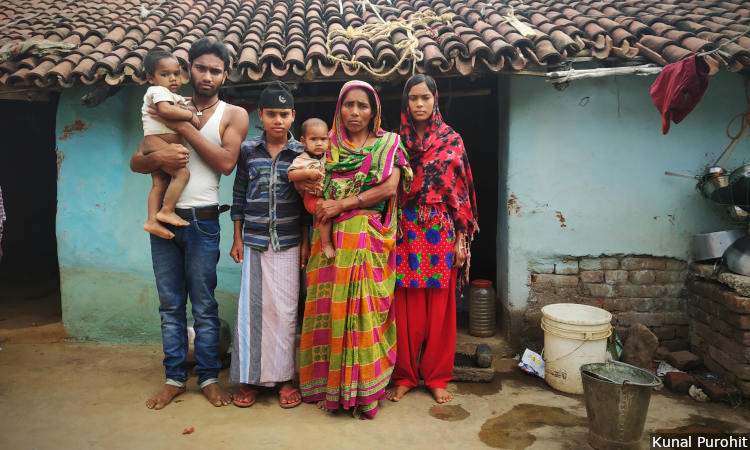
When Sakina Bibi (second from right) saw WhatsApp videos that showed her husband Chiraguddin Ansari being lynched by a mob, she asked her son to rush to the police for help. The police turned up three hours later, by when her husband was dead.

Garhwa district, Jharkhand: An April 2019 incident in western Jharkhand reminded 32-year-old Anita Minj about her own ordeal.

On April 10, four Christian tribals were lynched by a mob of Hindu villagers when they were carving a dead ox in Jurmu village of western Jharkhand’s Gumla district. The mob then dumped the four on the road outside the nearest police station, where they lay for three hours, before the police intervened. One of the four, 58-year-old Prakash Lakda, died on the street outside the police station.

The next day, the police filed a case of cow slaughter against Lakda.

About two years ago, something similar had happened to Anita’s husband, Ramesh–the 37-year-old Oraon tribal was lynched by a mob of armed Hindu villagers, allegedly because he, along with a group of other Oraon tribals, had slaughtered a bull in Barkol village of Garhwa district on August 20, 2017.

It was not the lynching alone that haunted Anita. Immediately after Ramesh was attacked, he was taken to the police station–bruised, battered and bleeding–but not to record his statement against the alleged assaulters. Instead, he was arrested under the Jharkhand Bovine Animal Prohibition of Slaughter Act, 2005, for cow slaughter.

On hearing of the assault the next morning, Anita rushed to the police station. “I saw him in the lock up. He was still bleeding–his leg had a deep gash which had exposed his bone, his fingers were broken. He could barely even speak or stand up.”

Anita’s pleas to get him medical attention were ignored. Two days later, Ramesh died in police custody.

Across Jharkhand–the second deadliest state in terms of religious hate crimes–police investigations in such crimes are often characterised by callousness and partisan behaviour. This apathy can be deadly–FactChecker found at least two cases where victims’ families alleged that delay by the police had led to the victims’ deaths.

Since 2009, Jharkhand has accounted for 14 hate crimes motivated by religion and nine deaths recorded in Hate Crime Watch, a FactChecker database that tracks such crimes. This makes it the second-deadliest state after Uttar Pradesh (23 dead), and all incidents have been reported after the Bharatiya Janata Party (BJP) won general and state elections in 2014. This reporting happened on the eve of the recent national elections, where the BJP won 11 of 14 parliamentary seats in Jharkhand.

Nationwide, over a decade to 2019, 93% of 287 hate crimes motivated by religious bias–claiming 98 lives–were reported after 2014, according to Hate Crime Watch.

Victims in Jharkhand must contend with police apathy, often made more potent when combined with religious prejudice.

[ . . .]  FULL TEXT HERE: https://factchecker.in/in-jharkhand-police-apathy-and-bias-as-fatal-as-hate-crimes/


[ You can read the first story here, the second here and the third here.] 

June 05, 2019

India: In Jharkhand, Ram Navami Celebrations Now Sites For Violence | Kunal Purohit


In Jharkhand, Ram Navami Celebrations Now Sites For Violence

Written by Kunal Purohit | Published on: June 3, 2019
Gumla town, Jharkhand: Irshad Khan knew there would be trouble when he saw the procession. “They were up to no good,” he said of the Ram Navami revellers in Gumla town on April 5, 2017. The rally had halted outside the Jama Masjid, when it was not supposed to.

RamNavami_750
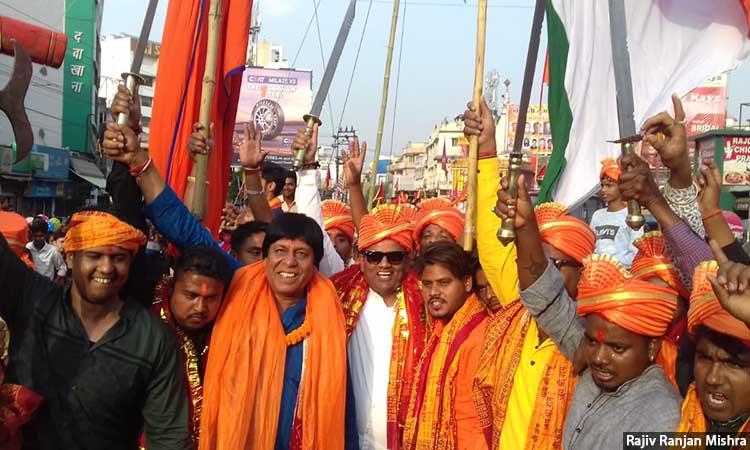
Rajiv Ranjan Mishra (centre, in blue) is a former chairperson of the Shri Mahavir Mandal and a key organiser of Ram Navami processions in Jharkhand state capital Ranchi for three decades. Mishra says up to 1 million people join the procession, often with weapons such as swords, sticks and rods. “After all, this procession is a shakti puja.So, men often get carried away, seeing all the weapons and the electric atmosphere.”

The halt made everyone anxious. Suddenly, the music changed and a new song came on. Khan does not remember the exact words. “But it was something to the effect of Mulle ki topi phenk do [let’s toss the Muslim man’s skullcap].” 

This was direct provocation for the Muslim community, said Khan, the Gumla head of Anjuman Islam, a socio-religious Muslim organisation. “Some of us tried to calm tempers in the Muslim community; others asked the procession members to stop the music.”

In those moments, Khan said, anything could have happened. Within minutes, however, the police intervened and defused the tension.

But Khan knew the situation was a ticking time bomb.

A few hours later, close to midnight, his fears came true, he told FactChecker on a recent April day. A call informed him that a group of Hindu men returning from the procession had lynched a Muslim boy, Mohamed Shalik, to death. The lynching had taken place in Soso village, 4 km from Gumla town, where the procession was held. The assailants had allegedly objected to Shalik’s relationship with a Hindu girl in the neighbourhood.

Calling Shalik a “jolha”, a pejorative term for Muslims, the mob had tied him to a pole and attacked him with sticks and rods, his father MD Minhaj told FactChecker. Shalik had died on the way to hospital, the first information report (FIR)–which is filed with the police by victims or eyewitnesses, and which FactChecker reviewed–said. 

Gumla_620
20-year-old Mohamed Shalik told his father, MD Minhaj (above), that he was going out to watch the Ram Navami procession that would travel across Gumla town. That night, when Shalik went to drop a Hindu girl to her village of Soso 4 km away, a mob of Hindu and tribal villagers lynched him to death. Many in the mob were returning from the Ram Navami procession in town.

Around the same time that evening, 280 km away in Koderma district’s Kolgarma village, Hindus participating in a similar Ram Navami procession had entered a Muslim neighbourhood, ransacked a mosque and assaulted local residents, including women.

Across Jharkhand, festivals are being weaponised in a bid to drive up religious hatred and polarise communities. Primary among them is Ram Navami, the occasion when the Hindu community celebrates the birth of Lord Ram.

Two of the seven hate crimes that this series investigated occurred on Ram Navami; the accused in both cases were procession participants. At the five other hate-crime spots, the festival played a key role in driving up communal frenzy, police officials and local observers said.

This is the first in a series of five stories investigating seven hate crimes across six districts of Jharkhand, recorded in Hate Crime Watch, a database of religious identity-based hate crimes across India from 2009 to 2019, maintained by FactChecker.

Jharkhand’s population is 68% Hindu and 14.53% Muslim, according to Census 2011 statistics. Since 2009, the state has reported 16 hate crimes motivated by religion and 12 deaths–the second highest after Uttar Pradesh (23 dead)–all of which have been reported after the Bharatiya Janata Party (BJP) won national and state elections in 2014 but before general elections in April and May 2019. The BJP won 11 of 14 parliamentary seats in Jharkhand this year.

Of the 16, FactChecker shortlisted nine instances listed in the database, trying to balance out different types of cases and geographical spread. Traveling across Jharkhand, covering more than 3,000 km in 13 days, we visited these nine spots, met the accused, the surviving victims and their families, and spoke to locals and police officials. The aim was to investigate and verify the listings in Hate Crime Watch, follow up on the developments that have taken place since, and document the long-term impact of the crimes on the social fabric of these regions. 

From our reporting, two cases did not turn out to be hate crimes, according to the definition and methodology employed for Hate Crime Watch.

For the purpose of Hate Crime Watch, FactChecker collates data on crimes motivated partly or wholly by prejudice against the religion of the victim(s). For an incident to qualify as religion-based hate crime under our criterion, the act must qualify as a criminal act under Indian law. It is not necessary that formal criminal proceedings should have started for the fulfillment of this criterion; only that the available evidence should suggest that the act qualifies as a criminal act on the face of it. The target of a hate crime can be a person, groups of persons or property. Hate Crime Watch does not document speech crimes.

The first of these was the alleged lynching of an elderly couple and their three daughters. While two daughters had sustained injuries, the couple and their elder daughter had died. Some of the media reporting of the incident had said the family were tribal Sarnas while the attackers were Hindus and Christians. Our investigation found that the victims were Hindus of the Kewat caste while some of the alleged attackers were also Hindus, some from the same caste and others from the Lohar caste. The reason behind the lynching, we found, was that the family had filed a complaint with the police against a 23-year-old Lohar youth for allegedly abducting their daughter. The youth, who had recently converted to Christianity though his family had remained Hindu, had died while trying to evade police custody. As a result, there was tension in the village, which had resulted in the lynching.

In the second case, it was reported that a 20-year-old Hindu girl from Ramgarh district had been raped and killed by her husband, his father and his uncle. The reason, the media reports had said, was that the girl had refused to convert to Islam.

We visited the families of the victim and the accused, spoke to senior police officials in the district as well as with defence and prosecution lawyers. We found that there was no evidence to show that the killing had been linked to the girl’s religion. The girl’s family also said that they did not fully understand why their daughter had been killed.

We are removing both these cases from our database, which leaves 14 cases from Jharkhand which led to nine deaths.

In each of the six districts FactChecker visited, Ram Navami celebrations had become synonymous with communal clashes and low-intensity tensions.

“The scale of Ram Navami celebrations in Jharkhand is unprecedented; it isn’t celebrated with as much fervour anywhere else in the country,” said ML Meena, additional director-general, Jharkhand Police. “Playing communally sensitive lyrics, provocative songs–there are some elements, not all, who try and do this. Some people take advantage of such major festivals and create trouble.”

Small scale, big style

The scale of Ram Navami celebrations in Jharkhand is massive. In state capital Ranchi alone, the procession that starts from different parts of the city and culminates at the Tapovan mandir in Doronda locality of the capital, comprises nearly 1 million people each year, IndiaSpend learned from long-term enthusiasts.

Typically, different akharas (in this context, Hindu socio-religious groups) start marching towards mandals (social groups) in different parts of the city, said Rajiv Ranjan Mishra, a former chairperson of key procession organiser Shri Mahavir Mandal, who has been at the helm of the celebrations for more than three decades. “When they start marching, people keep joining in and the procession keeps growing,” Mishra said.

Snaking through lanes and bylanes, the procession covers almost all the major parts of the city before reaching the mandir by late night. “The procession starts around 4 pm and then takes up to 8-9 hours to cover around 15 km,” Mishra said.

Most members of the procession wear saffron scarves–a colour associated with Hinduism–and are armed with weapons, such as swords, daggers, maces and rods. The procession involves showing off fighting skills using these weapons. “So, men either airfight or fight each other using these weapons on the streets,” said Mishra.

Often, the atmosphere, the weaponry and the fights create a sense of hyper-masculinity, Mishra said, adding, “After all, this procession is a shakti puja [worship of Shakti, the goddess of strength]So, men often get carried away, seeing all the weapons and the electric atmosphere.”

Traditionally, these processions featured live bands. These have given way to pre-recorded music, played by DJs (disc jockeys) atop trucks fitted with amplifiers.

Police officials said the music often sparks off altercations, as in the 2017 Ram Navami processions in Gumla, where provocative songs were played right in front of a mosque.

Hindu rashtra, Masjid gali and har ghar bhagwa

A dive into the world of Ram Navami music, and conversations with participants and observers, showed that many songs played at processions involve themes such as Ram Mandir, berating erstwhile Mughal rulers, and making India a Hindu rashtra (nation). The sub-text to the lyrics almost always threatens Muslims with violence. Consider this popular song.


Agar chhua mandir toh tujhe dikha denge,

Hum tujhko teri aukaad bataa denge..”

(If you touch the mandir, you won’t be spared,

We will show you your rightful place)

Another example is this song popular across many of Jharkhand’s Ram Navami processions which talks of a ‘Masjid galli’ (street).


One line goes:

Ram Seeta Lakhan sang hai Bajrang Bali

Chal tujhko ghuma laoon masjid galli

(With Ram, Seeta and Lakshman is Bajrang Bali

Let me take you for a ride to mosque lane)

“In that moment, with the slogans, the music and the weapons, the josh[fervour] is very high,” said Ramesh Singh (who did not wish to share his real name), 22, a Bajrang Dal member in Ranchi who has been going for these processions for years. “Some boys try and outshine the others by doing something.”

Singh’s ringtone is a wildly popular song often played at these processions, Har ghar bhagwa chayega (saffron will fly high in each house, saffron being a metaphor for Hinduism), which vows that gau-hatya (cow slaughter) will be stopped and insists that anyone who wants to continue to live in India must recite Vande Mataram (“Hail, Mother Goddess”, in popular usage taken to refer to Bharat Mata or Mother India). The song has gathered 230 million views on YouTube; its popularity has even elicited a second version.

That doing, Singh said, could include taking the lead in sloganeering in front of a mosque and provoking members of the Muslim community along the way.

Police precautions

Among police circles, Ram Navami celebrations have become a law and order issue. In some parts of Jharkhand, their link with hate crimes were direct and clear, as in the central Jharkhand district of Ramgarh.

One police official, not wishing to be named, narrated the sequence of altercations that the procession members would have with the police in the run-up to Ram Navami celebrations. “We would ask them to stick to the pre-decided route whereas they would insist on going to sensitive areas.”

Some of the main organisers of the Ram Navami celebrations in Ramgarh district have been Bajrang Dal members, including Chhotu Verma and Santosh Singh, a police official stationed in the district told FactChecker. Both of them led a mob in July 2017 that lynched and killed a trader, Alimuddin Ansari, for allegedly carrying beef.

“We had asked them [Bajrang Dal members] to submit a CD to us with all the songs they would play, because we had realised that the music is often provocative. They were angry but, finally, they had to submit the CD,” the police official added.

These precautions continue, current district superintendent of police Nidhi Dwivedi said: “We sit with both communities, map out a clear route and ask the organisers to submit a CD of the songs they are going to play.”

Despite these precautions, Ram Navami in Ramgarh district continues to be a thorny affair.

This year, there were clashes between two groups in the procession who hurled stones at each other, according to news reports. The violence left five people, including two police persons, injured.

Some instances are considered too local, or too sensitive, to be reported in the media, local reporters told IndiaSpend. “There have been times when there have been clashes between the two communities and the police defuse the situation. But, the authorities request the media to not report it so that it doesn’t lead to more tensions,” said Kasif Akhtar, a journalist based in Koderma district.

The Ram Navami procession in Koderma town passes through the Muslim localities peacefully, Akhtar said: “The Muslim community welcomes them with drinks and sweets when they pass by; the Hindu community does the same during Muharram processions.”

Yet, even in Koderma, fault lines exist.

‘Ram Navami an outlet for discord’

Kolgarma village in Koderma district, with a population of close to 1,700, has been on the edge since 2012, when construction of a mosque started on a piece of disputed land that both Hindu and Muslim communities claimed rights and ownership over.

In 2012, some Muslim villagers started voicing the need for a mosque in the village; the nearest one was at least 3 km away, said Mohamed Karim Rehmat Ansari, 35, the deputy village head.

But the construction ran into opposition, when the Hindu community objected. Hindu villagers said the Muslim community had deceived them. “We were told that a one-room madrassa [Islamic religious school] was being built. But then, once construction started, we realised it was not a small madrassa but a mosque that was being built, instead. That caused immense anger,” said Chhotu Yadav, 35, a daily-wage labourer.

The construction halted, but resumed after the Muslim community claimed they had obtained permission from the authorities. “We started construction again; in fact, the Hindu villagers were now on board, they even laid the foundation,” said Ansari.

But tensions were rising.

The mosque was inaugurated on March 25, 2017. On April 3, the Hindu community complained to the authorities.

A day later, on Ram Navami, the tensions spilled over. More than 200 members of the procession allegedly entered the Muslim neighbourhood during namaaz, assaulted people, and vandalised the mosque and some homes, according to the FIR filed at the Koderma police station. “The mob entered, shouting slogans like Jai Shri Ram [Hail Lord Ram], topi kholo[remove the skullcap], and Quran padhna band karo [Stop reading the Quran].”

24-year-old Imamul Haq was inside the mosque, praying, when he heard the slogans. “[But] I wasn’t afraid because the police were there,” he said. Within seconds, however, the attackers had broken in, and assaulted him with sticks, rods and swords, fracturing both his knee caps. “As soon as I received the first blow, I turned around to see a huge mob. They came from everywhere,” he said.

Kolgarma_620
24-year-old Imamul Haq stands outside the disputed mosque in Kolgarma village of Koderma district of northern Jharkhand, where he was assaulted on April 4, 2017, on the occasion of Ram Navami. A mob of more than 200 members from the Ram Navami procession entered the neighbourhood and attacked Haq as well as a few others who were praying in the mosque with sticks, rods and swords. Both his knees were fractured.

The injury was so severe that Haq, who was on a break from his job as a driver in Saudi Arabia, had to give up work. “For six months, I could barely walk,” he said. Even now, he cannot take up a job that involves using his legs.

Allegations and counter-allegations

Hindus blame Muslims for provoking Ram Navami processions.

“The procession was orderly. But when we were passing the Muslim neighbourhood, someone spat on us. Hence, some people got angry and reacted to it,” said Yadav of the clash following construction of a mosque in Kolgarma village.

Police officials registered a complaint from the Muslim community, against eight persons and 200 unnamed assailants.

Muslim villagers said after they lodged the complaint, the Hindu community boycotted them. “We were denied provisions at the shop; our fields went dry because we were not allowed to use sources of water on land owned by Hindus,” said Kayumuddin, 27, a local.

“We decided to not interact with them so that there is communal harmony and we don’t end up fighting. It was not a boycott,” said Dhaneshwar Sahu, 30, a Hindu trader from the village.

In 2018, the two communities clashed again in Kolgarma. Allegations and counter-allegations flew fast. Police officials at the Koderma police station said the incidents resulted from long-standing communal discord. “The dispute started with land–Hindu villagers had donated a piece of land and had agreed that a madrassa should be built. The Muslim community, instead, built a mosque,” Ram Narayan Thakur, the Koderma police station in-charge, said.

A police team from the Koderma police station were targeted while investigating the clashes, police officials told FactChecker.

The village now lives in an uneasy calm. Hindus told FactChecker that normalcy had returned, while Muslims said they felt fear.

Ansari, the deputy village head of Kolgarma, said the Muslim children in the local government school had stopped eating the government-distributed mid-day meals after a rumour spread that some Hindus were trying to poison their food. It has been two years since the clash in their village, but the children are still scared, he added.

This is the first of a five-part series.

Next: In Jharkhand, WhatsApp Is Both Polariser And Investigator

(Purohit is an independent journalist and an alumnus of the School of Oriental and African Studies (SOAS), University of London, writing on development, gender, right-wing politics and the intersections between them.)

Courtesy: http://factchecker.in/

May 27, 2019

Hindutva emphasis on beef is driving politics to target Adivasis in Jharkhand | Scroll.in

scroll.in

‘They are forcing us to become Hindu’: How beef is being used to target Adivasis in Jharkhand
In a state formed for Adivasi interests, ironically, the Hindutva emphasis on beef is driving politics.

read more: https://scroll.in/article/842948/they-are-forcing-us-to-become-hindu-how-beef-is-being-used-to-target-adivasis-in-jharkhand

April 21, 2019

Jharkhand’s Adivasi lynched to death by mob chanting Jai Shri Ram

On 10 April 2019, Prakash Lakda, a 50-year old Adivasi of Jurmu village of Gumla’s Dumri block, was lynched to death by a mob of men from the Sahu community of neighbouring Jairagi village. Three other victims from Jurmu – Peter Kerketta, Belarius Minj and Janerius Minj – sustained severe injuries due to the beating by the mob. A fact-finding team of Jharkhand Janadhikar Mahasabha, comprising of several activists and representatives of member organisations, conducted a fact-finding inquiry into the incident on 14-15 April.

http://www.sacw.net/article14076.html

August 26, 2018

An Adivasi Woman in Jharkhand Is Taking on the 'Gau Rakshaks'

The Wire

An Adivasi Woman in Jharkhand Is Taking on the 'Gau Rakshaks' Who Killed Her Husband

Anita Minj’s husband was killed last year by large group of self-styled Gau Rakshaks and she has been patiently and slowly fighting for justice [. . .]

July 18, 2018

India: Eminent social activist Swami Agnivesh assaulted by BJP’s youth wing in Jharkhand | countercurrents.org

Eminent social activist Swami Agnivesh was assaulted by BJP’s youth wing workers in Jharkhand’s Pakur area today. The video of the assault that took place in broad daylight has gone viral. Agnivesh was there to attend an event in a hotel. The moment he came out of the hotel, he was attacked. The assaulters were reportedly upset with Agnivesh’s recent statement defending consumption of beef. They thrashed him and tore apart his clothes. He was also shown black flags. [. . . ]
https://countercurrents.org/2018/07/17/eminent-social-activist-swami-agnivesh-assaulted-by-bjps-youth-wing-in-jharkhand/

July 17, 2018

India: Swami Agnivesh assaulted by BJP workers in Jharkhand

Swami Agnivesh assaulted by BJP workers in Jharkhand
Swami Agnivesh assaulted: The assaulters were reportedly upset with Swami Agnivesh's recent statement defending consumption of beef.

By: Express Web Desk | New Delhi | Updated: July 17, 2018

Social activist Swami Agnivesh was assaulted allegedly by BJP workers in Jharkhand’s Pakur area on Tuesday.

https://indianexpress.com/article/india/swami-agnivesh-thrashed-by-bjp-workers-in-jharkhand-5263222/

March 17, 2018

India: 11 Including Local BJP Leader Convicted for Lynching of Alimuddin Ansari in Jharkhand

  Ramgarh Lynching: 11 Including Local BJP Leader Convicted for Murdering Alimuddin Ansari
We want life imprisonment as we don’t want anyone to be killed, says victim’s family.
16 Mar 2018
  Jharkhand court on Friday convicted 11 self-styled ‘Gau Rakshaks’ (cow vigilantes), including a ruling Bharatiya Janata Party (BJP) leader – Nityanand Mahto, for murdering Alimuddin Ansari alias Asghar Ali at Bazartand in Ramgarh town on June 29, 2017 for allegedly carrying beef. The trial court held all of them guilty under Section 302 (murder) of the Indian Penal Code (IPC).
[ . . . ]
https://newsclick.in/ramgarh-lynching-11-including-local-bjp-leader-convicted-murdering-alimuddin-ansari

September 25, 2017

India: Jharkhand’s anti-conversion law is part of an ongoing project to politicise tribal identity along religious lines | Shahana Munazir


Divisive integration
Jharkhand’s anti-conversion law is part of an ongoing project to politicise tribal identity along religious lines

Written by Shahana Munazir | 

harkhand Freedom of Religion Bill, religious conversion, jharkhand tribals, jharkhand news, indian express news Through centuries of cultural contact with both Hinduism and Christianity, tribals in Jharkhand have dynamically syncretised their traditional belief system of nature worship with exotic elements borrowed from other religions.

BJP president Amit Shah launches ‘Shaheed Gram Vikas Yojana’ in JharkhandBJP president Amit Shah launches ‘Shaheed Gram Vikas Yojana’ in Jharkhand
The recently passed Jharkhand Freedom of Religion Bill, 2017, that is touted as a check on religious conversion, should steer our focus towards the broader question of identity politics among the tribals in the state. Notably, this bill follows from a series of calculated moves by the government, such as the draconian cow slaughter law and recent amendments to the Land Act, which deviously dilute the distinctiveness of tribal identity in Jharkhand.

Tribals constitute around 27 per cent of Jharkhand’s population. Among them, 4.3 per cent are Christians, about 13 per cent Sarnas (animistic believers) and the rest are largely Hindu tribals. Thus, a homogeneous tribal identity is a misnomer. Identity is not a static construction: It evolves with confronting situations. Tribals are no exception.

Through centuries of cultural contact with both Hinduism and Christianity, tribals in Jharkhand have dynamically syncretised their traditional belief system of nature worship with exotic elements borrowed from other religions. Despite such conversions, tribals have followed their indigenous festivals, worshipped trees, and believed in totemism. However, the BJP and sangh parivar’s outlook towards tribals has centred around the belief that tribes are “backward” Hindus. This derisive outlook encourages them to homogenise the sui-generis tribal identity under the “Hindu” umbrella.

The tribes of Jharkhand significantly differ from each other yet their indigenous identity, comprised of a unique cultural value system, is extolled for its symbiotic connection with nature that is distinct from other religions. Such an identity has evolved over centuries by selectively imbibing the beliefs and practices of other religions. For example, many Oraons of Chota Nagpur who have converted to Christianity still believe in supernatural powers like darha, gujar, etc. even though witchcraft is not accepted in Christianity. Similarly, when tribals convert to Hinduism they incorporate many of its elements, such as worship of Hindu deities. For Oraons, their revered deities — Devi Mai and Mahadev — are Hindu gods, whereas Barndo Pachcho, a household deity, has a Munda origin.

Syncretism, therefore, is a fundamental feature of the tribal belief system. It is this continuous process of construction and re-construction which imparts distinctiveness to the indigenous tribal identity that has been jeopardised time and again by its divisive politicisation by majoritarian forces.

Christian missionaries have been active in Jharkhand for centuries. Motivated by material considerations, many tribals have converted to Christianity, although never completely giving up on their original practices. Census data (2011) indicates a high rate of growth among the Christians (29.7 per cent). However, the missionaries have allegedly disapproved of many animist Sarna tribals who have resisted complete conversion.
The right-wing has carefully escalated its influence in Jharkhand by tapping into the deep wells of alienation within the tribal community festered by Christian conversions. The RSS has attempted to make the Sarna worshippers as their base in the region by striving to assimilate them into the fold of Hinduism, while simultaneously vilifying anything that remotely suggests any influence of Christianity. In effect, this has further engendered communal divisions between the “Christian” and “non-Christian” tribals. Checking Christian religious conversion has been at the forefront of the Hindutva political agenda.

In such an atmosphere of disruptive politics of identity, an anti-conversion bill will only act as another tool that would encourage divisions within the tribal community. Notably, Jharkhand is the seventh state after Madhya Pradesh, Chhattisgarh, Odisha, Gujarat, Maharashtra and Himachal Pradesh to enact such a law. Many of these laws, including the one proposed in Jharkhand, define “conversion” as “renouncing one’s own religion and adopting another”. The majoritarian view perceives tribal as Hindus. Hence, tribal conversion to Hinduism or re-conversion of Christian tribals into Hinduism does not draw the attention of the state. In principle, then, re-conversion of “Hindu tribals” from Christianity seems acceptable, even favoured.

Since the 1990s, the RSS has been operating Vanvasi Kalyan Ashrams, Vanbandhu Parishad, etc. in Jharkhand; “re-converting” tribals back to Hinduism and celebrating it as ghar wapasi. Sangh parivar outfits like the Bajrang Dal are noted for their aggressive propagation of Hindutva sentiments, even through the use of violence. This kind of politicisation and communalisation of social relations has disrupted harmony by pitting one group against the other. These efforts have not only created a wedge among the tribals but have also cultivated hatred towards Muslims, Christians, and Christian tribals.

The present government has successfully capitalised on the rhetoric of a threatening “other” to foster a Hindu utopia, so to speak. The BJP denies any difference between the Hindu religion and indigenous tribal religion. Such a ruthless processes of acculturation denies a syncretic tribal identity. The recent beef politics in Jharkhand is a case in point. The draconian cow slaughter law has inadvertently tried to force an unwanted Hindu custom on the tribals, although beef has been traditionally a part of their diet. For example, cattle sacrifice is part of the indigenous Doson festival of the Santhals, who have incorporated Hindu customs without giving up on their traditions.

Draconian state-laws and the politicisation of socio-religious identity of the tribals have festered communal and casteist divisions in Jharkhand. Playing politics with issues of conversion in the garb of protecting religious freedom harbours an imperfect agenda of tribal integration and only weakens the collective and individual agency of tribals.

The writer is an independent researcher and has been an Indira Gandhi Scholar of social anthropology at the Institute of Social and Cultural Anthropology (ISCA), University of Oxford

August 16, 2017

India: No change of religion without permission in Jharkhand State

The Telegraph

Ranchi conversion law sparks outrage

- No change of religion without permission

Pheroze L. Vincent

New Delhi, Aug. 12: Jharkhand today enacted a law restricting religious conversions, inviting charges of targeting Christians and prompting Church leaders to mull a legal challenge.
The bill was introduced and passed a day after several Ranchi newspapers featured a full front-page Hindi ad from the state government, which attacked Christian missionaries by using a purported Mahatma Gandhi quote whose authenticity has been questioned.
The Jharkhand Freedom of Religion Act 2017 mandates four years' jail or a Rs 1-lakh fine or both for people and organisations converting women, minors and people from the Dalit and tribal communities through inducement or blackmail.
For forced conversion of adult males from other communities, the jail term will be three years and the fine, Rs 50,000. Those seeking voluntary conversion would need permission from the deputy commissioner, who will first examine the circumstances of the conversion.
"They want us to go to court, where lakhs will be spent on lawyers and we'll get bogged down in their game. Instead, we'll build a public movement," Hemant Soren of the Jharkhand Mukti Morcha said after the Opposition walked out of the Assembly protesting the hurried passage of the bill.
"It's an attempt to pit Sarnas (non-Hindu, non-Christian tribal people) against Christians. (Chief minister) Raghubar Das is doing this because Christian tribals, who are educated, helped raise awareness against his government's land-grab efforts."
Jamshedpur Bishop Felix Toppo, chairman of the Jharkhand Regional Bishops Council, said the bishops would meet early next week to chart their course.
"We'll first meet the chief minister and make an earnest appeal, as the idea behind this law seems to be the persecution of Christians. (Later, if necessary) we'll discuss legal means to stop this."
Yesterday's newspaper ad quoted the Mahatma as saying: "If missionaries feel that a human being can attain intellectual salvation only after converting to Christianity, why don't they begin with me or Mahadeo Desai (Gandhi's private secretary). Why do they want to convert poor, innocent and ignorant forest dwellers?"
Gandhi was quoted as further saying the tribal people were "mute and simple, like cows" and converted "not for Jesus but for rice".
The ad did not say where, when and to whom the Mahatma had said this. Activists such as Gladson Dungdung and Vasavi Kiro said Gandhi was not known to use the word " vanvasi" - a Sangh coinage used in the ad - for the tribal communities.
In Delhi, activists John Dayal, Harsh Mander and others are planning to file an FIR against the state government as well as the publications that printed the ad and the agency that designed it.
"Regardless of what the Church does, the state has tried to spread hatred and incite violence through the ad. So, we'll file a case," Dayal said.
Biswanath Tirkey, vice-president of the All India Sarna Religious and Social Coordination Committee, criticised the law.
"If the BJP was interested in protecting our faith, why couldn't they codify our personal laws like those of other religions, as we have been demanding?" he said.
Tirkey said the government was scared after the tribal communities' recent land protests and the Adivasi Diwas celebrations on August 9, and wanted to play "divide and rule".
The conversion law comes after the state government unsuccessfully tried to amend

Published here: https://www.telegraphindia.com/1170813/jsp/nation/story_167037.jsp

August 14, 2017

India: Jean Dreze interrupts speech on communalism following angry objection by Jharkhand agriculture minister

The Indian Express

Economist Jean Dreze not allowed to complete speech following angry objection by Jharkhand agriculture minister

Speaking to The Indian Express, Dreze said: "I was interrupted when I argued that communalism was most dangerous when the state itself created antagonism between communities. I gave the infamous (government) ad quoting Gandhi (which had appeared on August 11) as an example."

By: Express News Service | Ranchi | Published:August 14, 2017 9:00 pm
Jean Dreze, Jean Dreze speech row, Jean Dreze speech interupted, Jharkhand agriculture minister, RSS, Mahatma Gandhi advertisement, Randhir Kumar Singh, Radha Mohan Singh, anti-conversion bill, india news, indian express Renowned economist Jean Dreze

Economist Jean Dreze could not complete his speech at a programme organised by a Hindi daily in Ranchi, when the state agriculture minister, Randhir Kumar Singh, angrily objected to his argument that communalism was most dangerous when the state itself created antagonism between the communities. Union Agriculture Minister Radha Mohan Singh and some other ministers were also present in the programme.
Dreze made this argument in the backdrop of the advertisement brought out by the government a day ahead of the tabling, and passing, the anti-conversion bill in the Assembly. The advertisement had quoted Mahatma Gandhi asking Christian missionaries not to go for religious conversion of poor and gullible tribals. The programme, called Jharkhand Conclave-2025, was held in the capital on Sunday.
Contacted for his version on the angry objection, Minister Singh said: “I only objected when he began talking about RSS. I told him that he doesn’t know about RSS.” The minister did not speak any further.
A video of the incident showed Singh, who was seated in the front row in audience, getting up suddenly and objecting angrily to Dreze and asking organisers to apologise for his remarks. Radha Mohan Singh then came to the mike, even as a couple of people sought an apology from Dreze, while a few others could be seen trying to pacify the minister.
The video also showed Radha Mohan to the mike and repeatedly asking Singh to calm down, assuring that he would clarify to Dreze on what Mahatma said on conversion.
By this time, the video showed, Dreze, had gone back to his seat on the dais. Even as Singh continued to seek apology, Radha Mohan virtually had to admonish him to calm down.
Subsequently, Radha Mohan referred to an interview given by Mahatma Gandhi to his publication “Harijan”, in which he had purportedly said that he would get entire business of conversion stopped, if he had the power to make laws.
Speaking to The Indian Express, Dreze said: “I was interrupted when I argued that communalism was most dangerous when the state itself created antagonism between communities. I gave the infamous (government) ad quoting Gandhi (which had appeared on August 11) as an example.”
Dreze added that the Union agriculture minister countered his view after asking everybody to calm down. Asked whether anybody asked him to complete his address, Dreze said: “Nobody insisted on my being allowed to complete my speech, so I just sat down.”
To a query on whether he wanted to register his protest at any forum, Dreze said: “I would prefer to meet my critics and engage with their arguments, if they are willing.”
However, a group of tribal and civil rights activists, including Dayamani Barla, gathered at Raj Bhavan to protest against infringement of right to freedom of expression by the minister. “He wasn’t only to speak and many demanded that he be asked to leave the stage,” said a spokesperson for the group.
During the programme, however, Rajya Sabha MP from Janata Dal (United) and former journalist Harivansh, who was long associated with Prabhat Khabar not only defended the right to freedom of expression, but also pointed out towards the contribution made by Dreze over several years in Jharkhand.
Dreze has been a critic of several government’s policies and has been raising the issue of challenges in service delivery to those in the interior.
Speaking on the condition of anonymity, one of the speakers, said: “Everybody has a right to object. But, the person objecting should have waited for his turn; more so, when he is a senior functionary in the government.”
Contacted Vijay Pathak, resident editor of Prabhat Khabar, who was part of the organising team, said: “Dreze had almost concluded when he pointed out about the advertisement. Earlier, he had raised a few questions on the involvement of RSS. The Union Minister intervened and asked the state minister to calm down and take seat many times and then quoted Mahatma Gandhi on conversion. It was not that Dreze was not allowed to speak right from the beginning.”

June 28, 2017

India: Communalism Has Been Injected Even in Bread and Butter Issues of Jharkhand

The Wire

In Mahuadand, a town in western Jharkhand, MNREGA contractors’ crimes are seen to stem from their religion, not from their trade.

Credit: Wikimedia
Mahuadand is a nondescript little town in the western part of Jharkhand bordering Chhattisgarh. The town is guarded by the Netarhat hills on one side and the landscape is dotted with stone quarries that employ largely adivasis on daily wages. During sunset, from far corners, one can see fumes from the quarries creating a stairway to the sky. Like most small towns in Jharkhand, the central square of this town has a sculpture of Birsa Munda, the legendary adivasi freedom fighter.
Birsa, also called Dharti Aba or father of the earth, led a revolt in the late 1800s against the British government and dikus (outsiders-exploiters). The dikus were mostly non-tribal farmers and landlords brought in by the British to ‘modernise’ adivasi agrarian techniques. The dikus engaged in land grabbing from the adivasis and became a new class of landlords. During the adivasi rebellion, Birsa is said to have risen and become a quasi-prophet figure. He is believed to have asked adivasis to not be swayed by religious groups and stick to their traditional religious beliefs.
The Birsa sculpture in Mahuadand stands proudly at the intersection of two arterial roads of the town: Ranchi road and Daltongunj road. The sculpture, enclosed in a small circular space has red flags mounted on the circumference of the fence. The colour of the flags bear no allegiance to the political belief that is generally associated with red. These flags are triangular and have a picture of Hanuman along with the phrase Jai Shree Ram embossed on one side. There are posters and signs near the main market displaying fervent religiosity by Bajrang Dal, the militant youth wing of the Vishwa Hindu Parishad (VHP). Since its inception a little over 30 years ago, the Bajrang Dal has been reportedly involved in several cases of riots and acts of vandalism, primarily against Muslims.
There is a significant Muslim community here. Zarina Begum (name changed), who lives in the region, is a committed worker with a state level organisation monitoring the National Rural Employment Guarantee Act (MNREGA). State accountability is of paramount significance for her. A strong desire for justice prompted her to suspend an otherwise busy schedule, to walk several kilometres with me early in the morning to a village. We set out to conduct meetings and register grievances pertaining to MNREGA wage payments, as part of my action research on transparency and accountability in MNREGA across several states.
Hindutva symbolism in every neighbourhood
Upon entering the village, one notices the big-brother-like Hanuman flags that have draped Birsa in Mahuadand towering everywhere. The in-your-face Hindutva symbolism seemed to stand guard in every adivasi tola (neighbourhood), irrespective of the fact that there were also many people of other faiths in the village. None of the other religions had prominent public displays. Birsa’s call to his followers to observe their indigenous or Sarna faith seems lost today, even though the conditions that led to his rebellion a little over a century ago don’t seem to have altered. While exact figures are unavailable, the village has about 35% Christians, 20% Hindus, 15-20% Muslims, and about 10-15% adivasis believing in the Sarna faith. The main adivasi groups here are Oraons, Nagesias, and a smattering of Birjias.
Corruption in MNREGA
In the entire block, there are about 10,000 MNREGA workers, of which around 6,200 are from adivasi households, 300 odd from Dalit households and the rest from the ‘other’ category. The main kinds of work include the construction of farm ponds, wells, road construction and land levelling.
As we started reading out the names of people who were supposed to have worked and received wages in the village, most of them cried foul saying that they never got the wages. Some of them had received partial payments while some others were given five kilograms of rice for work done under the MNREGA, supervised by private contractors. On discovering how they were being cheated, the simmering anger among the extremely poor adivasi workers was palpable. As Zarina Begum educated them about their rights and entitlements, she urged them to come forward and register their complaints against the local contractors. She knew who those contractors were but has lacked support in her endeavours to bring about justice. Those contractors are making money in your name. You are being used by somebody else and you don’t even know that. How can you be silent?”, she said while addressing the villagers.
After several hours of meetings, we temporarily parked ourselves with a few others from the village in a Hindu adivasi household. Discussions ensued on a range of topics. Unaware of Zarina Begum’s religious affiliation, one of them said, “Yeh Musalmanon ne tang kar rakha hai yahan” (These Muslims have created trouble here) referring to one of the contractors who happened to be Muslim. Zarina Begum sat there silently, nodding in agreement with what he was saying. Sitting opposite me, Pramila Devi, a resident of the village and not affiliated with any specific group, responded saying It doesn’t matter that they are Muslims. There are Hindu contractors too. What matters is that they are contractors in MNREGA and we should not let that happen.” Zarina Begum was quiet during this conversation. When I asked her later how she felt about the remarks about the Muslim contractor, she responded nonchalantly, “Usko kitna taqleef hua hoga woh kehne mein. Yeh thekedar log jo zulm karte hain, woh dharm nahin dekhte hain. Woh sirf dekhte hain ki kaise gareebon ko looten” (How much pain would have prompted him to say such a thing? These contractors who exploit, don’t care about the religion of the exploited. They only think about exploiting the poor).
A day later, I got a call from a friend in Delhi asking if things were alright where I was. I didn’t understand the reason for the question. She then told me about the four Muslim men who were recently lynched in another part of Jharkhand on the grounds of being child lifters. Notwithstanding that child trafficking is indeed a genuine concern in Jharkhand, the repeated stories of lynching left me shocked, upset and angry. A balance sheet of accusations drawn on religious grounds alone – when the crime is a secular one – is extremely disquieting. I worried whether one might be seeing a similar pattern emerge in Mahuadand – where contractors’ crimes are seen to stem from their religion, and not from their trade. Despite there being a salad of multiple religions here, it is only Hindutva which is visible. This is not just incongruous but also scary. I immediately wondered how Zarina Begum continues to maintain her resolve for justice in such a high strung atmosphere.
In a later conversation with Zarina Begum, I asked her if she isn’t scared of working on people’s rights in such an environment. She responded in her characteristic casual yet resilient manner – “Dar kyon hoga? Mujhe koi dar nahin. Main to bas yehi chahti hun ki logon ko unka haq mile. Haq to Hindu ya Musalman nahin hota, na? (Why should I fear? I am not scared. I just want everybody to get their rights. Rights per se are neither Hindu nor Musalaman, no?)”
While Zarina Begum battles to get rights for all, Hindutva forces appear to be injecting a slow poison where Muslims can become easy targets in the process – either when they demand their rights or when rights are being demanded against them. Do the same rights lose their importance when made against the state or Hindu contractors?
Rajendran Narayanan is a faculty member with Azim Premji University, Bangalore.